Cruise Missile Market

Cruise Missile Market valued at USD 9.2 Billion in 2025, forecast to reach USD 26.2 Billion by 2035, and is growing at a 10.8% CAGR through 2026–2035.
Download Free Sample PDF
Base Year (2025)
$9.20 Billion
Forecast (2035)
$26.20 Billion
CAGR (2026-2035)
10.8%
Top Region
North America

What Is the Cruise Missile Market Size?
The global Cruise Missile Market size was valued at USD 9.2 Billion in 2025 and is estimated at USD 10.4 Billion in 2026, forecast to reach USD 26.2 Billion by 2035, expanding at a 10.8% CAGR between 2026 and 2035. North America leads with approximately 42% share, while under launch platform, Air-Launched Cruise Missiles dominates with approximately 39% share.

We observed that growth is accelerating across every segmentation axis, with multi-year production framework agreements, stockpile replenishment programs, and ground-launched system deployment driving the dominant structural shifts through 2035.

Cruise Missile Market Revenue Forecast

Values in USD Billion

2025 $9.20 Billion
2025
2026 $10.19 Billion
2026
2027 $11.29 Billion
2027
2028 $12.51 Billion
2028
2029 $13.87 Billion
2029
2030 $15.36 Billion
2030
2031 $17.02 Billion
2031
2032 $18.86 Billion
2032
2033 $20.90 Billion
2033
2034 $23.16 Billion
2034
2035 $26.20 Billion
2035

Key Takeaways

By Launch Platform: Air-Launched Cruise Missiles held the largest share of approximately 39% (USD 3.6 Billion) in 2025; Ground-Launched Cruise Missiles is the fastest-growing sub-segment at 11.9% CAGR from 2026–2035.

By Speed Class: Subsonic held the largest share of approximately 65% (USD 6.0 Billion) in 2025; Hypersonic is the fastest-growing sub-segment at 19.5% CAGR from 2026–2035.

By Range Class: Long-Range Cruise Missiles held the largest share of approximately 46% (USD 4.2 Billion) in 2025; Extended-Range Cruise Missiles is the fastest-growing sub-segment at 15.4% CAGR from 2026–2035.

By Application: Land-Attack held the largest share of approximately 63% (USD 5.8 Billion) in 2025; Anti-Ship is the fastest-growing sub-segment at 12.5% CAGR from 2026–2035.

By End User: Air Force held the largest share of approximately 43% (USD 4.0 Billion) in 2025; Army is the fastest-growing sub-segment at 12.3% CAGR from 2026–2035.

Dominant Region: North America dominated with approximately 42% revenue share (USD 3.85 Billion) in 2025.

Fastest-Growing Region: Asia-Pacific is expected to register the highest CAGR of 12.5% during 2026–2035.

Dominant Country: U.S. led with approximately USD 3.35 Billion in 2025.

Fastest-Growing Country: India is the fastest-growing country at approximately 14.6% CAGR from 2026–2035.

Between 2026 and 2035, the Cruise Missile Market is set to generate an absolute dollar opportunity of USD 15.8 Billion, positioning multi-year framework production agreements and ground-launched deployment programs as a compelling area for capital allocation.

According to NMSC analysis, sustained stockpile replenishment following recent regional conflicts is compressing production lead times industry-wide, prompting defense agencies to shift toward seven-year framework agreements rather than annual lot-by-lot procurement.

What Does the Cruise Missile Market Encompass?

The Cruise Missile Market encompasses air-launched, sea-launched, ground-launched, and submarine-launched precision strike weapons designed to engage land and maritime targets at standoff range. Our assessment indicates that the market's scope spans subsonic, supersonic, and emerging hypersonic platforms across short, medium, long, and extended range classes procured by air force, navy, and army branches for land-attack and anti-ship missions. The category has evolved from Cold War-era strategic deterrence systems into precision-guided, network-integrated munitions supporting airdefensesystem suppression and maritime strike operations.

Procurement frameworks established by national defense ministries and multinational alliances increasingly shape sponsor selection of qualified production partners for multi-year supply agreements. We observed that technology adoption is shifting toward modular, multi-mission airframes capable of extended range and improved survivability against modern air defenses. NMSC's analysis indicates that this shift, combined with intensifying stockpile replenishment demand, is redefining sourcing criteria across the Cruise Missile Market.

Market Drivers & Dynamics

Interactive Dataset
Multi-year framework production agreements accelerating stockpile replenishment driver +2.4% North America 2026–2033
Sustained NATO and allied stockpile replenishment following recent conflicts driver +2.0% North America, Europe 2026–2035
Rising Indo-Pacific defense investment supporting indigenous missile programs driver +1.7% Asia-Pacific 2026–2035
Expanding ground-launched deployment following renewed land-based fires investment driver +1.3% North America, Europe 2026–2032
Growing foreign military sales demand for export-qualified standoff platforms driver +1.0% Global 2026–2035
Increasing investment in hypersonic and extended-range threat capability driver +0.7% North America, Asia-Pacific 2026–2032
Long qualification cycles and complex supply chains limiting rapid capacity scaling restraint −1.2% Global 2026–2030
High per-unit cost of stealthy, long-range munitions constraining smaller-budget procurement restraint −0.8% Middle East & Africa, Latin America 2026–2032
Export control and technology transfer restrictions limiting cross-border sales restraint −0.5% Global 2026–2035
Source: Next Move Strategy Consulting

Growth Drivers

What Is the Primary Growth Driver of the Cruise Missile Market?

Multi-year framework production agreements accelerating stockpile replenishment are the primary driver of the Cruise Missile Market. RTX Corporation's February 2026 framework agreements with the U.S. Department of War will increase annual Tomahawk cruise missile production to more than 1,000 units, a two-to-fourfold increase over prior production rates. We observed that this production scale-up, combined with the U.S. Air Force's stated intent to procure more than 16,000 Joint Air-to-Surface Standoff Missile and Long-Range Anti-Ship Missile units over five to seven years, continues to anchor multi-year manufacturer investment.

How Is Stockpile Replenishment Driving Market Growth?

Sustained stockpile replenishment following recent regional conflicts is accelerating market growth toward guaranteed multi-year production volumes. Lockheed Martin Corporation's cumulative Joint Air-to-Surface Standoff Missile and Long-Range Anti-Ship Missile contract value reached approximately $9.5 Billion in 2025, spanning production lots through 2033. Our assessment indicates that this replenishment cycle, combined with allied foreign military sales demand, is compressing lead times for new production commitments across leading manufacturers.

Growth Inhibitors

What Is Restraining Cruise Missile Market Expansion?

Long qualification cycles and complex supply chains limit the pace of rapid capacity scaling across the market. Industry disclosures indicate that critical long-lead components including rocket motors, guidance systems, and specialized electronics require extended sourcing timelines even under accelerated framework agreements. We found that smaller defense budgets face particular exposure, as production capacity allocation increasingly favors large, established national customers with multi-year volume commitments over smaller one-time export orders.

What Are the Growth Opportunities?

How Is Hypersonic Development Creating Opportunities for Advanced Propulsion Manufacturers?

Hypersonic cruise missile development presents a whitespace opportunity for manufacturers with advanced propulsion engineering capability. Developers that achieve qualified production status stand to capture premium contracts as defense agencies expand hypersonic strike programs to counter evolving integrated air defense systems.

Why Is Allied Co-Production Emerging as a Growth Opportunity for Export-Qualified Manufacturers?

Allied nations seeking domestic industrial participation present an underpenetrated opportunity for manufacturers offering co-production and technology-sharing arrangements. Vendors that establish local assembly partnerships can secure durable, multi-country contracts as partner nations balance capability acquisition against domestic industrial base development goals.

How Is Ground-Launched System Integration Unlocking Opportunities for Land-Based Fires Modernization?

Ground-launched cruise missile integration creates an opportunity for manufacturers adapting naval-derived munitions for land-based launchers. Early movers that qualify naval variants for ground deployment can differentiate with army modernization programs pursuing extended-range precision fires beyond traditional artillery range.

Segmentation Analysis

2025 (USD Billion)
2035 (USD Billion)
Air-Launched Cruise Missiles 2025: $3.60 Billion | 2035: $9.80 Billion
Air-Launched
Sea-Launched Cruise Missiles 2025: $3.00 Billion | 2035: $8.50 Billion
Sea-Launched
Ground-Launched Cruise Missiles 2025: $1.50 Billion | 2035: $4.60 Billion
Ground-Launc
Submarine-Launched Cruise Missiles 2025: $1.10 Billion | 2035: $3.30 Billion
Submarine-La
Air-Launched Cruise Missiles $3.60 Billion $9.80 Billion 10.7%
Sea-Launched Cruise Missiles $3.00 Billion $8.50 Billion 11.0%
Ground-Launched Cruise Missiles $1.50 Billion $4.60 Billion 11.9%
Submarine-Launched Cruise Missiles $1.10 Billion $3.30 Billion 11.6%

Which Launch Platform Dominates the Cruise Missile Market?

Air-Launched Cruise Missiles led the market with USD 3.6 Billion in 2025, supported by sustained air force demand for stealthy, standoff strike capability compatible with bomber and fighter platforms. We observed that Ground-Launched Cruise Missiles is the fastest-growing launch platform, expanding at an 11.9% CAGR from 2026 to 2035, as army modernization programs increasingly field land-based launchers integrating naval-derived cruise missile variants.

2025 (USD Billion)
2035 (USD Billion)
Subsonic Cru
Supersonic C
Hypersonic C
Segment Item 2025 (USD Billion) 2035 (USD Billion) CAGR
Subsonic Cruise Missiles $10.0 USD Billion $40.0 USD Billion 25.0%
Supersonic Cruise Missiles $17.1 USD Billion $51.1 USD Billion 11.0%
Hypersonic Cruise Missiles $24.2 USD Billion $62.2 USD Billion 25.0%

Segment-wise data is locked

Unlock complete segment-wise numbers for By Speed Class.

Unlock Full Data
2025 (USD Billion)
2035 (USD Billion)
Short-Range
Medium-Range
Long-Range C
Extended-Ran
Segment Item 2025 (USD Billion) 2035 (USD Billion) CAGR
Short-Range Cruise Missiles $10.0 USD Billion $40.0 USD Billion 27.0%
Medium-Range Cruise Missiles $17.1 USD Billion $51.1 USD Billion 9.0%
Long-Range Cruise Missiles $24.2 USD Billion $62.2 USD Billion 19.0%
Extended-Range Cruise Missiles $31.3 USD Billion $73.3 USD Billion 17.0%

Segment-wise data is locked

Unlock complete segment-wise numbers for By Range Class.

Unlock Full Data
2025 (USD Billion)
2035 (USD Billion)
Land-Attack
Anti-Ship
Segment Item 2025 (USD Billion) 2035 (USD Billion) CAGR
Land-Attack $10.0 USD Billion $40.0 USD Billion 14.0%
Anti-Ship $17.1 USD Billion $51.1 USD Billion 24.0%

Segment-wise data is locked

Unlock complete segment-wise numbers for By Application.

Unlock Full Data
2025 (USD Billion)
2035 (USD Billion)
Air Force
Navy
Army
Segment Item 2025 (USD Billion) 2035 (USD Billion) CAGR
Air Force $10.0 USD Billion $40.0 USD Billion 24.0%
Navy $17.1 USD Billion $51.1 USD Billion 22.0%
Army $24.2 USD Billion $62.2 USD Billion 20.0%

Segment-wise data is locked

Unlock complete segment-wise numbers for By End User.

Unlock Full Data

Which End User Segment Leads Cruise Missile Market Demand?

Air Force remained the dominant end user, reaching USD 4.0 Billion in 2025 due to sustained procurement of stealthy standoff munitions for contested airspace penetration missions. Based on research conducted by NMSC, we found that Army represents the fastest-growing end user at a 12.3% CAGR from 2026 to 2035, reflecting expanding ground-launched cruise missile deployment supporting land-based precision fires modernization.

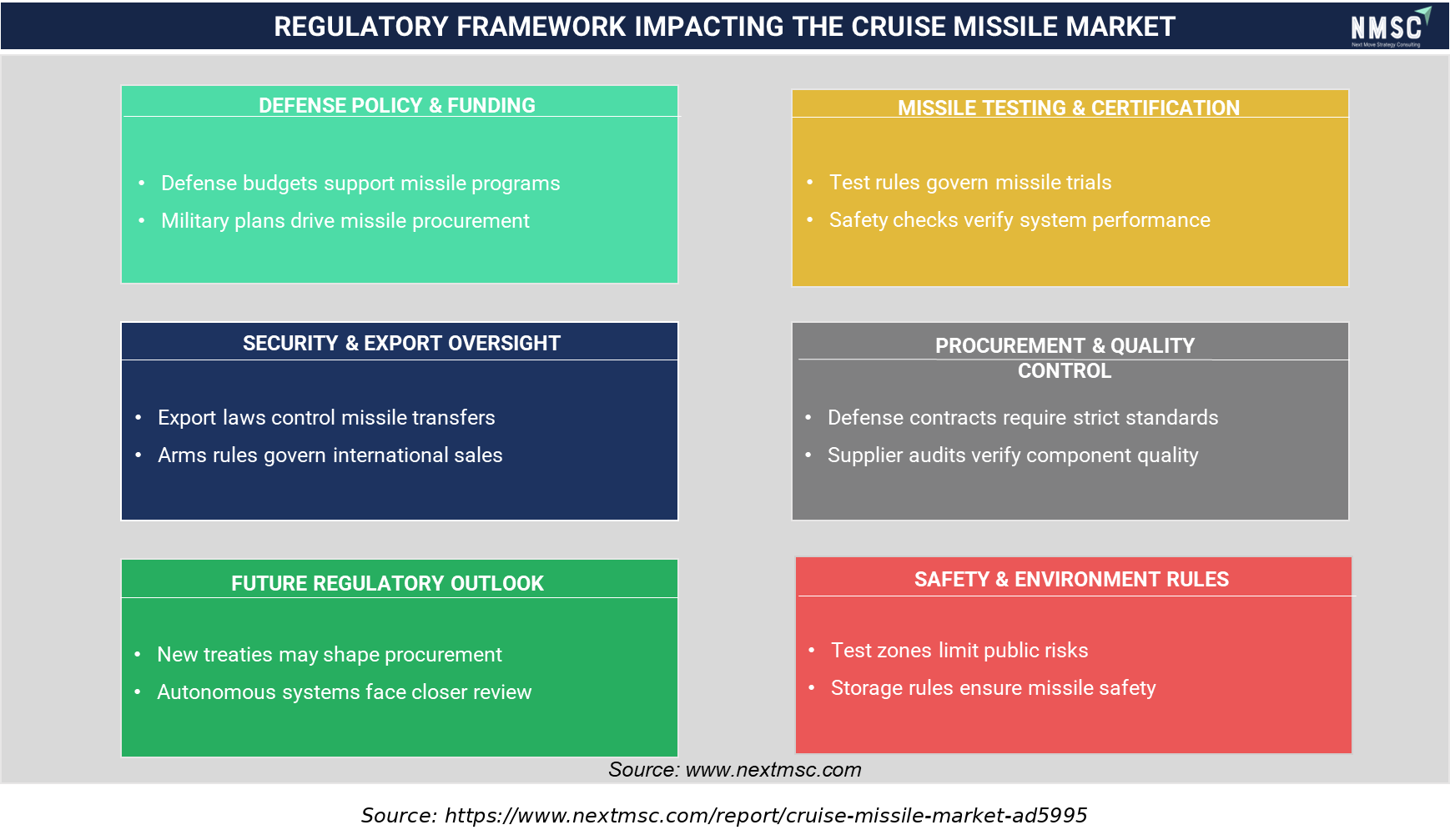
Regulatory Framework Impacting the Cruise Missile Market
The cruise missile market operates within a highly regulated defense environment shaped by national security policies, military funding, export controls, testing requirements, and procurement standards. Governments and defense agencies influence development and acquisition decisions, while manufacturers must meet strict quality, safety, and compliance requirements. Evolving geopolitical conditions and autonomous technologies may further strengthen regulatory oversight.

Growth Opportunities

Our analysis shows that three forward-looking opportunities stand out for stakeholders positioning within the Cruise Missile Market over the 2026-2035 forecast period.
How Is Hypersonic Development Creating Opportunities for Advanced Propulsion Manufacturers? Hypersonic cruise missile development presents a whitespace opportunity for manufacturers with advanced propulsion engineering capability. Developers that achieve qualified production status stand to capture premium contracts as defense agencies expand hypersonic strike programs to counter evolving integrated air defense systems.
Why Is Allied Co-Production Emerging as a Growth Opportunity for Export-Qualified Manufacturers? Allied nations seeking domestic industrial participation present an underpenetrated opportunity for manufacturers offering co-production and technology-sharing arrangements. Vendors that establish local assembly partnerships can secure durable, multi-country contracts as partner nations balance capability acquisition against domestic industrial base development goals.
How Is Ground-Launched System Integration Unlocking Opportunities for Land-Based Fires Modernization? Ground-launched cruise missile integration creates an opportunity for manufacturers adapting naval-derived munitions for land-based launchers. Early movers that qualify naval variants for ground deployment can differentiate with army modernization programs pursuing extended-range precision fires beyond traditional artillery range.

Regional Outlook

2025 (USD Billion)
2035 (USD Billion)
North Americ
Europe
Asia-Pacific
Middle East
Latin Americ
Region 2025 (USD Billion) 2035 (USD Billion) CAGR (%)
North America $10.0 USD Billion $40.0 USD Billion 9.0%
Europe $17.1 USD Billion $51.1 USD Billion 27.0%
Asia-Pacific $24.2 USD Billion $62.2 USD Billion 25.0%
Middle East & Africa $31.3 USD Billion $73.3 USD Billion 23.0%
Latin America $38.4 USD Billion $84.4 USD Billion 12.0%

Regional data is locked

Unlock complete regional numbers for this market.

Unlock Full Data

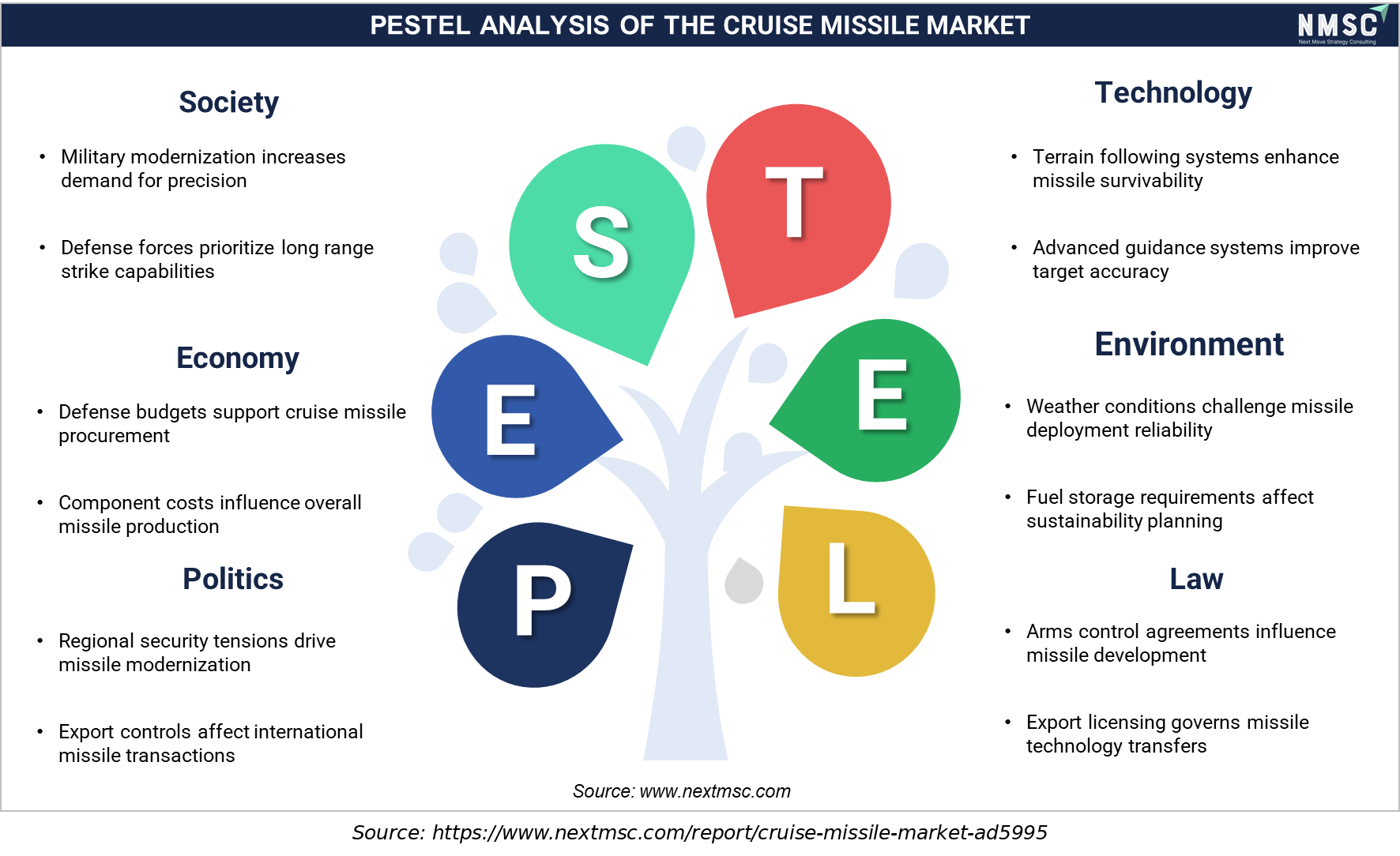
PESTEL Analysis of the Cruise Missile Market

PESTEL Analysis of the Cruise Missile Market
The cruise missile market is influenced by political priorities, defense spending, technological advancements, economic conditions, environmental considerations, and international legal frameworks. Geopolitical tensions and military modernization programs can drive demand, while export restrictions and arms-control obligations affect international trade. Continued innovation in guidance, propulsion, and autonomous capabilities remains a key factor shaping the market.

Competitive Landscape

We observed that the Cruise Missile Market features a moderately consolidated competitive landscape, with established defense primes competing on qualification history, production scale, and export approval credentials.

Dimension Description
Market Structure Moderately consolidated; a small number of qualified manufacturers hold long-running national production programs, with limited near-term entry given lengthy qualification cycles and national security procurement restrictions.
Innovation Focus Extended-range airframes, hypersonic propulsion, and ground-launched platform adaptation dominate current innovation pipelines across leading manufacturers.
M&A Activity Limited direct M&A given national security ownership restrictions; growth instead concentrated in multi-year framework production agreements, exemplified by RTX Corporation's February 2026 agreements with the U.S. Department of War.

How Do Companies Compete in the Cruise Missile Market?

Companies compete primarily on qualification history, production scale, and export approval credentials across the Cruise Missile Market. Established manufacturers such as RTX Corporation and Lockheed Martin Corporation leverage decades-long sole-source national production programs to secure recurring multi-year contracts, while MBDA competes on jointly developed European platform credentials spanning multiple allied nations.

Which Competitive Archetypes Dominate the Cruise Missile Market?

Two archetypes dominate the market: national prime contractors whose core business centers on precision strike munitions for a single home government, and multinational joint ventures developing platforms for coalition-wide procurement. RTX Corporation and Lockheed Martin Corporation exemplify the national prime archetype through sole-source U.S. government production programs, while MBDA exemplifies the multinational joint venture archetype serving multiple European NATO members simultaneously.

How Are Companies Differentiating Through Innovation in Cruise Missile?

Innovation and differentiation strategy increasingly center on extended-range airframes and multi-mission adaptability across launch platforms. Lockheed Martin Corporation's ongoing development of extended-range Joint Air-to-Surface Standoff Missile variants illustrates how manufacturers are pursuing incremental range and survivability improvements to maintain relevance against evolving air defense systems. Our analysis shows that manufacturers unable to demonstrate credible extended-range development roadmaps risk losing long-term modernization program consideration.

What M&A and Expansion Activity Is Shaping the Cruise Missile Market?

Capacity expansion rather than acquisition has been the primary growth mechanism shaping the market, given national security restrictions on cross-border ownership of missile production assets. RTX Corporation's February 2026 agreements with the U.S. Department of War, alongside a $2.6 Billion 2025 capital expenditure program expanding Tucson and Alabama production facilities, illustrate how leading manufacturers are scaling organic capacity to meet multi-year government demand rather than pursuing acquisitions.

Key Market Players

Our assessment indicates that the following 16 companies represent the validated competitive set actively shaping product innovation, capacity expansion, and strategic positioning within the global Cruise Missile Market.

RTX Corporation Lockheed Martin Corporation The Boeing Company MBDA Kongsberg Gruppen ASA Saab AB Israel Aerospace Industries Ltd. Rafael Advanced Defense Systems Ltd. Mitsubishi Heavy Industries, Ltd. BrahMos Aerospace Private Limited China Aerospace Science and Industry Corporation Tactical Missiles Corporation JSC Roketsan A.Ş. China North Industries Group Corporation LIG Nex1 Co., Ltd. Diehl Defence GmbH & Co. KG

Latest Developments

We found that recent production agreements and contract awards within the Cruise Missile Market are concentrated on multi-year framework production scale-up and stockpile replenishment.

Date Event
July 2026 MBDA and General Atomics signed a Memorandum of Understanding at the Farnborough International Airshow 2026 to integrate MBDA’s SPEAR precision-strike weapons onto the MQ-9B remotely piloted aircraft and Gambit 6 Collaborative Combat Aircraft. The agreement expands cooperation between the companies and extends SPEAR’s potential application to additional uncrewed-aircraft platforms.

Investment Opportunities

What Capital Inflows Are Targeting the Cruise Missile Market?

Capital inflows into the market are increasingly directed toward manufacturers with qualified, in-service platforms and multi-year framework production agreements. RTX Corporation's $2.6 Billion 2025 capital expenditure program and subsequent February 2026 framework agreements reflect continued government and industry capital commitment to production capacity expansion. We observed that investors favor manufacturers demonstrating multi-year contract backlogs, viewing production visibility as a proxy for long-term revenue stability.

How Is Infrastructure Investment Supporting Cruise Missile Deployment?

Infrastructure investment in production facilities and long-lead component supply chains is expanding the operational foundation required for sustained cruise missile output. Manufacturers continue to expand production capacity across established U.S. facilities in Tucson, Huntsville, and Troy to meet multi-year framework production commitments. This infrastructure investment reflects broader industry recognition that qualified production capacity is a prerequisite for securing long-term defense agency supply agreements.

What ESG Considerations Are Shaping Cruise Missile Investment Decisions?

Environmental, social, and governance considerations intersect with Cruise Missile Market investment decisions primarily through governance and export compliance rather than environmental impact, given the market's defense procurement nature. Manufacturers operating under strict national export control and foreign military sales regulations continue to emphasize compliance governance in investor disclosures. We found that investors increasingly favor manufacturers with transparent regulatory compliance records, treating export control governance as a proxy for long-term contract eligibility across allied markets.

Key Benefits for Stakeholders

How Does This Report Benefit Enterprise and Industry Leaders?

Enterprise and industry leaders gain access to validated segmentation, competitive benchmarking, and regional demand forecasts that support production planning and procurement decisions across the Cruise Missile Market. Our analysis shows that detailed launch platform, end-user, and regional breakdowns help defense agency procurement teams align specifications with modernization requirements while identifying underserved platform categories for portfolio expansion.

How Does This Report Benefit Investors and Financial Analysts?

Investors and financial analysts benefit from consistent, single-point market size and CAGR estimates that support valuation and capital-allocation decisions across the Cruise Missile Market manufacturer landscape. We observed that the report's regional and segment-level growth differentials help identify which manufacturers are best positioned to capture above-market growth in ground-launched and hypersonic categories through 2035.

How Does This Report Benefit Technology Vendors and Product Teams?

Technology vendors and product teams gain insight into emerging design requirements, including extended-range airframes, hypersonic propulsion, and multi-platform launch integration, that are reshaping the Cruise Missile Market. Our findings suggest that this analysis helps R&D teams prioritize development roadmaps around qualification pathways and production scalability increasingly required by defense agency procurement processes.

Key Market Segments Evaluated

By Launch Platform

  • Air-Launched Cruise Missiles
  • Sea-Launched Cruise Missiles
  • Ground-Launched Cruise Missiles
  • Submarine-Launched Cruise Missiles

By Speed Class

  • Subsonic Cruise Missiles
  • Supersonic Cruise Missiles
  • Hypersonic Cruise Missiles

By Range Class

  • Short-Range Cruise Missiles
  • Medium-Range Cruise Missiles
  • Long-Range Cruise Missiles
  • Extended-Range Cruise Missiles

By Application

  • Land-Attack
  • Anti-Ship

By End User

  • Air Force
  • Navy
  • Army

By Region

  • North America 
    • U.S.
    • Canada
    • Mexico
  • Europe 
    • UK
    • Germany
    • France
    • Italy
    • Spain
    • Sweden
    • Denmark
    • Finland
    • Netherlands
    • Rest of Europe
  • Asia-Pacific 
    • China
    • India
    • Japan
    • South Korea
    • Taiwan
    • Indonesia
    • Vietnam
    • Australia
    • Philippines
    • Malaysia
    • Rest of APAC
  • Middle East & Africa 
    • Saudi Arabia
    • UAE
    • Egypt
    • Israel
    • Turkey
    • Nigeria
    • South Africa
    • Rest of MEA
  • Latin America 
    • Brazil
    • Argentina
    • Chile
    • Colombia
    • Rest of LATAM

Conclusion & Recommendations

The long-term outlook for the Cruise Missile Market remains strongly positive, with global revenue projected to expand nearly threefold from USD 9.2 Billion in 2025 to USD 26.2 Billion by 2035 at a 10.8% CAGR. We observed that sustained multi-year framework production agreements, combined with expanding ground-launched deployment and allied co-procurement, will continue underpinning demand across air-launched, sea-launched, and ground-launched categories through the forecast period.

What Strategic Positioning Should Cruise Missile Vendors Pursue?

Vendors should prioritize qualification credentials and multi-year production scalability while pursuing extended-range development to secure long-term defense agency contracts. Our assessment indicates that companies investing early in hypersonic propulsion and ground-launched platform adaptation will be best positioned to capture premium pricing within the Cruise Missile Market.

How Attractive Is the Cruise Missile Market for New Investment?

The market presents a highly attractive investment case, supported by a USD 15.8 Billion absolute dollar opportunity between 2026 and 2035 and above-average growth in Asia-Pacific and hypersonic categories. We found that investment attractiveness is highest for manufacturers combining proven qualification history with expanding production capacity, positioning them to serve both established national programs and emerging allied co-procurement demand simultaneously.

What Market Shifts and Key Risks Should Stakeholders Monitor?

Stakeholders should monitor lengthy qualification cycles, complex long-lead component supply chains, and export control restrictions as key risks to the Cruise Missile Market. Our analysis shows that manufacturers unable to sustain qualified production status or navigate export approval processes risk losing multi-year contract renewals to established competitors with longer operational track records.

What Are the Key Growth Pathways for the Cruise Missile Market?

Key growth pathways include expanding multi-year framework production capacity, scaling hypersonic and extended-range development, and deepening penetration into allied co-procurement programs across Asia-Pacific. NMSC's analysis indicates that vendors pursuing these pathways while maintaining qualified production status will be best positioned to capture the market's projected growth through 2035.

FAQs

About the Author

Mihul Sharma

Mihul Sharma

Mihul Sharma is Research Associate at Next Move Strategy Consulting, where he has covered technology, industrial, and healthcare markets for 3 years. His work applies structured business research, market analysis, and secondary-source review to assess market trends, competitive developments, and growth opportunities. He supports report development by fully synthesizing industry data, company information, and market signals into concise findings for strategy and investment-focused research teams.

About the Reviewer

Supradip Baul

Supradip Baul

Supradip Baul is an accomplished business consultant and strategist with over a decade of rich experience in market intelligence, strategy, technology, and business transformation. His work has included rigorous qualitative and quantitative analysis across multiple industries, helping clients shape investment decisions and long-term roadmaps. Earlier in his career, he was associated with Gartner, where he contributed to industry-leading reports and market share analyses. He has worked with leading global companies and holds an MBA with a dual specialization in Marketing and Finance.

Download Free Sample

Ross J Mckenzie

ROSS J MCKENZIE

Business Insight Manager

Staysure Group

“Next MSC have been incredibly helpful in providing detailed & robust information on our market, alongside quantifying growth by different segments. The process to procure was simple and easy, with sample reports and regular contact to ensure we had what we needed. Succinct detail on their sources & methodologies is also greatly received, allowing transparency in this respect helps build trust in the detail you pay for. Joseph in particular was fantastic, and helped ensure efficient provision of the insight pack – thank you NMSC!”.

Henri Knyphausen

HENRI KNYPHAUSEN

Partner at Singulier [Ex-BCG]

Singulier

I recently engaged NEXTMSC.com for a commercial due diligence project within the intralogistics sector, and I am pleased to provide a reference based on my experience. In utilizing NEXTMSC.com's services, I found their report to offer valuable insights into market dynamics and key industry players. The initial report provided a solid foundation for our analysis. However, as we were investigating a smaller target in the market, and I had specific customization requests requiring additional research. These requests included detailed information on product portfolios of various players and sub-market sizes, both inclusive and exclusive of certain product categories. NEXTMSC.com demonstrated commendable responsiveness and agility in accommodating these customization requests. Within a timeframe of 1-2 weeks, they delivered a revised report that met our specific needs. Furthermore, they were receptive to my follow-up inquiries, ensuring clarity and understanding of the data provided. The final deliverable significantly contributed to our due diligence efforts. One of NEXTMSC.com's notable strengths lies in their qualitative research capabilities. However, for future engagements, I would recommend the inclusion of a quantified market model in Excel format. Such a model would offer the ability to conduct in-depth analyses and explore various market segments, including country-specific data and subcomponent breakdowns. Based on my positive experience, I would not hesitate to work with NEXTMSC.com again. Their responsiveness, willingness to accommodate customization requests, and commitment to delivering actionable insights make them a reliable partner for commercial research projects.

Kevin Coker

KEVIN COKER

Founder, CEO and Board Diector

Proxima Clinical Research

I have been using Next MSC reports for product positioning in a new geography for a long time. They have by far the best reports I have found and the price is reasonable too!

Kishu Kanda

KISHU KANDA

Strategy Analyst

Accenture

We purchased the AI Consumer Market Report from this company. Not only did they customize the report to meet our specific requirements, but they also showed great flexibility in accommodating our budget. The report we received fully met our expectations. Additionally, they provided prompt and thorough responses to both our pre-purchase and follow-up questions. We look forward to working with this company again in the future.

Gustaf Hummel Burstrom

GUSTAF HUMMEL BURSTROM

Founder

Revline Tools AB

Joseph and the team at Next Move Strategy Consulting have been excellent to work with, in supplying us with relevant market data and forecasts for our specific category. We had some special requirements and they were able to do a custom package to suit our needs. We would definitely recommend them to any other company needing market data and forecasts

Custom Market Research Services

We will customize the research for you if the listed report does not fully match your requirements.

Get 30% Free Customization

Select License

This website uses cookies to ensure you get the best experience on our website. Learn more

✖