Cupro Fabrics Market Global Industry Analysis and Forecast (2026–2035)

Cupro Fabrics Market size was USD 620 Million in 2025, projected to reach USD 1089.55 Million by 2035, growing at a CAGR of 5.8% from 2026 to 2035. Key drivers include rising demand for biodegradable cellulose textiles, premium drape and silk-like aesthetics, and recovery of dedicated cupro-fiber production capacity in Japan, with North America leading the global market.

Download Free Sample PDF
Base Year (2025)
$620.0 Million
Forecast (2035)
$1,089.6 Million
CAGR (2026-2035)
5.8%
Top Region
North America

What Is the Cupro Fabrics Market Size?

The global cupro fabrics market reached USD 620 Million in 2025 and is estimated at USD 655.96 Million in 2026, forecast to reach USD 1089.55 Million by 2035 at a CAGR of 5.8% between 2026 and 2035. North America leads with approximately 34% revenue share in 2025, while cupro woven fabrics are the dominant product type, holding approximately 48% of total market revenue.

Technological developments in regenerated-cellulose spinning influence cupro-fiber production economics. Asahi Kasei's Bemberg process uses closed-loop recovery of copper and ammonia, while its Nobeoka facility is the world's only cupro-fiber production site. Downstream fabric suppliers and converters use cupro yarn in woven and knitted materials for apparel and home-textile applications.

Cupro Fabrics Market Global Industry Analysis and Forecast (2026–2035) Revenue Forecast

Values in USD Million

2025 $620.0 Million
2025
2026 $656.0 Million
2026
2027 $694.0 Million
2027
2028 $734.3 Million
2028
2029 $776.8 Million
2029
2030 $821.9 Million
2030
2031 $869.6 Million
2031
2032 $920.0 Million
2032
2033 $973.4 Million
2033
2034 $1,029.8 Million
2034
2035 $1,089.6 Million
2035

Key Takeaways

By Product Type: Cupro woven fabrics held the largest share, expanding from USD 296.62 Million in 2025 to USD 476.67 Million by 2035; cupro blended fabrics are the fastest-growing at 7.2% CAGR from 2026–2035.

By Application: Apparel held the largest share, expanding from USD 316.78 Million in 2025 to USD 491.51 Million by 2035; Accessories and Other Uses are the fastest-growing at 8% CAGR from 2026–2035.

By End User: Luxury and Premium Brands held the largest share, expanding from USD 330.93 Million in 2025 to USD 507.65 Million by 2035; Home Furnishing Manufacturers is the fastest-growing at 8.1% CAGR from 2026–2035.

By Distribution Channel: Direct B2B Sales held the largest share, expanding from USD 299.39 Million in 2025 to USD 482.61 Million by 2035; Digital Procurement Platforms is the fastest-growing at 7.4% CAGR from 2026–2035.

Dominant Region: North America dominated the market with approximately 34% revenue share (USD 210.8 Million) in 2025, anchored by established premium apparel groups, specialty retail buyers, and luxury lining programs.

Fastest-Growing Region: Asia-Pacific is expected to register the highest CAGR of 8.6% during 2026–2035, driven by downstream fabric conversion and apparel demand in the region.

Dominant Country: The U.S. led the market with an estimated USD 160.21 Million in 2025 (~76% of North America), supported by established apparel brands and premium lining suppliers.

Fastest-Growing Country: India is among the fastest-growing major countries, projected to expand from USD 33.48 Million in 2025 to USD 90.04 Million by 2035 at a CAGR of approximately 10.4%, driven by blended fabric production hubs and government support for textile modernization.

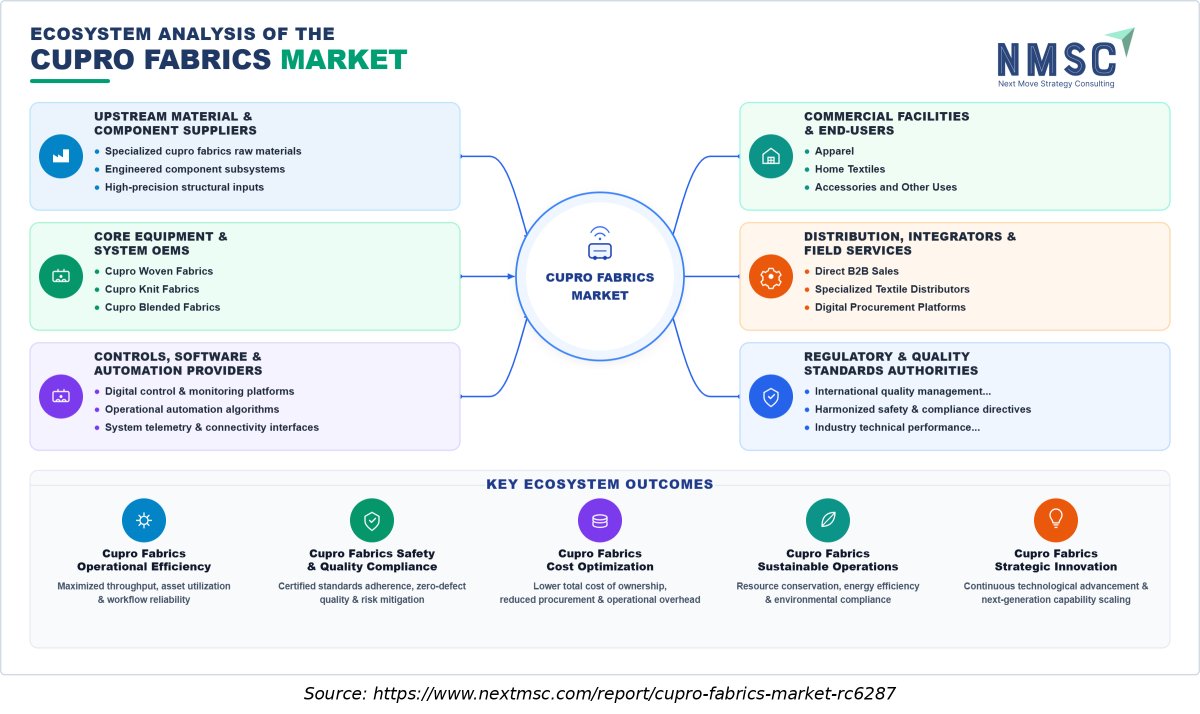
Ecosystem Analysis of the Cupro Fabrics Industry

The above infographic presents the Cupro Fabrics market ecosystem in a structured format, focusing on six core stakeholder groups: cotton linter and chemical input suppliers, the cupro-fiber producer, fabric weavers, knitters and converters, apparel and home textile brands, distributors and digital procurement platforms, and regulatory and certification bodies. It shows how these participants support production while contributing to fabric quality, cost optimization, sustainability, and process innovation across the cupro value chain.

What Does the Cupro Fabrics Market Encompass?

The cupro fabrics market encompasses woven and knitted textiles manufactured from regenerated cellulose fibers produced through the cuprammonium process. Product types include lightweight lining fabrics, drape-oriented dress materials, and blended fabrics combining cupro with cotton, viscose, or wool. Core technologies span cellulose dissolution, filament spinning, copper and ammonia recovery, and continuous finishing, all of which determine fiber fineness, luster, and dimensional stability in finished retail and consumer goods.
Design specifications in cupro fabrics typically emphasize fine denier consistency, smooth surface hand, and controlled shrinkage across varied weights. Material innovations focus on enhancing wash durability, dye uptake, and blend compatibility for mainstream apparel programs. Certifications such as OEKO-TEX STANDARD 100 and recognized environmental management frameworks increasingly support buyer confidence, while traceability documentation from pulp to finished roll is becoming a standard expectation for premium retail procurement.

Market Drivers & Dynamics

Interactive Dataset
Rising Demand for Biodegradable Cellulose Textiles driver High Immediate
Premium Drape and Silk-Like Aesthetics driver High Immediate
Recovery of Cupro Fiber Supply in Japan driver Medium Medium-term
Volatility in Cellulose Pulp and Chemical Inputs restraint High Immediate
Competition from Lower-Cost Viscose and Polyester restraint Medium Medium-term
Environmental Compliance Costs for Solvent Handling restraint Low Long-term
Source: Next Move Strategy Consulting

Growth Drivers

Rising Demand for Biodegradable Cellulose Textiles

Brands increasingly specify regenerated-cellulose cupro fabrics to replace petroleum-based synthetic linings and dress materials.

Premium Drape and Silk-Like Aesthetics

Fine filament structure gives cupro fabrics a luxury hand that supports adoption in premium retail apparel collections.

Recovery of Cupro Fiber Supply in Japan

Asahi Kasei's phased production recovery at the Nobeoka facility can improve cupro-fiber availability; downstream fabric conversion remains a separate activity.

Growth Inhibitors

Volatility in Cellulose Pulp and Chemical Inputs

Fluctuating pulp, copper, and ammonia costs compress margins for cupro fabrics producers operating on fixed contracts.

Competition from Lower-Cost Viscose and Polyester

Mass-market retailers often substitute cheaper fibers, limiting cupro fabrics penetration in price-sensitive segments.

Environmental Compliance Costs for Solvent Handling

Stricter effluent and solvent handling requirements raise capital needs for cupro fabrics mills over the long term.

Growth Catalyst & Risk Assessment Matrix

Factors Type Potential Impact on Market Growth Market Impact Rationale Impact Timeline
Rising Demand for Biodegradable Cellulose Textiles Driver High Brands increasingly specify regenerated-cellulose cupro fabrics to replace petroleum-based synthetic linings and dress materials. Immediate
Premium Drape and Silk-Like Aesthetics Driver High Fine filament structure gives cupro fabrics a luxury hand that supports adoption in premium retail apparel collections. Immediate
Recovery of Cupro Fiber Supply in Japan Driver Medium Asahi Kasei's phased production recovery at the Nobeoka facility can improve cupro-fiber availability; downstream fabric conversion remains a separate activity. Medium-term
Volatility in Cellulose Pulp and Chemical Inputs Restraint High Fluctuating pulp, copper, and ammonia costs compress margins for cupro fabrics producers operating on fixed contracts. Immediate
Competition from Lower-Cost Viscose and Polyester Restraint Medium Mass-market retailers often substitute cheaper fibers, limiting cupro fabrics penetration in price-sensitive segments. Medium-term
Environmental Compliance Costs for Solvent Handling Restraint Low Stricter effluent and solvent handling requirements raise capital needs for cupro fabrics mills over the long term. Long-term
Source: www.nextmsc.com

What Is the Primary Growth Driver in the Cupro Fabrics Market?

The primary catalyst in cupro fabrics is the growing preference of apparel brands for sustainably sourced regenerated cellulose fibers. Bemberg cupro yarn is made from cotton linter, and Asahi Kasei describes the fiber as biodegradable and compostable under specified conditions. This product-level property should not be assumed to apply to every finished or blended fabric without product-level testing. Our findings suggest that this sourcing shift is translating into multi-season supply agreements, which provide producers with the volume visibility needed to justify capacity investment and sustain the market trajectory toward USD 1089.55 million by 2035.

How Are Industry Standards and Directives Driving the Market?

Regulatory frameworks increasingly shape procurement decisions in cupro fabrics. The European Union's REACH regulation governs chemical substances, while OEKO-TEX STANDARD 100 is a voluntary textile product-safety certification that tests for harmful substances. These requirements influence the selection and testing of dyes, finishes, and processing aids. Environmental management standards and jurisdiction-specific industrial emissions and effluent regulations may also encourage mills to adopt closed-loop chemical recovery.

What Is Restraining the Cupro Fabrics Market?

The primary commercial restraint in cupro fabrics is the price sensitivity of mass-market retail channels. Cuprammonium production relies on cotton linters and specialized chemical inputs, making costs vulnerable to upstream supply fluctuations. Producers face pressure to absorb input volatility while competing against lower-priced viscose and polyester alternatives. This cost structure limits penetration into budget apparel programs, constraining volume expansion in segments where price remains the decisive purchasing criterion.

Segmentation Analysis

2025 (USD Million)
2035 (USD Million)
Cupro Woven Fabrics 2025: $296.6 Million | 2035: $476.7 Million
Cupro Woven
Cupro Knit Fabrics 2025: $204.3 Million | 2035: $374.6 Million
Cupro Knit F
Cupro Blended Fabrics 2025: $119.1 Million | 2035: $238.3 Million
Cupro Blende
Cupro Woven Fabrics $296.6 Million $476.7 Million 4.9%
Cupro Knit Fabrics $204.3 Million $374.6 Million 6.3%
Cupro Blended Fabrics $119.1 Million $238.3 Million 7.2%

Segment Sizing: By Product Type

2025 (USD Million)
2035 (USD Million)
Category A
Category B
Category C
Category D
Segment Item 2025 (USD Million) 2035 (USD Million) CAGR
Category A $10.0 USD Million $40.0 USD Million 18.0%
Category B $17.1 USD Million $51.1 USD Million 16.0%
Category C $24.2 USD Million $62.2 USD Million 22.0%
Category D $31.3 USD Million $73.3 USD Million 12.0%

Segment-wise data is locked

Unlock complete segment-wise numbers for By Application.

Unlock Full Data
2025 (USD Million)
2035 (USD Million)
Category A
Category B
Category C
Category D
Segment Item 2025 (USD Million) 2035 (USD Million) CAGR
Category A $10.0 USD Million $40.0 USD Million 26.0%
Category B $17.1 USD Million $51.1 USD Million 16.0%
Category C $24.2 USD Million $62.2 USD Million 18.0%
Category D $31.3 USD Million $73.3 USD Million 8.0%

Segment-wise data is locked

Unlock complete segment-wise numbers for By End User.

Unlock Full Data
2025 (USD Million)
2035 (USD Million)
Category A
Category B
Category C
Category D
Segment Item 2025 (USD Million) 2035 (USD Million) CAGR
Category A $10.0 USD Million $40.0 USD Million 25.0%
Category B $17.1 USD Million $51.1 USD Million 19.0%
Category C $24.2 USD Million $62.2 USD Million 25.0%
Category D $31.3 USD Million $73.3 USD Million 19.0%

Segment-wise data is locked

Unlock complete segment-wise numbers for Distribution Channel.

Unlock Full Data

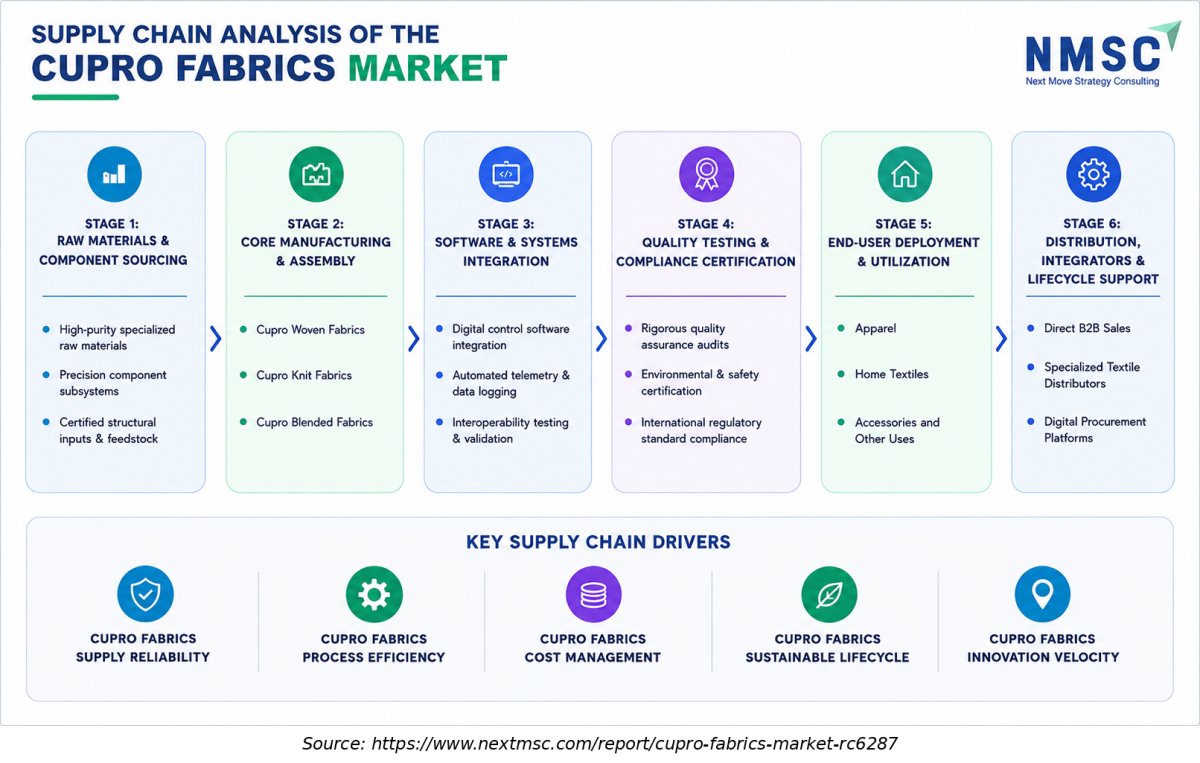
Supply Chain Analysis of the Cupro Fabrics Industry

Supply Chain Analysis of the Cupro Fabrics Industry
The above The infographic illustrates the six-stage supply chain of the Cupro Fabrics Market, covering raw material and component sourcing, core manufacturing, software integration, quality testing, end-user deployment, and distribution. It also highlights five key supply chain drivers: supply reliability, process efficiency, cost management, sustainable lifecycle practices, and innovation velocity..

Growth Opportunities

Our analysis shows that three structural whitespace opportunities are positioned to generate disproportionate commercial returns in the Cupro Fabrics Market through 2035:

Can Premium Lining and Luxury Apparel Capture High-Value Volumes?

Premium lining and luxury garment programs represent a concentrated opportunity for cupro fabrics. Designers value the fluid drape and smooth surface of fine cupro filament, particularly in coats, jackets, and evening wear. Our assessment indicates that long-term luxury brand partnerships can secure stable, high-value volumes. Converters that deliver consistent fabric quality across dense, repeat orders are well positioned to capture this demand and strengthen their competitive standing.

How Is Mid-Tier Brand and Regional Hub Adoption Unlocking New Market Volume?

Mid-tier apparel brands and regional garment hubs are emerging as important volume channels for cupro fabrics. Manufacturing clusters in Southeast Asia and Eastern Europe are integrating cupro into everyday collections to meet sustainability expectations. Regional converters and finishing facilities reduce lead times and logistics costs. Consequently, scaling adoption across secondary production centers broadens the addressable base and supports the market expansion toward USD 1089.55 million by 2035.

Can Specialized Applications Become Distinct Premium Markets?

Specialized applications such as home textiles, bedding, and performance blends are developing into distinct premium niches for cupro fabrics. Bedding manufacturers value the breathable, temperature-regulating properties of cellulose fibers, while blended fabrics combining cupro with wool or cotton open new design territory. These specialized categories allow producers to command higher margins, differentiating cupro fabrics from commodity viscose and reinforcing its position in quality-focused retail assortments.

Regional Outlook

2025 (USD Million)
2035 (USD Million)
North Americ
Europe
Asia-Pacific
Latin Americ
Middle East
Region 2025 (USD Million) 2035 (USD Million) CAGR (%)
North America $10.0 USD Million $40.0 USD Million 9.0%
Europe $17.1 USD Million $51.1 USD Million 27.0%
Asia-Pacific $24.2 USD Million $62.2 USD Million 25.0%
Latin America $31.3 USD Million $73.3 USD Million 23.0%
Middle East & Africa $38.4 USD Million $84.4 USD Million 12.0%

Regional data is locked

Unlock complete regional numbers for this market.

Unlock Full Data

Competitive Landscape

The competitive landscape of the cupro fabrics market combines a single global cupro-fiber producer with downstream fabric suppliers and converters. Asahi Kasei manufactures cupro under its Bemberg™ brand; downstream suppliers such as Batsons Textiles Pvt. Ltd. and SHINJINTEX Co., Ltd. identify cupro fabrics in their published product portfolios. Lenzing, Hyosung, and Toray operate in adjacent cellulose or synthetic-fiber markets, but their published portfolios do not establish them as direct cupro-fiber producers.

Competitive Dynamics and M&A Landscape

Recent strategic moves, partnerships, and acquisitions shaping the Cupro Fabrics Market Global Industry Analysis and Forecast (2026–2035).

May 2026 Bemberg and Indian designer Anita Dongre ready-to-wear collection Bemberg and Indian designer Anita Dongre launched the 18-piece BREATH ready-to-wear collection, demonstrating cupro's application in premium apparel.

Key Market Players

Based on research conducted by NMSC, the following 20 entities represent the broader competitive universe of cupro fiber producers, downstream fabric converters, and adjacent cellulosic textile suppliers (direct cupro product participation is noted accordingly):

Lenzing AG Asahi Kasei Corporation Lenzing Fibers Ltd Glanzstoff Industries GmbH Bemberg (Asahi Kasei) S.A., Inc. Shandong Sunrise Textile Co., Ltd. Zhejiang Jinhui Textile Co., Ltd. Jiangsu Zhongyuan Textile Co., Ltd. Nantong Textile Import & Export Co., Ltd. Hangzhou Xinxiang Textile Co., Ltd. Suzhou Yuanzhi Fiber Technology Co., Ltd. Hubei Huaxin Chemical Fiber Co., Ltd. Shandong Ruyi Technology Group Co., Ltd. Wujiang Dongfang Silk Co., Ltd. Italian Fabrics Srl, Inc. Tessitura Monti S.p.A. Carvico S.p.A. Marzotto Wool Manifattura S.p.A. Hyosung Corporation Toray Industries, Inc.

Where Are Capital Inflows Concentrating in the Cupro Fabrics Market?

Where Are Capital Inflows Concentrating in the Cupro Fabrics Market?

Capital inflows in the cupro fabrics market are concentrating on capacity expansion in Asia-Pacific, where growth is most pronounced at an 8.6% CAGR through 2035. Producers are directing funds toward weaving and blending lines that support the rising output of cupro blended fabrics. Investment in process technology that improves fiber consistency also attracts sustained attention from manufacturers serving luxury and premium buyers.

How Is Infrastructure Investment Shaping the Cupro Fabrics Market Capacity?

Infrastructure investment in cupro fabrics is focused on production facilities, automated finishing equipment, and regional distribution hubs. Automation improves throughput and quality control, which supports the reliable volume required by mass-market apparel brands and home furnishing manufacturers. Distribution hubs located near key consuming regions shorten lead times and strengthen the commercial reach of producers serving both direct B2B and digital procurement channels.

What ESG Considerations Are Influencing Market Investment?

Environmental sustainability is becoming a central factor in investment decisions across the cupro fabrics ecosystem. Producers are investing in energy efficiency, water management, and closed-loop processing to reduce operational impact. Documented material provenance and workplace safety compliance also influence buyer selection, as luxury brands increasingly require verifiable credentials before committing to long-term supply arrangements.

How Does This Report Benefit Industry Leaders and Commercial Operators?

How Does This Report Benefit Industry Leaders and Commercial Operators?

Operational executives, procurement directors, and commercial operators in the cupro fabrics market gain empirical benchmarks that support capacity planning and sourcing decisions. The report quantifies segment shares across product types, applications, end users, and channels. These benchmarks help commercial teams prioritize investments in the most promising subsegments and align procurement strategies with the evolving demand profile.

How Does This Report Benefit Investors and Financial Analysts?

Investors and financial analysts can evaluate the cupro fabrics market using clear valuation anchors. The market is projected to expand from USD 620 million in 2025 to USD 1089.55 million by 2035, with a 5.8% CAGR from 2026 to 2035. These benchmarks, combined with segment-level market size and growth estimates and competitive structure insights, support more informed capital allocation and due diligence decisions.

How Does This Report Benefit Fiber Producers and Fabric Converters?

Fiber producers and fabric converters can use the report to shape product roadmaps for the cupro fabrics market. Identifying high-growth segments such as cupro blended fabrics and digital procurement platforms helps teams target development where demand is accelerating. Insights into differentiation drivers also clarify which capabilities, including traceability and quality assurance tools, can strengthen competitive positioning.

Key Market Segments Evaluated

By Product Type

  • Cupro Woven Fabrics 
    • Lining Fabrics
    • Dress and Shirting Fabrics
    • Luxury Drapery Fabrics
  • Cupro Knit Fabrics 
    • Jersey Knits
    • Rib Knits
    • Interlock Knits
  • Cupro Blended Fabrics 
    • Cupro-Cotton Blends
    • Cupro-Modal Blends
    • Cupro-Wool Blends

By Application

  • Apparel 
    • Womenswear
    • Menswear
    • Lingerie and Sleepwear
  • Home Textiles 
    • Bedding
    • Curtains and Upholstery
  • Accessories 
    • Scarves and Linings
    • Medical and Hygiene Textiles
    • Others

By End User

  • Luxury and Premium Brands 
    • Designer Labels
    • Sustainable Fashion Labels
  • Mass-Market Apparel Brands 
    • Fast Fashion Retailers
    • Private Label Programs
  • Home Furnishing Manufacturers 
    • Bedding Producers
    • Upholstery Producers
  • Direct B2B Sales 
    • Long-Term Supply Contracts
    • Spot Orders
  • Specialized Textile Distributors 
    • Regional Distributors
    • Global Trading Houses
  • Digital Procurement Platforms 
    • B2B Marketplaces
    • Online Sample Platforms

By Region

  • North America 
    • U.S.
    • Canada
    • Mexico.
  • Europe 
    • UK
    • Germany
    • France
    • Italy
    • Rest of Europe.
  • Asia-Pacific 
    • China
    • India
    • Japan
    • South Korea
    • Australia
    • Rest of APAC.
  • Latin America 
    • Brazil
    • Argentina
    • Colombia
    • Rest of Latin America.
  • Middle East & Africa 
    • UAE
    • Saudi Arabia
    • South Africa
    • Rest of MEA.

Conclusion & Recommendations

The long-term outlook for the cupro fabrics market is positive, with revenue expanding from USD 655.96 million in 2026 to USD 1089.55 million by 2035 at a 5.8% CAGR. Growth is underpinned by durable demand from premium apparel and home textile buyers, the structural shift toward sustainable regenerated cellulose fibers, and continuous refinement of cuprammonium spinning and finishing technologies.

What Strategic Positioning Recommendations Does NMSC Offer?

Producers and distributors in the cupro fabrics market should prioritize cupro blended fabrics and accessories applications to capture the fastest-growing demand pools. Securing certified raw material supply and documenting fiber provenance will strengthen relationships with luxury and premium brands. Expanding capacity and sales coverage in Asia-Pacific, supported by digital procurement channels, will help sustain competitive advantage through 2035.

How Attractive Is the Cupro Fabrics Market for Investment?

Investment attractiveness is high, supported by the USD 433.59 million absolute growth opportunity between 2026 and 2035. Strong demand from luxury and premium brands provides stable margin foundations, while home furnishing applications add growth momentum. Investors who target blended product lines and Asia-Pacific capacity can participate in the market's most dynamic expansion vectors.

What Are the Key Market Shifts and Risks in the Cupro Fabrics Market?

Structural shifts in the cupro fabrics market include the move toward blended constructions and the rising role of digital procurement in mid-tier sourcing. Primary risks involve raw material price volatility and dependence on consistent upstream fiber supply. Producers must also manage quality variability across large production volumes to maintain the trust of premium buyers.

What Are the Primary Growth Pathways Through 2035?

Specific commercial growth pathways in the cupro fabrics market include scaling cupro blended fabrics, expanding into accessories and other uses, and serving home furnishing manufacturers. Each pathway addresses a segment growing faster than the overall market. Capturing a disproportionate share of the USD 433.59 million absolute growth opportunity will depend on disciplined capacity planning and targeted channel development.

FAQs

About the Author

Mayurima Roy

Mayurima Roy

Mayurima Roy is Research Analyst at Next Move Strategy Consulting, where she has spent 4 years working across the firm's full industry coverage rather than a single fixed vertical. Her work centers on structured research, ongoing trend tracking, competitive assessment, and insight-led content development, translating complex market data into clear, decision-ready narratives that support informed client decision-making across diverse global industries, market sectors, and world regions every day.

About the Reviewer

Supradip Baul

Supradip Baul

Supradip Baul is an accomplished business consultant and strategist with over a decade of rich experience in market intelligence, strategy, technology, and business transformation. His work has included rigorous qualitative and quantitative analysis across multiple industries, helping clients shape investment decisions and long-term roadmaps. Earlier in his career, he was associated with Gartner, where he contributed to industry-leading reports and market share analyses. He has worked with leading global companies and holds an MBA with a dual specialization in Marketing and Finance.

Download Free Sample

Robert Sean Trevino

ROBERT SEAN TREVINO

Sr. Director, Head of Strategic Insights & Analytics

Foundation Medicine

I realized that it was a reliable source of information. These days, there are many people who are looking for authentic data, and this is one of the only sources that can offer them with what they need;

Gaurav Jaiswal

GAURAV JAISWAL

Founder & CEO

Yano Charge Private Limited

The EV Charging market research report provided by the NextMSC was exceptionally detailed and insightful. It offered a comprehensive analysis that proved to be a game-changer for our strategic planning. Truly a testament to the NextMSC’s expertise and thoroughness in EV market landscape & analysis.

Diana Trejo

DIANA TREJO

Assistant Manager

Sumitomo Corporation de Mexico, S.A. de C.V.

Recently, we purchased a report on the Mexico Data Center Market from Next Move Strategy Consulting. The service has been excellent, with support that is always timely and thoroughly professional. The information provided is interesting, highly useful, and delivered with clarity. I would highly recommend NextMSC for anyone seeking insightful and dependable analysis.

Rishabh Jogani

RISHABH JOGANI

Strategy Analyst

Accenture Japan

We are incredibly impressed with the market report on the real estate market in India provided by Next Move Strategy Consulting. The report was thorough, insightful, and well-structured, offering deep analysis and actionable recommendations. It not only captured the current trends and dynamics but also provided a forward-looking perspective that has been invaluable for our strategic planning. Their team demonstrated exceptional professionalism, attention to detail, and a profound understanding of the industry. The data-driven insights and clarity of presentation exceeded our expectations, making complex market trends easy to understand. We highly recommend Next Move Strategy Consulting to anyone looking for reliable and comprehensive market research services. Their expertise has given us the confidence to navigate the complexities of the Indian real estate market with clarity and foresight.

Semih Kavaklioglu

SEMIH KAVAKLIOGLU

Co-Founder & Sales Manager

Decortie

I work a lot in the marketing industry and I know that research is an essential part of any campaign. I have used Market research reports for my own products and I found them to be very informative and well-researched. The team here produces insightful reports for a good price

Custom Market Research Services

We will customize the research for you if the listed report does not fully match your requirements.

Get 30% Free Customization

Select License

This website uses cookies to ensure you get the best experience on our website. Learn more

✖