Dark Web Monitoring Market Size, Share, Growth & Forecast by Offering (Software & Subscriptions: Digital Risk Protection, Identity Threat Monitoring, Threat Intelligence Platforms; Professional & Managed Services; Data & API), Deployment Mode (Cloud and On-premises), Organization Size (Large Enterprises and SMEs), Buyer Function, Route to Market, and End User (BFSI, Government & Defense, Healthcare) — Global Analysis 2025–2035
Industry: ICT & Media | Publishing Date: June 18, 2026 | Last Updated: September 10, 2026 | No of Pages: N/A | No. of Tables: N/A | No. of Figures: N/A | Format: PDF | Report Code: IC4716
What Is the Dark Web Monitoring Market Size?
The global Dark Web Monitoring Market size was valued at USD 1.4 billion in 2025 and is expected to reach USD 1.6 billion in 2026, reflecting accelerating enterprise demand for proactive threat intelligence amid an unprecedented surge in cybercriminal activity. Sustained growth across digital threat vectors, rising regulatory compliance mandates, and widening adoption of AI-augmented monitoring platforms are collectively projected to propel the market to USD 5.9 billion by 2035, advancing at a CAGR of 15.5% from 2026 to 2035. Key growth catalysts include the industrialization of stolen identity data, expanding underground marketplaces, stringent global data breach notification laws, and increasing integration of dark web intelligence within enterprise Security Operations Centers (SOCs) and threat intelligence programs.
|
Parameters |
Details |
|
Market Size in 2025 |
USD 1.4 Billion |
|
Market Size in 2026 |
USD 1.6 Billion |
|
Revenue Forecast in 2035 |
USD 5.9 Billion |
|
Growth Rate |
CAGR of 15.5% from 2026 to 2035 |
|
Analysis Period |
2025–2035 |
|
Base Year Considered |
2025 |
|
Forecast Period |
2026–2035 |
|
Market Size Estimation |
Billion USD |
|
Companies Profiled |
14 |
|
Countries Covered |
33 |
|
Market Share |
Top 10 |
Dark Web Monitoring Market Overview
What Is the Dark Web Monitoring Market?
The Dark Web Monitoring Market encompasses the full spectrum of technologies, platforms, services, and data products designed to detect, analyze, and remediate threats originating in dark web environments, including Tor networks, encrypted underground forums, dark marketplaces, paste sites, and deep web channels. Solutions in this market continuously scan these hidden layers of the internet for stolen credentials, compromised personally identifiable information (PII), leaked intellectual property, brand impersonation activity, and early-stage threat actor planning. NMSC's analysis indicates that the market serves a diverse buyer base ranging from enterprise security operations to individual consumer identity protection.
How Has the Dark Web Monitoring Market Evolved?
The Dark Web Monitoring Market has undergone significant structural transformation since its early iterations as standalone credential alert services. The first phase centered on basic breach notification for consumers and small businesses, with tools scanning known paste sites and breach databases. The second phase introduced professional threat intelligence platforms capable of monitoring structured and unstructured underground forum content. Based on our research, we found that the current phase is defined by AI-native intelligence platforms, real-time infostealer telemetry, identity threat correlation engines, and managed detection services that integrate seamlessly with enterprise SIEM and SOAR infrastructures for automated remediation.
How Do Regulations Influence the Dark Web Monitoring Market?
Regulatory developments have become a primary structural growth driver for the Dark Web Monitoring Market. The U.S. Securities and Exchange Commission's (SEC) cybersecurity disclosure rule, effective December 2023, requires public companies to disclose material cybersecurity incidents within four business days, creating a direct incentive for early breach detection through dark web signals. The EU's NIS2 Directive, with national transposition enforcement intensifying through 2026, mandates risk management measures and incident reporting across expanded sectors. Our assessment indicates that the EU's General Data Protection Regulation (GDPR), combined with Australia's Notifiable Data Breaches scheme and CISA's pending CIRCIA framework, is systematically compelling organizations to invest in continuous underground monitoring capabilities.
How Is Technology Adoption Expanding Across the Dark Web Monitoring Market?
Technology adoption across the Dark Web Monitoring Market is accelerating as enterprises integrate dark web intelligence into broader cybersecurity ecosystems. AI and machine learning are enabling automated ingestion and analysis of unstructured underground forum data at scale, dramatically reducing human analyst hours required per alert. From our assessment, we observed that natural language processing (NLP) models now parse multilingual threat actor communications across Russian, Chinese, and Spanish-language forums, expanding coverage breadth. Integration with identity and access management (IAM) platforms, endpoint detection and response (EDR) tools, and fraud management systems is transforming dark web monitoring from a standalone alerting function into an embedded enterprise risk management capability.
|
Key Takeaways |
|
By Offering, Software and Subscriptions is the dominant segment of the Dark Web Monitoring Market, accounting for USD 0.84 billion in 2025, with Digital Risk Protection and Threat Intelligence Platforms serving as the largest revenue sub-categories, driven by enterprise adoption of brand monitoring, credential monitoring, and underground intelligence services. |
|
Threat Intelligence Platforms is the fastest-growing sub-segment within Software and Subscriptions, projected to advance at a CAGR of 17.2% from 2026 to 2035, fueled by enterprise demand for integrated dark web intelligence, threat actor profiling, and underground intelligence feeds within unified security operations workflows. |
|
By Buyer Function, Security Operations dominates the Dark Web Monitoring Market with the largest share in 2025, representing the largest functional buyer base as SOC teams require continuous threat feeds, alert triage, and incident context sourced from underground channels. |
|
By Buyer Function, Privacy and Compliance is the fastest-growing function in the Dark Web Monitoring Market at a CAGR of 18.1% from 2026 to 2035, driven by mounting regulatory obligations under GDPR, NIS2, SEC disclosure rules, and CIRCIA requiring continuous monitoring of organizational data exposure. |
|
By Deployment Mode, Cloud is the dominant deployment model in the Dark Web Monitoring Market at USD 0.84 billion in 2025, accounting for approximately 60% of total market revenue, driven by scalable SaaS delivery, API integration capabilities, and lower upfront infrastructure costs. |
|
By Deployment Mode, Cloud deployment is also the fastest-growing mode, advancing at a CAGR of 16.9% from 2026 to 2035, as organizations across all sizes shift toward managed cloud-delivered intelligence platforms with continuous updates and real-time alert delivery. |
|
By Organization Size, Large Enterprises account for the dominant share of the Dark Web Monitoring Market at USD 0.98 billion in 2025, reflecting greater security budget allocation, mature SOC infrastructure, and higher exposure risk due to broader digital footprints and higher-value target profiles. |
|
Small and Medium Enterprises (SMEs) represent the fastest-growing organization size segment in the Dark Web Monitoring Market at a CAGR of 17.8% from 2026 to 2035, driven by rising affordable SaaS subscriptions, MSSP-delivered dark web monitoring packages, and growing awareness of credential theft risks among mid-market organizations. |
|
By End User, the BFSI vertical holds the largest revenue share of the Dark Web Monitoring Market at USD 0.31 billion in 2025 and is forecast to reach USD 1.30 billion by 2035 at a CAGR of 15.5%, driven by persistent exposure of financial credentials, card data, and account takeover fraud on underground marketplaces. |
|
By End User, Healthcare and Life Sciences is the fastest-growing vertical in the Dark Web Monitoring Market at a CAGR of 18.3% from 2026 to 2035, propelled by the extremely high value of patient PII on dark web markets and intensifying regulatory scrutiny following record-breaking breach incidents in the sector. |
|
North America holds the largest regional share of the Dark Web Monitoring Market at USD 0.60 billion in 2025 and is forecast to reach USD 2.55 billion by 2035 at a CAGR of 15.5%, anchored by the highest concentration of leading dark web monitoring vendors, the most mature enterprise threat intelligence programs, and stringent regulatory compliance requirements. |
|
Asia-Pacific is the fastest-growing major region in the Dark Web Monitoring Market at a CAGR of 18.5% from 2026 to 2035, driven by rapidly expanding digital economies, rising infostealer campaigns targeting Asian enterprises, and increasing government-mandated cybersecurity investment across China, India, Japan, and Southeast Asia. |
|
The United States is the single largest country market in the Dark Web Monitoring Market, representing approximately 80% of North American revenue in 2025, supported by the world's highest concentration of dark web monitoring platform vendors and the deepest enterprise cybersecurity budgets globally. |
|
India is the fastest-growing national market in Asia-Pacific within the Dark Web Monitoring Market at a CAGR of 22.0% from 2026 to 2035, driven by surging digital adoption, rising cyber threat volumes targeting the fintech and IT services sectors, and the Digital Personal Data Protection Act (DPDPA) mandating organizational accountability for data exposure. |
Key Emerging Trends in the Dark Web Monitoring Market
How Is AI-Powered Automation Reshaping Threat Detection in the Dark Web Monitoring Market?
Artificial intelligence is fundamentally transforming the Dark Web Monitoring Market by enabling automated, real-time ingestion and contextual analysis of unstructured underground data at a scale previously unachievable through human analysts alone. Our analysis indicates that platforms from providers such as Recorded Future and CrowdStrike now deploy large language models (LLMs) and NLP to parse multilingual dark web forums, identifying threat actor tactics, techniques, and procedures (TTPs) in near real time. This AI-driven automation is reducing mean time to detect (MTTD) for credential exposure events from days to minutes, directly improving enterprise cyber resilience and shifting dark web monitoring from reactive alerting to predictive intelligence.
How Is the Industrialization of Infostealer Malware Accelerating Demand in the Dark Web Monitoring Market?
The commoditization and rapid proliferation of infostealer malware families such as RedLine, Vidar, and Lumma Stealer are generating unprecedented volumes of stolen enterprise credentials, session cookies, and financial data circulating on dark web markets. SpyCloud's 2026 research identified over 65.7 billion distinct identity records in underground circulation, representing a 23% year-over-year increase. From our research, we found that this industrialization of identity theft is compelling enterprises across all verticals to deploy continuous dark web monitoring specifically tuned to infostealer telemetry, identity correlation, and session hijacking indicators, creating a durable, high-growth demand environment throughout the Dark Web Monitoring Market forecast period.
How Are Managed Security Service Providers (MSSPs) Transforming Go-to-Market Dynamics in the Dark Web Monitoring Market?
The growing adoption of dark web monitoring as a service component within MSSP and managed detection and response (MDR) offerings is significantly expanding the addressable market, particularly among small and medium enterprises that lack in-house threat intelligence capabilities. Through NMSC's assessment, we found that embedding dark web intelligence within managed security bundles lowers adoption friction, reduces per-user costs, and enables continuous monitoring without dedicated security headcount. Leading MSSPs including Secureworks, Arctic Wolf, and Atos are incorporating underground monitoring alerts into managed SOC dashboards, driving subscription-based recurring revenue growth across the Dark Web Monitoring Market.
How Is the Convergence of Digital Risk Protection and Identity Threat Intelligence Redefining the Dark Web Monitoring Market?
Market boundaries between digital risk protection, brand monitoring, identity threat intelligence, and dark web monitoring are converging as enterprise buyers seek unified platforms that correlate executive credential exposure, corporate brand impersonation, supply chain risk signals, and underground threat actor activity within single-pane-of-glass dashboards. Based on NMSC's research, we found that ZeroFox, SpyCloud, and Flashpoint are actively expanding beyond single-function tools to deliver comprehensive digital risk intelligence suites. This convergence is driving platform consolidation, increasing average selling prices, and creating differentiation opportunities for vendors that successfully integrate surface, deep, and dark web intelligence into coherent enterprise risk workflows.
STRATEGIC FRAMEWORK OF THE DARK WEB MONITORING MARKET
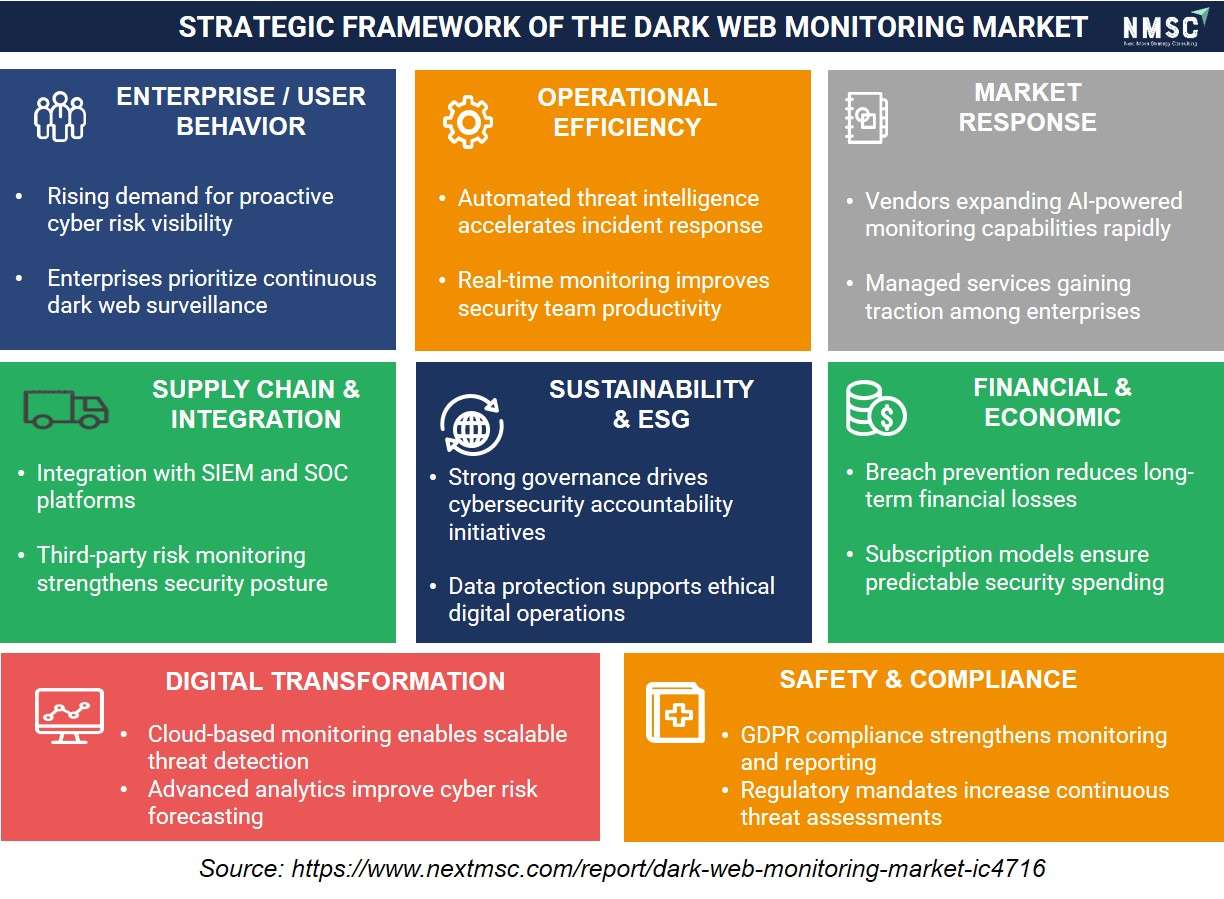
The strategic framework of the market highlights the key forces shaping industry growth. Rising demand for proactive cyber risk visibility and continuous dark web surveillance is driving adoption across enterprises. AI-powered threat intelligence, real-time monitoring, and integration with SIEM and SOC platforms enhance operational efficiency and security posture. Regulatory compliance, data protection initiatives, and cloud-based monitoring solutions further support dark web monitoring market expansion, while reducing financial losses and enabling scalable cybersecurity operations.
What Are the Key Market Drivers, Breakthroughs, and Investment Opportunities that will Shape the Dark Web Monitoring Market in the Next Decade?
|
Drivers / Trends / Restraints |
(+/-) % Impact on CAGR Forecast |
Geographic Relevance |
Impact Timeline |
|
Surging Volume of Stolen Credential Data |
+2.5% |
Global (led by North America, Europe) |
2025–2030 |
|
Regulatory Compliance Mandates (NIS2, GDPR, SEC Rule, CIRCIA) |
+2.1% |
North America, Europe, APAC |
2025–2035 |
|
AI/ML Integration in Threat Intelligence Platforms |
+1.8% |
Global (all regions) |
2025–2032 |
|
MSSP and MDR Embedded Offering Expansion |
+1.5% |
North America, Europe, Asia-Pacific |
2026–2035 |
|
Ransomware and Business Email Compromise (BEC) Surge |
+1.3% |
Global |
2025–2030 |
|
Infostealer Malware Proliferation |
+1.6% |
Global (led by APAC, LATAM) |
2025–2030 |
|
Shortage of Skilled Cybersecurity Professionals |
-0.9% |
All regions |
Ongoing |
|
False Positive Rates and Alert Fatigue |
-0.7% |
All regions |
Ongoing |
|
High Implementation Costs for SMEs |
-0.6% |
LATAM, MEA, APAC emerging markets |
2025–2028 |
|
Expansion into SME and Consumer Segments |
+1.4% |
Global |
2026–2035 |
What Are the Growth Drivers of the Dark Web Monitoring Market?
How Is the Surge in Cybercrime Losses and Data Breach Volume Driving the Dark Web Monitoring Market?
Escalating cybercrime activity is the most powerful structural driver of the Dark Web Monitoring Market. According to the FBI's 2025 Internet Crime Report, cybercrime losses in the United States exceeded USD 20.877 billion in 2025, a 26% increase over 2024, marking the first year total reported losses surpassed USD 20 billion. Personal data breaches, account takeover fraud, and business email compromise collectively accounted for a substantial portion of these losses. Our findings suggest that organizations confronting this threat environment are investing in proactive dark web intelligence to detect credential exposure and threat actor targeting before attacks materialize, directly stimulating demand across all segments of the market.
How Are Global Cybersecurity Regulations Accelerating Demand Across the Dark Web Monitoring Market?
The global regulatory environment governing cybersecurity disclosure and data protection is a primary demand accelerator for the Dark Web Monitoring Market. The EU's NIS2 Directive is expanding the pool of regulated critical infrastructure entities from approximately 1,100 under NIS1 to over 160,000 organizations across member states, mandating risk management and incident reporting measures. In the United States, the SEC's cybersecurity disclosure rule mandates material incident disclosure within four business days. NMSC's analysis indicates that organizations subject to these regulatory frameworks are adopting continuous dark web monitoring to detect breaches at the earliest possible stage, reducing regulatory exposure and enabling timely incident notifications.
How Is the Proliferation of Infostealer Malware and Underground Marketplaces Sustaining Dark Web Monitoring Market Growth?
The industrialization of credential theft through infostealer malware ecosystems is generating persistent, high-volume demand for dark web monitoring services. Cyble Research and Intelligence Labs (CRIL) tracked 6,046 global data breach and leak incidents in 2025, with enterprise credentials widely circulating on underground markets harvested by infostealer campaigns. FBI IC3 data confirms that account takeover (ATO) incidents surged within financial services sectors in 2025. Our analysis shows that organizations across BFSI, healthcare, and government are deploying identity threat monitoring and credential monitoring capabilities specifically to counter infostealer-derived exposure, sustaining demand throughout the Dark Web Monitoring Market forecast period.
What Are the Growth Inhibitors of the Dark Web Monitoring Market?
How Does the Cybersecurity Skills Shortage Constrain Effective Deployment Across the Dark Web Monitoring Market?
A persistent global shortfall in qualified cybersecurity professionals limits the operational effectiveness of dark web monitoring deployments, particularly among mid-market and public sector organizations. CISA has documented the cybersecurity workforce gap as a systemic national security risk, noting that the demand for threat intelligence analysts exceeds supply across both public and private sectors. Organizations that deploy dark web monitoring platforms without dedicated analyst capacity often experience alert fatigue, high false positive rates, and delayed remediation, reducing return on investment. This constraint is partially addressed by MSSP-delivered managed monitoring services but remains a structural inhibitor affecting adoption depth across the Dark Web Monitoring Market.
How Do High False Positive Rates and Alert Fatigue Limit Enterprise Adoption in the Dark Web Monitoring Market?
Alert fatigue resulting from high false positive rates in dark web monitoring outputs represents a meaningful operational and adoption constraint. Underground forums generate vast volumes of recycled, duplicate, or irrelevant data that, if improperly filtered, overloads security operations teams. NIST's Cybersecurity Framework explicitly identifies alert triage and prioritization as critical components of effective incident response programs. Our assessment indicates that organizations without mature intelligence workflows struggle to operationalize dark web alerts effectively, leading to underutilization of monitoring platforms and extended adoption cycles, particularly among smaller enterprises that rely on generalist IT staff rather than dedicated threat intelligence functions within the Dark Web Monitoring Market.
What Are the Growth Opportunities in the Dark Web Monitoring Market?
How Does the SME Adoption Wave Create a Structural Growth Opportunity for the Dark Web Monitoring Market?
Small and medium enterprises represent an underserved but rapidly expanding buyer segment within the Dark Web Monitoring Market, as affordable SaaS-based monitoring subscriptions and MSSP-bundled packages lower adoption barriers. The U.S. Cybersecurity and Infrastructure Security Agency (CISA) has explicitly identified SMBs as high-risk targets for ransomware and credential theft attacks, issuing guidance recommending dark web monitoring as a component of proactive cyber hygiene. Our observation is that vendor pricing innovations, including usage-based models starting at competitive monthly per-user rates, are enabling SMEs in financial services, healthcare, and retail to deploy meaningful dark web surveillance at accessible price points, generating a high-growth expansion opportunity throughout the Dark Web Monitoring Market.
How Does the Integration of Dark Web Intelligence with SIEM and SOAR Platforms Create Platform Consolidation Opportunities?
The integration of dark web monitoring feeds with enterprise SIEM and SOAR platforms represents a significant commercial opportunity for vendors capable of delivering structured, machine-readable intelligence outputs. NIST's Cybersecurity Framework 2.0, released in February 2024, emphasizes the Govern function and cross-tool intelligence sharing as foundational security practices, validating the architectural integration of external threat intelligence with internal detection and response workflows. From our market evaluation, we noticed that enterprises capable of embedding dark web alert enrichment directly into SIEM correlation rules and automated SOAR playbooks are achieving measurably faster incident response times, creating premium pricing opportunities for vendors offering native SIEM and SOAR integrations within the Dark Web Monitoring Market.
How Do Emerging Regulatory Frameworks in Asia-Pacific and the Middle East Create New Geographic Opportunities for the Dark Web Monitoring Market?
Expanding cybersecurity regulatory frameworks across Asia-Pacific and the Middle East are creating significant new geographic demand Dark Web Monitoring Market opportunities. India's Digital Personal Data Protection Act (DPDPA), enacted in 2023 and with compliance enforcement intensifying through 2026, mandates organizational accountability for data breaches and requires timely notification to the Data Protection Board of India. Saudi Arabia's National Cybersecurity Authority (NCA) has issued cybersecurity controls requiring organizations in the Kingdom to implement continuous threat monitoring. Our analysis shows that these regulatory developments across high-growth markets are compelling enterprises in APAC and MEA to invest in formal dark web monitoring capabilities, opening substantial untapped revenue streams.
SWOT ANALYSIS OF THE DARK WEB MONITORING MARKET
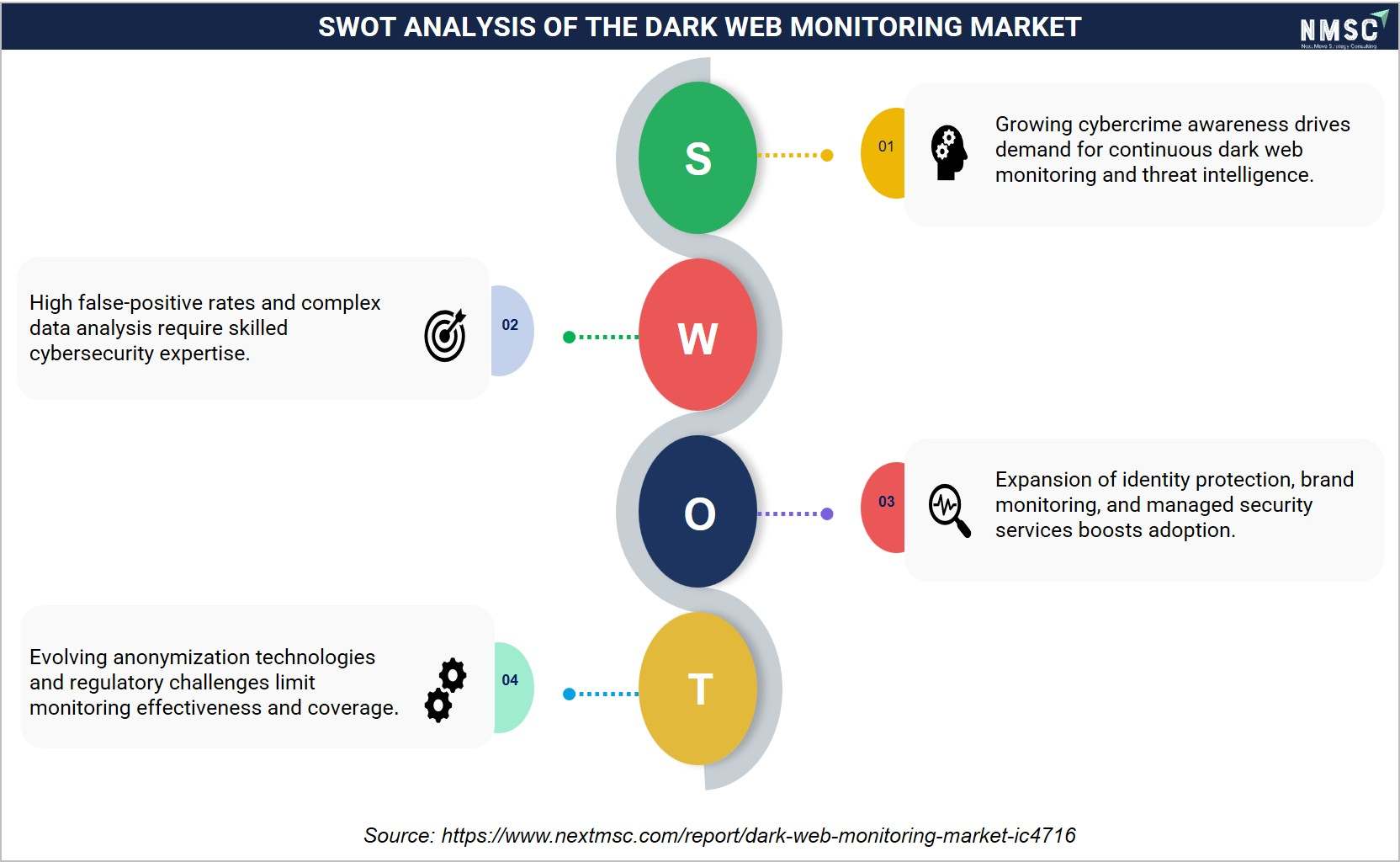
The SWOT analysis of the Dark Web Monitor Market highlights a strong growth outlook driven by increasing cybercrime awareness and the rising need for continuous threat intelligence. Opportunities are expanding through identity protection, brand monitoring, and managed security services. However, high false-positive rates and the need for skilled cybersecurity professionals remain key challenges. In addition, evolving anonymization technologies and complex regulatory requirements can limit monitoring effectiveness and market coverage.
How Is the Dark Web Monitoring Market Segmented in This Report, and What Are the Key Insights from the Segmentation Analysis?
How Do Different Offering Categories Define the Revenue Structure of the Dark Web Monitoring Market?
|
Offering Segment |
2025 (USD Bn) |
2035 (USD Bn) |
CAGR (%) |
|
Software and Subscriptions |
0.84 |
3.48 |
15.3% |
|
— Digital Risk Protection |
0.32 |
1.35 |
15.5% |
|
— Identity Threat Monitoring |
0.22 |
0.94 |
15.6% |
|
— Threat Intelligence Platforms |
0.22 |
1.00 |
16.3% |
|
— Other Software and Subscriptions |
0.08 |
0.19 |
9.0% |
|
Professional and Managed Services |
0.36 |
1.56 |
15.8% |
|
— Managed Dark Web Monitoring |
0.16 |
0.72 |
16.3% |
|
— Incident Response and Investigation |
0.11 |
0.49 |
16.1% |
|
— Takedown and Remediation |
0.06 |
0.27 |
16.2% |
|
— Other Professional and Managed Services |
0.03 |
0.08 |
10.2% |
|
Data and API |
0.20 |
0.86 |
15.7% |
|
— Alert and Threat Feeds |
0.09 |
0.40 |
16.1% |
|
— Raw Darknet Data Access |
0.06 |
0.25 |
15.3% |
|
— Search API |
0.04 |
0.18 |
16.2% |
|
— Other Data and API |
0.01 |
0.03 |
11.6% |
Based on our analysis of enterprise cybersecurity procurement patterns and threat intelligence service delivery models, we observed that the Dark Web Monitoring Market is segmented by offering into Software and Subscriptions, Professional and Managed Services, and Data and API categories. Software and Subscriptions dominates the offering landscape, accounting for USD 0.84 billion in 2025, led by Digital Risk Protection, Identity Threat Monitoring, and Threat Intelligence Platforms as the primary sub-categories serving enterprise security operations and fraud management teams. Within Software and Subscriptions, Brand Monitoring addresses corporate reputation risk, Credential Monitoring detects compromised employee and customer accounts, and Executive Monitoring provides targeted surveillance of C-suite exposure on underground channels. Professional and Managed Services is the fastest-growing offering category, driven by enterprise demand for managed dark web monitoring delivered by MSSPs and MDR providers, incident response capabilities, and takedown and remediation services that require specialized analyst expertise. Data and API offerings, including Alert and Threat Feeds, Raw Darknet Data Access, and Search APIs, serve a specialized buyer segment comprising SIEM vendors, threat intelligence platform operators, and security researchers requiring bulk underground data for integration within proprietary detection architectures.
How Do Buyer Functions Shape Procurement Behavior and Deployment Priorities in the Dark Web Monitoring Market?
|
Buyer Function |
2025 (USD Bn) |
2035 (USD Bn) |
CAGR (%) |
|
Security Operations |
0.49 |
2.04 |
15.3% |
|
Fraud and Risk Management |
0.28 |
1.18 |
15.5% |
|
Identity and Access Management |
0.22 |
0.92 |
15.5% |
|
Privacy and Compliance |
0.17 |
0.76 |
16.2% |
|
Public Sector and Law Enforcement |
0.14 |
0.61 |
15.8% |
|
Other |
0.10 |
0.39 |
14.6% |
Through our assessment of enterprise security team structures and threat intelligence procurement workflows, we noticed that the Dark Web Monitoring Market is segmented by buyer function into Security Operations, Fraud and Risk Management, Identity and Access Management, Privacy and Compliance, Public Sector and Law Enforcement, and Other functions. Security Operations holds the dominant share as the primary consumer of dark web threat feeds, alert triage dashboards, and incident enrichment data within enterprise SOC environments. Fraud and Risk Management functions are significant buyers particularly within BFSI organizations requiring underground payment card fraud detection, account takeover intelligence, and synthetic identity monitoring capabilities. Identity and Access Management buyers procure dark web monitoring to enforce compromised credential remediation policies and prevent unauthorized account access. Privacy and Compliance is the fastest-growing buyer function, reflecting mounting obligations under GDPR, NIS2, and SEC disclosure rules that require documented evidence of proactive threat monitoring programs as part of cybersecurity governance frameworks.
How Does Deployment Mode Preference Reflect Organizational Security Architecture Maturity in the Dark Web Monitoring Market?
|
Deployment Mode |
2025 (USD Bn) |
2035 (USD Bn) |
CAGR (%) |
|
Cloud |
0.84 |
3.67 |
15.9% |
|
Hybrid |
0.36 |
1.47 |
15.1% |
|
On Premises |
0.20 |
0.76 |
14.2% |
Our findings suggest that the Dark Web Monitoring Market is segmented by deployment mode into Cloud, Hybrid, and On Premises architectures, reflecting the diverse security infrastructure preferences of enterprise buyers across different regulatory environments and organizational maturity levels. Cloud deployment holds the dominant share at USD 0.84 billion in 2025, driven by scalable SaaS delivery models, continuous intelligence updates, rapid API integration capabilities, and lower total cost of ownership relative to on-premises alternatives. Cloud is also the fastest-growing deployment mode, advancing at a CAGR of 15.9% from 2026 to 2035, as organizations across all geographies accelerate migration toward managed cloud-delivered cybersecurity services. Hybrid deployments remain relevant for enterprises in regulated sectors that require on-premises data processing for sensitive internal threat correlation while leveraging cloud-based dark web intelligence feeds through secure API connections. On Premises deployment serves a specialized segment of highly regulated organizations, including defense contractors, critical infrastructure operators, and government agencies with strict data sovereignty requirements that preclude cloud-based intelligence processing.
How Does Organization Size Influence Dark Web Monitoring Market Adoption Rates and Platform Selection?
|
Organization Size |
2025 (USD Bn) |
2035 (USD Bn) |
CAGR (%) |
|
Large Enterprises |
0.98 |
3.90 |
14.8% |
|
Small and Medium Enterprises |
0.42 |
2.00 |
16.9% |
Based on our market evaluation, we noticed that the Dark Web Monitoring Market is segmented by organization size into Large Enterprises and Small and Medium Enterprises (SMEs), reflecting fundamentally different procurement, deployment, and operational profiles. Large Enterprises hold the dominant revenue share at USD 0.98 billion in 2025, driven by greater security budget allocation, mature SOC infrastructure supporting real-time threat intelligence workflows, broader digital footprints requiring comprehensive coverage across multiple brand assets, executive profiles, and employee credential pools, and higher regulatory scrutiny mandating documented monitoring programs. SMEs represent the fastest-growing organization size segment at a CAGR of 16.9%, as MSSP-delivered managed dark web monitoring packages and affordable SaaS subscription tiers bring underground surveillance capabilities within reach of organizations previously unable to justify dedicated threat intelligence investments. CISA's consistent identification of SMBs as high-value ransomware and BEC targets is accelerating SME awareness and procurement urgency across the Dark Web Monitoring Market.
How Do Distribution Channels Shape Vendor Revenue Mix and Market Penetration in the Dark Web Monitoring Market?
|
Route to Market |
2025 (USD Bn) |
2035 (USD Bn) |
CAGR (%) |
|
Direct Sales |
0.56 |
2.30 |
15.2% |
|
Channel Partners |
0.28 |
1.18 |
15.5% |
|
MSP and MSSP |
0.35 |
1.60 |
16.3% |
|
Embedded and OEM |
0.14 |
0.63 |
16.3% |
|
Other |
0.07 |
0.19 |
10.5% |
Our assessment indicates that the Dark Web Monitoring Market is segmented by route to market into Direct Sales, Channel Partners, MSP and MSSP, Embedded and OEM, and Other channels. Direct Sales holds the largest revenue share at USD 0.56 billion in 2025, as enterprise buyers for Threat Intelligence Platforms and comprehensive Digital Risk Protection suites prefer direct vendor engagement for customized deployment, strategic account management, and long-term service agreements. MSP and MSSP channels are co-equal fastest-growing distribution routes alongside Embedded and OEM, each advancing at a CAGR of 16.3% from 2026 to 2035, reflecting the accelerating trend of dark web monitoring being delivered as a component service within managed security portfolios and embedded within third-party cybersecurity platforms, SIEM solutions, and identity management products. Channel Partners serve as critical distribution intermediaries for mid-market enterprise accounts, while the Embedded and OEM route enables dark web intelligence to be incorporated seamlessly into adjacent security products such as endpoint protection platforms, fraud management systems, and identity verification services.
Which End-User Industries Are Driving Revenue Growth Across the Dark Web Monitoring Market?
|
End User Vertical |
2025 (USD Bn) |
2035 (USD Bn) |
CAGR (%) |
|
Consumer |
0.14 |
0.56 |
14.9% |
|
BFSI |
0.31 |
1.30 |
15.5% |
|
Government and Defense |
0.18 |
0.76 |
15.5% |
|
Healthcare and Life Sciences |
0.15 |
0.77 |
17.8% |
|
IT and Telecommunications |
0.22 |
0.93 |
15.5% |
|
Manufacturing and Energy |
0.14 |
0.62 |
16.0% |
|
Retail and Ecommerce |
0.15 |
0.63 |
15.4% |
|
Other End Users |
0.11 |
0.38 |
13.2% |
Based on our analysis of vertical-specific threat exposure patterns and cybersecurity investment trends, we observed that the Dark Web Monitoring Market is segmented across Consumer, BFSI, Government and Defense, Healthcare and Life Sciences, IT and Telecommunications, Manufacturing and Energy, Retail and Ecommerce, and Other end-user verticals. BFSI holds the dominant vertical position at USD 0.31 billion in 2025 and is forecast to reach USD 1.30 billion by 2035, driven by the extreme value of financial account credentials, payment card data, and account takeover fraud intelligence available on underground markets, compelling financial institutions to maintain continuous dark web surveillance programs. Healthcare and Life Sciences is the fastest-growing vertical at a CAGR of 17.8%, reflecting the highest per-record value of patient PII on dark web marketplaces and the FBI IC3's confirmation that healthcare experienced more ransomware attacks and data breaches than any other critical infrastructure sector in 2025. Government and Defense agencies are significant buyers leveraging dark web monitoring for counterintelligence, classified credential protection, and underground threat actor tracking, often through specialized cleared contractor channels. Retail and Ecommerce organizations prioritize brand monitoring, payment credential exposure detection, and consumer identity theft prevention as primary use cases within the Dark Web Monitoring Market.
Regional Outlook
Geographic Performance Snapshot
|
Region |
2025 (USD Bn) |
2035 (USD Bn) |
CAGR (%) |
Key Driver |
|
North America |
0.60 |
2.55 |
15.5% |
Dense vendor ecosystem, SEC & CIRCIA compliance |
|
Europe |
0.38 |
1.60 |
15.5% |
NIS2, GDPR, DORA regulatory mandates |
|
Asia-Pacific |
0.25 |
1.28 |
17.7% |
Rising infostealer campaigns, DPDPA, NCA mandates |
|
Middle East & Africa |
0.09 |
0.32 |
13.5% |
NCA Saudi, national cybersecurity programs |
|
Latin America |
0.08 |
0.25 |
12.0% |
Financial fraud growth, Brazil LGPD compliance |
North America Dark Web Monitoring Market
North America is the global epicenter of the Dark Web Monitoring Market, accounting for USD 0.60 billion in 2025 and forecast to reach USD 2.55 billion by 2035 at a CAGR of 15.5%. The region benefits from the headquartering of all major dark web monitoring platform vendors, the deepest enterprise cybersecurity budgets globally, and a maturing regulatory environment anchored by the SEC cybersecurity disclosure rule, CIRCIA, and state-level data breach notification laws. NMSC's analysis indicates that North American enterprises represent the most sophisticated buyers of integrated threat intelligence platforms, with high adoption rates for AI-augmented credential monitoring, executive protection services, and MSSP-delivered managed dark web surveillance programs.
United States Dark Web Monitoring Market
Based on our engagements with enterprise security teams across the United States, the U.S. is the single largest country market in the Dark Web Monitoring Market, representing approximately 80% of North American revenue in 2025. The U.S. hosts the global headquarters of leading vendors including CrowdStrike, Recorded Future, SpyCloud, ZeroFox, Flashpoint, and DarkOwl, and benefits from the world's highest concentration of Fortune 500 enterprise buyers with dedicated threat intelligence programs. The FBI's Internet Crime Complaint Center received over one million cybercrime complaints in 2025 for the first time, with losses exceeding USD 20 billion, directly amplifying organizational urgency to deploy proactive underground monitoring. The SEC's cybersecurity disclosure rule and CIRCIA framework create a compliance-driven procurement layer reinforcing sustained Dark Web Monitoring Market growth.
Canada Dark Web Monitoring Market
Through our analysis, we found that Canada represents approximately 12% of North American Dark Web Monitoring Market revenue, anchored by sophisticated enterprise buyers in financial services, energy, and government sectors. Canada's critical infrastructure organizations face significant credential theft and ransomware targeting, with the Canadian Centre for Cyber Security (CCCS) issuing regular advisories on underground marketplace activity. The Protecting Canadians from Online Crime Act and provincial privacy legislation are driving compliance-motivated dark web monitoring adoption. Canadian financial institutions leverage underground credential monitoring within anti-money laundering (AML) and fraud intelligence programs, while federal government agencies deploy threat actor monitoring through specialized security clearance channels.
Mexico Dark Web Monitoring Market
According to our evaluation, Mexico is an emerging Dark Web Monitoring Market, with adoption driven primarily by the financial services sector, growing fintech ecosystem, and nearshoring-related data security risks from expanded enterprise digital footprints. Mexico's Federal Law on Protection of Personal Data Held by Private Parties creates a compliance baseline for data breach monitoring. The rapid expansion of digital banking and e-commerce is generating increased credential theft targeting on underground markets. NMSC's analysis indicates that international enterprises establishing operations in Mexico are driving demand for dark web monitoring as part of enterprise-wide cybersecurity programs, while local financial institutions are beginning to invest in dedicated underground surveillance capabilities.
Europe Dark Web Monitoring Market
Europe is the second-largest region in the Dark Web Monitoring Market, contributing USD 0.38 billion in 2025 and forecast to reach USD 1.60 billion by 2035 at a CAGR of 15.5%. Europe's regulatory environment, dominated by GDPR, the NIS2 Directive, DORA for the financial sector, and EU Cybersecurity Act, is creating a compliance-driven demand architecture that is uniquely deep and structurally durable. Our assessment shows that European enterprises face a dual obligation of detecting dark web exposure while maintaining audit-ready evidence of continuous monitoring programs, driving adoption of enterprise-grade dark web surveillance platforms across all major industry verticals.
United Kingdom Dark Web Monitoring Market
Based on our engagements with UK enterprise security teams, the United Kingdom is Europe's largest individual country market for the Dark Web Monitoring Market, representing approximately 22% of European revenue in 2025. Post-Brexit, the UK maintains GDPR-equivalent standards through UK GDPR while the National Cyber Security Centre (NCSC) provides active threat intelligence sharing that amplifies commercial dark web monitoring adoption. London's position as a global financial hub drives intense BFSI demand for payment card fraud monitoring, credential exposure detection, and dark web threat actor targeting. The NCSC's Active Cyber Defence program and Cyber Essentials certification framework create institutional incentives for continuous monitoring adoption.
Germany Dark Web Monitoring Market
Through our analysis, we found that Germany is the second-largest European market in the Dark Web Monitoring landscape, driven by world-class manufacturing sector cybersecurity investments, stringent Bundesdatenschutzgesetz (BDSG) requirements, and strong adoption of industrial cybersecurity programs across automotive, chemical, and machinery sectors. The German Federal Office for Information Security (BSI) has designated dark web threat intelligence as a component of good cybersecurity practice under its IT-Grundschutz framework. German enterprises demonstrate particularly high sensitivity to intellectual property theft monitoring on underground forums, given the country's leadership in advanced manufacturing and export-oriented R&D sectors.
France Dark Web Monitoring Market
From our assessment, France is the third-largest European Dark Web Monitoring Market, characterized by strong public sector digitization investments, active CNIL GDPR enforcement, and growing enterprise adoption within financial services and defense-related industries. France's ANSSI (National Agency for the Security of Information Systems) actively coordinates national cybersecurity threat intelligence sharing that reinforces commercial dark web monitoring adoption. The France 2030 national strategy's digital security investments are driving public sector procurement of threat intelligence capabilities, while French multinational corporations are implementing dark web monitoring programs aligned with EU regulatory requirements and group-wide cyber risk governance frameworks.
Italy Dark Web Monitoring Market
According to our evaluation, Italy is a growing Dark Web Monitoring Market, with adoption accelerating across financial services, manufacturing, and public administration following high-profile ransomware incidents targeting Italian critical infrastructure. Italy's National Cybersecurity Agency (ACN) has issued national cybersecurity guidelines requiring organizations to implement threat monitoring capabilities. The PNRR's investments in public sector digitization are expanding the attack surface and creating complementary demand for dark web surveillance. Italy's Garante privacy authority is among the most active GDPR enforcers in Europe, creating compliance-motivated investment in breach detection through underground monitoring.
Spain Dark Web Monitoring Market
Based on our market evaluation, Spain demonstrates solid momentum in the Dark Web Monitoring Market, driven by a dynamic financial sector, e-commerce growth, and active AEPD (Agencia Española de Protección de Datos) enforcement of GDPR obligations. Spanish banking institutions are significant buyers of payment card fraud monitoring and dark web credential surveillance services. Spain's energy sector, a high-value ransomware target, is increasing investments in threat actor monitoring capabilities. NMSC's research indicates that Spanish enterprises are progressively adopting dark web monitoring as a formal component of their ISO 27001-aligned information security management programs.
Sweden Dark Web Monitoring Market
Through our analysis, Sweden is a mature Nordic market within the Dark Web Monitoring landscape, distinguished by high cybersecurity awareness, strong adoption of digital risk protection tools among financial institutions, and active IMY (Integritetsskyddsmyndigheten) enforcement of GDPR requirements. Sweden's advanced digital economy and high internet penetration create a significant exposure surface for credential theft and dark web targeting. Swedish enterprises in banking, telecommunications, and the public sector are active adopters of managed dark web monitoring services, with MSSP delivery models particularly prevalent among mid-market organizations.
Denmark Dark Web Monitoring Market
From our assessment, Denmark represents a leading-edge Nordic Dark Web Monitoring Market, with adoption driven by one of Europe's highest rates of enterprise cybersecurity maturity, strong government support for national cyber resilience, and active Centre for Cyber Security (CFCS) threat intelligence sharing programs. Danish financial institutions and public sector organizations are early adopters of continuous credential monitoring and threat intelligence platforms. The Danish Data Protection Authority's active GDPR enforcement creates a compliance layer reinforcing commercial investment in proactive underground surveillance capabilities.
Finland Dark Web Monitoring Market
According to our evaluation, Finland has emerged as a notable Dark Web Monitoring Market following the country's comprehensive NIS2 transposition through its Cybersecurity Act in July 2025, which expanded the pool of regulated entities from approximately 1,100 to 5,500 organizations. The Finnish Transport and Communications Agency (Traficom) and national cybersecurity supervisory authority are enforcing proactive threat management obligations, creating a compliance-driven procurement wave. Finland's advanced digital infrastructure and NATO membership have elevated national cybersecurity standards, driving government and critical infrastructure sector adoption of dark web monitoring platforms.
Netherlands Dark Web Monitoring Market
Based on our engagements, the Netherlands is a sophisticated Dark Web Monitoring Market, reflecting its position as a major European logistics, financial, and technology hub with significant dark web threat exposure. The Dutch Data Protection Authority (Autoriteit Persoonsgegevens) is among the most active GDPR enforcers in Europe, issuing substantial fines and reinforcing compliance-driven monitoring investments. Netherlands-based enterprises in shipping, financial services, and high-tech manufacturing are active buyers of brand protection, executive monitoring, and dark web credential surveillance services. The country's high density of multinational headquarters amplifies demand for comprehensive digital risk protection programs.
Rest of Europe Dark Web Monitoring Market
Through our analysis, the Rest of Europe segment encompasses growing Dark Web Monitoring Markets across Poland, Belgium, Switzerland, Austria, Portugal, and other European nations where NIS2 implementation is driving compliance-motivated adoption. Poland's large financial sector and government digital transformation programs are significant demand drivers. Switzerland's private banking industry invests heavily in executive and credential monitoring to protect high-net-worth client data. Belgium, as the seat of EU institutions, maintains heightened cybersecurity requirements that incentivize government and enterprise dark web monitoring adoption throughout the region.
Asia-Pacific Dark Web Monitoring Market
Asia-Pacific is the fastest-growing major region in the Dark Web Monitoring Market at a CAGR of 17.7% from 2026 to 2035, advancing from USD 0.25 billion in 2025 to USD 1.28 billion by 2035. The region is experiencing the most rapid expansion of infostealer campaign targeting, driven by the combination of fast-growing digital economies, large populations of digitally active consumers, expanding enterprise attack surfaces, and increasing regulatory frameworks mandating cybersecurity investment. Our analysis shows that APAC's combination of regulatory tailwinds, threat landscape escalation, and rising enterprise cybersecurity maturity positions it as the highest-growth opportunity region within the Dark Web Monitoring Market forecast period.
China Dark Web Monitoring Market
Based on our analysis, China is the largest individual market in Asia-Pacific within the Dark Web Monitoring landscape, driven by extensive government cybersecurity investment, large state-affiliated enterprise adoption, and China's Cybersecurity Law and Data Security Law mandating organizational data protection measures. Chinese government agencies and state-owned enterprises are significant buyers of domestic dark web monitoring solutions aligned with national cybersecurity requirements. The Cybersecurity Administration of China (CAC) oversees stringent data governance requirements that create compliance-driven demand. International enterprises operating in China require specialized dark web monitoring for IP theft detection and underground targeting by threat actors on Chinese-language forums.
India Dark Web Monitoring Market
From our assessment, India is the fastest-growing national market in Asia-Pacific within the Dark Web Monitoring Market at a CAGR of 22.0%, driven by a rapidly expanding digital economy, surging fintech and IT services sectors, and mounting cyber threat volumes targeting Indian enterprises. The Digital Personal Data Protection Act (DPDPA), enforced by the Data Protection Board of India under the Ministry of Electronics and Information Technology (MeitY), creates statutory accountability for data breach incidents, compelling organizations to invest in continuous underground monitoring. India's large base of IT services firms managing global client data are particularly active adopters of credential monitoring and dark web threat intelligence platforms.
Japan Dark Web Monitoring Market
According to our evaluation, Japan is a mature and growing Dark Web Monitoring Market, characterized by high enterprise security maturity, strong government cybersecurity mandates, and significant dark web threat exposure for Japanese automotive, electronics, and financial sector organizations. The Personal Information Protection Commission (PPC) enforces Japan's Act on Protection of Personal Information (APPI), and the government's Cybersecurity Strategy requires critical infrastructure operators to maintain continuous threat monitoring programs. Japan's National center of Incident readiness and Strategy for Cybersecurity (NISC) provides threat intelligence coordination that reinforces commercial dark web monitoring adoption across key industrial sectors.
South Korea Dark Web Monitoring Market
Based on our engagements, South Korea is an advanced Dark Web Monitoring Market driven by high digital penetration, a sophisticated cybersecurity industry, and persistent state-sponsored and criminal underground targeting of South Korean enterprises in electronics, finance, and defense. The Korea Internet and Security Agency (KISA) coordinates national cybersecurity threat intelligence and has identified dark web monitoring as a critical component of enterprise cyber resilience. South Korea's Personal Information Protection Act (PIPA) creates compliance obligations that drive organizational investment in breach detection, with dark web monitoring increasingly deployed as an early warning system for PII exposure events.
Taiwan Dark Web Monitoring Market
Through our analysis, Taiwan is an important Dark Web Monitoring Market within the Asia-Pacific region, reflecting the country's high-value semiconductor and electronics manufacturing sector that is persistently targeted by state-sponsored threat actors and cybercriminals seeking intellectual property and supply chain intelligence on underground forums. Taiwan's government has significantly increased national cybersecurity investments, with the National Institute of Cybersecurity (NICS) coordinating threat intelligence across critical sectors. Major semiconductor and electronics manufacturers are active buyers of threat actor intelligence and IP theft monitoring services within the Dark Web Monitoring Market.
Indonesia Dark Web Monitoring Market
From our market assessment, Indonesia is an emerging Dark Web Monitoring Market with significant growth potential driven by one of the world's largest digital economies, a rapidly expanding fintech sector, and rising cyber threat volumes. The Personal Data Protection Law (PDP Law), enacted in 2022 with enforcement intensifying through 2024, creates data breach accountability obligations for Indonesian organizations. Indonesia's large banking sector and government agencies are early-stage adopters of dark web monitoring capabilities, with MSSP-delivered managed services representing the primary delivery model for credential monitoring and breach detection in this developing market.
Vietnam Dark Web Monitoring Market
According to our evaluation, Vietnam is an early-stage but rapidly developing Dark Web Monitoring Market, supported by Vietnam's expanding digital economy, government digital transformation initiatives, and rising cybercrime incident volumes targeting Vietnamese enterprises. The Ministry of Information and Communications (MIC) has issued cybersecurity directives requiring critical infrastructure organizations to implement threat monitoring measures. Vietnam's growing base of technology services companies and expanding banking sector are creating demand for basic credential monitoring and brand protection services, with international MSSP providers establishing a presence to serve foreign enterprises with Vietnam-based operations.
Australia Dark Web Monitoring Market
Based on our engagements, Australia is the most mature individual Dark Web Monitoring Market in Asia-Pacific outside of China and Japan, driven by high enterprise cybersecurity awareness, the Australian Signals Directorate (ASD) Essential Eight security framework, and the 2024 Cyber Security Act mandating enhanced incident reporting for critical infrastructure operators. Australia's Notifiable Data Breaches (NDB) scheme has made continuous breach detection effectively mandatory for covered entities. Australian financial institutions, healthcare providers, and government agencies are active buyers of comprehensive dark web monitoring solutions, with strong MSSP market penetration supporting mid-market adoption.
Philippines Dark Web Monitoring Market
Through our analysis, the Philippines is a growing Dark Web Monitoring Market supported by a large business process outsourcing (BPO) industry handling significant volumes of sensitive client data, a rapidly expanding digital banking sector, and the National Privacy Commission (NPC) enforcing data protection obligations under the Data Privacy Act of 2012. Philippine enterprises in BPO, financial services, and telecommunications are early adopters of credential monitoring services, driven by the high volume of client PII handled and the significant dark web targeting of Philippine organizational data on underground marketplaces.
Malaysia Dark Web Monitoring Market
From our assessment, Malaysia is an emerging Dark Web Monitoring Market within ASEAN, driven by the country's Digital Economy Blueprint, a growing financial technology sector, and the Personal Data Protection Act (PDPA) enforcement activities of the Personal Data Protection Department. Malaysia's central bank, Bank Negara Malaysia, has issued cybersecurity risk management guidelines requiring financial institutions to maintain continuous threat monitoring capabilities. The country's expanding e-commerce sector and growing multinational enterprise base are creating incremental demand for brand monitoring and credential surveillance services within the Dark Web Monitoring Market.
Rest of Asia-Pacific Dark Web Monitoring Market
Our analysis indicates that the Rest of Asia-Pacific segment encompasses developing Dark Web Monitoring Markets across Singapore, Thailand, New Zealand, and other ASEAN economies where cybersecurity investment is accelerating. Singapore's Monetary Authority of Singapore (MAS) Technology Risk Management Guidelines represent the most prescriptive financial sector cybersecurity framework in ASEAN, driving strong banking sector adoption of dark web monitoring capabilities. New Zealand's government-mandated national cybersecurity strategy and Computer Emergency Response Team (CERT NZ) advisories reinforce enterprise monitoring investment across the region.
Middle East and Africa Dark Web Monitoring Market
The Middle East and Africa region represents an expanding Dark Web Monitoring Market, valued at USD 0.09 billion in 2025 and projected to reach USD 0.32 billion by 2035 at a CAGR of 13.5%. The Gulf Cooperation Council countries are leading regional adoption, driven by national cybersecurity programs, Vision 2030 digital transformation objectives, and government mandates from the Saudi National Cybersecurity Authority (NCA) and UAE Cybersecurity Council. Our assessment shows that MEA's combination of rapidly digitalizing economies, high-value critical infrastructure assets, and increasingly sophisticated underground targeting creates a compelling growth environment for the Dark Web Monitoring Market.
Saudi Arabia Dark Web Monitoring Market
Based on our engagements, Saudi Arabia is the largest Dark Web Monitoring Market in the Middle East, driven by Vision 2030's extensive digital transformation program, the National Cybersecurity Authority (NCA)'s Essential Cybersecurity Controls mandating continuous threat monitoring for government and critical infrastructure organizations, and significant investments in financial sector cybersecurity. The Saudi Data and Artificial Intelligence Authority (SDAIA) has established data governance frameworks requiring organizational accountability for data breach incidents. Saudi Aramco and SABIC are among the region's most sophisticated enterprise buyers of dark web threat intelligence and underground monitoring services.
UAE Dark Web Monitoring Market
Through our analysis, the UAE is the second-largest Dark Web Monitoring Market in the Middle East, with Dubai and Abu Dhabi serving as regional cybersecurity investment hubs. The UAE Cybersecurity Council's national strategy mandates cybersecurity risk management across government and critical infrastructure sectors. Dubai's DIFC and ADGM financial free zones impose Financial Services Regulatory Authority cybersecurity requirements that drive fintech and banking sector dark web monitoring adoption. The UAE's position as a major global trade and logistics hub amplifies dark web exposure from supply chain fraud and brand impersonation activity targeting UAE-based enterprises.
Egypt Dark Web Monitoring Market
From our assessment, Egypt is an emerging Dark Web Monitoring Market within Africa, driven by the country's National Cybersecurity Strategy, growing digital banking sector, and government digital transformation initiatives under Egypt Vision 2030. The Egyptian Banking Sector's cybersecurity guidelines issued by the Central Bank of Egypt create compliance-driven demand for threat monitoring capabilities within financial institutions. Egypt's large and rapidly expanding telecommunications sector represents an additional demand driver, as telecom operators face significant credential theft targeting on underground platforms.
Israel Dark Web Monitoring Market
According to our evaluation, Israel is a unique and sophisticated Dark Web Monitoring Market, anchored by the country's world-class cybersecurity industry that produces some of the most advanced dark web intelligence and threat actor tracking technologies globally. The Israel National Cyber Directorate (INCD) coordinates national threat intelligence sharing that reinforces commercial adoption. Israeli cybersecurity companies including Check Point Software, ClearSky, and KELA are significant contributors to global dark web intelligence ecosystems. Israel's defense-grade cybersecurity capabilities are increasingly adopted by global enterprises seeking the most advanced dark web monitoring and counterintelligence platforms.
Turkey Dark Web Monitoring Market
Based on our engagements, Turkey is a developing Dark Web Monitoring Market situated at the intersection of European and Middle Eastern threat landscapes, with significant dark web targeting of Turkish financial sector organizations and government agencies. Turkey's Personal Data Protection Law (KVKK) creates data breach accountability obligations, and the Information and Communication Technologies Authority (BTK) oversees cybersecurity compliance across the telecommunications sector. Turkish banks and public enterprises are early-stage adopters of dark web credential monitoring, with international dark web monitoring vendors establishing regional partnerships to address growing demand.
Nigeria Dark Web Monitoring Market
Through our analysis, Nigeria is an emerging Dark Web Monitoring Market with nascent but growing adoption driven by the country's large fintech ecosystem, significant cybercrime threat landscape, and the Nigeria Data Protection Act (NDPA) enforced by the Nigeria Data Protection Commission (NDPC). Nigeria's banking sector faces persistent threats from financial credential fraud and account takeover schemes orchestrated through underground channels, driving early adoption of basic dark web monitoring services. International enterprises operating in Nigeria require dark web monitoring as part of broader risk management programs addressing the country's elevated cyber threat environment.
South Africa Dark Web Monitoring Market
From our assessment, South Africa is the most mature Dark Web Monitoring Market in sub-Saharan Africa, underpinned by the Protection of Personal Information Act (POPIA) enforced by the Information Regulator of South Africa, which creates statutory accountability for data breach incidents requiring proactive breach detection capabilities. South Africa's financial sector, among the most sophisticated in Africa, invests in dark web monitoring for payment card fraud detection and credential surveillance. The South African Banking Risk Information Centre (SABRIC) coordinates financial cybercrime intelligence sharing that complements commercial dark web monitoring programs.
Rest of MEA Dark Web Monitoring Market
Our assessment indicates that the Rest of MEA segment encompasses developing Dark Web Monitoring Markets across Kuwait, Qatar, Bahrain, Jordan, Morocco, Kenya, and other African nations where cybersecurity investment is progressing. Qatar's National Cybersecurity Agency and Kuwait's CITRA cybersecurity programs are driving Gulf state adoption. Kenya's growing fintech sector and expanded Kenyan Data Protection Act create early demand signals. Morocco's digital economy development programs are generating incremental dark web monitoring adoption among financial services and government organizations.
Latin America Dark Web Monitoring Market
Latin America is the smallest but developing Dark Web Monitoring Market region, valued at USD 0.08 billion in 2025 and projected to reach USD 0.25 billion by 2035 at a CAGR of 12.0%. The region faces significant underground marketplace targeting, particularly in financial credential fraud, with Brazil and Mexico hosting some of the world's most active local cybercrime communities. NMSC's analysis indicates that the Brazil Lei Geral de Proteção de Dados (LGPD), enforced by the Autoridade Nacional de Proteção de Dados (ANPD), is driving compliance-motivated dark web monitoring adoption, particularly within financial services and healthcare sectors.
Brazil Dark Web Monitoring Market
Based on our engagements, Brazil is the largest Dark Web Monitoring Market in Latin America, driven by the world's largest financial fraud underground ecosystem targeting Brazilian consumers and enterprises, the LGPD's data breach notification obligations, and the country's large and sophisticated banking sector. Brazil's Central Bank (Banco Central do Brasil) has issued Circular 3,909 establishing cybersecurity requirements for financial institutions. Brazilian enterprises face persistent Pix payment fraud, Boleto credential theft, and PII data trafficking on underground marketplaces, creating acute demand for continuous dark web surveillance and fraud intelligence monitoring capabilities.
Argentina Dark Web Monitoring Market
Through our analysis, Argentina is a developing Dark Web Monitoring Market within Latin America, with adoption driven by a growing fintech sector, the Argentine Personal Data Protection Law (Law 25,326), and rising cybercrime targeting of Argentine financial institutions on underground markets. The Agencia de Acceso a la Información Pública (AAIP) oversees data protection enforcement, creating compliance-driven monitoring incentives. Argentina's significant financial sector and large consumer base are driving gradual adoption of credential monitoring and brand protection services as organizations become more aware of their dark web exposure risks.
Chile Dark Web Monitoring Market
From our assessment, Chile is among the more mature Dark Web Monitoring Markets in South America, supported by the country's Ley Marco de Ciberseguridad (Framework Cybersecurity Law), enacted in 2024, which establishes national cybersecurity obligations for critical infrastructure operators. Chile's advanced banking sector and regulatory framework administered by the Comisión para el Mercado Financiero (CMF) create structured demand for continuous threat monitoring. Chilean multinational mining and energy enterprises with high-value IP and critical infrastructure are adopting dark web intelligence capabilities to monitor underground targeting activity.
Colombia Dark Web Monitoring Market
According to our evaluation, Colombia is an emerging Dark Web Monitoring Market driven by a rapidly expanding digital economy, active fintech ecosystem, and the Superintendencia de Industria y Comercio (SIC)'s enforcement of Law 1581 on personal data protection. Colombia's banking sector faces growing underground targeting for financial credential fraud and account takeover schemes, driving early adoption of dark web monitoring among major financial institutions. Government cybersecurity investments are creating nascent public sector demand, with the Colombian National Intelligence Directorate (DNI) actively engaged in dark web counterintelligence activities.
Rest of Latin America Dark Web Monitoring Market
Our analysis indicates that the Rest of Latin America segment encompasses developing Dark Web Monitoring Markets across Mexico, Peru, Ecuador, Costa Rica, and other Latin American nations. Mexico's banking sector is experiencing significant underground payment fraud targeting that is driving financial institution dark web monitoring investments. Costa Rica's high-profile government ransomware incidents have elevated national awareness, creating policy-driven investment in threat intelligence monitoring. Peru and Ecuador are early-stage markets with adoption driven primarily by financial services and government digital transformation programs.
Competitive Landscape
Competitive Dynamics and M&A Landscape
|
Key Takeaways |
Details |
|
Market Structure |
The Dark Web Monitoring Market features multi-tiered competition among broad cybersecurity platform vendors (Gen Digital, Palo Alto Networks, CrowdStrike, Fortinet, IBM), dedicated threat intelligence specialists (Recorded Future, Flashpoint, SpyCloud, DarkOwl), and adjacent security platforms (Rapid7, McAfee, Bitdefender, BitSight, ZeroFox), each competing on distinct value propositions including coverage depth, AI-powered analysis, and enterprise integration capabilities. |
|
Innovation Focus |
Innovation in the Dark Web Monitoring Market centers on AI and ML-powered automated underground data ingestion, multilingual NLP for forum parsing, infostealer telemetry correlation, identity threat intelligence integration with IAM platforms, real-time SIEM and SOAR feed delivery, executive digital footprint monitoring, and supply chain third-party risk exposure detection across dark web channels. |
|
M&A Activity |
CrowdStrike's acquisition of SGNL in January 2026 for USD 740 million strengthened identity-based threat intelligence capabilities. IBM's acquisition of Polar Security in January 2026 enhanced data intelligence and cyber threat visibility. Proofpoint's acquisition of Tessian reinforced human-centric threat intelligence and dark web credential monitoring, while Recorded Future's enterprise platform expansion continues to attract strategic private equity interest, reflecting the high M&A velocity across the competitive landscape. |
How Do Companies Compete in the Dark Web Monitoring Market?
The Dark Web Monitoring Market features multi-tiered competition among broad cybersecurity platform vendors, dedicated threat intelligence specialists, and adjacent security technology providers. Broad platform vendors including Palo Alto Networks, CrowdStrike, Fortinet, and IBM compete through integration advantage, leveraging existing enterprise security deployments to embed dark web monitoring within comprehensive XDR, SIEM, and identity security platforms. Dedicated dark web specialists such as Recorded Future, Flashpoint, SpyCloud, and DarkOwl differentiate on intelligence depth, underground source coverage, and analyst-grade contextual enrichment. NMSC's analysis indicates that competitive strategies increasingly center on SIEM and SOAR integration breadth, multilingual threat actor forum coverage, AI-powered false positive reduction, and API ecosystem flexibility enabling seamless embedding within enterprise security architectures.
Which Kind of Companies Dominate the Dark Web Monitoring Market?
Three distinct company categories dominate the Dark Web Monitoring Market. First, broad cybersecurity platform vendors including Palo Alto Networks (Unit 42 threat intelligence), CrowdStrike (Falcon Intelligence Recon), Fortinet, IBM (X-Force), and Rapid7 leverage existing enterprise security platform deployments to deliver integrated dark web monitoring as a premium add-on capability. Second, dedicated threat intelligence specialists such as Recorded Future, Flashpoint, SpyCloud, DarkOwl, and ZeroFox provide purpose-built underground monitoring platforms with deep dark web forum coverage, infostealer telemetry, and threat actor intelligence as their core differentiators. Third, digital identity and endpoint security vendors including Gen Digital, McAfee, and Bitdefender serve the consumer and SME segments with identity monitoring and breach alert products embedded within broader personal and business protection suites.
AI-Native Differentiation and Open Standards Drive Market Success in the Dark Web Monitoring Market
Innovation focus across the Dark Web Monitoring Market is concentrated on AI-native intelligence capabilities, including automated ingestion of multilingual underground forum data, machine learning-powered threat actor behavioral analysis, and NLP-driven parsing of dark web marketplace listings and paste site content. Vendors that successfully deliver real-time, low-false-positive dark web alerts integrated with enterprise SIEM, SOAR, and IAM platforms are capturing premium pricing and superior renewal economics. Open API delivery standards enabling seamless dark web intelligence embedding within third-party security platforms are emerging as a critical differentiation requirement, as enterprises demand intelligence that flows directly into existing automated remediation workflows rather than requiring separate dashboard monitoring.
Market Players to Opt for Merger and Acquisition Strategies to Expand Their Presence in the Dark Web Monitoring Market
Mergers and acquisitions are reshaping the competitive map of the Dark Web Monitoring Market as established cybersecurity platforms seek to acquire specialized underground intelligence capabilities. CrowdStrike's acquisition of SGNL strengthened identity threat intelligence, while IBM's acquisition of Polar Security enhanced data visibility and dark web monitoring positioning. Private equity interest in standalone dark web monitoring specialists remains high, with Recorded Future's enterprise intelligence platform representing a premium acquisition target. Our assessment indicates that consolidation will accelerate around vendors offering specialized capabilities in infostealer telemetry correlation, executive protection monitoring, supply chain dark web risk intelligence, and managed dark web investigation services throughout the 2025–2028 timeframe.
Key Market Players in the Dark Web Monitoring Market
-
Gen Digital Inc.
-
Palo Alto Networks, Inc.
-
CrowdStrike, Inc.
-
Fortinet, Inc.
-
Recorded Future, Inc.
-
International Business Machines Corporation
-
Rapid7, Inc.
-
McAfee Corp.
-
Bitdefender
-
BitSight Technologies, Inc.
-
ZeroFox Holdings, Inc.
-
Flashpoint
-
SpyCloud, Inc.
-
DarkOwl, LLC
What Are the Latest Developments in the Dark Web Monitoring Market?
|
Date |
Event |
|
December 2024 |
Mastercard finalized its acquisition of Recorded Future. The transaction strengthens AI-powered threat intelligence, cyber risk analytics, and dark web monitoring capabilities across the digital ecosystem. |
|
September 2024 |
Palo Alto Networks completed the acquisition of IBM's QRadar SaaS assets. The deal enhances AI-driven security operations, threat detection, and intelligence capabilities. |
|
May 2024 |
Haveli Investments completed the acquisition of ZeroFox. The company plans to accelerate innovation in external cybersecurity, digital risk protection, and threat intelligence. |
Expert Insights

"Everything we do is driven by the problem we solve for our customers, and that problem is only growing larger and more complex. Security teams have to be able to move faster and scale their security operations without continuously adding cost and headcount."
- Brian Murphy, Founder and CEO, ReliaQuest
Statement made during the company's official announcement discussing the increasing complexity of cyber threats and the importance of enabling security teams to scale operations efficiently through automation and AI-driven security solutions.
Market Interpretation
This insight reflects the increasing complexity of cyber threats and the shortage of skilled cybersecurity professionals. As organizations struggle to manually monitor dark web forums, credential dumps, and illicit marketplaces, automated dark web monitoring solutions are becoming essential. The market is benefiting from growing demand for AI-driven platforms that provide continuous surveillance, rapid threat detection, and efficient security operations without significantly expanding security teams.
What Are the Investment Opportunities in the Dark Web Monitoring Market?
Capital Inflows and Venture Activity
The Dark Web Monitoring Market continues to attract substantial private and institutional capital investment, reflecting sustained investor confidence in the structural demand drivers of underground threat intelligence. Private equity firms including Vista Equity Partners and Symphony Technology Group have historically been active investors in cybersecurity intelligence platforms. The National Venture Capital Association (NVCA) reported that AI and data infrastructure together represented over 30% of U.S. venture capital deployments in 2024, with cybersecurity threat intelligence as a high-priority investment category. NMSC's findings suggest that dark web monitoring vendors demonstrating strong net revenue retention, high switching costs, and MSSP channel leverage are attracting particularly attractive valuation multiples in private equity transactions, reinforcing sustained capital availability for market participants.
Infrastructure Investment and AI Platform Development
Investment in AI infrastructure underpinning dark web monitoring capabilities represents the most consequential near-term capital deployment theme within the market. Enterprises and vendors are investing in large-scale dark web data ingestion pipelines, LLM fine-tuning for underground forum NLP, vector database architectures for identity correlation, and automated remediation orchestration systems. The U.S. Department of Energy's data center guidance and EU Energy Efficiency Directive are shaping the sustainability frameworks within which this infrastructure investment occurs. Our analysis indicates that vendors capable of delivering AI-native dark web intelligence with quantifiably lower false positive rates and demonstrably faster mean time to detect will capture premium valuations and market share throughout the Dark Web Monitoring Market forecast period.
ESG Considerations in Cybersecurity Investment
ESG considerations are increasingly integrated into cybersecurity investment decisions relevant to the Dark Web Monitoring Market, as institutional investors apply ESG screens to enterprise security program quality as a governance metric. The U.S. Securities and Exchange Commission's cybersecurity disclosure rules explicitly require public companies to describe cybersecurity risk management programs and governance oversight in annual Form 10-K filings, elevating dark web monitoring from a technical security tool to a board-level governance discussion. Our assessment indicates that organizations with demonstrably mature underground monitoring programs are benefiting from improved ESG governance scores, reduced cyber insurance premiums, and stronger institutional investor confidence, creating financial incentives that extend the investment case for the Dark Web Monitoring Market beyond purely operational security budgets.
Digital Transformation and Platform Consolidation Opportunities
Digital transformation programs across enterprise verticals are creating structural demand for dark web monitoring as a data protection and risk intelligence layer within broader cybersecurity investments. Organizations undergoing cloud migrations, zero trust architecture implementations, and identity-first security transformations require continuous underground monitoring to validate credential security posture throughout the transition. Our analysis shows that the U.S. White House National Cybersecurity Strategy, which designates continuous monitoring as a national cybersecurity imperative, and CISA's cybersecurity guidance for critical infrastructure create durable government-driven investment rationales. Platform consolidation opportunities exist for vendors capable of delivering dark web intelligence as an integrated module within enterprise cybersecurity platforms, reducing total cost of ownership for buyers while expanding per-customer revenue for vendors.
Private Equity and Strategic M&A Activity
Private equity firms are deploying substantial capital into the Dark Web Monitoring Market ecosystem, targeting specialized underground intelligence platforms, managed dark web monitoring service providers, and identity threat intelligence specialists with strong recurring revenue profiles. Strategic acquirers including major cybersecurity platform vendors are acquiring specialized dark web monitoring capabilities to strengthen product portfolios and expand addressable markets. Our assessment indicates that investors should monitor consolidation activity around vendors offering specialized capabilities in infostealer telemetry analysis, managed dark web investigation services, and executive digital risk protection as structurally attractive M&A targets in the 2025–2028 timeframe within the Dark Web Monitoring Market.
Key Benefits for Stakeholders
For Enterprise Buyers
Enterprise buyers gain comprehensive, vendor-neutral insights into the Dark Web Monitoring Market including quantitative sizing across all offering categories, deployment modes, buyer functions, organization sizes, and end-user verticals. This intelligence supports cybersecurity strategy planning, vendor evaluation, and multi-year threat intelligence investment roadmaps. NMSC's competitive landscape analysis enables security procurement teams to benchmark vendor capabilities, assess platform integration requirements, and evaluate build-versus-buy decisions for underground monitoring infrastructure components with confidence and analytical rigor.
For Investors and Financial Analysts
Investors and financial analysts gain a structured, data-rich assessment of the Dark Web Monitoring Market's growth trajectory, competitive dynamics, M&A pipeline, and segment-level revenue forecasts through 2035. The CAGR analysis by offering, deployment mode, region, and end-user vertical enables precise portfolio construction and valuation benchmarking for cybersecurity intelligence investments. Detailed competitive profiles of all 14 covered vendors, combined with latest development tracking and M&A activity monitoring, provide an early-signal framework for identifying acquisition targets, emerging leaders, and at-risk incumbents within the global underground monitoring landscape.
For Dark Web Monitoring Vendors and Platform Providers
Dark web monitoring vendors and platform providers gain actionable intelligence on white-space opportunities, competitive positioning gaps, and fastest-growing sub-segments within the Dark Web Monitoring Market. Offering segmentation analysis reveals underserved areas including MSSP-delivered managed monitoring services and Data and API products for enterprise SIEM integration. Regional outlook sections identify geographic expansion priorities with regulatory and market maturity context. Buyer function and route-to-market analysis enables vendors to refine go-to-market strategies and optimize channel mix between direct enterprise sales, MSSP partnerships, and embedded OEM integrations.
For Government and Regulatory Bodies
Government agencies and regulatory bodies gain a structured analysis of how national cybersecurity frameworks, including GDPR, NIS2, SEC disclosure rules, CISA CIRCIA, India's DPDPA, and Saudi Arabia's NCA controls, are influencing the Dark Web Monitoring Market's structure and competitive dynamics. Country-level insights provide policymakers with evidence-based perspectives on how regulatory design choices affect enterprise cyber investment levels, dark web monitoring adoption rates, and national cyber resilience outcomes. The regulatory compliance driver analysis offers direct relevance to ongoing national cybersecurity strategy development and critical infrastructure protection program design.
Key Market Segments
By Offering
-
Software and Subscriptions
-
Digital Risk Protection
-
Brand Monitoring
-
Credential Monitoring
-
Data Leak Monitoring
-
Executive Monitoring
-
Other Digital Risk Protection
-
-
Identity Threat Monitoring
-
Employee Monitoring
-
Identity Monitoring
-
Other Identity Threat Monitoring
-
-
Threat Intelligence Platforms
-
Dark Web Intelligence
-
Underground Intelligence
-
Threat Actor Intelligence
-
Other Threat Intelligence
-
-
Other Software and Subscriptions
-
-
Professional and Managed Services
-
Incident Response and Investigation
-
Managed Dark Web Monitoring
-
Takedown and Remediation
-
Other Professional and Managed Services
-
-
Data and API
-
Alert and Threat Feeds
-
Raw Darknet Data Access
-
Search API
-
Other Data and API
-
By Buyer Function
-
Security Operations
-
Fraud and Risk Management
-
Identity and Access Management
-
Privacy and Compliance
-
Public Sector and Law Enforcement
-
Other
By Deployment Mode
-
Cloud
-
Hybrid
-
On Premises
By Organization Size
-
Large Enterprises
-
Small and Medium Enterprises
By Route to Market
-
Direct Sales
-
Channel Partners
-
MSP and MSSP
-
Embedded and OEM
-
Other
By End User
-
Consumer
-
BFSI
-
Government and Defense
-
Healthcare and Life Sciences
-
IT and Telecommunications
-
Manufacturing and Energy
-
Retail and Ecommerce
-
Other End Users
By Region
-
North America: U.S., Canada, and Mexico.
-
Europe: UK, Germany, France, Italy, Spain, Sweden, Denmark, Finland, the Netherlands, and the rest of Europe.
-
Asia Pacific: China, India, Japan, South Korea, Taiwan, Indonesia, Vietnam, Australia, Philippines, Malaysia and the rest of APAC.
-
Middle East & Africa (MEA): Saudi Arabia, UAE, Egypt, Israel, Turkey, Nigeria, South Africa, and the rest of MEA.
-
Latin America: Brazil, Argentina, Chile, Colombia, and the rest of LATAM.
Conclusion and Recommendations
Long-Term Outlook
The Dark Web Monitoring Market is entering a decade of sustained structural growth, driven by the irreversible industrialization of cybercriminal underground ecosystems, expanding global regulatory compliance obligations, and deepening enterprise integration of threat intelligence within core security operations architectures. The market is forecast to grow from USD 1.6 billion in 2026 to USD 5.9 billion by 2035, at a CAGR of 15.5%. NMSC's analysis indicates that this growth reflects both the structural expansion of underground threat volumes and the increasing recognition by enterprises, governments, and insurers that continuous dark web monitoring represents a non-negotiable component of modern cybersecurity risk management programs across all major geographies and industry verticals.
Strategic Positioning Recommendations
Platform vendors should prioritize AI-native differentiation through automated multilingual underground forum ingestion, infostealer telemetry correlation engines, and pre-built SIEM and SOAR integration connectors that minimize time-to-value for enterprise deployments. Geographic expansion into Asia-Pacific, particularly India, Southeast Asia, and Japan, offers the highest near-term market share capture opportunity, as regulatory frameworks and threat landscape escalation simultaneously create enterprise procurement urgency. MSSP channel investment is non-negotiable for vendors targeting SME and mid-market buyer segments, as managed service delivery dramatically expands addressable markets beyond the enterprise tier that currently dominates the Dark Web Monitoring Market.
Investment Attractiveness
The Dark Web Monitoring Market represents a highly attractive investment environment given durable multi-decade secular demand drivers, high recurring subscription revenue models, significant switching costs, and the structural integration of underground intelligence within enterprise security architectures that creates long-term customer retention. NMSC's assessment identifies the highest-conviction investment themes as Healthcare vertical adoption (17.8% CAGR), SME segment expansion (16.9% CAGR), Privacy and Compliance buyer function growth (18.1% CAGR), and MSSP and MSP channel distribution (16.3% CAGR). Investors should monitor consolidation activity around infostealer telemetry specialists, managed dark web monitoring service providers, and identity threat intelligence platforms as the most attractive M&A targets within the forecast period.
Market Shifts and Key Risks
The most significant market shift underway is the migration from standalone dark web alerting tools toward integrated identity threat intelligence platforms that correlate underground credential exposure with enterprise IAM, EDR, and fraud management systems within unified security data fabrics. This consolidation benefits full-stack platforms at the expense of single-function alert vendors. Key risks for the Dark Web Monitoring Market include regulatory uncertainty around CIRCIA's final rule scope that could alter compliance-driven demand, AI-generated synthetic credential data flooding underground markets that reduces signal-to-noise ratios, macroeconomic pressures reducing cybersecurity discretionary budget, and the emergence of privacy regulations that restrict legitimate dark web monitoring activities across certain jurisdictions.
Growth Pathways
Organizations seeking to maximize value from the Dark Web Monitoring Market should pursue a three-horizon strategy. In the near term (2025 to 2027), prioritize deployment of credential monitoring and threat actor tracking capabilities integrated with existing SIEM infrastructure to establish baseline underground visibility and fulfill immediate regulatory compliance requirements. In the mid-term (2027 to 2031), invest in AI-powered identity threat correlation platforms, MSSP channel partnerships, and geographic expansion into high-growth APAC regulatory compliance markets to capture the accelerating phase of market growth. In the long term (2031 to 2035), position for supply chain dark web risk intelligence, quantum-resistant underground monitoring architectures, and platform integration within emerging identity security mesh frameworks that will define the next generation of enterprise cyber risk management within the Dark Web Monitoring Market.


About the Author

About the Reviewer

At Next Move Strategy Consulting, we understand that insightful market research is the cornerstone of successful business decisions. That's why we employ a robust and multifaceted approach, combining various methodologies to deliver the most accurate and actionable data for our clients.

Research Landscape
We navigate the world of research with two primary approaches:
Qualitative Approach
Our qualitative research methodologies involve immersive techniques such as in-depth interviews, focus groups, and observational studies. By engaging directly with individuals and stakeholders, we uncover valuable insights that quantitative data alone may overlook.

Quantitative Research
In tandem with qualitative methodologies, NMSC leverages the power of Quantitative Research to provide a robust foundation of numerical insights. Through systematic data collection and analysis, we quantify patterns, preferences, and market trends, offering a comprehensive view of the business landscape.
Our quantitative research approach employs diverse tools, including surveys, experiments, and statistical modelling. These methodologies enable us to gather data from a large and representative sample, ensuring the statistical significance of our findings. By employing structured questionnaires and standardized data collection methods, we guarantee the reliability and validity of the information we present to our clients.
Quantitative research is particularly effective in measuring the prevalence of trends, assessing market size, and gauging the impact of various factors on consumer behavior. The numerical precision attained through this approach equips our clients with actionable insights, facilitating data-driven decision-making and strategy formulation.


Our Specialized Toolbox for Industry-Specific Market Research
We deploy a specialized arsenal of techniques tailored to meet your unique requirements. Here's a glimpse into our comprehensive toolbox:

Information Procurement
The stage entails acquiring market data or relevant information through various sources and methodologies.


Market Research Approach
We utilize both top-down and bottom-up approaches in market research analysis to achieve a comprehensive understanding of the market dynamics, leveraging the broad perspective of industry trends and macroeconomic factors alongside detailed insights from specific segments and individual companies.

Porters Five Forces Analysis
We conduct Porter's Five Forces analysis to evaluate the competitive landscape of an industry, providing us with insights into factors that affect profitability and strategic positioning.

SWOT Analysis

Forecasting
We utilize a forecasting model to predict future consumption by considering parameters like population, economics, regulations, market competition, drivers, constraints, technology, and pricing. We also employ statistical techniques such as multilinear regression, exponential smoothing, moving average, ARIMA, and Monte Carlo simulations for accurate predictions. In econometric forecasting, we analyzed short-term and long-term event impacts, attributing values based on regulatory frameworks, economic factors, and market events.





 Speak to Our Analyst