Egypt Data Center Colocation Market Size, Share, and Trends 2026–2035: Segmentation by Colocation Format (Retail & Wholesale Colocation), Delivery Model (Turnkey, Powered Shell, & Build-to-Suit), Service Offering (Colocation Services, Connectivity Services, & Others), Data Center Tier, Contracted Power Capacity, Tenancy Model (Single & Multi-Tenant), and Customer Type (Cloud Service Providers, Network Service Providers, & Others) — Industry Report and Forecast, 2026–2035
Industry: ICT & Media | Latest Edition: September 30, 2026 | No of Pages: 189 | No. of Tables: 76 | No. of Figures: 69 | Format: PDF | Report Code: IC4392
What Is the Egypt Data Center Colocation Market Size?
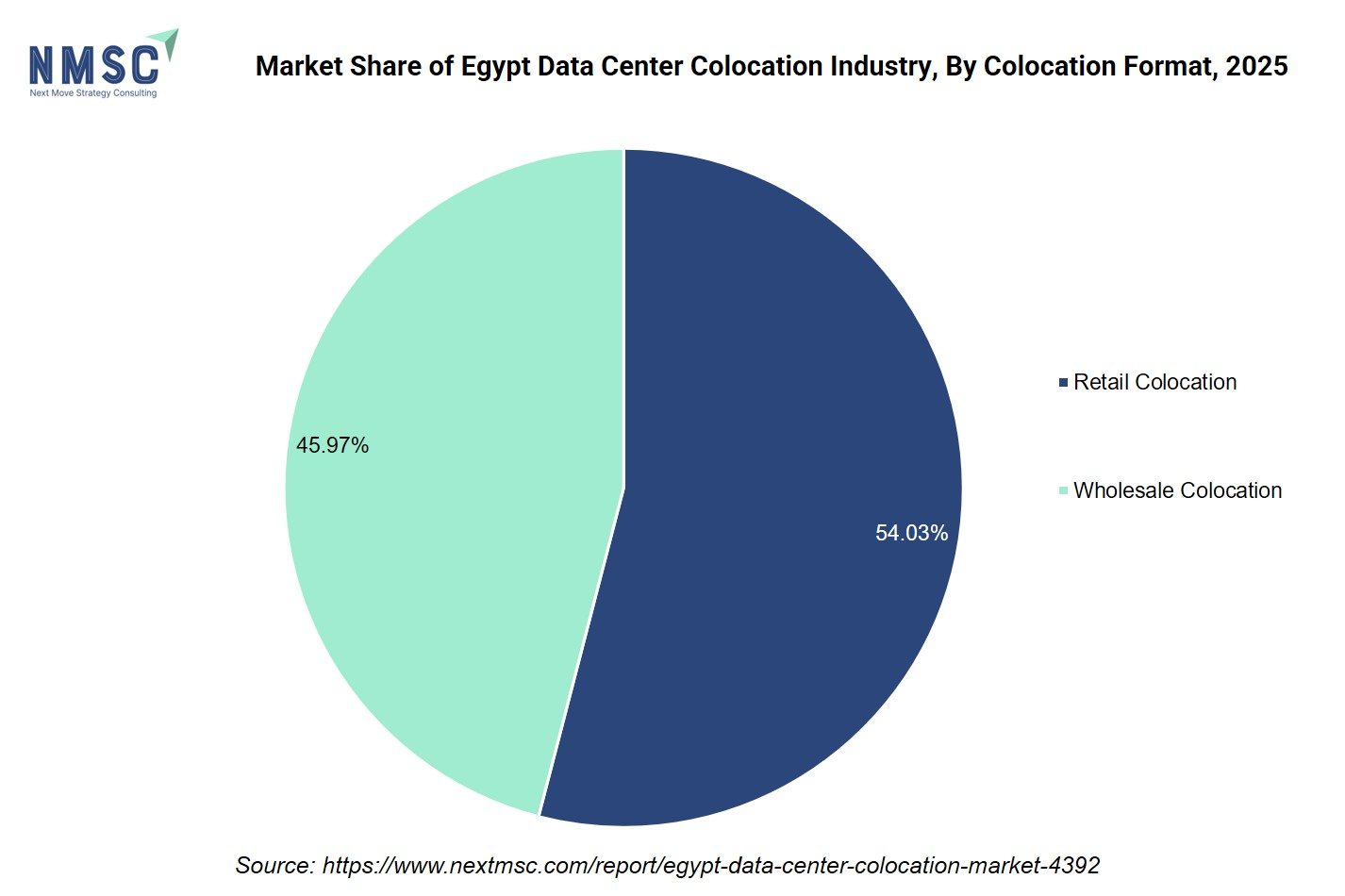
The Egypt data center colocation market size was valued at USD 134.7 million in 2025 and is estimated at USD 161 million in 2026, projected to reach USD 358.6 million by 2035, growing at a CAGR of 9.30% from 2026 to 2035. We analysed that Cairo led Egypt colocation revenue as the dominant demand hub, while Retail Colocation dominated the colocation format segmentation at roughly a 54% share.
Our findings suggest that the following key takeaways summarize the Egypt data center colocation market's segment-level dynamics as of 2025.
|
Key Takeaways |
|
By Colocation Format: Retail Colocation held the largest share, expanding from USD 72.8 million in 2025 to USD 163.4 million by 2035; Wholesale Colocation is the fastest-growing sub-segment at 11.15% CAGR from 2026–2035. |
|
By Delivery Model: Turnkey held the largest share, accounting for approximately 41% of the market with USD 55.53 million in 2025; Build-to-Suit is the fastest-growing sub-segment at 11.00% CAGR from 2026–2035. |
|
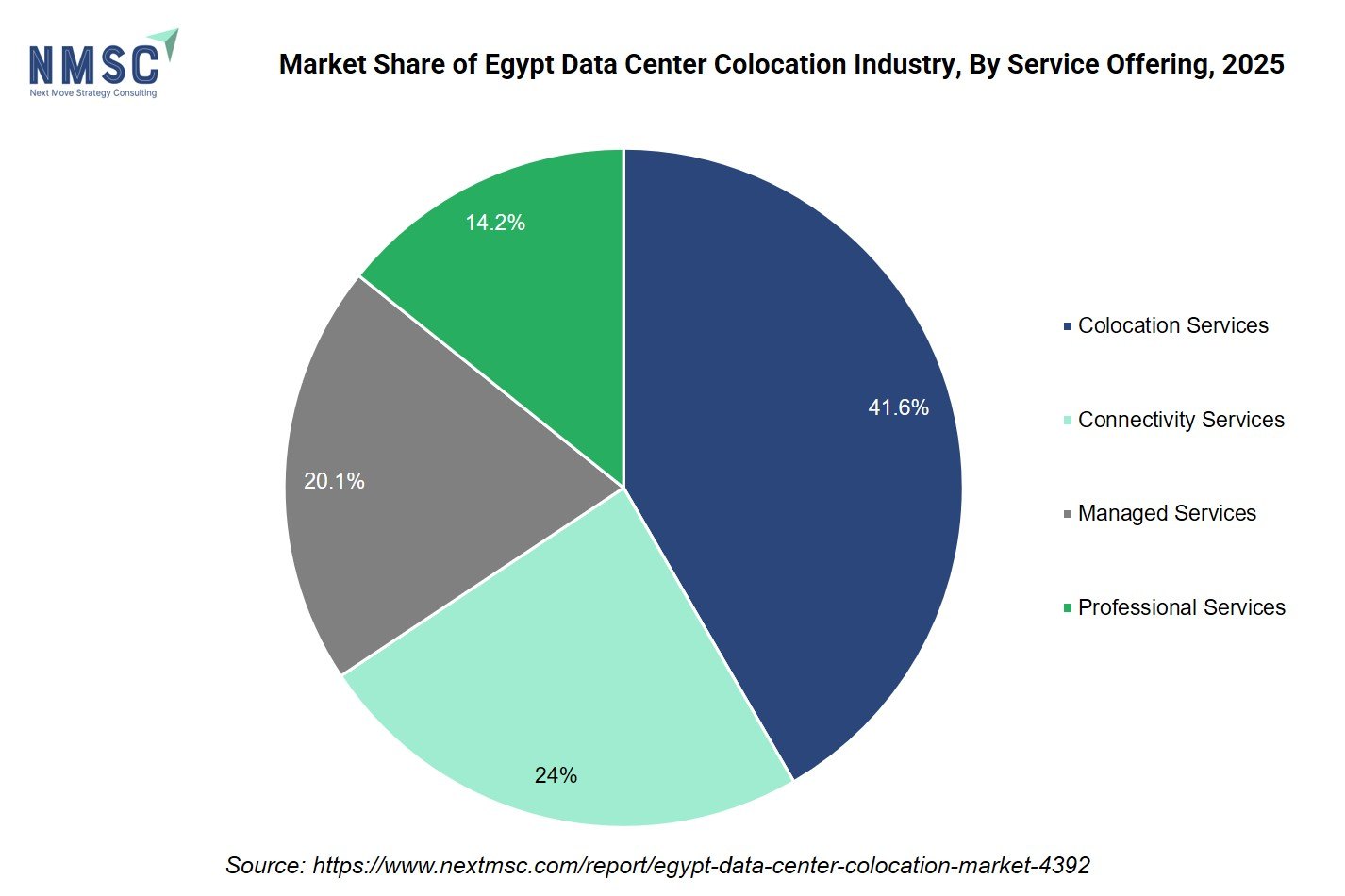
By Service Offering: Colocation Services held the largest share, accounting for approximately 42% of the market with USD 56.07 million in 2025; Managed Services is the fastest-growing sub-segment at 11.62% CAGR from 2026–2035. |
|
By Data Center Tier: Tier III held the largest share, accounting for approximately 40% of the market with USD 53.35 million in 2025; Tier IV is the fastest-growing sub-segment at 12.35% CAGR from 2026–2035. |
|
By Contracted Power Capacity: 250–999 kW held the largest share, accounting for approximately 23% of the market with USD 30.78 million in 2025; 20 MW and Above is the fastest-growing sub-segment at 14.34% CAGR from 2026–2035. |
|
By Tenancy Model: Multi-Tenant held the largest share, accounting for approximately 64% of the market with USD 86.34 million in 2025; Single Tenant is the fastest-growing sub-segment at 11.76% CAGR from 2026–2035. |
|
By Customer Type: Enterprises held the largest share, accounting for approximately 33% of the market with USD 44.19 million in 2025; Cloud Service Providers is the fastest-growing sub-segment at 12.38% CAGR from 2026–2035. |
Market Opportunity: The Egypt data center colocation market presents an absolute dollar opportunity of approximately USD 197.6 million between 2026 and 2035, calculated as the difference between the 2035 forecast value and the 2026 base value, an investment window favoring operators scaling wholesale, hyperscale-ready capacity.
According to NMSC analysis, we found that the gap between Egypt's expanding cloud on-ramp and internet exchange connectivity needs and its currently limited hyperscale colocation capacity is widening the addressable market for large-block wholesale providers, even as retail colocation continues to serve the country's broader enterprise base.
Ecosystem Analysis of the Egypt Data Center Colocation Industry
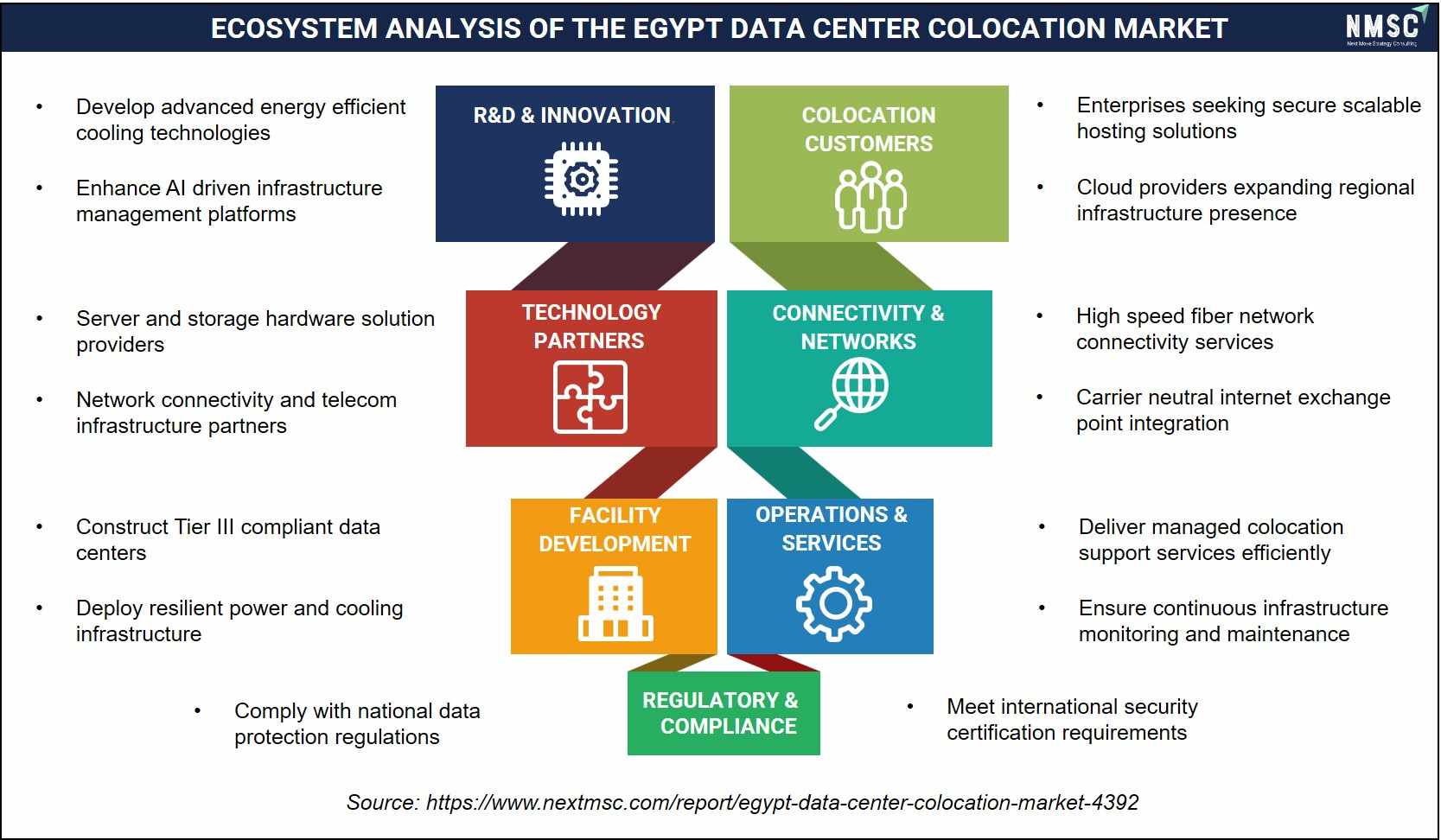
The above infographic presents an ecosystem analysis of the Egypt data center colocation market, covering R&D, technology partners, facility development, connectivity, operations, and regulatory compliance. Energy-efficient cooling technologies and AI-driven infrastructure platforms are being developed, supported by server and hardware providers, network providers, and telecom partners. Tier III compliant facilities are being constructed with resilient power and cooling infrastructure, while high-speed fiber networks and carrier-neutral internet exchanges ensure seamless connectivity. At the same time, managed colocation services and continuous monitoring support operational reliability, and national data protection regulations and international security certifications govern compliance. Looking ahead, we observed that these interconnected elements collectively shape the market's evolution across the region.
What does the Egypt Data Center Colocation Industry Encompass?
The Egypt data center colocation market encompasses retail and wholesale colocation space, power and cooling provisioning, connectivity, managed, and professional services delivered from third-party data center facilities across Egypt, spanning Tier I through Tier IV certified sites serving cloud service providers, network service providers, managed service providers, and enterprises. We observed that the market has structurally evolved from small carrier-neutral facilities toward larger, higher-tier campuses as Telecom Egypt, GPX Egypt, and other operators expand capacity to meet rising cloud migration and digital transformation demand across Cairo and Alexandria.
Egypt's data center operations are regulated by the National Telecommunications Regulatory Authority under Telecommunications Law No. 10 of 2003, requiring operators to secure official approval before offering colocation, cloud, or hosting services, while Personal Data Protection Law No. 151 of 2020 sets data-handling requirements that are building enterprise trust in local hosting. During our market evaluation, we noticed that data center infrastructure investment is accelerating fastest among wholesale and hyperscale-ready facilities as international connectivity through Telecom Egypt's subsea cable landing stations continues to expand.
|
Parameters |
Details |
|
Market Size in 2025 |
USD 134.7 Million |
|
Market Size in 2026 |
USD 161 Million |
|
Revenue Forecast in 2035 |
USD 358.6 Million |
|
Growth Rate |
CAGR of 9.30% from 2026 to 2035 |
|
Analysis Period |
2025–2035 |
|
Base Year Considered |
2025 |
|
Forecast Period |
2026–2035 |
|
Market Size Estimation |
Revenue (USD Million) |
|
Companies Profiled |
9 |
|
Market Share |
Available for Top 9 Companies |
Key Emerging Trends
Our analysis shows that four structural trends are reshaping facility design, connectivity strategy, and operator investment across the Egypt data center colocation market heading into 2035.
How Is Tier IV Facility Development Transforming Egypt's Colocation Landscape?
Tier IV facility development is transforming Egypt's colocation landscape as operators target the highest redundancy standard to attract enterprise and hyperscale-ready tenants. GPX Global Systems launched its second Cairo data center, a Tier IV facility adding 3,000 square meters of equipped space and 5 MW of power with a 99.999% uptime guarantee, illustrating how operators are scaling premium, fault-tolerant capacity. Stakeholder impact is greatest for cloud service providers and financial institutions requiring the highest levels of operational continuity.
Why Is Subsea Cable Connectivity Expansion Accelerating Colocation Demand?
Expanding subsea cable connectivity is accelerating colocation demand as Egypt strengthens its position as a regional interconnection hub between Europe, Africa, and Asia. Telecom Egypt's data center platform connects to more than 60 countries through its subsea cable landing stations, with the operator's submarine cable systems continuing to expand to reinforce Egypt's role in international data exchange. We found that this connectivity depth is a primary reason global hyperscalers view Egypt as a strategic edge location for both African and European markets.
How Is Personal Data Protection Regulation Reshaping Local Hosting Demand?
Egypt's Personal Data Protection Law No. 151 of 2020 is reshaping local hosting demand as enterprises increasingly prefer to store customer data within domestic colocation facilities that meet the law's security and consent requirements. This regulatory framework is building enterprise trust in local data centers over offshore alternatives, particularly among BFSI and government customers with heightened compliance obligations. Our assessment indicates that operators demonstrating clear compliance with the law's data-handling standards are gaining a measurable competitive advantage.
Why Is Wholesale Colocation Gaining Share Among Large Enterprise Tenants?
Wholesale colocation is gaining share among large enterprise and cloud tenants seeking dedicated data halls and private suites rather than shared retail rack space. As Egypt's cloud adoption and content-service demand scale, tenants requiring multi-megawatt contracted capacity are increasingly favoring wholesale agreements that offer greater control over power density and physical security. Based on research conducted by NMSC, we found that this shift is driving operators to reconfigure new-build capacity toward larger, wholesale-ready floor plans.
Growth Drivers & Restraints
Growth Catalyst & Risk Assessment Matrix
|
Factors |
Type |
(+/−) % Impact on CAGR |
Geographic Relevance |
Impact Timeline |
|
Expanding subsea cable and international connectivity infrastructure |
Driver |
+2.4% |
Cairo, Alexandria |
2026–2032 |
|
Rising cloud migration and enterprise digital transformation demand |
Driver |
+2.1% |
Cairo |
2026–2033 |
|
Personal Data Protection Law driving local hosting preference |
Driver |
+1.6% |
Nationwide |
2026–2030 |
|
NTRA regulatory clarity supporting operator licensing and investment |
Driver |
+1.2% |
Nationwide |
2026–2029 |
|
Growing wholesale and hyperscale-ready facility investment |
Driver |
+1.0% |
Cairo |
2026–2032 |
|
Limited grid power capacity constraining large-scale facility expansion |
Restraint |
−1.4% |
Nationwide |
2026–2030 |
|
Currency volatility affecting capital-intensive facility construction costs |
Restraint |
−0.9% |
Nationwide |
2026–2029 |
|
Competition from regional Middle East hubs for hyperscale investment |
Restraint |
−0.6% |
Nationwide |
2026–2031 |
What Is the Primary Growth Driver of the Egypt Data Center Colocation Market?
Expanding subsea cable and international connectivity infrastructure is the single largest driver of Egypt colocation revenue, as Telecom Egypt's landing-station network directly determines how attractive Egyptian facilities are to global content and cloud providers. Telecom Egypt's official disclosures confirm its data center platform connects to more than 60 countries through its subsea systems, with continued expansion strengthening Egypt's role as a regional digital hub. We observed that this connectivity advantage underpins demand across both retail and wholesale colocation formats.
How Is Cloud Migration Driving Market Growth?
Rising cloud migration and digital transformation initiatives are driving demand for Egypt data center capacity MW, particularly among cloud service providers requiring cloud on-ramp connectivity within domestic facilities. Egypt's National Telecommunications Regulatory Authority requires operators to secure official approval under Telecommunications Law No. 10 of 2003 before offering colocation, cloud, or hosting services, reflecting the formalized regulatory pathway supporting this expansion. Our analysis shows that the Cloud Service Providers customer segment is growing at a 12.38% CAGR, outpacing the broader market average of 9.30%.
What Is Restraining Egypt Data Center Colocation Market Growth?
Limited grid power capacity restrains large-scale facility expansion, particularly for wholesale and hyperscale-ready developments requiring multi-megawatt contracted power allocations. Currency volatility affecting capital-intensive facility construction costs also restrains new-build investment timelines for operators sourcing imported mechanical and electrical equipment. We found that these pressures weigh most heavily on new-entrant operators lacking the balance-sheet scale of established players such as Telecom Egypt and GPX Egypt.
Segmentation Analysis
Segment Sizing: By Colocation Format
|
Segment |
2025 (USD Million) |
2035 (USD Million) |
CAGR% (2026–2035) |
|
Retail Colocation |
72.8 Million |
163.4 Million |
7.45% |
|
Wholesale Colocation |
61.9 Million |
195.2 Million |
11.15% |
|
Total |
134.7 Million |
358.6 Million |
9.30% |
Which Colocation Format Segment Dominates the Market?
Retail Colocation dominates Egypt colocation revenue with approximately 54% share in 2025, valued at USD 72.8 million, reflecting the broad base of small and mid-sized enterprises leasing quarter, half, and full racks across Cairo facilities. Egypt wholesale colocation is the fastest-growing format at an 11.15% CAGR from 2026 to 2035, as cloud service providers and large enterprises increasingly contract private suites and dedicated data halls to support scaling digital infrastructure needs.
Segment Sizing: By Delivery Model
|
Segment |
2025 (USD Million) |
2035 (USD Million) |
CAGR% (2026–2035) |
|
Turnkey |
55.53 Million |
125.71 Million |
7.53% |
|
Powered Shell |
43.10 Million |
120.87 Million |
9.87% |
|
Build-to-Suit |
36.01 Million |
112.05 Million |
11.00% |
|
Total |
134.7 Million |
358.6 Million |
9.30% |
Which Delivery Model Segment Is Growing Fastest?
Turnkey delivery leads the delivery-model segmentation with approximately 41% share in 2025 at USD 55.53 million, reflecting tenant preference for fully fitted-out space that minimizes deployment time. Build-to-Suit is the fastest-growing delivery model at an 11.00% CAGR, as large cloud service providers and enterprises increasingly commission custom-designed facilities tailored to specific power density, cooling, and security requirements not met by standard turnkey offerings.
Segment Sizing: By Service Offering
|
Segment |
2025 (USD Million) |
2035 (USD Million) |
CAGR% (2026–2035) |
|
Colocation Services |
56.07 Million |
127.85 Million |
7.61% |
|
Connectivity Services |
32.34 Million |
90.11 Million |
9.80% |
|
Managed Services |
27.06 Million |
89.07 Million |
11.62% |
|
Professional Services |
19.18 Million |
51.60 Million |
9.41% |
|
Total |
134.7 Million |
358.6 Million |
9.30% |
Which Service Offering Segment Leads the Market?
Colocation Services lead the service-offering segmentation with approximately 42% share in 2025 at USD 56.07 million, anchored by core space, power, and cooling provisioning that forms the baseline revenue for every tenant relationship. Managed Services is the fastest-growing segment at an 11.62% CAGR, as enterprises increasingly outsource remote hands, smart hands, and managed security functions to colocation operators rather than maintaining on-site technical staff.
Growth Opportunities
Beyond the core drivers shaping overall demand, three whitespace opportunities stand out for operators positioning portfolios toward 2035.
How Can Operators Capture Value from Hyperscale-Ready Wholesale Capacity?
Developing large-block, hyperscale-ready wholesale capacity creates a mechanism for operators to capture cloud service provider tenancy as global hyperscalers evaluate Egypt as a regional edge location. Operators with confirmed multi-megawatt power allocations and Tier III or Tier IV certification stand to benefit most from this fastest-growing colocation-format opportunity.
What Opportunity Exists in Managed Security and Compliance Services?
Egypt's Personal Data Protection Law creates a mechanism for operators to bundle managed security and compliance services alongside core colocation space, helping BFSI and government tenants meet regulatory obligations without building in-house compliance capability. Operators offering integrated compliance-service packages are best positioned to capture this fastest-growing service-offering opportunity.
How Can Providers Benefit from Expanding Subsea Cable Interconnection?
Egypt's growing subsea cable landing-station network creates a mechanism for colocation providers to capture carrier connectivity and internet exchange revenue as content and cloud providers seek low-latency interconnection points between Europe, Africa, and Asia. Providers with facilities directly connected to major cable systems are best positioned to capture this connectivity-driven opportunity.
Competitive Landscape
Our assessment indicates that competitive intensity in the Egypt data center colocation industry is shaped by a small group of telecom-affiliated and specialist colocation providers competing on connectivity, certification tier, and enterprise trust.
|
Key Takeaways |
Details |
|
Market Structure |
Concentrated among a small number of telecom-affiliated and independent specialist operators, with Telecom Egypt and GPX Egypt holding established connectivity and facility advantages. |
|
Innovation Focus |
Tier IV facility certification, subsea cable interconnection depth, and managed security and compliance service bundling. |
|
M&A Activity |
Selective capacity expansion and telecom-affiliated facility investment rather than large-scale consolidation among established providers. |
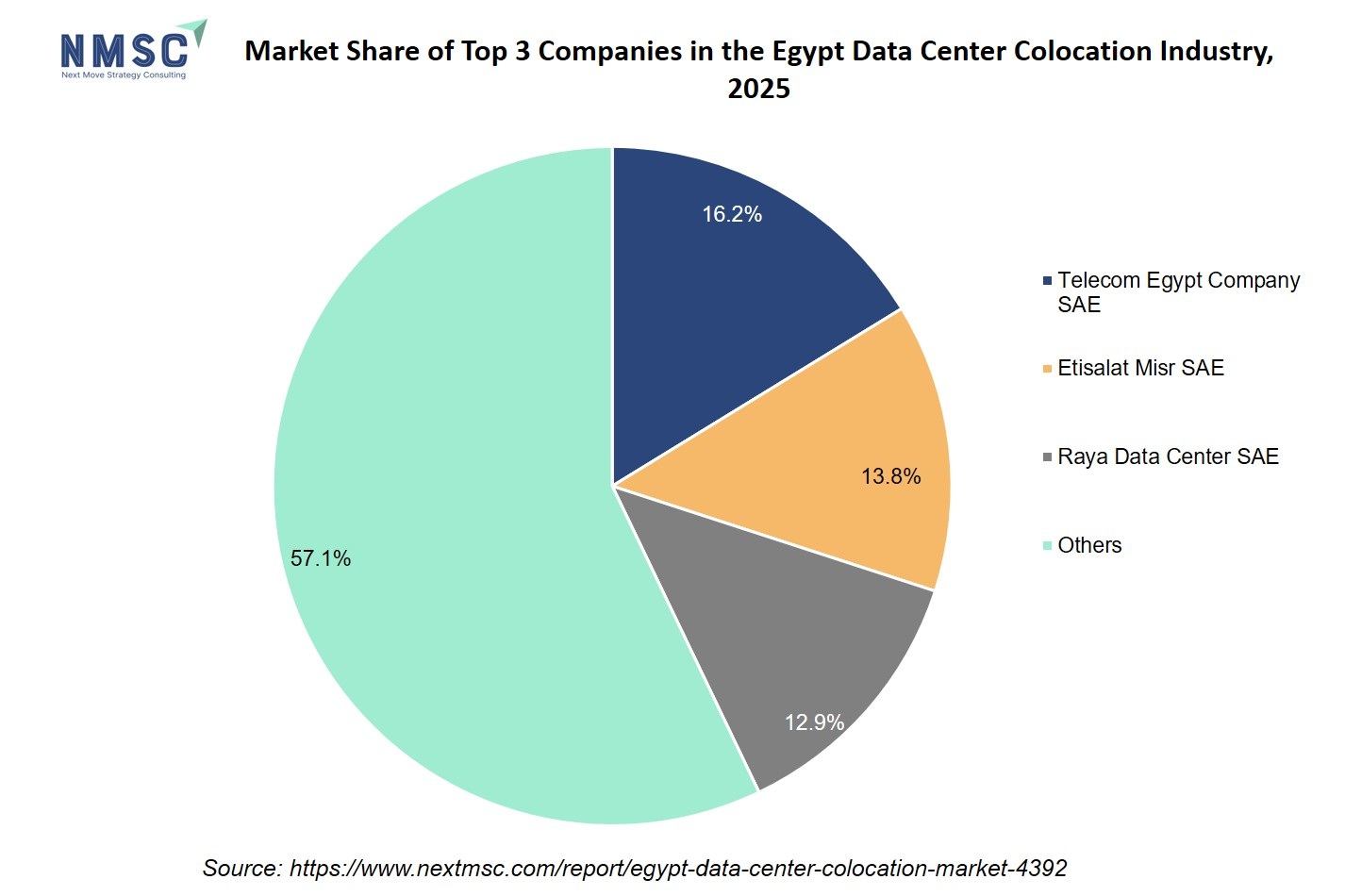
How Do Companies Compete in the Egypt Data Center Colocation Market?
Companies compete primarily on international connectivity depth, facility tier certification, power availability, and demonstrated compliance with Egypt's data protection framework. Our analysis shows that Telecom Egypt competes on its extensive subsea cable landing-station network and national telecom infrastructure, while GPX Egypt competes on carrier-neutral, high-redundancy Tier IV facility design targeting enterprise and cloud service provider tenants.
Which Competitive Archetypes Dominate the Egypt Data Center Colocation Industry?
Two archetypes dominate the market: telecom-affiliated operators leveraging national network infrastructure and subsea cable ownership, and independent carrier-neutral specialists competing on facility design and uptime guarantees. Telecom Egypt exemplifies the telecom-affiliated archetype through its integrated subsea cable and data center platform, while GPX Egypt exemplifies the carrier-neutral specialist archetype through its dedicated, high-redundancy Cairo facilities.
How Are Companies Differentiating Through Innovation?
Innovation and differentiation increasingly center on facility redundancy certification and connectivity breadth. GPX Global Systems' Tier IV Cairo facility offering a 99.999% uptime guarantee, and Telecom Egypt's continuously expanding subsea cable landing-station count, both illustrate how operators are embedding proprietary infrastructure advantages to differentiate beyond commodity rack space.
What M&A and Expansion Activity Is Shaping the Egypt Data Center Colocation Industry?
Expansion activity is concentrated in facility capacity additions and connectivity infrastructure investment rather than large-format acquisitions. GPX Global Systems' launch of its second Cairo data center, adding 3,000 square meters of equipped space and 5 MW of power, illustrates how operators are scaling through organic facility investment to meet rising enterprise and cloud demand.
Key Market Players
Our assessment indicates that the following nine companies are actively shaping facility investment, connectivity infrastructure, and service innovation within the Egypt data center colocation market.
-
Telecom Egypt Company SAE
-
GPX Egypt Ltd.
-
Vodafone Egypt Telecommunications SAE
-
Orange Egypt for Telecommunications S.A.E.
-
Etisalat Misr SAE
-
Raya Data Center SAE
-
Egypt Cyber Center SAE
-
NOOR Data Network S.A.E.
-
Egypt Information Technology (EGIT) S.A.E.
Latest Developments
We found that recent facility expansions and infrastructure investments within the market are concentrated on connectivity depth and higher-tier certification across 2025 and 2026.
|
Date |
Event |
|
July 2026 |
Telecom Egypt announced that it would retain full ownership of its Regional Data Center Hub (RDH) after terminating the proposed sale of a majority stake to Helios Investment Partners. |
Expert Insights

“As demand for digital infrastructure continues to accelerate, securing reliable capacity has become more critical than ever.”
— Jeff Tapley, Chief Operating Officer, Digital Realty
Statement made during the announcement of Digital Realty's supply capacity agreement with Schneider Electric
Market Interpretation
The statement highlights the growing importance of reliable capacity and resilient digital infrastructure in supporting the rapid expansion of data center colocation services. NMSC's analysis indicates that accelerating adoption of cloud computing, AI workloads, and enterprise digital transformation is intensifying demand for scalable colocation facilities with dependable power availability and operational resilience. Our findings further suggest that colocation providers are increasingly prioritizing capacity expansion, power infrastructure investments, and strategic partnerships to address supply constraints, support hyperscale and enterprise requirements, and strengthen long-term market competitiveness.
Regulatory Framework Impacting the Egypt Data Center Colocation Industry
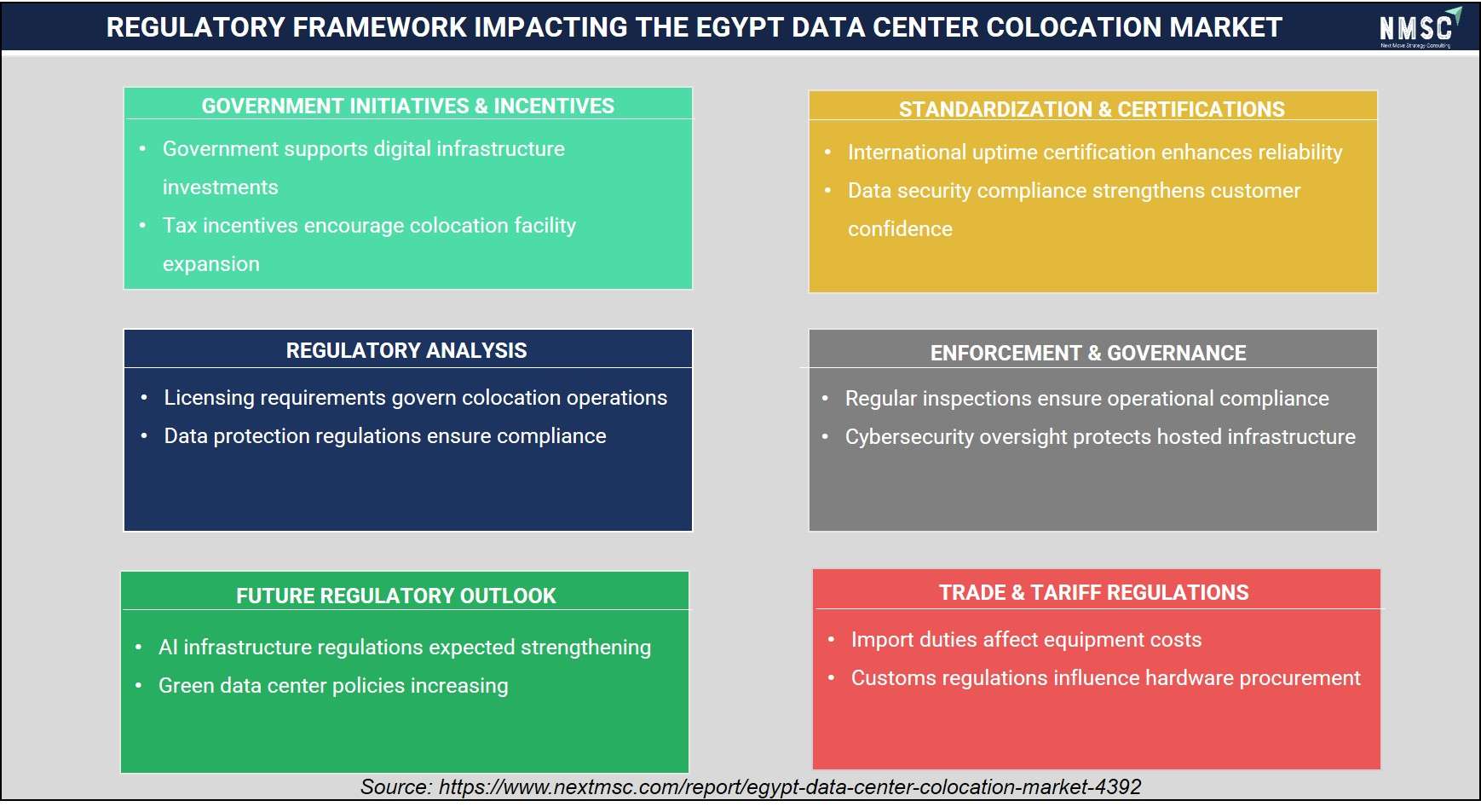
The above infographic presents a regulatory framework impacting the Egypt data center colocation market, where government support and tax incentives are encouraging digital infrastructure investments and facility expansion. Licensing requirements and data protection regulations are shaping operational compliance, while international uptime certifications and security standards are strengthening customer confidence. Enforcement through regular inspections and cybersecurity oversight ensures operational reliability, and future regulations are focusing on AI infrastructure and green data center policies. Looking ahead, we observed that import duties and customs regulations continue to influence equipment costs and hardware procurement across the market.
Investment Opportunities
What Capital Inflows Are Targeting the Egypt Data Center Colocation Market?
Capital inflows are increasingly directed toward wholesale and hyperscale-ready facility development, with Khazna Data Centers securing consortium funding in September 2025 to expand data center capacity across the Egyptian market. We observed that investors favor operators demonstrating confirmed power allocations and Tier III or Tier IV certification, viewing facility redundancy as a proxy for enterprise and cloud service provider tenant readiness.
How Is Infrastructure Investment Supporting the Market Growth?
Infrastructure investment tied to subsea cable landing-station expansion continues to underwrite Egypt's position as a regional connectivity hub. Telecom Egypt's continued growth in submarine cable system count directly supports colocation demand by improving international bandwidth and latency for tenant workloads. Our findings suggest that operators co-located near landing stations are best positioned to capture this connectivity-anchored investment advantage through 2035.
What ESG Considerations Are Shaping Investment Decisions?
Energy availability and grid reliability are central governance considerations shaping investment decisions, as Egypt's data center operators must secure sufficient, stable power allocations to support growing contracted capacity demand, particularly at the 20 MW and Above tier. We found that investors increasingly treat confirmed power-purchase arrangements and data-protection compliance under Law No. 151 of 2020 as governance indicators alongside conventional financial performance metrics.
Key Benefits for Stakeholders
How Does This Report Benefit Enterprise and Industry Leaders?
Enterprise and industry leaders gain access to validated segmentation, competitive benchmarking, and demand forecasts that support facility-selection and technology-investment decisions across the Egypt data center colocation industry. Our analysis shows that detailed colocation format, delivery model, and service offering breakdowns help procurement teams align sourcing strategy with the fastest-growing segments, including Wholesale Colocation and Managed Services.
How Does This Report Benefit Investors and Financial Analysts?
Investors and financial analysts benefit from consistent, single-point market size and CAGR estimates that support valuation and capital-allocation decisions across the Egypt data center colocation supply chain. We observed that the report's segment-level growth differentials help identify which operators are best positioned to capture above-market growth in wholesale colocation and cloud service provider tenancy through 2035.
How Does This Report Benefit Technology Vendors and Product Teams?
Technology vendors and product teams gain insight into emerging facility requirements, including Tier IV certification, managed security service bundling, and expanding contracted power capacity tiers, that are reshaping the industry. Our findings suggest that this analysis helps vendors prioritize product roadmaps around the Data Center Tier and Contracted Power Capacity segments showing the strongest above-market growth trajectories.
Key Market Segments
By Colocation Format
-
Retail Colocation
-
Quarter Rack
-
Half Rack
-
Full Rack
-
Private Cage
-
Custom Suite
-
-
Wholesale Colocation
-
Private Suite
-
Dedicated Data Hall
-
Entire Facility
-
By Delivery Model
-
Turnkey
-
Powered Shell
-
Build-to-Suit
By Service Offering
-
Colocation Services
-
Space Leasing
-
Power Provisioning
-
Cooling Provisioning
-
-
Connectivity Services
-
Carrier Connectivity
-
Internet Exchange Connectivity
-
Cloud On-Ramp Connectivity
-
Enterprise Private Connectivity
-
-
Managed Services
-
Remote Hands
-
Smart Hands
-
Managed Security Services
-
Backup & Disaster Recovery Services
-
-
Professional Services
-
Migration Services
-
Deployment Services
-
Consulting Services
-
Compliance Services
-
By Data Center Tier
-
Tier I
-
Tier II
-
Tier III
-
Tier IV
By Contracted Power Capacity
-
Less than 250 kW
-
250–999 kW
-
1–4.99 MW
-
5–9.99 MW
-
10–19.99 MW
-
20 MW and Above
By Tenancy Model
-
Single Tenant
-
Multi-Tenant
By Customer Type
-
Cloud Service Providers
-
Network Service Providers
-
Managed Service Providers
-
Enterprises
-
IT and Telecommunication
-
Healthcare
-
BFSI
-
Retail & E-commerce
-
Media and Entertainment
-
Government
-
Energy
-
Other Enterprises
-
Conclusion and Recommendations
What Is the Long-Term Outlook for the Egypt Data Center Colocation Market?
The long-term outlook for the Egypt data center colocation market remains positive, with revenue projected to grow more than twofold from USD 134.7 million in 2025 to USD 358.6 million by 2035 at a 9.30% CAGR. We observed that expanding subsea cable connectivity, rising cloud migration, and supportive data-protection regulation will continue underpinning demand across retail and wholesale colocation formats through the forecast period.
What Strategic Positioning Should Colocation Operators Pursue?
Operators should prioritize Tier III and Tier IV facility certification and wholesale-ready power capacity while maintaining strong subsea cable interconnection to capture cloud service provider tenancy. Our assessment indicates that operators investing early in managed security and compliance service bundles will be best positioned to capture premium enterprise revenue while retaining broad retail colocation demand.
How Attractive Is the Market for New Investment?
The Egypt data center colocation market presents an attractive investment case, supported by a USD 197.6 million absolute dollar opportunity between 2026 and 2035 and above-average growth in Wholesale Colocation and Cloud Service Providers. We found that investment attractiveness is highest for operators combining confirmed power allocations with strong connectivity infrastructure, positioning them to serve both established enterprise tenants and emerging hyperscale demand simultaneously.
What Market Shifts and Key Risks Should Stakeholders Monitor?
Stakeholders should monitor limited grid power capacity, currency volatility affecting construction costs, and competition from regional Middle East hubs as key risks to the Egypt data center colocation market. Our analysis shows that operators unable to secure confirmed power allocations risk losing wholesale and hyperscale tenant opportunities to better-resourced regional competitors.
What Are the Key Growth Pathways for the Egypt Data Center Colocation Market?
Key growth pathways include scaling Tier IV wholesale capacity, deepening subsea cable interconnection, and expanding managed security and compliance service offerings tied to Egypt's data protection framework. Next Move Strategy Consulting's analysis indicates that operators pursuing these pathways while maintaining reliable power infrastructure will be best positioned to capture the market's projected growth through 2035.


About the Author
 Mayurima Roy
— Mayurima Roy is Research Analyst at Next Move Strategy Consulting, where she has spent 4 years working across the firm's full industry coverage rather than a single fixed vertical. Her work centers on structured research, ongoing trend tracking, competitive assessment, and insight-led content development, translating complex market data into clear, decision-ready narratives that support informed client decision-making across diverse global industries, market sectors, and world regions every day.
Mayurima Roy
— Mayurima Roy is Research Analyst at Next Move Strategy Consulting, where she has spent 4 years working across the firm's full industry coverage rather than a single fixed vertical. Her work centers on structured research, ongoing trend tracking, competitive assessment, and insight-led content development, translating complex market data into clear, decision-ready narratives that support informed client decision-making across diverse global industries, market sectors, and world regions every day.
About the Reviewer
 Supradip Baul
— Supradip Baul is an accomplished business consultant and strategist with over a decade of rich experience in market intelligence, strategy, technology, and business transformation. His work has included rigorous qualitative and quantitative analysis across multiple industries, helping clients shape investment decisions and long-term roadmaps. Earlier in his career, he was associated with Gartner, where he contributed to industry-leading reports and market share analyses. He has worked with leading global companies and holds an MBA with a dual specialization in Marketing and Finance.
Supradip Baul
— Supradip Baul is an accomplished business consultant and strategist with over a decade of rich experience in market intelligence, strategy, technology, and business transformation. His work has included rigorous qualitative and quantitative analysis across multiple industries, helping clients shape investment decisions and long-term roadmaps. Earlier in his career, he was associated with Gartner, where he contributed to industry-leading reports and market share analyses. He has worked with leading global companies and holds an MBA with a dual specialization in Marketing and Finance.
At Next Move Strategy Consulting, we understand that insightful market research is the cornerstone of successful business decisions. That's why we employ a robust and multifaceted approach, combining various methodologies to deliver the most accurate and actionable data for our clients.

Research Landscape
We navigate the world of research with two primary approaches:
Qualitative Approach
Our qualitative research methodologies involve immersive techniques such as in-depth interviews, focus groups, and observational studies. By engaging directly with individuals and stakeholders, we uncover valuable insights that quantitative data alone may overlook.

Quantitative Research
In tandem with qualitative methodologies, NMSC leverages the power of Quantitative Research to provide a robust foundation of numerical insights. Through systematic data collection and analysis, we quantify patterns, preferences, and market trends, offering a comprehensive view of the business landscape.
Our quantitative research approach employs diverse tools, including surveys, experiments, and statistical modelling. These methodologies enable us to gather data from a large and representative sample, ensuring the statistical significance of our findings. By employing structured questionnaires and standardized data collection methods, we guarantee the reliability and validity of the information we present to our clients.
Quantitative research is particularly effective in measuring the prevalence of trends, assessing market size, and gauging the impact of various factors on consumer behavior. The numerical precision attained through this approach equips our clients with actionable insights, facilitating data-driven decision-making and strategy formulation.


Our Specialized Toolbox for Industry-Specific Market Research
We deploy a specialized arsenal of techniques tailored to meet your unique requirements. Here's a glimpse into our comprehensive toolbox:

Information Procurement
The stage entails acquiring market data or relevant information through various sources and methodologies.


Market Research Approach
We utilize both top-down and bottom-up approaches in market research analysis to achieve a comprehensive understanding of the market dynamics, leveraging the broad perspective of industry trends and macroeconomic factors alongside detailed insights from specific segments and individual companies.

Porters Five Forces Analysis
We conduct Porter's Five Forces analysis to evaluate the competitive landscape of an industry, providing us with insights into factors that affect profitability and strategic positioning.

SWOT Analysis

Forecasting
We utilize a forecasting model to predict future consumption by considering parameters like population, economics, regulations, market competition, drivers, constraints, technology, and pricing. We also employ statistical techniques such as multilinear regression, exponential smoothing, moving average, ARIMA, and Monte Carlo simulations for accurate predictions. In econometric forecasting, we analyzed short-term and long-term event impacts, attributing values based on regulatory frameworks, economic factors, and market events.





 Speak to Our Analyst