Arm Servers in the Data Center Market Size, Share, Trends and Growth Analysis, By Component (Processor, Server Systems, Software & Services), By Deployment (Hyperscale/Cloud Data Center, Enterprise Data Center, Edge Data Center, HPC/Research Data Center), By End User (Cloud Service Providers, Enterprise Organizations, Telecom Operators, and Government & Research Institutions), By Region — Global Industry Report and Forecast, 2026–2035
Industry: ICT & Media | Publishing Date: August 7, 2026 | Last Updated: August 7, 2026 | No of Pages: N/A | No. of Tables: N/A | No. of Figures: N/A | Format: PDF | Report Code: IC5634
What Is the Arm Servers in the Data Center Market Size?
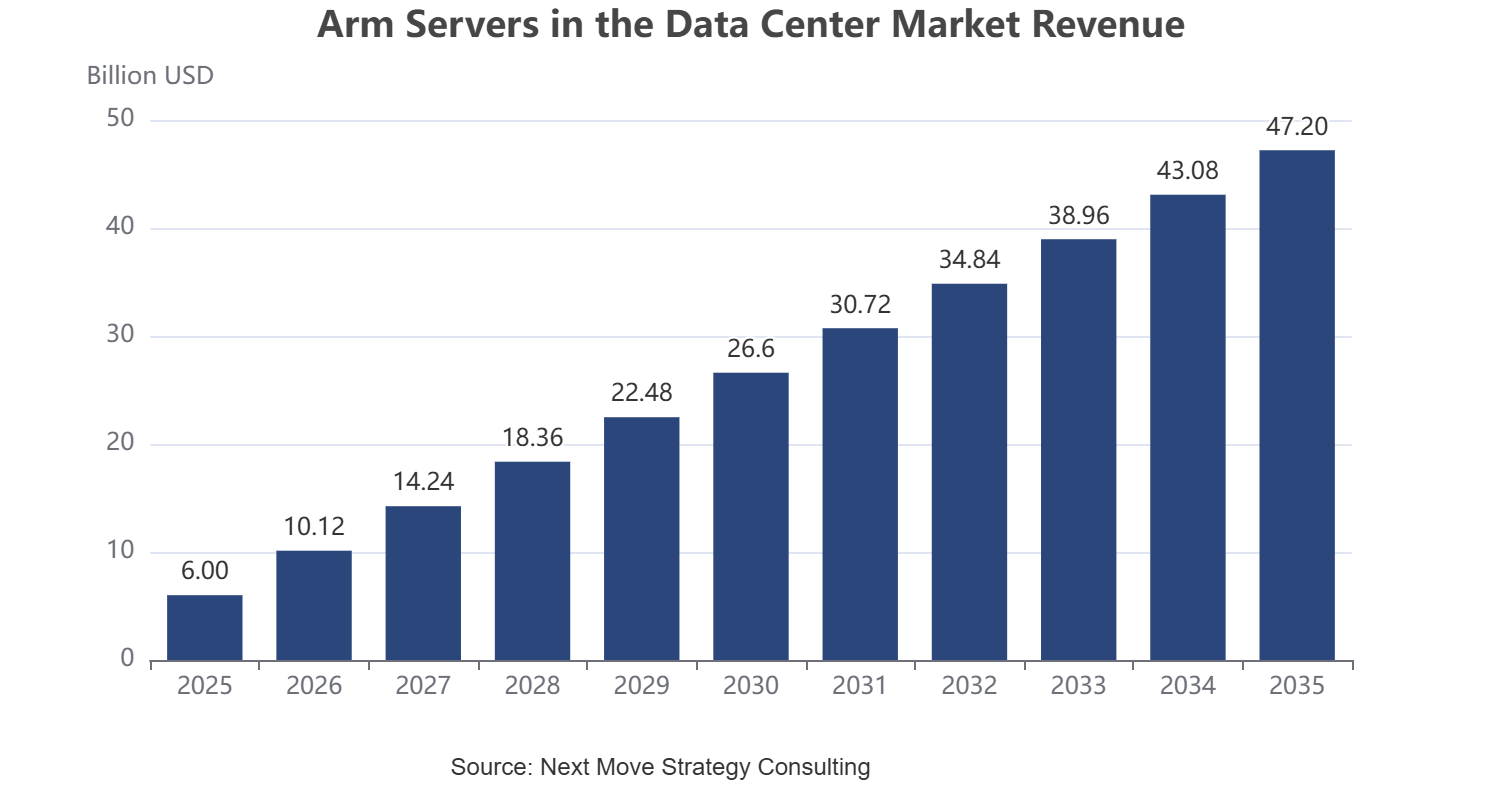
The global arm servers in the data center market size was valued at USD 6.00 billion in 2025 and is estimated at USD 7.05 billion in 2026, projected to reach USD 47.20 billion by 2035, expanding at a CAGR of 23.50% between 2026 and 2035, with North America holding approximately 53.3% share and Processor accounting for nearly 60.0% of 2025 revenue.
We observed that demand is broadening across hyperscale cloud infrastructure, enterprise data center modernization, and edge computing deployment as operators prioritize power-efficient Arm-based server architectures over traditional x86 platforms for scale-out workloads.
|
Key Takeaways |
|
By Component: Processor held the largest share of approximately 60.0% (USD 3.60 Billion) in 2025; Server Systems is the fastest-growing sub-segment at 24.2% CAGR from 2026–2035. |
|
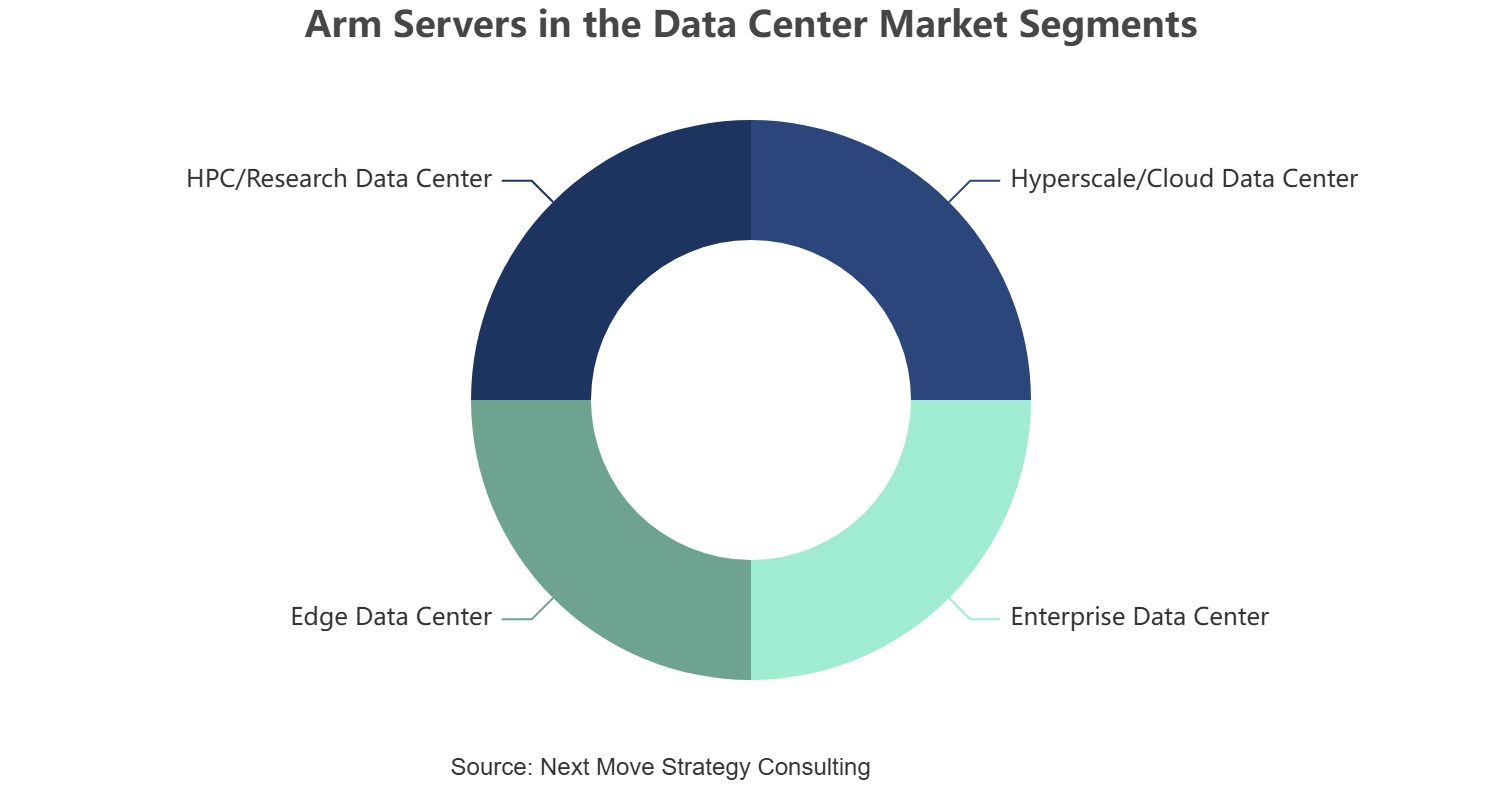
By Deployment: Hyperscale/Cloud Data Center held the largest share of approximately 68.3% (USD 4.10 Billion) in 2025; Edge Data Center is the fastest-growing sub-segment at 26.6% CAGR from 2026–2035. |
|
By End User: Cloud Service Providers held the largest share of approximately 65.0% (USD 3.90 Billion) in 2025; Enterprise Organizations is the fastest-growing sub-segment at 25.3% CAGR from 2026–2035. |
|
Dominant Region: North America dominated with approximately 53.3% revenue share (USD 3.20 Billion) in 2025. |
|
Fastest-Growing Region: Asia-Pacific is expected to register the highest CAGR of 26.8% during 2026–2035. |
|
Dominant Country: U.S. led with approximately USD 2.85 Billion in 2025. |
|
Fastest-Growing Country: India is the fastest-growing country at approximately 29.5% CAGR from 2026–2035. |
Market Opportunity: The arm servers in the data center market is expected to create an absolute dollar opportunity of USD 40.15 billion between 2026 and 2035, positioning Arm-based processor and server system vendors as priority allocations for hyperscale infrastructure investors.
According to Next Move Strategy Consulting analysis, hyperscale cloud operators are increasingly designing custom Arm-based silicon in-house, reflecting stakeholder demand for tighter performance-per-watt optimization across large-scale compute fleets.
Arm Servers in the Data Center Market Overview
What Does the Arm Servers in the Data Center Market Encompass?
The arm servers in the data center market encompasses Arm-architecture processors, server systems, and supporting software deployed across hyperscale, enterprise, edge, and high-performance computing data center environments. Our analysis shows that the market has evolved from niche experimental deployments toward mainstream hyperscale adoption as cloud providers develop custom silicon optimized for power efficiency and scale-out workloads.
Regulatory frameworks including U.S. Department of Energy data center efficiency guidance and European Union energy efficiency directives shape server power consumption standards across covered geographies. We found that technology adoption trends, including Arm Neoverse platform advancements and chiplet-based server design, are accelerating differentiation among established silicon vendors and hyperscale in-house design teams.
|
Parameter |
Details |
|
Market Size in 2025 |
USD 6.00 Billion |
|
Market Size in 2026 |
USD 7.05 Billion |
|
Revenue Forecast in 2035 |
USD 47.20 Billion |
|
Growth Rate |
CAGR of 23.50% from 2026 to 2035 |
|
Analysis Period |
2025–2035 |
|
Base Year Considered |
2025 |
|
Forecast Period |
2026–2035 |
|
Market Size Estimation |
Revenue (USD Billion) |
|
Companies Profiled |
20 |
|
Countries Covered |
33 |
|
Market Share |
Available for Top 10 Companies |
Key Emerging Trends
Based on research conducted by Next Move Strategy Consulting, we found that four structural trends are reshaping how data center operators select server processor architectures.
How Is Custom Silicon Design Transforming Hyperscale Server Procurement?
Custom silicon design is transforming hyperscale server procurement as cloud providers develop proprietary Arm-based processors tailored to internal workload profiles. We observed that Amazon.com, Inc. has expanded its Graviton processor family across additional instance types, reducing reliance on third-party silicon vendors. This transformation is reshaping procurement economics across large-scale cloud infrastructure deployments.
Why Is Power Efficiency Driving Arm Server Adoption in Data Centers?
Power efficiency is driving Arm server adoption as data center operators face rising energy costs and sustainability commitments. Our assessment indicates that operators increasingly prioritize performance-per-watt metrics when evaluating server platforms, directly impacting procurement specifications and vendor differentiation strategies across power-constrained facility environments.
How Is Edge Computing Expansion Accelerating Arm Server Deployment?
Edge computing expansion is accelerating Arm server deployment as telecom operators and content delivery networks require compact, power-efficient compute nodes at distributed locations. Our findings suggest that edge infrastructure providers increasingly favor Arm-based platforms offering reduced thermal footprint, with Ampere Computing LLC reporting expanded processor volumes tied to edge data center deployment programs.
What Role Does Chiplet-Based Design Play in Server Processor Innovation?
Chiplet-based design is emerging within Arm server processor development to enable modular scaling of core counts and memory bandwidth without full monolithic redesign. We noticed that Marvell Technology, Inc. has expanded its chiplet-compatible processor architecture, reflecting broader stakeholder demand for flexible, cost-efficient silicon scaling pathways.
Supply Chain Structure of the Arm Servers in the Data Center Market
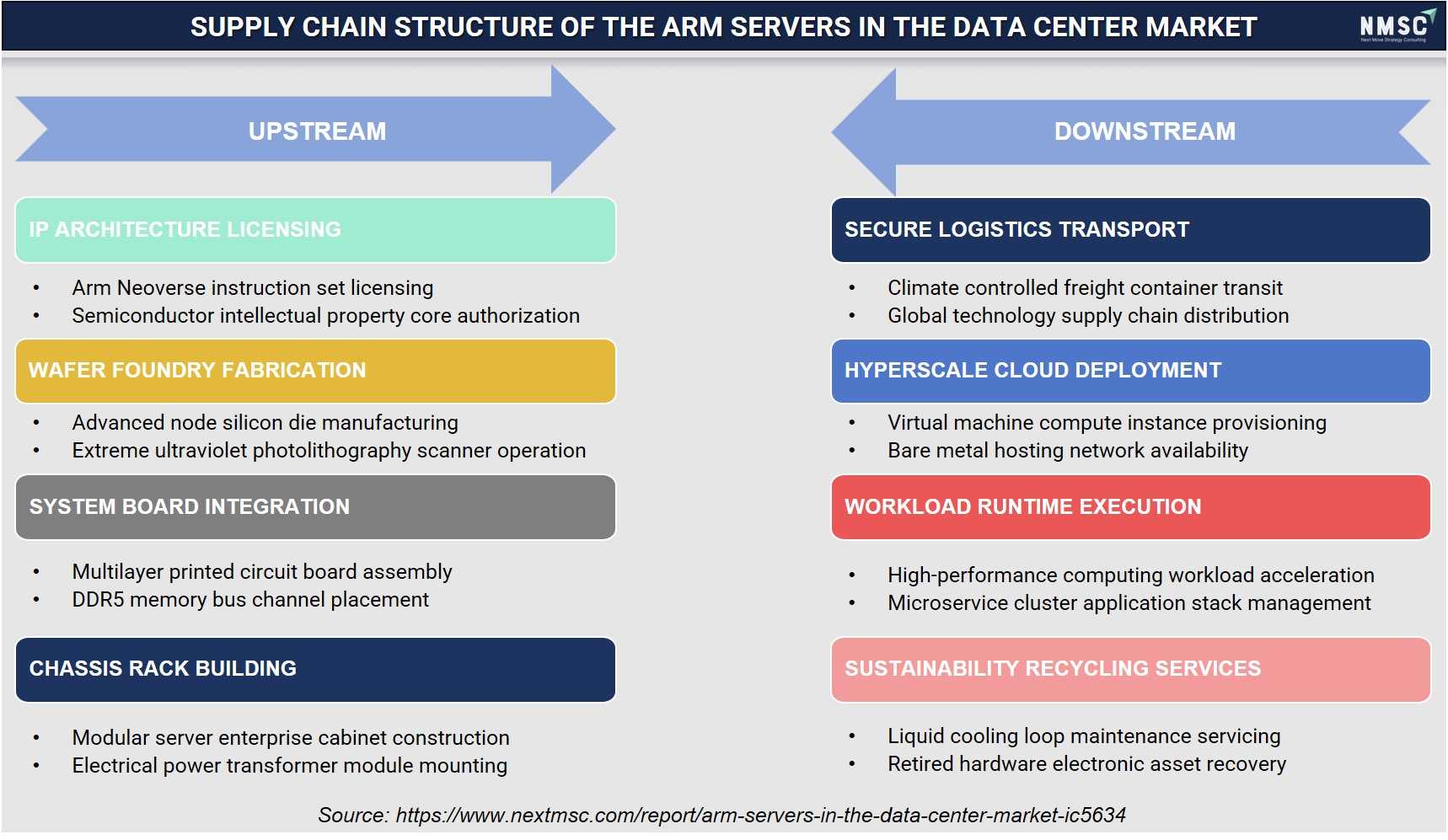
Based on research conducted by NMSC, we found that the supply chain structure of the Arm Servers in the Data Center Market connects Arm Neoverse IP licensing, EUV wafer fabrication, PCB assembly, and rack building with climate-controlled logistics. Downstream, hyperscale providers leverage bare-metal and virtual machine hosting for high-performance computing workload acceleration. Ultimately, ongoing liquid cooling loop maintenance and retired electronic asset recovery support sustainable infrastructure operations.
Growth Drivers and Restraints
|
Factors |
Type |
(+/-) % Impact on CAGR |
Geographic Relevance |
Impact Timeline |
|
Rising hyperscale custom silicon investment |
Driver |
+6.5% |
North America, Asia-Pacific |
2026–2035 |
|
Growing power efficiency and sustainability mandates |
Driver |
+4.8% |
North America, Europe |
2026–2033 |
|
Expanding edge computing infrastructure deployment |
Driver |
+3.6% |
Global |
2026–2032 |
|
Maturing Arm Neoverse platform ecosystem |
Driver |
+2.9% |
North America, Asia-Pacific |
2026–2031 |
|
Government data center energy efficiency incentives |
Driver |
+2.1% |
Europe, Asia-Pacific |
2026–2035 |
|
Software ecosystem compatibility gaps versus x86 |
Restraint |
-2.8% |
Global |
2026–2029 |
|
High upfront migration cost for legacy enterprise workloads |
Restraint |
-1.9% |
North America, Europe |
2026–2030 |
|
Limited enterprise IT familiarity with Arm architecture |
Restraint |
-1.4% |
Latin America, MEA |
2026–2029 |
|
Semiconductor supply chain capacity constraints |
Restraint |
-1.1% |
Global |
2026–2028 |
What Is the Primary Growth Driver of the Arm Servers in the Data Center Market?
Rising hyperscale custom silicon investment is the primary driver of the market, as cloud providers develop proprietary Arm-based processors to reduce total cost of ownership across large compute fleets. The U.S. Department of Energy reports expanding data center energy consumption nationally, prompting hyperscale operators to fund power-efficient silicon development aimed at controlling operating expenses.
How Is Power Efficiency Regulation Driving Market Growth?
Growing power efficiency and sustainability mandates are driving market growth as data center operators respond to energy consumption disclosure requirements. The European Union's energy efficiency directive has expanded data center reporting obligations, industry-derived estimate indicating meaningful Arm server adoption growth across facilities seeking to reduce power usage effectiveness metrics.
What Is Restraining Arm Servers in the Data Center Market Expansion?
Software ecosystem compatibility gaps versus x86 are restraining market expansion, particularly across enterprises running legacy applications without native Arm compilation support. The U.S. National Institute of Standards and Technology has noted software portability as a migration barrier, and industry-derived estimates indicate that compatibility testing costs disproportionately affect smaller enterprise IT deployments.
Segmentation Analysis
Segment Sizing: By Component
|
Segment |
2025 (USD) |
2035 (USD) |
CAGR% (2026–2035) |
|
Processor |
USD 3.60 Billion |
USD 27.50 Billion |
23.1% |
|
Server Systems |
USD 1.80 Billion |
USD 14.90 Billion |
24.2% |
|
Software & Services |
USD 0.60 Billion |
USD 4.80 Billion |
23.8% |
|
Total |
USD 6.00 Billion |
USD 47.20 Billion |
23.50% |
Which Component Segment Dominates the Arm Servers in the Data Center Market?
Processor led the market, valued at USD 3.60 billion in 2025 and projected to reach USD 27.50 billion by 2035, supported by sustained hyperscale silicon investment and rising core-count adoption across compute-intensive workloads. Server Systems is the fastest-growing sub-segment at a CAGR of 24.2%, driven by expanding integrated rack-scale deployment among enterprise and edge data center operators.
Segment Sizing: By Deployment
|
Segment |
2025 (USD) |
2035 (USD) |
CAGR% (2026–2035) |
|
Hyperscale/Cloud Data Center |
USD 4.10 Billion |
USD 30.80 Billion |
22.9% |
|
Enterprise Data Center |
USD 1.10 Billion |
USD 9.20 Billion |
24.4% |
|
Edge Data Center |
USD 0.50 Billion |
USD 4.90 Billion |
26.6% |
|
HPC/Research Data Center |
USD 0.30 Billion |
USD 2.30 Billion |
23.2% |
|
Total |
USD 6.00 Billion |
USD 47.20 Billion |
23.50% |
Which Deployment Segment Is Growing Fastest?
Edge Data Center is the fastest-growing deployment segment, expanding at a CAGR of 26.6% between 2026 and 2035, driven by rising distributed compute node deployment among telecom and content delivery operators. Hyperscale/Cloud Data Center remains the dominant segment given its established large-scale infrastructure base, while Enterprise Data Center continues to expand through gradual workload migration.
Segment Sizing: By End User
|
Segment |
2025 (USD) |
2035 (USD) |
CAGR% (2026–2035) |
|
Cloud Service Providers |
USD 3.90 Billion |
USD 28.90 Billion |
22.7% |
|
Enterprise Organizations |
USD 1.20 Billion |
USD 10.70 Billion |
25.3% |
|
Telecom Operators |
USD 0.60 Billion |
USD 5.30 Billion |
25.1% |
|
Government & Research Institutions |
USD 0.30 Billion |
USD 2.30 Billion |
23.2% |
|
Total |
USD 6.00 Billion |
USD 47.20 Billion |
23.50% |
Why Do Cloud Service Providers Lead the Market?
Cloud Service Providers dominated the market, reaching USD 3.90 billion in 2025 due to early and sustained Arm-based custom silicon investment across hyperscale compute fleets. Enterprise Organizations is expanding at the fastest CAGR of 25.3% as commercial IT departments increasingly migrate scale-out workloads to Arm-based server platforms for cost and efficiency gains.
Growth Opportunities
Our analysis shows that three forward-looking opportunities stand out for stakeholders positioning within the arm servers in the data center market.
How Can Pre-Validated Software Stacks Unlock Value for Enterprise Migration?
Pre-validated, Arm-compatible software stacks bundled with migration tooling present a whitespace opportunity for enterprise IT departments seeking to reduce compatibility testing overhead when transitioning legacy workloads to Arm-based server infrastructure.
Where Does Edge-Optimized Silicon Create Demand Among Telecom Operators?
Compact, thermally efficient Arm processors optimized for edge deployment create an underpenetrated opportunity across telecom operators building distributed 5G and content delivery infrastructure, where space and power constraints favor Arm-based compute density advantages.
How Can Managed Arm Server Hosting Benefit Mid-Market Enterprises?
Managed Arm server hosting offerings that abstract architecture-specific configuration create an opportunity for mid-market enterprises lacking in-house Arm expertise to access power-efficient compute without dedicated migration engineering investment.
Regional Outlook
|
Region |
2025 (USD) |
2035 (USD) |
CAGR% (2026–2035) |
Key Driver |
|
North America |
USD 3.20 Billion |
USD 22.80 Billion |
22.2% |
Hyperscale custom silicon investment |
|
Europe |
USD 0.90 Billion |
USD 7.80 Billion |
24.9% |
Energy efficiency regulation and sustainability mandates |
|
Asia-Pacific |
USD 1.40 Billion |
USD 13.90 Billion |
26.8% |
Expanding hyperscale and domestic silicon investment |
|
Middle East & Africa |
USD 0.28 Billion |
USD 1.60 Billion |
19.2% |
Data center infrastructure modernization |
|
Latin America |
USD 0.22 Billion |
USD 1.10 Billion |
17.5% |
Expanding cloud infrastructure investment |
|
Total |
USD 6.00 Billion |
USD 47.20 Billion |
23.50% |
|
North America Arm Servers in the Data Center Market Outlook
North America leads the market with a mature hyperscale infrastructure ecosystem and established vendor base spanning Amazon.com, Inc. and NVIDIA Corporation. Regulatory emphasis on data center energy reporting under U.S. Department of Energy guidance shapes procurement specification, while sustained custom silicon investment continues to anchor demand across the region.
Europe Arm Servers in the Data Center Market Outlook
Europe's market reflects a regulation-intensive landscape shaped by the European Union's energy efficiency directive, requiring rigorous data center power consumption compliance across operators. Strategic outlook favors vendors demonstrating power-efficiency credentials, with SiPearl SAS maintaining a strong regional footprint focused on European high-performance computing initiatives.
Asia-Pacific Arm Servers in the Data Center Market Outlook
Asia-Pacific is the fastest-growing region, propelled by expanding hyperscale infrastructure investment in China and India alongside rising domestic silicon development. Technology adoption is accelerating among cloud providers as regional governments prioritize semiconductor self-sufficiency within national technology strategies.
Middle East & Africa Arm Servers in the Data Center Market Outlook
The market in Middle East & Africa is expanding as Gulf Cooperation Council economies invest in data center infrastructure modernization and digital transformation initiatives. Regulatory support for expanded cloud infrastructure in Saudi Arabia and South Africa is accelerating institutional Arm server adoption across the region.
Latin America Arm Servers in the Data Center Market Outlook
Latin America's market is supported by expanding cloud infrastructure investment alongside growing enterprise digital transformation activity in Brazil and Argentina. Strategic outlook favors vendors offering cost-efficient Arm-based platforms tailored to the region's developing hyperscale and enterprise data center landscape.
U.S. Arm Servers in the Data Center Market
Based on our estimates, the U.S. market was valued at approximately USD 2.85 billion in 2025 and is projected to reach USD 20.30 billion by 2035, expanding at a CAGR of 22.2%. Demand structure reflects strong hyperscale custom silicon investment, high technology penetration, and competitive intensity among established cloud and chip vendors, supported by a favorable regulatory environment for data center infrastructure expansion.
Canada Arm Servers in the Data Center Market
The market in Canada reached roughly USD 0.30 billion in 2025 and is forecast to hit USD 2.10 billion by 2035 at a CAGR of 21.9%. Adoption levels are rising within enterprise cloud migration programs, supported by federal digital infrastructure funding and growing competitive intensity among regional and multinational server vendors.
UK Arm Servers in the Data Center Market
As per our estimate, the UK market stood at about USD 0.28 billion in 2025, advancing toward USD 2.55 billion by 2035 at a CAGR of 25.6%. Regulatory influence from energy efficiency directive statutes shapes vendor selection, while cloud service providers show strong demand structure for power-efficient Arm processors amid rising technology penetration.
Germany Arm Servers in the Data Center Market
According to our analysis, Germany's market was valued near USD 0.25 billion in 2025 and is set to reach USD 2.20 billion by 2035, growing at a CAGR of 25.1%. Strategic outlook favors vendors offering compliance-ready power-efficient designs, with enterprise data center operators showing strong adoption levels amid rising competitive intensity.
France Arm Servers in the Data Center Market
Based on our estimates, France's market reached approximately USD 0.16 billion in 2025, projected to climb to USD 1.35 billion by 2035 at a CAGR of 24.5%. Demand structure reflects growing adoption of Arm-based high-performance computing platforms, supported by national research funding and moderate competitive intensity.
China Arm Servers in the Data Center Market
The market in China was valued at approximately USD 0.55 billion in 2025 and is projected to reach USD 6.20 billion by 2035 at a CAGR of 28.6%. Adoption levels are accelerating rapidly across domestic hyperscale and telecom infrastructure, supported by strong government semiconductor investment and intense competitive activity among domestic silicon vendors.
India Arm Servers in the Data Center Market
As per our estimate, India's market stood at roughly USD 0.30 billion in 2025, advancing toward USD 3.60 billion by 2035 at a CAGR of 29.5%, the fastest among covered countries. Demand structure reflects rapid hyperscale-driven adoption, strong government digital infrastructure policy support, and rising competitive intensity among domestic and multinational vendors.
Japan Arm Servers in the Data Center Market
According to our analysis, Japan's market reached approximately USD 0.25 billion in 2025 and is forecast to reach USD 1.90 billion by 2035 at a CAGR of 23.0%. Technology penetration remains high, with high-performance computing adoption supported by national research initiatives amid moderate regulatory influence.
South Korea Arm Servers in the Data Center Market
Based on our estimates, South Korea's market was valued at about USD 0.15 billion in 2025, projected to reach USD 1.05 billion by 2035 at a CAGR of 21.9%. Strong government semiconductor investment funding and strategic outlook favoring domestic chip development support rising adoption levels across cloud infrastructure.
Australia Arm Servers in the Data Center Market
The market in Australia reached roughly USD 0.09 billion in 2025 and is expected to reach USD 0.60 billion by 2035 at a CAGR of 21.3%. Demand structure reflects growing cloud infrastructure adoption, supported by favorable regulatory environment and moderate competitive intensity among regional vendors.
UAE Arm Servers in the Data Center Market
As per our estimate, the UAE market stood at approximately USD 0.09 billion in 2025, advancing toward USD 0.55 billion by 2035 at a CAGR of 20.1%. Strategic outlook favors platforms aligned with national digital transformation goals, supported by strong government funding and rising technology penetration across regional cloud infrastructure.
Saudi Arabia Arm Servers in the Data Center Market
According to our analysis, Saudi Arabia's market reached approximately USD 0.10 billion in 2025 and is projected to reach USD 0.62 billion by 2035 at a CAGR of 20.3%. Demand structure is shaped by Vision 2030 digital infrastructure funding, supporting rising adoption levels across data center modernization programs.
South Africa Arm Servers in the Data Center Market
Based on our estimates, South Africa's market was valued at about USD 0.05 billion in 2025, advancing toward USD 0.25 billion by 2035 at a CAGR of 17.5%. Adoption levels remain constrained by infrastructure gaps, though rising cloud investment and government digital programs support gradual demand structure growth.
Brazil Arm Servers in the Data Center Market
The market in Brazil reached approximately USD 0.14 billion in 2025 and is forecast to reach USD 0.68 billion by 2035 at a CAGR of 17.1%. Demand structure reflects growing enterprise cloud adoption, supported by expanding digital infrastructure investment and moderate competitive intensity among regional vendors.
Argentina Arm Servers in the Data Center Market
As per our estimate, Argentina's market stood at roughly USD 0.05 billion in 2025, advancing toward USD 0.24 billion by 2035 at a CAGR of 16.9%. Technology penetration is rising steadily, with enterprise organizations showing increasing adoption of Arm-based server platforms amid a stabilizing regulatory environment.
Porter's Five Forces of the Arm Servers in the Data Center Market
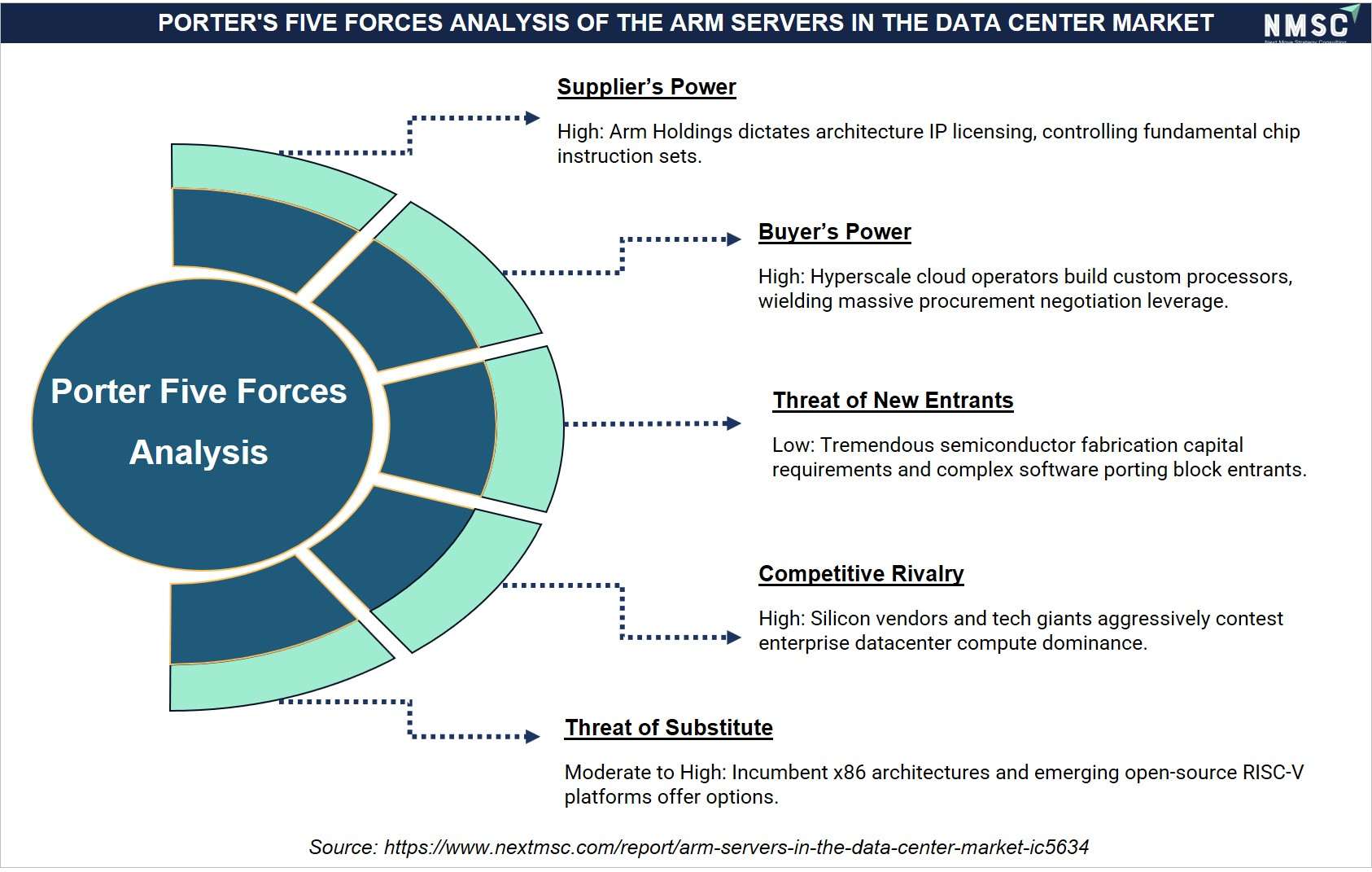
NMSC's analysis indicates that competitive rivalry in the Arm Servers in the Data Center Market is high as silicon vendors contest datacenter compute dominance. Simultaneously, Arm Holdings commands high supplier power through IP licensing, while hyperscale cloud operators possess significant buyer bargaining leverage. Furthermore, high fabrication costs keep new entrant threats low, whereas incumbent x86 architectures and emerging RISC-V platforms present a moderate-to-high substitution risk.
Competitive Landscape
We found that the competitive landscape is moderately fragmented, with hyperscale in-house silicon design teams competing alongside established chip vendors across the Industry.
|
Dimension |
Details |
|
Market Structure |
Moderately fragmented, with 20 profiled vendors spanning specialty silicon designers, hyperscale in-house teams, and diversified server system manufacturers |
|
Innovation Focus |
Custom silicon design, chiplet-based architecture, and power-efficiency optimization |
|
M&A Activity |
Selective acquisitions of specialty silicon design firms by larger server system and cloud infrastructure vendors |
How Do Companies Compete in the Arm Servers in the Data Center Market?
Companies compete primarily on processor performance-per-watt metrics, breadth of software ecosystem compatibility, and depth of integration support offered to hyperscale and enterprise customers. Pricing strategies increasingly favor volume-based supply agreements tied to multi-year infrastructure procurement contracts.
Which Competitive Archetypes Dominate the Arm Servers in the Data Center Industry?
Three archetypes dominate the Industry: hyperscale in-house silicon design teams such as Amazon.com, Inc. optimizing processors for internal workloads, specialty Arm silicon vendors such as Ampere Computing LLC focused on merchant server processors, and diversified server system manufacturers such as Hewlett Packard Enterprise Company emphasizing integrated platform delivery.
What Innovation and Differentiation Strategies Are Vendors Pursuing?
Vendors are differentiating through proprietary core architecture optimization, expanded chiplet-based scaling capability, and software ecosystem partnership programs, aiming to strengthen defensibility against commoditized generic Arm implementations offered by smaller entrants.
What M&A Activity Is Shaping the Competitive Landscape?
M&A activity has concentrated on acquisitions of specialty silicon design and chiplet technology firms by larger server system vendors seeking to accelerate proprietary processor capability development rather than build such functionality internally, reflecting broader industry consolidation trends.
Key Market Players
We found that the following companies represent the leading providers of arm servers in the data center based on market-specific revenue and scale of operations as of 2026.
-
Ampere Computing LLC
-
Amazon.com, Inc.
-
Marvell Technology, Inc.
-
Fujitsu Limited
-
Huawei Technologies Co., Ltd.
-
Alibaba Group Holding Limited
-
Microsoft Corporation
-
Hewlett Packard Enterprise Company
-
Dell Technologies Inc.
-
Lenovo Group Limited
-
Super Micro Computer, Inc.
-
Gigabyte Technology Co., Ltd.
-
ASUSTeK Computer Inc.
-
Arm Holdings plc
-
Phytium Technology Co., Ltd.
-
SiPearl SAS
-
Inspur Electronic Information Industry Co., Ltd.
-
Socionext Inc.
Latest Developments
We observed the following recent developments shaping vendor positioning and processor capability within the market.
|
Date |
Event |
|
May 2026 |
NVIDIA launched its NVIDIA Vera CPU, the first processor purpose-built for agentic AI, reinforcement learning, and data processing in data centers. Vera delivers 1.8 times faster task completion compared with x86 processors, serving as the CPU for standalone Vera servers, Vera Rubin, and storage platforms. |
|
April 2026 |
Amazon Web Services signed an agreement with Meta to deploy AWS Graviton Arm-based processors at scale. The agreement starts with tens of millions of Graviton cores, including Graviton5, to power CPU-intensive agentic artificial intelligence workloads, real-time reasoning, code generation, and multi-step agent workflows across Meta's infrastructure. |
|
March 2026 |
Hewlett Packard Enterprise introduced next-generation AI factory and supercomputing advancements featuring the HPE Cray Supercomputing GX240 platform powered by NVIDIA Vera CPUs. The system scales up to 40 blades with 640 NVIDIA Vera CPUs, delivering 56,320 Arm-compatible cores per rack for high-density AI data center infrastructure. |
|
November 2025 |
Microsoft announced Azure Cobalt 200, its next-generation custom Arm-based CPU for cloud-native workloads on Azure. Built using TSMC 3nm process technology, Cobalt 200 features more compute cores, larger cache, and faster memory, delivering up to 50% higher performance than Cobalt 100. |
Investment Opportunities
What Capital Inflows Are Supporting Market Expansion?
Corporate and venture capital investment continue to flow into custom silicon design and chiplet technology startups. Our findings suggest that investor interest is concentrated on companies demonstrating measurable performance-per-watt improvements alongside recurring multi-year hyperscale supply agreements.
How Is Infrastructure Investment Shaping Server Manufacturing Scalability?
Manufacturing capacity investment by established producers, including Super Micro Computer, Inc. and Lenovo Group Limited, underpins server scalability for expanding hyperscale and enterprise demand. This infrastructure investment supports consistent processor integration quality across geographically distributed production facilities.
What ESG Considerations Are Relevant to Market Investment?
Environmental, Social, and Governance considerations increasingly influence investment decisions, with operators evaluating vendor energy efficiency commitments and semiconductor supply chain sustainability practices. Government funding programs in several regions now require ESG disclosure as a condition of data center infrastructure grant eligibility.
Key Benefits for Stakeholders
How Does This Report Benefit Industry Leaders?
Industry leaders gain access to detailed segmentation, regional forecasts, and competitive benchmarking that support silicon investment and infrastructure procurement decisions across hyperscale, enterprise, and edge data center markets.
How Does This Report Benefit Investors and Financial Analysts?
Investors and financial analysts benefit from validated market sizing, CAGR forecasts, and company-level competitive positioning that inform capital allocation decisions across the arm servers in the data center value chain.
How Does This Report Benefit Technology Vendors and Product Teams?
Technology vendors and product teams gain insight into emerging trends, growth opportunities, and regional demand patterns that inform processor development prioritization and go-to-market strategy across covered geographies.
Key Market Segments
By Component
-
Processor
-
Server Systems
-
Software & Services
By Deployment
-
Hyperscale/Cloud Data Center
-
Enterprise Data Center
-
Edge Data Center
-
HPC/Research Data Center
By End User
-
Cloud Service Providers
-
Enterprise Organizations
-
Telecom Operators
-
Government & Research Institutions
By Region
-
North America: U.S., Canada, Mexico
-
Europe: UK, Germany, France, Italy, Spain, Sweden, Denmark, Finland, Netherlands, Rest of Europe
-
Asia-Pacific: China, India, Japan, South Korea, Taiwan, Indonesia, Vietnam,```html Australia, Philippines, Malaysia, Rest of APAC
-
Middle East & Africa: Saudi Arabia, UAE, Egypt, Israel, Turkey, Nigeria, South Africa, Rest of MEA
-
Latin America: Brazil, Argentina, Chile, Colombia, Rest of LATAM
Conclusion and Recommendations
What Is the Long-Term Outlook for the Market?
The long-term outlook remains strongly positive, with the market projected to expand from USD 7.05 billion in 2026 to USD 47.20 billion by 2035 as hyperscale and enterprise operators deepen reliance on power-efficient Arm-based server infrastructure.
What Strategic Positioning Should Vendors Pursue?
Vendors should prioritize software ecosystem compatibility and power-efficiency credentials to differentiate against established x86 alternatives, while pursuing strategic partnerships with hyperscale operators to strengthen custom silicon design credibility.
How Attractive Is the Market for Investment?
Investment attractiveness remains high given sustained strong double-digit CAGR expectations and expanding hyperscale custom silicon investment, though investors should weigh software compatibility barriers and semiconductor supply chain capacity constraints.
What Market Shifts and Key Risks Should Stakeholders Monitor?
Stakeholders should monitor evolving semiconductor supply chain dynamics, software ecosystem maturation pace, and potential shifts in hyperscale capital expenditure cycles, each of which could affect procurement timelines across covered geographies.
What Are the Primary Growth Pathways for Market Participants?
Primary growth pathways include expansion into underpenetrated enterprise migration markets, deeper edge-optimized silicon development, and strategic acquisition of chiplet and software compatibility startups to accelerate proprietary platform capability development.
About the Author
 Saista Faiyaz
— Saista Faiyaz is Research Associate at Next Move Strategy Consulting, where she has covered consumer markets and healthcare technologies for 3 years. Her work includes primary interview review, secondary-source validation, market sizing, and structured analysis of company and industry data. She supports research by comparing evidence across sources, organizing findings into market narratives, and documenting assumptions used in analysis. Her scope includes cross-market benchmarking, and reports.
Saista Faiyaz
— Saista Faiyaz is Research Associate at Next Move Strategy Consulting, where she has covered consumer markets and healthcare technologies for 3 years. Her work includes primary interview review, secondary-source validation, market sizing, and structured analysis of company and industry data. She supports research by comparing evidence across sources, organizing findings into market narratives, and documenting assumptions used in analysis. Her scope includes cross-market benchmarking, and reports.
About the Reviewer
 Supradip Baul
— Supradip Baul is an accomplished business consultant and strategist with over a decade of rich experience in market intelligence, strategy, technology, and business transformation. His work has included rigorous qualitative and quantitative analysis across multiple industries, helping clients shape investment decisions and long-term roadmaps. Earlier in his career, he was associated with Gartner, where he contributed to industry-leading reports and market share analyses. He has worked with leading global companies and holds an MBA with a dual specialization in Marketing and Finance.
Supradip Baul
— Supradip Baul is an accomplished business consultant and strategist with over a decade of rich experience in market intelligence, strategy, technology, and business transformation. His work has included rigorous qualitative and quantitative analysis across multiple industries, helping clients shape investment decisions and long-term roadmaps. Earlier in his career, he was associated with Gartner, where he contributed to industry-leading reports and market share analyses. He has worked with leading global companies and holds an MBA with a dual specialization in Marketing and Finance.
At Next Move Strategy Consulting, we understand that insightful market research is the cornerstone of successful business decisions. That's why we employ a robust and multifaceted approach, combining various methodologies to deliver the most accurate and actionable data for our clients.

Research Landscape
We navigate the world of research with two primary approaches:
Qualitative Approach
Our qualitative research methodologies involve immersive techniques such as in-depth interviews, focus groups, and observational studies. By engaging directly with individuals and stakeholders, we uncover valuable insights that quantitative data alone may overlook.

Quantitative Research
In tandem with qualitative methodologies, NMSC leverages the power of Quantitative Research to provide a robust foundation of numerical insights. Through systematic data collection and analysis, we quantify patterns, preferences, and market trends, offering a comprehensive view of the business landscape.
Our quantitative research approach employs diverse tools, including surveys, experiments, and statistical modelling. These methodologies enable us to gather data from a large and representative sample, ensuring the statistical significance of our findings. By employing structured questionnaires and standardized data collection methods, we guarantee the reliability and validity of the information we present to our clients.
Quantitative research is particularly effective in measuring the prevalence of trends, assessing market size, and gauging the impact of various factors on consumer behavior. The numerical precision attained through this approach equips our clients with actionable insights, facilitating data-driven decision-making and strategy formulation.


Our Specialized Toolbox for Industry-Specific Market Research
We deploy a specialized arsenal of techniques tailored to meet your unique requirements. Here's a glimpse into our comprehensive toolbox:

Information Procurement
The stage entails acquiring market data or relevant information through various sources and methodologies.


Market Research Approach
We utilize both top-down and bottom-up approaches in market research analysis to achieve a comprehensive understanding of the market dynamics, leveraging the broad perspective of industry trends and macroeconomic factors alongside detailed insights from specific segments and individual companies.

Porters Five Forces Analysis
We conduct Porter's Five Forces analysis to evaluate the competitive landscape of an industry, providing us with insights into factors that affect profitability and strategic positioning.

SWOT Analysis

Forecasting
We utilize a forecasting model to predict future consumption by considering parameters like population, economics, regulations, market competition, drivers, constraints, technology, and pricing. We also employ statistical techniques such as multilinear regression, exponential smoothing, moving average, ARIMA, and Monte Carlo simulations for accurate predictions. In econometric forecasting, we analyzed short-term and long-term event impacts, attributing values based on regulatory frameworks, economic factors, and market events.





 Speak to Our Analyst