Data Governance Market Size, Share, Growth & Forecast by Component (Software: Governance Suite, Data Catalog, Data Lineage, Data Quality, Privacy Governance, Master Data Governance, Policy and Stewardship, Data Marketplace, Embedded Governance; Services: Advisory, Implementation, Managed Services, Training), Deployment (Cloud, On-Premises, Hybrid), Buyer, Organization Size, Industry and Sales Channel — Global Analysis 2026–2035
Industry: ICT & Media | Publishing Date: June 18, 2026 | Last Updated: September 10, 2026 | No of Pages: N/A | No. of Tables: N/A | No. of Figures: N/A | Format: PDF | Report Code: IC4709
What Is the Data Governance Market Size?
The global Data Governance Market was valued at USD 4.8 billion in 2025 and is expected to reach USD 5.6 billion in 2026. Accelerating regulatory compliance mandates, enterprise AI adoption requiring governed data assets, and growing demand for trusted, high-quality data pipelines are projected to propel the market to USD 21.6 billion by 2035, advancing at a CAGR of 16.3% from 2026 to 2035. Key growth drivers include expanding data privacy legislation across major economies, the proliferation of AI and machine learning workloads dependent on clean and lineage-tracked data, digital transformation initiatives across regulated industries, and rising enterprise investment in data stewardship and master data management capabilities.
|
Parameters |
Details |
|
Market Size in 2025 |
USD 4.8 Billion |
|
Market Size in 2026 |
USD 5.6 Billion |
|
Revenue Forecast in 2035 |
USD 21.6 Billion |
|
Growth Rate |
CAGR of 16.3% from 2026 to 2035 |
|
Analysis Period |
2025–2035 |
|
Base Year Considered |
2025 |
|
Forecast Period |
2026–2035 |
|
Market Size Estimation |
USD Billion |
|
Companies Profiled |
20 |
|
Countries Covered |
33 |
|
Market Share |
Top 10 |
Data Governance Market Overview
What Is the Data Governance Market?
The Data Governance Market encompasses the software, platforms, and professional services that enable organizations to define, manage, enforce, and monitor policies governing data assets across their enterprise environments. Data governance solutions address data quality, data lineage, metadata management, master data management, privacy governance, policy stewardship, and compliance reporting. NMSC's analysis indicates that as enterprises accumulate increasingly large and complex data estates across cloud, hybrid, and on-premises environments, structured governance frameworks have become a foundational requirement for regulatory compliance, AI readiness, and trusted analytics at scale.
How Has the Data Governance Market Evolved?
From our research, we found that the Data Governance Market has undergone three distinct evolution phases. The first phase, predominant through the early 2010s, focused on manual metadata cataloging, spreadsheet-based data dictionaries, and siloed data stewardship processes within individual business units. The second phase, driven by GDPR enforcement beginning in 2018, triggered enterprise-wide investments in privacy governance, data lineage tracking, and access control management. The current third phase, underway since 2022, centers on AI-driven active governance, automated data cataloging, semantic data discovery, embedded governance within data pipelines, and federated governance architectures that span multi-cloud and hybrid environments.
How Do Regulations Influence the Data Governance Market?
Regulatory frameworks have become the single most powerful structural driver of Data Governance Market investment. The European Union's General Data Protection Regulation, the California Consumer Privacy Act, the Digital Personal Data Protection Act in India, and equivalent frameworks across over 140 jurisdictions mandate data lineage, consent management, data quality assurance, and retention policy enforcement. The EU AI Act, enacted in 2024, introduces additional governance obligations for AI training datasets, requiring organizations to document data provenance, bias assessments, and quality metrics. These compounding mandates are compelling enterprises to move from reactive, audit-driven governance toward continuous, automated governance operating in real time across the data lifecycle.
How Is Technology Adoption Expanding Across the Data Governance Market?
Through our market assessment, we observed that technology adoption across the Data Governance Market is rapidly transitioning from standalone catalog and lineage tools toward integrated governance suites that embed governance controls within data fabric architectures. AI-powered metadata harvesting, automated data classification, and intelligent policy recommendation engines are reducing the manual overhead historically associated with data governance programs. Cloud-native deployment is lowering the cost of entry for midmarket organizations, while platform consolidation is driving large enterprises to standardize on full-suite solutions from vendors such as Microsoft Purview, Collibra, and Alation. Embedded governance capabilities within cloud data platforms are also reshaping the competitive landscape.
|
Key Takeaways |
|
By deployment, Cloud-based solutions commanded the largest share at USD 2.6 billion in 2025, representing approximately 54% of total market revenue, underpinned by scalability and pay-as-you-use economics. Hybrid deployment is the fastest-growing mode in the Data Governance Market at a CAGR of 20.2% from 2026 to 2035, as regulated enterprises balance cloud agility with on-premises data residency obligations. |
|
By buyer function, the Risk and Compliance Team segment accounted for USD 1.12 billion in 2025, the largest buyer share, driven by regulatory reporting obligations across financial services, healthcare, and government sectors. The CDO and Data Office segment is the fastest-growing buyer category at a CAGR of 20.5% from 2026 to 2035, reflecting the institutionalization of Chief Data Officer roles across Global 2000 enterprises. |
|
By organization size, Large Enterprises accounted for USD 3.1 billion in 2025, the dominant segment, given complex multi-cloud data estates requiring enterprise-grade governance at scale. The Midmarket segment is the fastest-growing at a CAGR of 18.9% from 2026 to 2035, as cloud-native governance platforms eliminate upfront capital barriers for mid-sized organizations. |
|
By industry, Banking and Financial Services held the largest share at USD 1.0 billion in 2025, driven by Basel III/IV data quality mandates, AML compliance, and model risk governance requirements. Healthcare and Life Sciences is the fastest-growing vertical in the Data Governance Market at a CAGR of 21.2% from 2026 to 2035, fueled by HIPAA compliance, real-world evidence data governance, and clinical data quality demands. |
|
By region, North America held the largest regional share at USD 2.0 billion in 2025, projected to reach USD 8.66 billion by 2035 at a CAGR of 17.7%, anchored by the highest enterprise AI and regulatory compliance investment globally. |
|
Asia-Pacific is the fastest-growing region in the Data Governance Market at a CAGR of 19.2%, driven by India's DPDPA mandate, China's data security law, and digital transformation across Southeast Asian financial services. |
|
By country, the United States is the single largest country market in the Data Governance Market, representing over 78% of North American revenue in 2025, underpinned by the world's highest concentration of enterprise data governance vendors and buyers. |
|
India is the fastest-growing national market in Asia-Pacific within the Data Governance Market at a CAGR of 25.2%, propelled by the Digital Personal Data Protection Act and widespread enterprise investment in data compliance infrastructure. |
Key Emerging Trends in the Data Governance Market
How Is AI-Powered Active Metadata Management Transforming the Data Governance Market?
AI-powered active metadata management is fundamentally reshaping the Data Governance Market by replacing passive, catalog-only approaches with dynamic, intelligence-driven governance systems. Based on NMSC's research, we found that platforms such as Microsoft Purview and Collibra Governance Cloud now deploy machine learning models to automatically classify sensitive data, detect schema drift, and recommend stewardship assignments across petabyte-scale data estates. For example, Microsoft Purview's automated data discovery can scan structured and unstructured data across Azure, on-premises, and multi-cloud environments without manual intervention, dramatically reducing the labor cost of governance programs and improving policy enforcement consistency.
How Is the Rise of Data Products and Data Mesh Architectures Influencing the Data Governance Market?
The adoption of data mesh architectures, which distribute data ownership to domain teams and treat datasets as governed products, is creating new demand patterns within the Data Governance Market. Through our market assessment, we observed that organizations implementing data mesh require federated governance frameworks that enforce enterprise-wide standards while granting domain autonomy. Vendors such as Atlan, Collibra, and Alation have responded with platform updates supporting distributed data catalog synchronization, domain-level policy inheritance, and automated governance certification workflows. Financial services firms, including major European banks, are among the earliest adopters of data mesh governance tooling to manage cross-domain regulatory reporting.
How Is Privacy Engineering Becoming a Core Capability in the Data Governance Market?
Privacy engineering, the practice of embedding privacy controls directly into data systems rather than applying them retrospectively, is emerging as a high-growth capability within the Data Governance Market. NMSC's analysis indicates that vendors such as OneTrust, BigID, and Immuta have positioned privacy governance as a first-class product category, offering dynamic data masking, differential privacy, purpose-based access control, and consent management frameworks. Healthcare organizations deploying these capabilities under HIPAA mandates and European enterprises responding to GDPR enforcement actions represent the largest adopter cohorts. The EU AI Act's requirements for privacy-preserving AI training data are expected to accelerate privacy engineering investment substantially through 2030.
How Is Embedded Governance Within Cloud Data Platforms Reshaping the Competitive Dynamics of the Data Governance Market?
Cloud hyperscalers and lakehouse platform vendors are embedding native governance capabilities directly into their data platforms, creating a structural challenge for standalone governance vendors while simultaneously expanding the total addressable market. Our findings suggest that Snowflake's Horizon governance suite, Databricks Unity Catalog, and Google Cloud Dataplex now provide data lineage, access controls, data quality monitoring, and classification within their core platform offering. This trend is compelling enterprises to evaluate whether they require a best-of-breed standalone governance platform or whether platform-native governance tools can satisfy their requirements, reshaping the competitive positioning and go-to-market strategies of pure-play Data Governance Market vendors.
What Are the Key Market Drivers, Breakthroughs, and Investment Opportunities that Will Shape the Data Governance Market in the Next Decade?
|
Drivers / Trends / Restraints |
(+/-) % Impact on CAGR Forecast |
Geographic Relevance |
Impact Timeline |
|
Global Data Privacy Regulation Expansion |
+2.4% |
Global (all regions) |
2025–2035 |
|
AI/ML Workload Governance Requirements |
+2.1% |
North America, Europe, APAC |
2025–2032 |
|
Cloud and Hybrid Data Estate Complexity |
+1.7% |
North America, Europe, Australia |
2025–2030 |
|
Master Data Management Modernization |
+1.3% |
Global |
2026–2035 |
|
Data Mesh and Data Product Adoption |
+1.1% |
North America, Europe |
2026–2035 |
|
Embedded Governance in Cloud Platforms |
+0.9% |
Global (hyperscaler-led markets) |
2025–2030 |
|
Implementation Complexity and Skills Shortage |
-1.4% |
SMB, Midmarket globally |
Ongoing |
|
Fragmented Regulatory Standards Across Jurisdictions |
-1.0% |
Europe, APAC, North America |
Ongoing |
|
High Total Cost of Governance Program Deployment |
-0.7% |
All regions |
2025–2029 |
|
CDO Role Institutionalization as a Growth Catalyst |
+1.5% |
North America, Europe |
2025–2032 |
What Are the Growth Drivers of the Data Governance Market?
How Is the Global Expansion of Data Privacy Legislation Driving the Data Governance Market?
The proliferation of data privacy and data protection legislation across major economies represents the most powerful structural driver of the Data Governance Market. As of 2024, over 140 countries had enacted comprehensive data protection laws or were actively legislating them, according to the United Nations Conference on Trade and Development. Each jurisdiction's compliance requirements, including mandatory data lineage documentation, privacy impact assessments, breach notification protocols, and data subject rights management, directly translate into enterprise investment in governance software and services. The EU's GDPR, India's Digital Personal Data Protection Act, Brazil's LGPD, and the California Consumer Privacy Act have collectively created a sustained, multi-year demand cycle that shows no sign of abating through the 2035 forecast horizon.
How Is Enterprise AI Adoption Creating Structural Demand for Data Governance Market Solutions?
The rapid deployment of artificial intelligence and machine learning across enterprise operations is generating unprecedented demand for governed, high-quality, and traceable data assets within the Data Governance Market. Based on our market evaluation, we noticed that AI models require clean, lineage-tracked, and bias-audited training datasets to meet both performance standards and regulatory obligations under frameworks such as the EU AI Act and NIST AI Risk Management Framework. Organizations deploying large language models and retrieval-augmented generation architectures must govern the provenance, quality, and access permissions of every dataset contributing to model training, creating durable demand for data lineage, data quality, and data catalog solutions across all major industry verticals.
How Is the Complexity of Multi-Cloud and Hybrid Data Environments Fueling Data Governance Market Growth?
As organizations distribute data across multiple cloud providers, legacy on-premises systems, and edge environments, the complexity of maintaining consistent data governance policies across heterogeneous environments is creating substantial demand for centralized governance platforms. Through NMSC's assessment, we found that enterprises operating on two or more cloud platforms face significant challenges in maintaining unified data catalogs, consistent data quality monitoring, and coherent access governance without a dedicated governance layer. The U.S. National Institute of Standards and Technology Cybersecurity Framework and equivalent frameworks globally explicitly reference data governance as a foundational element of enterprise data security and resilience, reinforcing institutional investment in cross-environment governance capabilities.
What Are the Growth Inhibitors of the Data Governance Market?
How Does Implementation Complexity and the Enterprise Data Governance Skills Shortage Constrain Data Governance Market Growth?
Data governance programs are among the most organizationally complex enterprise technology initiatives, requiring sustained collaboration between IT teams, business domain owners, legal and compliance functions, and executive leadership. Our assessment indicates that a significant gap between available data governance talent and enterprise demand continues to constrain program deployment timelines and adoption rates, particularly in mid-sized organizations without dedicated data governance teams. The U.S. Bureau of Labor Statistics projects continued growth in data management and compliance roles through 2033, indicating that the talent supply pipeline has not yet closed the gap with enterprise demand, extending average program implementation timelines and increasing consulting service costs across the Data Governance Market.
How Does Regulatory Fragmentation Across Jurisdictions Limit the Data Governance Market's Full Potential?
The absence of harmonized global data governance standards creates a compounding compliance burden for multinational enterprises and increases vendor development costs within the Data Governance Market. Organizations operating across the EU, U.S., India, China, and Southeast Asia must simultaneously satisfy GDPR, CCPA, DPDPA, China's Data Security Law, and PDPA requirements that differ materially in their definitions of personal data, consent mechanisms, and data subject rights. According to the European Commission's assessments of GDPR implementation, conflicting national interpretations of EU data governance standards have introduced additional uncertainty even within the single market, compelling enterprises to invest in flexible governance platforms capable of adapting to jurisdiction-specific requirements rather than standardized configurations.
What Are the Growth Opportunities in the Data Governance Market?
How Does the Institutionalization of the Chief Data Officer Role Create a Structural Opportunity in the Data Governance Market?
The formalization of the Chief Data Officer function across Global 2000 enterprises is creating sustained executive sponsorship and dedicated budget allocation for data governance programs. Based on our research findings, organizations with an established CDO function demonstrate materially higher governance platform adoption rates and larger annual governance technology investment compared to those without senior data leadership. The U.S. federal government's mandate for CDO appointment across major agencies under the Evidence Act of 2018 and the Federal Data Strategy has institutionalized this trend at the public sector level, creating a replicable procurement model that private sector organizations are following. This structural shift ensures long-term, committed demand for comprehensive governance suites within the Data Governance Market.
How Does the Expansion of Data Marketplace and Data Monetization Use Cases Represent a Growth Opportunity in the Data Governance Market?
The emergence of enterprise data marketplaces, internal data sharing hubs, and commercial data monetization programs is creating substantial demand for advanced governance capabilities including data quality certification, data usage tracking, consent-based access controls, and automated policy enforcement within the Data Governance Market. Based on our market evaluation, organizations seeking to publish governed datasets for internal consumption or external monetization require mature governance tooling to certify data quality, document lineage, and enforce access policies at marketplace scale. The U.S. National Oceanic and Atmospheric Administration's open data marketplace and equivalent government data exchange programs illustrate how governed data sharing infrastructure creates demand for governance tooling that extends well beyond traditional compliance use cases.
How Do Digital Public Infrastructure Programs in Emerging Markets Present a Structural Growth Opportunity for the Data Governance Market?
Digital public infrastructure programs across India, Southeast Asia, Africa, and Latin America are creating national-scale data governance requirements that present significant market expansion opportunities. India's Digital Personal Data Protection Act, enforced from 2025 onwards, mandates governance controls across every organization processing Indian citizens' personal data, creating demand for governance platforms optimized for high-volume, multilingual, and consent-heavy data environments. The Reserve Bank of India's guidelines on data governance for regulated entities establish explicit requirements for data quality, lineage, and stewardship frameworks across the financial sector. Similar governance mandates in Indonesia, Brazil, and Nigeria are generating early-stage but structurally significant demand for cloud-native data governance platforms within the expanding Data Governance Market.
How Is the Data Governance Market Segmented in This Report, and What Are the Key Insights from the Segmentation Analysis?
How Does Deployment Mode Shape Revenue Distribution Across the Data Governance Market?
|
Deployment Segment |
2025 (USD Bn) |
2035 (USD Bn) |
CAGR (%) |
|
Cloud |
2.6 |
12.2 |
18.7% |
|
On-Premises |
1.4 |
5.2 |
15.7% |
|
Hybrid |
0.8 |
4.2 |
20.2% |
Through our market assessment, we observed that the Data Governance Market is segmented into Cloud, On-Premises, and Hybrid deployment models. Cloud deployment dominates the market, representing 54% of total revenue in 2025, driven by the scalability, rapid provisioning, and lower total cost of ownership of SaaS governance platforms. On-premises deployment remains relevant among highly regulated industries including government, defense, and financial services that mandate local data processing. Hybrid deployment is the fastest-growing mode as regulated enterprises seek to govern data assets spanning cloud and on-premises environments through a unified policy framework without compromising data residency obligations.
Which Buyer Functions Are Driving Purchasing Decisions in the Data Governance Market?
|
Buyer Segment |
2025 (USD Bn) |
2035 (USD Bn) |
CAGR (%) |
|
CDO and Data Office |
0.62 |
3.33 |
20.5% |
|
Data Governance Team |
0.78 |
3.56 |
18.4% |
|
Data Engineering Team |
0.58 |
2.63 |
18.3% |
|
Risk and Compliance Team |
1.12 |
4.81 |
17.6% |
|
Business Leaders |
0.86 |
3.72 |
17.7% |
|
IT Team |
0.84 |
3.54 |
17.3% |
Based on our market evaluation, we noticed that the Data Governance Market is segmented across six buyer functions: CDO and Data Office, Data Governance Team, Data Engineering Team, Risk and Compliance Team, Business Leaders, and IT Team. The Risk and Compliance Team represents the largest buyer segment, driven by regulatory reporting obligations, audit readiness requirements, and model risk governance mandates across financial services and healthcare. The CDO and Data Office function is the fastest-growing buyer, as organizations with established data leadership formalize enterprise-wide governance programs and centralize data policy authority. Data Engineering Teams are also increasing governance technology investment to embed quality and lineage controls within automated data pipelines.
How Does Organization Size Influence Adoption Patterns in the Data Governance Market?
|
Organization Size Segment |
2025 (USD Bn) |
2035 (USD Bn) |
CAGR (%) |
|
Large Enterprise |
3.12 |
13.24 |
17.4% |
|
Midmarket |
1.08 |
5.14 |
18.9% |
|
Small Business |
0.60 |
3.22 |
20.5% |
Our findings suggest that the Data Governance Market is segmented into Large Enterprise, Midmarket, and Small Business organizations. Large Enterprises account for 65% of total market revenue in 2025, reflecting the complexity of governing multi-cloud data estates, extensive regulatory reporting requirements, and the organizational scale required to fund dedicated governance programs. Midmarket organizations are the fastest-growing segment as cloud-native, modular governance platforms eliminate the high upfront investment historically associated with enterprise governance deployments. Small Business adoption is accelerating, particularly in regulated sectors such as financial advisory and healthcare, where regulatory obligations mandate minimum data governance capabilities regardless of organizational size.
Which Industry Verticals Generate the Most Value in the Data Governance Market?
|
Industry Vertical |
2025 (USD Bn) |
2035 (USD Bn) |
CAGR (%) |
|
Banking and Financial Services |
1.00 |
4.41 |
17.9% |
|
Insurance |
0.38 |
1.67 |
17.9% |
|
Healthcare and Life Sciences |
0.62 |
3.51 |
21.2% |
|
Government |
0.42 |
1.89 |
18.2% |
|
Telecom and IT |
0.51 |
2.16 |
17.4% |
|
Technology |
0.47 |
2.05 |
17.8% |
|
Manufacturing |
0.35 |
1.48 |
17.4% |
|
Retail and Consumer Goods |
0.31 |
1.34 |
17.7% |
|
Energy and Utilities |
0.20 |
0.88 |
17.9% |
|
Other Industries |
0.54 |
2.21 |
16.9% |
Based on our analysis of enterprise data compliance and digital transformation priorities, we observed that the Data Governance Market is segmented across Banking and Financial Services, Insurance, Healthcare and Life Sciences, Government, Telecom and IT, Technology, Manufacturing, Retail and Consumer Goods, Energy and Utilities, and Other Industries. Banking and Financial Services dominates, driven by Basel III data quality standards, anti-money laundering compliance, model risk governance requirements, and DORA obligations in Europe. Healthcare and Life Sciences is the fastest-growing vertical, fueled by HIPAA data stewardship mandates, real-world evidence data governance requirements, and the clinical data quality standards imposed by regulatory bodies for AI-assisted diagnostics and drug discovery programs.
How Are Distribution Channels Reshaping Go-to-Market Strategies in the Data Governance Market?
|
Sales Channel Segment |
2025 (USD Bn) |
2035 (USD Bn) |
CAGR (%) |
|
Direct Sales |
2.16 |
9.38 |
17.7% |
|
Channel Partner |
0.96 |
4.20 |
17.8% |
|
System Integrator |
0.88 |
3.97 |
18.2% |
|
Cloud Marketplace |
0.52 |
2.94 |
21.2% |
|
OEM |
0.28 |
1.11 |
16.5% |
Through NMSC's assessment, we found that the Data Governance Market distributes products and services across five primary channels: Direct Sales, Channel Partners, System Integrators, Cloud Marketplace, and OEM. Direct Sales dominates, representing 45% of total revenue in 2025, reflecting enterprise buyer preference for vendor-direct engagement, strategic account management, and customized deployment support for complex governance programs. System Integrators represent a significant and growing channel as organizations engage global consulting firms to design and implement governance operating models alongside platform deployment. Cloud Marketplace is the fastest-growing distribution channel at a CAGR of 21.2%, as enterprises leverage committed cloud spend with AWS, Azure, and Google Cloud marketplaces to procure governance software within existing procurement workflows.
Regional Outlook
Geographic Performance Snapshot
|
Region |
2025 (USD Bn) |
2035 (USD Bn) |
CAGR (%) |
Key Driver |
|
North America |
2.0 |
8.66 |
17.7% |
Regulatory maturity, enterprise AI governance |
|
Europe |
1.4 |
6.03 |
17.6% |
GDPR enforcement, EU AI Act compliance |
|
Asia-Pacific |
0.88 |
4.28 |
19.2% |
DPDPA, China DSL, APAC privacy laws |
|
Middle East & Africa |
0.26 |
1.28 |
19.4% |
Vision 2030, MEA data protection laws |
|
Latin America |
0.26 |
1.34 |
20.0% |
LGPD, regional digital transformation |
North America Data Governance Market
North America is the largest region in the Data Governance Market, accounting for USD 2.0 billion in 2025 and forecast to reach USD 8.66 billion by 2035 at a CAGR of 17.7%. The region benefits from the highest concentration of enterprise data governance vendors, mature cloud infrastructure, and the most advanced regulatory enforcement environment globally. The U.S. Federal Data Strategy and Canada's Digital Ambition have institutionalized data governance investment across public and private sectors. Strong enterprise AI adoption is compelling organizations to deploy governance tooling to ensure AI training datasets meet the quality, lineage, and compliance standards required by emerging regulatory frameworks.
U.S. Data Governance Market
Based on our analysis, we found that the United States represents over 78% of North American Data Governance Market revenue and is the world's single largest national market. The U.S. benefits from the highest concentration of Fortune 500 enterprise buyers, the headquarters of leading governance platform vendors including Microsoft, IBM, Salesforce, OneTrust, Collibra, Alation, BigID, and Immuta, and a mature venture capital ecosystem supporting governance technology innovation. The Federal Data Strategy, overseen by the Office of Management and Budget, mandates structured data governance frameworks across federal agencies. State-level privacy laws including the California Consumer Privacy Act and its subsequent amendments are driving sustained enterprise investment in privacy governance and consent management platforms.
Canada Data Governance Market
Through our analysis, we observed that Canada represents approximately 14% of North American Data Governance Market revenue. Canadian financial institutions, insurance firms, and healthcare organizations are among the most governance-mature enterprise buyers globally. The federal government's Directive on Service and Digital mandates structured data governance across all government departments, while Canada's proposed Consumer Privacy Protection Act is expected to impose GDPR-equivalent obligations on private sector organizations. Provincial privacy laws in British Columbia, Alberta, and Quebec impose additional requirements that drive enterprise investment in multi-jurisdiction governance frameworks and cloud data residency capabilities.
Mexico Data Governance Market
From our assessment, Mexico represents the fastest-growing market within North America in the Data Governance Market. Mexico's growing fintech sector, expanding manufacturing data estates, and nearshoring-driven data infrastructure investment are generating demand for data quality and stewardship solutions. The Ley Federal de Protección de Datos Personales en Posesión de los Particulares establishes data governance obligations for private sector organizations, compelling investment in consent management and data lineage capabilities. Government digitization programs are also driving public sector adoption of governance tooling to support open data initiatives and interoperability standards across federal agencies.
Europe Data Governance Market
Europe is the second-largest region in the Data Governance Market, contributing USD 1.4 billion in 2025 and forecast to reach USD 6.03 billion by 2035 at a CAGR of 17.6%. Europe's regulatory environment, dominated by GDPR, the EU AI Act, the Digital Governance Act, and the EU Data Act, is both the primary growth catalyst and a source of compliance complexity for organizations operating across multiple member states. The European Data Governance Act establishes a framework for trusted data intermediaries and data altruism organizations, creating new governance requirements. SAP, headquartered in Germany, holds a structural home market advantage in enterprise data governance across European corporate buyers.
UK Data Governance Market
Based on our engagements, the United Kingdom is Europe's largest individual country market for data governance, representing approximately 21% of European revenue in 2025. The UK GDPR, maintained post-Brexit, sustains GDPR-equivalent data governance obligations across UK organizations. The Financial Conduct Authority's operational resilience and data governance guidelines create specific governance requirements for financial services firms, while the National Health Service's data governance frameworks drive healthcare sector investment. London's status as a global financial hub underpins strong demand for data quality, lineage, and access governance tools among asset management, banking, and insurance organizations operating international data pipelines.
Germany Data Governance Market
Through our analysis, Germany is the second-largest European market in the Data Governance Market, driven by world-class manufacturing enterprises investing in industrial data governance and supply chain data quality frameworks. German organizations apply among the most rigorous data privacy standards globally under the Bundesdatenschutzgesetz and GDPR, creating strong demand for on-premises and sovereign cloud governance deployments. The Federal Office for Information Security's cloud security guidelines shape platform certification requirements for enterprise procurement. SAP's Metadata Management and Data Intelligence platforms enjoy a strong home market advantage across German enterprise buyers navigating complex ERP and data lakehouse governance environments.
France Data Governance Market
From our assessment, France is the third-largest European Data Governance Market, distinguished by public sector digital transformation investment and a highly active regulatory environment. The CNIL is among Europe's most active GDPR enforcement bodies, having issued significant fines that have directly accelerated enterprise privacy governance investment. France's France 2030 and France Relance programs allocate funding to cloud and data infrastructure projects, including governance capabilities for public sector entities. OVHcloud's governance-compliant European cloud infrastructure positions French enterprises seeking GDPR-compliant, EU-controlled governance solutions as an alternative to U.S. hyperscaler offerings.
Italy Data Governance Market
According to our assessment, Italy is a mid-tier European market in the Data Governance Market, with growing adoption in financial services, manufacturing, and public administration. The Piano Nazionale di Ripresa e Resilienza has directed substantial cloud migration investment across Italian public sector entities, creating governance requirements for cloud-hosted government data assets. Italy's Garante data protection authority has been active in GDPR enforcement, compelling organizations to invest in compliant data governance architectures. The Polo Strategico Nazionale provides sovereign cloud infrastructure for government and regulated industry data processing, creating a structured market for governance tooling certified for Italian data residency requirements.
Spain Data Governance Market
Based on our market evaluation, Spain demonstrates growing momentum in the Data Governance Market, driven by an active financial sector, retail expansion, and public sector digital transformation under the Agenda España Digital 2026. The Agencia Española de Protección de Datos actively enforces GDPR, compelling enterprise investment in privacy governance and access control tools. Spanish banking conglomerates and insurance groups are significant buyers of data quality and master data governance platforms to support Basel regulatory reporting and Solvency II compliance. AWS, Google Cloud, and Microsoft Azure all operate local cloud regions in Spain, supporting enterprise data governance deployments with local data residency.
Sweden Data Governance Market
Through our analysis, Sweden represents a mature and well-developed segment of the European Data Governance Market. Sweden's advanced digital economy, high enterprise technology adoption rates, and active regulatory enforcement by the Swedish Authority for Privacy Protection create a structurally favorable environment for governance platform adoption. Swedish financial services and public healthcare organizations are among the most governance-mature buyers in Scandinavia, investing in integrated governance suites that address personal data management, data quality, and regulatory reporting simultaneously. Nordic cloud infrastructure investments by AWS and Google Cloud support compliant, low-latency governance deployments for Swedish enterprises.
Denmark Data Governance Market
From our assessment, Denmark is a technology-forward market within the European Data Governance Market, characterized by high enterprise digital maturity and a proactive regulatory environment. The Danish Data Protection Agency enforces GDPR with consistent regulatory activity, driving enterprise investment in privacy governance and data lineage tools. Denmark's digital government initiatives, including the widespread adoption of the NemID and MitID digital identity frameworks, create governance requirements for citizen data management across public sector platforms. The concentration of pharmaceutical and life sciences companies in the Copenhagen region generates specialized demand for clinical data governance and real-world evidence quality assurance capabilities.
Finland Data Governance Market
Based on our engagements, Finland represents a niche but governance-advanced segment of the European Data Governance Market. Finland's strong public sector digitization, robust healthcare data infrastructure, and active GDPR enforcement by the Office of the Data Protection Ombudsman create a consistent governance investment environment. Finnish telecommunications companies and healthcare providers are significant enterprise adopters of data quality and master data governance platforms. The Finnish government's AuroraAI initiative and related public sector AI projects create demand for AI governance frameworks and explainable AI data quality standards within the broader market ecosystem.
Netherlands Data Governance Market
According to our assessment, the Netherlands is a strategically important European market in the Data Governance Market, functioning as a major logistics, financial services, and technology hub for the continent. The Dutch Data Protection Authority is one of Europe's most active GDPR enforcement bodies, having issued several landmark fines that have materially accelerated enterprise governance investment across Dutch industries. The Amsterdam Internet Exchange and the Netherlands' cloud infrastructure prominence attract data-intensive organizations requiring robust cross-border data governance frameworks. Dutch financial sector organizations and global logistics companies headquartered in the Netherlands are significant buyers of data lineage, data quality, and master data governance platforms.
Rest of Europe Data Governance Market
Through our market assessment, we observed that the Rest of Europe segment, including Poland, Belgium, Austria, Switzerland, Portugal, Romania, and the Czech Republic, represents a growing and increasingly active portion of the European Data Governance Market. GDPR enforcement across all EU member states creates baseline governance investment requirements, while national digital transformation programs are accelerating public sector adoption. Switzerland's Federal Act on Data Protection, which entered into force in 2023, aligns closely with GDPR standards, compelling Swiss multinational organizations to invest in compatible governance platforms. CEE markets including Poland and Romania are experiencing early-stage but high-growth enterprise governance adoption as digital maturity increases.
Asia-Pacific Data Governance Market
Asia-Pacific is the fastest-growing major region in the Data Governance Market, contributing USD 0.88 billion in 2025 and forecast to reach USD 4.28 billion by 2035 at a CAGR of 19.2%. The region's data governance momentum is driven by India's Digital Personal Data Protection Act, China's Data Security Law and Personal Information Protection Law, Japan's APPI amendments, Australia's Privacy Act reforms, and the proliferation of national data governance frameworks across Southeast Asia. Diverse regulatory environments create complex compliance requirements for multinational organizations and domestic enterprises alike, sustaining demand for flexible, multi-jurisdiction governance platforms across the region.
China Data Governance Market
Based on our analysis, China represents the largest single-country market within Asia-Pacific for data governance, driven by the comprehensive regulatory framework established by the Cybersecurity Law, Data Security Law, and Personal Information Protection Law. The Cyberspace Administration of China actively enforces these regulations, mandating data classification, important data catalogs, data security assessments, and cross-border data transfer governance for organizations processing Chinese citizens' data. Financial institutions under the People's Bank of China's data governance guidelines and healthcare organizations under the National Health Commission's data standards are among the most governance-mature enterprise buyers. Domestic governance platform vendors including domestic ERP and data management providers compete alongside international platforms in this strategically regulated market.
India Data Governance Market
Through our analysis, India is the fastest-growing national market within Asia-Pacific in the Data Governance Market at a CAGR of 25.2%, propelled by the Digital Personal Data Protection Act enforced from 2025. The Ministry of Electronics and Information Technology oversees DPDPA compliance, mandating consent management, data minimization, and data principal rights management across organizations processing Indian citizens' data. The Reserve Bank of India's Master Direction on IT Governance explicitly mandates data governance frameworks for banking institutions, creating structured regulatory demand. India's rapidly expanding technology services sector, fintech ecosystem, and healthcare digitization programs are generating broad enterprise adoption of cloud-native data governance platforms across the country's dynamic economic base.
Japan Data Governance Market
From our assessment, Japan represents a mature and compliance-driven segment of the Asia-Pacific Data Governance Market. The Act on the Protection of Personal Information, updated through multiple amendments with the most recent changes effective in 2022, imposes comprehensive data handling obligations on Japanese organizations. The Personal Information Protection Commission oversees APPI enforcement and has been progressively aligning Japanese data protection standards with global frameworks including GDPR. Japanese manufacturing conglomerates, financial institutions, and healthcare providers are significant enterprise buyers of master data governance and data quality platforms, particularly as they navigate complex multinational data transfer obligations under bilateral data adequacy agreements.
South Korea Data Governance Market
Based on our market evaluation, South Korea is a technologically advanced and governance-active market within the Asia-Pacific Data Governance Market. The Personal Information Protection Act, enforced by the Personal Information Protection Commission, establishes comprehensive data governance obligations that are among the most stringent in Asia. South Korean financial institutions, telecommunications companies, and healthcare organizations invest significantly in data quality, lineage, and privacy governance tools to satisfy PIPA compliance and sector-specific regulatory requirements. The concentration of major global technology conglomerates including Samsung, LG, and SK in South Korea creates enterprise-scale demand for integrated governance platforms supporting complex multinational data operations.
Taiwan Data Governance Market
According to our assessment, Taiwan represents a niche but growing market in the Asia-Pacific Data Governance Market, driven by the island's semiconductor and technology manufacturing sector and the Personal Data Protection Act. The Ministry of Digital Affairs oversees digital governance initiatives and data protection enforcement, creating regulatory pressure on organizations managing sensitive production and enterprise data. Taiwan's technology export-oriented economy requires governance frameworks that satisfy international customer data protection requirements, particularly for multinational technology firms auditing supply chain data handling practices. Cloud adoption among Taiwanese enterprises is increasing, supporting cloud-native governance platform deployment across financial services and technology verticals.
Indonesia Data Governance Market
Through our analysis, Indonesia is an early-stage but high-growth market within the Asia-Pacific Data Governance Market. Indonesia's Personal Data Protection Law, enacted in 2022, established the first comprehensive national data protection framework, mandating data governance obligations for organizations processing Indonesian citizens' data. The Ministry of Communication and Information Technology oversees PDP Law implementation, with enforcement beginning progressively from 2024. Indonesia's large and rapidly digitizing economy, anchored by major e-commerce, fintech, and banking sectors, creates substantial demand for cloud-native governance platforms. The government's Making Indonesia 4.0 manufacturing digitization program is also generating industrial data governance requirements.
Vietnam Data Governance Market
Based on our engagements, Vietnam is an emerging governance market within Asia-Pacific, driven by the Cybersecurity Law and the Decree on Personal Data Protection. The Ministry of Public Security oversees data protection enforcement, mandating data localization for certain categories of sensitive data and governance controls for organizations processing Vietnamese citizens' information. Vietnam's rapidly expanding digital economy, including a growing fintech sector and significant foreign direct investment from technology multinationals, is creating demand for governance platforms capable of satisfying Vietnamese localization requirements alongside international compliance standards. Cloud adoption is accelerating among Vietnamese enterprises, particularly within financial services and retail sectors.
Australia Data Governance Market
From our assessment, Australia represents a mature governance market within Asia-Pacific, supported by the Privacy Act 1988 and its ongoing reform process. The Privacy Act review, recommending significant enhancements to Australia's personal data governance framework, is expected to impose GDPR-comparable obligations on Australian organizations, creating substantial investment demand across the Data Governance Market. The Office of the Australian Information Commissioner enforces privacy obligations and has been progressively expanding enforcement activity. The Consumer Data Right framework, administered by the Australian Competition and Consumer Commission, mandates structured data governance for financial institutions sharing consumer data within open banking ecosystems, creating specialized governance tooling demand.
Philippines Data Governance Market
According to our assessment, the Philippines represents a growing market within the Asia-Pacific Data Governance Market, anchored by the Data Privacy Act of 2012 enforced by the National Privacy Commission. The NPC has been progressively strengthening enforcement activity, compelling organizations in financial services, healthcare, and the business process outsourcing sector to invest in structured governance frameworks. The Philippines' significant BPO industry, which processes data on behalf of international clients across multiple regulatory jurisdictions, creates demand for multi-framework governance platforms capable of satisfying both Philippine DPA requirements and international client governance standards simultaneously.
Malaysia Data Governance Market
Through our market assessment, we observed that Malaysia is a mid-tier market within the Asia-Pacific Data Governance Market, governed by the Personal Data Protection Act 2010 and overseen by the Department of Personal Data Protection. Malaysia's financial sector, large-scale e-commerce platforms, and multinational manufacturing operations are the primary enterprise buyers of data governance tools. Bank Negara Malaysia's Risk Management in Technology guidelines establish specific data governance requirements for financial institutions, creating regulatory compliance demand. Malaysia's national cloud strategy and the Twelfth Malaysia Plan's digital economy investment commitments are accelerating public sector and enterprise cloud adoption, supporting cloud-native governance platform deployment.
Rest of APAC Data Governance Market
Based on our analysis, the Rest of Asia-Pacific segment, encompassing New Zealand, Thailand, Singapore, Pakistan, Bangladesh, Sri Lanka, and other markets, represents a diverse and progressively governance-active portion of the Asia-Pacific Data Governance Market. Singapore's Personal Data Protection Act and the Monetary Authority of Singapore's data governance guidelines position the city-state as the most advanced governance market in Southeast Asia, attracting regional headquarters investment from governance platform vendors. Thailand's Personal Data Protection Act B.E. 2562, enforced from 2022, is creating new compliance obligations for Thai enterprises. New Zealand's Privacy Act 2020 aligns closely with international standards, supporting governance platform adoption across New Zealand's financial and healthcare sectors.
Middle East and Africa Data Governance Market
The Middle East and Africa region is contributing USD 0.26 billion in 2025 and is forecast to reach USD 1.28 billion by 2035 at a CAGR of 19.4%. The region's governance momentum is driven by Saudi Arabia's Vision 2030 data strategy, the UAE's data governance initiatives under the Abu Dhabi International Data Corporation, Israel's privacy regulation evolution, and emerging data protection frameworks across African markets. MEA's rapidly expanding cloud infrastructure investment by AWS, Microsoft Azure, and Google Cloud is creating technical prerequisites for enterprise governance platform adoption across the region's diversifying economies.
Saudi Arabia Data Governance Market
Based on our engagements, Saudi Arabia is the largest and most governance-active market within the Middle East in the Data Governance Market. The National Data Management Office under SDAIA has established comprehensive data governance standards for government entities, including the National Data Governance Interim Regulations that mandate data classification, stewardship, and quality management frameworks. Vision 2030's digital economy diversification program requires robust data governance capabilities across government-linked organizations, financial institutions, and healthcare providers. The Saudi Arabia Personal Data Protection Law, enforced from 2023, imposes governance obligations on private sector organizations, creating compliance-driven enterprise demand that is growing substantially year over year.
UAE Data Governance Market
Through our analysis, the UAE is the second most developed data governance market in the Middle East, driven by Abu Dhabi's data governance framework under the Abu Dhabi International Data Corporation and Dubai's smart city data governance initiatives. The UAE's Personal Data Protection Law establishes data governance obligations for organizations processing UAE residents' personal data. Financial services organizations under the Central Bank of UAE's IT governance guidelines and healthcare providers under the Department of Health Abu Dhabi's data standards represent the most governance-mature enterprise buyer segments. The UAE's ambition to become a global AI hub is creating urgent demand for AI governance and data quality tooling to support sovereign AI development programs.
Egypt Data Governance Market
From our assessment, Egypt is an emerging market within the MEA Data Governance landscape, driven by the government's Egypt Vision 2030 digital transformation agenda and the Personal Data Protection Law enacted in 2020. The National Telecom Regulatory Authority oversees data protection enforcement, with progressive implementation creating new compliance obligations for financial services, telecommunications, and healthcare organizations. Egypt's banking sector modernization, driven by Central Bank of Egypt initiatives, is creating demand for data quality and master data governance solutions. The government's investment in e-government platforms and digital public services infrastructure is generating public sector data governance requirements.
Israel Data Governance Market
According to our assessment, Israel is the most technologically advanced Data Governance Market within the broader MEA region, characterized by a world-class cybersecurity and enterprise software ecosystem. The Protection of Privacy Law and the Israel Privacy Protection Authority's enforcement activities create baseline compliance requirements for data governance. Israel's position as a global cybersecurity and data privacy technology hub means that several market vendors, including privacy engineering and data security companies, have R&D operations in Israel. The country's financial services sector, healthcare system, and technology multinationals are significant governance platform buyers with sophisticated requirements for AI governance and data lineage.
Turkey Data Governance Market
Based on our market evaluation, Turkey is a growing market within the MEA Data Governance Market, governed by the Law on Protection of Personal Data. The Personal Data Protection Authority enforces KVKK compliance requirements, mandating data governance controls across organizations processing Turkish residents' data. Turkey's large banking sector, active e-commerce market, and rapidly digitalizing manufacturing base are the primary enterprise buyers of data quality and privacy governance tools. The Turkish government's digital transformation program is accelerating public sector cloud adoption, creating new governance requirements for citizen data management across federal agencies and government-linked organizations.
Nigeria Data Governance Market
Through our analysis, Nigeria is the largest data governance market within Africa, driven by the Nigeria Data Protection Act signed in 2023 and enforced by the Nigeria Data Protection Commission. The NDPC has been progressively building enforcement capacity, creating compliance urgency for organizations across Nigeria's financial services, telecommunications, and healthcare sectors. Nigeria's rapidly expanding fintech ecosystem, anchored by platforms including Flutterwave and Paystack, requires robust data quality and privacy governance frameworks to satisfy both domestic regulatory requirements and international investor due diligence standards. Nigeria's banking sector under the Central Bank of Nigeria's cybersecurity and IT governance frameworks represents a growing enterprise buyer segment.
South Africa Data Governance Market
Based on our engagements, South Africa is a governance-mature market within Africa, anchored by the Protection of Personal Information Act enforced from 2021. The Information Regulator has been actively building enforcement capacity, creating compliance investment requirements across South African financial services, healthcare, and retail organizations. South Africa's JSE-listed corporations, subject to King IV corporate governance principles that explicitly address information governance and data stewardship, represent sophisticated governance platform buyers. The South African financial sector's international connectivity and adherence to Basel standards create alignment with global data quality and lineage governance requirements within the broader Data Governance Market ecosystem.
Rest of MEA Data Governance Market
From our assessment, the Rest of MEA segment, encompassing Kuwait, Qatar, Bahrain, Oman, Kenya, Ethiopia, Morocco, and other emerging markets, is at an early but rapidly developing stage of Data Governance Market adoption. GCC countries beyond Saudi Arabia and UAE are progressively implementing data protection laws aligned with international standards as part of broader economic diversification strategies. Kenya's Data Protection Act 2019 and Morocco's Law 09-08 on Personal Data Protection are creating compliance obligations that drive enterprise governance investment in East and North Africa respectively. Gulf Cooperation Council cloud infrastructure expansion by hyperscalers is enabling cloud-native governance deployment across these emerging markets.
Latin America Data Governance Market
Latin America is the second-fastest growing region in the Data Governance Market, contributing USD 0.26 billion in 2025 and forecast to reach USD 1.34 billion by 2035 at a CAGR of 20.0%. Brazil's Lei Geral de Proteção de Dados is the primary regulatory catalyst, supplemented by progressive data protection legislation in Argentina, Colombia, Chile, and Mexico. Latin America's rapidly expanding digital economy, driven by fintech growth, e-commerce expansion, and public sector digitization programs, is creating sustained enterprise demand for cloud-native data governance platforms across the region's major economies.
Brazil Data Governance Market
Based on our analysis, Brazil is the dominant and most governance-advanced market within Latin America in the Data Governance Market, anchored by the Lei Geral de Proteção de Dados enforced since 2021. The Autoridade Nacional de Proteção de Dados oversees LGPD compliance, mandating data governance obligations including data classification, data subject rights management, and privacy impact assessments for organizations processing Brazilian residents' data. Brazil's large financial services sector, active e-commerce market, and expanding healthtech ecosystem are significant enterprise buyers of data quality, privacy governance, and data lineage platforms. The Brazilian government's digital transformation programs are also creating public sector governance requirements across federal and state entities.
Argentina Data Governance Market
Through our analysis, Argentina is the second-largest Data Governance Market within Latin America, governed by the Personal Data Protection Act and overseen by the Agencia de Acceso a la Información Pública. Argentina is actively modernizing its data protection framework to align with GDPR standards, with proposed legislative reforms expected to significantly strengthen data governance obligations for private sector organizations. Argentina's financial services sector, technology industry, and growing startup ecosystem are the primary enterprise buyers of governance tools. The Argentine government's digital government agenda is driving public sector cloud adoption and creating governance requirements for citizen data management across national and provincial entities.
Chile Data Governance Market
From our assessment, Chile is a governance-progressive market within the Latin American Data Governance Market. Chile enacted a new Personal Data Protection Law in 2024, significantly strengthening data governance requirements and establishing an independent data protection authority. The law introduces GDPR-comparable obligations including data classification, purpose limitation, data subject rights, and mandatory breach notification, creating structured compliance investment demand across Chilean financial services, retail, and healthcare sectors. Chile's advanced digital infrastructure, high internet penetration, and technologically sophisticated enterprise buyers support cloud-native governance platform adoption at rates above the regional average.
Colombia Data Governance Market
According to our assessment, Colombia is a growing market within the Latin American Data Governance Market, governed by Law 1581 on Personal Data Protection enforced by the Superintendencia de Industria y Comercio. Colombia's financial sector, active telecommunications market, and government digital transformation programs are the primary drivers of governance investment. The SIC has been progressively increasing enforcement activity, creating compliance urgency that translates into enterprise governance platform procurement. Colombia's growing fintech sector and the government's Plan Nacional de Desarrollo digital economy commitments are supporting cloud-native governance adoption among midmarket and enterprise organizations across the country's diversifying economic base.
Rest of LATAM Data Governance Market
Based on our market evaluation, the Rest of Latin America segment, encompassing Peru, Ecuador, Uruguay, Panama, Costa Rica, and other markets, represents an early-stage but growing portion of the Latin American Data Governance Market. Uruguay is the most governance-advanced market among smaller LATAM economies, holding an EU adequacy decision for data protection that positions it as a regional hub for privacy-compliant data processing. Peru's Personal Data Protection Law and Panama's personal data protection framework are creating compliance obligations that drive enterprise governance investment in these markets. Regional cloud infrastructure expansion by hyperscalers is progressively enabling cloud-native governance deployment across smaller Latin American economies.
PESTEL Analysis of the Data Governance Market
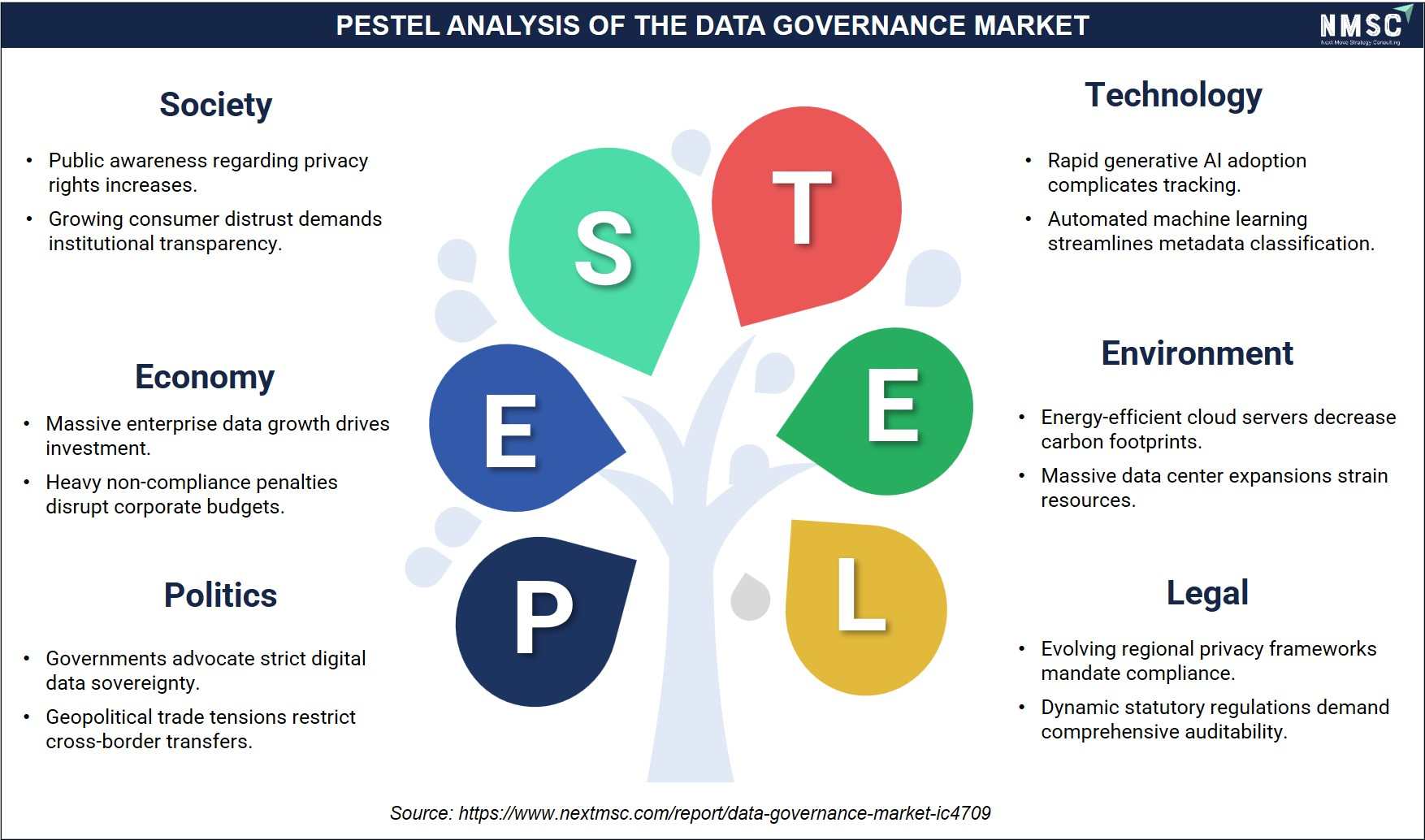
The PESTEL analysis of the Data Governance Market highlights the broad external factors shaping adoption, investment, and regulatory priorities across industries. Politically, governments are strengthening national data protection frameworks and sovereignty requirements, increasing demand for governance solutions. Economic factors include rising enterprise spending on data quality, compliance, and risk management initiatives. Socially, growing concerns regarding privacy, trust, and responsible data usage are driving organizations to implement stronger governance practices. Technological advancements in cloud computing, AI, metadata management, and data catalogs are accelerating market innovation and scalability. Environmental considerations are encouraging more efficient data management and storage practices within sustainable digital transformation strategies. Legally, evolving regulations such as GDPR, CCPA, DPDPA, and industry-specific compliance mandates continue to reinforce the need for robust governance frameworks, making data governance a strategic priority for organizations worldwide.
Competitive Landscape
Competitive Dynamics and M&A Landscape
|
Key Takeaways |
Details |
|
Market Structure |
The Data Governance Market is moderately concentrated, with a competitive mix of large enterprise software vendors (Microsoft, IBM, Oracle, SAP, Salesforce) and specialized pure-play governance platform vendors (Collibra, Alation, OneTrust, BigID, Immuta, Ataccama, Atlan). |
|
Innovation Focus |
Key innovation themes include AI-powered automated metadata discovery, embedded governance within cloud data platforms, federated governance for data mesh architectures, privacy engineering and consent management, and real-time data quality monitoring integrated within streaming pipelines. |
|
M&A Activity |
The market has experienced active M&A consolidation, with platform vendors acquiring point-solution governance tools to build integrated suites. Notable transactions include IBM's acquisition of OpenPages for GRC integration, Salesforce's acquisition of Informatica assets, and private equity consolidation among mid-tier governance vendors. |
How Do Companies Compete in the Data Governance Market?
The Data Governance Market competitive landscape is defined by a dual-tier structure. Large enterprise software vendors including Microsoft, IBM, Oracle, SAP, and Salesforce compete through platform bundling, leveraging existing enterprise relationships to offer governance capabilities as integrated components of broader cloud and data platform contracts. Our assessment indicates that these vendors benefit from deep customer installed bases, extensive system integrator ecosystems, and the ability to embed governance tooling within data pipelines, ERP systems, and analytics platforms customers already operate. Their competitive strategy emphasizes comprehensive suite coverage, multi-cloud integration, and alignment with regulatory reporting frameworks.
Which Kind of Companies Dominate the Data Governance Market?
Large enterprise technology vendors dominate total Data Governance Market revenue by virtue of their enterprise-scale customer relationships and bundled governance capabilities within broader platform contracts. Microsoft Purview, Oracle's data governance within the Oracle Cloud Infrastructure, SAP Data Intelligence, and IBM's governance capabilities within the watsonx platform collectively command significant revenue from existing enterprise license bases. However, our findings suggest that pure-play governance specialists command superior competitive positioning in greenfield governance program deployments, where organizations are selecting dedicated governance platforms based on functional depth, governance community adoption, and specialized integrations with cloud data platforms.
AI-Native Differentiation and Open Standards Drive Market Success in the Data Governance Market
Vendors achieving sustained competitive success in the Data Governance Market are characterized by three shared capabilities. First, they deploy AI-native metadata management that reduces manual cataloging and classification effort by 60% to 80% compared to traditional approaches, enabling governance programs to scale with data volume growth without proportional staffing increases. Second, successful vendors embrace open standards including Apache Atlas metadata schemas, OpenLineage for lineage capture, and OpenMetadata specifications, enabling interoperability with cloud data platforms customers already operate. Third, market leaders demonstrate strong integration ecosystems connecting governance platforms to dbt, Airflow, Spark, Snowflake, Databricks, and hyperscaler-native data services, ensuring governance controls operate within existing data engineering workflows rather than requiring separate governance-specific pipelines.
Market Players to Opt for Merger and Acquisition Strategies to Expand Their Presence in the Data Governance Market
Merger and acquisition activity within the Data Governance Market is accelerating as enterprise software vendors seek to close functional gaps, acquire governance-specialized talent, and consolidate market position against emerging pure-play competitors. Our analysis shows that acquisitions in the global market typically follow two strategic patterns. The first is capability acquisition, where large vendors acquire point-solution specialists in emerging governance sub-categories such as privacy engineering, AI governance, or data marketplace management to fill gaps in their integrated suite offerings. The second pattern is market consolidation by private equity sponsors acquiring multiple mid-tier governance vendors to build scaled, profitable governance platform businesses serving specific regulated vertical markets.
Who Are the Key Market Players in the Data Governance Market?
-
Microsoft Corporation
-
Google LLC
-
Oracle Corporation
-
SAP SE
-
International Business Machines Corporation
-
Salesforce, Inc.
-
ServiceNow, Inc.
-
SAS Institute Inc.
-
QlikTech International AB
-
Collibra NV
-
OneTrust, LLC
-
Varonis Systems, Inc.
-
BigID, Inc.
-
Alation, Inc.
-
Precisely Holdings, LLC
-
Ataccama Software, Inc.
-
Immuta, Inc.
-
Atlan Pte. Ltd.
-
Stibo Systems A/S
-
Denodo Technologies, Inc.
What Are the Latest Developments in the Data Governance Market?
|
Date |
Event |
|
Mar 2026 |
Collibra introduced Collibra Data Access, a new data access governance capability that centralizes access controls, policy enforcement, sensitive data protection, and governed self-service access. The launch strengthens Collibra’s position in the data governance market by extending governance into data access management and AI-agent environments. |
|
Mar 2026 |
Immuta introduced the industry's first Data Provisioning Platform for managing agentic data access. The platform enables enterprises to provision, govern, and control AI agent access to enterprise data in real time, addressing emerging governance requirements for AI-driven environments. |
|
Oct 2025 |
Immuta released its State of Data Governance in the Age of AI report, highlighting governance challenges associated with AI adoption and identifying a widening gap between governance leadership priorities and operational implementation across enterprises. |
|
Oct 2025 |
Immuta expanded its platform with Guardrail Policies, Policy Exception Workflows, and Multi-Approver Workflows. The new capabilities help organizations automate governance enforcement, strengthen policy controls, and improve oversight of data access decisions. |
|
Jun 2025 |
OneTrust expanded its partnership with Databricks through a new Data Policy Enforcement integration. The solution automates governance policy enforcement within the Databricks Data Intelligence Platform, helping organizations govern AI, analytics, and data workloads at scale. |
What Are the Investment Opportunities in the Data Governance Market?
Capital Inflows and Venture Investment in the Data Governance Market
The Data Governance Market is attracting substantial venture capital and private equity investment, driven by the recognition that enterprise data governance is a non-discretionary technology requirement across regulated industries globally. Based on our research, we found that AI governance and privacy engineering sub-sectors are commanding the highest valuation multiples within the broader governance platform ecosystem. The National Venture Capital Association's annual venture activity data confirms that data management, privacy technology, and compliance automation sectors received sustained investment through 2024 and 2025, indicating investor confidence in the long-term commercial durability of governance platform demand. Pure-play governance specialists with recurring SaaS revenue models are particularly attractive targets for growth equity investment given their predictable revenue growth profiles and land-and-expand dynamics.
Infrastructure Investment Supporting the Data Governance Market
Enterprise infrastructure investment in cloud data platforms is creating a parallel investment opportunity in governance tooling required to operate these platforms in compliance with regulatory and internal quality standards. Our assessment indicates that organizations investing in cloud lakehouse platforms, streaming data infrastructure, and AI data platforms require commensurate governance infrastructure to catalog, classify, monitor, and protect the data assets flowing through these environments. U.S. federal government cloud migration investment, managed through GSA's cloud procurement frameworks, creates structured public sector demand for governance platforms certified under FedRAMP authorization, representing a high-value, recurring revenue opportunity for governance vendors that achieve federal compliance certification.
ESG Considerations and Responsible Data Governance in the Investment Landscape
Environmental, social, and governance investment frameworks are increasingly evaluating enterprise data governance maturity as a component of corporate governance quality assessments. Our findings suggest that institutional investors applying ESG screening criteria are assessing whether portfolio companies have implemented structured data governance programs that address data quality, privacy compliance, and data ethics standards. The EU's Corporate Sustainability Reporting Directive, which mandates structured ESG data reporting with auditable data lineage, is creating direct governance investment demand for European listed companies. Organizations demonstrating certified data governance maturity scores are gaining competitive advantage in institutional capital markets where ESG ratings influence investment allocation decisions.
Digital Transformation Investment as a Catalyst for Data Governance Market Growth
Enterprise digital transformation programs consistently generate governance investment requirements as organizations modernize data estates, migrate legacy systems to cloud platforms, and deploy AI and analytics capabilities across business operations. Based on NMSC's research, we found that data governance investment is among the top ten enterprise technology spending priorities in financial services, healthcare, and government sectors according to multiple industry surveys. The U.S. federal government's Data Strategy Action Plan and equivalent national digital transformation programs across Europe, Asia-Pacific, and Latin America represent direct public sector drivers of governance platform procurement, ensuring sustained investment demand that complements private sector growth within the Data Governance Market through the 2035 forecast horizon.
Key Benefits for Stakeholders
For Enterprise Buyers
Enterprise buyers gain comprehensive, vendor-neutral insights into the Data Governance Market, including quantitative sizing across governance components, deployment models, buyer functions, organization sizes, and industry verticals. This intelligence supports enterprise data management strategies, regulatory compliance planning, and long-term digital transformation initiatives. Our competitive landscape analysis enables procurement and data leadership teams to benchmark vendor capabilities, governance frameworks, metadata management solutions, and pricing models, supporting informed technology investment decisions with confidence and analytical rigor.
For Investors and Financial Analysts
Investors and financial analysts access a structured, data-rich assessment of the Data Governance Market's growth trajectory, competitive dynamics, investment activity, and segment-level revenue forecasts through 2035. CAGR analysis by component, deployment model, region, and customer segment enables precise valuation modeling and portfolio allocation decisions. Detailed company profiles of leading market participants, combined with tracking of acquisitions, partnerships, and product innovations, provide an early-signal framework for identifying emerging leaders, consolidation opportunities, and competitive risks within the global data governance ecosystem.
For Data Governance Vendors and Platform Providers
Data governance vendors and platform providers gain actionable intelligence on white-space opportunities, competitive positioning gaps, and the fastest-growing segments within the Data Governance Market. Component-level analysis highlights rising demand for embedded governance, automated policy management, data cataloging, metadata intelligence, and AI-enabled compliance solutions. Regional outlook assessments identify geographic expansion opportunities with regulatory and market maturity context. Buyer function and deployment analyses enable vendors to refine product strategies, strengthen partner ecosystems, identify cross-sell opportunities, and optimize routes to market across direct sales, cloud marketplaces, and consulting-led channels.
For Government and Regulatory Bodies
Government agencies and regulatory bodies gain a structured analysis of how evolving data protection laws, privacy regulations, and governance frameworks—including GDPR, CCPA, India's Digital Personal Data Protection Act (DPDPA), and other national data sovereignty requirements—are influencing the Data Governance Market's structure and competitive dynamics. Country-level insights provide policymakers with evidence-based perspectives on how regulatory frameworks impact enterprise compliance readiness, digital economy development, data-sharing practices, and AI governance initiatives. The analysis offers direct relevance to national strategies focused on data security, privacy protection, regulatory modernization, and responsible data management practices.
Regulatory Framework Impacting the Data Governance Market
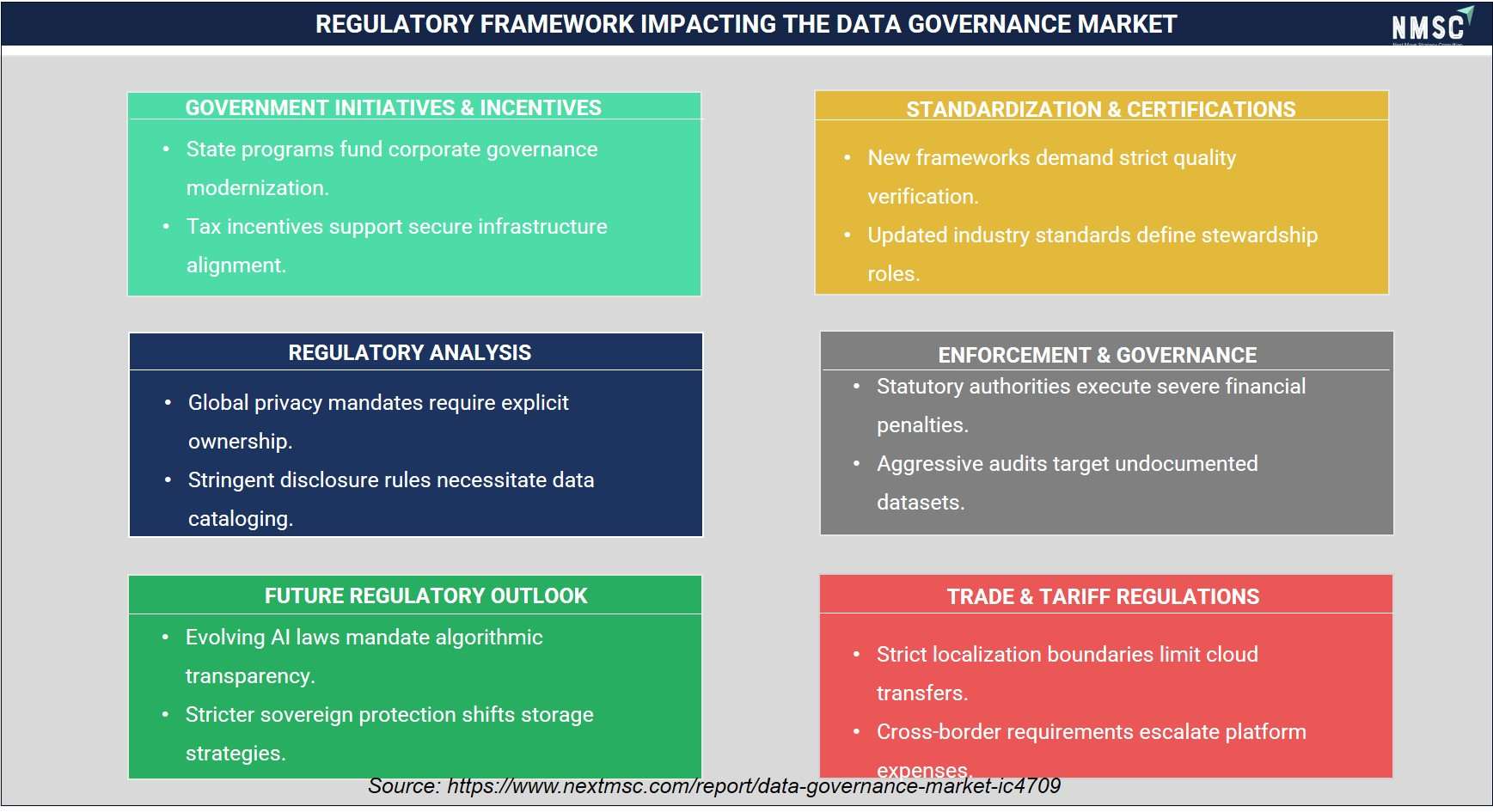
The regulatory framework influencing the Data Governance Market is becoming increasingly stringent as governments and industry bodies prioritize data privacy, accountability, and responsible data management. Regulatory mandates such as GDPR, CCPA, India's DPDPA, and emerging AI governance requirements are driving enterprise investments in data cataloging, stewardship, quality management, and compliance automation. Updated standards and certification frameworks are strengthening requirements for data ownership, transparency, and governance accountability, while enforcement agencies continue to increase audits and penalties for non-compliance. Looking ahead, evolving AI regulations, stricter data sovereignty mandates, and cross-border data transfer restrictions are expected to reshape governance strategies, technology architectures, and operational practices, making robust data governance a critical component of enterprise risk management and digital transformation initiatives.
Key Market Segments
By Component
-
Software
-
Governance Suite
-
Data Catalog
-
Data Lineage
-
Data Quality
-
Privacy Governance
-
Master Data Governance
-
Policy and Stewardship
-
Data Marketplace
-
Embedded Governance
-
-
Services
-
Advisory
-
Implementation
-
Managed Services
-
Training
-
By Deployment
-
Cloud
-
On-Premises
-
Hybrid
By Buyer
-
CDO and Data Office
-
Data Governance Team
-
Data Engineering Team
-
Risk and Compliance Team
-
Business Leaders
-
IT Team
By Organization Size
-
Large Enterprise
-
Midmarket
-
Small Business
-
By Sales Channel
-
Direct Sales
-
Channel Partner
-
System Integrator
-
Cloud Marketplace
-
OEM
By End-Use Industry
-
Banking and Financial Services
-
Insurance
-
Healthcare and Life Sciences
-
Government
-
Telecom and IT
-
Technology
-
Manufacturing
-
Retail and Consumer Goods
-
Energy and Utilities
-
Other Industries
By Region
-
North America: U.S., Canada, and Mexico.
-
Europe: UK, Germany, France, Italy, Spain, Sweden, Denmark, Finland, the Netherlands, and the rest of Europe.
-
Asia Pacific: China, India, Japan, South Korea, Taiwan, Indonesia, Vietnam, Australia, Philippines, Malaysia and the rest of APAC.
-
Middle East & Africa (MEA): Saudi Arabia, UAE, Egypt, Israel, Turkey, Nigeria, South Africa, and the rest of MEA.
-
Latin America: Brazil, Argentina, Chile, Colombia, and the rest of LATAM.
Conclusion and Recommendations
Long-Term Outlook
The Data Governance Market is entering its most consequential growth decade, driven by an unprecedented convergence of regulatory mandates, enterprise AI adoption, and digital transformation investment. The market is forecast to grow from USD 5.6 billion in 2026 to USD 21.6 billion by 2035, at a CAGR of 16.3%. NMSC's analysis indicates that this growth reflects not only expanding enterprise data volumes but the structural shift from reactive, compliance-driven governance toward proactive, AI-assisted active governance that operates continuously across every stage of the data lifecycle. Organizations that invest in governance infrastructure today are building competitive data assets that will underpin AI-driven business models through 2035 and beyond.
Strategic Positioning Recommendations
Platform vendors should prioritize AI-native differentiation, embedding machine learning capabilities within core cataloging, lineage, and quality monitoring functions rather than offering them as optional add-on modules. Organizations targeting regulated verticals must demonstrate certified regulatory mapping to GDPR, EU AI Act, HIPAA, DPDPA, and equivalent frameworks as a baseline qualification for enterprise procurement consideration. Hybrid deployment capability is non-negotiable for vendors targeting European and Asian enterprise buyers subject to data residency obligations. Cloud marketplace distribution through AWS, Azure, and Google Cloud marketplaces represents the highest-growth channel investment priority, enabling vendors to access committed cloud spend budgets and accelerate procurement cycles within enterprise Data Governance Market accounts.
Investment Attractiveness
The Data Governance Market represents a highly attractive investment environment given non-discretionary regulatory demand, expanding AI-driven market creation, recurring SaaS revenue models, and a structural shift from one-time implementation to ongoing managed governance services. Our assessment indicates that the highest-conviction investment themes include AI Governance capabilities growing at over 22% CAGR, Privacy Engineering platforms capturing compliance mandates from the EU AI Act, Healthcare vertical governance adoption at 21.2% CAGR, and Cloud Marketplace channel growth at 21.2% CAGR. Strategic acquirers should monitor pure-play governance specialists in data mesh governance, AI model lineage, and privacy engineering sub-categories as consolidation targets offering high functional differentiation and strong recurring revenue profiles.
Market Shifts and Key Risks
The most significant market shift underway is the migration from standalone point-solution governance tools toward consolidated AI-native governance platforms that serve as the central nervous system for enterprise data quality, lineage, policy, and compliance reporting. This shift benefits full-suite platform vendors and embedded governance within hyperscaler data platforms at the expense of narrow point-solution providers. Key risks for the Data Governance Market include implementation complexity constraining adoption timelines among midmarket organizations, regulatory fragmentation increasing multi-jurisdiction compliance costs, and hyperscaler-embedded governance capabilities commoditizing certain functional areas that currently command premium pricing from specialized vendors.
Growth Pathways
Organizations seeking to maximize value from the Data Governance Market should pursue a three-horizon strategy. In the near term through 2027, organizations should prioritize data catalog implementation, regulatory compliance mapping, and master data quality foundation-building to establish the governed data assets required for AI deployment. In the mid-term from 2027 to 2031, investment should shift toward AI governance frameworks, privacy engineering integration, and data marketplace governance capabilities to capture value from AI-driven data monetization programs. In the long term from 2031 to 2035, organizations should position for federated governance across multi-cloud, edge, and sovereign environments as data volume growth exceeds current centralized governance architectural limits, creating demand for next-generation distributed governance paradigms.


About the Author

About the Reviewer

At Next Move Strategy Consulting, we understand that insightful market research is the cornerstone of successful business decisions. That's why we employ a robust and multifaceted approach, combining various methodologies to deliver the most accurate and actionable data for our clients.

Research Landscape
We navigate the world of research with two primary approaches:
Qualitative Approach
Our qualitative research methodologies involve immersive techniques such as in-depth interviews, focus groups, and observational studies. By engaging directly with individuals and stakeholders, we uncover valuable insights that quantitative data alone may overlook.

Quantitative Research
In tandem with qualitative methodologies, NMSC leverages the power of Quantitative Research to provide a robust foundation of numerical insights. Through systematic data collection and analysis, we quantify patterns, preferences, and market trends, offering a comprehensive view of the business landscape.
Our quantitative research approach employs diverse tools, including surveys, experiments, and statistical modelling. These methodologies enable us to gather data from a large and representative sample, ensuring the statistical significance of our findings. By employing structured questionnaires and standardized data collection methods, we guarantee the reliability and validity of the information we present to our clients.
Quantitative research is particularly effective in measuring the prevalence of trends, assessing market size, and gauging the impact of various factors on consumer behavior. The numerical precision attained through this approach equips our clients with actionable insights, facilitating data-driven decision-making and strategy formulation.


Our Specialized Toolbox for Industry-Specific Market Research
We deploy a specialized arsenal of techniques tailored to meet your unique requirements. Here's a glimpse into our comprehensive toolbox:

Information Procurement
The stage entails acquiring market data or relevant information through various sources and methodologies.


Market Research Approach
We utilize both top-down and bottom-up approaches in market research analysis to achieve a comprehensive understanding of the market dynamics, leveraging the broad perspective of industry trends and macroeconomic factors alongside detailed insights from specific segments and individual companies.

Porters Five Forces Analysis
We conduct Porter's Five Forces analysis to evaluate the competitive landscape of an industry, providing us with insights into factors that affect profitability and strategic positioning.

SWOT Analysis

Forecasting
We utilize a forecasting model to predict future consumption by considering parameters like population, economics, regulations, market competition, drivers, constraints, technology, and pricing. We also employ statistical techniques such as multilinear regression, exponential smoothing, moving average, ARIMA, and Monte Carlo simulations for accurate predictions. In econometric forecasting, we analyzed short-term and long-term event impacts, attributing values based on regulatory frameworks, economic factors, and market events.





 Speak to Our Analyst