Database Security Market Size, Share, Growth & Forecast 2025–2035, By Offering (Software: Database Activity Monitoring and Auditing, Database Firewall, Encryption and Key Management, Data Masking, Services: Consulting, Implementation, Managed Services, Support and Maintenance), End User Industry (BFSI, IT and Telecom, Government, Healthcare and Life Sciences, Retail and Ecommerce, Manufacturing, Energy and Utilities), and Region — Global Analysis 2025–2035
Industry: ICT & Media | Publishing Date: June 16, 2026 | Last Updated: September 10, 2026 | No of Pages: N/A | No. of Tables: N/A | No. of Figures: N/A | Format: PDF | Report Code: IC4669
Industry Outlook
The global Database Security Market size was valued at USD 12.4 billion in 2025 and is projected to reach USD 14.1 billion in 2026, expanding to USD 44.8 billion by 2035, at a CAGR of 13.7% from 2026 to 2035. This sustained growth reflects escalating enterprise demand for database activity monitoring, encryption, and privileged access management solutions as organizations contend with rising volumes of targeted data breaches, increasingly stringent global data protection regulations, the accelerating migration of sensitive workloads to cloud environments, and the growing complexity of hybrid IT architectures that expand the database attack surface across large enterprises, mid-market organizations, and regulated public sector agencies worldwide.
|
Parameters |
Details |
|
Market Size in 2026 |
USD 14.1 Billion |
|
Revenue Forecast in 2035 |
USD 44.8 Billion |
|
Growth Rate |
CAGR of 13.7% from 2026 to 2035 |
|
Analysis Period |
2025–2035 |
|
Base Year Considered |
2025 |
|
Forecast Period |
2026–2035 |
|
Market Size Estimation |
USD Billion |
|
Companies Profiled |
20 |
|
Countries Covered |
33 |
|
Market Share |
Top 10 |
Database Security Market Overview
What Is the Database Security Market and How Has It Evolved Structurally?
The database security market encompasses the full ecosystem of software solutions and professional services designed to protect organizational databases from unauthorized access, data exfiltration, insider threats, injection attacks, and compliance violations. Core software categories include database activity monitoring and auditing, database firewalls, encryption and key management, data masking, tokenization, data discovery and classification, vulnerability assessment, and privileged access management. Structurally, the market has evolved from perimeter-centric security toward data-centric, identity-aware protection layers that operate natively within cloud, on-premises, and hybrid database environments, reflecting the expansion of enterprise data assets beyond traditional network boundaries.
How Is the Regulatory Environment Shaping the Database Security Market?
The database security market is significantly shaped by a global patchwork of data protection and cybersecurity regulations. The EU General Data Protection Regulation mandates data protection by design and by default, requiring enterprises to implement technical safeguards including encryption and access controls at the database layer. The U.S. Health Insurance Portability and Accountability Act enforce stringent technical safeguards for protected health information stored in healthcare databases. The Payment Card Industry Data Security Standard requires encryption, access logging, and vulnerability assessment for all cardholder data environments. National cybersecurity frameworks from NIST, ISO 27001, and sector-specific mandates in financial services are further expanding compliance-driven investment in database security solutions globally.
How Is Technology Adoption Transforming the Database Security Market?
NMSC's analysis indicates that cloud database deployments are reshaping the database security market's technology adoption landscape, with cloud-native database security solutions from hyperscale providers supplementing and, in many cases, replacing legacy on-premises appliance-based tools. The proliferation of NoSQL and multi-model databases in modern application architectures is expanding the attack surface beyond traditional relational systems, requiring security platforms to extend coverage across diverse database engines. Through our market assessment, we observed that AI-driven anomaly detection and behavioural analytics are being integrated into database activity monitoring platforms, significantly improving threat detection accuracy and reducing false positive rates for security operations center teams.
|
Key Takeaway |
|
Software dominates the Database Security Market by offering, accounting for approximately USD 9.2 billion in 2025, with Database Activity Monitoring and Auditing representing the single largest software sub-category driven by regulatory audit requirements across BFSI and healthcare verticals. Managed Services is the fastest-growing service sub-segment, estimated at a CAGR of 16.4%, as mid-market and SMB organizations increasingly outsource database security operations to managed security service providers. |
|
Cloud deployment leads the Database Security Market by deployment mode, estimated at USD 5.8 billion in 2025, reflecting the migration of enterprise workloads to AWS, Azure, and Google Cloud environments requiring cloud-native database security tooling. Hybrid deployment is the fastest-growing model at an estimated CAGR of 15.2%, driven by enterprises managing simultaneous on-premises legacy databases and cloud-native environments requiring unified security policy enforcement. |
|
Relational databases represent the largest Database Security Market segment by database type, accounting for approximately USD 8.6 billion in 2025, reflecting the incumbent dominance of Oracle, Microsoft SQL Server, and IBM Db2 in enterprise environments. NoSQL database security is the fastest-growing database type sub-segment at an estimated CAGR of 16.8%, driven by the adoption of MongoDB, Cassandra, and cloud-native document databases in modern application architectures. |
|
Large Enterprise customers generate approximately 61% of total Database Security Market revenue in 2025 at an estimated USD 7.6 billion, reflecting their complex multi-database, multi-cloud environments and elevated regulatory compliance obligations. SMB is the fastest-growing customer size segment at an estimated CAGR of 15.6%, enabled by cloud-delivered SaaS database security solutions and managed service models that reduce upfront capital investment barriers. |
|
BFSI is the largest end-use industry in the Database Security Market, estimated at approximately USD 3.2 billion in 2025, driven by stringent financial sector regulations, high-value cardholder data environments, and zero-tolerance breach postures in banking and insurance operations. Healthcare and Life Sciences is the fastest-growing vertical at an estimated CAGR of 15.8%, driven by HIPAA enforcement, electronic health record database proliferation, and escalating ransomware targeting of healthcare data environments. |
|
Partner channel distribution leads the Database Security Market, reflecting the extensive value-added reseller and managed security service provider ecosystems built around Microsoft, Oracle, IBM, and specialist vendors. Marketplace distribution is the fastest-growing channel at an estimated CAGR of 18.2%, driven by AWS Security Hub, Azure Marketplace, and Google Cloud Marketplace enabling frictionless procurement of database security tools within existing cloud spend commitments. |
|
North America leads the global Database Security Market at an estimated USD 5.4 billion in 2025, anchored by the highest concentration of regulated enterprise databases, NIST framework adoption, and cybersecurity vendor headquarter presence. Asia Pacific is the fastest-growing region at a projected CAGR of 15.1%, driven by digital economy expansion in India and China and escalating cyber threat activity. The United States is the largest national market at approximately USD 4.5 billion in 2025, while India is the fastest-growing country market over the forecast horizon. |
|
The United States is the largest market for database security, driven by high cybersecurity spending, stringent compliance requirements, and the presence of major technology and cybersecurity vendors. Strong adoption across finance, healthcare, government, and enterprise sectors continues to support market leadership. |
|
Asia Pacific is the fastest-growing region in the Database Security Market, fueled by rapid digital transformation, increasing cloud adoption, and rising cybersecurity concerns. Growing investments in data protection and regulatory compliance are driving demand across the region. |
|
India is the fastest-growing country in the Database Security Market, supported by expanding digital infrastructure, increasing cloud deployments, and rising awareness of data security. Strong enterprise adoption of digital technologies continues to boost demand for database protection solutions. |
Key Emerging Trends in the Database Security Market
How Is AI-Driven Behavioral Analytics Transforming Database Threat Detection?
From our research, we found that AI-driven behavioral analytics is replacing static rule-based database activity monitoring across large enterprise deployments in North America and Europe. Machine learning models establish baseline behavioral profiles for database users and applications, flagging deviations such as anomalous query volumes, off-hours access, and unusual data export patterns as potential insider threats or credential compromise indicators. Oracle Data Safe, IBM Guardium Insights, and Microsoft Defender for SQL have all integrated ML-based anomaly scoring into their database security platforms, significantly reducing analyst investigation time and improving detection precision.
How Is Cloud-Native Database Security Reshaping Architecture Decisions in the Database Security Market?
Through our market assessment, we observed that the migration of enterprise workloads to cloud database services such as Amazon RDS, Azure SQL Database, Google Cloud Spanner, and Snowflake is fundamentally repositioning the database security market toward cloud-native, API-integrated security tooling. Traditional network-layer database firewalls are giving way to cloud-delivered database activity monitoring agents, serverless encryption key management via AWS KMS and Azure Key Vault, and identity-integrated privileged access controls that enforce least-privilege at the database object level. This architectural shift is accelerating cloud deployment revenue and expanding the addressable market for cloud-native security vendors.
How Is Zero-Trust Architecture Driving Privileged Access Management Adoption in the Database Security Market?
Based on NMSC's research, we found that the adoption of zero-trust security frameworks across enterprise IT environments is elevating privileged access management to a foundational database security requirement. The principle of least-privilege access mandates just-in-time credential provisioning, session recording, and continuous verification for all database administrator and application service account access. CyberArk's Privileged Access Security and BeyondTrust's Privileged Access Management platforms are seeing accelerated enterprise procurement as CISA's Zero Trust Maturity Model drives federal agency and defense industrial base compliance in the United States and influences allied nation regulatory frameworks in Europe and Australia.
How Is the Surge in Ransomware Targeting Database Environments Expanding the Database Security Market?
Our findings suggest that ransomware groups are increasingly targeting database backup repositories and live database environments as their primary data exfiltration and encryption targets, fundamentally elevating database security from a compliance obligation to a board-level business continuity priority. According to the Cybersecurity and Infrastructure Security Agency, healthcare, critical infrastructure, and financial services organizations face the highest frequency of database-targeted ransomware campaigns. This threat escalation is driving emergency procurement of database encryption, tokenization, and vulnerability assessment solutions among organizations that had previously deprioritized database-specific security investment.
What Are the Key Market Drivers, Breakthroughs, and Investment Opportunities That Will Shape the Database Security Market Industry in the Next Decade?
Growth Catalyst & Risk Assessment Matrix
|
Drivers / Trends / Restraints |
(+/−) % Impact on CAGR Forecast |
Geographic Relevance |
Impact Timeline |
|
Escalating Data Breach Frequency |
+2.4% |
Global |
2025–2035 |
|
Cloud Database Migration |
+2.2% |
North America, Europe, APAC |
2025–2030 |
|
GDPR, HIPAA, PCI-DSS Compliance Mandates |
+1.8% |
Europe, North America |
2025–2035 |
|
Zero-Trust Architecture Adoption |
+1.6% |
North America, Europe, Australia |
2025–2032 |
|
Ransomware Targeting of Database Environments |
+1.4% |
Global |
2025–2030 |
|
AI-Driven Database Threat Detection |
+1.2% |
North America, Europe, APAC |
2026–2035 |
|
NoSQL Database Security Gap |
+0.9% |
Global |
2026–2035 |
|
Public Sector Cybersecurity Mandates |
+0.8% |
North America, Europe, MEA |
2025–2035 |
|
Complexity of Hybrid Database Environments |
−1.2% |
Mid-Market, SMB |
2025–2030 |
|
Shortage of Database Security Expertise |
−0.9% |
LATAM, MEA |
2025–2032 |
|
High Total Cost of Ownership for Legacy Tools |
−0.7% |
SMB, Mid-Market |
2025–2030 |
|
Open-Source Security Tool Commoditization |
−0.5% |
Global |
2026–2035 |
What Are the Growth Drivers of the Database Security Market?
How Is the Rising Frequency of Data Breaches Driving Database Security Market Investment?
The accelerating frequency and severity of data breaches targeting enterprise database environments is the most powerful structural driver of database security market growth. According to the U.S. Department of Health and Human Services breach portal, thousands of healthcare database breaches involving millions of patient records are reported annually, each carrying regulatory penalties and remediation costs that far exceed the cost of preventive database security investment. The FBI's Internet Crime Complaint Center (IC3) annual report consistently identifies business email compromise and database intrusion as the highest-cost cyber incidents, creating compelling financial justification for database activity monitoring and encryption investments across all enterprise segments.
How Are Global Data Protection Regulations Sustaining a Long-Term Database Security Market Demand?
Compliance-driven investment represents a reliable and non-discretionary growth driver in the database security market, anchored by the mandatory technical control requirements of GDPR, HIPAA, PCI-DSS, and the evolving U.S. state privacy law landscape following CCPA. The EU GDPR's Article 32 explicitly requires implementation of appropriate technical measures including encryption and access controls at the data layer, effectively mandating database security investment for any organization processing EU resident personal data. NMSC's analysis indicates that compliance-motivated purchases account for a material proportion of first-year database security budget allocation across mid-market and large enterprise buyers.
How Is the Shift to Cloud Databases Expanding the Database Security Market's Addressable Scope?
Enterprise migration from on-premises to cloud database services is dramatically expanding the database security market's addressable scope by introducing new security requirements that legacy on-premises tools cannot fulfill. Cloud databases including Amazon Aurora, Azure Cosmos DB, Google BigQuery, and managed PostgreSQL and MySQL services require cloud-native identity integration, serverless encryption key management, and API-based activity monitoring that traditional network appliances cannot provide. Based on our market evaluation, we noticed that organizations operating in multi-cloud environments face the most acute database security coverage gaps, creating strong procurement demand for cross-cloud unified database security platforms.
What Are the Growth Inhibitors of the Database Security Market?
How Does the Complexity of Hybrid Database Environments Create Deployment Barriers in the Database Security Market?
Organizations managing simultaneous on-premises legacy databases, private cloud databases, and public cloud managed database services face significant complexity in deploying unified database security policies that span all environments consistently. The heterogeneity of database engines, operating systems, and cloud APIs requires security teams to operate multiple disjointed tools, increasing operational overhead and leaving coverage gaps. According to the U.S. National Institute of Standards and Technology, hybrid cloud security architecture requires explicit data flow mapping and control plane integration, capabilities that many legacy database security tools lack, slowing deployment timelines and increasing total project cost for mid-market buyers.
How Does the Cybersecurity Skills Shortage Limit Database Security Market Adoption?
A persistent shortage of qualified database security professionals, including database administrators with security specialization and security engineers with database platform expertise, is constraining the pace of database security market adoption, particularly in SMB and mid-market segments. According to the U.S. Cybersecurity and Infrastructure Security Agency, the national cybersecurity workforce gap remains a critical vulnerability in enterprise security posture. This talent deficit elevates the strategic importance of managed database security services and automated, AI-assisted monitoring platforms that reduce dependence on scarce in-house expertise, indirectly creating a market shift toward service-oriented database security delivery models.
What Are the Growth Opportunities in the Database Security Market?
How Is the Expansion of Public Sector Cybersecurity Mandates Creating Structural Demand in the Database Security Market?
Government cybersecurity mandates across the United States, European Union, and Asia Pacific are creating institutionalized, budget-backed demand for database security investments within public sector organizations. The U.S. Office of Management and Budget's M-22-09 memorandum mandating zero-trust architecture implementation across federal agencies explicitly includes database access control and privileged access management as required technical capabilities. The EU Network and Information Security Directive (NIS2) extend cybersecurity obligations to a broader range of critical infrastructure operators, requiring technical database protection measures. Through NMSC's assessment, we found that public sector procurement represents a growing, long-duration revenue opportunity for certified database security vendors.
How Does the NoSQL Database Security Gap Represent a High-Growth Opportunity for the Database Security Market?
The widespread adoption of NoSQL databases including MongoDB, Apache Cassandra, Redis, and Elasticsearch in modern application architectures has created significant security coverage gaps, as most enterprise database security tools were architected primarily for relational database environments. Our analysis shows that NoSQL databases are frequently deployed with default or weak security configurations, creating high-exposure vulnerabilities that are actively exploited by threat actors. Vendors developing NoSQL-native security monitoring, encryption, and access control capabilities are addressing an underserved and rapidly growing segment within the database security market, with particularly strong demand in technology, retail, and media verticals.
How Is the Growth of Data Privacy as a Competitive Differentiator Creating Premium Market Opportunities in the Database Security Market?
Enterprises across BFSI, technology, and healthcare sectors are increasingly positioning data privacy and database security as competitive differentiators in customer acquisition and retention, creating demand for premium database security solutions beyond minimum compliance requirements. Our findings suggest that organizations pursuing privacy-by-design certifications such as ISO 27701, SOC 2 Type II, and FedRAMP are investing in advanced tokenization, data masking, and dynamic data anonymization capabilities that represent higher-value, higher-margin product categories within the database security market, elevating average deal sizes and contract durations.
How Is the Database Security Market Segmented in This Report, and What Are the Key Insights from the Segmentation Analysis?
How Do Software and Services Sub-Segments Define the Revenue Structure of the Database Security Market?
|
Segment |
2025 (USD Bn) |
2035 (USD Bn) |
CAGR (%) |
|
Software |
9.2 |
32.4 |
13.4% |
|
Services |
3.2 |
12.4 |
14.6% |
Software dominates the database security market offering dimension, with Database Activity Monitoring and Auditing representing the largest sub-category, underpinned by mandatory audit logging requirements across BFSI, healthcare, and government sectors. Database Firewall software is the second-largest sub-category, protecting SQL injection and privilege escalation attack vectors across relational database environments. Encryption and Key Management solutions are gaining accelerated traction as cloud database migrations expand cryptographic key management complexity. Data Masking and Tokenization are the fastest-growing software sub-categories, driven by GDPR anonymization requirements and PCI-DSS cardholder data de-identification mandates. Privileged Access Management software is an elevated-growth category reflecting zero-trust architecture adoption. The Services segment, covering Consulting, Implementation, Managed Services, and Support, is growing at a premium rate, driven by managed database security service demand from SMB and mid-market organizations lacking in-house security operations capacity.
How Do On-Premises, Cloud, and Hybrid Deployment Models Compare in the Database Security Market?
|
Segment |
2025 (USD Bn) |
2035 (USD Bn) |
CAGR (%) |
|
On-Premises |
4.4 |
11.6 |
10.2% |
|
Cloud |
5.8 |
22.6 |
14.6% |
|
Hybrid |
2.2 |
10.6 |
17.0% |
Cloud deployment leads the database security market, reflecting the migration of enterprise databases to AWS RDS, Azure SQL, and Google Cloud SQL environments that require cloud-native security tooling with API-based integration and serverless key management capabilities. On-premises deployment retains a substantial revenue base anchored by large financial institutions, defense contractors, and government agencies with stringent data residency and air-gap requirements. Hybrid deployment is the fastest-growing model, driven by enterprises simultaneously managing legacy on-premises databases and cloud-native workloads that require unified policy enforcement and consolidated audit reporting. Oracle Database Vault and IBM Guardium are prominent platforms serving hybrid deployment architectures across large enterprise accounts globally.
Which Database Types Are Generating the Most Security Investment in the Database Security Market?
|
Segment |
2025 (USD Bn) |
2035 (USD Bn) |
CAGR (%) |
|
Relational |
8.6 |
28.4 |
12.7% |
|
NoSQL |
2.4 |
11.2 |
16.7% |
|
Mainframe |
0.9 |
2.8 |
12.0% |
|
Other Database |
0.5 |
2.4 |
17.0% |
Relational databases represent the largest database type category in the database security market, reflecting the pervasive enterprise deployment of Oracle Database, Microsoft SQL Server, IBM Db2, and PostgreSQL across BFSI, healthcare, and government sectors with extensive historical security tooling investment. NoSQL database security is the fastest-growing type sub-segment, driven by the adoption of MongoDB, Elasticsearch, and Cassandra in modern application architectures that lack mature native security controls and require third-party monitoring and access governance overlays. Mainframe database security maintains a stable revenue base among legacy financial institutions and insurance companies, while Other Database types including in-memory and time-series databases are emerging as new security investment categories aligned with IoT and streaming analytics workloads.
How Do Direct, Partner, and Marketplace Channels Compete for Revenue in the Database Security Market?
|
Segment |
2025 (USD Bn) |
2035 (USD Bn) |
CAGR (%) |
|
Direct |
4.6 |
15.6 |
13.0% |
|
Partner |
6.2 |
21.8 |
13.4% |
|
Marketplace |
1.6 |
7.4 |
16.6% |
Partner channel distribution leads the database security market, underpinned by extensive MSSP, VAR, and SI ecosystems around Microsoft, Oracle, IBM, and specialist vendors such as CyberArk and Thales. Direct sales dominate large enterprise and public sector accounts requiring custom commercial structures, proof-of-concept deployments, and dedicated account management. Cloud Marketplace distribution is the fastest-growing channel, driven by AWS Security Hub integration, Azure Marketplace, and Google Cloud Marketplace procurement that enables organizations to purchase database security tooling within existing cloud spending commitments and consolidated billing arrangements. This frictionless procurement model is accelerating SMB and mid-market adoption of cloud-native database security solutions.
|
Segment |
2025 (USD Bn) |
2035 (USD Bn) |
CAGR (%) |
|
Large Enterprise |
7.6 |
26.2 |
13.2% |
|
Mid-Market |
3.2 |
12.0 |
14.2% |
|
SMB |
1.6 |
6.6 |
15.2% |
Large Enterprise customers represent the majority of database security market revenue, deploying comprehensive multi-vendor security stacks that include database activity monitoring, encryption, privileged access management, and vulnerability assessment across diverse on-premises and cloud database portfolios. Mid-Market organizations are the second-fastest growing segment, increasingly adopting integrated, cloud-delivered database security platforms that consolidate multiple security functions within a single vendor relationship to reduce management complexity. SMB is the fastest-growing customer size cohort, enabled by SaaS-delivered database security tools and MSSP partnerships that provide enterprise-grade protection at SMB-accessible price points. Cloud marketplace procurement and consumption-based pricing are the primary adoption catalysts within the SMB segment.
Which Industries Are the Largest and Fastest-Growing Consumers of Database Security Solutions?
|
Segment |
2025 (USD Bn) |
2035 (USD Bn) |
CAGR (%) |
|
BFSI |
3.2 |
11.2 |
13.4% |
|
IT and Telecom |
2.4 |
8.8 |
13.9% |
|
Government |
1.6 |
5.8 |
13.7% |
|
Healthcare and Life Sciences |
1.8 |
7.2 |
14.9% |
|
Retail and Ecommerce |
1.4 |
5.2 |
14.1% |
|
Manufacturing |
1.0 |
3.4 |
13.0% |
|
Energy and Utilities |
0.6 |
2.2 |
13.9% |
|
Other Industry |
0.4 |
1.0 |
9.6% |
BFSI is the largest end-user industry in the database security market, driven by PCI-DSS cardholder data environment compliance, Basel III regulatory reporting data governance, real-time fraud detection database monitoring, and zero-tolerance breach postures in retail banking and insurance. IT and Telecom is the second-largest vertical, reflecting large-scale subscriber data repository security requirements and SOC 2 compliance programs. Healthcare and Life Sciences is the fastest-growing industry vertical, driven by HIPAA enforcement, rising ransomware attacks on hospital systems, and EHR database proliferation. Government represents a structurally growing segment, underpinned by U.S. federal zero-trust mandates and EU NIS2 requirements. Retail and Ecommerce demand is fueled by payment data protection and customer PII database compliance requirements.
Regulatory Framework Impacting the Database Security Market
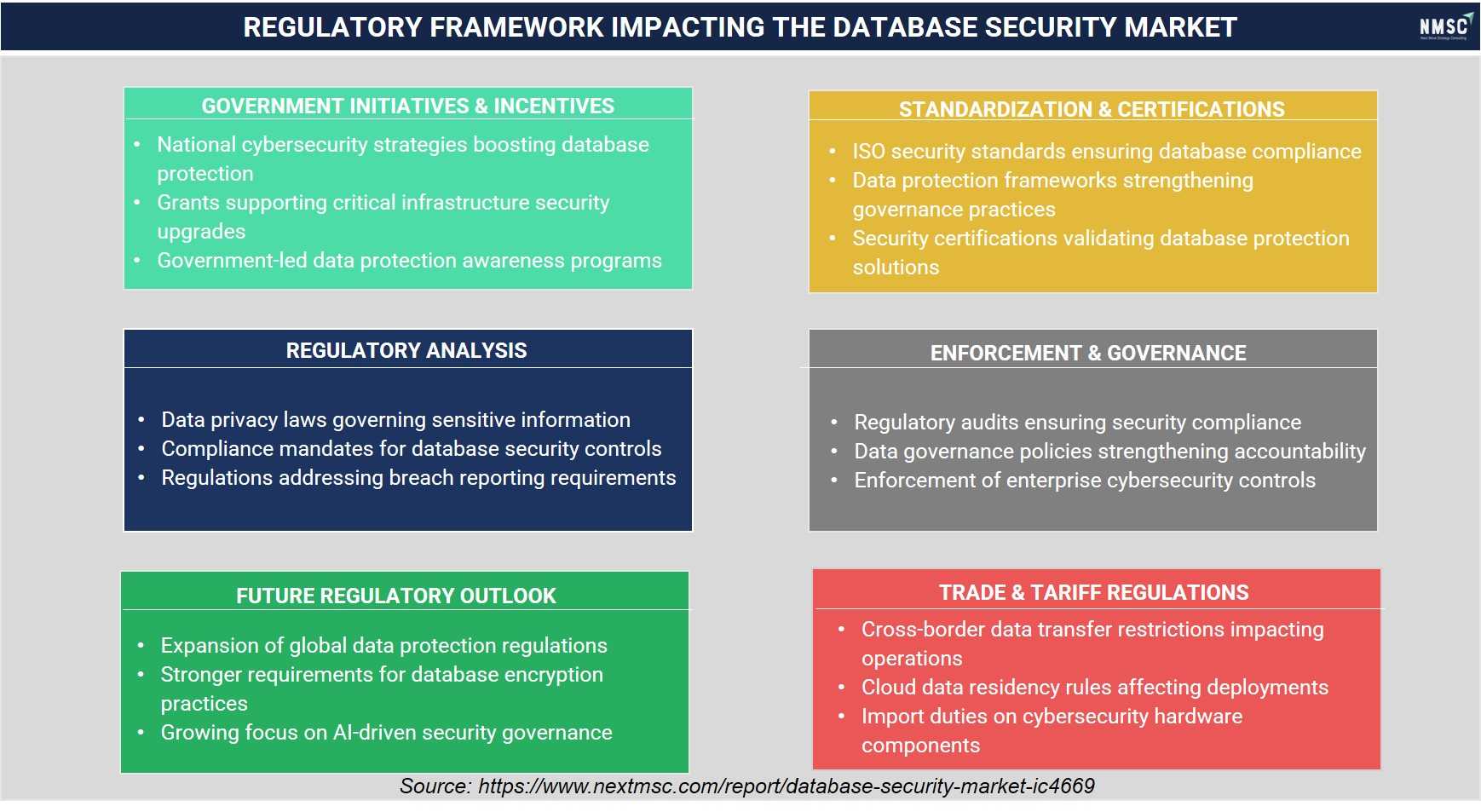
The infographic outlines that the database security market is shaped by government initiatives such as national cybersecurity strategies and grants for critical infrastructure, along with regulatory analysis covering data privacy laws, security mandates, and breach reporting requirements. Looking ahead, the future regulatory outlook points to expanding global data protection rules, stronger encryption mandates, and AI-driven governance. Additionally, standardization through ISO certifications and data protection frameworks, enforcement via audits and governance policies, plus trade and tariff regulations including cross-border data transfer restrictions and cloud data residency rules, collectively influence market dynamics.
Regional Outlook
Geographic Performance Snapshot
|
Region |
2025 Market Size (USD Bn) |
2035 Forecast (USD Bn) |
CAGR 2026–2035 (%) |
Key Driver |
|
North America |
5.4 |
18.8 |
13.3% |
NIST framework, federal zero-trust mandates, HIPAA, PCI-DSS |
|
Europe |
3.2 |
11.4 |
13.6% |
GDPR compliance, NIS2 directive, cloud migration |
|
Asia Pacific |
2.4 |
9.4 |
14.6% |
Digital economy expansion, escalating cyber threats |
|
Middle East & Africa |
0.8 |
3.2 |
14.9% |
Vision 2030 AI programs, SAMA/CBUAE cyber frameworks |
|
Latin America |
0.6 |
2.0 |
12.8% |
LGPD compliance, banking sector digitalization |
North America Database Security Market
North America leads the global database security market at an estimated USD 5.4 billion in 2025, supported by the world's most mature enterprise security regulatory ecosystem, the highest concentration of regulated database environments, and the headquarter presence of leading vendors including Microsoft, Oracle, IBM, CyberArk, and Varonis. Based on our engagements with enterprise security procurement teams, U.S. federal mandates including NIST SP 800-53, OMB M-22-09 zero-trust requirements, and CISA cybersecurity directives create non-discretionary database security investment across civilian agencies and federal contractors, sustaining public sector demand throughout the forecast period.
United States Database Security Market
Through our analysis, the United States database security market is estimated at approximately USD 4.5 billion in 2025, the single largest national market globally. HIPAA, PCI-DSS, CCPA, and SEC cybersecurity disclosure rules collectively impose database security obligations across healthcare, financial services, retail, and publicly listed enterprises. The CISA Known Exploited Vulnerabilities catalog explicitly includes database software vulnerabilities, mandating rapid remediation cycles that drive vulnerability assessment and patching service demand. Competitive intensity is the highest globally, with all twenty profiled vendors maintaining active enterprise sales operations in the United States market.
Canada Database Security Market
From our assessment, Canada's database security market is valued at approximately USD 0.62 billion in 2025. PIPEDA enforcement by the Office of the Privacy Commissioner, provincial health information protection acts, and OSFI cybersecurity expectations for financial institutions create multi-layered compliance obligations that sustain database security investment. The Canadian Centre for Cyber Security's National Cyber Threat Assessment identifies database breaches as a top enterprise risk, reinforcing board-level investment prioritization. Hybrid cloud deployment is a prominent architecture preference among regulated Canadian enterprises.
Mexico Database Security Market
According to our evaluation, Mexico's database security market is estimated at approximately USD 0.28 billion in 2025. BFSI sector compliance under CNBV cybersecurity circulars, expanding retail e-commerce data environments, and manufacturing sector OT-IT convergence programs are the primary demand drivers. Cloud adoption is accelerating, with AWS and Microsoft Azure infrastructure investments in Mexico City improving availability of cloud-native database security services. The LFPDPPP personal data protection law creates foundational compliance-driven database security investment across commercial enterprises.
Europe Database Security Market
Europe's database security market is projected at USD 3.2 billion in 2025, shaped by the EU General Data Protection Regulation's mandatory technical safeguards at the data layer, the NIS2 Directive's expanded cybersecurity obligations across critical infrastructure sectors, and national enforcement actions by data protection authorities that have imposed material financial penalties for inadequate database protection. Based on NMSC's research, we found that GDPR enforcement is directly accelerating investment in data discovery and classification, encryption, and access audit capabilities that enable organizations to demonstrate compliance with data minimization and accountability obligations.
United Kingdom Database Security Market
Through our analysis, the United Kingdom database security market is estimated at approximately USD 0.74 billion in 2025. UK GDPR and the Data Protection Act 2018 maintain stringent database security obligations post-Brexit. The FCA's operational resilience framework and PRA's cyber requirements impose database protection standards on financial institutions. NCSC's Cyber Essentials Plus scheme drives database security adoption across government supplier chains. London's financial services concentration creates premium demand for database encryption, activity monitoring, and privileged access management solutions.
Germany Database Security Market
From our assessment, Germany's database security market is valued at approximately USD 0.58 billion in 2025. BSI IT-Grundschutz provides a comprehensive database security baseline that regulated German enterprises implement. The Bundesdatenschutzgesetz national GDPR implementation and strict data protection enforcement by Datenschutzbehörden create robust compliance investment. Industrial sector database security, driven by Industrie 4.0 OT-IT database integration programs at Siemens, Bosch, and BASF, represents an additional demand vector beyond traditional BFSI and government verticals.
France Database Security Market
Based on our engagements, France's database security market is estimated at approximately USD 0.44 billion in 2025. ANSSI cybersecurity guidelines and CNIL GDPR enforcement create layered database security obligations. The French government's cloud de confiance program mandates data encryption and access control for government database workloads. Defense, aerospace, and financial services represent premium demand verticals. Thales S.A.'s headquarter presence in France positions it as both a major employer and a leading domestic database encryption and key management vendor.
Italy Database Security Market
Through NMSC's assessment, Italy's database security market reached approximately USD 0.26 billion in 2025. Garante Privacy GDPR enforcement, Banca d'Italia cybersecurity circulars for financial institutions, and the PNRR digital investment plan's cybersecurity component are primary demand drivers. Banking, insurance, and public administration represent the core database security consumer base. Italian MSSP and SI partners are the primary distribution channel for global database security vendor deployments.
Spain Database Security Market
Our analysis shows that Spain's database security market is estimated at approximately USD 0.22 billion in 2025. AEPD GDPR enforcement, CNBV-equivalent financial sector regulations, and Spain's National Cybersecurity Plan are creating compliance-driven investment. Telecommunications companies, retail banks, and energy utilities represent primary demand verticals. Madrid's growing technology sector is attracting SI talent and driving mid-market database security adoption via cloud marketplace channels.
Sweden Database Security Market
According to our evaluation, Sweden's database security market reached approximately USD 0.14 billion in 2025. IMY data protection enforcement, Sweden's NIS2 transposition, and the high technology adoption maturity of Swedish enterprises drive market demand. Financial services, healthcare, and telecommunications represent primary verticals. Sweden's progressive digital economy supports early adoption of cloud-native database security platforms and zero-trust architecture implementation programs.
Denmark Database Security Market
From our assessment, Denmark's database security market is valued at approximately USD 0.11 billion in 2025. The Danish Data Protection Authority's GDPR enforcement, healthcare database security requirements under the national health data registry, and financial services compliance obligations are key drivers. Denmark's comprehensive digital government infrastructure creates specific public sector database security investment needs across citizen data repositories.
Finland Database Security Market
Based on our market evaluation, Finland's database security market reached approximately USD 0.09 billion in 2025. Tietosuojavaltuutettu data protection authority enforcement, NIS2 transposition, and Nokia's enterprise IT security investments represent key market drivers. Public sector healthcare database security and defense sector investments are notable demand anchors. High enterprise cloud penetration supports cloud-native database security adoption.
Netherlands Database Security Market
Through our analysis, the Netherlands database security market is estimated at approximately USD 0.19 billion in 2025. AP (Autoriteit Persoonsgegevens) GDPR enforcement with demonstrated willingness to impose substantial fines creates strong compliance-driven investment. Amsterdam's cloud hub concentration (AWS, Azure, Google) drives cloud database security tooling adoption. Financial services, logistics, and technology sectors are primary verticals. The Netherlands' high enterprise IT maturity supports sophisticated database security program development.
Rest of Europe Database Security Market
According to our evaluation, the Rest of Europe segment, encompassing Poland, Belgium, Switzerland, Austria, and other markets, collectively represents approximately USD 0.42 billion in 2025. GDPR enforcement across EU member states creates uniform baseline compliance demand. Central and Eastern European markets are experiencing accelerating database security adoption driven by financial sector modernization, EU digital cohesion funding, and nearshoring of technology operations that expands the regulated database footprint.
Asia Pacific Database Security Market
Asia Pacific is the fastest-growing regional market in the database security market, projected to expand from USD 2.4 billion in 2025 to USD 9.4 billion by 2035 at a CAGR of 14.6%. NMSC's analysis indicates that the combination of rapidly expanding digital economy database footprints, escalating nation-state and cybercriminal threat activity targeting APAC enterprises, and government cybersecurity framework development across India, Australia, Singapore, and South Korea creates a structurally high-growth environment. Domestic cloud providers in China including Alibaba Cloud and Huawei Cloud are developing competitive database security tooling that captures demand in the protected domestic market.
China Database Security Market
Through our analysis, China's database security market is estimated at approximately USD 0.82 billion in 2025. China's Cybersecurity Law, Data Security Law, and Personal Information Protection Law create a comprehensive database security regulatory framework that mandates encryption, access controls, and data classification for all organizations processing Chinese personal data. State-owned enterprises, financial institutions, and technology companies represent primary demand verticals. Domestic database security vendors benefit from regulatory preferences for localized solutions and data residency requirements that limit international vendor market penetration.
India Database Security Market
From our assessment, India's database security market reached approximately USD 0.48 billion in 2025 and is the fastest-growing national market in the region. The Digital Personal Data Protection Act's implementation trajectory is creating foundational compliance-driven database security investment. BFSI sector compliance under RBI cybersecurity guidelines, IT services company SOC 2 certification programs, and healthcare EHR database security requirements represent primary demand drivers. AWS, Microsoft, and global database security vendors are expanding their India presence to serve accelerating enterprise demand.
Japan Database Security Market
According to our evaluation, Japan's database security market is valued at approximately USD 0.46 billion in 2025. Japan's Act on Protection of Personal Information, FSA cybersecurity guidelines for financial institutions, and the Ministry of Economy's DX Suishin program create layered database security obligations. Manufacturing, financial services, and government represent primary demand verticals. Local SI partners Fujitsu and NTT Data are the primary deployment channel for global database security vendor engagements in Japan.
South Korea Database Security Market
Based on our engagements, South Korea's database security market is estimated at approximately USD 0.24 billion in 2025. The Personal Information Protection Act enforced by the PIPC, FSC cybersecurity requirements for financial institutions, and Korea Internet and Security Agency cybersecurity guidelines create comprehensive database protection obligations. Samsung, SK Group, and major Korean banks are flagship enterprise adopters. High technology adoption maturity supports early deployment of AI-driven database anomaly detection solutions.
Taiwan Database Security Market
Through NMSC's assessment, Taiwan's database security market reached approximately USD 0.11 billion in 2025. Semiconductor and electronics manufacturing enterprises (TSMC, ASE Group) represent the primary database security demand vertical, protecting sensitive process data and IP. The Financial Supervisory Commission imposes database security requirements on financial institutions. National cybersecurity policy under the Executive Yuan is strengthening public sector database protection programs.
Indonesia Database Security Market
Our analysis shows that Indonesia's database security market is valued at approximately USD 0.09 billion in 2025. The Personal Data Protection Law enacted in 2022 is creating compliance-driven investment across financial services, e-commerce, and telecommunications sectors. Bank Indonesia and OJK cybersecurity regulations impose database protection requirements on financial institutions. Cloud database security adoption is accelerating with improving hyperscale infrastructure availability.
Vietnam Database Security Market
From our assessment, Vietnam's database security market is estimated at approximately USD 0.05 billion in 2025. Vietnam's Cybersecurity Law and Decree 13/2023/ND-CP on personal data protection create database security compliance obligations. Banking sector modernization under State Bank of Vietnam supervision, manufacturing sector IT security investment, and telecommunications database protection represent primary demand drivers. Cloud database security adoption is growing with increasing regional cloud service availability.
Australia Database Security Market
According to our evaluation, Australia's database security market reached approximately USD 0.22 billion in 2025. The Australian Privacy Act 1988 and Notifiable Data Breaches scheme, APRA CPS 234 information security standard for financial institutions, and the Australian Cyber Security Centre's Essential Eight framework create multi-layered database security compliance obligations. Financial services, healthcare, and government are primary demand verticals. Australia's mature enterprise security market supports comprehensive database security program adoption.
Philippines Database Security Market
Based on our engagements, the Philippines database security market is valued at approximately USD 0.05 billion in 2025. The Data Privacy Act of 2012 enforced by the National Privacy Commission creates database protection compliance requirements. Banking sector digitalization under BSP cybersecurity circulars, BPO sector data protection programs, and government database security investments are key demand drivers. Cloud database security adoption is accelerating with improving infrastructure availability.
Malaysia Database Security Market
Through our analysis, Malaysia's database security market is estimated at approximately USD 0.08 billion in 2025. The Personal Data Protection Act enforced by the Department of Personal Data Protection, BNM risk management guidelines, and Malaysia's National Cyber Security Policy create database security compliance foundations. Financial services, government, and technology sectors represent primary demand verticals. MDEC's digital economy initiatives are accelerating enterprise technology modernization, expanding the database security addressable market.
Rest of APAC Database Security Market
Our findings suggest that the Rest of APAC segment, encompassing Thailand, New Zealand, Bangladesh, Sri Lanka, and other markets, collectively represents approximately USD 0.10 billion in 2025. Improving data protection legislation across Southeast Asian markets, fintech growth, and government digitalization programs are primary demand catalysts. Cloud service expansion from regional hyperscale providers is reducing adoption barriers for cloud-native database security solutions in these markets.
Middle East & Africa (MEA) Database Security Market
The MEA database security market is projected at USD 0.8 billion in 2025 and is one of the fastest-growing regional markets at a CAGR of 14.9%, driven by Saudi Arabia Vision 2030 digital transformation programs, UAE's Smart Government and CBUAE cybersecurity framework requirements, and government-led national cybersecurity strategy investments across GCC member states. Based on NMSC's research, we found that financial sector database security mandates from the Saudi Central Bank (SAMA) and UAE Central Bank are among the most stringent globally, creating significant compliance-driven database security spending in the region's banking sector.
Saudi Arabia Database Security Market
Through our analysis, Saudi Arabia's database security market is valued at approximately USD 0.22 billion in 2025. SAMA Cybersecurity Framework, NCA Essential Cybersecurity Controls, and SDAIA data protection regulations collectively mandate database security investment across financial institutions, government agencies, and critical infrastructure operators. Vision 2030 digital economy programs are creating new data-intensive workloads that expand the database security addressable market. Sovereign cloud deployment preferences reinforce investment in on-premises and private cloud database security solutions.
UAE Database Security Market
From our assessment, the UAE database security market reached approximately USD 0.18 billion in 2025. CBUAE cybersecurity framework, DIFC Data Protection Law, and Abu Dhabi Global Market data regulations create layered database security compliance obligations. Smart Dubai and Abu Dhabi government digital programs generate significant public sector database security demand. The UAE's progressive approach to AI governance and data regulation positions it as an advanced adopter of AI-driven database monitoring solutions within the MEA region.
Egypt Database Security Market
Based on our market evaluation, Egypt's database security market is estimated at approximately USD 0.08 billion in 2025. Central Bank of Egypt cybersecurity guidelines, the Personal Data Protection Law, and government digital transformation programs are primary demand drivers. Banking sector compliance investment and telecommunications database protection represent the core commercial demand base. Cloud database security adoption is growing with expanding regional cloud infrastructure.
Israel Database Security Market
According to our evaluation, Israel's database security market is valued at approximately USD 0.09 billion in 2025. Israel's globally recognized cybersecurity sector, the National Cyber Directorate's regulatory guidance, and stringent Defense Ministry database security requirements create a sophisticated demand environment. Financial services, defense technology, and healthcare represent primary verticals. Israeli cybersecurity companies contribute both to supply and demand within the domestic market.
Turkey Database Security Market
Through NMSC's assessment, Turkey's database security market reached approximately USD 0.07 billion in 2025. KVKK personal data protection law enforcement, BDDK banking sector cybersecurity requirements, and BTK information and communications technology regulations create database security compliance obligations. BFSI, telecommunications, and retail represent primary demand verticals. Cloud adoption is accelerating with growing domestic and regional cloud infrastructure availability.
Nigeria Database Security Market
Based on our engagements, Nigeria's database security market is estimated at approximately USD 0.05 billion in 2025. Nigeria Data Protection Act, CBN cybersecurity framework for financial institutions, and NDPC enforcement create database security compliance requirements. Fintech sector growth, banking digitalization, and telecommunications database protection represent primary demand drivers. Cloud database security adoption is growing with improving regional infrastructure.
South Africa Database Security Market
Our analysis shows that South Africa's database security market is valued at approximately USD 0.07 billion in 2025. POPIA enforcement by the Information Regulator, SARB cybersecurity requirements for financial institutions, and SASSA database protection programs are primary regulatory drivers. JSE-listed enterprises, banking sector, and telecommunications companies represent the core demand base. Johannesburg's enterprise technology concentration supports competitive market development.
Rest of MEA Database Security Market
From our assessment, the Rest of MEA segment, including Qatar, Kuwait, Bahrain, Morocco, Kenya, and other markets, collectively represents approximately USD 0.04 billion in 2025. GCC financial sector database security mandates extend across Qatar and Kuwait via common regulatory frameworks. East African fintech growth, particularly in Kenya, is creating new database security demand anchors. National cybersecurity strategy investments across the region are creating incremental public sector demand.
Latin America Database Security Market
Latin America's database security market is estimated at USD 0.6 billion in 2025, primarily driven by Brazil's LGPD data protection law enforcement, Mexico's banking sector cybersecurity regulations, and growing e-commerce data environment protection requirements. Through our market assessment, we observed that LGPD enforcement by the ANPD is creating compliance-driven database encryption and access control investment across Brazilian enterprises, with the financial sector demonstrating the highest adoption maturity. Cloud-delivered database security solutions are gaining traction among mid-market Latin American organizations where capital investment constraints previously limited database security program development.
Brazil Database Security Market
Based on our engagements, Brazil's database security market is the largest in Latin America at approximately USD 0.28 billion in 2025. LGPD enforcement by the ANPD, Banco Central do Brasil cybersecurity resolutions, and CVM capital markets data protection requirements create multi-sector database security obligations. The BFSI sector (Itaú, Nubank, Bradesco) represents the largest enterprise demand vertical. AWS São Paulo and Microsoft Azure Brazil South infrastructure supports accelerating cloud database security adoption.
Argentina Database Security Market
Through our analysis, Argentina's database security market reached approximately USD 0.08 billion in 2025. The Ley de Protección de Datos Personales and BCRA cybersecurity requirements for financial institutions create compliance-driven investment. Technology sector growth and fintech expansion represent additional demand drivers despite macroeconomic challenges. Cloud-native database security solutions with consumption-based pricing are particularly attractive for Argentine enterprises seeking cost flexibility.
Chile Database Security Market
From our assessment, Chile's database security market is valued at approximately USD 0.07 billion in 2025. Chile's Ley Marco de Ciberseguridad, CMF financial market cybersecurity requirements, and comprehensive data protection legislation create layered compliance obligations. Mining sector database protection, financial services security, and retail e-commerce compliance represent primary demand drivers. Chile's advanced digital economy infrastructure supports higher cloud database security penetration.
Colombia Database Security Market
According to our evaluation, Colombia's database security market reached approximately USD 0.09 billion in 2025. Ley 1581 de Protección de Datos Personales, SFC financial sector cybersecurity requirements, and government digital transformation programs are primary demand drivers. The fintech sector's expansion and retail digitalization are generating new database security requirements. AWS and Azure regional infrastructure in Bogotá supports cloud database security service delivery.
Rest of LATAM Database Security Market
Based on our market evaluation, the Rest of LATAM segment, including Ecuador, Peru, Uruguay, and Central American markets, collectively represents approximately USD 0.08 billion in 2025. Banking sector digitalization, retail analytics database protection, and government e-services programs are primary demand drivers. Improving cloud infrastructure and marketplace distribution channels are supporting gradual mid-market database security adoption across this grouping.
Competitive Landscape
Competitive Dynamics and M&A Landscape
|
Key Takeaways |
Details |
|
Market Structure |
The Database Security Market is characterized by competition between global technology providers such as Microsoft, Oracle, IBM, AWS, SAP, and Google Cloud, and specialized vendors including Thales, CyberArk, Varonis, Protegrity, and DataSunrise. Companies compete through encryption, data masking, privileged access management, compliance, and cloud database security capabilities. |
|
Innovation Focus |
Innovation focuses on AI-driven threat detection, automated policy enforcement, zero-trust security, database activity monitoring, data discovery, and quantum-safe encryption. Vendors are increasingly integrating automation, analytics, and identity governance to secure hybrid and multi-cloud database environments while improving operational efficiency. |
|
M&A Activity |
M&A activity is driven by the need to strengthen identity security, data governance, and cloud security capabilities. Vendors continue to pursue acquisitions and strategic partnerships to expand product portfolios, enhance enterprise reach, and deliver unified security platforms across databases, applications, and cloud infrastructure. |
How Do Companies Compete in the Database Security Market?
Based on our analysis, we found that leading participants including Microsoft Corporation, Oracle Corporation, International Business Machines Corporation, Amazon.com, Inc., and SAP SE compete through integrated cloud-native security ecosystems combining database protection, identity governance, encryption, and compliance management. Their competitive positioning is supported by large enterprise customer bases, global infrastructure presence, and deep integration across database, analytics, and cloud platforms. Market trends indicate that platform-centric security architectures increasingly influence enterprise purchasing decisions.
Which Kind of Companies Dominate the Database Security Market?
The database security market remains highly competitive between global technology leaders and specialized data protection vendors. Companies such as Thales S.A., CyberArk Software Ltd., Varonis Systems, Inc., Protegrity, Inc., and DataSunrise, Inc. focus on encryption, tokenization, privileged access management, activity monitoring, and data masking technologies. Our assessment indicates that these specialists compete by delivering highly targeted security capabilities for regulated industries where granular control, compliance readiness, and data visibility remain critical operational requirements.
AI-Native Differentiation and Open Standards Drive Market Success in the Database Security Market
We found that innovation increasingly centers on AI-driven threat detection, automated policy enforcement, zero-trust architectures, and quantum-resilient cryptography. Vendors are rapidly expanding capabilities across hybrid-cloud and multi-cloud database environments as enterprise data volumes continue to grow. Companies including Trend Micro Incorporated, Check Point Software Technologies Ltd., Fortinet, Inc., and Huawei Technologies Co., Ltd. are increasingly embedding automation, AI analytics, and real-time risk assessment into database protection frameworks to improve detection accuracy and reduce security response times.
Market Players to Opt for Merger and Acquisition Strategies to Expand Their Presence in the Database Security Market
Strategic acquisitions, ecosystem partnerships, and platform expansion initiatives continue to shape competitive dynamics across the database security market. Leading vendors increasingly pursue inorganic growth to strengthen identity security, cloud security, data governance, and compliance portfolios. We observed that companies seek to consolidate adjacent security technologies to provide unified protection across databases, applications, users, and cloud infrastructure. This strategy enables broader enterprise penetration, enhances cross-selling opportunities, and strengthens long-term competitive positioning within increasingly complex cybersecurity environments.
Who Are the Key Market Players in the Database Security Market?
-
Microsoft Corporation
-
Oracle Corporation
-
International Business Machines Corporation
-
Amazon.com, Inc.
-
Alphabet Inc.
-
Thales S.A.
-
Fortinet, Inc.
-
Check Point Software Technologies Ltd.
-
CyberArk Software Ltd.
-
Broadcom Inc.
-
SAP SE
-
Trend Micro Incorporated
-
Alibaba Group Holding Limited
-
Huawei Technologies Co., Ltd.
-
Varonis Systems, Inc.
-
Trellix, LLC
-
Quest Software Inc.
-
Trustwave Holdings, Inc.
-
Protegrity, Inc.
-
DataSunrise, Inc.
What Are the Latest Developments in the Database Security Industry?
|
Date |
Event |
|
July 2025 |
Oracle Corporation issued its July 2025 Critical Patch Update containing multiple new security patches for Oracle Database products, Oracle GoldenGate, and related data platforms. The update reflects growing industry emphasis on proactive vulnerability management, database hardening, and protection of enterprise data environments against evolving cyber threat |
Expert Insights

“With cloud adoption and AI, identity security keeps resurfacing as the constant challenge. It’s now firmly on executive agendas.”
- David Higgins, Senior Director, CyberArk Field Technology Office
The insight highlights how rapid cloud migration and AI integration are intensifying identity-related risks across enterprise environments.
Market Interpretation
The statement reflects the increasing centrality of identity governance in the database security market, where privileged access, authentication, and authorization controls directly determine database resilience. Our analysis indicates that expanding hybrid and multi-cloud database deployments are amplifying identity attack surfaces, compelling enterprises to adopt stronger identity-centric security frameworks, continuous access monitoring, and zero-trust enforcement. This shift is accelerating demand for integrated database security platforms that unify identity management with data protection and compliance.
SWOT Analysis of the Database Security Market
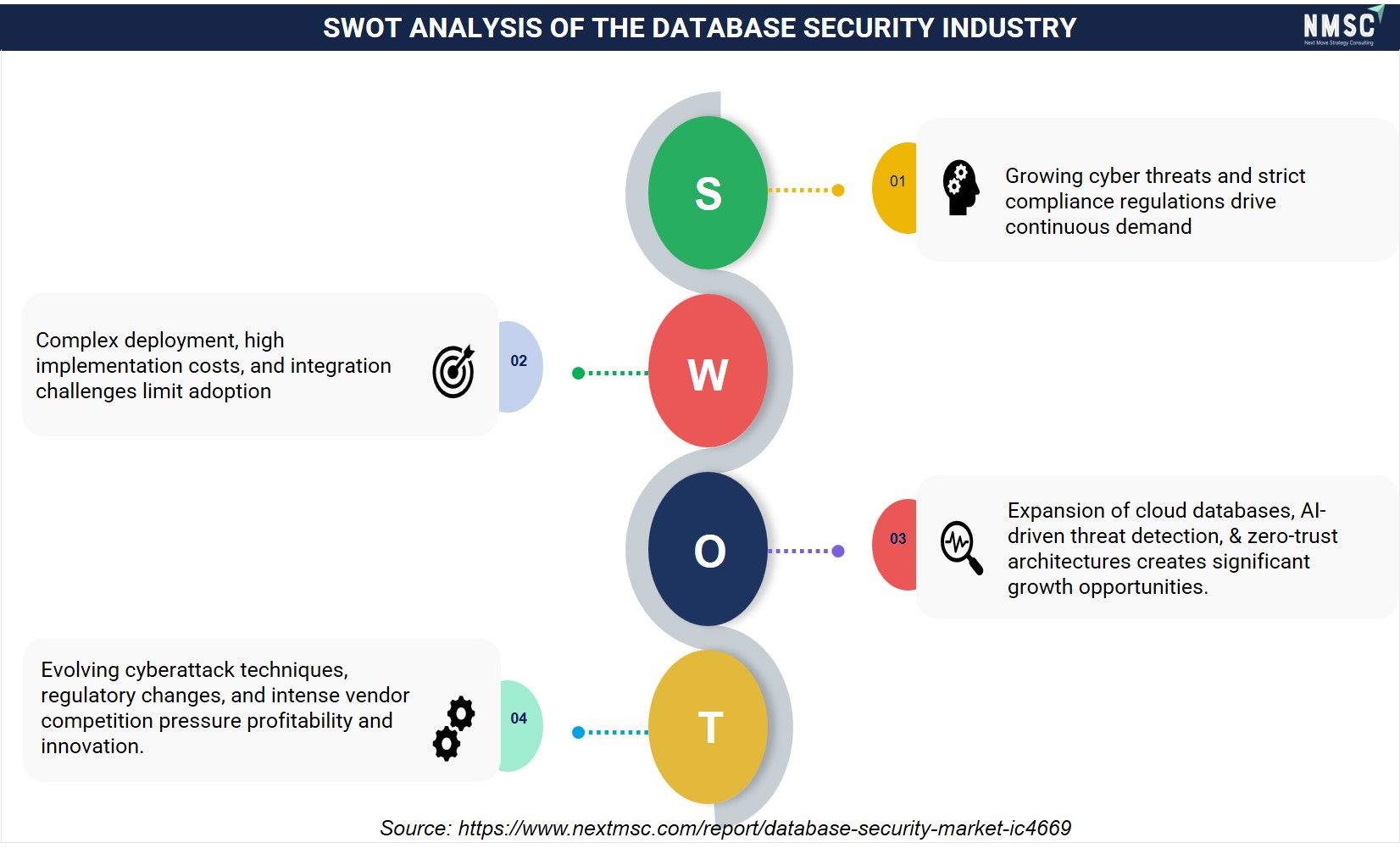
The infographic outlines the SWOT analysis driven by strengths such as rising demand, fueled by growing cyber threats and strict compliance regulations. However, weaknesses include complex deployment, high implementation costs, and integration challenges, which limit adoption. On the other hand, opportunities arise from the expansion of cloud databases, AI-driven threat detection, and zero-trust architectures. Nevertheless, threats such as evolving cyberattack techniques, regulatory changes, and intense vendor competition continue to pressure profitability and innovation.
What Are the Investment Opportunities in the Database Security Market?
Capital Inflows and Venture Activity
The database security market has attracted substantial private and institutional capital, reflecting strong investor conviction in data protection as a structural growth sector. Thales’ USD 3.6 billion acquisition of Imperva in 2023 marked one of the largest strategic transactions in the market, creating a combined data security platform of significant scale. We noticed that Varonis’ transition to a SaaS-delivered model, CyberArk’s continued expansion into cloud-native privileged access management, and a growing pipeline of venture-backed startups targeting AI-driven database monitoring, NoSQL security, and data security posture management reflect sustained capital market interest. The National Venture Capital Association (NVCA) reported that cybersecurity collectively represented one of the top U.S. venture capital deployment categories in 2024, with database and data protection sub-sectors attracting material funding activity.
Infrastructure Investment
Data center infrastructure investment is a foundational enabler of database security market growth, with hyperscalers committing hundreds of billions of dollars to global data center expansion that directly enlarges the managed database service footprint requiring cloud-native security tooling. Moreover, we found that Microsoft announced plans to invest USD 80 billion in AI-optimized data centers in FY2025, the majority supporting Azure database and security services. Google parent Alphabet committed USD 75 billion in 2025 capital expenditure directed primarily at cloud and AI infrastructure. These capital programs directly expand the addressable market for cloud-native database security vendors by growing managed database deployments across previously underserved geographies in MEA, APAC, and Latin America.
ESG and Sustainable Data Infrastructure
Environmental, Social, and Governance (ESG) considerations are increasingly influencing database security market investment decisions. Corporate sustainability reporting requirements under the EU Corporate Sustainability Reporting Directive and SEC cybersecurity disclosure rules are creating board-level accountability for data breach incidents, elevating database security from a technical control to a governance priority. Enterprises pursuing ESG-aligned certification programs including SOC 2 Type II, ISO 27001, and FedRAMP are investing in advanced database encryption, data masking, and continuous audit capabilities. ESG-compliant database security platforms offering automated compliance reporting, privacy-by-design controls, and audit trail transparency command preference in enterprise procurement evaluations and institutional investment mandates.
Digital Transformation Enablement
Database security solutions serve as foundational components of broader enterprise digital transformation programs, making them structurally integral to multi-year IT investment cycles. Enterprises undergoing ERP migrations (SAP S/4HANA), CRM modernizations (Salesforce), and manufacturing digitization (IoT plus edge computing) require database security controls, access governance, and audit frameworks to protect sensitive workloads during and after migration. We further analysed that the NIST Cybersecurity Framework and the European Commission’s NIS2 Directive explicitly reference database access control and data protection as prerequisites for operational resilience, creating durable, multi-year compliance-driven demand tied to broader technology refresh cycles.
Private Equity and Strategic M&A Activity
Private equity firms are deploying significant capital into the database security market ecosystem, targeting mid-market database security platform vendors, managed security service providers, and specialist data protection tool companies. Vista Equity Partners and Thoma Bravo have historically been active acquirers of enterprise security software companies. Strategic M&A is accelerating as platform vendors seek to acquire capabilities in AI-driven behavioral analytics, NoSQL security, data security posture management, and privacy engineering. We assessed that investors should monitor consolidation activity around database activity monitoring vendors, tokenization and data masking specialists, and privileged access management providers as structurally attractive M&A targets in the 2025–2028 timeframe.
What Are the Investment Opportunities in the Database Security Market?
How Is PE and VC Activity Shaping the Database Security Market Investment Landscape?
The database security market has attracted material PE and strategic M&A investment, most prominently Thales’ acquisition of Imperva for approximately USD 3.6 billion in 2023, which created a combined encryption, key management, and database activity monitoring platform of significant scale. IBM’s acquisition of Polar Security in 2023 expanded Guardium’s data security posture management capabilities. Varonis’ transition to a SaaS-delivered managed service model reflects investor conviction in recurring revenue transformation within the database security specialist segment. Ongoing PE interest targets database security tool consolidation and the integration of AI-powered analytics within existing monitoring platform stacks.
How Are Cloud Infrastructure Investments Creating Database Security Market Expansion Opportunities?
Hyperscale cloud providers are collectively investing hundreds of billions of dollars in global data center infrastructure expansion, directly expanding the database security addressable market by growing the managed database service footprint in MEA, APAC, and Latin America. According to Microsoft's official investor filings, the company committed to USD 80 billion in data center investment in fiscal year 2025, a material portion of which supports Azure database services that require native security tooling. This infrastructure expansion is creating new geographic revenue pools for cloud-native database security vendors in previously underserved emerging markets.
How Are ESG and Data Governance Obligations Creating Premium Database Security Investment Opportunities?
Corporate sustainability reporting requirements under the EU CSRD and SEC cybersecurity disclosure rules are creating board-level accountability for data breach incidents that directly elevates database security from a technical control to a corporate governance priority. Organizations pursuing SOC 2 Type II, ISO 27001, and FedRAMP certifications are investing in advanced database encryption, data masking, and continuous audit capabilities that represent premium, higher-margin product categories within the database security market. Our findings suggest that ESG-aligned investors are additionally scrutinizing portfolio company cybersecurity posture, creating indirect investment pressure toward database security program maturation.
How Is the Digital Transformation Wave Creating Database Security Investment Opportunities in Emerging Markets?
Emerging markets across APAC, MEA, and LATAM present compelling database security investment opportunities driven by the combination of rapidly expanding digital economy database footprints and nascent but strengthening regulatory enforcement programs. India’s Digital Personal Data Protection Act implementation, Brazil’s ANPD LGPD enforcement maturation, Saudi Arabia’s SDAIA data protection framework, and Indonesia’s Personal Data Protection Law are collectively creating new compliance-driven market segments in geographies where enterprise database security adoption has historically lagged. Our assessment indicates that PE and growth equity investors targeting regional MSSP and SI firms in these markets are accessing the database security market’s highest incremental growth opportunities.
Key Benefits for Stakeholders
For Technology Vendors and Solution Providers
Vendors receive detailed competitive positioning analysis, product-market fit assessment across offering sub-category, deployment model, and end-user industry dimensions, and distribution channel strategy insights. The segmentation analysis enables precise product roadmap alignment with the fastest-growing capability categories including NoSQL security, AI-driven behavioral monitoring, tokenization, and cloud-native privileged access management.
For Enterprise Technology Buyers
CISOs, database administrators, and IT procurement teams can benchmark database security investment against peer adoption patterns, evaluate total cost of ownership across on-premises, cloud, and hybrid deployment models, and identify the specific regulatory compliance obligations in their operating geographies that define minimum required database security control investments across the 2025 to 2035 planning horizon.
For Investors and Financial Analysts
PE, VC, and equity analysts gain market sizing, CAGR projections across all segments, M&A transaction mapping, and investment opportunity assessments across the database security market's highest-growth sub-segments including cloud deployment, managed services, SMB customer expansion, NoSQL security, and marketplace distribution channels.
For Government and Regulatory Bodies
Policymakers receive market maturity assessment, regulatory impact analysis across 38 countries, and technology adoption benchmarking data that supports evidence-based national cybersecurity policy development, database security framework formulation, and critical infrastructure protection program investment decision-making.
Database Security Market Key Segments
By Offering
-
Software
-
Database Activity Monitoring and Auditing
-
Database Firewall
-
Encryption and Key Management
-
Data Masking
-
Tokenization
-
Data Discovery and Classification
-
Vulnerability Assessment
-
Privileged Access Management
-
Other Software
-
-
Services
-
Consulting
-
Implementation
-
Managed Services
-
Support and Maintenance
-
By Deployment
-
On-Premises
-
Cloud
-
Hybrid
By Database Type
-
Relational
-
NoSQL
-
Mainframe
-
Other Database
By Sales Channel
-
Direct
-
Partner
-
Marketplace
By Customer Size
-
Large Enterprise
-
Mid-Market
-
SMB
By End User Industry
-
BFSI
-
IT and Telecom
-
Government
-
Healthcare and Life Sciences
-
Retail and Ecommerce
-
Manufacturing
-
Energy and Utilities
-
Other Industry
By Region
-
North America: U.S., Canada, Mexico
-
Europe: UK, Germany, France, Italy, Spain, Sweden, Denmark, Finland, Netherlands, Rest of Europe
-
Asia Pacific: China, India, Japan, South Korea, Taiwan, Indonesia, Vietnam, Australia, Philippines, Malaysia, Rest of APAC
-
Middle East & Africa: Saudi Arabia, UAE, Egypt, Israel, Turkey, Nigeria, South Africa, Rest of MEA
-
Latin America: Brazil, Argentina, Chile, Colombia, Rest of LATAM
Conclusion & Recommendations
Long-Term Outlook
The database security market is positioned for sustained high-growth expansion through 2035, driven by the convergence of escalating cyber threat activity, expanding compliance obligations, cloud database migration, and zero-trust architecture adoption across enterprise and public sector organizations globally. NMSC's assessment indicates that the market will progressively bifurcate between integrated platform vendors (hyperscalers and enterprise security suites) serving bundled buyers and specialist vendors serving buyers who prioritize technical depth, multi-database coverage, and advanced capabilities such as AI-driven behavioral analytics and enterprise tokenization.
Strategic Positioning
Enterprise security buyers should prioritize database security platforms that offer unified coverage across relational and NoSQL database engines, on-premises and cloud deployment environments, and native integration with zero-trust identity frameworks. Vendors with consumption-based cloud marketplace distribution, AI-powered behavioral analytics, and automated compliance reporting capabilities are best positioned to capture the largest share of market growth through 2035. Regional market entry strategies should prioritize APAC and MEA, where regulatory framework maturation is creating new compliance-driven demand frontiers.
Investment Attractiveness
The database security market presents high investment attractiveness across multiple vectors. Cloud-delivered specialist vendors offer high-growth equity exposure with SaaS recurring revenue models. Managed database security services represent lower-volatility growth with strong demand from talent-constrained mid-market buyers. Emerging market infrastructure investments in India, GCC, and Brazil offer geographic diversification with premium growth rate differentials. The NoSQL security and AI-driven behavioral analytics sub-segments represent the highest-growth technical investment categories within the platform vendor landscape.
Key Risks and Market Shifts
Primary market risks include increasing commoditization of baseline database security capabilities through hyperscale platform bundling, which may compress specialist vendor pricing power in the SMB and mid-market segments. Rapid technology platform evolution, particularly the shift to serverless and managed database services, requires continuous investment in platform compatibility maintenance. Macroeconomic headwinds affecting enterprise IT security budgets represent near-term demand moderation risk, though regulatory compliance obligations provide a structural floor below which database security investment is unlikely to fall.
Growth Pathways
The primary growth pathways in the database security market include AI-driven threat detection capability expansion capturing security operations efficiency budgets, managed service delivery model adoption democratizing enterprise-grade protection for SMB and mid-market buyers, NoSQL and multi-model database security coverage addressing modern application architecture gaps, and public sector compliance mandate expansion creating institutional demand in MEA, APAC, and LATAM geographies. The convergence of database security with broader data security posture management platforms represents the strategic product evolution direction with the highest long-term revenue capture potential.


About the Author
 Mayurima Roy
— Mayurima Roy is Research Analyst at Next Move Strategy Consulting, where she has spent 4 years working across the firm's full industry coverage rather than a single fixed vertical. Her work centers on structured research, ongoing trend tracking, competitive assessment, and insight-led content development, translating complex market data into clear, decision-ready narratives that support informed client decision-making across diverse global industries, market sectors, and world regions every day.
Mayurima Roy
— Mayurima Roy is Research Analyst at Next Move Strategy Consulting, where she has spent 4 years working across the firm's full industry coverage rather than a single fixed vertical. Her work centers on structured research, ongoing trend tracking, competitive assessment, and insight-led content development, translating complex market data into clear, decision-ready narratives that support informed client decision-making across diverse global industries, market sectors, and world regions every day.
About the Reviewer
 Supradip Baul
— Supradip Baul is an accomplished business consultant and strategist with over a decade of rich experience in market intelligence, strategy, technology, and business transformation. His work has included rigorous qualitative and quantitative analysis across multiple industries, helping clients shape investment decisions and long-term roadmaps. Earlier in his career, he was associated with Gartner, where he contributed to industry-leading reports and market share analyses. He has worked with leading global companies and holds an MBA with a dual specialization in Marketing and Finance.
Supradip Baul
— Supradip Baul is an accomplished business consultant and strategist with over a decade of rich experience in market intelligence, strategy, technology, and business transformation. His work has included rigorous qualitative and quantitative analysis across multiple industries, helping clients shape investment decisions and long-term roadmaps. Earlier in his career, he was associated with Gartner, where he contributed to industry-leading reports and market share analyses. He has worked with leading global companies and holds an MBA with a dual specialization in Marketing and Finance.
At Next Move Strategy Consulting, we understand that insightful market research is the cornerstone of successful business decisions. That's why we employ a robust and multifaceted approach, combining various methodologies to deliver the most accurate and actionable data for our clients.

Research Landscape
We navigate the world of research with two primary approaches:
Qualitative Approach
Our qualitative research methodologies involve immersive techniques such as in-depth interviews, focus groups, and observational studies. By engaging directly with individuals and stakeholders, we uncover valuable insights that quantitative data alone may overlook.

Quantitative Research
In tandem with qualitative methodologies, NMSC leverages the power of Quantitative Research to provide a robust foundation of numerical insights. Through systematic data collection and analysis, we quantify patterns, preferences, and market trends, offering a comprehensive view of the business landscape.
Our quantitative research approach employs diverse tools, including surveys, experiments, and statistical modelling. These methodologies enable us to gather data from a large and representative sample, ensuring the statistical significance of our findings. By employing structured questionnaires and standardized data collection methods, we guarantee the reliability and validity of the information we present to our clients.
Quantitative research is particularly effective in measuring the prevalence of trends, assessing market size, and gauging the impact of various factors on consumer behavior. The numerical precision attained through this approach equips our clients with actionable insights, facilitating data-driven decision-making and strategy formulation.


Our Specialized Toolbox for Industry-Specific Market Research
We deploy a specialized arsenal of techniques tailored to meet your unique requirements. Here's a glimpse into our comprehensive toolbox:

Information Procurement
The stage entails acquiring market data or relevant information through various sources and methodologies.


Market Research Approach
We utilize both top-down and bottom-up approaches in market research analysis to achieve a comprehensive understanding of the market dynamics, leveraging the broad perspective of industry trends and macroeconomic factors alongside detailed insights from specific segments and individual companies.

Porters Five Forces Analysis
We conduct Porter's Five Forces analysis to evaluate the competitive landscape of an industry, providing us with insights into factors that affect profitability and strategic positioning.

SWOT Analysis

Forecasting
We utilize a forecasting model to predict future consumption by considering parameters like population, economics, regulations, market competition, drivers, constraints, technology, and pricing. We also employ statistical techniques such as multilinear regression, exponential smoothing, moving average, ARIMA, and Monte Carlo simulations for accurate predictions. In econometric forecasting, we analyzed short-term and long-term event impacts, attributing values based on regulatory frameworks, economic factors, and market events.





 Speak to Our Analyst