Denmark Travel Insurance Market By Age Group (Generation X, Millennials, & Others), By Income Level (Low, Middle, & High-Income), By Traveler Structure (Solo, Couple, & Groups), By Coverage Type (Medical & Health, Trip Protection Coverage, & Others), By Distributional Channel (Insurance Companies, Banks, & Others), By Underwriting (Standard Underwriting, Simplified Issue, & Others), By End-User (Leisure & Holiday, Pilgrimage & Religious Travelers, & Others) – Analysis & Forecast, 2026–2035
Industry: BFSI | Latest Edition: June 18, 2026 | No of Pages: 226 | No. of Tables: 101 | No. of Figures: 88 | Format: PDF | Report Code: BF1966
Denmark Travel Insurance Market Size & Forecast
|
Parameters |
Details |
|
Market Size in 2026 |
USD 285.7 million |
|
Revenue Forecast in 2035 |
USD 493 million |
|
Growth Rate |
CAGR of 6.25% from 2026 to 2035 |
|
Analysis Period |
2025–2035 |
|
Base Year Considered |
2025 |
|
Forecast Period |
2026–2035 |
|
Market Size Estimation |
Million (USD) |
|
Companies Profiled |
15 |
|
Market Share |
Available for 10 companies |
Industry Outlook
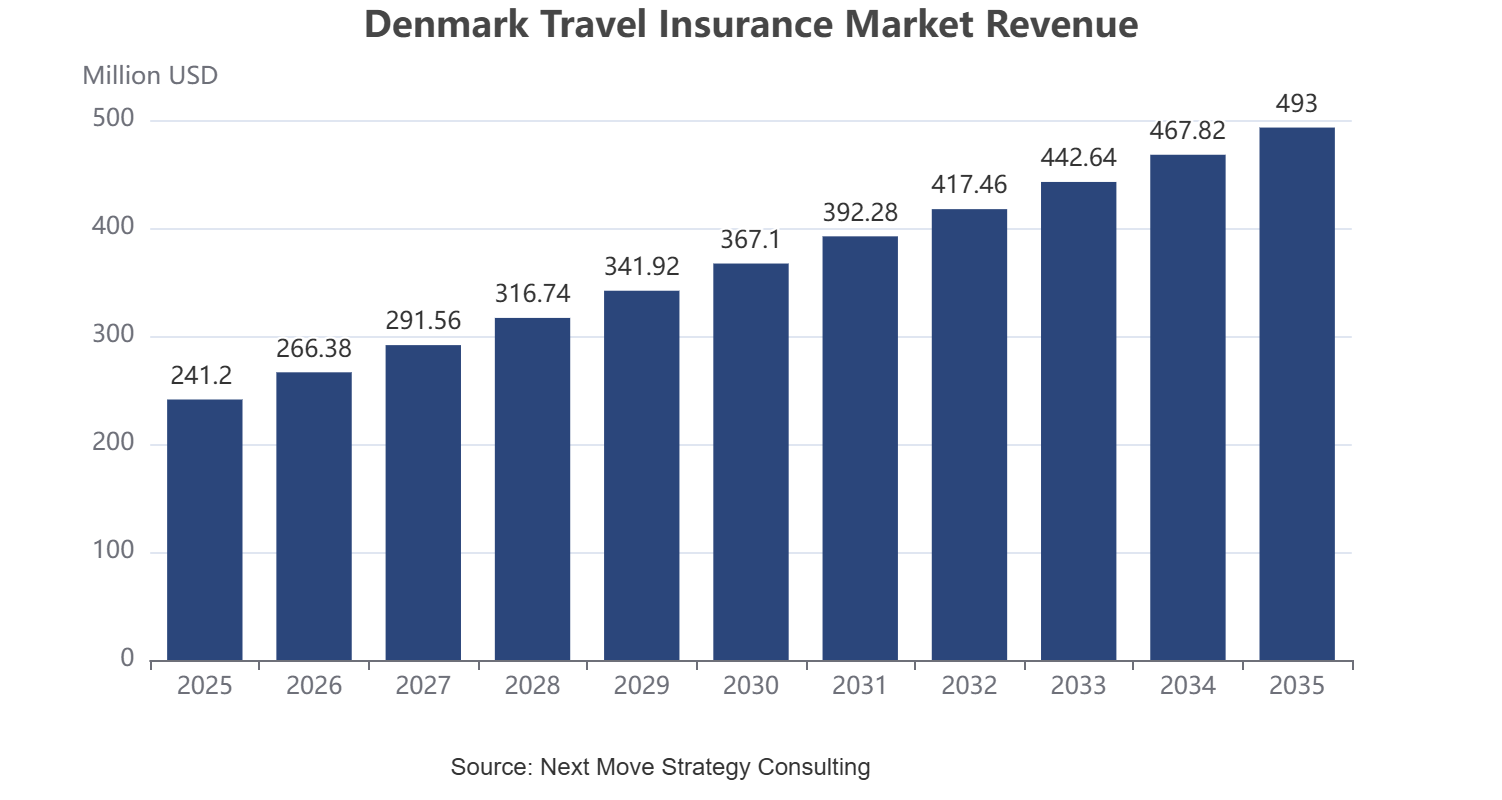
The Denmark Travel Insurance Market size was valued at USD 241.2 million in 2025 and is expected to reach USD 285.7 million by 2026. Looking ahead, the industry is projected to expand significantly, reaching USD 493 million by 2035, registering a CAGR of 6.25% from 2026 to 2035.
Ecosystem Analysis of the Denmark Travel Insurance Market:
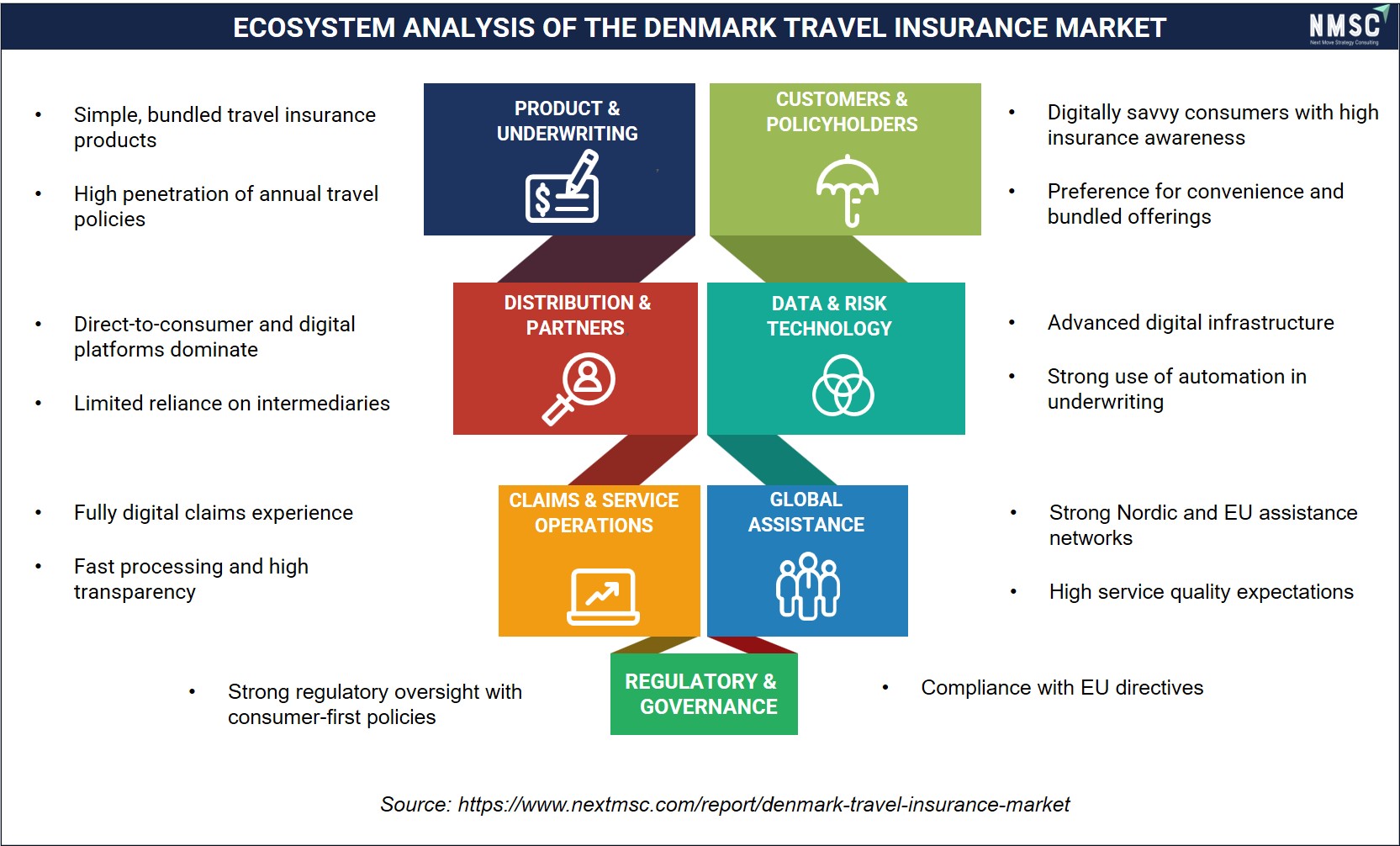
The infographic illustrates the Denmark travel insurance market as a structured, interdependent ecosystem where each layer contributes to overall efficiency, trust, and service delivery. It begins with product underwriting and customer segmentation, driven by health-conscious travelers who increasingly demand comprehensive and reliable coverage. Building on this foundation, distribution partners and digital technology platforms play a key role in connecting insurers with policyholders, supported by advanced data analytics and risk management capabilities that improve pricing accuracy and operational efficiency. Claims handling and service operations, strengthened by global assistance networks, directly shape customer satisfaction and long-term retention outcomes. At the highest level, the entire system operates under Denmark’s stringent regulatory framework, which ensures strong solvency oversight, governance standards, and GDPR-compliant data privacy protections across all participants in the market.
What are the Key Market Drivers, Breakthroughs, and Investment Opportunities that will Shape the Denmark Travel Insurance Market in the Next Decade?
Growth Catalyst & Risk Assessment Matrix
|
DRIVERS / TRENDS / RESTRAINTS |
(+/–) % IMPACT ON CAGR FORECAST |
GEOGRAPHIC RELEVANCE |
IMPACT TIMELINE |
|
High disposable income driving frequent long-haul travel and higher uptake of comprehensive insurance |
+1.35% |
Denmark outbound long-haul corridors (U.S., Asia, Oceania, Europe) |
Short–medium term (1–4 years) |
|
Strong digital adoption enabling fast, comparison-based online insurance purchases |
+0.78% |
Urban Denmark (Copenhagen, Aarhus, Odense) |
Short term (1–3 years) |
|
Winter sports and adventure tourism increasing demand for specialised high-risk coverage |
+0.62% |
Alpine and Nordic ski destinations |
Medium term (2–5 years) |
|
Growth in premium travel boosting demand for high-value insurance plans |
+0.49% |
Long-haul leisure travelers |
Medium term (2–4 years) |
|
Nordic/EU healthcare coverage reducing perceived need for insurance on short-haul travel |
-0.92% |
Intra-Nordic/EU travel |
Long term (3–6 years) |
Denmark’s travel insurance market is shaped by a high-income consumer base, strong digital maturity, and a well-established culture of frequent international leisure travel. Danish travelers regularly visit destinations across Europe and beyond, supported by strong purchasing power and a preference for experience-driven tourism. The market benefits from highly digital insurance adoption, where most policies are purchased online through insurers or comparison platforms, ensuring smooth and fast access to coverage. However, we noticed that demand dynamics are partially moderated by the presence of public healthcare agreements within Nordic countries, which reduces the perceived necessity of insurance for regional travel. This creates a more selective insurance purchasing pattern, where coverage is prioritized mainly for long-haul and high-risk travel. As a result, the market is increasingly concentrated around premium products, particularly those designed for adventure tourism, skiing, and winter sports activities. Overall, Denmark represents a digitally advanced but selectively insured travel market.
Growth Drivers:
How is High Disposable Income Supporting Frequent International Leisure Travel in the Denmark Travel Insurance Market?
NMSC analysis indicates that high disposable income levels in Denmark are a key driver supporting frequent international leisure travel and, consequently, travel insurance demand. Danish consumers have strong purchasing power, allowing them to prioritize international holidays multiple times per year, across different continents. These travel patterns include both short European trips and long-haul vacations to destinations such as Asia, North America, and Oceania, where insurance coverage becomes more relevant due to higher travel costs and increased risk exposure. Further, higher-income travelers are more likely to opt for comprehensive insurance plans that include medical emergencies, trip cancellation, and baggage protection, as they seek to safeguard higher-value travel investments. This financial flexibility also encourages a stronger focus on travel experience quality, indirectly increasing the perceived value of insurance coverage. As a result, high disposable income plays a central role in sustaining consistent and high-value insurance demand in the Danish market.
How is Strong Digital Adoption Enabling Easy Online Travel Insurance Purchase in the Denmark Travel Insurance Market?
Based on our assessment, we found that Denmark’s strong digital adoption significantly enhances the accessibility and convenience of travel insurance purchasing. Consumers are highly comfortable with online financial transactions, which has led to widespread use of digital insurance platforms, mobile applications, and comparison websites. This digital-first behaviour allows travelers to purchase insurance quickly during trip planning or booking stages without requiring physical interaction or agent involvement. Furthermore, digital channels are particularly effective in Denmark due to high trust in online systems and a strong preference for self-service financial products. This has reduced friction in the insurance purchase process and improved conversion rates across both short-haul and long-haul travel segments. Additionally, digital platforms enable transparent comparison of pricing and coverage features, encouraging more informed decision-making. Over time, this has contributed to higher efficiency in distribution and strengthened overall market penetration through seamless user experiences.
How is Premium Adventure and Winter Sports Tourism Driving Specialized Insurance Demand in Denmark?
Premium adventure and winter sports tourism is an increasingly important driver of specialised travel insurance demand in Denmark. Danish travelers frequently engage in skiing, snowboarding, hiking, and other adventure-based activities, particularly in European mountain destinations. These activities involve higher physical risk exposure, making standard travel insurance insufficient for many travelers. In our observation, there is a growing preference for specialised insurance products that include coverage for sports-related injuries, emergency evacuation, and equipment protection. This is especially relevant among younger travelers and high-income groups who prioritize experience-driven tourism. Insurers are responding by offering tailored premium packages designed specifically for adventure and winter sports travel, with enhanced coverage limits and additional assistance services. This segment contributes disproportionately to premium revenue, despite representing a smaller share of total travelers, and is helping drive value-based growth within the travel insurance market in Denmark.
Growth Inhibitor:
How are Public Healthcare Coverage Agreements within Nordic Countries Reducing Perceived Need for Travel Insurance in Denmark?
Our market analysis indicates that public healthcare coverage agreements within Nordic countries act as a key restraint of the Denmark travel insurance market by reducing the perceived necessity of insurance for regional travel. Danish travelers benefit from healthcare arrangements within Nordic and certain European systems, which provide a sense of security when traveling within nearby countries. This creates a behavioural tendency to underestimate the need for additional travel insurance, particularly for short-haul trips. Further, many travelers assume that basic medical coverage is sufficient within these agreements, leading to lower uptake of comprehensive insurance for regional travel. This is especially evident among frequent intra-European travelers who prioritize convenience and cost savings. As a result, insurance demand becomes more concentrated around long-haul and high-risk travel segments, while regional coverage adoption remains relatively limited. This structural perception challenge restricts broader penetration and limits growth in the short-distance travel insurance category.
Growth Opportunity:
How is Premium Travel Insurance for Adventure and Winter Sports Tourism Supporting Denmark travel insurance Market Expansion in Denmark?
The expansion of premium travel insurance products tailored for adventure and winter sports tourism presents a strong growth opportunity in Denmark. Danish travelers are highly active in skiing and outdoor recreational activities, particularly across European winter destinations, which increases demand for specialized coverage solutions. These products typically offer enhanced protection for sports-related injuries, emergency medical evacuation, and equipment loss or damage. Through NMSC's assessment, we found that travelers participating in these activities are increasingly willing to pay higher premiums for coverage that aligns closely with their travel behaviour and risk exposure. This creates an opportunity for insurers to move beyond standard travel insurance offerings and focus on niche, high-value segments. Additionally, bundling these products with travel bookings or sports packages further enhances accessibility and uptake. As adventure and winter tourism continue to grow, this segment is expected to play a key role in driving premiumization and value expansion in the Denmark travel insurance market.
How is the Denmark Travel Insurance Industry segmented in this report, and what are the key insights from the segmentation analysis?
By Age Group Insights
How are Age-Based Segments Shaping the Denmark Travel Insurance Market in 2025?
Based on age group, the Denmark travel insurance market is segmented into generation Z (18–24 years), millennials (25–40 years), generation X (41–56 years), baby boomers (57–75 years), and senior travelers (Above 75 years).
We observed that generation Z (18–24 years) typically engages with travel insurance in a limited but growing manner, driven by short, budget-conscious trips where basic, digital-first policies with essential medical coverage are most relevant. As travel frequency increases, millennials (25–40 years) demonstrate stronger and more structured adoption, favouring flexible, app-based plans that combine trip cancellation, health protection, and multi-trip benefits aligned with active leisure and work-related mobility. This progression continues with Generation X (41–56 years), where purchasing behaviour becomes more family-oriented, with higher coverage limits and broader protection reflecting greater financial responsibilities. Baby boomers (57–75 years) prioritize comprehensive medical and emergency evacuation coverage, especially for long-haul travel, while senior travelers (above 75 years) require highly customised, medically underwritten policies with stricter eligibility conditions. Across these segments, insurers are refining offerings to align with lifecycle-based risk and travel behaviour in Denmark in 2025.
By Days of Coverage Insights
How are Coverage Duration Preferences Shaping the Denmark Travel Insurance Market in 2025?
Based on days of coverage, the Denmark travel insurance market is segmented into single-trip insurance and multi-trip insurance.
Single-trip insurance remains widely adopted in Denmark among occasional travelers who undertake seasonal vacations, short business visits, or one-off international journeys, where trip-specific protection and cost efficiency are the primary considerations. This gradually transitions into stronger uptake of multi-trip insurance, particularly among frequent flyers, business professionals, and globally mobile individuals who benefit from annual coverage, reduced administrative effort, and overall cost optimization across multiple journeys. The increasing normalization of international travel from Denmark is reinforcing this shift, as consumers seek more flexible and continuous protection models rather than repeated single-policy purchases. Overall, insurers are responding by enhancing digital policy management and offering more customizable duration-based options, enabling better alignment with diverse travel frequencies and evolving mobility patterns in 2025.
Competitive Landscape
The Denmark travel insurance industry operates within a highly mature and structurally stable insurance ecosystem, supported by the strong presence of domestic insurers and Nordic insurance groups with deep-rooted service and claims infrastructure. Our market analysis indicates that demand is consistently underpinned by high outbound travel frequency across Europe and long-haul destinations, strong consumer awareness of healthcare costs abroad, and a preference for bundled insurance solutions integrated with broader household, health, or credit-related policies. In addition, Denmark’s advanced digital maturity is significantly reshaping customer behaviour, with most policies now being purchased, managed, and renewed through online platforms, mobile applications, and automated insurer portals, improving convenience and reducing dependency on traditional intermediaries.
Strategic Developments:
-
April 2026 - Gjensidige confirmed that the Gouda brand will be phased out and integrated into a unified Nordic travel insurance brand. The strategy focuses on digital simplification and operational consolidation across Scandinavian markets including Denmark.
-
June 2025 - ERGO completed the merger of its Danish travel insurer Europæiske Rejseforsikring with its Nordic health insurance business to form a unified Nordic platform. The move strengthens travel insurance distribution and digital integration across Denmark.
Key Players of the Denmark Travel Insurance Market:
-
Gouda Forsikring A/S
-
If Skadeforsikring AB
-
Europæiske Rejseforsikring A/S
-
Alm. Brand A/S
-
Codan Forsikring A/S
-
Alka Forsikring A/S
-
GF Forsikring A/S
-
Tryg Forsikring A/S
-
Topdanmark Forsikring A/S
-
LB Forsikring A/S
-
Tokio Marine HCC
-
AIG Travel Guard
-
The Cigna Group
-
POP Versicherung AG
Competitive dynamics are increasingly shaped by service reliability, operational efficiency, and the ability to deliver seamless international assistance rather than competing on price alone. Key players such as Gouda Forsikring A/S, If Skadeforsikring AB, Europæiske Rejseforsikring A/S, Alm. Brand A/S, Codan Forsikring A/S, Alka Forsikring A/S, GF Forsikring A/S, and others are strengthening their positions through faster claims settlement processes, 24/7 global assistance services, and highly digitised customer onboarding systems. Our evaluation further suggests that insurers with strong Nordic cooperation frameworks, integrated digital ecosystems, and simplified, transparent policy structures are better positioned to enhance customer loyalty and expand their market share. Furthermore, deeper integration with banking institutions, employer-sponsored benefit programs, and travel distribution partners is gradually contributing to a more interconnected, efficient, and service-oriented competitive landscape in the Denmark travel insurance market.
Consumer Behaviour Analysis of the Denmark Travel Insurance Market:
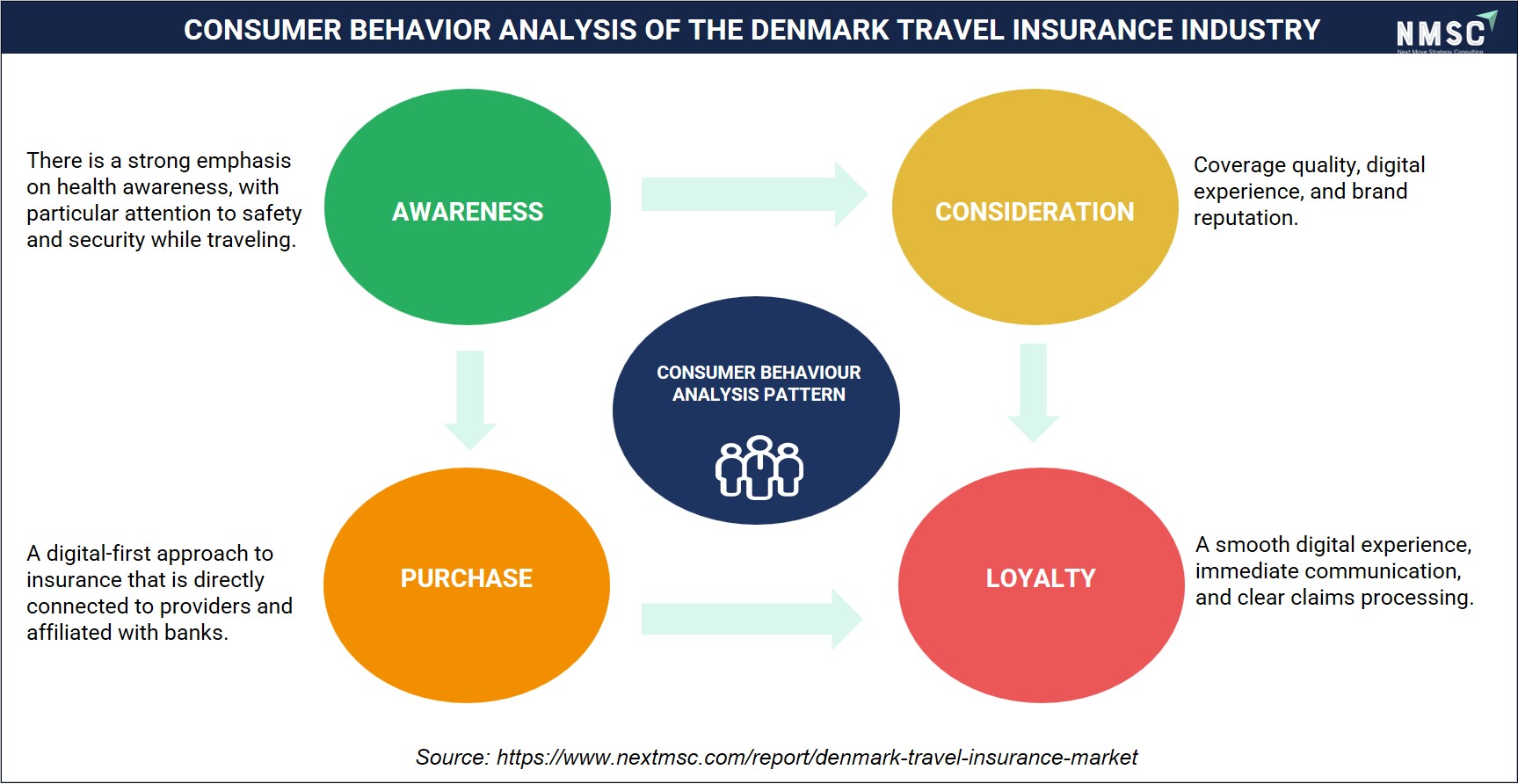
The infographic outlines a four-stage consumer journey in the Denmark travel insurance market, shaped by evolving expectations around safety, digital convenience, and service reliability. The process begins with strong health awareness, as travelers increasingly prioritize safety and security when planning trips. During the consideration stage, policy selection is influenced by coverage quality, digital experience, and insurer reputation, reflecting a shift toward value-driven evaluation. In the purchase stage, a digital-first behaviour dominates, with consumers favouring direct insurer platforms and bank-affiliated offerings for speed and convenience. Over time, customer loyalty is primarily built through seamless digital experiences, real-time communication during claims, and transparent claims processing that reinforces trust and long-term engagement.
Denmark Travel Insurance Market Key Segments
By Age Group
-
Generation Z (18–24 years)
-
Millennials (25–40 years)
-
Generation X (41–56 years)
-
Baby Boomers (57–75 years)
-
Senior Travelers (Above 75 years)
By Income Level
-
Low-Income Travelers
-
Middle-Income Travelers
-
High-Income Travelers
By Traveler Structure
-
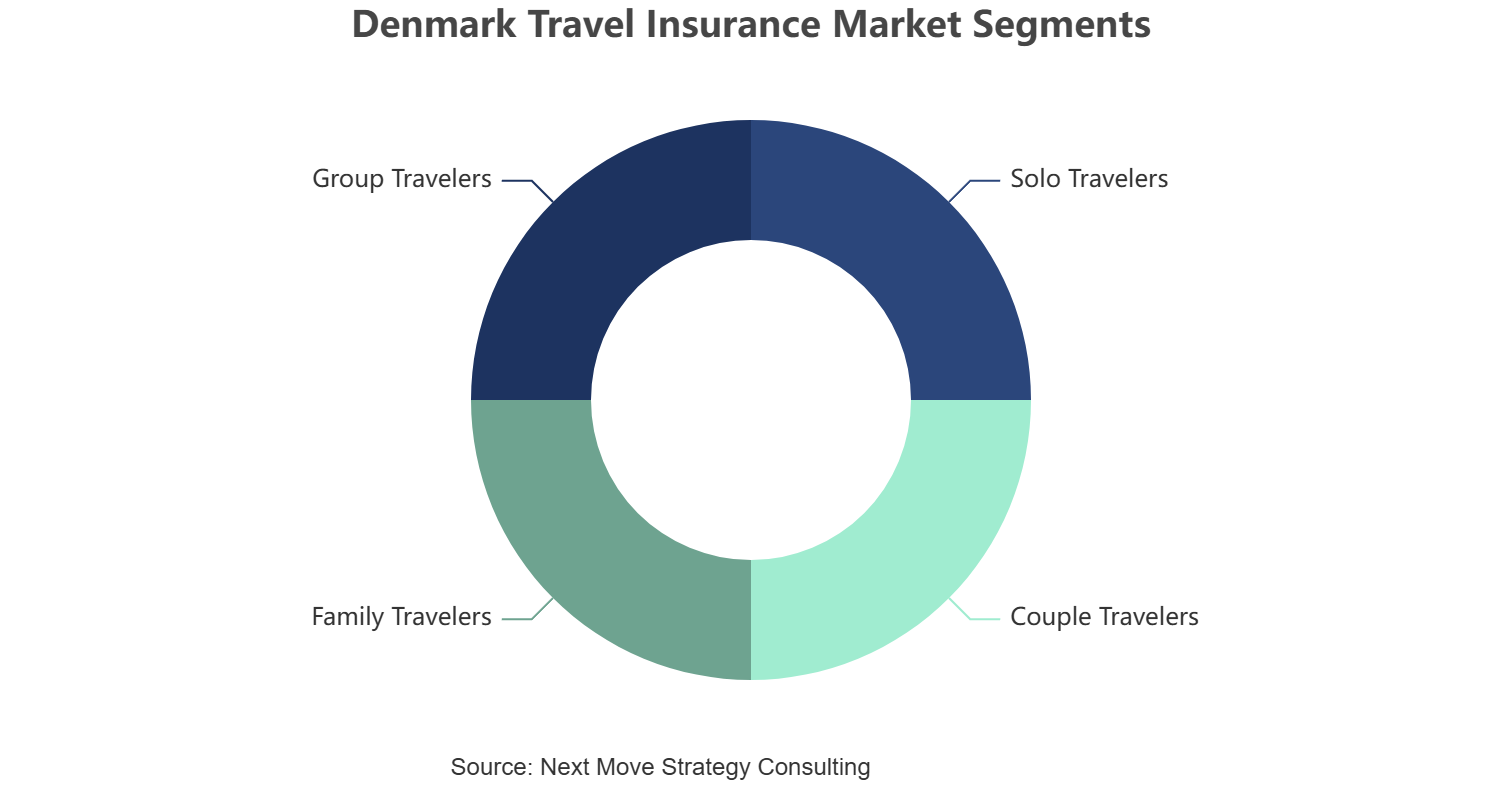
Solo Travelers
-
Couple Travelers
-
Family Travelers
-
Group Travelers
By Coverage Type
-
Medical & Health Coverage
-
Emergency Medical Treatment
-
Hospitalization
-
Medical Evacuation & Repatriation
-
-
Trip Protection Coverage
-
Trip Cancellation
-
Trip Interruption
-
Trip Delay
-
Missed Connections
-
-
Asset & Document Protection Coverage
-
Baggage & Personal Belongings
-
Loss of Travel Documents
-
-
Personal Accident Coverage
-
Accidental Death & Dismemberment (AD&D)
-
Permanent / Temporary Disability
-
-
Liability Coverage
-
Personal Liability
-
Legal Expenses Abroad
-
By Days Of Coverage
-
Single-Trip Insurance
-
Short Duration (1–7 days)
-
Medium Duration (8–30 days)
-
Long Duration (31–90 days)
-
Extended Duration (91–180 days)
-
Multi-Trip Insurance
-
Annual Multi-Trip
-
Frequent Business Travel Plans
By Geographic Scope
-
Domestic Travel
-
International Travel
By Distributional Channel
-
Direct Sales by Insurance Companies
-
Bancassurance (Banks & NBFCs)
-
Airline & Travel Booking Platforms
-
Online Insurance Aggregators & Comparison Websites
-
Travel Agents & Tour Operators
By Sales Model
-
Standalone Travel Insurance
-
Bundled Travel Insurance
By Underwriting
-
Standard Underwriting
-
Simplified Issue
-
Fully Underwritten
-
Guaranteed Issue
By Pricing Mechanism
-
Age-Based Pricing
-
Destination-Based Pricing
-
Duration-Based Pricing
-
Risk-Based Pricing
By Policy Delivery Mode
-
Online
-
Offline
-
Hybrid
By Value Tier
-
Basic/Economy Plans
-
Standard Plans
-
Premium Plans
-
Elite/Platinum Plans
By End-User
-
Leisure & Holiday Travelers
-
Business Travelers
-
Education / Student Travelers
-
Pilgrimage & Religious Travelers
-
Adventure & Sports Travelers
-
Medical Tourism Travelers
-
Family & Group Travelers
Key Benefits for Stakeholders:
Next Move Strategy Consulting (NMSC) presents a comprehensive analysis of the Denmark travel insurance market trends, covering historical trends from 2020 through 2025 and offering detailed forecasts through 2035. Our study examines the market at regional and country levels, providing quantitative projections and insights into key growth drivers, challenges, and investment opportunities across all major travel insurance segments.
The Denmark travel insurance market reflects a more mature and digitally advanced ecosystem where value creation is shaped by high travel frequency and a strong regulatory structure. Investors benefit from predictable premium inflows and efficient digital distribution networks that support sustainable, low-friction growth. Customers experience a highly streamlined insurance journey, with easy access to comprehensive coverage and fast, transparent claims processing that aligns with their digitally native expectations. Policymakers, meanwhile, benefit from a well-governed framework that ensures strong consumer safeguards and cross-border compliance, reinforcing trust and maintaining the stability of an already well-established insurance environment.
|
Parameters |
Details |
|
Customization Scope |
Free customization (equivalent to up to 80 analyst-working hours) after purchase. |
|
Pricing and Purchase Options |
Avail customized purchase options to meet your exact research needs. |
|
Approach |
In-depth primary and secondary research; proprietary databases; rigorous quality control and validation measures. |
|
Analytical Tools |
Porter's Five Forces, SWOT, value chain, and Harvey ball analysis to assess competitive intensity, stakeholder roles, and relative impact of key factors. |
About the Author
 Mayurima Roy
— Mayurima Roy is Research Analyst at Next Move Strategy Consulting, where she has spent 4 years working across the firm's full industry coverage rather than a single fixed vertical. Her work centers on structured research, ongoing trend tracking, competitive assessment, and insight-led content development, translating complex market data into clear, decision-ready narratives that support informed client decision-making across diverse global industries, market sectors, and world regions every day.
Mayurima Roy
— Mayurima Roy is Research Analyst at Next Move Strategy Consulting, where she has spent 4 years working across the firm's full industry coverage rather than a single fixed vertical. Her work centers on structured research, ongoing trend tracking, competitive assessment, and insight-led content development, translating complex market data into clear, decision-ready narratives that support informed client decision-making across diverse global industries, market sectors, and world regions every day.
About the Reviewer
 Supradip Baul
— Supradip Baul is an accomplished business consultant and strategist with over a decade of rich experience in market intelligence, strategy, technology, and business transformation. His work has included rigorous qualitative and quantitative analysis across multiple industries, helping clients shape investment decisions and long-term roadmaps. Earlier in his career, he was associated with Gartner, where he contributed to industry-leading reports and market share analyses. He has worked with leading global companies and holds an MBA with a dual specialization in Marketing and Finance.
Supradip Baul
— Supradip Baul is an accomplished business consultant and strategist with over a decade of rich experience in market intelligence, strategy, technology, and business transformation. His work has included rigorous qualitative and quantitative analysis across multiple industries, helping clients shape investment decisions and long-term roadmaps. Earlier in his career, he was associated with Gartner, where he contributed to industry-leading reports and market share analyses. He has worked with leading global companies and holds an MBA with a dual specialization in Marketing and Finance.
At Next Move Strategy Consulting, we understand that insightful market research is the cornerstone of successful business decisions. That's why we employ a robust and multifaceted approach, combining various methodologies to deliver the most accurate and actionable data for our clients.

Research Landscape
We navigate the world of research with two primary approaches:
Qualitative Approach
Our qualitative research methodologies involve immersive techniques such as in-depth interviews, focus groups, and observational studies. By engaging directly with individuals and stakeholders, we uncover valuable insights that quantitative data alone may overlook.

Quantitative Research
In tandem with qualitative methodologies, NMSC leverages the power of Quantitative Research to provide a robust foundation of numerical insights. Through systematic data collection and analysis, we quantify patterns, preferences, and market trends, offering a comprehensive view of the business landscape.
Our quantitative research approach employs diverse tools, including surveys, experiments, and statistical modelling. These methodologies enable us to gather data from a large and representative sample, ensuring the statistical significance of our findings. By employing structured questionnaires and standardized data collection methods, we guarantee the reliability and validity of the information we present to our clients.
Quantitative research is particularly effective in measuring the prevalence of trends, assessing market size, and gauging the impact of various factors on consumer behavior. The numerical precision attained through this approach equips our clients with actionable insights, facilitating data-driven decision-making and strategy formulation.


Our Specialized Toolbox for Industry-Specific Market Research
We deploy a specialized arsenal of techniques tailored to meet your unique requirements. Here's a glimpse into our comprehensive toolbox:

Information Procurement
The stage entails acquiring market data or relevant information through various sources and methodologies.


Market Research Approach
We utilize both top-down and bottom-up approaches in market research analysis to achieve a comprehensive understanding of the market dynamics, leveraging the broad perspective of industry trends and macroeconomic factors alongside detailed insights from specific segments and individual companies.

Porters Five Forces Analysis
We conduct Porter's Five Forces analysis to evaluate the competitive landscape of an industry, providing us with insights into factors that affect profitability and strategic positioning.

SWOT Analysis

Forecasting
We utilize a forecasting model to predict future consumption by considering parameters like population, economics, regulations, market competition, drivers, constraints, technology, and pricing. We also employ statistical techniques such as multilinear regression, exponential smoothing, moving average, ARIMA, and Monte Carlo simulations for accurate predictions. In econometric forecasting, we analyzed short-term and long-term event impacts, attributing values based on regulatory frameworks, economic factors, and market events.





 Speak to Our Analyst