
Digital Map Market By Offering (Map Data, Software & Services), By Location (Outdoor & Indoor), By Map Type (2D Maps, 3D Maps, Vector Maps, & Raster Maps), By Deployment (Cloud-Hosted, On-Premise Licensed, Embedded, & Hybrid Cloud-Edge), By Application (Automotive Navigation & Autonomous Mapping, Consumer Navigation & Location Apps, & Others), By End User (Automotive & Mobility, Consumer Devices & Apps, Enterprise & Government GIS, & Others) – Global Analysis & Forecast, 2025-2035
Industry: ICT & Media | Publishing Date: March 23, 2026 | Last Updated: September 11, 2026 | No of Pages: N/A | No. of Tables: N/A | No. of Figures: N/A | Format: PDF | Report Code: IC4338
Industry Outlook
The global Digital Map Market size was valued at USD 31.29 billion in 2025, and is expected to be valued at USD 36.36 billion by the end of 2026. The industry is projected to grow, hitting USD 140.45 billion by 2035, with a CAGR of 16.2% between 2026 and 2035.
Digital Map Industry Size & Forecast
|
Parameters |
Details |
|
Market Size in 2026 |
USD 36.36 Billion |
|
Revenue Forecast in 2035 |
USD 140.45 Billion |
|
Growth Rate |
CAGR of 16.2% from 2026 to 2035 |
|
Analysis Period |
2025–2035 |
|
Base Year Considered |
2025 |
|
Forecast Period |
2026–2035 |
|
Market Size Estimation |
Billion (USD) |
|
Companies Profiled |
20 |
|
Countries Covered |
33 |
|
Market Share |
Available for 10 companies |
Digital map industry is transitioning from a consumer navigation-centric industry to a foundational layer of digital infrastructure supporting mobility platforms, enterprise applications, and public sector systems. Today, digital mapping solutions underpin ride-hailing, logistics optimisation, connected vehicles, urban planning, and location-based services. Through our interviews with product managers and operations teams, we observed that real-time accuracy, API-based integration, and scalable cloud architectures are now core competitive parameters, positioning mapping platforms as embedded intelligence engines rather than standalone tools.
Growth in the digital map market is being reinforced by demand for high-definition mapping, immersive 3D visualisation, and AI-driven geospatial analytics across automotive, smart city, and enterprise ecosystems. Based on our further discussions with technology providers, we found that recurring API revenues, lifecycle-based automotive contracts, and enterprise-grade analytics solutions are strengthening financial visibility and long-term scalability. Looking ahead, we anticipate that providers that prioritise interoperability, robust data validation frameworks, and platform resilience secures a strategic advantage as digital maps become increasingly integral to next-generation connected economies.
The surge in global internet users strongly influences the expansion of the digital map market. With over 5 billion people online in 2025, demand for real time navigation, location-based services, and interactive mapping applications has surged across both consumer and enterprise segments. Industry insights indicate that increased connectivity enables seamless integration of GPS-enabled devices, IoT applications, and smart city solutions, thereby expanding the adoption of digital maps. Further, regions with higher internet penetration consistently demonstrate stronger market growth and usage intensity.

The chart above illustrates the explosive growth of global internet users, from 39.2 million in 1995 to 5,560 million projected by 2025, marking a 140-fold increase driven by mobile and broadband adoption. This surge expands the addressable market for geographic information systems, fueling demand in navigation, logistics, autonomous vehicles, and location-based services amid rising smartphone penetration.
What Are the Key Trends in the Digital Map Industry?
How is the Shift Toward 3D And Immersive Mapping Transforming the Digital Map Market?
Based on NMSC’s primary research, we noticed a structural transition from traditional 2D mapping to 3D and photorealistic spatial environments that provide elevation data, building geometry, and terrain intelligence critical for infrastructure planning, utilities management, and environmental modelling. We noticed that immersive mapping enhances decision accuracy for urban planners, construction firms, and public authorities by enabling scenario simulation and spatial risk evaluation, however, it also increases data processing complexity, storage costs, and rendering requirements for mapping providers. Moreover, companies investing in scalable 3D data pipelines and efficient compression technologies are better positioned to manage operational costs while securing high-value enterprise contracts, strengthening long-term competitive differentiation.
How is the Rise of API-First Architectures Reshaping the Digital Map Industry?
Digital maps are increasingly delivered through API-first and cloud-native architectures, enabling seamless integration into mobility apps, enterprise software, fintech platforms, and logistics systems. This shift enhances deployment speed and scalability for end users while generating recurring, usage-based revenues for providers. From our interviews with developers and enterprise IT teams, we observed that interoperability, latency optimisation, and cost transparency are becoming decisive factors in vendor selection, positioning platform robustness as a core long-term strategic advantage while accelerating the adoption of scalable, developer-centric mapping platforms across the global digital map market. As a result, API-driven ecosystems are expected to play a pivotal role in shaping innovation, monetisation models, and competitive dynamics within the digital map industry in the coming years.
How is Indoor Mapping and Micro-Location Technology Expanding Enterprise Adoption?
From our interviews with facility operators, we found a growing demand for indoor mapping solutions that enable asset tracking, customer navigation, and workforce coordination within complex environments where traditional GPS lacks precision. Micro-location technologies such as Bluetooth beacons and Wi-Fi triangulation are improving operational visibility and efficiency, particularly in logistics hubs and healthcare facilities. Providers that deliver cost-effective, interoperable indoor mapping layers unlock incremental enterprise revenues while expanding the digital map market beyond outdoor navigation use cases, positioning indoor spatial intelligence as a key growth frontier for enterprise-focused mapping platforms. Consequently, the integration of indoor mapping and micro-location capabilities is set to drive wider enterprise adoption, creating new opportunities for service differentiation and revenue growth within the digital mapping ecosystem.
How is Real-Time and Crowdsourced Data Validation Enhancing Mapping Reliability?
Digital map providers are increasingly harnessing crowdsourced inputs, connected device telemetry, and IoT sensor data to ensure real-time accuracy and reduce update cycles. Our assessment indicates that continuous validation models markedly enhance routing precision and operational efficiency for mobility operators and logistics firms, directly impacting service reliability and cost optimisation. Our discussions with technology providers highlighted that sustained investment in AI-driven verification and anomaly detection further strengthens data integrity, reinforcing platform trust. Together, these innovations enable consistently reliable mapping services across high-density urban areas and complex enterprise environments, positioning real-time data validation as a critical differentiator in the digital map market.
Ecosystem Analysis of the Digital Map Industry
This infographic provides a comprehensive ecosystem analysis of the digital map market, highlighting the key stakeholders, technology layers, and operational functions that drive adoption, innovation, and value creation.
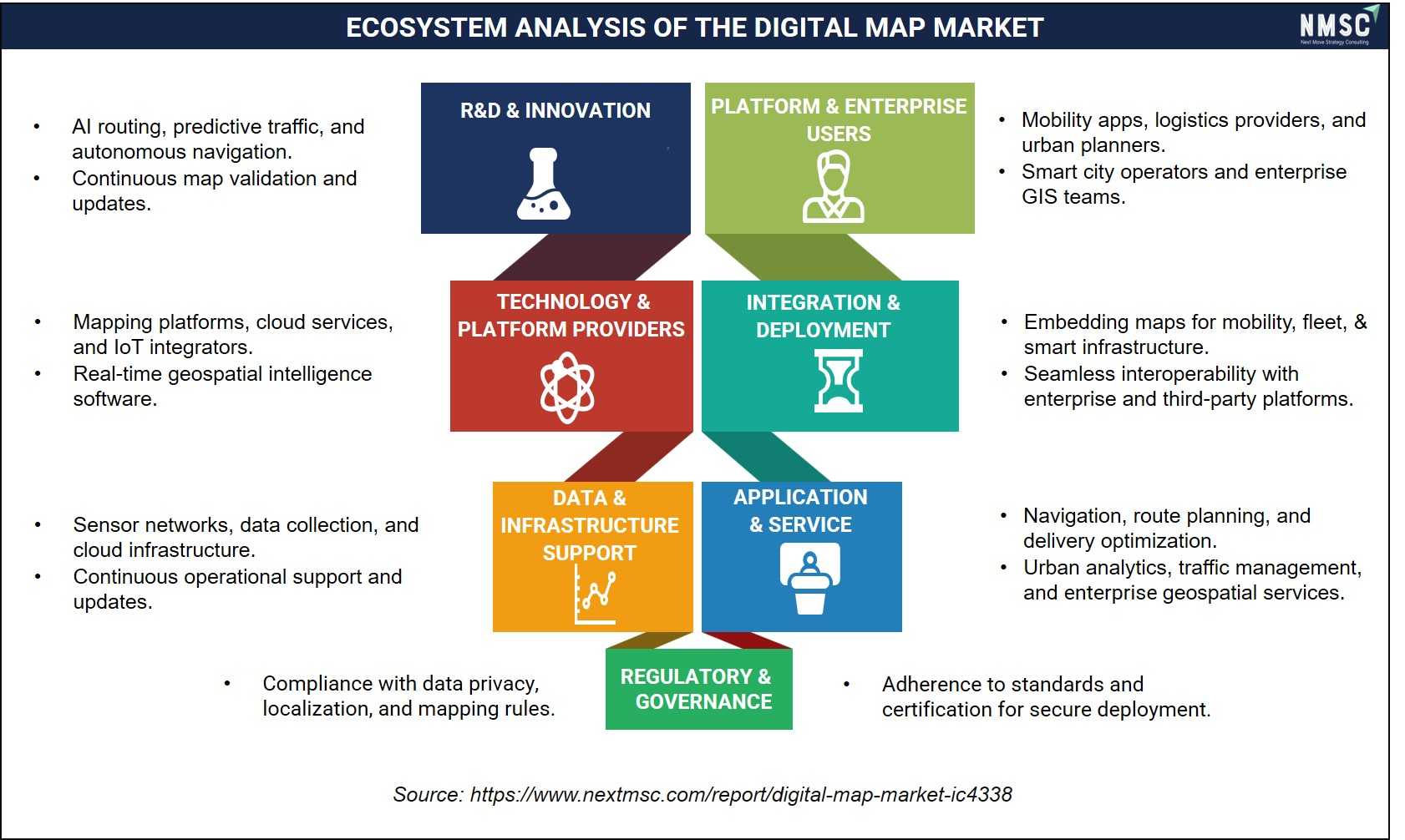
The infographic above depicts the end-to-end ecosystem of the digital map market, illustrating how innovation, technology providers, operators, and regulatory frameworks interconnect to deliver real-time geospatial intelligence. It highlights the flow from R&D and data collection to platform integration, deployment, and service applications, showing the operational and strategic touchpoints that drive market adoption. By visualising stakeholders, technology layers, and governance structures, we noticed how investment in AI, IoT, and cloud infrastructure, combined with regulatory alignment, creates scalable, reliable, and commercially valuable digital mapping solutions across mobility, logistics, and smart city ecosystems.
What Are the Key Market Drivers, Breakthroughs, And Investment Opportunities That Will Shape the Digital Map Industry in the Next Decade?
Growth Catalyst & Risk Assessment Matrix
|
DRIVERS/TRENDS/ RESTRAINTS |
(+/-) % IMPACT ON CAGR FORECAST |
GEOGRAPHIC RELEVANCE |
IMPACT TIMELINE |
|
Expansion of location-based services, mobility platforms, and last-mile delivery ecosystems |
+3.9% |
Global (U.S., China, India, Southeast Asia, Europe) |
Medium to Long term (3–6 years) |
|
Growth of autonomous vehicles and ADAS requires high-definition and real-time mapping |
+3.4% |
North America, Europe, China, Japan, South Korea |
Long term (≥4 years) |
|
Rising adoption of digital maps in smart cities and urban infrastructure planning initiatives |
+2.2% |
Europe, Middle East, China, India, North America |
Medium term (2–4 years) |
|
Advancements in AI-driven geospatial analytics and digital twin integration |
+1.6% |
U.S., Germany, Japan, Singapore, UAE |
Medium to Long term (3–6 years) |
|
Data privacy regulations, geospatial data localisation mandates, and cross-border restrictions |
-1.8% |
Europe, China, India, Middle East |
Short to Medium term (≤3 years) |
From our market evaluation, we found that the digital map market is being shaped by the rapid expansion of real-time, data-driven location intelligence across mobility, enterprise, and infrastructure ecosystems. The growing reliance on location-based services, ride-hailing platforms, and logistics networks, alongside the acceleration of autonomous and connected vehicle technologies, is significantly increasing demand for high-precision, continuously updated mapping platforms. At the same time, our analysis indicates that tightening data privacy regulations and regional data localisation mandates are introducing operational complexities, influencing infrastructure investments and cross-border data strategies for mapping providers. However, emerging opportunities are also becoming evident as AI-driven geospatial analytics and digital twin platforms expand the strategic role of digital maps beyond navigation into predictive spatial intelligence, enabling advanced planning, simulation, and decision-making across smart cities, industrial operations, and large-scale infrastructure ecosystems.
Growth Drivers:
How is the Expansion of Location-Based Services and Mobility Platforms Accelerating the Digital Map Market?
Based on our market analysis, we observed that the rapid expansion of location-based services, ride-hailing, and last-mile delivery platforms is significantly accelerating demand for high-precision, real-time digital maps, as these ecosystems rely on accurate geocoding, live traffic intelligence, and dynamic route optimisation to maintain operational efficiency. Through our interviews with mobility operators and logistics providers, we evaluated that even marginal improvements in mapping accuracy directly enhance fleet utilisation, reduce fuel costs, and improve service reliability, making digital maps a core operational asset rather than a supplementary tool. Therefore, this operational dependence is strengthening recurring revenue models through enterprise API subscriptions and usage-based licensing, improving scalability and long-term monetisation visibility for mapping companies and investors.
How Are the Acceleration of Autonomous and Connected Vehicle Ecosystems Driving Digital Map Market Growth?
We assessed that advances in autonomous driving and ADAS technologies are driving demand for high-definition, lane-level, and sensor-enriched digital maps capable of supporting machine-based navigation. Through our discussions with automotive OEMs, we found that digital maps are increasingly embedded as safety-critical components within vehicle software stacks, requiring continuous updates and centimetre-level accuracy. Furthermore, this shift elevates entry barriers and strengthens long-term contractual revenues through lifecycle-based mapping services, over-the-air updates, and data monetisation from connected fleets, reinforcing scalability and strategic positioning for advanced map providers.
Growth Inhibitor:
How do Data Privacy Regulations and Geopolitical Data Localisation Policies Constrain Digital Map Market Expansion?
On the basis of our assessment, we noticed that tightening data privacy regulations and data localisation mandates are significantly constraining the scalability of the digital map market, as mapping platforms rely heavily on real-time location data, satellite imagery, and crowd-sourced inputs. We also found that varying regional standards increase infrastructure costs, delay cross-border deployments, and complicate data-sharing frameworks. This regulatory fragmentation raises operational risk and capital requirements, limiting expansion for smaller players and reinforcing consolidation among well-capitalised firms with strong compliance capabilities, ultimately slowing cross-regional platform scalability and shaping competitive dynamics within the global location-based services ecosystem.
Growth Opportunity:
How is the Convergence of AI-Driven Geospatial Analytics and Digital Twin Platforms Creating Strategic Upside?
Based on our market analysis, we identified that the integration of AI-powered geospatial analytics with digital twin platforms as a high-impact opportunity, as enterprises and governments increasingly require predictive spatial intelligence for infrastructure planning, asset monitoring, and risk modelling. From our primary research with infrastructure operators and industrial stakeholders, we observed growing demand for maps enriched with analytics layers that enable forecasting, simulation, and real-time decision support. This convergence expands revenue potential beyond navigation into high-margin enterprise contracts, positioning digital map providers as strategic partners in next-generation digital infrastructure ecosystems.
Regulatory Framework Impacting the Digital Map Industry
The infographic below outlines the regulatory landscape playing a critical role in shaping the adoption, deployment, and innovation of digital map technologies across industries.
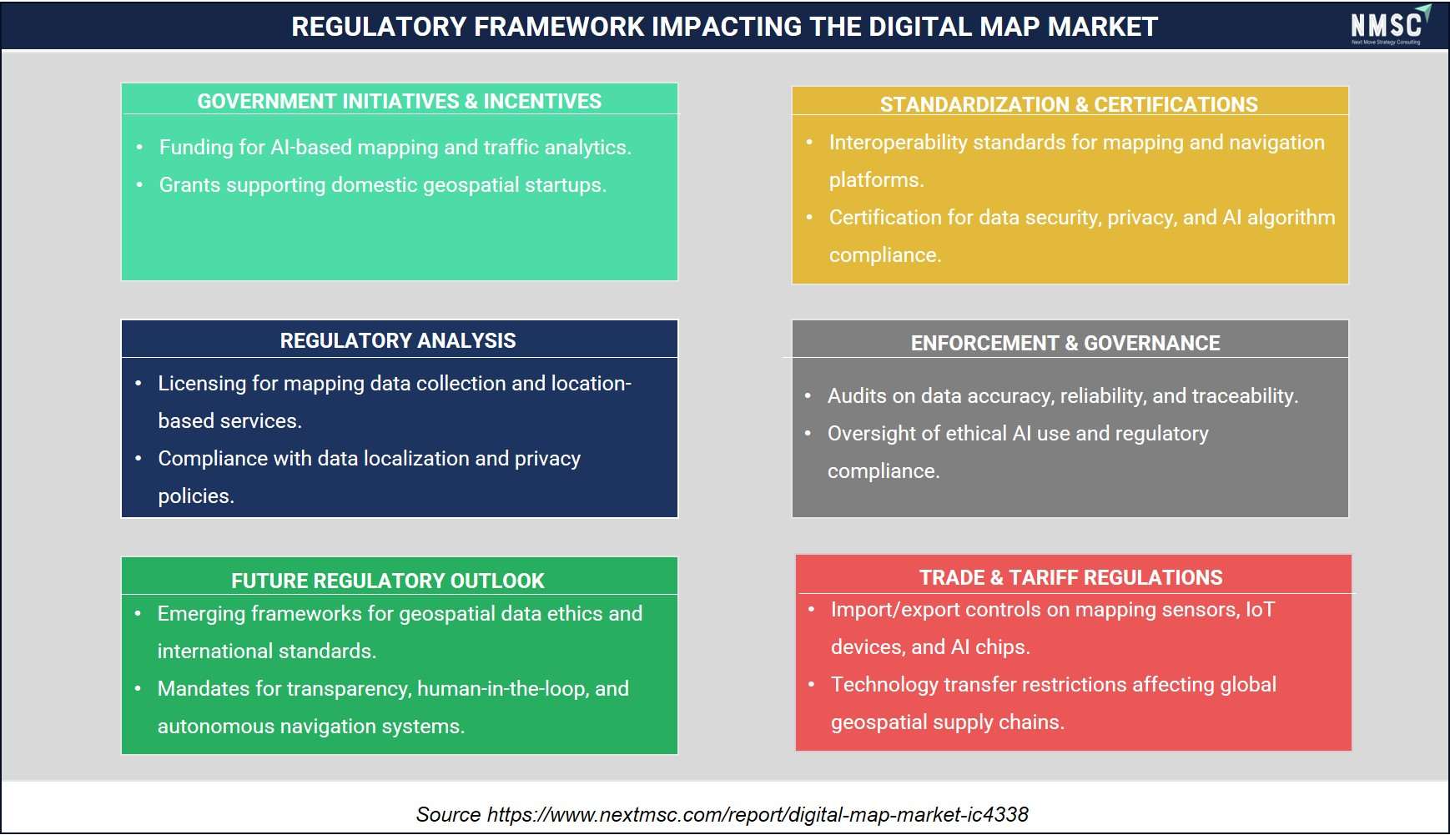
This infographic highlights the key regulatory factors shaping the digital map market, from government incentives and standardisation efforts to compliance, governance, and trade policies. We noticed that regulatory clarity drives innovation while ensuring privacy, data security, and ethical AI use in mapping solutions. Companies, therefore, navigate licensing, cross-border data policies, and emerging ethical frameworks to deploy services effectively. Overall, adherence to these regulations not only reduces operational risks but also supports scalable adoption of AI-enabled maps, navigation, and geospatial analytics across industries.
How Is the Digital Map Industry Segmented in This Report, And What Are the Key Insights from the Segmentation Analysis?
Market Highlights & Strategic Insights – Digital Map Industry:
|
Segments |
Key Takeaways |
|
Offering |
Software platforms drive the largest revenue, led by enterprise GIS, embedded mapping, and routing tools. Map Data, including base, HD, imagery, and real-time datasets, remains a key revenue source, while services such as managed mapping, integration, and geospatial analytics are a fast-growing segment, catering to enterprises and governments seeking customised, operationally ready deployments. |
|
Location |
Outdoor mapping dominates current adoption, underpinning mobility, logistics, and operational planning, whereas indoor and mixed environments are expected to gain prominence as precise location intelligence and operational efficiency become key drivers of market growth. |
|
Deployment |
Cloud-hosted solutions currently lead, offering scalability, analytics, and flexible access. However, hybrid cloud-edge deployments are expected to dominate future adoption, combining secure edge computing with cloud analytics for real-time geospatial intelligence and resilient operations |
|
End-User |
Automotive and mobility sectors lead current adoption. In the coming years, enterprise and government GIS are projected to drive growth, leveraging AI-enabled mapping and geospatial intelligence for large-scale, mission-critical applications. |
By Offering Insights
Is Software or Services Driving the Digital Map Market in 2025?
On the basis of offering, the digital map market is segmented into map data, software and services.
Based on our assessment, we noticed that the software currently leads the market, driven by strong adoption of enterprise GIS platforms, embedded mapping solutions, and routing & analytics tools across automotive, logistics, and urban planning applications. Its dominance is reinforced by AI-enabled features, real-time data integration services, and developer-friendly APIs that enable scalable, customizable solutions. Meanwhile, services, including managed mapping, professional integration, and geospatial analytics, are poised for rapid growth, as enterprises and government agencies increasingly demand end-to-end, operationally ready deployments to maximise the value of their digital map investments.
By Location Insights
How is Location Segmentation Shaping the Digital Map Industry in 2025?
Based on location, the digital map market is segmented into outdoor and indoor.
Through our market research, we found that outdoor mapping currently dominates the digital map market, supported by its extensive coverage, real-time data integration, and critical role in transportation, logistics, and smart city operations. However, indoor mapping is expected to gain significant traction in the coming years, driven by rising demand for accurate, context-specific location intelligence in complex environments such as airports, retail, and industrial facilities.

By Map Type Insights
Are 2D, 3D, Vector, or Raster Maps Driving the Digital Map Industry in 2025?
Based on map type, the digital map market is segmented into 2D maps, 3D maps, vector maps, and raster maps.
Based on our analysis, we observed that 2D maps currently lead the market, widely deployed for planar street maps, terrain visualisation, and basic navigation applications. Their simplicity, reliability, and compatibility with most GIS and navigation platforms make them the backbone for automotive, logistics, and urban planning use cases. However, 3D maps are emerging as a high-growth segment, enabling immersive city and indoor models, advanced simulation, and multi-layer spatial analysis. They support applications in autonomous driving, smart city planning, and facility management, providing richer contextual insights than traditional 2D maps.
Vector maps, on the other hand, continue to drive adoption for interactive and customizable geospatial solutions, offering flexible layering, high-resolution rendering, and integration with web and mobile applications. Their scalability and support for dynamic updates make them ideal for fleet management, logistics optimisation, and enterprise GIS operations, while we also observed that raster maps maintain a niche but essential role, providing high-fidelity image-based tiles and static map layers for visualisation, historical data comparison, and geospatial intelligence applications. They are widely used in urban planning, environmental monitoring, and satellite imagery analysis, where detailed visuals are critical.

By End-User Insights
How is End-User Segmentation Driving Value Creation in the Digital Map Industry?
By end-user, the digital map market is segmented into automotive & mobility, transportation & logistics, government & public sector, retail & e-commerce, telecommunications, agriculture, energy & utilities, media & advertising, consumer technology platforms, defense & security, and others.
From our assessment, we found that automotive and mobility remain the leading end users in the digital map market, driven by the broad adoption of in-car navigation, connected vehicles, and autonomous driving technologies. Enterprise and government GIS applications are expected to see strong growth in the coming years, propelled by smart city projects, infrastructure planning, and defense modernization initiatives. Meanwhile, consumer devices, transportation and logistics, and other niche sectors complement this expansion, with emerging areas like agriculture and IoT poised for rapid adoption as geospatial intelligence becomes increasingly essential for operational and strategic decision-making.
Regional Outlook:
Geographic Performance Snapshot:
|
Regions |
Key Takeaways |
|
North America |
North America represents the most mature digital map market, led by the U.S., driven by strong adoption across mobility platforms, connected vehicles, enterprise logistics, and smart city infrastructure. Advanced cloud ecosystems, automotive innovation, and API-driven platform integration accelerate scalability. Canada demonstrates steady growth in urban planning, geospatial analytics, and public infrastructure mapping, supported by digital transformation initiatives. |
|
Europe |
Europe is a technologically advanced but regulation-intensive market. The UK, Germany, France, and the Nordics lead in automotive HD mapping, smart mobility, and sustainable urban planning. GDPR compliance and data sovereignty frameworks shape operational strategies, while investments in digital twins and green infrastructure mapping sustain long-term enterprise demand. |
|
Asia-Pacific |
Asia-Pacific is the fastest-growing region, driven by rapid urbanisation, e-commerce expansion, and smart city deployments. China leads in large-scale digital mapping integration across mobility and super apps, while India, Japan, South Korea, and Southeast Asia expand adoption in route optimisation and infrastructure planning. Strong government-backed digital ecosystem development supports scalable mapping platforms. |
|
Middle East & Africa (MEA) |
MEA growth is concentrated in Gulf countries such as the UAE and Saudi Arabia, where smart city megaprojects drive demand for advanced geospatial intelligence. Public sector investment supports enterprise adoption, while broader African markets face infrastructure and data availability constraints that moderate scalability. |
|
Latin America (LATAM) |
Latin America remains an emerging market led by Brazil and Chile, with adoption centred on urban mobility, fleet management, and e-commerce logistics. Price-sensitive procurement and reliance on global providers, with growth tied to urban mobility mapping initiatives and regulatory alignment. |
The digital map market is geographically studied across North America, Europe, Asia Pacific, the Middle East & Africa, and Latin America (LATAM), and each region is further studied across countries.
Digital Map Market in North America
Based on our regional assessments, we identified that North America represents the most mature and innovation-driven digital map market globally, supported by a strong automotive ecosystem, widespread enterprise digitalisation, and high adoption of mobility platforms. Consequently, digital mapping solutions are deeply embedded across ride-hailing services, logistics and fleet optimisation platforms, connected vehicles, and emerging smart city initiatives. Although regulators in the U.S. and Canada emphasise data privacy and geospatial security, the compliance environment remains commercially enabling, supporting sustained market expansion. Furthermore, industry developments indicate increasing investments in advanced geospatial analytics, HD mapping technologies and API-based mapping platforms. As a result, buyers increasingly prioritise scalability, real-time data accuracy, and interoperability, reinforcing North America’s leadership in high-value enterprise and automotive mapping contracts.
Digital Map Market in the United States
Our research indicates that the United States leads the digital map market, driven by widespread adoption of digital mapping across mobility, e-commerce logistics, autonomous vehicle testing, and enterprise GIS and SaaS platforms. Interactions with automotive OEMs and product managers highlight strong demand for HD maps, 3D visualisation, and API-first architectures integrated into connected vehicle systems. The regulatory environment continues to balance innovation with robust data governance, particularly through evolving state-level privacy frameworks. Sustained investment in geospatial AI, satellite imagery, and real-time traffic intelligence underscores confidence in long-term digital mapping applications, while market competitiveness is increasingly defined by technological depth, ecosystem partnerships, and scalable enterprise revenue generation.
Digital Map Market in Canada
Canada demonstrates steady growth in the digital map market, driven by smart city initiatives, infrastructure modernisation, and public sector geospatial programs. Adoption is concentrated in urban planning, utilities mapping, and mobility optimisation across major metropolitan areas. Based on our engagements with system integrators, we observed a strong emphasis on data sovereignty and public-private collaboration frameworks. While infrastructure readiness is robust in major urban centres, the overall market scale remains smaller compared with the U.S. Nevertheless, Canada presents stable, policy-aligned expansion opportunities, particularly in enterprise deployments and municipal mapping projects, where government-backed digital initiatives support sustained demand for geospatial solutions.
Digital Map Market in Europe
Based on our regional evaluation, we found that Europe represents a technologically advanced digital map market but one that is strongly shaped by stringent regulatory frameworks, particularly GDPR and data localisation requirements. Adoption is expanding across automotive HD mapping and sustainable urban mobility platforms applications for infrastructure and city planning. Compliance and ethical data governance remain critical procurement criteria for both public and enterprise contracts. Our analysis further indicates that the competitive landscape increasingly favours providers with privacy-by-design architectures and strong localisation capabilities aligned with regional regulatory standards. Investment activity is largely directed toward green mobility initiatives, cross-border transportation interoperability, and advanced geospatial analytics, collectively supporting steady market expansion driven primarily by regulatory compliance and mobility ecosystem demand.
Digital Map Market in the United Kingdom
The UK is a leading European hub for geospatial innovation, supported by mobility and smart infrastructure ecosystems. Based on our market engagements, we observed significant adoption of API-driven mapping within logistics platforms, insurance risk modelling, and autonomous vehicle pilot programs, reflecting the growing integration of location intelligence across enterprise applications. At the same time, regulators encourage digital innovation while maintaining clear data governance standards that support responsible data usage. The UK market, therefore rewards agile providers capable of integrating AI-driven geospatial analytics with enterprise platforms, supported by active private investment and public innovation funding.
Digital Map Market in Germany
Germany’s digital map market is closely tied to its automotive manufacturing base, with HD mapping and precision geospatial data forming the backbone of connected vehicle platforms and advanced manufacturing logistics. Based on our interviews with OEM stakeholders, we observed that long-term contracts and lifecycle-based integration models are increasingly shaping demand across the market. Regulatory intensity remains high, particularly around data protection and cross-border data transfers, making compliance critical. Consequently, Germany offers high-value enterprise opportunities in automotive, industrial, and mobility-driven mapping applications, with successful participation dependent on robust compliance and strong ecosystem partnerships.
Digital Map Market in France
Our market engagements identified that France demonstrates steady adoption driven by public sector digital transformation and urban mobility modernisation. Smart city initiatives and transport optimisation programs support enterprise demand for real-time geospatial analytics. We further observed a strong emphasis on sovereign data management frameworks and the development of local digital ecosystems to reduce external dependencies. Competitive positioning increasingly depends on effective public-private collaboration and close alignment with national digital sovereignty strategies, which collectively shape procurement priorities and long-term partnership models.
Digital Map Market in Italy
Italy represents an emerging yet steadily expanding market within Europe, with adoption primarily concentrated in logistics, tourism, and municipal planning applications. However, infrastructure readiness varies significantly across regions, which directly influences deployment timelines and scalability. In addition, cost sensitivity and extended public procurement cycles moderate the pace of rapid market expansion. Nevertheless, growing investment in digital infrastructure and smart city initiatives is reinforcing long-term enterprise adoption prospects across the country.
Digital Map Market in Spain
Spain is experiencing rising demand across smart mobility, tourism analytics, and urban infrastructure mapping applications. This adoption momentum is being reinforced by EU-backed digital funding programs and sustainable transport initiatives that encourage modernisation at both municipal and regional levels. Based on our market engagements, we noticed increasing collaboration between municipalities and technology providers to accelerate digital mapping and data-driven planning capabilities. Furthermore, Spain presents moderate growth potential, with long-term scalability closely tied to continued infrastructure upgrades and stronger regional digital alignment.
Digital Map Market in the Nordics
The Nordic region, comprising Sweden, Norway, Denmark, and Finland, demonstrates high digital maturity, advanced infrastructure readiness, and early adoption of smart city and connected mobility technologies. Based on our interviews with technology providers, we found a strong focus on sustainability initiatives, open data ecosystems, and interoperability standards, which facilitate scalable digital map deployments. Although the overall market size is relatively modest, the region presents innovation-driven growth opportunities and increasingly serves as a testing ground for advanced geospatial solutions and next-generation mapping platforms.
Digital Map Market in the Asia-Pacific
Our research indicates that Asia-Pacific represents the fastest-growing regional market, supported by rapid urbanisation, expanding super app ecosystems, and the continuous growth of e-commerce logistics networks. Further, we noticed that governments across the region are actively investing in smart city infrastructure and mobility digitisation initiatives to strengthen national digital capabilities. Although adoption levels vary across countries due to differences in infrastructure maturity, ongoing upgrades and mobile-first consumer behaviour are accelerating the integration of digital mapping solutions. As a result, scalability potential remains high, particularly for API-driven and AI-enhanced mapping platforms that support diverse enterprise and consumer applications.
Digital Map Market in China
China leads large-scale digital mapping integration across mobility super apps, e-commerce ecosystems, and smart city megaprojects, reflecting its highly interconnected digital economy. At the same time, regulatory oversight remains stringent, particularly with respect to data localisation and cross-border data governance requirements. Consequently, domestic providers maintain market dominance due to strong regulatory alignment and deep ecosystem integration across platforms and public infrastructure projects. Furthermore, sustained investment in AI-driven geospatial analytics and autonomous mobility solutions continues to strengthen both market scale and technological depth.
Digital Map Market in Japan
Japan exhibits advanced adoption of automotive HD mapping, autonomous vehicle navigation, and infrastructure resilience planning, supported by a robust industrial and mobility ecosystem. Based on our interviews with OEMs and technology integrators, we noticed a strong focus on precision engineering, safety compliance, and long-term lifecycle integration models. Infrastructure readiness remains high, and the regulatory environment provides clarity and stability, supporting steady enterprise expansion and enabling sustained innovation in digital mapping technologies across automotive, industrial, and smart infrastructure applications.
Digital Map Market in India
Our research indicates that India represents an emerging high-growth market, driven by rapid urbanisation, expanding e-commerce ecosystems, and government-led digital transformation initiatives. Based on our discussions with industry leaders, we noticed that cost sensitivity and the evolving regulatory landscape play a critical role in shaping competitive positioning and market entry strategies. Nevertheless, rising investment in logistics optimisation, last-mile delivery networks, and digital mobility platforms is accelerating the adoption of mapping solutions across both enterprise and consumer segments.
Digital Map Market in South Korea
Based on our regional assessment, we found that South Korea represents a technologically advanced and innovation-driven digital map market, supported by high digital connectivity, strong adoption of location-based services, and a globally competitive automotive sector. HD mapping is increasingly integrated into connected vehicles, advanced driver assistance systems (ADAS), autonomous mobility platforms, and emerging smart city initiatives. Further, competitive positioning increasingly depends on providers’ ability to deliver high-precision location intelligence and integrate mapping platforms across mobility ecosystems, including automotive navigation, ride-hailing services, and digital urban infrastructure. As a result, South Korea continues to evolve as a high-value digital mapping market driven by connected mobility, advanced navigation technologies, and widespread adoption of location-based digital services.
Digital Map Market in Taiwan
Taiwan’s digital map market is primarily driven by the growth of urban mobility solutions, smart transportation systems, and enterprise logistics optimization. Adoption is strong in industrial planning, infrastructure development, and metropolitan mapping projects, supported by high infrastructure readiness and robust telecom networks. Although the overall market size is moderate compared with larger economies, Taiwan presents specialized enterprise opportunities, especially in integrating digital mapping with AI-driven analytics and edge computing technologies. We observed that customers in the region emphasize accuracy, interoperability, and high performance, and long-term market growth is expected to align with the advancement of smart infrastructure, mobility solutions, and technology-enabled mapping services.
Digital Map Market in Indonesia
Indonesia represents a high-growth but infrastructure-diverse digital map market within Southeast Asia. Rapid urbanisation, expanding e-commerce ecosystems, and strong super-app penetration are driving demand for real-time navigation, delivery optimisation, and urban analytics. From our interviews with mobility operators and logistics platforms, we observed that cost efficiency and scalability remain central procurement drivers, particularly for high-volume, consumer-facing deployments. However, infrastructure readiness varies considerably between major urban centres and secondary cities, which affects deployment consistency and service quality. Further, regulatory frameworks continue to evolve, especially in areas related to data governance and digital platform oversight, and this evolution is shaping the competitive positioning over time. Although operational complexity persists, Indonesia presents substantial long-term expansion potential, supported by strong demographic growth and accelerating digital adoption.
Digital Map Market in Australia
Our research indicates that Australia has a mature but niche-focused digital map market, with adoption concentrated in mining logistics, urban transport optimisation, utilities management, and infrastructure planning, alongside strong demand for geospatial analytics. Infrastructure readiness is high, supported by stable digital governance frameworks and advanced connectivity networks. Buyers prioritise reliability, compliance alignment, and seamless integration with existing enterprise systems, while competitive differentiation is driven by domain-specific expertise rather than consumer-scale mapping. Moreover, investment remains steady but selective, with a focus on AI-enhanced analytics and digital twin integration for infrastructure projects, positioning Australia for stable long-term growth anchored in enterprise contracts and public sector modernisation initiatives.
Digital Map Market in Latin America
From our regional evaluation, we found that Latin America remains an emerging yet strategically expanding digital map market, led by Brazil and Chile, with adoption primarily focused on urban mobility platforms, fleet tracking systems, and e-commerce logistics optimisation. Although procurement is largely price-sensitive, enterprises continue to rely on global mapping providers while gradually developing local capabilities. At the same time, infrastructure readiness varies across countries, affecting deployment speed and data accuracy, and evolving regulatory harmonisation further influences cross-border scalability for mapping services.
Digital Map Market in the Middle East & Africa
The Middle East represents a high-investment, government-led digital map market, particularly in the UAE and Saudi Arabia, where smart city megaprojects, infrastructure digitalisation, and transport optimisation initiatives drive advanced geospatial adoption. Based on our engagements with digital mapping solution providers, we noticed strong demand for 3D mapping, digital twins, and AI-enabled urban analytics integrated into national transformation programs. Infrastructure readiness in Gulf Cooperation Council countries is high, supported by sovereign funding and digital-first strategies. In contrast, broader African markets face infrastructure limitations, data availability gaps, and funding constraints that moderate rapid scaling. However, mobile-first digital ecosystems and growing urbanisation are gradually expanding demand for navigation and logistics optimisation solutions.
Competitive Landscape
Competitive Dynamics & M&A Landscape:
|
Key Takeaways |
|
The digital map industry is shaped by established leaders such as HERE Technologies, Google, Apple, TomTom, Esri, and Mapbox, alongside regional specialists like NavInfo, Mappls, and ZENRIN. This mix of global giants and agile niche players drives competition across consumer, automotive, and enterprise segments, emphasising scale, data quality, and platform integration. |
|
From our assessment, we found that companies are prioritising HD mapping, AI-powered routing, real-time traffic and mobility feeds, and lane-level geometry. Operational efficiency, cloud integration, developer APIs, and data interoperability have emerged as key differentiators. Firms invest heavily in sensor integration, automated map updates, and AI-enabled spatial analytics to enhance mapping solutions across applications. |
|
Recent innovations highlight real-time GIS capabilities, advanced visualisation tools, high-precision base maps, and developer-customizable APIs. In our evaluation, companies accelerating map refresh cycles, sensor-fused HD maps, and autonomous-driving compatible layers gain a competitive edge in both consumer navigation and enterprise geospatial solutions. |
|
Recent strategic collaborations focus on ecosystem expansion, vertical integration, AI and cloud-enabled mapping, and regional market penetration, rather than simple portfolio expansion. From our competitive assessment, we noticed that alliances between mapping vendors, automotive OEMs, and semiconductor partners accelerate R&D, improve map data performance, and enable rapid adoption of connected and autonomous mobility solutions globally |
Which Companies Dominate the Digital Map Industry and How Do They Compete?
Based on our analysis, we found that the digital map market is shaped by a combination of global technology leaders and specialised geospatial firms that compete through scale, innovation, and diverse offerings. Companies such as HERE Technologies, Google, TomTom, Apple, Esri, Mapbox, and NavInfo consistently rank as top providers due to their expansive map data repositories, integrated platforms, and developer-focused ecosystems. HERE is recognised for its comprehensive mapping solutions across automotive and enterprise sectors, leveraging strategic partnerships to enhance HD map capabilities. Google and Apple maintain strong consumer navigation and platform-integrated maps, while Mapbox continues to differentiate itself with highly customisable developer-first mapping solutions, capturing a technology-driven client base. Overall, competition in the digital map industry is increasingly defined by data accuracy, platform scalability, and ecosystem integration, enabling leading providers to strengthen long-term enterprise partnerships and sustain competitive differentiation across mobility, automotive, and geospatial intelligence applications.
Market Dominated by Digital Map Giants and Specialists
The competitive landscape features both giants with broad geographic reach and specialists focused on niche capabilities or regional leadership. We observed that global leaders such as Google, Apple, and HERE compete heavily in consumer and automotive segments, while specialists like Esri excel in enterprise GIS and NavInfo in the Asia Pacific automotive mapping. We further noticed that Esri’s 2026 Map Viewer and real-time GIS enhancements emphasise its strength in spatial analytics and enterprise workflows, extending its relevance beyond basic navigation. Providers like Mappls (MapmyIndia) are emerging regionally, offering localised 3D navigation and digital address systems as alternatives to global solutions. This dynamic reflects how giants anchor the global market through scale and integration, while specialists leverage domain depth or regional insights to compete effectively.
Innovation and Adaptability Drive Market Success
From our assessment, we observed that innovation remains a central factor driving competitive advantage in the digital map market. Companies are advancing mapping accuracy, refresh cycles, and real-time data integration to meet growing demand for connected and autonomous applications. We noticed that TomTom’s iterative map updates throughout 2026 reflect its commitment to precision, ensuring navigation and routing reliability. The broader adoption of HD maps with lane-level geometry, live traffic feeds, and sensor integration is shaping product development strategies across the market, enabling players to respond to emerging autonomous and mobility-driven requirements efficiently.
Market Players to Opt for Merger & Acquisition Strategies to Expand their Presence
The digital map market remains highly favourable for consolidation and collaborative initiatives, as companies seek to strengthen their technological capabilities and expand market reach. Recent deal-making trends emphasise AI, cloud services, and location data platforms, which serve as critical enablers for mapping and analytics solutions. At CES 2026, strategic partnerships involving HERE, TomTom, and Mapbox highlighted efforts to broaden ecosystems and integrate complementary technologies. Additionally, collaborations with automotive and semiconductor companies, including Qualcomm, demonstrate how vertical integration enhances market presence and technological capacity without relying solely on traditional M&A, accelerating the adoption and deployment of advanced mapping solutions.
List of Key Digital Map Companies
-
HERE
-
TomTom International BV
-
Google
-
Apple Inc.
-
Beijing NavInfo Technology Co., Ltd.
-
Trimble Inc.
-
Garmin Ltd.
-
Nearmap
-
Getmapping Ltd
-
ZENRIN CO., LTD.
-
Cyient
-
Dynamic Map Platform Co., Ltd.
-
2GIS (Sberbank)
-
CARTO
-
DMTI Spatial
-
CE Info Systems Ltd
-
ThinkGeo LLC
What Are the Latest Key Industry Developments?
-
February 2026- South Korea approved the export of high-precision map data, enabling Google Maps to operate fully in the country. This regulatory shift is strategically significant, opening a long-restricted market and allowing Google to compete with local map platforms in Asia.
-
January 2026- HERE showcased AI-powered mapping integration for automated driving purposes at CES 2026, demonstrating enhanced ADAS and automated driving use cases with Qualcomm’s Snapdragon Ride Pilot to improve positioning and safety globally. This underscores the industry’s shift toward AI-augmented map intelligence for autonomous mobility.
-
January 2026- Realsee built the world’s largest spatial database with over 55 million 3D models, showcasing rapid growth in AI-enabled spatial digitisation and 3D mapping for global digital transformation use cases across industries.
Expert Insights
 “Our vision is to have an integrated map in every moving vehicle, even the most affordable. That marks a big change.”
- Mike Nefkens - CEO of HERE Technologies
Strategic Framework of the Digital Map Industry
The infographic below depicts the strategic framework of the digital map market, which highlights the critical dimensions shaping industry growth, operational efficiency, and competitive positioning.
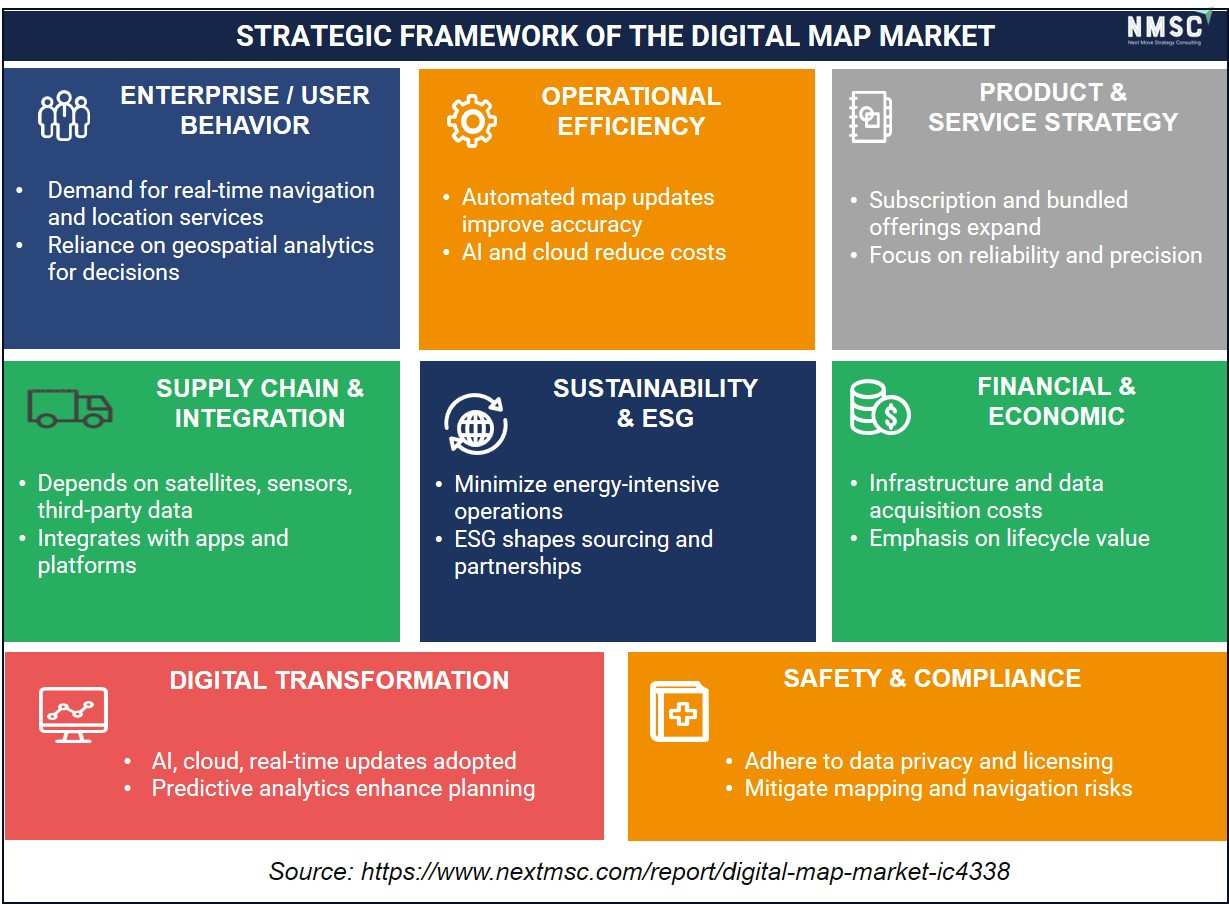
From our strategic assessment, we analysed that the infographic framework illustrates the multifaceted drivers shaping the digital map market, from evolving user needs and operational efficiency to regulatory compliance and sustainability. Providers leverage automation, AI, and cloud solutions to deliver accurate, real-time geospatial data, while product strategies emphasise subscriptions, bundling, and reliability. Supply chain integration, financial considerations, and digital transformation initiatives further dictate competitive positioning. Understanding these interconnected dimensions enables stakeholders to optimise offerings, mitigate risks, and capture growth opportunities in an industry where precision, innovation, and compliance are paramount.
What Are the Key Factors Influencing Investment Analysis & Opportunities in the Digital Map Industry?
Investment in the digital map market is increasingly driven by demand for high-precision, real-time geospatial data, AI-enabled analytics, and platform-based deployment models. From our competitive assessment, we observed that investors are prioritising companies that demonstrate strong integration capabilities with mobility platforms, enterprise logistics, smart city initiatives, and autonomous vehicle ecosystems. Funding trends indicate a focus on technology differentiation, including HD mapping, 3D visualisation, digital twin integration, and AI-driven data validation frameworks. Valuations are increasingly influenced by the ability to deliver recurring, API-based revenue models and scalable platform adoption across multiple sectors.
Furthermore, strategic investment hotspots are concentrated in regions with advanced digital infrastructure, supportive regulatory frameworks, and high enterprise adoption, including North America, Europe, and select Asia-Pacific markets. We found that emerging opportunities exist in AI-enhanced geospatial services, indoor and micro-location mapping, and integrated mobility analytics, where early investors capture long-term value. Moreover, successful market entrants combine technological innovation with operational reliability, ecosystem partnerships, and regulatory alignment to secure sustainable competitive advantage.
Key Benefits for Stakeholders:
Next Move Strategy Consulting (NMSC) provides a comprehensive and evidence-based analysis of the digital map market trends, covering historical developments from 2020 to 2025 and offering forward-looking forecasts through 2035. Our study assesses the market at global, regional, and country levels, combining quantitative outlooks with qualitative insights into key growth drivers, adoption constraints, technology evolution, and investment dynamics across major digital map segments.
The digital map industry delivers substantial strategic and economic value for investors and customers, while policymakers serve as enabling stakeholders. From our competitive assessment, we found that investors benefit from scalable, recurring revenue models, API-driven adoption, and enterprise contracts across mobility, logistics, and smart city ecosystems, providing long-term portfolio growth and exposure to innovation-led markets. Customers, including mobility operators, logistics providers, and urban planners, gain operational efficiency, enhanced routing accuracy, and AI-driven geospatial insights that improve asset management, decision-making, and cost optimisation.
Further, policymakers indirectly support these stakeholders by establishing data governance frameworks, regulatory clarity, and innovation incentives, which promote market stability, secure integration, and responsible adoption. Collectively, this ecosystem ensures that value creation is reinforced across investment, operational performance, and strategic alignment, positioning the digital map market as both a commercially attractive and structurally resilient industry.
|
Parameters |
Details |
|
Customization Scope |
Free customization (equivalent to up to 80 analyst-working hours) after purchase. Addition or alteration to country, regional & segment scope. |
|
Pricing and Purchase Options |
Avail customized purchase options to meet your exact research needs. |
|
Approach |
In-depth primary and secondary research; proprietary databases; rigorous quality control and validation measures. |
|
Analytical Tools |
Porter's Five Forces, SWOT, value chain, and Harvey ball analysis to assess competitive intensity, stakeholder roles, and relative impact of key factors. |
Digital Map Market Key Segments
By Offering
-
Map Data
-
Base Map Data
-
Road Networks
-
Administrative Boundaries
-
Terrain & Elevation Models
-
POI & Address Databases
-
-
High-Definition Maps
-
Lane-level Geometry
-
ADAS HD Maps
-
Autonomous Driving HD Maps
-
-
Imagery & 3D Spatial Data
-
Satellite Imagery
-
Aerial Imagery
-
Street-Level Imagery
-
LiDAR
-
3D Mesh & City Models
-
-
Thematic & Analytical Datasets
-
Demographic Data
-
Land Use & Zoning
-
Environmental & Climate Layers
-
Mobility Heatmaps
-
-
Real-Time & Dynamic Data
-
Live Traffic Data
-
Transit & Mobility Feeds
-
Vehicle Probe Data
-
-
-
Software
-
Enterprise GIS Software
-
Desktop GIS
-
Web GIS
-
-
Embedded Mapping Software
-
In-Vehicle Navigation Systems
-
Offline Device Mapping SDKs
-
Edge Mapping Software
-
-
Routing & Dispatch Software
-
Route Planning Software
-
Fleet Optimisation Systems
-
Last-mile Delivery Routing
-
Dispatch & Workforce Allocation
-
-
-
Services
-
Managed Mapping Services
-
Hosted Mapping
-
Map Maintenance & Update Management
-
-
Professional & Integration Services
-
GIS Implementation
-
Custom Map Development
-
-
Analytical Services
-
Geospatial Analytics
-
Predictive Routing
-
-
By Location
-
Outdoor
-
Road & Highway Networks
-
Urban Infrastructure
-
Rural & Remote Areas
-
Environmental & Terrain Mapping
-
Others
-
-
Indoor
-
Airports & Transit Hubs
-
Retail & Malls
-
Healthcare Facilities
-
Industrial Facilities
-
Hospitality & Event Venues
-
Others
-
By Map Type
-
2D Maps
-
Planar Street Maps
-
Terrain Maps
-
-
3D Maps
-
3D City Models
-
3D Indoor Models
-
-
Vector Maps
-
Vector Tiles
-
Customizable Map Layers
-
-
Raster Maps
-
Image-Based Tiles
-
Static Map Layers
-
By Deployment
-
Cloud-Hosted
-
On-Premise Licensed
-
Embedded
-
Hybrid Cloud-Edge
By Application
-
Automotive Navigation & Autonomous Mapping
-
Consumer Navigation & Location Apps
-
Enterprise GIS & Spatial Analytics
-
Logistics & Fleet Optimization
-
Location-Based Marketing & Retail Analytics
-
Telecom Network Planning & IoT Mapping
-
Agriculture & Environmental Mapping
-
Defense & Emergency Response
-
Others
By End-User
-
Automotive & Mobility
-
Transportation & Logistics
-
Government & Public Sector
-
Retail & E-commerce
-
Telecommunications
-
Agriculture
-
Energy & Utilities
-
Media & Advertising
-
Consumer Technology Platforms
-
Defense & Security
-
Others
Geographical Breakdown
-
North America: U.S., Canada, and Mexico.
-
Europe: UK, Germany, France, Italy, Spain, Sweden, Denmark, Finland, the Netherlands, and the Rest of Europe.
-
Asia Pacific: China, India, Japan, South Korea, Taiwan, Indonesia, Vietnam, Australia, Philippines, Malaysia and the rest of APAC.
-
Middle East & Africa (MEA): Saudi Arabia, UAE, Egypt, Israel, Turkey, Nigeria, South Africa, and the rest of MEA.
-
Latin America: Brazil, Argentina, Chile, Colombia, and the rest of LATAM.
Conclusion & Recommendations
The digital map market is evolving from a navigation-focused ecosystem into a critical infrastructure layer for mobility, logistics, smart cities, and enterprise geospatial intelligence. From our competitive assessment, we observed that market growth is increasingly driven by real-time, AI-enhanced mapping, API-based platform integration, 3D and immersive visualisation, and digital twin applications. Adoption is strongest where infrastructure readiness, regulatory clarity, and technology innovation converge, highlighting regional hubs such as North America, Europe, and select Asia-Pacific markets as strategic hotspots. Furthermore, providers that invest in data validation frameworks, scalable platform architectures, and ecosystem partnerships are well-positioned to capture long-term value and strengthen market differentiation.
From our engagements with executives and investors, we advise prioritising interoperability, AI-enabled analytics, and enterprise-grade reliability when planning digital mapping initiatives. Investors should focus on companies delivering recurring platform revenues and high-value integration capabilities across mobility and infrastructure ecosystems. Policymakers can support sustainable market expansion by fostering clear regulatory frameworks, encouraging innovation incentives, and enabling secure data sharing. Collectively, coordinated action across these groups will reinforce the digital map market’s resilience, scalability, and strategic relevance in the next-generation digital economy.


About the Author
 Mayurima Roy
— Mayurima Roy is Research Analyst at Next Move Strategy Consulting, where she has spent 4 years working across the firm's full industry coverage rather than a single fixed vertical. Her work centers on structured research, ongoing trend tracking, competitive assessment, and insight-led content development, translating complex market data into clear, decision-ready narratives that support informed client decision-making across diverse global industries, market sectors, and world regions every day.
Mayurima Roy
— Mayurima Roy is Research Analyst at Next Move Strategy Consulting, where she has spent 4 years working across the firm's full industry coverage rather than a single fixed vertical. Her work centers on structured research, ongoing trend tracking, competitive assessment, and insight-led content development, translating complex market data into clear, decision-ready narratives that support informed client decision-making across diverse global industries, market sectors, and world regions every day.
About the Reviewer
 Supradip Baul
— Supradip Baul is an accomplished business consultant and strategist with over a decade of rich experience in market intelligence, strategy, technology, and business transformation. His work has included rigorous qualitative and quantitative analysis across multiple industries, helping clients shape investment decisions and long-term roadmaps. Earlier in his career, he was associated with Gartner, where he contributed to industry-leading reports and market share analyses. He has worked with leading global companies and holds an MBA with a dual specialization in Marketing and Finance.
Supradip Baul
— Supradip Baul is an accomplished business consultant and strategist with over a decade of rich experience in market intelligence, strategy, technology, and business transformation. His work has included rigorous qualitative and quantitative analysis across multiple industries, helping clients shape investment decisions and long-term roadmaps. Earlier in his career, he was associated with Gartner, where he contributed to industry-leading reports and market share analyses. He has worked with leading global companies and holds an MBA with a dual specialization in Marketing and Finance.
At Next Move Strategy Consulting, we understand that insightful market research is the cornerstone of successful business decisions. That's why we employ a robust and multifaceted approach, combining various methodologies to deliver the most accurate and actionable data for our clients.

Research Landscape
We navigate the world of research with two primary approaches:
Qualitative Approach
Our qualitative research methodologies involve immersive techniques such as in-depth interviews, focus groups, and observational studies. By engaging directly with individuals and stakeholders, we uncover valuable insights that quantitative data alone may overlook.

Quantitative Research
In tandem with qualitative methodologies, NMSC leverages the power of Quantitative Research to provide a robust foundation of numerical insights. Through systematic data collection and analysis, we quantify patterns, preferences, and market trends, offering a comprehensive view of the business landscape.
Our quantitative research approach employs diverse tools, including surveys, experiments, and statistical modelling. These methodologies enable us to gather data from a large and representative sample, ensuring the statistical significance of our findings. By employing structured questionnaires and standardized data collection methods, we guarantee the reliability and validity of the information we present to our clients.
Quantitative research is particularly effective in measuring the prevalence of trends, assessing market size, and gauging the impact of various factors on consumer behavior. The numerical precision attained through this approach equips our clients with actionable insights, facilitating data-driven decision-making and strategy formulation.


Our Specialized Toolbox for Industry-Specific Market Research
We deploy a specialized arsenal of techniques tailored to meet your unique requirements. Here's a glimpse into our comprehensive toolbox:

Information Procurement
The stage entails acquiring market data or relevant information through various sources and methodologies.


Market Research Approach
We utilize both top-down and bottom-up approaches in market research analysis to achieve a comprehensive understanding of the market dynamics, leveraging the broad perspective of industry trends and macroeconomic factors alongside detailed insights from specific segments and individual companies.

Porters Five Forces Analysis
We conduct Porter's Five Forces analysis to evaluate the competitive landscape of an industry, providing us with insights into factors that affect profitability and strategic positioning.

SWOT Analysis

Forecasting
We utilize a forecasting model to predict future consumption by considering parameters like population, economics, regulations, market competition, drivers, constraints, technology, and pricing. We also employ statistical techniques such as multilinear regression, exponential smoothing, moving average, ARIMA, and Monte Carlo simulations for accurate predictions. In econometric forecasting, we analyzed short-term and long-term event impacts, attributing values based on regulatory frameworks, economic factors, and market events.





 Speak to Our Analyst