Experiential Wayfinding Market Global Industry Analysis and Forecast (2026-2035)

Experiential Wayfinding Market size was USD 3.72 billion in 2026, projected to reach USD 7.86 billion by 2035, growing at a CAGR of 8.7% from 2026 to 2035. Key drivers include rising healthcare facility construction and renovation investment, expanding airport and transit infrastructure investment, and growing digital wayfinding technology integration, with North America leading the market.

Download Free Sample PDF
Base Year (2025)
$3.42 Billion
Forecast (2035)
$7.86 Billion
CAGR (2026-2035)
8.7%
Top Region
North America

What Is the Experiential Wayfinding Market Size?

The global experiential wayfinding market size was valued at USD 3.42 billion in 2025 and is estimated at USD 3.72 billion in 2026, forecast to reach USD 7.86 billion by 2035, expanding at an 8.7% CAGR between 2026 and 2035. North America leads with approximately 42% share, while Design and Consulting Services dominates all other offerings with approximately 36% share.

We observed that the growth is broad-based across every segmentation axis, with digital wayfinding adoption and healthcare facility investment driving the dominant structural shifts through 2035.

Experiential Wayfinding Market Global Industry Analysis and Forecast (2026-2035) Revenue Forecast

Values in USD Billion

2025 $3.42 Billion
2025
2026 $3.72 Billion
2026
2027 $4.04 Billion
2027
2028 $4.40 Billion
2028
2029 $4.78 Billion
2029
2030 $5.19 Billion
2030
2031 $5.65 Billion
2031
2032 $6.14 Billion
2032
2033 $6.67 Billion
2033
2034 $7.25 Billion
2034
2035 $7.86 Billion
2035

Key Takeaways

By Offering: Design and Consulting Services held the largest share of approximately 36% (USD 1.23 billion) in 2025; Digital and Interactive Wayfinding Technology is the fastest-growing sub-segment at 13.7% CAGR from 2026-2035.

By Solution Type: Static Physical Wayfinding Systems held the largest share of approximately 48% (USD 1.64 billion) in 2025; Digital Wayfinding Systems is the fastest-growing sub-segment at 12.8% CAGR from 2026-2035.

By End Use: Healthcare Facilities held the largest share of approximately 24% (USD 0.82 billion) in 2025; Educational Institutions is the fastest-growing sub-segment at 9.8% CAGR from 2026-2035.

Dominant Region: North America dominated with approximately 42% revenue share (USD 1.44 billion) in 2025.

Fastest-Growing Region: Asia-Pacific is expected to register the highest CAGR of 12.6% during 2026-2035.

Dominant Country: U.S. led with approximately USD 1.15 billion in 2025.

Fastest-Growing Country: India is the fastest-growing country at approximately 18.4% CAGR from 2026-2035.

Market Opportunity: The experiential wayfinding market is expected to create an absolute dollar opportunity of USD 4.14 billion between 2026 and 2035, presenting significant investment potential across the digital and interactive wayfinding technology value chain.

According to Next Move Strategy Consulting analysis, healthcare systems and airport operators are increasingly commissioning combined physical-and-digital wayfinding programs rather than standalone signage packages, a shift that favors multidisciplinary design firms with in-house digital capability over signage fabricators as institutional clients consolidate vendor relationships through 2035.

What Does the Experiential Wayfinding Market Encompass?

The experiential wayfinding market encompasses design, fabrication, and technology services that guide and orient people through complex-built environments while reinforcing brand identity and place narrative. Our assessment indicates that the scope spans physical signage systems, digital and interactive navigation technology, and the design consulting services that unify them, delivered to healthcare, transit, retail, corporate, and cultural clients. The category has evolved from functional directional signage into holistic, brand-integrated experience design, closely intersecting with the broader indoor positioning and indoor navigation technology ecosystem worldwide.
Regulatory frameworks such as the U.S. Americans with Disabilities Act's signage accessibility standards and national building code requirements shape design specifications, while airport and healthcare accreditation guidelines increasingly influence wayfinding program scope. We observed that technology adoption is shifting toward interactive digital directories and mobile-integrated navigation that complement physical signage. Next Move Strategy Consulting's analysis indicates that this structural shift, combined with rising institutional investment in patient and passenger experience, is redefining sourcing criteria across the market.

ECOSYSTEM ANALYSIS OF THE EXPERIENTIAL WAYFINDING MARKET

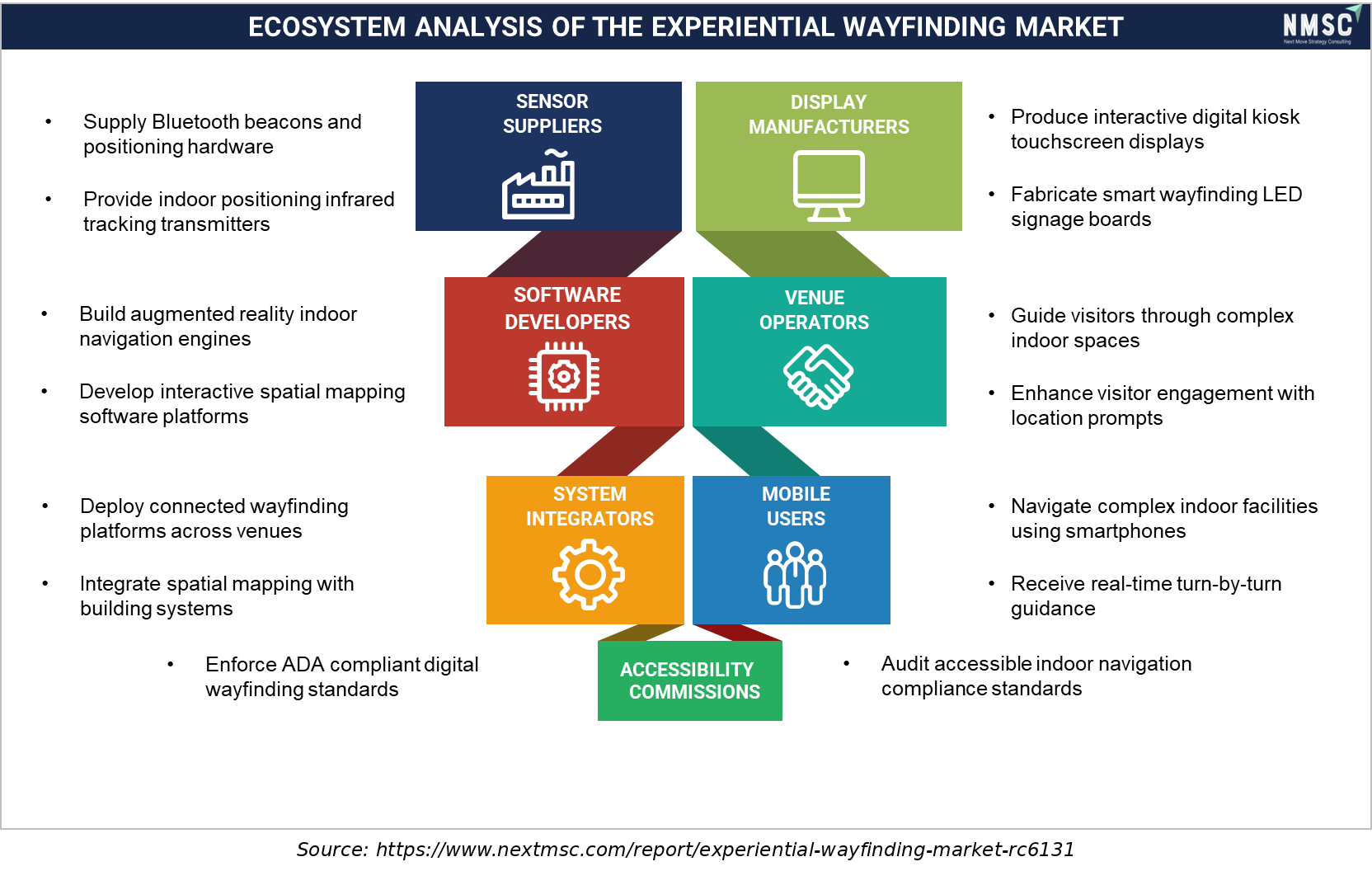
The ecosystem analysis illustrates the interconnected stakeholders shaping the experiential wayfinding market. Sensor suppliers and display manufacturers provide core hardware, while software developers enable digital functionality and interactive experiences. Venue operators and system integrators connect these technologies with physical environments and user needs. Mobile users represent the primary experience layer, while accessibility commissions influence inclusive design and compliance. Together, these stakeholders form an integrated ecosystem supporting navigation, engagement, information delivery, and accessible experiences across diverse venues.

Market Drivers & Dynamics

Interactive Dataset
Rising healthcare facility construction and renovation investment driver +2.1% North America, Europe 2026-2035
Expanding airport and transit infrastructure investment driver +1.8% Asia-Pacific, MEA 2026-2035
Growing digital wayfinding technology integration driver +1.5% Global 2026-2032
Rising mixed-use and retail placemaking investment driver +1.1% North America, Europe 2026-2035
Accessibility compliance requirements driving signage upgrades driver +0.8% North America, Europe 2026-2032
Private equity consolidation of founder-led design studios restraint -0.9% North America 2026-2030
Long project sales cycles limiting revenue predictability restraint -0.7% Global 2026-2032
High customization costs limiting small client access restraint -0.5% Global 2026-2032
Source: Next Move Strategy Consulting

Growth Drivers

What Is the Primary Growth Driver of the Experiential Wayfinding Market?

Rising healthcare facility construction and renovation investment is the primary driver of the market. The U.S. Census Bureau continues to report sustained healthcare construction spending nationwide, supporting demand for patient-centered wayfinding programs in new and renovated facilities. We observed that this construction activity, reinforced by expanding airport and transit infrastructure investment, continues to anchor baseline consumption of design consulting and signage fabrication services across developed and emerging economies alike.

How Is Airport Infrastructure Investment Driving Market Growth?

Expanding airport and transit infrastructure investment is accelerating market growth toward large-scale, brand-integrated wayfinding programs. The U.S. Federal Aviation Administration continues to fund airport improvement grants supporting terminal expansion and passenger experience upgrades nationwide. Our assessment indicates that this infrastructure investment, combined with rising passenger volume, is compressing adoption timelines for comprehensive wayfinding programs among airport authorities and transit agencies.

Growth Inhibitors

What Is Restraining Experiential Wayfinding Market Expansion?

Long project sales cycles restrain revenue predictability across the experiential wayfinding supply chain. Design and construction project timelines commonly extend from initial concept through installation over multiple years, delaying revenue recognition for design firms. We found that smaller independent studios face particular exposure, as limited working capital reduces their ability to sustain extended project pipelines compared with larger, better-capitalized firms with diversified project portfolios.

What Are the Growth Opportunities?

How Can Mobile-Integrated Navigation Unlock Value for Healthcare Systems?

Mobile-integrated navigation presents a whitespace opportunity for design firms serving large hospital campuses seeking to reduce patient anxiety and missed-appointment rates. Firms that commercialize validated app-based turn-by-turn navigation stand to capture recurring digital-service revenue as health systems increasingly bundle ongoing digital wayfinding maintenance into long-term facility contracts.

Where Does Campus-Wide Branding Integration Create New Demand?

Campus-wide branding integration represents an underpenetrated opportunity for firms engineered to unify wayfinding with institutional identity programs. Providers that develop validated, scalable branded-environment offerings can secure long-term university and corporate campus contracts, benefiting from recurring signage refresh and expansion revenue tied to ongoing facility development.

How Can Media Architecture Benefit Transit and Cultural Venues?

Transit authorities and cultural venues seeking landmark visitor experiences create an opportunity for firms combining dynamic media with permanent wayfinding infrastructure. Early movers that integrate augmented reality content with physical navigation systems can differentiate with venues pursuing distinctive, story-driven visitor experiences.

Segmentation Analysis

2025 (USD Billion)
2035 (USD Billion)
Design and Consulting Services 2025: $1.23 Billion | 2035: $2.67 Billion
Design and C
Signage and Fabrication 2025: $1.03 Billion | 2035: $1.89 Billion
Signage and
Digital and Interactive Wayfinding Technology 2025: $0.68 Billion | 2035: $2.36 Billion
Digital and
Installation and Project Management 2025: $0.48 Billion | 2035: $0.94 Billion
Installation
Design and Consulting Services $1.23 Billion $2.67 Billion 8.0%
Signage and Fabrication $1.03 Billion $1.89 Billion 6.0%
Digital and Interactive Wayfinding Technology $0.68 Billion $2.36 Billion 13.7%
Installation and Project Management $0.48 Billion $0.94 Billion 6.8%

Which Offering Segment Dominates the Experiential Wayfinding Market?

Design and Consulting Services led the market with USD 1.23 billion in 2025, supported by client demand for strategic navigation planning that precedes any physical or digital implementation. We observed that Digital and Interactive Wayfinding Technology is the fastest-growing offering, expanding at a 13.7% CAGR from 2026 to 2035, as healthcare and transit clients increasingly specify interactive directories and mobile-integrated navigation alongside physical signage.

2025 (USD Billion)
2035 (USD Billion)
Static Physi
Digital Wayf
Hybrid Wayfi
Segment Item 2025 (USD Billion) 2035 (USD Billion) CAGR
Static Physical Wayfinding Systems $10.0 USD Billion $40.0 USD Billion 25.0%
Digital Wayfinding Systems $17.1 USD Billion $51.1 USD Billion 11.0%
Hybrid Wayfinding Systems $24.2 USD Billion $62.2 USD Billion 25.0%

Segment-wise data is locked

Unlock complete segment-wise numbers for By Solution Type.

Unlock Full Data

Which Solution Type Leads Experiential Wayfinding Deployment?

Static Physical Wayfinding Systems remained the leading solution type, valued at USD 1.64 billion in 2025 on sustained demand for durable, code-compliant signage in institutional settings. Based on research conducted by Next Move Strategy Consulting, we found that Digital Wayfinding Systems is the fastest-growing solution type at a 12.8% CAGR from 2026 to 2035, reflecting expanding LED display and interactive directory adoption across large-format institutional venues.

2025 (USD Billion)
2035 (USD Billion)
Healthcare F
Airports and
Retail and M
Corporate Ca
Educational
Segment Item 2025 (USD Billion) 2035 (USD Billion) CAGR
Healthcare Facilities $10.0 USD Billion $40.0 USD Billion 27.0%
Airports and Transit Hubs $17.1 USD Billion $51.1 USD Billion 9.0%
Retail and Mixed-Use Developments $24.2 USD Billion $62.2 USD Billion 19.0%
Corporate Campuses $31.3 USD Billion $73.3 USD Billion 17.0%
Educational Institutions $38.4 USD Billion $84.4 USD Billion 18.0%

Segment-wise data is locked

Unlock complete segment-wise numbers for By End Use.

Unlock Full Data

Which End Use Segment Leads Experiential Wayfinding Demand?

Healthcare Facilities remained the leading end use segment, valued at USD 0.82 billion in 2025 as hospital systems prioritize patient and visitor navigation experience. Our findings suggest that Educational Institutions is the fastest-growing end use segment, registering a 9.8% CAGR from 2026 to 2035, as universities and school districts increasingly commission campus-wide wayfinding and branding programs to support enrollment and campus identity goals.

2025 (USD Billion)
2035 (USD Billion)
North Americ
Canada
Mexico
Europe: UK
Germany
Segment Item 2025 (USD Billion) 2035 (USD Billion) CAGR
North America: U.S. $10.0 USD Billion $40.0 USD Billion 14.0%
Canada $17.1 USD Billion $51.1 USD Billion 24.0%
Mexico $24.2 USD Billion $62.2 USD Billion 22.0%
Europe: UK $31.3 USD Billion $73.3 USD Billion 12.0%
Germany $38.4 USD Billion $84.4 USD Billion 27.0%

Segment-wise data is locked

Unlock complete segment-wise numbers for By Region.

Unlock Full Data

Growth Opportunities

Our analysis shows that three forward-looking opportunities stand out for stakeholders positioning within the market over the 2026-2035 forecast period.

How Can Mobile-Integrated Navigation Unlock Value for Healthcare Systems?

Mobile-integrated navigation presents a whitespace opportunity for design firms serving large hospital campuses seeking to reduce patient anxiety and missed-appointment rates. Firms that commercialize validated app-based turn-by-turn navigation stand to capture recurring digital-service revenue as health systems increasingly bundle ongoing digital wayfinding maintenance into long-term facility contracts.

Where Does Campus-Wide Branding Integration Create New Demand?

Campus-wide branding integration represents an underpenetrated opportunity for firms engineered to unify wayfinding with institutional identity programs. Providers that develop validated, scalable branded-environment offerings can secure long-term university and corporate campus contracts, benefiting from recurring signage refresh and expansion revenue tied to ongoing facility development.

How Can Media Architecture Benefit Transit and Cultural Venues?

Transit authorities and cultural venues seeking landmark visitor experiences create an opportunity for firms combining dynamic media with permanent wayfinding infrastructure. Early movers that integrate augmented reality content with physical navigation systems can differentiate with venues pursuing distinctive, story-driven visitor experiences.

CONSUMER BEHAVIOR ANALYSIS OF THE EXPERIENTIAL WAYFINDING MARKET

CONSUMER BEHAVIOR ANALYSIS OF THE EXPERIENTIAL WAYFINDING MARKET

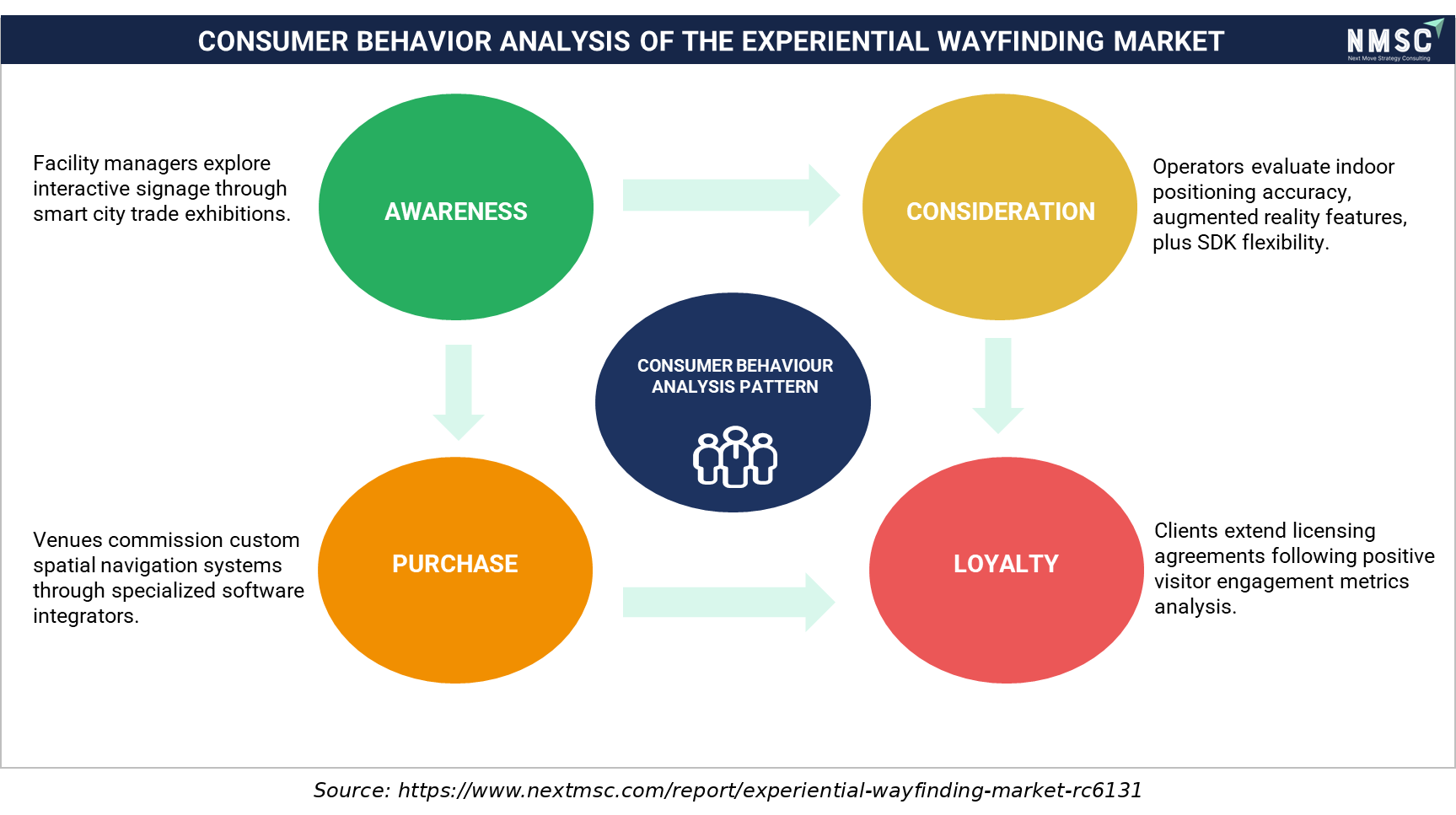
The consumer behavior analysis illustrates the experiential wayfinding adoption journey across awareness, consideration, purchase, and loyalty stages. Facility managers initially explore interactive signage and smart-city applications, while operators assess positioning accuracy, augmented-reality capabilities, and software flexibility. Venues then engage specialized integrators to commission customized navigation systems, with successful visitor engagement and performance outcomes supporting license extensions and long-term customer relationships.

Regional Outlook

2025 (USD Billion)
2035 (USD Billion)
North Americ
Europe
Asia-Pacific
Middle East
Latin Americ
Region 2025 (USD Billion) 2035 (USD Billion) CAGR (%)
North America $10.0 USD Billion $40.0 USD Billion 9.0%
Europe $17.1 USD Billion $51.1 USD Billion 27.0%
Asia-Pacific $24.2 USD Billion $62.2 USD Billion 25.0%
Middle East & Africa $31.3 USD Billion $73.3 USD Billion 23.0%
Latin America $38.4 USD Billion $84.4 USD Billion 12.0%

Regional data is locked

Unlock complete regional numbers for this market.

Unlock Full Data

Competitive Landscape

We observed that the experiential wayfinding market remains highly fragmented, with independent boutique design studios, multidisciplinary firms, and a growing number of private equity-backed platforms competing across overlapping segments of the value chain.

Dimension Description
Market Structure Highly fragmented among independent boutique studios, with early-stage private equity-driven consolidation among leading firms
Innovation Focus Digital and mobile-integrated wayfinding, placemaking and civic identity design, and media architecture
M&A Activity Private equity acquisition of founder-led studios to build scaled, multi-market design platforms

How Do Companies Compete in the Experiential Wayfinding Market?

Companies compete primarily on design portfolio strength, multidisciplinary capability, and long-term institutional client relationships within the experiential wayfinding market. We observed that firms combining branding, wayfinding, and placemaking under one roof can offer more competitive proposals than signage-only fabricators. Award recognition and repeat project history increasingly differentiate bids in institutional procurement, alongside digital integration capability for clients seeking combined physical and digital programs.

Which Competitive Archetypes Dominate the Experiential Wayfinding Industry?

Two archetypes dominate the experiential wayfinding industry: established multidisciplinary studios with decades-long institutional client relationships, and newer digitally focused firms specializing in interactive and mobile navigation technology. We found that the first group competes primarily on design pedigree and portfolio depth, while the second differentiates through digital product capability that traditional signage-focused studios often lack, securing recurring technology-licensing revenue from clients seeking ongoing digital wayfinding maintenance.

What Innovation and Differentiation Strategies Define Market Leaders?

Market leaders differentiate through placemaking depth, digital wayfinding integration, and immersive media capability. Our analysis shows that firms investing in building information modeling (BIM) coordination with architects are positioning to capture premium institutional accounts earlier in the design process, while combined physical-digital program delivery increasingly forms a core part of competitive bids across large healthcare and transit tenders.

How Active Is M&A in the Experiential Wayfinding Market?

M&A activity is emerging as a structural theme as private equity investors pursue acquisition of founder-led design studios to build scaled platforms. We found that Astria Elevate's 2025 acquisition of Entro Communications reflects this trend toward institutional investment in the sector, while independent studios pursue selective partnerships to expand geographic reach and digital capability without ceding full ownership.

Key Market Players

We observed that the following 15 companies represent the leading verified participants shaping the competitive structure of the experiential wayfinding market.

RSM Design Selbert Perkins Design Entro Communications Mijksenaar Poulin + Morris Inc. Two Twelve Associates, Inc. Sussman/Prejza & Co., Inc. C&G Partners LLC Calori & Vanden-Eynden Design Consultants Corbin Design Hunt Design Associates Moment Factory Pentagram Design Limited Roll Barresi & Associates SKA Design

Latest Developments

Our assessment indicates that recent corporate activity reflects continued consolidation and digital capability expansion across the experiential wayfinding market.

Date Event
April 2026 C&G Partners was engaged to create a new wayfinding and mapping system for Storm King Art Center’s 500-acre outdoor museum campus following its expansion. The system introduces a refined visual language that integrates navigation with artwork, architecture, landscape, and visitor exploration.
March 2026 Entro announced proprietary AI, data, and research capabilities alongside its Designing with Intelligence white paper. The approach combines technology, neuroscience, spatial science, and behavioral research to improve understanding of how people navigate, perceive, and experience branded and built environments.

Investment Opportunities

Where Are Capital Inflows Concentrated in the Experiential Wayfinding Market?

Capital inflows are concentrated in private equity acquisition of founder-led design studios and digital wayfinding technology development. We observed that investment firms are increasingly funding platform consolidation across previously independent studios, reflecting growing investor confidence in experiential wayfinding as a scalable, recurring-revenue design services category rather than a purely project-based practice.

How Significant Is Infrastructure Investment in Experiential Wayfinding Delivery?

Infrastructure investment in digital directory hardware and mobile navigation platforms is accelerating as institutional clients modernize legacy signage systems. Our findings suggest that augmented reality and virtual reality headset adoption is emerging as an adjacent infrastructure investment theme, with museums and cultural venues piloting immersive navigation experiences to supplement traditional physical wayfinding.

What ESG Considerations Shape Experiential Wayfinding Investment?

Environmental, social, and governance considerations increasingly shape investment decisions, with clients favoring firms that demonstrate sustainable material sourcing and inclusive, accessible design practice. We observed that universal design compliance and multilingual accessibility are drawing heightened institutional client attention, reflecting growing focus on equitable navigation experiences across the built environment services value chain.

Key Benefits for Stakeholders

How Does This Report Benefit Design Firm and Industry Leaders?

Design firm and industry leaders gain access to segment-level revenue forecasts and offering-adoption trends that inform service line planning. Our analysis shows that the report's regional breakdowns support market-entry and capacity-expansion decisions, helping stakeholders align investment with the fastest-growing offerings and end-use segments through 2035.

How Does This Report Benefit Investors and Financial Analysts?

Investors and financial analysts benefit from consolidated market-sizing data, competitive-landscape mapping, and CAGR-level growth drivers that support valuation and due-diligence work. We found that the report's country-level forecasts help identify markets with the strongest risk-adjusted return profiles, particularly across the fastest-growing Asia-Pacific and Middle East & Africa regions.

How Does This Report Benefit Institutional Facility Owners and Developers?

Institutional facility owners and developers gain segmentation-level insight into offering, solution type, and end-use preferences that inform capital project planning. Our assessment indicates that the report's trend analysis highlights digital wayfinding integration as a high-growth adjacency, helping facility owners align budget allocation with the fastest-growing sub-segments identified in this market report.

Key Market Segments Evaluated

By Offering

  • Design and Consulting Services
  • Signage and Fabrication
  • Digital and Interactive Wayfinding Technology
  • Installation and Project Management

By Solution Type

  • Static Physical Wayfinding Systems
  • Digital Wayfinding Systems
  • Hybrid Wayfinding Systems

By End Use

  • Healthcare Facilities
  • Airports and Transit Hubs
  • Retail and Mixed-Use Developments
  • Corporate Campuses
  • Educational Institutions
  • Cultural and Museum Venues
  • Hospitality

By Region

  • North America: U.S.
  • Canada
  • Mexico
  • Europe: UK
  • Germany
  • France
  • Italy
  • Spain
  • Sweden
  • Denmark
  • Finland
  • Netherlands
  • Rest of Europe
  • Asia-Pacific: China
  • India
  • Japan
  • South Korea
  • Taiwan
  • Indonesia
  • Vietnam
  • Australia
  • Philippines
  • Malaysia
  • Rest of APAC
  • Middle East & Africa: Saudi Arabia
  • UAE
  • Egypt
  • Israel
  • Turkey
  • Nigeria
  • South Africa
  • Rest of MEA
  • Latin America: Brazil
  • Argentina
  • Chile
  • Colombia
  • Rest of LATAM

Conclusion & Recommendations

The long-term outlook remains positive, with the market projected to grow from USD 3.72 billion in 2026 to USD 7.86 billion by 2035. We observed that this trajectory is underpinned by structural healthcare and transit infrastructure investment rather than short-term project cycles alone, positioning experiential wayfinding as a durable built environment services category through 2035 and beyond.

What Strategic Positioning Should Stakeholders Pursue?

Stakeholders should pursue multidisciplinary positioning that combines design consulting, physical fabrication, and digital wayfinding technology under one delivery model. Our analysis shows that firms investing early in digital capability and scaled platform operations, spanning healthcare, transit, and corporate applications, will be best positioned to capture premium institutional contract awards within the experiential wayfinding market.

How Attractive Is the Experiential Wayfinding Market for New Investment?

The experiential wayfinding industry presents an attractive investment case, supported by a USD 4.14 billion absolute dollar opportunity between 2026 and 2035 and above-average growth in Asia-Pacific and Middle East & Africa. We found that investment attractiveness is highest for firms combining design pedigree with digital differentiation, positioning them to serve both institutional healthcare and transit clients and premium hospitality and cultural segments simultaneously.

What Market Shifts and Key Risks Should Stakeholders Monitor?

Stakeholders should monitor long project sales cycles, private equity-driven consolidation pressure on independent studios, and high customization costs limiting small client access as key risks to the market. Our analysis shows that firms unable to sustain extended project pipelines risk losing institutional contracts to better-capitalized competitors, particularly as consolidation accelerates through 2035.

What Are the Key Growth Pathways for the Experiential Wayfinding Market?

Key growth pathways include expanding digital and mobile-integrated wayfinding capability, scaling multidisciplinary placemaking services, and deepening penetration into educational and corporate campus segments. Next Move Strategy Consulting's analysis indicates that firms pursuing these pathways while maintaining design quality in core signage and consulting categories will be best positioned to capture the market's projected growth through 2035.

FAQs

About the Author

Liza Phukan

Liza Phukan

Liza Phukan is Research Associate at Next Move Strategy Consulting, where she has covered emerging industries and market research across sectors for 3.5 years. Her work includes analyzing industry developments, validating market data, and developing structured business content from research findings. She uses secondary research and data-validation practices to turn complex market information into clear decision-useful market analysis for business audiences and support report development and B2B.

About the Reviewer

Supradip Baul

Supradip Baul

Supradip Baul is an accomplished business consultant and strategist with over a decade of rich experience in market intelligence, strategy, technology, and business transformation. His work has included rigorous qualitative and quantitative analysis across multiple industries, helping clients shape investment decisions and long-term roadmaps. Earlier in his career, he was associated with Gartner, where he contributed to industry-leading reports and market share analyses. He has worked with leading global companies and holds an MBA with a dual specialization in Marketing and Finance.

Download Free Sample

Amos Chang

AMOS CHANG

Strategy Consultant

Kardex Group

I have bought the intralogistics market reports from NMSC two times so far. Joseph and his team are always very helpful and flexible in responding to any customization requirements on the report. Their expertise in market reports really helps us steer the day-to-day business. I will definitely recommend and come back myself whenever there is a need.

Gaurav Jaiswal

GAURAV JAISWAL

Founder & CEO

Yano Charge Private Limited

The EV Charging market research report provided by the NextMSC was exceptionally detailed and insightful. It offered a comprehensive analysis that proved to be a game-changer for our strategic planning. Truly a testament to the NextMSC’s expertise and thoroughness in EV market landscape & analysis.

Ross J Mckenzie

ROSS J MCKENZIE

Business Insight Manager

Staysure Group

“Next MSC have been incredibly helpful in providing detailed & robust information on our market, alongside quantifying growth by different segments. The process to procure was simple and easy, with sample reports and regular contact to ensure we had what we needed. Succinct detail on their sources & methodologies is also greatly received, allowing transparency in this respect helps build trust in the detail you pay for. Joseph in particular was fantastic, and helped ensure efficient provision of the insight pack – thank you NMSC!”.

Rishabh Jogani

RISHABH JOGANI

Strategy Analyst

Accenture Japan

We are incredibly impressed with the market report on the real estate market in India provided by Next Move Strategy Consulting. The report was thorough, insightful, and well-structured, offering deep analysis and actionable recommendations. It not only captured the current trends and dynamics but also provided a forward-looking perspective that has been invaluable for our strategic planning. Their team demonstrated exceptional professionalism, attention to detail, and a profound understanding of the industry. The data-driven insights and clarity of presentation exceeded our expectations, making complex market trends easy to understand. We highly recommend Next Move Strategy Consulting to anyone looking for reliable and comprehensive market research services. Their expertise has given us the confidence to navigate the complexities of the Indian real estate market with clarity and foresight.

Semih Kavaklioglu

SEMIH KAVAKLIOGLU

Co-Founder & Sales Manager

Decortie

I work a lot in the marketing industry and I know that research is an essential part of any campaign. I have used Market research reports for my own products and I found them to be very informative and well-researched. The team here produces insightful reports for a good price

Custom Market Research Services

We will customize the research for you if the listed report does not fully match your requirements.

Get 30% Free Customization

Select License

This website uses cookies to ensure you get the best experience on our website. Learn more

✖