Peer-to-Peer Payment Market Size, Share, Trends and Growth Analysis, By Operational Mechanism (Domestic Account Transfers (Real-Time Transfers and Deferred Transfers), Domestic Wallet Transfers (Closed Loop and Open Loop), Super App Transfers (Social Platform and Lifestyle Platform), and Cross Border P2P Transfers, By Platform Type, By Access Channel, By Funding Source, By Recipient Type , By Settlement Speed , By Monetization , By End Use – Global Industry Report and Forecast, 2026–2035.
Industry: BFSI | Publishing Date: July 17, 2026 | Last Updated: September 30, 2026 | No of Pages: N/A | No. of Tables: N/A | No. of Figures: N/A | Format: PDF | Report Code: BF5203
What Is the Peer-to-Peer Payment Market Size?
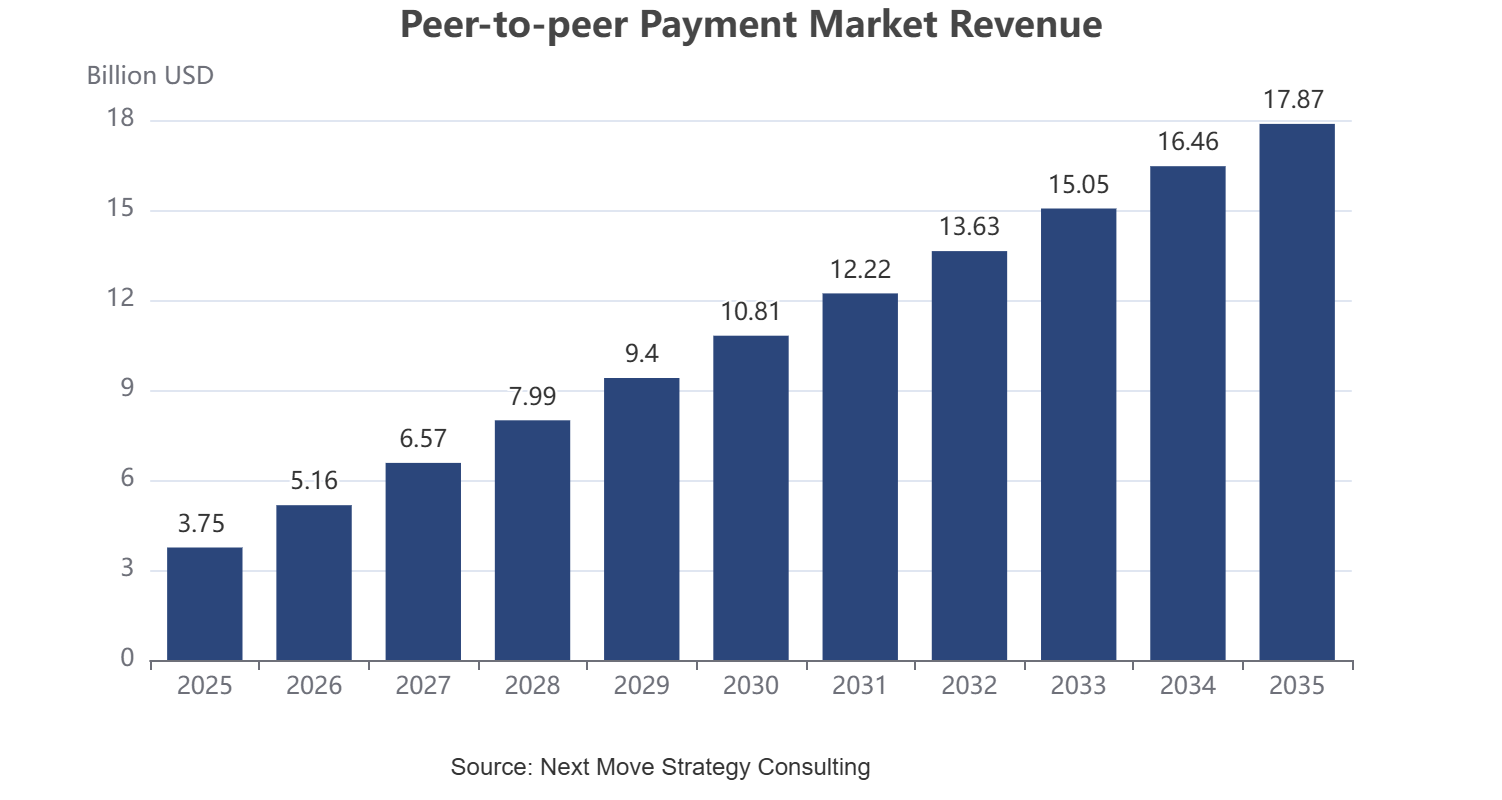
The global Peer-to-Peer Payment Market size was valued at USD 3.75 billion in 2025 and is estimated at USD 4.35 billion in 2026, forecast to reach USD 17.87 billion by 2035, expanding at a 17.0% CAGR between 2026 and 2035. Asia-Pacific leads with approximately 36% share, while domestic account transfers dominate all other operational mechanisms with approximately 38% share.
We observed that growth is broad-based across every segmentation axis, with cross-border wallet interoperability and gig economy instant payout adoption driving the dominant structural shifts through 2035.
|
Key Takeaways |
|
By Operational Mechanism: Domestic Account Transfers held the largest share of approximately 38% (USD 1.43 billion) in 2025; Cross Border P2P Transfers is the fastest-growing sub-segment at 23.3% CAGR from 2026–2035. |
|
By Platform Type: Independent Digital Wallet held the largest share of approximately 34% (USD 1.28 billion) in 2025; Remittance Platform is the fastest-growing sub-segment at 20.8% CAGR from 2026–2035. |
|
By Access Channel: Mobile Banking Application held the largest share of approximately 30% (USD 1.13 billion) in 2025; Embedded API is the fastest-growing sub-segment at 23.8% CAGR from 2026–2035. |
|
By Funding Source: Bank Account held the largest share of approximately 44% (USD 1.65 billion) in 2025; Stored Value Balance is the fastest-growing sub-segment at 20.9% CAGR from 2026–2035. |
|
By Recipient Type: Consumer held the largest share of approximately 58% (USD 2.17 billion) in 2025; Gig Worker is the fastest-growing sub-segment at 22.0% CAGR from 2026–2035. |
|
By Settlement Speed: Instant held the largest share of approximately 52% (USD 1.95 billion) in 2025; Same Day is the fastest-growing sub-segment at 20.3% CAGR from 2026–2035. |
|
By Monetization: Transaction Fee held the largest share of approximately 34% (USD 1.28 billion) in 2025; Instant Transfer Fee is the fastest-growing sub-segment at 20.4% CAGR from 2026–2035. |
|
By End Use: Personal Transfers held the largest share of approximately 46% (USD 1.73 billion) in 2025; Freelance Payments is the fastest-growing sub-segment at 21.5% CAGR from 2026–2035. |
|
Dominant Region: Asia-Pacific dominated with approximately 36% revenue share (USD 1.35 billion) in 2025. |
|
Fastest-Growing Region: Latin America is expected to register the highest CAGR of 18.5% during 2026–2035. |
|
Dominant Country: U.S. led with approximately USD 784 million in 2025. |
|
Fastest-Growing Country: India is the fastest-growing country at approximately 23.8% CAGR from 2026–2035. |
Market Opportunity: The peer-to-peer payment market is expected to create an absolute dollar opportunity of USD 13.52 billion between 2026 and 2035, presenting significant investment potential across the digital wallet interoperability and cross-border remittance value chain.
According to NMSC analysis, wallet operators and remittance platforms are increasingly building interoperability partnerships that let domestic wallets function across borders without separate international payment methods, a shift that favors platforms with broad partner networks over single-market wallets as cross-border commerce and migrant remittance flows intensify through 2035.
What Does the Peer-to-Peer Payment Industry Encompass?
The peer-to-peer payment Industry encompasses domestic account transfers, digital wallet transfers, super app transfers, and cross-border P2P transfers that enable individuals and small businesses to send money directly without traditional banking intermediaries. Our assessment indicates that the scope spans bank-owned platforms, independent digital wallets, super app platforms, and remittance platforms accessed through mobile banking applications, digital wallet applications, super apps, web portals, and embedded APIs across instant, same day, next day, and standard settlement speeds worldwide.
Regulatory frameworks such as India's Unified Payments Interface, the European Union's Payment Services Directive, and national real-time payment schemes shape settlement infrastructure and interoperability requirements across the industry. We observed that technology adoption is shifting toward wallet-to-wallet interoperability that lets users transact internationally using their existing domestic payment credentials. NMSC's analysis indicates that this structural shift, combined with expanding gig economy instant payout demand, is redefining platform partnership strategy across the peer-to-peer payment market.
|
Parameter |
Details |
|
Market Size in 2025 |
USD 3.75 Billion |
|
Market Size in 2026 |
USD 4.35 Billion |
|
Revenue Forecast in 2035 |
USD 17.87 Billion |
|
Growth Rate |
CAGR of 17.0% from 2026 to 2035 |
|
Analysis Period |
2025–2035 |
|
Base Year Considered |
2025 |
|
Forecast Period |
2026–2035 |
|
Market Size Estimation |
Revenue (USD Billion) |
|
Companies Profiled |
20 |
|
Countries Covered |
33 |
|
Market Share |
Available for Top 10 Companies |
Key Emerging Trends
Based on research conducted by NMSC, we found that four structural trends are reshaping product development, platform partnerships, and stakeholder engagement across the industry.
How Is Wallet Interoperability Transforming Cross-Border P2P Transfers?
Wallet interoperability is transforming cross-border P2P transfers as platforms connect previously siloed domestic payment systems into unified global networks. We observed that PayPal Holdings, Inc. unveiled PayPal World in July 2025, a platform connecting PayPal, Venmo, Mercado Pago, India's Unified Payments Interface, and Tenpay Global to enable nearly two billion users to transact across borders using their existing domestic wallets. Consumers are adopting these interoperable networks to shop and send money internationally without acquiring separate international payment methods.
Why Are Shareable Payment Links Gaining Adoption Across Messaging Platforms?
Shareable payment links are gaining adoption as platforms seek to reduce friction in initiating peer-to-peer transfers across messaging and social applications. Our findings suggest that PayPal Holdings, Inc. introduced PayPal Links in September 2025, allowing users to send or receive P2P payments through personalized shareable links regardless of the recipient's platform. Users increasingly favor these link-based mechanisms over traditional account-lookup methods, particularly when transacting with recipients outside their primary payment network.
How Is Super App Expansion Reshaping Regional P2P Competition?
Super app expansion into new geographies is reshaping regional competitive dynamics as established players enter markets historically served by domestic incumbents. We observed that Revolut Ltd. opened a waitlist for its India market launch in October 2025, with an initial consumer-focused rollout built around Unified Payments Interface integration. This trend is elevating competitive intensity as global digital wallet operators pursue expansion into large, underpenetrated domestic P2P markets.
What Role Does Gig Economy Growth Play in Instant Payout Innovation?
Gig economy expansion is emerging as a central driver of instant payout feature development across P2P and business-to-person payment platforms. Our analysis shows that platforms serving freelance and gig worker recipients increasingly prioritize instant transfer capabilities that let workers access earnings immediately after task completion rather than waiting for standard settlement cycles. This direction is exemplified by vendors expanding instant transfer fee monetization models specifically tailored to gig worker and freelance payment use cases.
Growth Drivers and Restraints
Growth Catalyst and Risk Assessment Matrix
|
Factors |
Type |
(+/−) % Impact on CAGR |
Geographic Relevance |
Impact Timeline |
|
Expanding wallet interoperability enabling seamless cross-border transfers |
Driver |
+3.0% |
Global |
2026-2035 |
|
Rising gig economy workforce requiring instant payout capability |
Driver |
+2.4% |
Global |
2026-2035 |
|
Government-backed real-time payment infrastructure expansion |
Driver |
+2.0% |
Asia-Pacific |
2026-2035 |
|
Growing remittance flows to emerging market economies |
Driver |
+1.6% |
Latin America, Middle East & Africa |
2026-2035 |
|
Expanding super app entry into new geographic markets |
Driver |
+1.3% |
Asia-Pacific, Europe |
2026-2035 |
|
Rising small business adoption of P2P payment collection |
Driver |
+1.0% |
Global |
2026-2032 |
|
Fraud and account takeover risk undermining consumer trust |
Restraint |
-1.6% |
Global |
2026-2035 |
|
Regulatory fragmentation complicating cross-border compliance |
Restraint |
-1.1% |
Europe, North America |
2026-2032 |
|
Market saturation in mature domestic P2P segments |
Restraint |
-0.7% |
North America, Europe |
2028-2035 |
What Is the Primary Growth Driver of the Peer-to-Peer Payment Industry?
Expanding wallet interoperability enabling seamless cross-border transfers is the primary driver of the market. India's National Payments Corporation of India continues to expand Unified Payments Interface connectivity through international partnerships, supporting cross-border transaction volume growth. We observed that this interoperability-driven demand, reinforced by PayPal World's July 2025 launch connecting major global wallets, continues to anchor baseline consumption of cross-border P2P transfer capability across developed and emerging payment markets alike.
How Is Gig Economy Growth Driving Peer-to-Peer Payment Industry's Growth?
Rising gig economy workforce participation is accelerating demand for instant payout capability among platforms serving freelance and gig worker recipients. NMSC's analysis indicates that this workforce-driven demand, combined with expanding instant transfer fee monetization models, is compressing adoption timelines for real-time settlement infrastructure across platforms serving delivery, rideshare, and freelance marketplace workers globally.
What Is Restraining Peer-to-Peer Payment Industry's Expansion?
Fraud and account takeover risk restrain consumer trust and adoption speed across the industry, as scam-related losses continue to affect P2P transfer platforms handling instant, largely irreversible transactions. We found that smaller platforms face particular exposure, as limited fraud detection investment reduces their ability to match the security infrastructure maintained by large, well-capitalized incumbents serving mainstream consumer segments.
Segmentation Analysis
Segment Sizing: By Operational Mechanism
|
Segment |
2025 (USD) |
2035 (USD) |
CAGR% (2026–2035) |
|
Domestic Account Transfers |
USD 1.43 Billion |
USD 5.93 Billion |
15.3% |
|
Domestic Wallet Transfers |
USD 1.05 Billion |
USD 4.86 Billion |
16.6% |
|
Super App Transfers |
USD 0.82 Billion |
USD 3.65 Billion |
16.0% |
|
Cross Border P2P Transfers |
USD 0.45 Billion |
USD 3.43 Billion |
23.3% |
|
Total |
USD 3.75 Billion |
USD 17.87 Billion |
17.0% |
Which Operational Mechanism Dominates the Peer-to-Peer Payment Industry?
Domestic Account Transfers led the market with USD 1.43 billion in 2025, supported by their established role as the default P2P mechanism across markets with mature real-time bank transfer infrastructure. We observed that Cross Border P2P Transfers are the fastest-growing operational mechanism, expanding at a 23.3% CAGR from 2026 to 2035, as wallet interoperability platforms and remittance networks scale rapidly to serve growing international transfer demand.
Segment Sizing: By Platform Type
|
Segment |
2025 (USD) |
2035 (USD) |
CAGR% (2026–2035) |
|
Independent Digital Wallet |
USD 1.28 Billion |
USD 5.94 Billion |
16.7% |
|
Super App Platform |
USD 1.13 Billion |
USD 5.38 Billion |
17.1% |
|
Bank-Owned Platform |
USD 0.82 Billion |
USD 3.22 Billion |
14.4% |
|
Remittance Platform |
USD 0.52 Billion |
USD 3.33 Billion |
20.8% |
|
Total |
USD 3.75 Billion |
USD 17.87 Billion |
17.0% |
Which Platform Type Leads Peer-to-Peer Payment Industry Demand?
Independent Digital Wallet remained the leading platform type within the market, valued at USD 1.28 billion in 2025 on the established consumer base and cross-platform reach of standalone wallet providers. Our findings suggest that Remittance Platform is the fastest-growing platform type, registering a 20.8% CAGR from 2026 to 2035, as cross-border money transfer specialists expand digital capabilities to capture growing international P2P transfer demand.
Segment Sizing: By End Use
|
Segment |
2025 (USD) |
2035 (USD) |
CAGR% (2026–2035) |
|
Personal Transfers |
USD 1.73 Billion |
USD 7.68 Billion |
16.1% |
|
Family Support |
USD 0.90 Billion |
USD 4.18 Billion |
16.7% |
|
Shared Expenses |
USD 0.53 Billion |
USD 2.40 Billion |
16.4% |
|
Freelance Payments |
USD 0.37 Billion |
USD 2.53 Billion |
21.5% |
|
Small Business Payments |
USD 0.22 Billion |
USD 1.08 Billion |
17.1% |
|
Total |
USD 3.75 Billion |
USD 17.87 Billion |
17.0% |
Which End Use Is Most Widely Adopting Peer-to-Peer Payment Platforms?
Personal Transfers remained the dominant end use, reaching USD 1.73 billion in 2025 due to the broad, everyday nature of sending money to friends, splitting purchases, and settling informal debts. Based on research conducted by NMSC, we found that Freelance Payments is the fastest-growing end use at a 21.5% CAGR from 2026 to 2035, reflecting expanding gig economy participation and rising demand for instant, platform-based freelance compensation.
Consumer Behavior Analysis of the Peer-to-Peer Payment Market
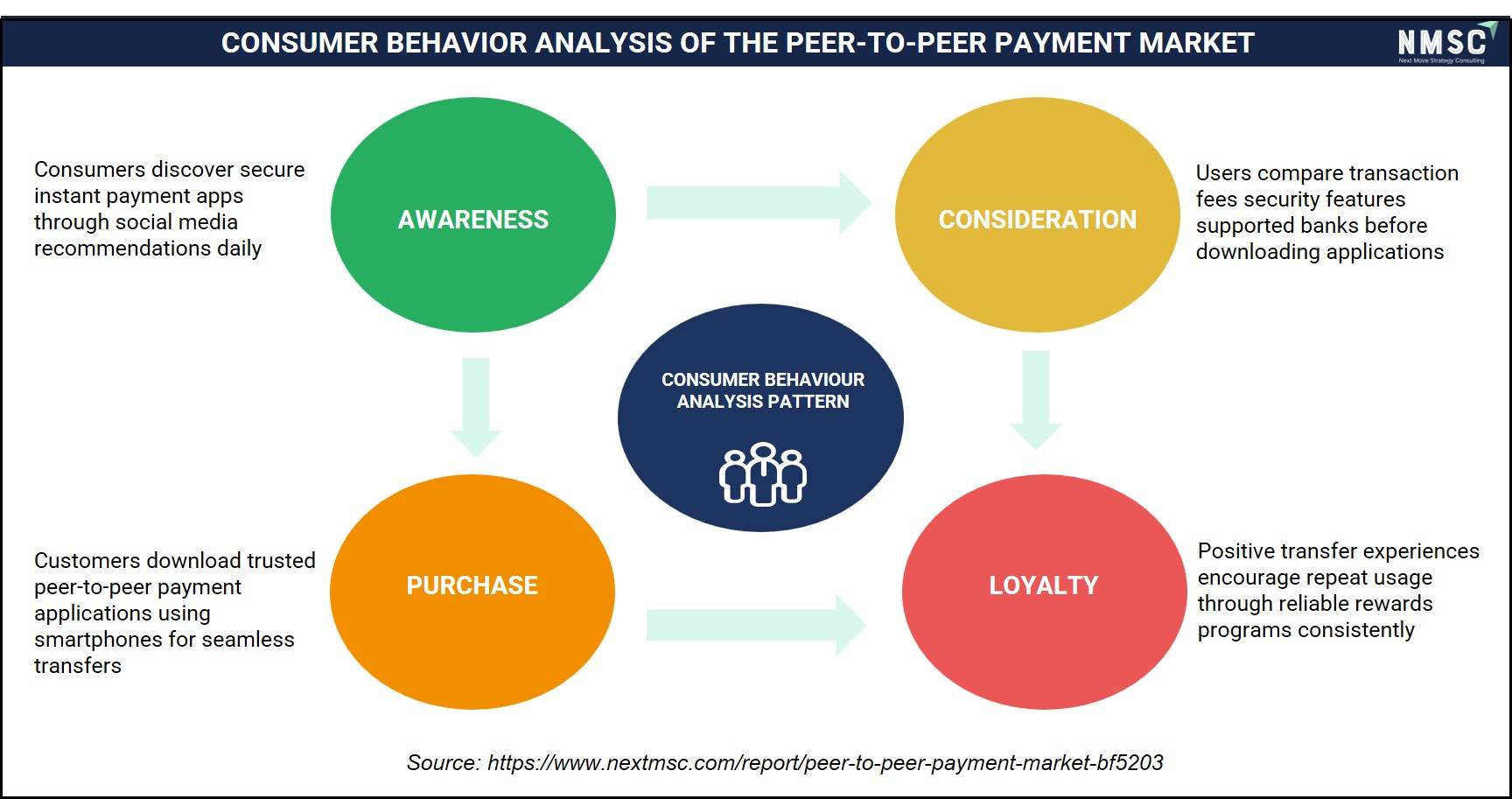
The consumer behavior analysis highlights the decision-making journey in the Peer-to-Peer Payment Market, from awareness to long-term loyalty. Users prioritize security, transaction speed, convenience, and low fees when selecting payment platforms. Positive payment experiences, seamless transfers, and value-added features such as rewards and trusted banking integrations encourage repeat usage and strengthen customer retention across digital payment ecosystems.
Growth Opportunities
Our analysis shows that three forward-looking opportunities stand out for stakeholders positioning within the peer-to-peer payment market over the 2026-2035 forecast period.
How Can Wallet Interoperability Partnerships Unlock Value for Cross-Border Platforms?
Wallet interoperability partnerships present a whitespace opportunity for platforms seeking to expand cross-border reach without building independent international infrastructure. Vendors that secure broad partner networks stand to capture transaction volume as consumers increasingly expect to send money internationally using their existing domestic wallet credentials rather than acquiring separate international payment methods.
Where Do Embedded API Integrations Create New Demand?
E-commerce and gig economy platforms seeking native payment capabilities represent an underpenetrated opportunity for embedded P2P payment APIs. Vendors that develop simple, well-documented embedded integration options can secure new platform partnerships, benefiting from transaction-based revenue as marketplaces and gig platforms increasingly embed P2P disbursement directly into their core applications.
How Can Instant Payout Services Benefit Gig Worker Platforms?
Gig worker platforms facing competitive pressure to offer immediate earnings access create an opportunity for suppliers offering reliable instant payout infrastructure. Early movers that validate low-latency, high-volume instant transfer capability can differentiate with delivery, rideshare, and freelance marketplace platforms pursuing worker retention through faster, more flexible payment access.
Regional Outlook
Geographic Performance Snapshot
|
Region |
2025 (USD) |
2035 (USD) |
CAGR% (2026–2035) |
Key Driver |
|
Asia-Pacific |
USD 1.35 Billion |
USD 6.91 Billion |
17.9% |
Government-backed real-time payment infrastructure and super app adoption |
|
North America |
USD 0.98 Billion |
USD 4.13 Billion |
15.5% |
Established digital wallet penetration and gig economy payout demand |
|
Europe |
USD 0.67 Billion |
USD 2.94 Billion |
15.9% |
PSD2 open banking framework and cross-border wallet expansion |
|
Latin America |
USD 0.45 Billion |
USD 2.40 Billion |
18.5% |
Expanding remittance flows and super app payment adoption |
|
Middle East & Africa |
USD 0.30 Billion |
USD 1.49 Billion |
17.5% |
Financial inclusion initiatives and mobile money expansion |
|
Total |
USD 3.75 Billion |
USD 17.87 Billion |
17.0% |
— |
Asia-Pacific Peer-to-Peer Payment Market Outlook
Asia-Pacific leads the peer-to-peer payment market with government-backed real-time payment infrastructure and dense super app adoption across China and India. We observed that India's Unified Payments Interface continues to anchor regional transaction volume growth, reinforced by PayPal World's July 2025 interoperability partnership. Technology adoption remains advanced, with super app platforms driving demand across the region's large mobile-first consumer base.
North America Peer-to-Peer Payment Market Outlook
North America's peer-to-peer payment market reflects a mature but innovation-intensive landscape shaped by established digital wallet penetration and growing gig economy payout demand. Our findings suggest that platforms across the U.S. and Canada are accelerating instant transfer feature development to serve freelance and gig worker recipients. Technology adoption favors mobile banking application access among the region's large banked consumer base.
Europe Peer-to-Peer Payment Market Outlook
Europe's peer-to-peer payment market is supported by the EU's Payment Services Directive open banking framework and expanding cross-border wallet partnerships. We found that regulatory frameworks favor standardized, interoperable payment infrastructure, giving vendors a foundation for pan-European expansion. Technology adoption is accelerating as regional wallet operators, including several UK-based platforms, pursue international market entry.
Latin America Peer-to-Peer Payment Market Outlook
Latin America is the fastest-growing peer-to-peer payment market region, propelled by expanding remittance flows and super app payment adoption in Brazil and Argentina. We observed that regulatory frameworks are less harmonized than in North America or Europe, giving vendors flexibility to scale wallet-based offerings rapidly. Technology adoption is accelerating as regional platforms, including several Brazil-based operators, expand digital wallet transfer capability.
Middle East & Africa Peer-to-Peer Payment Market Outlook
The peer-to-peer payment market in Middle East & Africa is expanding as financial inclusion initiatives and mobile money expansion accelerate across Gulf Cooperation Council and Sub-Saharan African economies. Our analysis shows that Saudi Arabia and the UAE are attracting digital wallet investment linked to flagship financial inclusion programs. Regulatory influence remains developing, while technology adoption is gradually shifting toward mobile-first wallet platforms.
U.S. Peer-to-Peer Payment Market
Based on our estimates, the U.S. market was valued at approximately USD 784 million in 2025 and is projected to reach USD 3.13 billion by 2035, growing at a 14.8% CAGR. Demand is anchored by established digital wallet penetration and expanding gig economy instant payout requirements. Technology penetration favors mobile banking and digital wallet applications, and competitive intensity remains high among established platforms serving mainstream consumer and gig worker segments.
Canada Peer-to-Peer Payment Market
The market in Canada reached roughly USD 137 million in 2025 and is forecast to hit USD 592 million by 2035 at a 15.8% CAGR. Demand structure mirrors U.S. digital wallet adoption patterns, while federal open banking guidance shapes interoperability expectations. Technology penetration is rising as national consumers request instant transfer capability, with competitive intensity moderate given reliance on cross-border platform partnerships.
UK Peer-to-Peer Payment Market
As per our estimate, the UK market stood at about USD 121 million in 2025, advancing toward USD 526 million by 2035 at a 15.8% CAGR. Demand is driven by digital wallet operators navigating the UK's open banking regulatory framework. Regulatory influence is significant, technology penetration favors mobile wallet applications, and competitive intensity remains steady among domestic and international platforms.
Germany Peer-to-Peer Payment Market
According to our analysis, Germany's market was valued near USD 161 million in 2025 and is set to reach USD 740 million by 2035, expanding at a 16.5% CAGR. Demand structure benefits from a strong domestic banking infrastructure pursuing digital transfer modernization. Germany's PSD2 compliance guidance drives regulatory influence, while technology penetration favors bank-owned platforms among leading financial institutions.
France Peer-to-Peer Payment Market
Based on our estimates, France's market reached approximately USD 94 million in 2025, projected to climb to USD 415 million by 2035 at a 16.0% CAGR. Demand is supported by France's growing digital wallet adoption and rising cross-border transfer demand. Regulatory influence from French financial services legislation is notable, and competitive intensity remains high given the concentration of digital wallet operators serving the domestic market.
China Peer-to-Peer Payment Market
The market in China stood at roughly USD 459 million in 2025 and is forecast to reach USD 2.23 billion by 2035, registering a 17.2% CAGR. Demand is fueled by dense super app penetration and established QR code-based transfer infrastructure. Regulatory influence is increasing gradually, technology penetration is near saturation among urban consumers, and competitive intensity remains elevated among domestic super app operators.
India Peer-to-Peer Payment Market
As per our estimate, India's market was valued at about USD 270 million in 2025, projected to reach USD 2.14 billion by 2035 at a 23.8% CAGR, the fastest among covered countries. Demand structure reflects rapidly expanding Unified Payments Interface adoption and growing digital financial inclusion. Regulatory influence remains developing, while technology penetration is rising quickly as domestic and multinational platforms localize P2P payment offerings.
Japan Peer-to-Peer Payment Market
According to our analysis, Japan's market reached close to USD 135 million in 2025 and is expected to hit USD 574 million by 2035, growing at a 15.5% CAGR. Demand is supported by Japan's established digital banking sector and gradually increasing cashless payment preference. Regulatory influence is well established, technology penetration is advanced, and competitive intensity remains high among long-standing domestic and international platforms.
South Korea Peer-to-Peer Payment Market
Based on our estimates, South Korea's market stood at approximately USD 122 million in 2025, forecast to reach USD 617 million by 2035 at a 17.8% CAGR. Demand structure benefits from the country's advanced mobile payment infrastructure and dominant domestic super app operators. Technology penetration is high, with domestic operators adopting instant transfer capability, and competitive intensity remains pronounced amid rapid innovation cycles.
Australia Peer-to-Peer Payment Market
The peer-to-peer payment market in Australia reached about USD 68 million in 2025 and is projected to reach USD 310 million by 2035, expanding at a 16.5% CAGR. Demand is supported by a well-established digital banking sector and growing consumer preference for instant transfers. Regulatory influence stems from national payment system reform guidance, while technology penetration favors mobile banking applications amid moderate competitive intensity.
UAE Peer-to-Peer Payment Market
As per our estimate, the UAE market was valued near USD 66 million in 2025, projected to reach USD 321 million by 2035 at a 17.2% CAGR. Demand structure is shaped by the UAE's role as a regional remittance and financial services hub. Regulatory influence remains moderate, technology penetration is improving through flagship digital wallet initiatives, and competitive intensity is rising as platforms expand Gulf portfolios.
Saudi Arabia Peer-to-Peer Payment Market
According to our analysis, Saudi Arabia's market reached roughly USD 72 million in 2025 and is expected to hit USD 367 million by 2035, growing at a 17.8% CAGR. Demand is driven by Vision 2030-linked financial inclusion programs and rising digital wallet adoption. Regulatory influence is developing under national payment system guidelines, and technology penetration is advancing as domestic digital wallet operators scale adoption.
South Africa Peer-to-Peer Payment Market
Based on our estimates, South Africa's market stood at about USD 36 million in 2025, forecast to reach USD 157 million by 2035 at a 15.8% CAGR. Demand structure reflects a developing mobile money sector serving regional Southern African markets. Regulatory influence remains moderate, technology penetration is gradually improving, and competitive intensity is limited given reliance on regional mobile money operators.
Brazil Peer-to-Peer Payment Market
The market in Brazil reached approximately USD 234 million in 2025 and is projected to reach USD 1.31 billion by 2035, registering a 19.2% CAGR. Demand is underpinned by Brazil's expanding super app and instant payment infrastructure serving a large unbanked and underbanked population. Regulatory influence stems from national instant payment system policy, technology penetration favors mobile wallet applications, and competitive intensity remains moderate among regional platforms.
Argentina Peer-to-Peer Payment Market
As per our estimate, Argentina's market was valued near USD 63 million in 2025, projected to reach USD 304 million by 2035 at a 17.2% CAGR. Demand structure is supported by steady digital wallet adoption despite macroeconomic volatility. Regulatory influence remains limited, technology penetration is modest, and competitive intensity is centered on a small number of regional platforms serving domestic consumers.
Competitive Landscape
We observed that the peer-to-peer payment market features a moderately consolidated competitive landscape, with large global wallet operators and regional super app platforms competing on network reach, interoperability partnerships, and settlement speed.
Key Takeaways
|
Dimension |
Description |
|
Market Structure |
Moderately consolidated; large global digital wallet operators compete alongside dominant regional super app platforms and specialized cross-border remittance providers, each anchored in distinct geographic strongholds. |
|
Innovation Focus |
Wallet interoperability, shareable payment links, and instant payout infrastructure for gig workers dominate current innovation pipelines across leading suppliers. |
|
M&A Activity |
Active partnership expansion exemplified by PayPal Holdings, Inc.'s PayPal World platform connecting Venmo, Mercado Pago, UPI, and Tenpay Global, reflecting industry-wide movement toward wallet network interoperability. |
How Do Companies Compete in the Peer-to-Peer Payment Market?
Companies compete primarily on network reach, interoperability partnerships, and settlement speed across the industry. Global wallet operators such as PayPal Holdings, Inc. and Block, Inc. leverage broad consumer networks to serve cross-platform P2P demand, while regional super app operators such as Ant Group Co., Ltd. and Tencent Holdings Limited compete on deep integration with lifestyle and commerce services supplied directly to domestic consumers.
Which Competitive Archetypes Dominate the Peer-to-Peer Payment Market?
Two archetypes dominate the market: global digital wallet operators offering broad, multi-market P2P capability, and regional super app platforms embedding payments within dominant local lifestyle ecosystems. PayPal Holdings, Inc. and Block, Inc. exemplify the global wallet archetype, while Ant Group Co., Ltd. and Grab Holdings Limited exemplify the super app archetype through deep integration with commerce, ride-hailing, and food delivery services.
How Are Companies Differentiating Through Innovation in Peer-to-Peer Payments?
Innovation and differentiation strategy increasingly center on interoperability and frictionless transfer initiation. PayPal World's cross-wallet connectivity and PayPal Links' shareable payment mechanism both apply focused engineering to reduce barriers between previously siloed payment networks. Our analysis shows that platforms unable to demonstrate credible cross-border and cross-platform interoperability risk losing relevance as consumers increasingly expect seamless transfers regardless of recipient platform.
What M&A and Expansion Activity Is Shaping the Peer-to-Peer Payment Market?
Strategic partnerships and geographic expansion continue to shape competitive dynamics within the industry. PayPal Holdings, Inc.'s July 2025 launch of PayPal World, connecting major global wallets including Tenpay Global and India's Unified Payments Interface, illustrates the industry's shift toward network interoperability, while Revolut Ltd.'s October 2025 India market entry demonstrates how global digital wallet operators continue pursuing expansion into large, underpenetrated domestic markets.
Porter' Five Forces Analysis of the Peer-to-Peer Payment Market
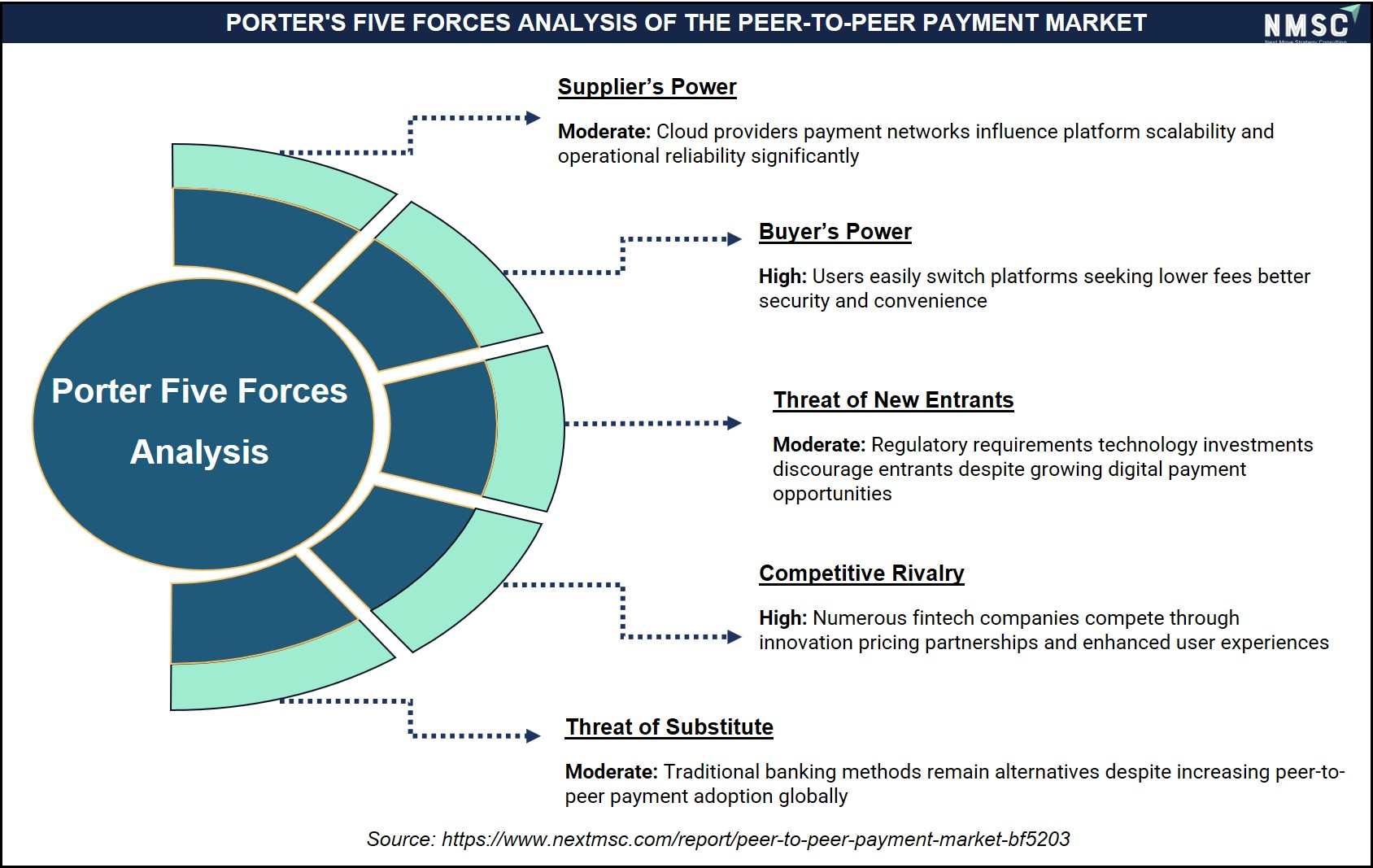
The Porter's Five Forces analysis indicates a highly competitive Peer-to-Peer Payment Market driven by fintech innovation, evolving consumer expectations, and rapid digital payment adoption. While regulatory requirements and infrastructure investments create moderate entry barriers, strong buyer bargaining power and competition compel providers to differentiate through security, instant settlement, user experience, and value-added financial services.
Key Market Players
Our assessment indicates that the following 20 companies are actively shaping platform interoperability, geographic expansion, and product innovation strategy within the global peer-to-peer payment market.
-
PayPal Holdings, Inc.
-
Ant Group Co., Ltd.
-
Block, Inc.
-
Early Warning Services, LLC
-
Western Union Company
-
Revolut Ltd.
-
Remitly Global, Inc.
-
MercadoLibre, Inc.
-
One97 Communications Limited
-
PhonePe Private Limited
-
G-Xchange, Inc.
-
Grab Holdings Limited
-
PT GoTo Gojek Tokopedia Tbk
-
Sea Limited
-
Kaspi.kz Joint Stock Company
-
Kakao Corp.
-
Naver Corporation
-
Zepz Ltd.
Latest Developments
We found that recent platform launches and partnership announcements within the peer-to-peer payment market are concentrated on wallet interoperability and cross-border transfer expansion.
|
Date |
Event |
|
April 2026 |
PayPal was named the official peer-to-peer payments partner of the NFL, with the deal positioning PayPal as the official way for fans to send, split, pool, and settle money in the PayPal app. |
|
Feb 2026 |
PhonePe rolled out biometric authentication for UPI payments, and said the feature would apply to everyday use cases including peer-to-peer money transfers. |
Investment Opportunities
What Capital Inflows Are Targeting the Peer-to-Peer Payment Market?
Capital inflows into the peer-to-peer payment market are increasingly directed toward interoperability infrastructure and geographic expansion. Established platforms continue to fund partnership development, as seen in PayPal Holdings, Inc.'s multi-wallet PayPal World network and Revolut Ltd.'s India market entry. We observed that investors favor platforms demonstrating broad partner networks, viewing interoperability reach as a proxy for long-term transaction volume growth.
How Is Infrastructure Investment Supporting Peer-to-Peer Payment Deployment?
Infrastructure investment is expanding real-time settlement and fraud detection capacity across platforms to support rising transaction volumes. Our findings suggest that vendors are investing in interoperability middleware and API infrastructure to improve cross-platform connectivity, supporting the seamless experience increasingly demanded by consumers transacting across multiple wallet ecosystems.
What ESG Considerations Are Shaping Peer-to-Peer Payment Investment Decisions?
Environmental, social, and governance considerations are increasingly relevant to investment decisions across the industry, with financial inclusion and fraud prevention as key criteria. Government financial inclusion initiatives continue to inform platform expansion strategy in underbanked regions. We found that investors increasingly favor platforms extending services to unbanked recipients and gig workers, treating financial inclusion reach as a governance indicator alongside consumer fraud protection standards.
Key Benefits for Stakeholders
How Does This Report Benefit Enterprise and Industry Leaders?
Enterprise and industry leaders gain access to validated segmentation, competitive benchmarking, and regional demand forecasts that support product-portfolio decisions across the peer-to-peer payment industry. Our analysis shows that detailed operational mechanism, platform type, and recipient type breakdowns help product and partnership teams align feature roadmaps with regulatory and interoperability requirements while identifying underserved recipient segments for portfolio expansion.
How Does This Report Benefit Investors and Financial Analysts?
Investors and financial analysts benefit from consistent, single-point market size and CAGR estimates that support valuation and capital-allocation decisions across the peer-to-peer payment market supply chain. We observed that the report's regional and segment-level growth differentials help identify which platforms and technology categories are best positioned to capture above-market growth in Cross Border P2P Transfers and Latin America categories through 2035.
How Does This Report Benefit Technology Vendors and Product Teams?
Technology vendors and product teams gain insight into emerging design requirements, including wallet interoperability, embedded API integration, and instant payout infrastructure, that are reshaping the industry. Our findings suggest that this analysis helps research and development teams prioritize roadmaps around cross-platform connectivity and gig worker payment needs increasingly required by partnership and platform integration processes.
Key Market Segments
By Operational Mechanism
-
Domestic Account Transfers
-
Real-Time Transfers
-
Deferred Transfers
-
-
Domestic Wallet Transfers
-
Closed Loop
-
Open Loop
-
-
Super App Transfers
-
Social Platform
-
Lifestyle Platform
-
-
Cross Border P2P Transfers
-
Account-to-Account
-
Account to Wallet
-
Wallet to Account
-
Wallet to Wallet
-
Cash Pickup
-
By Platform Type
-
Bank-Owned Platform
-
Independent Digital Wallet
-
Super App Platform
-
Remittance Platform
By Access Channel
-
Mobile Banking Application
-
Digital Wallet Application
-
Super App
-
Web Portal
-
Embedded API
By Funding Source
-
Bank Account
-
Debit Card
-
Credit Card
-
Stored Value Balance
-
Cash
By Recipient Type
-
Consumer
-
Sole Proprietor
-
Gig Worker
-
Small Business
-
Unbanked Recipient
By Settlement Speed
-
Instant
-
Same Day
-
Next Day
-
Standard
Monetization
-
Transaction Fee
-
Instant Transfer Fee
-
Foreign Exchange Spread
-
Subscription Fee
-
Value Added Service Fee
By End Use
-
Personal Transfers
-
Family Support
-
Shared Expenses
-
Freelance Payments
-
Small Business Payments
By Region
-
North America: U.S., Canada, Mexico
-
Europe: UK, Germany, France, Italy, Spain, Sweden, Denmark, Finland, Netherlands, Rest of Europe
-
Asia-Pacific: China, India, Japan, South Korea, Taiwan, Indonesia, Vietnam,, Australia, Philippines, Malaysia, Rest of APAC
-
Middle East & Africa: Saudi Arabia, UAE, Egypt, Israel, Turkey, Nigeria, South Africa, Rest of MEA
-
Latin America: Brazil, Argentina, Chile, Colombia, Rest of LATAM
Conclusion and Recommendations
What Is the Long-Term Outlook for the Peer-to-Peer Payment Market?
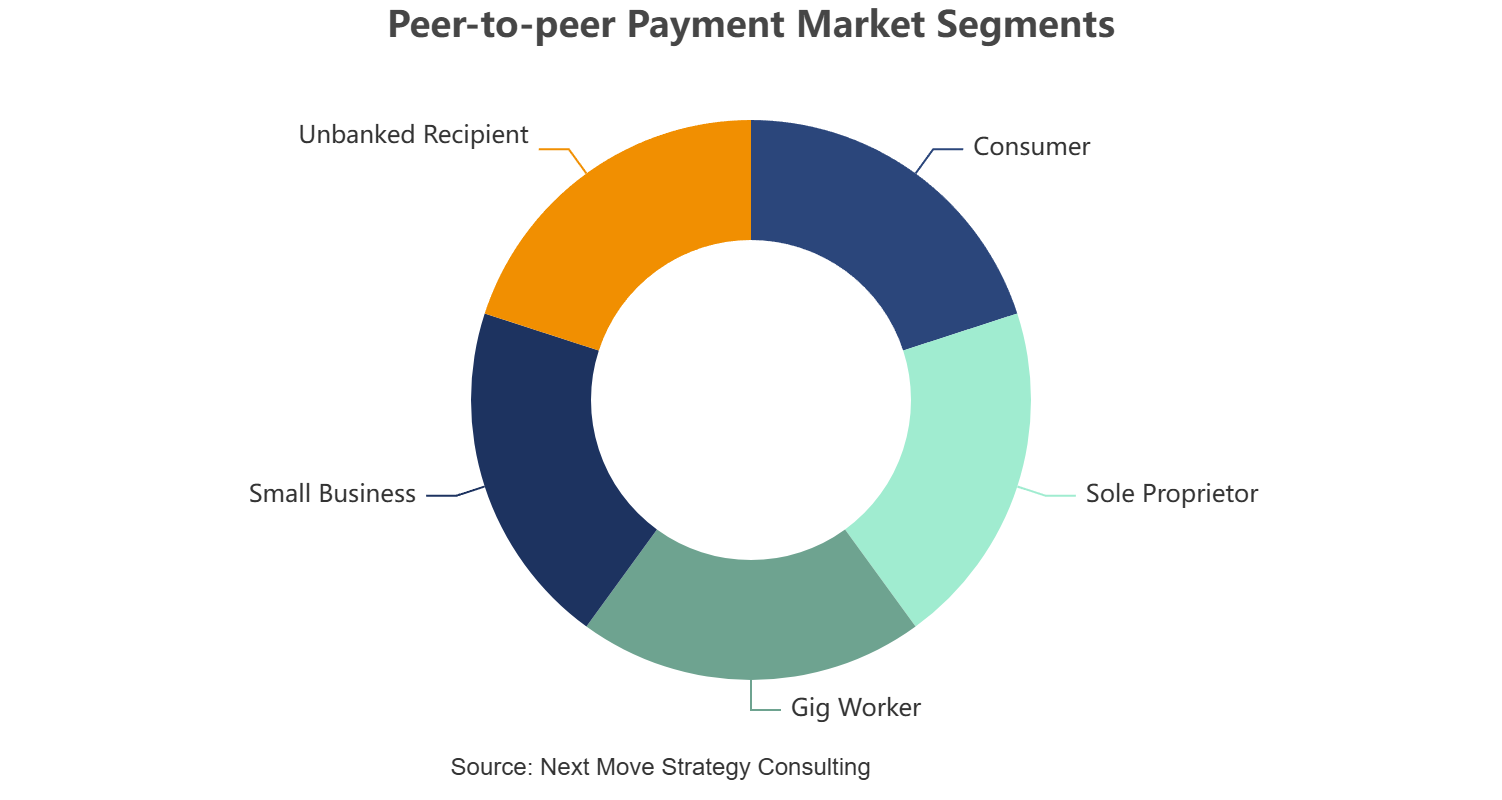
The long-term outlook for the market remains strongly positive, with global revenue projected to expand more than fourfold from USD 3.75 billion in 2025 to USD 17.87 billion by 2035 at a 17.0% CAGR. We observed that sustained wallet interoperability expansion, gig economy instant payout demand, and growing cross-border remittance flows will continue underpinning demand across consumer, gig worker, and small business recipient segments through the forecast period.
What Strategic Positioning Should Peer-to-Peer Payment Platforms Pursue?
Platforms should prioritize wallet interoperability partnerships and instant settlement capability while pursuing embedded API integration to secure long-term platform relationships. NMSC's assessment indicates that companies investing early in cross-border network expansion and gig worker payout infrastructure will be best positioned to capture premium positioning within the peer-to-peer payment market.
How Attractive Is the Peer-to-Peer Payment Market for New Investment?
The peer-to-peer payment industry presents a highly attractive investment case, supported by a USD 13.52 billion absolute dollar opportunity between 2026 and 2035 and above-average growth in Latin America and Cross Border P2P Transfers categories. We found that investment attractiveness is highest for platforms combining broad interoperability networks with strong domestic market positions, positioning them to serve both mainstream consumer and specialized cross-border transfer segments simultaneously.
What Market Shifts and Key Risks Should Stakeholders Monitor?
Stakeholders should monitor fraud and account takeover risk, regulatory fragmentation across cross-border markets, and market saturation in mature domestic segments as key risks to the peer-to-peer payment market. Our analysis shows that platforms unable to demonstrate credible fraud protection risk losing consumer trust to competitors with proven security infrastructure, particularly as instant, largely irreversible transactions remain a primary fraud vector.
What Are the Key Growth Pathways for the Peer-to-Peer Payment Market?
Key growth pathways include expanding wallet interoperability networks, scaling instant payout infrastructure for gig workers, and deepening penetration into Latin American and cross-border remittance segments. NMSC's analysis indicates that platforms pursuing these pathways while maintaining fraud protection discipline will be best positioned to capture the peer-to-peer payment market's projected growth through 2035.
About the Author
 Mihul Sharma
— Mihul Sharma is Research Associate at Next Move Strategy Consulting, where he has covered technology, industrial, and healthcare markets for 3 years. His work applies structured business research, market analysis, and secondary-source review to assess market trends, competitive developments, and growth opportunities. He supports report development by fully synthesizing industry data, company information, and market signals into concise findings for strategy and investment-focused research teams.
Mihul Sharma
— Mihul Sharma is Research Associate at Next Move Strategy Consulting, where he has covered technology, industrial, and healthcare markets for 3 years. His work applies structured business research, market analysis, and secondary-source review to assess market trends, competitive developments, and growth opportunities. He supports report development by fully synthesizing industry data, company information, and market signals into concise findings for strategy and investment-focused research teams.
About the Reviewer
 Supradip Baul
— Supradip Baul is an accomplished business consultant and strategist with over a decade of rich experience in market intelligence, strategy, technology, and business transformation. His work has included rigorous qualitative and quantitative analysis across multiple industries, helping clients shape investment decisions and long-term roadmaps. Earlier in his career, he was associated with Gartner, where he contributed to industry-leading reports and market share analyses. He has worked with leading global companies and holds an MBA with a dual specialization in Marketing and Finance.
Supradip Baul
— Supradip Baul is an accomplished business consultant and strategist with over a decade of rich experience in market intelligence, strategy, technology, and business transformation. His work has included rigorous qualitative and quantitative analysis across multiple industries, helping clients shape investment decisions and long-term roadmaps. Earlier in his career, he was associated with Gartner, where he contributed to industry-leading reports and market share analyses. He has worked with leading global companies and holds an MBA with a dual specialization in Marketing and Finance.
At Next Move Strategy Consulting, we understand that insightful market research is the cornerstone of successful business decisions. That's why we employ a robust and multifaceted approach, combining various methodologies to deliver the most accurate and actionable data for our clients.

Research Landscape
We navigate the world of research with two primary approaches:
Qualitative Approach
Our qualitative research methodologies involve immersive techniques such as in-depth interviews, focus groups, and observational studies. By engaging directly with individuals and stakeholders, we uncover valuable insights that quantitative data alone may overlook.

Quantitative Research
In tandem with qualitative methodologies, NMSC leverages the power of Quantitative Research to provide a robust foundation of numerical insights. Through systematic data collection and analysis, we quantify patterns, preferences, and market trends, offering a comprehensive view of the business landscape.
Our quantitative research approach employs diverse tools, including surveys, experiments, and statistical modelling. These methodologies enable us to gather data from a large and representative sample, ensuring the statistical significance of our findings. By employing structured questionnaires and standardized data collection methods, we guarantee the reliability and validity of the information we present to our clients.
Quantitative research is particularly effective in measuring the prevalence of trends, assessing market size, and gauging the impact of various factors on consumer behavior. The numerical precision attained through this approach equips our clients with actionable insights, facilitating data-driven decision-making and strategy formulation.


Our Specialized Toolbox for Industry-Specific Market Research
We deploy a specialized arsenal of techniques tailored to meet your unique requirements. Here's a glimpse into our comprehensive toolbox:

Information Procurement
The stage entails acquiring market data or relevant information through various sources and methodologies.


Market Research Approach
We utilize both top-down and bottom-up approaches in market research analysis to achieve a comprehensive understanding of the market dynamics, leveraging the broad perspective of industry trends and macroeconomic factors alongside detailed insights from specific segments and individual companies.

Porters Five Forces Analysis
We conduct Porter's Five Forces analysis to evaluate the competitive landscape of an industry, providing us with insights into factors that affect profitability and strategic positioning.

SWOT Analysis

Forecasting
We utilize a forecasting model to predict future consumption by considering parameters like population, economics, regulations, market competition, drivers, constraints, technology, and pricing. We also employ statistical techniques such as multilinear regression, exponential smoothing, moving average, ARIMA, and Monte Carlo simulations for accurate predictions. In econometric forecasting, we analyzed short-term and long-term event impacts, attributing values based on regulatory frameworks, economic factors, and market events.





 Speak to Our Analyst