
EdTech and Online Learning Market Size, Share, Trends and Growth Analysis, By Component (Content, Platforms and Software, and Services), By End User (K-12 Education, Higher Education, Corporate and Enterprise Learning, and Individual and Consumer Learners), By Deployment Mode (Cloud Based, and On Premise), and Region — Global Industry Report and Forecast, 2026–2035
Industry: ICT & Media | Publishing Date: August 1, 2026 | Last Updated: August 1, 2026 | No of Pages: N/A | No. of Tables: N/A | No. of Figures: N/A | Format: PDF | Report Code: IC5520
What Is the EdTech and Online Learning Market Size?
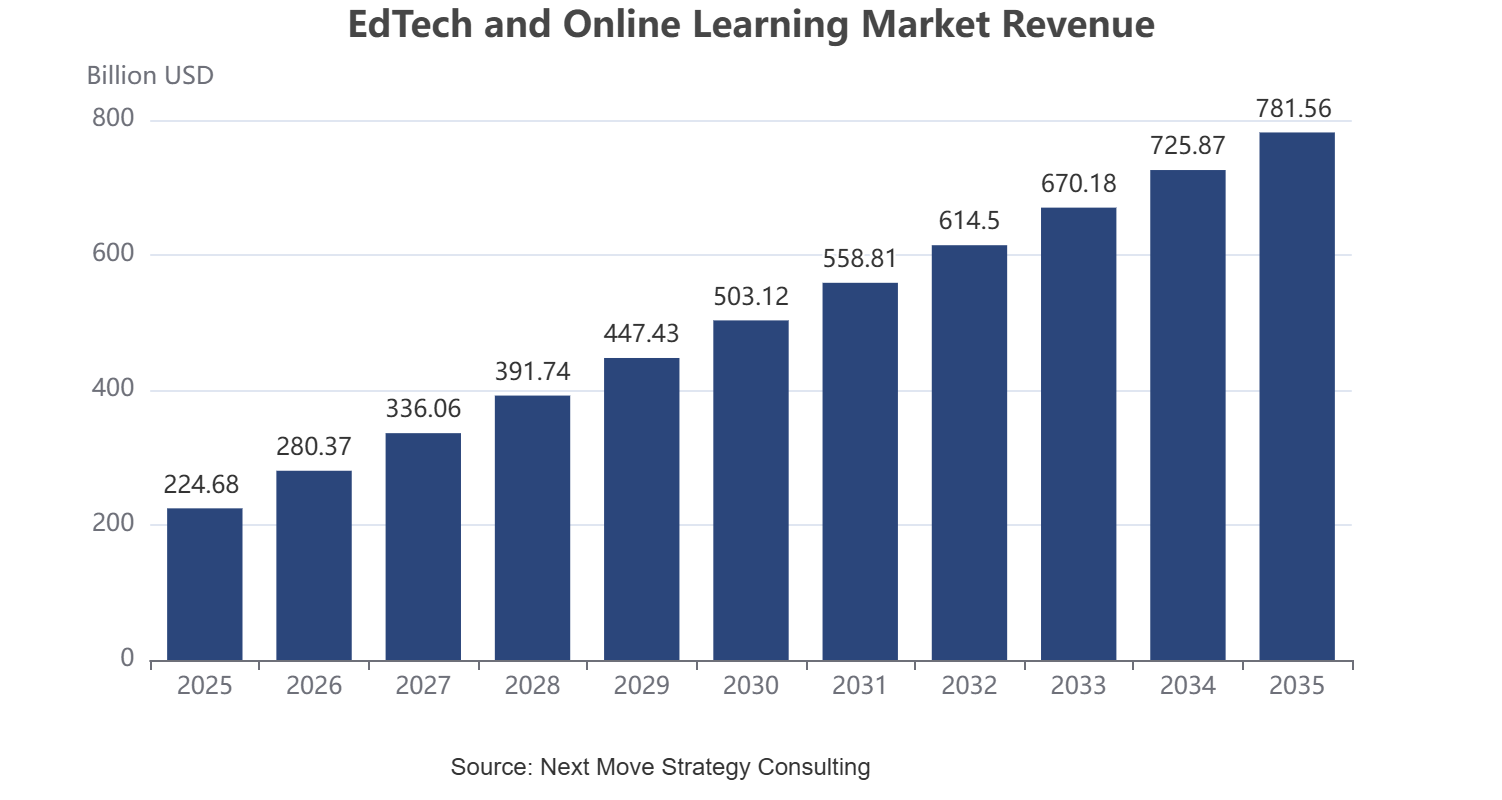
The global EdTech and Online Learning Market size was valued at USD 224.68 billion in 2025 and is estimated at USD 252.94 billion in 2026, forecast to reach USD 781.56 billion by 2035, expanding at a 13.35% CAGR between 2026 and 2035. Asia-Pacific leads with approximately 33% share, while platforms and software dominate all other components with approximately 45% share.
We observed that the growth is broad-based across every segmentation axis, with corporate upskilling programs and AI-enabled adaptive learning platforms driving the dominant structural shifts through 2035.
|
Key Takeaways |
|
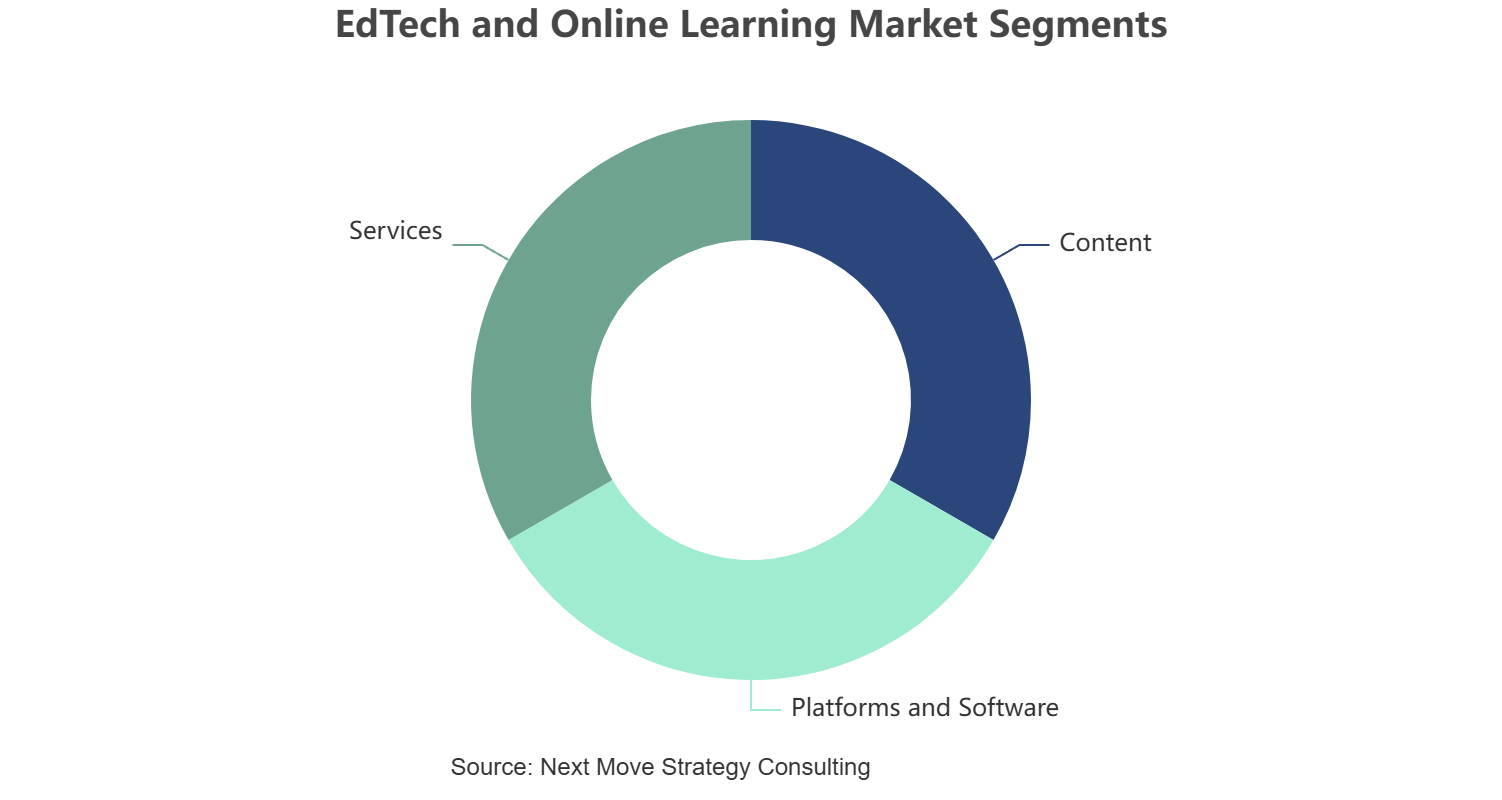
By Component: Platforms and Software held the largest share of approximately 45% (USD 101.11 Billion) in 2025; Platforms and Software is the fastest-growing sub-segment at 14.4% CAGR from 2026–2035. |
|
By End User: Corporate and Enterprise Learning held the largest share of approximately 30% (USD 67.40 Billion) in 2025; Corporate and Enterprise Learning is the fastest-growing sub-segment at 14.9% CAGR from 2026–2035. |
|
By Deployment Mode: Cloud Based held the largest share of approximately 82% (USD 184.24 Billion) in 2025; Cloud Based is the fastest-growing sub-segment at 14.5% CAGR from 2026–2035. |
|
Dominant Region: Asia-Pacific dominated with approximately 33% revenue share (USD 74.14 Billion) in 2025. |
|
Fastest-Growing Region: Asia-Pacific is expected to register the highest CAGR of 15.1% during 2026–2035. |
|
Dominant Country: U.S. led with approximately USD 59.0 billion in 2025. |
|
Fastest-Growing Country: India is the fastest-growing country at approximately 17.1% CAGR from 2026–2035. |
Market Opportunity: The EdTech and online learning market is expected to create an absolute dollar opportunity of USD 528.62 billion between 2026 and 2035, presenting significant investment potential across the corporate training, higher education, and K-12 digital learning value chain.
According to Next Move Strategy Consulting analysis, institutions and enterprises are increasingly consolidating learning-technology spend with fewer, interoperable platform vendors to simplify data governance and reduce integration overhead, a shift that favors diversified platform providers over single-product specialists as procurement scrutiny intensifies through 2035.
|
Parameter |
Details |
|
Market Size in 2025 |
USD 224.68 Billion |
|
Market Size in 2026 |
USD 252.94 Billion |
|
Revenue Forecast in 2035 |
USD 781.56 Billion |
|
Growth Rate |
CAGR of 13.35% from 2026 to 2035 |
|
Analysis Period |
2025–2035 |
|
Base Year Considered |
2025 |
|
Forecast Period |
2026–2035 |
|
Market Size Estimation |
Revenue (USD Billion) |
|
Companies Profiled |
20 |
|
Countries Covered |
38 |
|
Market Share |
Available for Top 10 Companies |
EdTech and Online Learning Market Overview
The EdTech and online learning market report covers digital content, learning management platforms, and delivery services that enable instruction outside traditional classroom-only settings, spanning K-12, higher education, corporate training, and individual consumer learning. Our assessment indicates that the market has evolved from static video-based courseware into adaptive, AI-enabled platforms that personalize content sequencing, assessment, and credentialing pathways for learners across school, university, and workplace environments.
Regulatory frameworks such as the U.S. Family Educational Rights and Privacy Act and the European Union's General Data Protection Regulation shape student-data handling and platform accreditation requirements, while national digital-education missions in India and China increasingly influence public procurement of online learning platforms. We observed that technology adoption is shifting toward AI-driven adaptive learning engines and skills-based micro-credentialing, and Based on research conducted by Next Move Strategy Consulting, we found that this structural shift, combined with employer demand for verifiable digital credentials, is redefining sourcing criteria across the market report on this market.
Key Emerging Trends
Based on research conducted by Next Move Strategy Consulting, we found that four structural trends are reshaping product development, sourcing, and stakeholder engagement across the industry.
How Is Artificial Intelligence Transforming Adaptive Learning Platforms?
Artificial intelligence engines that sequence content, generate practice questions, and flag learning gaps in real time are replacing static, one-size-fits-all course structures. We observed that Coursera, Inc.'s Coursera Coach generative-AI tutor, expanded in 2025, personalizes explanations and feedback across thousands of courses. Universities and corporate learning teams are adopting these engines to raise completion rates, while content publishers retool authoring workflows to support adaptive, AI-sequenced modules across STEM and professional-skills catalogs.
Why Are Skills-Based Micro-Credentials Gaining Employer Recognition?
Micro-credentials and stackable certificates are gaining traction as employers shift hiring criteria toward verifiable, skills-specific proof points rather than degree pedigree alone. Our findings suggest that enterprise learning and development teams increasingly map internal training to external micro-credential frameworks to standardize skills verification. Platform providers are expanding employer-recognized certificate catalogs, positioning stackable credentials as a premium, higher-retention category within the broader market segmentation structure.
How Is Mobile-First Design Reshaping Online Learning Access?
Mobile-first course design is expanding access to learners in bandwidth-constrained and rural markets, particularly across Asia-Pacific and Latin America. We observed that Duolingo, Inc.'s gamified mobile app architecture continues to anchor daily-engagement mechanics that competitors are replicating across language-learning and test-preparation categories. This trend is elevating demand for offline-mode content caching and lightweight video compression among platform providers targeting emerging-market consumer segments.
What Role Does Synchronous Cohort-Based Learning Play in Retention?
Cohort-based, instructor-led synchronous formats are emerging as a retention-focused complement to fully self-paced asynchronous courses. Our analysis shows that platform providers in professional-skills and corporate-training categories are pairing recorded content with live cohort sessions and peer accountability structures to reduce dropout rates. 2U, Inc.'s cohort-based edX Executive Education programs, scaled through 2025, exemplify this direction with structured live-session pacing layered onto asynchronous coursework.
Consumer Behavior Analysis of the EdTech and Online Learning Industry
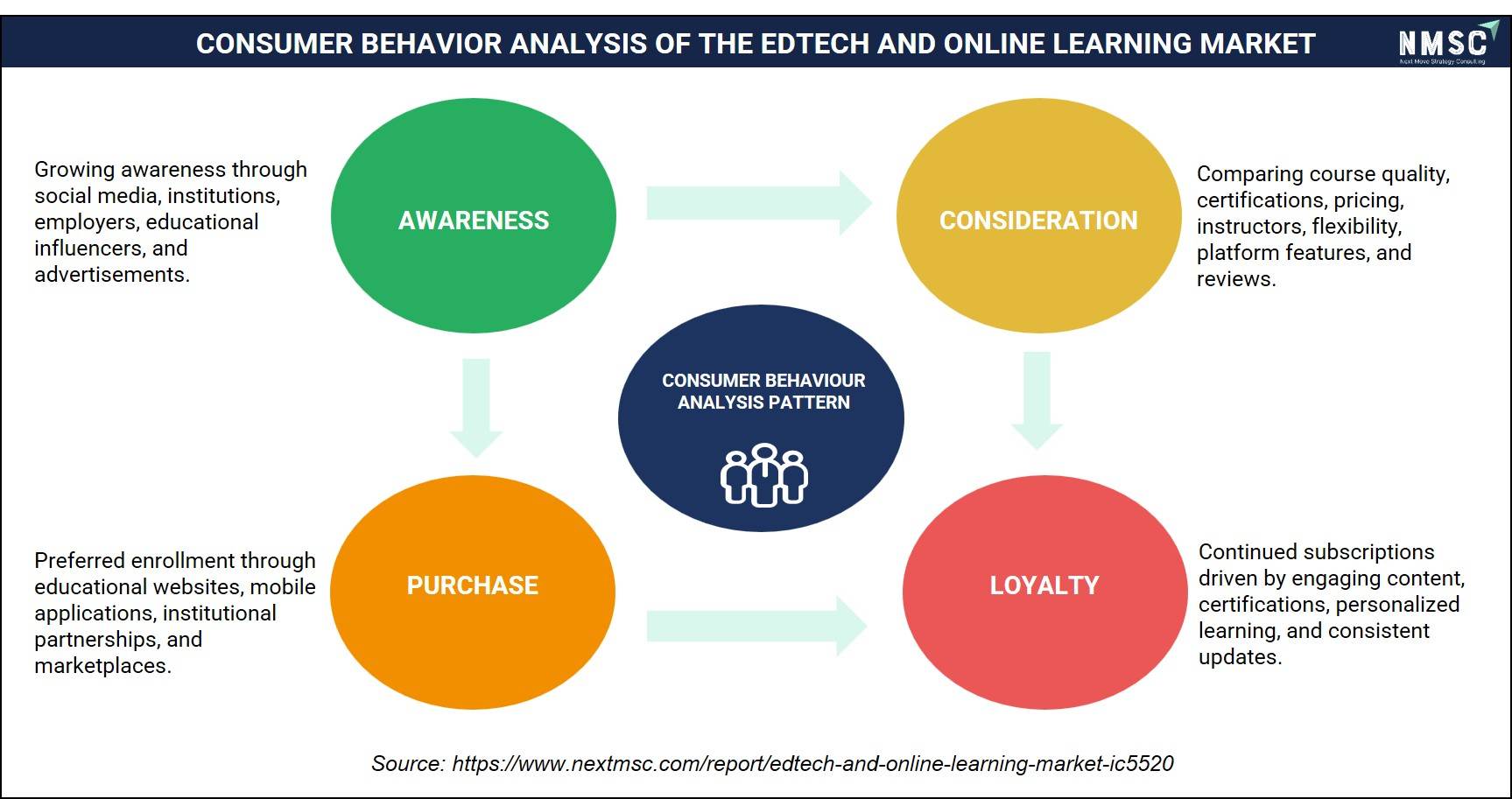
Based on our consumer behavior assessment, we identified that learners evaluate online education platforms based on course quality, certifications, instructor expertise, flexibility, pricing, platform features, and peer reviews. Furthermore, our analysis indicates that enrollment decisions are increasingly influenced by educational websites, mobile applications, institutional partnerships, and digital marketplaces, while customer loyalty is strengthened through engaging learning content, recognized certifications, personalized learning pathways, and continuous platform enhancements
Growth Drivers and Restraints
|
Factors |
Type |
(+/−) % Impact on CAGR |
Geographic Relevance |
Impact Timeline |
|
Rising corporate reskilling and upskilling spend |
Driver |
+2.6% |
Global |
2026-2035 |
|
Government digital-education missions in Asia-Pacific |
Driver |
+2.1% |
Asia-Pacific |
2026-2035 |
|
Expansion of AI-enabled adaptive learning engines |
Driver |
+2.3% |
Global |
2026-2035 |
|
Rising smartphone and broadband penetration |
Driver |
+1.7% |
Asia-Pacific, Latin America, MEA |
2026-2035 |
|
Employer demand for verifiable micro-credentials |
Driver |
+1.4% |
North America, Europe |
2026-2035 |
|
Growth of cross-border higher-education enrollment |
Driver |
+1.0% |
Global |
2026-2032 |
|
Data-privacy and student-data protection compliance costs |
Restraint |
-1.1% |
Europe, North America |
2026-2035 |
|
Digital-access disparity in low-income regions |
Restraint |
-0.9% |
MEA, Latin America |
2026-2035 |
|
Course-completion and learner-retention challenges |
Restraint |
-0.7% |
Global |
2026-2032 |
What Is the Primary Growth Driver of the EdTech and Online Learning Market?
Rising corporate reskilling and upskilling spend is the primary driver of the market. The U.S. Department of Education continues to promote workforce-aligned digital learning pathways through federal grant programs, sustaining enterprise demand for scalable online training platforms. We observed that this behavioral shift, reinforced by rapid technology-driven skills obsolescence, continues to anchor baseline consumption of platform and content subscriptions across developed and emerging economies alike.
How Is Government Digital-Education Policy Driving Market Growth?
National digital-education initiatives and public procurement of online learning infrastructure are accelerating adoption across Asia-Pacific and the Middle East. India's Ministry of Education continues to expand its digital learning infrastructure through national e-learning platforms serving school and higher-education students. Our assessment indicates that this policy support, combined with growing private-sector platform partnerships, is compressing adoption timelines for cloud-based learning management systems across public education systems.
What Is Restraining EdTech and Online Learning Market Expansion?
Data-privacy and student-data protection compliance obligations restrain platform-vendor margins and slow procurement cycles across the supply chain. The European Commission's education directorate continues to reinforce General Data Protection Regulation obligations for platforms processing minors' data, requiring additional compliance investment. We found that smaller regional platform providers face particular exposure, as limited scale reduces their ability to absorb compliance costs compared with larger, diversified learning-technology groups.
Segmentation Analysis
Segment Sizing: By Component
|
Segment |
2025 (USD) |
2035 (USD) |
CAGR% (2026–2035) |
|
Content |
USD 67.40 Billion |
USD 203.21 Billion |
11.6% |
|
Platforms and Software |
USD 101.11 Billion |
USD 382.96 Billion |
14.4% |
|
Services |
USD 56.17 Billion |
USD 195.39 Billion |
13.4% |
|
Total |
USD 224.68 Billion |
USD 781.56 Billion |
13.35% |
Which Component Segment Dominates the EdTech and Online Learning Market?
Platforms and Software, encompassing learning management systems, adaptive learning engines, and virtual classroom infrastructure, led the market with USD 101.11 billion in 2025, supported by recurring subscription revenue and deep institutional integration. We observed that Platforms and Software is also the fastest-growing component, expanding at a 14.4% CAGR from 2026 to 2035, as AI-enabled personalization features drive upgrade cycles across corporate and higher-education deployments.
Segment Sizing: By End User
|
Segment |
2025 (USD) |
2035 (USD) |
CAGR% (2026–2035) |
|
K-12 Education |
USD 49.43 Billion |
USD 148.50 Billion |
11.5% |
|
Higher Education |
USD 62.91 Billion |
USD 203.21 Billion |
12.4% |
|
Corporate and Enterprise Learning |
USD 67.40 Billion |
USD 265.73 Billion |
14.9% |
|
Individual and Consumer Learners |
USD 44.94 Billion |
USD 164.13 Billion |
14.0% |
|
Total |
USD 224.68 Billion |
USD 781.56 Billion |
13.35% |
Which End User Segment Leads EdTech and Online Learning Market Demand?
Corporate and Enterprise Learning remained the leading end user within the market, valued at USD 67.40 billion in 2025 on sustained employer-funded reskilling and compliance-training consumption. Our findings suggest that Corporate and Enterprise Learning is also the fastest-growing end user, registering a 14.9% CAGR from 2026 to 2035, as enterprises increasingly specify AI-personalized upskilling platforms to close technology-driven skills gaps across global workforces.
Segment Sizing: By Deployment Mode
|
Segment |
2025 (USD) |
2035 (USD) |
CAGR% (2026–2035) |
|
Cloud Based |
USD 184.24 Billion |
USD 703.40 Billion |
14.5% |
|
On Premise |
USD 40.44 Billion |
USD 78.16 Billion |
6.2% |
|
Total |
USD 224.68 Billion |
USD 781.56 Billion |
13.35% |
Which Deployment Mode Is Most Widely Used in the EdTech and Online Learning Market?
Cloud Based deployment remained dominant across the market, reaching USD 184.24 billion in 2025 due to lower upfront infrastructure cost, faster institutional rollout, and continuous feature updates. Based on research conducted by Next Move Strategy Consulting, we found that Cloud Based deployment is also the fastest-growing category at a 14.5% CAGR from 2026 to 2035, reflecting institutions' and enterprises' preference for scalable, subscription-based learning infrastructure over legacy on-premise systems.
Growth Opportunities
Our analysis shows that three forward-looking opportunities stand out for stakeholders positioning within the EdTech and online learning market over the 2026-2035 forecast period.
How Can Employer-Recognized Micro-Credentials Unlock Value for Platform Providers?
Stackable, employer-recognized micro-credentials present a whitespace opportunity for platform providers seeking recurring certification revenue beyond one-time course fees. Providers that build direct employer-verification pipelines stand to capture ongoing subscription renewals as enterprises formalize skills-based hiring across the corporate and enterprise learning segment.
Where Do Vernacular-Language K-12 Platforms Create New Demand?
Regional and vernacular-language K-12 content represents an underpenetrated opportunity across India, Southeast Asia, and Latin America. Providers that localize adaptive content for regional-language instruction can secure long-term public-sector procurement contracts, benefiting from national digital-education funding cycles targeting the K-12 education end-user segment.
How Can AI Assessment Tools Benefit Higher-Education Institutions?
Higher-education institutions seeking automated, plagiarism-resistant assessment create an opportunity for AI-enabled proctoring and grading tool developers. Early movers that secure institutional accreditation-body validation can differentiate with university procurement teams pursuing scalable assessment infrastructure across the higher education end-user segment.
Regional Outlook
|
Region |
2025 (USD) |
2035 (USD) |
CAGR% (2026–2035) |
Key Driver |
|
North America |
USD 71.90 Billion |
USD 226.65 Billion |
12.1% |
Enterprise reskilling spend and mature higher-education online programs |
|
Europe |
USD 47.18 Billion |
USD 148.50 Billion |
12.1% |
GDPR-aligned platform accreditation and EU digital-skills funding |
|
Asia-Pacific |
USD 74.14 Billion |
USD 296.99 Billion |
15.1% |
National digital-education missions and rising smartphone penetration |
|
Middle East and Africa |
USD 15.73 Billion |
USD 54.71 Billion |
13.4% |
Vision 2030-linked education-technology investment |
|
Latin America |
USD 15.73 Billion |
USD 54.71 Billion |
13.4% |
Expanding mobile-first consumer learning adoption |
|
Total |
USD 224.68 Billion |
USD 781.56 Billion |
13.35% |
– |
North America EdTech and Online Learning Market Outlook
North America leads enterprise-funded reskilling spend with a mature online higher-education program base and established platform-vendor ecosystem. We observed that U.S. Department of Education workforce-development grant programs sustain demand for corporate and community-college digital learning partnerships, while institutions increasingly specify AI-personalized platforms to meet accreditation-linked outcome requirements. Technology adoption remains advanced, with employer-funded subscriptions driving demand for verifiable micro-credential integrations across the region's enterprise learning sector.
Europe EdTech and Online Learning Market Outlook
Europe's market reflects a mature but compliance-intensive landscape shaped by the European Union's General Data Protection Regulation and national digital-skills funding frameworks. Our findings suggest that institutions across Germany, France, and the UK are accelerating adoption of GDPR-compliant, accredited online-learning platforms to satisfy data-protection and quality-assurance requirements. Technology adoption favors interoperable learning management systems capable of multi-country regulatory compliance across the region's higher-education and corporate-training base.
Asia-Pacific EdTech and Online Learning Market Outlook
Asia-Pacific is the fastest-growing region, propelled by national digital-education missions in China and India alongside rapidly expanding smartphone and broadband penetration. We observed that public procurement of e-learning infrastructure continues to scale across school systems, while private platform providers expand vernacular-language content catalogs. Competitive intensity is rising as regional and global providers both target the region's large K-12 and consumer-learner populations.
Middle East and Africa EdTech and Online Learning Market Outlook
The Middle East and Africa market is shaped by Vision 2030-linked education-technology investment in Saudi Arabia and the UAE, alongside growing mobile-first consumer learning adoption across South Africa and Nigeria. Our assessment indicates that regulatory support for digital-skills curricula is expanding institutional procurement, while technology penetration gaps in parts of Sub-Saharan Africa continue to moderate near-term consumer-segment growth relative to institutional demand.
Latin America EdTech and Online Learning Market Outlook
Latin America's market is expanding on rising mobile-first consumer adoption and growing employer interest in digital-skills training across Brazil and Argentina. We found that regulatory environments remain comparatively light-touch relative to Europe, supporting faster platform-vendor market entry, while technology penetration gaps in rural areas continue to concentrate near-term demand within urban higher-education and corporate-training segments.
U.S. EdTech and Online Learning Market Outlook
Based on our engagements, U.S.'s EdTech and online learning market was valued at approximately USD 59.0 billion in 2025 and is projected to reach approximately USD 183.6 billion by 2035, expanding at approximately a 12.0% CAGR from 2026 to 2035. the U.S. remains the largest single country market, anchored by extensive enterprise reskilling budgets and widespread higher-education online-degree adoption. Demand structure favors platform and content subscriptions over one-time course purchases, with strong regulatory oversight from state education boards shaping accreditation standards. Technology penetration is near-universal across corporate and university settings, and competitive intensity remains high among both domestic and international platform providers targeting the country's large enterprise-learning base.
Canada EdTech and Online Learning Market Outlook
Through our analysis, Canada's EdTech and online learning market was valued at approximately USD 12.9 billion in 2025 and is projected to reach approximately USD 43.1 billion by 2035, expanding at approximately a 12.8% CAGR from 2026 to 2035. Canada's market benefits from strong public-sector digital-skills funding and bilingual content requirements across federal and provincial education systems. Demand structure is weighted toward higher-education and corporate-training platforms, with moderate regulatory influence from provincial privacy statutes. Technology penetration is high in urban centers, and competitive intensity is moderate, with U.S.-headquartered platforms holding meaningful share alongside domestic providers.
UK EdTech and Online Learning Market Outlook
From our assessment, UK's EdTech and online learning market was valued at approximately USD 11.3 billion in 2025 and is projected to reach approximately USD 34.2 billion by 2035, expanding at approximately a 11.6% CAGR from 2026 to 2035. the UK market reflects steady demand from higher-education institutions and corporate learning and development teams navigating post-Brexit skills-funding frameworks. Demand structure favors accredited, GDPR-compliant platforms, with the Department for Education shaping curriculum-alignment standards for school-focused content. Technology penetration is advanced, and competitive intensity remains elevated given the concentration of global platform providers with UK operating entities.
Germany EdTech and Online Learning Market Outlook
According to evaluation, Germany's EdTech and online learning market was valued at approximately USD 9.4 billion in 2025 and is projected to reach approximately USD 29.7 billion by 2035, expanding at approximately a 12.1% CAGR from 2026 to 2035. Germany's market is shaped by strong vocational-training traditions and growing enterprise adoption of digital upskilling platforms tied to Industry 4.0 workforce transitions. Demand structure favors corporate and vocational end users, with data-protection authorities enforcing strict GDPR compliance on student-data handling. Technology penetration is high among large enterprises, and competitive intensity is moderate, with domestic vocational-training providers competing alongside global platforms.
France EdTech and Online Learning Market Outlook
Based on our engagements, France's EdTech and online learning market was valued at approximately USD 7.5 billion in 2025 and is projected to reach approximately USD 23.8 billion by 2035, expanding at approximately a 12.1% CAGR from 2026 to 2035. France's market benefits from national digital-skills initiatives and growing higher-education adoption of blended-learning formats. Demand structure is weighted toward higher-education and corporate-training platforms, with regulatory influence from national data-protection authorities shaping consent requirements for minors. Technology penetration is expanding steadily, and competitive intensity is moderate, with domestic and pan-European providers both active.
China EdTech and Online Learning Market Outlook
Through our analysis, China's EdTech and online learning market was valued at approximately USD 24.5 billion in 2025 and is projected to reach approximately USD 95.0 billion by 2035, expanding at approximately a 14.8% CAGR from 2026 to 2035. China's market is propelled by strong national digital-education policy support and large-scale K-12 and higher-education online-learning adoption. Demand structure favors platform and content subscriptions across public education systems, with the Ministry of Education shaping curriculum and data-localization requirements. Technology penetration is extensive across urban and increasingly rural areas, and competitive intensity is high, dominated by large domestic platform providers.
India EdTech and Online Learning Market Outlook
From our assessment, India's EdTech and online learning market was valued at approximately USD 17.8 billion in 2025 and is projected to reach approximately USD 83.2 billion by 2035, expanding at approximately a 17.1% CAGR from 2026 to 2035. India's market is the fastest-growing country market, driven by national digital-education missions and rapidly expanding smartphone-based consumer learning adoption. Demand structure spans K-12, higher-education, and large consumer test-preparation segments, with the Ministry of Education shaping public digital-infrastructure procurement. Technology penetration continues to expand across tier-two and tier-three cities, and competitive intensity is intense among domestic platform providers.
Japan EdTech and Online Learning Market Outlook
According to evaluation, Japan's EdTech and online learning market was valued at approximately USD 10.4 billion in 2025 and is projected to reach approximately USD 35.6 billion by 2035, expanding at approximately a 13.2% CAGR from 2026 to 2035. Japan's market reflects steady corporate-training adoption amid demographic-driven workforce reskilling needs. Demand structure favors corporate and higher-education end users, with regulatory influence from national education ministries shaping curriculum-alignment standards. Technology penetration is high among large enterprises, and competitive intensity is moderate, with domestic providers holding meaningful share alongside global platforms.
South Korea EdTech and Online Learning Market Outlook
Based on our engagements, South Korea's EdTech and online learning market was valued at approximately USD 6.7 billion in 2025 and is projected to reach approximately USD 23.8 billion by 2035, expanding at approximately a 13.6% CAGR from 2026 to 2035. South Korea's market benefits from high broadband penetration and strong consumer demand for test-preparation and language-learning platforms. Demand structure favors individual and consumer-learner segments alongside corporate training, with regulatory influence from national education authorities shaping private-tutoring-adjacent platform standards. Technology penetration is near-universal, and competitive intensity is high among domestic and international providers.
Australia EdTech and Online Learning Market Outlook
Through our analysis, Australia's EdTech and online learning market was valued at approximately USD 5.2 billion in 2025 and is projected to reach approximately USD 17.8 billion by 2035, expanding at approximately a 13.2% CAGR from 2026 to 2035. Australia's market reflects steady higher-education and vocational-training adoption supported by national digital-skills funding programs. Demand structure favors higher-education and corporate-training platforms, with the Department of Education shaping accreditation standards for online-degree providers. Technology penetration is advanced across urban centers, and competitive intensity is moderate, with domestic and international providers both active.
UAE EdTech and Online Learning Market Outlook
From our assessment, UAE's EdTech and online learning market was valued at approximately USD 4.4 billion in 2025 and is projected to reach approximately USD 14.8 billion by 2035, expanding at approximately a 12.9% CAGR from 2026 to 2035. the UAE market is propelled by government-led digital-education investment tied to national economic-diversification strategy. Demand structure favors K-12 and higher-education platforms procured through public-sector partnerships, with regulatory bodies shaping curriculum and data-residency requirements. Technology penetration is high across urban centers, and competitive intensity is moderate, with international providers holding meaningful share.
Saudi Arabia EdTech and Online Learning Market Outlook
According to evaluation, Saudi Arabia's EdTech and online learning market was valued at approximately USD 4.7 billion in 2025 and is projected to reach approximately USD 16.4 billion by 2035, expanding at approximately a 13.4% CAGR from 2026 to 2035. Saudi Arabia's market benefits from Vision 2030-linked education-technology investment and expanding public-sector digital-learning infrastructure. Demand structure favors K-12 and higher-education platforms, with the Saudi education ministry shaping curriculum-alignment and data-residency standards. Technology penetration is expanding rapidly, and competitive intensity is moderate, with international providers increasingly partnering with domestic distributors.
South Africa EdTech and Online Learning Market Outlook
Based on our engagements, South Africa's EdTech and online learning market was valued at approximately USD 2.4 billion in 2025 and is projected to reach approximately USD 8.2 billion by 2035, expanding at approximately a 13.4% CAGR from 2026 to 2035. South Africa's market reflects growing consumer and corporate demand for mobile-first learning platforms amid infrastructure constraints in rural areas. Demand structure favors individual-learner and corporate-training segments, with regulatory influence from national education authorities shaping curriculum standards. Technology penetration remains concentrated in urban centers, and competitive intensity is moderate, with international providers holding meaningful share.
Brazil EdTech and Online Learning Market Outlook
Through our analysis, Brazil's EdTech and online learning market was valued at approximately USD 7.1 billion in 2025 and is projected to reach approximately USD 24.1 billion by 2035, expanding at approximately a 13.1% CAGR from 2026 to 2035. Brazil's market is the largest in Latin America, driven by rising corporate demand for digital upskilling and growing consumer test-preparation adoption. Demand structure favors corporate-training and individual-learner segments, with regulatory influence from national data-protection law shaping platform compliance requirements. Technology penetration continues to expand across urban centers, and competitive intensity is moderate, with domestic and international providers both active.
Argentina EdTech and Online Learning Market Outlook
From our assessment, Argentina's EdTech and online learning market was valued at approximately USD 2.5 billion in 2025 and is projected to reach approximately USD 8.8 billion by 2035, expanding at approximately a 13.4% CAGR from 2026 to 2035. Argentina's market reflects steady growth in consumer and higher-education online-learning adoption amid macroeconomic volatility affecting discretionary spend. Demand structure favors individual-learner and higher-education segments, with regulatory influence from national education authorities shaping accreditation standards. Technology penetration is expanding steadily in urban centers, and competitive intensity is moderate, with regional providers holding meaningful share.
Porter's Five Forces Analysis of the EdTech and Online Learning Market
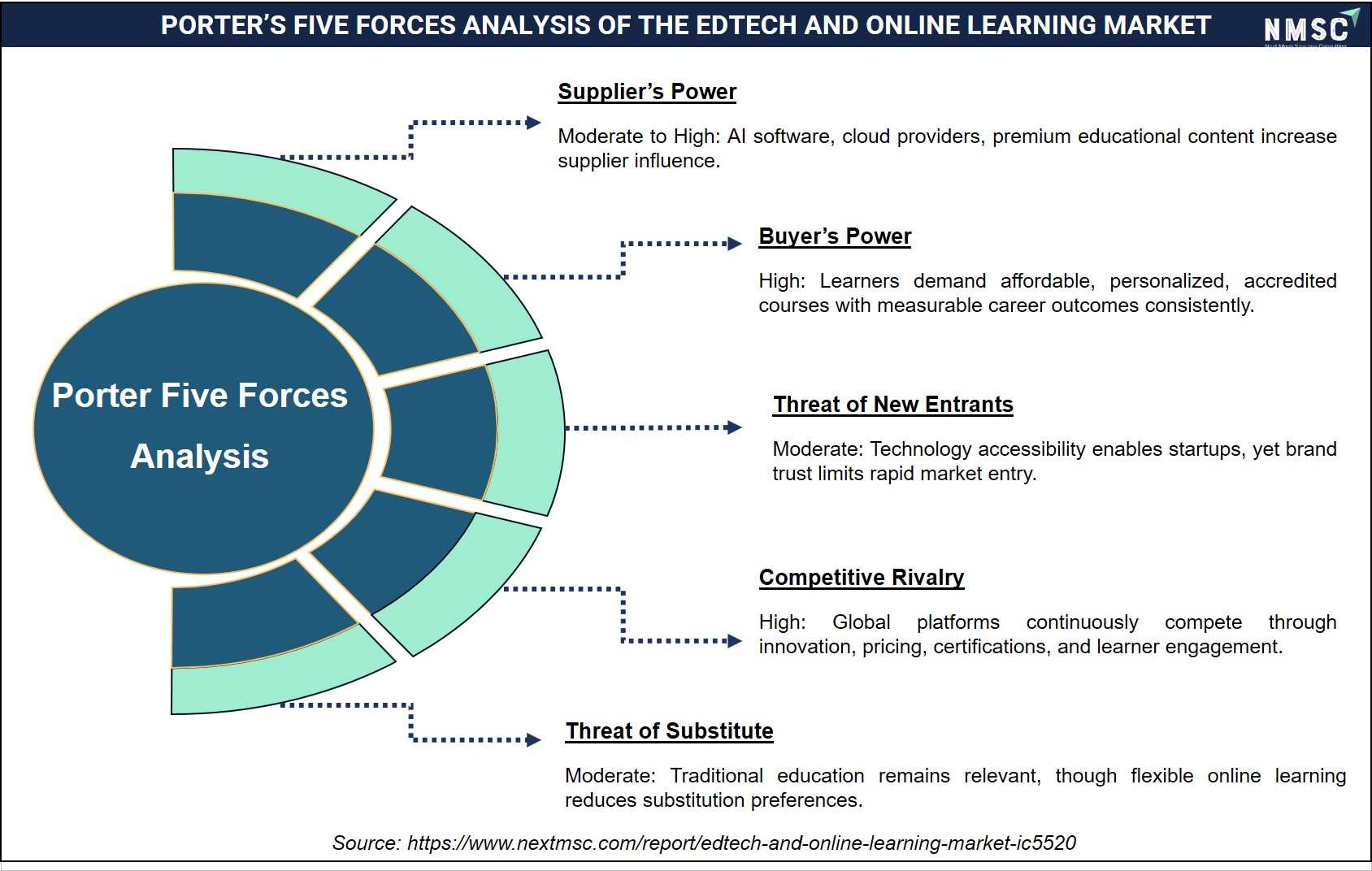
Based on our Porter's Five Forces assessment, we identified that competitive rivalry is high due to the presence of numerous online learning platforms offering diverse courses and AI-enabled learning experiences. The threat of new entrants is moderate because cloud technologies simplify platform development, although content quality and institutional partnerships remain key differentiators. Buyer bargaining power is high owing to multiple learning alternatives, while supplier bargaining power is moderate because instructors, content creators, and technology providers are broadly available. The threat of substitutes is moderate as traditional classroom education, corporate training, and self-learning resources continue to compete with digital learning platforms.
Competitive Landscape
We observed that the EdTech and online learning market remains moderately fragmented, with global platform providers, publishing-heritage content firms, and specialized corporate-training vendors all competing for institutional and enterprise procurement budgets.
|
Dimension |
Details |
|
Market Structure |
Moderately fragmented, with the Top 10 companies accounting for a defined share of Industry revenue |
|
Innovation Focus |
AI-enabled adaptive learning, generative-AI tutoring, and skills-based micro-credentialing |
|
M&A Activity |
Consolidation among platform and content vendors to broaden employer-recognized credential catalogs |
How Do Companies Compete Within the EdTech and Online Learning Market?
Companies compete primarily on catalog breadth, employer-recognized credential partnerships, and institutional integration depth with existing student-information and enterprise HR systems. Our analysis shows that platform providers increasingly differentiate through AI-personalization capability rather than content volume alone, as buyers prioritize demonstrable completion and skills-verification outcomes.
Which Competitive Archetypes Dominate the EdTech and Online Learning Market?
Three archetypes dominate: global consumer-facing platform providers such as Coursera, Inc. and Udemy, Inc.; publishing-heritage content firms such as Pearson plc and Cengage Group, Inc.; and specialized corporate-training and learning-management vendors such as Docebo Inc. and Skillsoft Corp. Each archetype leverages distinct distribution channels, from direct-to-consumer marketing to enterprise HR procurement relationships.
What Innovation and Differentiation Strategies Are Companies Pursuing?
Companies are pursuing generative-AI tutoring, adaptive assessment engines, and stackable micro-credential partnerships with employers and universities as core differentiation strategies. We found that Industry leaders are also investing in mobile-first content delivery and offline-access capability to expand reach across bandwidth-constrained emerging markets.
What M&A Activity Is Shaping the Competitive Landscape?
M&A activity is concentrated on broadening credential catalogs and adding complementary content categories, as platform providers acquire specialized content studios and assessment-technology firms. Our assessment indicates that this consolidation trend is expected to continue as providers seek to reduce customer-acquisition cost through broader, cross-sellable catalog scope.
Key Market Players
Our findings suggest that the following 20 companies represent the leading verified providers active in the EdTech and online learning market as of 2026, ranked by market-specific revenue and scale of operations.
-
Udemy, Inc.
-
Chegg, Inc.
-
2U, Inc.
-
Pearson plc
-
Cengage Group, Inc.
-
McGraw Hill LLC
-
John Wiley & Sons, Inc.
-
Instructure Holdings, Inc.
-
PowerSchool Holdings, Inc.
-
D2L Corporation
-
Docebo Inc.
-
Skillsoft Corp.
-
Anthology Inc.
-
Age of Learning, Inc.
-
Renaissance Learning, Inc.
-
Kahoot! ASA
-
Multiverse Group Limited
-
upGrad Education Private Limited
Latest Developments
|
Date |
Event |
|
June 2026 |
Duolingo, Inc. officially unveiled and launched its patent-pending ear scan technology for the Duolingo English Test (DET) at DETcon London 2026. The new mobile-app-based security innovation uses specialized sensor algorithms to detect hidden micro-sized earbuds, strengthening test integrity and fraud prevention in high-stakes online language assessments. |
|
May 2026 |
Coursera, Inc. officially announced the completion of its strategic business combination with Udemy, Inc., uniting a global ecosystem of 290 million learners, 18,000 enterprise customers, and 95,000 instructors. The merger creates a comprehensive AI-powered skills and online learning platform designed to accelerate agentic product innovations and connect skill development directly to real-world career outcomes. |
|
May 2026 |
Pearson plc announced an expanded multi-year strategic partnership with Salesforce, Inc. to accelerate AI readiness and workforce skill development globally. The collaboration integrates Pearson's Faethm, Credly, and assessment capabilities with Salesforce's CRM architecture to anticipate skill gaps, deliver targeted corporate learning, and validate competencies at scale. |
|
February 2026 |
Udemy, Inc. partnered with Google to launch its first-of-its-kind individual subscription plan, "Learn AI with Google," bringing Google's AI Professional Certificates and Google AI Pro hands-on practice tools to Udemy's global learner community. |
Expert Insights
 “We're pretty much all in the same boat, whether you are a factory worker or on the frontlines or whether you're a knowledge worker sitting behind a desk. Technology is shifting the way almost every job task will be performed.”
— Jeff Maggioncalda, CEO, Coursera
Statement made during the World Economic Forum's discussion on the Future of Jobs Report 2023, highlighting how technological advancements are transforming work and driving the need for continuous learning and workforce reskilling.
Market Interpretation
The statement underscores the growing importance of digital learning and continuous upskilling as technology reshapes occupations across industries. As organizations and individuals increasingly seek flexible, accessible, and career-oriented education to keep pace with evolving skill requirements, demand for online learning platforms and digital education solutions is expected to accelerate, supporting the long-term growth of the global EdTech and Online Learning Market.
Investment Opportunities
What Capital Inflows Are Targeting the EdTech and Online Learning Market?
Capital inflows continue to target AI-personalization technology and employer-credentialing infrastructure, with corporate and enterprise learning platforms attracting sustained investor interest. Our assessment indicates that investors favor providers demonstrating measurable completion-rate and skills-verification outcomes over pure enrollment-growth metrics.
How Is Infrastructure Investment Shaping Market Expansion?
Cloud infrastructure investment continues to expand platform scalability, supporting the 14.5% CAGR projected for cloud-based deployment through 2035. We found that providers are prioritizing content-delivery-network expansion to serve bandwidth-constrained learners across Asia-Pacific, Latin America, and the Middle East and Africa regions.
What ESG Considerations Are Relevant to EdTech Investment?
Environmental, Social, and Governance considerations increasingly favor providers expanding affordable-access programs for underserved learners and maintaining rigorous student-data governance practices. Our analysis shows that institutional investors are prioritizing platform providers with transparent data-protection compliance disclosures aligned with GDPR and comparable regional frameworks.
Key Benefits for Stakeholders
How Does This Report Benefit Education and Enterprise Leaders?
Education and enterprise learning leaders gain access to verified segmentation, regional sizing, and competitive benchmarking that inform platform-procurement and curriculum-investment decisions. Our analysis, data, and forecasts help leaders prioritize AI-personalization and micro-credential integration investments aligned with projected segment growth.
How Does This Report Benefit Investors and Financial Analysts?
Investors and financial analysts benefit from validated market-sizing, CAGR methodology, and company-level competitive positioning that support capital-allocation and valuation decisions. Our findings suggest that segment-level growth differentials, particularly in cloud-based deployment and corporate learning, offer actionable signals for portfolio construction.
How Does This Report Benefit Technology Vendors and Product Teams?
Technology vendors and product teams gain strategic insight into emerging trends, competitive archetypes, and regional demand patterns that inform product-roadmap prioritization. We observed that this analysis supports go-to-market planning for AI-personalization features and employer-credentialing partnerships across target end-user segments.
Key Market Segments
By Component
-
Content
-
Platforms and Software
-
Services
By End User
-
K-12 Education
-
Higher Education
-
Corporate and Enterprise Learning
-
Individual and Consumer Learners
By Deployment Mode
-
Cloud Based
-
On Premise
By Region
-
North America: U.S., Canada, Mexico.
-
Europe: UK, Germany, France, Italy, Spain, Sweden, Denmark, Finland, Netherlands, Rest of Europe.
-
Asia-Pacific: China, India, Japan, South Korea, Taiwan, Indonesia, Vietnam,Australia, Philippines, Malaysia, Rest of APAC.
-
Middle East & Africa: Saudi Arabia, UAE, Egypt, Israel, Turkey, Nigeria, South Africa, Rest of MEA.
-
Latin America: Brazil, Argentina, Chile, Colombia, Rest of LATAM.
Conclusion and Recommendations
What Is the Long-Term Outlook for the EdTech and Online Learning Market?
The long-term outlook remains strongly positive, with the market projected to expand from USD 252.94 billion in 2026 to USD 781.56 billion by 2035 at a 13.35% CAGR. Our assessment indicates that sustained enterprise reskilling demand and government digital-education investment will anchor growth across both mature and emerging economies through the forecast horizon.
What Strategic Positioning Should Companies Pursue?
Companies should prioritize AI-personalization capability and employer-recognized credential partnerships to differentiate within an increasingly crowded platform landscape. Our findings suggest that providers combining broad content catalogs with verified outcome-tracking infrastructure will be best positioned to retain institutional and enterprise renewal contracts.
How Attractive Is the Market for New Investment?
The market presents an attractive investment case, supported by a USD 528.62 billion absolute dollar opportunity between 2026 and 2035 and above-average growth in Asia-Pacific and the corporate learning segment. We found that investment attractiveness is highest for platform providers combining AI-personalization technology with scaled institutional distribution.
What Market Shifts and Key Risks Should Stakeholders Monitor?
Stakeholders should monitor tightening student-data privacy regulation, digital-access disparity in low-income regions, and persistent course-completion challenges as key risks. Our analysis shows that providers unable to demonstrate measurable learning outcomes risk losing institutional contracts to competitors with stronger outcome-verification infrastructure.
What Are the Key Growth Pathways for the Market?
Key growth pathways include expanding employer-recognized micro-credential catalogs, scaling AI-personalization infrastructure, and deepening penetration into vernacular-language K-12 content across Asia-Pacific and Latin America. Next Move Strategy Consulting's analysis indicates that providers pursuing these pathways while maintaining catalog breadth will be best positioned to capture the market's projected growth through 2035.
About the Author
 Saista Faiyaz
— Saista Faiyaz is Research Associate at Next Move Strategy Consulting, where she has covered consumer markets and healthcare technologies for 3 years. Her work includes primary interview review, secondary-source validation, market sizing, and structured analysis of company and industry data. She supports research by comparing evidence across sources, organizing findings into market narratives, and documenting assumptions used in analysis. Her scope includes cross-market benchmarking, and reports.
Saista Faiyaz
— Saista Faiyaz is Research Associate at Next Move Strategy Consulting, where she has covered consumer markets and healthcare technologies for 3 years. Her work includes primary interview review, secondary-source validation, market sizing, and structured analysis of company and industry data. She supports research by comparing evidence across sources, organizing findings into market narratives, and documenting assumptions used in analysis. Her scope includes cross-market benchmarking, and reports.
About the Reviewer
 Supradip Baul
— Supradip Baul is an accomplished business consultant and strategist with over a decade of rich experience in market intelligence, strategy, technology, and business transformation. His work has included rigorous qualitative and quantitative analysis across multiple industries, helping clients shape investment decisions and long-term roadmaps. Earlier in his career, he was associated with Gartner, where he contributed to industry-leading reports and market share analyses. He has worked with leading global companies and holds an MBA with a dual specialization in Marketing and Finance.
Supradip Baul
— Supradip Baul is an accomplished business consultant and strategist with over a decade of rich experience in market intelligence, strategy, technology, and business transformation. His work has included rigorous qualitative and quantitative analysis across multiple industries, helping clients shape investment decisions and long-term roadmaps. Earlier in his career, he was associated with Gartner, where he contributed to industry-leading reports and market share analyses. He has worked with leading global companies and holds an MBA with a dual specialization in Marketing and Finance.
At Next Move Strategy Consulting, we understand that insightful market research is the cornerstone of successful business decisions. That's why we employ a robust and multifaceted approach, combining various methodologies to deliver the most accurate and actionable data for our clients.

Research Landscape
We navigate the world of research with two primary approaches:
Qualitative Approach
Our qualitative research methodologies involve immersive techniques such as in-depth interviews, focus groups, and observational studies. By engaging directly with individuals and stakeholders, we uncover valuable insights that quantitative data alone may overlook.

Quantitative Research
In tandem with qualitative methodologies, NMSC leverages the power of Quantitative Research to provide a robust foundation of numerical insights. Through systematic data collection and analysis, we quantify patterns, preferences, and market trends, offering a comprehensive view of the business landscape.
Our quantitative research approach employs diverse tools, including surveys, experiments, and statistical modelling. These methodologies enable us to gather data from a large and representative sample, ensuring the statistical significance of our findings. By employing structured questionnaires and standardized data collection methods, we guarantee the reliability and validity of the information we present to our clients.
Quantitative research is particularly effective in measuring the prevalence of trends, assessing market size, and gauging the impact of various factors on consumer behavior. The numerical precision attained through this approach equips our clients with actionable insights, facilitating data-driven decision-making and strategy formulation.


Our Specialized Toolbox for Industry-Specific Market Research
We deploy a specialized arsenal of techniques tailored to meet your unique requirements. Here's a glimpse into our comprehensive toolbox:

Information Procurement
The stage entails acquiring market data or relevant information through various sources and methodologies.


Market Research Approach
We utilize both top-down and bottom-up approaches in market research analysis to achieve a comprehensive understanding of the market dynamics, leveraging the broad perspective of industry trends and macroeconomic factors alongside detailed insights from specific segments and individual companies.

Porters Five Forces Analysis
We conduct Porter's Five Forces analysis to evaluate the competitive landscape of an industry, providing us with insights into factors that affect profitability and strategic positioning.

SWOT Analysis

Forecasting
We utilize a forecasting model to predict future consumption by considering parameters like population, economics, regulations, market competition, drivers, constraints, technology, and pricing. We also employ statistical techniques such as multilinear regression, exponential smoothing, moving average, ARIMA, and Monte Carlo simulations for accurate predictions. In econometric forecasting, we analyzed short-term and long-term event impacts, attributing values based on regulatory frameworks, economic factors, and market events.





 Speak to Our Analyst