Electronic Toll Collection (ETC) Market By Offering (Hardware, Software, Services), Technology (Transponder-Based, Video-Based, Satellite-Based, Mobile-Based, Hybrid Systems),Toll Structure (Barrier Tolling, Free-Flow Tolling, Closed-Loop Tolling, Hybrid Tolling), Vehicle Class (Passenger Vehicles, Light Commercial Vehicles, Heavy Trucks & Buses, Two-Wheelers), Toll Facility (Road Corridor, Managed Lane, Bridge, Tunnel, Urban Cordon, Other Tolled Assets) – Global Analysis & Forecast, 2025–2035
Industry: Automotive & Transportation | Latest Edition: September 30, 2026 | No of Pages: 330 | No. of Tables: 497 | No. of Figures: 422 | Format: PDF | Report Code: AT394
Industry Outlook
The Electronic Toll Collection (ETC) Market size was valued at USD 12.90 billion in 2025 and is expected to be valued at USD 14.03 billion by the end of 2026. The industry is projected to grow, hitting USD 29.92 billion by 2035, with a CAGR of 8.78% between 2026 and 2035.
Electronic Toll Collection (ETC) Market Size & Forecast
|
Parameters |
Details |
|
Market Size in 2026 |
USD 14.03 billion |
|
Revenue Forecast in 2035 |
USD 29.92 billion |
|
Growth Rate |
CAGR of 8.78% from 2026 to 2035 |
|
Analysis Period |
2025–2035 |
|
Base Year Considered |
2025 |
|
Forecast Period |
2026–2035 |
|
Market Size Estimation |
Billion (USD) |
|
Companies Profiled |
20 |
|
Countries Covered |
33 |
|
Market Share |
Available for 10 companies |
NMSC’s assessment indicates that the Electronic Toll Collection (ETC) Market is currently positioned at a strong growth inflection point, driven by the rapid expansion of intelligent transportation infrastructure, increasing highway congestion, and rising adoption of cashless mobility solutions. Demand is accelerating across urban expressways, national highways, smart city projects, and cross-border transportation corridors, where ETC systems are increasingly deployed to improve traffic efficiency, reduce vehicle wait times, and enhance toll collection accuracy. Based on our interactions with transportation authorities and infrastructure operators, we observed growing investments in RFID-based tolling, GNSS-enabled road pricing, and interoperable toll payment ecosystems. Additionally, the expansion of connected mobility platforms and government-led digital transportation initiatives is further strengthening market adoption globally.
The future outlook for the Electronic Toll Collection (ETC) Market remains highly positive, supported by smart mobility modernization programs, increasing deployment of intelligent transport systems, and rising emphasis on seamless vehicle-to-infrastructure connectivity. Cloud-based toll management platforms, AI-enabled traffic analytics, and multi-lane free-flow tolling technologies are enabling stronger operational efficiency while enhancing commuter convenience and revenue optimization. Moreover, on the infrastructure side, public-private partnership investments and sustainability-focused transportation strategies are emerging as key enablers of long-term network expansion and modernization. As digital mobility ecosystems continue to evolve globally, ETC systems are expected to transition from conventional tolling solutions to fully integrated smart transportation infrastructure components, supported by sustained adoption across both developed and emerging economies.
What Are the Key Trends in the Electronic Toll Collection (ETC) Market?
How are Open-Road Tolling Systems Replacing Traditional Toll Plaza Infrastructure Globally?
Our market evaluation indicates that the transition toward open-road tolling (ORT) systems is significantly reshaping the operational landscape of the Electronic Toll Collection (ETC) Market. We analysed that transportation authorities and highway operators are increasingly replacing conventional toll booth infrastructure with multi-lane free-flow tolling systems to reduce congestion, minimize vehicle idle times, and improve traffic throughput efficiency. At the same time, rising urbanization, expanding smart highway initiatives, and growing pressure to optimize transportation infrastructure are accelerating deployment of RFID-based and GNSS-enabled toll collection technologies across major transportation corridors. Governments are increasingly prioritizing seamless tolling frameworks to improve commuter convenience, reduce fuel consumption, and lower carbon emissions associated with traffic bottlenecks. This trend is particularly prominent in developed economies, where intelligent transportation modernization and mobility optimization remain key infrastructure priorities. Overall, the global shift toward open-road tolling is expected to sustain long-term demand growth while transforming toll operations into fully automated and digitally integrated transportation ecosystems.
How is Artificial Intelligence Integration Improving Toll Traffic Analytics and Operational Efficiency?
Industry analysis suggests that artificial intelligence integration is emerging as a transformative trend within the Electronic Toll Collection (ETC) Market. Based on our assessment of intelligent transportation deployments, we evaluated increasing adoption of AI-driven traffic analytics, predictive congestion monitoring, and automated vehicle classification systems across modern tolling networks. Toll operators are increasingly leveraging machine learning algorithms and real-time data analytics to optimize traffic flow management, improve revenue assurance, and strengthen incident detection capabilities. Additionally, AI-enabled platforms are supporting dynamic pricing strategies, predictive maintenance scheduling, and fraud detection mechanisms, enabling greater operational efficiency and cost optimization. The integration of cloud computing, edge analytics, and connected vehicle ecosystems is further enhancing decision-making accuracy and network responsiveness. This shift is improving toll system scalability, enhancing commuter experience, and strengthening the overall efficiency of transportation infrastructure management. Overall, AI-powered automation and analytics are emerging as critical competitive differentiators, supporting smarter mobility ecosystems and accelerating digital transformation across the ETC industry.
How are Interoperable Tolling Platforms Enabling Seamless Cross-Border Mobility?
NMSC’s research indicates that interoperable tolling platforms are emerging as a major transformation trend in the Electronic Toll Collection (ETC) Market. Transportation agencies and highway operators are increasingly implementing unified toll payment ecosystems that allow motorists to use a single RFID tag or digital account across multiple highways, states, and national transport corridors. We observed that this trend is being accelerated by rising regional mobility integration initiatives, expanding expressway networks, and increasing demand for frictionless transportation experiences. Interoperability frameworks are reducing operational complexity, improving toll revenue collection efficiency, and minimizing delays associated with fragmented payment systems. In addition, cloud-connected tolling platforms and centralized mobility databases are strengthening traffic monitoring and payment authentication capabilities. Overall, interoperable ETC ecosystems are improving commuter convenience, enhancing transportation efficiency, and supporting the development of integrated smart mobility infrastructure globally.
How are Cloud-Based Toll Management Platforms Accelerating Digital Transformation?
Our market assessment indicates that cloud-based toll management solutions are significantly accelerating digital transformation across the Electronic Toll Collection (ETC) Market. Toll operators are increasingly migrating from legacy on-premise systems toward scalable cloud-enabled platforms to improve operational flexibility, real-time monitoring, and centralized data management. We analysed that cloud integration is enabling faster processing of toll transactions, seamless software updates, and improved system interoperability across geographically distributed tolling networks. At the same time, the growing adoption of Software-as-a-Service (SaaS)-based transportation management platforms is helping operators reduce infrastructure costs and enhance cybersecurity resilience. Advanced cloud architectures are also supporting integration with AI analytics, smart traffic management systems, and connected vehicle ecosystems. This digital transition is improving operational transparency, enhancing scalability, and enabling more adaptive transportation infrastructure management. Overall, cloud-based tolling ecosystems are emerging as a foundational technology trend supporting next-generation intelligent transportation systems worldwide.
Ecosystem Analysis of the Electronic Toll Collection (ETC) Market
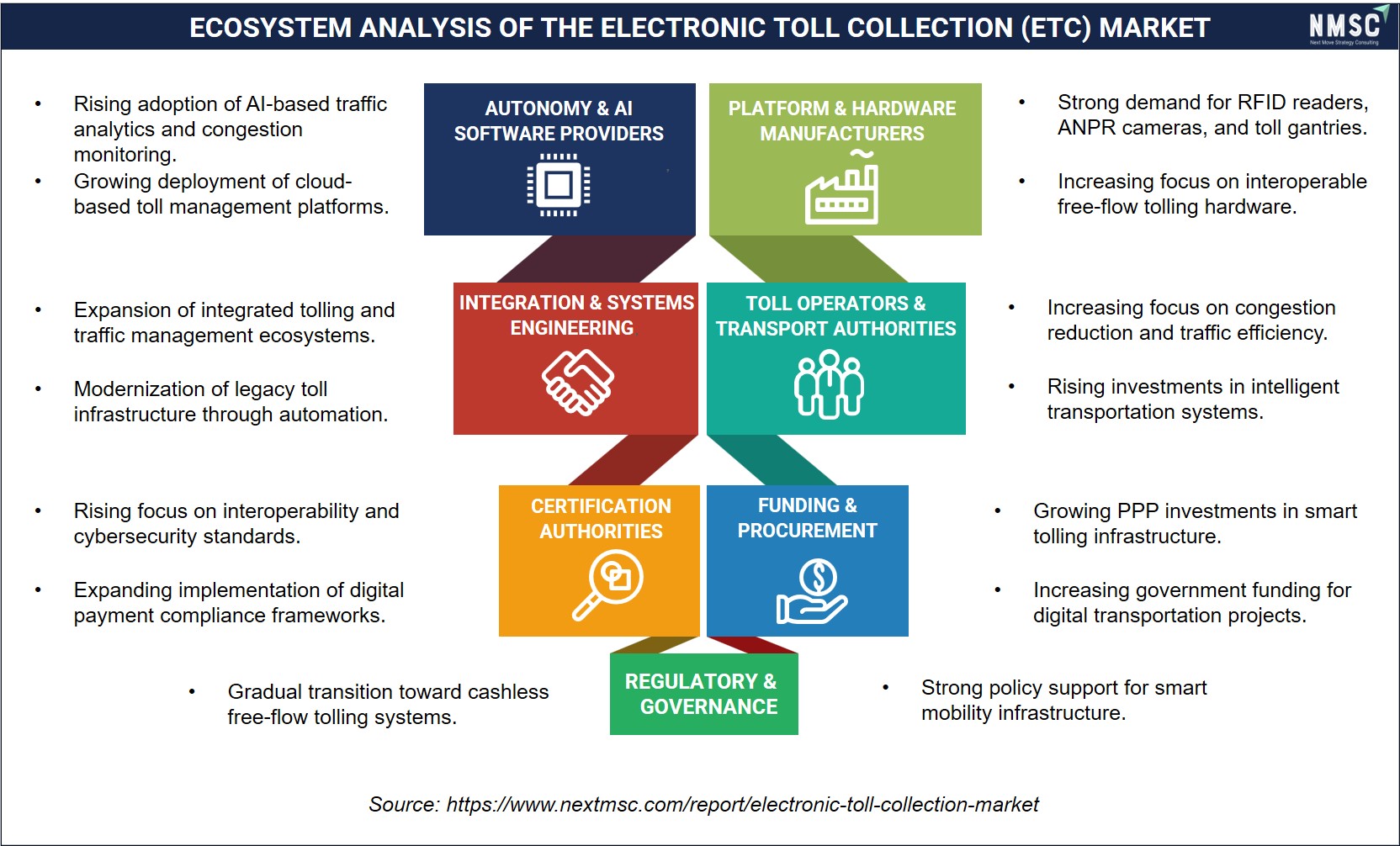
The ecosystem analysis of the Electronic Toll Collection (ETC) Market reflects a highly interconnected infrastructure network driven by transportation digitalization, intelligent mobility integration, and increasing adoption of automated toll management systems across highways, bridges, tunnels, and urban transport corridors.
NMSC's analysis indicates that the ecosystem of the Electronic Toll Collection (ETC) market follows a structured multi-layer progression from enabling technologies to governance, shaped by digital transformation, infrastructure modernization, and demand for seamless mobility. At the Autonomy & AI layer, the ecosystem is influenced by AI-based vehicle classification and predictive analytics. The Software Providers layer is driven by payment processing and violation detection platforms. Platform & Hardware Manufacturers focus on RFID transponders, ANPR cameras, and roadside readers. Integration & Systems Engineering ensures interoperability across multiple toll authorities. Toll Operators & Transport Authorities manage pricing, enrolment, and lane throughput. Certification Authorities provide compliance with ISO/TS 17444 and security standards. Funding & Procurement structures PPPs and government tenders. Finally, the Regulatory & Governance layer establishes data privacy laws, open standards, and toll evasion penalties, resulting in a resilient, interoperable, and scalable ETC ecosystem.
What are the Key Market Drivers, Breakthroughs, and Investment Opportunities that will Shape the Electronic Toll Collection (ETC) Market in the Next Decade?
Growth Catalyst & Risk Assessment Matrix
|
Drivers / Trends / Restraints |
(+/-) % Impact on CAGR Forecast |
Geographic Relevance |
Impact Timeline |
|
Expanding national highway modernization programs and intelligent transportation infrastructure investments are accelerating deployment of Electronic Toll Collection (ETC) Market systems globally |
+3.14% |
Asia-Pacific (China, India, Japan), North America, Europe, Middle East |
Medium to Long term (3–7 years) |
|
Rising commercial freight transportation volumes and cross-border logistics activity are increasing demand for automated toll management and interoperable payment systems |
+2.71% |
North America, Europe, China, India, Southeast Asia |
Medium to Long term (3–6 years) |
|
Open-road tolling systems are increasingly replacing traditional toll plaza infrastructure to improve traffic flow efficiency and reduce congestion |
+1.94% |
North America, Europe, Australia, Gulf countries, selected Asia-Pacific markets |
Medium term (2–5 years) |
|
High infrastructure installation and maintenance costs continue limiting ETC deployment across developing economies and cost-sensitive transportation networks |
-2.38% |
Africa, Latin America, Southeast Asia, selected South Asian economies |
Medium term (2–5 years) |
The Electronic Toll Collection (ETC) Market is being strongly shaped by expanding highway modernization programs, increasing freight transportation activity, and rising investments in intelligent transportation infrastructure globally. Our research indicates that transportation authorities, highway operators, and logistics companies are increasingly adopting automated tolling systems to improve traffic flow efficiency, reduce congestion, and enhance toll revenue management capabilities. Infrastructure planners and mobility solution providers are prioritizing interoperable tolling ecosystems, AI-enabled traffic analytics, and cloud-connected transportation platforms to support seamless vehicle movement and digitally integrated roadway operations. Industry trends indicate that open-road tolling deployment and smart city mobility initiatives are further accelerating adoption of advanced ETC technologies across both developed and emerging transportation markets. However, the industry continues to face constraints from high infrastructure installation costs, ongoing maintenance expenses, and digital connectivity limitations in developing economies, which collectively restrict large-scale deployment and operational scalability across cost-sensitive transportation networks.
Growth Drivers:
How are Expanding National Highway Modernization Programs Accelerating Electronic Toll Collection Deployment Worldwide?
NMSC’s assessment indicates that large-scale highway modernization and smart transportation infrastructure investments are significantly accelerating growth in the Electronic Toll Collection (ETC) Market. We observed governments across developed and emerging economies increasingly deploy ETC systems within intelligent transportation and mobility optimization initiatives aimed at reducing congestion, improving toll revenue collection, and enhancing roadway efficiency. Demand is rising across expressways, urban ring roads, bridges, and intercity transportation corridors where automated tolling solutions are replacing conventional manual toll collection infrastructure. According to the World Bank national transport programs in 2025, investments in highway expansion, smart connectivity, and digital traffic systems are rising globally, especially in Asia-Pacific and the Middle East. Furthermore, transportation authorities are increasingly prioritizing RFID-enabled and multi-lane free-flow tolling systems to support seamless mobility and reduce vehicle idle times. In India, FASTag has achieved 98% penetration with more than 8 crore users in 2025, as per Government of India Press Information Bureau (PIB), significantly strengthening ETC adoption on National Highways. This infrastructure modernization trend is expected to strengthen further as governments continue investing in sustainable and digitally integrated transportation ecosystems worldwide.
How are Rising Commercial Freight Transportation Volumes Increasing Demand for Automated Toll Management Systems?
The rapid growth of freight transportation and logistics activity is emerging as a major demand driver for the Electronic Toll Collection (ETC) Market. Based on our evaluation of transportation and supply chain dynamics, we found that increasing movement of commercial vehicles across national and cross-border trade corridors is intensifying the need for efficient, high-speed, and automated toll collection systems. According to the International Transport Forum in 2025, global freight transportation volumes continue to expand steadily due to e-commerce growth, industrial production recovery, and rising international trade activity. Moreover, logistics operators and fleet management companies are increasingly adopting ETC-enabled fleet payment solutions to minimize delays, optimize route efficiency, and reduce operational costs associated with manual toll processing. Market analysis indicates that AI-enabled toll analytics, cloud-based fleet monitoring platforms, and interoperable tolling frameworks are improving traffic flow efficiency while strengthening toll transaction accuracy. Additionally, the expansion of dedicated freight corridors and smart logistics infrastructure is further supporting demand for advanced automated toll management technologies globally. In Europe, freight mobility trends reinforce this growth trajectory, as Eurostat reports that total road freight transport in the European Union reached approximately 1,869 billion tonne-kilometers in 2024, up from 1,857 billion tonne-kilometers in 2023, underscoring sustained freight movement across tolled highway networks.
Growth Inhibitor:
Why are High Infrastructure Installation and Maintenance Costs Limiting Electronic Toll Collection Deployment in Developing Economies?
NMSC’s analysis indicates that the high capital expenditure required for toll plaza modernization, RFID infrastructure deployment, automated surveillance systems, and backend traffic management platforms is significantly constraining Electronic Toll Collection (ETC) adoption across developing economies. We observed that many lower- and middle-income countries continue to rely on conventional toll collection systems due to limited public infrastructure budgets and delayed transportation modernization programs. The deployment of ETC systems requires substantial investments in toll gantries, sensors, cameras, communication networks, software integration, and long-term system maintenance, creating financial barriers for highway authorities with constrained funding capacity. According to the Asian Development Bank (ADB), developing Asia requires approximately USD 1.7 trillion annually in infrastructure investment through 2030, with transport infrastructure representing a major funding requirement. This infrastructure financing gap continues to limit the pace of smart highway and ETC deployment across several emerging markets. In addition, recurring maintenance costs, interoperability challenges, and the need for continuous technology upgrades further increase operational expenditure for toll operators. As a result, despite rising interest in intelligent transportation systems and traffic digitization, high infrastructure and lifecycle costs remain a key inhibitor slowing ETC market penetration in cost-sensitive economies.
Growth Opportunity:
How are Smart City Development Programs Creating New Expansion Opportunities for Integrated Tolling Platforms?
Based on our assessment, we found that the rapid expansion of smart city development initiatives is creating substantial growth opportunities for the Electronic Toll Collection (ETC) Market. Governments and urban transportation authorities are increasingly integrating ETC systems into broader intelligent transportation infrastructure frameworks aimed at improving urban mobility, reducing traffic congestion, and enhancing real-time traffic management capabilities. Integrated tolling platforms are enabling seamless connectivity between highways, parking systems, public transportation networks, and connected mobility ecosystems, thereby improving operational efficiency and commuter convenience. We observed that smart city programs across Asia-Pacific, Europe, and the Middle East are increasingly prioritizing AI-enabled traffic monitoring, cloud-based transportation management, and interoperable payment systems to support digitally connected urban infrastructure. Supporting this transition, the European Commission Connecting Europe Facility (CEF) allocated approximately EUR 25.8 billion under the 2021–2027 CEF Transport programme to advance smart, sustainable, inclusive, safe, and digitally connected mobility infrastructure projects across the European Union. Additionally, the deployment of IoT-enabled sensors, vehicle-to-infrastructure communication technologies, and centralized mobility control platforms is strengthening data-driven transportation planning and revenue optimization capabilities. This evolving smart mobility ecosystem is creating new opportunities for ETC solution providers to expand service integration, improve scalability, and strengthen long-term infrastructure partnerships globally.
How is the Electronic Toll Collection (ETC) Market Segmented in this Report, and What are the Key Insights from the Segmentation Analysis?
Market Highlights & Strategic Insights - Electronic Toll Collection (ETC) Market:
|
Segments |
Key Takeaways |
|
Offering |
Offering segmentation indicates that hardware dominates the ETC market due to extensive deployment of RFID readers, ANPR cameras, antennas, roadside units, and vehicle tagging systems across highways and urban toll networks. Software is witnessing rapid growth through cloud-based toll management, interoperability, and AI-driven analytics adoption. Meanwhile, services maintain a strong presence through integration, maintenance, and managed tolling contracts supporting long-term operational efficiency. |
|
Technology |
Technology segmentation shows that transponder-based ETC systems dominate the market owing to their mature infrastructure ecosystem, operational reliability, and widespread adoption across national toll networks. Video-based (ANPR) solutions are expanding rapidly with increasing free-flow tolling implementation and AI-enabled vehicle recognition capabilities. Meanwhile, satellite-based (GNSS), mobile-based, and hybrid systems are gaining traction through smart mobility integration and multi-platform interoperability requirements. |
|
Toll Structure |
Toll structure analysis indicates that barrier tolling remains the dominant segment due to its established infrastructure base and large-scale deployment across existing toll plazas worldwide. Free-flow tolling is emerging rapidly as governments prioritize congestion reduction, fuel efficiency, and seamless traffic movement. Meanwhile, closed-loop tolling supports long-distance highway systems, while hybrid tolling models are increasingly adopted during phased toll infrastructure modernization initiatives. |
|
Vehicle Class |
Vehicle class segmentation reveals that passenger vehicles dominate ETC transactions due to rising vehicle ownership, daily commuter traffic, and widespread highway usage. Heavy trucks & buses contribute significantly to toll revenues because of higher toll charges and expanding freight transportation activity. Meanwhile, light commercial vehicles are witnessing steady adoption through e-commerce logistics growth, while two-wheelers remain a smaller but gradually expanding segment in Asian markets. |
|
Toll Facility |
Toll facility segmentation indicates that road corridors dominate the ETC market owing to extensive highway development, intercity transportation demand, and expressway modernization programs globally. Managed lanes are gaining momentum through urban congestion management initiatives and smart mobility projects. Meanwhile, bridges and tunnels remain key ETC application areas, while urban cordon tolling is emerging steadily through congestion pricing and sustainable urban transport policies. |
By Offering Insights
How is Offering Segmentation Influencing Operational Efficiency and Revenue Growth in the Electronic Toll Collection (ETC) Market?
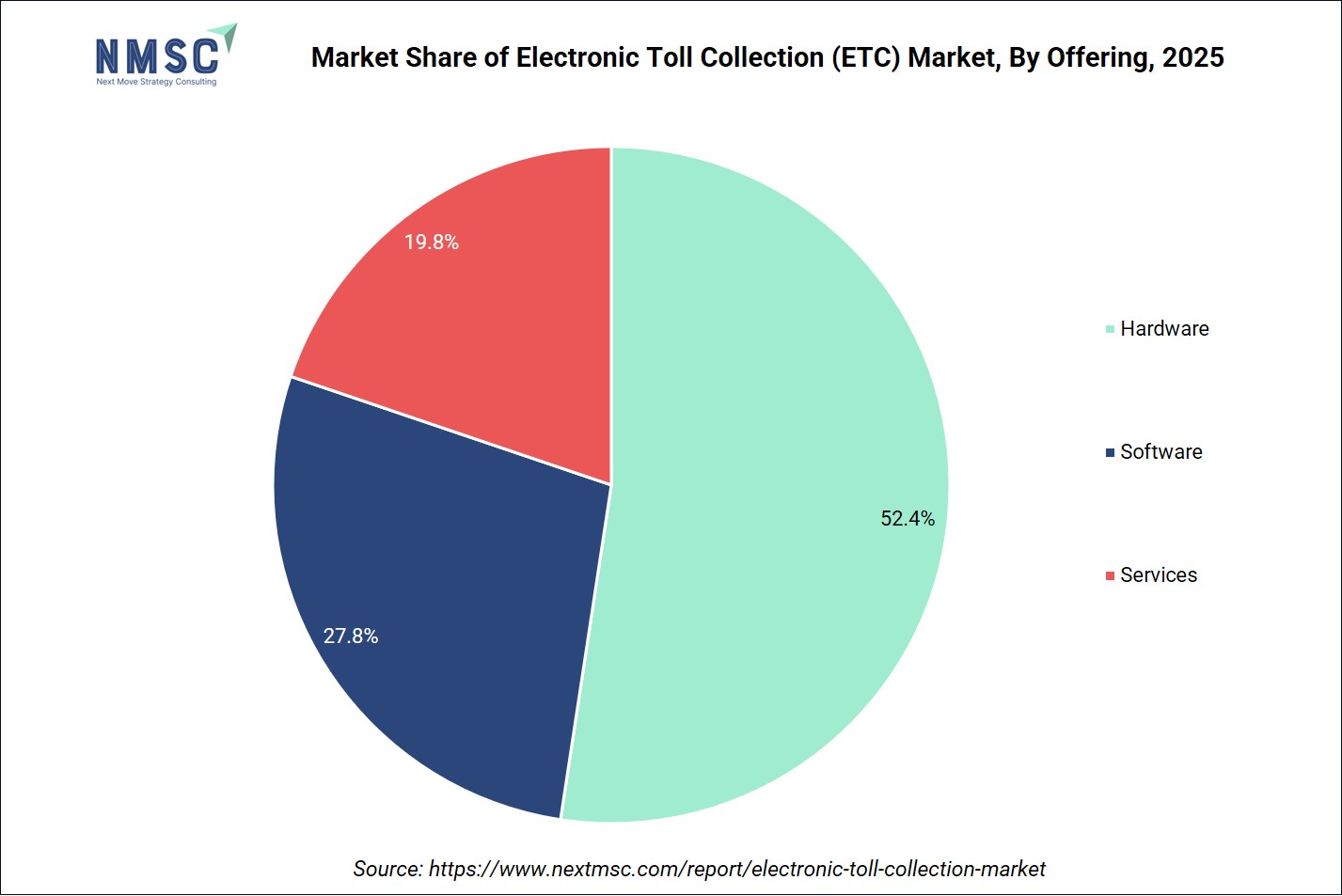
On the basis of offering, the Electronic Toll Collection (ETC) market is segmented into hardware, software, and services.
Based on our assessment, we found that hardware remains the dominant segment, as toll operators continue investing heavily in RFID infrastructure, ANPR cameras, roadside equipment, sensors, and automated lane systems to improve toll collection efficiency and traffic throughput. Our analysis further indicates that software solutions are gaining strong momentum due to rising demand for centralized toll management, cloud integration, interoperability platforms, AI-enabled traffic analytics, and real-time transaction monitoring. Meanwhile, services play a critical role in supporting system integration, maintenance, consulting, and managed tolling operations under long-term public-private partnership models. Overall, the market is increasingly shifting toward integrated digital tolling ecosystems that combine physical infrastructure with intelligent software and operational support services.
By Technology Insights
Is Technology Segmentation Accelerating Digital Transformation in the Electronic Toll Collection (ETC) Market?
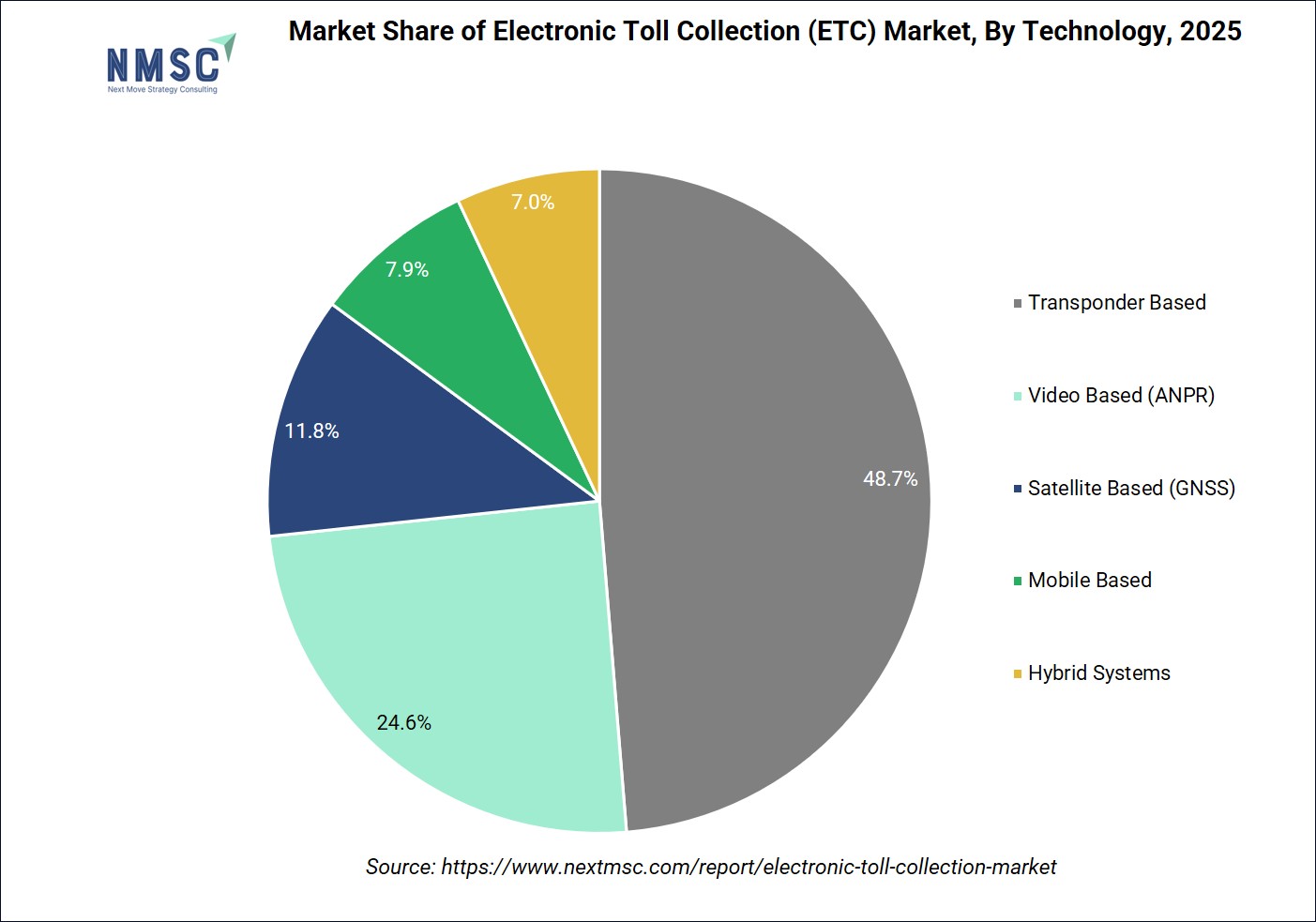
On the basis of technology, the Electronic Toll Collection (ETC) market is segmented into transponder-based, video-based (ANPR), satellite-based (GNSS), mobile-based, and hybrid systems.
Based on our assessment, we found that transponder-based ETC systems continue to dominate the market owing to their well-established infrastructure ecosystem, high transaction reliability, faster processing capability, and extensive deployment across national expressways, urban toll corridors, and large-scale highway modernization projects globally. Our analysis further indicates that video-based (ANPR) systems are witnessing accelerated adoption as transportation authorities increasingly implement free-flow tolling, AI-enabled vehicle recognition, and automated enforcement technologies to reduce congestion and improve operational efficiency. Meanwhile, satellite-based (GNSS) tolling is gaining traction for distance-based charging models, freight monitoring, and cross-border toll interoperability applications. Mobile-based and hybrid ETC systems are also expanding steadily, supported by smart mobility initiatives, digital payment integration, connected transportation ecosystems, and rising demand for multi-technology interoperability solutions.
By Toll Structure Insights
Is Toll Structure Segmentation Reshaping Traffic Management and Tolling Efficiency in the Electronic Toll Collection (ETC) Market?
On the basis of toll structure, the Electronic Toll Collection (ETC) Market is segmented into barrier tolling, free-flow tolling, closed-loop tolling, and hybrid tolling.
Based on our assessment, we found that barrier tolling currently dominates the market due to its extensive installed infrastructure base, established operational framework, and continued deployment across conventional toll plaza networks in both developing and mature economies. Our evaluation further indicates that free-flow tolling is emerging as the fastest-growing segment, driven by increasing government focus on congestion reduction, uninterrupted traffic flow, lower vehicle emissions, improved fuel efficiency, and smart transportation modernization initiatives. Meanwhile, closed-loop tolling continues to play a vital role in long-distance expressway and corridor-based transportation systems requiring accurate distance-based fare calculation. Hybrid tolling models are also gaining strong traction as toll operators gradually transition from legacy toll infrastructure toward highly automated, interoperable, and digitally integrated toll management ecosystems.
Regional Outlook
Geographic Performance Snapshot:
|
Geography |
Key Takeaways |
|
North America |
North America represents a mature ETC market supported by extensive toll road infrastructure and widespread adoption of RFID and ANPR technologies. The United States and Canada lead deployment of cashless and barrier-free tolling systems. Strong commercial vehicle traffic, intelligent transportation investments, and continuous toll road modernization initiatives continue supporting stable regional market expansion. |
|
Europe |
Europe is an interoperability-driven ETC market characterized by advanced cross-border tolling systems and strong regulatory alignment. Countries including Germany, France, and Italy are leading adoption of GNSS-based and distance-based tolling technologies. Environmental regulations, emission-linked tolling policies, and increasing focus on sustainable mobility continue accelerating regional ETC deployment and modernization efforts. |
|
Asia-Pacific |
Asia-Pacific is the fastest-growing ETC market, driven by highway expansion, rising vehicle ownership, and strong government digitalization initiatives. China and India are leading deployment through nationwide RFID-enabled tolling systems and integrated digital payment platforms. Smart city projects, urban congestion management, and expressway modernization programs continue accelerating ETC adoption across the region. |
|
Latin America |
Latin America is an emerging ETC market supported by infrastructure modernization projects and growing public-private partnerships in toll road development. Brazil and Mexico lead regional adoption through increasing deployment of automated toll collection systems. However, interoperability challenges and uneven infrastructure investment continue limiting broader market penetration across several developing economies. |
|
Middle East & Africa |
The Middle East & Africa ETC market is witnessing gradual growth driven by smart infrastructure investments and urban mobility initiatives. Gulf countries, particularly the UAE and Saudi Arabia, are leading deployment of automated tolling technologies. Meanwhile, African markets remain at an early adoption stage due to infrastructure gaps and varying levels of digital readiness. |
The Electronic Toll Collection (ETC) Market is geographically studied across North America, Europe, Asia Pacific, the Middle East & Africa, and Latin America, and each region is further studied across countries.
Electronic Toll Collection (ETC) Market in North America
North America represents a technologically mature and highly penetrated Electronic Toll Collection (ETC) market, driven by widespread deployment of intelligent transportation infrastructure and strong adoption of cashless mobility solutions. Our assessment indicates that demand is supported by extensive highway toll networks, advanced digital payment ecosystems, and increasing implementation of barrier-free tolling technologies across the United States and Canada. According to transportation infrastructure and mobility investment trends, the region continues to prioritize modernization of toll roads, congestion management systems, and interoperable toll collection frameworks.
Based on our interactions with industry participants and transportation authorities, we observed rising investments in RFID-, ANPR-, and cloud-based toll management technologies to improve operational efficiency and reduce traffic congestion. Government focus on smart transportation initiatives, coupled with increasing commercial vehicle movement and urban traffic density, is further accelerating ETC deployment. Overall, market growth in North America is being driven by digital infrastructure modernization, interoperability expansion, and transition toward fully automated toll collection ecosystems.
Electronic Toll Collection (ETC) Market in the United States
NMSC’s analysis indicates that the United States is the largest and most advanced Electronic Toll Collection (ETC) Market within North America, supported by extensive highway toll infrastructure and high adoption of cashless tolling technologies. Based on our assessment, widespread deployment of RFID-based transponders, ANPR systems, and free-flow tolling solutions across highways, bridges, and managed lanes continues strengthening market expansion. Industry findings further suggest that transportation agencies are increasingly prioritizing interoperability, congestion reduction, and operational automation through intelligent toll management systems. Rising freight transportation activity, increasing urban traffic congestion, and continuous investments in smart highway infrastructure are also driving demand for advanced ETC solutions. Additionally, integration of ETC platforms with mobile payments, connected vehicle ecosystems, and real-time traffic analytics is improving operational efficiency and enhancing user convenience. Overall, the United States market continues to benefit from strong transportation modernization initiatives and long-term investments in intelligent mobility infrastructure.
Electronic Toll Collection (ETC) Market in Canada
Canada represents a steadily developing Electronic Toll Collection (ETC) Market, supported by transportation infrastructure modernization programs and increasing deployment of intelligent mobility technologies. We observed growing adoption of RFID-enabled toll collection systems, automated license plate recognition technologies, and interoperable digital payment platforms across major transportation corridors and urban regions. Industry evidence further indicates that government initiatives focused on congestion reduction, highway efficiency improvement, and smart transportation development are supporting continued ETC implementation. Rising cross-border transportation activity with the United States and increasing urbanization are also contributing to demand for automated toll management solutions. Additionally, investments in intelligent transportation systems and digital highway infrastructure are encouraging greater integration of real-time traffic monitoring and cashless tolling technologies. Overall, the Canadian ETC market is experiencing stable growth, driven by ongoing infrastructure upgrades, digital transportation transformation, and increasing preference for seamless toll collection operations.
Electronic Toll Collection (ETC) Market in Europe
NMSC’s research indicates that Europe represents one of the most advanced and interoperability-focused Electronic Toll Collection (ETC) Market globally, supported by strong regulatory alignment and cross-border transportation integration. Our assessment suggests that countries across Western Europe are increasingly deploying GNSS-based tolling, free-flow systems, and interoperable electronic toll services to improve traffic efficiency and enable seamless regional mobility. Europe also remains a leading adopter of distance-based and emission-linked tolling frameworks, particularly for heavy commercial vehicles, reflecting the region’s strong sustainability orientation. Additionally, government contribution in intelligent transportation infrastructure investments, congestion management systems, and automated traffic monitoring technologies continue accelerating ETC modernization. Based on our interactions with transportation stakeholders, we observed rising focus on digital payment integration, operational automation, and real-time traffic management capabilities. Overall, regulatory standardization, sustainability objectives, and continuous transportation digitalization are reinforcing Europe’s position as a technologically mature and policy-driven ETC market.
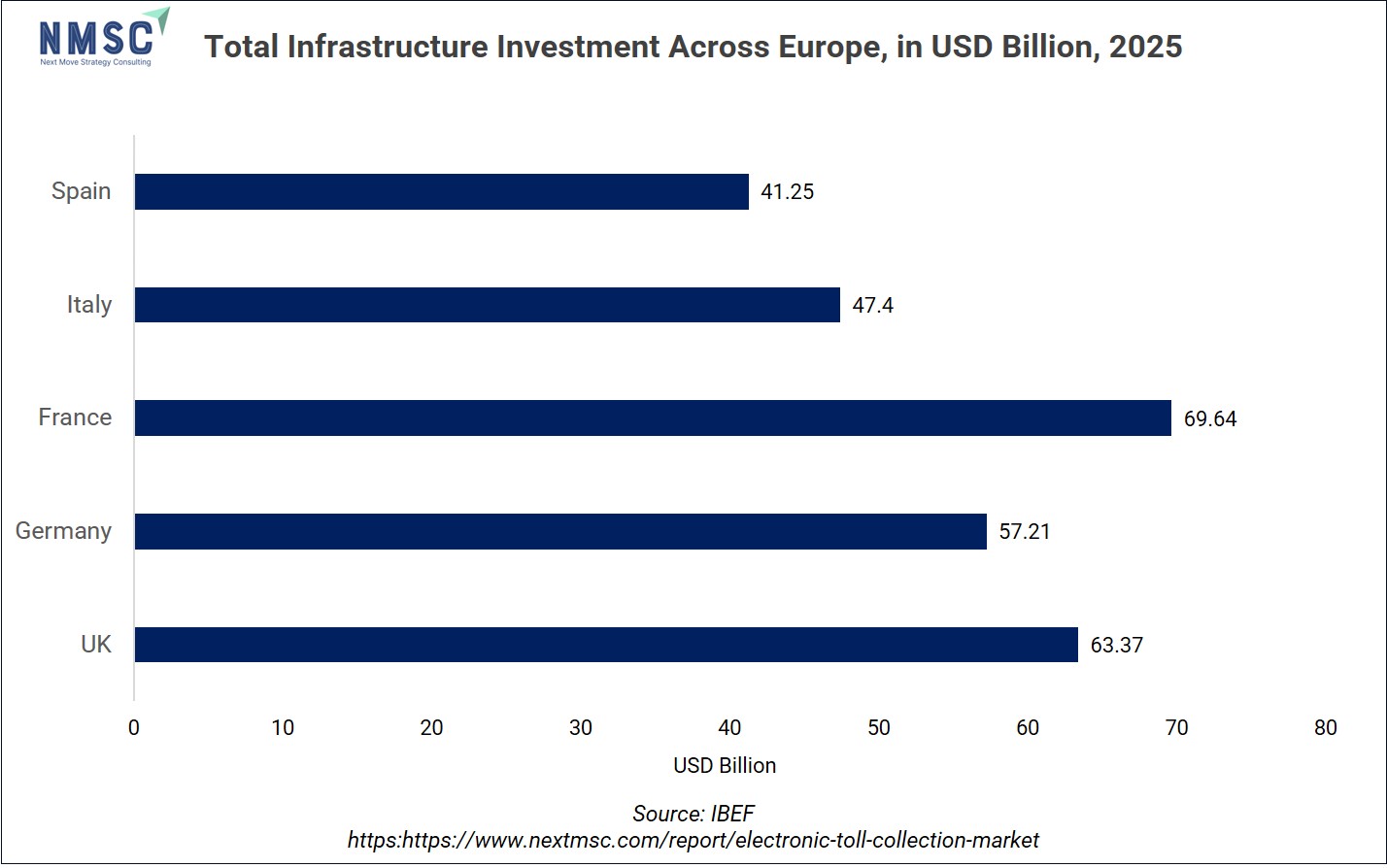
Electronic Toll Collection (ETC) Market in the United Kingdom
Our market assessment suggests that the United Kingdom represents a mature and technologically advanced Electronic Toll Collection (ETC) Market, characterized by extensive deployment of cashless and free-flow tolling technologies across highways, bridges, and urban transport corridors. Strong investments in intelligent transportation systems, automated enforcement technologies, and smart mobility infrastructure continue supporting market expansion throughout the country. Industry evidence further indicates increasing adoption of ANPR-based tolling systems, digital payment integration, and real-time traffic monitoring platforms to improve operational efficiency and reduce congestion levels. Rising urban traffic density and growing emphasis on sustainable transportation solutions are also accelerating deployment of digitally integrated toll management systems. Additionally, transportation authorities are increasingly prioritizing interoperability and barrier-free toll collection frameworks to enhance user convenience and traffic flow optimization. Overall, the UK ETC market is defined by advanced infrastructure modernization, strong operational automation capabilities, and continuous transition toward seamless digital mobility ecosystems.
Electronic Toll Collection (ETC) Market in Germany
Germany represents one of Europe’s most structurally advanced Electronic Toll Collection (ETC) Market, supported by highly developed transportation infrastructure and strong emphasis on efficiency-driven mobility management systems. Based on our assessment, GNSS-based tolling technologies for heavy commercial vehicles remain central to the country’s ETC ecosystem, particularly across major freight transportation corridors. Industry findings further suggest that strict environmental regulations, emission-based tolling policies, and rising freight movement are continuing to accelerate demand for intelligent toll management solutions. We also observed increasing implementation of automated toll collection, real-time traffic monitoring, and digital enforcement technologies aimed at improving operational efficiency and reducing congestion. Additionally, investments in smart transportation infrastructure and connected mobility systems are strengthening integration of digitally managed tolling frameworks. Overall, Germany’s ETC market is strongly shaped by sustainability objectives, infrastructure efficiency requirements, and long-term transportation digitalization strategies.
Electronic Toll Collection (ETC) Market in France
France’s Electronic Toll Collection (ETC) Market is characterized by extensive motorway toll infrastructure and increasing transition toward automated and free-flow toll collection technologies. Our industry assessment indicates that transportation authorities are prioritizing congestion reduction, seamless traffic movement, and operational efficiency through wider deployment of RFID- and ANPR-based tolling systems across major transport corridors. Industry evidence further suggests that smart mobility initiatives and modernization of existing toll networks are accelerating adoption of intelligent toll management platforms and digital payment ecosystems. Rising vehicle traffic volumes and increasing investments in transportation infrastructure are also supporting market expansion. Additionally, integration of automated enforcement systems and real-time traffic monitoring technologies is improving toll collection efficiency and reducing operational delays. Overall, the French ETC market reflects a balanced combination of established toll infrastructure and continuous digital transformation within national transportation networks.
Electronic Toll Collection (ETC) Market in Italy
Italy’s Electronic Toll Collection (ETC) Market is evolving steadily through ongoing modernization of motorway toll infrastructure and increasing adoption of interoperable electronic toll collection technologies. Our analysis indicates that the country maintains strong deployment of ETC systems across major expressways, supported by high intercity transportation activity and significant tourism-driven vehicle movement. Industry interactions further suggest growing investments in free-flow tolling technologies, automated lane management systems, and digital payment integration to improve operational efficiency and reduce traffic congestion. Additionally, transportation authorities are increasingly implementing intelligent traffic monitoring and automated enforcement solutions to support seamless toll collection operations. Demand is also being strengthened by rising focus on smart mobility initiatives and transportation infrastructure upgrades across regional highway networks. Overall, Italy’s ETC landscape reflects gradual but consistent digital transformation supported by infrastructure modernization and evolving transportation management strategies.
Electronic Toll Collection (ETC) Market in Spain
NMSC’s analysis indicates that Spain is experiencing steady Electronic Toll Collection (ETC) Market expansion, supported by highway modernization programs and increasing deployment of automated toll collection technologies across major transportation corridors. We observed rising implementation of cashless tolling systems, interoperable digital payment platforms, and intelligent traffic management solutions aimed at improving traffic efficiency and reducing operational bottlenecks. Government focus on transportation infrastructure development and smart mobility integration is further accelerating adoption of digitally managed tolling systems. Industry evidence also suggests growing transition toward free-flow tolling environments and enhanced automation capabilities across selected expressway networks. Additionally, increasing urbanization and rising vehicle traffic volumes are contributing to long-term demand for efficient toll management technologies. Overall, the Spanish ETC market is gradually evolving toward more advanced and digitally integrated toll collection ecosystems.
Electronic Toll Collection (ETC) Market in the Nordics
The Nordics represent one of the most digitally advanced and sustainability-oriented Electronic Toll Collection (ETC) Market globally, where transportation modernization is closely aligned with environmental and smart mobility objectives. We observed widespread adoption of automated tolling systems, congestion pricing frameworks, and interoperable digital payment technologies across Sweden, Norway, and Denmark. Government initiatives focused on emission reduction, intelligent traffic management, and seamless urban mobility integration continue supporting strong ETC deployment across regional transportation networks. Industry findings further indicate rising implementation of barrier-free tolling systems and real-time traffic monitoring technologies to improve operational efficiency and support sustainable transportation goals. Additionally, high digital infrastructure readiness and strong public acceptance of smart mobility solutions are accelerating adoption of integrated toll management ecosystems. Overall, the Nordic ETC market operates as a highly technology-driven and sustainability-focused transportation environment.
Electronic Toll Collection (ETC) Market in the Asia-Pacific
Based on our regional assessment, we observed that Asia-Pacific serves as the fastest-growing and most infrastructure-intensive Electronic Toll Collection (ETC) market globally, supported by rapid highway expansion, increasing vehicle ownership, and strong government-led transportation modernization initiatives. China, India, Japan, and Southeast Asian countries are accelerating deployment of RFID-enabled tolling systems, interoperable payment frameworks, and intelligent transportation infrastructure to improve traffic efficiency and reduce congestion. The region operates through a dual dynamic, combining large-scale expressway development with rising adoption of smart mobility ecosystems and digital payment integration. We also observed increasing investments in free-flow tolling, AI-enabled traffic management systems, and cloud-based toll operations platforms to strengthen transportation efficiency and operational automation. Overall, market growth across Asia-Pacific is being reinforced by urbanization, smart city initiatives, expanding logistics activity, and continuous investments in digitally integrated transportation infrastructure and automated toll collection technologies.
Electronic Toll Collection (ETC) Market in China
China’s Electronic Toll Collection (ETC) market is evolving rapidly through large-scale deployment of intelligent transportation infrastructure and nationwide adoption of digital tolling technologies. Based on our assessment, strong government support for smart mobility initiatives and transportation digitalization continues driving implementation of RFID-enabled tolling systems across expressways and urban transport corridors. Demand is primarily supported by rising vehicle ownership, increasing intercity freight movement, and rapid highway network expansion throughout the country. We also observed strong integration of ETC platforms with mobile payment ecosystems, cloud-based traffic management systems, and AI-enabled vehicle identification technologies to improve operational efficiency and traffic flow optimization. Industry evidence further indicates increasing transition toward barrier-free and interoperable tolling environments supported by centralized toll management frameworks. Overall, China’s ETC market is characterized by infrastructure scale, strong policy-driven deployment, and accelerating adoption of digitally integrated transportation management ecosystems.
Electronic Toll Collection (ETC) Market in Japan
Japan represents a highly advanced and efficiency-driven Electronic Toll Collection (ETC) Market where operational reliability, traffic optimization, and technology integration strongly influence deployment strategies. ETC systems are extensively integrated across expressways, urban highways, and major transportation corridors, supported by sophisticated transportation infrastructure and high digital readiness. Our assessment indicates that transportation authorities prioritize seamless toll processing, automated traffic monitoring, and interoperability capabilities to reduce congestion and improve mobility efficiency. Industry interactions further suggest increasing adoption of AI-enabled traffic analytics, smart mobility integration, and cloud-based toll management systems to support next-generation transportation ecosystems. Additionally, strong focus on infrastructure resilience and operational precision continues encouraging investments in advanced toll automation technologies. Overall, Japan’s ETC market operates as a highly mature and technology-centric transportation ecosystem characterized by stable deployment, strong digital integration, and continuous operational modernization initiatives.
Electronic Toll Collection (ETC) Market in India
India functions as one of the world’s fastest-expanding Electronic Toll Collection (ETC) market, supported by nationwide highway modernization programs and mandatory RFID-based tolling implementation under the FASTag ecosystem. We observed strong deployment growth across national highways, expressways, and urban transport corridors driven by rising vehicle traffic and increasing focus on congestion reduction. Unlike several developing markets, India benefits from large-scale digital payment adoption and centralized toll interoperability frameworks that support efficient nationwide ETC operations. Government initiatives focused on smart transportation infrastructure, highway expansion, and intelligent mobility integration are further accelerating market growth. We also observed rising investments in free-flow tolling pilots, AI-enabled traffic monitoring systems, and automated enforcement technologies to improve toll collection efficiency. Overall, India’s ETC market is characterized by rapid infrastructure expansion, strong policy-driven adoption, and continuous transition toward digitally integrated transportation management ecosystems.
Electronic Toll Collection (ETC) Market in South Korea
NMSC’s regional analysis suggests that South Korea represents a technologically advanced Electronic Toll Collection (ETC) Market where smart mobility integration and digital transportation efficiency strongly shape market development. Demand is supported by extensive urban transportation networks, high vehicle density, and increasing adoption of automated tolling technologies across expressways and metropolitan transport corridors. We observed strong implementation of RFID-enabled toll systems, digital payment integration, and intelligent traffic management platforms aimed at improving operational efficiency and reducing congestion. Industry findings further indicate rising investments in connected mobility ecosystems, AI-driven traffic analytics, and real-time toll management technologies to strengthen transportation automation capabilities. Government-led smart city initiatives and advanced digital infrastructure are also accelerating adoption of interoperable tolling frameworks. Overall, South Korea’s ETC market reflects strong technological maturity, efficient transportation management systems, and continuous digital mobility transformation initiatives.
Electronic Toll Collection (ETC) Market in Taiwan
Taiwan represents a technologically progressive Electronic Toll Collection (ETC) Market characterized by strong digital infrastructure and widespread deployment of free-flow electronic tolling systems across national expressways. We observed that transportation authorities are increasingly prioritizing seamless traffic movement, automated toll collection, and real-time traffic management to improve operational efficiency and reduce congestion levels. Industry evidence further suggests rising integration of ETC systems with digital payment platforms, intelligent transportation infrastructure, and connected mobility ecosystems. Strong government focus on transportation modernization and smart infrastructure development continues supporting adoption of advanced toll management technologies. Additionally, increasing vehicle movement and urban transportation demand are encouraging investments in AI-enabled traffic monitoring and automated enforcement solutions. Overall, Taiwan’s ETC market operates as a highly digitized transportation ecosystem characterized by operational automation, strong interoperability capabilities, and continuous smart mobility advancement.
Electronic Toll Collection (ETC) Market in Indonesia
Indonesia holds growing strategic importance within the Asia-Pacific Electronic Toll Collection (ETC) Market due to rapid toll road expansion and increasing investments in transportation infrastructure modernization. Our assessment indicates that electronic tolling deployment is accelerating across major highways and urban transport corridors, supported by government-led infrastructure development initiatives and rising vehicle traffic volumes. Demand is further strengthened by increasing adoption of RFID-enabled toll systems, digital payment platforms, and automated traffic management technologies aimed at improving operational efficiency. However, infrastructure gaps, fragmented transportation networks, and varying digital readiness levels continue influencing deployment scalability across certain regions. Industry evidence also suggests increasing transition toward interoperable toll collection systems and centralized traffic management frameworks to support long-term mobility efficiency. Overall, Indonesia’s ETC market remains in an active development phase characterized by infrastructure expansion and gradual digital transportation transformation.
Electronic Toll Collection (ETC) Market in Australia
NMSC’s evaluation indicates that Australia represents a mature and highly automated Electronic Toll Collection (ETC) Market where digital mobility infrastructure and operational efficiency strongly influence transportation management strategies. Electronic tolling systems are extensively deployed across urban motorways, managed lanes, and major transport corridors, supported by widespread adoption of cashless toll collection technologies. We observed strong implementation of ANPR systems, interoperable toll payment platforms, and intelligent traffic management solutions aimed at reducing congestion and improving traffic flow optimization. Industry findings further suggest increasing investments in smart mobility initiatives, cloud-based toll operations, and connected transportation ecosystems to strengthen long-term infrastructure efficiency. Additionally, transportation authorities continue prioritizing barrier-free tolling frameworks and automated enforcement technologies to improve operational performance and user convenience. Overall, Australia’s ETC market reflects strong digital maturity, infrastructure modernization, and highly integrated transportation management capabilities.
Electronic Toll Collection (ETC) Market in Latin America
Our regional analysis indicates that Latin America represents an emerging Electronic Toll Collection (ETC) market supported by ongoing highway modernization projects and increasing investments in transportation infrastructure development. Brazil, Mexico, and Chile are leading regional deployment of automated toll collection technologies through public-private partnership models and expanding toll road networks. We observed growing implementation of RFID-enabled tolling systems, interoperable payment platforms, and intelligent traffic management technologies aimed at improving operational efficiency and reducing congestion. However, deployment remains uneven across the region due to infrastructure gaps, regulatory inconsistencies, and varying levels of digital readiness. Industry evidence further suggests that governments are increasingly prioritizing free-flow tolling and automated traffic management systems to improve revenue collection and mobility efficiency. Overall, the Latin American ETC market remains in a developing growth phase characterized by infrastructure expansion, gradual digital transformation, and increasing adoption of intelligent transportation systems.
Electronic Toll Collection (ETC) Market in the Middle East & Africa
Our evaluation indicates that the Middle East & Africa region represents a gradually expanding Electronic Toll Collection (ETC) Market characterized by uneven infrastructure development and varying levels of transportation digitalization. Gulf countries, particularly the UAE and Saudi Arabia, are leading deployment of automated and barrier-free tolling technologies through smart city initiatives and intelligent mobility programs. We observed increasing adoption of RFID-based toll collection systems, digital payment integration, and AI-enabled traffic management platforms across major urban transport corridors. In contrast, several African economies remain at an early deployment stage due to infrastructure limitations, funding constraints, and lower digital readiness levels. Industry findings further suggest that rising urbanization, increasing vehicle traffic, and government investments in transportation modernization are gradually supporting ETC adoption across selected regional markets. Overall, the region reflects a dual-speed ETC landscape with advanced deployment in Gulf economies and foundational development across Africa.
Regulatory Framework Impacting the Electronic Toll Collection (ETC) Market
The below mentioned regulatory framework of the Electronic Toll Collection (ETC) Market illustrates how government investments, compliance oversight, and evolving digital rules collectively shape market operations and long-term industry stability across the global ETC ecosystem.
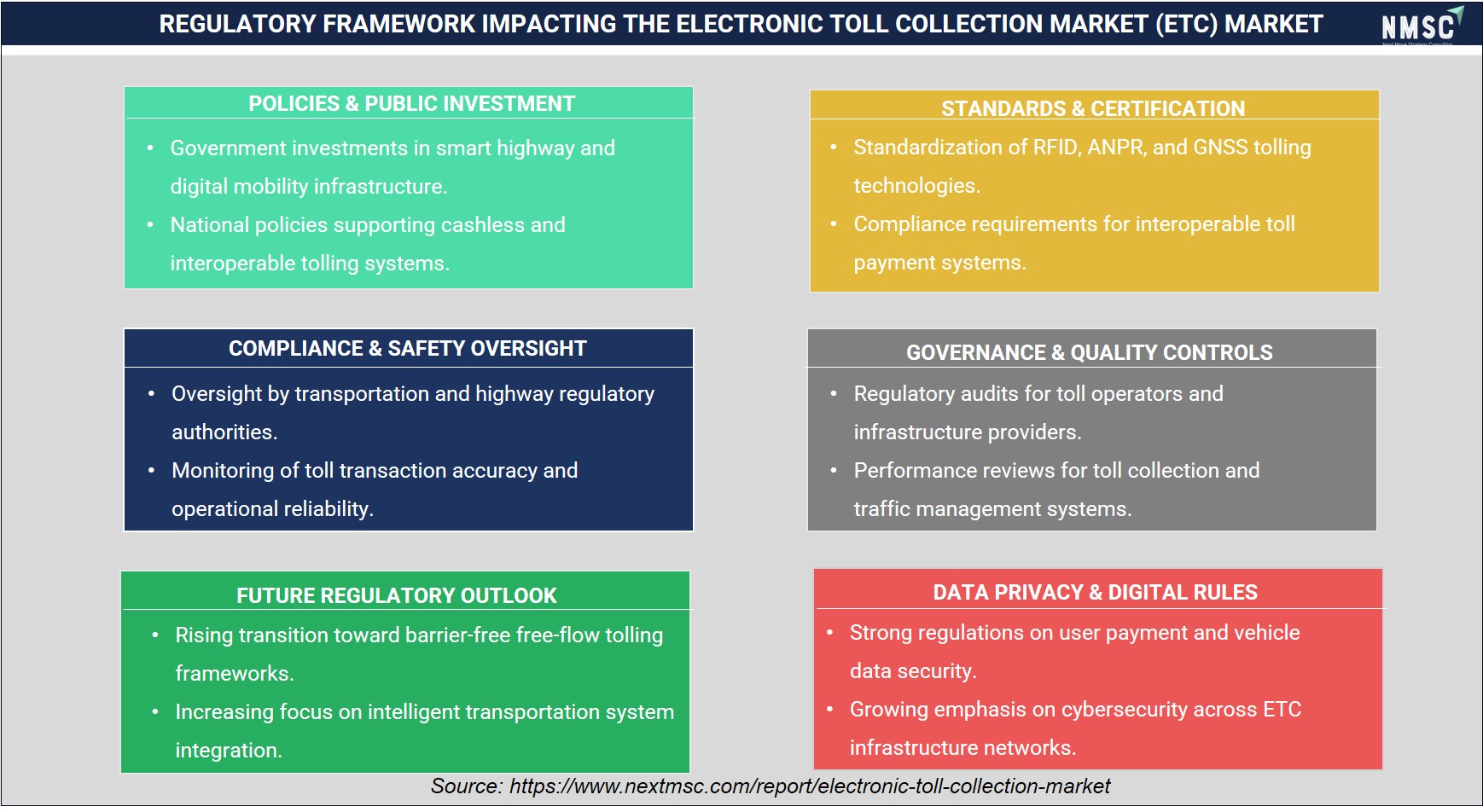
The ETC Market is increasingly defined by the convergence of national cashless tolling policies, interoperable technology standards, and data security mandates rather than fragmented regional toll collection dynamics. Based on our assessment, we found that transport authorities and toll operators are shifting toward RFID, ANPR, and GNSS standardisation, while operational systems are being optimised for transaction accuracy, safety compliance, and real-time monitoring. Regulatory audits and performance reviews are becoming decisive factors in toll operator selection and infrastructure procurement across global markets. We noticed that data privacy laws and cybersecurity requirements are strengthening consumer trust and network resilience across interconnected tolling systems. Overall, the market is evolving into a structured, compliance-driven regulatory environment where governance, security, and operational transparency determine long-term viability.
Competitive Landscape
Competitive Dynamics & M&A Landscape:
The Electronic Toll Collection (ETC) market is characterized by a highly consolidated yet technologically diverse competitive ecosystem, led by global system integrators and intelligent transport solution providers such as Kapsch TrafficCom AG, Conduent Incorporated, and TransCore LP. These players dominate large-scale tolling concessions and national deployments through end-to-end ETC platforms combining RFID, ANPR, and back-office clearing systems. European infrastructure operators such as Sanef SA and Abertis Mobility Services further reinforce market consolidation through integrated toll road operations and mobility services expansion. Meanwhile, technology-driven enforcement and imaging specialists like Perceptics, LLC and VITRONIC Dr.-Ing. Stein Bildverarbeitungssysteme GmbH strengthen the ANPR and video-based tolling segment.
Mid-tier and regional players are intensifying competition by focusing on modular tolling infrastructure, interoperability, and national highway deployments. Companies such as International Road Dynamics Inc. (IRD), Q-Free ASA, and Neology Inc. are leveraging flexible transponder systems and roadside unit technologies to capture emerging free-flow tolling projects. Asian and European engineering and mobility solution providers including Indra Sistemas S.A., SICE, EFKON GmbH, and TagMaster AB are strengthening their positioning through smart transport integration, V2X readiness, and digital toll enforcement platforms. Similarly, organizations like GeoToll and Eurotoll SAS are expanding cloud-based toll payment and cross-border interoperability solutions.
Technology differentiation is increasingly defining competitive advantage, with a strong shift toward multi-lane free-flow tolling, GNSS-based systems, and AI-enabled enforcement analytics. Industrial technology conglomerates such as Mitsubishi Heavy Industries and TOSHIBA CORPORATION are contributing advanced electronics, sensors, and mobility infrastructure components, accelerating system accuracy and scalability. Across the ecosystem, M&A activity and strategic alliances are driven by the need to integrate hardware, software, and digital payment platforms into unified mobility ecosystems. The competitive battleground is increasingly centered on interoperability standards, national highway digitization programs, and the transition toward fully automated, contactless tolling architectures.
Which Companies Dominate the Electronic Toll Collection (ETC) Market and How Do They Compete?
NMSC’s assessment indicates that the Electronic Toll Collection (ETC) market is dominated by a concentrated group of global tolling technology providers, intelligent transport system (ITS) integrators, and enforcement and payment ecosystem specialists. We observed that leading players such as Kapsch TrafficCom AG, Conduent Incorporated, and TransCore LP anchor the global competitive landscape through large-scale highway tolling deployments, interoperable multi-lane free-flow (MLFF) systems, and end-to-end toll transaction management platforms. These companies maintain dominance through long-term government concessions, deep integration with national transportation authorities, and strong capabilities in RFID, DSRC, ANPR, and GNSS-based tolling architectures.
Market Dominated by ETC Giants and Integrated Mobility Solution Providers
The Electronic Toll Collection (ETC) Market structure is characterized by a dual dominance of system integrators and toll infrastructure operators, creating a layered competitive environment. Based on our analysis, European mobility operators such as Sanef SA and Abertis Mobility Services maintain strong market positions through vertically integrated toll road ownership, concession-based revenue models, and large-scale deployment of electronic tolling networks across multiple geographies. These firms benefit from direct access to toll infrastructure, allowing them to combine operations, enforcement, and payment collection under unified digital platforms. At the same time, technology-centric ITS providers such as Q-Free ASA, Neology Inc., and International Road Dynamics Inc. (IRD) compete by offering modular, scalable, and interoperable tolling systems tailored to national highway authorities and smart mobility programs. These companies emphasize transponder technologies, roadside equipment, and back-office software solutions that enable flexible deployment across both developed and emerging tolling corridors. Meanwhile, enforcement and vehicle identification specialists such as VITRONIC Dr.-Ing. Stein Bildverarbeitungssysteme GmbH and Perceptics, LLC strengthen the competitive ecosystem through advanced ANPR (Automatic Number Plate Recognition), video analytics, and high-accuracy vehicle classification systems that are critical for free-flow tolling environments.
Innovation and Technology Convergence Drive Competitive Differentiation
Innovation within the Electronic Toll Collection (ETC) Market is increasingly driven by digital transformation, automation, and convergence of tolling with broader intelligent transportation ecosystems. Companies such as Indra Sistemas S.A., SICE, EFKON GmbH, and TagMaster AB are advancing integrated tolling architectures that combine roadside hardware, centralized toll management platforms, and interoperability frameworks supporting cross-border and multi-network tolling. Additionally, cloud-native and digital payment-focused firms such as GeoToll and Eurotoll SAS are reshaping the market by enabling account-based tolling, smartphone-enabled payments, and seamless multi-jurisdiction billing systems. These capabilities are increasingly critical as governments transition toward fully cashless, barrier-free tolling ecosystems. Industrial and electronics conglomerates such as Mitsubishi Heavy Industries and TOSHIBA CORPORATION further contribute to market evolution through advanced sensing technologies, embedded systems, and high-performance electronics that enhance tolling accuracy, vehicle detection reliability, and system scalability in high-traffic environments.
Competitive Strategies and Market Expansion Dynamics
Strategic expansion in the Electronic Toll Collection (ETC) Market is primarily driven by long-term concession agreements, digital highway modernization programs, and interoperability-driven partnerships rather than purely acquisition-led consolidation. Leading players are increasingly focused on securing integrated tolling ecosystems that combine hardware infrastructure, software platforms, enforcement systems, and payment reconciliation capabilities into unified mobility-as-a-service frameworks. We observed that competitive positioning is increasingly defined by the ability to deliver end-to-end digital tolling infrastructure, support real-time data processing, and ensure seamless interoperability across regional and national networks. As a result, companies are prioritizing AI-enabled vehicle classification, GNSS-based tolling expansion, and cloud-based toll transaction management systems to strengthen operational efficiency and scalability. Overall, the ETC market is evolving into a fully digitized mobility infrastructure ecosystem, where competitive advantage is no longer defined solely by tolling hardware deployment, but by platform integration, data intelligence capabilities, and the ability to support next-generation smart transportation networks.
List of Key Electronic Toll Collection (ETC) Companies
-
Kapsch TrafficCom AG
-
Conduent Incorporated
-
TransCore LP
-
Sanef S.A.
-
Perceptics LLC
-
International Road Dynamics Inc.
-
Q-Free ASA
-
Egis S.A.
-
Neology, Inc.
-
GeoToll
-
Abertis Mobility Services
-
VITRONIC Dr.-Ing. Stein Bildverarbeitungssysteme GmbH
-
STAR Systems International Limited
-
Mitsubishi Heavy Industries, Ltd.
-
Toshiba Corporation
-
Eurotoll S.A.S.
-
Indra Sistemas, S.A.
-
SICE Tecnología y Sistemas, S.A.
-
EFKON GmbH
-
TagMaster AB
What Are the Latest Key Industry Developments?
-
February 2026 – Kapsch TrafficCom expanded its GNSS-based tolling capabilities through a satellite-based truck tolling project in Lithuania featuring smartphone-app integration and infrastructure-light road user charging technology. The system reduces dependence on roadside tolling infrastructure while supporting digital and distance-based toll collection models for national road networks.
-
January 2026 - Kapsch partnered with Valeo (automotive tech leader) to develop a Vehicle-to-Everything (V2X) tolling solution. The technology allows vehicles to communicate directly with roadside units to perform secure, automated toll transactions. The system is based on the SAE J3217 open standard.
-
January 2026 - TransCore was awarded a $146 million contract to become the new toll service provider for the RiverLink system serving the Louisville-Southern Indiana Ohio River Bridges. The company will deploy its cloud-based Integrity Back Office System to manage customer service, account management, and invoicing.
-
December 2025 - TransCore secured a major contract for a fully electronic, barrier-free tolling system for the Western Harbour Tunnel. The system relies on video-based tolling (ANPR + backend reconciliation) instead of physical tags.
-
April 2025 - Q-Free, a global leader in mobility solutions for smart city infrastructure, today announced it has won three major contracts with toll road operators to deploy the company’s acclaimed Kinetic® Mobility Advanced Traffic Management System (ATMS), signaling the solution’s entry into the U.S. tolling market
Expert Insights
 “The CBDTP's results demonstrate how innovation and close collaboration can deliver real, measurable benefits in one of the world's most complex transportation environments. In just months, the program has reduced congestion, improved travel speeds, reduced accidents, and is already generating substantial new funding for public transit.”
- Whitt Hall, President and CEO of TransCore LP
Statement made upon receiving the International Bridge, Tunnel and Turnpike Association's (IBTTA) Toll Excellence Award in the Private Sector Innovation category for the Metropolitan Transportation Authority's Central Business District Tolling Program (CBDTP), the first congestion pricing program of its kind in the United States.
Market Interpretation
This assertion signifies an unprecedented turning point for the Electronic Toll Collection (ETC) Market, marked by the implementation of the first urban congestion charging system in the USA. CBDTP is revolutionary for the industry not only due to its nature being quite different from regular tolling of highways but also thanks to the use of the innovative AI technology provided by TransCore, which features machine learning and neural networks for data processing and enables vehicle detection at more than 100 points surrounding Manhattan's Congestion Relief Zone, all without using any underground sensors or transponders. In terms of the whole ETC industry, the project serves as a viable model for implementing such a solution in other urban environments in different countries around the world who consider implementing congestion charging in their cities. As for the mentioned benefits achieved by the use of this technology, it is clear that the implementation of AI in ETC systems helps solve traffic problems, promote sustainability, and raise money for transportation infrastructure development.
SWOT Analysis of the Electronic Toll Collection (ETC) Market
The following SWOT analysis highlights a structured overview of the Electronic Toll Collection (ETC) market, mapping its key internal strengths and weaknesses alongside external opportunities and threats. It reflects how the increasing adoption of automated, cashless, and interoperable tolling infrastructure is reshaping modern transportation systems, while also acknowledging the operational and infrastructural challenges associated with large-scale deployment and modernization.
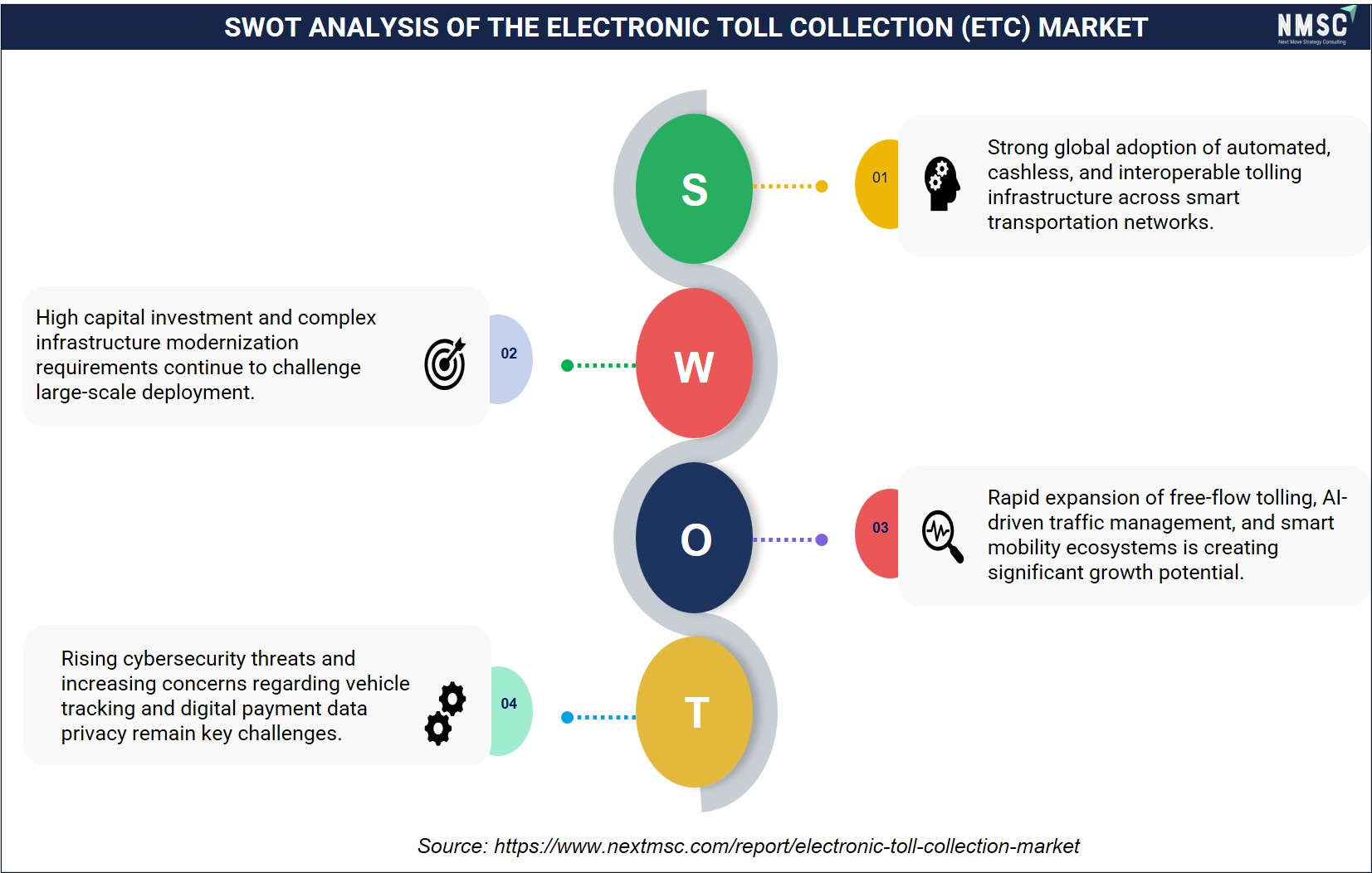
The infographic outlines the four core dimensions of the Electronic Toll Collection (ETC) market. Strengths are driven by strong global adoption of automated, cashless, and interoperable tolling systems across smart transportation networks. Weaknesses are primarily linked to high capital investment requirements and the complexity of infrastructure modernization, which continue to limit rapid large-scale implementation. Opportunities arise from the fast expansion of free-flow tolling, AI-driven traffic management, and integrated smart mobility ecosystems, which are creating significant growth potential for market participants. However, threats remain significant, particularly due to rising cybersecurity risks and increasing concerns around vehicle tracking and digital payment data privacy, which continue to challenge trust, regulatory compliance, and system resilience.
What Are the Key Factors Influencing Investment Analysis & Opportunities in the Electronic Toll Collection (ETC) Market?
Based on our market research, we assessed that investment activity in the Electronic Toll Collection (ETC) market is increasingly shifting toward intelligent transportation infrastructure, interoperability platforms, and digitally integrated mobility ecosystems rather than traditional toll plaza expansion alone. Institutional investors, infrastructure funds, and transportation technology providers are prioritizing projects focused on free-flow tolling, AI-enabled traffic management, cloud-based toll operations, and real-time data analytics to improve operational efficiency and long-term revenue optimization. Moreover, valuations are strengthening for companies demonstrating strong digital integration capabilities, scalable interoperable tolling platforms, and advanced automation technologies, as these attributes improve traffic throughput, reduce operational costs, and support recurring service-based revenue models.
From our further interactions with transportation infrastructure stakeholders, we identified rising investment interest in smart mobility platforms, automated enforcement systems, connected vehicle ecosystems, and GNSS-based tolling technologies designed to support congestion management and intelligent transportation modernization. Private equity participation and public-private partnership activity are intensifying across Asia-Pacific, North America, and Europe, where highway modernization and smart infrastructure investments remain strong. Additionally, emerging opportunities are being identified in cloud-native toll management systems, AI-driven vehicle analytics, cybersecurity frameworks for transportation networks, and integrated digital payment ecosystems. Overall, investment momentum is increasingly concentrated around automation, interoperability, mobility digitalization, and data-driven transportation infrastructure, signaling a structural transition from conventional toll collection systems toward fully connected and intelligent mobility management ecosystems.
Key Benefits for Stakeholders:
Next Move Strategy Consulting provides a comprehensive and evidence-based analysis of the Electronic Toll Collection (ETC) Market, covering historical developments from 2020 to 2025 and offering forward-looking forecasts through 2035. Our study assesses the market at global, regional, and country levels, combining quantitative outlooks with qualitative insights into key growth drivers, operational challenges, technology evolution, regulatory frameworks, and investment dynamics across major ETC segments.
The Electronic Toll Collection (ETC) Market creates differentiated value across governments, infrastructure operators, investors, technology providers, and transportation stakeholders through the convergence of mobility digitalization, traffic efficiency optimization, and smart infrastructure modernization. From our assessment, we observed that investors benefit primarily from long-term infrastructure revenue visibility, recurring service-based business models, and growing adoption of interoperable digital tolling ecosystems. Additionally, transportation authorities and toll operators benefit from improved traffic flow, reduced congestion, enhanced operational automation, and more efficient revenue collection mechanisms supported by intelligent transportation technologies.
For end users, ETC systems deliver measurable advantages through reduced travel delays, seamless digital payments, lower fuel consumption, and improved commuting efficiency. From a regulatory perspective, government initiatives focused on smart mobility, transportation sustainability, and intelligent infrastructure development continue strengthening market expansion and technological adoption. Overall, value creation is increasingly shared across stakeholders through transportation digitalization, infrastructure automation, operational efficiency enhancement, and integrated smart mobility ecosystem development.
|
Parameters |
Details |
|
Customization Scope |
Free customization (equivalent to up to 80 analyst-working hours) after purchase. Addition or alteration to country, regional & segment scope. |
|
Pricing and Purchase Options |
Avail customized purchase options to meet your exact research needs. |
|
Approach |
In-depth primary and secondary research; proprietary databases; rigorous quality control and validation measures. |
|
Analytical Tools |
Porter's Five Forces, SWOT, value chain, and Harvey ball analysis to assess competitive intensity, stakeholder roles, and relative impact of key factors. |
Key Market Segments
By Offering
-
Hardware
-
On-Board Units
-
Roadside Units
-
Enforcement Devices
-
Network Equipment
-
Other Hardware
-
-
Software
-
Core Toll Platforms
-
Transaction Processing Engines
-
Back-Office Systems
-
Violation Processing
-
Middleware and Integration
-
Analytics and Reporting Tools
-
Customer Portals and Apps
-
Other Software
-
-
Services
-
System Integration and Consulting
-
Maintenance and Support
-
Managed Operations
-
Other Services
-
By Technology
-
Transponder Based
-
RFID-Based
-
DSRC-Based
-
-
Video Based (ANPR)
-
Satellite Based (GNSS)
-
Mobile Based
-
App Based
-
NFC
-
BLE
-
-
Hybrid Systems
By Toll Structure
-
Barrier Tolling
-
Free-Flow Tolling
-
Closed-Loop Tolling
-
Hybrid Tolling
By Vehicle Class
-
Passenger Vehicles
-
Light Commercial Vehicles
-
Heavy Trucks & Buses
-
Two-Wheelers
By Toll Facility
-
Road Corridor
-
Managed Lane
-
Bridge
-
Tunnel
-
Urban Cordon
-
Other Tolled Asset
Geographical Breakdown
-
North America: U.S., Canada, and Mexico.
-
Europe: UK, Germany, France, Italy, Spain, Sweden, Denmark, Finland, the Netherlands, and the rest of Europe.
-
Asia Pacific: China, India, Japan, South Korea, Taiwan, Indonesia, Vietnam, Australia, Philippines, Malaysia and the rest of APAC.
-
Middle East & Africa (MEA): Saudi Arabia, UAE, Egypt, Israel, Turkey, Nigeria, South Africa, and the rest of MEA.
-
Latin America: Brazil, Argentina, Chile, Colombia, and the rest of LATAM.
Conclusion & Recommendations
Based on our evaluation, we analysed that the Electronic Toll Collection (ETC) market is entering a technologically mature yet rapidly transforming phase, where growth is increasingly defined by interoperability, automation, and intelligent mobility integration rather than conventional toll infrastructure expansion alone. Demand is being reinforced by rising investments in smart transportation systems, widespread adoption of cashless mobility solutions, and accelerating deployment of free-flow tolling technologies across highways, bridges, tunnels, and urban corridors. While transponder-based systems continue to anchor large-scale deployment volumes, value creation is progressively shifting toward AI-enabled traffic analytics, cloud-based toll management platforms, GNSS-based tolling, and integrated digital payment ecosystems. Furthermore, real-time data processing, operational automation, and cybersecurity capabilities are emerging as critical competitive differentiators across transportation infrastructure networks.
Looking ahead, the market is expected to increasingly reward technology providers and infrastructure operators capable of delivering interoperable, scalable, and digitally integrated tolling ecosystems while maintaining strong regulatory compliance and operational efficiency. AI-driven traffic optimization, connected vehicle integration, cloud-native toll operations, and intelligent mobility platforms will play a defining role in shaping long-term competitive advantage. For executives and investors, the strategic imperative lies in building resilient smart transportation ecosystems and scalable digital infrastructure capabilities rather than relying solely on legacy toll collection models. Overall, industry evidence points to a decisive transition toward automated, data-driven, and seamlessly connected ETC ecosystems with strong long-term infrastructure modernization and mobility optimization potential.


About the Author
 Tushmi Dutta
— Tushmi Dutta is a focused researcher specializing in detailed analysis and insight-driven research across diverse business landscapes. She supports strategic initiatives through structured data interpretation, thorough validation, and clear communication of findings that aid informed decision-making. With a strong interest in writing, she enjoys presenting research insights in an engaging and accessible manner. Beyond work, she enjoys traveling, reading, painting, and continuously learning new skills that contribute to her creative and professional growth.
Tushmi Dutta
— Tushmi Dutta is a focused researcher specializing in detailed analysis and insight-driven research across diverse business landscapes. She supports strategic initiatives through structured data interpretation, thorough validation, and clear communication of findings that aid informed decision-making. With a strong interest in writing, she enjoys presenting research insights in an engaging and accessible manner. Beyond work, she enjoys traveling, reading, painting, and continuously learning new skills that contribute to her creative and professional growth.
About the Reviewer
 Supradip Baul
— Supradip Baul is an accomplished business consultant and strategist with over a decade of rich experience in market intelligence, strategy, technology, and business transformation. His work has included rigorous qualitative and quantitative analysis across multiple industries, helping clients shape investment decisions and long-term roadmaps. Earlier in his career, he was associated with Gartner, where he contributed to industry-leading reports and market share analyses. He has worked with leading global companies and holds an MBA with a dual specialization in Marketing and Finance.
Supradip Baul
— Supradip Baul is an accomplished business consultant and strategist with over a decade of rich experience in market intelligence, strategy, technology, and business transformation. His work has included rigorous qualitative and quantitative analysis across multiple industries, helping clients shape investment decisions and long-term roadmaps. Earlier in his career, he was associated with Gartner, where he contributed to industry-leading reports and market share analyses. He has worked with leading global companies and holds an MBA with a dual specialization in Marketing and Finance.
At Next Move Strategy Consulting, we understand that insightful market research is the cornerstone of successful business decisions. That's why we employ a robust and multifaceted approach, combining various methodologies to deliver the most accurate and actionable data for our clients.

Research Landscape
We navigate the world of research with two primary approaches:
Qualitative Approach
Our qualitative research methodologies involve immersive techniques such as in-depth interviews, focus groups, and observational studies. By engaging directly with individuals and stakeholders, we uncover valuable insights that quantitative data alone may overlook.

Quantitative Research
In tandem with qualitative methodologies, NMSC leverages the power of Quantitative Research to provide a robust foundation of numerical insights. Through systematic data collection and analysis, we quantify patterns, preferences, and market trends, offering a comprehensive view of the business landscape.
Our quantitative research approach employs diverse tools, including surveys, experiments, and statistical modelling. These methodologies enable us to gather data from a large and representative sample, ensuring the statistical significance of our findings. By employing structured questionnaires and standardized data collection methods, we guarantee the reliability and validity of the information we present to our clients.
Quantitative research is particularly effective in measuring the prevalence of trends, assessing market size, and gauging the impact of various factors on consumer behavior. The numerical precision attained through this approach equips our clients with actionable insights, facilitating data-driven decision-making and strategy formulation.


Our Specialized Toolbox for Industry-Specific Market Research
We deploy a specialized arsenal of techniques tailored to meet your unique requirements. Here's a glimpse into our comprehensive toolbox:

Information Procurement
The stage entails acquiring market data or relevant information through various sources and methodologies.


Market Research Approach
We utilize both top-down and bottom-up approaches in market research analysis to achieve a comprehensive understanding of the market dynamics, leveraging the broad perspective of industry trends and macroeconomic factors alongside detailed insights from specific segments and individual companies.

Porters Five Forces Analysis
We conduct Porter's Five Forces analysis to evaluate the competitive landscape of an industry, providing us with insights into factors that affect profitability and strategic positioning.

SWOT Analysis

Forecasting
We utilize a forecasting model to predict future consumption by considering parameters like population, economics, regulations, market competition, drivers, constraints, technology, and pricing. We also employ statistical techniques such as multilinear regression, exponential smoothing, moving average, ARIMA, and Monte Carlo simulations for accurate predictions. In econometric forecasting, we analyzed short-term and long-term event impacts, attributing values based on regulatory frameworks, economic factors, and market events.





 Speak to Our Analyst