Ethylene Oxide Derivatives Market Global Industry Analysis and Forecast (2026-2035)

Ethylene Oxide Derivatives Market size was USD 49.10 billion in 2026, projected to reach USD 78.82 billion by 2035, growing at a CAGR of 5.4% from 2026 to 2035. Key drivers include expanding polyester fiber and PET resin manufacturing, rising biodegradable surfactant formulation demand, and growing personal care and pharmaceutical applications, with Asia-Pacific leading the market..
Download Free Sample PDF
Base Year (2025)
$46.80 Billion
Forecast (2035)
$78.82 Billion
CAGR (2026-2035)
5.4%
Top Region
Asia-Pacific

What Is the Ethylene Oxide Derivatives Market Size?

The global Ethylene Oxide Derivatives Market size was valued at USD 46.80 Billion in 2025 and is estimated at USD 49.10 Billion in 2026, and it is projected to reach USD 78.82 Billion by 2035, growing at a CAGR of 5.4% from 2026 to 2035. Asia Pacific led the market with a near 44% revenue share in 2025, while Ethylene Glycols remained the dominant product segment with an approximate 42% share.
Ethylene Oxide Derivatives Market Global Industry Analysis and Forecast (2026-2035) Revenue Forecast

Values in USD Billion

2025 $46.80 Billion
2025
2026 $49.10 Billion
2026
2027 $51.75 Billion
2027
2028 $54.55 Billion
2028
2029 $57.49 Billion
2029
2030 $60.60 Billion
2030
2031 $63.87 Billion
2031
2032 $67.32 Billion
2032
2033 $70.95 Billion
2033
2034 $74.78 Billion
2034
2035 $78.82 Billion
2035

Key Takeaways

By Product: Ethylene Glycols held the largest share, expanding from USD 19.66 billion in 2025 to USD 31.55 billion by 2035; Polyethylene Glycol is the fastest-growing product segment at 6.5% CAGR from 2026–2035.

By Application: Polyester Fibers and PET Resins held the largest share, expanding from USD 14.04 billion in 2025 to USD 22.49 billion by 2035; Pharmaceuticals and Medical Sterilization is the fastest-growing application segment at 6.8% CAGR from 2026–2035.

By End-Use Industry: Textile held the largest share, expanding from USD 12.64 billion in 2025 to USD 20.32 billion by 2035; Healthcare is the fastest-growing end-use industry segment at 7.0% CAGR from 2026–2035.

Dominant Region: Asia-Pacific dominated, expanding from USD 20.59 billion in 2025 to USD 35.88 billion by 2035.

Fastest-Growing Region: Middle East and Africa is expected to register the highest CAGR of 7.0% during 2026–2035.

Dominant Country: China led the market, expanding from approximately USD 9.30 billion in 2025 to USD 15.20 billion by 2035.

Fastest-Growing Country: India is the fastest-growing country at an approximate CAGR of 8.7% during 2026–2035.

We observed that segment-level performance across the Ethylene Oxide Derivatives Market reflects diverging end-use demand cycles, ranging from mature polyester and antifreeze applications to fast-growing personal care, pharmaceutical, and specialty surfactant uses that continue to reshape overall market revenue and demand composition.
NMSC's analysis indicates that the Ethylene Oxide Derivatives Market presents an incremental revenue opportunity of approximately USD 29.72 Billion between 2026 and 2035, an investment insight that positions feedstock-integrated producers to capture a durable share of downstream petrochemical value creation.

According to NMSC analysis, sustained capacity integration among feedstock-advantaged producers across the U.S. Gulf Coast, the Middle East, and coastal China is narrowing the cost gap between naphtha-based and ethane-based ethylene production routes, a structural shift with direct implications for regional trade flows and long-term derivative pricing.

What Does the Ethylene Oxide Derivatives Market Encompass?

The Ethylene Oxide Derivatives Market report covers the production, processing, and commercialization of chemicals derived from the catalytic oxidation of ethylene, including ethylene glycols, ethoxylates, ethanolamines, glycol ethers, and polyethylene glycol. These intermediates function as feedstocks for polyester fibers, PET resins, antifreeze, surfactants, personal care ingredients, pharmaceutical excipients, and industrial solvents. Our findings suggest that the market has structurally evolved from commodity glycol production toward higher-value specialty ethoxylates and pharmaceutical-grade derivatives, supported by integrated Verbund-style manufacturing complexes.

Regulatory oversight shapes the market through occupational exposure limits, emissions controls on sterilization facilities, and classification of ethylene oxide as a carcinogenic and mutagenic substance in several jurisdictions. Technology adoption trends include advanced silver catalyst systems that improve selectivity, digital process monitoring for emissions compliance, and growing interest in bio-based and mass-balance-certified feedstocks. Based on research conducted by NMSC, we found that this evolving regulatory and technological landscape is reshaping capital allocation decisions among established derivative producers worldwide.

Supply Chain Structure of the Ethylene Oxide Derivatives Market
Supply Chain Structure of the Ethylene Oxide Derivatives Market
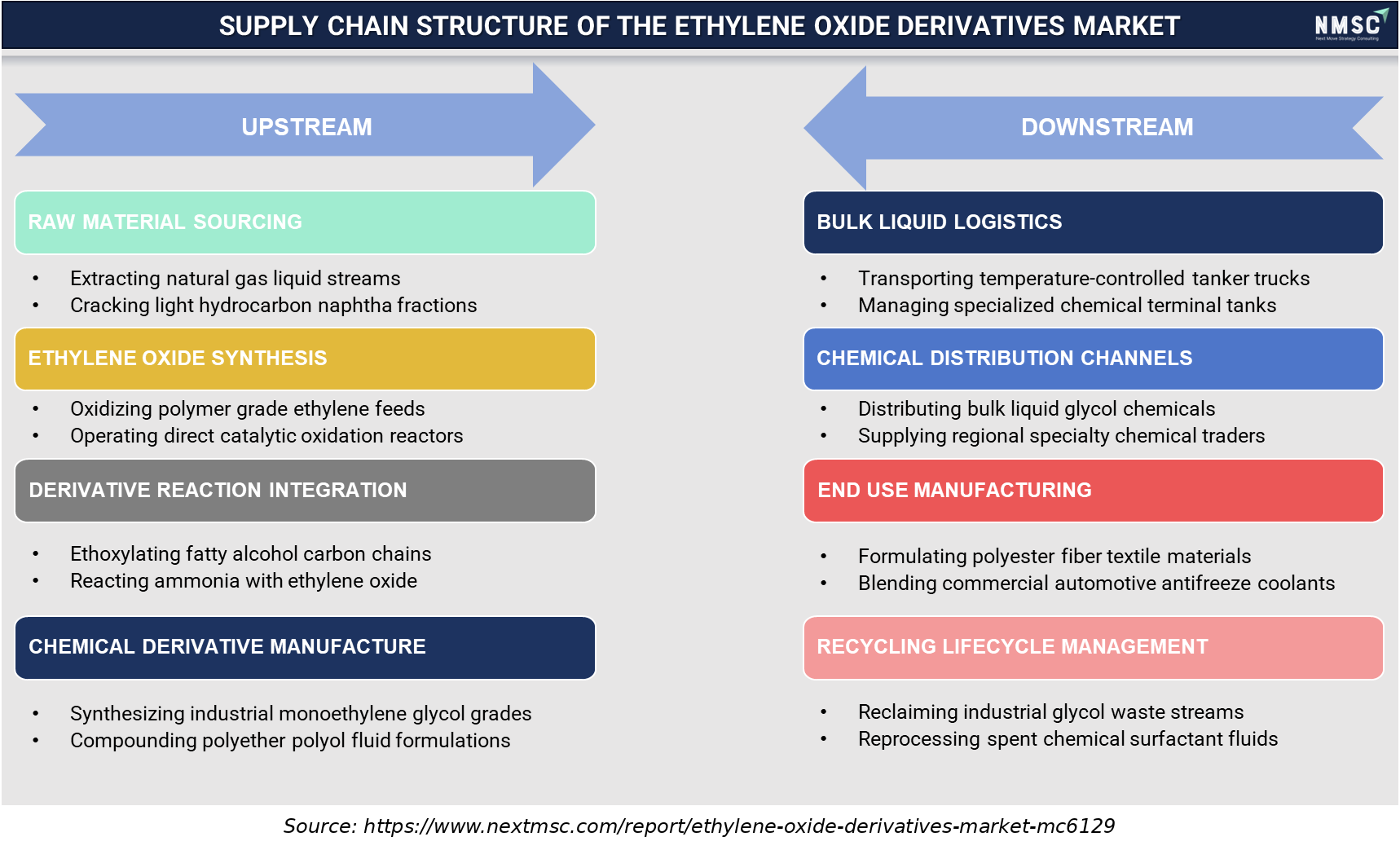
The above infographic presents the supply chain structure of the ethylene oxide derivatives market, segmented into upstream and downstream activities. Natural gas liquids and naphtha are processed into ethylene, which is oxidized through catalytic reactors to produce ethylene oxide. Ethylene oxide is subsequently reacted with water, fatty alcohols, ammonia, and other suitable feedstocks to produce derivatives including ethylene glycols, ethoxylates, ethanolamines, glycol ethers, and polyethylene glycol. Furthermore, bulk logistics and chemical distribution support downstream manufacturing of polyester fibers, automotive antifreeze, and surfactants. Looking ahead, we observed that reclamation and reprocessing of glycol waste streams are gaining importance, supporting sustainability and resource efficiency across the chemical sector.

Market Drivers & Dynamics

Interactive Dataset
Expanding polyester fiber and PET resin manufacturing capacity driver +1.1% Asia Pacific 2026–2035
Rising formulation of biodegradable, eco-labeled surfactants driver +0.9% Global 2026–2032
Growth in personal care, pharmaceutical excipient, and cosmetic ingredient demand driver +0.8% North America and Europe 2026–2035
Feedstock-integrated capacity expansions by major producers driver +0.7% North America and Middle East 2026–2030
Rising automotive coolant, brake fluid, and antifreeze consumption driver +0.6% Global 2026–2033
Expanding medical device and pharmaceutical sterilization requirements driver +0.5% North America and Europe 2026–2035
Tightening occupational exposure and emissions regulations on ethylene oxide restraint −0.6% North America and Europe 2026–2030
Volatility in crude oil, naphtha, and ethylene feedstock pricing restraint −0.5% Global 2026–2035
Carcinogenicity classification and stringent handling and storage requirements restraint −0.4% Europe and North America 2026–2032
Source: Next Move Strategy Consulting

Growth Drivers

What Is the Primary Growth Driver for the Ethylene Oxide Derivatives Market?

Expanding polyester fiber and PET resin production remains the primary growth driver, since monoethylene glycol is an irreplaceable feedstock in polyester manufacturing. Plastics Europe has reported multi-year increases in regional PET demand tied to packaging and textile consumption, and this pattern is mirrored globally as apparel and beverage packaging output expands. We observed that this single application anchors nearly a third of total derivative demand across the forecast period.

How Is Rising Polyester and PET Resin Demand Driving Market Growth?

China's ethylene production capacity exceeded 62 million metric tons annually by the end of 2025, an increase of about 19% year-on-year, reinforcing the country's position as the leading integrated producer of downstream ethylene oxide and ethylene glycol. This capacity build-out, combined with steady polyester fiber consumption across South and Southeast Asia, continues to anchor Asia Pacific's dominant share of global ethylene oxide derivatives demand through the forecast period.

Growth Inhibitors

What Is Restraining the Ethylene Oxide Derivatives Market?

The U.S. Environmental Protection Agency finalized stricter emissions standards for commercial ethylene oxide sterilization facilities, requiring significant reductions in fugitive and vent emissions at existing and new facilities. The European Chemicals Agency classifies ethylene oxide as a Category 1B carcinogen, mutagen, and reproductive toxicant under the CLP Regulation, which raises compliance costs for handling, storage, and worker protection and represents the most significant restraint on capacity expansion in developed markets.

Segmentation Analysis

2025 (USD Billion)
2035 (USD Billion)
Polyester Fibers and PET Resins 2025: $14.04 Billion | 2035: $22.49 Billion
Polyester Fi
Antifreeze and Coolants 2025: $7.49 Billion | 2035: $11.49 Billion
Antifreeze a
Detergents and Surfactant Formulations 2025: $9.36 Billion | 2035: $16.61 Billion
Detergents a
Personal Care and Cosmetics 2025: $5.62 Billion | 2035: $10.40 Billion
Personal Car
Pharmaceuticals and Medical Sterilization 2025: $4.21 Billion | 2035: $8.00 Billion
Pharmaceutic
Paints, Coatings and Solvents 2025: $3.74 Billion | 2035: $6.21 Billion
Paints, Coat
Agrochemicals 2025: $1.40 Billion | 2035: $2.23 Billion
Agrochemical
Other Applications 2025: $0.94 Billion | 2035: $1.39 Billion
Other Applic
Polyester Fibers and PET Resins $14.04 Billion $22.49 Billion 4.8%
Antifreeze and Coolants $7.49 Billion $11.49 Billion 4.3%
Detergents and Surfactant Formulations $9.36 Billion $16.61 Billion 6.0%
Personal Care and Cosmetics $5.62 Billion $10.40 Billion 6.5%
Pharmaceuticals and Medical Sterilization $4.21 Billion $8.00 Billion 6.8%
Paints, Coatings and Solvents $3.74 Billion $6.21 Billion 5.2%
Agrochemicals $1.40 Billion $2.23 Billion 4.7%
Other Applications $0.94 Billion $1.39 Billion 3.9%

Which Application Leads Demand for Ethylene Oxide Derivatives?

Polyester Fibers and PET Resins led application-based demand with a 30% share in 2025, reflecting ethylene glycol's role as a core polyester feedstock across textile and packaging value chains. We found that Pharmaceuticals and Medical Sterilization is expanding fastest, at a 6.8% CAGR to 2035, supported by rising excipient-grade polyethylene glycol consumption and continued reliance on ethylene oxide gas sterilization for heat-sensitive medical devices despite tightening emissions oversight.

2025 (USD Billion)
2035 (USD Billion)
Textile
Automotive
Packaging
Household an
Healthcare
Segment Item 2025 (USD Billion) 2035 (USD Billion) CAGR
Textile $10.0 USD Billion $40.0 USD Billion 27.0%
Automotive $17.1 USD Billion $51.1 USD Billion 9.0%
Packaging $24.2 USD Billion $62.2 USD Billion 19.0%
Household and Personal Care $31.3 USD Billion $73.3 USD Billion 17.0%
Healthcare $38.4 USD Billion $84.4 USD Billion 18.0%

Segment-wise data is locked

Unlock complete segment-wise numbers for By End-Use Industry.

Unlock Full Data

Which End-Use Industry Drives the Largest Share of Market Revenue?

Textile remained the leading end-use industry in 2025 with a 27% revenue share, consistent with Asia Pacific's dominant polyester manufacturing base. During our market evaluation, we noticed that Healthcare is the fastest-growing end-use category at a 7.0% CAGR through 2035, propelled by expanding global medical device output and sustained reliance on ethylene oxide-based sterilization for catheters, syringes, and other single-use devices across both mature and emerging healthcare systems.

2025 (USD Billion)
2035 (USD Billion)
Ethylene Gly
Monoethylene
Diethylene G
Triethylene
Ethoxylates
Segment Item 2025 (USD Billion) 2035 (USD Billion) CAGR
Ethylene Glycols $10.0 USD Billion $40.0 USD Billion 14.0%
Monoethylene Glycol (MEG) $17.1 USD Billion $51.1 USD Billion 8.0%
Diethylene Glycol (DEG) $24.2 USD Billion $62.2 USD Billion 14.0%
Triethylene Glycol (TEG) $31.3 USD Billion $73.3 USD Billion 20.0%
Ethoxylates $38.4 USD Billion $84.4 USD Billion 27.0%

Segment-wise data is locked

Unlock complete segment-wise numbers for By Product Type.

Unlock Full Data

What Is the Outlook for Ethylene Glycols and Ethoxylates in the Product Type Segment?

Product type segmentation spans ethylene glycols, ethoxylates, ethanolamines, glycol ethers, and polyethylene glycol, each serving distinct downstream chemistries. Ethylene Glycols led with a 42% share in 2025, valued at USD 19.66 Billion, on sustained polyester and antifreeze demand. Our analysis shows that Polyethylene Glycol is the fastest-growing segment at a 6.5% CAGR through 2035, driven by expanding pharmaceutical excipient and cosmetic formulation adoption across North America, Europe, and East Asia.

Growth Opportunities

Our findings suggest that three forward-looking mechanisms offer the clearest whitespace for producers seeking to move beyond commodity glycol economics over the coming decade.

Where Does Bio-Based Ethylene Glycol Create Whitespace for Producers?

Chemically recycled monoethylene glycol produced from post-consumer PET waste and bio-attributed monoethylene glycol produced from renewable feedstocks offer separate pathways toward lower-carbon alternatives to conventional fossil-based production. Beverage and packaging brand owners committed to recycled-content targets are the primary beneficiaries, creating contractual offtake opportunities for producers able to certify circular or bio-attributed supply chains at commercial scale.

How Can Specialty Ethoxylate Portfolios Unlock Premium Personal Care Demand?

Producers investing in narrow-range, oleochemical-based, and readily biodegradable ethoxylate chemistries can capture premium pricing from personal care and home care formulators seeking sustainable surfactant alternatives. Global personal care brand owners remain the principal beneficiary segment, given their reliance on mild, non-ionic ethoxylates for cleansing and emulsification applications.

What Opportunity Exists in Pharmaceutical-Grade Polyethylene Glycol Excipients?

Rising biologics, injectable, and oral solid-dose drug formulation activity is expanding demand for pharmacopoeia-grade polyethylene glycol excipients with tightly controlled molecular weight distribution. Contract manufacturers and specialty excipient producers stand to benefit most, as pharmaceutical customers increasingly qualify dedicated, validated PEG supply chains rather than relying on general industrial-grade output, supporting long-term contract value and margin expansion for qualified suppliers.

Regional Outlook

2025 (USD Billion)
2035 (USD Billion)
Asia Pacific
North Americ
Europe
Middle East
Latin Americ
Region 2025 (USD Billion) 2035 (USD Billion) CAGR (%)
Asia Pacific $10.0 USD Billion $40.0 USD Billion 9.0%
North America $17.1 USD Billion $51.1 USD Billion 27.0%
Europe $24.2 USD Billion $62.2 USD Billion 25.0%
Middle East and Africa $31.3 USD Billion $73.3 USD Billion 23.0%
Latin America $38.4 USD Billion $84.4 USD Billion 12.0%

Regional data is locked

Unlock complete regional numbers for this market.

Unlock Full Data

PESTEL Analysis of the Ethylene Oxide Derivatives Market
PESTEL Analysis of the Ethylene Oxide Derivatives Market
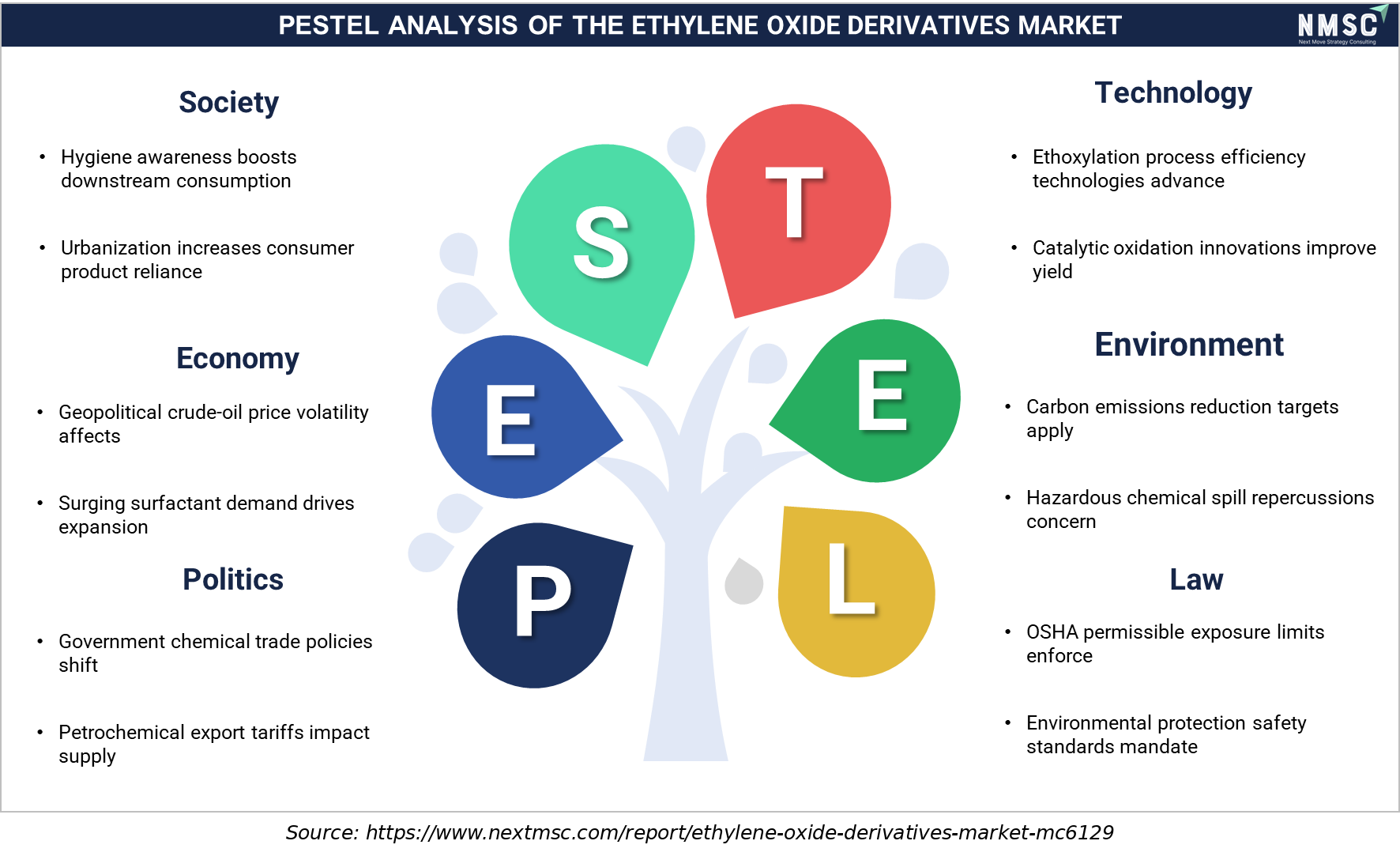
The above infographic presents a PESTEL analysis of the ethylene oxide derivatives market, wherein government trade policies and petrochemical tariffs are shaping supply dynamics and export competitiveness. Surfactant demand and urbanization are driving downstream consumption, while ethoxylation and catalytic oxidation technologies are improving production efficiency and yield. Environmental regulations and hazardous chemical concerns are increasing operational compliance pressure, reinforced by OSHA exposure limits and safety standards. Looking ahead, we observed that regulatory alignment and sustainable process innovation will remain essential for long-term market growth and risk mitigation.

Competitive Landscape

We observed that the Ethylene Oxide Derivatives Market Industry remains moderately consolidated, with integrated petrochemical majors controlling the majority of world-scale ethylene oxide capacity while specialty producers compete on derivative differentiation and application-specific formulation expertise. Key Takeaways
Dimension Description
Dimension Assessment
Market Structure Moderately consolidated; top 10 producers hold the majority of global capacity
Innovation Focus Low-carbon feedstock, specialty ethoxylates, and pharmaceutical-grade excipients
M&A Activity Backward integration and joint-venture capacity expansion in Asia and the Middle East

Key Market Players

Our findings suggest that the following companies represent the leading participants in the global Ethylene Oxide Derivatives Market, ranked by verified market-specific production scale and revenue relevance.

Dow Inc. Shell plc SABIC LyondellBasell Industries N.V. INEOS Group Holdings S.A. BASF SE China Petroleum & Chemical Corporation (Sinopec) PetroChina Company Limited MEGlobal Reliance Industries Limited Huntsman Corporation Clariant AG Eastman Chemical Company Indorama Ventures Public Company Limited Formosa Plastics Corporation PTT Global Chemical Public Company Limited Sasol Limited India Glycols Limited Croda International Plc Sumitomo Chemical Co., Ltd.

Latest Developments

We found that recent capacity and supply agreements among leading producers reflect the industry's continued focus on feedstock integration and Asia Pacific expansion.

Date Event
July 2026 Indovinya, the specialty chemicals division of Indorama Ventures, entered into an agreement with Air Liquide for the supply of renewable oxygen. This renewable feedstock will be utilized in the manufacturing of ethylene oxide, a key raw material for Indovinya’s downstream surfactant and specialty chemical solutions.
January 2026 BASF commissioned its Zhanjiang Verbund steam cracker with 1 million metric tons/year of ethylene capacity. BASF also confirmed the start-up of downstream ethylene oxide and ethylene glycol plants, strengthening integrated production and supply for customers in China.
November 2025 Clariant opened expanded facilities at Daya Bay, China, significantly increasing its production capacity for ethylene oxide derivatives (EODs) alongside surfactants and other specialty chemicals.
October 2025 Dow and MEGlobal finalized an expanded strategic ethylene supply agreement under which Dow will supply an additional equivalent of 100 KTA of ethylene from its U.S. Gulf Coast operations to MEGlobal's Oyster Creek facility, strengthening feedstock availability for ethylene glycol production.

Expert Insights

Christian Vang

Christian Vang

Business President Care Chemicals and Americas | Clariant

"The evolution of Daya Bay from Clariant's first ethoxylation plant in Asia to an integrated Multi-Purpose Plant and Ethylene Oxide Derivatives site demonstrates our long-term vision for the region,"

Analyst Interpretation

By bringing our innovation and expertise closer to customers, we're better positioned to help drive their developments forward while addressing our customers sustainability targets and end-product performance needs.

The statement highlights the increasing importance of localized Ethylene Oxide Derivatives production, application-specific innovation, and sustainability-oriented formulations in the specialty chemicals industry. NMSC's analysis indicates that EOD manufacturers are expanding regional production capabilities to respond more closely to customer requirements while supporting performance and sustainability objectives. The development also reinforces Asia-Pacific, particularly China, as an important manufacturing and demand center for Ethylene Oxide Derivatives.

Investment Opportunities

Where Are Capital Inflows Concentrated in the Ethylene Oxide Derivatives Market?

Capital inflows remain concentrated in integrated Asia Pacific and Middle Eastern complexes, exemplified by BASF's approximately EUR 8.7 Billion Zhanjiang Verbund investment and SABIC's roughly USD 6.4 Billion Fujian petrochemical complex. Our assessment indicates that investors continue to favor projects combining steam cracking with downstream ethylene oxide and glycol capacity over standalone derivative units, given the feedstock security such integration provides.

How Is Infrastructure Investment Shaping Future Capacity?

Infrastructure investment is increasingly directed toward abatement and emissions control systems required to meet tightening U.S. and European regulatory standards for ethylene oxide handling and sterilization operations. Producers are also investing in port and storage logistics to support growing export volumes from the Middle East and U.S. Gulf Coast toward Asian polyester manufacturers, reinforcing cross-regional trade infrastructure as a distinct investment category.

What ESG Considerations Are Influencing Investment Decisions?

Environmental, social, and governance considerations are steering investment toward renewable-powered steam cracking, exemplified by BASF's Zhanjiang cracker using main compressors powered entirely by renewable electricity, and toward bio-attributed or chemically recycled ethylene glycol production. Based on research conducted by NMSC, we found that mass-balance certification under frameworks such as ISCC PLUS is becoming a standard due-diligence criterion for institutional investors evaluating new derivative capacity.

Key Benefits for Stakeholders

How Does This Market Report Benefit Industry Leaders and Manufacturers?

Industry leaders gain access to validated 2025 through 2035 revenue forecasts, segment-level sizing across product type, application, and end-use industry, and competitive benchmarking against 20 profiled producers. This market report equips manufacturers to prioritize capacity investment toward the fastest-growing segments, including polyethylene glycol, pharmaceutical excipients, and specialty ethoxylate applications.

How Does This Market Report Benefit Investors and Financial Analysts?

Investors and financial analysts benefit from a consistent, single-point 2026 to 2035 CAGR estimate, regional and country-level revenue breakdowns, and documented capital expenditure activity from leading producers. The report's Growth Catalyst and Risk Assessment Matrix quantifies the directional impact of key drivers and restraints, supporting more precise capital allocation and risk assessment across the ethylene oxide derivatives value chain.

How Does This Market Report Benefit Technology Vendors and Product Teams?

Technology vendors and product development teams gain visibility into emerging trends shaping capital spending, including digital emissions monitoring, advanced catalyst systems, and bio-based feedstock integration. Our analysis shows that this strategic insight allows equipment suppliers and specialty ingredient developers to align product roadmaps with the specific derivative segments and regions projected to grow fastest through 2035.

Key Market Segments Evaluated

By Application

  • Polyester Fibers and PET Resins
  • Antifreeze and Coolants
  • Detergents and Surfactant Formulations
  • Personal Care and Cosmetics
  • Pharmaceuticals and Medical Sterilization
  • Paints, Coatings and Solvents
  • Agrochemicals
  • Other Applications

By End-Use Industry

  • Textile
  • Automotive
  • Packaging
  • Household and Personal Care
  • Healthcare
  • Construction
  • Agriculture
  • Other Industries

By Product Type

  • Ethylene Glycols
  • Ethoxylates
  • Ethanolamines
  • Glycol Ethers
  • Polyethylene Glycol
  • Other Derivatives

Conclusion & Recommendations

The long-term outlook remains constructive, with the market projected to grow from USD 49.10 Billion in 2026 to USD 78.82 Billion by 2035 at a 5.4% CAGR. We observed that this growth trajectory is underpinned by durable polyester demand, expanding personal care and pharmaceutical excipient applications, and continued capacity integration among feedstock-advantaged producers across Asia Pacific and the Middle East through the full forecast period.

What Strategic Positioning Should Producers Pursue?

Producers should prioritize backward integration with captive ethylene supply while diversifying downstream capacity toward higher-margin ethoxylates and pharmaceutical-grade polyethylene glycol. Our analysis shows that companies pairing base ethylene oxide production with dedicated specialty alkoxylation units are best positioned to defend margin against commodity glycol price volatility, particularly as Asia Pacific capacity additions continue to pressure conventional glycol economics through 2035.

How Attractive Is the Market for New Investment?

Investment attractiveness remains high in Asia Pacific and the Middle East, where integrated capacity additions benefit from cost-advantaged feedstock and proximity to growing polyester demand, while North America and Europe offer more selective opportunities concentrated in specialty and pharmaceutical-grade derivatives. NMSC's analysis indicates that the USD 29.72 Billion incremental opportunity between 2026 and 2035 favors investors targeting integrated, export-oriented production platforms.

What Market Shifts and Key Risks Should Stakeholders Monitor?

Stakeholders should monitor tightening ethylene oxide emissions and occupational exposure regulations in North America and Europe, feedstock price volatility linked to crude oil and naphtha markets, and the pace of new Asia Pacific and Middle Eastern capacity additions that could pressure commodity glycol margins. Our findings suggest that regulatory compliance costs represent the single largest near-term risk for smaller, non-integrated derivative producers.

What Are the Clearest Growth Pathways Through 2035?

The clearest growth pathways run through pharmaceutical-grade polyethylene glycol, biodegradable specialty ethoxylates for personal care, and bio-based or chemically recycled ethylene glycol supply chains. Based on research conducted by NMSC, we found that producers combining these three pathways with integrated, feedstock-advantaged base capacity are best positioned to outperform the broader market's 5.4% CAGR through the 2026 to 2035 forecast period.

FAQs

About the Author

Mayurima Roy

Mayurima Roy

Mayurima Roy is Research Analyst at Next Move Strategy Consulting, where she has spent 4 years working across the firm's full industry coverage rather than a single fixed vertical. Her work centers on structured research, ongoing trend tracking, competitive assessment, and insight-led content development, translating complex market data into clear, decision-ready narratives that support informed client decision-making across diverse global industries, market sectors, and world regions every day.

About the Reviewer

Supradip Baul

Supradip Baul

Supradip Baul is an accomplished business consultant and strategist with over a decade of rich experience in market intelligence, strategy, technology, and business transformation. His work has included rigorous qualitative and quantitative analysis across multiple industries, helping clients shape investment decisions and long-term roadmaps. Earlier in his career, he was associated with Gartner, where he contributed to industry-leading reports and market share analyses. He has worked with leading global companies and holds an MBA with a dual specialization in Marketing and Finance.

Download Free Sample

Mohit Agarwal

MOHIT AGARWAL

Chief Manager

DryChem India Pvt. Ltd.

Next Move Strategy Consulting is an amazing team of consultants. We required a market study report for our investors on top priority and the team went above and beyond our expectations to deliver the same with ample supporting data within a short time span enabling us to secure the investments and keep our project timeline maintained. Their professionalism, attention to detail, and timely delivery of actionable recommendations have left a lasting impression on our organization.

Kevin Coker

KEVIN COKER

Founder, CEO and Board Diector

Proxima Clinical Research

I have been using Next MSC reports for product positioning in a new geography for a long time. They have by far the best reports I have found and the price is reasonable too!

Nishant Awate

NISHANT AWATE

Business Development Global Sales

Zehnder Group Deutschland GmbH

Our experience working with Next Move Strategy Consulting was positive. The team was responsive, professional, and open to incorporating our specific requirements throughout the project. The India AHU market study was comprehensive and well structured, covering market value and volume forecasts, product and application segments, and key industry trends. The inclusion of both AHU and residential MVHR market insights made the study particularly relevant for our strategic market assessment. Overall, the report provides a solid foundation for evaluating market potential, identifying priority segments, and supporting business-development decisions in India.

Robert Sean Trevino

ROBERT SEAN TREVINO

Sr. Director, Head of Strategic Insights & Analytics

Foundation Medicine

I realized that it was a reliable source of information. These days, there are many people who are looking for authentic data, and this is one of the only sources that can offer them with what they need;

Pratyush Kumar Das

PRATYUSH KUMAR DAS

Assistant Manager

Polycab India Limited

We would like to express our appreciation for the data and insights provided by nextmsc. We are very pleased with the quality and depth of the information, which has proven to be highly valuable and beneficial for our business decision-making.

Custom Market Research Services

We will customize the research for you if the listed report does not fully match your requirements.

Get 30% Free Customization

Select License

This website uses cookies to ensure you get the best experience on our website. Learn more

✖