
EV Charge Point Operator (CPO) Market by Charging Infrastructure Type (AC Charging and DC Charging), By Deployment Location (Residential, Workplace, Destination, Public Off-Street, and Other), By Ownership & Operating Model (Operator Owned and Operated, Site Host Owned, Third-Party Operated and Other), By End-User (Private Passenger EV Users, Commercial Light Vehicle Fleets, Shared Mobility and Public and Institutional Fleets) – Global Analysis & Forecast, 2025–2035
Industry: Automotive & Transportation | Publishing Date: May 20, 2026 | Last Updated: September 30, 2026 | No of Pages: 813 | No. of Tables: 1242 | No. of Figures: 1233 | Format: PDF | Report Code: AT4519
Industry Outlook
The global EV Charge Point Operator (CPO) Market size was valued at USD 11.22 billion in 2025 and is expected to be valued at USD 14.24 billion by the end of 2026. The industry is projected to grow, hitting USD 80.34 billion by 2035, with a CAGR of 21.19% between 2026 and 2035.
EV Charge Point Operator (CPO) Market Size & Forecast
|
Parameters |
Details |
|
Market Size in 2026 |
USD 14.24 Billion |
|
Revenue Forecast in 2035 |
USD 80.34 Billion |
|
Growth Rate |
CAGR of 21.19% from 2026 to 2035 |
|
Analysis Period |
2025–2035 |
|
Base Year Considered |
2025 |
|
Forecast Period |
2026–2035 |
|
Market Size Estimation |
Billion (USD) |
|
Companies Profiled |
20 |
|
Countries Covered |
33 |
|
Market Share |
Available for 10 companies |
Based on NMSC’s primary research, we noticed that the global EV charge point operator (CPO) market is witnessing robust growth, driven by accelerating electric vehicle adoption, expanding public charging infrastructure, and increasing regulatory mandates supporting decarbonisation. Charge points operators, responsible for the installation, operation, and maintenance of EV charging networks, are becoming central to the electric mobility ecosystem by ensuring reliable and accessible charging services for end users. From our interactions with charge point operators and utility providers, we identified that high-power DC fast charging, network interoperability, and uptime optimisation are critical factors enhancing user experience and network utilisation. In addition, hardware-intensive infrastructure continues to dominate investments, while software platforms for energy management, billing, and remote monitoring are emerging as strategic differentiators.
Moreover, through our evaluation of charging deployments across North America, Europe, and Asia-Pacific, we identified that market dynamics are shaped by policy frameworks, grid integration capabilities, and utilisation rates. Specifically, Asia-Pacific leads in charging infrastructure scale, supported by strong government initiatives and high EV penetration, while Europe emphasises competitive market structures and interoperability among operators. Meanwhile, North America benefits from increasing private sector investments and highway fast-charging network expansion. Furthermore, emerging markets such as India are witnessing rapid growth in charging networks, driven by policy incentives and rising EV adoption. Key market participants compete through network expansion, strategic partnerships, and integrated energy solutions. Consequently, recent developments, including ultra-fast charging technologies and charging-as-a-service models, are reducing range anxiety and improving asset utilisation, thereby strengthening long-term return on investment and reinforcing trust and reliability across the EV charging ecosystem.
What Are the Key EV Charge Point Operator (CPO) Market Trends?
How Is Ultra-Fast Charging Redefining Network Economics in the CPO Market?
Based on our evaluation of charging infrastructure deployment patterns, we observed that ultra-fast charging is fundamentally reshaping network economics by increasing station throughput and reducing dwell time per vehicle. As a result, operators are able to serve higher volumes within the same footprint, improving asset utilisation and revenue density per site. In addition, deployment is increasingly concentrated across high-traffic intercity corridors and dense metropolitan clusters where utilisation rates are maximised. Unlike conventional models focused on network coverage, ultra-fast charging shifts investment priorities toward performance-driven infrastructure. Furthermore, operators are aligning site selection with demand intensity and traffic predictability. This is redefining charging networks as high-throughput, revenue-optimised assets rather than static infrastructure deployments.
How Is AI-Driven Network Intelligence Transforming CPO Operations?
From our assessment of operational systems, we found that AI-driven network intelligence is transforming how charge point operators manage utilisation, reliability, and user experience. In practice, predictive analytics, real-time monitoring, and demand forecasting are enabling operators to dynamically allocate capacity and reduce congestion across high-demand locations. Moreover, AI-enabled predictive maintenance is improving uptime and minimising service disruptions, directly enhancing network reliability. Unlike traditional static operations, intelligent systems allow continuous optimisation of charging patterns and pricing strategies. At the same time, data-driven insights are guiding site expansion and performance benchmarking. This marks a shift from infrastructure-led operations to intelligence-driven network management.
How Is Energy Integration Reshaping the Role of CPOs in the Power Ecosystem?
Based on our evaluation of energy integration models, we observed that CPOs are increasingly evolving into active participants within broader energy ecosystems rather than standalone infrastructure providers. In addition, integration with renewable energy, battery storage, and demand response systems is enabling operators to optimise energy consumption and reduce peak load dependency. Furthermore, bidirectional charging capabilities and grid interaction models are allowing infrastructure to support energy balancing and flexibility services. Unlike traditional charging models, this approach positions CPOs within decentralised energy networks. Consequently, operators are transitioning toward energy-enabled platforms that combine mobility and power management capabilities.
Ecosystem Analysis of the EV Charge Point Operator (CPO) Market:
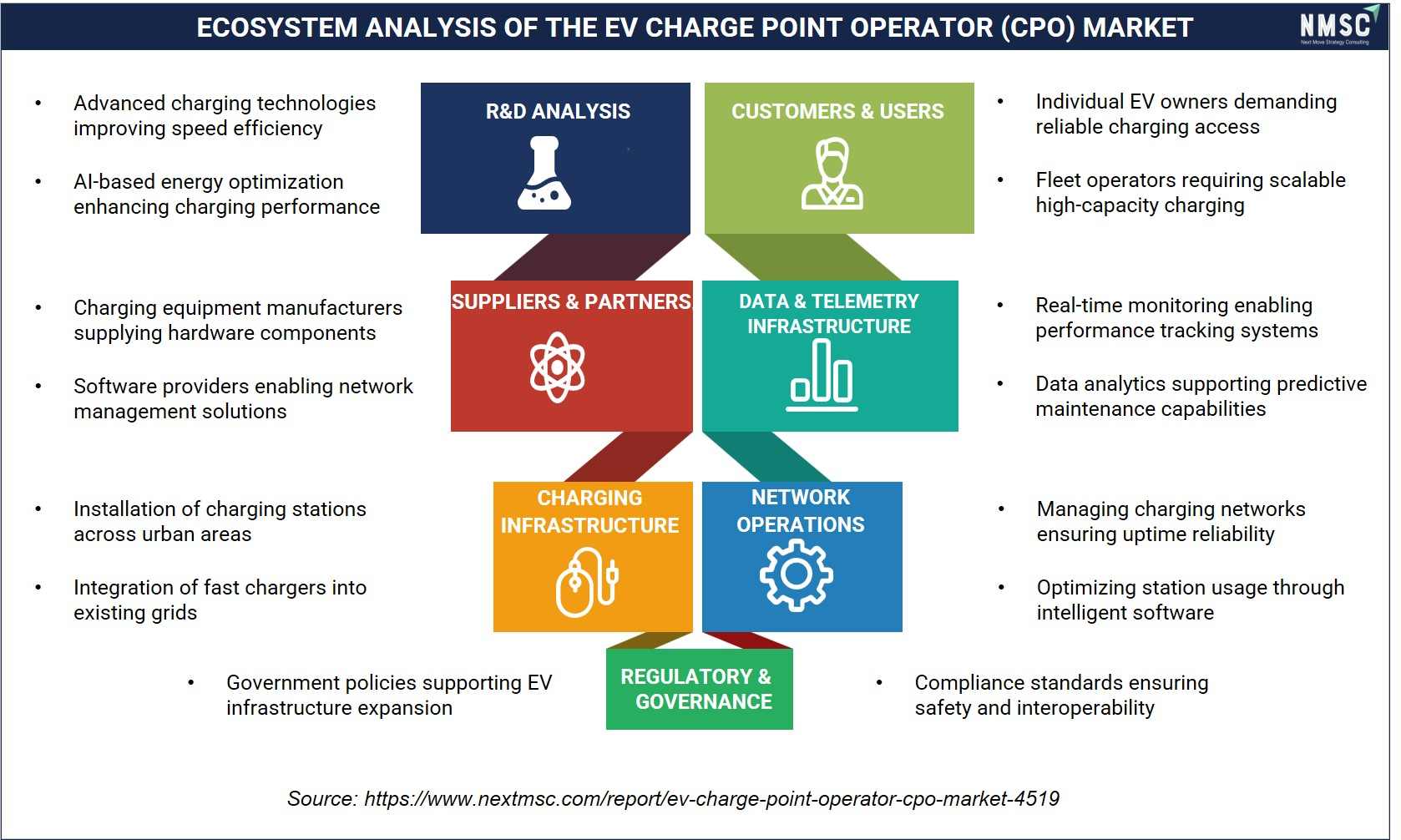
Based on our evaluation of the EV charge point operator (CPO) market ecosystem, we noticed the market is driven by interconnected layers of innovation, infrastructure, and operations. R&D advancements and AI-driven optimisation enhance charging efficiency, while EV users and fleet operators generate consistent demand. In addition, suppliers and data systems enable seamless integration and real-time performance monitoring. Furthermore, charging infrastructure and network operations ensure reliable and scalable service delivery. Consequently, this integrated ecosystem is enabling efficient, resilient, and future-ready EV charging networks.
What Are the Key Market Drivers, Breakthroughs, And Investment Opportunities That Will Shape The EV Charge Point Operator (CPO) Industry in the Next Decade?
Growth Catalyst & Risk Assessment Matrix
|
Drivers / Trends / Restraints |
(+/–) % Impact On Cagr Forecast |
Geographic Relevance |
Impact Timeline |
|
Rapid growth in global EV adoption, driven by emission regulations and fuel economy mandates |
+1.5% |
Europe (Germany, Norway, UK), China, North America |
Long term (3–8 years) |
|
Increasing electrification of commercial fleets, supported by depot-based charging demand |
+0.9% |
US, China, India, UK |
Medium term (2–5 years) |
|
Expansion of fast and ultra-fast DC charging networks across highways and urban corridors |
+1.0% |
North America, Europe, China, Japan |
Medium term (2–5 years) |
|
Expansion of energy monetisation and value-added services, including pricing and subscription models |
+0.8% |
Europe, North America |
Medium to long term (3–7 years) |
|
High upfront infrastructure deployment costs, including grid upgrades and land acquisition, limit expansion |
–0.9% |
Emerging Asia, Latin America, Africa |
Medium to long term (3–6 years) |
Based on our evaluation of charging infrastructure deployment strategies and network scaling models, we identified that EV charge point operators are increasingly positioning charging networks as long-term strategic assets rather than standalone infrastructure investments. In addition, our interactions with charge point operators and utility providers indicate that network planning is now closely aligned with utilisation optimisation, site profitability, and grid integration capabilities. As a result, operators are prioritising high-demand locations, dynamic load management, and energy-efficient system design to maximise asset performance across both urban clusters and intercity corridors.
Furthermore, advancements in ultra-fast charging, intelligent energy management, and AI-driven network optimisation are enhancing throughput efficiency and operational visibility. While capital intensity and grid readiness continue to influence rollout pace in certain markets, evolving business models such as charging-as-a-service and energy partnerships are enabling more flexible and scalable deployment strategies. Consequently, this shift reflects a transition toward performance-driven, asset-optimised charging ecosystems.
Growth Drivers:
How Is Rising EV Adoption Intensifying Charging Infrastructure Demand?
Based on our evaluation of global mobility transitions, we observed that accelerating electric vehicle adoption is emerging as the primary driver for the EV charge point operator (CPO) market. The increasing number of EVs on the road is creating sustained demand for accessible, reliable, and high-capacity charging services across both urban and intercity environments. In addition, our interactions with charge point operators indicate that rising charging frequency and evolving user expectations are increasing dependency on consistent and readily available charging access. Furthermore, our analysis shows that growing EV penetration is directly influencing usage patterns, with higher frequency of charging events and longer network engagement durations. As EV adoption accelerates, charging demand is becoming more predictable and continuous across diverse use cases. Consequently, this shift is strengthening demand visibility while enabling scalable and long-term growth for charge point operators.
How Is Fleet Electrification Strengthening Commercial EV Charge Point Operator (CPO) Market Demand?
In our research on commercial mobility trends, we identified that fleet electrification is significantly strengthening demand for charge point operators across logistics and transportation sectors. The transition toward electric delivery vehicles, buses, and shared mobility fleets is creating predictable and high-volume charging requirements. Moreover, our interactions with logistics operators indicate that reliability, uptime, and charging speed are becoming critical factors influencing infrastructure planning. In parallel, our evaluation shows that depot-based charging and managed charging solutions are improving energy efficiency and operational control. As commercial fleets scale electrification efforts, charging demand becomes more structured and continuous. As a result, fleet electrification is enabling stable utilisation patterns while supporting expansion into high-growth commercial charging segments.
Growth Inhibitor:
How Are High Capital Investment and Site-Level Deployment Complexity Limiting EV Charge Point Operator (CPO) Market Expansion?
Based on our assessment of charging infrastructure deployment models, we found that high capital investment and site-level deployment complexity act as key constraints limiting the pace of expansion in the CPO market. The costs associated with hardware installation, land acquisition, permitting, and grid connectivity create significant financial and operational barriers, particularly for large-scale and multi-location deployments. In addition, our interactions with charge point operators indicate that site readiness, permitting delays, and infrastructure compatibility issues extend deployment timelines and reduce execution speed. Furthermore, our analysis shows that variability in site conditions and regulatory requirements increases planning complexity and impacts rollout consistency across regions. As a result, operators are required to prioritise locations selectively, which slows network densification and delays large-scale infrastructure rollout.
Growth Opportunity:
How Is Energy Monetisation and Value-Added Services Creating New Revenue Streams for CPOs?
From our evaluation of evolving business strategies, we identified that energy monetisation and value-added services are creating new revenue opportunities for charge point operators. Operators are increasingly leveraging dynamic pricing, energy management services, and revenue-generating grid services to enhance monetisation beyond core charging operations. Moreover, our assessments indicates that integrated digital platforms for billing, subscriptions, and user engagement are improving customer experience and operational visibility. In addition, our interactions with charge point operators reveal that bundling charging services with energy solutions enables differentiated offerings and stronger customer retention. As service models evolve, operators are expanding beyond infrastructure providers into energy service platforms. This shift is strengthening profitability while enabling more diversified and scalable revenue models.
Pain Point Analysis of the EV Charge Point Operator (CPO) Market:
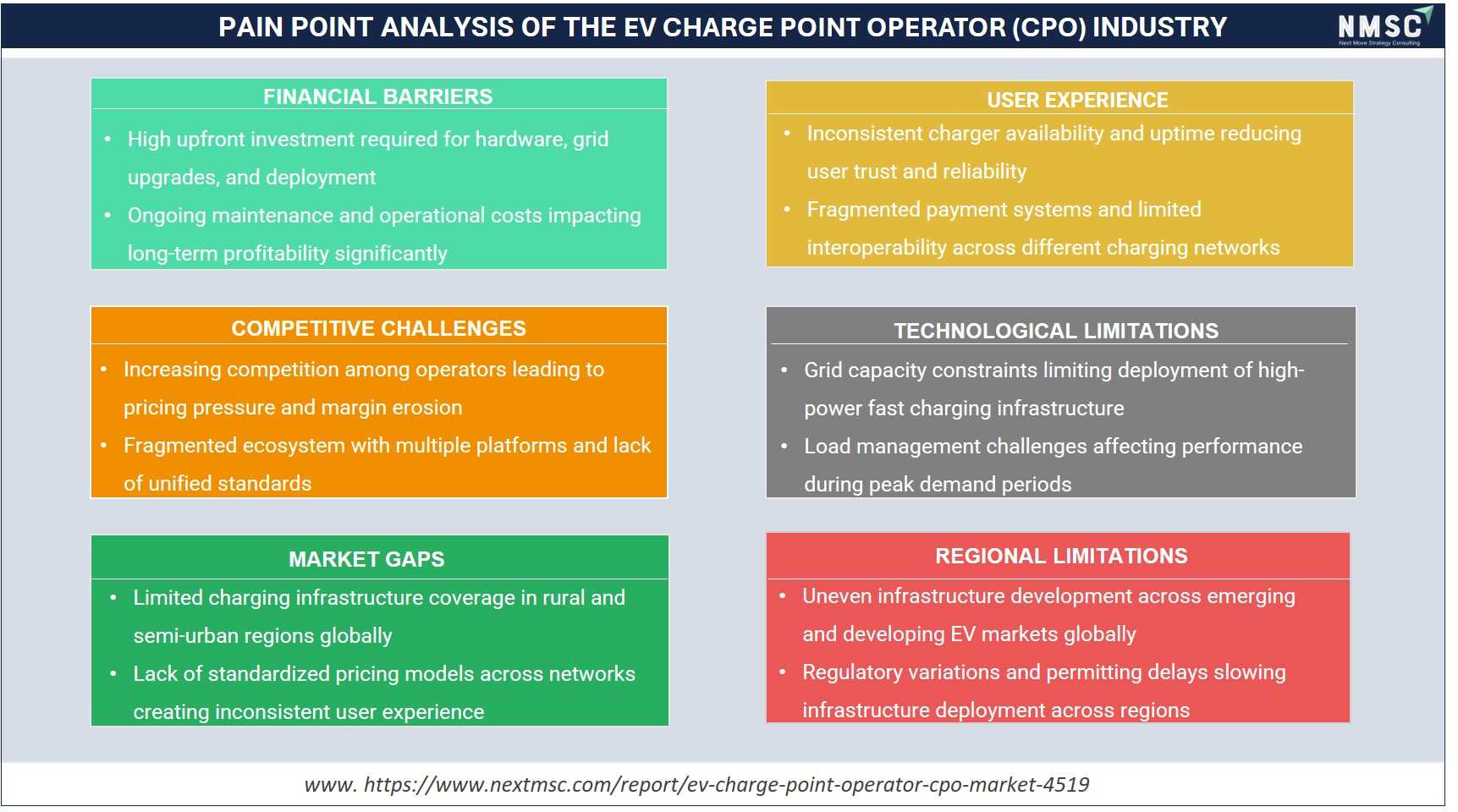
Based on our evaluation of the EV charge point operator (CPO) market ecosystem, we noticed that while strong demand from rising EV adoption supports network growth, operators face key challenges including high infrastructure costs, grid constraints, and fragmented user experience. At the same time, competitive pressure and regional disparities further impact scalability. Consequently, addressing these financial, technological, and operational gaps remains critical to enable consistent, efficient, and large-scale charging network expansion.
How Is the EV Charge Point Operator (CPO) Market Segmented in This Report, And What Are the Key Insights from the Segmentation Analysis?
Market Highlights & Strategic Insights – EV Charge Point Operator (CPO) Market:
|
Segments |
Key Takeaways |
|
Charging Infrastructure Type |
AC Charging dominated with 67.1% share in 2025, driven by widespread residential and workplace installations, while continuing to expand at a strong CAGR. DC Charging, although smaller in share, gains traction in high-power and highway applications with steady growth momentum. |
|
Deployment Location |
Residential charging led with 36.0% share, reflecting strong home-charging adoption. Meanwhile, Fleet Depot and Logistics Yard emerges as the fastest-growing segment (24.79% CAGR), supported by rapid electrification of commercial fleets. |
|
Ownership & Operating Model |
Operator-owned networks held the leading position with 35.2% share, supported by full control over pricing and operations. Public-private partnership models, although smaller, expand at a notable 23.92% CAGR, indicating increasing collaboration-driven deployment. |
|
Accessibility |
Open Public Access dominated the market with 56.0% share, ensuring maximum utilization and public availability, while membership-based models continue to expand steadily, supported by network-specific benefits and user retention strategies. |
|
Pricing Model |
Transactional pricing accounted for the largest 53.0% share, reflecting pay-per-use dominance. In contrast, Contracted Revenue models register strong growth (23.29% CAGR), driven by fleet agreements and long-term commercial contracts. |
|
Geographic Scope of Operations |
National networks held the leading position with 29.7% share, supported by large-scale infrastructure expansion. At the same time, regional networks show balanced growth, while cross-border networks continue to expand steadily with increasing inter-country EV mobility. |
|
Service Offering |
Charging, Payment, and Roaming services led with 41.0% share, driven by interoperability requirements across networks. Managed charging and software services are expanding at a higher pace (22.66% CAGR), reflecting growing demand for energy optimization and smart charging solutions. |
|
End-User |
Private passenger EV users dominated with 52.9% share, supported by rising EV adoption among individuals. Meanwhile, public and institutional fleets record one of the fastest growth rates (23.14% CAGR), driven by government-led electrification initiatives. |
By Charging Infrastructure Type Insights
Which Charging Types Drive Demand in the Global EV Charge Point Operator (CPO) Market?
Based on our analysis of charging infrastructure deployments across key EV markets, we observed that the Global EV charge point operator (CPO) Market is segmented into AC charging and DC charging.
From our evaluation of real-world charging usage patterns and operator deployments, we found that AC charging leads overall adoption, driven by its widespread use in residential and workplace environments where longer dwell times support lower-power charging. In contrast, DC charging is increasingly deployed across highways and urban fast-charging corridors, where high-power output and reduced charging time are critical. Our interactions with charge point operators indicate that DC charging is gaining strategic importance for intercity travel and commercial use cases, despite higher deployment costs. As a result, while AC charging ensures volume-driven network utilization, DC charging strengthens high-value, time-sensitive charging demand across the market.
By Deployment Location Insights
How Do Deployment Locations Shape Charging Demand Across the CPO Market?
Based on our assessment of EV charging infrastructure placement strategies, we identified that the EV charge point operator (CPO) market is segmented into residential, workplace, destination, public off-street, public on-street, highway and corridor, and fleet depot and logistics yard locations.
From our analysis of usage behavior and infrastructure rollout, we found that residential charging accounts for a significant share, supported by convenience and overnight charging patterns among private EV users. Meanwhile, fleet depot and logistics yard deployments are expanding rapidly, driven by the increasing electrification of commercial fleets requiring predictable and high-volume charging. Our discussions with logistics operators and infrastructure planners indicate that highway and corridor charging plays a critical role in enabling long-distance mobility and reducing range anxiety. Consequently, charging demand varies by location, with residential ensuring base load utilization, while commercial and corridor-based deployments drive growth in high-frequency and high-capacity charging segments.

By Service Offering Insights
How Do Service Offerings Influence Revenue Generation in the EV CPO Market?
Based on our evaluation of operator business models and service integration strategies, we found that the EV charge point operator (CPO) market is segmented into basic charging services, charging payment and roaming, managed charging and software services, and energy services and grid integration.
From our analysis of operator strategies and customer engagement models, we found that charging and roaming services predominate, as network interoperability becomes essential for a seamless user experience. At the same time, managed charging and software services are gaining strong traction, supported by the need for energy optimization, load management, and operational control. Our interactions with charge point operators indicate that energy services, including grid integration and demand response, are emerging as key value-added offerings. As a result, service models are evolving beyond basic charging, enabling operators to diversify revenue streams and improve long-term profitability.

Regional Outlook:
Geographic Performance Snapshot:
|
Region |
Key Takeaways |
|
North America |
North America accounted for approximately 20.0% of the global EV charge point operator (CPO) market in 2025, supported by high EV adoption, strong utilisation of public charging networks, and expanding fleet electrification. Increasing investments from energy companies and infrastructure providers continued to drive the deployment of high-capacity fast charging networks across urban centres and intercity corridors. |
|
Europe |
Europe held around 27.2% market share in 2025 and is projected to grow at a CAGR of 19.8%, driven by stringent emissions regulations, cross-border mobility requirements, and strong integration with renewable energy systems. Interoperable charging infrastructure, public-private partnerships, and increasing focus on energy-efficient network operations further support growth. |
|
Asia-Pacific |
Asia-Pacific dominated the EV Charge Point Operator (CPO) market with a 41.3% share in 2025 and is expected to expand at a CAGR of ~23.0%, reflecting large-scale infrastructure deployment across China, Japan, and South Korea. Rapid urbanisation, government-led electrification programs, and cost-efficient manufacturing are accelerating the adoption of scalable and high-density charging networks. |
|
Latin America |
Latin America is projected to grow at a CAGR of 15.8%, driven by increasing urban mobility demand and gradual EV adoption across major cities. Growth is supported by improving infrastructure investment, rising logistics activity, and deployment of cost-effective charging solutions tailored to price-sensitive markets. |
|
Middle East & Africa |
The Middle East & Africa accounted for approximately 7.5% of the global market in 2025, supported by government-led infrastructure investments and emerging EV adoption trends. The region is expected to grow at a CAGR of 17.7%, driven by smart city initiatives in the Middle East and gradual electrification across African markets. |

The EV charge point operator (CPO) market is geographically studied across North America, Europe, Asia Pacific, Latin America and the Middle East & Africa and each region is further studied across countries.
EV Charge Point Operator (CPO) Market in North America
Based on our evaluation of regional charging network utilisation patterns and infrastructure deployment trends, we observed that the EV charge point operator (CPO) market in North America, accounting for approximately 20.0% of the global market, is driven by increasing charging intensity and evolving mobility behaviour. As EV adoption accelerates across both private and commercial segments, demand for reliable and high-capacity charging networks continues to rise. The United States anchors this growth through dense highway corridors and high-frequency urban charging demand, while Canada supports expansion through policy-backed programs and renewable energy integration. In addition, rising expectations for faster charging and reduced wait times are pushing operators to optimise uptime and performance. Furthermore, sustained capital inflows are accelerating deployment in high-utilisation locations. Consequently, the region’s growth is shaped by demand intensity, infrastructure reliability, and consistent network usage patterns.
EV Charge Point Operator (CPO) Market in the United States
The United States represents a high-utilisation EV charge point operator (CPO) market, contributing around 81.0% of North America’s market share, where demand is shaped by large-scale EV adoption and time-sensitive mobility requirements. From our assessment, we found that expanding ride-hailing fleets and logistics operations are significantly increasing dependency on fast and accessible charging networks. Moreover, federal and state-level incentives are improving deployment economics and accelerating infrastructure rollout. Unlike other regions, operators in the U.S. prioritise throughput efficiency and network availability to manage peak demand conditions. In parallel, digital platforms enabling real-time station visibility and seamless payments are enhancing user experience. As charging demand becomes more usage-driven, operators are focusing on optimising existing infrastructure rather than only expanding capacity. As a result, the market is driven by utilisation efficiency, digital integration, and service reliability.
EV Charge Point Operator (CPO) Market in Canada
In Canada, the EV charge point operator (CPO) market, holding approximately 12.5% share within North America, evolves through a policy-supported and sustainability-focused framework that encourages steady infrastructure development. Based on our regional analysis, we observed that provincial electrification targets and federal funding programs are enabling consistent expansion across urban and intercity networks. In addition, geographic and climatic conditions influence deployment strategies, with operators prioritising resilient and weather-adaptive charging systems. Furthermore, integration with renewable energy sources, particularly hydroelectric power, supports efficient and low-emission operations. Compared with more aggressive markets, Canada emphasises reliability and long-term network stability over rapid scaling. At the same time, increasing fleet adoption and intercity travel demand are creating predictable utilisation patterns. Consequently, market growth is reinforced by policy alignment, sustainability priorities, and reliability-focused infrastructure planning.
EV Charge Point Operator (CPO) Market in Europe
Across Europe, the EV charge point operator (CPO) market, representing approximately 27.2% of the global market share, is structured around regulatory enforcement and energy system integration. From our evaluation, we found that stringent emissions targets and national electrification mandates are accelerating deployment of interoperable charging networks. Moreover, cross-border mobility requirements are driving demand for roaming-enabled platforms and standardised infrastructure. In addition, operators are aligning charging networks with renewable energy systems and grid-balancing mechanisms to meet sustainability goals. Unlike other regions, Europe prioritises interoperability and compliance alongside infrastructure expansion. Furthermore, coordinated public-private initiatives are enabling large-scale deployment across multiple countries. As a result, the market is driven by regulatory pressure, sustainability mandates, and integrated energy ecosystems.
EV Charge Point Operator (CPO) Market in Germany
Germany’s EV charge point operator (CPO) market, accounting for approximately 18.3% of the European market, reflects an engineering-led approach where infrastructure deployment is closely aligned with industrial standards and system reliability requirements. Based on our analysis, we observed that strong manufacturing logistics and high EV penetration are driving demand for precision-oriented charging systems. In addition, operators prioritise safety certifications, system durability, and performance consistency over rapid expansion. Furthermore, integration with industrial energy systems and renewable sources is improving efficiency and grid interaction. Germany’s structured ecosystem enables close collaboration between utilities, OEMs, and municipalities, supporting customised deployment models. This reinforces Germany’s position as a reliability-driven market shaped by engineering precision and industrial demand.
EV Charge Point Operator (CPO) Market in the United Kingdom
From our observation of deployment patterns, we noticed that the United Kingdom’s EV charge point operator (CPO) market is driven by dense urban demand and strong policy-backed electrification initiatives. High EV adoption in metropolitan areas is pushing operators to optimise charging networks within space-constrained environments. Moreover, government incentives and infrastructure grants are accelerating rollout across both public and private sectors. In addition, fleet electrification, particularly in logistics and public transport, is generating predictable high-volume charging demand. Compared with other European markets, the UK shows stronger emphasis on urban infrastructure and retrofit deployments. Furthermore, digital platforms are improving accessibility and operational visibility. This positions the UK market around urban density, fleet demand, and policy-supported expansion.
EV Charge Point Operator (CPO) Market in France
France’s EV charge point operator (CPO) market, holding approximately 14.3% share within Europe, is shaped by a balanced mix of policy-driven electrification and urban mobility transformation. Based on our evaluation, we noticed that national EV targets and renewable energy incentives are driving structured expansion of charging infrastructure across cities and transport corridors. In addition, strong emphasis on urban logistics and last-mile delivery is increasing demand for accessible public charging and fleet depot solutions. Furthermore, integration of solar energy and battery storage systems is enabling operators to optimise energy efficiency and reduce operational costs. Compared with other European markets, France places greater importance on regulatory compliance and energy transparency. This supports a coordinated and sustainability-focused infrastructure expansion across the country.
EV Charge Point Operator (CPO) Market in Italy
In Italy, the EV charge point operator (CPO) market is projected to grow at a CAGR of approximately 22.1%, reflecting one of the fastest growth trajectories within Europe. From our assessment, we found that increasing EV adoption in metropolitan regions is driving demand for charging infrastructure across high-density metropolitan clusters and long-distance travel corridors. Moreover, fragmented logistics infrastructure is encouraging operators to deploy flexible and modular charging solutions tailored to diverse site conditions. In addition, growing commercial fleet electrification is creating consistent demand for depot-based charging systems. Unlike more mature markets, Italy emphasises adaptable deployment strategies rather than standardised infrastructure models. This positions Italy as a high-growth market driven by flexibility, urban expansion, and evolving mobility demand.
EV Charge Point Operator (CPO) Market in Spain
Based on our engagements with regional stakeholders, we found that Spain’s EV charge point operator (CPO) market is expanding at a CAGR of approximately 22.9%, driven by a combination of sustainability mandates and rising energy cost awareness. Increasing adoption of EVs across urban areas is creating demand for efficient and cost-optimised charging networks. In addition, government incentives and EU funding programs are accelerating infrastructure deployment across highway corridors and metropolitan hubs. Furthermore, operators are prioritising energy-efficient systems and smart load management to address cost pressures and grid constraints. Compared with other European markets, Spain demonstrates stronger sensitivity to affordability and operational efficiency. This dynamic continues to strengthen Spain’s position as a cost-conscious yet rapidly expanding charging market.
EV Charge Point Operator (CPO) Market in the Nordics
From our observation of regional deployment trends, we noticed that the Nordics represent a highly advanced EV charge point operator (CPO) market, collectively contributing over 13% of Europe’s charging infrastructure share including Sweden, Denmark, and Finland. The market is driven by sustainability priorities and high digital maturity. Strong EV adoption rates and renewable energy availability are enabling widespread deployment of high-uptime, fast-charging networks with optimised load distribution. Moreover, operators in this region prioritise long-term reliability, energy efficiency, and environmental performance over rapid expansion. Integration with renewable energy sources and grid-balancing systems further enhances operational sustainability. Unlike other regions, Nordic markets demonstrate high trust in automation and advanced energy systems. Strong government support and coordinated infrastructure planning continue to reinforce long-term system reliability and sustainable network expansion.
EV Charge Point Operator (CPO) Market in Asia-Pacific
The EV charge point operator (CPO) market in Asia-Pacific dominates the global landscape, accounting for approximately 41.3% of total market share, making it the largest regional market. Based on our regional evaluation, we observed that rising EV adoption and dense population centres are creating strong demand for high-density, demand-aligned charging infrastructure. The region is also projected to expand at a CAGR of 23.0%, reflecting strong policy support and rapid infrastructure deployment. Countries such as China, Japan, and South Korea are accelerating rollout through national electrification strategies and domestic manufacturing capabilities. Cost optimisation and local production further reduce infrastructure barriers. This positions Asia-Pacific as a scale-driven and high-growth market where affordability and policy alignment accelerate widespread adoption.
EV Charge Point Operator (CPO) Market in China
China represents a scale-dominant EV charge point operator (CPO) market, accounting for approximately 64.5% of the Asia-Pacific market share, making it the clear regional leader. From our analysis, we identified that high urban population density and rapid EV adoption are generating continuous, high-volume charging demand. The market is expected to grow at a CAGR of 25.5%, the fastest among major countries. National policies and subsidies continue to accelerate deployment at scale, while domestic OEM capabilities significantly reduce infrastructure costs. China prioritises deployment speed and network coverage over premium infrastructure differentiation. Integration with local digital ecosystems further enhances accessibility and operational efficiency. This reinforces a market dynamic where scale, affordability, and policy-driven expansion define competitiveness.
EV Charge Point Operator (CPO) Market in Japan
Japan’s EV charge point operator (CPO) market reflects a precision-driven approach shaped by technological advancement and demographic factors, with a moderate growth trajectory of 18.5% CAGR. Based on our analysis, we observed that an ageing workforce and high service expectations are driving demand for reliable and user-friendly charging systems. Government incentives and smart city initiatives are supporting infrastructure deployment across urban and suburban regions. Operators prioritise system uptime, safety standards, and seamless user experience over aggressive expansion. Compared with other markets, Japan places stronger emphasis on quality and long-term service reliability. Integration with advanced digital monitoring systems continues to enhance operational efficiency. This positions Japan as a quality-focused and stability-driven market within the broader Asia-Pacific landscape.
EV Charge Point Operator (CPO) Market in India
India represents an emerging EV charge point operator (CPO) market, accounting for approximately 2.1% of the Asia-Pacific market, where growth is driven by rapid urbanisation and increasing pressure on mobility infrastructure. From our interactions with charging network operators and infrastructure developers, we identified that expanding e-commerce, ride-hailing platforms, and urban logistics are creating demand for scalable charging solutions. Moreover, government initiatives such as FAME incentives are improving investment viability and accelerating deployment. The market is projected to grow at a CAGR of 23.8%, reflecting strong future expansion potential. In addition, cost sensitivity is influencing infrastructure strategies, with operators focusing on modular and affordable solutions. Unlike developed markets, India emphasises accessibility and scalability over high-end infrastructure. This positions India as a high-growth, cost-optimised market is driven by high-frequency urban mobility demand and fleet-based charging requirements and policy-backed electrification.
EV Charge Point Operator (CPO) Market in South Korea
In South Korea, the EV charge point operator (CPO) market, contributing around 2.7% of the Asia-Pacific share, is driven by strong technological infrastructure and early adoption of advanced energy systems. Based on our evaluation, we found that high EV penetration and government-led electrification policies are accelerating deployment across urban and commercial areas. Moreover, integration with smart grids and digital platforms is enhancing operational efficiency and network reliability. The market is expanding at a CAGR of 17.6%, supported by continuous innovation in charging and energy management technologies. Domestic technology companies are enabling rapid advancement in AI-driven optimisation and connected infrastructure. This positions South Korea as a technology-led market where digital integration and innovation drive competitive advantage.
EV Charge Point Operator (CPO) Market in Taiwan
Taiwan’s EV charge point operator (CPO) market holds approximately 2.5% share within Asia-Pacific and reflects a technology-driven and integration-focused ecosystem. From our assessment, we found that increasing EV adoption in urban and industrial regions is driving demand for reliable and interoperable charging networks. In addition, operators prioritise system integration with existing digital infrastructure to ensure seamless performance. The market is expected to grow at a CAGR of 14.6%, indicating steady but controlled expansion. Furthermore, deployment strategies often involve pilot-based validation and phased scaling to ensure ROI efficiency. Compared with larger markets, Taiwan emphasises precision and system compatibility over rapid rollout. This reinforces Taiwan’s position as a reliability-focused and technology-integrated charging market.
EV Charge Point Operator (CPO) Market in Indonesia
Based on our regional analysis, we observed that Indonesia’s EV charge point operator (CPO) market, contributing approximately 1.7% of the Asia-Pacific share, is driven by rapid urbanisation and expanding logistics infrastructure. Increasing demand from metropolitan areas is creating the need for scalable and easy-to-deploy charging solutions. In addition, government initiatives supporting EV adoption are gradually improving infrastructure investment conditions. The market is projected to grow at a CAGR of 21.5%, reflecting strong expansion potential from a low base. Operators prioritise affordability and flexible deployment models to address market constraints. Unlike mature markets, Indonesia focuses on accessibility and gradual network expansion. This positions Indonesia as a high-growth, affordability-driven market supported by urban demand and incremental infrastructure development.
EV Charge Point Operator (CPO) Market in Australia
Australia demonstrates a steady and efficiency-driven EV charge point operator (CPO) market, holding around 2.8% share within Asia-Pacific. From our evaluation, we noticed that long travel distances and sparse population density are driving demand for reliable highway charging networks. Moreover, government incentives and renewable energy integration are supporting infrastructure expansion across key regions. The market is expanding at a CAGR of 16.8%, reflecting stable and infrastructure-led growth. Operators focus on ensuring uptime and service reliability to support long-distance travel requirements. Compared with other regions, Australia emphasises performance consistency and operational resilience. This reinforces Australia’s position as a reliability-focused market shaped by geographic constraints and renewable integration.
EV Charge Point Operator (CPO) Market in Latin America
Latin America represents a developing EV charge point operator (CPO) market, accounting for approximately 4.1% of global market share, where growth is driven by urban expansion and increasing EV adoption. Based on our analysis, we observed that major cities are leading infrastructure deployment due to rising mobility demand and logistics activity. The region is expected to grow at a CAGR of 15.8%, reflecting gradual but steady market development. Government incentives and private-sector investments are improving infrastructure conditions, while operators focus on cost-effective and scalable deployment models. Compared with developed markets, adoption remains gradual but shows strong long-term potential. This positions Latin America as an affordability-driven market with urban demand acting as the primary growth catalyst.
EV Charge Point Operator (CPO) Market in the Middle East & Africa
From NMSC’s regional evaluation, we observed that the Middle East & Africa EV charge point operator (CPO) market, representing approximately 7.5% of global share, is evolving through a combination of high-value infrastructure investments and emerging adoption trends. The region is projected to grow at a CAGR of 17.7%, supported by government-led initiatives and improving EV penetration. In the Middle East, strong public investment and smart city developments are enabling the deployment of premium charging infrastructure. In contrast, Africa remains at an early stage, where adoption is driven by improving logistics and gradual electrification. Operators prioritise scalable and cost-effective solutions to address diverse market conditions. This creates a dual-market dynamic shaped by investment-led growth in the Middle East and emerging demand across Africa.
SWOT Analysis of EV Charge Point Operator (CPO) Market:
The EV charge point operator (CPO) market is undergoing rapid transformation, driven by global EV adoption and evolving charging infrastructure dynamics.
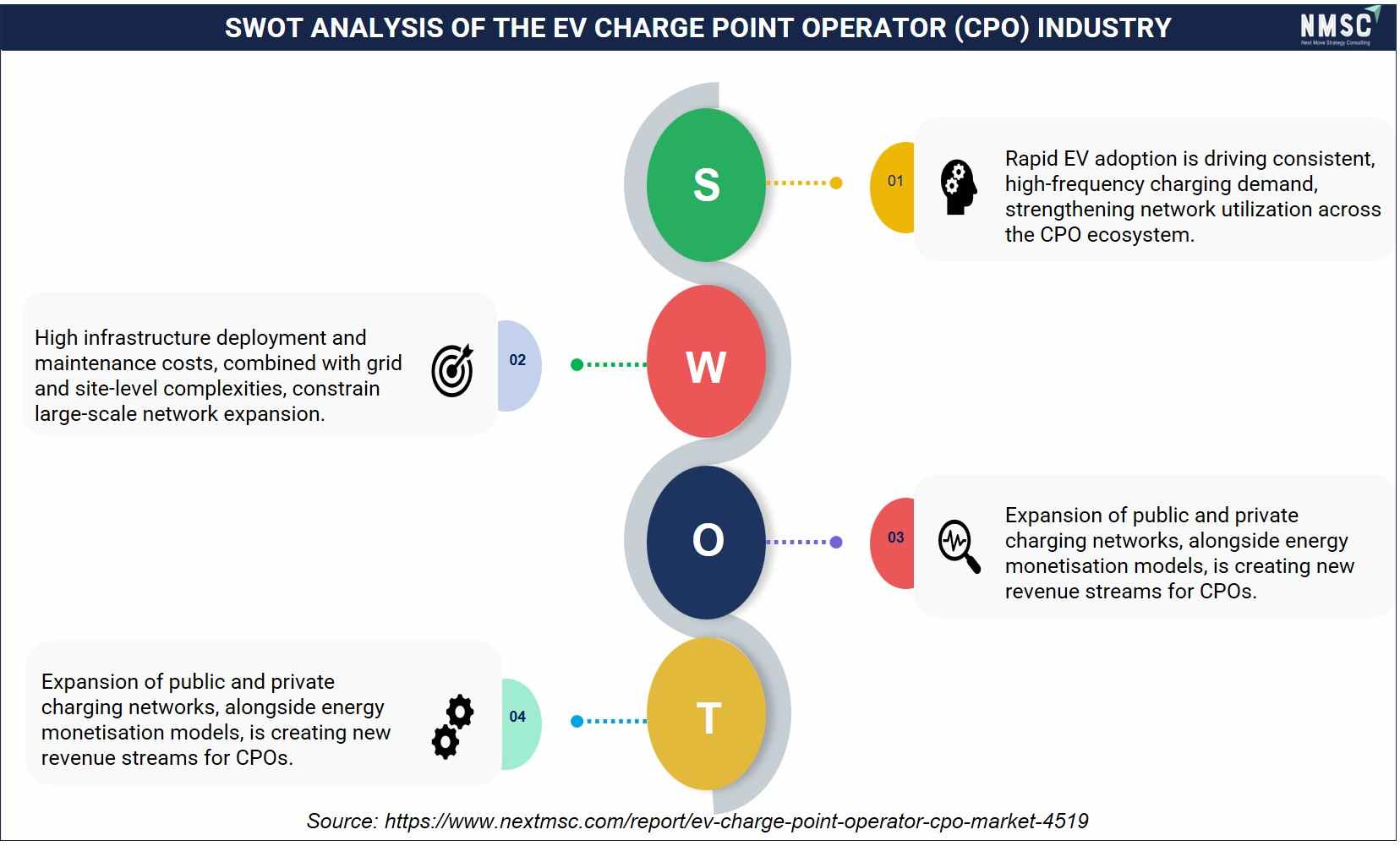
Based on our evaluation of CPO deployments, we noticed that rapid EV adoption drives consistent charging demand, while high infrastructure costs constrain expansion. However, expanding networks and energy monetisation models are creating new revenue opportunities, supporting more scalable and utilization-driven growth.
Competitive Landscape
Competitive Dynamics & M&A Landscape:
|
Key Takeaways |
|
The global EV charge point operator (CPO) market is led by major energy-backed and specialized charging network providers such as Tesla Supercharger Network, Shell Recharge, BP Pulse, IONITY, Electrify America, and EVgo. Based on our analysis, these companies maintain strong market positioning through extensive ultra-fast charging deployment, strategic highway and urban site locations, and robust financial backing, while regional players such as Fastned, GridServe, InstaVolt, and Zunder expand through high-utilisation corridors and renewable-powered charging hubs. |
|
Competitive differentiation in the EV CPO market is primarily driven by ultra-fast charging capabilities, smart energy management, digital payment integration, and network reliability. Operators are increasingly focusing on real-time monitoring, load optimisation, and seamless mobile-based user interfaces to enhance customer experience and improve asset utilisation across networks. |
|
Recent mergers, acquisitions, and partnerships indicate a shift toward ecosystem integration, fleet electrification, and renewable energy alignment rather than only geographic expansion. Operators focusing on scalable infrastructure, ESG compliance, and digital-first engagement are securing stronger long-term competitive positioning. |

Which Companies Dominate the EV Charge Point Operator (CPO) Industry and How Do They Compete?
Based on our analysis, we observed that the EV charge point operator (CPO) market is led by a mix of energy-backed players and specialised charging network providers. Tesla Supercharger Network, Shell Recharge, BP Pulse, IONITY, Electrify America, and EVgo consistently lead large-scale deployments where network reliability, ultra-fast charging capabilities, and strategic site locations are critical decision factors. In addition, our evaluation shows that these operators are frequently selected for high-traffic highway corridors and urban hubs requiring consistent uptime and seamless user experience. Furthermore, Fastned, GridServe, and InstaVolt strengthen their positions through high-performance charging corridors and renewable-powered infrastructure. Consequently, competition at this level is primarily driven by network density, charging speed, and capital-backed expansion strategies.
Market Dominated by EV Charge Point Operator (CPO) Giants and Specialists
From our observation, we found that the competitive landscape is further shaped by regional and emerging operators such as Zunder, GreenWay, Be Charge, Connected Kerb, and Be.EV. In addition, our interactions with charging network operators and infrastructure developers indicate that these companies gain traction by focusing on region-specific deployment strategies, public-private partnerships, and scalable urban charging solutions. Moreover, operators such as Connected Kerb and Be Charge are increasingly adopted in municipal and residential environments, while Zunder and GreenWay expand across high-growth European corridors. As a result, large operators establish network scale and brand trust, while regional players accelerate adoption through targeted and flexible deployment models.
Innovation and Adaptability Drive Market Success
From our market evaluations, we determined that technology integration and user experience are central to competitive differentiation in the EV CPO market. In addition, leading operators are advancing capabilities in AI-driven network optimisation, smart energy management, and real-time monitoring to enhance charger utilisation and reliability. Furthermore, our analysis indicates that investments in mobile applications, digital payment systems, and seamless interoperability are improving customer accessibility and engagement. At the same time, operators integrating renewable energy, battery storage, and load balancing systems are strengthening operational efficiency. Consequently, these advancements are enabling operators to scale efficiently while enhancing overall service quality.
Market Players to Opt for Merger & Acquisition Strategies to Expand Their Presence
Based on our primary research, we noticed that strategic partnerships and ecosystem integration are emerging as key growth strategies in the EV CPO market. In addition, operators are increasingly collaborating with utilities, fleet operators, real estate developers, and governments to accelerate infrastructure deployment and improve network accessibility. Moreover, our analysis shows that partnerships focused on energy integration, fleet charging solutions, and digital platform expansion are enabling stronger end-to-end service offerings. Rather than solely focusing on geographic expansion, operators are prioritising ecosystem connectivity and operational efficiency. As a result, these strategies are reinforcing network strength, service capabilities, and long-term market positioning.
CPO Data of Different Companies of the Market
|
Company Name |
Data Availability |
Stalls |
|
Tesla Supercharger Network |
Public global network |
75000 |
|
ChargePoint |
Largest independent |
xxx |
|
Shell Recharge Solutions |
Global oil-major network |
xxx |
|
Electrify America |
US open DC fast network |
4800 |
|
EVgo |
US DC fast network |
5850 |
|
Blink Charging |
Global operator |
xxx |
|
BP Pulse |
UK/Europe network |
33900 |
|
Allego |
European operator |
xxx |
|
IONITY |
European high-power network |
xxx |
|
Fastned |
European fast charger operator |
xxx |
The global EV charge point operator (CPO) market includes a mix of large network operators and independent providers offering public, fast, and regional charging solutions. The companies listed above represent key players ranked by network scale and stall availability, reflecting their infrastructure reach across major EV markets. While leaders such as Tesla Supercharger Network and ChargePoint demonstrate significant scale, the market remains fragmented with regional and specialized operators supporting localized expansion.
Our analysis covers a detailed assessment of 50 companies. For comprehensive insights and complete data access, we recommend purchasing the full report.
List of Key EV Charge Point Operator (CPO) Companies
-
Tesla Supercharger Network
-
EVgo
-
Shell Recharge
-
Vattenfall InCharge
-
Fastned
-
GridServe
-
InstaVolt
-
Francis Energy
-
Connected Kerb
-
Be Charge
-
GreenWay
-
Zunder
-
EVCS
-
Be.EV
-
Revel Charging
-
BP Pulse
-
JOLT Charge Pty Ltd.
-
Red E Charge
What are the Latest Key Industry Developments?
-
December 2025 – GRIDSERVE announced the continued expansion of its Electric Freightway with the launch of four new dedicated eHGV charging hubs across England, following its recognition as the Charging Network of the Year for 2026 by Electrifying.com.
-
November 2025 – Tesla officially launched its first integrated Tesla Center in Gurugram, India, combining retail, delivery, and a V4 Supercharging hub as part of a broader strategy to establish charging infrastructure in all major Indian cities.
-
October 2025 - BP Pulse launched a 40-stall ultrafast EV charging hub near Houston’s William P. Hobby Airport, expanding its U.S. footprint and targeting ride-hail, rental fleets, and public charging demand at key travel hubs.
What are the Key Factors Influencing Investment Analysis & Opportunities in the EV Charge Point Operator (CPO) Market?
Investment analysis in the EV charge point operator (CPO) market is increasingly shaped by a shift toward platform-driven and energy-integrated business models, rather than standalone charging infrastructure deployment. Based on our evaluation of recent funding activity, partnerships, and expansion strategies, we observed that investors favour operators with recurring revenue streams derived from charging services, subscription-based models, digital platforms, and energy management solutions. Companies demonstrating scalable network expansion, strong utilisation rates, and seamless integration with payment systems and grid infrastructure consistently attract premium valuations.
In addition, we identified growing investment concentration around ultra-fast charging networks, AI-driven network optimisation, and smart energy management solutions, particularly in deployments addressing rising EV demand, peak load management, and network scalability. Furthermore, strategic investments are increasingly prioritised over purely financial funding, as energy companies, utilities, and infrastructure players seek ecosystem control and faster market expansion. At the same time, operators combining technology integration with strong operational execution are gaining higher investor confidence. Consequently, the most compelling opportunities are emerging in companies that balance infrastructure scale, digital capabilities, and long-term energy ecosystem integration.
Key Benefits for Stakeholders:
Next Move Strategy Consulting (NMSC) presents a comprehensive analysis of the EV charge point operator (CPO) market trends, covering historical developments from 2020 to 2025 and providing forward-looking forecasts through 2035. Our study evaluates the market at global, regional, and country levels, delivering quantitative outlooks alongside qualitative insights into key growth drivers, adoption barriers, technology shifts, and investment trends across all major EV Charge Point Operator (CPO) segments.
From our observations, the market delivers significant and sustainable value across the broader EV ecosystem. We observe that the increasing adoption of electric vehicles and expansion of charging infrastructure provide investors with predictable revenue streams, supported by recurring service contracts, home-based charging programs, and scalable deployment of advanced technologies. Our analysis indicates that this growth enables operators and service providers to enhance operational efficiency, improve utilisation, and elevate user experience through automated monitoring systems, precision charging equipment, and digitally integrated management platforms. At the same time, manufacturers, technology providers, and service partners capture long-term opportunities through device upgrades, software-enabled management solutions, and expanded service networks. By linking technological innovation with operational efficiency and scalable infrastructure, we find that the EV charge point operator (CPO) market not only supports user-centric, reliable charging services but also generates measurable value for all stakeholders, ensuring sustainable growth and long-term profitability.
|
Parameters |
Details |
|
Customization Scope |
Free customization (equivalent to up to 80 analyst-working hours) after purchase. Addition or alteration to country, regional & segment scope. |
|
Pricing and Purchase Options |
Avail customized purchase options to meet your exact research needs. |
|
Approach |
In-depth primary and secondary research; proprietary databases; rigorous quality control and validation measures. |
|
Analytical Tools |
Porter's Five Forces, SWOT, value chain, and Harvey ball analysis to assess competitive intensity, stakeholder roles, and relative impact of key factors. |
Key Market Segments
By Charging Infrastructure Type
-
AC Charging
-
AC Slow (≤7 kW)
-
AC Fast (7.1 to 22 kW)
-
-
DC Charging
-
DC Low Power (<50kW)
-
DC Medium Power (50-149 kW)
-
DC High Power (≥150 kW)
-
By Deployment Location
-
Residential
-
Home Private Driveway or Garage
-
Multi-Dwelling Residence Common
-
-
Workplace
-
Office Campus
-
Industrial Site
-
-
Destination
-
Retail and Shopping Centers
-
Hospitality and Leisure Sites
-
-
Public Off-Street
-
Car Park and Parking Garage
-
Retail Surface Parking
-
-
Public On-Street
-
Highway and Corridor
-
Motorway Service Areas
-
Highway Fast Charge Hubs
-
-
Fleet Depot and Logistics Yard
-
Light Commercial Depot
-
Heavy Truck and Bus Depot
-
-
Semi-Public Restricted Access
-
Fleet Guest Parking
-
Property-Managed Parking with Limited Access
-
By Ownership & Operating Model
-
Operator Owned and Operated
-
Site Host Owned, Third-Party Operated
-
Revenue Share Partnership
-
Utility Operated
-
Public Authority Operated
-
Public-Private Partnership
By Accessibility
-
Open Public Access
-
Membership or Network Access Only
-
Site Restricted Access
-
Fleet Only
-
Resident Only
-
By Pricing Model
-
Transactional Pricing
-
Energy Based (per kWh)
-
Time Based (per minute or per hour)
-
Per Session Flat Fee
-
-
Hybrid Pricing
-
Subscription and Membership
-
Contracted Revenue
-
Fleet Service Agreements
-
Managed Charging Contracts
-
-
Ancillary Revenue
-
Advertising
-
Retail or Parking Fees
-
Value Added Services
-
By Geographic Scope of Operations
-
Single Site Operator
-
City or Municipal Network
-
Regional Network
-
National Network
-
Cross-Border International Network
By Service offering
-
Basic Charging Only
-
Charging, Payment, and Roaming
-
Managed Charging and Software Services
-
Load Management
-
Smart Scheduling
-
-
Energy Services and Grid Integration
-
Behind-the-Meter Storage
-
Demand Response and V2G
-
By End-User
-
Private Passenger EV Users
-
Commercial Light Vehicle Fleets
-
Delivery and Logistics
-
Trade Vehicles
-
-
Heavy Duty Fleets
-
Buses
-
Trucks and Haulage
-
-
Shared Mobility
-
Ride-Hail and Taxis
-
Car Rental and Car Share
-
-
Public and Institutional Fleets
-
Municipal Services
-
Emergency Services
-
Geographical Breakdown
-
North America: U.S., Canada, and Mexico.
-
Europe: UK, Germany, France, Italy, Spain, Sweden, Denmark, Finland, the Netherlands, and the Rest of Europe.
-
Asia Pacific: China, India, Japan, South Korea, Taiwan, Indonesia, Vietnam, Australia, Philippines, Malaysia and the rest of APAC.
-
Middle East & Africa (MEA): Saudi Arabia, UAE, Egypt, Israel, Turkey, Nigeria, South Africa, and the rest of MEA.
-
Latin America: Brazil, Argentina, Chile, Colombia, and the rest of LATAM.
Conclusion & Recommendations
This report provides stakeholders, service providers, investors, and consultants with actionable insights to capitalise on the structural transformation underway in the market. By combining rigorous data-driven analysis with proven strategic frameworks, NMSC’s EV Charge Point Operator (CPO) Market Report serves as a critical decision-support resource for navigating a rapidly evolving electrification landscape. Based on our evaluation, we observed that the CPO market is positioned for sustained expansion, supported by accelerating EV adoption, increasing demand for reliable public charging networks, and the transition toward energy-integrated mobility ecosystems. Key strategic insights highlight the growing importance of ultra-fast charging infrastructure, AI-driven network optimisation, and seamless integration with digital payment platforms and grid systems, as these capabilities enhance utilisation efficiency and long-term return on investment. Operators prioritising scalable infrastructure, smart energy management, and user-centric digital platforms consistently achieve stronger network performance and recurring revenue generation.
For executives and investors, capturing value requires focusing on high-growth segments such as highway fast-charging corridors, fleet and depot charging, and urban high-density charging hubs, while continuing investments in technology integration, energy optimisation, and strategic partnerships. In addition, expanding presence across high-growth regions and EV adoption corridors is unlocking new demand opportunities. Furthermore, scalability, network reliability, and consistent user experience are strengthening operator credibility and accelerating adoption. Consequently, these factors are enabling durable value creation while shaping a more efficient, connected, and future-ready EV charging ecosystem.


About the Author
 Saista Faiyaz
— Saista Faiyaz is Research Associate at Next Move Strategy Consulting, where she has covered consumer markets and healthcare technologies for 3 years. Her work includes primary interview review, secondary-source validation, market sizing, and structured analysis of company and industry data. She supports research by comparing evidence across sources, organizing findings into market narratives, and documenting assumptions used in analysis. Her scope includes cross-market benchmarking, and reports.
Saista Faiyaz
— Saista Faiyaz is Research Associate at Next Move Strategy Consulting, where she has covered consumer markets and healthcare technologies for 3 years. Her work includes primary interview review, secondary-source validation, market sizing, and structured analysis of company and industry data. She supports research by comparing evidence across sources, organizing findings into market narratives, and documenting assumptions used in analysis. Her scope includes cross-market benchmarking, and reports.
About the Reviewer
 Supradip Baul
— Supradip Baul is an accomplished business consultant and strategist with over a decade of rich experience in market intelligence, strategy, technology, and business transformation. His work has included rigorous qualitative and quantitative analysis across multiple industries, helping clients shape investment decisions and long-term roadmaps. Earlier in his career, he was associated with Gartner, where he contributed to industry-leading reports and market share analyses. He has worked with leading global companies and holds an MBA with a dual specialization in Marketing and Finance.
Supradip Baul
— Supradip Baul is an accomplished business consultant and strategist with over a decade of rich experience in market intelligence, strategy, technology, and business transformation. His work has included rigorous qualitative and quantitative analysis across multiple industries, helping clients shape investment decisions and long-term roadmaps. Earlier in his career, he was associated with Gartner, where he contributed to industry-leading reports and market share analyses. He has worked with leading global companies and holds an MBA with a dual specialization in Marketing and Finance.
At Next Move Strategy Consulting, we understand that insightful market research is the cornerstone of successful business decisions. That's why we employ a robust and multifaceted approach, combining various methodologies to deliver the most accurate and actionable data for our clients.

Research Landscape
We navigate the world of research with two primary approaches:
Qualitative Approach
Our qualitative research methodologies involve immersive techniques such as in-depth interviews, focus groups, and observational studies. By engaging directly with individuals and stakeholders, we uncover valuable insights that quantitative data alone may overlook.

Quantitative Research
In tandem with qualitative methodologies, NMSC leverages the power of Quantitative Research to provide a robust foundation of numerical insights. Through systematic data collection and analysis, we quantify patterns, preferences, and market trends, offering a comprehensive view of the business landscape.
Our quantitative research approach employs diverse tools, including surveys, experiments, and statistical modelling. These methodologies enable us to gather data from a large and representative sample, ensuring the statistical significance of our findings. By employing structured questionnaires and standardized data collection methods, we guarantee the reliability and validity of the information we present to our clients.
Quantitative research is particularly effective in measuring the prevalence of trends, assessing market size, and gauging the impact of various factors on consumer behavior. The numerical precision attained through this approach equips our clients with actionable insights, facilitating data-driven decision-making and strategy formulation.


Our Specialized Toolbox for Industry-Specific Market Research
We deploy a specialized arsenal of techniques tailored to meet your unique requirements. Here's a glimpse into our comprehensive toolbox:

Information Procurement
The stage entails acquiring market data or relevant information through various sources and methodologies.


Market Research Approach
We utilize both top-down and bottom-up approaches in market research analysis to achieve a comprehensive understanding of the market dynamics, leveraging the broad perspective of industry trends and macroeconomic factors alongside detailed insights from specific segments and individual companies.

Porters Five Forces Analysis
We conduct Porter's Five Forces analysis to evaluate the competitive landscape of an industry, providing us with insights into factors that affect profitability and strategic positioning.

SWOT Analysis

Forecasting
We utilize a forecasting model to predict future consumption by considering parameters like population, economics, regulations, market competition, drivers, constraints, technology, and pricing. We also employ statistical techniques such as multilinear regression, exponential smoothing, moving average, ARIMA, and Monte Carlo simulations for accurate predictions. In econometric forecasting, we analyzed short-term and long-term event impacts, attributing values based on regulatory frameworks, economic factors, and market events.





 Speak to Our Analyst