Exhaust Air Heat Pump Market

Customize Now
Exhaust Air Heat Pump Market

Exhaust Air Heat Pump Market Size, Share, Trends and Growth Analysis, By Product Configuration (Integrated Exhaust Air Heat Pumps, Modular Exhaust Air Heat Pumps, Exhaust Air Heat Pump Water Heaters, and Others), By Capacity Range (Residential Systems, and Commercial Systems), By Technology Type (Refrigerant Type and Others), By Installation Type (New Construction, and Retrofit), By Sales Channel (Direct Sales & Others) — Global Industry Report and Forecast, 2026–2035

What Is the Exhaust Air Heat Pump Market Size?

The global exhaust air heat pump market size was valued at USD 4.2 billion in 2025 and is estimated at USD 4.5 billion in 2026, forecast to reach USD 8.7 billion by 2035, expanding at a 7.8% CAGR between 2026 and 2035. Europe leads with approximately 46% share, while integrated systems dominate with approximately 58% share of product configurations.

We observed that growth is broad-based across every segmentation axis, with natural-refrigerant adoption and integrated, factory-assembled system architectures driving the dominant structural shifts through 2035.

Key Takeaways

By Product Configuration: Integrated Exhaust Air Heat Pumps held the largest share of approximately 58% (USD 2.44 billion) in 2025; Exhaust Air Heat Pump Water Heaters is the fastest-growing sub-segment at 9.6% CAGR from 2026–2035.

By Capacity Range: Residential Systems held the largest share of approximately 72% (USD 3.02 billion) in 2025; Commercial Systems is the fastest-growing sub-segment at 9.4% CAGR from 2026–2035.

By Refrigerant Type: Synthetic Refrigerant held the largest share of approximately 54% (USD 2.27 billion) in 2025; Natural Refrigerant is the fastest-growing sub-segment at 12.4% CAGR from 2026–2035.

By Compressor Technology: Variable Speed Compressor held the largest share of approximately 63% (USD 2.65 billion) in 2025; Other Compressor is the fastest-growing sub-segment at 10.8% CAGR from 2026–2035.

By Installation Type: Retrofit held the largest share of approximately 61% (USD 2.56 billion) in 2025; New Construction is the fastest-growing sub-segment at 9.8% CAGR from 2026–2035.

By Sales Channel: Installer Channel held the largest share of approximately 44% (USD 1.85 billion) in 2025; Online is the fastest-growing sub-segment at 14.6% CAGR from 2026–2035.

By End User Application: Residential Buildings held the largest share of approximately 66% (USD 2.77 billion) in 2025; Commercial Buildings is the fastest-growing sub-segment at 9.4% CAGR from 2026–2035.

Dominant Region: Europe dominated with approximately 46% revenue share (USD 1.95 billion) in 2025.

Fastest-Growing Region: Asia-Pacific is expected to register the highest CAGR of approximately 10.7% during 2026–2035.

Dominant Country: Germany led with approximately USD 0.62 billion in 2025.

Fastest-Growing Country: India is the fastest-growing country at approximately 15.2% CAGR from 2026–2035.

Market Opportunity: The exhaust air heat pump market is expected to create an absolute dollar opportunity of USD 4.2 billion between 2026 and 2035, presenting significant investment potential across the retrofit ventilation and low-carbon residential heating value chain.

According to Next Move Strategy Consulting analysis, installers and distributors are increasingly consolidating around natural-refrigerant, factory-integrated exhaust air heat pump platforms to simplify F-Gas Regulation compliance, a shift that favors diversified manufacturers with in-house ventilation and refrigeration engineering over single-technology specialists as regulatory scrutiny intensifies through 2035.

What Does the Exhaust Air Heat Pump Market Encompass?

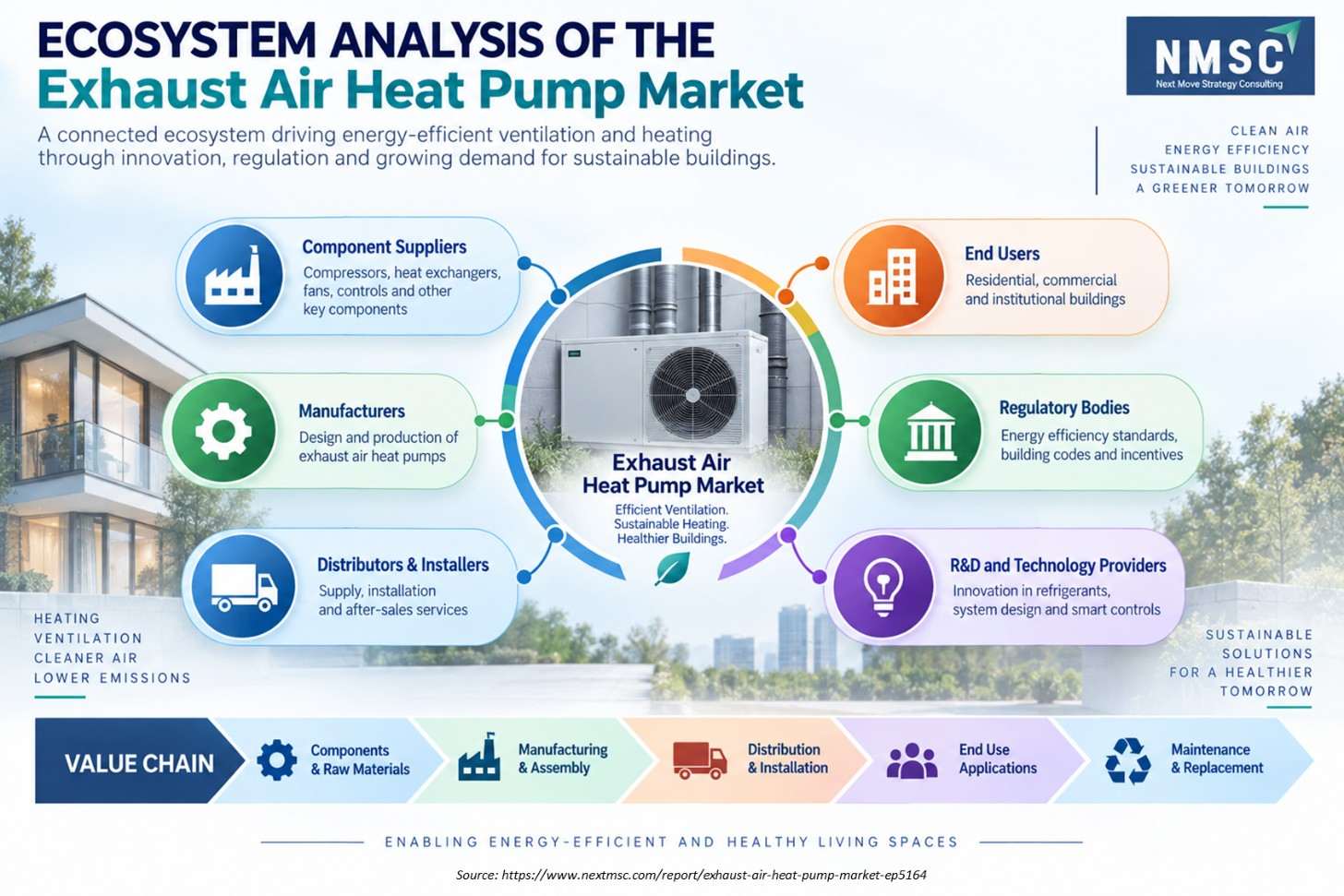
The exhaust air heat pump market encompasses systems that recover thermal energy from a building's outgoing ventilation air to deliver space heating, domestic hot water, and, in many configurations, controlled fresh-air ventilation, without requiring an outdoor unit. Our assessment indicates that the scope spans integrated, modular, and water-heater-only architectures supplied to housebuilders, installers, and facility owners across single-family homes, multi-family buildings, and light commercial and industrial premises, with the category rooted in Nordic and Central European building practice before expanding into broader retrofit and new-construction markets.

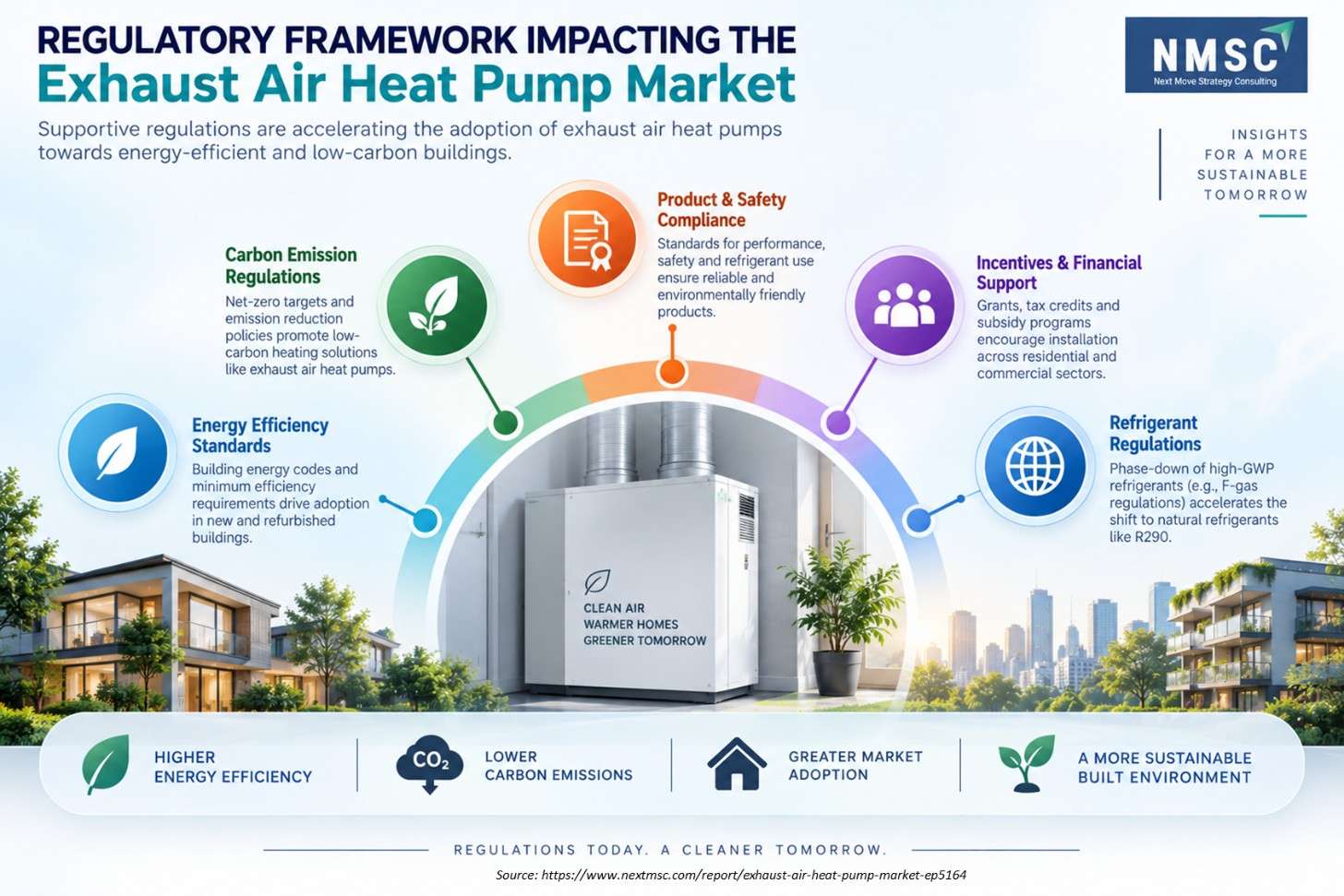
Regulatory frameworks such as the European Union's revised F-Gas Regulation (EU) 2024/573 and the recast Energy Performance of Buildings Directive shape refrigerant selection and mandate progressive electrification of heating in new and renovated buildings, while national subsidy schemes influence installer channel economics. We observed that technology adoption is shifting toward natural-refrigerant, variable-speed platforms that replace legacy synthetic-refrigerant designs. Next Move Strategy Consulting's analysis indicates that this structural shift, combined with tightening retrofit compliance timelines, is redefining specification criteria across the exhaust air heat pump market.

Parameters

Details

Market Size in 2025

USD 4.2 Billion

Market Size in 2026

USD 4.5 Billion

Revenue Forecast in 2035

USD 8.7 Billion

Growth Rate

CAGR of 7.8% from 2026 to 2035

Analysis Period

2025–2035

Base Year Considered

2025

Forecast Period

2026–2035

Market Size Estimation

Revenue (USD Billion)

Companies Profiled

20

Countries Covered

38

Market Share

Available for Top 10 Companies

Key Emerging Trends

Based on research conducted by Next Move Strategy Consulting, we found that four structural trends are reshaping product design, sourcing, and stakeholder engagement across the industry.

How Is the Shift to Natural Refrigerants Reshaping Exhaust Air Heat Pump Design?

Manufacturers are re-engineering refrigerant circuits around propane (R290) to meet the European Union's revised F-Gas Regulation (EU) 2024/573, which tightens global warming potential limits on synthetic refrigerants used in heat pump equipment. We observed that Stiebel Eltron's hpnext platform, unveiled at ISH 2025, standardized R290 across its air source, ground source, and integral ventilation heat pump ranges. Brand owners and installers are adopting these architectures to secure long-term regulatory compliance ahead of tightening 2027 and 2032 phase-down milestones.

How Are All-in-One Integrated Systems Transforming Retrofit Adoption?

Integrated exhaust air heat pumps that combine heating, domestic hot water, and mechanical ventilation within a single compact cabinet are gaining share as retrofit projects prioritize minimal footprint and simplified commissioning. Our findings suggest that compact vertical-cabinet formats, such as NIBE's F-series, are increasingly specified in apartment retrofits where drilling boreholes or siting an outdoor unit is impractical. Manufacturers are expanding integrated portfolios to capture this compact-footprint retrofit demand across dense urban housing stock.

Why Is Variable-Speed Compressor Technology Gaining Adoption?

Variable-speed, inverter-driven compressors are displacing fixed-speed designs as installers prioritize noise reduction and part-load efficiency. We observed that inverter-driven platforms adapt output to real-time ventilation and heating demand, reducing cycling noise in occupied multi-family buildings. This trend is elevating demand for variable-speed architectures among installer channels serving noise-sensitive urban retrofit and new-construction projects across Europe and Asia-Pacific.

How Is the EU's Energy Performance of Buildings Directive Accelerating Installer Channel Growth?

The recast Energy Performance of Buildings Directive is phasing in stricter minimum energy performance requirements for renovated buildings, pushing housing associations and private landlords toward electrified heating and heat-recovery ventilation. Our analysis shows that this regulatory pressure is expanding demand through installer and distributor channels, as certified contractors become the primary route for compliance-driven retrofit specification across the exhaust air heat pump market's Installer Channel and Distributer segments.

CONSUMER BEHAVIOR ANALYSIS OF THE EXHAUST AIR HEAT PUMP MARKET

The consumer behavior pattern in the Exhaust Air Heat Pump Market follows four stages: awareness, consideration, purchase, and loyalty. Consumers first recognize the benefits of energy-efficient heating systems, then compare efficiency, installation costs, and warranty options before purchasing. Buying decisions are influenced by trusted installers and distributors. Consistent energy savings, reliable performance, and quality after-sales support enhance customer satisfaction, encouraging repeat purchases, positive recommendations, and long-term brand loyalty.

Growth Drivers and Restraints

Growth Catalyst and Risk Assessment Matrix

Factors

Type

(+/−) % Impact on CAGR

Geographic Relevance

Impact Timeline

EU F-Gas Regulation (EU) 2024/573 accelerating natural refrigerant adoption

Driver

+1.9%

Europe

2026–2035

EPBD-linked building electrification and renovation mandates

Driver

+1.6%

Europe

2026–2035

Rising retrofit demand in mechanically ventilated apartment stock

Driver

+1.3%

Europe, North America

2026–2035

Government heat pump subsidy and rebate programs

Driver

+1.1%

Europe, North America

2026–2032

Growing demand for integrated heating, hot water, and ventilation systems

Driver

+0.9%

Europe, Asia-Pacific

2026–2035

Expanding installer channel and merchant distribution networks

Driver

+0.8%

Global

2026–2035

Limited applicability to naturally ventilated and older building stock

Restraint

−1.0%

Global

2026–2035

Competition from air-to-water and ground-source heat pumps

Restraint

−0.7%

Europe, North America

2026–2032

High installer certification and training costs for natural refrigerants

Restraint

−0.5%

Global

2028–2035

What Is the Primary Growth Driver of the Exhaust Air Heat Pump Market?

The European Union's revised F-Gas Regulation (EU) 2024/573, which entered into force in March 2024 and tightens global warming potential limits on refrigerants used in heat pump equipment, is the primary driver of the market. The European Commission's climate action framework continues to phase down high-GWP synthetic refrigerants toward 2050, sustaining manufacturer investment in natural-refrigerant platforms. We observed that this regulatory shift, reinforced by national retrofit mandates, continues to anchor baseline demand for compliant integrated and modular systems across developed European economies.

How Is Sustainability Regulation Driving Exhaust Air Heat Pump Market Growth?

Building electrification mandates under the European Union's recast Energy Performance of Buildings Directive are accelerating market growth toward natural-refrigerant, variable-speed formats. Our assessment indicates that this regulatory pressure, combined with national subsidy programs administered through bodies such as Germany's Federal Ministry for Economic Affairs and Climate Action, is compressing adoption timelines for compliant exhaust air heat pump platforms across new construction and retrofit projects alike.

What Is Restraining Exhaust Air Heat Pump Market Expansion?

Limited applicability to buildings without mechanical exhaust ventilation, along with higher installer certification costs for flammable natural refrigerants, restrains broader adoption outside Europe's mature retrofit base. The U.S. Department of Energy continues to track building-envelope and ventilation-system compatibility as a key constraint on heat pump technology selection. We found that smaller regional installers face particular exposure, as certification and training investment requirements limit their ability to service natural-refrigerant systems compared with larger, multi-brand contracting groups.

Segmentation Analysis

Segment Sizing: By Product Configuration

Segment

2025 (USD)

2035 (USD)

CAGR% (2026–2035)

Integrated Exhaust Air Heat Pumps

USD 2.44 Billion

USD 4.79 Billion

7.0%

Modular Exhaust Air Heat Pumps

USD 0.86 Billion

USD 1.83 Billion

8.8%

Exhaust Air Heat Pump Water Heaters

USD 0.61 Billion

USD 1.39 Billion

9.6%

Other Exhaust Air Heat Pump Systems

USD 0.29 Billion

USD 0.69 Billion

9.0%

Total

USD 4.20 Billion

USD 8.70 Billion

7.8%

Which Product Configuration Segment Dominates the Exhaust Air Heat Pump Market?

Integrated Exhaust Air Heat Pumps, which combine heating, domestic hot water, and ventilation heat recovery within a single cabinet, led the market with USD 2.44 billion in 2025, supported by simplified installation and compact footprint in retrofit apartments. We observed that Exhaust Air Heat Pump Water Heaters are the fastest-growing product configuration, expanding at a 9.6% CAGR from 2026 to 2035, as standalone domestic hot water units gain traction in buildings retaining existing space-heating systems.

Segment Sizing: By Sales Channel

Segment

2025 (USD)

2035 (USD)

CAGR% (2026–2035)

Direct Sales

USD 0.85 Billion

USD 1.65 Billion

7.6%

Distributer

USD 1.10 Billion

USD 2.15 Billion

7.7%

Installer Channel

USD 1.85 Billion

USD 3.55 Billion

7.5%

Online

USD 0.40 Billion

USD 1.35 Billion

14.6%

Total

USD 4.20 Billion

USD 8.70 Billion

7.8%

Which Sales Channel Leads Exhaust Air Heat Pump Market Distribution?

The Installer Channel remained the leading distribution route, valued at USD 1.85 billion in 2025, as certified contractors continue to serve as the primary specification point for compliance-driven retrofit and new-construction projects. Our findings suggest that Online is the fastest-growing channel, registering a 14.6% CAGR from 2026 to 2035, as compact residential units increasingly move through e-commerce platforms serving self-specifying homeowners and smaller contracting firms.

Segment Sizing: By End User Application

Segment

2025 (USD)

2035 (USD)

CAGR% (2026–2035)

Residential Buildings

USD 2.77 Billion

USD 5.55 Billion

8.0%

Commercial Buildings

USD 1.05 Billion

USD 2.35 Billion

9.4%

Industrial Buildings

USD 0.38 Billion

USD 0.80 Billion

8.6%

Total

USD 4.20 Billion

USD 8.70 Billion

7.8%

Which End User Application Leads Exhaust Air Heat Pump Market Demand?

Residential Buildings remained the leading end user application, valued at USD 2.77 billion in 2025 on sustained single-family and multi-family retrofit and new-construction demand. Based on research conducted by Next Move Strategy Consulting, we found that Commercial Buildings is the fastest-growing application, registering a 9.4% CAGR from 2026 to 2035, as offices, education facilities, and healthcare buildings increasingly specify heat-recovery ventilation integrated with heating and hot water delivery.

Growth Opportunities

Our analysis shows that three forward-looking opportunities stand out for stakeholders positioning within the exhaust air heat pump market over the 2026–2035 forecast period.

How Can Natural-Refrigerant Retrofit Kits Unlock Value in Aging European Housing Stock?

Natural-refrigerant retrofit kits present a whitespace opportunity for manufacturers serving Europe's aging multi-family housing stock, where mechanical exhaust ventilation already exists but heating remains fossil-fuel based. Suppliers that commercialize drop-in R290 retrofit platforms stand to capture recurring installer channel demand as housing associations pursue Energy Performance of Buildings Directive compliance ahead of tightening renovation deadlines.

Where Do Commercial and Light Industrial Buildings Create New Demand?

Commercial buildings, including education, healthcare, and office facilities, represent an underpenetrated opportunity for higher-capacity exhaust air heat pump systems engineered to institutional ventilation standards. Manufacturers that develop validated commercial-capacity platforms can secure long-term procurement relationships with facility owners, benefiting from replacement-cycle revenue tied to institutional building electrification programs across the Commercial Buildings segment.

How Can Online and Direct-to-Installer Sales Channels Expand Market Reach?

Online and direct-to-installer sales channels create an opportunity for manufacturers to reach smaller contracting firms and self-specifying homeowners outside traditional distributor networks. Early movers that build e-commerce-ready product configurators and installer training content can differentiate with cost-sensitive residential customers pursuing compact, factory-integrated systems across the Online and Direct Sales segments.

PESTEL ANALYSIS OF THE EXHAUST AIR HEAT PUMP MARKET

The PESTEL analysis of the Exhaust Air Heat Pump Market highlights the external factors shaping industry growth. Political support through energy efficiency policies and incentives, economic trends affecting investment in sustainable heating, and increasing environmental awareness drive adoption. Technological advancements improve system performance and efficiency, while evolving legal regulations on emissions and building standards encourage compliance. Social preferences for eco-friendly, energy-saving solutions further accelerate market demand and long-term industry expansion.

Regional Outlook

Geographic Performance Snapshot

Region

2025 (USD)

2035 (USD)

CAGR% (2026–2035)

Key Driver

North America

USD 0.78 Billion

USD 1.50 Billion

6.7%

Building electrification incentives and cold-climate retrofit demand

Europe

USD 1.95 Billion

USD 3.55 Billion

6.2%

F-Gas Regulation and EPBD-driven renovation mandates

Asia-Pacific

USD 1.05 Billion

USD 2.85 Billion

10.7%

Expanding urban apartment construction and rising electrification

Middle East & Africa

USD 0.27 Billion

USD 0.50 Billion

6.2%

Diversification-linked construction and green building codes

Latin America

USD 0.15 Billion

USD 0.30 Billion

7.2%

Growing multi-family construction and modern retail infrastructure

Total

USD 4.20 Billion

USD 8.70 Billion

7.8%

North America Exhaust Air Heat Pump Market Outlook

North America's exhaust air heat pump market is expanding as building electrification incentives and cold-climate retrofit programs broaden demand beyond its traditional Nordic base. We observed that U.S. Department of Energy efficiency guidance and state-level electrification mandates sustain demand for compliant heat pump equipment, while installers increasingly specify integrated units in multi-family retrofit projects. Technology adoption remains moderate, with variable-speed platforms gaining share among cold-climate specification requirements.

Europe Exhaust Air Heat Pump Market Outlook

Europe's exhaust air heat pump market reflects a mature, regulation-intensive landscape shaped by the European Union's F-Gas Regulation and recast Energy Performance of Buildings Directive. Our findings suggest that manufacturers across Germany, the UK, and France are accelerating adoption of natural-refrigerant and variable-speed systems to satisfy renovation compliance obligations. Technology adoption favors integrated architectures, supported by installer channels trained under national heat pump certification schemes.

Asia-Pacific Exhaust Air Heat Pump Market Outlook

Asia-Pacific is the fastest-growing exhaust air heat pump market region, propelled by expanding urban apartment construction in China and India and rising electrification of residential heating. We found that regulatory frameworks remain less harmonized than in Europe, giving manufacturers flexibility to scale integrated and modular product lines rapidly. Technology adoption is accelerating as regional distributors, including several Japan and South Korea-based suppliers, expand installer training programs to serve growing residential demand.

Middle East & Africa Exhaust Air Heat Pump Market Outlook

The exhaust air heat pump market in Middle East & Africa is expanding as Gulf Cooperation Council economies diversify into green building construction and adopt updated energy codes. Our analysis shows that Saudi Arabia and the UAE are attracting installer training investment tied to Vision 2030-linked green building mandates. Regulatory influence remains moderate, while technology adoption is gradually shifting toward imported integrated systems as regional distributors align with global sustainability expectations.

Latin America Exhaust Air Heat Pump Market Outlook

Latin America's exhaust air heat pump market is supported by growing multi-family construction in Brazil and Argentina and expanding modern retail infrastructure for building equipment. We observed that regulatory frameworks are less stringent than in North America or Europe, though multinational developers operating locally are introducing energy-efficient ventilation specifications. Technology adoption remains centered on integrated systems, with competitive intensity increasing as regional distributors partner with global manufacturers.

U.S. Exhaust Air Heat Pump Market

Based on our estimates, the U.S. market was valued at approximately USD 0.42 billion in 2025 and is projected to reach USD 0.78 billion by 2035, growing at a 6.4% CAGR. Demand is anchored by state-level building electrification mandates, cold-climate retrofit programs, and U.S. Department of Energy efficiency guidance. Technology penetration favors variable-speed integrated units, and competitive intensity remains moderate among established HVAC manufacturers serving national contractor networks.

Canada Exhaust Air Heat Pump Market

The market in Canada, the Canada's market was valued at approximately USD 0.10 billion in 2025 and is projected to reach USD 0.19 billion by 2035, growing at a 6.7% CAGR. Demand structure mirrors U.S. multi-family retrofit consumption patterns, while Natural Resources Canada efficiency guidance shapes specification requirements. Technology penetration is rising as provincial retailers request natural-refrigerant systems, with competitive intensity moderate given reliance on cross-border supply.

UK Exhaust Air Heat Pump Market

As per our estimate, the UK's market was valued at approximately USD 0.28 billion in 2025 and is projected to reach USD 0.52 billion by 2035, growing at a 6.4% CAGR. Demand is driven by Future Homes Standard compliance and updated Building Regulations favoring electrified heating with integrated ventilation. Regulatory influence is significant, technology penetration favors integrated systems with cooling capability, and competitive intensity remains steady among established Nordic and domestic suppliers.

Germany Exhaust Air Heat Pump Market

According to our analysis, the Germany's market was valued at approximately USD 0.62 billion in 2025 and is projected to reach USD 1.10 billion by 2035, growing at a 5.9% CAGR. Demand structure benefits from a strong domestic heat pump manufacturing base and F-Gas Regulation-driven refrigerant transition. Germany's Federal Ministry for Economic Affairs and Climate Action subsidy programs drive regulatory influence, while technology penetration favors natural-refrigerant, integrated architectures among leading manufacturers.

France Exhaust Air Heat Pump Market

Based on our estimates, the France's market was valued at approximately USD 0.24 billion in 2025 and is projected to reach USD 0.44 billion by 2035, growing at a 6.3% CAGR. Demand is supported by France's renovation-focused building stock and national heat pump subsidy schemes. Regulatory influence from EPBD transposition is notable, and competitive intensity remains high given the concentration of European manufacturers serving French installer networks.

China Exhaust Air Heat Pump Market

The market in China, the China's market was valued at approximately USD 0.42 billion in 2025 and is projected to reach USD 1.15 billion by 2035, growing at a 10.6% CAGR. Demand is fueled by expanding urban apartment construction and a dense base of regional HVAC manufacturers. Regulatory influence is increasing gradually, technology penetration is accelerating through domestic production upgrades, and competitive intensity remains elevated among numerous China-based suppliers.

India Exhaust Air Heat Pump Market

As per our estimate, the India's market was valued at approximately USD 0.14 billion in 2025 and is projected to reach USD 0.52 billion by 2035, growing at a 15.2% CAGR. Demand structure reflects rising urban electrification and expanding organized construction for multi-family housing, the fastest-growing country in the report

As per our estimate, the India's market was valued at approximately USD 0.14 billion in 2025 and is projected to reach USD 0.52 billion by 2035, growing at a 15.2% CAGR. Demand structure reflects rising urban electrification and expanding organized construction for multi-family housing, the fastest-growing country in the report. Regulatory influence remains developing, while technology penetration is rising quickly as multinational manufacturers localize production to serve India's growing residential base.

Japan Exhaust Air Heat Pump Market

According to our analysis, the Japan's market was valued at approximately USD 0.19 billion in 2025 and is projected to reach USD 0.42 billion by 2035, growing at a 9.3% CAGR. Demand is supported by Japan's precision-engineered building equipment heritage and established domestic manufacturers. Regulatory influence is well established, technology penetration is advanced, and competitive intensity remains high among long-standing domestic manufacturers serving replacement demand.

South Korea Exhaust Air Heat Pump Market

Based on our estimates, the South Korea's market was valued at approximately USD 0.12 billion in 2025 and is projected to reach USD 0.29 billion by 2035, growing at a 10.3% CAGR. Demand structure benefits from the country's expanding multi-family construction sector and government electrification incentives. Technology penetration is high, with domestic manufacturers supplying integrated units, and competitive intensity remains pronounced amid rapid product innovation cycles.

Australia Exhaust Air Heat Pump Market

The exhaust air heat pump market in Australia, the Australia's market was valued at approximately USD 0.07 billion in 2025 and is projected to reach USD 0.16 billion by 2035, growing at a 8.9% CAGR. Demand is supported by growing consumer preference for sustainable building equipment and updated national construction codes. Regulatory influence stems from government climate and energy guidance, while technology penetration favors imported integrated systems amid moderate competitive intensity.

UAE Exhaust Air Heat Pump Market

As per our estimate, the UAE's market was valued at approximately USD 0.05 billion in 2025 and is projected to reach USD 0.11 billion by 2035, growing at a 8.9% CAGR. Demand structure is emerging alongside green building mandates tied to national diversification strategy. Regulatory influence remains moderate, technology penetration is gradually improving, and competitive intensity is limited given reliance on imported components from Europe and Asia.

Saudi Arabia Exhaust Air Heat Pump Market

Based on our estimates, the Saudi Arabia's market was valued at approximately USD 0.07 billion in 2025 and is projected to reach USD 0.16 billion by 2035, growing at a 9.5% CAGR. Demand is underpinned by Vision 2030-linked green building construction and expanding residential development programs. Regulatory influence stems from evolving national energy codes, technology penetration favors imported integrated systems, and competitive intensity remains moderate among regional distributors.

South Africa Exhaust Air Heat Pump Market

The market in South Africa, the South Africa's market was valued at approximately USD 0.03 billion in 2025 and is projected to reach USD 0.06 billion by 2035, growing at a 7.6% CAGR. Demand structure is supported by growing commercial construction activity and gradual adoption of energy-efficient building codes. Regulatory influence remains limited, technology penetration is modest, and competitive intensity is centered on a small number of regional distributors.

Brazil Exhaust Air Heat Pump Market

The market in Brazil, the Brazil's market was valued at approximately USD 0.08 billion in 2025 and is projected to reach USD 0.17 billion by 2035, growing at a 8.5% CAGR. Demand is underpinned by Brazil's expanding multi-family construction sector and growing organized retail for building equipment. Regulatory influence stems from national energy efficiency guidance, technology penetration favors integrated systems, and competitive intensity remains moderate among regional distributors.

Argentina Exhaust Air Heat Pump Market

As per our estimate, the Argentina's market was valued at approximately USD 0.03 billion in 2025 and is projected to reach USD 0.06 billion by 2035, growing at a 7.5% CAGR. Demand structure is supported by steady multi-family construction despite macroeconomic volatility. Regulatory influence remains limited, technology penetration is modest, and competitive intensity is centered on a small number of regional distributors serving domestic developers.

Competitive Landscape

We observed that the exhaust air heat pump market features a moderately consolidated competitive landscape, with diversified European heating and ventilation groups competing alongside global appliance manufacturers on refrigerant compliance, integration, and installer support.

Key Takeaways

Description

Market Structure

Moderately consolidated; the top companies profiled in this report collectively account for a majority of global exhaust air heat pump market revenue, while numerous regional European ventilation specialists serve retrofit-specific demand.

Innovation Focus

Natural-refrigerant conversion, variable-speed compressor integration, and compact all-in-one cabinet design dominate current innovation pipelines across leading manufacturers.

M&A Activity

Selective consolidation through platform and channel acquisitions, exemplified by diversified heating groups broadening ventilation and heat pump integration capabilities to serve installer-channel demand.

How Do Companies Compete in the Exhaust Air Heat Pump Market?

Companies compete primarily on refrigerant compliance credentials, installer training support, and manufacturing scale across the industry. Global players such as NIBE Industrier AB and Stiebel Eltron GmbH and Co. KG leverage broad integrated and modular portfolios to serve multinational housebuilders, while regional European ventilation specialists compete on customization and rapid retrofit turnaround for smaller installer networks.

Which Competitive Archetypes Dominate the Exhaust Air Heat Pump Market?

Two archetypes dominate the market: diversified global heating and climate groups offering full-service design and installer support, and specialized regional ventilation manufacturers focused on retrofit-specific compact systems. Vaillant Group and Bosch Home Comfort Group exemplify the diversified archetype through integrated heat pump and ventilation manufacturing, while Nilan A/S and Aereco S.A. exemplify the specialized ventilation-integration archetype serving European retrofit demand.

How Are Companies Differentiating Through Innovation in Exhaust Air Heat Pumps?

Innovation and differentiation strategy increasingly center on natural-refrigerant conversion and compact all-in-one cabinet engineering. Stiebel Eltron's hpnext platform and NIBE's integrated exhaust air ranges both standardize on R290 to secure long-term F-Gas Regulation compliance. Our analysis shows that suppliers unable to demonstrate credible natural-refrigerant transition pathways risk exclusion from housing association and installer channel specification shortlists across Europe.

What M&A and Expansion Activity Is Shaping the Exhaust Air Heat Pump Market?

Mergers, acquisitions, and geographic expansion continue to consolidate heating and ventilation capabilities within the industry. Diversified groups including BDR Thermea Group BV and Groupe Atlantic have broadened heat pump and ventilation portfolios through brand integration, while manufacturers such as Panasonic Holdings Corporation and Daikin Industries, Ltd. pursue geographic expansion into European retrofit channels to diversify beyond core air-to-air and air-to-water product lines.

Key Market Players

Our assessment indicates that the following 20 companies are actively shaping product innovation, refrigerant transition, and channel expansion within the global exhaust air heat pump market.

  • NIBE Industrier AB

  • Stiebel Eltron GmbH and Co. KG

  • Vaillant Group

  • Bosch Home Comfort Group

  • Viessmann Climate Solutions SE

  • BDR Thermea Group BV

  • Groupe Atlantic

  • Nilan A/S

  • Panasonic Holdings Corporation

  • Daikin Industries, Ltd.

  • Mitsubishi Electric Corporation

  • Midea Group Co., Ltd.

  • LG Electronics Inc.

  • Samsung Electronics Co., Ltd.

  • Systemair AB

  • Swegon Group AB

  • Glen Dimplex Group

  • A. O. Smith Corporation

  • ComfortZone AB

  • Aereco S.A.

Latest Developments

We found that recent product and policy developments within the exhaust air heat pump market are concentrated on natural-refrigerant platform launches, reflecting the industry's broader compliance-driven transition.

Date

Event

March 2025

Stiebel Eltron unveiled its hpnext generation of heat pumps at ISH 2025, including the R290-based LWZ integral ventilation and heat pump unit combining heating, hot water, and heat-recovery ventilation in a single natural-refrigerant platform.

December 2024

NIBE Energy Systems announced plans to introduce a new exhaust air heat pump range with integrated cooling capability in the UK, aligned with the Future Homes Standard and updated Building Regulations.

Expert Insights


Statement made during Daikin's 2024 AHR Expo announcement, discussing HVAC decarbonization, sustainable building technologies, and the role of advanced heat pump solutions in addressing climate-related challenges.

Market Interpretation

Philip Johnston's statement underscores the HVAC industry's accelerating transition toward low-carbon and energy-efficient heating technologies in response to climate-related challenges. Daikin's emphasis on heat pumps, inverter compressor technology, and low-global warming potential (GWP) refrigerants reflects the growing market shift toward electrified heating solutions. This trend is directly relevant to the Exhaust Air Heat Pump Market, as exhaust air heat pumps recover thermal energy from building exhaust ventilation to provide space heating and domestic hot water with significantly lower energy consumption and carbon emissions. Increasing demand for decarbonized buildings, stringent energy-efficiency regulations, and the adoption of sustainable HVAC systems are expected to support the long-term growth of exhaust air heat pump installations.

Investment Opportunities

What Capital Inflows Are Targeting the Exhaust Air Heat Pump Market?

Capital inflows into the exhaust air heat pump market are increasingly directed toward natural-refrigerant tooling and compressor manufacturing capacity upgrades. Strategic heating and climate groups continue to fund channel and brand integration, as seen in diversified manufacturers broadening ventilation-integrated heat pump portfolios. We observed that investors favor manufacturers demonstrating validated R290 compliance pathways, viewing regulatory alignment as a proxy for long-term installer channel contract retention.

How Is Infrastructure Investment Supporting Exhaust Air Heat Pump Manufacturing?

Infrastructure investment is expanding compressor and heat exchanger assembly capacity across Europe, particularly in Germany and the Nordic region, to serve rising domestic renovation and new-construction demand. Our findings suggest that manufacturers are investing in automated assembly lines to improve dimensional consistency for compact cabinet formats, supporting the precision required for integrated heating, hot water, and ventilation architectures.

What ESG Considerations Are Shaping Exhaust Air Heat Pump Investment Decisions?

Environmental, social, and governance considerations are central to investment decisions across the industry, with natural-refrigerant conversion and building electrification as key criteria. The European Heat Pump Association continues to track installed-base decarbonization progress that informs manufacturer sustainability disclosures. We found that investors increasingly favor manufacturers with validated R290 safety certification, treating it as a governance indicator alongside installer training and safety compliance.

Key Benefits for Stakeholders

How Does This Report Benefit Enterprise and Industry Leaders?

Enterprise and industry leaders gain access to validated segmentation, competitive benchmarking, and regional demand forecasts that support sourcing and product-portfolio decisions across the exhaust air heat pump industry. Our analysis shows that detailed refrigerant type, compressor technology, and sales channel breakdowns help procurement teams align specifications with regulatory and installer-training requirements while identifying underserved end user application segments for portfolio expansion.

How Does This Report Benefit Investors and Financial Analysts?

Investors and financial analysts benefit from consistent, single-point market size and CAGR estimates that support valuation and capital-allocation decisions across the exhaust air heat pump market supply chain. We observed that the report's regional and segment-level growth differentials help identify which manufacturers and installer networks are best positioned to capture above-market growth in natural-refrigerant and commercial-building categories through 2035.

How Does This Report Benefit Technology Vendors and Product Teams?

Technology vendors and product teams gain insight into emerging design requirements, including natural-refrigerant circuits, variable-speed compressors, and compact integrated cabinets, that are reshaping the industry. Our findings suggest that this analysis helps R&D teams prioritize development roadmaps around F-Gas Regulation compliance and installer-training simplicity that are increasingly required by housing association and installer channel procurement processes.

Key Market Segments

By Product Configuration

  • Integrated Exhaust Air Heat Pumps

  • Modular Exhaust Air Heat Pumps

  • Exhaust Air Heat Pump Water Heaters

  • Other Exhaust Air Heat Pump Systems

By Capacity Range

  • Residential Systems

  • Commercial Systems

By Technology Type

  • Refrigerant Type

    • Synthetic Refrigerant

    • Natural Refrigerant

    • Other Refrigerant

  • Compressor Technology

    • Fixed Speed Compressor

    • Variable Speed Compressor

    • Other Compressor

By Installation Type

  • New Construction

  • Retrofit

By Sales Channel

  • Direct Sales

  • Distributer

  • Installer Channel

  • Online

By End User Application

  • Residential Buildings

    • Single Family Homes

    • Multi-Family Buildings

  • Commercial Buildings

    • Hospitals

    • Healthcare

    • Education

    • Office

    • Retail

    • Other Commercial

  • Industrial Buildings

    • Light Industrial

    • Other Industrial

By Region

  • North America: U.S., Canada, Mexico.

  • Europe: UK, Germany, France, Italy, Spain, Sweden, Denmark, Finland, Netherlands, Rest of Europe.

  • Asia-Pacific: China, India, Japan, South Korea, Taiwan, Indonesia, Vietnam, Australia, Philippines, Malaysia, Rest of APAC.

  • Middle East & Africa: Saudi Arabia, UAE, Egypt, Israel, Turkey, Nigeria, South Africa, Rest of MEA.

  • Latin America: Brazil, Argentina, Chile, Colombia, Rest of LATAM.

Conclusion and Recommendations

What Is the Long-Term Outlook for the Exhaust Air Heat Pump Market?

The long-term outlook for the market remains positive, with global revenue projected to roughly double from USD 4.2 billion in 2025 to USD 8.7 billion by 2035 at a 7.8% CAGR. We observed that sustained F-Gas Regulation compliance pressure, EPBD-driven renovation mandates, and integrated-system adoption will continue underpinning demand across residential, commercial, and industrial applications through the forecast period.

What Strategic Positioning Should Exhaust Air Heat Pump Suppliers Pursue?

Suppliers should prioritize natural-refrigerant and variable-speed product platforms while pursuing installer certification programs to secure long-term housing association and installer channel contracts. Our assessment indicates that manufacturers investing early in R290 refrigerant capability and compact integrated architectures will be best positioned to capture premium specification within the exhaust air heat pump market.

How Attractive Is the Exhaust Air Heat Pump Market for New Investment?

The exhaust air heat pump industry presents an attractive investment case, supported by a USD 4.2 billion absolute dollar opportunity between 2026 and 2035 and above-average growth in Asia-Pacific and commercial-building categories. We found that investment attractiveness is highest for manufacturers combining natural-refrigerant compliance credentials with scaled installer training capacity, positioning them to serve both retrofit and new-construction segments simultaneously.

What Market Shifts and Key Risks Should Stakeholders Monitor?

Stakeholders should monitor installer certification bottlenecks, tightening F-Gas Regulation compliance timelines, and competitive pressure from air-to-water and ground-source alternatives as key risks to the exhaust air heat pump market. Our analysis shows that suppliers unable to scale natural-refrigerant installer training risk losing specification share to competitors with certified R290 platforms, particularly within Europe's increasingly regulated renovation environment.

What Are the Key Growth Pathways for the Exhaust Air Heat Pump Market?

Key growth pathways include expanding commercial and industrial building portfolios, scaling natural-refrigerant compressor manufacturing capacity, and deepening penetration into online and direct-to-installer sales channels. Next Move Strategy Consulting's analysis indicates that suppliers pursuing these pathways while maintaining installer training scale in core residential retrofit categories will be best positioned to capture the exhaust air heat pump market's projected growth through 2035.

Exhaust Air Heat Pump Market Revenue by 2030 (Billion USD) Exhaust Air Heat Pump Market Segmentation


About the Author

Liza Phukan is a content and market research professional with a strong focus on analyzing emerging industries, validating market data, and developing insightful business content. She is passionate about transforming complex information into clear, engaging, and well-structured research that supports strategic decision-making. Beyond her professional interests, she enjoys crocheting, gardening, reading, and exploring creative projects while continuously enhancing her research and writing skills.

About the Reviewer

Supradip Baul is an accomplished business consultant and strategist with over a decade of rich experience in market intelligence, strategy, technology, and business transformation. His work has included rigorous qualitative and quantitative analysis across multiple industries, helping clients shape investment decisions and long-term roadmaps. Earlier in his career, he was associated with Gartner, where he contributed to industry-leading reports and market share analyses. He has worked with leading global companies and holds an MBA with a dual specialization in Marketing and Finance.

Download Free Sample

Please Enter Full Name

Please Enter Valid Email ID

Please enter Country Code and Phone No

Please enter message

Frequently Asked Questions

The exhaust air heat pump market size is estimated at USD 4.5 billion in 2026.

The exhaust air heat pump market is forecast to reach USD 8.7 billion by 2035.

The exhaust air heat pump market is projected to grow at a CAGR of 7.8% from 2026 to 2035.

Integrated Exhaust Air Heat Pumps dominate the market, valued at USD 2.44 billion in 2025.

Exhaust Air Heat Pump Water Heaters are the fastest-growing product configuration, expanding at a 9.6% CAGR from 2026 to 2035.

Europe leads the exhaust air heat pump market, accounting for approximately 46% revenue share in 2025.

Asia-Pacific is the fastest-growing region, expanding at a CAGR of approximately 10.7% from 2026 to 2035.

Germany holds the largest country-level share, with a market size of approximately USD 0.62 billion in 2025.

Key players include NIBE Industrier AB, Stiebel Eltron GmbH and Co. KG, Vaillant Group, Bosch Home Comfort Group, and Viessmann Climate Solutions SE, among 20 companies profiled in this report.

The EU's F-Gas Regulation and EPBD-driven renovation mandates are key drivers, with the Installer Channel alone generating USD 1.85 billion in 2025.

Limited applicability to buildings without mechanical exhaust ventilation restrains broader adoption, affecting uptake outside Europe's mature retrofit base.

Natural-refrigerant retrofit kits and commercial-building platforms present strong opportunities, with the Commercial Buildings segment growing at a 9.4% CAGR from 2026 to 2035.

Variable-speed compressor and natural-refrigerant technology is reshaping the market, with the Natural Refrigerant segment growing at a 12.4% CAGR.

Regulations including the EU's F-Gas Regulation (EU) 2024/573 and the recast Energy Performance of Buildings Directive shape the roughly 54% share still held by Synthetic Refrigerant systems.

Germany's exhaust air heat pump market was valued at approximately USD 0.62 billion in 2025 and is projected to reach USD 1.10 billion by 2035.

This website uses cookies to ensure you get the best experience on our website. Learn more