Residential Geothermal Heat Pump Market Size, Share, Trends and Growth Analysis, By Equipment Type (Water-to-Air Heat Pumps, Water-to-Water Heat Pumps, and Other Equipment Types), By Ground Loop Configuration (Closed Loop, and Open Loop), By Capacity Range, By Distribution Channel, By Application (New Construction, Retrofit & Replacement), By End User Building Type (Single-Family, Multi-Family, Other Residential), and Region — Global Industry Report and Forecast, 2026–2035
Industry: Energy & Power | Publishing Date: July 22, 2026 | Last Updated: September 30, 2026 | No of Pages: N/A | No. of Tables: N/A | No. of Figures: N/A | Format: PDF | Report Code: EP5300
What Is the Residential Geothermal Heat Pump Market Size?
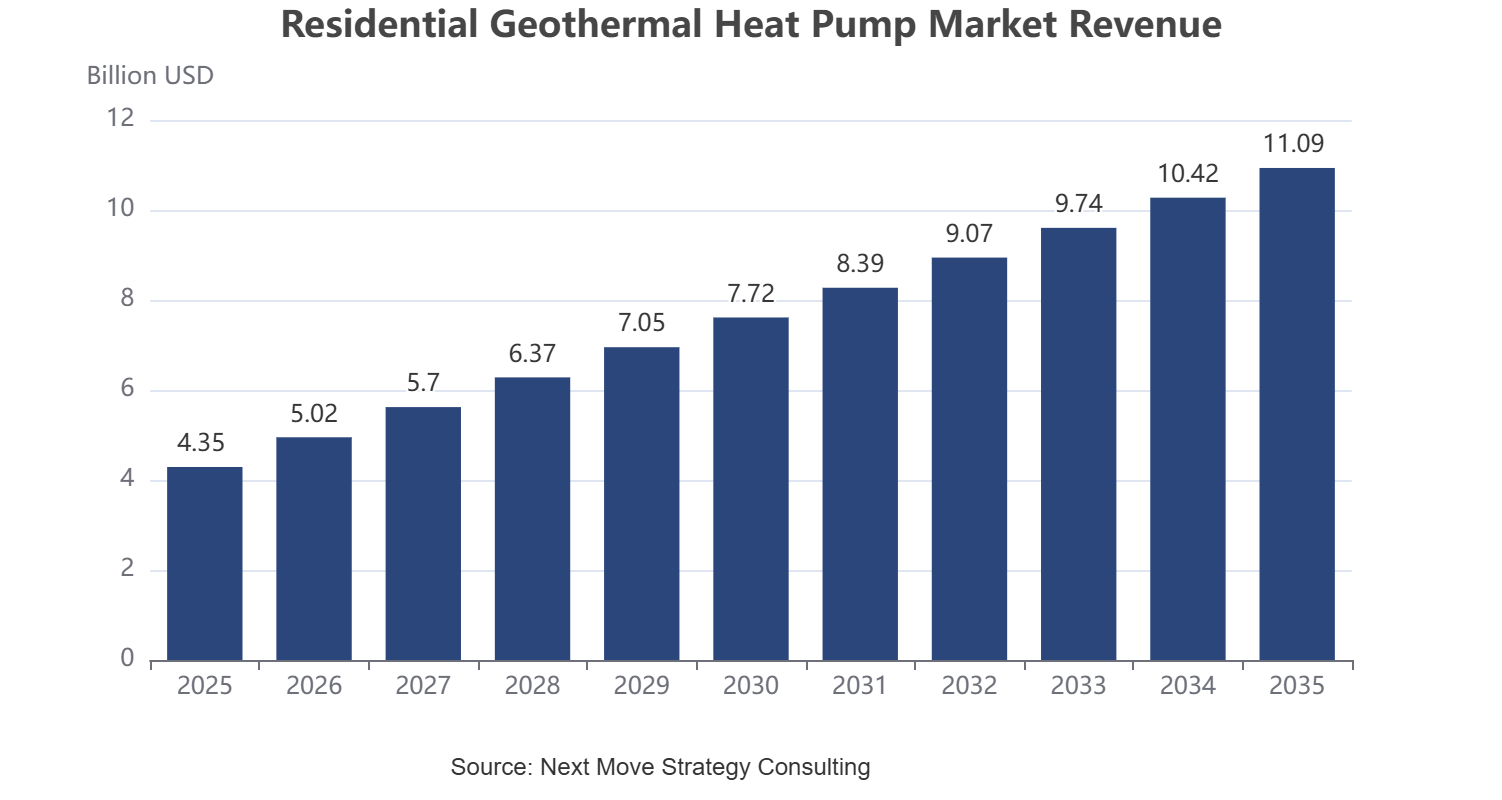
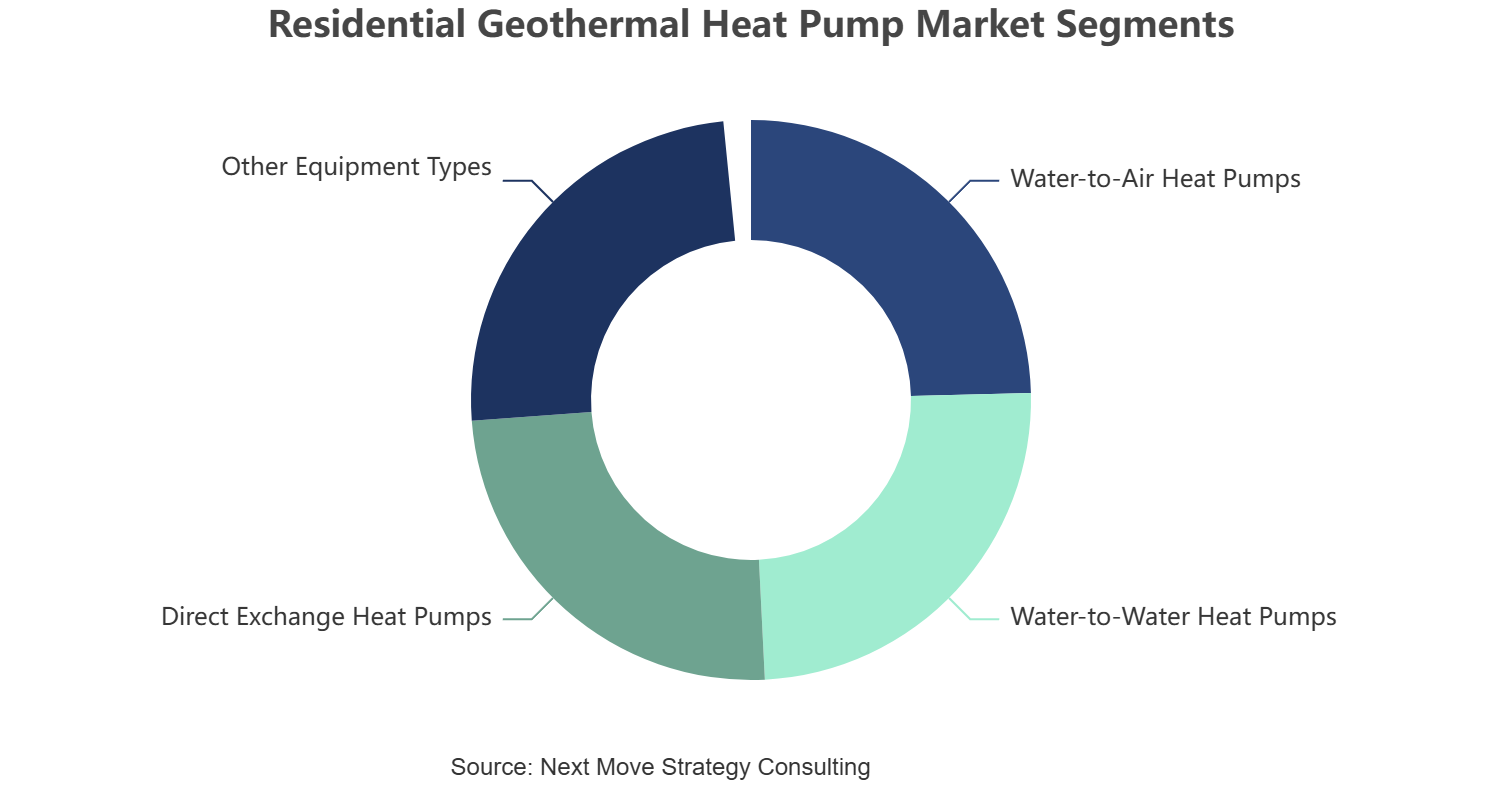
The residential geothermal heat pump market size was valued at USD 4.35 billion in 2025 and is estimated at USD 4.78 billion in 2026, forecast to reach USD 11.09 billion by 2035, expanding at a 9.81% CAGR between 2026 and 2035. North America leads with approximately 42% share, while water-to-air heat pumps dominate with approximately 55% share.
We observed that growth is broad-based across every segmentation axis, with direct exchange systems and multi-family retrofit adoption driving the fastest structural shifts through 2035.
|
Key Takeaways |
|
By Equipment Type: Water-to-Air Heat Pumps held the largest share of approximately 55% (USD 2.39 billion) in 2025; Direct Exchange Heat Pumps is the fastest-growing sub-segment at 14.1% CAGR from 2026–2035. |
|
By Ground Loop Configuration: Closed Loop held the largest share of approximately 83% (USD 3.60 billion) in 2025; Open Loop is the fastest-growing sub-segment at 11.6% CAGR from 2026–2035. |
|
By Capacity Range: Small up to 4 Tons held the largest share of approximately 48% (USD 2.09 billion) in 2025; Large over 6 Tons is the fastest-growing sub-segment at 12.5% CAGR from 2026–2035. |
|
By Distribution Channel: Direct Sales held the largest share of approximately 64% (USD 2.78 billion) in 2025; Distributor and Wholesale is the fastest-growing sub-segment at 11.2% CAGR from 2026–2035. |
|
By Application: New Construction held the largest share of approximately 58% (USD 2.52 billion) in 2025; Retrofit and Replacement is the fastest-growing sub-segment at 10.3% CAGR from 2026–2035. |
|
By End User Building Type: Single-Family held the largest share of approximately 76% (USD 3.31 billion) in 2025; Multi-Family is the fastest-growing sub-segment at 13.9% CAGR from 2026–2035. |
|
Dominant Region: North America dominated with approximately 42% revenue share (USD 1.83 billion) in 2025. |
|
Fastest-Growing Region: Asia-Pacific is expected to register the highest CAGR of 15.3% during 2026–2035. |
|
Dominant Country: U.S. led with approximately USD 1.43 billion in 2025. |
|
Fastest-Growing Country: India is the fastest-growing country at approximately 18.4% CAGR from 2026–2035. |
Market Opportunity: The residential geothermal heat pump market is expected to create an absolute dollar opportunity of USD 6.31 billion between 2026 and 2035, presenting significant investment potential across new-construction and whole-home electrification value chains.
According to NMSC analysis, homebuilders are increasingly bundling geothermal systems with third-party leases and Geo-as-a-Service financing models to eliminate upfront cost barriers, a shift that is broadening residential adoption beyond early-adopter, high-income households through 2035.
What Does the Residential Geothermal Heat Pump Market Encompass?
The residential geothermal heat pump market encompasses ground-coupled and water-source heating and cooling systems that exchange thermal energy with the earth or a water body through buried or submerged loop piping, rather than rejecting heat to outdoor air. Our assessment indicates that the scope spans water-to-air, water-to-water, and direct exchange equipment supplied to single-family, multi-family, and other residential buildings across new construction, retrofit and replacement applications. The category has evolved from a niche off-grid heating solution into a mainstream electrification technology as homeowners seek durable alternatives to fossil-fuel furnaces and conventional air-source heat pumps.
Regulatory frameworks such as the U.S. Internal Revenue Service's Residential Clean Energy Credit and Natural Resources Canada's Greener Homes incentive structure shape system economics, while the UK's Future Homes Standard is phasing out fossil-fuel heating in new-build homes. We observed that technology adoption is shifting toward compact, factory-assembled units and networked ground loop infrastructure that lowers per-home drilling cost. NMSC's analysis indicates that this structural shift, combined with home automation integration, is redefining installer value propositions across the residential geothermal heat pump market.
|
Field |
Details |
|
Market Size in 2025 |
USD 4.35 Billion |
|
Market Size in 2026 |
USD 4.78 Billion |
|
Revenue Forecast in 2035 |
USD 11.09 Billion |
|
Growth Rate |
CAGR of 9.81% from 2026 to 2035 |
|
Analysis Period |
2025–2035 |
|
Base Year Considered |
2025 |
|
Forecast Period |
2026–2035 |
|
Market Size Estimation |
USD Billion |
|
Companies Profiled |
20 |
|
Countries Covered |
38 |
|
Market Share |
Available for Top 10 Companies |
Key Emerging Trends
Based on research conducted by NMSC, we found that four structural trends are reshaping product design, financing, and installer strategy across the industry.
How Is Third-Party Financing Transforming Geothermal Adoption?
Third-party ownership and lease structures are removing the upfront cost barrier that has historically limited geothermal adoption to higher-income households. We observed that Dandelion Energy's Geo-as-a-Service offering, launched in March 2026, allows builders to install geothermal systems at or below the cost of conventional HVAC by shifting ownership to a financing partner. Builders and multi-family developers are adopting these models to differentiate new communities while homeowners pay a monthly service fee tied to utility bill savings.
Why Are Networked Ground Loop Systems Gaining Traction in New Communities?
Shared, utility-style ground loop networks are emerging as a scalable alternative to individual borehole drilling for single-family and multi-family developments. Kensa Heat Pumps and Octopus Energy Generation broke ground in 2025 on a UK networked ground source heat pump scheme serving over 100 homes, funded as an investor-backed clean energy asset. This model reduces per-home grid capacity requirements and is attracting infrastructure investors seeking long-duration, regulated-style returns from residential heat networks.
How Is Product Innovation Improving Geothermal System Compactness?
Manufacturers are compressing equipment footprints and simplifying installation to compete with single-day air-source heat pump replacements. WaterFurnace International's 5 Series 3D system, launched in April 2025, combines forced-air heating, forced-air cooling, and hydronic heat in a single unit with advanced two-way system controls. We observed that this multi-function architecture reduces mechanical room space requirements, a critical factor for retrofit applications in older single-family and multi-family housing stock.
What Role Does Multi-Family and Builder Partnership Activity Play in Market Expansion?
Homebuilders and multi-family developers are increasingly specifying geothermal systems at the community level rather than per-unit retrofit. Dandelion Energy's partnership with Dream Finders Homes and Ward Communities, backed by a Maryland Energy Administration grant, illustrates how state-level incentives are unlocking geothermal deployment across 129 planned homes. NMSC's analysis indicates that these builder partnerships are shifting geothermal from a custom-home specialty into a standard offering within planned residential communities.
Growth Drivers and Restraints
Growth Catalyst and Risk Assessment Matrix
|
Factors |
Type |
(+/−) % Impact on CAGR |
Geographic Relevance |
Impact Timeline |
|
Federal and state clean-energy tax credits for geothermal systems |
Driver |
+2.4% |
North America |
2026-2035 |
|
Rising cost and grid-capacity strain of air-source heat pump alternatives |
Driver |
+1.6% |
Global |
2026-2035 |
|
Expansion of networked and third-party-owned ground loop financing |
Driver |
+1.9% |
North America, Europe |
2026-2032 |
|
Tightening building energy codes and fossil-fuel heating phase-outs |
Driver |
+1.5% |
Europe, North America |
2028-2035 |
|
Growing multi-family and production homebuilder specification |
Driver |
+1.2% |
North America, Europe |
2026-2035 |
|
Long-term energy cost savings and system durability |
Driver |
+1.0% |
Global |
2026-2035 |
|
High upfront drilling and installation cost |
Restraint |
−1.8% |
Global |
2026-2035 |
|
Limited licensed drilling contractor availability |
Restraint |
−1.1% |
North America, Europe |
2026-2032 |
|
Site and soil suitability constraints for ground loops |
Restraint |
−0.7% |
Global |
2026-2035 |
|
Policy uncertainty around residential tax credit continuity |
Restraint |
−0.9% |
North America |
2026-2030 |
What Is the Primary Growth Driver of the Residential Geothermal Heat Pump Market?
Federal and state clean-energy tax incentives are the primary driver of the market. The U.S. Internal Revenue Service's Residential Clean Energy Credit continues to allow homeowners to claim a percentage of qualifying geothermal system costs, sustaining demand despite high upfront drilling expenses. We observed that this incentive, layered with state-level programs such as Maryland's Ground Source Heat Pump Advantage Pilot Program, anchors baseline residential adoption across new construction and retrofit applications alike.
How Is Third-Party Financing Driving Market Growth?
Third-party ownership and lease-based financing models are accelerating market growth by removing the upfront capital barrier that has historically constrained adoption. Dandelion Energy's nationwide Geo-as-a-Service offering enables builders to install geothermal systems at parity with conventional HVAC cost. NMSC's analysis indicates that this financing innovation, combined with expanding energy storage systems integration for whole-home electrification, is compressing adoption timelines among production homebuilders across North America.
What Is Restraining Residential Geothermal Heat Pump Market Expansion?
High upfront drilling and ground loop installation costs restrain broader market penetration relative to conventional HVAC and air-source heat pump alternatives. The U.S. Department of Energy notes that ground loop installation remains the largest single cost component of a residential geothermal system. We found that the limited availability of licensed drilling contractors in several U.S. states further constrains installation capacity, extending project timelines and elevating costs for homeowners outside established geothermal markets.
Segmentation Analysis
Segment Sizing: By Equipment Type
|
Segment |
2025 (USD) |
2035 (USD) |
CAGR% (2026–2035) |
|
Water-to-Air Heat Pumps |
USD 2.39 Billion |
USD 5.60 Billion |
8.9% |
|
Water-to-Water Heat Pumps |
USD 1.09 Billion |
USD 2.50 Billion |
8.7% |
|
Direct Exchange Heat Pumps |
USD 0.52 Billion |
USD 1.95 Billion |
14.1% |
|
Other Equipment Types |
USD 0.35 Billion |
USD 1.04 Billion |
11.5% |
|
Total |
USD 4.35 Billion |
USD 11.09 Billion |
9.81% |
Which Equipment Type Segment Dominates the Residential Geothermal Heat Pump Market?
Water-to-Air Heat Pumps led the market with USD 2.39 billion in 2025, reflecting their compatibility with existing ducted distribution systems in single-family homes. Our findings suggest that Direct Exchange Heat Pumps are the fastest-growing equipment type, registering a 14.1% CAGR from 2026 to 2035, as simplified refrigerant-loop installation reduces drilling scope and appeals to retrofit projects seeking shorter installation timelines than closed-loop water systems.
Segment Sizing: By Ground Loop Configuration
|
Segment |
2025 (USD) |
2035 (USD) |
CAGR% (2026–2035) |
|
Closed Loop |
USD 3.60 Billion |
USD 8.85 Billion |
9.4% |
|
Open Loop |
USD 0.75 Billion |
USD 2.24 Billion |
11.6% |
|
Total |
USD 4.35 Billion |
USD 11.09 Billion |
9.81% |
Which Ground Loop Configuration Leads Residential Geothermal Heat Pump Demand?
Closed-loop configurations, led by vertical borehole installations, remained dominant at USD 3.60 billion in 2025 due to their suitability across nearly all lot sizes and soil conditions. We found that Open Loop systems are the fastest-growing configuration at an 11.6% CAGR from 2026 to 2035, gaining share in regions with favorable groundwater access where lower drilling intensity reduces installed system cost.
Segment Sizing: By Application
|
Segment |
2025 (USD) |
2035 (USD) |
CAGR% (2026–2035) |
|
New Construction |
USD 2.52 Billion |
USD 6.20 Billion |
9.4% |
|
Retrofit and Replacement |
USD 1.83 Billion |
USD 4.89 Billion |
10.3% |
|
Total |
USD 4.35 Billion |
USD 11.09 Billion |
9.81% |
Which Application Segment Leads Residential Geothermal Heat Pump Market Demand?
New Construction remained the leading application, valued at USD 2.52 billion in 2025, as homebuilders increasingly specify geothermal systems to meet tightening energy codes. Our analysis shows that Retrofit and Replacement is the fastest-growing application, expanding at a 10.3% CAGR from 2026 to 2035, as aging furnace and boiler replacement cycles converge with rising incentive availability for whole-home electrification projects.
Supply Chain Analysis of the Residential Geothermal Heat Pump Market
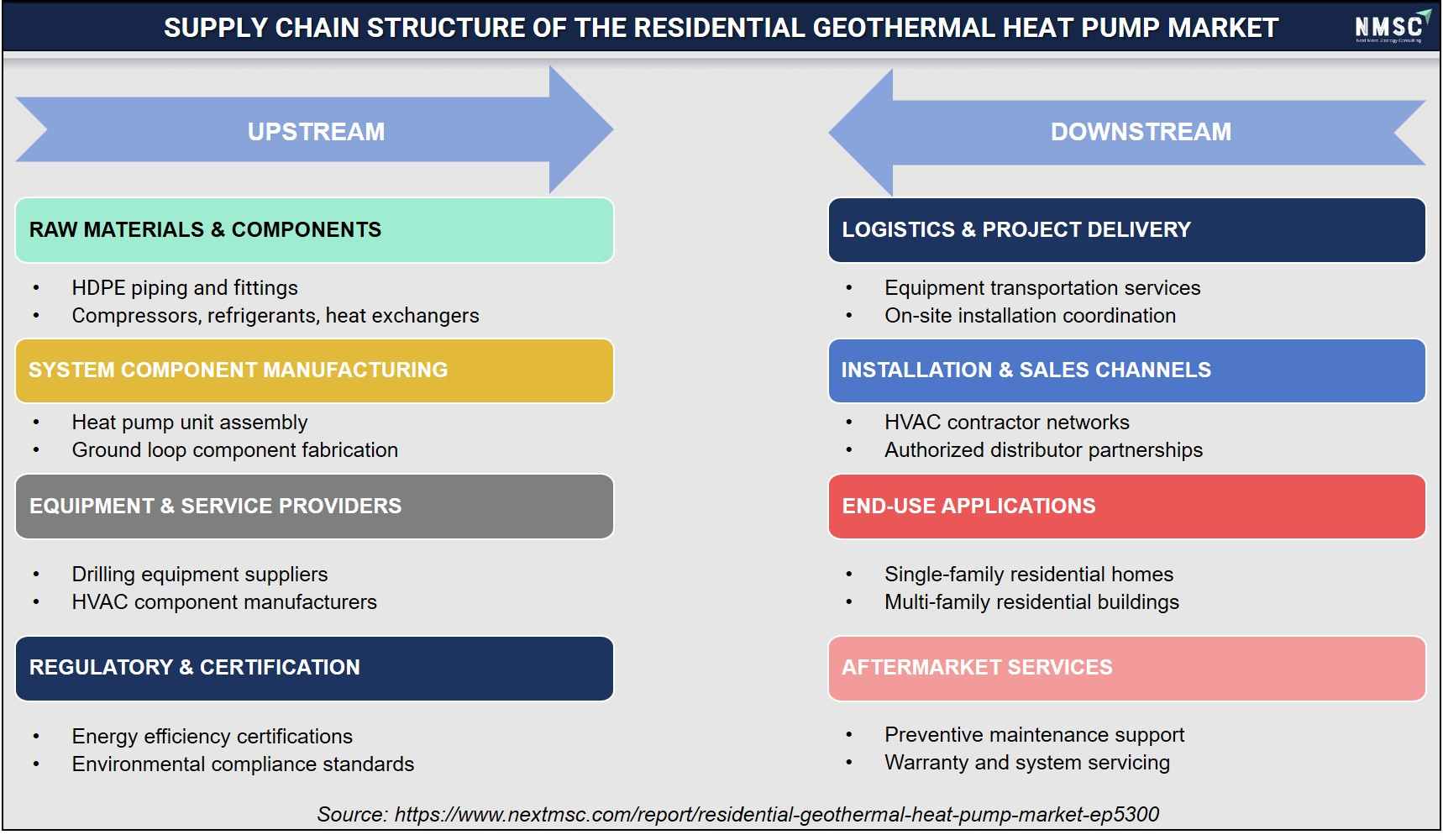
The above infographic presents the supply chain structure of the residential geothermal heat pump market, segmented into upstream and downstream activities. Upstream begins with HDPE piping, compressors, and heat exchangers, moving into heat pump assembly and ground loop fabrication. Suppliers provide drilling equipment and HVAC components, while energy efficiency certifications ensure compliance. Moving downstream, logistics and installation services enable project delivery through contractor networks to residential buildings. Looking ahead, we observed that preventive maintenance, warranty support, and system servicing ensure long-term reliability and customer satisfaction.
Growth Opportunities
Our analysis shows that three forward-looking opportunities stand out for stakeholders positioning within the residential geothermal heat pump market over the 2026-2035 forecast period.
How Can Networked Ground Loop Infrastructure Unlock Value for Multi-Family Developers?
Shared ground loop networks present a whitespace opportunity for multi-family developers seeking to decarbonize buildings without individual borehole drilling per unit. Infrastructure investors and utilities that fund networked systems can capture recurring, regulated-style revenue while developers reduce per-unit mechanical costs, benefiting the Multi-Family end-user segment as urban decarbonization mandates expand across North American and European metropolitan markets.
Where Does Third-Party Financing Create New Demand Among Production Homebuilders?
Zero-upfront-cost lease and Geo-as-a-Service financing models create an underpenetrated opportunity among production homebuilders reluctant to absorb geothermal's higher first cost. Financing partners that scale third-party ownership structures can secure long-term service revenue while builders differentiate communities, benefiting the New Construction application segment as homebuyers increasingly value predictable, lower utility costs.
How Can Direct Exchange Systems Benefit Retrofit-Focused Installers?
Direct exchange systems, which eliminate the intermediary water loop, present an opportunity for installers targeting retrofit projects on constrained urban and suburban lots. Manufacturers that scale direct exchange production can capture share from installers seeking shorter drilling and commissioning timelines, benefiting the Retrofit and Replacement application segment as homeowners replace aging fossil-fuel systems under compressed renovation schedules.
Regional Outlook
Geographic Performance Snapshot
|
Region |
2025 (USD) |
2035 (USD) |
CAGR% (2026–2035) |
Key Driver |
|
North America |
USD 1.83 Billion |
USD 3.95 Billion |
8.0% |
Federal tax credits and mature installer network |
|
Europe |
USD 1.44 Billion |
USD 3.26 Billion |
8.5% |
Building energy code reform and fossil-fuel heating phase-outs |
|
Asia-Pacific |
USD 0.65 Billion |
USD 2.71 Billion |
15.3% |
Expanding new-construction base and rising electrification |
|
Middle East & Africa |
USD 0.22 Billion |
USD 0.62 Billion |
11.1% |
Diversification-linked construction investment |
|
Latin America |
USD 0.21 Billion |
USD 0.55 Billion |
10.1% |
Growing modern housing development |
|
Total |
USD 4.35 Billion |
USD 11.09 Billion |
9.81% |
– |
North America
North America leads the residential geothermal heat pump market with a mature installer base and long-standing federal tax incentive structure. We observed that the U.S. Internal Revenue Service's Residential Clean Energy Credit and Natural Resources Canada's Greener Homes program sustain demand across new construction and retrofit applications. Technology adoption remains advanced, with third-party financing models such as Geo-as-a-Service expanding access among production homebuilders across the region's single-family and multi-family markets.
Europe
Europe's residential geothermal heat pump market reflects a regulation-intensive landscape shaped by national building energy codes and fossil-fuel heating phase-out timelines. Our findings suggest that the UK's Future Homes Standard and Germany's building energy law are accelerating the specification of low-carbon heating in new residential developments. Technology adoption favors networked ground loop infrastructure, supported by investor-backed clean energy financing entering the region's housing development pipeline.
Asia-Pacific
Asia-Pacific is the fastest-growing residential geothermal heat pump market region, propelled by expanding new-construction activity and rising residential electrification interest in China and India. We found that regulatory frameworks remain less harmonized than in Europe, giving manufacturers flexibility to scale water-to-air equipment production rapidly. Technology adoption is accelerating as regional component suppliers expand capacity to serve both domestic and export-oriented residential construction demand.
Middle East & Africa
The residential geothermal heat pump market in the Middle East & Africa is expanding as Gulf Cooperation Council economies diversify into sustainable construction and hospitality-linked residential development. Our analysis shows that Saudi Arabia and the UAE are attracting green-building investment tied to Vision 2030-aligned construction programs. Regulatory influence remains moderate, while technology adoption is gradually shifting toward imported closed-loop systems as developers align with global sustainability certification expectations.
Latin America
Latin America's residential geothermal heat pump market is supported by growing modern housing development in Brazil and Argentina and expanding interest in residential electrification. We observed that regulatory frameworks are less stringent than in North America or Europe, though international homebuilders operating locally are introducing geothermal specifications in premium developments. Technology adoption remains centered on closed-loop systems, with competitive intensity increasing as regional distributors partner with global equipment manufacturers.
U.S.
Based on our estimates, the U.S. market was valued at approximately USD 1.43 billion in 2025 and is projected to reach USD 3.05 billion by 2035, growing at a 7.9% CAGR. Demand is anchored by the Residential Clean Energy Credit, a mature drilling contractor base, and strong production homebuilder participation. Technology penetration favors water-to-air systems, and competitive intensity remains high among established manufacturers serving national distributor networks.
Canada
The market in Canada reached roughly USD 0.28 billion in 2025 and is forecast to hit USD 0.62 billion by 2035 at an 8.3% CAGR. Demand structure mirrors U.S. single-family consumption patterns, while Natural Resources Canada's Greener Homes guidance shapes incentive eligibility. Technology penetration is rising as provincial utilities promote electrification, with competitive intensity moderate given reliance on cross-border equipment supply from U.S.-based manufacturers.
UK
<As per our estimate, the UK Residential Geothermal Heat Pump Market stood at about USD 0.19 billion in 2025, advancing toward USD 0.40 billion by 2035 at a 7.7% CAGR. Demand is driven by the Future Homes Standard's fossil-fuel heating phase-out for new-build homes. Regulatory influence is significant, technology penetration favors networked closed-loop systems, and competitive intensity remains steady among domestic and European manufacturers serving UK housebuilders.
Germany
According to our analysis, Germany's market was valued near USD 0.32 billion in 2025 and is set to reach USD 0.68 billion by 2035, expanding at a 7.8% CAGR. Demand structure benefits from a strong domestic heat pump manufacturing base and building energy law amendments favoring renewable heating. Germany's regulatory influence remains high, while technology penetration favors closed-loop vertical systems among leading manufacturers.
France
Based on our estimates, France's market reached approximately USD 0.14 billion in 2025, projected to climb to USD 0.31 billion by 2035 at an 8.3% CAGR. Demand is supported by France's renewable heat fund incentives, which shape closed loop system adoption in new residential developments. Regulatory influence from national energy transition legislation is notable, and competitive intensity remains moderate among domestic and European equipment suppliers.
China
The market in China stood at roughly USD 0.16 billion in 2025 and is forecast to reach USD 0.82 billion by 2035, registering a 17.7% CAGR. Demand is fueled by expanding new-construction activity and government-backed residential electrification pilots. Regulatory influence is increasing gradually, technology penetration is accelerating through domestic component manufacturing scale-up, and competitive intensity remains elevated among numerous regional equipment suppliers.
India
As per our estimate, India's market was valued at about USD 0.07 billion in 2025, projected to reach USD 0.38 billion by 2035 at an 18.4% CAGR, the fastest among covered countries. Demand structure reflects rising urban electrification interest and expanding organized residential construction. Regulatory influence remains developing, while technology penetration is rising quickly as international manufacturers localize distribution to serve India's growing new-construction base.
Japan
According to our analysis, Japan's market reached close to USD 0.10 billion in 2025 and is expected to hit USD 0.34 billion by 2035, growing at a 13.0% CAGR. Demand is supported by Japan's precision-engineered residential HVAC heritage and rising interest in whole-home electrification. Regulatory influence is well established, technology penetration is advanced, and competitive intensity remains high among long-standing domestic equipment manufacturers.
South Korea
Based on our estimates, South Korea's market stood at approximately USD 0.055 billion in 2025, forecast to reach USD 0.19 billion by 2035 at a 13.2% CAGR. Demand structure benefits from national green-building certification programs and rising new-construction electrification. Technology penetration is high, with domestic suppliers expanding water-to-air product lines, and competitive intensity remains pronounced amid rapid product innovation cycles.
Australia
The market in Australia reached about USD 0.09 billion in 2025 and is projected to reach USD 0.28 billion by 2035, expanding at a 12.0% CAGR. Demand is supported by growing residential electrification interest and state-level renewable heating incentives. Regulatory influence stems from national energy efficiency standards, while technology penetration favors imported closed-loop systems amid moderate competitive intensity among regional installers.
UAE
As per our estimate, the UAE Residential Geothermal Heat Pump Market was valued near USD 0.03 billion in 2025, projected to reach USD 0.085 billion by 2035 at an 11.0% CAGR. Demand structure is shaped by the UAE's sustainable construction initiatives tied to national development strategy. Regulatory influence remains moderate, technology penetration is improving through imported closed loop equipment, and competitive intensity is rising as distributors expand residential portfolios.
Saudi Arabia
According to our analysis, Saudi Arabia's market reached roughly USD 0.035 billion in 2025 and is expected to hit USD 0.10 billion by 2035, growing at an 11.1% CAGR. Demand is fueled by Vision 2030-linked sustainable housing development and hospitality-driven residential construction. Regulatory influence remains moderate, technology penetration is gradually increasing, and competitive intensity is rising among regional distributors serving new residential communities.
South Africa
Based on our estimates, South Africa's market was valued at about USD 0.025 billion in 2025 and is forecast to reach USD 0.065 billion by 2035 at a 10.0% CAGR. Demand structure reflects growing interest in energy security amid grid reliability concerns. Regulatory influence remains limited, technology penetration is concentrated in premium residential developments, and competitive intensity is moderate among specialized regional installers.
Brazil
The market in Brazil reached roughly USD 0.09 billion in 2025 and is forecast to hit USD 0.24 billion by 2035 at a 10.3% CAGR. Demand structure benefits from expanding modern housing development and growing interest in sustainable building certification. Regulatory influence remains developing, technology penetration favors closed-loop systems in premium developments, and competitive intensity is moderate among international equipment distributors.
Argentina
As per our estimate, Argentina's market stood at about USD 0.035 billion in 2025, advancing toward USD 0.09 billion by 2035 at a 9.9% CAGR. Demand is supported by growing residential construction activity in urban centers and rising interest in energy cost stability. Regulatory influence remains limited, technology penetration is concentrated among premium homebuilders, and competitive intensity is moderate amid a small base of specialized installers.
PESTEL Analysis of the Residential Geothermal Heat Pump Industry
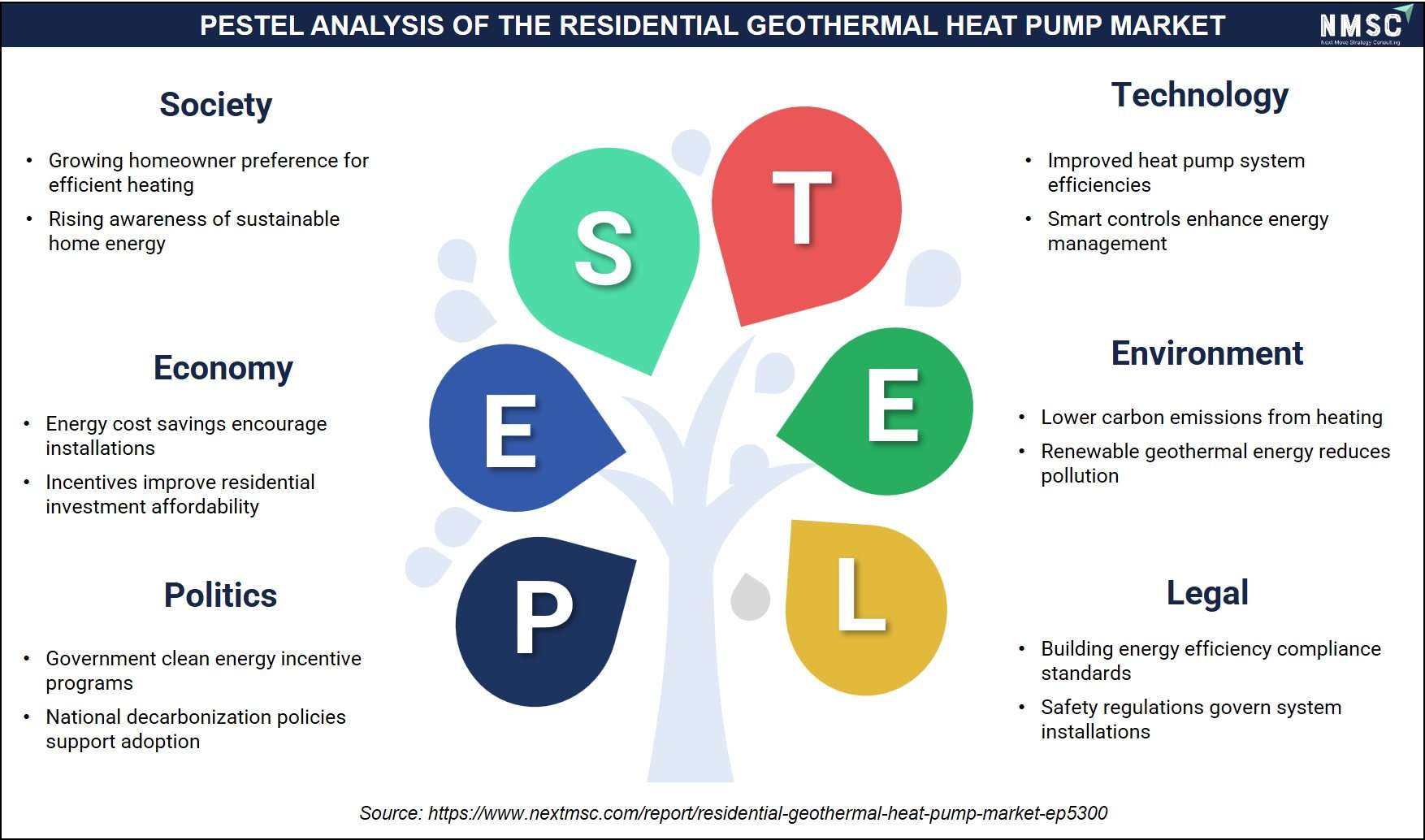
The above infographic presents a PESTEL analysis of the residential geothermal heat pump market, where government incentives and national decarbonization policies are driving adoption, while energy cost savings are improving affordability. At the same time, growing homeowner preference for efficient heating and rising sustainability awareness are shaping social acceptance, supported by advancements in heat pump systems and smart controls that enhance efficiency. Environmental benefits such as reduced carbon emissions further boost demand, all within a legal framework of building energy compliance and safety regulations. Looking ahead, we observed that these interconnected factors collectively shape the market's evolution across the residential sector.
Competitive Landscape
We observed that the residential geothermal heat pump market features a mix of established HVAC conglomerates, specialized geothermal manufacturers, and venture-backed installation-financing entrants competing across equipment innovation, financing structures, and installer network scale.
|
Field |
Details |
|
Market Structure |
Moderately consolidated among diversified HVAC conglomerates, with fragmented regional competition among specialized ground source manufacturers and installer-financiers. |
|
Innovation Focus |
Compact multi-function units, networked ground loop infrastructure, and third-party financing platforms dominate current innovation pipelines across leading suppliers. |
|
M&A Activity |
Selective capital raises and strategic partnerships, exemplified by Dandelion Energy's Series C funding and its financing partnership with Upstream to scale third-party-owned geothermal deployment. |
How Do Companies Compete in the Residential Geothermal Heat Pump Market?
Companies compete primarily on system efficiency, installer network breadth, and financing flexibility across the residential HVAC market. Global HVAC conglomerates such as Carrier Global Corporation and Trane Technologies leverage broad distribution and brand recognition to serve mainstream homebuilders, while specialized manufacturers such as WaterFurnace International and Kensa Heat Pumps compete on geothermal-specific engineering depth and drilling-partner relationships for both new construction and retrofit projects.
Which Competitive Archetypes Dominate the Residential Geothermal Heat Pump Market?
Two archetypes dominate the market: diversified global HVAC manufacturers offering full-service product portfolios across heating technologies, and specialized geothermal-only manufacturers with deep drilling and loop-design expertise. Bosch Thermotechnology and Mitsubishi Electric exemplify the diversified archetype through broad regional distribution, while Dandelion Energy and Kensa Heat Pumps exemplify the specialized archetype through vertically integrated installation and financing models focused exclusively on ground source systems.
How Are Companies Differentiating Through Innovation in Residential Geothermal Systems?
Innovation and differentiation strategy increasingly center on compact multi-function equipment and financing-enabled distribution. WaterFurnace's 5 Series 3D and Dandelion's Geo-as-a-Service platform both address historical adoption barriers, whether mechanical footprint or upfront cost. Our analysis shows that manufacturers unable to pair equipment innovation with accessible financing risk losing specification share to competitors offering bundled system and payment solutions to homebuilders.
What M&A and Expansion Activity Is Shaping the Residential Geothermal Heat Pump Market?
Capital raises, financing partnerships, and manufacturing capacity expansion continue to shape competitive positioning within the industry. Dandelion Energy's Series C funding round and its Upstream lease partnership broadened its third-party-ownership financing capability, while WaterFurnace International's Fort Wayne, Indiana manufacturing footprint expansion illustrates how established manufacturers are scaling production capacity to meet rising residential demand.
Key Market Players
Our assessment indicates that the following 20 companies are actively shaping product innovation, financing models, and installation capacity within the global residential geothermal heat pump market.
-
WaterFurnace International, Inc.
-
Trane Technologies plc
-
Stiebel Eltron GmbH & Co. KG
-
Vaillant GmbH
-
OCHSNER Wärmepumpen GmbH
-
Kensa Heat Pumps Ltd
-
Dandelion Energy, Inc.
-
Mitsubishi Electric Corporation
-
Waterkotte GmbH
-
Maritime Geothermal Ltd.
-
Ecoforest S.A.
-
Aermec S.p.A.
-
Weishaupt GmbH
-
Heliotherm Wärmepumpentechnik GmbH
-
Glen Dimplex Deutschland GmbH
-
Atlantic S.A.S.
-
EarthLinked Technologies, Inc.
Latest Developments
We found that recent product launches and financing partnerships within the residential geothermal heat pump market are concentrated on compact equipment design and third-party ownership models that lower adoption barriers.
|
Date |
Event |
|
March 2026 |
Dandelion Energy expanded financing for residential geothermal heating and cooling through a partnership with Diverso Energy and launched its nationwide Geo-as-a-Service offering for homebuilders. The model provides a zero-upfront-cost pathway for geothermal installations, addressing initial investment barriers and supporting wider adoption of geothermal heat pumps in residential new construction. |
|
October 2025 |
Dandelion Energy launched a geothermal lease program designed to make residential geothermal heating and cooling more accessible to builders. The offering enables geothermal systems to be installed with lower upfront costs, supporting broader deployment of ground-source heat pump technology in new residential construction. |
|
June 2025 |
Carrier relaunched its residential geothermal heat pump product line with updated communicating models, two-stage operation for entry-level systems, smaller and lighter equipment, improved serviceability, and Puron Advance refrigerant technology. |
Expert Insights
 “We’re excited to bring our geothermal technology into a high-production environment and accelerate our efforts to deliver the unparalleled comfort, performance, and cost savings of geothermal heat pumps to Colorado homeowners.”
— Daniel Yates, CEO at Dandelion Energy
Statement made following Dandelion Energy’s partnership with Lennar to deploy residential geothermal heating and cooling systems in new home construction.
Market Interpretation
The statement highlights the growing integration of geothermal heat pump technology into high-volume residential construction, reflecting increasing opportunities to scale ground-source heating and cooling beyond individual retrofit projects. NMSC’s analysis indicates that partnerships between geothermal technology providers and major homebuilders can accelerate market adoption by integrating energy-efficient systems directly into new housing developments. Our findings suggest that the combination of residential comfort, operating performance, and long-term cost savings is strengthening the value proposition of geothermal heat pumps for homeowners and supporting broader market penetration.
Investment Opportunities
What Capital Inflows Are Targeting the Residential Geothermal Heat Pump Market?
Capital inflows into the residential geothermal heat pump market are increasingly directed toward third-party financing platforms and installer network scale-up. Venture and infrastructure investors, including GV and Breakthrough Energy Ventures, continue to fund geothermal financing innovators such as Dandelion Energy. We observed that investors favor companies demonstrating validated installer partnerships, viewing distribution scale as a proxy for long-term homebuilder contract retention.
How Is Infrastructure Investment Supporting Residential Geothermal Manufacturing?
Infrastructure investment is expanding manufacturing and drilling capacity across North America and Europe to serve rising residential demand. WaterFurnace International's Fort Wayne, Indiana facility expansion illustrates how manufacturers are investing in production scale, while networked ground loop projects backed by renewable energy investors such as Octopus Energy Generation are funding shared infrastructure supporting hundreds of new UK homes.
What ESG Considerations Are Shaping Residential Geothermal Investment Decisions?
Environmental, social, and governance considerations are central to investment decisions across the industry, with carbon-emission reduction and grid-demand relief as key criteria. The U.S. Department of Energy's building electrification data continues to inform investor sustainability disclosures. We found that investors increasingly favor manufacturers and installers demonstrating measurable carbon-reduction outcomes, treating decarbonization impact as a governance indicator alongside labor and safety compliance.
Key Benefits for Stakeholders
How Does This Report Benefit Enterprise and Industry Leaders?
Enterprise and industry leaders gain access to validated segmentation, competitive benchmarking, and regional demand forecasts that support product-portfolio and manufacturing-capacity decisions across the residential geothermal heat pump industry. Our analysis shows that detailed equipment-type, ground loop, and end-user breakdowns help manufacturers align production planning with regulatory and incentive-driven demand shifts while identifying underserved application segments for portfolio expansion.
How Does This Report Benefit Investors and Financial Analysts?
Investors and financial analysts benefit from consistent, single-point market size and CAGR estimates that support valuation and capital-allocation decisions across the residential real estate and geothermal equipment supply chain. We observed that the report's regional and segment-level growth differentials help identify which manufacturers and financing platforms are best positioned to capture above-market growth in direct exchange and multi-family categories through 2035.
How Does This Report Benefit Technology Vendors and Product Teams?
Technology vendors and product teams gain insight into emerging design requirements, including compact multi-function equipment, networked ground loop infrastructure, and financing-enabled distribution, that are reshaping the industry. Our findings suggest that this analysis helps R&D teams prioritize development roadmaps around installation-time reduction and financing integration increasingly required by homebuilder request-for-proposal processes.
Key Market Segments
By Equipment Type
-
Water-to-Air Heat Pumps
-
Water-to-Water Heat Pumps
-
Direct Exchange Heat Pumps
-
Other Equipment Types
By Ground Loop Configuration
-
Closed Loop
-
Vertical
-
Horizontal
-
Pond and Lake
-
-
Open Loop
By Capacity Range
-
Small up to 4 Tons
-
Medium 4 to 6 Tons
-
Large over 6 Tons
By Distribution Channel
-
Direct Sales
-
Distributor and Wholesale
By Application
-
New Construction
-
Retrofit and Replacement
By End User Building Type
-
Single-Family
-
Multi-Family
-
Other Residential
By Region
-
North America: U.S., Canada, Mexico
-
Europe: UK, Germany, France, Italy, Spain, Sweden, Denmark, Finland, Netherlands, Rest of Europe
-
Asia-Pacific: China, India, Japan, South Korea, Taiwan, Indonesia, Vietnam, Australia, Philippines, Malaysia, Rest of APAC
-
Middle East & Africa: Saudi Arabia, UAE, Egypt, Israel, Turkey, Nigeria, South Africa, Rest of MEA
-
Latin America: Brazil, Argentina, Chile, Colombia, Rest of LATAM
Conclusion and Recommendations
What Is the Long-Term Outlook for the Residential Geothermal Heat Pump Market?
The long-term outlook for the market remains positive, with global revenue projected to more than double from USD 4.35 billion in 2025 to USD 11.09 billion by 2035 at a 9.81% CAGR. We observed that sustained tax incentive availability, third-party financing innovation, and multi-family builder adoption will continue underpinning demand across new construction and retrofit applications through the forecast period.
What Strategic Positioning Should Residential Geothermal Suppliers Pursue?
Suppliers should prioritize compact, multi-function equipment platforms while expanding financing partnerships to secure long-term homebuilder contracts. Our assessment indicates that manufacturers investing early in networked ground loop capability and direct exchange product lines will be best positioned to capture premium specification share within the residential geothermal heat pump market.
How Attractive Is the Residential Geothermal Heat Pump Market for New Investment?
The residential geothermal heat pump industry presents an attractive investment case, supported by a USD 6.31 billion absolute dollar opportunity between 2026 and 2035 and above-average growth in Asia-Pacific and direct exchange product categories. We found that investment attractiveness is highest for financing platforms combining installer network scale with validated third-party ownership models, positioning them to serve both cost-sensitive and premium homebuilder segments simultaneously.
What Market Shifts and Key Risks Should Stakeholders Monitor?
Stakeholders should monitor tax incentive policy continuity, drilling contractor capacity constraints, and competitive pressure from improving air-source heat pump efficiency as key risks to the residential geothermal heat pump market. Our analysis shows that suppliers unable to offer accessible financing risk losing specification share to competitors with established third-party ownership platforms, particularly within North America's incentive-sensitive residential construction environment.
What Are the Key Growth Pathways for the Residential Geothermal Heat Pump Market?
Key growth pathways include expanding networked ground loop infrastructure, scaling third-party financing platforms, and deepening penetration into multi-family and retrofit and replacement channels. NMSC's analysis indicates that suppliers pursuing these pathways while maintaining installation-cost competitiveness in single-family new construction will be best positioned to capture the residential geothermal heat pump market's projected growth through 2035.
About the Author
 Mayurima Roy
— Mayurima Roy is Research Analyst at Next Move Strategy Consulting, where she has spent 4 years working across the firm's full industry coverage rather than a single fixed vertical. Her work centers on structured research, ongoing trend tracking, competitive assessment, and insight-led content development, translating complex market data into clear, decision-ready narratives that support informed client decision-making across diverse global industries, market sectors, and world regions every day.
Mayurima Roy
— Mayurima Roy is Research Analyst at Next Move Strategy Consulting, where she has spent 4 years working across the firm's full industry coverage rather than a single fixed vertical. Her work centers on structured research, ongoing trend tracking, competitive assessment, and insight-led content development, translating complex market data into clear, decision-ready narratives that support informed client decision-making across diverse global industries, market sectors, and world regions every day.
About the Reviewer
 Supradip Baul
— Supradip Baul is an accomplished business consultant and strategist with over a decade of rich experience in market intelligence, strategy, technology, and business transformation. His work has included rigorous qualitative and quantitative analysis across multiple industries, helping clients shape investment decisions and long-term roadmaps. Earlier in his career, he was associated with Gartner, where he contributed to industry-leading reports and market share analyses. He has worked with leading global companies and holds an MBA with a dual specialization in Marketing and Finance.
Supradip Baul
— Supradip Baul is an accomplished business consultant and strategist with over a decade of rich experience in market intelligence, strategy, technology, and business transformation. His work has included rigorous qualitative and quantitative analysis across multiple industries, helping clients shape investment decisions and long-term roadmaps. Earlier in his career, he was associated with Gartner, where he contributed to industry-leading reports and market share analyses. He has worked with leading global companies and holds an MBA with a dual specialization in Marketing and Finance.
At Next Move Strategy Consulting, we understand that insightful market research is the cornerstone of successful business decisions. That's why we employ a robust and multifaceted approach, combining various methodologies to deliver the most accurate and actionable data for our clients.

Research Landscape
We navigate the world of research with two primary approaches:
Qualitative Approach
Our qualitative research methodologies involve immersive techniques such as in-depth interviews, focus groups, and observational studies. By engaging directly with individuals and stakeholders, we uncover valuable insights that quantitative data alone may overlook.

Quantitative Research
In tandem with qualitative methodologies, NMSC leverages the power of Quantitative Research to provide a robust foundation of numerical insights. Through systematic data collection and analysis, we quantify patterns, preferences, and market trends, offering a comprehensive view of the business landscape.
Our quantitative research approach employs diverse tools, including surveys, experiments, and statistical modelling. These methodologies enable us to gather data from a large and representative sample, ensuring the statistical significance of our findings. By employing structured questionnaires and standardized data collection methods, we guarantee the reliability and validity of the information we present to our clients.
Quantitative research is particularly effective in measuring the prevalence of trends, assessing market size, and gauging the impact of various factors on consumer behavior. The numerical precision attained through this approach equips our clients with actionable insights, facilitating data-driven decision-making and strategy formulation.


Our Specialized Toolbox for Industry-Specific Market Research
We deploy a specialized arsenal of techniques tailored to meet your unique requirements. Here's a glimpse into our comprehensive toolbox:

Information Procurement
The stage entails acquiring market data or relevant information through various sources and methodologies.


Market Research Approach
We utilize both top-down and bottom-up approaches in market research analysis to achieve a comprehensive understanding of the market dynamics, leveraging the broad perspective of industry trends and macroeconomic factors alongside detailed insights from specific segments and individual companies.

Porters Five Forces Analysis
We conduct Porter's Five Forces analysis to evaluate the competitive landscape of an industry, providing us with insights into factors that affect profitability and strategic positioning.

SWOT Analysis

Forecasting
We utilize a forecasting model to predict future consumption by considering parameters like population, economics, regulations, market competition, drivers, constraints, technology, and pricing. We also employ statistical techniques such as multilinear regression, exponential smoothing, moving average, ARIMA, and Monte Carlo simulations for accurate predictions. In econometric forecasting, we analyzed short-term and long-term event impacts, attributing values based on regulatory frameworks, economic factors, and market events.





 Speak to Our Analyst