U.S. Air Coolers Market By Product Type (Tower Coolers, Desert (Evaporative) Coolers, Window/Wall-Mounted Coolers, and Personal/Table-top Coolers), By Cooling Capacity {Small (Less Than 500 CFM), Medium (500 to 1500 CFM), and Large (More Than 1500 CFM)}, By Tank Capacity (Low, Medium, and High), By Distribution Channel (Online and Offline), and By End User (Residential, Commercial, and Industrial) – Opportunity Analysis & Forecast, 2025–2035
Industry: Retail and Consumer | Latest Edition: October 6, 2026 | No of Pages: 131 | No. of Tables: 31 | No. of Figures: 26 | Format: PDF | Report Code: RC1530
U.S. Air Coolers Market & Forecast
|
Parameters |
Details |
|
Market Size in 2025 |
USD 2.36 Billion |
|
Market Size in 2026 |
USD 2.78 Billion |
|
Revenue Forecast in 2035 |
USD 7.01 Billion |
|
Growth Rate |
CAGR of 10.83% from 2026 to 2035 |
|
Analysis Period |
2025–2035 |
|
Base Year Considered |
2025 |
|
Forecast Period |
2026–2035 |
|
Market Size Estimation |
Billion (USD) |
|
Companies Profiled |
15 |
|
Market Share |
Available for 10 companies |
Industry Outlook
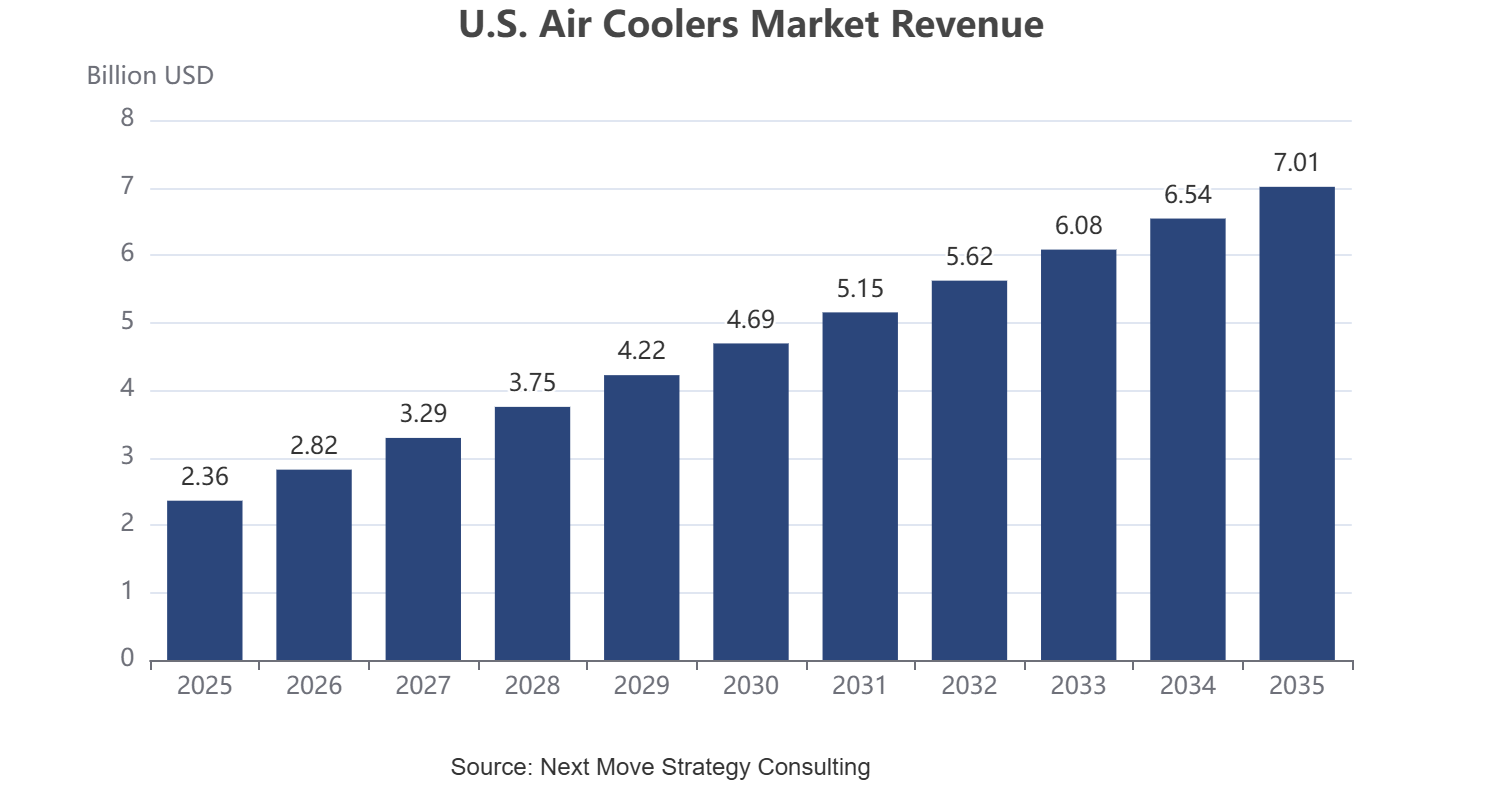
The U.S. Air Coolers Market size was valued at USD 2.36 Billion in 2025 and reached USD 2.78 Billion by 2026. Looking ahead, the industry is projected to expand significantly, reaching USD 7.01 Billion by 2035, registering a CAGR of 10.83% from 2026 to 2035. Rising residential and commercial demand for energy-efficient cooling solutions, combined with growing preference for low-emission alternatives to conventional air conditioning, continues to strengthen market expansion across warm and dry climate regions of the United States.
Porter's Five Forces Analysis of the U.S. Air Coolers Industry
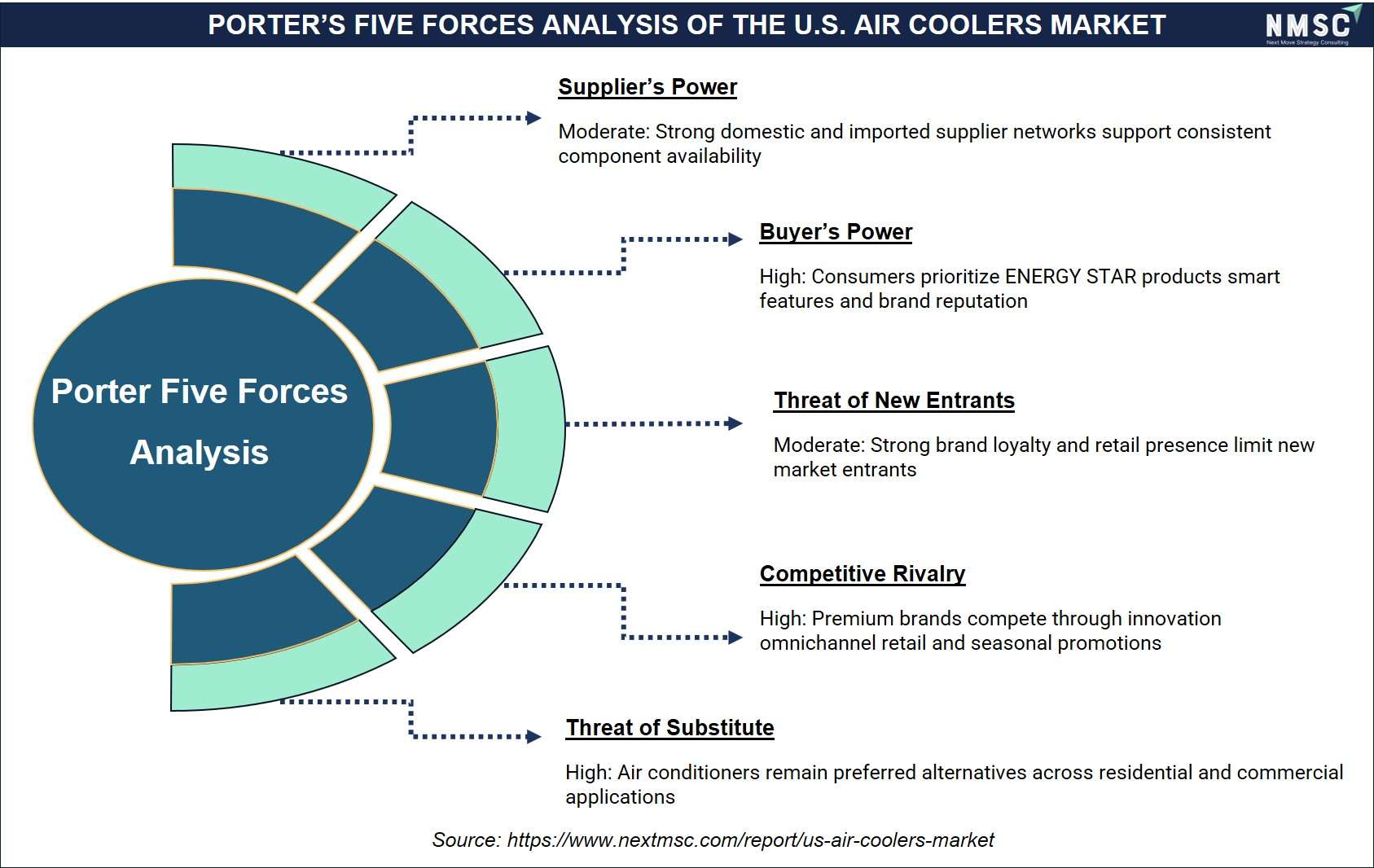
The Porter’s Five Forces analysis highlights a competitive landscape shaped by established manufacturers, evolving consumer preferences, and expanding product differentiation. Our assessment indicates that supplier influence remains balanced through diversified sourcing, while buyer bargaining power strengthens with broad product availability. Competitive rivalry remains significant as brands invest in energy-efficient technologies, distribution expansion, and product innovation to strengthen market positioning.
What Are the Key Market Drivers, Breakthroughs, and Investment Opportunities That Will Shape the U.S. Air Coolers Industry in the Next Decade?
Growth Catalyst & Risk Assessment Matrix
|
Drivers / Trends / Restraints |
(+/–) % Impact on CAGR Forecast |
Geographic Relevance |
Impact Timeline |
|
Rising residential and commercial cooling demand across warm and dry U.S. climate zones is strengthening adoption of energy-efficient air cooling systems |
+1.7% |
Southwest, Southeast, Texas |
Medium term (2–5 years) |
|
Expansion of e-commerce and organized retail distribution channels is accelerating access to portable and evaporative cooling appliances |
+1.4% |
National, Metro regions |
Short to medium term (1–4 years) |
|
Growing preference for energy-efficient, low-emission cooling alternatives to conventional air conditioning is increasing demand for evaporative and tower coolers |
+1.5% |
California, Arizona, Nevada |
Medium to long term (2–6 years) |
|
Limited cooling efficiency of evaporative systems in high-humidity regions is restricting broader geographic adoption |
–1.1% |
Southeast, Gulf Coast, Midwest humid zones |
Medium term (2–5 years) |
|
Rising integration of smart, app-controlled, and IoT-enabled air cooler features is creating differentiated product opportunities |
+1.3% |
National, Urban markets |
Medium term (2–6 years) |
Through our market assessment, we observed that the U.S. Air Coolers Market is witnessing steady growth driven by rising residential and commercial cooling demand, expanding e-commerce distribution of portable cooling appliances, and growing consumer preference for energy-efficient alternatives to conventional air conditioning. Increasing investment in smart, IoT-enabled cooling products is accelerating adoption across metro and suburban markets. Meanwhile, limited performance of evaporative systems in humid regions continues to restrict broader geographic penetration across parts of the country.
Growth Drivers
How Is Rising Residential and Commercial Cooling Demand Driving the U.S. Air Coolers Market Growth?
Through our U.S. consumer appliance assessment, we observed that rising residential and commercial cooling demand across warm and dry climate zones is significantly driving market growth. Increasing summer temperatures and extended cooling seasons are strengthening demand for cost-effective, energy-efficient alternatives to central air conditioning. Air coolers deliver lower operating costs, simpler installation, and reduced electricity consumption across households and small commercial spaces. Consequently, consumers across the Southwest, Southeast, and Texas regions are accelerating adoption to manage rising cooling requirements affordably.
How Is Expansion of E-Commerce Distribution Fueling the U.S. Air Coolers Market Expansion?
Expansion of e-commerce and organized retail distribution infrastructure is fueling market expansion across the United States. Our findings suggest that rising online purchasing of portable and evaporative cooling appliances is increasing consumer access to a broader range of product types and price points. Improved logistics and delivery infrastructure support faster fulfilment of bulky cooling appliances directly to residential addresses. Furthermore, online retailers are broadening product assortments to strengthen consumer choice and improve purchasing convenience throughout national distribution networks.
How Is Preference for Energy-Efficient Cooling Alternatives Driving the Market Growth?
Based on NMSC's research, we found that growing consumer preference for energy-efficient, low-emission cooling alternatives is substantially driving market growth across the United States. Rising electricity costs and environmental awareness are encouraging households and businesses to adopt evaporative and tower cooling systems that consume significantly less power than conventional air conditioning. Manufacturers are expanding energy-efficient product lines to meet this demand. As a result, sustainability-driven purchasing behavior is reinforcing long-term implementation of efficient cooling technologies nationwide.
Growth Restraint:
How Is Limited Efficiency in High-Humidity Regions Acting as a Constraint for the U.S. Air Coolers Market?
Limited cooling efficiency of evaporative systems in high-humidity regions continues acting as a constraint for the market across parts of the Southeast, Gulf Coast, and humid Midwest. In our observation, we found that evaporative cooling technology performs less effectively in environments with elevated ambient moisture, reducing its practicality as a primary cooling solution. This performance limitation restricts broader geographic adoption outside dry and arid climate zones. Consequently, regional climate variability continues shaping the pace of market penetration across different parts of the United States.
Growth Opportunity:
How Is Integration of Smart and IoT-Enabled Features Unlocking New Growth Opportunities for the U.S. Air Coolers Market?
Through NMSC's assessment, we found that rising integration of smart, app-controlled, and IoT-enabled features is unlocking new growth opportunities for the market across the United States. Increasing consumer demand for connected home appliances is encouraging manufacturers to introduce remote-controlled and automated cooling products. These features improve user convenience, energy monitoring, and operational customization across residential and commercial settings. Additionally, manufacturers are accelerating product innovation to strengthen differentiation and capture emerging demand throughout smart-home-enabled consumer segments.
How Is the U.S. Air Coolers Industry Segmented in This Report, and What Are the Key Insights from the Segmentation Analysis?
By Product Type Insights
Is Product Type Segmentation Supporting Consumer Choice in the U.S. Air Coolers Market?
Based on product type, the market is segmented into tower coolers, desert (evaporative) coolers, window/wall-mounted coolers, and personal/table-top coolers. Based on our analysis, we observed that tower coolers are supporting compact residential cooling needs across urban households, while desert coolers continue serving larger indoor and semi-outdoor spaces requiring higher airflow. Window/wall-mounted coolers are being integrated into fixed installation settings, and personal/table-top coolers are addressing individual workspace and small-room cooling requirements across the country.
By Distribution Channel Insights
Is Distribution Channel Segmentation Supporting Product Accessibility in the U.S. Air Coolers Market?
Based on distribution channel, the market is segmented into online and offline channels. Based on our evaluation, we identified that online channels are strengthening consumer access to a wider variety of air cooler models through e-commerce platforms and direct-to-consumer websites. Offline channels, including home improvement retailers and appliance stores, continue supporting consumers who prefer in-person product evaluation before purchase. Both channels are contributing to broader market accessibility across residential and commercial buyer segments nationwide.
Competitive Landscape
The U.S. Air Coolers Market is characterised by a moderately fragmented structure, supported by the presence of established appliance manufacturers, regional cooling specialists, and industrial equipment providers. Market growth is being driven by increasing consumer demand for energy-efficient cooling alternatives, expanding e-commerce distribution, and rising adoption of smart cooling features across residential, commercial, and industrial end users. In addition, product innovation and expanding manufacturing capacity are strengthening competitive positioning across the industry.
Strategic Development
-
May 2026 - EVAPCO, Inc. announced the PuRe-JET™ pumpless adiabatic cooling system, designed to simplify operations and reduce water/maintenance costs.
-
May 2026 - Phoenix Manufacturing expanded its distribution network by partnering with the new Johnstone Supply – Pueblo (Colorado) location.
Key Players of The U.S. Air Coolers Market
-
Portacool
-
Big Ass Fans
-
Phoenix Manufacturing
-
Essick Air Products
-
Hessaire Products
-
United Metal Products
-
Agilis Technologies
-
EVAPCO
-
Power Breezer
-
Quietaire
-
Premier Industries
-
J&D Manufacturing
-
Bonaire Durango
-
Munters
-
S&B Evaps
Based on NMSC's research, we found that competitive dynamics are increasingly shaped by product innovation, energy-efficiency improvements, and distribution network expansion. Key companies such as Portacool, Big Ass Fans, Phoenix Manufacturing, Essick Air Products, Hessaire Products, United Metal Products, Agilis Technologies, EVAPCO, Power Breezer, Quietaire, Premier Industries, J&D Manufacturing, Bonaire Durango, Munters, and S&B Evaps are strengthening their market presence through expanded product portfolios, improved cooling technologies, and broader retail partnerships. Consequently, the competitive landscape is advancing toward a more innovation-focused structure in the Market.
Key Segments
By Product Type
-
Tower Coolers
-
Desert (Evaporative) Coolers
-
Window/Wall-Mounted Coolers
-
Personal/Table-top Coolers
By Cooling Capacity
-
Small (Less Than 500 CFM)
-
Medium (500 to 1500 CFM)
-
Large (More Than 1500 CFM)
By Tank Capacity
-
Low
-
Medium
-
High
By Distribution Channel
-
Online
-
Offline
By End User
-
Residential
-
Commercial
-
Industrial
Supply Chain Structure of the U.S. Air Coolers Industry
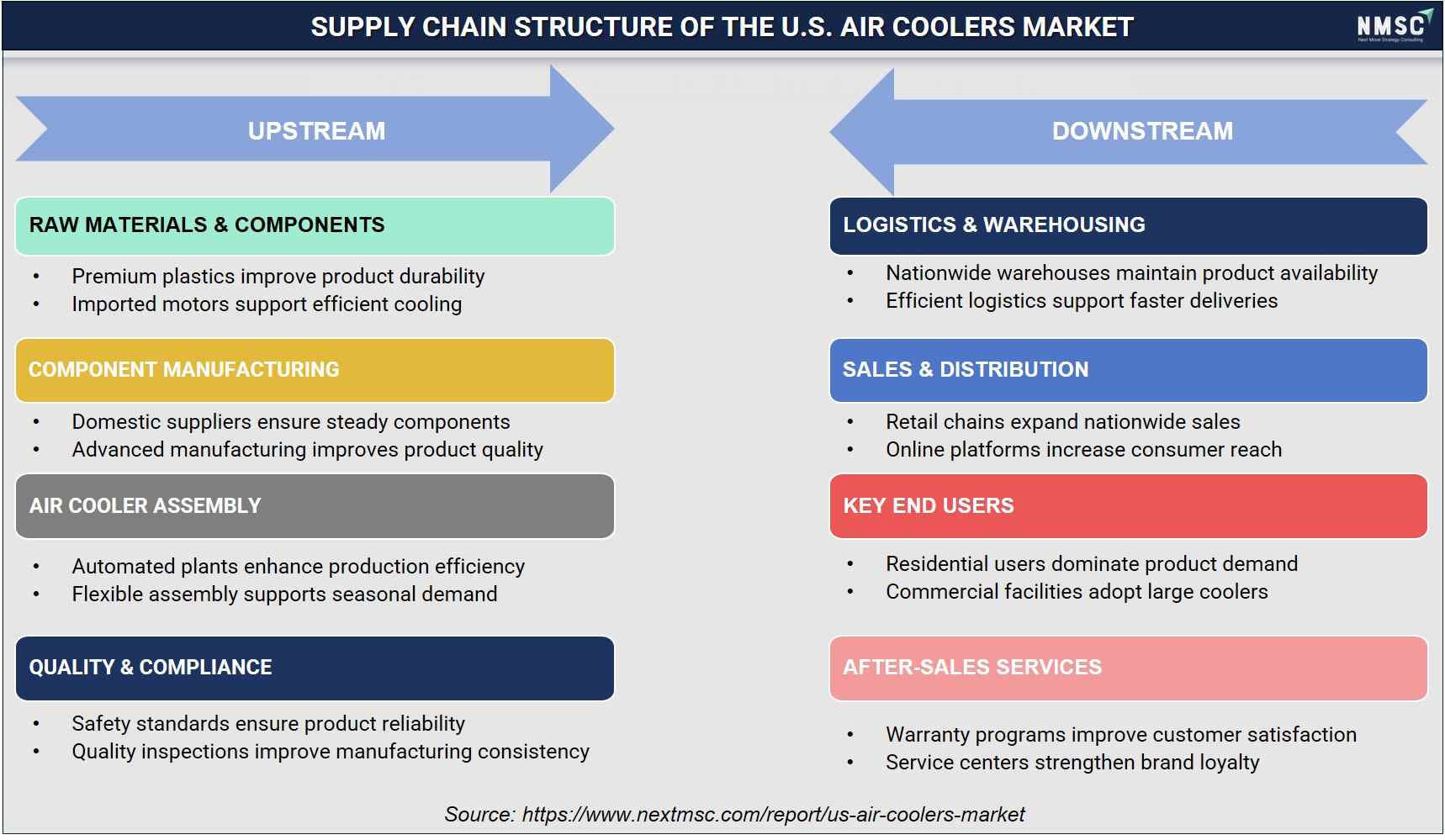
The U.S. air coolers supply chain integrates component sourcing, manufacturing, logistics, distribution, and after-sales support to maintain product availability and quality. Our analysis shows that efficient warehousing and nationwide retail networks strengthen market reach, while quality compliance and advanced assembly processes improve operational consistency. Residential demand and commercial adoption continue supporting stable distribution and service activities.
Key Benefits for Stakeholders:
Next Move Strategy Consulting (NMSC) presents a comprehensive analysis of the U.S. Air Coolers Market, covering historical developments from 2020 to 2025 and providing forward-looking forecasts through 2035. Our study evaluates the market at national and regional levels, delivering quantitative outlooks alongside qualitative insights into consumer cooling preferences, distribution channel evolution, product innovation trends, and energy-efficiency adoption across residential, commercial, and industrial end users.
The Market delivers measurable value to a diverse stakeholder ecosystem. Investors benefit from increasing investment opportunities in energy-efficient appliance manufacturing and expanding distribution infrastructure. Retailers and e-commerce platforms benefit from rising consumer demand and broader product assortment opportunities. Manufacturers and component suppliers benefit from growing demand for smart, IoT-enabled, and energy-efficient cooling technologies across residential, commercial, and industrial segments throughout the United States.
|
Parameters |
Details |
|
Customization Scope |
Free customization (equivalent to up to 80 analyst-working hours) after purchase. |
|
Pricing and Purchase Options |
Avail customized purchase options to meet your exact research needs. |
|
Approach |
In-depth primary and secondary research; proprietary databases; rigorous quality control and validation measures. |
|
Analytical Tools |
Porter's Five Forces, SWOT, value chain, and Harvey ball analysis to assess competitive intensity, stakeholder roles, and relative impact of key factors. |
Conclusion
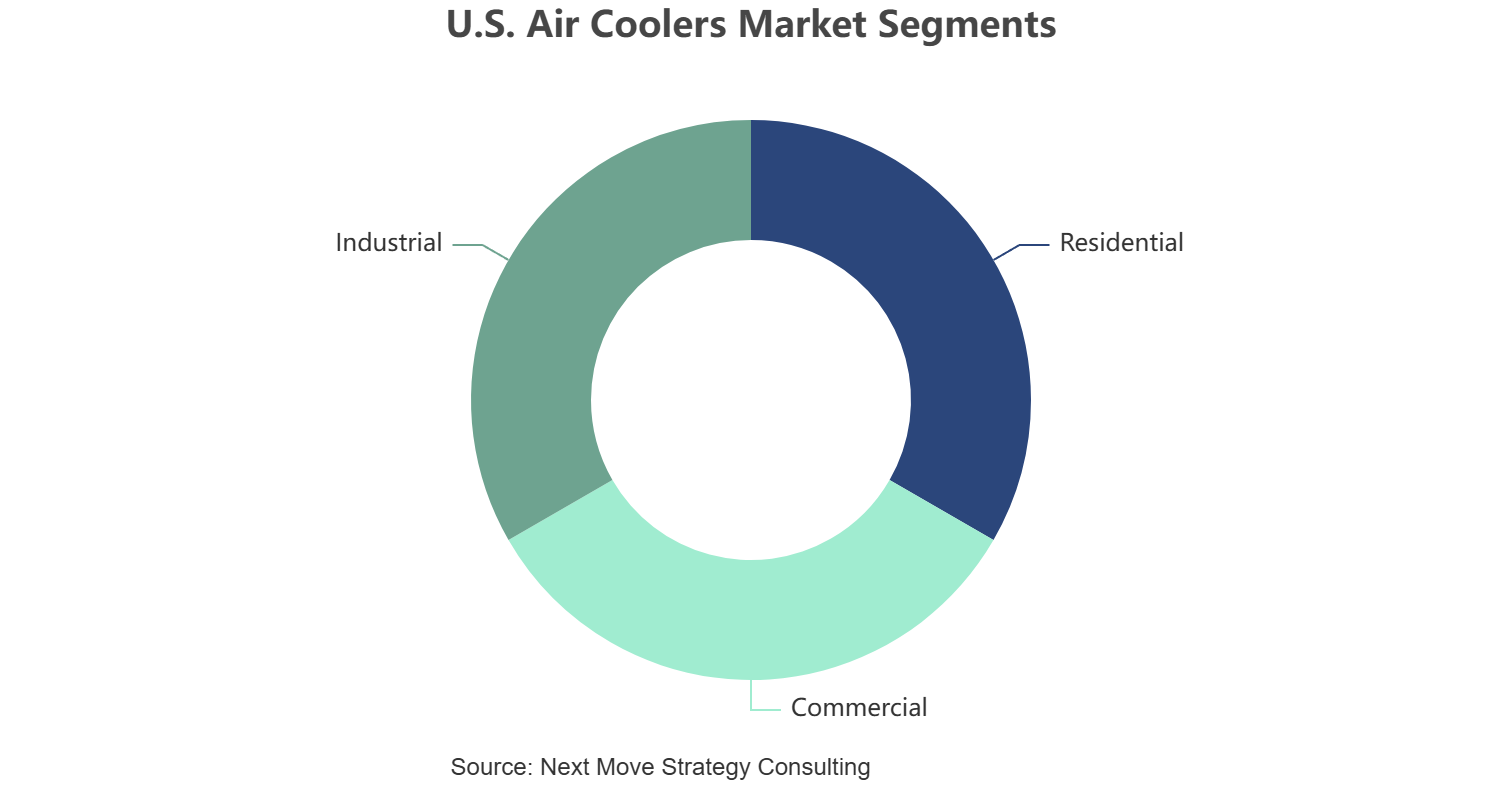
The U.S. Air Coolers Market is positioned for sustained growth through 2035, supported by rising demand for energy-efficient cooling alternatives, expanding e-commerce distribution, and growing integration of smart product features. While humidity-related performance limitations continue to restrict adoption in certain regions, ongoing innovation in evaporative and tower cooling technologies is expected to broaden the market's geographic reach. Overall, the market outlook remains positive, with steady growth anticipated across residential, commercial, and industrial end-user segments nationwide.
About the Author
 Saista Faiyaz
— Saista Faiyaz is Research Associate at Next Move Strategy Consulting, where she has covered consumer markets and healthcare technologies for 3 years. Her work includes primary interview review, secondary-source validation, market sizing, and structured analysis of company and industry data. She supports research by comparing evidence across sources, organizing findings into market narratives, and documenting assumptions used in analysis. Her scope includes cross-market benchmarking, and reports.
Saista Faiyaz
— Saista Faiyaz is Research Associate at Next Move Strategy Consulting, where she has covered consumer markets and healthcare technologies for 3 years. Her work includes primary interview review, secondary-source validation, market sizing, and structured analysis of company and industry data. She supports research by comparing evidence across sources, organizing findings into market narratives, and documenting assumptions used in analysis. Her scope includes cross-market benchmarking, and reports.
About the Reviewer
 Supradip Baul
— Supradip Baul is an accomplished business consultant and strategist with over a decade of rich experience in market intelligence, strategy, technology, and business transformation. His work has included rigorous qualitative and quantitative analysis across multiple industries, helping clients shape investment decisions and long-term roadmaps. Earlier in his career, he was associated with Gartner, where he contributed to industry-leading reports and market share analyses. He has worked with leading global companies and holds an MBA with a dual specialization in Marketing and Finance.
Supradip Baul
— Supradip Baul is an accomplished business consultant and strategist with over a decade of rich experience in market intelligence, strategy, technology, and business transformation. His work has included rigorous qualitative and quantitative analysis across multiple industries, helping clients shape investment decisions and long-term roadmaps. Earlier in his career, he was associated with Gartner, where he contributed to industry-leading reports and market share analyses. He has worked with leading global companies and holds an MBA with a dual specialization in Marketing and Finance.
At Next Move Strategy Consulting, we understand that insightful market research is the cornerstone of successful business decisions. That's why we employ a robust and multifaceted approach, combining various methodologies to deliver the most accurate and actionable data for our clients.

Research Landscape
We navigate the world of research with two primary approaches:
Qualitative Approach
Our qualitative research methodologies involve immersive techniques such as in-depth interviews, focus groups, and observational studies. By engaging directly with individuals and stakeholders, we uncover valuable insights that quantitative data alone may overlook.

Quantitative Research
In tandem with qualitative methodologies, NMSC leverages the power of Quantitative Research to provide a robust foundation of numerical insights. Through systematic data collection and analysis, we quantify patterns, preferences, and market trends, offering a comprehensive view of the business landscape.
Our quantitative research approach employs diverse tools, including surveys, experiments, and statistical modelling. These methodologies enable us to gather data from a large and representative sample, ensuring the statistical significance of our findings. By employing structured questionnaires and standardized data collection methods, we guarantee the reliability and validity of the information we present to our clients.
Quantitative research is particularly effective in measuring the prevalence of trends, assessing market size, and gauging the impact of various factors on consumer behavior. The numerical precision attained through this approach equips our clients with actionable insights, facilitating data-driven decision-making and strategy formulation.


Our Specialized Toolbox for Industry-Specific Market Research
We deploy a specialized arsenal of techniques tailored to meet your unique requirements. Here's a glimpse into our comprehensive toolbox:

Information Procurement
The stage entails acquiring market data or relevant information through various sources and methodologies.


Market Research Approach
We utilize both top-down and bottom-up approaches in market research analysis to achieve a comprehensive understanding of the market dynamics, leveraging the broad perspective of industry trends and macroeconomic factors alongside detailed insights from specific segments and individual companies.

Porters Five Forces Analysis
We conduct Porter's Five Forces analysis to evaluate the competitive landscape of an industry, providing us with insights into factors that affect profitability and strategic positioning.

SWOT Analysis

Forecasting
We utilize a forecasting model to predict future consumption by considering parameters like population, economics, regulations, market competition, drivers, constraints, technology, and pricing. We also employ statistical techniques such as multilinear regression, exponential smoothing, moving average, ARIMA, and Monte Carlo simulations for accurate predictions. In econometric forecasting, we analyzed short-term and long-term event impacts, attributing values based on regulatory frameworks, economic factors, and market events.





 Speak to Our Analyst