Finished Wood Products Market

Finished wood products market size was USD 285.00 billion in 2025, projected to reach USD 452.80 billion by 2035, growing at a 4.8% CAGR from 2026 to 2035

Download Free Sample PDF
Base Year (2025)
$285.00 Billion
Forecast (2035)
$452.80 Billion
CAGR (2026-2035)
4.8%
Top Region
North America

What Is the Finished Wood Products Market Size?

The global finished wood products market size was valued at USD 285.00 billion in 2025 and is estimated at USD 296.50 billion in 2026, forecast to reach USD 452.80 billion by 2035, expanding at a 4.8% CAGR between 2026 and 2035. North America leads with approximately 33% share, while Lumber and Structural Wood dominates the product landscape with approximately 28% share.

We observed that softwood lumber tariff realignment and renovation-driven demand are jointly reshaping sourcing patterns as manufacturers adjust supply chains to absorb new trade costs.

Finished Wood Products Market Revenue Forecast

Values in USD Billion

2025 $285.00 Billion
2025
2026 $298.68 Billion
2026
2027 $313.02 Billion
2027
2028 $328.04 Billion
2028
2029 $343.79 Billion
2029
2030 $360.29 Billion
2030
2031 $377.58 Billion
2031
2032 $395.71 Billion
2032
2033 $414.70 Billion
2033
2034 $434.61 Billion
2034
2035 $452.80 Billion
2035

Key Takeaways

By Product Type: Lumber and Structural Wood held the largest share of approximately 28% (USD 79.80 billion) in 2025; Furniture Components is the fastest-growing sub-segment at 7.4% CAGR from 2026–2035.

By Wood Type: Softwood held the largest share of approximately 54% (USD 153.90 billion) in 2025; Engineered/Composite Wood is the fastest-growing sub-segment at 8.7% CAGR from 2026–2035.

By Application: Residential Construction held the largest share of approximately 38% (USD 108.30 billion) in 2025; Industrial and Packaging is the fastest-growing sub-segment at 6.4% CAGR from 2026–2035.

By Distribution Channel: Building Material Distributors held the largest share of approximately 42% (USD 119.70 billion) in 2025; Online/E-Commerce is the fastest-growing sub-segment at 13.2% CAGR from 2026–2035.

By End User: Residential held the largest share of approximately 46% (USD 131.10 billion) in 2025; Institutional is the fastest-growing sub-segment at 8.0% CAGR from 2026–2035.

Dominant Region: North America dominated with approximately 33% revenue share (USD 94.05 billion) in 2025.

Fastest-Growing Region: Latin America is expected to register the highest CAGR of 6.7% during 2026–2035.

Dominant Country: U.S. led with approximately USD 78.06 billion in 2025.

Fastest-Growing Country: India is the fastest-growing country at approximately 9.0% CAGR from 2026–2035.

Market Opportunity: The finished wood products market is expected to create an absolute dollar opportunity of USD 156.30 billion between 2026 and 2035, presenting significant investment potential across engineered wood, cabinetry, and e-commerce distribution channels.

According to NMSC analysis, manufacturers are increasingly relocating cabinetry and millwork production closer to end markets to mitigate new import tariff exposure, a shift that is reshaping capital investment decisions across the broader [construction material](https: //www.nextmsc.com/report/construction-material-market) supply chain.

What Does the Finished Wood Products Market Encompass?

The finished wood products market encompasses processed and converted wood goods, including structural lumber, engineered wood, panels, flooring, doors, windows, cabinetry, and furniture components, sold to residential, commercial, and industrial buyers. Our assessment indicates that the scope spans softwood, hardwood, and engineered or composite wood inputs distributed through building material distributors, direct manufacturer channels, retail, and e-commerce, supported by the 20 companies profiled in this report.
The category has evolved from commodity lumber production into a diversified, value-added manufacturing sector as renovation activity and engineered wood adoption reshape demand mix. Regulatory frameworks including the U.S. Section 232 tariffs on wood products, effective October 14, 2025, imposing a 10% global tariff on softwood timber and lumber alongside tariffs on upholstered furniture and kitchen cabinets, and the ongoing U.S.-Canada softwood lumber antidumping and countervailing duty proceedings, continue to reshape sourcing and pricing across the industry. We observed that technology adoption is shifting toward engineered wood and automated milling, extending finished wood products deeper into the flooring and cabinetry value chain.

Market Drivers & Dynamics

Interactive Dataset
Renovation and remodeling activity in mature housing markets driver +1.1% North America, Europe 2026-2035
Engineered wood adoption in mass timber construction driver +0.9% North America, Europe, Asia-Pacific 2026-2035
Domestic manufacturing investment amid Section 232 tariffs driver +0.7% North America 2026-2032
Rising residential construction activity in Asia-Pacific driver +1.3% Asia-Pacific 2026-2035
E-commerce distribution channel expansion driver +0.6% Global 2026-2035
Latin America housing and infrastructure investment driver +0.8% Latin America 2026-2035
Softwood lumber and OSB oversupply depressing composite pricing restraint -0.9% North America 2026-2030
Elevated Section 232 and antidumping duty cost exposure restraint -0.7% North America 2026-2032
Substitution pressure from steel, concrete, and composite materials restraint -0.5% Global 2026-2035
Source: Next Move Strategy Consulting

Growth Drivers

What Is the Primary Growth Driver of the Finished Wood Products Market?

Renovation and remodeling activity in mature housing markets is the primary driver of the market. We observed that aging housing stock across North America and Europe continues to generate steady replacement demand for flooring, cabinetry, and millwork independent of new construction cycles. This behavioral pattern, reinforced by longer homeowner tenure, continues to anchor baseline demand for finished wood products even as new residential construction activity moderates in response to elevated financing costs.

How Is Engineered Wood Adoption Driving Finished Wood Products Market Growth?

Engineered wood adoption in mass timber construction is accelerating market growth as architects and developers specify cross-laminated timber and laminated veneer lumber for their lower embodied carbon profile relative to steel and concrete. Our assessment indicates that manufacturers expanding engineered wood production capacity are positioned to capture premium pricing as commercial and institutional developers increasingly prioritize sustainable structural materials.

Growth Inhibitors

What Is Restraining Finished Wood Products Market Expansion?

Softwood lumber and oriented strand board oversupply is restraining market expansion, with the Random Lengths Framing Lumber Composite price averaging USD 378 per thousand board feet in the fourth quarter of 2025, near multi-decade lows on an inflation-adjusted basis. We found that this pricing weakness, combined with Section 232 tariff cost exposure, prompted West Fraser Timber Co. Ltd. to announce mill closures and curtailments in late 2025 to align capacity with softer demand.

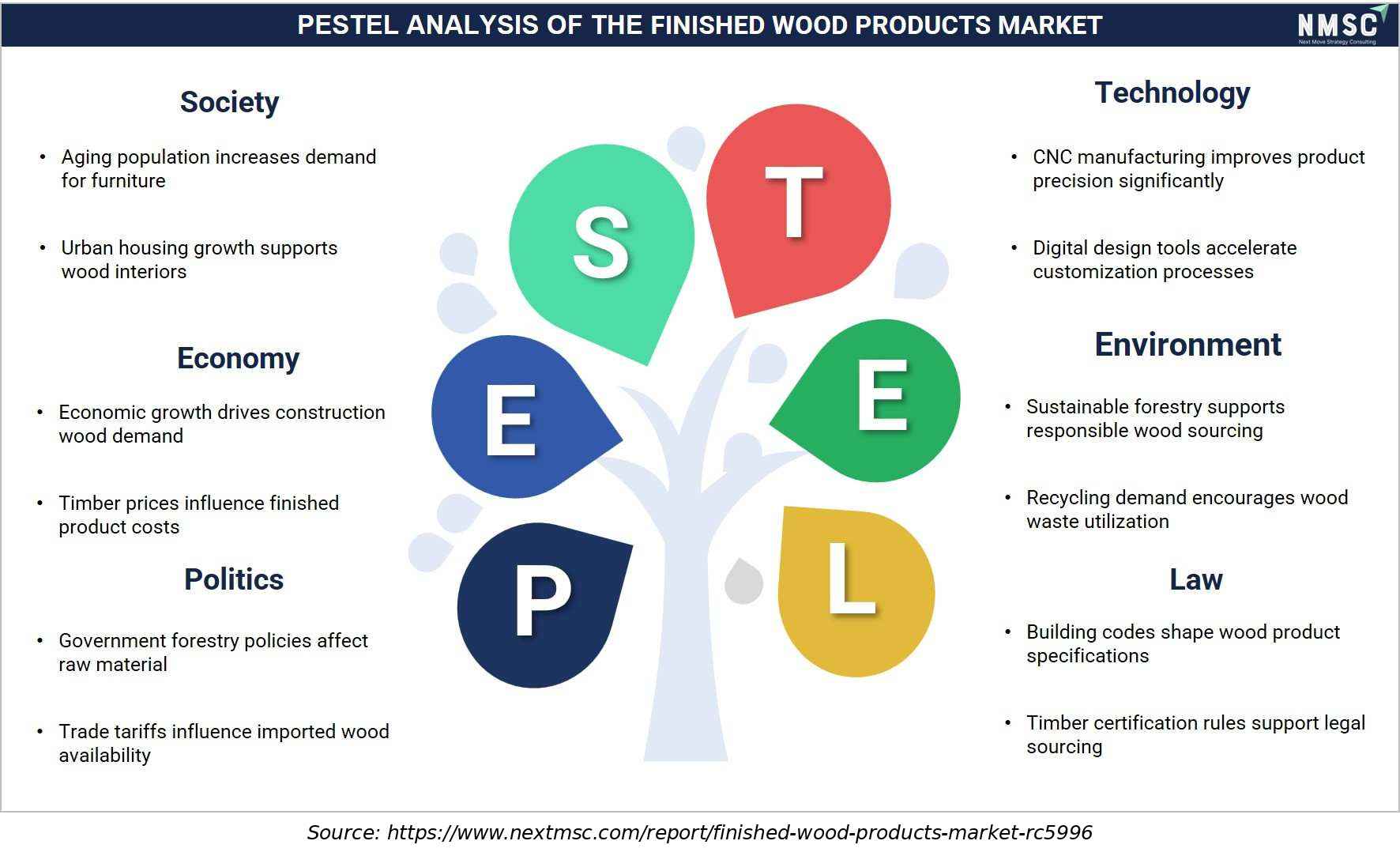
PESTEL Analysis of the Finished Wood Products Market

PESTEL Analysis of the Finished Wood Products Market

The finished wood products market is influenced by political policies, economic conditions, construction activity, consumer preferences, technological advancements, environmental concerns, and evolving legal requirements. An evidence-based PESTEL analysis helps stakeholders assess market drivers, operational risks, sustainability expectations, and regulatory factors that may influence production, investment, demand, and long-term industry growth.

Segmentation Analysis

2025 (USD Billion)
2035 (USD Billion)
Lumber and Structural Wood 2025: $79.80 Billion | 2035: $113.20 Billion
Lumber and S
Wood Panels 2025: $62.70 Billion | 2035: $95.09 Billion
Wood Panels
Flooring and Decking 2025: $45.60 Billion | 2035: $72.45 Billion
Flooring and
Doors and Windows 2025: $39.90 Billion | 2035: $63.39 Billion
Doors and Wi
Cabinetry and Millwork 2025: $37.05 Billion | 2035: $67.92 Billion
Cabinetry an
Furniture Components 2025: $19.95 Billion | 2035: $40.75 Billion
Furniture Co
Lumber and Structural Wood $79.80 Billion $113.20 Billion 3.6%
Wood Panels $62.70 Billion $95.09 Billion 4.3%
Flooring and Decking $45.60 Billion $72.45 Billion 4.7%
Doors and Windows $39.90 Billion $63.39 Billion 4.7%
Cabinetry and Millwork $37.05 Billion $67.92 Billion 6.2%
Furniture Components $19.95 Billion $40.75 Billion 7.4%

Which Product Type Segment Dominates the Finished Wood Products Market?

Lumber and Structural Wood led the market with USD 79.80 billion in 2025, reflecting its foundational role across residential and commercial framing applications. We observed that Furniture Components is the fastest-growing product type, expanding at a 7.4% CAGR from 2026 to 2035, as furniture manufacturers increasingly source engineered wood panels and components to meet cost and sustainability requirements amid elevated Section 232 tariff exposure on finished upholstered furniture.

2025 (USD Billion)
2035 (USD Billion)
Softwood
Hardwood
Engineered/C
Segment Item 2025 (USD Billion) 2035 (USD Billion) CAGR
Softwood $10.0 USD Billion $40.0 USD Billion 25.0%
Hardwood $17.1 USD Billion $51.1 USD Billion 11.0%
Engineered/Composite Wood $24.2 USD Billion $62.2 USD Billion 25.0%

Segment-wise data is locked

Unlock complete segment-wise numbers for By Wood Type.

Unlock Full Data

Which Wood Type Segment Is Growing Fastest in the Finished Wood Products Market?

Softwood remained the dominant wood type, valued at USD 153.90 billion in 2025 as the primary structural framing material across North American and European construction. Our findings suggest that Engineered/Composite Wood is the fastest-growing wood type, registering an 8.7% CAGR from 2026 to 2035, as mass timber construction and cross-laminated timber adoption scale across commercial and institutional building projects.

2025 (USD Billion)
2035 (USD Billion)
Residential
Renovation a
Commercial C
Furniture Ma
Industrial a
Segment Item 2025 (USD Billion) 2035 (USD Billion) CAGR
Residential Construction $10.0 USD Billion $40.0 USD Billion 27.0%
Renovation and Remodeling $17.1 USD Billion $51.1 USD Billion 9.0%
Commercial Construction $24.2 USD Billion $62.2 USD Billion 19.0%
Furniture Manufacturing $31.3 USD Billion $73.3 USD Billion 17.0%
Industrial and Packaging $38.4 USD Billion $84.4 USD Billion 18.0%

Segment-wise data is locked

Unlock complete segment-wise numbers for By Application.

Unlock Full Data
2025 (USD Billion)
2035 (USD Billion)
Building Mat
Direct to Ma
Retail and H
Online/E-Com
Segment Item 2025 (USD Billion) 2035 (USD Billion) CAGR
Building Material Distributors $10.0 USD Billion $40.0 USD Billion 14.0%
Direct to Manufacturer $17.1 USD Billion $51.1 USD Billion 24.0%
Retail and Home Improvement Stores $24.2 USD Billion $62.2 USD Billion 22.0%
Online/E-Commerce $31.3 USD Billion $73.3 USD Billion 12.0%

Segment-wise data is locked

Unlock complete segment-wise numbers for By Distribution Channel.

Unlock Full Data
2025 (USD Billion)
2035 (USD Billion)
Residential
Commercial
Industrial
Institutiona
Segment Item 2025 (USD Billion) 2035 (USD Billion) CAGR
Residential $10.0 USD Billion $40.0 USD Billion 24.0%
Commercial $17.1 USD Billion $51.1 USD Billion 22.0%
Industrial $24.2 USD Billion $62.2 USD Billion 20.0%
Institutional $31.3 USD Billion $73.3 USD Billion 22.0%

Segment-wise data is locked

Unlock complete segment-wise numbers for By End User.

Unlock Full Data

Which End User Segment Is Growing Fastest in the Finished Wood Products Market?

Residential remained the largest end user segment, reaching USD 131.10 billion in 2025 across new construction and renovation applications. We found that Institutional is the fastest-growing end user category, registering an 8.0% CAGR from 2026 to 2035, as schools, healthcare facilities, and government buildings increasingly specify engineered wood structural systems for sustainability certification and embodied carbon reduction goals.

Growth Opportunities

Our analysis shows that three forward-looking opportunities stand out for stakeholders positioning within the finished wood products market over the 2026-2035 forecast period.

How Can Mass Timber Manufacturing Unlock Value in Institutional Construction?

Manufacturers that scale cross-laminated timber and laminated veneer lumber production capacity can capture recurring contracts from institutional developers pursuing embodied carbon reduction targets. This positions engineered wood suppliers to secure long-term relationships with architecture and construction firms specifying mass timber structural systems.

Where Does Domestic Cabinetry Production Create Opportunity Amid Tariff Realignment?

Domestically manufactured cabinetry and millwork present a whitespace opportunity as the delayed Section 232 tariff increase to 50% on kitchen cabinets and vanities, effective January 1, 2027, approaches. Manufacturers investing in domestic production capacity ahead of this increase stand to capture share from import-dependent competitors facing rising landed costs.

How Can Direct-to-Consumer E-Commerce Expand Flooring and Millwork Reach?

Manufacturers expanding direct-to-consumer online sales for flooring and smaller millwork items can capture recurring revenue from renovation-focused homeowners bypassing traditional distributor channels. Vendors offering integrated digital sampling and installation scheduling stand to capture share from conventional retail and distributor-only sales models.

Regional Outlook

2025 (USD Billion)
2035 (USD Billion)
North Americ
Europe
Asia-Pacific
Middle East
Latin Americ
Region 2025 (USD Billion) 2035 (USD Billion) CAGR (%)
North America $10.0 USD Billion $40.0 USD Billion 9.0%
Europe $17.1 USD Billion $51.1 USD Billion 27.0%
Asia-Pacific $24.2 USD Billion $62.2 USD Billion 25.0%
Middle East & Africa $31.3 USD Billion $73.3 USD Billion 23.0%
Latin America $38.4 USD Billion $84.4 USD Billion 12.0%

Regional data is locked

Unlock complete regional numbers for this market.

Unlock Full Data

Competitive Landscape

We observed that the finished wood products market features a moderately fragmented competitive landscape, with large integrated lumber and panel producers competing alongside specialized millwork and cabinetry manufacturers across the Industry.

Dimension Description
Market Structure Moderately fragmented; large integrated producers profiled in this report compete across lumber, panels, and engineered wood, while specialized cabinetry and millwork manufacturers serve differentiated finished product segments.
Innovation Focus Engineered wood and mass timber capacity expansion, automated milling, domestic manufacturing scale-up amid tariff realignment, and direct-to-consumer e-commerce distribution dominate current innovation pipelines.
M&A Activity Selective capacity rationalization amid oversupply conditions, exemplified by West Fraser Timber Co. Ltd.'s late-2025 announcements of lumber and oriented strand board mill closures and curtailments to align capacity with demand.

How Do Companies Compete in the Finished Wood Products Market?

Companies compete primarily on manufacturing scale, product diversification, and tariff-adjusted cost positioning across the Industry. Large integrated producers such as Weyerhaeuser Company and West Fraser Timber Co. Ltd. leverage extensive timberland and mill networks to serve commodity lumber and panel demand, while specialized manufacturers such as American Woodmark Corporation and MasterBrand, Inc. compete on finished cabinetry design and domestic production capability.

Which Competitive Archetypes Dominate the Finished Wood Products Market?

Three archetypes dominate the market: large integrated lumber and panel producers, specialized doors and windows manufacturers, and dedicated cabinetry and millwork producers. Weyerhaeuser Company and West Fraser Timber Co. Ltd. exemplify the integrated producer archetype, JELD-WEN Holding, Inc. and Masonite International Corporation exemplify the doors and windows archetype, and American Woodmark Corporation and MasterBrand, Inc. exemplify the cabinetry archetype serving residential and commercial customers.

How Are Companies Differentiating Through Innovation in Finished Wood Products?

Innovation and differentiation strategy increasingly center on engineered wood capacity expansion and domestic manufacturing investment. Stora Enso Oyj and Metsä Group exemplify this direction through continued cross-laminated timber and engineered wood investment across European operations. Our analysis shows that manufacturers unable to demonstrate domestic production capability risk losing share to competitors better positioned to absorb Section 232 tariff cost exposure.

What M&A and Capacity Activity Is Shaping the Finished Wood Products Market?

Capacity rationalization and strategic repositioning continue to reshape competitive positioning within the Industry. West Fraser Timber Co. Ltd.'s late-2025 announcements of lumber and oriented strand board mill closures, following a fourth-quarter 2025 net loss of USD 751 million, illustrate how producers are right-sizing capacity amid oversupply conditions and elevated tariff and trade duty costs.

Key Market Players

Our assessment indicates that the following 20 companies are actively shaping manufacturing capacity, product innovation, and tariff-adjusted sourcing strategy within the global finished wood products market.

West Fraser Timber Co. Ltd. Canfor Corporation Interfor Corporation UFP Industries, Inc. Boise Cascade Company Louisiana-Pacific Corporation Georgia-Pacific LLC Stora Enso Oyj Metsä Group Sierra Pacific Industries Roseburg Forest Products Co. Andersen Corporation JELD-WEN Holding, Inc. Masonite International Corporation American Woodmark Corporation MasterBrand, Inc. Mohawk Industries, Inc. Egger Group Kronospan Holdings

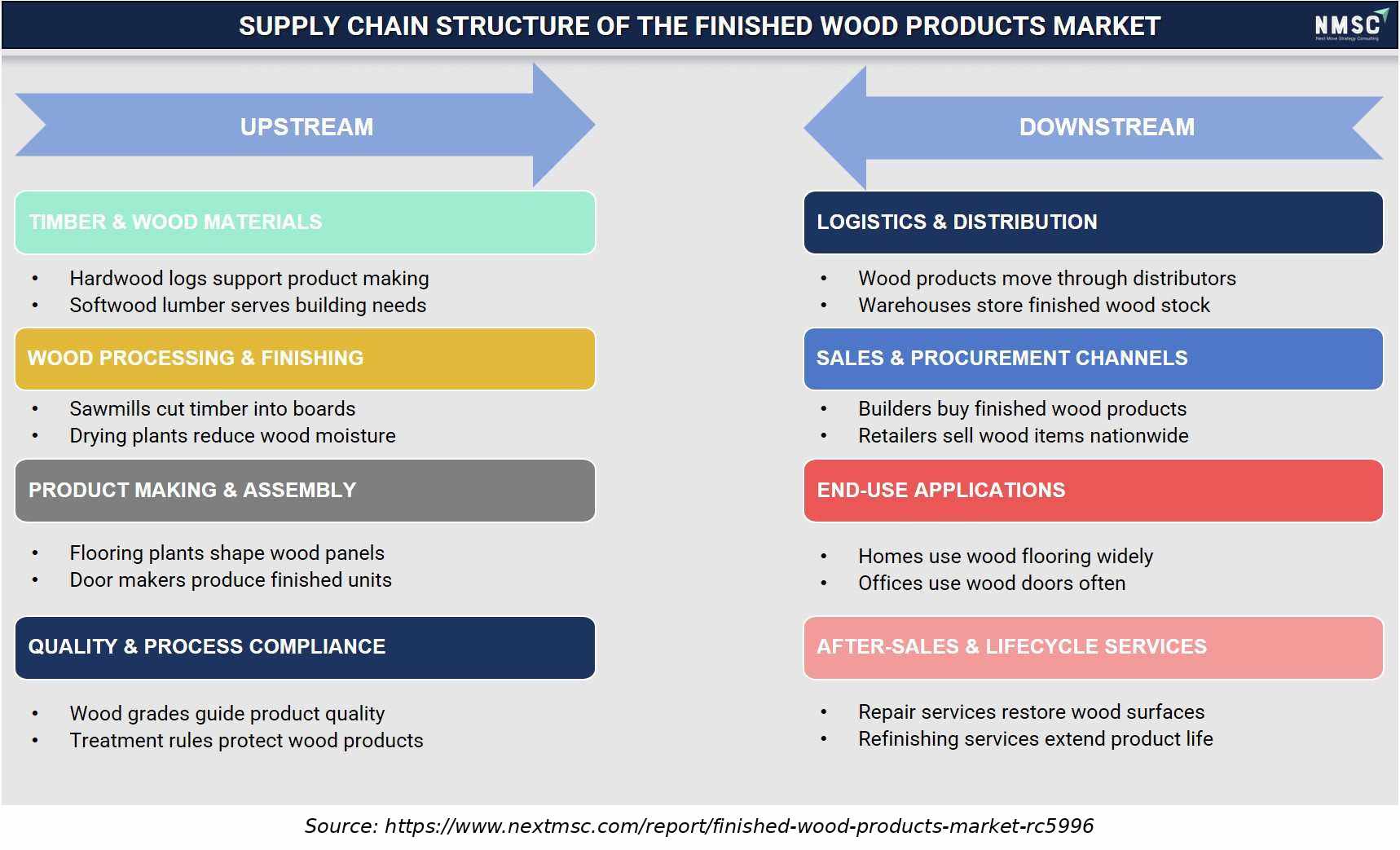
Supply Chain Structure of the Finished Wood Products Market

Supply Chain Structure of the Finished Wood Products Market

The finished wood products supply chain spans timber sourcing, wood processing, manufacturing, quality compliance, logistics, distribution, and end-use applications. Efficient coordination across these stages is essential for maintaining product quality, managing costs, and ensuring reliable supply. Industry participants are increasingly focused on sustainable sourcing, process efficiency, distribution capabilities, and lifecycle services to strengthen long-term market competitiveness.

Latest Developments

We found that recent activity within the finished wood products market is concentrated on tariff-driven trade proceedings and capacity rationalization, reflecting the industry's response to shifting trade policy and softer commodity pricing.

Date Event
May 2026 MasterBrand completed its all-stock merger with American Woodmark, creating a significantly broader cabinetry portfolio and expanded manufacturing and distribution footprint across North America. The combination brings together complementary residential cabinet brands, channels and production capabilities, strengthening access to stock, semi-custom and premium finished wood cabinetry.
February 2026 Weyerhaeuser previewed two engineered wood products at the 2026 International Builders’ Show: Trus Joist ProPanel floor panels with enhanced moisture resistance and DownPore drainage, and AeroStrand laminated-strand-lumber floor joists with pre-cut service openings for building systems. Both products target more efficient, predictable residential construction.

Investment Opportunities

What Capital Inflows Are Targeting the Finished Wood Products Market?

Capital inflows into the market are increasingly directed toward engineered wood capacity and domestic cabinetry manufacturing ahead of the delayed 2027 tariff increase. We observed that producers are prioritizing capacity discipline following West Fraser Timber Co. Ltd.'s fourth-quarter 2025 net loss of USD 751 million, reflecting a broader industry shift toward measured, tariff-adjusted capital allocation.

How Is Infrastructure Investment Supporting Finished Wood Products Manufacturing?

Infrastructure investment is expanding engineered wood and mass timber production capacity across North America and Europe to serve rising institutional and commercial construction demand. Our findings suggest that manufacturers are investing in automated milling facilities, complementing adjacent investment in the broader furniture manufacturing supply chain that increasingly sources engineered wood components.

What ESG Considerations Are Shaping Finished Wood Products Investment Decisions?

Environmental, social, and governance considerations are central to investment decisions, with embodied carbon reduction and sustainable forestry certification as key criteria for finished wood products manufacturers. We found that investors increasingly favor producers demonstrating certified sustainable timber sourcing and engineered wood adoption, treating these as governance indicators alongside traditional production-scale metrics.

Key Benefits for Stakeholders

How Does This Report Benefit Enterprise and Industry Leaders?

Enterprise and industry leaders gain access to validated segmentation, competitive benchmarking, and regional demand forecasts that support sourcing and capacity-planning decisions across the finished wood products industry. Our analysis shows that detailed product type, wood type, and distribution channel breakdowns help manufacturers align production planning with shifting tariff and demand dynamics while identifying underserved segments for expansion.

How Does This Report Benefit Investors and Financial Analysts?

Investors and financial analysts benefit from consistent, single-point market size and CAGR estimates that support valuation and capital-allocation decisions across the finished wood products supply chain. We observed that the report's regional and segment-level growth differentials help identify which manufacturers are best positioned to capture above-market growth in Latin America and Institutional end user categories through 2035.

How Does This Report Benefit Technology Vendors and Product Teams?

Technology vendors and product teams gain insight into emerging design requirements, including engineered wood adoption, automated milling, and domestic manufacturing compliance, that are reshaping the industry. Our findings suggest that this analysis helps product teams prioritize development roadmaps around mass timber and cross-laminated timber systems increasingly required by institutional and commercial procurement processes.

Key Market Segments Evaluated

By Product Type

  • Lumber and Structural Wood
  • Wood Panels
  • Flooring and Decking
  • Doors and Windows
  • Cabinetry and Millwork
  • Furniture Components

By Wood Type

  • Softwood
  • Hardwood
  • Engineered/Composite Wood

By Application

  • Residential Construction
  • Renovation and Remodeling
  • Commercial Construction
  • Furniture Manufacturing
  • Industrial and Packaging

By Distribution Channel

  • Building Material Distributors
  • Direct to Manufacturer
  • Retail and Home Improvement Stores
  • Online/E-Commerce

By End User

  • Residential
  • Commercial
  • Industrial
  • Institutional

By Region

  • North America 
    • U.S.
    • Canada
    • Mexico
  • Europe 
    • UK
    • Germany
    • France
    • Italy
    • Spain
    • Sweden
    • Denmark
    • Finland
    • Netherlands
    • Rest of Europe
  • Asia-Pacific 
    • China
    • India
    • Japan
    • South Korea
    • Taiwan
    • Indonesia
    • Vietnam
    • Australia
    • Philippines
    • Malaysia
    • Rest of APAC
  • Middle East & Africa 
    • Saudi Arabia
    • UAE
    • Egypt
    • Israel
    • Turkey
    • Nigeria
    • South Africa
    • Rest of MEA
  • Latin America 
    • Brazil
    • Argentina
    • Chile
    • Colombia
    • Rest of LATAM

Conclusion & Recommendations

The long-term outlook for the market remains steadily positive, with global revenue projected to expand from USD 285.00 billion in 2025 to USD 452.80 billion by 2035 at a 4.8% CAGR. We observed that renovation-driven demand, engineered wood adoption, and rising Asia-Pacific and Latin America residential construction will continue underpinning growth across residential, commercial, and institutional applications through the forecast period, despite near-term tariff and oversupply headwinds.

What Strategic Positioning Should Finished Wood Products Manufacturers Pursue?

Manufacturers should prioritize engineered wood capacity and domestic production investment to mitigate Section 232 tariff cost exposure ahead of the delayed 2027 increase. Our assessment indicates that manufacturers investing early in mass timber capability and e-commerce distribution infrastructure will be best positioned to capture premium pricing within the finished wood products market.

How Attractive Is the Finished Wood Products Market for New Investment?

The finished wood products industry presents a moderately attractive investment case, supported by a USD 156.30 billion absolute dollar opportunity between 2026 and 2035 and above-average growth in Latin America and Institutional end user categories. We found that investment attractiveness is highest for manufacturers combining engineered wood capability with domestic production capacity, positioning them to serve both residential and institutional buyer segments simultaneously.

What Market Shifts and Key Risks Should Stakeholders Monitor?

Stakeholders should monitor softwood lumber and oriented strand board oversupply, elevated Section 232 and antidumping duty cost exposure, and substitution pressure from steel and concrete as key risks to the finished wood products market. Our analysis shows that manufacturers unable to manage tariff-driven cost increases risk losing share to competitors with domestic production capacity better insulated from trade policy volatility.

What Are the Key Growth Pathways for the Finished Wood Products Market?

Key growth pathways include expanding engineered wood and mass timber capacity, scaling domestic cabinetry and millwork production ahead of the 2027 tariff increase, and deepening penetration into e-commerce distribution channels. NMSC's analysis indicates that manufacturers pursuing these pathways while maintaining cost discipline amid current oversupply conditions will be best positioned to capture the finished wood products market's projected growth through 2035.

FAQs

About the Author

Mihul Sharma

Mihul Sharma

Mihul Sharma is Research Associate at Next Move Strategy Consulting, where he has covered technology, industrial, and healthcare markets for 3 years. His work applies structured business research, market analysis, and secondary-source review to assess market trends, competitive developments, and growth opportunities. He supports report development by fully synthesizing industry data, company information, and market signals into concise findings for strategy and investment-focused research teams.

About the Reviewer

Supradip Baul

Supradip Baul

Supradip Baul is an accomplished business consultant and strategist with over a decade of rich experience in market intelligence, strategy, technology, and business transformation. His work has included rigorous qualitative and quantitative analysis across multiple industries, helping clients shape investment decisions and long-term roadmaps. Earlier in his career, he was associated with Gartner, where he contributed to industry-leading reports and market share analyses. He has worked with leading global companies and holds an MBA with a dual specialization in Marketing and Finance.

Download Free Sample

Gustaf Hummel Burstrom

GUSTAF HUMMEL BURSTROM

Founder

Revline Tools AB

Joseph and the team at Next Move Strategy Consulting have been excellent to work with, in supplying us with relevant market data and forecasts for our specific category. We had some special requirements and they were able to do a custom package to suit our needs. We would definitely recommend them to any other company needing market data and forecasts

Semih Kavaklioglu

SEMIH KAVAKLIOGLU

Co-Founder & Sales Manager

Decortie

I work a lot in the marketing industry and I know that research is an essential part of any campaign. I have used Market research reports for my own products and I found them to be very informative and well-researched. The team here produces insightful reports for a good price

Diana Trejo

DIANA TREJO

Assistant Manager

Sumitomo Corporation de Mexico, S.A. de C.V.

Recently, we purchased a report on the Mexico Data Center Market from Next Move Strategy Consulting. The service has been excellent, with support that is always timely and thoroughly professional. The information provided is interesting, highly useful, and delivered with clarity. I would highly recommend NextMSC for anyone seeking insightful and dependable analysis.

Kishu Kanda

KISHU KANDA

Strategy Analyst

Accenture

We purchased the AI Consumer Market Report from this company. Not only did they customize the report to meet our specific requirements, but they also showed great flexibility in accommodating our budget. The report we received fully met our expectations. Additionally, they provided prompt and thorough responses to both our pre-purchase and follow-up questions. We look forward to working with this company again in the future.

Amos Chang

AMOS CHANG

Strategy Consultant

Kardex Group

I have bought the intralogistics market reports from NMSC two times so far. Joseph and his team are always very helpful and flexible in responding to any customization requirements on the report. Their expertise in market reports really helps us steer the day-to-day business. I will definitely recommend and come back myself whenever there is a need.

Custom Market Research Services

We will customize the research for you if the listed report does not fully match your requirements.

Get 30% Free Customization

Select License

This website uses cookies to ensure you get the best experience on our website. Learn more

✖