Flexible AC Transmission Systems (FACTS) Market By Technology (Series, Shunt, Combined Compensation, & Rotating Support), By Voltage Class (Medium, High, & Extra High Voltage), By End Use (Transmission Grid, Distribution Grid, & Others), By Revenue Stream (New System Sale, Retrofit and Uprate, & Lifecycle Service and Spares), By Customer Type (Electric Utility and TSO, Renewable Project Developer, & Others), and By Region – Global Industry Report and Forecast, 2026–2035
Industry: Energy & Power | Publishing Date: July 20, 2026 | Last Updated: September 30, 2026 | No of Pages: N/A | No. of Tables: N/A | No. of Figures: N/A | Format: PDF | Report Code: EP5262
What Is the FACTS Market Size?
The global FACTS market size was valued at USD 2.95 billion in 2025 and is estimated at USD 3.18 billion in 2026, projected to reach USD 6.23 billion by 2035, growing at a CAGR of 7.76% from 2026 to 2035. Asia-Pacific led the market with an approximate 40% revenue share in 2025, while the Shunt Compensation technology segment dominated at roughly a 46% share.
Our findings suggest that the following key takeaways summarize the FACTS market's segment-level and geographic dynamics as of 2025.
|
Key Takeaways |
|
By Technology: Shunt Compensation held the largest share, expanding from USD 1.36 billion in 2025 to USD 2.62 billion by 2035, representing approximately a 46% share; Combined Compensation is the fastest-growing sub-segment at 12.7% CAGR from 2026–2035. |
|
By Voltage Class: High Voltage held the largest share, accounting for approximately 54% of the market with USD 1.59 billion in 2025; Extra High Voltage is the fastest-growing sub-segment at 9.7% CAGR from 2026–2035. |
|
By End Use: Transmission Grid held the largest share, accounting for approximately 52% of the market with USD 1.53 billion in 2025; Renewable Integration is the fastest-growing sub-segment at 10.9% CAGR from 2026–2035. |
|
By Revenue Stream: New System Sale held the largest share, accounting for approximately 58% of the market with USD 1.71 billion in 2025; Lifecycle Service and Spares is the fastest-growing sub-segment at 9.0% CAGR from 2026–2035. |
|
By Customer Type: Electric Utility and TSO held the largest share, accounting for approximately 56% of the market with USD 1.65 billion in 2025; Renewable Project Developer is the fastest-growing sub-segment at 13.0% CAGR from 2026–2035. |
|
Dominant Region: Asia-Pacific dominated with approximately 40% revenue share in 2025. |
|
Fastest-Growing Region: Middle East & Africa is expected to register the highest CAGR of 10.6% during 2026–2035. |
|
Dominant Country: China led the market with USD 0.45 billion in 2025. |
|
Fastest-Growing Country: Saudi Arabia is the fastest-growing country at a CAGR of 10.6% during 2026–2035. |
Market Opportunity: The FACTS market presents an absolute dollar opportunity of approximately USD 3.05 billion between 2026 and 2035, calculated as the difference between the 2035 forecast value and the 2026 base value, an investment window favoring vendors scaling grid-forming and renewable-integration compensation technology.
According to NMSC analysis, we found that the retirement of synchronous generation capacity across mature grids is widening the addressable market for power-electronics-based voltage and inertia support, even as transmission system operators face tightening capital budgets for new-build infrastructure.
What does the FACTS Market Encompass?
The FACTS market encompasses power-electronics-based devices, including static VAR compensators, static synchronous compensators, thyristor-controlled series compensators, and unified power flow controllers, that regulate voltage, manage reactive power, and enhance the stability and transfer capacity of alternating current transmission and distribution networks. We observed that the market has structurally evolved from thyristor-based shunt and series compensation toward voltage source converter technology capable of grid-forming operation, as demonstrated by the world's first supercapacitor-powered E-STATCOM commissioned at TenneT's Mehrum substation in Germany in December 2025.
Regulatory frameworks such as U.S. Department of Energy grid resilience funding programs and FERC Order No. 2023 on generator interconnection continue to shape transmission investment priorities, while national transmission system operators across Germany, the U.S., and India drive procurement standards for reactive power compensation equipment. During our market evaluation, we noticed that technology adoption is most advanced in transmission infrastructure modernization programs across Europe and North America, while renewable-integration demand is accelerating fastest across China, India, and the Middle East.
|
Parameters |
Details |
|
Market Size in 2025 |
USD 2.95 Billion |
|
Market Size in 2026 |
USD 3.18 Billion |
|
Revenue Forecast in 2035 |
USD 6.23 Billion |
|
Growth Rate |
CAGR of 7.76% from 2026 to 2035 |
|
Analysis Period |
2025–2035 |
|
Base Year Considered |
2025 |
|
Forecast Period |
2026–2035 |
|
Market Size Estimation |
USD Billion |
|
Companies Profiled |
20 |
|
Countries Covered |
38 |
|
Market Share |
Available for Top 10 Companies |
Key Emerging Trends
Our analysis shows that four structural trends are reshaping technology selection, deployment scale, and procurement strategy across the global FACTS market heading into 2035.
How Is Grid-Forming STATCOM Technology Transforming Voltage Stability?
Grid-forming STATCOM technology that behaves as a controlled voltage source rather than a purely reactive device is transforming how transmission system operators manage stability on grids with declining synchronous generation. Amprion's deployment of Europe's first high-power grid-forming SVC Light STATCOM at its Opladen substation, rated at plus or minus 300 Mvar on a 400 kV system, illustrates this shift toward converters that actively secure grid stability during periods of extremely low short-circuit strength. Stakeholder impact is greatest for transmission system operators managing renewable-heavy network corridors.
Why Is Supercapacitor-Enhanced STATCOM Adoption Accelerating?
Supercapacitor-enhanced STATCOM systems capable of both voltage and frequency stabilization are accelerating adoption as coal and nuclear baseload retirements remove traditional sources of grid inertia. Siemens Energy and TenneT Germany commissioned the world's first supercapacitor-powered E-STATCOM at Mehrum in December 2025, a 300 MVA modular multilevel converter capable of injecting or absorbing up to 200 MW of active power within milliseconds. We found that TenneT alone estimates approximately 30 similar facilities will be required across its network.
How Is Renewable Integration Reshaping FACTS Deployment Patterns?
Utility-scale renewable integration is reshaping FACTS deployment away from centralized bulk-transmission corridors toward distributed voltage-support installations near solar and wind generation clusters. Siemens Energy's SVC PLUS installation at LADWP's Barren Ridge Switching Station in California, supporting the utility's expanded renewable energy transmission, exemplifies this shift toward compensation equipment sited specifically to manage variable generation. Our assessment indicates that this pattern is compressing typical project lead times as utilities prioritize speed-to-interconnection over centralized network planning.
Why Is Mobile and Modular FACTS Equipment Gaining Traction?
Mobile and modular FACTS equipment that can be relocated within days rather than requiring years of permanent substation construction is gaining traction among utilities responding to extreme weather and unplanned outages. Siemens' Mobile STATCOM technology, first delivered to Dominion Energy in the United States, allows transmission operators to redeploy reactive power support wherever grid stress emerges. Based on research conducted by NMSC, we found that this flexibility is particularly valued by utilities balancing rising demand growth against constrained permanent-infrastructure budgets.
Growth Drivers & Restraints
Growth Catalyst & Risk Assessment Matrix
|
Factors |
Type |
(+/−) % Impact on CAGR |
Geographic Relevance |
Impact Timeline |
|
Retirement of synchronous generation removing grid inertia sources |
Driver |
+1.8% |
North America, Europe |
2026–2032 |
|
Utility-scale renewable integration requiring voltage support |
Driver |
+1.5% |
Asia-Pacific, Middle East, Europe |
2026–2035 |
|
Government grid resilience and transmission modernization funding |
Driver |
+1.2% |
North America, Asia-Pacific |
2026–2030 |
|
Rising demand growth from electrification and data centers |
Driver |
+1.0% |
North America, Asia-Pacific |
2026–2032 |
|
Adoption of grid-forming and supercapacitor-enhanced STATCOM technology |
Driver |
+0.8% |
Europe, North America |
2027–2035 |
|
Long transmission-project lead times and permitting complexity |
Restraint |
−0.9% |
North America, Europe |
2026–2031 |
|
High capital cost of extra high voltage compensation equipment |
Restraint |
−0.7% |
Latin America, Africa |
2026–2030 |
|
Constrained utility capital budgets amid competing grid priorities |
Restraint |
−0.5% |
Global |
2026–2029 |
What Is the Primary Growth Driver of the FACTS Market?
The retirement of synchronous generation capacity that historically provided grid inertia and voltage support is the single largest driver of the market demand, as transmission operators turn to power-electronics-based alternatives. Germany's TenneT estimates that approximately 30 E-STATCOM facilities and additional synchronous condensers will be required across its network, while all four German transmission system operators collectively project a need for 70 STATCOM installations over the next decade. We observed that this replacement cycle is creating durable, multi-year procurement pipelines for compensation equipment suppliers.
How Is Renewable Integration Driving the Market Growth?
Rising renewable generation capacity is driving demand for reactive power compensation as wind and solar plants lack the inherent voltage-support characteristics of retiring conventional generators. The U.S. Department of Energy's Grid Resilience and Innovation Partnerships program has allocated up to USD 10.5 billion in competitive funding across its first funding rounds to strengthen grid resilience and innovation, supporting utility investment in stability infrastructure. Our analysis shows that the Renewable Integration end-use segment is growing at a 10.9% CAGR from 2026 to 2035, outpacing the broader market average.
What Is Restraining FACTS Market Growth?
Long transmission-project lead times and permitting complexity restrain the pace of new FACTS deployment, particularly for extra high voltage installations requiring extensive interconnection studies. The U.S. Department of Energy's own interconnection roadmap documents that annual transmission interconnection requests rose from 500 to 1,000 per year in the 2000s to 2,500 to 3,000 per year over the past decade, straining review capacity. We found that these bottlenecks weigh most heavily on smaller utilities lacking dedicated transmission-planning resources.
Segmentation Analysis
Segment Sizing: By Technology
|
Segment |
2025 (USD) |
2035 (USD) |
CAGR% (2026–2035) |
|
Shunt Compensation |
1.36 Billion |
2.62 Billion |
6.8% |
|
Series Compensation |
0.94 Billion |
1.74 Billion |
6.3% |
|
Combined Compensation |
0.41 Billion |
1.37 Billion |
12.7% |
|
Rotating Support |
0.24 Billion |
0.50 Billion |
7.8% |
|
Total |
2.95 Billion |
6.23 Billion |
7.76% |
Which Technology Segment Dominates the FACTS Industry?
Shunt Compensation, encompassing Static VAR Compensator and Static Synchronous Compensator technology, dominates the market with approximately 46% share in 2025, valued at USD 1.36 billion, reflecting its established role as the most widely deployed voltage-support technology across transmission networks. Combined Compensation, encompassing Unified Power Flow Controller and Hybrid Series and Shunt Compensator technology, is the fastest-growing segment at a 12.7% CAGR from 2026 to 2035, driven by transmission operators seeking simultaneous voltage and power-flow control on constrained network corridors.
Segment Sizing: By Voltage Class
|
Segment |
2025 (USD) |
2035 (USD) |
CAGR% (2026–2035) |
|
High Voltage |
1.59 Billion |
3.12 Billion |
6.9% |
|
Extra High Voltage |
0.89 Billion |
2.24 Billion |
9.7% |
|
Medium Voltage |
0.47 Billion |
0.87 Billion |
6.3% |
|
Total |
2.95 Billion |
6.23 Billion |
7.76% |
Which Voltage Class Segment Is Growing Fastest?
High Voltage installations account for approximately 54% share in 2025 at USD 1.59 billion, reflecting the concentration of FACTS deployment at standard transmission-level voltages across regional grid networks. Extra High Voltage is the fastest-growing voltage class at a 9.7% CAGR from 2026 to 2035, propelled by long-distance bulk-transmission corridors connecting remote renewable generation, such as Amprion's 400 kV Opladen grid-forming STATCOM installation, to major demand centers.
Segment Sizing: By End Use
|
Segment |
2025 (USD) |
2035 (USD) |
CAGR% (2026–2035) |
|
Transmission Grid |
1.53 Billion |
2.87 Billion |
6.4% |
|
Renewable Integration |
0.71 Billion |
1.99 Billion |
10.9% |
|
Industrial Load |
0.41 Billion |
0.81 Billion |
7.0% |
|
Distribution Grid |
0.30 Billion |
0.56 Billion |
6.6% |
|
Total |
2.95 Billion |
6.23 Billion |
7.76% |
Which End Use Segment Leads the FACTS Market?
Transmission Grid applications lead the market with approximately a 52% share in 2025 at USD 1.53 billion, anchored by transmission system operator investment in voltage stability across bulk power networks. Renewable Integration is the fastest-growing end-use segment at a 10.9% CAGR, supported by utility-scale wind and solar interconnection projects such as LADWP's Barren Ridge Switching Station upgrade, which required dedicated reactive power compensation to accommodate expanding renewable transmission capacity.
Supply Chain Analysis of the FACTS Industry
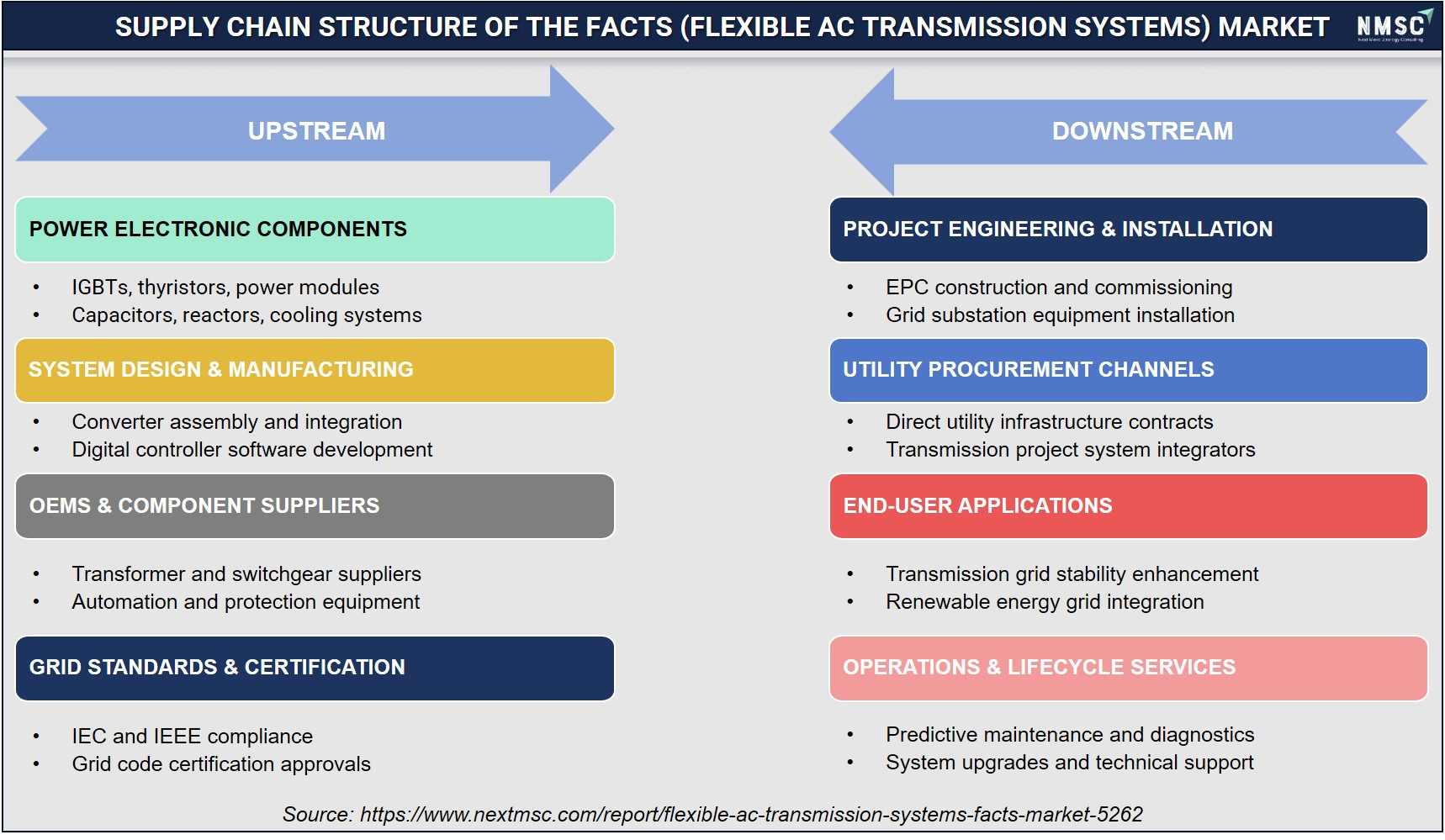
The above infographic presents the supply chain structure of the FACTS market, segmented into upstream and downstream activities. Upstream begins with power electronic components like IGBTs and capacitors, moving into converter assembly, software development, and system integration. OEMs supply transformers and automation equipment, while compliance with IEC and IEEE standards ensures reliability. Moving downstream, EPC contractors handle installation for utility projects, with systems deployed for transmission stability and renewable integration. Looking ahead, we observed that predictive maintenance and upgrades ensure long-term operational performance across the energy sector.
Growth Opportunities
Beyond the core drivers shaping overall demand, three whitespace opportunities stand out for FACTS vendors positioning portfolios toward 2035.
How Can Vendors Capture Value from Inertia-Replacement Retrofits?
Retrofit programs that pair STATCOM installations with supercapacitor or synchronous-condenser inertia support create a mechanism for vendors to capture recurring revenue from transmission system operators replacing retiring conventional generation. Established FACTS suppliers with proven grid-forming technology stand to benefit most from this inertia-replacement retrofit cycle across European and North American transmission networks.
What Opportunity Exists in Renewable Project Developer-Direct Sales?
Direct compensation-equipment sales to renewable project developers, rather than solely to transmission system operators, create a mechanism for vendors to capture value earlier in the interconnection process as developers seek to accelerate approval timelines. Vendors offering pre-engineered, modular STATCOM packages are best positioned to capture this fastest-growing customer-type opportunity as renewable capacity additions continue to outpace transmission buildout.
How Can Suppliers Benefit from Mobile FACTS Deployment Models?
Mobile and relocatable FACTS units that can be deployed within days rather than years create a mechanism for suppliers to serve utilities facing extreme-weather-driven grid stress without committing to permanent substation projects. Equipment manufacturers offering containerized, pre-tested compensation units are best positioned to capture this opportunity as utilities prioritize deployment speed alongside long-term infrastructure planning.
Regional Outlook
|
Region |
2025 (USD) |
2035 (USD) |
CAGR% (2026–2035) |
Key Driver |
|
North America |
0.65 Billion |
1.18 Billion |
6.2% |
Grid resilience funding and renewable interconnection |
|
Europe |
0.59 Billion |
1.12 Billion |
6.6% |
Synchronous generation retirement and grid-forming STATCOM adoption |
|
Asia-Pacific |
1.18 Billion |
2.62 Billion |
8.3% |
Transmission expansion and renewable integration at scale |
|
Middle East & Africa |
0.30 Billion |
0.81 Billion |
10.6% |
Grid infrastructure investment and giga-project development |
|
Latin America |
0.24 Billion |
0.50 Billion |
7.8% |
Transmission network expansion and renewable capacity growth |
|
Total |
2.95 Billion |
6.23 Billion |
7.76% |
— |
North America
North America's FACTS market benefits from sustained federal grid resilience funding, with the U.S. Department of Energy announcing an approximately USD 1.9 billion SPARK funding opportunity in 2026 to accelerate grid infrastructure upgrades. Regulatory influence remains significant through FERC's interconnection and transmission planning orders, while technology adoption favors mobile and modular STATCOM deployment for extreme-weather resilience. We observed that strategic outlook favors vendors with established utility relationships and proven rapid-deployment capability.
Europe
Europe's market is shaped by the retirement of coal and nuclear baseload capacity, driving transmission system operators including TenneT and Amprion to invest heavily in grid-forming STATCOM and synchronous condenser technology. Technology adoption is the most advanced globally, exemplified by the world's first supercapacitor-powered E-STATCOM commissioned at Mehrum in December 2025. Strategic outlook favors suppliers combining proven grid-forming control platforms with strong domestic transmission system operator partnerships.
Asia-Pacific
Asia-Pacific is the largest and fastest-scaling major regional market by absolute dollar growth, propelled by large-scale transmission expansion in China and renewable-driven grid investment across India and Southeast Asia. Technology adoption spans both high-capacity extra high voltage installations on bulk transmission corridors and distribution-level compensation supporting industrial and renewable interconnection. Strategic outlook favors vendors able to localize manufacturing and service capacity within the region's expanding transmission infrastructure programs.
Middle East & Africa
The Middle East & Africa market is the fastest-growing region globally at a 10.6% CAGR, driven by grid infrastructure investment tied to Gulf economic diversification giga-projects and continued transmission network expansion across Sub-Saharan Africa. Regulatory frameworks remain in earlier development relative to Europe and North America, giving suppliers flexibility in technology specification. Strategic outlook favors vendors with strong regional utility and EPC contractor relationships.
Latin America
Latin America's market is expanding steadily as transmission network buildout and growing renewable capacity additions in Brazil and Argentina drive demand for voltage-support infrastructure. Technology adoption remains concentrated in high voltage rather than extra high voltage installations relative to Asia-Pacific and Europe. Strategic outlook favors suppliers building EPC contractor partnerships ahead of anticipated transmission-investment acceleration across the region.
U.S.
Based on our estimates, the U.S. market was valued at approximately USD 441.3 million in 2025 and is projected to reach USD 757.6 million by 2035, growing at a 5.6% CAGR. Demand is anchored in renewable interconnection and grid resilience upgrades, with strong competitive activity among Siemens Energy, GE Vernova, and Hitachi Energy supporting a mature but steadily expanding strategic outlook shaped by DOE and FERC transmission programs.
Canada
The market in Canada was valued at approximately USD 136.3 million in 2025 and is forecast to reach USD 248.6 million by 2035, expanding at a 6.2% CAGR. Demand structure mirrors the U.S. with a transmission-modernization tilt, moderate renewable-integration project activity, and provincial utility procurement standards shaping compensation-equipment specification.
UK
As per our estimate, the UK FACTS market stood at approximately USD 76.7 million in 2025 and is projected to reach USD 134.6 million by 2035, growing at a 5.8% CAGR. Demand structure favors offshore wind grid-support installations, with Siemens Energy's Enhanced STATCOM deployment for Ørsted's Hornsea offshore wind program illustrating growing UK Clean Power 2030-aligned investment in grid stabilization technology.
Germany
According to our analysis, Germany's market was valued at approximately USD 129.8 million in 2025 and is expected to reach USD 235.5 million by 2035, at a 6.1% CAGR. Demand is driven by the country's most advanced grid-forming STATCOM deployment pipeline, with TenneT and Amprion together projected to require approximately 70 STATCOM installations over the next decade to offset retiring conventional generation.
France
Based on our estimates, France's market was valued at approximately USD 88.5 million in 2025 and is projected to reach USD 157.0 million by 2035, growing at a 5.9% CAGR. Demand structure is led by transmission-network reinforcement supporting nuclear-to-renewable generation mix transition, with competitive intensity concentrated among European FACTS suppliers serving the national transmission system operator.
China
The market in China was valued at approximately USD 448.4 million in 2025 and is projected to reach USD 889.6 million by 2035, growing at a 7.1% CAGR, the largest country-level market globally. Demand structure spans large-scale extra high voltage transmission corridors and rapidly expanding renewable integration capacity, supported by domestic suppliers including NR Electric, TBEA, and Rongxin Power Electronic alongside multinational technology providers.
India
According to our analysis, India's FACTS market was valued at approximately USD 236.0 million in 2025 and is projected to reach USD 628.0 million by 2035, expanding at a 10.3% CAGR, among the fastest-growing large markets globally. Demand is driven by continued transmission grid expansion and renewable capacity additions, with Bharat Heavy Electricals Limited and multinational suppliers competing for state and national transmission system operator contracts.
Japan
As per our estimate, Japan's market was valued at approximately USD 106.2 million in 2025 and is projected to reach USD 183.2 million by 2035, growing at a 5.6% CAGR. Demand structure is technology-mature, with distribution-level STATCOM installations supporting industrial customers and renewable photovoltaic plants, and domestic suppliers including Mitsubishi Electric, Toshiba Energy Systems, and Fuji Electric competing within a stable regulatory environment.
South Korea
Based on our estimates, South Korea's market was valued at approximately USD 94.4 million in 2025 and is projected to reach USD 183.2 million by 2035, at a 6.9% CAGR. Demand structure closely resembles Japan's with strong industrial-load compensation demand, growing offshore wind interconnection activity, and domestic suppliers including LS Electric and Hyosung Heavy Industries scaling grid-support product lines.
Australia
The market in Australia was valued at approximately USD 70.8 million in 2025 and is projected to reach USD 157.0 million by 2035, growing at an 8.3% CAGR. Demand structure is led by renewable integration across large-scale wind and solar zones connected via long transmission corridors, supported by a regulatory environment that has proven accommodating to grid-forming compensation technology trials.
UAE
According to our analysis, the UAE FACTS market was valued at approximately USD 59.0 million in 2025 and is projected to reach USD 153.9 million by 2035, growing at a 10.1% CAGR. Demand structure is dominated by grid infrastructure investment tied to Dubai and Abu Dhabi's long-term urban and industrial master planning, alongside growing renewable project developer demand for interconnection compensation equipment.
Saudi Arabia
Based on our estimates, Saudi Arabia's market was valued at approximately USD 76.7 million in 2025 and is projected to reach USD 210.6 million by 2035, growing at a 10.6% CAGR, the fastest country-level growth rate in this report. Demand is driven by Vision 2030-linked grid infrastructure and giga-project development, with strong regulatory support for transmission investment supporting large-scale renewable and industrial interconnection programs.
South Africa
As per our estimate, South Africa's market was valued at approximately USD 26.5 million in 2025 and is projected to reach USD 72.9 million by 2035, growing at a 10.6% CAGR. Demand structure combines transmission network reinforcement addressing chronic grid-stability challenges with growing renewable-integration investment concentrated in major industrial and mining regions.
Brazil
The market in Brazil was valued at approximately USD 103.8 million in 2025 and is projected to reach USD 209.3 million by 2035, growing at a 7.3% CAGR, the largest market in Latin America. Demand structure is led by long-distance transmission corridors connecting remote hydropower and wind generation to demand centers, with EPC contractors expanding compensation-equipment procurement to serve national grid expansion programs.
Argentina
According to our analysis, Argentina's market was valued at approximately USD 42.5 million in 2025 and is projected to reach USD 89.7 million by 2035, growing at a 7.8% CAGR. Demand structure reflects gradual transmission-network modernization and renewable capacity growth, with regional distributors and EPC contractors serving as the primary channels for compensation-equipment procurement.
PESTEL Analysis of the FACTS Industry
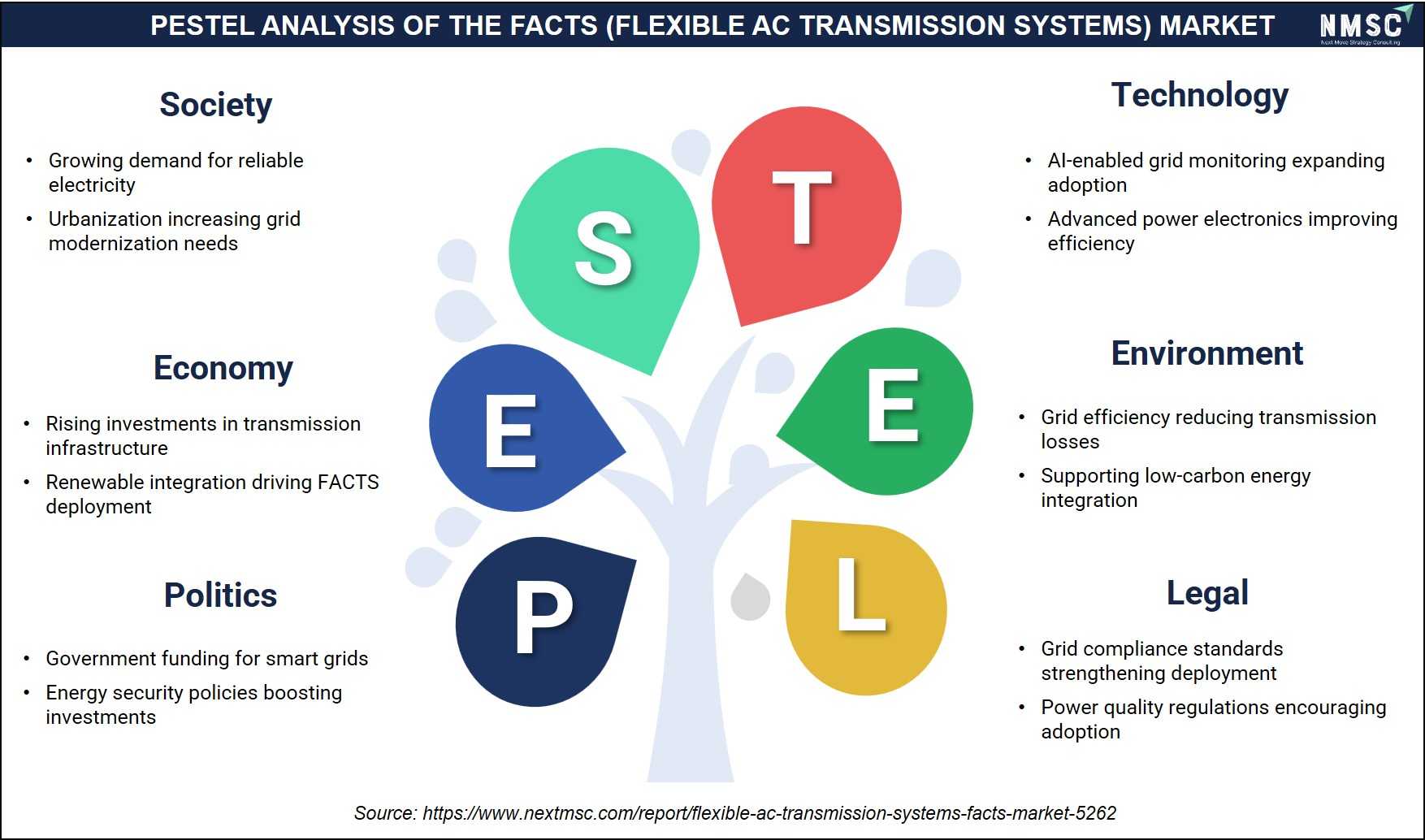
The above infographic presents a PESTEL analysis of the FACTS market, where government funding and energy security policies are driving grid modernization and smart grid investments. At the same time, urbanization and rising demand for reliable electricity are shaping social acceptance, supported by advanced power electronics and AI-enabled monitoring that improve grid efficiency and stability. Renewable integration and low-carbon energy goals are further driving FACTS deployment for environmental benefits, while grid compliance and power quality regulations ensure regulatory adherence. Looking ahead, we observed that these interconnected factors collectively shape the market's evolution across the energy sector.
Competitive Landscape
Our assessment indicates that competitive intensity in the FACTS market is shaped by a small number of global power-electronics leaders and a growing set of regional Asian manufacturers competing across transmission, renewable-integration, and industrial verticals within the broader power electronics equipment industry.
|
Key Takeaways |
Details |
|
Market Structure |
Concentrated among a handful of global technology leaders at the extra high voltage tier, with growing competition from Chinese and Korean manufacturers at the medium and high voltage tiers. |
|
Innovation Focus |
Grid-forming control, supercapacitor-enhanced STATCOM technology, and mobile or modular deployment platforms. |
|
M&A Activity |
Selective technology partnerships with transmission system operators rather than large-scale consolidation among established suppliers. |
How Do Companies Compete in the FACTS Market?
Companies compete primarily on converter reliability, grid-forming control sophistication, project delivery track record, and lifecycle service capability across multi-decade equipment installations. Our analysis shows that Siemens Energy and Hitachi Energy compete heavily on proprietary voltage source converter technology and long-standing transmission system operator relationships, while Chinese manufacturers including NR Electric and TBEA compete on cost competitiveness and rapid scaling within domestic and Belt and Road-adjacent markets.
Which Competitive Archetypes Dominate the Market?
Two archetypes dominate the market: established global power-electronics leaders offering proprietary, high-reliability converter platforms for extra high voltage transmission applications, and regional Asian manufacturers competing on scale and price across medium and high voltage segments. Siemens Energy exemplifies the global technology-leader archetype through its SVC PLUS platform, while NR Electric and Rongxin Power Electronic exemplify the regional-scale archetype serving China's expansive domestic transmission buildout.
How Are Companies Differentiating Through Innovation?
Innovation and differentiation increasingly center on grid-forming control capability and hybrid energy-storage integration. Siemens Energy's supercapacitor-enhanced SVC PLUS FS platform, deployed as the world's first E-STATCOM at Mehrum, and Hitachi Energy's Grid-enSure portfolio combining STATCOM with supercapacitor support both illustrate how established suppliers are embedding proprietary inertia-replacement technology to differentiate beyond conventional reactive power compensation.
What M&A and Expansion Activity Is Shaping the Market?
Expansion activity is concentrated in long-term framework agreements with transmission system operators rather than large-format acquisitions. Siemens Energy's cumulative delivery of over 100 STATCOM systems to Germany's Amprion, alongside Hitachi Energy's multi-project partnership with New Zealand's Transpower, illustrates how established suppliers are deepening single-customer relationships across successive grid-stabilization phases rather than pursuing horizontal consolidation.
Key Market Players
Our assessment indicates that the following 20 companies are actively shaping converter technology innovation, manufacturing scale, and transmission system operator partnerships within the global FACTS market.
-
Hitachi Energy Ltd.
-
GE Vernova Inc.
-
Mitsubishi Electric Corporation
-
NR Electric Co., Ltd.
-
Hyosung Heavy Industries Corporation
-
Bharat Heavy Electricals Limited
-
Rongxin Power Electronic Co., Ltd.
-
LS Electric Co., Ltd.
-
American Superconductor Corporation
-
TBEA Co., Ltd.
-
Nissin Electric Co., Ltd.
-
Fuji Electric Co., Ltd.
-
CHINT Group Co., Ltd.
-
Eaton Corporation plc
-
Quality Power Electrical Equipments Limited
-
Meidensha Corporation
-
Sieyuan Electric Co., Ltd.
Latest Developments
We found that recent project awards within the FACTS market are concentrated on grid-forming STATCOM commissioning, renewable-integration compensation projects, and offshore wind grid-stabilization contracts across 2025 and 2026.
|
Date |
Event |
|
April 2026 |
Hitachi Energy and Samsung C&T expanded their strategic collaboration to accelerate flexible AC grid infrastructure globally. |
Expert Insights
 “The global energy landscape is entering a defining decade for its energy future, and resilient AC grid infrastructure is foundational to making the transition work. This expanded collaboration with Samsung C&T brings together leading technology and execution capabilities to accelerate grid modernization, strengthen resilience, and enable the large-scale integration of renewables – supporting a more connected and energy-secure system.”
— Niklas Persson, CEO of Grid Integration Business Unit, Hitachi Energy
Statement made discussing the growing importance of resilient and flexible AC grid infrastructure.
Market Interpretation
The insight highlights the increasing need for flexible and resilient AC transmission infrastructure as power grids accommodate rising electrification and greater renewable energy penetration. NMSC's analysis indicates that these evolving grid requirements are creating stronger demand for FACTS technologies, which help utilities improve voltage stability, manage reactive power, enhance transmission capacity, and maintain grid resilience under variable operating conditions. As renewable integration accelerates, FACTS solutions are expected to become increasingly important for modernizing transmission networks and supporting reliable, flexible power delivery.
Investment Opportunities
What Capital Inflows Are Targeting the FACTS Market?
Capital inflows are increasingly directed toward grid-forming and inertia-replacement technology, with the U.S. Department of Energy's Grid Resilience and Innovation Partnerships program having allocated up to USD 10.5 billion in competitive funding across its first funding rounds to strengthen transmission and distribution resilience. We observed that investors favor suppliers demonstrating proven grid-forming deployment, viewing transmission system operator framework agreements as a proxy for durable, multi-year revenue visibility.
How Is Infrastructure Investment Supporting FACTS Market Growth?
Infrastructure investment tied to national transmission expansion programs continues to underwrite FACTS procurement, with the U.S. Department of Energy's Transmission Facilitation Program having committed approximately USD 1.5 billion across four transmission projects requiring associated reactive power compensation infrastructure. Our findings suggest that suppliers with established public-sector procurement relationships are best positioned to capture this policy-anchored investment flow through 2035.
What ESG Considerations Are Shaping Market Investment Decisions?
Grid decarbonization is the central ESG consideration shaping investment decisions, as FACTS equipment directly enables higher renewable energy penetration by compensating for the voltage and inertia characteristics that variable generation lacks. We found that transmission system operators increasingly treat grid-forming compensation capability as a governance and reliability indicator alongside conventional financial and safety metrics when evaluating supplier partnerships.
Key Benefits for Stakeholders
How Does This Report Benefit Enterprise and Industry Leaders?
Enterprise and industry leaders gain access to validated segmentation, competitive benchmarking, and regional demand forecasts that support sourcing and technology-investment decisions across the FACTS industry. Our analysis shows that detailed technology, voltage class, and end-use breakdowns help transmission system operator and EPC contractor procurement teams align specifications with the fastest-growing segments, including Combined Compensation and Renewable Integration.
How Does This Report Benefit Investors and Financial Analysts?
Investors and financial analysts benefit from consistent, single-point market size and CAGR estimates that support valuation and capital-allocation decisions across the FACTS equipment supply chain. We observed that the report's regional and segment-level growth differentials help identify which suppliers are best positioned to capture above-market growth in grid-forming and renewable-integration compensation technology through 2035.
How Does This Report Benefit Technology Vendors and Product Teams?
Technology vendors and product teams gain insight into emerging design requirements, including grid-forming control, supercapacitor-enhanced active power response, and mobile deployment platforms, that are reshaping the industry. Our findings suggest that this analysis helps R&D teams prioritize development roadmaps around the Combined Compensation and Extra High Voltage segments, showing the strongest above-market growth trajectories.
Key Market Segments
By Technology
-
Series Compensation
-
Fixed Series Compensation
-
Thyristor Controlled Series Compensation
-
Static Synchronous Series Compensator
-
-
Shunt Compensation
-
Static VAR Compensator
-
Static Synchronous Compensator
-
-
Combined Compensation
-
Unified Power Flow Controller
-
Hybrid Series and Shunt Compensator
-
-
Rotating Support
By Voltage Class
-
Medium Voltage
-
High Voltage
-
Extra High Voltage
By End Use
-
Transmission Grid
-
Distribution Grid
-
Renewable Integration
-
Industrial Load
By Revenue Stream
-
New System Sale
-
Retrofit and Uprate
-
Lifecycle Service and Spares
By Customer Type
-
Electric Utility and TSO
-
Renewable Project Developer
-
Heavy Industrial End User
-
EPC Contractor
By Region
-
North America: U.S., Canada, Mexico
-
Europe: UK, Germany, France, Italy, Spain, Sweden, Denmark, Finland, Netherlands, Rest of Europe
-
Asia-Pacific: China, India, Japan, South Korea, Taiwan, Indonesia, Vietnam, Australia, Philippines, Malaysia, Rest of APAC
-
Middle East & Africa: Saudi Arabia, UAE, Egypt, Israel, Turkey, Nigeria, South Africa, Rest of MEA
-
Latin America: Brazil, Argentina, Chile, Colombia, Rest of LATAM
Conclusion and Recommendations
What Is the Long-Term Outlook for the FACTS Market?
The long-term outlook for the FACTS market remains positive, with global revenue projected to more than double from USD 2.95 billion in 2025 to USD 6.23 billion by 2035 at a 7.76% CAGR. We observed that synchronous generation retirement, renewable integration, and government grid resilience investment will continue underpinning demand across transmission, distribution, and industrial applications through the forecast period.
What Strategic Positioning Should FACTS Suppliers Pursue?
Suppliers should prioritize grid-forming control capability and modular, rapidly deployable platforms while maintaining strong transmission system operator framework relationships in mature markets. Our assessment indicates that manufacturers investing early in supercapacitor-enhanced and inertia-replacement technology will be best positioned to capture premium pricing while retaining access to policy-anchored transmission-modernization demand.
How Attractive Is the FACTS Market for New Investment?
The FACTS market presents an attractive investment case, supported by a USD 3.05 billion absolute dollar opportunity between 2026 and 2035 and above-average growth in the Middle East & Africa region and Combined Compensation technology. We found that investment attractiveness is highest for suppliers combining grid-forming technical credentials with scaled manufacturing capacity, positioning them to serve both mature-market replacement demand and emerging-market new-build growth simultaneously.
What Market Shifts and Key Risks Should Stakeholders Monitor?
Stakeholders should monitor long transmission-project lead times, high extra high voltage equipment costs, and constrained utility capital budgets as key risks to the FACTS market. Our analysis shows that suppliers unable to demonstrate rapid, cost-competitive deployment risk losing share to competitors offering modular or mobile platforms, particularly across price-sensitive Latin American and African markets.
What Are the Key Growth Pathways for the Market?
Key growth pathways include scaling grid-forming and supercapacitor-enhanced STATCOM platforms, deepening renewable project developer-direct sales channels, and expanding mobile deployment capacity for extreme-weather resilience. Next Move Strategy Consulting's analysis indicates that suppliers pursuing these pathways while maintaining cost competitiveness in conventional shunt and series compensation will be best positioned to capture the FACTS market's projected growth through 2035.
About the Author
 Mayurima Roy
— Mayurima Roy is Research Analyst at Next Move Strategy Consulting, where she has spent 4 years working across the firm's full industry coverage rather than a single fixed vertical. Her work centers on structured research, ongoing trend tracking, competitive assessment, and insight-led content development, translating complex market data into clear, decision-ready narratives that support informed client decision-making across diverse global industries, market sectors, and world regions every day.
Mayurima Roy
— Mayurima Roy is Research Analyst at Next Move Strategy Consulting, where she has spent 4 years working across the firm's full industry coverage rather than a single fixed vertical. Her work centers on structured research, ongoing trend tracking, competitive assessment, and insight-led content development, translating complex market data into clear, decision-ready narratives that support informed client decision-making across diverse global industries, market sectors, and world regions every day.
About the Reviewer
 Supradip Baul
— Supradip Baul is an accomplished business consultant and strategist with over a decade of rich experience in market intelligence, strategy, technology, and business transformation. His work has included rigorous qualitative and quantitative analysis across multiple industries, helping clients shape investment decisions and long-term roadmaps. Earlier in his career, he was associated with Gartner, where he contributed to industry-leading reports and market share analyses. He has worked with leading global companies and holds an MBA with a dual specialization in Marketing and Finance.
Supradip Baul
— Supradip Baul is an accomplished business consultant and strategist with over a decade of rich experience in market intelligence, strategy, technology, and business transformation. His work has included rigorous qualitative and quantitative analysis across multiple industries, helping clients shape investment decisions and long-term roadmaps. Earlier in his career, he was associated with Gartner, where he contributed to industry-leading reports and market share analyses. He has worked with leading global companies and holds an MBA with a dual specialization in Marketing and Finance.
At Next Move Strategy Consulting, we understand that insightful market research is the cornerstone of successful business decisions. That's why we employ a robust and multifaceted approach, combining various methodologies to deliver the most accurate and actionable data for our clients.

Research Landscape
We navigate the world of research with two primary approaches:
Qualitative Approach
Our qualitative research methodologies involve immersive techniques such as in-depth interviews, focus groups, and observational studies. By engaging directly with individuals and stakeholders, we uncover valuable insights that quantitative data alone may overlook.

Quantitative Research
In tandem with qualitative methodologies, NMSC leverages the power of Quantitative Research to provide a robust foundation of numerical insights. Through systematic data collection and analysis, we quantify patterns, preferences, and market trends, offering a comprehensive view of the business landscape.
Our quantitative research approach employs diverse tools, including surveys, experiments, and statistical modelling. These methodologies enable us to gather data from a large and representative sample, ensuring the statistical significance of our findings. By employing structured questionnaires and standardized data collection methods, we guarantee the reliability and validity of the information we present to our clients.
Quantitative research is particularly effective in measuring the prevalence of trends, assessing market size, and gauging the impact of various factors on consumer behavior. The numerical precision attained through this approach equips our clients with actionable insights, facilitating data-driven decision-making and strategy formulation.


Our Specialized Toolbox for Industry-Specific Market Research
We deploy a specialized arsenal of techniques tailored to meet your unique requirements. Here's a glimpse into our comprehensive toolbox:

Information Procurement
The stage entails acquiring market data or relevant information through various sources and methodologies.


Market Research Approach
We utilize both top-down and bottom-up approaches in market research analysis to achieve a comprehensive understanding of the market dynamics, leveraging the broad perspective of industry trends and macroeconomic factors alongside detailed insights from specific segments and individual companies.

Porters Five Forces Analysis
We conduct Porter's Five Forces analysis to evaluate the competitive landscape of an industry, providing us with insights into factors that affect profitability and strategic positioning.

SWOT Analysis

Forecasting
We utilize a forecasting model to predict future consumption by considering parameters like population, economics, regulations, market competition, drivers, constraints, technology, and pricing. We also employ statistical techniques such as multilinear regression, exponential smoothing, moving average, ARIMA, and Monte Carlo simulations for accurate predictions. In econometric forecasting, we analyzed short-term and long-term event impacts, attributing values based on regulatory frameworks, economic factors, and market events.





 Speak to Our Analyst