Food and Beverages E-Commerce Market Global Industry Analysis and Forecast (2026-2035)

Food and beverages e-commerce market size is estimated at USD 1,057.76 billion in 2026, projected to reach USD 3,794.43 billion by 2035, growing at a CAGR of 15.25% from 2026 to 2035. Key drivers include expanding smartphone and rapid quick commerce and dark store network expansion, and marketplace consolidation, with North America leading the market and Asia-Pacific registering the fastest growth.

Download Free Sample PDF
Base Year (2025)
$753.68 Billion
Forecast (2035)
$3,794.43 Billion
CAGR (2026-2035)
15.3%
Top Region
North America

What Is the Food and Beverages E-Commerce Market Size?

The global food and beverages e-commerce market size was valued at USD 753.68 billion in 2025 and is estimated at USD 1,057.76 billion in 2026, forecast to reach USD 3,794.43 billion by 2035, expanding at a 15.25% CAGR between 2026 and 2035. North America leads with approximately 38% share, while marketplace platforms dominate all other business models with approximately 48% share.

We observed that growth is broad-based across every segmentation axis, with quick commerce delivery and Asia-Pacific digital grocery adoption driving the most pronounced structural shifts through 2035.

Food and Beverages E-Commerce Market Global Industry Analysis and Forecast (2026-2035) Revenue Forecast

Values in USD Billion

2025 $753.68 Billion
2025
2026 $868.62 Billion
2026
2027 $1,001.08 Billion
2027
2028 $1,153.74 Billion
2028
2029 $1,329.69 Billion
2029
2030 $1,532.47 Billion
2030
2031 $1,766.17 Billion
2031
2032 $2,035.51 Billion
2032
2033 $2,345.93 Billion
2033
2034 $2,703.68 Billion
2034
2035 $3,794.43 Billion
2035

Key Takeaways

By Business Model: Marketplace Platforms held the largest share of approximately 48% (USD 361.77 billion) in 2025; Quick Commerce and Dark Store Delivery is the fastest-growing sub-segment at 21.7% CAGR from 2026–2035.

By Product Category: Prepared and Restaurant Meals held the largest share of approximately 33% (USD 248.71 billion) in 2025; Beverages is the fastest-growing sub-segment at 19.1% CAGR from 2026–2035.

By Order Fulfillment Model: Store-Based Picking held the largest share of approximately 42% (USD 316.55 billion) in 2025; Dark Store and Micro-Fulfillment Centers is the fastest-growing sub-segment at approximately 20.3% CAGR from 2026–2035.

By Delivery Speed: Scheduled and Next-Day Delivery held the largest share of approximately 34% (USD 256.25 billion) in 2025; Quick Commerce (Under 30 Minutes) is the fastest-growing sub-segment at 20.6% CAGR from 2026–2035.

By Payment and Revenue Model: Commission-Based Merchant Fees held the largest share of approximately 40% (USD 301.47 billion) in 2025; Retail Media and Advertising Revenue is the fastest-growing sub-segment at approximately 21.8% CAGR from 2026–2035.

By End User: Individual Consumers held the largest share of approximately 68% (USD 512.50 billion) in 2025; Institutional and Bulk Buyers is the fastest-growing sub-segment at approximately 17.4% CAGR from 2026–2035.

Dominant Region: North America dominated with approximately 38% revenue share (USD 286.40 billion) in 2025.

Fastest-Growing Region: Asia-Pacific is expected to register the highest CAGR of 18.2% during 2026–2035.

Dominant Country: U.S. led with approximately USD 229.12 billion in 2025.

Fastest-Growing Country: India is the fastest-growing country at approximately 20.5% CAGR from 2026–2035.

Market Opportunity: The food and beverages e-commerce market is expected to create an absolute dollar opportunity of USD 2,736.67 billion between 2026 and 2035, presenting significant investment potential across quick commerce infrastructure and Asia-Pacific digital grocery expansion.

According to NMSC analysis, retailers and marketplace platforms are increasingly consolidating fulfillment infrastructure around dark store and micro-fulfillment networks, a shift that favors vertically integrated operators over asset-light aggregators as delivery-speed expectations compress from same-day to under-30-minute standards through 2035.

What Does the Food and Beverages E-Commerce Market Encompass?

The food and beverages e-commerce market encompasses online platforms and retailer-owned digital storefronts that enable consumers to order groceries, prepared meals, beverages, and packaged food for delivery or pickup. Our assessment indicates that the scope spans marketplace platforms, first-party retail e-commerce, quick commerce and dark store delivery, and direct-to-consumer subscription models serving individual consumers, households, and institutional buyers across fresh grocery, prepared meals, beverages, and meal kit categories worldwide. The category has evolved from early online grocery pilots into a multi-format digital commerce ecosystem, driven by smartphone penetration, urbanization, and shifting consumer expectations around delivery speed.
Regulatory frameworks such as digital payment modernization for government nutrition assistance programs and data privacy requirements shape platform checkout and personalization architecture, while national competition authorities increasingly scrutinize marketplace consolidation. We observed that technology adoption is shifting toward AI-driven personalization and dark store micro-fulfillment that compress delivery windows below 30 minutes. NMSC's analysis indicates that this structural shift is redefining competitive positioning across the food and beverages e-commerce market.

Consumer Behaviour in the Food and Beverages E-Commerce Market

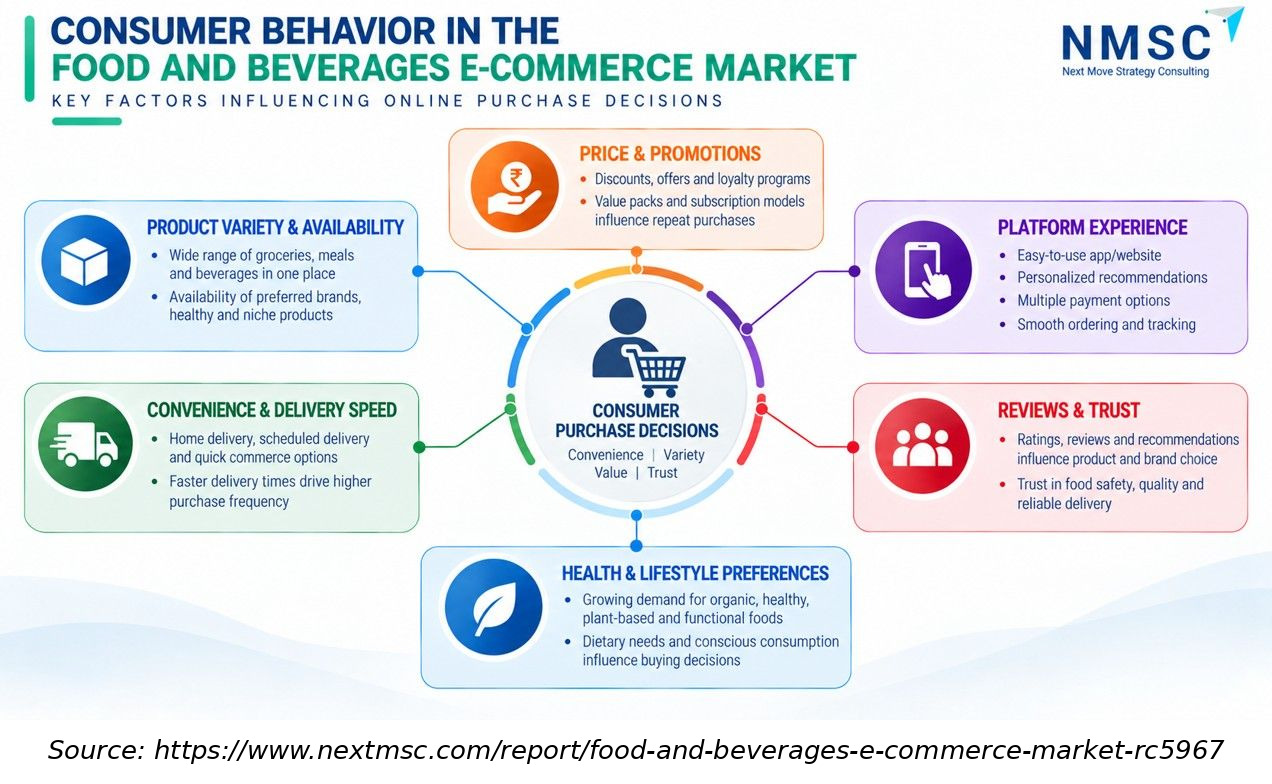
Consumer Behaviour in the Food and Beverages E-Commerce Market

The infographic highlights key factors shaping consumer purchase decisions in the Food and Beverages E-Commerce Market. It emphasizes product variety and availability, pricing and promotions, convenience and delivery speed, platform experience, reviews and trust, and health and lifestyle preferences. Consumers increasingly value convenient ordering, fast delivery, discounts, personalized recommendations, reliable product quality, and access to organic, healthy, and plant-based options when purchasing food and beverages online.

Market Drivers & Dynamics

Interactive Dataset
Expanding smartphone and mobile commerce penetration driver +3.6% Global 2026–2035
Rapid quick commerce and dark store network expansion driver +3.1% Asia-Pacific, North America 2026–2035
Marketplace consolidation improving delivery network density driver +2.4% Global 2026–2032
Retail media advertising creating high-margin revenue streams driver +2.0% Global 2026–2035
Government digital payment modernization for nutrition programs driver +1.5% North America 2026–2032
Rising urbanization and dual-income household time constraints driver +1.8% Global 2026–2035
Thin delivery margins constraining smaller platform profitability restraint −1.6% Global 2026–2032
Regulatory scrutiny of marketplace mergers and labor classification restraint −1.2% North America, Europe 2026–2032
Last-mile delivery cost inflation in low-density markets restraint −0.8% Global 2026–2035
Source: Next Move Strategy Consulting

Growth Drivers

What Is the Primary Growth Driver of the Food and Beverages E-Commerce Market?

Expanding smartphone and mobile commerce penetration is the primary driver of the market. Approximately 72% of all online grocery transactions now occur through mobile applications, reflecting the central role of mobile-first platform design in consumer adoption. We observed that this mobile commerce foundation, reinforced by rapid quick commerce network expansion, continues to anchor baseline demand for food and beverages e-commerce platforms across developed and emerging markets alike.

How Is Quick Commerce Expansion Driving Food and Beverages E-Commerce Market Growth?
Quick commerce expansion is accelerating market growth as dark store and micro-fulfillment networks proliferate across dense urban markets. Quick commerce formats now represent more than 35% of total online grocery transaction volume in markets where the format has scaled, growing at a rate that substantially outpaces traditional scheduled delivery. Our assessment indicates that this dark store build-out is compressing customer acquisition timelines for platforms able to guarantee delivery windows under 30 minutes.

Growth Inhibitors

What Is Restraining Food and Beverages E-Commerce Market Expansion?

Thin delivery margins restrain market expansion, particularly for platforms lacking retail media or subscription revenue diversification. Regulatory scrutiny of marketplace consolidation, exemplified by blocked grocery merger attempts reviewed by national competition authorities, further constrains large-scale consolidation pathways in some markets. We found that platforms reliant solely on delivery and commission fees face particular margin exposure, as last-mile delivery costs in lower-density markets erode profitability compared with platforms operating diversified advertising and subscription revenue streams.

What Are the Growth Opportunities?

How Can Retail Media Networks Unlock Value for Marketplace Platforms?

Retail media networks present a whitespace opportunity for marketplace platforms seeking to diversify beyond delivery and commission fees. Platforms that build first-party advertising infrastructure on top of grocery and restaurant transaction data stand to capture high-margin revenue, benefiting from the 70 to 90% gross margins characteristic of retail media compared with commission-based delivery fees.

Where Does Dark Store Micro-Fulfillment Create New Demand in Asia-Pacific?

Dark store and micro-fulfillment infrastructure represents an underpenetrated opportunity for platforms scaling quick commerce across dense Asia-Pacific urban centers. Providers that build localized fulfillment networks can secure recurring high-frequency grocery and convenience orders, benefiting from delivery-speed differentiation in markets where under-30-minute fulfillment remains uncommon outside major metropolitan areas.

How Can Institutional Bulk Ordering Benefit Restaurant and Catering Buyers?

Institutional and bulk ordering features create an opportunity for platforms serving restaurant, catering, and office buyers seeking recurring supply relationships. Early movers that build dedicated bulk-order interfaces and last mile delivery scheduling can differentiate with institutional buyers pursuing predictable, multi-order procurement relationships through 2035.

Segmentation Analysis

2025 (USD Billion)
2035 (USD Billion)
Marketplace Platforms 2025: $361.77 Billion | 2035: $1,631.60 Billion
Marketplace
First-Party Retail E-Commerce 2025: $226.10 Billion | 2035: $967.58 Billion
First-Party
Quick Commerce and Dark Store Delivery 2025: $113.05 Billion | 2035: $929.64 Billion
Quick Commer
Direct-to-Consumer Subscription 2025: $52.76 Billion | 2035: $265.61 Billion
Direct-to-Co
Marketplace Platforms $361.77 Billion $1,631.60 Billion 13.8%
First-Party Retail E-Commerce $226.10 Billion $967.58 Billion 13.2%
Quick Commerce and Dark Store Delivery $113.05 Billion $929.64 Billion 21.7%
Direct-to-Consumer Subscription $52.76 Billion $265.61 Billion 15.2%

Which Business Model Dominates the Food and Beverages E-Commerce Market?

Marketplace Platforms, which aggregate multiple retailers and restaurants under a single consumer-facing application, led the market with USD 361.77 billion in 2025, supported by network effects that connect large restaurant and grocery partner bases with broad consumer reach. We observed that Quick Commerce and Dark Store Delivery is the fastest-growing business model, expanding at a 21.7% CAGR from 2026 to 2035, as delivery-speed expectations increasingly determine which platforms retain high-frequency grocery and convenience customers.

2025 (USD Billion)
2035 (USD Billion)
Fresh Grocer
Fruits and V
Meat
Poultry and
Dairy and Ba
Segment Item 2025 (USD Billion) 2035 (USD Billion) CAGR
Fresh Grocery $10.0 USD Billion $40.0 USD Billion 22.0%
Fruits and Vegetables $17.1 USD Billion $51.1 USD Billion 16.0%
Meat $24.2 USD Billion $62.2 USD Billion 22.0%
Poultry and Seafood $31.3 USD Billion $73.3 USD Billion 12.0%
Dairy and Bakery $38.4 USD Billion $84.4 USD Billion 27.0%

Segment-wise data is locked

Unlock complete segment-wise numbers for By Product Category.

Unlock Full Data

Which Product Category Leads Food and Beverages E-Commerce Market Demand?
Prepared and Restaurant Meals remained the dominant product category across the market, reaching USD 248.71 billion in 2025 due to the scale of restaurant delivery marketplaces serving time-constrained urban consumers. Our findings suggest that Beverages is the fastest-growing product category, registering a 19.1% CAGR from 2026 to 2035, as quick commerce platforms expand alcohol and specialty beverage delivery in markets where regulatory frameworks permit online sale and delivery.

2025 (USD Billion)
2035 (USD Billion)
Store-Based
Dark Store a
Centralized
Restaurant a
Segment Item 2025 (USD Billion) 2035 (USD Billion) CAGR
Store-Based Picking $10.0 USD Billion $40.0 USD Billion 18.0%
Dark Store and Micro-Fulfillment Centers $17.1 USD Billion $51.1 USD Billion 12.0%
Centralized Warehouse Fulfillment $24.2 USD Billion $62.2 USD Billion 10.0%
Restaurant and Merchant-Direct Fulfillment $31.3 USD Billion $73.3 USD Billion 12.0%

Segment-wise data is locked

Unlock complete segment-wise numbers for By Order Fulfillment Model.

Unlock Full Data
2025 (USD Billion)
2035 (USD Billion)
Scheduled an
Same-Day Del
Quick Commer
Click and Co
Segment Item 2025 (USD Billion) 2035 (USD Billion) CAGR
Scheduled and Next-Day Delivery $10.0 USD Billion $40.0 USD Billion 21.0%
Same-Day Delivery $17.1 USD Billion $51.1 USD Billion 27.0%
Quick Commerce (Under 30 Minutes) $24.2 USD Billion $62.2 USD Billion 9.0%
Click and Collect $31.3 USD Billion $73.3 USD Billion 15.0%

Segment-wise data is locked

Unlock complete segment-wise numbers for By Delivery Speed.

Unlock Full Data

Which Delivery Speed Segment Drives the Food and Beverages E-Commerce Market?

Scheduled and Next-Day Delivery remained the leading delivery speed segment within the market, valued at USD 256.25 billion in 2025 on continued reliance on planned weekly grocery shopping patterns. Based on research conducted by NMSC, we found that Quick Commerce (Under 30 Minutes) is the fastest-growing delivery speed segment, registering a 20.6% CAGR from 2026 to 2035, as urban consumers increasingly expect near-instant fulfillment for convenience and top-up grocery purchases.

2025 (USD Billion)
2035 (USD Billion)
Delivery and
Subscription
Retail Media
Commission-B
Segment Item 2025 (USD Billion) 2035 (USD Billion) CAGR
Delivery and Service Fees $10.0 USD Billion $40.0 USD Billion 12.0%
Subscription Membership Fees $17.1 USD Billion $51.1 USD Billion 26.0%
Retail Media and Advertising Revenue $24.2 USD Billion $62.2 USD Billion 8.0%
Commission-Based Merchant Fees $31.3 USD Billion $73.3 USD Billion 18.0%

Segment-wise data is locked

Unlock complete segment-wise numbers for By Payment and Revenue Model.

Unlock Full Data
2025 (USD Billion)
2035 (USD Billion)
Individual C
Household an
Institutiona
Segment Item 2025 (USD Billion) 2035 (USD Billion) CAGR
Individual Consumers $10.0 USD Billion $40.0 USD Billion 25.0%
Household and Family Subscriptions $17.1 USD Billion $51.1 USD Billion 23.0%
Institutional and Bulk Buyers $24.2 USD Billion $62.2 USD Billion 9.0%

Segment-wise data is locked

Unlock complete segment-wise numbers for By End User.

Unlock Full Data

Growth Opportunities

Three forward-looking whitespace opportunities stand out for platforms positioning ahead of 2035 demand across the food and beverages e-commerce market.

How Can Retail Media Networks Unlock Value for Marketplace Platforms?

Retail media networks present a whitespace opportunity for marketplace platforms seeking to diversify beyond delivery and commission fees. Platforms that build first-party advertising infrastructure on top of grocery and restaurant transaction data stand to capture high-margin revenue, benefiting from the 70 to 90% gross margins characteristic of retail media compared with commission-based delivery fees.

Where Does Dark Store Micro-Fulfillment Create New Demand in Asia-Pacific?

Dark store and micro-fulfillment infrastructure represents an underpenetrated opportunity for platforms scaling quick commerce across dense Asia-Pacific urban centers. Providers that build localized fulfillment networks can secure recurring high-frequency grocery and convenience orders, benefiting from delivery-speed differentiation in markets where under-30-minute fulfillment remains uncommon outside major metropolitan areas.

How Can Institutional Bulk Ordering Benefit Restaurant and Catering Buyers?

Institutional and bulk ordering features create an opportunity for platforms serving restaurant, catering, and office buyers seeking recurring supply relationships. Early movers that build dedicated bulk-order interfaces and last mile delivery scheduling can differentiate with institutional buyers pursuing predictable, multi-order procurement relationships through 2035.

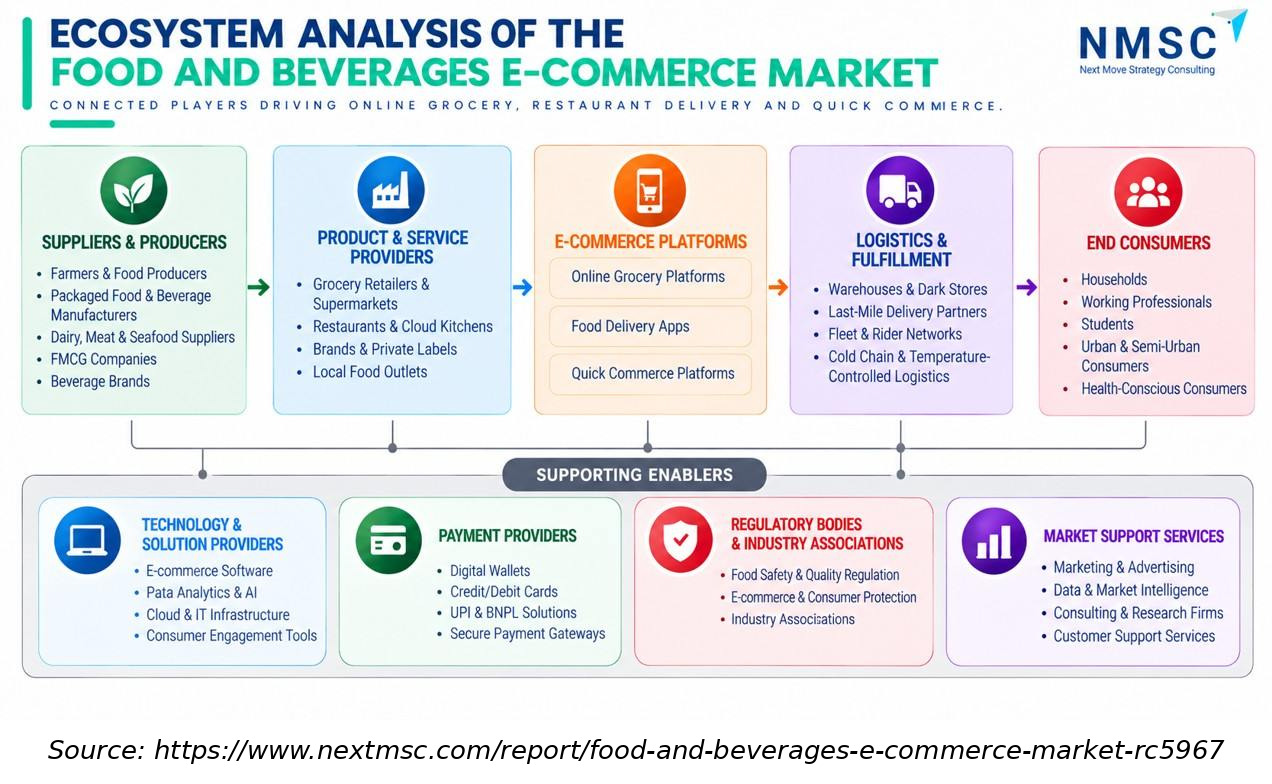
Ecosystem Analysis Of The Food And Beverages E-Commerce Market

The infographic presents an ecosystem analysis of the Food and Beverages E-Commerce Market, mapping the interconnected roles of suppliers, producers, retailers, restaurants, e-commerce platforms, logistics providers, and end consumers. It also highlights supporting enablers, including technology and AI, digital payment solutions, regulatory bodies, industry associations, and market-support services. Together, these participants facilitate online grocery, restaurant delivery, and quick-commerce operations across the digital food value chain.

Regional Outlook

2025 (USD Billion)
2035 (USD Billion)
North Americ
Europe
Asia-Pacific
Middle East
Latin Americ
Region 2025 (USD Billion) 2035 (USD Billion) CAGR (%)
North America $10.0 USD Billion $40.0 USD Billion 9.0%
Europe $17.1 USD Billion $51.1 USD Billion 27.0%
Asia-Pacific $24.2 USD Billion $62.2 USD Billion 25.0%
Middle East & Africa $31.3 USD Billion $73.3 USD Billion 23.0%
Latin America $38.4 USD Billion $84.4 USD Billion 12.0%

Regional data is locked

Unlock complete regional numbers for this market.

Unlock Full Data

Competitive Landscape

We observed that the food and beverages e-commerce market features a moderately consolidated competitive landscape, with diversified technology and retail majors competing alongside specialized delivery marketplaces on network density, fulfillment speed, and revenue diversification.

Dimension Description
Dimension Assessment
Market Structure Moderately consolidated; leading companies profiled in this report account for a substantial share of Industry revenue, while numerous regional platforms serve local restaurant and grocery delivery demand.
Innovation Focus Quick commerce dark store networks, retail media advertising, and AI-driven personalization dominate current innovation pipelines across leading platforms.
M&A Activity Active consolidation through cross-border acquisitions, exemplified by DoorDash's completed acquisition of Deliveroo in October 2025, extending its local commerce platform into nine additional countries.

How Do Companies Compete in the Food and Beverages E-Commerce Market?

Companies compete primarily on delivery network density, fulfillment speed, and merchant partner breadth across the Industry. Global marketplace platforms such as DoorDash, Inc. and Uber Technologies, Inc. leverage scaled courier networks and multi-category merchant relationships to serve dense urban markets, while diversified retail majors such as Amazon.com, Inc. and Walmart Inc. compete on first-party grocery integration and membership bundling across broader e-commerce ecosystems.

Which Competitive Archetypes Dominate the Food and Beverages E-Commerce Market?

Two archetypes dominate the market: asset-light marketplace platforms that aggregate third-party restaurants and retailers under a single consumer application, and vertically integrated retail e-commerce operators that combine first-party inventory with proprietary delivery infrastructure. DoorDash, Inc. and Meituan exemplify the marketplace archetype, while Amazon.com, Inc. and The Kroger Co. exemplify the vertically integrated retail archetype serving grocery-first consumer demand.

How Are Companies Differentiating Through Innovation in Food and Beverages E-Commerce?

Innovation and differentiation strategy increasingly center on quick commerce fulfillment and retail media monetization. Platforms scaling dark store networks and AI-driven personalized recommendations are replacing generic search-and-browse interfaces with predictive, speed-optimized ordering experiences. Our analysis shows that platforms unable to demonstrate credible sub-30-minute delivery capability risk losing high-frequency grocery and convenience order share to competitors with established dark store infrastructure.

What M&A and Expansion Activity Is Shaping the Food and Beverages E-Commerce Market?

Strategic acquisitions, cross-border expansion, and fulfillment infrastructure investment continue to consolidate capabilities within the Industry. DoorDash's USD 3.9 billion acquisition of Deliveroo, completed in October 2025, illustrates how marketplace platforms pursue geographic expansion through consolidation rather than organic market entry, while continued dark store network build-out across Asia-Pacific and North America demonstrates sustained capital investment in quick commerce infrastructure.

Key Market Players

Our assessment indicates that the following 20 companies are actively shaping platform innovation, delivery network expansion, and revenue diversification within the global food and beverages e-commerce market.

Amazon.com, Inc. Walmart Inc. Alibaba Group Holding Limited JD.com, Inc. Meituan Maplebear Inc. (Instacart) DoorDash, Inc. Uber Technologies, Inc. Delivery Hero SE Just Eat Takeaway.com N.V. Ocado Group plc The Kroger Co. Coupang Corp. HelloFresh SE Eternal Limited Swiggy Limited Tesco plc Carrefour SA J Sainsbury plc Woolworths Group Limited

Latest Developments

We observed that recent company activity centers on marketplace consolidation, quick commerce expansion, and payment modernization across the food and beverages e-commerce market.

Date Event
September 2026 nstacart extended its AI-powered grocery shopping technology beyond its marketplace, bringing Cart Assistant to grocers’ own websites and apps. Food Bazaar, Harmon’s, Heritage Grocers Group, The Save Mart Companies, Stew Leonard’s and Woodman’s were among initial adopters. The move expands AI-led discovery and personalization across first-party online grocery channels.
August, 2026 Kroger and Instacart launched a capability allowing customers to combine groceries and eligible prescriptions in one delivery order across nearly all Kroger banners. The service connects more than 2,200 Kroger pharmacy locations with grocery ordering, strengthening integrated digital shopping and increasing convenience within Kroger’s online food-and-essentials ecosystem.

Investment Opportunities

What Capital Inflows Are Targeting the Food and Beverages E-Commerce Market?

Capital inflows into the food and beverages e-commerce market are increasingly directed toward quick commerce infrastructure and cross-border marketplace consolidation. Strategic investment continues to fund platform expansion, as seen in DoorDash's USD 3.9 billion acquisition of Deliveroo, completed in October 2025. We observed that investors favor platforms demonstrating validated delivery-speed capability and revenue diversification, viewing retail media growth as a proxy for long-term margin expansion beyond commission-based delivery fees.

How Is Infrastructure Investment Supporting Food and Beverages E-Commerce Expansion?

Infrastructure investment is expanding dark store and micro-fulfillment center networks across North America, Europe, and Asia-Pacific to serve rising quick commerce demand. Our findings suggest that platforms are investing in localized fulfillment capacity and courier network density to improve delivery-speed guarantees for high-frequency grocery and convenience orders across dense urban markets.

What ESG Considerations Are Shaping Food and Beverages E-Commerce Investment Decisions?

Environmental, social, and governance considerations are central to investment decisions across the Industry, with courier labor classification and packaging waste reduction as key criteria. Regulatory scrutiny of platform labor practices continues to shape operating models across major markets. We found that investors increasingly favor platforms demonstrating measurable improvements in courier compensation transparency and sustainable packaging adoption, treating these as governance indicators alongside data privacy compliance.

Key Benefits for Stakeholders

How Does This Report Benefit Enterprise and Industry Leaders?

Enterprise and industry leaders gain access to validated segmentation, competitive benchmarking, and regional demand forecasts that support platform strategy and partnership decisions across the food and beverages e-commerce Industry. Our analysis shows that detailed business model, product category, and delivery speed breakdowns help strategy teams align investment with quick commerce and retail media opportunities while identifying underserved payment model and end user segments for expansion.

How Does This Report Benefit Investors and Financial Analysts?

Investors and financial analysts benefit from consistent, single-point market size and CAGR estimates that support valuation and capital-allocation decisions across the food and beverages e-commerce ecosystem. We observed that the report's regional and segment-level growth differentials help identify which platforms are best positioned to capture above-market growth in quick commerce and Asia-Pacific categories through 2035.

How Does This Report Benefit Technology Vendors and Product Teams?

Technology vendors and product teams gain insight into emerging platform requirements, including mobile payment integration and AI-driven personalization, that are reshaping the industry. Our findings suggest that this analysis helps R&D teams prioritize development roadmaps around dark store logistics software and retail media infrastructure increasingly required by platform monetization strategies.

Key Market Segments Evaluated

By Business Model

  • Marketplace Platforms
  • First-Party Retail E-Commerce
  • Quick Commerce and Dark Store Delivery
  • Direct-to-Consumer Subscription

By Product Category

  • Fresh Grocery 
    • Fruits and Vegetables
    • Meat, Poultry and Seafood
    • Dairy and Bakery
  • Packaged and Processed Food
  • Beverages 
    • Non-Alcoholic Beverages
    • Alcoholic Beverages
  • Prepared and Restaurant Meals
  • Meal Kits and Subscription Boxes

By Order Fulfillment Model

  • Store-Based Picking
  • Dark Store and Micro-Fulfillment Centers
  • Centralized Warehouse Fulfillment
  • Restaurant and Merchant-Direct Fulfillment

By Delivery Speed

  • Scheduled and Next-Day Delivery
  • Same-Day Delivery
  • Quick Commerce (Under 30 Minutes)
  • Click and Collect

By Payment and Revenue Model

  • Delivery and Service Fees
  • Subscription Membership Fees
  • Retail Media and Advertising Revenue
  • Commission-Based Merchant Fees

By End User

  • Individual Consumers
  • Household and Family Subscriptions
  • Institutional and Bulk Buyers

By Region

  • North America 
    • U.S.
    • Canada
    • Mexico.
  • Europe 
    • UK
    • Germany
    • France
    • Italy
    • Spain
    • Sweden
    • Denmark
    • Finland
    • Netherlands
    • Rest of Europe.
  • Asia-Pacific 
    • China
    • India
    • Japan
    • South Korea
    • Taiwan
    • Indonesia
    • Vietnam
    • Australia
    • Philippines
    • Malaysia
    • Rest of APAC.
  • Middle East & Africa 
    • Saudi Arabia
    • UAE
    • Egypt
    • Israel
    • Turkey
    • Nigeria
    • South Africa
    • Rest of MEA.
  • Latin America 
    • Brazil
    • Argentina
    • Chile
    • Colombia
    • Rest of LATAM.

Conclusion & Recommendations

The long-term outlook for the food and beverages e-commerce market remains strongly positive, supported by a USD 2,736.67 billion absolute dollar opportunity between 2026 and 2035 and sustained Asia-Pacific digital grocery expansion. NMSC's analysis indicates that platforms combining quick commerce fulfillment with retail media monetization will be best positioned to capture the market's projected growth from USD 1,057.76 billion in 2026 to USD 3,794.43 billion by 2035.

What Strategic Positioning Should Platforms Pursue in the Food and Beverages E-Commerce Market?

Platforms should prioritize dark store and micro-fulfillment infrastructure to secure long-term high-frequency grocery order share. Our assessment indicates that operators investing early in retail media monetization and cross-border consolidation, alongside expanded delivery-speed capability, will be best positioned to capture premium positioning within the food and beverages e-commerce market as consumer expectations shift toward near-instant fulfillment.

How Attractive Is the Food and Beverages E-Commerce Market for New Investment?
The food and beverages e-commerce Industry presents an attractive investment case, supported by a USD 2,736.67 billion absolute dollar opportunity between 2026 and 2035 and above-average growth in Asia-Pacific and quick commerce categories. We found that investment attractiveness is highest for platforms combining validated delivery-speed metrics with diversified revenue streams, positioning them to serve both mature North American and emerging Asia-Pacific segments simultaneously.

What Market Shifts and Key Risks Should Stakeholders Monitor?

Stakeholders should monitor thin delivery margins, regulatory scrutiny of marketplace consolidation, and courier labor classification risk as key considerations for the food and beverages e-commerce market. Our analysis shows that platforms unable to diversify beyond commission-based delivery fees risk margin compression relative to competitors with established retail media and subscription revenue streams, particularly amid rising last-mile delivery costs in lower-density markets.

What Are the Key Growth Pathways for the Food and Beverages E-Commerce Market?

Key growth pathways include expanding quick commerce and dark store networks, scaling retail media advertising infrastructure, and deepening penetration into Asia-Pacific and Latin American digital commerce channels. NMSC's analysis indicates that platforms pursuing these pathways while maintaining cost discipline in scheduled and next-day delivery categories will be best positioned to capture the food and beverages e-commerce market's projected growth through 2035.

FAQs

Consolidated Source Table

Source Name / Organization URL
DoorDash, Inc.
U.S. Securities and Exchange Commission (SEC)
Amazon.com, Inc.
Walmart Inc.
Instacart (Maplebear Inc.)
U.S. Department of Agriculture (USDA) Food and Nutrition Service
Federal Trade Commission (FTC)
European Commission
UK Competition and Markets Authority
U.S. Census Bureau
Methodology note: Market size and CAGR figures presented in this report are industry-derived estimates developed by Next Move Strategy Consulting through triangulation of company disclosures, government and regulatory data, and a proprietary bottom-up segmentation model, as no single publicly verifiable dataset matches the food and beverages e-commerce market's exact scope, segmentation, and forecast window.

About the Author

Liza Phukan

Liza Phukan

Liza Phukan is Research Associate at Next Move Strategy Consulting, where she has covered emerging industries and market research across sectors for 3.5 years. Her work includes analyzing industry developments, validating market data, and developing structured business content from research findings. She uses secondary research and data-validation practices to turn complex market information into clear decision-useful market analysis for business audiences and support report development and B2B.

About the Reviewer

Supradip Baul

Supradip Baul

Supradip Baul is an accomplished business consultant and strategist with over a decade of rich experience in market intelligence, strategy, technology, and business transformation. His work has included rigorous qualitative and quantitative analysis across multiple industries, helping clients shape investment decisions and long-term roadmaps. Earlier in his career, he was associated with Gartner, where he contributed to industry-leading reports and market share analyses. He has worked with leading global companies and holds an MBA with a dual specialization in Marketing and Finance.

Download Free Sample

Diana Trejo

DIANA TREJO

Assistant Manager

Sumitomo Corporation de Mexico, S.A. de C.V.

Recently, we purchased a report on the Mexico Data Center Market from Next Move Strategy Consulting. The service has been excellent, with support that is always timely and thoroughly professional. The information provided is interesting, highly useful, and delivered with clarity. I would highly recommend NextMSC for anyone seeking insightful and dependable analysis.

Henri Knyphausen

HENRI KNYPHAUSEN

Partner at Singulier [Ex-BCG]

Singulier

I recently engaged NEXTMSC.com for a commercial due diligence project within the intralogistics sector, and I am pleased to provide a reference based on my experience. In utilizing NEXTMSC.com's services, I found their report to offer valuable insights into market dynamics and key industry players. The initial report provided a solid foundation for our analysis. However, as we were investigating a smaller target in the market, and I had specific customization requests requiring additional research. These requests included detailed information on product portfolios of various players and sub-market sizes, both inclusive and exclusive of certain product categories. NEXTMSC.com demonstrated commendable responsiveness and agility in accommodating these customization requests. Within a timeframe of 1-2 weeks, they delivered a revised report that met our specific needs. Furthermore, they were receptive to my follow-up inquiries, ensuring clarity and understanding of the data provided. The final deliverable significantly contributed to our due diligence efforts. One of NEXTMSC.com's notable strengths lies in their qualitative research capabilities. However, for future engagements, I would recommend the inclusion of a quantified market model in Excel format. Such a model would offer the ability to conduct in-depth analyses and explore various market segments, including country-specific data and subcomponent breakdowns. Based on my positive experience, I would not hesitate to work with NEXTMSC.com again. Their responsiveness, willingness to accommodate customization requests, and commitment to delivering actionable insights make them a reliable partner for commercial research projects.

Gaurav Jaiswal

GAURAV JAISWAL

Founder & CEO

Yano Charge Private Limited

The EV Charging market research report provided by the NextMSC was exceptionally detailed and insightful. It offered a comprehensive analysis that proved to be a game-changer for our strategic planning. Truly a testament to the NextMSC’s expertise and thoroughness in EV market landscape & analysis.

Mohit Agarwal

MOHIT AGARWAL

Chief Manager

DryChem India Pvt. Ltd.

Next Move Strategy Consulting is an amazing team of consultants. We required a market study report for our investors on top priority and the team went above and beyond our expectations to deliver the same with ample supporting data within a short time span enabling us to secure the investments and keep our project timeline maintained. Their professionalism, attention to detail, and timely delivery of actionable recommendations have left a lasting impression on our organization.

Nishant Awate

NISHANT AWATE

Business Development Global Sales

Zehnder Group Deutschland GmbH

Our experience working with Next Move Strategy Consulting was positive. The team was responsive, professional, and open to incorporating our specific requirements throughout the project. The India AHU market study was comprehensive and well structured, covering market value and volume forecasts, product and application segments, and key industry trends. The inclusion of both AHU and residential MVHR market insights made the study particularly relevant for our strategic market assessment. Overall, the report provides a solid foundation for evaluating market potential, identifying priority segments, and supporting business-development decisions in India.

Custom Market Research Services

We will customize the research for you if the listed report does not fully match your requirements.

Get 30% Free Customization

Select License

This website uses cookies to ensure you get the best experience on our website. Learn more

✖