Dairy Free Food Market By Product Type (Dairy-Free Milk & Beverages, Dairy-Free Cheese, Dairy-Free Yogurt & Desserts, Others), By Source (Soy-Based Products, Nut-Based Products, Oat-Based Products, Coconut-Based Products, Rice-Based Products, Others), By Distribution Channel (Supermarkets & Hypermarkets, Specialty Health & Organic Stores, Online Retail, Food Service), By End User (Individual Consumers, Commercial Buyers, Institutional Buyers) – Global Analysis & Forecast, 2025–2030
Industry: Retail and Consumer | Publishing Date: June 11, 2026 | Last Updated: October 16, 2026 | No of Pages: N/A | No. of Tables: N/A | No. of Figures: N/A | Format: PDF | Report Code: RC3741
Industry Outlook
The global Dairy Free Food Market size was valued at USD 37.51 billion in 2024 and is expected to reach USD 41.38 billion by 2025. Looking ahead, the industry is projected to expand significantly, reaching USD 67.55 billion by 2030, registering a CAGR of 10.3% from 2025 to 2030.
The dairy free food market is undergoing a period of accelerated expansion, driven by shifting consumer preferences toward healthier, sustainable, and ethically produced food options. Increasing awareness of lactose intolerance, environmental concerns associated with traditional dairy farming, and a broader movement toward plant-based diets are redefining how consumers perceive dairy alternatives. This transition is further supported by evolving regulatory frameworks that recognize the nutritional adequacy and safety of fortified plant-based products in institutional food programs, strengthening their legitimacy in mainstream food systems. As a result, dairy-free products are moving beyond niche health aisles into core grocery categories, appealing to a broader demographic seeking taste parity, nutrition, and environmental responsibility.
Simultaneously, growing consumer acceptance and habitual purchasing are transforming dairy-free products into everyday staples rather than occasional substitutes. Companies in this market are responding by expanding product portfolios, improving formulations for better texture and flavour, and investing in distribution across retail and foodservice sectors. The increasing normalization of plant-based milk, yoghurt, cheese, and frozen desserts across households highlights a maturing market ready for scale. Looking ahead, sustained growth depends on continued innovation, transparent supply chains, and strong brand differentiation that bridges health, convenience, and sustainability, positioning dairy-free foods as a core component of the modern diet.
The expanding global wellness economy positively influences the dairy free food market growth by shifting consumer priorities toward healthier, cleaner and more sustainable eating habits. As wellness becomes a mainstream lifestyle focus, people increasingly seek foods that support digestive comfort, reduce allergens and align with plant-forward nutrition, making dairy-free alternatives more appealing.
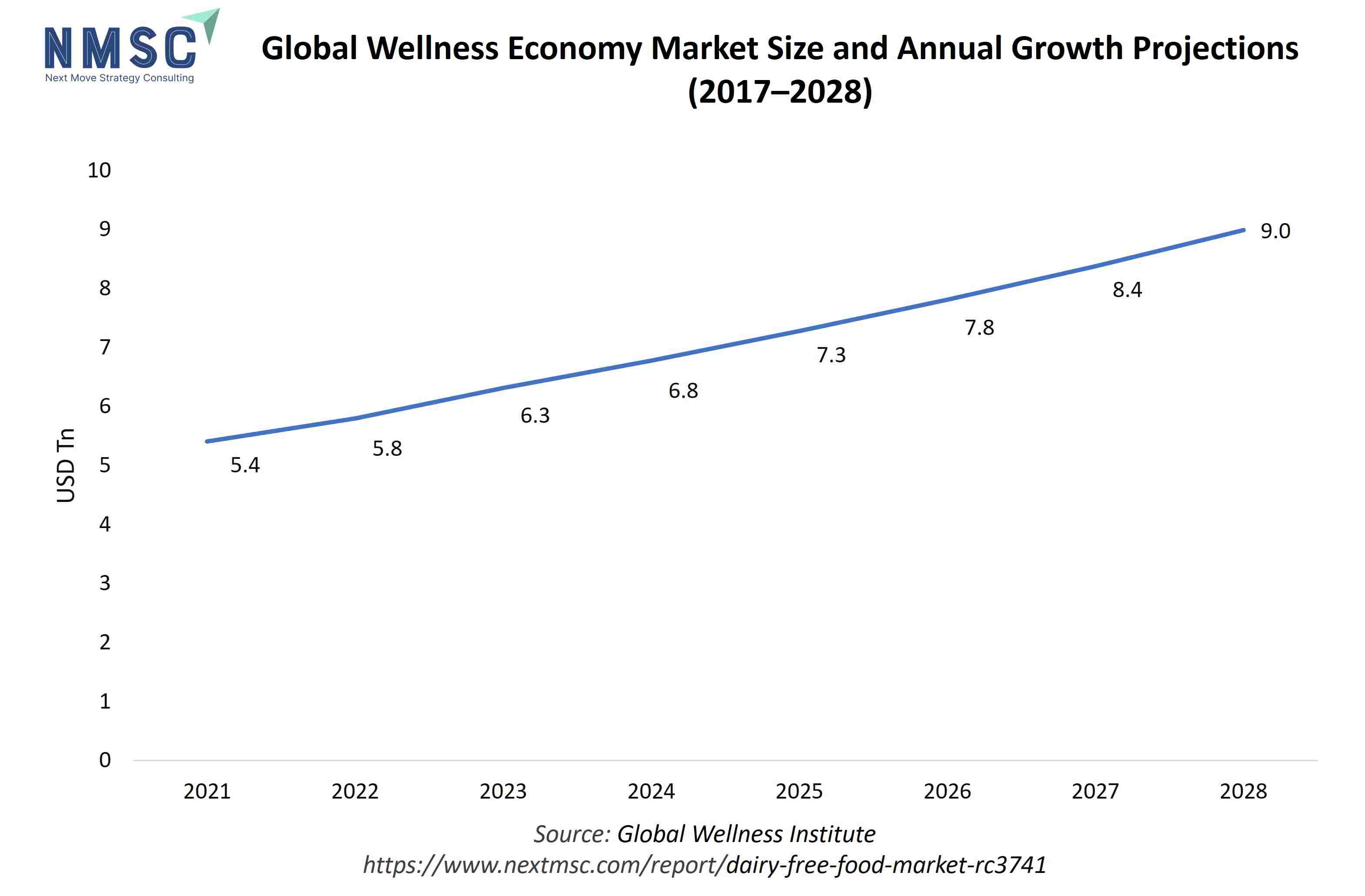
The chart above shows a steady rise in the global wellness economy from 2021 through projected values for 2028, indicating consistent and robust market expansion. This upward trend reflects growing global interest in health, nutrition, fitness, preventive care and mindful consumption. For the dairy free food market, this momentum creates a favourable demand environment, as consumers increasingly align their eating habits with wellness-centric values such as digestive health, natural ingredients and plant-based nutrition. As the wellness economy grows, more shoppers look for food options that support long-term health goals, encouraging faster adoption of dairy-free products and supporting market innovation, premiumisation and broader mainstream acceptance.
What are the Key Trends in the Dairy Free Food Industry?
How is the Dairy Free Food Market Aligning with Global Sustainability and Agricultural Transformation?
The global dairy free food market is increasingly interlinked with broader agricultural and environmental policy shifts. According to recent OECD-FAO agricultural outlooks, world milk output continued to expand modestly in 2024, reflecting the enduring dominance of traditional dairy systems even as consumer interest in lower-emission alternatives rises. At the same time, EU agricultural strategies highlight how changing consumption patterns and climate goals are influencing land use, feed sourcing, and trade priorities. This evolving context presents both challenges and growth prospects for the dairy-free sector. Established dairy industries are tightening control over raw-material standards, while governments and corporate buyers are pivoting toward verified, low-carbon food supply chains. For companies in the dairy-free space, the strategic focus shifts toward measurable sustainability. Mapping life-cycle footprints, integrating regenerative crop inputs such as regionally grown oats or pulses, and securing long-term sourcing contracts reduces exposure to supply volatility. Businesses that invest in digital traceability systems and transparent environmental reporting not only meet emerging policy requirements but also gain preferential access to sustainability-driven retail programs and institutional procurement, reinforcing their competitive edge as sustainable nutrition becomes a mainstream expectation.
How is the Dairy Free Food Market Driving Innovation and Category Evolution?
The dairy free food market is rapidly advancing beyond simple milk substitutes into a dynamic phase of product diversification and technological sophistication. Global food-system assessments and EU agricultural outlooks highlight strong growth in categories such as plant-based cheese, cultured dairy alternatives, and frozen desserts, underpinned by continuous research in protein functionality and fermentation-derived dairy proteins. This wave of innovation signals that the market is evolving from a replacement model to a mature ecosystem where taste, texture, and nutrition compete directly with conventional dairy. For companies, the opportunity lies in leveraging advanced ingredient science and bioprocessing partnerships to create plant-based products that replicate authentic dairy properties, like meltability, creaminess, and balanced nutrition, without depending on allergenic or unsustainable inputs. Building agile innovation frameworks with quick prototype-to-market pipelines, consumer sensory testing, and collaborations with foodservice or FMCG players dramatically accelerate product adoption. Brands that combine technological precision with scalable, verified supply chains are set to lead the next phase of category expansion, turning plant-based dairy from an alternative niche into a mainstream, repeat-purchase segment within the global food market.
How is the Dairy Free Food Market Redefining Consumer Perception And Lifestyle Integration?
The modern dairy free food market is no longer driven solely by dietary restrictions or ethical choices, but it’s becoming a lifestyle statement anchored in wellness, sustainability, and inclusivity. Consumers today perceive dairy-free products as part of a broader shift toward conscious eating, where taste, health benefits, and environmental values align seamlessly. This transformation is reshaping brand strategies. The most successful companies are positioning their offerings not as alternatives but as innovative, desirable products in their own right. Marketing narratives increasingly highlight clean ingredients, digestive comfort, and culinary versatility, appealing to flexitarians and health-conscious buyers rather than targeting only vegan audiences. For businesses, this change in perception opens a pathway to premiumization and brand differentiation. Investing in storytelling that connects flavour innovation with emotional and ethical appeal through digital engagement, transparent sourcing stories, and lifestyle partnerships strengthens loyalty and justifies higher price points. As dairy-free options integrate into daily consumption patterns, brands that resonate authentically with consumers’ evolving values define the next frontier of growth in the global dairy-free movement.
What are the Key Market Drivers, Breakthroughs, and Investment Opportunities that will Shape the Dairy Free Food Industry in the Next Decade?
The dairy free food market is experiencing robust growth, driven by rising consumer awareness of health, sustainability, and dietary diversity. As individuals increasingly seek alternatives to traditional dairy for reasons ranging from lactose intolerance to ethical and environmental concerns, plant-based formulations have become central to modern consumption patterns. The market now spans multiple sectors, including food and beverages, nutrition, and personal care, reflecting its expanding relevance and appeal. Consumers are demanding clean-label, minimally processed products that combine taste, nutrition, and sustainability, prompting companies to innovate with improved textures, fortified formulations, and transparent sourcing practices that build trust and loyalty.
Nonetheless, the industry faces challenges such as regulatory compliance, nutritional equivalence, and the need to secure sustainable ingredient supply chains. Despite these hurdles, dairy-free producers that embrace fortification, eco-friendly manufacturing, and credible labelling are well-positioned to thrive. By aligning product development with evolving consumer values and global sustainability standards, companies turn these challenges into strategic advantages, reinforcing the dairy-free category’s transition from niche alternative to mainstream dietary choice.
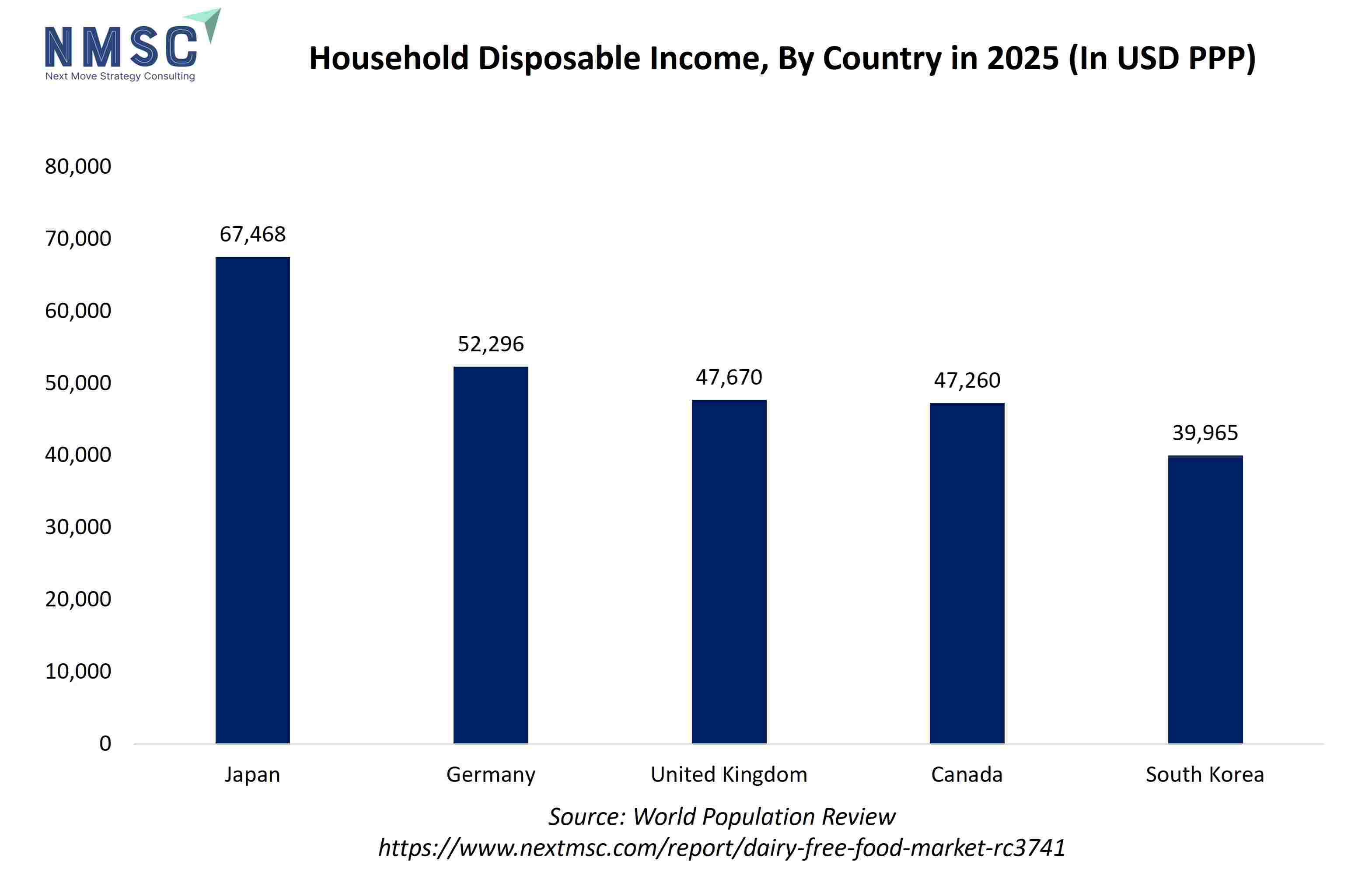
Additionally, rising household disposable income directly supports the dairy free food market demand by enabling consumers to spend more on premium, health-oriented and specialty products. As families gain greater financial flexibility, they become more willing to try higher-priced alternatives such as plant-based milk, cheeses, yogurts and desserts, which are often costlier than conventional dairy options. Increased income also encourages experimentation with new dietary preferences linked to wellness, sustainability and ethical consumption, expanding the customer base beyond lactose-intolerant or vegan consumers. Moreover, higher purchasing power boosts demand for convenient, ready-to-eat dairy-free products that align with modern lifestyles. Altogether, these factors create a positive cycle where an expanding middle class with rising disposable income accelerates adoption, supports product premiumisation and strengthens long-term market growth.
Growth Drivers
How is Policy Integration Expanding Opportunities in the Dairy Free Food Market?
Recent regulatory updates are opening new institutional pathways for dairy-free products. In April 2024, the U.S. Department of Agriculture revised its Special Supplemental Nutrition Program for Women, Infants, and Children to allow fortified plant-based milk, yogurt, and cheese alternatives that meet specific nutrient standards to replace traditional dairy items. This development, also supported by the National CACFP Sponsors Association, marks a pivotal step toward mainstream acceptance of dairy-free nutrition in federally funded programs serving nearly seven million beneficiaries. For the market, this represents more than regulatory recognition, it signals growing institutional confidence in the nutritional adequacy and reliability of plant-based formulations. Companies that align their products with these updated standards and proactively engage with state-level WIC programs gain entry into a stable, government-supported distribution channel. This move strengthens market legitimacy, enhances public-sector visibility, and positions compliant brands for broader retail and foodservice expansion.
How is Household Purchase Penetration of Plant-based Milk Driving Scale in the Dairy Free Food Market?
Rising household adoption of plant-based milk across Europe is signalling a major structural shift within the dairy free food market. According to data from GFI Europe, nearly half of European households now purchase dairy-free milk products, including 46% in Spain and 37% in Germany. This widespread inclusion of plant-based options in everyday grocery baskets shows that the category has evolved from a niche preference into a staple of modern diets. The trend reflects increasing consumer trust in product quality, nutritional adequacy, and affordability, which collectively enhance market resilience. For companies operating in this space, the focus must now shift from driving initial awareness to fostering long-term loyalty and habitual purchasing. Strengthening in-store presence, ensuring consistent availability, and engaging in value-driven promotions will help brands solidify repeat sales and establish the dairy-free segment as a permanent fixture alongside conventional dairy in mainstream retail environments.
Growth Inhibitors
How does Nutritional-equivalence Uncertainty Slow the Dairy Free Food Market Expansion?
Nutritional equivalence remains a significant hurdle for the market, as highlighted by a report from the UK government’s Scientific Advisory Committee on nutrition and the committee on toxicity of chemicals in food, consumer products and the environment. The review found that almond, oat, and soy drinks currently available in the market do not match cow’s milk in key nutrients such as vitamin A, iodine, riboflavin, and protein, posing potential risks of deficiency, particularly for children aged one and above.
This has intensified regulatory scrutiny and raised consumer concerns about the adequacy of dairy-free alternatives, potentially slowing adoption in sensitive categories like early childhood nutrition and public procurement. To overcome this barrier, companies advance fortification practices, implement transparent nutrition labelling, and seek third-party validation to ensure nutritional credibility and maintain consumer trust in a tightening regulatory environment.
How is Sustainability Positioning Creating a Competitive Edge for the Dairy Free Food Market?
Sustainability has become a defining opportunity for the dairy free food market, as environmental policies and agricultural data continue to highlight the lower ecological footprint of plant-based alternatives compared to traditional dairy. Research published in MDPI indicates that a standard 250 mL serving of plant-based beverages produces 59% to 71% fewer greenhouse gas emissions than conventional milk, reinforcing their value in climate-conscious consumption patterns. In parallel, the European Commission’s Agricultural Outlook notes that EU agricultural systems are evolving toward more sustainable and low-emission supply chains, further supporting market expansion for dairy-free producers. This alignment of environmental benefits with policy direction gives dairy-free companies a strong edge in positioning their products as both nutritious and climate-responsible. To capitalize, brands should integrate life-cycle impact assessments, prioritize regenerative and traceable ingredient sourcing, and communicate verified sustainability credentials. Such measures will strengthen market credibility and appeal to ESG-driven consumers and procurement programs seeking low-carbon food solutions.
How Dairy Free Food Market Segmented in this Report, and What are the Key Insights from the Segmentation Analysis?
By Product Type Insights
Is the Dairy Free Food Industry in 2025 Shaped By Diverse Product Type?
Based on product type, the dairy free food market share is segmented into dairy free milk & beverages, dairy free cheese and others.
Dairy-free milk & beverages include all plant-based milk alternatives that are made without animal-derived dairy. Products in this category are designed to replicate the taste, texture, and nutritional benefits of traditional milk while catering to consumers who are lactose-intolerant, vegan, or seeking healthier or sustainable options. Common types include almond milk, soy milk, oat milk, coconut milk, and rice milk. These beverages are widely used for drinking directly, in cooking, baking, or as ingredients in other food and beverage products. dairy-free milk & beverages focus on providing a versatile, accessible, and dairy-free alternative to conventional milk.
By Source Insights
Is the Dairy Free Food Market in 2025 Being Shaped By Source?
On the basis of source, the market is segmented into soy-based products, nut-based products and others.
Soy-based products include all dairy-free food and beverage items made primarily from soybeans. These products are designed to provide a plant-based alternative to traditional dairy while delivering similar protein content and nutritional benefits. Common examples include soy milk, soy yoghurt, and soy-based cheese alternatives. soy-based products are widely used by consumers who are lactose-intolerant, vegan, or seeking healthier or sustainable options, and they serve as a versatile ingredient in both home cooking and commercial food preparation.
By Distribution Channel Insights
Are Distribution Channels Shaping the Dairy Free Food Market in 2025?
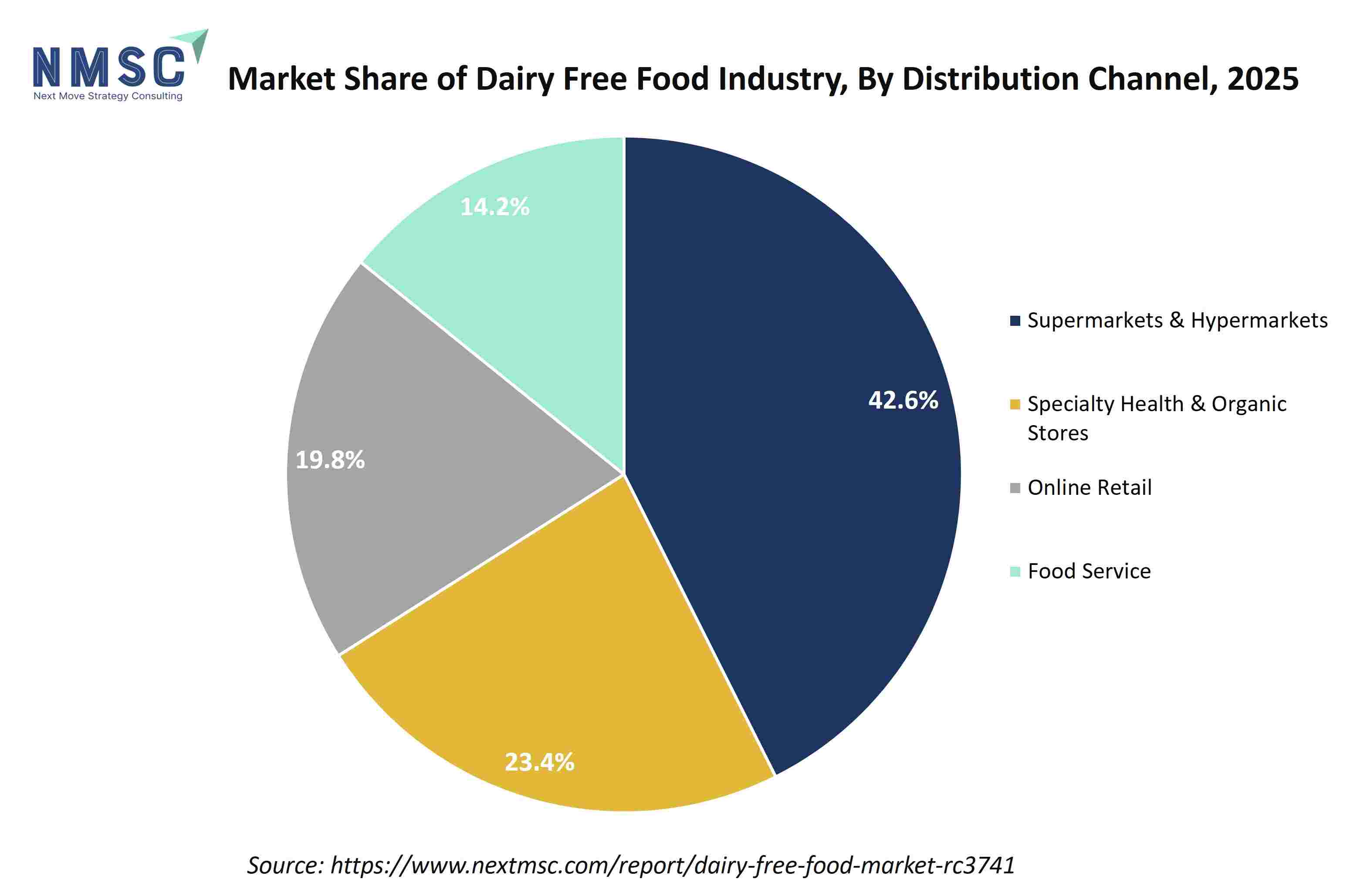
On the basis of distribution channel, the market is segmented into supermarkets & hypermarkets, specialty health & organic stores and others.
Supermarkets & hypermarkets include large retail stores that sell a wide range of dairy-free food products directly to consumers. These outlets provide easy access to everyday dairy-free essentials such as plant-based milk, cheese alternatives, yogurts, and desserts. Supermarkets & hypermarkets cater to a broad consumer base by offering convenience, variety, and competitive pricing, making them a primary channel for purchasing dairy-free products for home consumption.
By End User Insights
Which End User is Driving the Dairy Free Food Market in 2025?
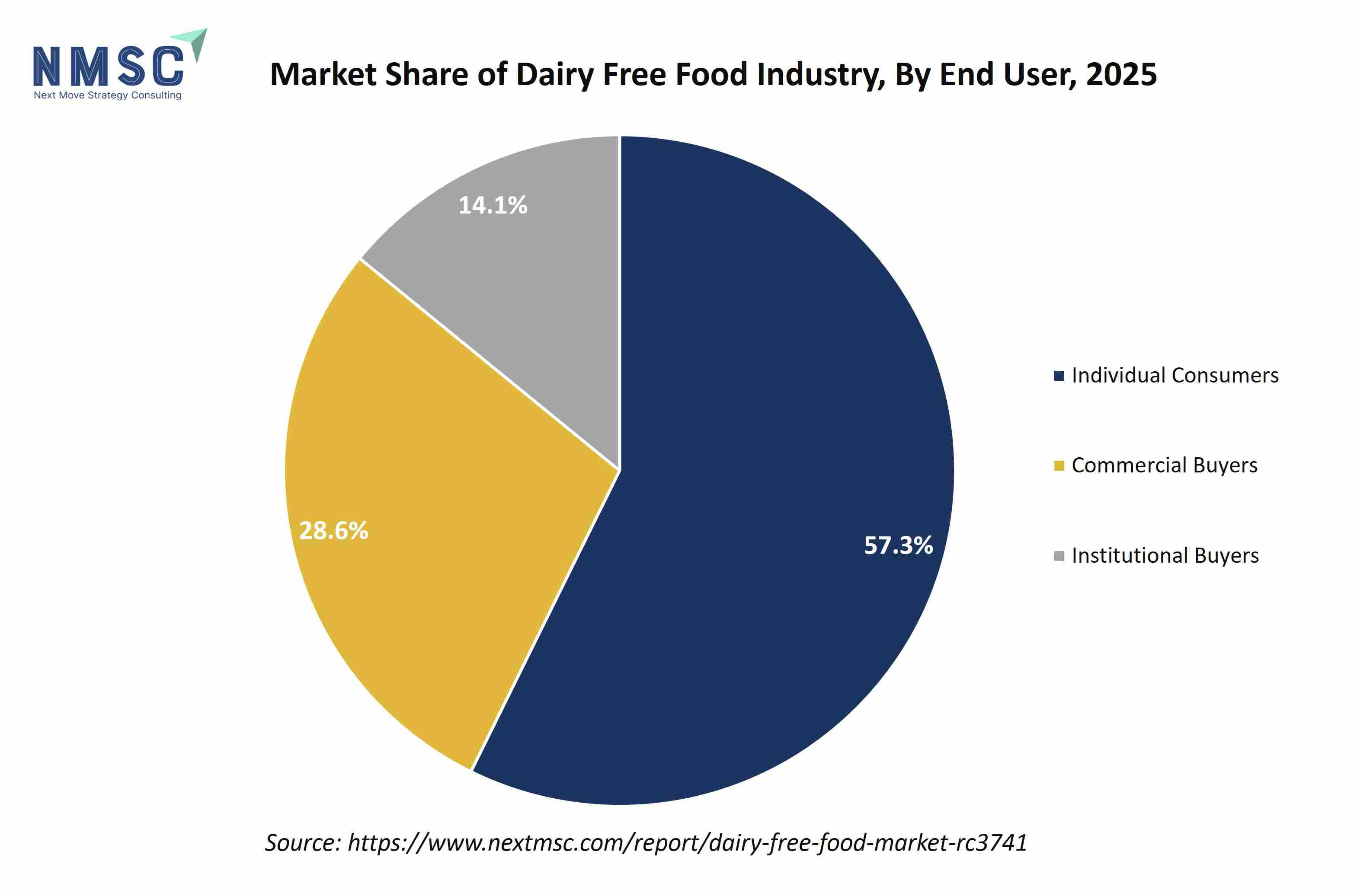
On the basis of end user, the market is segmented into individual consumers, commercial buyers and institutional buyers.
Individual consumers include people who purchase dairy-free products for personal or household use. This group consists of vegans, lactose-intolerant individuals, health-conscious buyers, and those seeking sustainable or plant-based alternatives. Individual consumers primarily buy products such as dairy-free milk, cheese, yoghurt, and desserts for direct consumption at home or for use in cooking and baking.
Regional Outlook
The dairy free food market is geographically studied across North America, Europe, Asia Pacific, Middle East & Africa, and Latin America and each region is further studied across countries.
Dairy Free Food Market in North America
The North American dairy free food market is being driven by a blend of shifting consumer habits, strong retail networks, and expanding foodservice demand. Growing interest in health-conscious and plant-based choices has encouraged greater adoption of dairy-free products, especially as retail and cafe channels increasingly embrace high-quality alternatives. At the same time, efficient logistics and well-developed distribution systems are helping manufacturers bring these products to market more quickly and broadly. Supportive government nutrition and procurement initiatives are also shaping product innovation and fortification trends. Overall, the region’s dairy-free food landscape is characterized by scaling efficiencies, strategic private-label collaborations, and enhanced supply-chain transparency, all of which are accelerating the market’s maturity and mainstream appeal.
Dairy Free Food Market in the United States
A major driver of the U.S. dairy free food market is the growing consumer loyalty and repeat purchasing behaviour toward plant-based alternatives. According to the Good Food Institute, the plant-based milk category in the U.S. recorded repeat-purchase rates of around 76% in 2024, reflecting strong and sustained consumer engagement with dairy-free options. This high level of repeat consumption signals that plant-based products are no longer limited to niche or trial markets but have become staples in many American households. Such consistent demand encourages manufacturers to expand dairy-free portfolios across adjacent categories like yogurt, cheese, and ice cream, further accelerating market growth. The trend underscores how familiarity, satisfaction with taste and functionality, and growing trust in plant-based products are reinforcing the overall momentum of the U.S. dairy-free food industry.
Dairy Free Food Market in Canada
Canada’s dairy free food market is evolving within a well-established dairy industry, reflecting a gradual shift in consumer preferences toward plant-based and clean-label options. As health-conscious eating and sustainability considerations gain ground, retailers are expanding their plant-based offerings across both chilled and shelf-stable categories. Institutional demand, influenced by provincial nutrition guidelines and procurement practices, is also encouraging manufacturers to develop fortified products that meet local standards. With strong retail infrastructure and an active private-label environment, domestic producers and supermarket brands are well positioned to scale dairy-free product lines that offer affordability and familiarity, key factors driving the market’s continued growth and mainstream acceptance.
Dairy Free Food Market in Europe
The European dairy free food market is moving firmly into the mainstream, supported by growing consumer focus on sustainability, digestive health, and product transparency. While the level of adoption varies across regions, more mature markets in northern and western Europe are leading the shift through strong retailer support and an expanding range of private-label plant-based options. In contrast, parts of Eastern Europe are still in earlier stages of development but are showing increasing interest in plant-based alternatives. Broader EU sustainability goals and agricultural initiatives are also encouraging environmentally responsible production, which favours brands able to demonstrate credible sourcing and low-impact supply chains. Companies that align their formulations, nutritional fortification, and transparency practices with evolving European standards are positioned to strengthen their presence and competitiveness in the region’s growing dairy-free market.
Dairy Free Food Market in the United Kingdom
A major driver of the UK dairy free food market is the country’s accelerating sustainability and climate-conscious consumer culture. Growing awareness of the environmental footprint of animal-based production has led many consumers to explore plant-based alternatives as part of a more sustainable lifestyle. Government commitments to carbon reduction and food system reform, alongside retailer sustainability pledges are reinforcing this shift by encouraging the development and promotion of low-emission, plant-based products. This alignment between public policy, corporate responsibility, and consumer values is propelling innovation and helping dairy-free foods gain deeper traction across mainstream retail and foodservice channels.
Dairy Free Food Market in Germany
A key driver of the market in Germany is the significant decline in conventional dairy consumption, signalling a clear shift in consumer behaviour. According to data from the Federal the growing openness to plant-based nutrition, combined with the availability of high-quality dairy-free products in retail and foodservice channels, is accelerating the transition away from traditional dairy. As a result, manufacturers of dairy-free foods are finding greater opportunities to capture market share and expand product innovation within Germany’s evolving food landscape.
Dairy Free Food Market in France
France’s Dairy free food market is evolving within a culture deeply rooted in traditional cuisine, where consumers are increasingly open to plant-based innovations that complement familiar eating habits. The market is seeing growth in dairy alternatives and desserts that emphasize premium quality, regional identity, and natural ingredients. Retailers and foodservice operators are playing a vital role in introducing and normalizing these products, supported by growing alignment with national nutrition priorities and consumer expectations of trust and quality. Success in the French market depends heavily on replicating the taste, texture, and culinary versatility of conventional dairy, making research and development in sensory experience and performance a key competitive factor driving market expansion.
Dairy Free Food Market in Italy
A major driver of the Dairy free food market in Italy is the growing influence of Mediterranean wellness and lifestyle trends, which emphasize balance, natural ingredients, and nutritional quality. Italian consumers are increasingly associating plant-based and dairy-free foods with lighter, more digestible, and sustainable eating habits that align with these values. This shift is encouraging both traditional food producers and new entrants to reformulate products using locally sourced, plant-based ingredients while maintaining the taste and authenticity central to Italian cuisine. As a result, dairy-free alternatives are gaining traction not as substitutes, but as modern complements to Italy’s culinary heritage, driving broader acceptance and innovation across the market.
Dairy Free Food Market in Spain
Spain’s dairy free food market is expanding as consumers increasingly integrate plant-based alternatives into their daily diets, particularly in urban areas where accessibility and variety are greater. The country’s Mediterranean food culture, with its emphasis on pulses and cereals, naturally supports the development of locally sourced plant-based ingredients for dairy-free products. Strong retail participation and growing visibility in cafes and restaurants are helping normalize consumption and encourage repeat purchases. Spanish consumers prioritize affordability and familiar flavours, so brands that deliver value while aligning with local tastes and culinary habits are well-positioned to thrive. This balance of cultural alignment, accessibility, and innovation is driving steady growth across Spain’s dairy-free market.
Dairy Free Food Market in the Nordics
The market in the Nordic region is shaped by a strong culture of environmental responsibility and early adoption of plant-based eating. Consumers in these markets tend to prioritize sustainability, transparency, and product quality over price, creating favourable conditions for brands that emphasize ethical sourcing and clear climate credentials. The region also serves as a testing ground for innovation, with dairy-free products introduced first through foodservice channels and institutional programs before reaching mainstream retail. Supportive policy frameworks and sustainability-driven consumer behaviour continue to strengthen the position of plant-based and dairy-free foods, making the Nordics a key hub for market development and product experimentation in this sector.
Dairy Free Food Market in the Asia-Pacific
The market in the Asia-Pacific region is evolving rapidly, shaped by diverse economic and cultural dynamics. As urbanization and rising incomes influence dietary habits, many consumers are exploring plant-based options that align with modern health and convenience trends. Urban markets, supported by global retail chains and expanding foodservice offerings, are leading this shift, making dairy-free products more accessible and appealing to a broader audience. Locally sourced ingredients such as soy, coconut, rice, and oat are being used to create regionally relevant products that suit local tastes and lifestyles. At the same time, innovation in shelf-stable and flavoured formats is helping brands reach new consumer segments. Together, these factors are driving strong momentum for dairy-free foods across the Asia-Pacific region, even as traditional dairy consumption remains significant in some areas.
Dairy Free Food Market in China
A major driver of the market in China is the growing alignment between traditional dietary habits and modern plant-based innovation. Chinese cuisine has long incorporated soy, nuts, and grains, ingredients that naturally lend themselves to dairy-free alternatives, making the shift toward plant-based products culturally compatible. As younger consumers adopt more globalised and health-conscious lifestyles, there is a growing appreciation for dairy-free foods that combine local familiarity with modern convenience. This convergence of tradition and innovation is encouraging domestic brands to experiment with new flavours, textures, and formats tailored to Chinese tastes, driving broader acceptance and sustained growth in the country’s dairy-free market.
Dairy Free Food Market in Japan
Japan’s dairy free food market is evolving in line with the country’s focus on quality, texture, and reliability in food products. Growing acceptance of plant-based alternatives is most visible in urban areas, where convenience stores and foodservice outlets are expanding their offerings of single-serve and shelf-stable dairy-free options. Changing demographics, such as an ageing population and smaller households, are also encouraging demand for functional and fortified products that align with health and wellness priorities. At the same time, Japan’s rigorous food-safety regulations and high retail standards require producers to maintain exceptional consistency and compliance, shaping how brands approach product development and positioning. These factors together are driving steady growth and innovation in Japan’s dairy-free market, particularly in premium and convenience-focused segments.
Dairy Free Food Market in India
One of the key factors driving the growth of India’s market is the high incidence of lactose intolerance among consumers. As noted by the India Brand Equity Foundation, nearly 60% of the Indian population experiences some level of lactose intolerance, making traditional dairy products difficult to digest for a large portion of the market. This has naturally steered consumers toward plant-based and dairy-free alternatives that provide comparable taste and nutrition without causing discomfort. The trend is further reinforced by rising health consciousness, increased awareness of clean-label foods, and growing urban demand for functional and easily digestible products. Together, these factors are shaping a strong foundation for the expansion of India’s dairy-free food sector, encouraging innovation and product diversification across both domestic and international brands.
Dairy Free Food Market in South Korea
South Korea’s market is growing rapidly, supported by a modern food culture that values innovation, convenience, and premium experiences. Urban consumers, particularly younger demographics and professionals, are increasingly drawn to plant-based dairy alternatives that fit their busy lifestyles, such as ready-to-drink beverages and desserts. Retailers and cafes are playing a key role in familiarising consumers with these products by incorporating dairy-free milks and creams into popular menu items. Brands that tailor flavours to local tastes and collaborate with established retail and foodservice partners are finding strong opportunities to expand their reach. This blend of consumer curiosity, convenience-driven demand, and strategic partnerships is fueling the steady rise of the dairy-free market in South Korea.
Dairy Free Food Market in Taiwan
A major driver of the market in Taiwan is the country’s strong innovation ecosystem and growing focus on sustainable food production. Taiwanese consumers are increasingly interested in environmentally responsible products, and this aligns with the government’s broader push toward sustainability and reduced carbon emissions in the food industry. Local food manufacturers are leveraging Taiwan’s advanced technology and R&D capabilities to develop high-quality plant-based and dairy-free products that appeal to both health-conscious and eco-aware consumers. This fusion of innovation, sustainability, and consumer awareness is helping the dairy-free segment gain traction and establish itself as a key part of Taiwan’s evolving food landscape.
Dairy Free Food Market in Indonesia
The market in Indonesia is being shaped by shifting consumer lifestyles and growing environmental awareness. As urban populations embrace modern eating habits, there is a rising interest in plant-based foods that align with health, sustainability, and ethical values. Domestic producers are responding by developing dairy-free options that fit local tastes and culinary traditions, highlighting natural ingredients and environmentally conscious sourcing. At the same time, Indonesia’s strong digital and e-commerce presence is helping brands reach younger, health-focused consumers more effectively. This combination of lifestyle change, sustainability focus, and digital engagement is creating fertile ground for continued growth in the country’s dairy-free market.
Dairy Free Food Market in Australia
Australia’s dairy free food market is benefiting from a combination of consumer interest in health and wellness and a culture of culinary experimentation. Shoppers and foodservice operators are increasingly exploring plant-based alternatives that offer both nutritional benefits and versatile applications in cooking and beverages. Local producers are able to innovate with familiar ingredients like oats and legumes, creating products that resonate with domestic tastes while maintaining high-quality standards. By focusing on product innovation, flavour development, and strong distribution networks, brands tap into both the growing domestic demand and emerging export opportunities in the wider Asia-Pacific region, driving growth in the dairy-free sector.
Dairy Free Food Market in Latin America
The market in Latin America is evolving unevenly, with urban consumers in countries like Brazil, Argentina, and Chile driving growth through greater openness to plant-based beverages and dairy alternatives. Retail expansion and rising awareness of health and sustainability trends are encouraging adoption in cities, while rural areas continue to rely heavily on traditional dairy. Local ingredient availability, such as soy and oats, along with regional trade conditions, influence both product offerings and pricing strategies. Brands that tailor their products to local tastes, align with regional cost structures, and leverage native crops are better positioned to capture market share and expand the dairy-free segment across Latin America.
Dairy Free Food Market in the Middle East & Africa
The dairy free food market in the Middle East and Africa is shaped by diverse consumer needs and market conditions. In Gulf countries and major urban centres, demand is growing for premium plant-based dairy alternatives, driven by health-conscious consumers, expatriate communities, and modern retail environments. In contrast, many African markets remain more price-sensitive and reliant on traditional dairy. Challenges such as supply limitations, import costs, and distribution infrastructure influence product formats, making shelf-stable options particularly practical. Brands that offer affordable, convenient products, build local partnerships, and address nutritional and cultural considerations, such as halal certification, are well-positioned to capture opportunities and expand the dairy-free segment across the region.
Competitive Landscape
Which Companies Dominate the Dairy Free Food Industry and How do they Compete?
Leading companies in the market, such as Oatly Group AB, Vitasoy International Holdings Limited, Hain Celestial, SunOpta, and Blue Diamond Growers, have solidified their positions through strategic product innovation and global distribution. Oatly, for instance, leverages its expertise in oat-based formulations to deliver dairy-free beverages and products with strong brand recognition, while Vitasoy focuses on plant-based milk and nutrition products tailored to diverse markets. Hain Celestial emphasizes clean-label and organic offerings, and SunOpta and Blue Diamond Growers capitalize on their robust supply chains and ingredient sourcing capabilities to meet the rising demand for plant-based alternatives. These companies compete by expanding product portfolios, enhancing taste and texture profiles, and strengthening their presence across retail and foodservice channels.
Other notable players, including Califia Farms, Perfect Day, Miyoko’s Creamery, Valio Oy, Ripple Foods, Earth’s Own, Daiya Foods, Nestlé, General Mills, and Danone, are actively shaping the market through innovation, sustainability, and strategic partnerships. Califia Farms and Miyoko’s Creamery focus on artisanal and functional dairy-free alternatives, while Perfect Day pioneers’ fermentation-based proteins that replicate dairy functionality. Large multinational food companies such as Nestle, Danone, and General Mills leverage global scale, R&D capabilities, and marketing strength to accelerate category growth. By integrating sustainability initiatives, ethical sourcing, and consumer-focused innovation, these companies are driving differentiation and capturing expanding market share in the rapidly growing dairy-free sector.
Market Dominated by Dairy Free Food Giants and Specialists
The dairy free food market features a dynamic mix of global leaders and specialized players, each establishing strong positions across different regions and product categories. Companies like Nestle, Danone, and General Mills leverage their global scale, extensive R&D capabilities, and diversified portfolios to drive innovation and expand market reach. In contrast, focused players such as Oatly Group AB, Vitasoy International Holdings, Hain Celestial, Califia Farms, Perfect Day, Miyoko’s Creamery, Ripple Foods, Earth’s Own, Daiya Foods, SunOpta, Blue Diamond Growers, and Valio Oy concentrate on specific plant-based formulations, functional ingredients, and niche segments, offering tailored products that meet evolving consumer preferences. This structure promotes healthy competition, with multinational corporations utilizing scale and marketing strength, while specialists and regional players innovate with texture, flavor, fortification, and sustainability initiatives, ultimately enhancing product diversity and driving growth in the rapidly expanding dairy-free sector.
Innovation and Adaptability Drive Market Success
Innovation is a key driver of success in the vegan dairy substitutes industry, with companies continually developing new products and applications to meet evolving consumer demands. Oatly Group AB’s launch of two new oat milk varieties in North America, Unsweetened and Super Basic, in January 2024 exemplifies how innovation and adaptability are key drivers of success in the market. By expanding beyond their core portfolio, Oatly not only responds to evolving consumer preferences for simpler, cleaner, and unsweetened options but also demonstrates agility in addressing emerging trends. This strategic product innovation allows the company to capture a broader segment of health-conscious and plant-based consumers while maintaining brand relevance in a competitive market. It highlights that continuous adaptation, whether through flavor variety, formulation improvements, or responding to consumer lifestyle shifts, is critical for companies seeking to scale and sustain growth in the rapidly expanding dairy-free sector.
Market Players to Opt for Partnership & Collaboration Strategies to Expand their Presence
Partnership and collaboration strategies have become pivotal for companies aiming to strengthen their position in the market. In January 2025, Oatly’s partnership with Nespresso to launch a limited edition line of oat milk coffee capsules for Nespresso Vertuo machines highlights how market players are leveraging collaboration strategies to expand their presence. By joining forces with an established coffee brand, Oatly taps into Nespresso’s loyal customer base and premium retail channels, creating a unique value proposition that combines convenience, taste, and plant-based innovation. Such partnerships enable companies to accelerate market penetration, enhance brand visibility, and introduce dairy-free products to new consumer segments without shouldering the full operational or marketing burden alone. This approach underscores a broader trend in the dairy-free sector, where strategic alliances and co-branded offerings are increasingly used to drive growth and strengthen competitive positioning.
List of Key Dairy Free Food Companies
- Oatly Group AB
-
Vitasoy International Holdings Limited.
-
hain celestial
-
Sunopta
-
Blue Diamond Growers.
-
Califia Farms, LLC
-
Perfect Day, Inc.
-
Miyoko's Creamery
-
Valio Oy
-
Earth’s Own
-
Daiya Foods.
-
General Mills Inc
-
Danone
What are the Latest Key Industry Developments?
- June 2024- Miyoko’s Creamery introduced two new oat milk butter flavours, Garlic Parm and Cinnamon Brown Sugar, strengthening its foothold in the premium dairy-free spreads segment. This product launch highlights Miyoko’s focus on flavour innovation and functional performance, catering to consumers seeking high-quality, plant-based alternatives that replicate traditional dairy experiences.
- February 2024- Perfect Day, Inc. partnered with Breyers to launch a lactose-free chocolate ice cream tub made with its precision fermented dairy protein, marking a significant milestone for the company in the dairy-free market. This collaboration not only reinforces Perfect Day’s position as an innovator in functional, animal-free dairy proteins but also demonstrates the growing acceptance of alternative dairy ingredients by mainstream food brands.
What are the Key Factors influencing investment Analysis & Opportunities in the Dairy Free Food Market?
Investment in the dairy free food market is increasingly driven by the global shift toward plant-based, sustainable, and health-focused nutrition. Investors are prioritizing companies that offer innovative dairy-free formulations, fortified products, and plant-based solutions across food, beverages, and nutrition segments. Businesses that demonstrate strong quality control, traceable supply chains, and compliance with evolving regulatory standards are viewed as lower-risk and better positioned for long-term growth, attracting more capital and strategic interest. Market differentiation through product innovation, texture, flavour development, and nutritional fortification enhances valuations and makes companies more appealing to investors seeking scalable opportunities in a rapidly growing sector.
Regions with strong retail infrastructure, urbanized populations, and supportive regulatory environments, such as North America, Europe, and parts of Asia-Pacific, are emerging as key investment hotspots for dairy-free ventures. Companies that integrate sustainability practices, ethical sourcing, and transparent labelling are particularly well-placed to capture investor attention. Strategic partnerships, co-development with ingredient suppliers, and R&D collaborations further strengthen growth potential, allowing firms to scale efficiently while meeting rising consumer demand for plant-based alternatives. This combination of innovation, regulatory compliance, and sustainability creates a compelling investment landscape in the market.
Key Benefits for Stakeholders
Next Move Strategy Consulting (NMSC) presents a comprehensive analysis of the dairy free food market, covering historical market trends from 2020 through 2024 and offering detailed forecasts through 2030. Our study examines the market at regional and country levels, providing quantitative projections and insights into key growth drivers, challenges, and investment opportunities across all major dairy free food segments.
The dairy free food industry creates value across its ecosystem by connecting economic growth with evolving consumer preferences for health, sustainability, and plant-based nutrition. Investors benefit from high-growth potential, portfolio diversification, and opportunities to support companies offering innovative, fortified, and premium dairy-free products. Consumers gain access to nutritious, convenient, and ethically produced alternatives that align with clean-label and wellness trends, while retailers and foodservice operators meet increasing market demand for sustainable and versatile options. Suppliers and manufacturers also profit from steady demand for plant-based raw materials and the ability to develop differentiated products with functional and sensory appeal. Together, this ecosystem fosters mutual growth, where innovation, quality, and sustainability enhance value for financial stakeholders, businesses, and end consumers alike.
Report Scope
|
Parameters |
Details |
|
Market Size in 2025 |
USD 41.38 Billion |
|
Revenue Forecast in 2030 |
USD 67.55 Billion |
|
Growth Rate |
CAGR of 10.3% from 2025 to 2030 |
|
Analysis Period |
2024–2030 |
|
Base Year Considered |
2024 |
|
Forecast Period |
2025–2030 |
|
Market Size Estimation |
Billion (USD) |
|
Growth Factors |
|
|
Companies Profiled |
15 |
|
Countries Covered |
33 |
|
Market Share |
Available for 10 companies |
|
Customization Scope |
Free customization (equivalent to up to 80 analyst-working hours) after purchase. Addition or alteration to country, regional & segment scope. |
|
Pricing and Purchase Options |
Avail customized purchase options to meet your exact research needs. |
|
Approach |
In-depth primary and secondary research; proprietary databases; rigorous quality control and validation measures. |
|
Analytical Tools |
Porter's Five Forces, SWOT, value chain, and Harvey ball analysis to assess competitive intensity, stakeholder roles, and relative impact of key factors. |
Key Market Segments
By Product Type
-
Dairy-Free Milk & Beverages
-
Almond Milk
-
Soy Milk
-
Oat Milk
-
Coconut Milk
-
Rice Milk
-
-
Dairy Free Cheese
-
Slices
-
Blocks
-
Spreads
-
Others
-
-
Dairy-Free Yogurt & Desserts
-
Plant-Based Yogurt
-
Ice Creams
-
Puddings
-
-
Others
By Source
-
Soy-Based Products
-
Nut-Based Products
-
Oat-Based Products
-
Coconut-Based Products
-
Rice-Based Products
-
Others
By Distribution Channel
-
Supermarkets & Hypermarkets
-
Specialty Health & Organic Stores
-
Online Retail
-
Food Service
By End User
-
Individual Consumers
-
Commercial Buyers
-
Institutional Buyers
Geographical Breakdown
-
North America: U.S., Canada, and Mexico.
-
Europe: U.K., Germany, France, Italy, Spain, Sweden, Denmark, Finland, Netherlands, and rest of Europe.
-
Asia Pacific: China, India, Japan, South Korea, Taiwan, Indonesia, Vietnam, Australia, Philippines, Malaysia and rest of APAC.
-
Middle East & Africa (MEA): Saudi Arabia, UAE, Egypt, Israel, Turkey, Nigeria, South Africa, and rest of MEA.
-
Latin America: Brazil, Argentina, Chile, Colombia, and rest of LATAM
Conclusion & Recommendations
Our report provides stakeholders, industry participants, investors, and consultants with actionable insights to capitalize on the transformative potential of the market. By integrating data-driven analysis with strategic frameworks, NMSC’s Dairy Free Food Market Report serves as a vital resource for navigating the rapidly evolving landscape.
Growth is being fueled by rising consumer demand for plant-based, sustainable, and health-focused alternatives across food, beverage, and nutrition sectors. Strategic takeaways emphasize the importance of product innovation, nutritional fortification, regulatory compliance, and transparent supply chains, all of which enhance brand credibility and competitive positioning. Companies that develop innovative formulations, improve functional parity with dairy, and diversify applications are better placed to capture larger market share and strengthen long-term growth prospects, while sustainability and ethical sourcing initiatives further support differentiation in a competitive landscape.
For executives and investors, seizing opportunities in the dairy-free market requires identifying high-potential product segments, investing in R&D for novel formulations, and fostering strategic partnerships to expand distribution and consumer reach. Prioritizing regions with supportive regulatory frameworks, urbanized populations, and robust retail or foodservice infrastructure optimizes production, sourcing, and scaling strategies. Additionally, focusing on consumer education, transparent labeling, and premium positioning builds brand trust and encourages repeat adoption. These approaches collectively unlock substantial value creation potential, ensuring that companies thrive as the global dairy-free sector continues to expand.


About the Author
 Jayanta Das
— Jayanta Das is Senior Analyst at Next Move Strategy Consulting, where he has spent 4.5 years covering the firm's full industry taxonomy — spanning aerospace and defense, healthcare, BFSI, energy and power, semiconductors, and beyond — rather than one specialization. His work follows NextMSC's research model, combining data mining, analytics, and secondary research to build market sizing and forecasts behind NextMSC's 2,000-plus research reports, trusted by more than 3,000 organizations globally.
Jayanta Das
— Jayanta Das is Senior Analyst at Next Move Strategy Consulting, where he has spent 4.5 years covering the firm's full industry taxonomy — spanning aerospace and defense, healthcare, BFSI, energy and power, semiconductors, and beyond — rather than one specialization. His work follows NextMSC's research model, combining data mining, analytics, and secondary research to build market sizing and forecasts behind NextMSC's 2,000-plus research reports, trusted by more than 3,000 organizations globally.
About the Reviewer
 Supradip Baul
— Supradip Baul is an accomplished business consultant and strategist with over a decade of rich experience in market intelligence, strategy, technology, and business transformation. His work has included rigorous qualitative and quantitative analysis across multiple industries, helping clients shape investment decisions and long-term roadmaps. Earlier in his career, he was associated with Gartner, where he contributed to industry-leading reports and market share analyses. He has worked with leading global companies and holds an MBA with a dual specialization in Marketing and Finance.
Supradip Baul
— Supradip Baul is an accomplished business consultant and strategist with over a decade of rich experience in market intelligence, strategy, technology, and business transformation. His work has included rigorous qualitative and quantitative analysis across multiple industries, helping clients shape investment decisions and long-term roadmaps. Earlier in his career, he was associated with Gartner, where he contributed to industry-leading reports and market share analyses. He has worked with leading global companies and holds an MBA with a dual specialization in Marketing and Finance.
At Next Move Strategy Consulting, we understand that insightful market research is the cornerstone of successful business decisions. That's why we employ a robust and multifaceted approach, combining various methodologies to deliver the most accurate and actionable data for our clients.

Research Landscape
We navigate the world of research with two primary approaches:
Qualitative Approach
Our qualitative research methodologies involve immersive techniques such as in-depth interviews, focus groups, and observational studies. By engaging directly with individuals and stakeholders, we uncover valuable insights that quantitative data alone may overlook.

Quantitative Research
In tandem with qualitative methodologies, NMSC leverages the power of Quantitative Research to provide a robust foundation of numerical insights. Through systematic data collection and analysis, we quantify patterns, preferences, and market trends, offering a comprehensive view of the business landscape.
Our quantitative research approach employs diverse tools, including surveys, experiments, and statistical modelling. These methodologies enable us to gather data from a large and representative sample, ensuring the statistical significance of our findings. By employing structured questionnaires and standardized data collection methods, we guarantee the reliability and validity of the information we present to our clients.
Quantitative research is particularly effective in measuring the prevalence of trends, assessing market size, and gauging the impact of various factors on consumer behavior. The numerical precision attained through this approach equips our clients with actionable insights, facilitating data-driven decision-making and strategy formulation.


Our Specialized Toolbox for Industry-Specific Market Research
We deploy a specialized arsenal of techniques tailored to meet your unique requirements. Here's a glimpse into our comprehensive toolbox:

Information Procurement
The stage entails acquiring market data or relevant information through various sources and methodologies.


Market Research Approach
We utilize both top-down and bottom-up approaches in market research analysis to achieve a comprehensive understanding of the market dynamics, leveraging the broad perspective of industry trends and macroeconomic factors alongside detailed insights from specific segments and individual companies.

Porters Five Forces Analysis
We conduct Porter's Five Forces analysis to evaluate the competitive landscape of an industry, providing us with insights into factors that affect profitability and strategic positioning.

SWOT Analysis

Forecasting
We utilize a forecasting model to predict future consumption by considering parameters like population, economics, regulations, market competition, drivers, constraints, technology, and pricing. We also employ statistical techniques such as multilinear regression, exponential smoothing, moving average, ARIMA, and Monte Carlo simulations for accurate predictions. In econometric forecasting, we analyzed short-term and long-term event impacts, attributing values based on regulatory frameworks, economic factors, and market events.





 Speak to Our Analyst