Processed Food Market Size, Share, Trends and Growth Analysis, By Product Category (Bakery and Cereal Products, Snacks and Confectionery, Dairy and Dairy Alternatives, Meat, Poultry and Seafood, Prepared Meals and Meal Kits, Sauces, Condiments and Spreads, Pasta, Noodles and Rice, Oils and Fats, Sweeteners and Starches, Cocoa and Chocolate Ingredients, Baby Food and Infant Nutrition), By Temperature State, By Brand Model, By Distribution Channel,— Global Industry Report and Forecast, 2026–2035
Industry: Retail and Consumer | Publishing Date: July 10, 2026 | Last Updated: September 30, 2026 | No of Pages: N/A | No. of Tables: N/A | No. of Figures: N/A | Format: PDF | Report Code: RC5088
What Is the Processed Food Market Size?
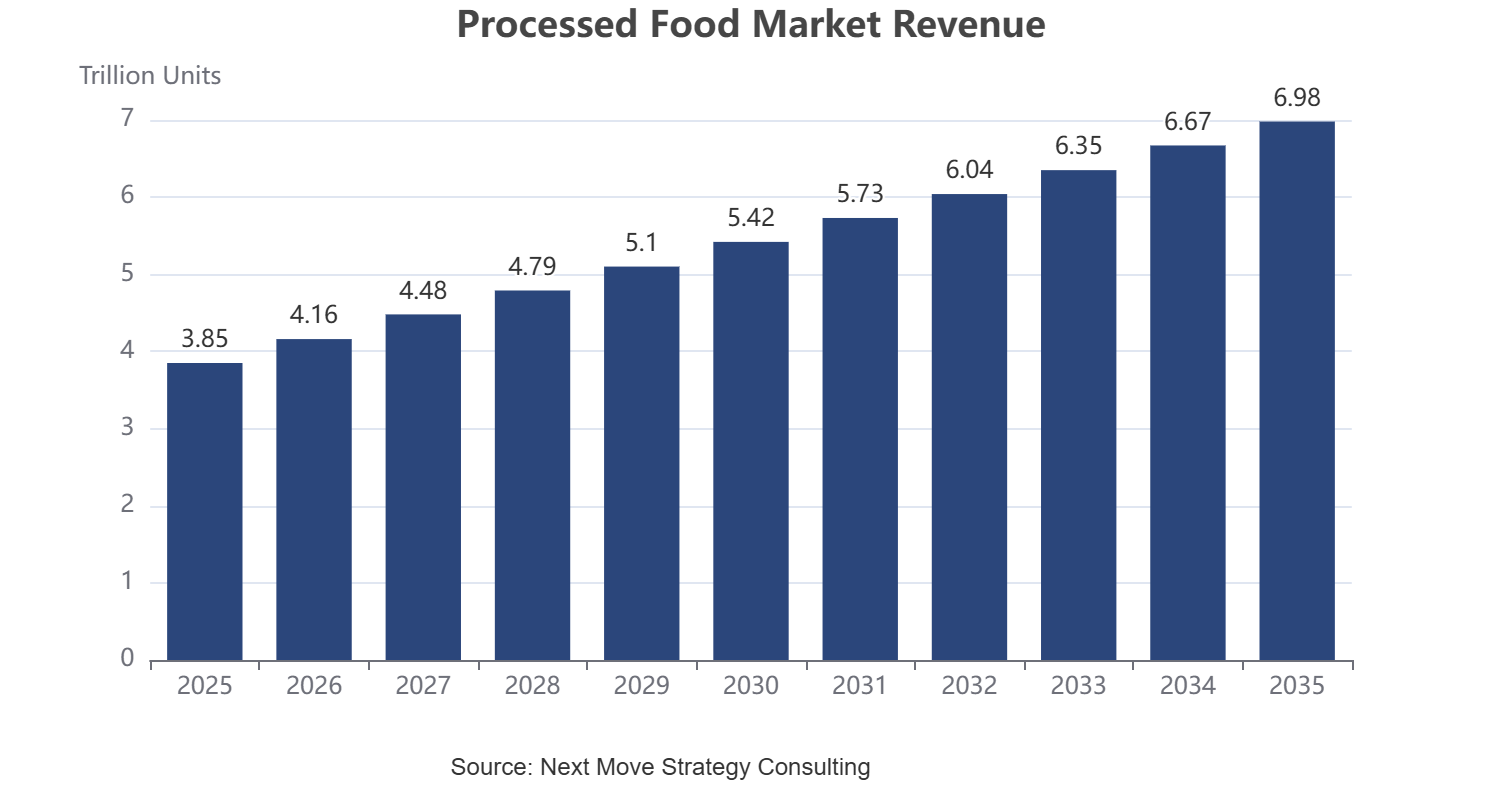
The global Processed Food Market size was valued at USD 3.85 Trillion in 2025 and is estimated at USD 4.02 Trillion in 2026, forecast to reach USD 6.98 Trillion by 2035, expanding at a 6.3% CAGR between 2026 and 2035. North America leads with approximately 29% share, while under product category, Dairy and Dairy Alternatives dominate with approximately 16% share.
We observed that growth is broad-based across every segmentation axis, with convenience-driven prepared meal formats and fortified beverage categories driving the dominant structural shifts through 2035.
|
Key Takeaways |
|
By Product Category: Dairy and Dairy Alternatives held the largest share of approximately 16% (USD 610 Billion) in 2025; Prepared Meals and Meal Kits is the fastest-growing sub-segment at 9.8% CAGR from 2026–2035. |
|
By Temperature State: Ambient held the largest share of approximately 62% (USD 2.39 Trillion) in 2025; Frozen is the fastest-growing sub-segment at 9.9% CAGR from 2026–2035. |
|
By Brand Model: Branded held the largest share of approximately 71% (USD 2.73 Trillion) in 2025; Private Label is the fastest-growing sub-segment at 8.8% CAGR from 2026–2035. |
|
By Distribution Channel: Retail held the largest share of approximately 64% (USD 2.46 Trillion) in 2025; Industrial B2B is the fastest-growing sub-segment at 8.7% CAGR from 2026–2035. |
|
Dominant Region: North America dominated with approximately 29% revenue share (USD 1.12 Trillion) in 2025. |
|
Fastest-Growing Region: Asia-Pacific is expected to register the highest CAGR of 10.5% during 2026–2035. |
|
Dominant Country: U.S. led with approximately USD 804 Billion in 2025. |
|
Fastest-Growing Country: India is the fastest-growing country at approximately 13.7% CAGR from 2026–2035. |
Between 2026 and 2035, the Processed Food Market is set to generate an absolute dollar opportunity of USD 2.96 Trillion, positioning convenience-oriented and fortified categories as a compelling area for capital allocation.
According to our analysis, sustained investment in cold chain infrastructure and protein-fortified formulations is reshaping procurement criteria for brand owners, as clean-label and nutrition-forward positioning increasingly determines retailer shelf allocation across dairy, snacking, and prepared meal categories.
What Does the Processed Food Industry Encompass?
The Processed Food Industry encompasses packaged and industrially prepared food and beverage products that have undergone mechanical, thermal, chemical, or fermentation-based transformation from raw agricultural inputs, spanning bakery, dairy, meat, prepared meals, sauces, beverages, and ingredient categories. Our assessment indicates that the scope covers ambient, chilled, and frozen formats supplied to retail, foodservice, and industrial B2B customers through branded, private label, and contract manufactured business models across virtually every global consumer market.
The category has evolved from single-purpose canned and dried staples into a diversified ecosystem of convenience-oriented, fortified, and clean-label offerings, driven by urbanization, dual-income households, and rising demand for time-saving meal solutions. Regulatory frameworks such as the U.S. Food and Drug Administration's food labeling and additive rules and the European Food Safety Authority's risk assessment protocols shape reformulation and fortification requirements, while national food safety authorities across Asia-Pacific increasingly influence ingredient sourcing standards. We observed that technology adoption is shifting toward AI-enabled demand forecasting and shelf-life extension packaging, and Next Move Strategy Consulting's analysis indicates that this structural shift is redefining sourcing criteria across the Processed Food Market.
|
Parameter |
Details |
|
Market Size in 2025 |
USD 3.85 Trillion |
|
Market Size in 2026 |
USD 4.02 Trillion |
|
Revenue Forecast in 2035 |
USD 6.98 Trillion |
|
Growth Rate |
CAGR of 6.3% from 2026 to 2035 |
|
Analysis Period |
2025–2035 |
|
Base Year Considered |
2025 |
|
Forecast Period |
2026–2035 |
|
Market Size Estimation |
Revenue (USD Trillion) |
|
Companies Profiled |
20 |
|
Countries Covered |
33 |
|
Market Share |
Available for Top 10 Companies |
Key Emerging Trends
Based on research conducted by Next Move Strategy Consulting, we found that four structural trends are reshaping product development, sourcing, and stakeholder engagement across the Processed Food Market.
How Is Reformulation Transforming Processed Food Recipes?
Sugar, sodium, and saturated-fat reformulation is becoming a core innovation priority as brand owners respond to public health scrutiny and retailer scorecards. We observed that Nestlé's ongoing nutrient-profile upgrades across confectionery and culinary lines illustrate how global manufacturers are recalibrating recipes without compromising taste. Brand owners are adopting natural sweeteners and sodium-reduction technology to satisfy tightening regulatory thresholds, while contract manufacturers retool formulation lines to accommodate cleaner ingredient decks across bakery and snack applications.
Why Is Protein Fortification Gaining Traction Across Processed Food Categories?
Protein-enriched formats are gaining share as consumers seek functional nutrition within everyday convenience foods. Our findings suggest that dairy, snack bar, and ready-to-drink beverage categories increasingly specify pea, whey, or dairy-protein fortification to differentiate on nutrition labels. Manufacturers such as General Mills and Danone are expanding high-protein portfolios, positioning these formats as a premium, higher-margin category within the broader Processed Food Market segmentation structure.
How Is AI-Driven Demand Forecasting Reshaping Processed Food Supply Chains?
Artificial intelligence and predictive analytics are being deployed to reduce spoilage and optimize inventory across perishable processed food categories. We observed that leading manufacturers are integrating machine-learning-based demand sensing into production planning to align chilled and frozen output with retail replenishment cycles. This trend is elevating investment in digital supply chain platforms among Industrial B2B suppliers, while packaging integrators redesign shelf-life monitoring to minimize waste during last-mile distribution.
What Role Does Plant-Based and Hybrid Protein Innovation Play in Processed Food?
Plant-based and hybrid animal-plant protein systems are emerging as a structural response to sustainability scrutiny and flexitarian consumer demand. Our analysis shows that brand owners in the meat, poultry, and dairy alternatives categories are piloting blended formulations that combine plant proteins with reduced animal content to lower cost and environmental footprint. Unilever's plant-based portfolio expansion exemplifies this direction with recipes engineered to replicate taste and texture across mainstream retail channels.
Growth Drivers and Restraints
|
Factors |
(+/−) % Impact on CAGR |
Geographic Relevance |
Impact Timeline |
|
Rising urbanization and dual-income household convenience demand |
+1.8% |
Global |
2026–2035 |
|
Expansion of organized retail and cold chain infrastructure |
+1.5% |
Asia-Pacific |
2026–2035 |
|
Growth of e-commerce grocery and quick-commerce delivery |
+1.1% |
Global |
2026–2032 |
|
Rising demand for ready-to-eat and convenience formats |
+1.3% |
North America, Europe |
2026–2035 |
|
Government nutrition and food-fortification programs |
+0.8% |
Asia-Pacific, MEA, LATAM |
2026–2035 |
|
Private label expansion among mass retailers |
+0.9% |
North America, Europe |
2026–2033 |
|
Rising input and packaging cost inflation |
−1.0% |
Global |
2026–2035 |
|
Tightening sugar, sodium and ultra-processed food regulation |
−0.9% |
Europe, North America |
2027–2035 |
|
Consumer shift toward fresh and minimally processed alternatives |
−0.7% |
North America, Europe |
2026–2035 |
What Is the Primary Growth Driver of the Processed Food Industry?
Rising urbanization combined with growing dual-income household penetration is the primary driver of the Processed Food Market. The U.S. Department of Agriculture's Economic Research Service continues to document a rising share of household food expenditure directed toward convenience and away-from-home-style packaged formats. We observed that this behavioral shift, reinforced by time-scarcity among working households, continues to anchor baseline consumption of bakery, dairy, and prepared meal categories across developed and emerging economies alike.
How Is Cold Chain Expansion Driving Processed Food Industry's Growth?
Expanding cold chain and organized retail infrastructure across Asia-Pacific is accelerating Processed Food Market growth toward chilled and frozen formats. The Food Safety and Standards Authority of India's cold storage licensing framework is supporting investment in temperature-controlled logistics networks. Our assessment indicates that this infrastructure build-out, combined with rising modern trade penetration, is compressing adoption timelines for frozen prepared meals and dairy alternatives across China, India, and Southeast Asia.
What Is Restraining Processed Food Market Expansion?
Tightening regulation on sugar, sodium, and ultra-processed food labeling restrains category expansion across mature Processed Food Market regions. The European Food Safety Authority's ongoing risk-assessment updates for food additives are compelling reformulation investment that raises near-term production costs. We found that smaller regional manufacturers face particular exposure, as limited reformulation budgets reduce their ability to compete with larger, vertically integrated food groups on nutrition-label compliance.
Consumer Behavior Analysis of the Processed Food Market
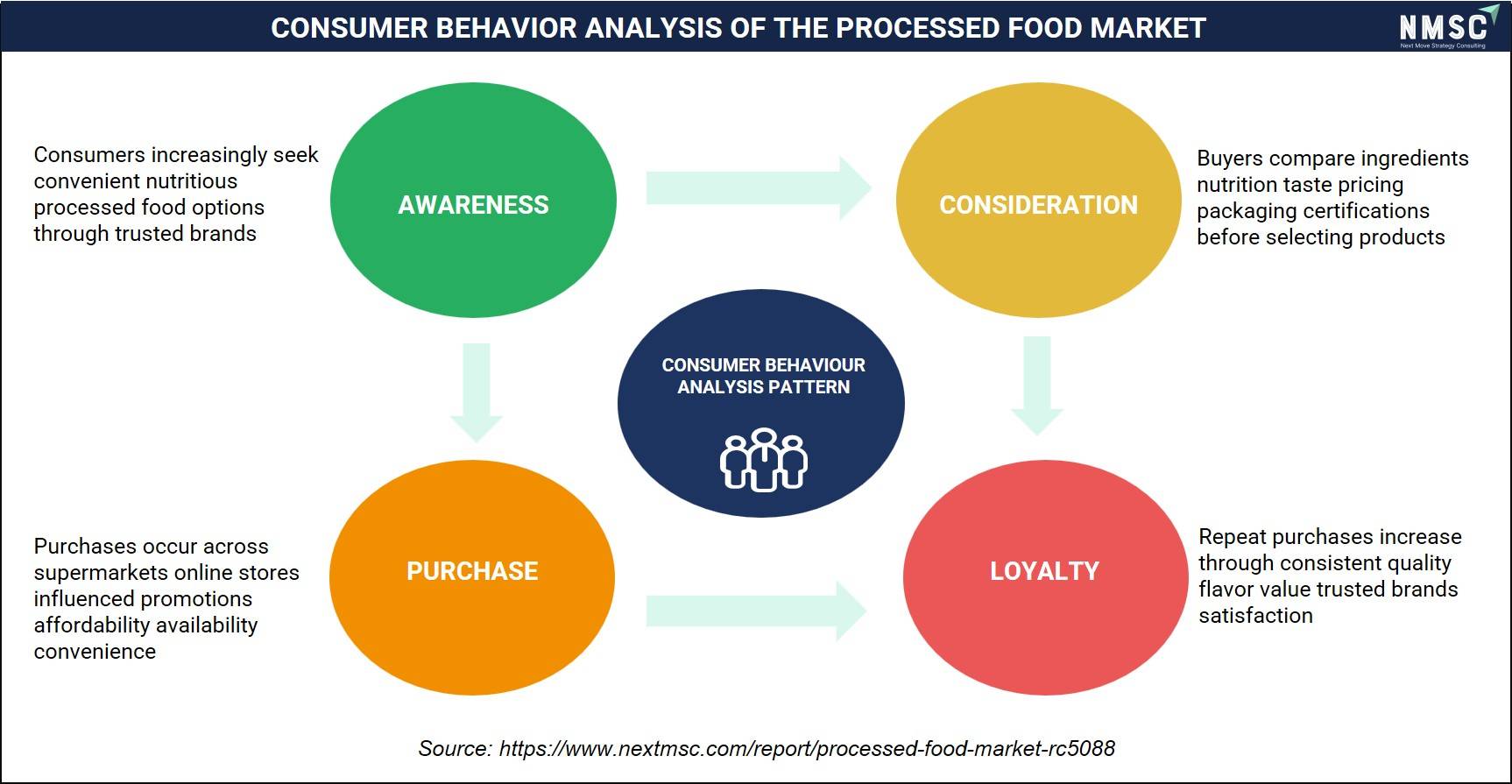
Consumer behavior in the processed food market follows a structured journey from awareness to loyalty, shaped by convenience, nutrition, affordability, and brand trust. Purchasing decisions are increasingly influenced by ingredient transparency, product quality, certifications, and pricing. As health consciousness grows, manufacturers are focusing on clean-label innovation, value-driven offerings, and consistent product experiences to strengthen consumer engagement and repeat purchases.
Segmentation Analysis
Segment Sizing: By Product Category
|
Segment |
2025 (USD) |
2035 (USD) |
CAGR% (2026–2035) |
|
Dairy and Dairy Alternatives |
USD 610 Billion |
USD 1.06 Trillion |
6.4% |
|
Meat, Poultry and Seafood |
USD 523 Billion |
USD 879 Billion |
5.9% |
|
Bakery and Cereal Products |
USD 443 Billion |
USD 709 Billion |
5.4% |
|
Snacks and Confectionery |
USD 385 Billion |
USD 675 Billion |
6.4% |
|
Non-Alcoholic Packaged Beverages |
USD 338 Billion |
USD 722 Billion |
8.8% |
|
Oils and Fats |
USD 302 Billion |
USD 484 Billion |
5.4% |
|
Pasta, Noodles and Rice |
USD 258 Billion |
USD 457 Billion |
6.6% |
|
Prepared Meals and Meal Kits |
USD 214 Billion |
USD 498 Billion |
9.8% |
|
Sauces, Condiments and Spreads |
USD 196 Billion |
USD 375 Billion |
7.5% |
|
Fruit and Vegetable Preparations |
USD 167 Billion |
USD 341 Billion |
8.3% |
|
Sweeteners and Starches |
USD 127 Billion |
USD 204 Billion |
5.4% |
|
Cocoa and Chocolate Ingredients |
USD 102 Billion |
USD 198 Billion |
7.6% |
|
Baby Food and Infant Nutrition |
USD 98 Billion |
USD 198 Billion |
8.1% |
|
Other Processed Foods |
USD 87 Billion |
USD 177 Billion |
8.2% |
|
Total |
USD 3.85 Trillion |
USD 6.98 Trillion |
6.3% |
Source: www.nextmsc.com
Which Product Category Dominates the Processed Food Market?
Dairy and Dairy Alternatives dominate the Processed Food Market, valued at USD 610 Billion in 2025 on sustained fluid milk, cheese, and fermented dairy consumption across mature and emerging economies. Our findings suggest that Prepared Meals and Meal Kits is the fastest-growing category, registering a 9.8% CAGR from 2026 to 2035, as time-scarce urban households increasingly substitute home cooking with frozen and chilled ready-to-eat formats offering improved convenience and portion consistency.
Segment Sizing: By Temperature State
|
Segment |
2025 (USD) |
2035 (USD) |
CAGR% (2026–2035) |
|
Ambient |
USD 2.39 Trillion |
USD 3.98 Trillion |
5.8% |
|
Chilled |
USD 924 Billion |
USD 1.75 Trillion |
7.3% |
|
Frozen |
USD 539 Billion |
USD 1.26 Trillion |
9.9% |
|
Total |
USD 3.85 Trillion |
USD 6.98 Trillion |
6.3% |
Which Temperature State Leads the Processed Food Market?
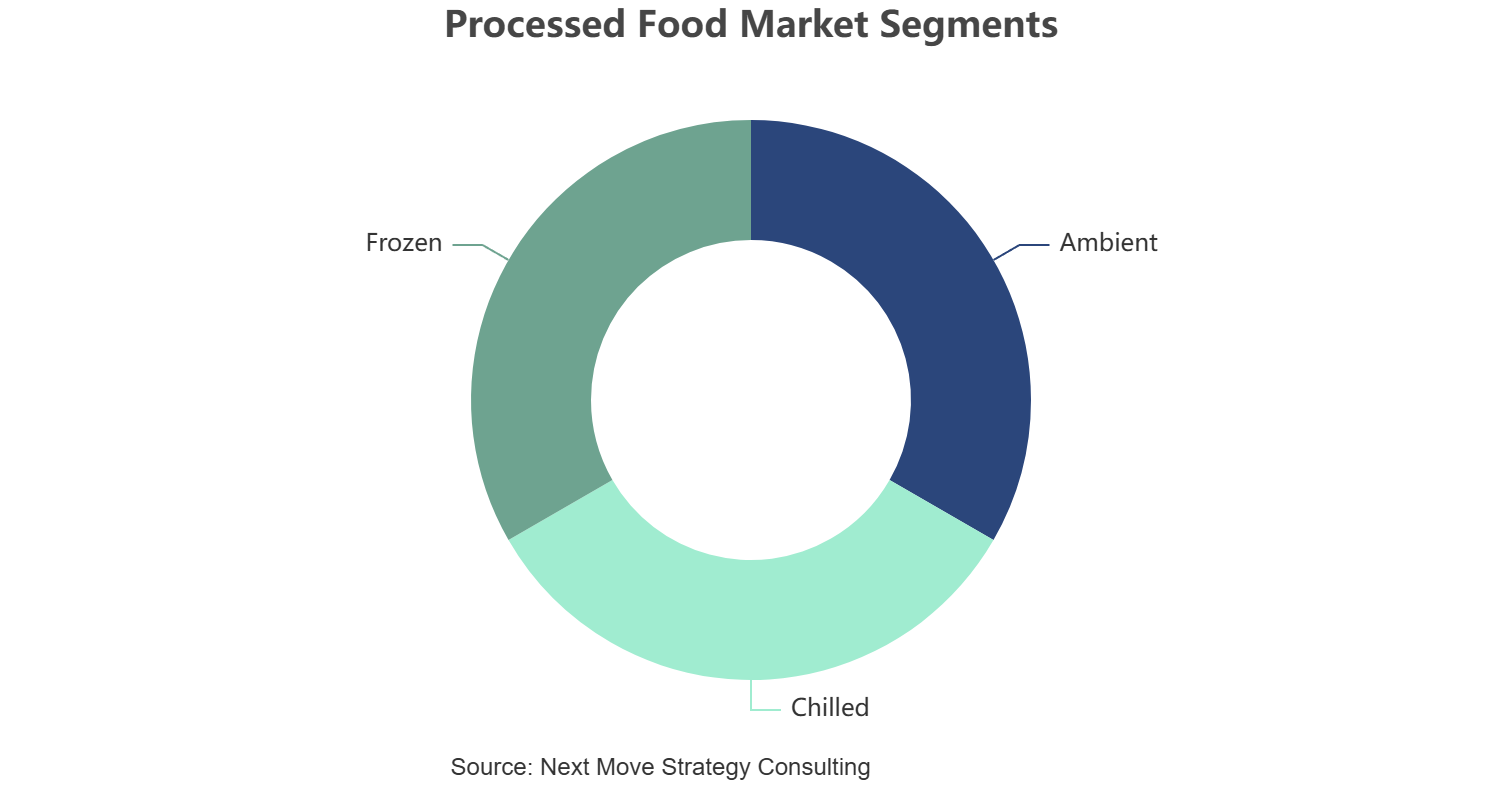
Ambient formats remain the dominant temperature state across the Processed Food Market, reaching USD 2.39 Trillion in 2025 due to their extended shelf life, lower logistics cost, and broad accessibility across developing retail infrastructure. Based on research conducted by Next Move Strategy Consulting, we found that Frozen is the fastest-growing category at a 9.9% CAGR from 2026 to 2035, reflecting expanding cold chain investment and rising consumer preference for retained nutritional quality in prepared meals and vegetable preparations.
Segment Sizing: By Distribution Channel
|
Segment |
2025 (USD) |
2035 (USD) |
CAGR% (2026–2035) |
|
Retail |
USD 2.46 Trillion |
USD 4.19 Trillion |
6.1% |
|
Foodservice |
USD 924 Billion |
USD 1.82 Trillion |
7.8% |
|
Industrial B2B |
USD 462 Billion |
USD 977 Billion |
8.7% |
|
Total |
USD 3.85 Trillion |
USD 6.98 Trillion |
6.3% |
Which Distribution Channel Is Most Widely Used in Processed Food?
Retail remained the dominant distribution channel across the Processed Food Industry, reaching USD 2.46 Trillion in 2025 due to the breadth of hypermarket, supermarket, and e-commerce grocery access available to consumers worldwide. Our analysis shows that Industrial B2B, encompassing ingredient and bulk supply to food manufacturers and foodservice operators, represents the fastest-growing category at an 8.7% CAGR from 2026 to 2035, reflecting rising demand for formulated ingredient inputs among contract manufacturers and private label producers.
Growth Opportunities
Our analysis shows that three forward-looking opportunities stand out for stakeholders positioning within the Processed Food Market over the 2026–2035 forecast period.
How Are High-Protein Snack Formats Creating Opportunities for Brand Owners?
High-protein and functional snack formats present a whitespace opportunity for brand owners seeking to capture health-conscious consumers within the Snacks and Confectionery and Snack Bars categories. Suppliers that commercialize fortified, minimally processed snack platforms stand to capture recurring purchase frequency as consumers shift spending toward nutrition-forward everyday formats across both mature and emerging retail channels.
Why Is Private Label Expansion Unlocking Opportunities for Contract Manufacturers?
Private label expansion among mass retailers represents an underpenetrated opportunity for contract manufacturers capable of matching branded quality at competitive cost. Manufacturers that develop flexible, high-throughput production capacity for retailer-owned brands can secure long-term supply contracts, benefiting from recurring volume tied to private label's above-average 8.8% CAGR through 2035.
How Is Cold Chain Investment Opening Opportunities for Frozen and Chilled Meals?
Cold chain infrastructure investment across Asia-Pacific and Latin America creates an opportunity for suppliers of frozen and chilled prepared meals and meal kits. Early movers that establish temperature-controlled distribution networks can differentiate with retail and foodservice customers pursuing expanded convenience assortments, capturing share within a category already growing at a 9.8% CAGR through the forecast period.
Regional Outlook
|
Region |
2025 (USD) |
2035 (USD) |
CAGR% (2026–2035) |
Key Driver |
|
North America |
USD 1.12 Trillion |
USD 1.47 Trillion |
3.1% |
Mature retail infrastructure and FDA reformulation compliance |
|
Asia-Pacific |
USD 1.08 Trillion |
USD 2.65 Trillion |
10.5% |
Expanding cold chain and organized retail penetration |
|
Europe |
USD 924 Billion |
USD 1.26 Trillion |
3.5% |
EFSA regulation and sustainability-linked reformulation |
|
Middle East & Africa |
USD 385 Billion |
USD 838 Billion |
9.0% |
Vision 2030-linked food security and diversification |
|
Latin America |
USD 347 Billion |
USD 768 Billion |
9.2% |
Growing modern retail and packaged food penetration |
|
Total |
USD 3.85 Trillion |
USD 6.98 Trillion |
6.3% |
– |
North America Processed Food Industry Outlook
North America leads the Processed Food Market with an established manufacturing base and mature retail distribution network spanning grocery, club, and e-commerce channels. We observed that U.S. Food and Drug Administration labeling and additive requirements sustain steady reformulation investment, while brand owners increasingly specify clean-label ingredient decks to meet retailer sustainability commitments. Technology adoption remains advanced, with AI-enabled demand forecasting driving efficiency across the region's dense cold chain network.
Europe Processed Food Industry Outlook
Europe's Processed Food Market reflects a mature but regulation-intensive landscape shaped by the European Food Safety Authority's additive risk-assessment framework and national nutrition-labeling mandates. Our findings suggest that brand owners across Germany, France, and the UK are accelerating reformulation of sugar and sodium content to satisfy tightening public health obligations. Technology adoption favors precision fermentation and plant-based protein platforms, supported by regional manufacturers investing in EFSA-compliant production lines.
Asia-Pacific Processed Food Industry Outlook
Asia-Pacific is the fastest-growing Processed Food Market region, propelled by expanding cold chain infrastructure in China and India and rising middle-class packaged food spending. We found that regulatory frameworks remain less harmonized than in Europe, giving manufacturers flexibility to scale ambient and chilled production rapidly. Technology adoption is accelerating as regional processors, including several China-based suppliers, expand export capacity to serve global retail and foodservice brand owners.
Middle East & Africa Processed Food Industry Outlook
The Middle East & Africa Processed Food Market is expanding as Gulf Cooperation Council economies diversify into food security and domestic manufacturing capacity. Our analysis shows that Saudi Arabia and the UAE are attracting processing investment tied to Vision 2030-linked diversification programs. Regulatory influence remains moderate, while technology adoption is gradually shifting toward imported cold chain and fortification systems as regional distributors align with global nutrition expectations.
Latin America Processed Food Industry Outlook
Latin America's Processed Food Market is supported by growing packaged food consumption in Brazil and Argentina and expanding modern retail infrastructure. We observed that regulatory frameworks are less stringent than in North America or Europe, though multinational brand owners operating locally are introducing reformulated, lower-sodium product lines. Technology adoption remains centered on ambient and chilled formats, with competitive intensity increasing as regional distributors partner with global processors to expand product breadth.
U.S. Processed Food Industry
Based on our engagements, the U.S. Processed Food Market was valued at approximately USD 804 Billion in 2025 and is projected to reach USD 1.04 Trillion by 2035, growing at a 2.9% CAGR. Demand is anchored by mature retail penetration, high convenience-food adoption, and U.S. Food and Drug Administration labeling compliance. Technology penetration favors AI-enabled demand forecasting, and competitive intensity remains high among established manufacturers serving national retail chains.
Canada Processed Food Industry
Through our analysis, Canada's Processed Food Market reached roughly USD 156 Billion in 2025 and is forecast to hit USD 205 Billion by 2035 at a 3.1% CAGR. Demand structure mirrors U.S. convenience and packaged food consumption patterns, while Health Canada labeling guidance shapes reformulation specifications. Technology penetration is rising as national retailers request nutrition-forward product lines, with competitive intensity moderate given the market's reliance on cross-border supply from U.S.-based processors.
UK Processed Food Industry
From our assessment, the UK market stood at about USD 176 Billion in 2025, advancing toward USD 226 Billion by 2035 at a 2.9% CAGR. Demand is driven by established retail and foodservice brands navigating post-Brexit food-labeling rules. Regulatory influence is significant, technology penetration favors reformulated low-sugar product lines, and competitive intensity remains steady among domestic and European processors serving UK retail chains.
Germany Processed Food Industry
According to evaluation, Germany's market was valued near USD 203 Billion in 2025 and is set to reach USD 264 Billion by 2035, expanding at a 2.9% CAGR. Demand structure benefits from a strong domestic bakery and dairy manufacturing base. Germany's implementation of EFSA-aligned additive rules drives regulatory influence, while technology penetration favors precision fermentation and clean-label reformulation among leading processors.
France Processed Food Industry
Based on our engagements, France's market reached approximately USD 148 Billion in 2025, projected to climb to USD 195 Billion by 2035 at a 3.1% CAGR. Demand is supported by France's prominent culinary and prepared-meal manufacturing industry, which shapes premium and artisanal product adoption. Regulatory influence from French nutrition-labeling legislation is notable, and competitive intensity remains high given the concentration of premium food processors headquartered domestically.
China Processed Food Industry
Through our analysis, China's Processed Food Market stood at roughly USD 367 Billion in 2025 and is forecast to reach USD 928 Billion by 2035, registering a 10.9% CAGR. Demand is fueled by expanding cold chain infrastructure and a dense base of regional processors. Regulatory influence is increasing gradually, technology penetration is accelerating through export-oriented production upgrades, and competitive intensity remains elevated among numerous China-based suppliers.
India Processed Food Industry
From our assessment, India's Processed Food Market was valued at about USD 151 Billion in 2025, projected to reach USD 477 Billion by 2035 at a 13.7% CAGR, the fastest among covered countries. Demand structure reflects rising urbanization and expanding organized retail for packaged food products. The Food Safety and Standards Authority of India's regulatory framework remains developing, while technology penetration is rising quickly as multinational brand owners localize processed food sourcing to serve India's growing consumer base.
Japan Processed Food Industry
According to evaluation, Japan's market reached close to USD 140 Billion in 2025 and is expected to hit USD 239 Billion by 2035, growing at a 6.1% CAGR. Demand is supported by Japan's precision food-manufacturing heritage and aging-population nutrition needs. Regulatory influence is well established, technology penetration is advanced, and competitive intensity remains high among long-standing domestic manufacturers.
South Korea Processed Food Industry
Based on our engagements, South Korea's market stood at approximately USD 76 Billion in 2025, forecast to reach USD 159 Billion by 2035 at an 8.6% CAGR. Demand structure benefits from the country's globally influential convenience food culture and export momentum. Technology penetration is high, with domestic processors supplying premium fermented and ready-to-eat formats, and competitive intensity remains pronounced amid rapid product innovation cycles.
Australia Processed Food Industry
Through our analysis, Australia's market reached about USD 65 Billion in 2025 and is projected to reach USD 133 Billion by 2035, expanding at an 8.3% CAGR. Demand is supported by a well-established retail sector and growing consumer preference for fortified and functional packaged food. Regulatory influence stems from Food Standards Australia New Zealand's compositional standards, while technology penetration favors imported cold chain systems amid moderate competitive intensity.
UAE Processed Food Industry
From our assessment, the UAE market was valued near USD 62 Billion in 2025, projected to reach USD 134 Billion by 2035 at a 9.0% CAGR. Demand structure is shaped by the UAE's role as a regional food distribution hub. Regulatory influence remains moderate, technology penetration is improving through imported fortified formats, and competitive intensity is rising as distributors expand product portfolios to serve Gulf markets.
Saudi Arabia Processed Food Industry
According to evaluation, Saudi Arabia's market reached roughly USD 85 Billion in 2025 and is expected to hit USD 176 Billion by 2035, growing at an 8.5% CAGR. Demand is driven by Vision 2030-linked food security initiatives and rising organized retail penetration. Regulatory influence stems from Saudi Standards, Metrology and Quality Organization compositional requirements, technology penetration favors imported fortification systems, and competitive intensity is increasing among regional distributors.
South Africa Processed Food Industry
Through our analysis, South Africa's Processed Food Market was valued near USD 54 Billion in 2025, projected to reach USD 117 Billion by 2035 at a 9.0% CAGR. Demand structure is supported by expanding organized retail and rising urban packaged food consumption. Regulatory influence remains developing, technology penetration is gradually improving through fortification-focused product launches, and competitive intensity is centered on a small number of regional processors serving domestic and export markets.
Brazil Processed Food Industry
Based on our engagements, Brazil's Processed Food Market reached approximately USD 153 Billion in 2025, forecast to reach USD 338 Billion by 2035 at a 9.2% CAGR. Demand is supported by a large domestic manufacturing base and expanding modern retail infrastructure. Regulatory influence stems from Brazil's national food-labeling framework, technology penetration favors ambient and chilled formats, and competitive intensity remains moderate among regional processors.
Argentina Processed Food Industry
From our assessment, Argentina's Processed Food Market was valued near USD 52 Billion in 2025, projected to reach USD 115 Billion by 2035 at a 9.2% CAGR. Demand structure is supported by steady packaged food consumption despite macroeconomic volatility. Regulatory influence remains limited, technology penetration is modest, and competitive intensity is centered on a small number of regional distributors serving domestic brand owners.
Supply Chain Structure of the Processed Food Market
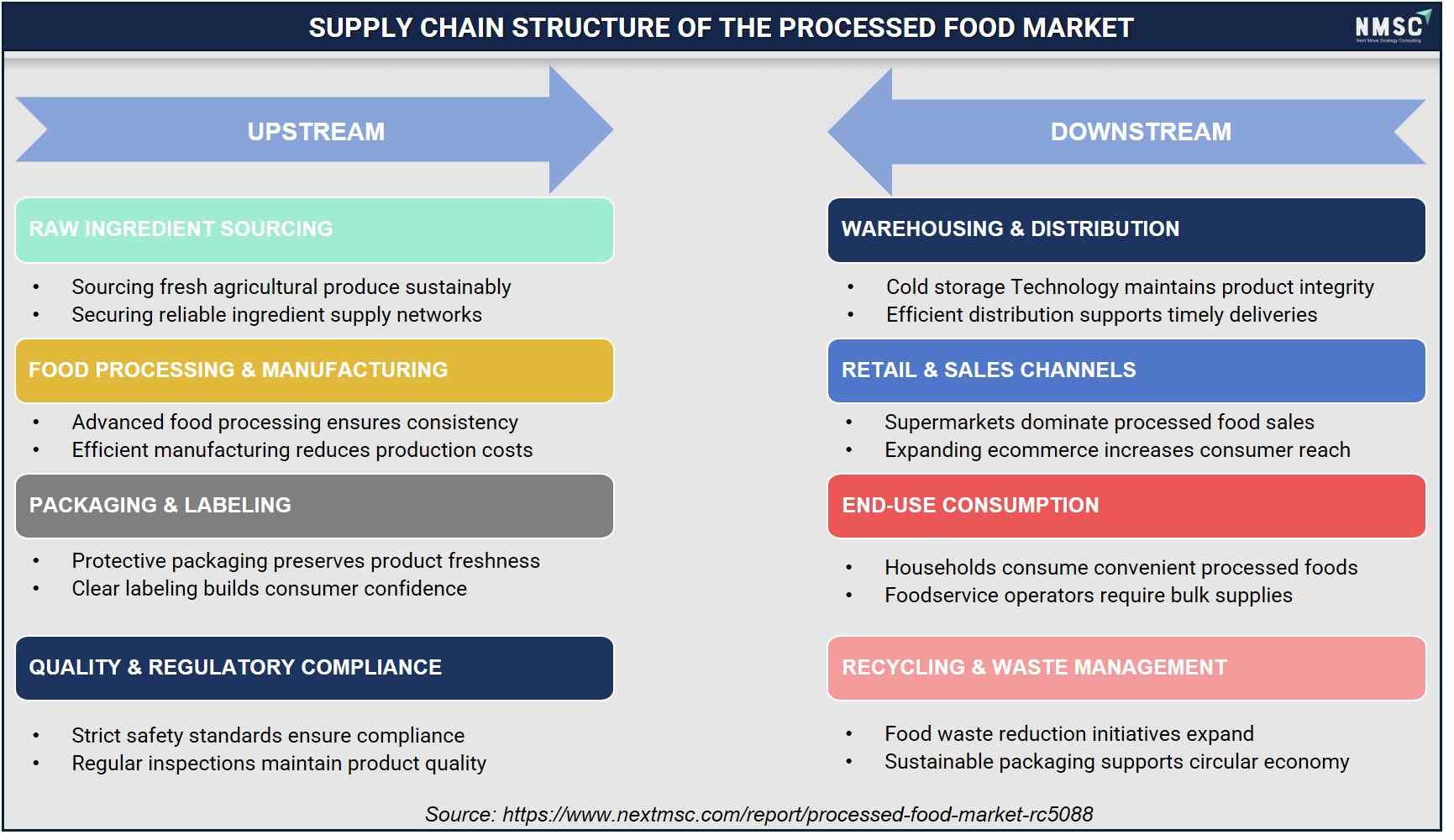
The processed food market relies on an integrated supply chain encompassing sustainable raw material sourcing, efficient manufacturing, packaging, distribution, retail, and end-use consumption. Maintaining food safety, regulatory compliance, and cold-chain efficiency is essential for product quality and availability. Growing emphasis on sustainable packaging and food waste reduction is further driving supply chain resilience and supporting long-term market sustainability.
Competitive Landscape
We observed that the Processed Food Industry features a moderately consolidated competitive landscape, with diversified multinational manufacturers competing alongside regional processors on cost, innovation, and nutrition credentials.
|
Dimension |
Description |
|
Market Structure |
Moderately consolidated; the top companies profiled in this report collectively account for a significant share of global Processed Food Market revenue, while numerous regional processors serve cost-sensitive ambient and private label demand. |
|
Innovation Focus |
Reformulation, protein fortification, and AI-enabled supply chain optimization dominate current innovation pipelines across leading manufacturers. |
|
M&A Activity |
Selective consolidation through portfolio restructuring, exemplified by The Kraft Heinz Company's evaluation of a separation into two independent, publicly traded companies to sharpen category focus. |
How Do Companies Compete in the Processed Food Market?
Companies compete primarily on brand equity, reformulation speed, and manufacturing scale across the Processed Food Market. Global players such as Nestlé S.A. and PepsiCo, Inc. leverage broad category portfolios to serve retail and foodservice customers worldwide, while regional processors compete on cost efficiency and rapid product turnaround for private label and industrial B2B customers across emerging markets.
Which Competitive Archetypes Dominate the Processed Food Market?
Two archetypes dominate the Processed Food Market: diversified global manufacturers offering full-portfolio innovation and regulatory support, and specialized regional processors focused on high-volume, cost-competitive staple categories. Cargill, Incorporated and Archer-Daniels-Midland Company exemplify the diversified archetype through integrated ingredient-to-product manufacturing, while regional dairy and bakery processors exemplify the cost-leadership archetype serving domestic retail demand.
How Are Companies Differentiating Through Innovation in Processed Food?
Innovation and differentiation strategy increasingly center on clean-label reformulation and functional nutrition validation. Danone S.A. and General Mills, Inc. have both expanded high-protein and fortified product lines to address evolving nutrition-label expectations. Our analysis shows that manufacturers unable to demonstrate credible reformulation pathways risk exclusion from retailer shelf-space allocation in Europe and North America.
What M&A and Expansion Activity Is Shaping the Processed Food Market?
Mergers, acquisitions, and portfolio restructuring continue to reshape category focus within the Processed Food Market. The Kraft Heinz Company's September 2025 announcement of a plan to separate into two independent, publicly traded companies illustrates how diversified manufacturers pursue sharper category focus, while PepsiCo, Inc.'s continued portfolio expansion into functional and better-for-you beverages illustrates geographic and category expansion across the beverage segment.
Key Market Players
Our assessment indicates that the following 20 companies represent the validated competitive set actively shaping product innovation, capacity expansion, and nutrition strategy within the global Processed Food Market.
-
Nestlé S.A.
-
PepsiCo, Inc.
-
Cargill, Incorporated
-
Mars, Incorporated
-
The Coca-Cola Company
-
Mondelēz International, Inc.
-
Danone S.A.
-
Bunge Global SA
-
Lactalis Group
-
The Kraft Heinz Company
-
WH Group Limited
-
General Mills, Inc.
-
Grupo Bimbo, S.A.B. de C.V.
-
Ferrero International S.A.
-
Archer-Daniels-Midland Company
-
Unilever PLC
-
Conagra Brands, Inc.
-
The Hershey Company
Latest Developments
We found that recent strategic activity within the Processed Food Market is concentrated on portfolio restructuring and reformulation-led growth initiatives, reflecting the industry's broader transformation.
|
Date |
Event |
|
Sep 2025 |
Tyson Foods, Inc. launched Tyson Chicken Cups, a ready-to-eat portable chicken snack containing 30g or more of protein, expanding its convenience food portfolio. |
|
July 2025 |
Tyson Foods, Inc. introduced Tyson Simple Ingredient Nuggets, featuring a simplified ingredient list, gluten-free formulation, and high-protein positioning. |
|
May 2025 |
Conagra introduced a broad portfolio of new snack and frozen food innovations at the 2025 Sweets & Snacks Expo, featuring new products across brands including Slim Jim, DAVID, Angie's BOOMCHICKAPOP, Vlasic, and Duke's. |
|
May 2025 |
The Hershey Company introduced multiple new products at the 2025 Sweets & Snacks Expo, including HERSHEY'S Milk Chocolate with Caramel, Reese's PB&J Big Cups, Reese's Filled Pretzels, Jolly Rancher Freeze Dried, Jolly Rancher Chewy Poppers, and Dot's Homestyle Pretzels Buffalo Flavor. |
|
March 2025 |
Cargill introduced new food ingredient solutions, including pectin alternatives, bake-stable fillings, and trans fat-free vanaspati for bakery and processed food manufacturers at AAHAR 2025. |
Investment Opportunities
What Capital Inflows Are Targeting the Processed Food Market?
Capital inflows into the Processed Food Market are increasingly directed toward reformulation capability and functional-ingredient sourcing. Strategic acquirers continue to fund portfolio restructuring, as seen in The Kraft Heinz Company's evaluation of a category-focused separation. We observed that investors favor manufacturers demonstrating credible nutrition reformulation pathways, viewing regulatory alignment as a proxy for long-term retailer shelf-space retention.
How Is Infrastructure Investment Supporting Processed Food Manufacturing?
Infrastructure investment is expanding cold chain and processing capacity across Asia-Pacific, particularly in China and India, to serve rising domestic and export demand. Our findings suggest that regional processors are investing in automated production lines to improve consistency across ambient, chilled, and frozen formats, supporting the scale required for prepared meal and dairy alternative categories.
What ESG Considerations Are Shaping Processed Food Investment Decisions?
Environmental, social, and governance considerations are central to investment decisions across the Processed Food Market, with sustainable sourcing and packaging waste reduction as key criteria. The U.S. Environmental Protection Agency's food loss and waste reduction guidance continues to inform brand owner sustainability disclosures. We found that investors increasingly favor manufacturers with third-party sustainability certification, treating it as a governance indicator alongside labor and food safety compliance.
Key Benefits for Stakeholders
How Does This Report Benefit Enterprise and Industry Leaders?
Enterprise and industry leaders gain access to validated segmentation, competitive benchmarking, and regional demand forecasts that support sourcing and product-portfolio decisions across the Processed Food Market. Our analysis shows that detailed product category, temperature state, and distribution channel breakdowns help procurement teams align specifications with regulatory and nutrition requirements while identifying underserved segments for portfolio expansion.
How Does This Report Benefit Investors and Financial Analysts?
Investors and financial analysts benefit from consistent, single-point market size and CAGR estimates that support valuation and capital-allocation decisions across the Processed Food Market supply chain. We observed that the report's regional and segment-level growth differentials help identify which manufacturers and ingredient suppliers are best positioned to capture above-market growth in prepared meal and fortified categories through 2035.
How Does This Report Benefit Technology Vendors and Product Teams?
Technology vendors and product teams gain insight into emerging requirements, including AI-enabled demand forecasting, reformulation technology, and cold chain digitization, that are reshaping the Processed Food Market. Our findings suggest that this analysis helps R&D teams prioritize development roadmaps around nutrition reformulation and functional fortification that are increasingly required by retailer and regulatory expectations.
Key Market Segments
By Product Category
-
Bakery and Cereal Products
-
Bread and Fresh Bakery
-
Cakes and Pastries
-
Cookies and Crackers
-
Breakfast Cereals and Cereal Bars
-
Flour and Baking Mixes
-
-
Snacks and Confectionery
-
Savory Snacks
-
Chocolate Confectionery
-
Sugar Confectionery and Gum
-
Snack Bars and Fruit Snacks
-
-
Dairy and Dairy Alternatives
-
Fluid Milk and Cream
-
Yogurt and Fermented Dairy
-
Cheese
-
Butter and Dairy Spreads
-
Ice Cream and Frozen Dairy Desserts
-
Dairy Ingredients
-
Plant-Based Dairy Alternatives
-
-
Meat, Poultry and Seafood
-
Processed Meat
-
Processed Poultry
-
Processed Seafood
-
Plant-Based Proteins
-
-
Prepared Meals and Meal Kits
-
Frozen Prepared Meals
-
Chilled Prepared Meals
-
Shelf-Stable Prepared Meals
-
Soups and Broths
-
Pizza and Savory Pies
-
Meal Kits
-
-
Sauces, Condiments and Spreads
-
Table Sauces
-
Cooking Sauces
-
Dressings and Dips
-
Sweet Spreads, Jams and Nut Butters
-
Bouillon and Stock
-
-
Pasta, Noodles and Rice
-
Pasta and Noodles
-
Rice
-
-
Oils and Fats
-
Vegetable Oils
-
Margarine and Non-Dairy Spreads
-
Animal Fats
-
-
Sweeteners and Starches
-
Sugar and Sweeteners
-
Starch and Starch Derivatives
-
-
Cocoa and Chocolate Ingredients
-
Cocoa Powder and Cocoa Butter
-
Industrial Chocolate and Coatings
-
-
Baby Food and Infant Nutrition
-
Infant Formula
-
Baby Meals and Snacks
-
-
Non-Alcoholic Packaged Beverages
-
Carbonated Soft Drinks
-
Bottled Water
-
Juice and Juice Drinks
-
Ready-to-Drink Tea and Coffee
-
Energy and Sports Drinks
-
-
Fruit and Vegetable Preparations
-
Canned Fruits and Vegetables
-
Frozen Fruits and Vegetables
-
Dried and Dehydrated Fruits and Vegetables
-
Pickled and Fermented Vegetables
-
-
Other Processed Foods
By Temperature State
-
Ambient
-
Chilled
-
Frozen
By Brand Model
-
Branded
-
Private Label
-
Contract Manufactured
By Distribution Channel
-
Retail
-
Foodservice
-
Industrial B2B
By Region
-
North America: U.S., Canada, Mexico
-
Europe: UK, Germany, France, Italy, Spain, Sweden, Denmark, Finland, Netherlands, Rest of Europe
-
Asia-Pacific: China, India, Japan, South Korea, Taiwan, Indonesia, Vietnam, Australia, Philippines, Malaysia, Rest of APAC
-
Middle East & Africa: Saudi Arabia, UAE, Egypt, Israel, Turkey, Nigeria, South Africa, Rest of MEA
-
Latin America: Brazil, Argentina, Chile, Colombia, Rest of LATAM
Conclusion and Recommendations
What Is the Long-Term Outlook for the Processed Food Market?
The long-term outlook for the Processed Food Market remains positive, with global revenue projected to nearly double from USD 3.85 Trillion in 2025 to USD 6.98 Trillion by 2035 at a 6.3% CAGR. We observed that sustained urbanization, cold chain expansion, and fortified-format adoption will continue underpinning demand across dairy, prepared meal, and beverage applications through the forecast period.
What Strategic Positioning Should Processed Food Suppliers Pursue?
Suppliers should prioritize reformulation capability and functional fortification platforms while pursuing nutrition-label compliance to secure long-term retailer contracts. Our assessment indicates that manufacturers investing early in clean-label ingredient sourcing and protein-fortified product lines will be best positioned to capture premium pricing within the Processed Food Market.
How Attractive Is the Processed Food Market for New Investment?
The Processed Food Market presents an attractive investment case, supported by a USD 2.96 Trillion absolute dollar opportunity between 2026 and 2035 and above-average growth in Asia-Pacific and prepared meal categories. We found that investment attractiveness is highest for manufacturers combining reformulation credentials with scaled cold chain capacity, positioning them to serve both cost-sensitive and premium retail segments simultaneously.
What Market Shifts and Key Risks Should Stakeholders Monitor?
Stakeholders should monitor input cost volatility, tightening ultra-processed food regulation, and competitive pressure from fresh and minimally processed alternatives as key risks to the Processed Food Market. Our analysis shows that suppliers unable to adapt to reformulation specifications risk losing shelf space to competitors with certified clean-label platforms, particularly within Europe's increasingly regulated nutrition environment.
What Are the Key Growth Pathways for the Processed Food Market?
Key growth pathways include expanding prepared meal and protein-fortified portfolios, scaling cold chain and private label capacity, and deepening penetration into foodservice and industrial B2B channels. Next Move Strategy Consulting's analysis indicates that suppliers pursuing these pathways while maintaining cost competitiveness in staple categories will be best positioned to capture the Processed Food Market's projected growth through 2035.
About the Author
 Mihul Sharma
— Mihul Sharma is Research Associate at Next Move Strategy Consulting, where he has covered technology, industrial, and healthcare markets for 3 years. His work applies structured business research, market analysis, and secondary-source review to assess market trends, competitive developments, and growth opportunities. He supports report development by fully synthesizing industry data, company information, and market signals into concise findings for strategy and investment-focused research teams.
Mihul Sharma
— Mihul Sharma is Research Associate at Next Move Strategy Consulting, where he has covered technology, industrial, and healthcare markets for 3 years. His work applies structured business research, market analysis, and secondary-source review to assess market trends, competitive developments, and growth opportunities. He supports report development by fully synthesizing industry data, company information, and market signals into concise findings for strategy and investment-focused research teams.
About the Reviewer
 Supradip Baul
— Supradip Baul is an accomplished business consultant and strategist with over a decade of rich experience in market intelligence, strategy, technology, and business transformation. His work has included rigorous qualitative and quantitative analysis across multiple industries, helping clients shape investment decisions and long-term roadmaps. Earlier in his career, he was associated with Gartner, where he contributed to industry-leading reports and market share analyses. He has worked with leading global companies and holds an MBA with a dual specialization in Marketing and Finance.
Supradip Baul
— Supradip Baul is an accomplished business consultant and strategist with over a decade of rich experience in market intelligence, strategy, technology, and business transformation. His work has included rigorous qualitative and quantitative analysis across multiple industries, helping clients shape investment decisions and long-term roadmaps. Earlier in his career, he was associated with Gartner, where he contributed to industry-leading reports and market share analyses. He has worked with leading global companies and holds an MBA with a dual specialization in Marketing and Finance.
At Next Move Strategy Consulting, we understand that insightful market research is the cornerstone of successful business decisions. That's why we employ a robust and multifaceted approach, combining various methodologies to deliver the most accurate and actionable data for our clients.

Research Landscape
We navigate the world of research with two primary approaches:
Qualitative Approach
Our qualitative research methodologies involve immersive techniques such as in-depth interviews, focus groups, and observational studies. By engaging directly with individuals and stakeholders, we uncover valuable insights that quantitative data alone may overlook.

Quantitative Research
In tandem with qualitative methodologies, NMSC leverages the power of Quantitative Research to provide a robust foundation of numerical insights. Through systematic data collection and analysis, we quantify patterns, preferences, and market trends, offering a comprehensive view of the business landscape.
Our quantitative research approach employs diverse tools, including surveys, experiments, and statistical modelling. These methodologies enable us to gather data from a large and representative sample, ensuring the statistical significance of our findings. By employing structured questionnaires and standardized data collection methods, we guarantee the reliability and validity of the information we present to our clients.
Quantitative research is particularly effective in measuring the prevalence of trends, assessing market size, and gauging the impact of various factors on consumer behavior. The numerical precision attained through this approach equips our clients with actionable insights, facilitating data-driven decision-making and strategy formulation.


Our Specialized Toolbox for Industry-Specific Market Research
We deploy a specialized arsenal of techniques tailored to meet your unique requirements. Here's a glimpse into our comprehensive toolbox:

Information Procurement
The stage entails acquiring market data or relevant information through various sources and methodologies.


Market Research Approach
We utilize both top-down and bottom-up approaches in market research analysis to achieve a comprehensive understanding of the market dynamics, leveraging the broad perspective of industry trends and macroeconomic factors alongside detailed insights from specific segments and individual companies.

Porters Five Forces Analysis
We conduct Porter's Five Forces analysis to evaluate the competitive landscape of an industry, providing us with insights into factors that affect profitability and strategic positioning.

SWOT Analysis

Forecasting
We utilize a forecasting model to predict future consumption by considering parameters like population, economics, regulations, market competition, drivers, constraints, technology, and pricing. We also employ statistical techniques such as multilinear regression, exponential smoothing, moving average, ARIMA, and Monte Carlo simulations for accurate predictions. In econometric forecasting, we analyzed short-term and long-term event impacts, attributing values based on regulatory frameworks, economic factors, and market events.





 Speak to Our Analyst