France Healthcare Cybersecurity Market By Component (Software, Hardware, and Services), By Deployment Model (Cloud, On-Premises, and Hybrid), By Organization Size (Small, Medium, and Large), By Commercial Model (Subscription, Perpetual License, Consumption Based, Appliance Sale, Project-Based, Managed Service Contract, and Support Contract), By Customer Type, By Buyer Type, and By Sales Channel – Opportunity Analysis & Forecast, 2025–2035
Industry: Healthcare | Latest Edition: August 21, 2026 | No of Pages: 314 | No. of Tables: 164 | No. of Figures: 157 | Format: PDF | Report Code: HC4073
What Is the France Healthcare Cybersecurity Market Size?
The France Healthcare Cybersecurity Market was valued at USD 1.09 Billion in 2025, is estimated at USD 1.41 Billion in 2026, and is projected to reach USD 3.88 Billion by 2035, expanding at a CAGR of 11.94% from 2026 to 2035. Software remains the dominant component, supported by rising demand for identity, endpoint, and network protection across hospitals, payers, and digital health providers.
We observed that demand is concentrated in organizations that must protect patient data, clinical workflows, and connected medical environments while meeting tighter European and French governance expectations. The market is moving beyond point products toward integrated platforms that combine detection, response, access control, and compliance automation. This shift is widening procurement budgets and strengthening recurring revenue opportunities across managed and cloud delivered offerings.
|
Key Takeaways |
|
By Component: Software is the dominant segment, while Services is the fastest-growing segment. |
|
By Deployment Model: On-Premises is the dominant segment, while Cloud is the fastest-growing segment. |
|
By Organization Size: Large is the dominant segment, while Medium is the fastest-growing segment. |
|
By Commercial Model: Subscription is the dominant segment, while Managed Service Contract is the fastest-growing segment. |
|
By Customer Type: Healthcare Providers is the dominant segment, while Healthcare Public Sector is the fastest-growing segment. |
|
By Buyer Type: Chief Information Security Officer is the dominant segment, while Risk and Compliance is the fastest-growing segment. |
|
By Sales Channel: Direct Sales is the dominant segment, while Managed Security Service Providers is the fastest-growing segment. |
Market Opportunity: The market is expected to create an absolute dollar opportunity of USD 2.47 Billion between 2026 and 2035, making managed services, cloud migration controls, and identity governance especially attractive for investors and solution providers.
According to NMSC’s analysis, procurement in France is shifting toward integrated security stacks that unify compliance automation, identity control, and continuous monitoring, which should support faster adoption in public hospitals and digital health ecosystems.
What does the France Healthcare Cybersecurity Market Encompass?
The France Healthcare Cybersecurity Market report covers the technologies and services used to protect clinical systems, patient records, connected devices, and health data exchanges across public and private care settings. We observed that the market now spans software, hardware, and services rather than isolated tools, because buyers increasingly want unified visibility across identities, endpoints, networks, clouds, and medical technologies. That shift reflects a broader move from perimeter defense to continuous resilience.
NMSC’s analysis indicates that France is also influenced by a stricter regulatory and policy environment, including European cybersecurity obligations, health data governance, and national digital health priorities. The market has evolved alongside telehealth, AI-assisted workflows, and cloud-hosted care platforms, which increase both operational efficiency and attack exposure. As a result, providers and public institutions are investing in access control, monitoring, incident response, and secure data handling as baseline requirements.
|
Parameter |
Details |
|
Market Size in 2025 |
USD 1.09 Billion |
|
Market Size in 2026 |
USD 1.41 Billion |
|
Revenue Forecast in 2035 |
USD 3.88 Billion |
|
Growth Rate |
CAGR of 11.94% from 2026 to 2035 |
|
Analysis Period |
2025–2035 |
|
Base Year Considered |
2025 |
|
Forecast Period |
2026–2035 |
|
Market Size Estimation |
USD Billion |
|
Companies Profiled |
15 |
|
Market Share |
Available for Top 10 Companies |
Key Emerging Trends
We found that four structural trends are reshaping buying behavior, operating models, and security architecture across the France Healthcare Cybersecurity Market.
How Is Zero Trust Reshaping Clinical Access and Identity Control?
Zero trust is moving from an enterprise concept to a practical healthcare requirement as French providers try to protect clinician logins, administrative portals, and remote access pathways. We observed that identity governance, privileged access control, and multifactor authentication are becoming central to procurement conversations because hospitals need tighter verification without slowing patient care. A useful example is the ANSSI ecosystem, which increasingly promotes self-service and resilience-oriented guidance through MesServicesCyber.
Why Are Managed Security Services Expanding Across French Healthcare?
Managed security services are gaining traction because many hospitals and care networks lack the staffing depth to run 24-hour monitoring, detection, and incident response internally. During our market evaluation, we noticed that buyers are prioritizing managed detection and response, security operations support, and outsourced compliance operations to reduce response time and stabilize budgets. This model is especially relevant for regional hospitals and smaller providers that need enterprise-grade coverage without building full in-house teams.
What Is Driving Cloud Native Health Data Governance?
Cloud adoption is rising because care providers want scalable collaboration, faster analytics, and easier integration across digital health applications. Our findings suggest that cloud security posture management, workload protection, and access governance are now expected features rather than optional add-ons. The France health data strategy and broader European health data initiatives reinforce this shift by encouraging stronger data governance, auditability, and secure interoperability across systems such as hospital data warehouses and digital care platforms.
How Is Medical Device and OT Security Becoming More Visible?
Medical device security is moving higher on the agenda as connected diagnostics, monitoring tools, and clinical IoT assets expand inside hospitals. We observed that stakeholders are paying more attention to passive network sensors, device visibility, and segmented networks because a breach can disrupt operations, not just data. This trend is particularly important for biomedical engineering teams and clinical engineering buyers, who increasingly need controls that protect both patient safety and service continuity.
Ecosystem Analysis of the France Healthcare Cybersecurity Market
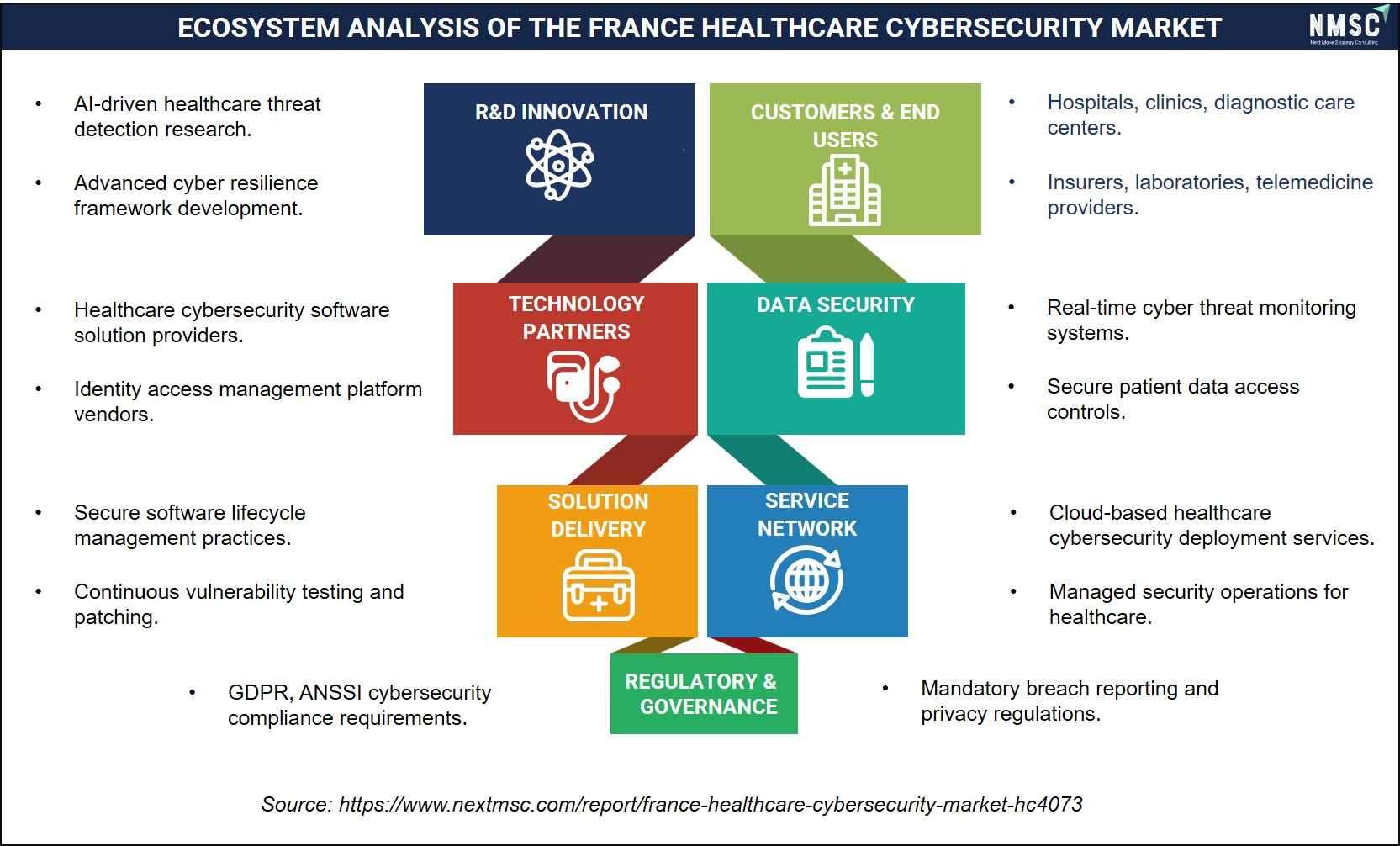
This infographic illustrates the ecosystem of the France healthcare cybersecurity market, highlighting the interconnected roles of R&D innovation, technology partners, data security providers, service networks, solution delivery, and regulatory governance. It also identifies key end users, including hospitals, clinics, diagnostic care centers, insurers, laboratories, and telemedicine providers. Together, these stakeholders drive cybersecurity innovation, strengthen digital resilience, and enhance the protection of healthcare systems and patient data across France.
Growth Drivers & Restraints
|
Factors |
Type |
(+/−) % Impact on CAGR |
Geographic Relevance |
Impact Timeline |
|
NIS2 alignment and hospital cyber readiness |
Driver |
+2.2% |
France nationwide, strongest in public hospitals |
2026–2030 |
|
Ransomware preparedness and response spending |
Driver |
+1.8% |
Paris, Lyon, Marseille, Lille, and major CHUs |
2026–2029 |
|
Cloud-hosted health data and AI workflows |
Driver |
+1.6% |
National, strongest in digitally mature regions |
2026–2031 |
|
Legacy systems and connected medical device exposure |
Restraint |
−1.4% |
Public hospitals and long-term care facilities |
2026–2030 |
|
Budget pressure and procurement complexity |
Restraint |
−1.1% |
Nationwide |
2026–2028 |
|
Security skills shortages in healthcare IT |
Restraint |
−0.9% |
Nationwide |
2026–2031 |
What is the primary growth driver of the France Healthcare Cybersecurity Market?
The primary growth driver is compliance-led modernization across hospitals, payers, and public health bodies. We observed that the French cyber authority maintained a high threat posture through 2025, while the European health sector action plan launched in January 2025 strengthened pressure on hospitals to improve detection, preparedness, and crisis response. Together, those signals are converting cybersecurity from a discretionary spend into a continuity and governance requirement, especially for care providers that process sensitive patient and identity data.
How are digital health and AI programs driving the France Healthcare Cybersecurity Market growth?
Digital health and AI programs are expanding the attack surface and accelerating demand for stronger controls. During our market evaluation, we noticed that France’s digital health roadmap and the 2025 to 2028 AI and health data strategy both reinforce secure interoperability, training, and governance. That combination is pushing buyers toward identity-first security, cloud controls, and stronger monitoring for data warehouses, telehealth platforms, and connected clinical applications. The result is broader adoption across providers and the healthcare public sector.
What is restraining the France Healthcare Cybersecurity Market?
The main restraint is the combination of legacy infrastructure, fragmented budgets, and operational complexity inside healthcare organizations. We found that many providers still run mixed estates that include older systems, specialized devices, and multiple procurement paths, which slows standardization and raises deployment cost. Enforcement activity by the CNIL also shows that data security lapses remain a recurring issue, meaning providers must spend on remediation, governance, and training before they can scale new controls efficiently.
Segmentation Analysis
By Component Insights
How Is the France Healthcare Cybersecurity Market Segmented by Component?
Based on component, the France Healthcare Cybersecurity Market is segmented into software, hardware, and services. Software addresses the widest range of needs because buyers want identity control, endpoint defense, network protection, cloud governance, and security operations in a single operational flow. Hardware remains important where appliance based deployment is still preferred, while services support deployment, response, compliance, and maintenance across complex healthcare estates. This structure reflects the market’s move toward integrated protection rather than isolated point solutions.
We observed that software is the dominant component because it supports recurring use cases across users, endpoints, data, and networks, while services are the fastest-growing component as providers outsource monitoring, consulting, and incident response. Managed security services and professional services are gaining importance in France because many healthcare organizations prefer external expertise for speed, resilience, and regulatory alignment. That combination is especially visible in public hospitals, regional provider networks, and digital health operators.
By Deployment Model Insights
How Do Cloud, On-Premises, and Hybrid Models Shape Adoption?
Based on deployment model, the France Healthcare Cybersecurity Market is divided into cloud, on-premises, and hybrid approaches. On-premises deployments remain central in facilities that manage legacy systems, critical clinical infrastructure, and tightly controlled patient environments. Cloud adoption is rising as digital health platforms, remote collaboration tools, and analytics workflows expand, while hybrid models help providers balance sovereignty, interoperability, and operational flexibility. The deployment mix therefore mirrors the market’s push to modernize without disrupting care delivery.
We found that on-premises is the dominant deployment model because many hospitals still rely on legacy architecture and internal governance preferences, while cloud is the fastest-growing model due to the growth of SaaS security services, telehealth, and scalable monitoring. Hybrid adoption is also gaining ground because it lets providers segment sensitive clinical assets while moving administrative and analytics functions into more agile environments. This is particularly relevant for large hospital groups and public health institutions.
Growth Opportunities
Our analysis shows that three forward looking opportunities stand out for stakeholders operating in the France Healthcare Cybersecurity Market over the 2026 to 2035 forecast period.
Where Can Managed Security Services Unlock Faster Hospital Resilience?
Managed security services create a clear whitespace opportunity because many providers need continuous monitoring, response coordination, and compliance support without building large internal teams. The beneficiary segment is general hospitals and regional provider networks, which can adopt detection and response, security operations center support, and remote maintenance to lower response times and stabilize costs. This model also helps suppliers build recurring revenue while improving service depth.
How Does Identity Governance Create New Value in Healthcare Access Control?
Identity governance and administration create an opportunity where multi user clinical environments must be tightly controlled. The beneficiary segments are integrated delivery networks, academic medical centers, and healthcare public sector bodies that manage thousands of staff, contractors, and rotating access privileges. Vendors that combine privileged access management, single sign on, and multifactor authentication can reduce friction for clinicians while strengthening auditability and reducing account abuse risk.
Why Is Medical Device Security a Strategic Whitespace?
Medical device security is becoming a strategic whitespace as hospitals connect more bedside devices, imaging systems, and biomedical assets to shared networks. The beneficiary segment is clinical engineering and biomedical engineering, which needs passive monitoring, segmentation, and asset visibility without disrupting care delivery. Suppliers that can package device discovery, network monitoring, and incident readiness can capture demand from buyers that are now linking cybersecurity directly to patient safety.
Regulatory Framework Impacting the France Healthcare Cybersecurity Market
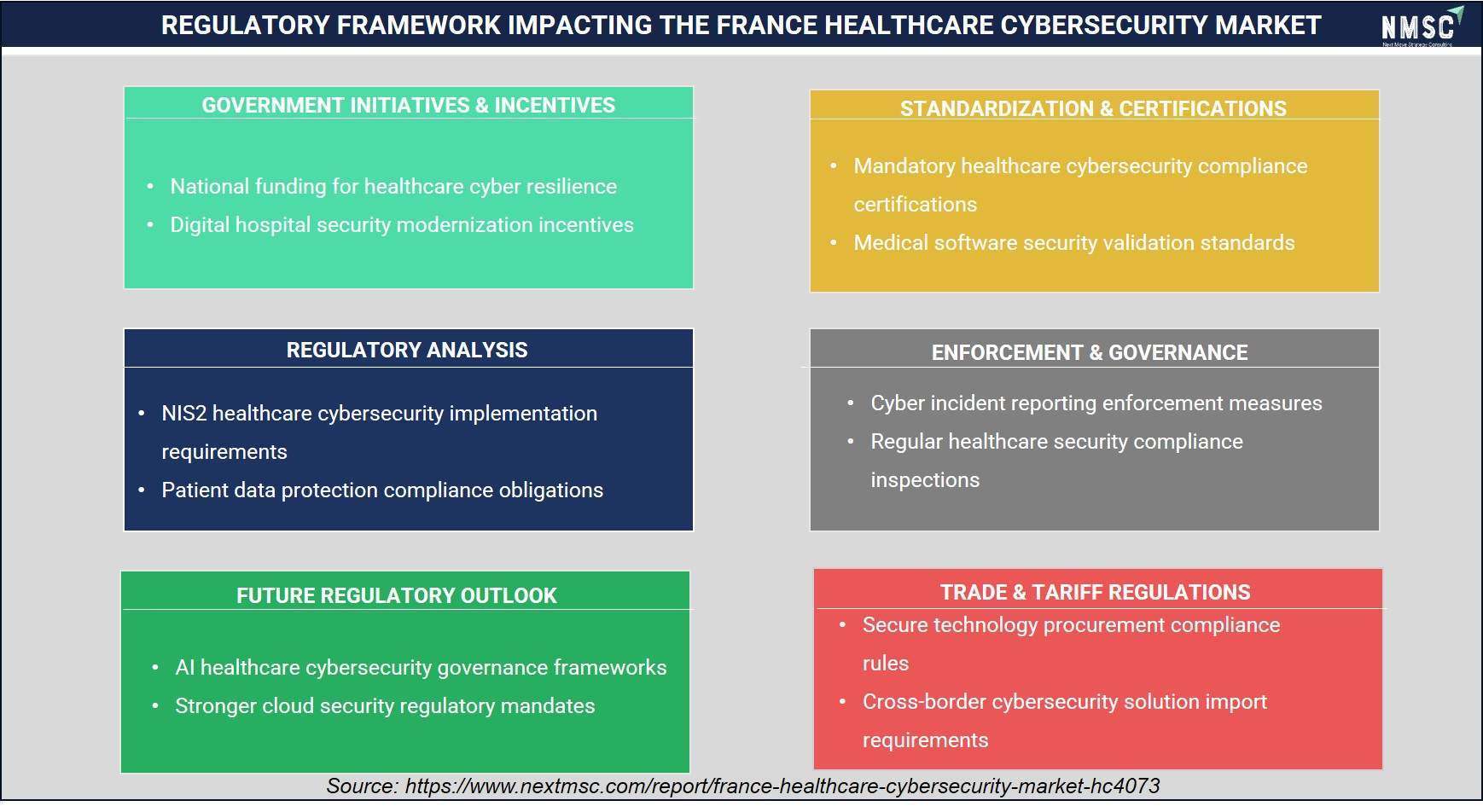
This infographic outlines the regulatory framework shaping the France healthcare cybersecurity market. It highlights government funding initiatives, healthcare cybersecurity certification standards, NIS2 implementation requirements, patient data protection obligations, cyber incident reporting, and regulatory compliance inspections. The framework also emphasizes future priorities such as AI governance, stronger cloud security regulations, and secure technology procurement, supporting enhanced cyber resilience, regulatory compliance, and the secure digital transformation of France's healthcare sector.
Competitive Landscape
We observed that the France Healthcare Cybersecurity Market features a highly competitive Industry landscape, where global security platforms, healthcare specific specialists, and channel partners compete on trust, compliance readiness, and integration depth. Buyers generally prefer vendors that can align security operations with clinical continuity, procurement constraints, and data governance obligations, which makes solution breadth and service quality more important than standalone feature claims.
|
Dimension |
Description |
|
Market Structure |
Highly competitive, with global vendors, specialist healthcare security firms, and service partners competing across software, appliances, and managed services. |
|
Innovation Focus |
Identity security, cloud governance, endpoint visibility, medical device protection, and AI assisted detection dominate product roadmaps. |
|
M&A Activity |
Platform consolidation, niche tuck ins, and channel expansion continue to shape portfolio strategy and geographic reach. |
How Do Companies Compete in the France Healthcare Cybersecurity Market?
Companies compete through compliance alignment, deployment flexibility, pricing structure, and the ability to integrate across clinical and administrative environments. We found that direct sales remains essential for strategic accounts, while managed security service providers and systems integrators help vendors expand into smaller facilities and public institutions. Many vendors bundle subscription software with services to reduce adoption friction, and that approach supports stronger retention where buyers prefer predictable operating expenditure.
Which Competitive Archetypes Dominate the France Healthcare Cybersecurity Industry?
Two archetypes stand out. The first is the global platform vendor that can cover identity, endpoint, cloud, and operations from one portfolio, which appeals to large providers that want simpler procurement and unified oversight. The second is the specialist healthcare or OT focused provider that differentiates through medical device visibility, clinical workflow awareness, or sovereign data handling. Those archetypes dominate because they address both technical requirements and the operational realities of French care delivery.
How Are Firms Differentiating Through Innovation and Pricing Strategy?
Innovation is increasingly centered on AI assisted detection, automation, secure access, and continuous compliance reporting. We observed that vendors are also refining pricing strategies by offering subscription tiers, managed service contracts, and project based deployment support, which helps buyers match spending to maturity. Companies that pair advanced telemetry with implementation support are better positioned to win public sector and hospital network deals, where budget sensitivity and integration complexity are both high.
What Role Do M&A and Geographic Expansion Play in the Market?
M&A activity is helping vendors fill capability gaps in managed services, OT protection, and identity control, while geographic expansion supports access to regional hospital groups and public health buyers. Our assessment indicates that acquisitive firms are looking for local credibility, deeper channel coverage, and service delivery capacity rather than only product breadth. That strategy matters in France because procurement often rewards implementation depth, French language support, and experience with regulated healthcare environments.
Key Market Players
We found that the following companies are actively shaping product innovation, portfolio expansion, and competitive positioning within the France Healthcare Cybersecurity Market.
-
Fortinet France SAS
-
CrowdStrike France SAS
-
Check Point Software Technologies France SAS
-
Microsoft France SAS
-
Zscaler France SAS
-
IBM France SAS
-
Trend Micro France SAS
-
Arista Networks France SAS
-
Softtek France SAS
-
Akamai Technologies SAS
-
Trellix France SAS
-
Sophos France SAS
-
CyberArk France SAS
Latest Developments
We observed that recent developments in France are concentrated on cyber resilience, health data governance, and regulatory enforcement, all of which directly affect healthcare cybersecurity spending.
|
Date |
Event |
|
May 2026 |
ANSSI published the Cyber Threat Overview 2025, noting that threat levels remained high throughout 2025 and that hospitals experienced repeated disruption risks. |
Investment Opportunities
What Capital Inflows Are Targeting the France Healthcare Cybersecurity Market?
Capital inflows are flowing toward managed security services, identity governance, and healthcare specific compliance automation because these areas combine recurring revenue with clear mission critical demand. We observed that strategic investors favor vendors with public sector access, hospital references, and demonstrable regulatory alignment. The most attractive targets are businesses that can scale through subscriptions and service contracts while proving that they reduce response times and implementation complexity for buyers.
How Is Infrastructure Investment Supporting Market Expansion?
Infrastructure investment is going into security operations centers, network segmentation, endpoint telemetry, and protected cloud environments that can support digital health workflows. During our market evaluation, we noticed that providers are also upgrading connectivity for telehealth, remote diagnostics, and AI enabled analytics, which increases the need for centralized security oversight. This infrastructure buildout creates opportunities for vendors that can bundle deployment, monitoring, and maintenance into one operating model.
What ESG Considerations Are Shaping Investment Decisions?
ESG priorities in healthcare cybersecurity are centered on patient safety, service continuity, privacy stewardship, and responsible governance. Our findings suggest that investors increasingly view secure healthcare infrastructure as a social resilience asset because outages and data exposure can directly affect care quality. Vendors that demonstrate transparent governance, inclusive workforce training, and energy conscious cloud operations are more likely to win long horizon mandates from institutions that measure both compliance and impact.
Key Benefits for Stakeholders
How Does This Report Benefit Enterprise and Industry Leaders?
Enterprise and industry leaders gain a practical view of where spending is likely to concentrate across software, hardware, services, and deployment models. We observed that the report helps leadership teams compare procurement priorities, assess risk exposure, and align cybersecurity roadmaps with digital health initiatives. It also supports operating teams that must balance protection, continuity, and compliance while managing the realities of complex hospital and payer environments.
How Does This Report Benefit Investors and Financial Analysts?
Investors and financial analysts benefit from the report’s point estimates, forecast trajectory, and segmentation logic, which together make it easier to judge growth quality and execution risk. Our analysis shows that the strongest opportunities sit in recurring revenue models, managed services, and cloud security controls, where retention and expansion potential are highest. The report also helps capital allocators compare vendor archetypes and identify where margin resilience may be strongest through 2035.
How Does This Report Benefit Technology Vendors and Product Teams?
Technology vendors and product teams gain insight into the capabilities that matter most to French healthcare buyers, including identity security, endpoint monitoring, medical device visibility, and automated compliance reporting. We found that the report clarifies which buyer groups are likely to own procurement, which channels are most effective, and which services can support faster adoption. That makes it easier to prioritize product roadmaps, packaging, and partner strategy around real market demand.
Key Market Segments
By Component
-
Software
-
Identity Security
-
Identity Governance and Administration
-
Privileged Access Management
-
Multi-Factor Authentication
-
Single Sign-On
-
Identity Threat Detection and Response
-
-
Endpoint Security
-
Endpoint Protection
-
Endpoint Detection and Response
-
Extended Detection and Response
-
Mobile Threat Defense
-
-
Network Security
-
Network Firewall
-
Network Detection and Response
-
Network Access Control
-
Secure Remote Access
-
Network Segmentation
-
-
Cloud Security
-
Cloud Security Posture Management
-
Cloud Workload Protection
-
Cloud Access Security Broker
-
Container Security
-
Kubernetes Security
-
-
Application Security
-
Web Application Firewall
-
API Security
-
Runtime Application Protection
-
Application Security Testing
-
-
Data Security
-
Data Loss Prevention
-
Encryption
-
Database Security
-
File Security
-
Tokenization
-
-
Email Security
-
Secure Email Gateway
-
Anti-Phishing
-
Business Email Protection
-
Email Encryption
-
-
Security Operations
-
Security Information and Event Management
-
Automation and Response
-
Threat Intelligence
-
Log Management
-
Threat Hunting
-
-
Exposure Management
-
Vulnerability Management
-
Attack Surface Management
-
Configuration Compliance
-
Security Validation
-
-
Operational Technology Security
-
Medical Device Security
-
Clinical Internet of Things Security
-
Network Monitoring
-
Biomedical Asset Protection
-
-
Other Security Software
-
-
Hardware
-
Network Security Appliances
-
Firewall Appliances
-
Secure Web Gateways
-
Secure Remote Access Appliances
-
-
Identity Security Appliances
-
Hardware Security Modules
-
Authentication Appliances
-
-
OT Security Appliances
-
Passive Network Sensors
-
Dedicated Monitoring Appliances
-
-
Other Security Hardware
-
-
Services
-
Managed Security Services
-
Detection and Response
-
Security Operations Center
-
Firewall
-
Endpoint Security
-
Cloud Security
-
Exposure Management
-
Other Managed Security Services
-
-
Professional Services
-
Security Consulting
-
Risk Assessment
-
Compliance Advisory
-
Security Architecture
-
Deployment
-
System Integration
-
Incident Response
-
Digital Forensics
-
Security Awareness Training
-
Other Professional Services
-
-
Support and Maintenance
-
Technical Support
-
Software Maintenance
-
Hardware Maintenance
-
Premium Support
-
-
By Deployment Model
-
Cloud
-
On-Premises
-
Hybrid
By Organization Size
-
Small
-
Medium
-
Large
By Commercial Model
-
Subscription
-
Perpetual License
-
Consumption Based
-
Appliance Sale
-
Project-Based
-
Managed Service Contract
-
Support Contract
By Customer Type
-
Healthcare Providers
-
Integrated Delivery Networks
-
General Hospitals
-
Specialty Hospitals
-
Physician Practices
-
Ambulatory Surgery Centers
-
Diagnostic Imaging Centers
-
Long-Term Care Facilities
-
Home Healthcare Providers
-
-
Healthcare Payers
-
Commercial Health Insurers
-
Government Health Payers
-
-
Life Sciences
-
Pharmaceutical Companies
-
Biotechnology Companies
-
Contract Research Organizations
-
-
Medical Technology
-
Medical Device Manufacturers
-
Digital Health Companies
-
-
Healthcare Public Sector
-
Public Health Agencies
-
Academic Medical Centers
-
Research Institutes
-
By Buyer Type
-
Chief Information Officer
-
Chief Information Security Officer
-
Information Technology Infrastructure
-
Security Operations Center
-
Clinical Engineering
-
Biomedical Engineering
-
Risk and Compliance
-
Procurement
By Sales Channel
-
Direct Sales
-
Value-Added Resellers
-
Systems Integrators
-
Managed Security Service Providers
-
Cloud Marketplaces
-
Original Equipment Manufacturer Partners
Conclusion & Recommendations
What Is the Long-Term Outlook for the France Healthcare Cybersecurity Market?
The long-term outlook remains constructive because digital health adoption, compliance pressure, and threat intensity are all moving in the same direction. We observed that demand will continue to expand as hospitals, payers, and public health bodies modernize identities, endpoints, and monitoring workflows. The market’s 11.94% CAGR through 2035 suggests that security spending will remain a structural budget line rather than a one-off upgrade cycle.
What Strategic Positioning Recommendations Should Companies Follow?
Companies should position around integrated platforms, strong local delivery, and clear healthcare use cases. Our assessment indicates that vendors gain advantage when they bundle identity, endpoint, cloud, and managed response capabilities into a single operating model. In France, buyers also value language support, compliance awareness, and implementation depth, so partner ecosystems and service capability are as important as feature breadth. Pricing models that reduce upfront friction are likely to perform best.
How Attractive Is the France Healthcare Cybersecurity Market for Investment?
The market is attractive because it combines recurring demand, regulatory momentum, and a widening need for managed services. We found that investors can pursue both growth and resilience, especially in subscription software, managed security contracts, and healthcare specific integration services. The projected move from USD 1.41 Billion in 2026 to USD 3.88 Billion by 2035 creates room for scalable platforms, particularly where vendors can demonstrate measurable risk reduction.
What Market Shifts and Key Risks Should Stakeholders Monitor?
Stakeholders should monitor ransomware evolution, device exposure, budget compression, and procurement delays. We observed that the biggest risk is not just attack frequency but operational disruption in clinical environments, where downtime can affect patient care and reputational trust. Regulatory tightening will continue to improve discipline, but organizations that delay modernization may face higher remediation costs. The competitive risk also rises if vendors cannot prove integration, interoperability, and service reliability.
What Are the Key Growth Pathways for the France Healthcare Cybersecurity Market?
The clearest growth pathways are managed services, identity governance, cloud security, and medical device protection. NMSC’s analysis indicates that vendors that align with healthcare workflows, public sector procurement, and continuous compliance needs will capture disproportionate share of future spend. Partnerships with systems integrators, MSSPs, and cloud marketplaces can extend reach, while focused solutions for hospitals and public health bodies can improve conversion and retention through 2035.


About the Author
 Liza Phukan
— Liza Phukan is Research Associate at Next Move Strategy Consulting, where she has covered emerging industries and market research across sectors for 3.5 years. Her work includes analyzing industry developments, validating market data, and developing structured business content from research findings. She uses secondary research and data-validation practices to turn complex market information into clear decision-useful market analysis for business audiences and support report development and B2B.
Liza Phukan
— Liza Phukan is Research Associate at Next Move Strategy Consulting, where she has covered emerging industries and market research across sectors for 3.5 years. Her work includes analyzing industry developments, validating market data, and developing structured business content from research findings. She uses secondary research and data-validation practices to turn complex market information into clear decision-useful market analysis for business audiences and support report development and B2B.
About the Reviewer
 Supradip Baul
— Supradip Baul is an accomplished business consultant and strategist with over a decade of rich experience in market intelligence, strategy, technology, and business transformation. His work has included rigorous qualitative and quantitative analysis across multiple industries, helping clients shape investment decisions and long-term roadmaps. Earlier in his career, he was associated with Gartner, where he contributed to industry-leading reports and market share analyses. He has worked with leading global companies and holds an MBA with a dual specialization in Marketing and Finance.
Supradip Baul
— Supradip Baul is an accomplished business consultant and strategist with over a decade of rich experience in market intelligence, strategy, technology, and business transformation. His work has included rigorous qualitative and quantitative analysis across multiple industries, helping clients shape investment decisions and long-term roadmaps. Earlier in his career, he was associated with Gartner, where he contributed to industry-leading reports and market share analyses. He has worked with leading global companies and holds an MBA with a dual specialization in Marketing and Finance.
At Next Move Strategy Consulting, we understand that insightful market research is the cornerstone of successful business decisions. That's why we employ a robust and multifaceted approach, combining various methodologies to deliver the most accurate and actionable data for our clients.

Research Landscape
We navigate the world of research with two primary approaches:
Qualitative Approach
Our qualitative research methodologies involve immersive techniques such as in-depth interviews, focus groups, and observational studies. By engaging directly with individuals and stakeholders, we uncover valuable insights that quantitative data alone may overlook.

Quantitative Research
In tandem with qualitative methodologies, NMSC leverages the power of Quantitative Research to provide a robust foundation of numerical insights. Through systematic data collection and analysis, we quantify patterns, preferences, and market trends, offering a comprehensive view of the business landscape.
Our quantitative research approach employs diverse tools, including surveys, experiments, and statistical modelling. These methodologies enable us to gather data from a large and representative sample, ensuring the statistical significance of our findings. By employing structured questionnaires and standardized data collection methods, we guarantee the reliability and validity of the information we present to our clients.
Quantitative research is particularly effective in measuring the prevalence of trends, assessing market size, and gauging the impact of various factors on consumer behavior. The numerical precision attained through this approach equips our clients with actionable insights, facilitating data-driven decision-making and strategy formulation.


Our Specialized Toolbox for Industry-Specific Market Research
We deploy a specialized arsenal of techniques tailored to meet your unique requirements. Here's a glimpse into our comprehensive toolbox:

Information Procurement
The stage entails acquiring market data or relevant information through various sources and methodologies.


Market Research Approach
We utilize both top-down and bottom-up approaches in market research analysis to achieve a comprehensive understanding of the market dynamics, leveraging the broad perspective of industry trends and macroeconomic factors alongside detailed insights from specific segments and individual companies.

Porters Five Forces Analysis
We conduct Porter's Five Forces analysis to evaluate the competitive landscape of an industry, providing us with insights into factors that affect profitability and strategic positioning.

SWOT Analysis

Forecasting
We utilize a forecasting model to predict future consumption by considering parameters like population, economics, regulations, market competition, drivers, constraints, technology, and pricing. We also employ statistical techniques such as multilinear regression, exponential smoothing, moving average, ARIMA, and Monte Carlo simulations for accurate predictions. In econometric forecasting, we analyzed short-term and long-term event impacts, attributing values based on regulatory frameworks, economic factors, and market events.





 Speak to Our Analyst