Germany Wireless Charging Market By Technology (Inductive, Magnetic Resonance, Radio Frequency, and Other Technologies), By Power Level (Low Power (≤ 15 W), Medium Power (>15 W to 60 W), High Power (>60 W to 500 W), and Ultra High Power (>500 W)), By Application (Consumer Electronics, Automotive, Healthcare, Industrial, Aerospace & Defense, and Other Applications), By Distribution Channel (Online, Offline Retail, OEM Supply, and Direct Enterprise) - Analysis & Forecast, 2025-2035
Industry: Semiconductor & Electronics | Latest Edition: August 26, 2026 | No of Pages: 155 | No. of Tables: 47 | No. of Figures: 43 | Format: PDF | Report Code: SE5663
Germany wireless charging Market size and forecast
|
Parameters |
Details |
|
Market size in 2025 |
USD 1.34 Billion |
|
Market size in 2026 |
USD 1.62 Billion |
|
Revenue forecast in 2035 |
USD 8.79 Billion |
|
CAGR (2026-2035) |
20.63% |
|
Analysis period |
2025–2035 |
|
Historical/base year |
2025 |
|
Estimate year |
2026 |
|
Forecast period |
2026–2035 |
|
Market size estimation |
Billion (USD) |
Industry outlook
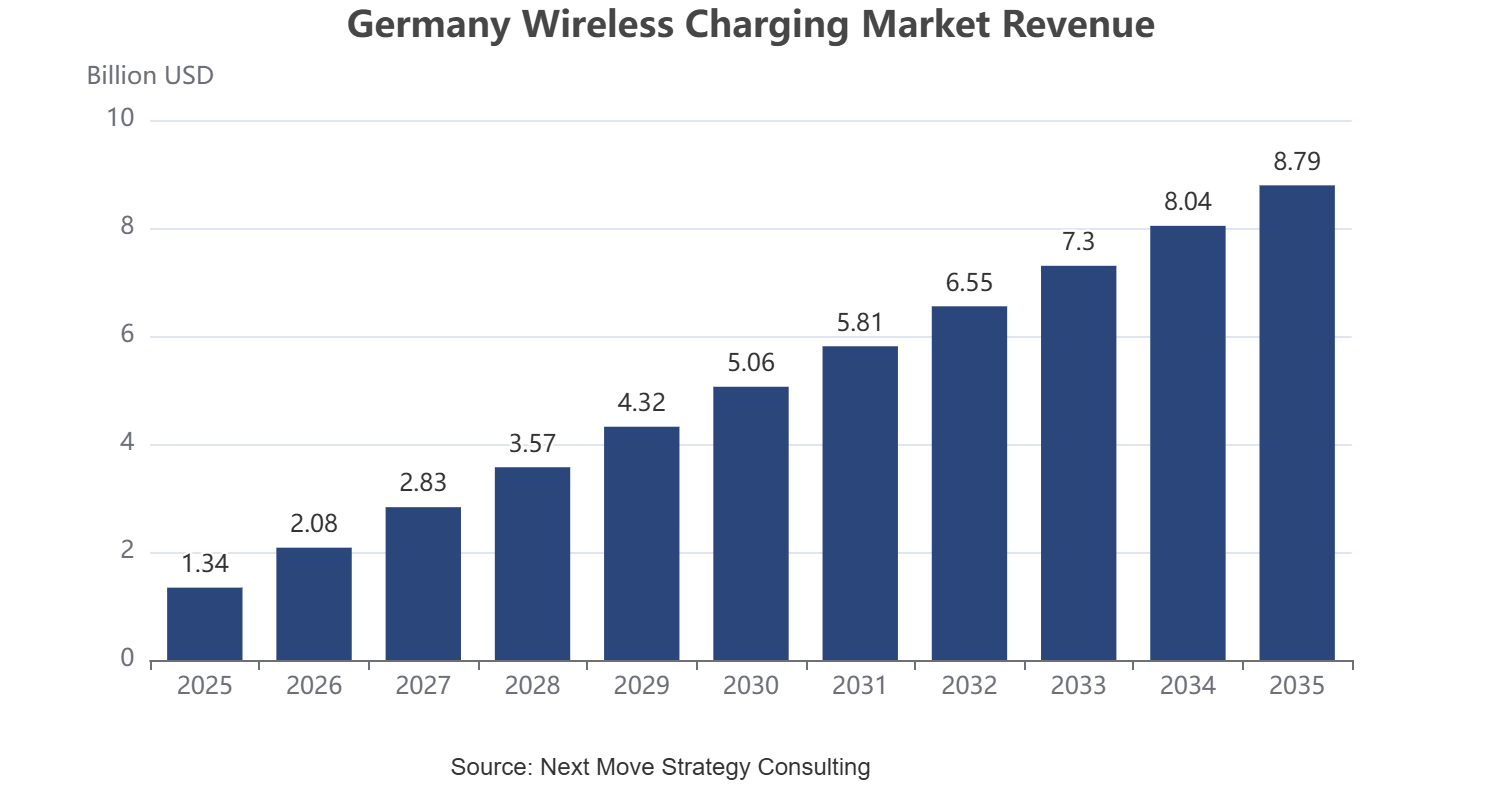
The Germany wireless charging market was valued at USD 1.34 billion in 2025 and is estimated at USD 1.62 billion in 2026. By 2035, the market is projected to reach USD 8.79 billion, reflecting a CAGR of 20.63% from 2026 to 2035. Growth is supported by Germany’s automotive engineering depth, premium consumer device demand, and expanding industrial automation use cases across factories and logistics hubs.
What are the key drivers, restraints, and opportunities shaping the Germany wireless charging market through 2035?
Growth catalyst and risk assessment matrix
|
Drivers / Trends / Restraints |
(+/-) % Impact on CAGR Forecast |
Geographic Relevance |
Impact Timeline |
|
Strong automotive R&D ecosystem supports the development and commercialization of wireless EV charging systems, strengthening innovation and pilot deployments across the mobility sector |
+3.2% |
Germany |
Medium to long term (3–7 years) |
|
Growing premium consumer electronics market drives adoption of wireless charging-enabled smartphones, wearables, and other connected devices |
+2.6% |
Germany |
Short to medium term (1–4 years) |
|
Germany’s leadership in industrial automation and Industry 4.0 accelerates wireless charging adoption across AGVs, AMRs, robotics, and factory equipment |
+3.4% |
Germany |
Medium term (2–5 years) |
|
Energy transfer losses remain higher than wired charging systems, limiting adoption in efficiency-sensitive and high-power applications |
-1.7% |
Germany |
Short to medium term (1–4 years) |
|
Industrial-scale deployment of wireless charging infrastructure for electric mobility creates new growth opportunities across transportation and logistics sectors |
+3.8% |
Germany |
Long term (5–10 years) |
Germany’s wireless charging landscape is shaped by a mix of mobility innovation, premium device adoption, and industrial digitization. Automotive suppliers, consumer electronics brands, and factory operators are all contributing to demand, while standardization and efficiency concerns continue to influence purchasing decisions. The following assessment highlights the market forces most likely to shape revenue expansion, adoption timing, and deployment depth across the forecast period.
Growth Driver:
How does a strong automotive R&D ecosystem support development of wireless EV charging systems?
Germany’s automotive R&D ecosystem is a critical enabler for wireless EV charging because it brings together vehicle engineers, tier-one suppliers, and test infrastructure under one innovation network. That environment accelerates prototyping for stationary and dynamic charging, improves alignment between vehicle platforms and charging pads, and supports safety validation. As a result, domestic engineering strength is helping Germany move from concept testing toward scalable mobility deployment.
How is the growing premium consumer electronics market driving device-level adoption?
Germany’s premium consumer electronics market is expanding adoption by making wireless charging a standard feature in higher-value smartphones, wearables, laptops, and accessories. Consumers in this segment tend to pay more for convenience, sleek product design, and ecosystem compatibility, which supports faster uptake than in budget categories. That preference also gives brands room to bundle charging accessories, strengthen loyalty, and expand repeat purchases across retail and online channels.
How does Germany’s industrial automation leadership expand wireless charging adoption?
Germany’s leadership in industrial automation and Industry 4.0 is creating a strong opening for wireless charging in factories, warehouses, and automated production lines. AGVs, AMRs, robots, and smart tools benefit from contactless power transfer because it reduces wear on connectors, lowers maintenance interruptions, and supports continuous workflows. As industrial buyers pursue higher uptime and more autonomous operations, wireless charging becomes a practical infrastructure layer rather than just a consumer convenience.
Growth Inhibitor:
Why do energy transfer losses continue to restrain market adoption?
Energy transfer losses remain a meaningful restraint because wired charging still delivers better efficiency, faster energy conversion, and clearer performance expectations in many environments. Buyers evaluating large-scale deployments often compare total operating cost, heat management, and charging speed before approving procurement. When wireless systems cannot match wired convenience with similar efficiency, enterprise adoption slows and premium pricing becomes harder to justify.
Growth Opportunity:
How will industrial-scale deployment of wireless charging for electric mobility create new growth avenues?
Industrial-scale deployment of wireless charging for electric mobility could unlock a major new revenue stream in Germany by supporting fleets, depots, smart corridors, and high-utilization transport routes. Where operational uptime matters more than short-term installation cost, contactless charging can reduce range anxiety and simplify vehicle scheduling. If pilots move into commercial rollout, the market could gain a broader infrastructure role across logistics, public transit, and managed mobility networks.
Supply Chain Structure of the Germany Wireless Charging Market
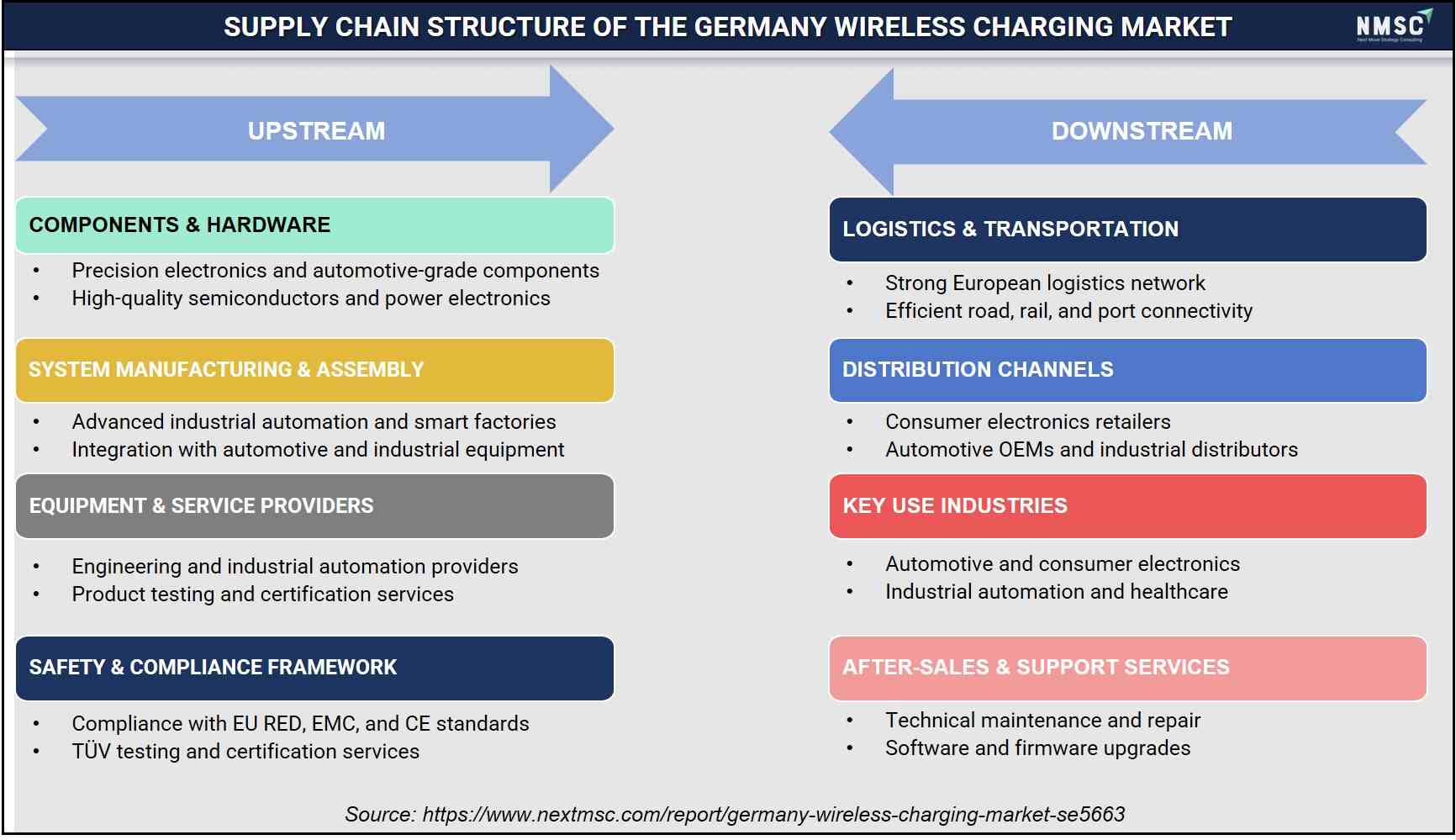
Germany’s wireless charging market is supported by a highly advanced industrial and automotive manufacturing ecosystem. Upstream activities are driven by precision electronics, automotive-grade components, power semiconductors, and engineering expertise, while system integration benefits from smart factory capabilities and Industry 4.0 adoption. Downstream, strong logistics infrastructure, established distribution networks, and robust after-sales services support efficient market delivery. Compliance with EU and TÜV certification standards further ensures product quality, interoperability, and regulatory alignment across automotive, industrial, healthcare, and consumer electronics applications.
How Is the Germany Wireless Charging Market Segmented, and What Are the Key Insights from the Segmentation Analysis?
By Technology
How is the technology segmentation shaping revenue distribution in the Germany wireless charging market?
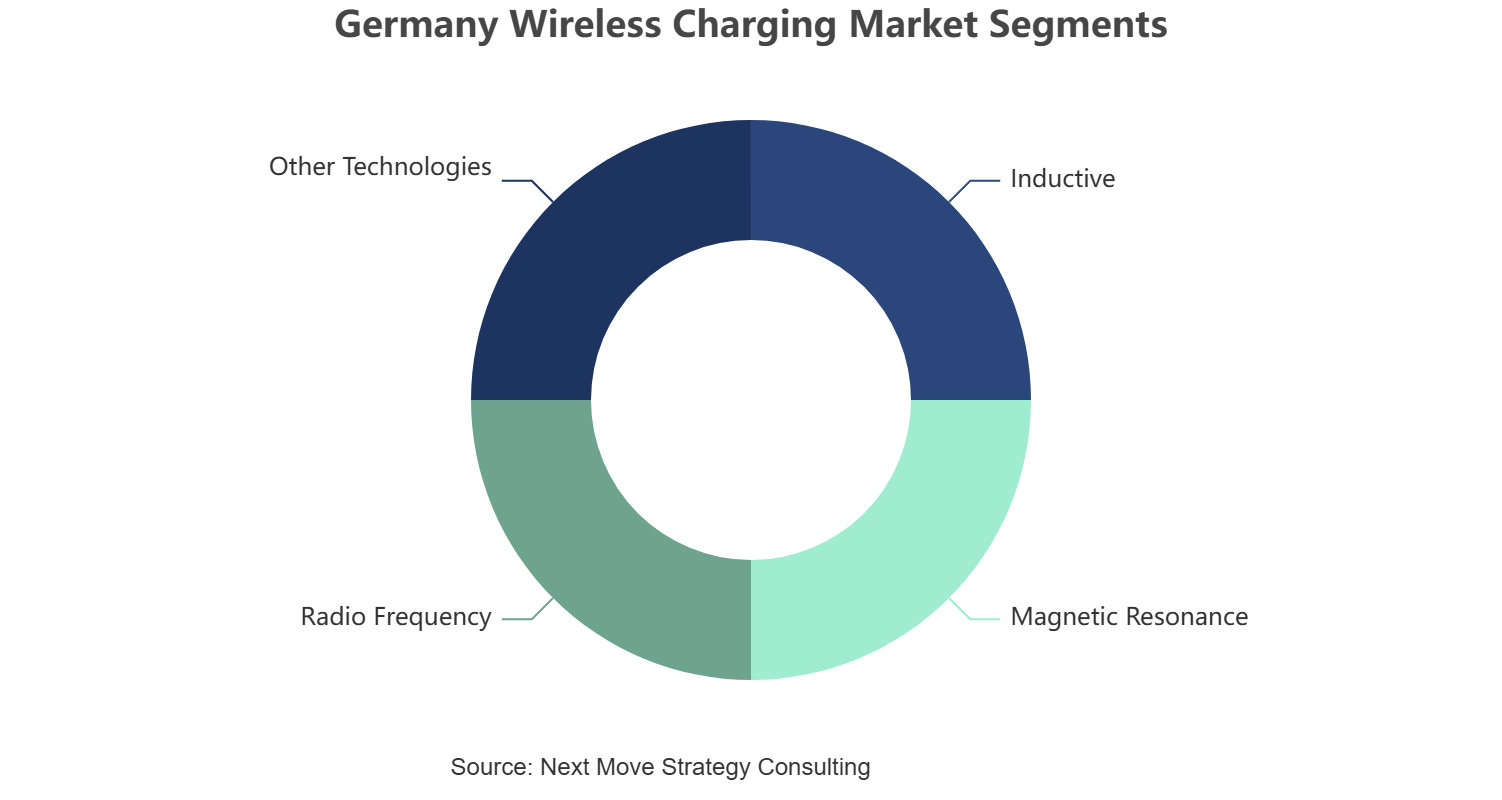
Based on technology, the market is segmented into inductive, magnetic resonance, radio frequency, and other technologies. Inductive platforms currently anchor mainstream consumer adoption, while magnetic resonance is gaining traction where alignment flexibility and broader device compatibility matter. Radio frequency and niche alternatives remain smaller but support specialized, lower-power, and experimental deployments.
The technology mix will evolve as buyers place greater value on charging efficiency, thermal stability, and multi-device interoperability. Inductive systems should remain the volume leader because of mature supply chains and strong consumer familiarity, but magnetic resonance may capture higher-value opportunities in automotive and industrial environments. Vendors that can combine software control, safety features, and design flexibility will be best positioned to expand share as use cases become more integrated.
By Distribution Channel
How is the distribution channel segmentation driving demand across the Germany wireless charging market?
Based on distribution channel, the market is segmented into online, offline retail, OEM supply, and direct enterprise. Online channels are expected to account for a significant share of sales due to strong e-commerce adoption and broad product availability. Offline retail remains important for product demonstrations and consumer trust, while OEM supply is expanding as wireless charging becomes increasingly integrated into consumer electronics and vehicles. Direct enterprise channels continue to serve commercial and industrial deployment requirements.
The distribution channel mix will evolve as wireless charging becomes more deeply embedded across devices and business environments. Online and offline retail channels should remain important for consumer purchases, while OEM supply is likely to gain share through factory-integrated solutions. Direct enterprise sales can expand alongside adoption in commercial, healthcare, hospitality, and industrial settings, supporting broader market development over the forecast period.
Key segments
By Technology
-
Inductive
-
Magnetic Resonance
-
Radio Frequency
-
Other Technologies
By Power Level
-
Low Power (≤ 15 W)
-
Medium Power (>15 W to 60 W)
-
High Power (>60 W to 500 W)
-
Ultra High Power (>500 W)
By Application
-
Consumer Electronics
-
Smartphones and Tablets
-
Wearable
-
Laptops and Notebooks
-
Other Consumer Devices
-
-
Automotive
-
In-Vehicle Chargers
-
Stationary EV Charging
-
Dynamic EV Charging
-
-
Healthcare
-
Implantable Devices
-
Portable Equipment
-
-
Industrial
-
AGVs & AMRs
-
Robots
-
Tools & Machinery
-
Other Industrial Uses
-
-
Aerospace & Defense
-
UAVs
-
Military Equipment
-
-
Other Applications
By Distribution Channel
-
Online
-
Offline Retail
-
OEM Supply
-
Direct Enterprise
Strategic Framework of the Germany Wireless Charging Market
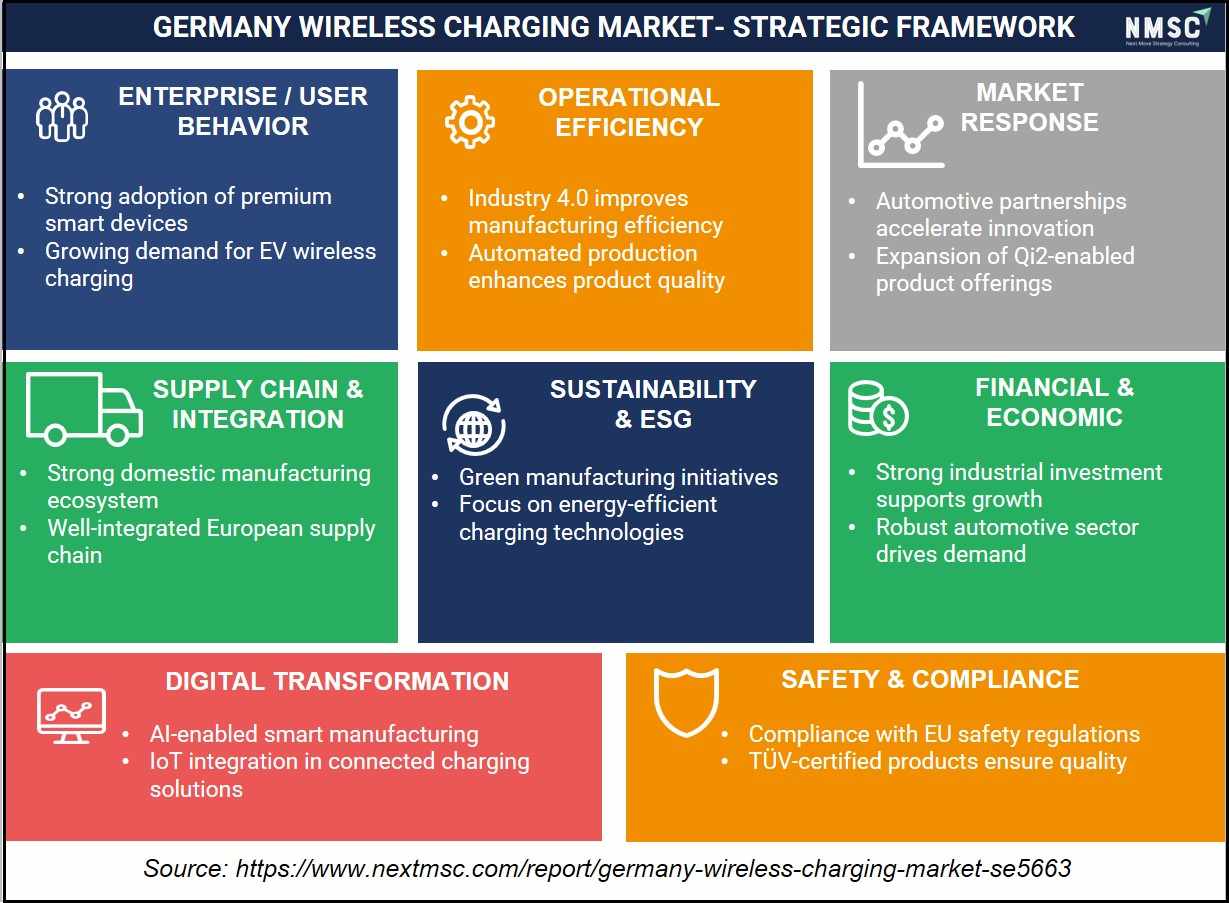
Germany’s wireless charging market is benefiting from strong demand for premium smart devices and increasing interest in wireless EV charging solutions. The country’s Industry 4.0 leadership, automated manufacturing capabilities, and well-integrated European supply chain enhance operational efficiency and product quality. Strong industrial investments, automotive sector innovation, and sustainability initiatives support market expansion, while AI-enabled manufacturing, IoT-connected charging solutions, and compliance with stringent EU safety and TÜV certification standards strengthen competitiveness, reliability, and long-term market growth.
Competitive landscape
The Germany wireless charging market is becoming increasingly competitive as consumer electronics brands, industrial suppliers, and automotive technology providers target overlapping customer needs. Competition centers on charging speed, interoperability, safety, industrial durability, and the ability to support multiple device categories without added complexity. Partnerships with OEMs, retailers, fleet operators, and infrastructure developers are especially important because they help vendors embed wireless power into larger adoption ecosystems.
Key players
-
UGREEN LIMITED GmbH
-
ZAGG International
-
Apple Retail Germany B.V. & Co. KG.
-
Robert Bosch GmbH
-
Infineon Technologies AG
-
Continental Aktiengesellschaft (Continental AG).
-
Xiaomi Technology Germany GmbH
-
Belkin International, Inc.
-
Powercast Corporation
-
GAO Tek Inc.
-
Conductix-Wampfler GmbH
-
Lenovo (Deutschland) GmbH.
-
IKEA Deutschland GmbH & Co. KG
Apple Retail Germany B.V. & Co. KG., Samsung Electronics GmbH, and Belkin International, Inc. reinforce premium consumer ecosystems, while UGREEN LIMITED GmbH, Anker Innovations Deutschland GmbH, Xiaomi Technology Germany GmbH, and ZAGG International compete on design depth, charging convenience, and accessory breadth. Robert Bosch GmbH, Infineon Technologies AG, Continental AG, Conductix-Wampfler GmbH, Lenovo (Deutschland) GmbH, IKEA Deutschland GmbH & Co. KG, Powercast Corporation, GAO Tek Inc.further widen the competitive field across consumer, industrial, and mobility applications.
Key benefits for stakeholders
For investors and strategic planners, the Germany wireless charging market provides a clear view of how consumer demand, automotive engineering, and industrial automation intersect across the value chain. The report helps identify where premium pricing, recurring enterprise contracts, and infrastructure-led demand are most likely to emerge. It also supports capital allocation by clarifying which technologies, applications, and channels offer the strongest long-term commercialization potential.
For manufacturers, distributors, and enterprise buyers, the report clarifies how segment performance, channel preferences, and application priorities shape procurement decisions. Consumer electronics brands can identify accessory opportunities, automotive firms can evaluate charging integration pathways, and industrial operators can assess uptime-driven use cases. Healthcare and aerospace stakeholders can compare reliability requirements, while all participants gain a structured view of product positioning, partnerships, and go-to-market planning.
|
Parameters |
Details |
|
Customization scope |
Free customization, equivalent to up to 80 analyst working hours, after purchase. |
|
Pricing and purchase options |
Avail customized purchase options to meet exact research requirements. |
|
Approach |
In-depth primary and secondary research, proprietary databases, and rigorous validation measures. |
|
Analytical tools |
Porter’s Five Forces, SWOT, value chain, and Harvey ball analysis. |
Conclusion
The Germany wireless charging market is positioned for sustained expansion through 2035, supported by premium consumer device demand, automotive R&D strength, and growing industrial automation adoption. Energy transfer losses remain a constraint, but commercial EV charging deployments and broader ecosystem integration create meaningful long-term opportunity. Competitive intensity will stay high as major brands and specialist vendors compete on compatibility, innovation, and the ability to scale wireless power across consumer, industrial, and mobility applications.
About the Author
 Mihul Sharma
— Mihul Sharma is Research Associate at Next Move Strategy Consulting, where he has covered technology, industrial, and healthcare markets for 3 years. His work applies structured business research, market analysis, and secondary-source review to assess market trends, competitive developments, and growth opportunities. He supports report development by fully synthesizing industry data, company information, and market signals into concise findings for strategy and investment-focused research teams.
Mihul Sharma
— Mihul Sharma is Research Associate at Next Move Strategy Consulting, where he has covered technology, industrial, and healthcare markets for 3 years. His work applies structured business research, market analysis, and secondary-source review to assess market trends, competitive developments, and growth opportunities. He supports report development by fully synthesizing industry data, company information, and market signals into concise findings for strategy and investment-focused research teams.
About the Reviewer
 Supradip Baul
— Supradip Baul is an accomplished business consultant and strategist with over a decade of rich experience in market intelligence, strategy, technology, and business transformation. His work has included rigorous qualitative and quantitative analysis across multiple industries, helping clients shape investment decisions and long-term roadmaps. Earlier in his career, he was associated with Gartner, where he contributed to industry-leading reports and market share analyses. He has worked with leading global companies and holds an MBA with a dual specialization in Marketing and Finance.
Supradip Baul
— Supradip Baul is an accomplished business consultant and strategist with over a decade of rich experience in market intelligence, strategy, technology, and business transformation. His work has included rigorous qualitative and quantitative analysis across multiple industries, helping clients shape investment decisions and long-term roadmaps. Earlier in his career, he was associated with Gartner, where he contributed to industry-leading reports and market share analyses. He has worked with leading global companies and holds an MBA with a dual specialization in Marketing and Finance.
At Next Move Strategy Consulting, we understand that insightful market research is the cornerstone of successful business decisions. That's why we employ a robust and multifaceted approach, combining various methodologies to deliver the most accurate and actionable data for our clients.

Research Landscape
We navigate the world of research with two primary approaches:
Qualitative Approach
Our qualitative research methodologies involve immersive techniques such as in-depth interviews, focus groups, and observational studies. By engaging directly with individuals and stakeholders, we uncover valuable insights that quantitative data alone may overlook.

Quantitative Research
In tandem with qualitative methodologies, NMSC leverages the power of Quantitative Research to provide a robust foundation of numerical insights. Through systematic data collection and analysis, we quantify patterns, preferences, and market trends, offering a comprehensive view of the business landscape.
Our quantitative research approach employs diverse tools, including surveys, experiments, and statistical modelling. These methodologies enable us to gather data from a large and representative sample, ensuring the statistical significance of our findings. By employing structured questionnaires and standardized data collection methods, we guarantee the reliability and validity of the information we present to our clients.
Quantitative research is particularly effective in measuring the prevalence of trends, assessing market size, and gauging the impact of various factors on consumer behavior. The numerical precision attained through this approach equips our clients with actionable insights, facilitating data-driven decision-making and strategy formulation.


Our Specialized Toolbox for Industry-Specific Market Research
We deploy a specialized arsenal of techniques tailored to meet your unique requirements. Here's a glimpse into our comprehensive toolbox:

Information Procurement
The stage entails acquiring market data or relevant information through various sources and methodologies.


Market Research Approach
We utilize both top-down and bottom-up approaches in market research analysis to achieve a comprehensive understanding of the market dynamics, leveraging the broad perspective of industry trends and macroeconomic factors alongside detailed insights from specific segments and individual companies.

Porters Five Forces Analysis
We conduct Porter's Five Forces analysis to evaluate the competitive landscape of an industry, providing us with insights into factors that affect profitability and strategic positioning.

SWOT Analysis

Forecasting
We utilize a forecasting model to predict future consumption by considering parameters like population, economics, regulations, market competition, drivers, constraints, technology, and pricing. We also employ statistical techniques such as multilinear regression, exponential smoothing, moving average, ARIMA, and Monte Carlo simulations for accurate predictions. In econometric forecasting, we analyzed short-term and long-term event impacts, attributing values based on regulatory frameworks, economic factors, and market events.





 Speak to Our Analyst