Glass Waveguide Components and Process Equipment Market

Glass waveguide components and process equipment market size was USD 1.85 billion in 2025, projected to reach USD 15.59 billion by 2035 at a 24.0% CAGR.

Download Free Sample PDF
Base Year (2025)
$1.85 Billion
Forecast (2035)
$15.59 Billion
CAGR (2026-2035)
24.0%
Top Region
Asia-Pacific

What Is the Glass Waveguide Components and Process Equipment Market Size?

The global glass waveguide components and process equipment market size was valued at USD 1.85 billion in 2025 and is estimated at USD 2.25 billion in 2026, forecast to reach USD 15.59 billion by 2035, expanding at a 24.0% CAGR between 2026 and 2035. Asia-Pacific leads with approximately 42% share, while Glass Waveguide Components dominate all other offering tiers with approximately 44% share.

We observed that growth is broad-based across every segmentation axis, with high refractive index glass and AR display waveguide manufacturing driving the dominant structural shifts through 2035.

Glass Waveguide Components and Process Equipment Market Revenue Forecast

Values in USD Billion

2025 $1.85 Billion
2025
2026 $2.29 Billion
2026
2027 $2.84 Billion
2027
2028 $3.53 Billion
2028
2029 $4.37 Billion
2029
2030 $5.42 Billion
2030
2031 $6.73 Billion
2031
2032 $8.34 Billion
2032
2033 $10.34 Billion
2033
2034 $12.82 Billion
2034
2035 $15.59 Billion
2035

Key Takeaways

By Offering Tier: Glass Waveguide Components held the largest share of approximately 44% (USD 814 million) in 2025; Glass Waveguide Components is also the fastest-growing offering tier at 25.5% CAGR from 2026–2035.

By Glass Type: High Refractive Index Glass held the largest share of approximately 42% (USD 777 million) in 2025; High Refractive Index Glass is also the fastest-growing glass type at 25.3% CAGR from 2026–2035.

By End Use Application: Telecom and Datacenters held the largest share of approximately 37% (USD 684 million) in 2025; AR and Spatial Computing is the fastest-growing application at 26.3% CAGR from 2026–2035.

By Sales Channel: Direct OEM Sales held the largest share of approximately 58% (USD 1.07 billion) in 2025; Contract Manufacturing is the fastest-growing channel at 24.5% CAGR from 2026–2035.

Dominant Region: Asia-Pacific dominated with approximately 42% revenue share (USD 777 million) in 2025.

Fastest-Growing Region: Asia-Pacific is expected to register the highest CAGR of 25.7% during 2026–2035.

Dominant Country: U.S. led with approximately USD 476 million in 2025.

Fastest-Growing Country: India is the fastest-growing country at approximately 29.8% CAGR from 2026–2035.

Market Opportunity: The glass waveguide components and process equipment market is expected to create an absolute dollar opportunity of USD 13.34 billion between 2026 and 2035, presenting significant investment potential across the high refractive index glass and nanoimprint lithography value chain.

According to NMSC analysis, glass and equipment suppliers are increasingly co-locating optical glass production, wafer processing, and waveguide assembly under integrated manufacturing footprints to shorten qualification cycles, a shift that favors vertically capable vendors over standalone glass or equipment specialists as AR glasses and AI datacenter customers accelerate high-volume sourcing decisions through 2035.

What Does the Glass Waveguide Components and Process Equipment Market Encompass?

The glass waveguide components and process equipment market encompasses specialty glass wafers and substrates, finished glass waveguide components, and the process equipment used to manufacture them, spanning applications from augmented reality eyepieces to photonic integrated circuits used in AI datacenter optical interconnects. Our assessment indicates that the scope covers wafer and panel format substrates, telecom, AR display, PIC, and sensing waveguide components, and the nanoimprint lithography, etch, deposition, bonding, and metrology equipment used across the value chain, supplied to consumer electronics OEMs, semiconductor foundries, and datacenter equipment manufacturers.
Regulatory and industry frameworks including SEMI equipment and materials standards shape process qualification practices, while export control regimes affecting advanced semiconductor process equipment continue to influence supply chain structuring for lithography and metrology tools. We observed that technology adoption is shifting from experimental AR waveguide prototypes toward consumer-scale manufacturing readiness, paralleling growing silicon photonics adoption for co-packaged optics in AI datacenters. NMSC's analysis indicates that this dual demand pull, spanning wearable AR devices and datacenter optical connectivity, is redefining capacity investment priorities across the glass waveguide components and process equipment market.

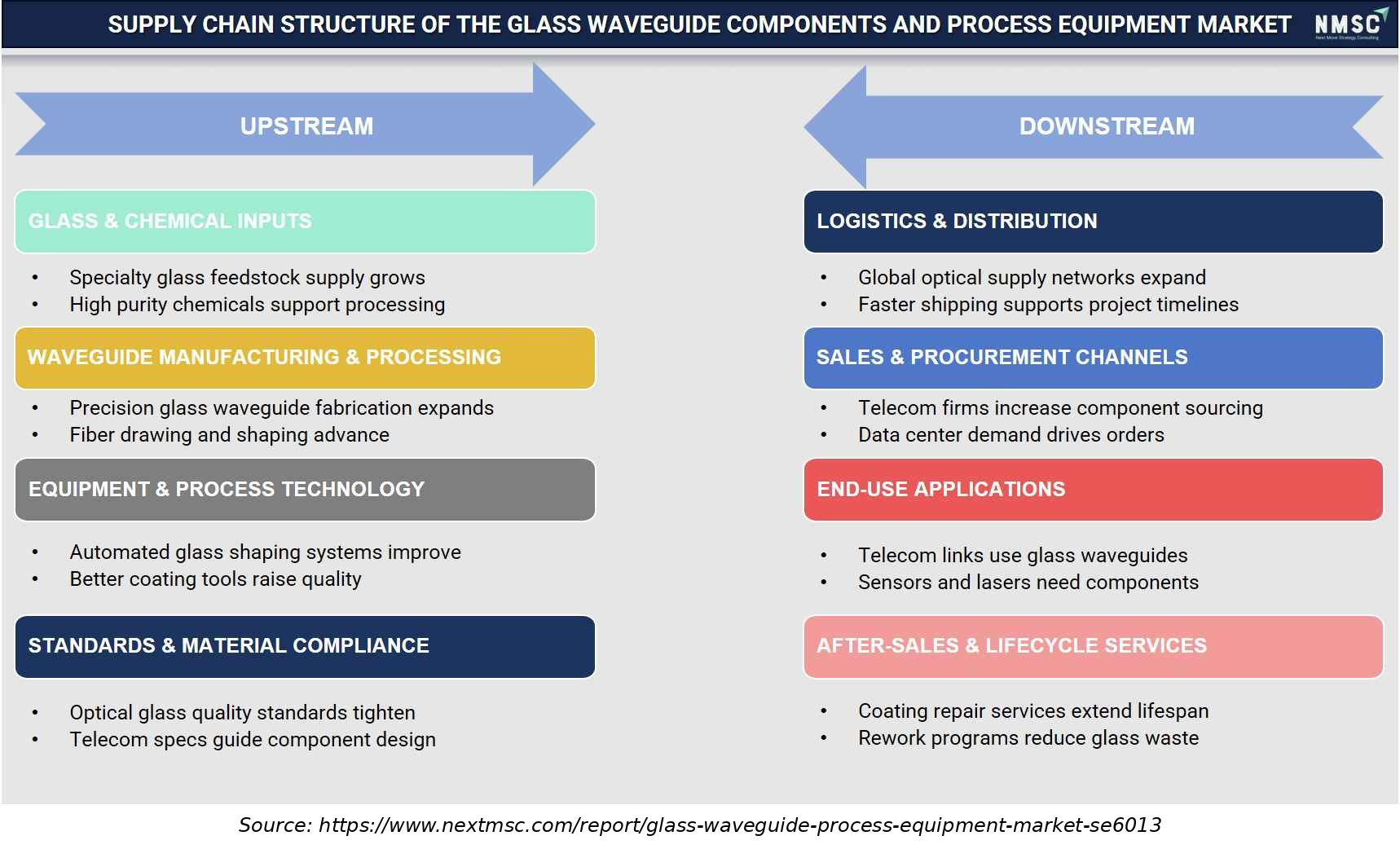
Supply Chain Structure Analysis of the Glass Waveguide Components and Process Equipment Market

Supply Chain Structure Analysis of the Glass Waveguide Components and Process Equipment Market
The supply chain structure of the Glass Waveguide Components and Process Equipment Market spans upstream glass and chemical inputs, waveguide manufacturing, equipment and process technology, and standards compliance before reaching downstream logistics, sales channels, end-use applications, and lifecycle services. This framework highlights the importance of specialized materials, precision processing, efficient distribution, application-specific demand, and ongoing maintenance in supporting market development.

Market Drivers & Dynamics

Interactive Dataset
Accelerating AI datacenter demand for co-packaged optics and optical interconnects driver +4.1% Global 2026–2035
Consumer-scale AR smart glasses commercialization by major technology brands driver +3.6% North America, Asia-Pacific 2026–2035
Expanding nanoimprint lithography capacity for high-volume waveguide fabrication driver +2.8% Global 2026–2032
Rising investment in photonic integrated circuit packaging and testing infrastructure driver +2.3% Asia-Pacific, North America 2026–2035
Growing demand for high refractive index glass wafers from AR optics developers driver +1.9% Global 2027–2035
Expanding aerospace and defense sensing applications for glass waveguide components driver +1.2% North America, Europe 2026–2035
Semiconductor equipment export control restrictions affecting cross-border supply chains restraint −2.1% Asia-Pacific 2026–2032
High capital intensity and long qualification cycles for waveguide process equipment restraint −1.4% Global 2026–2030
Yield and cost challenges in scaling geometric reflective waveguide manufacturing restraint −1.0% Global 2026–2029
Source: Next Move Strategy Consulting

Growth Drivers

What Is the Primary Growth Driver of the Glass Waveguide Components and Process Equipment Market?

Accelerating AI datacenter demand for optical interconnects is the primary driver of the market. Corning Incorporated reported that its Optical Communications segment sales grew 36% year over year in the first quarter of 2026, with management citing robust demand for generative AI products and new hyperscale customer agreements as key contributors. We observed that this datacenter-driven demand, combined with growing co-packaged optics adoption, continues to anchor baseline capacity investment across glass waveguide and process equipment suppliers.

How Is AR Smart Glasses Commercialization Driving Market Growth?

Consumer augmented reality smart glasses commercialization is accelerating market growth toward high-volume glass waveguide manufacturing. SCHOTT AG's September 2025 announcement of consumer-scale geometric reflective waveguide production, alongside its established partnership with Lumus Ltd., illustrates how major technology brands are moving AR eyepieces from prototype to mass-market hardware. Our assessment indicates that this commercialization milestone is compressing procurement timelines for waveguide glass and nanoimprint lithography equipment suppliers across North America and Asia-Pacific.

Growth Inhibitors

What Is Restraining Glass Waveguide Components and Process Equipment Market Expansion?

Semiconductor equipment export control restrictions restrain broader market expansion, particularly for advanced lithography and metrology tools moving across certain international borders. These restrictions can complicate supply chain planning for equipment vendors and their customers operating across multiple manufacturing regions. We found that smaller regional equipment suppliers face particular exposure, as compliance complexity and qualification delays slow adoption compared with established global suppliers with diversified regional manufacturing footprints.

Segmentation Analysis

2025 (USD Billion)
2035 (USD Billion)
Glass Waveguide Components 2025: $0.81 Billion | 2035: $7.64 Billion
Glass Wavegu
Process Equipment 2025: $0.63 Billion | 2035: $4.99 Billion
Process Equi
Glass Wafer and Substrate 2025: $0.41 Billion | 2035: $2.96 Billion
Glass Wafer
Glass Waveguide Components $0.81 Billion $7.64 Billion 25.5%
Process Equipment $0.63 Billion $4.99 Billion 23.2%
Glass Wafer and Substrate $0.41 Billion $2.96 Billion 22.0%

Which Offering Tier Dominates the Glass Waveguide Components and Process Equipment Market?

Glass Waveguide Components led the market with USD 814 million in 2025, supported by rising finished-component demand from AR eyepiece and photonic integrated circuit manufacturers moving into volume production. We observed that Glass Waveguide Components is also the fastest-growing offering tier, expanding at a 25.5% CAGR from 2026 to 2035, as consumer-scale AR smart glasses programs and AI datacenter optical interconnect deployments both draw on finished waveguide component supply.

2025 (USD Billion)
2035 (USD Billion)
High Refract
Silica on Si
Doped Silica
Other Glass
Segment Item 2025 (USD Billion) 2035 (USD Billion) CAGR
High Refractive Index Glass $10.0 USD Billion $40.0 USD Billion 25.0%
Silica on Silicon $17.1 USD Billion $51.1 USD Billion 11.0%
Doped Silica $24.2 USD Billion $62.2 USD Billion 25.0%
Other Glass $31.3 USD Billion $73.3 USD Billion 11.0%

Segment-wise data is locked

Unlock complete segment-wise numbers for Glass Type.

Unlock Full Data

Which Glass Type Leads Glass Waveguide Components and Process Equipment Market Demand?

High Refractive Index Glass remained the dominant glass type, reaching USD 777 million in 2025 due to its essential role in diffractive and geometric reflective AR waveguide architectures. Our findings suggest that High Refractive Index Glass is also the fastest-growing glass type, registering a 25.3% CAGR from 2026 to 2035, as AR device makers scale field-of-view and image quality requirements that depend on higher-index optical substrates.

2025 (USD Billion)
2035 (USD Billion)
Telecom and
AR and Spati
Industrial
Medical and
Aerospace an
Segment Item 2025 (USD Billion) 2035 (USD Billion) CAGR
Telecom and Datacenters $10.0 USD Billion $40.0 USD Billion 27.0%
AR and Spatial Computing $17.1 USD Billion $51.1 USD Billion 9.0%
Industrial $24.2 USD Billion $62.2 USD Billion 19.0%
Medical and Sensing $31.3 USD Billion $73.3 USD Billion 17.0%
Aerospace and Defense $38.4 USD Billion $84.4 USD Billion 18.0%

Segment-wise data is locked

Unlock complete segment-wise numbers for End Use Application.

Unlock Full Data

Which End Use Application Leads Glass Waveguide Components and Process Equipment Market Adoption?

Telecom and Datacenters remained the leading end use application, valued at USD 684 million in 2025 on sustained optical interconnect demand from hyperscale and AI computing infrastructure buildouts. We found that AR and Spatial Computing is the fastest-growing application, registering a 26.3% CAGR from 2026 to 2035, as consumer-scale smart glasses commercialization drives rapidly expanding glass waveguide component and process equipment demand from device manufacturers.

2025 (USD Billion)
2035 (USD Billion)
Direct OEM S
Contract Man
Distributor
Segment Item 2025 (USD Billion) 2035 (USD Billion) CAGR
Direct OEM Sales $10.0 USD Billion $40.0 USD Billion 14.0%
Contract Manufacturing $17.1 USD Billion $51.1 USD Billion 24.0%
Distributor Sales $24.2 USD Billion $62.2 USD Billion 22.0%

Segment-wise data is locked

Unlock complete segment-wise numbers for Sales Channel.

Unlock Full Data

Growth Opportunities

Our analysis shows that three forward-looking opportunities stand out for stakeholders positioning within the glass waveguide components and process equipment market over the 2026-2035 forecast period.

How Can Co-Packaged Optics Integration Unlock Value for Datacenter Suppliers?

Deeper co-packaged optics integration presents a whitespace opportunity for glass waveguide suppliers serving AI datacenter customers. Vendors that develop detachable fiber-to-chip coupling solutions compatible with leading silicon photonics platforms stand to capture recurring supply contracts as hyperscale operators standardize optical interconnect architectures across next-generation network infrastructure.

Where Does Contract Manufacturing Create New Demand for AR Waveguide Suppliers?

Contract manufacturing capacity for AR waveguide components represents an underpenetrated opportunity as device brands seek manufacturing partners capable of consumer-scale output. Smart glass developers without in-house glass processing capability can secure long-term supply agreements with vendors offering integrated glass, coating, and waveguide assembly services.

How Can Metrology and Inspection Innovation Expand Equipment Vendor Reach?

Advanced metrology and inspection tools tailored to waveguide-specific defect detection create an opportunity for process equipment vendors to extend beyond core lithography and etch offerings. Early movers that develop specialized inspection capability for nanoscale waveguide structures can differentiate against general-purpose semiconductor metrology competitors serving broader chip manufacturing markets.

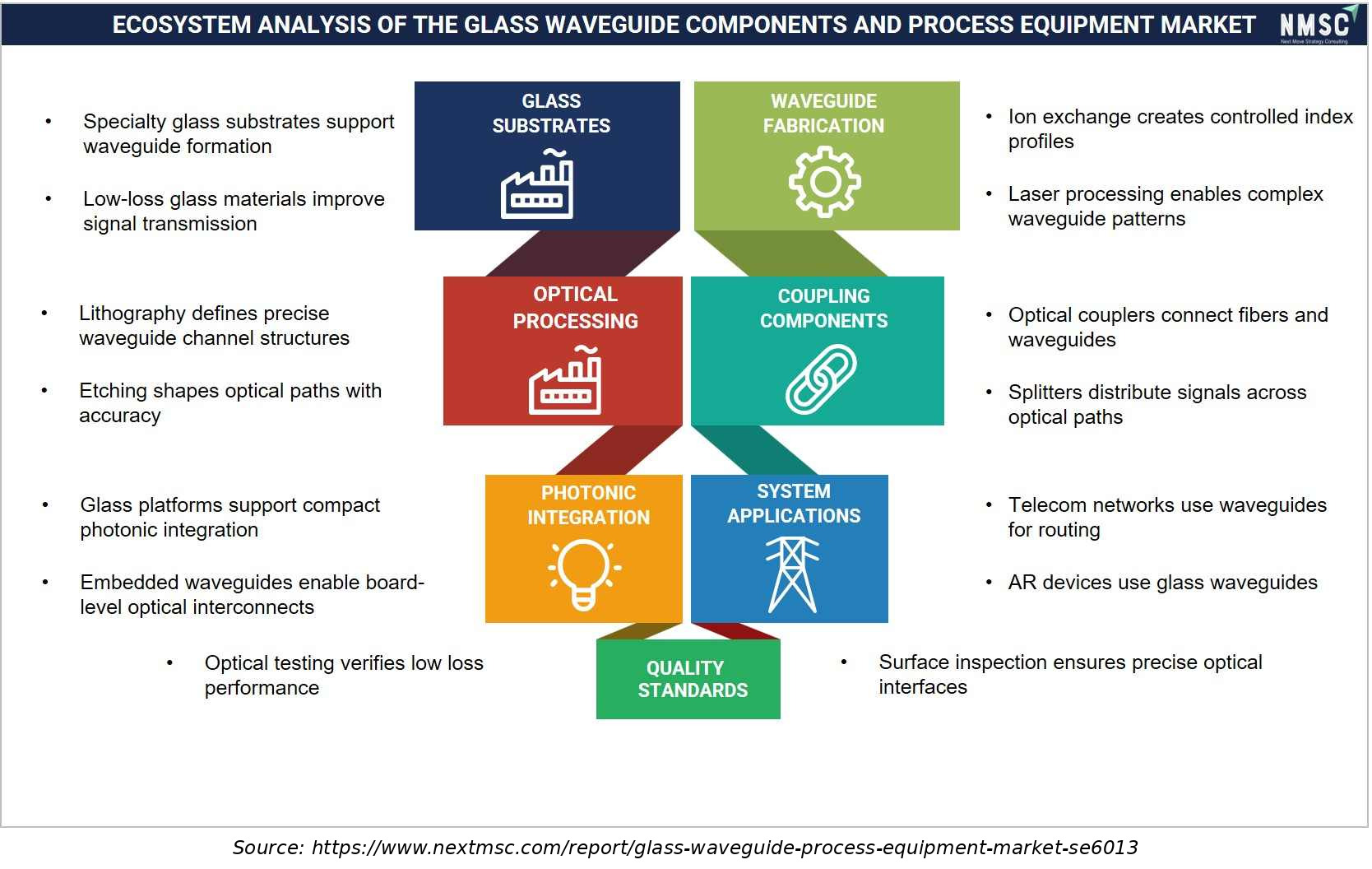
Ecosystem Analysis of the Glass Waveguide Components and Process Equipment Market

The ecosystem analysis maps the major participants and value-creation stages across the Glass Waveguide Components and Process Equipment Market. Glass substrate suppliers provide foundational materials, followed by waveguide fabrication, optical processing, coupling components, photonic integration, and system applications. Quality standards provide an overarching framework, ensuring that optical performance, component compatibility, manufacturing precision, and application requirements are addressed throughout the ecosystem.

Regional Outlook

2025 (USD Billion)
2035 (USD Billion)
Asia-Pacific
North Americ
Europe
Middle East
Latin Americ
Region 2025 (USD Billion) 2035 (USD Billion) CAGR (%)
Asia-Pacific $10.0 USD Billion $40.0 USD Billion 9.0%
North America $17.1 USD Billion $51.1 USD Billion 27.0%
Europe $24.2 USD Billion $62.2 USD Billion 25.0%
Middle East & Africa $31.3 USD Billion $73.3 USD Billion 23.0%
Latin America $38.4 USD Billion $84.4 USD Billion 12.0%

Regional data is locked

Unlock complete regional numbers for this market.

Unlock Full Data

Competitive Landscape

We observed that the glass waveguide components and process equipment market features a moderately consolidated competitive landscape, with specialty glass conglomerates and semiconductor process equipment leaders competing alongside AR-focused component specialists on manufacturing scale, optical performance, and integration depth.

Dimension Description
Market Structure Moderately consolidated; specialty glass majors and established semiconductor process equipment vendors account for a significant share of global revenue, while specialized AR waveguide and component developers compete for design wins in emerging applications.
Innovation Focus Consumer-scale geometric reflective and diffractive waveguide manufacturing, co-packaged optics integration, and next-generation nanoimprint lithography platforms dominate current innovation pipelines across leading vendors.
M&A Activity Active consolidation through strategic acquisitions, exemplified by AAC Technologies Holdings Inc.'s acquisition of Dispelix to accelerate diffractive waveguide technology commercialization.

How Do Companies Compete in the Glass Waveguide Components and Process Equipment Market?

Companies compete primarily on manufacturing scale, optical performance, and integration depth across the industry. Specialty glass majors such as SCHOTT AG and Corning Incorporated leverage decades of optical glass expertise and end-to-end production capability to serve AR device and datacenter customers, while process equipment leaders such as EV Group and Applied Materials, Inc. compete on lithography resolution, throughput, and cost-of-ownership for high-volume waveguide fabrication.

Which Competitive Archetypes Dominate the Glass Waveguide Components and Process Equipment Market?

Two archetypes dominate the market: vertically integrated specialty glass and optics suppliers offering end-to-end waveguide manufacturing, and semiconductor process equipment vendors offering the lithography, etch, and metrology tools that enable waveguide fabrication. SCHOTT AG and AGC Inc. exemplify the vertically integrated archetype through combined glass and waveguide production, while EV Group and SUSS MicroTec SE exemplify the equipment archetype through specialized nanoimprint and bonding technology.

How Are Companies Differentiating Through Innovation in Glass Waveguide Components and Process Equipment?

Innovation and differentiation strategy increasingly center on consumer-scale manufacturing readiness and co-packaged optics integration. SCHOTT AG's geometric reflective waveguide serial production and Corning Incorporated's GlassBridge edge-coupling solution both address distinct high-growth applications within the same underlying glass waveguide technology base. Our analysis shows that vendors unable to demonstrate high-volume manufacturing readiness risk exclusion from design wins with major AR device brands and hyperscale datacenter customers.

What M&A Activity Is Shaping the Glass Waveguide Components and Process Equipment Market?

Mergers, acquisitions, and strategic partnerships continue to consolidate capabilities within the industry. AAC Technologies Holdings Inc.'s acquisition of Dispelix strengthens its diffractive waveguide technology portfolio, while Corning Incorporated's collaboration with GlobalFoundries on silicon photonics edge-coupling illustrates how glass suppliers are partnering with semiconductor foundries to expand distribution into new co-packaged optics applications.

Key Market Players

Our assessment indicates that the following 20 companies are actively shaping product innovation, capacity expansion, and go-to-market strategy within the global glass waveguide components and process equipment market.

Corning Incorporated SCHOTT AG AGC Inc. Sumitomo Electric Industries, Ltd. Furukawa Electric Co., Ltd. Yangtze Optical Fibre and Cable Joint Stock Limited Company (YOFC) Henan Shijia Photons Technology Co., Ltd. LioniX International Lumus Ltd. Goertek Inc. AAC Technologies Holdings Inc. Sunny Optical Technology (Group) Company Limited DigiLens Inc. EV Group (EVG) SUSS MicroTec SE Morphotonics Applied Materials, Inc. NAURA Technology Group Co., Ltd. Advanced Micro-Fabrication Equipment Inc. China (AMEC) Shanghai Micro Electronics Equipment (Group) Co., Ltd. (SMEE)

Latest Developments

We found that recent product launches, capacity investments, and regulatory developments within the glass waveguide components and process equipment market are concentrated on low-carbon formulations and expanding infrastructure demand, reflecting the industry's steady capitalization cycle.

Date Event
September 2025 SCHOTT announced serial production of geometric reflective waveguides for consumer AR devices, integrating optical-glass production, ultra-flat wafer processing, vacuum coating and waveguide processing. The company expanded its Kulim, Malaysia facilities to support high-volume manufacturing and established an integrated supply chain from glass through final waveguide assembly.
September 2025 Goeroptics introduced a silicon-carbide etched full-color diffractive waveguide at CIOE 2025. The fully laminated solution measures 0.65mm thick and weighs 3.5g, targeting glasses-like AR designs while reducing chromatic differences. The company also showcased a high-efficiency Micro-LED full-color nanoimprinted waveguide display module.
September 2025 Corning and GlobalFoundries announced a collaboration on detachable fiber connectors using a glass-waveguide edge coupler compatible with GF Fotonix. The solution targets co-packaged optics for AI infrastructure and is designed to improve bandwidth density and power efficiency while enabling scalable optical connectivity.

Expert Insights

Dr. Ruediger Sprengard

Senior Vice President, Augmented Reality | SCHOTT

"This breakthrough in industrial production of Geometric Reflective Waveguides means nothing less than adding a crucial missing puzzle piece to the AR technology landscape. For years, the promise of lightweight and powerful smart glasses available at scale has been out of reach. Today, we are changing that. By offering Geometric Reflective Waveguides at scale, we’re helping our partners cross the threshold into truly wearable products, providing an immersive experience."

Analyst Interpretation

This is one of the strongest market-development insights for the market because it directly identifies the transition from technologically promising waveguides to serial manufacturing at commercial scale. The development increases demand for high-precision glass processing, wafer preparation, optical coating, waveguide shaping, assembly, and automated inspection equipment. It also suggests that manufacturing capability and production yield are becoming critical competitive factors as AR glasses move closer to broader consumer commercialization.

Investment Opportunities

What Capital Inflows Are Targeting the Glass Waveguide Components and Process Equipment Market?

Capital inflows into the glass waveguide components and process equipment market are increasingly directed toward consumer-scale manufacturing capacity and co-packaged optics integration. Strategic acquisitions such as AAC Technologies Holdings Inc.'s purchase of Dispelix reflect growing investor and corporate interest in diffractive waveguide technology. We observed that investors favor vendors demonstrating measurable manufacturing scale-up milestones, viewing high-volume readiness as a proxy for long-term design-win retention with major device and datacenter customers.

How Is Infrastructure Investment Supporting Glass Waveguide Components and Process Equipment Deployment?

Infrastructure investment is expanding integrated glass, wafer processing, and waveguide assembly capacity to support both AR device and datacenter optical interconnect demand. Our findings suggest that SCHOTT AG's integrated production infrastructure investment and Corning Incorporated's collaboration with GlobalFoundries on silicon photonics packaging both illustrate how suppliers are building dedicated capacity to serve fast-growing end markets without relying solely on external partners.

What ESG Considerations Are Shaping Glass Waveguide Components and Process Equipment Investment Decisions?

Environmental, social, and governance considerations are increasingly relevant to investment decisions, with energy efficiency and supply chain resilience as key criteria. Corning Incorporated's public sustainability and manufacturing disclosures continue to inform enterprise ESG assessments across the optical communications supply chain. We found that investors increasingly favor vendors with diversified, regionally resilient manufacturing footprints, treating supply chain governance as an indicator alongside growth and profitability metrics.

Key Benefits for Stakeholders

How Does This Report Benefit Enterprise and Industry Leaders?

Enterprise and industry leaders gain access to validated segmentation, competitive benchmarking, and regional demand forecasts that support vendor-selection and capacity-investment decisions across the glass waveguide components and process equipment industry. Our analysis shows that detailed offering tier, glass type, and end use breakdowns help procurement and product teams align sourcing strategies with AR device and datacenter optical interconnect requirements while identifying underserved segments for expansion.

How Does This Report Benefit Investors and Financial Analysts?

Investors and financial analysts benefit from consistent, single-point market size and CAGR estimates that support valuation and capital-allocation decisions across the glass waveguide components and process equipment supply chain. We observed that the report's regional and segment-level growth differentials help identify which vendors are best positioned to capture above-market growth in AR and Spatial Computing and Asia-Pacific categories through 2035.

How Does This Report Benefit Technology Vendors and Product Teams?

Technology vendors and product teams gain insight into emerging design requirements, including consumer-scale waveguide manufacturing, co-packaged optics integration, and next-generation nanoimprint lithography, that are reshaping the industry. Our findings suggest that this analysis helps R&D teams prioritize development roadmaps around high-volume manufacturing readiness increasingly required by AR device brands and hyperscale datacenter customers.

Key Market Segments Evaluated

By Offering Tier

  • Glass Wafer and Substrate 
    • Wafer Format
    • Panel Format
    • Other Substrate Format
  • Glass Waveguide Components 
    • Telecom and Datacom Waveguide
    • AR Display Waveguide
    • PIC Waveguide
    • Sensing Waveguide
    • Other Glass Waveguide Component
  • Process Equipment 
    • Nanoimprint Lithography
    • Lithography
    • Etch
    • Deposition
    • Bonding and Lamination
    • Metrology and Inspection
    • Dicing and Packaging

By Glass Type

  • High Refractive Index Glass
  • Silica on Silicon
  • Doped Silica
  • Other Glass

By End Use Application

  • Telecom and Datacenters
  • AR and Spatial Computing
  • Industrial, Medical and Sensing
  • Aerospace and Defense
  • Other Applications

By Sales Channel

  • Direct OEM Sales
  • Contract Manufacturing
  • Distributor Sales

By Region

  • North America 
    • U.S.
    • Canada
    • Mexico
  • Europe 
    • UK
    • Germany
    • France
    • Italy
    • Spain
    • Sweden
    • Denmark
    • Finland
    • Netherlands
    • Rest of Europe
  • Asia-Pacific 
    • China
    • India
    • Japan
    • South Korea
    • Taiwan
    • Indonesia
    • Vietnam
    • Australia
    • Philippines
    • Malaysia
    • Rest of APAC
  • Middle East & Africa 
    • Saudi Arabia
    • UAE
    • Egypt
    • Israel
    • Turkey
    • Nigeria
    • South Africa
    • Rest of MEA
  • Latin America 
    • Brazil
    • Argentina
    • Chile
    • Colombia
    • Rest of LATAM

Conclusion & Recommendations

The long-term outlook for the market remains strongly positive, with global revenue projected to expand more than eightfold from USD 1.85 billion in 2025 to USD 15.59 billion by 2035 at a 24.0% CAGR. We observed that sustained AI datacenter optical interconnect demand, consumer AR smart glasses commercialization, and expanding nanoimprint lithography capacity will continue underpinning demand across telecom, AR, and industrial sensing applications through the forecast period.

What Strategic Positioning Should Glass Waveguide Components and Process Equipment Vendors Pursue?

Vendors should prioritize vertically integrated manufacturing capability spanning glass production, wafer processing, and waveguide assembly to secure long-term design wins with AR device and datacenter customers. Our assessment indicates that vendors investing early in consumer-scale manufacturing readiness and co-packaged optics integration will be best positioned to capture premium pricing within the glass waveguide components and process equipment market.

How Attractive Is the Glass Waveguide Components and Process Equipment Market for New Investment?

The glass waveguide components and process equipment industry presents a highly attractive investment case, supported by a USD 13.34 billion absolute dollar opportunity between 2026 and 2035 and above-average growth in Asia-Pacific and AR and Spatial Computing categories. We found that investment attractiveness is highest for vendors combining proven manufacturing scale with diversified end-market exposure across AR devices, datacenters, and industrial sensing applications.

What Market Shifts and Key Risks Should Stakeholders Monitor?

Stakeholders should monitor semiconductor equipment export control restrictions, high capital intensity, and manufacturing yield challenges as key risks to the glass waveguide components and process equipment market. Our analysis shows that vendors unable to demonstrate resilient, geographically diversified manufacturing capacity risk losing design wins to competitors with established multi-region production footprints, particularly as cross-border equipment trade policies continue to evolve.

What Are the Key Growth Pathways for the Glass Waveguide Components and Process Equipment Market?

Key growth pathways include expanding consumer-scale AR waveguide manufacturing capacity, scaling co-packaged optics integration for AI datacenters, and deepening penetration into aerospace, defense, and industrial sensing applications. NMSC's analysis indicates that vendors pursuing these pathways while maintaining vertically integrated production capability will be best positioned to capture the glass waveguide components and process equipment market's projected growth through 2035.

FAQs

About the Author

Mihul Sharma

Mihul Sharma

Mihul Sharma is Research Associate at Next Move Strategy Consulting, where he has covered technology, industrial, and healthcare markets for 3 years. His work applies structured business research, market analysis, and secondary-source review to assess market trends, competitive developments, and growth opportunities. He supports report development by fully synthesizing industry data, company information, and market signals into concise findings for strategy and investment-focused research teams.

About the Reviewer

Supradip Baul

Supradip Baul

Supradip Baul is an accomplished business consultant and strategist with over a decade of rich experience in market intelligence, strategy, technology, and business transformation. His work has included rigorous qualitative and quantitative analysis across multiple industries, helping clients shape investment decisions and long-term roadmaps. Earlier in his career, he was associated with Gartner, where he contributed to industry-leading reports and market share analyses. He has worked with leading global companies and holds an MBA with a dual specialization in Marketing and Finance.

Download Free Sample

Robert Sean Trevino

ROBERT SEAN TREVINO

Sr. Director, Head of Strategic Insights & Analytics

Foundation Medicine

I realized that it was a reliable source of information. These days, there are many people who are looking for authentic data, and this is one of the only sources that can offer them with what they need;

Melanie Samko

MELANIE SAMKO

Director of Marketing

TOSOH BIOSCIENCE, INC.

The information provided by NMSC is incredibly valuable, thank you so much for such a excellent work. I really appreciate it. I will make sure to reference all of it, in my summary document.

Pratyush Kumar Das

PRATYUSH KUMAR DAS

Assistant Manager

Polycab India Limited

We would like to express our appreciation for the data and insights provided by nextmsc. We are very pleased with the quality and depth of the information, which has proven to be highly valuable and beneficial for our business decision-making.

Diana Trejo

DIANA TREJO

Assistant Manager

Sumitomo Corporation de Mexico, S.A. de C.V.

Recently, we purchased a report on the Mexico Data Center Market from Next Move Strategy Consulting. The service has been excellent, with support that is always timely and thoroughly professional. The information provided is interesting, highly useful, and delivered with clarity. I would highly recommend NextMSC for anyone seeking insightful and dependable analysis.

Rishabh Jogani

RISHABH JOGANI

Strategy Analyst

Accenture Japan

We are incredibly impressed with the market report on the real estate market in India provided by Next Move Strategy Consulting. The report was thorough, insightful, and well-structured, offering deep analysis and actionable recommendations. It not only captured the current trends and dynamics but also provided a forward-looking perspective that has been invaluable for our strategic planning. Their team demonstrated exceptional professionalism, attention to detail, and a profound understanding of the industry. The data-driven insights and clarity of presentation exceeded our expectations, making complex market trends easy to understand. We highly recommend Next Move Strategy Consulting to anyone looking for reliable and comprehensive market research services. Their expertise has given us the confidence to navigate the complexities of the Indian real estate market with clarity and foresight.

Custom Market Research Services

We will customize the research for you if the listed report does not fully match your requirements.

Get 30% Free Customization

Select License

This website uses cookies to ensure you get the best experience on our website. Learn more

✖