Automotive Glass Market By Glass Type (Laminated Glass, Tempered Glass, Other Glass Types), By Vehicle Type (Passenger Car, Commercial Vehicles, Electric Vehicles), By Application {Windshield, Sidelite, Backlite, Sunroof, Rear-View and Side-View Mirrors, Other Applications (Quarter Glass, Vent Glass)}, and By End-Use (Original Equipment Manufacturer, Aftermarket) – Global Opportunity Analysis and Industry Forecast, 2025–2030
Industry: Automotive & Transportation | Publishing Date: June 11, 2026 | Last Updated: October 16, 2026 | No of Pages: N/A | No. of Tables: N/A | No. of Figures: N/A | Format: PDF | Report Code: AT3820
Industry Outlook
The global Automotive Glass Market size was valued at USD 33.03 billion in 2024 and is expected to reach USD 34.77 billion by the end of 2025. The industry is projected to grow, hitting USD 44.97 billion by 2030, with a CAGR of 5.84% between 2025 and 2030.
The automotive glass industry is evolving rapidly, driven by rising consumer demand for safety, comfort, and advanced vehicle technologies. Buyers increasingly prefer features such as laminated and tempered glass, UV protection, acoustic insulation, and smart glass solutions that enhance driving experience and passenger wellbeing. Growing awareness about vehicle safety standards, energy efficiency, and sustainability is shaping purchasing choices, with consumers seeking durable, lightweight, and eco-friendly materials. Manufacturers are responding with advanced coating technologies, energy-efficient production processes, and recyclable glass solutions. By combining safety, comfort, and sustainability, the automotive glass industry is aligning with modern consumer expectations while fostering innovation and market growth.
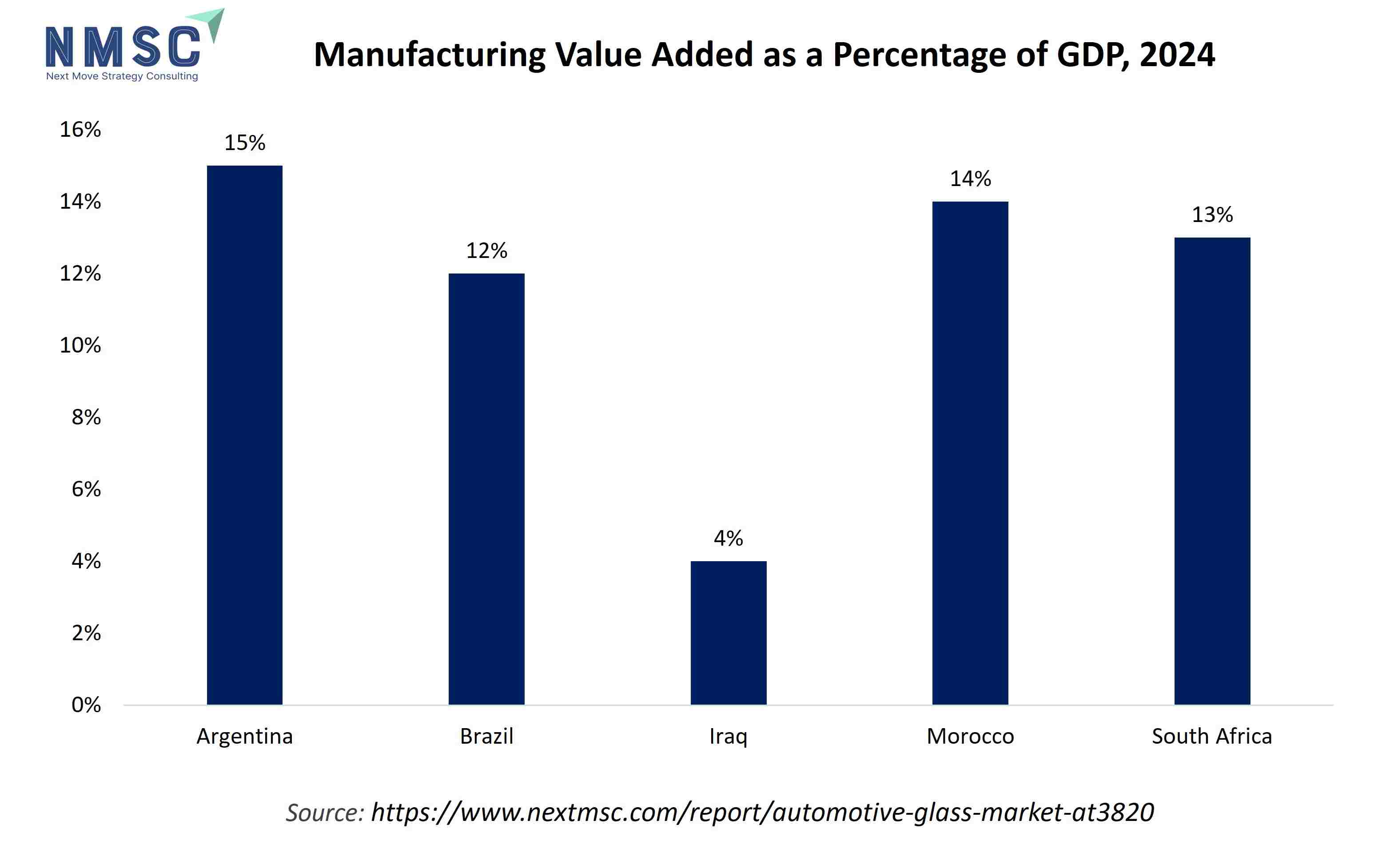
The chart presents manufacturing value added as a percentage of GDP for selected countries in 2024, with Argentina, Morocco, South Africa, and Brazil all demonstrating strong manufacturing sectors (12–15%), while Iraq lags at 4%. This data reflects the relative importance and development of manufacturing industries within these economies. For the automotive glass market, countries with higher manufacturing value added are likely to have a more robust automotive supply chain, including glass production. Strong manufacturing hubs can attract investments, support local automotive assembly, and drive demand for advanced automotive glass solutions, thereby influencing trends in innovation, supply stability, and regional automotive glass market growth for automotive glass manufacturers.
What Are the Key Trends in Automotive Glass Industry?
How is Smart Glass Revolutionising the Automotive Glass Market?
Smart glass technologies, including electrochromic and polymer-dispersed liquid crystal (PDLC) systems, are increasingly adopted in the automotive industry. These solutions enable instant opacity adjustment, reduce glare, and block ultraviolet and infrared light, enhancing passenger comfort, privacy, and vehicle energy efficiency. Automakers are integrating such innovations into premium and high-tech vehicles to elevate the in-cabin experience while supporting climate control efficiency. For example, certain luxury models feature “digital curtain” systems that allow rear passengers to customize window tinting at the touch of a button. As demand grows for connected, comfortable, and energy-efficient cabins, smart glass is becoming a key differentiator in vehicle design, with potential adoption expanding beyond luxury segments into mainstream applications.
How are Regulatory Standards Influencing Automotive Glass Innovations?
Stricter safety regulations and environmental standards are accelerating innovation in automotive glass. Manufacturers are prioritizing lightweight, energy-efficient, and multifunctional solutions to meet regulatory requirements while enhancing vehicle performance and design. The growing demand for laminated windshields and panoramic roofs reflects both their safety advantages and aesthetic appeal. At the same time, efforts to reduce vehicle CO₂ emissions are driving the adoption of coated and multifunctional glass products that improve thermal insulation and cabin energy efficiency. As regulatory pressure and consumer expectations converge, automakers are increasingly integrating advanced glass technologies into new models, positioning smart and high-performance glazing as a key differentiator in both safety compliance and passenger comfort.
How is the Aftermarket Segment Contributing to Market Growth?
The automotive glass replacement market is witnessing strong growth, driven by rising vehicle ownership, aging fleets, and increasing frequency of accidents and collisions. Technological advancements in glass materials, coupled with the growing integration of advanced driver assistance systems (ADAS), are further fuelling demand in the aftermarket segment. Consumers and fleet operators are seeking high-quality, durable, and multifunctional replacement glass solutions that support safety, energy efficiency, and enhanced in-cabin comfort. As vehicles become increasingly sophisticated, aftermarket providers are adapting with improved installation techniques, advanced coatings, and smart glass technologies to meet evolving expectations. Overall, the automotive glass replacement market is positioned for sustained growth, driven by both functional necessity and technological innovation.
What are the Key Market Drivers, Breakthroughs, and Investment Opportunities that will Shape the Automotive Glass Industry in the Next Decade?
The automotive glass market demand is experiencing dynamic growth, driven by technological advancements and shifting consumer preferences. Key drivers include the rise in vehicle production, especially electric vehicles (EVs), and innovations in glass manufacturing technologies. However, challenges such as high production costs and regulatory complexities pose obstacles. Opportunities lie in emerging markets and the integration of smart glass technologies.
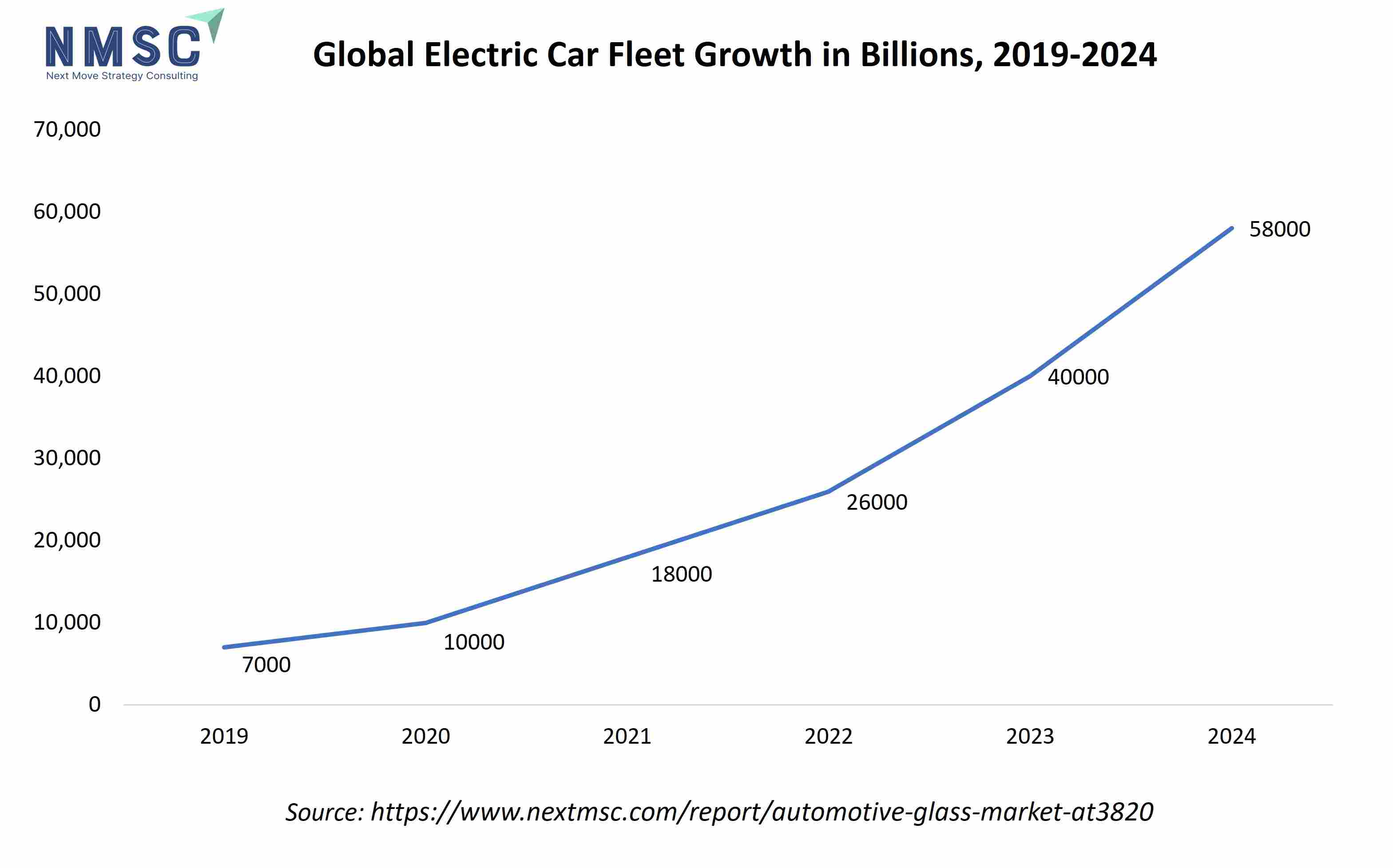
This chart illustrates the rapid global growth of the electric car fleet from 2019 to 2024, with the number of vehicles increasing from 7,000 in 2019 to a projected 58,000 in 2024. The rapid growth of the global electric car fleet directly increases demand for automotive glass, as EVs feature larger panoramic roofs and more complex glazing. This trend pushes the automotive glass market to expand in both volume and technological sophistication.
Growth Drivers:
How is Rising Vehicle Production and Electrification Trends Driving the Automotive Glass Market?
Steady growth in global vehicle manufacturing, particularly in electric and next-generation vehicles, is driving demand for advanced automotive glass solutions. According to IBEF 2025 report, India sets an ambitious target to elevate EV sales to 30% of private cars, 70% of commercial vehicles, 40% of buses, and 80% of two- and three-wheelers by 2030, translating to approximately 80 million EVs on Indian roads. These vehicles feature larger windshields, panoramic roofs, and integrated glass panels designed to optimize aerodynamics and enhance aesthetic appeal. To support performance and energy efficiency, automakers are increasingly investing in lightweight, multifunctional, and coated glass solutions that improve thermal management and reduce overall vehicle weight. The adoption of such advanced glazing not only contributes to enhanced battery range and cabin comfort in electric vehicles but also aligns with broader industry trends toward sustainable and high-performance vehicle design. As a result, demand for innovative automotive glass continues to expand across both OEM and aftermarket segments.
How are Technological Advancements and Aftermarket Growth Contributing to Market Expansion?
Rapid advancements in automotive glass manufacturing, including thinner yet stronger substrates, advanced coatings, and compatibility with heads-up displays (HUDs), are opening new growth opportunities for both OEMs and the aftermarket. These innovations enhance vehicle safety, energy efficiency, and in-cabin technology integration, making glass a critical component of next-generation vehicles. The replacement glass aftermarket is also expanding, driven by higher vehicle ownership and the need for frequent windshield and window replacements. Leading manufacturers are investing in research, development, and production capacity to address growing demand and evolving specifications. As automakers and aftermarket providers continue to adopt advanced glass solutions, the segment is poised for sustained growth, underpinned by both technological innovation and functional necessity.
Growth Inhibitors:
What are the Challenges Posed by Raw Material Price Volatility and Supply Chain Disruptions?
Fluctuations in raw material prices and supply chain disruptions present notable challenges for the automotive glass market. Volatility in key inputs such as soda ash, silica sand, and other glass-forming materials increase production costs and pressure profitability. At the same time, global supply chain constraints, driven by geopolitical tensions, transportation bottlenecks, and other external factors, have contributed to delays and higher procurement costs for both raw materials and finished components. These disruptions hinder timely product delivery, complicate inventory management, and slow automotive glass market expansion. As a result, manufacturers must adopt strategic sourcing, diversify supplier networks, and implement risk mitigation measures to sustain production efficiency and support continued growth in the automotive glass sector.
How are Smart Glass Technologies Creating Investment Opportunities in the Automotive Sector?
Smart glass technologies, including electrochromic and polymer-dispersed liquid crystal (PDLC) systems, are emerging as key investment opportunities within the automotive sector. These solutions provide enhanced passenger comfort, improved energy efficiency, and increased safety through glare reduction and UV/infrared light control. Rising demand for premium vehicles and the broader adoption of advanced in-cabin technologies are driving investment in smart glass integration. Automakers are increasingly incorporating features such as adjustable window tinting to elevate the passenger experience and differentiate their products. The focus on combining functionality with aesthetics underscores the strategic value of smart glass, positioning it as a critical component in next-generation vehicles and offering attractive opportunities for both technology developers and investors.
How Is the Automotive Glass Industry Segmented in this Report, and What are the Key Insights from Segmentation Analysis?
By Glass Type Insights
Is Laminated Glass Dominating the Market in 2025?
Based on glass type, the market is segmented into laminated glass, tempered glass, and other glass types.
Laminated glass is expected to dominate the automotive glass market in 2025. This type of glass is widely used in windshields due to its safety features, such as preventing shattering upon impact. The increasing emphasis on vehicle safety regulations and consumer demand for enhanced protection are driving the adoption of laminated glass. Additionally, advancements in laminated glass technologies, such as acoustic and UV-protective coatings, are further contributing to its dominance in the market.
By Vehicle Type Insights
Are Passenger Cars Leading the Automotive Glass Market in 2025?
Based on vehicle type, the market is segmented into passenger cars, commercial vehicles, and electric vehicles (EVs).
Passenger cars are anticipated to lead the automotive glass market in 2025. The high production volumes of passenger vehicles and the increasing consumer preference for advanced features are driving the demand for automotive glass in this segment. Additionally, the growing adoption of electric vehicles (EVs) and the integration of advanced technologies, such as heads-up displays and smart glass, are further boosting the demand for automotive glazing in passenger cars.
By Application Insights
Is the Windshield Segment Dominating the Automotive Glass Market in 2025?
Based on application, the market is segmented into windshields, sidelites (side windows), backlites (rear windows), sunroofs, rear-view and side-view mirrors, and other applications including quarter glass and vent glass.
The windshield segment is expected to dominate the automotive glass market in 2025. Windshields play a crucial role in vehicle safety and structural integrity, leading to their significant share in the market. The increasing focus on safety regulations and the demand for advanced features, such as heads-up displays and acoustic coatings, are driving the growth of the windshield segment.
By End-Use Insights
Is the OEM Segment Leading the Automotive Glass Market in 2025?
Based on end-use, the market is segmented into original equipment manufacturer (OEM) and aftermarket.
The Original Equipment Manufacturer (OEM) segment is projected to lead the market in 2025. OEMs account for a significant share of the market due to their large-scale production and integration of advanced technologies in vehicles. The growing demand for premium vehicles and the emphasis on safety and comfort features are contributing to the dominance of the OEM segment in the market.
Regional Outlook
The market is geographically studied across North America, Europe, Asia Pacific, Latin America and the Middle East & Africa and each region is further studied across countries.
Automotive Glass Market in North America
The North American market is witnessing robust growth, driven by rising vehicle production, growing replacement demand, and stringent safety regulations across the U.S. and Canada. Increasing adoption of electric vehicles (EVs), premium vehicles, and ADAS-equipped cars is boosting demand for laminated, tempered, acoustic, and solar-control glass. Consumers prioritize durability, energy efficiency, UV protection, and enhanced comfort, while OEMs collaborate with glass manufacturers to integrate sensor-enabled windshields for advanced safety features. Additionally, expanding urbanization and logistics modernization are increasing demand for commercial vehicles with high-quality glazing solutions.
Automotive Glass Market in the United States
The U.S. market is witnessing steady expansion, driven by increasing vehicle production, replacement demand, and a strong emphasis on safety and performance standards. Demand is rising for advanced glass solutions, including laminated, lightweight, and UV-protective windshields, which enhance durability, energy efficiency, and passenger protection. The growth of electric and autonomous vehicles is further boosting adoption, as these vehicles require windshields integrated with sensors and cameras for safety and driver-assistance systems. In 2024, the U.S. auto industry employed an average of 4,486,300 people, accounting for 2.8% of all nonfarm jobs, highlighting the sector’s critical role in supporting the automotive glass market and its continued expansion.
Automotive Glass Market in Canada
Canada’s market is expanding, driven by regulatory standards that mandate safety-compliant glass and increasing vehicle replacement rates. Growing investments in premium and electric vehicles, along with rising consumer demand for enhanced visibility, acoustic comfort, and UV protection, are further supporting market growth. Collaborations and strategic partnerships between glass manufacturers and automotive OEMs help ensure the supply of specialized glass solutions for both domestic and imported vehicles, strengthening market presence and technological capabilities.
Automotive Glass Market in Europe
Europe’s market is expanding steadily, supported by strong vehicle production, replacement demand, and strict safety and environmental regulations in countries including Germany, France, the UK, and Spain. The growing adoption of EVs, premium vehicles, and connected cars is driving demand for laminated, acoustic, and solar-control glass. Urban traffic congestion, emission-reduction policies, and consumer focus on comfort and aesthetics further boost growth. OEMs are increasingly integrating ADAS-compatible windshields and energy-efficient glazing, while collaborations with glass manufacturers ensure availability of high-performance solutions for both passenger and commercial vehicles.
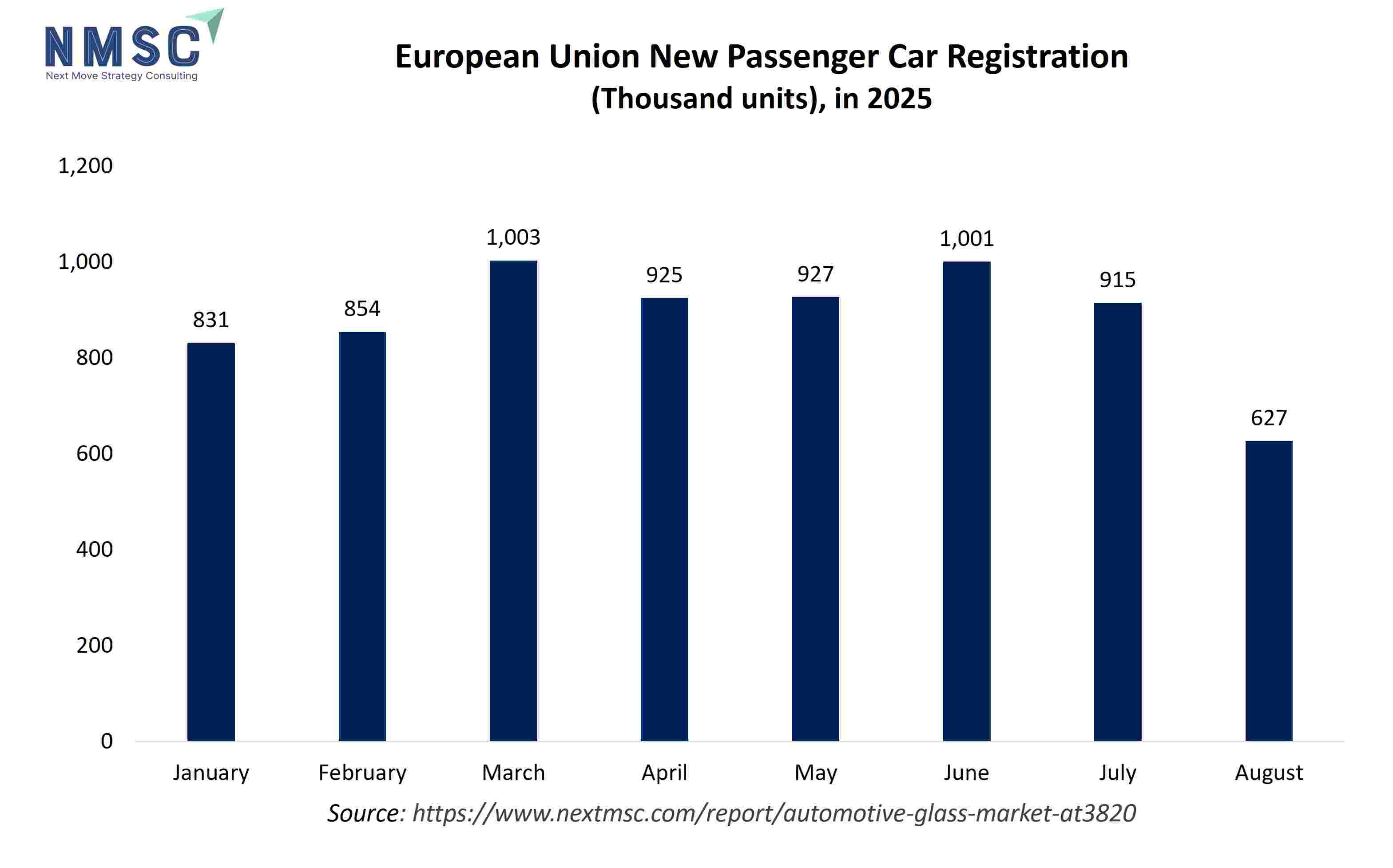
The chart illustrates new passenger car registrations across the European Union in 2025, showing fluctuations in monthly volumes ranging from a high of 1,003 thousand units in March to a notable low of 627 thousand units in August. This pattern reflects seasonality in consumer demand, with peaks in spring and early summer and a sharp decline by late summer. Such registration trends are critical for automotive manufacturers and suppliers, as they directly influence production planning, inventory levels, and market strategies, potentially prompting companies to adapt their supply chains and promotional campaigns to align with these cyclical demand shifts.
Automotive Glass Market in the United Kingdom
The UK market is growing steadily, fueled by increasing vehicle production, rising replacement demand, and the adoption of advanced glazing solutions in premium and electric vehicles. Consumer preference for acoustic, solar-control, and safety-compliant laminated windshields drives market expansion, while collaborations between local glass manufacturers and OEMs ensure the availability of specialised glass, including ADAS-compatible windshields. The UK’s surge in electric vehicle adoption, registering nearly 382,000 new BEVs in 2024 and surpassing Germany, further strengthens demand for innovative glazing solutions, highlighting the country’s shift toward zero-emission vehicles and advanced automotive technologies.
Automotive Glass Market in Germany
Germany, home to some of the world’s leading automotive manufacturers, represents a pivotal market for automotive glass. High vehicle production volumes, stringent safety regulations, and growing demand for electric and autonomous vehicles equipped with sensor-compatible windshields are major growth drivers. The premium and luxury vehicle segments increasingly prefer acoustic, laminated, and lightweight glass solutions that enhance safety, reduce cabin noise, and improve fuel efficiency. Rising consumer awareness of comfort, UV protection, and advanced driver-assistance systems (ADAS) integration further fuels demand for innovative glazing technologies. Additionally, collaborations between OEMs and specialised glass manufacturers ensure supply of high-quality, technologically advanced automotive windshield, while ongoing R&D initiatives focus on smart glass, solar-control coatings, and energy-efficient solutions. Germany’s robust automotive ecosystem, coupled with regulatory support for EV adoption, positions it as a leading European market for both conventional and next-generation automotive glass products.
Automotive Glass Market in France
France’s market is witnessing steady growth, driven by rising vehicle production and replacement demand. Government regulations on safety and environmental compliance encourage the adoption of laminated, UV-protective, and solar-control glass solutions. Consumer demand for comfort-enhancing features, including acoustic and heat-insulating windshields, is further fueling market expansion. The increasing penetration of electric and premium vehicles, coupled with collaborations between OEMs and specialised glass manufacturers, supports the supply of advanced glazing technologies. Additionally, innovations in ADAS-compatible and energy-efficient glass are strengthening France’s position as a key automotive glass market in Europe.
Automotive Glass Market in Spain
Spain’s market is witnessing steady growth, driven by increasing urban vehicle demand, rising replacement cycles, and the adoption of advanced glazing solutions in passenger and commercial vehicles. Integration of energy-efficient, UV-protective, and safety-enhanced glass supports the expanding production of electric vehicles while ensuring compliance with EU vehicle standards. Spain ranks as the 2nd largest automaker in Europe and the 9th largest globally, with the automotive industry being a strategic sector for the national economy. Nine multinational brands operate 18 manufacturing plants across the country, producing 2.38 million vehicles in 2024, including 44 different models, 25 of which are electrified. The automotive sector accounts for approximately 10% of Spain’s GDP and 18% of total exports, with an external trade surplus of USD 17.6 billion in 2024, including vehicles and auto parts.
Automotive Glass Market in Asia Pacific
The Asia Pacific market is one of the fastest-growing globally, fuelled by high vehicle production, replacement demand, and rapid EV adoption in China, India, Japan, South Korea, and Australia. Rising urbanisation, increasing disposable incomes, and demand for premium vehicles are boosting laminated, tempered, acoustic, and solar-control glass adoption. OEMs are integrating ADAS and connected vehicle technologies, while collaborations with glass suppliers ensure the supply of advanced glazing solutions. Additionally, modernisation of commercial vehicle fleets, government safety regulations, and logistics expansion contribute to sustained market growth across the region.
Automotive Glass Market in China
China leads the Asia-Pacific market, supported by the country’s position as the world’s largest vehicle producer. The robust growth in vehicle sales, 3.226 million units in September 2025, up 14.9% year-on-year following a 16.4% rise in August, directly boosts demand for advanced windshields, laminated glass, and smart glazing solutions. Government regulations on safety, energy efficiency, and emissions, along with rapid electric vehicle adoption, further drive the adoption of innovative automotive glass technologies. Collaboration between glass manufacturers and OEMs ensures large-scale deployment, positioning China as the fastest-growing market for automotive glass in the region.
Automotive Glass Market in Japan
Japan’s market is supported by robust domestic vehicle production, stringent safety regulations, and strong demand for premium and connected vehicles. Growing adoption of EVs and advanced driver-assistance systems (ADAS) is driving the integration of laminated, acoustic, and solar-control glass solutions. Consumer preference for energy-efficient, comfort-enhancing, and technologically integrated glazing further fuels market expansion. Close collaborations between OEMs and glass manufacturers ensure a steady supply of advanced automotive glass, positioning Japan as a key and steadily growing market for high-performance automotive glass in the Asia-Pacific region.
Automotive Glass Market in India
India’s market is growing steadily, supported by rising vehicle production, replacement demand, and increasing adoption of safety-compliant laminated and tempered glass. Accelerated EV adoption, driven by government incentives and energy-efficiency regulations, is boosting demand for acoustic and solar-control windshields in premium models. Collaborations between OEMs and glass manufacturers ensure a consistent supply of advanced glazing solutions. Urbanisation, expanding infrastructure, and e-commerce-driven logistics further contribute to market growth. With nearly a dozen new EV launches planned in 2025 and EV sales rising 20%, India is emerging as a significant automotive glass market in the Asia-Pacific region, poised for continued expansion toward its 30% EV target by 2030.
Automotive Glass Market in South Korea
South Korea’s market is expanding, driven by advanced vehicle manufacturing, premium car demand, and increasing EV production. Laminated, acoustic, and lightweight glass solutions are widely adopted, with ADAS-compatible windshields becoming standard. Collaborations between OEMs and glass suppliers ensure a reliable supply for domestic and export vehicles. The rapidly growing EV market, projected to reach 20% of total vehicle sales by the end of 2025, further fuels demand for energy-efficient and safety-compliant glazing. In 2025, South Korea produced 407,009 EVs, representing 11% of total automobile production, while government investment of over USD 448 million in charging infrastructure and new safety regulations enhances market opportunities. Rising consumer demand for comfort, safety, and sustainability, combined with policy support and export potential, positions South Korea as a key player in the Asia-Pacific automotive glass landscape.
Automotive Glass Market in Australia
Australia’s market is experiencing steady growth, supported by rising vehicle replacement demand, stringent safety regulations, and increasing adoption of laminated, acoustic, and solar-control glass solutions. Expanding EV production and growing consumer preference for energy-efficient, durable, and ADAS-compatible windshields further drive market development. Collaborations between OEMs and glass manufacturers ensure the supply of advanced glazing technologies for both domestic and imported vehicles. Urbanisation, heightened traffic safety awareness, and the demands of e-commerce logistics for reliable fleet operations enhance adoption, positioning Australia as a stable and strategically important market for automotive glass in the Asia-Pacific region.
Automotive Glass Market in Latin America
The Latin American market is driven by increasing vehicle production in Brazil, Mexico, and Argentina, alongside rising replacement demand due to aging fleets. Growing urbanisation and expanding middle-class populations are boosting demand for passenger vehicles with safety-compliant laminated and tempered glass. E-commerce growth and logistics modernisation are driving demand for commercial vehicles requiring durable windshields. Additionally, government regulations on vehicle safety and environmental standards encourage the adoption of energy-efficient, acoustic, and solar-control glass, supporting market expansion.
Automotive Glass Market in the Middle East & Africa
The Middle East & Africa market is driven by rising vehicle production and replacement demand in key countries such as the UAE, Saudi Arabia, South Africa, and Nigeria. Growing adoption of luxury and commercial vehicles fuels demand for laminated, acoustic, and solar-control glass. Urbanisation, expanding road infrastructure, and gradually strengthening vehicle safety regulations further support growth. Additionally, government initiatives promoting local automotive manufacturing and collaborations with OEMs encourage investment in advanced glazing solutions across the region.
Competitive Landscape
Who are the Leading Companies in the Automotive Glass Market, and How are they Competing?
The market is led by major players such as AGC Inc., Nippon Sheet Glass, and Xinyi Glass, which leverage extensive manufacturing capabilities, technological expertise, and global supply networks to maintain a competitive advantage. These companies are positioned to meet both OEM and aftermarket demand through integrated production, quality control, and innovation in advanced glazing solutions. Their scale and breadth create high barriers to entry for smaller competitors, enabling them to influence industry standards, deploy cutting-edge technologies, and capture significant market share. Continuous investment in R&D, production capacity, and strategic partnerships reinforces their leadership and ensures sustained influence in the evolving automotive glass landscape.
Innovation and Adaptability Drive Market Success
Innovation is a critical driver of success in the automotive glass sector, as companies respond to evolving vehicle designs, regulatory requirements, and consumer expectations. Firms are investing in advanced solutions such as smart glass, lightweight substrates, coatings, and HUD-compatible panels to enhance safety, comfort, and energy efficiency. Adaptability to changing automotive glass market trends, including the rise of electric vehicles, autonomous systems, and connected car technologies, enables manufacturers to remain competitive and expand their offerings. Companies that rapidly translate research insights into scalable products, while anticipating future mobility trends, are better positioned to capture growth opportunities and strengthen relationships with OEMs and aftermarket customers.
Market Players to Opt for Partnership & Collaboration Strategies to Expand their Presence
To enhance their global presence and product capabilities, automotive glass companies are increasingly pursuing mergers, acquisitions, and strategic collaborations. These approaches enable firms to broaden product portfolios, access new geographies, and integrate advanced technologies more efficiently. M&A activity also facilitates knowledge transfer, consolidation of R&D capabilities, and economies of scale in manufacturing and distribution. Strategic partnerships with suppliers, technology providers, and energy or software firms further enhance market reach and operational resilience. By leveraging consolidation and alliance strategies, industry players strengthen competitive positioning, accelerate innovation, and capture emerging opportunities across OEM and aftermarket segments, ensuring long-term growth in a dynamic automotive glass market.
List of Key Automotive Glass Companies
-
AGC Inc.
-
Nippon Sheet Glass Co., Ltd.
-
Xinyi Glass Holdings Limited
-
Central Glass Co., Ltd
-
Corning Incorporated
-
Guardian Industries
-
Pilkington
-
Shenzhen Benson Automobile Glass Co., Ltd.
-
Carlex Glass Company, LLC
-
Schott AG
-
Huihua Glass Co
-
Tyneside Safety Glass
-
Olimpia Auto Glass Inc
What Are the Latest Key Industry Developments?
-
June 2025- Toyota introduced a 'digital curtain' feature in its Century SUV, allowing rear passengers to adjust window tinting for enhanced privacy. Developed by AGC, this technology integrates a special film between laminated glass panels, enabling users to switch glass transparency between clear, semi-transparent, and opaque using applied voltage.
-
June 2025- AGC Automotive Europe showcased its cutting-edge glass technologies, including the series-bound Windshield Black-band Polarised HUD, at IAA Mobility 2025 in Munich, highlighting innovations in visibility, connectivity, safety, and sustainable mobility.
-
August 2024- Xinyi Glass expanded its overseas manufacturing presence in 2024 by building new automotive glass production lines in Indonesia and acquiring additional capacity in China, responding to global demand and optimising supply for regional markets.
-
March 2025- Şişecam, in 2024, advanced its global expansion via significant investments in innovation, technology partnerships, and the launch of its 'Plant of the Future' platform, aimed at digitalising operations and partnering with suppliers for new product development in the automotive glass segment.
What Are the Key Factors Influencing Investment Analysis & Opportunities in Automotive Glass Market?
Investment in the automotive glass market is increasingly driven by technological innovation, regulatory compliance, and evolving market demand. Companies are prioritizing the development of lightweight, energy-efficient, and smart glass solutions to meet the requirements of next-generation vehicles, including electric and connected models. Regions with strong vehicle production, growing EV adoption, and expanding aftermarket activity offer attractive opportunities for capital deployment. Additionally, strategic partnerships, joint ventures, and acquisitions are commonly pursued to enhance technological capabilities, expand product portfolios, and strengthen market presence. Investors focusing on firms that provide modular, scalable, and advanced glazing solutions are well-positioned to benefit from the ongoing modernization of vehicles and the rising importance of passenger comfort, safety, and energy efficiency.
Key Benefits for Stakeholders:
Next Move Strategy Consulting (NMSC) provides a detailed investment analysis of the global automotive glass market, covering historical trends from 2020 to 2024 and offering forecasts through 2030. The study provides insights at global, regional, and country levels, analysing market size, growth drivers, investment hotspots, challenges, and opportunities. Stakeholders gain actionable intelligence on emerging trends, strategic partnerships, and high-potential market segments. This comprehensive coverage enables investors, industry players, and strategic decision-makers to identify optimal entry points, evaluate risk-reward scenarios, and develop informed strategies to maximize returns in the dynamic and rapidly expanding market.
Report Scope
|
Parameters |
Details |
|
Market Size in 2025 |
USD 34.77 Billion |
|
Revenue Forecast in 2030 |
USD 44.97 Billion |
|
Growth Rate |
CAGR of 5.84% from 2025 to 2030 |
|
Analysis Period |
2024–2030 |
|
Base Year Considered |
2024 |
|
Forecast Period |
2025–2030 |
|
Market Size Estimation |
Billion (USD) |
|
Growth Factors |
|
|
Countries Covered |
33 |
|
Companies Profiled |
15 |
|
Market Share |
Available for 10 companies |
|
Customization Scope |
Free customization (equivalent up to 80 analyst-working hours) after purchase. Addition or alteration to country, regional & segment scope. |
|
Pricing and Purchase Options |
Avail customized purchase options to meet your exact research needs. |
|
Approach |
In-depth primary and secondary research; proprietary databases; rigorous quality control and validation measures. |
|
Analytical Tools |
Porter's Five Forces, SWOT, value chain, and Harvey ball analysis to assess competitive intensity, stakeholder roles, and relative impact of key factors. |
Key Market Segments
By Glass Type
-
Laminated Glass
-
Windshields (Front and Rear)
-
Acoustic Laminated Glass
-
UV-Protective Laminated Glass
-
Heated Laminated Glass
-
-
Tempered Glass
-
Side Windows
-
Rear Windows
-
Door Glass
-
Sunroofs and Roof Panels
-
Quarter Windows
-
-
Other Glass Types
-
Smart Glass (Electrochromic, SPD, PDLC, Thermochromic)
-
Plastic Automotive Glazing (Polycarbonate, Acrylic)
-
Bulletproof or Armored Glass
-
Privacy Glass (Tinted or Privacy Films)
-
Head-Up Display (HUD) Glass
-
By Vehicle Type
-
Passenger Cars
-
Commercial Vehicles
-
Electric Vehicles (EV)
By Application
-
Windshield
-
Sidelite (Side Windows)
-
Backlite (Rear Windows)
-
Sunroof
-
Rear-View & Side-View Mirrors
-
Other Applications
-
Quarter Glass
-
Vent Glass
By End-Use
-
Original Equipment Manufacturer (OEM)
-
Aftermarket
Geographical Breakdown
North America: U.S., Canada, and Mexico.
Europe: U.K., Germany, France, Italy, Spain, Sweden, Denmark, Finland, Netherlands, and rest of Europe.
Asia Pacific: China, India, Japan, South Korea, Taiwan, Indonesia, Vietnam, Australia, Philippines, Malaysia and rest of APAC.
Middle East & Africa (MEA): Saudi Arabia, UAE, Egypt, Israel, Turkey, Nigeria, South Africa, and rest of MEA.
Latin America: Brazil, Argentina, Chile, Colombia, and rest of LATAM.
Conclusion & Recommendations
Our report equips stakeholders, industry participants, investors, policy-makers, and consultants with actionable intelligence to capitalize on market transformative potential. By combining robust data-driven analysis with strategic frameworks, NMSC’s Automotive Glass Market Report serves as an indispensable resource for navigating the evolving landscape.


About the Author
 Ridip Gogoi
— Ridip Gogoi is a Research Associate at Next Move Strategy Consulting, where he supports cross-vertical market research and analysis across multiple industry sectors, with four years of experience. His work includes market analysis, data validation, secondary research, and insight development, helping structure evidence into clear findings for business and strategy decisions. He contributes to research quality checks and reporting, with a focus on consistency, source review, and clarity accuracy.
Ridip Gogoi
— Ridip Gogoi is a Research Associate at Next Move Strategy Consulting, where he supports cross-vertical market research and analysis across multiple industry sectors, with four years of experience. His work includes market analysis, data validation, secondary research, and insight development, helping structure evidence into clear findings for business and strategy decisions. He contributes to research quality checks and reporting, with a focus on consistency, source review, and clarity accuracy.
About the Reviewer
 Supradip Baul
— Supradip Baul is an accomplished business consultant and strategist with over a decade of rich experience in market intelligence, strategy, technology, and business transformation. His work has included rigorous qualitative and quantitative analysis across multiple industries, helping clients shape investment decisions and long-term roadmaps. Earlier in his career, he was associated with Gartner, where he contributed to industry-leading reports and market share analyses. He has worked with leading global companies and holds an MBA with a dual specialization in Marketing and Finance.
Supradip Baul
— Supradip Baul is an accomplished business consultant and strategist with over a decade of rich experience in market intelligence, strategy, technology, and business transformation. His work has included rigorous qualitative and quantitative analysis across multiple industries, helping clients shape investment decisions and long-term roadmaps. Earlier in his career, he was associated with Gartner, where he contributed to industry-leading reports and market share analyses. He has worked with leading global companies and holds an MBA with a dual specialization in Marketing and Finance.
At Next Move Strategy Consulting, we understand that insightful market research is the cornerstone of successful business decisions. That's why we employ a robust and multifaceted approach, combining various methodologies to deliver the most accurate and actionable data for our clients.

Research Landscape
We navigate the world of research with two primary approaches:
Qualitative Approach
Our qualitative research methodologies involve immersive techniques such as in-depth interviews, focus groups, and observational studies. By engaging directly with individuals and stakeholders, we uncover valuable insights that quantitative data alone may overlook.

Quantitative Research
In tandem with qualitative methodologies, NMSC leverages the power of Quantitative Research to provide a robust foundation of numerical insights. Through systematic data collection and analysis, we quantify patterns, preferences, and market trends, offering a comprehensive view of the business landscape.
Our quantitative research approach employs diverse tools, including surveys, experiments, and statistical modelling. These methodologies enable us to gather data from a large and representative sample, ensuring the statistical significance of our findings. By employing structured questionnaires and standardized data collection methods, we guarantee the reliability and validity of the information we present to our clients.
Quantitative research is particularly effective in measuring the prevalence of trends, assessing market size, and gauging the impact of various factors on consumer behavior. The numerical precision attained through this approach equips our clients with actionable insights, facilitating data-driven decision-making and strategy formulation.


Our Specialized Toolbox for Industry-Specific Market Research
We deploy a specialized arsenal of techniques tailored to meet your unique requirements. Here's a glimpse into our comprehensive toolbox:

Information Procurement
The stage entails acquiring market data or relevant information through various sources and methodologies.


Market Research Approach
We utilize both top-down and bottom-up approaches in market research analysis to achieve a comprehensive understanding of the market dynamics, leveraging the broad perspective of industry trends and macroeconomic factors alongside detailed insights from specific segments and individual companies.

Porters Five Forces Analysis
We conduct Porter's Five Forces analysis to evaluate the competitive landscape of an industry, providing us with insights into factors that affect profitability and strategic positioning.

SWOT Analysis

Forecasting
We utilize a forecasting model to predict future consumption by considering parameters like population, economics, regulations, market competition, drivers, constraints, technology, and pricing. We also employ statistical techniques such as multilinear regression, exponential smoothing, moving average, ARIMA, and Monte Carlo simulations for accurate predictions. In econometric forecasting, we analyzed short-term and long-term event impacts, attributing values based on regulatory frameworks, economic factors, and market events.





 Speak to Our Analyst