Biodegradable Mulch Film Market Global Industry Analysis and Forecast (2026-2035)

Miners Container Market size was USD 683.29 Million in 2026, projected to reach USD 1,181.94 Million by 2035, growing at a CAGR of 6.28% from 2026 to 2035. Key drivers include rising immersion cooling adoption, expanding mining hosting infrastructure, and growing demand for factory-integrated modular deployment, with North America leading the market.

Download Free Sample PDF
Base Year (2025)
$1.04 Billion
Forecast (2035)
$2.78 Billion
CAGR (2026-2035)
10.4%
Top Region
Asia-Pacific

What Is the Biodegradable Mulch Film Market Size?

The global Biodegradable Mulch Film market was valued at USD 1.04 billion in 2025 and is estimated at USD 1.14 billion in 2026, forecast to reach USD 2.78 billion by 2035, growing at a 10.4% CAGR from 2026 to 2035. Asia-Pacific leads with approximately 41% revenue share, while PBAT-Based Films command approximately 40% of total market value in 2025.

NMSC's analysis indicates that the Biodegradable Mulch Film market is at an inflection point, as convergent regulatory mandates across the European Union and China, rising organic food demand, and material cost reductions driven by PBAT production scale-up are collectively compressing the cost premium over conventional polyethylene mulch and accelerating mainstream agricultural adoption.

Biodegradable Mulch Film Market Global Industry Analysis and Forecast (2026-2035) Revenue Forecast
Values in USD Billion

2025 $1.04 Billion
2025
2026 $1.15 Billion
2026
2027 $1.27 Billion
2027
2028 $1.40 Billion
2028
2029 $1.54 Billion
2029
2030 $1.71 Billion
2030
2031 $1.88 Billion
2031
2032 $2.08 Billion
2032
2033 $2.30 Billion
2033
2034 $2.53 Billion
2034
2035 $2.78 Billion
2035

Key Takeaways

By Raw Material: PBAT-Based Films held the largest share of approximately 40% (USD 0.42 Billion) in 2025; PBS-Based Films is the fastest-growing sub-segment at 13.5% CAGR from 2026–2035.

By Crop Type: Vegetables held the largest share of approximately 46% (USD 0.48 Billion) in 2025; Flowers and Nursery Crops is the fastest-growing sub-segment at 13.5% CAGR from 2026–2035.

By Film Thickness: Standard Films (10–25 microns) held the largest share of approximately 55% (USD 0.57 Billion) in 2025; Very Thin Films (below 10 microns) is the fastest-growing sub-segment at approximately 12.8% CAGR from 2026–2035.

By Application: Weed Suppression held the largest share of approximately 48% (USD 0.50 Billion) in 2025; Soil Moisture Conservation is the fastest-growing sub-segment at approximately 11.8% CAGR from 2026–2035.

By End User: Conventional Farmers held the largest share of approximately 49% (USD 0.51 Billion) in 2025; Organic Farmers is the fastest-growing segment at approximately 13.5% CAGR from 2026–2035.

Dominant Region: Asia-Pacific dominated with approximately 41% revenue share (USD 0.43 Billion) in 2025.

Fastest-Growing Region: Middle East & Africa is expected to register the highest regional CAGR of approximately 13.5% during 2026–2035.

Dominant Country: China led with approximately USD 260 Million in 2025.

Fastest-Growing Country: Vietnam is the fastest-growing country at approximately 16.6% CAGR from 2026–2035.

Market Opportunity: The Biodegradable Mulch Film market is expected to create an absolute dollar opportunity of USD 1.64 billion between 2026 and 2035, offering compelling positioning for biopolymer material suppliers, agricultural film converters, and organic farming input distributors investing in sustainable crop production solutions.

According to NMSC analysis, China's compulsory biodegradable mulch film policy expanding across major vegetable and tobacco growing provinces represents a demand catalyst capable of sustaining double-digit volume growth rates for PBAT-based film production through the early 2030s, independent of regulatory developments in other geographies.

What Does the Biodegradable Mulch Film Market Encompass?

The Biodegradable Mulch Film market encompasses the production, distribution, and sale of thin polymer films formulated from biodegradable and compostable biopolymers — principally PBAT, PLA, PBS, thermoplastic starch, and their blends — designed for soil surface application in crop production. These films perform the same agronomic functions as conventional polyethylene mulch films: weed suppression, soil moisture retention, soil temperature regulation, and erosion control, while degrading in the soil through microbial action after the growing season, eliminating the film collection, baling, and disposal costs that drive grower dissatisfaction with conventional mulch programs.

The regulatory environment is increasingly prescriptive. The European Union's Single-Use Plastics Directive and associated Farm to Fork Strategy set sustainability targets for agricultural plastic inputs, while China's Ministry of Agriculture and Rural Affairs has implemented compulsory biodegradable mulch standards in key producing regions. Technology adoption trends reflect a shift from first-generation starch-blended films with inconsistent degradation toward PBAT-PLA formulations engineered to match PE tensile strength and mechanical laying machine compatibility, reducing the agronomic performance gap that has historically constrained grower uptake across North America and northern European grain production regions.

Market Drivers & Dynamics

Interactive Dataset
Regulatory bans and restrictions on conventional PE mulch films driver +3.2% Europe, Asia-Pacific 2026–2033
Growing organic food demand requiring certified biodegradable mulch driver +2.1% Global 2026–2035
Microplastic contamination concerns from residual PE mulch film fragments in soil driver +1.8% Global 2026–2035
Government subsidies for biodegradable agricultural inputs driver +1.4% Europe, Asia-Pacific 2026–2032
Mechanized film laying compatibility improvements reducing adoption barriers driver +1.2% North America, Europe 2026–2035
Higher material cost versus conventional polyethylene mulch film restraint −1.8% Global 2026–2032
Inconsistent biodegradation rates across diverse soil conditions and climates restraint −1.3% Global 2026–2035
Insufficient certified composting infrastructure in emerging markets restraint −0.9% MEA, Latin America 2026–2030
Fragmented biodegradation certification standards across jurisdictions restraint −0.7% Global 2026–2035
Source: Next Move Strategy Consulting

Growth Drivers

What Is the Primary Growth Driver of the Biodegradable Mulch Film Market?

Regulatory pressure on conventional polyethylene mulch film is the dominant demand catalyst. The European Commission's Single-Use Plastics Directive and China's National Development and Reform Commission plastic reduction action plan collectively address an estimated 1.5 million tonnes of agricultural plastic consumed annually in Europe and China alone, according to the Food and Agriculture Organization of the United Nations. The mandate-driven replacement cycle is creating non-discretionary demand at volume scales that dwarf voluntary adoption, particularly in intensive vegetable and specialty crop production regions where organic fertilizers and other biodegradable input programs are co-adopted as integrated sustainable agriculture commitments.

How Is Organic Food Demand Driving Biodegradable Mulch Film Market Growth?

The global expansion of certified organic food production is a structurally significant demand driver for biodegradable mulch films, as organic certification standards prohibit or restrict conventional polyethylene mulch film due to its non-biodegradable petroleum-based composition. The USDA National Organic Program and European organic regulation (EU 2018/848) both establish requirements that organic operators use only permitted synthetic materials, and EN 17033 soil-biodegradable certification is increasingly accepted for organic farming input compliance. Growth in organic food and vegetables consumption is directly translating into expanded certified organic farmland area, each new organic conversion creating a fresh addressable market for biodegradable mulch film at the commercial farm level.

Growth Inhibitors

What Is Restraining the Biodegradable Mulch Film Market?

The cost premium of biodegradable mulch films relative to conventional low-density polyethylene mulch is the primary restraint on market expansion. PBAT-based films currently command a per-kilogram price premium of 40–80% over standard PE mulch, an industry-derived estimate based on raw material input cost differentials, as PBAT production scale has not yet reached the cost curve inflection point achieved by PE commodity film production. European Bioplastics e.V. bioplastic production capacity data confirms that PBAT represents the most produced agricultural biopolymer globally, but total output volumes remain substantially below PE mulch production, sustaining price premiums that limit penetration among price-sensitive large-scale grain and forage crop producers who face no organic certification or regulatory mandate requiring biodegradable inputs.

What Are the Growth Opportunities?

How Can Performance-Parity PBAT-PLA Blends Unlock Mass-Market Vegetable Production Adoption?

The largest single addressable opportunity lies in achieving performance and total-cost parity with conventional PE mulch in large-scale outdoor vegetable production. Growers currently default to PE because biodegradable alternatives fail mechanical laying tests or carry unacceptable cost premiums. Biopolymer compounders that develop PBAT-PLA blend formulations maintaining tensile strength and elongation performance under mid-season thermal stress can unlock the price-sensitive conventional farmer end-user segment — the largest at USD 0.51 billion in 2025 — without requiring any regulatory mandate as the adoption trigger.

What Opportunity Does Certified Organic Agriculture Expansion Create for Premium Biodegradable Mulch?

The organic farming end-user segment represents a premium revenue opportunity because organic growers exhibit structurally higher willingness-to-pay for certified biodegradable mulch relative to conventional farmers. Agricultural input suppliers with certified organic-compliant biodegradable mulch products endorsed under EU 2018/848 or the USDA NOP can charge a 15–25% premium over standard biodegradable film pricing. The addressable organic premium market is expanding in parallel with global agricultural biological input adoption, as organic farmers co-invest in integrated soil health programs where biodegradable mulch reduces tillage requirement alongside biostimulant and biocontrol inputs.

How Can Faster-Degrading PBS Film Formulations Capture Northern Climate Agricultural Markets?

Northern European, Canadian, and Japanese agricultural markets represent an underserved opportunity for PBS-based biodegradable mulch formulations, where lower soil temperatures cause PBAT-based films to persist beyond the harvest and soil preparation window. PBS and PBS-PBAT blend formulations with accelerated low-temperature biodegradation kinetics can address this performance gap, positioning PBS-specialized producers to capture premium pricing from technically demanding markets where grower willingness-to-pay for agronomically validated degradation performance is demonstrably higher than in warm-climate markets where all biodegradable films degrade within acceptable timeframes.

Segmentation Analysis

2025 (USD Billion)
2035 (USD Billion)
PBAT-Based Films 2025: $0.42 Billion | 2035: $1.05 Billion
PBAT-Based F
PLA-Based Films 2025: $0.22 Billion | 2035: $0.61 Billion
PLA-Based Fi
Starch-Based Films 2025: $0.18 Billion | 2035: $0.47 Billion
Starch-Based
PBS-Based Films 2025: $0.09 Billion | 2035: $0.28 Billion
PBS-Based Fi
Blended Biopolymer Films 2025: $0.11 Billion | 2035: $0.34 Billion
Blended Biop
Other Raw Materials 2025: $0.02 Billion | 2035: $0.03 Billion
Other Raw Ma
PBAT-Based Films $0.42 Billion $1.05 Billion 10.7%
PLA-Based Films $0.22 Billion $0.61 Billion 12.0%
Starch-Based Films $0.18 Billion $0.47 Billion 11.3%
PBS-Based Films $0.09 Billion $0.28 Billion 13.5%
Blended Biopolymer Films $0.11 Billion $0.34 Billion 13.3%
Other Raw Materials $0.02 Billion $0.03 Billion 4.6%

Which Raw Material Segment Dominates the Biodegradable Mulch Film Market?

PBAT-Based Films commanded the largest revenue share, reaching USD 0.42 billion in 2025, driven by PBAT's superior mechanical properties — particularly its elongation at break and tear resistance — that most closely replicate PE mulch film performance characteristics required for high-speed mechanical film laying in intensive vegetable and fruit production. Our findings suggest that PBS-Based Films are the fastest-growing raw material segment at a 13.5% CAGR from 2026 to 2035, as PBS's faster soil biodegradation rates make it preferred for applications in northern European climates where PBAT's degradation kinetics are too slow for full soil incorporation within a standard growing season. The bioplastic recycling market is also creating secondary demand for PLA and PBS-compatible biodegradable film formulations as downstream material recovery infrastructure develops alongside primary biodegradable mulch adoption.

2025 (USD Billion)
2035 (USD Billion)
Vegetables
Fruits and B
Grains and C
Tobacco
Flowers and
Segment Item 2025 (USD Billion) 2035 (USD Billion) CAGR
Vegetables $10.0 USD Billion $40.0 USD Billion 25.0%
Fruits and Berries $17.1 USD Billion $51.1 USD Billion 11.0%
Grains and Cereals $24.2 USD Billion $62.2 USD Billion 25.0%
Tobacco $31.3 USD Billion $73.3 USD Billion 11.0%
Flowers and Nursery Crops $38.4 USD Billion $84.4 USD Billion 16.0%

Segment-wise data is locked

Unlock complete segment-wise numbers for By Crop Type.

Unlock Full Data

Which Crop Type Segment Leads the Biodegradable Mulch Film Market?

Vegetables dominated the crop type axis, generating USD 0.48 billion in 2025, reflecting intensive mulch usage rates in tomato, pepper, cucumber, watermelon, and leafy vegetable production where film is applied across virtually every planted bed. Fruits and Berries is the second-largest segment at USD 0.23 billion, driven by strawberry and raspberry production in Europe and North America where biodegradable mulch adoption has advanced furthest. Flowers and Nursery Crops is the fastest-growing crop type at a 13.5% CAGR from 2026 to 2035, as specialty flower growers in the Netherlands, Germany, and China adopt biodegradable mulch to meet retailer sustainability sourcing standards without the film retrieval cost that conventional PE imposes on labor-intensive nursery operations.

2025 (USD Billion)
2035 (USD Billion)
Very Thin Fi
Standard Fil
Thick Films
Segment Item 2025 (USD Billion) 2035 (USD Billion) CAGR
Very Thin Films (below 10 microns) $10.0 USD Billion $40.0 USD Billion 27.0%
Standard Films (10–25 microns) $17.1 USD Billion $51.1 USD Billion 9.0%
Thick Films (above 25 microns) $24.2 USD Billion $62.2 USD Billion 19.0%

Segment-wise data is locked

Unlock complete segment-wise numbers for By Film Thickness.

Unlock Full Data
2025 (USD Billion)
2035 (USD Billion)
Weed Suppres
Soil Moistur
Soil Tempera
Erosion Cont
Other Applic
Segment Item 2025 (USD Billion) 2035 (USD Billion) CAGR
Weed Suppression $10.0 USD Billion $40.0 USD Billion 14.0%
Soil Moisture Conservation $17.1 USD Billion $51.1 USD Billion 24.0%
Soil Temperature Regulation $24.2 USD Billion $62.2 USD Billion 22.0%
Erosion Control $31.3 USD Billion $73.3 USD Billion 12.0%
Other Applications $38.4 USD Billion $84.4 USD Billion 27.0%

Segment-wise data is locked

Unlock complete segment-wise numbers for By Application.

Unlock Full Data
2025 (USD Billion)
2035 (USD Billion)
Conventional
Organic Farm
Commercial G
Research and
Segment Item 2025 (USD Billion) 2035 (USD Billion) CAGR
Conventional Farmers $10.0 USD Billion $40.0 USD Billion 24.0%
Organic Farmers $17.1 USD Billion $51.1 USD Billion 22.0%
Commercial Greenhouse Operators $24.2 USD Billion $62.2 USD Billion 20.0%
Research and Government Institutions $31.3 USD Billion $73.3 USD Billion 22.0%

Segment-wise data is locked

Unlock complete segment-wise numbers for By End User.

Unlock Full Data

Which End User Segment Leads the Biodegradable Mulch Film Market?

Conventional Farmers accounted for the largest revenue share at USD 0.51 billion in 2025, primarily driven by mandate-induced adoption in China and compliance-driven uptake in European countries. Organic Farmers are the fastest-growing end-user segment at a 13.5% CAGR from 2026 to 2035, as USDA ERS data confirms sustained growth in certified organic cropland across the U.S., and organic certification requirements effectively create non-negotiable demand for certified biodegradable mulch from every operator maintaining organic status. The commercial greenhouse operator segment is the third-largest and second-fastest growing, as controlled-environment growers adopt biodegradable in-row mulch to reduce plastic waste volume from high-turnover cropping cycles in Netherlands, Israel, and Spain glasshouse complexes.

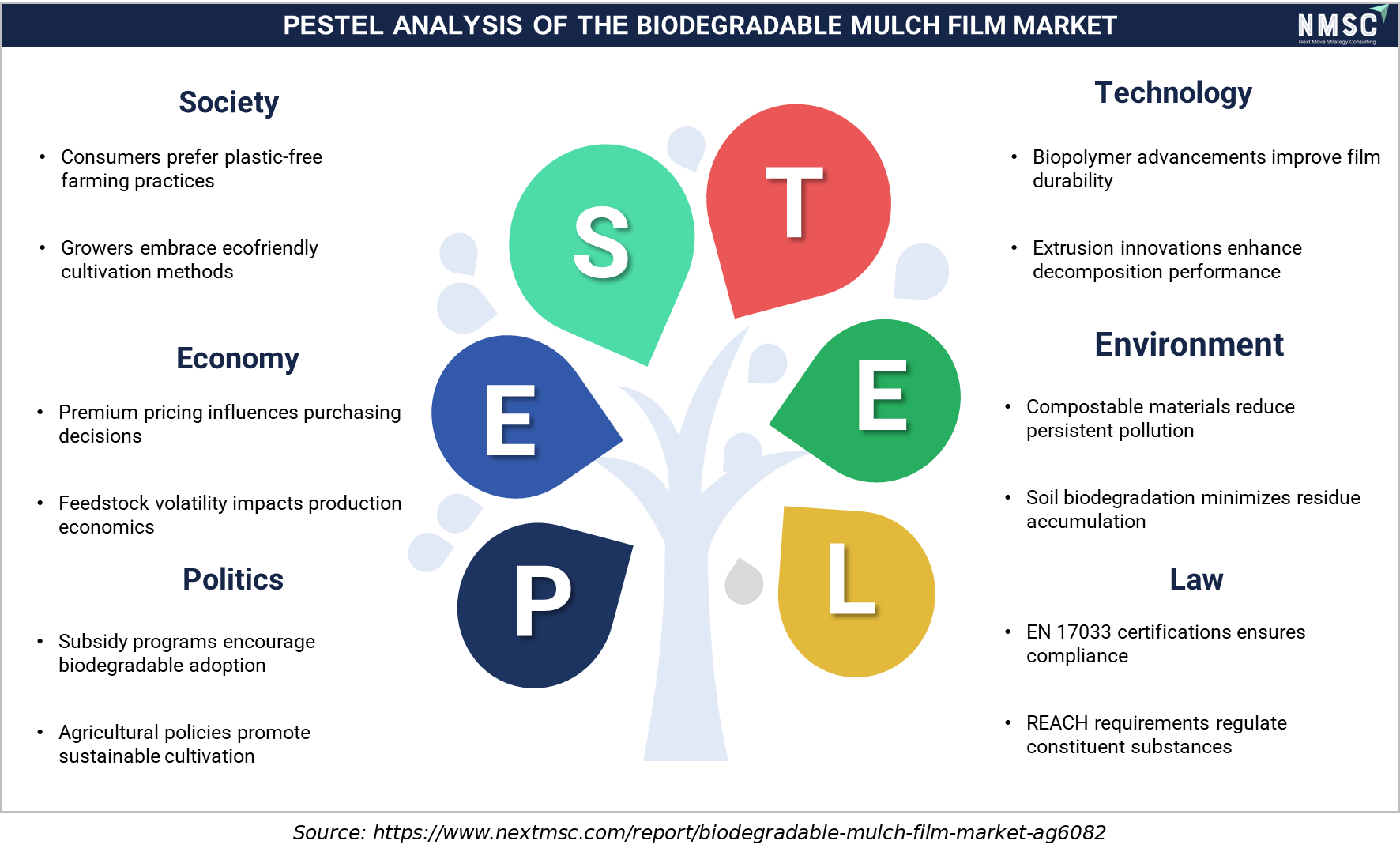
PESTEL Analysis of the Biodegradable Mulch Film Market

PESTEL Analysis of the Biodegradable Mulch Film Market
The biodegradable mulch film market is influenced by environmental priorities, technological advancements, agricultural economics, evolving regulations, and changing sustainability preferences. Growing demand for soil-friendly farming solutions supports adoption, while advances in biopolymer formulations improve performance and durability. Regulatory emphasis on biodegradability, chemical safety, and sustainable agriculture is further shaping product development and market expansion.

Growth Opportunities

Our analysis shows that three high-potential growth opportunities are emerging for biopolymer suppliers, film converters, and distribution partners within the Biodegradable Mulch Film market over the 2026–2035 forecast period.

How Can Performance-Parity PBAT-PLA Blends Unlock Mass-Market Vegetable Production Adoption?

The largest single addressable opportunity lies in achieving performance and total-cost parity with conventional PE mulch in large-scale outdoor vegetable production. Growers currently default to PE because biodegradable alternatives fail mechanical laying tests or carry unacceptable cost premiums. Biopolymer compounders that develop PBAT-PLA blend formulations maintaining tensile strength and elongation performance under mid-season thermal stress can unlock the price-sensitive conventional farmer end-user segment — the largest at USD 0.51 billion in 2025 — without requiring any regulatory mandate as the adoption trigger.

What Opportunity Does Certified Organic Agriculture Expansion Create for Premium Biodegradable Mulch?

The organic farming end-user segment represents a premium revenue opportunity because organic growers exhibit structurally higher willingness-to-pay for certified biodegradable mulch relative to conventional farmers. Agricultural input suppliers with certified organic-compliant biodegradable mulch products endorsed under EU 2018/848 or the USDA NOP can charge a 15–25% premium over standard biodegradable film pricing. The addressable organic premium market is expanding in parallel with global agricultural biological input adoption, as organic farmers co-invest in integrated soil health programs where biodegradable mulch reduces tillage requirement alongside biostimulant and biocontrol inputs.

How Can Faster-Degrading PBS Film Formulations Capture Northern Climate Agricultural Markets?

Northern European, Canadian, and Japanese agricultural markets represent an underserved opportunity for PBS-based biodegradable mulch formulations, where lower soil temperatures cause PBAT-based films to persist beyond the harvest and soil preparation window. PBS and PBS-PBAT blend formulations with accelerated low-temperature biodegradation kinetics can address this performance gap, positioning PBS-specialized producers to capture premium pricing from technically demanding markets where grower willingness-to-pay for agronomically validated degradation performance is demonstrably higher than in warm-climate markets where all biodegradable films degrade within acceptable timeframes.

Regional Outlook

2025 (USD Billion)
2035 (USD Billion)
North Americ
Europe
Asia-Pacific
Middle East
Latin Americ
Region 2025 (USD Billion) 2035 (USD Billion) CAGR (%)
North America $10.0 USD Billion $40.0 USD Billion 9.0%
Europe $17.1 USD Billion $51.1 USD Billion 27.0%
Asia-Pacific $24.2 USD Billion $62.2 USD Billion 25.0%
Middle East & Africa $31.3 USD Billion $73.3 USD Billion 23.0%
Latin America $38.4 USD Billion $84.4 USD Billion 12.0%

Regional data is locked

Unlock complete regional numbers for this market.

Unlock Full Data

Competitive Landscape

During our market evaluation, we noticed that the Biodegradable Mulch Film market exhibits a fragmented competitive structure at the film manufacturing level but is dominated at the biopolymer material supply level by a small number of large chemical groups whose compound innovations set the technical parameters for the entire industry.

Dimension Description
Market Structure Fragmented film converter layer with regional producers across Europe, China, and North America; concentrated biopolymer supply layer dominated by BASF SE (Ecoflex®/Ecovio®) and Novamont S.p.A. (Mater-Bi®) in Europe and Kingfa Sci. & Tech. and Xinjiang Zhongtai Chemical in China; NatureWorks LLC and TotalEnergies Corbion control premium PLA supply globally.
Innovation Focus PBAT-PLA blend optimization for PE performance parity; PBS compound development for cold-climate fast-degradation; starch content increase to reduce fossil-based PBAT dependency; third-party certified degradation rate testing under EN 17033 and ISO 17088 to support organic certification compliance documentation.
M&A Activity Biopolymer capacity expansion through greenfield PBAT and PBS production plant investments in China; strategic supply agreements between European film converters and Chinese PBAT producers; technology licensing partnerships between PLA resin suppliers and agricultural film converters in India and Southeast Asia.

How Do Companies Compete in the Biodegradable Mulch Film Industry?

Competition operates at two distinct value-chain levels. At the biopolymer material level, BASF SE, Novamont, NatureWorks, and TotalEnergies Corbion compete through proprietary polymer formulation innovation, certification investment, and supply chain reliability for large-volume agricultural film converters. At the film converter level, competition centers on agricultural application expertise, field-proven degradation performance claims, agronomic advisory services, and distributor network coverage. We observed that material suppliers with vertically integrated film manufacturing capabilities — notably Novamont, which produces Mater-Bi compound and markets certified mulch film directly — achieve stronger market positioning by controlling both technical performance and end-market narrative.

Which Competitive Archetypes Dominate the Biodegradable Mulch Film Market?

Three competitive archetypes dominate: vertically integrated biopolymer-to-film producers (Novamont, BASF's Ecovio brand converter partnerships); commodity PBAT producers competing on volume and price (Kingfa, Xinjiang Zhongtai); and specialty film converters using licensed biopolymer compounds to serve premium organic and export segments (Barbier Group, Sphere S.A.S., Ginegar Plastic Products). Our analysis shows that vertically integrated producers command pricing premiums through certification documentation, agronomic field trial data, and retailer sustainability program co-marketing, while commodity Chinese PBAT producers drive the price point compression that is accelerating conventional farmer adoption in Asia-Pacific.

How Are Companies Innovating and Differentiating Within the Biodegradable Mulch Film Market?

Innovation investment is concentrated in three areas: increasing biobased content within PBAT-PLA blends to reduce fossil-based material dependency; developing mulch films with independently certified degradation rates at specific soil temperatures for northern climate growers; and embedding agronomic performance data from controlled field trials into marketing programs that address grower skepticism about biodegradable film reliability versus conventional PE. The broader specialty chemicals industry's investment in renewable feedstock biopolymer synthesis is reducing PLA and PBS raw material costs, enabling competitive film pricing at biodegradable premium levels more acceptable to non-mandate-driven markets.

What M&A and Capacity Expansion Activity Is Shaping the Biodegradable Mulch Film Market?

Strategic investment in PBAT production capacity is the dominant capital deployment theme, with Chinese chemical groups expanding PBAT output at scale to serve domestic policy-driven demand and developing export markets. NatureWorks LLC has announced PLA production capacity expansion plans to meet growing non-food biopolymer demand including agricultural film applications, while Corbion N.V. continues to invest in lactic acid fermentation capacity that underpins the PLA supply chain. European film converter M&A activity is directionally consolidating around firms with certified EN 17033 soil-biodegradable product portfolios and established grower distribution networks, as smaller converters unable to fund certification programs exit the premium biodegradable segment.

Key Market Players

Our findings suggest that the following 20 companies are the leading manufacturers, biopolymer material suppliers, and film converters shaping global production, innovation, and market development in the Biodegradable Mulch Film market.

BASF SE Novamont S.p.A. NatureWorks LLC TotalEnergies Corbion Mitsubishi Chemical Corporation Kingfa Sci. & Tech. Co., Ltd. Danimer Scientific, Inc. Corbion N.V. Toray Industries, Inc. Jiangsu Torise Biomaterials Co., Ltd. Barbier Group SAS Sphere S.A.S. RKW Group SE TRIOPLAST AB [Ginegar Plastic Products Ltd.](file:///C:\Users\Liza%20Phukan\AppData\Local\Temp\4fbfbe3d-16db-4414-bd0b-0b12ea2c84fe_RD_Biodegradable%20Mulch%20Film%20Market.zip.4fe\Products%20Ltd.https:\ginegar.com\agriculture\films\mulch-and-orchard) Xinjiang Zhongtai Chemical Co., Ltd. Shenzhen Esun Industrial Co., Ltd. Wuhan Huali Environmental Technology Co., Ltd. Zhongcai Holdings Limited Futamura Chemical Co., Ltd.

Latest Developments

Based on research conducted by NMSC, we found that 2025–2026 developments are focused on biopolymer capacity expansion, certified film product launches, regulatory implementation milestones, and strategic partnerships between material suppliers and agricultural film distributors.

Date Event
November 2025 Novamont announced that its soil-biodegradable Mater-Bi mulch film obtained conformity certification under EU Fertilizer Regulation 2019/1009. The certification recognizes the film as an inorganic soil improver and confirms compliance with biodegradability, soil-accumulation and ecotoxicity criteria introduced for mulch-film polymers.
April 2025 Kingfa’s PBAT biodegradable mulch-film solution was highlighted among leading biodegradable-plastics technologies in connection with CHINAPLAS 2025. The solution uses PBAT molecular-structure modification, anti-hydrolysis catalysts and starch plasticization to improve mechanical performance, moisture retention and adaptability for agricultural films.

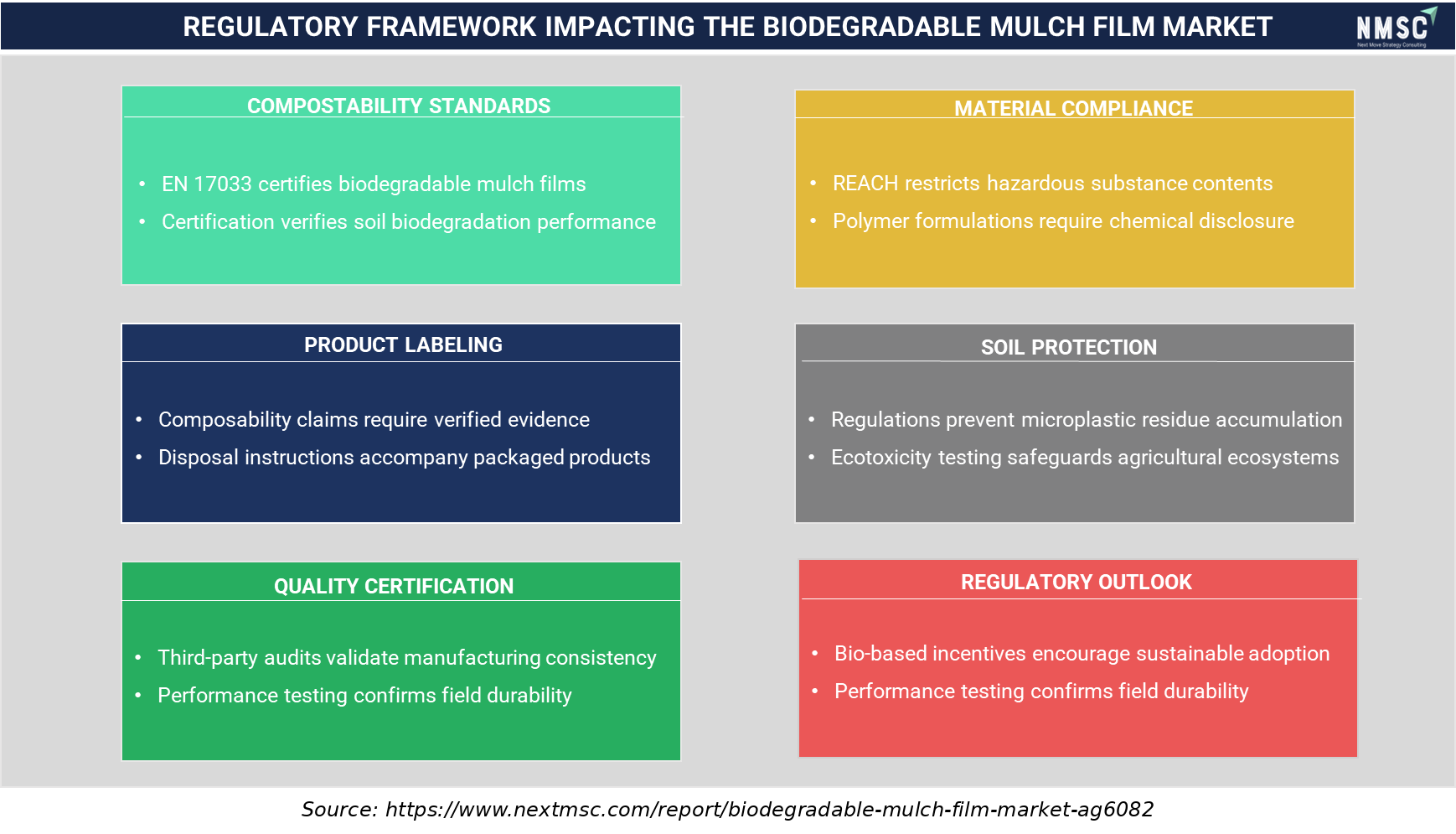
Regulatory Framework Impacting the Biodegradable Mulch Film Market
The regulatory landscape for biodegradable mulch films increasingly emphasizes verified biodegradability, material safety, product labeling, soil protection, and manufacturing quality. Standards such as EN 17033 support performance and soil biodegradation requirements, while chemical regulations influence polymer formulations. Certification, ecotoxicity testing, and validated environmental claims are becoming increasingly important for manufacturers seeking market acceptance and regulatory compliance.

Investment Opportunities

What Capital Inflows Are Targeting the Biodegradable Mulch Film Market?

Capital inflows into the Biodegradable Mulch Film market are primarily channeled through biopolymer production capacity expansion investments by major chemical companies, government-backed green agriculture funds in Europe and China, and private equity positioning in specialty agricultural input distributors with certified biodegradable product ranges. BASF SE, NatureWorks LLC, and Corbion N.V. have all disclosed biopolymer production investments aligned with growing agricultural film demand, while European venture capital is actively funding biodegradable agricultural input startups pursuing novel PBS and PHA mulch film formulations that can command premium pricing in organic and export vegetable grower segments. The EU European Green Deal funding instruments specifically include circular bioeconomy investments eligible for biodegradable agricultural material development programs.

How Is Agricultural Infrastructure Investment Supporting Biodegradable Mulch Film Adoption?

Agricultural infrastructure investment in precision planting equipment, drip irrigation systems, and protected cultivation facilities is creating co-investment demand for biodegradable mulch film as a standard component of modern intensive crop production systems. USDA Farm Service Agency and EU Common Agricultural Policy infrastructure support programs are subsidizing the transition to precision agriculture infrastructure that naturally integrates biodegradable mulch as a standard agronomic practice. The growth of polymer blend and alloy manufacturing capabilities for agricultural biopolymer applications is also attracting specialty chemicals investors who see PBAT-PLA compound development as a high-margin manufacturing opportunity within the broader specialty polymer sector.

What ESG Considerations Are Shaping Biodegradable Mulch Film Investment Decisions?

ESG considerations are fundamental to the Biodegradable Mulch Film market's investment thesis. On the environmental dimension, biodegradable mulch directly addresses soil microplastic contamination from PE mulch film fragments — a documented environmental impact identified by the FAO in its Assessment of Agricultural Plastics report — positioning biodegradable film investment as a verifiable plastic waste reduction commitment aligned with EU Taxonomy green criteria. On the social dimension, eliminating film retrieval labor reduces farm worker exposure to sharp plastic edge injuries and high-heat post-season retrieval conditions in warm-climate vegetable production. On governance, companies investing in third-party certified biodegradable mulch supply chains are increasingly favored in sustainable agriculture fund screening criteria and ESG fund inclusion processes.

Key Benefits for Stakeholders

How Does This Report Benefit Agricultural Input Manufacturers and Growers?

Agricultural input manufacturers and growers gain validated segmentation across all raw material, crop type, film thickness, application, and end-user dimensions, enabling product development, pricing, and grower program strategies calibrated to where biodegradable mulch demand is growing fastest. Our analysis shows that the report's detailed breakdown of the USD 1.04 billion 2025 market across five end-user segments and six raw material types helps manufacturers identify which biopolymer compound investments and film converter partnerships will generate the highest commercial return through the 2035 forecast horizon, particularly in the high-growth Organic Farmers and Commercial Greenhouse Operators segments.

How Does This Report Benefit Investors and Financial Analysts in the Biodegradable Mulch Film Market?

Investors and financial analysts benefit from single-point market size estimates — USD 1.04 billion in 2025 to USD 2.78 billion by 2035 at a 10.4% CAGR — supporting investment thesis construction and comparable company analysis for biopolymer producers, agricultural film converters, and sustainable agriculture input distributors. We observed that the report's regional differentiation — identifying MEA as the fastest-growing region at 13.5% CAGR and Europe as the most regulatory-advanced market at 12.1% CAGR — enables investors to identify above-market growth positioning among companies with geographic concentration in these high-growth zones.

How Does This Report Benefit Biopolymer Technology Developers and Product Teams?

Biopolymer technology developers and product teams gain insight into which raw material segment growth rates justify R&D investment prioritization, why PBS-Based Films at 13.5% CAGR and Blended Biopolymer Films at 13.3% CAGR are outpacing PBAT at 10.7%, and which crop type and climate geography applications create the most technically specific performance requirements. Our findings suggest that the report's analysis of cold-climate degradation constraints, EN 17033 certification investment returns, and PBAT-PLA blend performance optimization paths enables R&D and product management teams to build roadmap investment cases grounded in market-validated agronomic demand.

Key Market Segments Evaluated

By Raw Material

  • PBAT-Based Films
  • PLA-Based Films
  • Starch-Based Films
  • PBS-Based Films
  • Blended Biopolymer Films
  • Other Raw Materials

By Crop Type

  • Vegetables
  • Fruits and Berries
  • Grains and Cereals
  • Tobacco
  • Flowers and Nursery Crops
  • Other Crop Types

By Film Thickness

  • Very Thin Films (below 10 microns)
  • Standard Films (10–25 microns)
  • Thick Films (above 25 microns)

By Application

  • Weed Suppression
  • Soil Moisture Conservation
  • Soil Temperature Regulation
  • Erosion Control
  • Other Applications

By End User

  • Conventional Farmers
  • Organic Farmers
  • Commercial Greenhouse Operators
  • Research and Government Institutions

Conclusion & Recommendations

The Biodegradable Mulch Film market is positioned for sustained double-digit CAGR growth through 2035, advancing from USD 1.14 billion in 2026 to USD 2.78 billion by 2035 at a 10.4% CAGR. NMSC's analysis indicates that the market's expansion is structurally anchored by regulatory mandates in the EU and China that together represent more than half of global addressable mulch film consumption, insulating core demand from commodity input price cycle volatility. Asia-Pacific will consolidate volume leadership while Europe sustains regulatory-intensity growth; Middle East & Africa will outpace all regions at approximately 13.5% CAGR as Gulf state agricultural investment programs accelerate covered horticulture development.

What Strategic Positioning Should Market Participants Pursue?

Biopolymer material suppliers should prioritize PBAT-PLA blend formulation investment to achieve PE mulch performance parity verified through third-party field trials, while simultaneously developing PBS-based product lines for cold-climate growers where degradation rate performance is the decisive purchase criterion. Film converters should invest in EN 17033 and USDA NOP-compatible certification programs enabling premium pricing in organic farming and export vegetable segments, and should develop agronomic advisory capabilities that differentiate on soil health outcomes rather than competing purely on price against commodity PBAT importers from China.

How Attractive Is the Biodegradable Mulch Film Market for New Investment?
The Biodegradable Mulch Film market presents an attractive investment profile through 2035, combining a 10.4% CAGR with structural demand anchoring from binding regulatory mandates and growing organic certification-driven non-discretionary demand. We found that PBS-Based Films (13.5% CAGR), Blended Biopolymer Films (13.3% CAGR), Organic Farmers (13.5% CAGR), and the Middle East & Africa region (13.5% CAGR) all offer above-market growth profiles. Biopolymer material investment with integrated film converter partnerships represents the highest-return business model, combining material margin with certified product premium pricing that commodity converters alone cannot achieve.

What Market Shifts and Key Risks Should Stakeholders Monitor?

The primary structural shift is the migration from first-generation starch-blend films toward PBAT-PLA and PBS-based formulations, creating obsolescence risk for starch-blend film producers who lack biopolymer compound reformulation capability. Key risks include PBAT price volatility linked to adipic acid and 1,4-butanediol feedstock markets, inconsistent regulatory enforcement timelines in China delaying mandate-driven volume build-out, and the emergence of soil-biodegradable PE blend films marketed with unverified degradation claims that could distort grower perception and undermine certified biodegradable film premiums. Based on our estimates, companies without independent degradation performance certification face increasing buyer skepticism in regulated European markets.

What Are the Key Growth Pathways for the Biodegradable Mulch Film Market?

Three primary growth pathways exist through 2035: first, converting conventional farmer end-users through PE-performance-parity PBAT-PLA blend films that eliminate the grower performance risk barrier without requiring regulatory mandate; second, capturing the organic farming premium segment with certified EN 17033 or USDA NOP-compliant biodegradable mulch programs that justify a 15–25% price premium through documentation support and soil health outcome guarantees; and third, developing specialty PBS and PBS-PBAT blend formulations for northern climate vegetable, berry, and floriculture markets where cold-temperature fast degradation is the decisive product differentiation factor that no current commodity PBAT producer can satisfactorily address.

FAQs

About the Author

Mihul Sharma

Mihul Sharma

Mihul Sharma is Research Associate at Next Move Strategy Consulting, where he has covered technology, industrial, and healthcare markets for 3 years. His work applies structured business research, market analysis, and secondary-source review to assess market trends, competitive developments, and growth opportunities. He supports report development by fully synthesizing industry data, company information, and market signals into concise findings for strategy and investment-focused research teams.

About the Reviewer

Supradip Baul

Supradip Baul

Supradip Baul is an accomplished business consultant and strategist with over a decade of rich experience in market intelligence, strategy, technology, and business transformation. His work has included rigorous qualitative and quantitative analysis across multiple industries, helping clients shape investment decisions and long-term roadmaps. Earlier in his career, he was associated with Gartner, where he contributed to industry-leading reports and market share analyses. He has worked with leading global companies and holds an MBA with a dual specialization in Marketing and Finance.

Download Free Sample

Gaurav Jaiswal

GAURAV JAISWAL

Founder & CEO

Yano Charge Private Limited

The EV Charging market research report provided by the NextMSC was exceptionally detailed and insightful. It offered a comprehensive analysis that proved to be a game-changer for our strategic planning. Truly a testament to the NextMSC’s expertise and thoroughness in EV market landscape & analysis.

Semih Kavaklioglu

SEMIH KAVAKLIOGLU

Co-Founder & Sales Manager

Decortie

I work a lot in the marketing industry and I know that research is an essential part of any campaign. I have used Market research reports for my own products and I found them to be very informative and well-researched. The team here produces insightful reports for a good price

Kevin Coker

KEVIN COKER

Founder, CEO and Board Diector

Proxima Clinical Research

I have been using Next MSC reports for product positioning in a new geography for a long time. They have by far the best reports I have found and the price is reasonable too!

Gustaf Hummel Burstrom

GUSTAF HUMMEL BURSTROM

Founder

Revline Tools AB

Joseph and the team at Next Move Strategy Consulting have been excellent to work with, in supplying us with relevant market data and forecasts for our specific category. We had some special requirements and they were able to do a custom package to suit our needs. We would definitely recommend them to any other company needing market data and forecasts

Nishant Awate

NISHANT AWATE

Business Development Global Sales

Zehnder Group Deutschland GmbH

Our experience working with Next Move Strategy Consulting was positive. The team was responsive, professional, and open to incorporating our specific requirements throughout the project. The India AHU market study was comprehensive and well structured, covering market value and volume forecasts, product and application segments, and key industry trends. The inclusion of both AHU and residential MVHR market insights made the study particularly relevant for our strategic market assessment. Overall, the report provides a solid foundation for evaluating market potential, identifying priority segments, and supporting business-development decisions in India.

Custom Market Research Services

We will customize the research for you if the listed report does not fully match your requirements.

Get 30% Free Customization

Select License

This website uses cookies to ensure you get the best experience on our website. Learn more

✖