Gypsum Powder Market Size, Share, Growth & Forecast by Product Form (Raw Gypsum Powder, Beta Hemihydrate, Alpha Hemihydrate, Anhydrite), Source (Natural Gypsum, Synthetic Gypsum, Recycled Gypsum), Particle Size (Standard, Fine, Ultra Fine, Granulated), Sales Channel (Direct, Distributor, Retail), and Application (Construction, Cement, Agriculture, Industrial) - Global Analysis 2025–2035
Industry: Construction & Manufacturing | Latest Edition: September 30, 2026 | No of Pages: 614 | No. of Tables: 864 | No. of Figures: 852 | Format: PDF | Report Code: CM4931
Gypsum Powder Market
What Is the Gypsum Powder Market Size?
The global Gypsum Powder Market was valued at USD 7.07 billion in 2025 and is expected to reach USD 7.89 billion in 2026. Driven by accelerating residential and commercial construction activity across Asia-Pacific, a structural shift toward alpha hemihydrate formulations in premium building plaster applications, growing agricultural soil amendment programs in North America and Europe, and the rising industrial demand for high-precision dental and medical-grade calcined gypsum, the market is projected to reach USD 12.73 billion by 2035, advancing at a CAGR of 5.45% from 2026 to 2035. In volume terms, the Gypsum Powder Market was estimated at 134 thousand tons in 2025, expected to grow from 151 thousand tons in 2026 to 242 thousand tons by 2035, registering a CAGR of 5.41%.
|
Parameters |
Details |
|
Market Size in 2025 |
USD 7.07 Billion |
|
Market Size in 2026 |
USD 7.89 Billion |
|
Revenue Forecast in 2035 |
USD 12.73 Billion |
|
Growth Rate |
CAGR of 5.45% from 2026 to 2035 |
|
Market Volume in 2025 |
134 thousand tons |
|
Market Volume in 2026 |
151 thousand tons |
|
Volume Forecast in 2035 |
242 thousand tons |
|
Volume Growth Rate |
CAGR of 5.41% from 2026 to 2035 |
|
Analysis Period |
2025–2035 |
|
Base Year Considered |
2025 |
|
Forecast Period |
2026–2035 |
|
Market Size Estimation |
USD Billion |
|
Companies Profiled |
20 |
|
Countries Covered |
33 |
|
Market Share |
Top 10 |
Gypsum Powder Market Overview
What Is the Gypsum Powder Market?
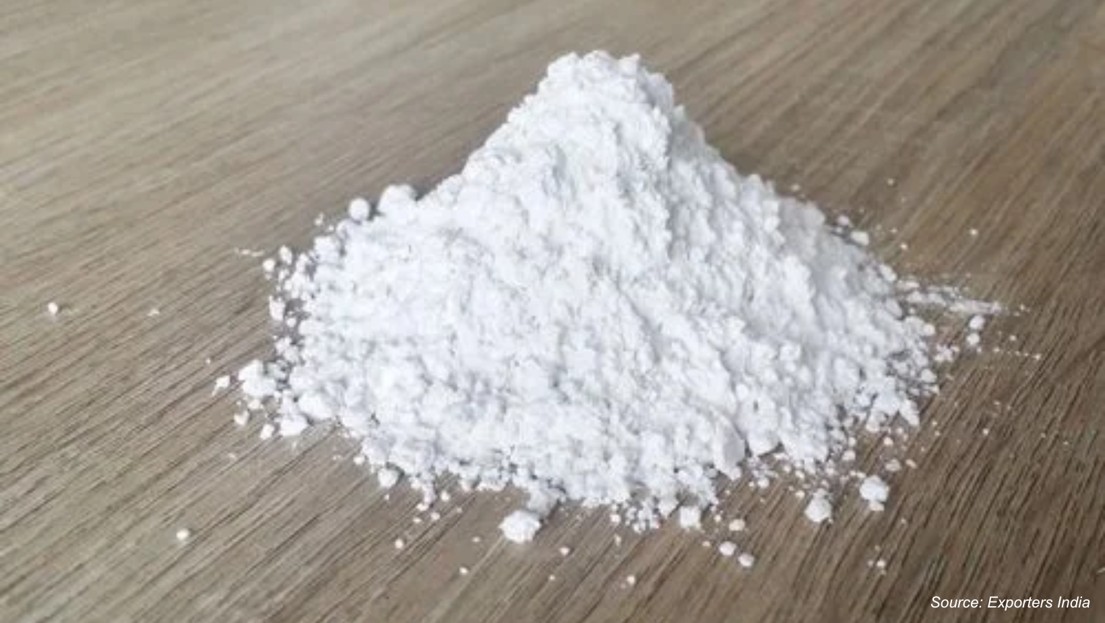
The Gypsum Powder Market encompasses the production, processing, and commercial supply of calcium sulfate-based powders derived from natural gypsum ore, synthetic by-products, and recycled construction materials. The market covers a spectrum of product forms including raw gypsum powder, beta hemihydrate (plaster of paris), alpha hemihydrate, and anhydrite, each engineered to specific hardness, setting time, and application performance requirements. End-use applications span construction board feedstock, site-applied plasters, screeds, agricultural soil amendments, and precision industrial uses including dental and medical-grade gypsum-based building materials products.
How Has the Gypsum Powder Market Evolved Structurally?
The Gypsum Powder Market has undergone a gradual structural evolution from a commodity construction mineral to a differentiated specialty material serving diverse industrial applications. An initial phase dominated by natural gypsum quarrying and basic beta hemihydrate production has progressively expanded to incorporate synthetic gypsum utilization, particularly flue gas desulfurization gypsum as a by-product of coal-fired power generation, and recycled construction gypsum recovery programs. NMSC's analysis indicates that the current phase reflects growing alpha hemihydrate adoption in high-performance building plaster applications, ultra-fine powder demand in industrial and dental segments, and increased circular economy integration across European construction gypsum supply chains.
How Do Regulations Influence the Gypsum Powder Market?
Regulatory frameworks across major Gypsum Powder Market geographies shape product specifications, sourcing requirements, and environmental compliance standards. The European Union's Construction Products Regulation mandates CE marking and performance declarations for gypsum-based construction products, directly influencing product formulation and quality standards across the European building plaster supply chain. U.S. EPA standards govern phosphogypsum utilisation and disposal, creating material constraints on a key synthetic gypsum source. India's BIS standards for plaster of paris and gypsum plaster products define procurement specifications for government housing programs. Recycled content mandates in European waste directives are progressively expanding the Recycled Gypsum sub-segment within the overall Gypsum Powder Market.
How Is Technology Adoption Advancing Across the Gypsum Powder Market?
Technology adoption across the Gypsum Powder Market is accelerating through advances in calcination process control, particle size engineering, and admixture formulation that enable performance-specific product customisation for construction, industrial, and agricultural applications. Rotary kiln calcination and fluidised bed reactor technologies are enabling consistent alpha hemihydrate production at commercial scale. Ultra-fine powder milling and air classification are creating new product grades for dental, pharmaceutical, and advanced ceramics applications. Based on NMSC's research, we found that synthetic gypsum processing technologies, particularly FGD gypsum purification systems, are enhancing product quality to meet board-grade feedstock specifications across North American and European gypsum-based building materials manufacturing operations.
|
Key Takeaways |
|
By product form, Alpha Hemihydrate dominated the Gypsum Powder Market with a 48.5% revenue share at USD 3.43 billion in 2025, driven by its superior strength and dimensional stability in premium building plaster, self-levelling screed, and high-end construction applications across Europe and North America. |
|
Alpha Hemihydrate is also the fastest-growing product form in the Gypsum Powder Market at a CAGR of 6.35% from 2026 to 2035, advancing from USD 3.43 billion in 2025 to USD 6.72 billion by 2035, reflecting rising demand for high-performance Construction Gypsum in premium interior finishing and industrial casting applications. |
|
By source, Natural Gypsum dominated the Gypsum Powder Market with a 64.57% revenue share at USD 4.56 billion in 2025, anchored by established quarrying infrastructure in the U.S., Spain, Iran, and China and its extensive use as the primary raw material for Beta Hemihydrate and board-grade feedstock production globally. |
|
Recycled Gypsum is the fastest-growing source segment in the Gypsum Powder Market at a CAGR of 6.37% from 2026 to 2035, advancing from USD 0.52 billion in 2025 to USD 1.03 billion by 2035, driven by European circular economy directives mandating gypsum recovery from demolition waste and end-of-life wallboard. |
|
By particle size, Fine Powder held the largest revenue share in the Gypsum Powder Market at 33.76% with USD 2.39 billion in 2025, reflecting its broad applicability across board feedstock, site-applied plaster, and standard industrial calcined gypsum formulations globally. |
|
Ultra Fine Powder is the fastest-growing particle size segment in the Gypsum Powder Market at a CAGR of 8.48% from 2026 to 2035, advancing from USD 1.40 billion in 2025 to USD 3.36 billion by 2035, driven by increasing demand in dental, medical, food grade, and advanced ceramics applications requiring precise particle distribution. |
|
By sales channel, Direct Sales dominated the Gypsum Powder Market with a 42.25% revenue share at USD 2.99 billion in 2025, reflecting large-volume OEM supply agreements between gypsum producers and wallboard manufacturers, cement plants, and major construction contractors. |
|
Distributor Sales is the fastest-growing commercial channel in the Gypsum Powder Market at a CAGR of 6.85% from 2026 to 2035, advancing from USD 2.40 billion in 2025 to USD 4.94 billion by 2035, driven by increasing demand from small and medium construction companies, agricultural distributors, and industrial specialty users in emerging markets. |
|
By application, Construction dominated the Gypsum Powder Market with a 70.53% revenue share at USD 4.99 billion in 2025, led by Board Feedstock at USD 3.32 billion (66.59% of construction segment) as the primary demand driver for wallboard manufacturing across all major markets. |
|
Agriculture is the fastest-growing application in the Gypsum Powder Market at a CAGR of 8.88% from 2026 to 2035, advancing from USD 0.24 billion in 2025 to USD 0.59 billion by 2035, driven by soil amendment adoption in water-stressed U.S. agricultural states, European soil health regulations, and expanding Indian and Brazilian farming sectors. |
|
Asia-Pacific dominated the Gypsum Powder Market with a 40.09% revenue share at USD 2.83 billion in 2025, anchored by China's construction activity, India's housing programs, and expanding Southeast Asian urban infrastructure investment. |
|
Asia-Pacific is also the fastest-growing major region in the Gypsum Powder Market at a CAGR of 6.06% from 2026 to 2035, projected to advance from USD 2.83 billion in 2025 to USD 5.41 billion by 2035, driven by ongoing urbanization in China, India's PMAY housing mission, and metro construction activity across Vietnam, Indonesia, and the Philippines. |
|
China is the largest country market in the Gypsum Powder Market at USD 1.33 billion in 2025, representing 47.0% of Asia-Pacific revenue and approximately 18.8% of global revenue, underpinned by the world's largest wallboard manufacturing industry and extensive infrastructure construction activity. |
|
India is the fastest-growing major country market in Asia-Pacific at a CAGR of 9.22% from 2026 to 2035, advancing from USD 276 million in 2025 to USD 709 million by 2035, driven by PMAY affordable housing construction, government building codes mandating gypsum plaster, and rapidly growing domestic wallboard manufacturing capacity. |
Ecosystem Analysis of the Gypsum Powder Market
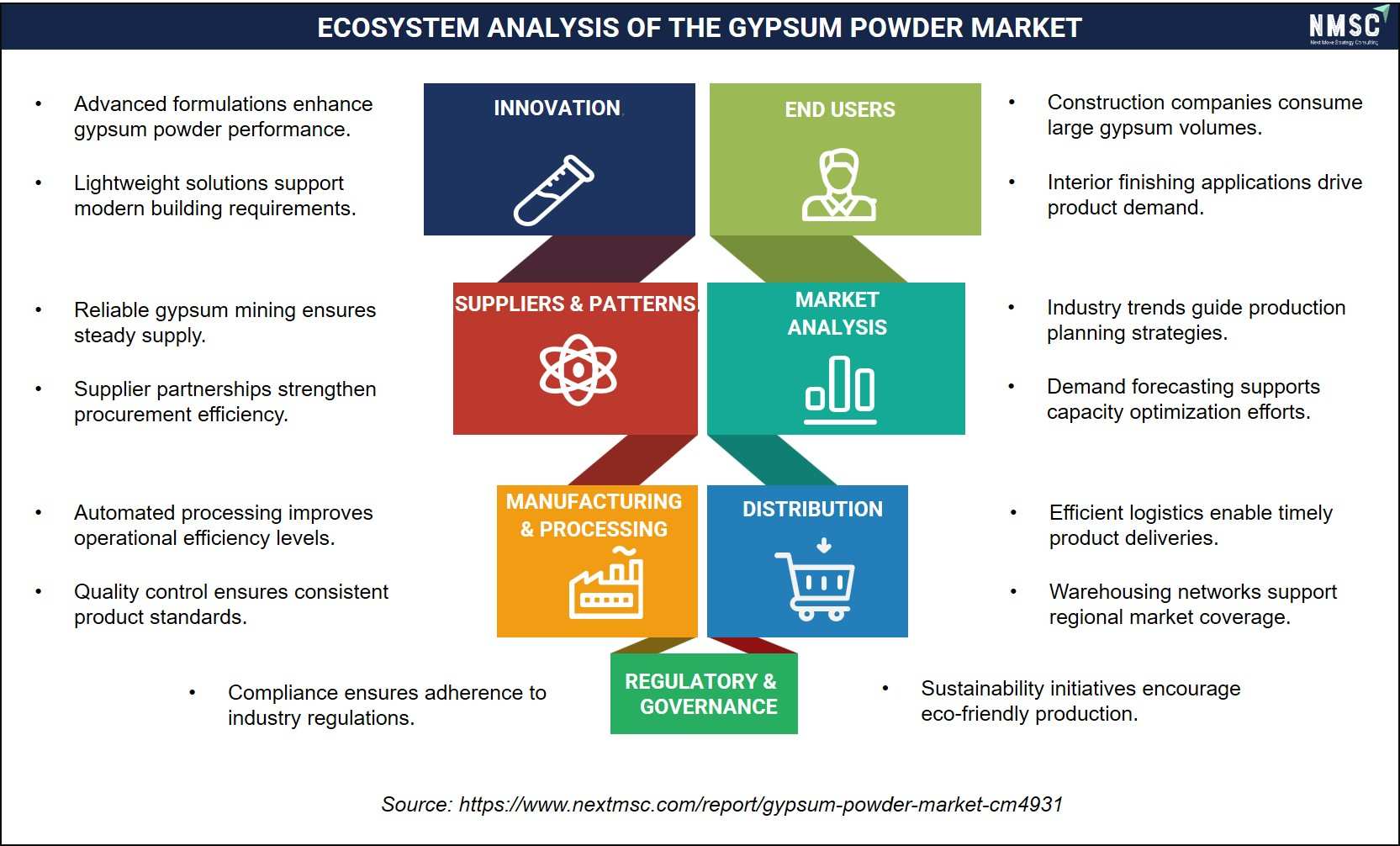
The above infographic illustrates the ecosystem of the Gypsum Powder Market by highlighting the interconnected roles of innovation, suppliers, manufacturing and processing, distribution networks, market dynamics, end users, and regulatory frameworks. It depicts how raw material sourcing, technological advancements, and governance influence the value chain, while demand from construction and interior finishing applications drives market growth. Overall, the infographic provides a holistic view of the key stakeholders and factors shaping the industry's development.
Key Emerging Trends in the Gypsum Powder Market
How Is the Shift Toward Alpha Hemihydrate Reshaping the Gypsum Powder Market?
Alpha Hemihydrate production is displacing Beta Hemihydrate across premium construction segments of the Gypsum Powder Market due to its superior mechanical strength, lower water demand, and tighter dimensional tolerances after setting. From our research, we found that European interior plaster manufacturers and self-levelling screed producers are increasingly specifying alpha hemihydrate formulations to comply with EN 13279 gypsum binder standards. Compagnie de Saint-Gobain and Knauf Gips KG have expanded alpha hemihydrate calcination capacity to serve demand from high-end residential and commercial fit-out projects, reinforcing the product's role as the premium tier within the Construction Gypsum category globally.
How Is the Circular Economy Driving Recycled Gypsum Adoption Across the Gypsum Powder Market?
Circular economy policy frameworks in Europe are structurally transforming the Gypsum Powder Market's raw material base by mandating the recovery and reprocessing of gypsum from demolition waste and end-of-life wallboard. The European Commission's Construction and Demolition Waste Framework targets high rates of material recovery, creating formal collection infrastructure for post-consumer gypsum. Through our market assessment, we observed that British Gypsum (Saint-Gobain) and Knauf Gips have established dedicated recycled gypsum processing streams at UK and German manufacturing sites. Recycled gypsum is the fastest-growing source segment at a CAGR of 6.37%, reflecting policy momentum and improving collection logistics across the EU and UK.
How Is Agricultural Gypsum Demand Creating New Growth Channels Within the Gypsum Powder Market?
Agricultural gypsum applications are emerging as the fastest-growing end-use segment within the Gypsum Powder Market at a CAGR of 8.88% through 2035, driven by scientific evidence supporting calcium sulfate as a soil amendment for improving soil structure, reducing aluminium toxicity, and enhancing water infiltration in high-clay soils. NMSC's analysis indicates that the U.S. Department of Agriculture's promotion of gypsum as a conservation practice amendment has accelerated adoption across corn, soybean, and peanut growing regions. Diamond K Gypsum and other agricultural gypsum specialists are expanding distribution networks to serve the growing Soil Amendment and Fertilizer Input sub-segments across North America, South America, and South Asia.
How Is Ultra-Fine Powder Technology Creating Premium Market Tiers in the Gypsum Powder Market?
Ultra-fine powder milling and classification technologies are enabling new high-value product tiers within the Gypsum Powder Market by producing calcium sulfate grades with controlled particle size distributions below 10 microns, meeting precision specifications in dental, pharmaceutical, and advanced ceramics applications. Our findings suggest that dental stone demand, a premium alpha hemihydrate product, is growing in step with global dental care expansion, particularly in Asia-Pacific and the Middle East, where dental services penetration is rising rapidly. Food and pharmaceutical-grade ultra-fine gypsum, used as a calcium source and anti-caking agent, represents a high-margin sub-segment within the Industrial application category, growing at a CAGR of 4.92% through 2035.
What Are the Key Market Drivers, Breakthroughs, and Investment Opportunities That Will Shape the Gypsum Powder Market Industry in the Next Decade?
|
Drivers / Trends / Restraints |
(+/-) % Impact on CAGR Forecast |
Geographic Relevance |
Impact Timeline |
|
Expansion of Residential and Commercial Construction Activity |
+1.8% |
Asia-Pacific, MEA, North America |
2025–2035 |
|
Rising Demand for Alpha Hemihydrate in Premium Construction Gypsum |
+1.2% |
Europe, North America, APAC |
2025–2032 |
|
Agricultural Soil Amendment Adoption Growth |
+0.9% |
North America, India, Brazil |
2026–2035 |
|
Circular Economy and Recycled Gypsum Mandates (EU) |
+0.7% |
Europe |
2025–2030 |
|
FGD Gypsum Supply Growth from Coal Power Transition |
+0.6% |
Asia-Pacific, North America |
2025–2035 |
|
Industrial and Medical Grade Ultra-Fine Gypsum Demand |
+0.8% |
Global |
2025–2035 |
|
High Mining Logistics and Raw Material Transportation Costs |
-0.6% |
All regions |
Ongoing |
|
Phosphogypsum Regulatory Restrictions (U.S. EPA) |
-0.5% |
North America |
Ongoing |
|
Green Building Standards Reducing Overall Plaster Use |
-0.3% |
Europe, North America |
2025–2030 |
|
Emerging Wallboard Manufacturing in India and Southeast Asia |
+1.0% |
India, Vietnam, Indonesia |
2026–2035 |
|
Distributor Network Expansion in Emerging Markets |
+0.5% |
MEA, Latin America, APAC |
2025–2032 |
What Are the Growth Drivers of the Gypsum Powder Market?
How Is Global Construction Activity Driving Structural Demand for Gypsum-Based Building Materials?
Accelerating residential, commercial, and infrastructure construction activity globally represents the most consequential structural growth driver for the Gypsum Powder Market, with construction applications accounting for 70.53% of total market revenue at USD 4.99 billion in 2025. Our analysis shows that India's Pradhan Mantri Awas Yojana (PMAY) housing program targets the construction of tens of millions of affordable housing units, directly mandating gypsum plaster as a wall finishing material under Bureau of Indian Standards construction specifications. The U.S. Department of Housing and Urban Development's residential construction pipeline and the European Commission's Renovation Wave initiative targeting 35 million building renovations by 2030 collectively define a multi-year procurement horizon sustaining gypsum-based building materials demand globally.
How Is the Growth of Synthetic Gypsum Supply Supporting Gypsum Powder Market Expansion?
Flue gas desulfurization gypsum generated as a by-product of coal-fired power plant emissions controls represents a structurally growing and cost-competitive raw material source that is expanding the Gypsum Powder Market's supply base in Asia-Pacific and North America. Based on NMSC's research, we found that FGD gypsum holds a 61.48% share of the synthetic gypsum sub-segment at USD 1.22 billion in 2025. The U.S. EPA's Clean Air Act enforcement of sulfur dioxide emission limits ensures continued FGD gypsum output from U.S. power plants, providing wallboard manufacturers including Georgia-Pacific and New NGC with a reliable synthetic feedstock alternative to mined natural gypsum, reducing input cost volatility and supporting stable supply chain planning.
How Is the Agriculture Segment Creating New Demand Pathways for the Gypsum Powder Market?
Agricultural gypsum applications are the fastest-growing end-use category in the Gypsum Powder Market at a CAGR of 8.88%, representing USD 0.24 billion in 2025 and projected to reach USD 0.59 billion by 2035. Our assessment indicates that the USDA Natural Resources Conservation Service has formally recognised gypsum as a conservation practice for improving soil health in high-clay agricultural soils, providing government policy endorsement that accelerates farmer adoption across U.S. Corn Belt states. The International Fertilizer Association's research on calcium sulfate as a secondary nutrient source for sulfur-deficient soils is driving awareness and adoption expansion across European, Indian, and Brazilian farming sectors, establishing agriculture as a structurally durable growth pillar for the Gypsum Powder Market.
What Are the Growth Inhibitors of the Gypsum Powder Market?
How Do High Transportation and Logistics Costs Constrain Gypsum Powder Market Growth?
Natural gypsum's relatively low value-to-weight ratio creates structural transportation cost constraints that limit the geographic reach of individual mining operations and elevate final product costs in markets distant from major gypsum deposits. Our analysis shows that quarrying regions in Spain, Iran, and North America supply global markets through bulk shipping, but freight cost volatility directly impacts Gypsum Powder Market margins for downstream processors and board manufacturers. The U.S. Geological Survey estimates that gypsum is mined in over 85 countries globally, yet economically viable transportation distances typically limit natural gypsum supply chains to regional sourcing corridors, creating supply concentration risks in markets with limited domestic mining resources.
How Do Regulatory Restrictions on Phosphogypsum Limit Gypsum Powder Market Supply Optionality?
Phosphogypsum, generated as a by-product of phosphate fertilizer production, represents a theoretically abundant synthetic gypsum source that remains substantially underutilized due to regulatory restrictions on radioactive content and utilization pathway approvals. The U.S. EPA's regulations under the Clean Air Act restrict phosphogypsum stacking and require EPA approval for beneficial use applications, limiting this synthetic feedstock's contribution to the North American Gypsum Powder Market despite its large-scale production volume. International regulatory divergence creates uneven supply optionality across markets, with some Southeast Asian countries allowing broader phosphogypsum utilization for road base and agricultural applications while others maintain strict containment requirements, limiting the global scalability of this feedstock category.
What Are the Growth Opportunities in the Gypsum Powder Market?
How Does the Emerging Wallboard Manufacturing Expansion in South and Southeast Asia Create Gypsum Powder Market Opportunities?
Rapid expansion of domestic wallboard manufacturing capacity in India, Vietnam, Indonesia, and the Philippines is creating a structurally new procurement base for gypsum board feedstock that directly benefits the Gypsum Powder Market's Construction segment. Our findings suggest that India's construction sector growth, anchored by government infrastructure programs, has attracted board manufacturing investments from Gyproc (Saint-Gobain) and USG Boral, requiring large-volume gypsum feedstock supply contracts. The Association of Southeast Asian Nations' infrastructure investment agenda, supported by Asian Development Bank project financing, is accelerating building material adoption, including gypsum wallboard systems, in commercial and residential construction projects across Vietnam, Indonesia, and the Philippines markets.
How Does the Medical and Dental Grade Gypsum Segment Represent a High-Margin Growth Opportunity in the Gypsum Powder Market?
The Dental and Medical sub-segment of the Industrial application category is the fastest-growing industrial end-use in the Gypsum Powder Market at a CAGR of 6.25%, advancing from USD 0.50 billion in 2025 to USD 0.97 billion by 2035. Based on our market evaluation, we noticed that dental stone and die stone demand is growing in step with expanding dental care infrastructure across Asia-Pacific and the Middle East, where dental services penetration is increasing rapidly as disposable income levels rise. The World Health Organization's oral health global targets emphasize access expansion that will progressively grow dental procedure volumes in emerging markets, creating sustainable long-term demand growth for high-precision alpha hemihydrate dental grade products within the premium Industrial tier of the Gypsum Powder Market.
How Do ESG Mandates and Green Building Certifications Create Investment Opportunities in the Gypsum Powder Market?
Green building certification frameworks including LEED, BREEAM, and the Indian Green Building Council's rating systems are creating structured demand incentives for recycled content and low-carbon gypsum products within the Gypsum Powder Market. Through NMSC's assessment, we found that recycled gypsum wallboard qualifies for material credits under LEED v4 MR credits, directly incentivizing architects and developers to specify recycled gypsum products in green-certified construction projects. The European Investment Bank's sustainable infrastructure financing programs and IFC green building lending standards in emerging markets are progressively embedding recycled gypsum and low-carbon building plaster specifications into project finance requirements, creating durable institutional demand for sustainable Gypsum Powder Market product categories.
How Is the Gypsum Powder Market Segmented, and What Are the Key Insights from the Segmentation Analysis?
Which Product Forms Are Driving Revenue Leadership in the Gypsum Powder Market?
|
Product Form |
2025 (USD Bn) |
2035 (USD Bn) |
CAGR % (2026–2035) |
|
Raw Gypsum Powder |
0.92 |
1.44 |
4.01% |
|
Beta Hemihydrate |
2.34 |
4.04 |
4.98% |
|
Alpha Hemihydrate |
3.43 |
6.72 |
6.35% |
|
Anhydrite |
0.38 |
0.53 |
2.76% |
Our analysis shows that the Gypsum Powder Market product form segmentation is led by Alpha Hemihydrate with a commanding 48.5% revenue share at USD 3.43 billion in 2025, reflecting its dominant role in high-performance Construction Gypsum applications including self-levelling screeds, precision casting plasters, and premium interior wall finishes that demand superior mechanical properties. Alpha Hemihydrate is simultaneously the fastest-growing product form at a 6.35% CAGR through 2035. Beta Hemihydrate holds a 33.2% share at USD 2.34 billion, serving the broad plaster of paris demand base across board feedstock, joint compounds, and general building plaster. Raw Gypsum Powder and Anhydrite address specific niche applications in cement retarder and flooring compound sectors, respectively, with Anhydrite showing the slowest growth at 2.76% CAGR due to its substitution in modern construction formulations.
How Do Natural, Synthetic, and Recycled Gypsum Sources Define the Supply Landscape of the Gypsum Powder Market?
|
Source |
2025 (USD Bn) |
2035 (USD Bn) |
CAGR % (2026–2035) |
|
Natural Gypsum |
4.56 |
8.13 |
5.34% |
|
Synthetic Gypsum |
1.98 |
3.57 |
5.46% |
|
Recycled Gypsum |
0.52 |
1.03 |
6.37% |
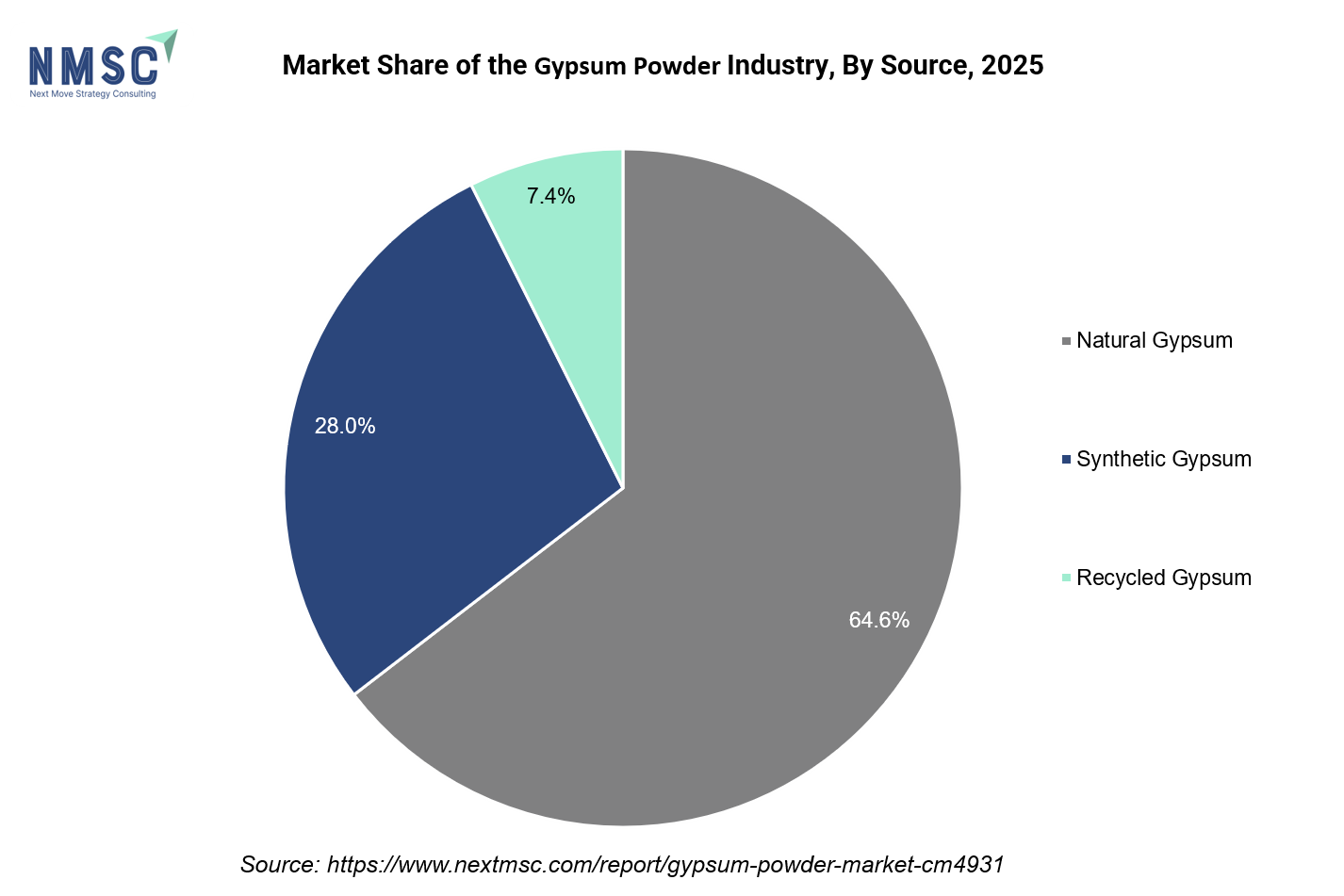
From our market assessment, we observed that the Gypsum Powder Market source segmentation is dominated by Natural Gypsum at 64.57% revenue share and USD 4.56 billion in 2025, reflecting the deep integration of mined gypsum across global supply chains. Within Synthetic Gypsum, which holds a 28.05% share, FGD Gypsum leads at 61.48% of the sub-segment (USD 1.22 billion in 2025), providing a cost-competitive feedstock for board-grade applications in markets with active coal power sectors. Phosphogypsum is the fastest-growing synthetic variant at a 6.90% CAGR, reflecting gradually expanding utilization pathways. Recycled Gypsum at 7.38% share is the fastest-growing primary source category at 6.37% CAGR, driven by European demolition waste recovery mandates and growing sustainability commitments among major board manufacturers.
How Does Particle Size Differentiation Drive Value Creation Across the Gypsum Powder Market?
|
Particle Size |
2025 (USD Bn) |
2035 (USD Bn) |
CAGR % (2026–2035) |
|
Standard Powder |
2.18 |
3.23 |
3.38% |
|
Fine Powder |
2.39 |
4.30 |
5.46% |
|
Ultra Fine Powder |
1.40 |
3.36 |
8.48% |
|
Granulated Powder |
1.10 |
1.84 |
4.66% |
NMSC's analysis indicates that the Gypsum Powder Market particle size segmentation reveals Fine Powder as the largest segment at 33.76% share and USD 2.39 billion in 2025, reflecting its widespread use in board manufacturing, joint compound formulations, and standard building plaster products that collectively constitute the market's broadest volume application base. Ultra Fine Powder, at 19.80% share, is the fastest-growing particle size category at an 8.48% CAGR, driven by escalating demand in dental stone, pharmaceutical excipient, and advanced ceramics applications requiring precise sub-10-micron particle distribution. Standard Powder serves commodity construction and cement applications with a modest 3.38% CAGR, reflecting market maturity. Granulated Powder finds application in agricultural slow-release formats and industrial pelletized products, growing at a 4.66% CAGR.
Which Commercial Channel Strategy Is Gaining Momentum in the Gypsum Powder Market?
|
Sales Channel |
2025 (USD Bn) |
2035 (USD Bn) |
CAGR % (2026–2035) |
|
Direct Sales |
2.99 |
4.81 |
4.28% |
|
Distributor Sales |
2.40 |
4.94 |
6.85% |
|
Retail Sales |
1.68 |
2.97 |
5.27% |
Through our market assessment, we observed that Direct Sales leads the Gypsum Powder Market commercial channel segmentation at 42.25% share and USD 2.99 billion in 2025, anchored by long-term supply agreements between major producers such as Compagnie de Saint-Gobain and Knauf Gips and large wallboard plants, cement manufacturers, and industrial customers that procure in bulk volumes. Distributor Sales is the fastest-growing channel at a 6.85% CAGR, advancing from USD 2.40 billion in 2025 to USD 4.94 billion by 2035, driven by distributor network expansion serving small and medium construction contractors, agricultural merchants, and industrial specialty buyers in emerging markets where direct supply infrastructure is limited. Retail Sales serves the DIY and small contractor segment at 23.78% share, growing at a 5.27% CAGR.
Supply Chain Structure of the Gypsum Powder Market
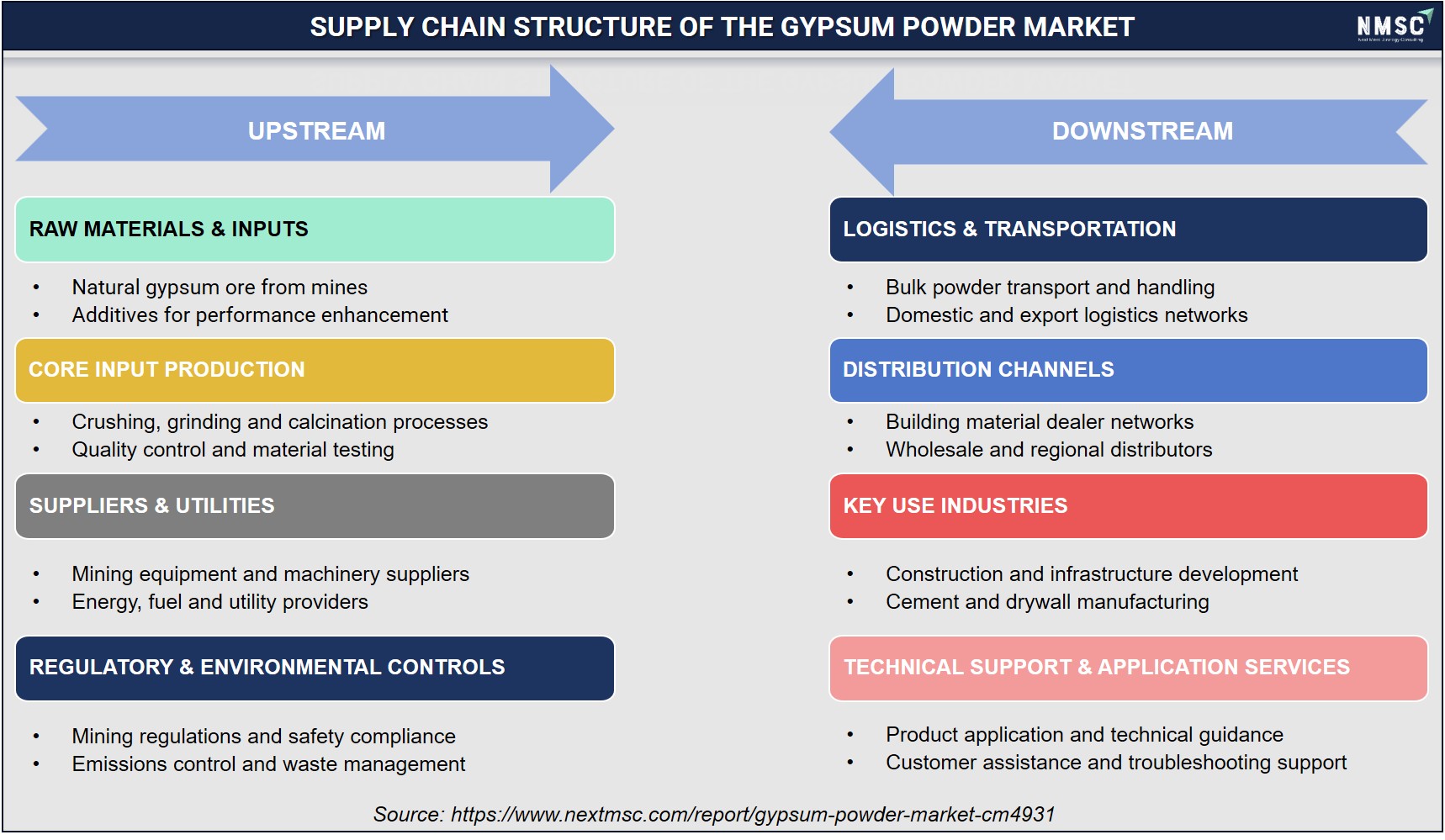
The above infographic presents the supply chain structure of the Gypsum Powder Market, illustrating the flow from upstream raw material sourcing and gypsum processing to downstream distribution and end-use industries. NMSC analysis highlights the role of mining inputs, manufacturing operations, logistics networks, and technical support services in ensuring product availability. Additionally, it emphasizes the importance of regulatory compliance and environmental controls in maintaining an efficient and sustainable gypsum powder value chain.
Regional Outlook
Geographic Performance Snapshot
|
Region |
2025 (USD Mn) |
2035 (USD Mn) |
CAGR % |
Key Driver |
|
North America |
1261.5 |
2283.5 |
5.51% |
Housing construction, renovation wave, FGD gypsum supply |
|
Europe |
2178.4 |
3707.5 |
4.86% |
Green Deal renovation, EN-standard premium plasters, recycled gypsum |
|
Asia-Pacific |
2833.7 |
5405.1 |
6.06% |
China construction, India housing programs, SE Asia urbanization |
|
MEA |
472.9 |
780.4 |
4.53% |
GCC construction boom, North Africa housing, infrastructure programs |
|
Latin America |
322.4 |
550.9 |
4.90% |
Brazil housing, Colombia and Chile infrastructure, agricultural gypsum |
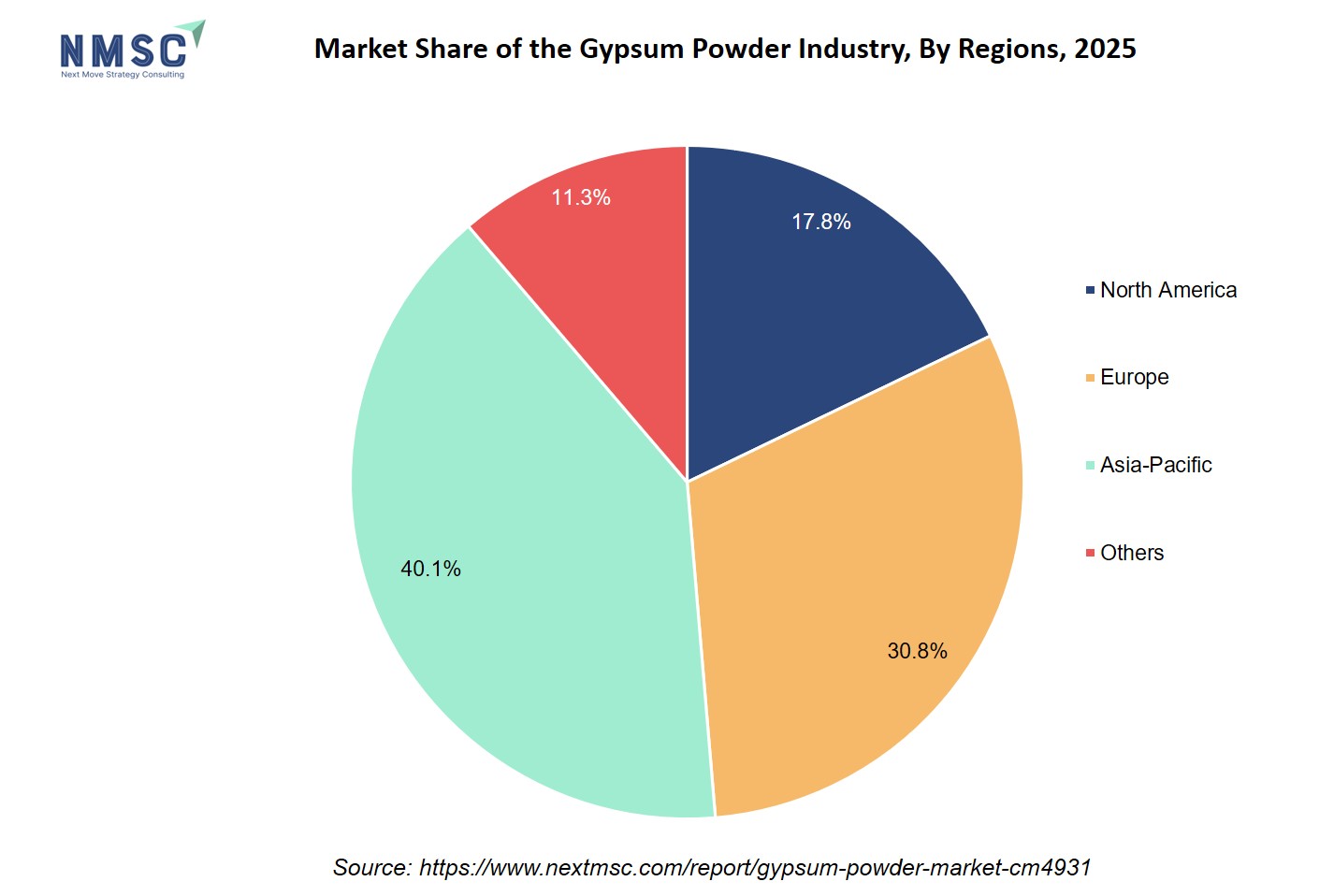
North America Gypsum Powder Market
Based on our engagements with North American building materials market participants, the region's Gypsum Powder Market is valued at USD 1.26 billion in 2025 and is forecast to reach USD 2.28 billion by 2035 at a CAGR of 5.51%. Demand is anchored by one of the world's largest wallboard manufacturing industries, supported by abundant natural gypsum deposits in Nova Scotia and the American Southwest and substantial FGD gypsum supply from coal-fired power generation. The U.S. EPA's clean air regulations and USDA soil health programs drive both supply-side FGD gypsum availability and demand-side agricultural gypsum adoption, supporting a balanced growth profile across Construction Gypsum and agricultural application categories.
U.S. Gypsum Powder Market
Based on our engagements, the United States represents 83.15% of North American Gypsum Powder Market revenue at USD 1.05 billion in 2025, growing to USD 1.91 billion by 2035 at a CAGR of 5.60%. The market benefits from the world's most integrated FGD gypsum supply chain linking power utilities and wallboard manufacturers, with Georgia-Pacific and New NGC as dominant domestic producers. The U.S. Geological Survey confirms the U.S. as a top-five global gypsum producer. Residential construction activity, commercial renovation demand, and expanding agricultural soil amendment programs collectively sustain broad-based Gypsum Powder Market growth. Technology adoption is advanced, with synthetic gypsum processing and ultra-fine powder milling supporting premium product segments.
Gypsum Production in the United States
|
Sl. No. |
Gypsum Production |
2024 |
2025 |
|
1 |
Crude |
20,800 |
20,000 |
|
2 |
Synthetic |
17,000 |
17,000 |
|
3 |
Calcined |
18,700 |
18,000 |
|
4 |
Wallboard products sold, (million square feet) |
27,200 |
26,000 |
|
5 |
Imports, crude (including anhydrite) |
7,160 |
6,800 |
The above table depicts that, according to the U.S. Geological Survey (USGS), the U.S. gypsum industry witnessed a moderate slowdown in 2025, with calcined gypsum production, a key raw material used in gypsum powder and plaster manufacturing, declining from 18.7 million metric tons in 2024 to 18.0 million metric tons. Lower wallboard sales and reduced crude gypsum imports also point to softer construction activity, which directly affects gypsum powder consumption. Nevertheless, stable synthetic gypsum output underscores the industry's ability to maintain supply while supporting sustainability and alternative raw material utilization.
Canada Gypsum Powder Market
Through our analysis, Canada's Gypsum Powder Market is valued at USD 146 million in 2025 and is projected to reach USD 240 million by 2035 at a CAGR of 4.51%. Nova Scotia's Milford gypsum mine, operated by Saint-Gobain, is one of the largest natural gypsum deposits in North America and serves both domestic and U.S. export markets. Residential construction activity in major Canadian metropolitan centers drives board feedstock demand. The National Building Code of Canada's construction standards govern gypsum product specifications. Technology adoption is mature, aligned with North American manufacturing standards, with competitive intensity concentrated among Saint-Gobain and CGC Inc. serving the Canadian building materials market.
Mexico Gypsum Powder Market
From our assessment, Mexico's Gypsum Powder Market is valued at USD 67 million in 2025 and is projected to reach USD 129 million by 2035 at a CAGR of 6.17%, the highest growth rate in North America, reflecting rapid urbanization and infrastructure investment. Mexico's construction sector expansion, anchored by government housing programs under CONAVI and private commercial development, is driving demand for building plaster and board feedstock products. Mexico has domestic gypsum deposits in Coahuila and Baja California states. Competitive intensity is growing as international board manufacturers including Saint-Gobain expand production capacity to serve Mexico's growing construction materials demand through 2035.
Europe Gypsum Powder Market
Through our analysis, the Europe Gypsum Powder Market is the largest regional market at USD 2.18 billion in 2025, projected to reach USD 3.71 billion by 2035 at a CAGR of 4.86%. Europe's market is defined by a sophisticated Construction Gypsum supply chain built on natural gypsum deposits in Spain, Germany, France, and the UK, supplemented by FGD gypsum from Central and Eastern European power plants. The European Commission's Construction Products Regulation and EN 13279 gypsum binder standards govern product performance specifications. The Renovation Wave initiative targeting 35 million building energy renovations by 2030 underpins sustained demand for gypsum plaster, drylining systems, and insulation board applications across the region.
UK Gypsum Powder Market
Based on our engagements, the UK Gypsum Powder Market is valued at USD 263 million in 2025 and is projected to reach USD 417 million by 2035 at a CAGR of 4.11%. British Gypsum (Saint-Gobain) dominates domestic supply through its Sherburn and East Leake manufacturing operations. Government housing targets under the UK's National Planning Policy Framework and the Social Housing Decarbonization Fund drive demand for gypsum-based wall finishing systems. The UK's net-zero building standards are increasing demand for thermal plaster formulations. Technology adoption includes recycled gypsum integration from post-consumer wallboard recovery, positioning British Gypsum as a circular economy leader in the European Gypsum Powder Market competitive landscape.
Germany Gypsum Powder Market
Through our analysis, Germany's Gypsum Powder Market is the largest in Europe at USD 350 million in 2025, projected to reach USD 580 million by 2035 at a CAGR of 4.58%. Germany is a leading global gypsum producer with major natural deposits in the Harz mountains and substantial FGD gypsum supply from its coal power transition. Knauf Gips KG, headquartered in Iphofen, is one of the world's largest gypsum powder producers and serves both domestic and international markets. Germany's Gebäudeenergiegesetz (GEG) building energy law mandates renovation standards that drive gypsum plaster and drylining demand. Technology adoption is at the frontier, with automated sprayed plaster application and high-performance screed systems standard in commercial construction.
France Gypsum Powder Market
From our assessment, France's Gypsum Powder Market is valued at USD 222 million in 2025 and is projected to reach USD 378 million by 2035 at a CAGR of 4.85%. France hosts natural gypsum deposits in the Paris Basin, historically the origin of the term Plaster of Paris, supplying a mature domestic plaster manufacturing industry. The French RE2020 energy standard and MaPrimeRénov housing renovation incentive program drive sustained demand for gypsum-based interior systems. Compagnie de Saint-Gobain and Placo (a Saint-Gobain brand) dominate the French market. Technology adoption includes digitally controlled sprayed plaster application and advanced lightweight board systems for high-performance building envelope applications aligned with French thermal renovation requirements.
Italy Gypsum Powder Market
Based on our engagements, Italy's Gypsum Powder Market is valued at USD 212 million in 2025 and is projected to reach USD 352 million by 2035 at a CAGR of 4.60%. Italy's National Recovery Plan (PNRR) allocates substantial investment to building renovation and energy efficiency upgrades, directly driving demand for gypsum plaster and drylining systems. The Italian market is served by Fassa S.r.l. as a leading domestic manufacturer alongside international players including Knauf and Saint-Gobain. Italy's construction sector benefits from Superbonus renovation incentives that have accelerated interior refurbishment activity. Technology adoption includes advanced mineral-based plaster formulations and lightweight partition systems meeting Italian UNI EN acoustic and thermal performance standards.
Spain Gypsum Powder Market
Through our analysis, Spain's Gypsum Powder Market is valued at USD 143 million in 2025 and is projected to reach USD 270 million by 2035 at a CAGR of 5.97%, the highest growth rate in Western Europe. Spain is one of the world's largest natural gypsum producers, with major deposits in Zaragoza, Burgos, and Almería provinces, establishing it as both a domestic market leader and a significant gypsum exporter. SIKA Corporation and MAPEI serve the premium interior plaster and self-leveling screed segments. The Spanish government's Plan de Recuperación aligned with EU Renovation Wave targets drives renovation activity. Strong domestic raw material supply positions Spanish gypsum manufacturers for competitive cost advantages in the European Gypsum Powder Market.
Sweden Gypsum Powder Market
From our assessment, Sweden's Gypsum Powder Market is valued at USD 112 million in 2025 and is projected to reach USD 176 million by 2035 at a CAGR of 4.03%. Sweden's construction market is driven by housing development programs in major metropolitan areas and commercial building renovation aligned with Sweden's energy efficiency building regulations. Knauf and Saint-Gobain serve the Swedish market through distribution networks covering the Nordic region. Sweden's building standards require high acoustic and fire performance in partition systems, driving demand for specialist gypsum board and plaster formulations. Technology adoption is mature, with BIM-integrated construction practices influencing product specification processes across Swedish contractor and developer procurement channels.
Denmark Gypsum Powder Market
Based on our engagements, Denmark's Gypsum Powder Market is valued at USD 105 million in 2025 and is projected to reach USD 192 million by 2035 at a CAGR of 5.61%. Denmark's green building standards under BR18 mandate low-energy building designs, driving demand for high-performance gypsum board and thermal plaster products in new construction and renovation projects. The Danish state's construction programs for social housing and public buildings provide a structured procurement base. Technology adoption includes prefabricated gypsum partition systems and modular drylining solutions aligned with Denmark's industrialized construction sector. Competitive dynamics involve pan-European gypsum suppliers serving Danish contractors through established Nordic distribution networks.
Finland Gypsum Powder Market
Through our analysis, Finland's Gypsum Powder Market is valued at USD 87 million in 2025 and is projected to reach USD 135 million by 2035 at a CAGR of 3.88%, reflecting a stable and mature market. Finland's National Energy and Climate Strategy drives building renovation investment that sustains gypsum plaster and board demand. The Finnish RTS environmental classification system for building products incentivizes low-carbon and recycled-content gypsum formulations. Climate conditions requiring high-moisture-resistant gypsum products for bathroom and utility applications create niche product demand. International suppliers including Knauf and Saint-Gobain serve Finnish construction contractors, with competitive intensity moderate given the market's smaller scale within the broader European Gypsum Powder Market.
Netherlands Gypsum Powder Market
From our assessment, the Netherlands Gypsum Powder Market is valued at USD 136 million in 2025 and is projected to reach USD 221 million by 2035 at a CAGR of 4.35%. The Dutch building renovation program under the National Insulation Program and Climate Agreement drives demand for gypsum-based insulation board systems and lightweight partition products. The Netherlands has limited domestic gypsum production, making it reliant on imports from Germany, Spain, and Belgium. ARDEX and MAPEI serve the premium screed and tile adhesive segments. Technology adoption includes advanced machine-applied plaster systems and spray screed technologies aligned with the Netherlands' industrialized construction prefabrication trends. Competitive intensity reflects pan-European market dynamics.
Rest of Europe Gypsum Powder Market
Based on NMSC's research, we found that the Rest of Europe Gypsum Powder Market is valued at USD 548 million in 2025 and is projected to reach USD 987 million by 2035 at a CAGR of 5.44%, the highest in the European sub-regional breakdown. This segment encompasses Poland, Czech Republic, Romania, Hungary, Austria, Belgium, Portugal, and other European countries with active construction markets and EU-funded infrastructure programs. Poland's housing deficit and EU Cohesion Fund-supported infrastructure development drive strong demand. Turkey (covered in MEA for this report) and Southeastern European countries represent growing markets for both Construction Gypsum and agricultural applications, particularly soil amendment adoption in Eastern European farming regions.
Asia-Pacific Gypsum Powder Market
From our research, we found that Asia-Pacific leads the Gypsum Powder Market at USD 2.83 billion in 2025, representing 40.09% of global revenue, projected to reach USD 5.41 billion by 2035 at the highest regional CAGR of 6.06%. The region's structural dominance reflects China's construction sector scale, India's government housing mission, Japan's established gypsum industry, and rapidly expanding Southeast Asian construction markets. Regulatory frameworks spanning China's GB standards for gypsum products, India's BIS standards for plaster, and ASEAN building material specifications govern product quality across diverse procurement contexts. Technology adoption ranges from frontier manufacturing technology in Japan and China to rapidly developing modern practices in Vietnam, Indonesia, and the Philippines.
China Gypsum Powder Market
Based on our engagements, China's Gypsum Powder Market is the largest nationally, valued at USD 1.33 billion in 2025 and projected to reach USD 2.53 billion by 2035 at a CAGR of 6.03%. China is the world's largest gypsum producer and consumer, with domestic natural gypsum deposits in Hubei, Shandong, and Sichuan provinces, complemented by large-scale FGD gypsum output from its coal power sector. China National Building Material (CNBM) dominates the domestic supply chain through Taishan Gypsum operations. Government infrastructure programs under the 14th Five-Year Plan and urban renewal initiatives sustain large-volume board feedstock demand. Technology adoption is advancing rapidly, with PMSM calcination and automated wallboard lines achieving international quality benchmarks.
India Gypsum Powder Market
Through our analysis, India's Gypsum Powder Market is the fastest-growing major country market at a CAGR of 9.22%, advancing from USD 276 million in 2025 to USD 709 million by 2035. India's Pradhan Mantri Awas Yojana housing mission, Smart Cities program, and Bureau of Indian Standards mandate for gypsum plaster as a wall finish in government-funded housing collectively create a structurally growing demand base for plaster of paris and Construction Gypsum. UltraTech Cement and Sakarni Plaster serve the domestic market alongside Gyproc (Saint-Gobain). India's natural gypsum deposits in Rajasthan are being supplemented by phosphogypsum utilization from fertilizer manufacturing. FDI in wallboard manufacturing from Gyproc and Saint-Gobain is expanding board-grade feedstock demand significantly.
Japan Gypsum Powder Market
From our assessment, Japan's Gypsum Powder Market is valued at USD 217 million in 2025 and is projected to reach USD 340 million by 2035 at a CAGR of 3.95%, reflecting a mature, technically sophisticated market. Yoshino Gypsum Co., Ltd. dominates domestic production through its extensive wallboard and specialty plaster operations. Japan's high construction quality standards under the Building Standards Law drive demand for precision-grade gypsum products. FGD gypsum from Japan's coal and LNG power sector provides a significant synthetic feedstock. Technology adoption is at the global frontier, with advanced automated sprayed plaster and precision-milled dental and industrial gypsum grades produced to exacting Japanese Industrial Standards. Competitive intensity is high between Yoshino Gypsum and international players.
South Korea Gypsum Powder Market
Based on our engagements, South Korea's Gypsum Powder Market is valued at USD 157 million in 2025 and is projected to reach USD 244 million by 2035 at a CAGR of 3.91%. Korea's construction sector, driven by residential apartment developments and commercial building activity in Seoul and major metropolitan areas, sustains board feedstock and plaster demand. Korea's FGD gypsum supply from coal-fired power plants provides synthetic feedstock for domestic wallboard manufacturing. Korean building construction standards governed by the Ministry of Land, Infrastructure and Transport specify gypsum board products for fire and acoustic performance requirements. International brands including Knauf and Saint-Gobain compete with domestic suppliers in the Korean building materials market.
Taiwan Gypsum Powder Market
Through our analysis, Taiwan's Gypsum Powder Market is valued at USD 106 million in 2025 and is projected to reach USD 191 million by 2035 at a CAGR of 5.47%. Taiwan's urban construction sector, commercial building renovation activity, and electronics industry requirements for specialty gypsum products drive demand across construction and industrial application categories. Taiwan has FGD gypsum supply from its coal power sector supporting domestic wallboard manufacturing. The Ministry of the Interior's building codes specify performance requirements for gypsum partition systems in commercial construction. Technology adoption is advanced in industrial-grade gypsum applications, with precision milling serving Taiwan's electronics and semiconductor packaging industries that use gypsum-based tooling and casting materials.
Indonesia Gypsum Powder Market
From our assessment, Indonesia's Gypsum Powder Market is valued at USD 121 million in 2025 and is projected to reach USD 267 million by 2035 at a CAGR of 7.62%, one of the highest growth rates in Asia-Pacific. Indonesia's urbanization rate, government-backed National Housing Program targets, and Nusantara capital city construction project collectively generate strong construction gypsum demand. Indonesia's limited domestic gypsum production creates import dependency, primarily sourced from Australia and China. The Ministry of Public Works and Housing's building standards specify construction material requirements for government-funded housing. Technology adoption is advancing through joint ventures between international wallboard producers and domestic construction material distributors serving Indonesia's growing building materials market.
Vietnam Gypsum Powder Market
Based on our engagements, Vietnam's Gypsum Powder Market is valued at USD 61 million in 2025 and is projected to reach USD 147 million by 2035 at a CAGR of 8.63%, the highest country-level CAGR in Asia-Pacific, reflecting Vietnam's rapid urbanization and construction sector expansion. Vietnam's government has committed to expanding affordable housing supply and commercial zone development across Ho Chi Minh City, Hanoi, and emerging industrial park clusters. The Vietnamese Ministry of Construction's product standards align progressively with international specifications, enabling growing use of imported and domestically formulated gypsum plaster systems. International wallboard producers are establishing manufacturing operations in Vietnam to serve its fast-growing gypsum-based building materials demand base.
Australia Gypsum Powder Market
Through our analysis, Australia's Gypsum Powder Market is valued at USD 172 million in 2025 and is projected to reach USD 284 million by 2035 at a CAGR of 4.50%. Australia is a significant natural gypsum producer, with deposits in South Australia and Western Australia supplying both domestic and Asian export markets. CSR Limited (trading as Gyprock) and Saint-Gobain's Gyproc brand serve the domestic wallboard market. Australia's agricultural gypsum application is particularly strong in South Australian and Victorian wine-growing regions where gypsum improves soil water retention. Building Code of Australia specifications drive fire-rated and moisture-resistant gypsum board demand in commercial construction. Technology adoption includes advanced automated wallboard lines and premium screed systems in commercial fit-out.
Philippines Gypsum Powder Market
From our assessment, the Philippines Gypsum Powder Market is valued at USD 51 million in 2025 and is projected to reach USD 100 million by 2035 at a CAGR of 6.40%, reflecting strong construction-driven growth. The government's Build Better More infrastructure program and ongoing residential housing development in Metro Manila and regional urban centers drive gypsum plaster and board demand. The Philippines relies primarily on imported gypsum from China, Australia, and Thailand. The Philippine Green Building Code encourages sustainable building material specifications that include gypsum-based partition systems. Competitive intensity is growing as international gypsum producers expand distribution networks to serve the Philippines' expanding construction market through local distributor partnerships.
Malaysia Gypsum Powder Market
Based on our engagements, Malaysia's Gypsum Powder Market is valued at USD 61 million in 2025 and is projected to reach USD 129 million by 2035 at a CAGR of 7.14%, driven by sustained construction sector activity. Malaysia's 12th Malaysia Plan housing and infrastructure programs and the Johor Bahru-Singapore economic corridor development generate growing demand for gypsum-based construction materials. Malaysia imports most of its gypsum from Thailand, Australia, and China, with domestic supply supplemented by FGD gypsum from local power plants. Malaysia's Green Building Index certification system is increasing specification of recycled-content and low-carbon gypsum products. Competitive intensity involves international brands including Knauf and domestic building material distributors serving Malaysian contractors.
Rest of Asia-Pacific Gypsum Powder Market
Through our analysis, the Rest of Asia-Pacific Gypsum Powder Market is valued at USD 199 million in 2025 and is projected to reach USD 314 million by 2035 at a CAGR of 4.07%. This sub-segment includes Bangladesh, Sri Lanka, Nepal, Myanmar, Thailand, Pakistan, Cambodia, and other APAC nations with active construction sectors. Bangladesh's housing deficit and garment industry building expansion generate growing gypsum plaster demand. Thailand's established construction industry and agricultural gypsum adoption in sugar cane and cassava cultivation contribute to sub-regional demand. Nepal's post-earthquake reconstruction programs sustained by government investment and international aid provide a specific procurement context for gypsum-based building materials across the broader Asia-Pacific region's diverse smaller markets.
Middle East and Africa Gypsum Powder Market
According to evaluation of regional construction and infrastructure investment trends, the Middle East and Africa Gypsum Powder Market is valued at USD 473 million in 2025 and is forecast to reach USD 780 million by 2035 at a CAGR of 4.53%. The region's demand is shaped by Gulf Cooperation Council construction programs aligned with national Vision plans, North African housing development funded through multilateral development banks, and Sub-Saharan African infrastructure investment. Natural gypsum deposits in Iran, Jordan, and Saudi Arabia provide regional supply. The region hosts key Gypsum Powder Market participants including Mada Gypsum Company and Global Gypsum Board Co. LLC serving GCC construction demand with domestically produced Construction Gypsum and board products.
Saudi Arabia Gypsum Powder Market
Based on our engagements, Saudi Arabia's Gypsum Powder Market is valued at USD 60 million in 2025 and is projected to reach USD 111 million by 2035 at a CAGR of 5.70%. Vision 2030 mega-projects including NEOM, the Red Sea Project, and Diriyah Gate generate substantial demand for interior finishing products including gypsum plaster and board systems. Saudi Arabia has domestic natural gypsum deposits in the Hejaz region, with Mada Gypsum Company as the primary domestic producer. The Saudi Building Code specifies gypsum product performance standards for commercial and residential construction. Technology adoption is advancing rapidly as international construction standards are applied to Vision 2030 projects, driving demand for high-performance alpha hemihydrate plaster and self-leveling screed systems.
UAE Gypsum Powder Market
Through our analysis, the UAE Gypsum Powder Market is valued at USD 44 million in 2025 and is projected to reach USD 86 million by 2035 at a CAGR of 6.22%. Dubai's ongoing commercial development, Abu Dhabi's urban infrastructure expansion, and Expo legacy projects collectively sustain demand for premium interior finishing systems using alpha hemihydrate-based plasters and self-leveling screeds. Global Gypsum Board Co. LLC serves the UAE market with locally produced board products. The UAE's Estidama Pearl Building Rating System and Dubai's Green Building Regulations incentivize sustainable building material specifications. Al Ahli International Building Products Trading represents the distribution channel serving smaller contractors and retail buyers across the UAE construction market.
Egypt Gypsum Powder Market
From our assessment, Egypt's Gypsum Powder Market is valued at USD 42 million in 2025 and is projected to reach USD 67 million by 2035 at a CAGR of 4.06%. Egypt's large-scale government housing programs under the Social Housing Finance Fund and New Administrative Capital construction generate substantial plaster and board demand. Egypt has significant natural gypsum deposits in the Sinai Peninsula and Eastern Desert, supporting domestic production capacity. The Egyptian Organization for Standardization governs gypsum product quality specifications. Construction Gypsum demand is driven primarily by interior wall finishing in government housing units at scale. Competitive intensity involves domestic producers and imported board products from regional manufacturers serving Egypt's growing construction market.
Israel Gypsum Powder Market
Based on our engagements, Israel's Gypsum Powder Market is valued at USD 21 million in 2025 and is projected to reach USD 30 million by 2035 at a CAGR of 2.82%, reflecting a small but technically advanced market. Israel's residential construction activity and commercial renovation programs sustain steady gypsum demand. The Standards Institution of Israel governs building material product specifications. Israel has limited natural gypsum production, relying primarily on imports from Cyprus and Spain. Technology adoption is sophisticated, with premium interior plaster and acoustic gypsum board systems specified in commercial construction projects. Agricultural gypsum usage in Israeli drip-irrigation intensive agriculture for soil structure management represents a niche but technically advanced application sub-segment within the Israeli market context.
Turkey Gypsum Powder Market
Through our analysis, Turkey's Gypsum Powder Market is the largest in the MEA region at USD 88 million in 2025, projected to reach USD 128 million by 2035 at a CAGR of 3.18%. Turkey is a significant gypsum producer with deposits in central and southeastern Anatolia, and a major regional exporter to North Africa and the Middle East. Aytas Alci A.S. is a leading domestic gypsum plaster manufacturer serving the Turkish construction market. Turkey's housing construction sector, though recovering from post-earthquake urban renewal requirements in affected provinces, faces headwinds from macroeconomic volatility. Turkish gypsum products are increasingly exported to neighboring markets, positioning Turkey as a regional supply base for the broader Middle Eastern Gypsum Powder Market.
Nigeria Gypsum Powder Market
From our assessment, Nigeria's Gypsum Powder Market is valued at USD 28 million in 2025 and is projected to reach USD 37 million by 2035 at a CAGR of 2.16%, reflecting constrained but structurally growing demand. Nigeria's urbanization, housing deficit estimated in the tens of millions of units, and government social housing programs drive incremental demand for gypsum plaster as an affordable wall finishing alternative. Nigeria has domestic gypsum deposits in Gombe, Bauchi, and other northern states. Currency volatility and infrastructure limitations constrain market development pace. Technology adoption is at an early stage, with beta hemihydrate plaster of paris serving the majority of domestic demand through local distribution channels and small contractor procurement networks.
South Africa Gypsum Powder Market
Based on our engagements, South Africa's Gypsum Powder Market is valued at USD 27 million in 2025 and is projected to reach USD 37 million by 2035 at a CAGR of 2.40%, reflecting a mature market constrained by economic headwinds. South Africa has domestic natural gypsum production from Kalahari Gypsum and Gyproc's manufacturing operations, serving the local construction and industrial segments. Government-funded low-cost housing programs (RDP housing) sustain base-level plaster demand, while commercial construction fluctuates with economic cycles. Agricultural gypsum use is growing in Western Cape wine and fruit farming regions where soil structure improvement is critical. Competitive intensity involves Saint-Gobain's Gyproc and domestic producers serving South African construction contractors and industrial buyers.
Rest of MEA Gypsum Powder Market
Through our analysis, the Rest of MEA Gypsum Powder Market is valued at USD 84 million in 2025 and is projected to reach USD 155 million by 2035 at a CAGR of 5.72%, the highest among MEA country sub-segments, reflecting accelerating greenfield construction investment across Qatar, Kuwait, Oman, Morocco, Kenya, and other MEA nations. Qatar's post-World Cup infrastructure legacy projects, Kuwait's New Kuwait Vision 2035 development plan, and Oman's diversification housing programs represent concentrated demand drivers. Morocco's affordable housing initiative and Kenya's Big Four Agenda housing programs are expanding North and East African gypsum plaster demand progressively. International producers including Knauf and Saint-Gobain are establishing regional distribution to capture growing MEA Gypsum Powder Market opportunities.
Latin America Gypsum Powder Market
From our research, we found that the Latin America Gypsum Powder Market is valued at USD 322 million in 2025 and is forecast to reach USD 551 million by 2035 at a CAGR of 4.90%. Brazil dominates the regional market at a 35.47% share, driven by its large construction sector and growing agricultural gypsum adoption. Colombia and Chile are the fastest-growing country markets at CAGRs of 6.38% and 7.16% respectively, reflecting active infrastructure investment programs and growing interior finishing product adoption. The region benefits from natural gypsum deposits in Brazil (Araripina basin, Pernambuco), Chile, and Mexico that provide cost-competitive raw material supply for domestic Gypsum Powder Market production serving regional construction demand.
Brazil Gypsum Powder Market
Based on our engagements, Brazil's Gypsum Powder Market is the largest in Latin America at USD 114 million in 2025 and is projected to reach USD 178 million by 2035 at a CAGR of 3.94%. Brazil's Araripina region in Pernambuco state hosts one of the world's most significant gypsum deposits, establishing Brazil as a major producer of raw gypsum and processed plaster powder. The Brazilian government's Minha Casa Minha Vida housing program drives construction gypsum demand at scale. Agricultural gypsum adoption in Brazilian soybean and corn production is expanding under EMBRAPA research recommendations. Competitive intensity involves domestic producers including Gypsum do Brasil alongside international brands serving Brazilian construction contractors and agricultural cooperatives.
Argentina Gypsum Powder Market
Through our analysis, Argentina's Gypsum Powder Market is valued at USD 44 million in 2025 and is projected to reach USD 71 million by 2035 at a CAGR of 4.16%. Argentina's construction sector, though subject to macroeconomic volatility and currency constraints, sustains demand for gypsum plaster as a standard wall finishing material in residential and commercial applications. Argentina has domestic gypsum deposits in the San Juan and Mendoza provinces. Agricultural gypsum use in Argentine soybean cultivation regions provides a growing secondary demand base. Matanat A Company and regional distributors serve the local market. Technology adoption remains primarily conventional, with beta hemihydrate building plaster dominating the Argentine construction Gypsum Powder Market application base.
Chile Gypsum Powder Market
From our assessment, Chile's Gypsum Powder Market is valued at USD 33 million in 2025 and is projected to reach USD 70 million by 2035 at a CAGR of 7.16%, the highest in Latin America. Chile's mining sector infrastructure expansion, residential construction in Santiago and regional centers, and growing adoption of drylining systems in commercial construction drive demand. Chile has natural gypsum deposits in the Atacama and Antofagasta regions. The Chilean Ministry of Housing and Urban Development's construction norms govern building material specifications. International brands including Knauf and Saint-Gobain serve the Chilean premium construction segment while domestic distributors supply standard plaster of paris formulations to smaller contractors across Chile's urbanizing regions.
Colombia Gypsum Powder Market
Based on our engagements, Colombia's Gypsum Powder Market is valued at USD 36 million in 2025 and is projected to reach USD 71 million by 2035 at a CAGR of 6.38%. Colombia's 4G and 5G infrastructure concession programs, Bogotá Metro construction, and government social housing programs are driving construction material demand growth. Colombia has limited domestic gypsum production, relying on imports primarily from Venezuela and Mexico. The Camacol (Colombian Chamber of Construction) standards influence building material specifications. Technology adoption is growing in the commercial construction segment, with drylining system specification increasing in Bogotá and Medellín commercial developments. Competitive intensity involves regional gypsum importers and international brands expanding Colombian distribution presence.
Rest of Latin America Gypsum Powder Market
Through our analysis, the Rest of Latin America Gypsum Powder Market is valued at USD 94 million in 2025 and is projected to reach USD 160 million by 2035 at a CAGR of 4.84%. This sub-segment includes Peru, Ecuador, Bolivia, Paraguay, Uruguay, Venezuela, Panama, and Central American nations. Peru's construction sector growth driven by Lima urban expansion and mining infrastructure provides a material sub-regional demand base. Ecuador's housing deficit programs and Panama's logistics infrastructure investment generate incremental gypsum plaster demand. Agricultural gypsum adoption is emerging across the Andean agricultural belt for soil amendment applications in coffee, cocoa, and horticultural crops, establishing a secondary demand growth pillar alongside construction for the Rest of Latin America Gypsum Powder Market category.
Competitive Landscape
Competitive Dynamics and M&A Landscape
|
Key Takeaways |
Details |
|
Market Structure |
Moderately consolidated. Compagnie de Saint-Gobain, Knauf Gips KG, CNBM, Georgia-Pacific, and New NGC collectively represent an estimated 50–55% of global Gypsum Powder Market revenue. A broader ecosystem of regional producers, specialty manufacturers, and agricultural gypsum suppliers serves niche demand segments. |
|
Innovation Focus |
Alpha hemihydrate process optimization, ultra-fine particle milling, synthetic and recycled gypsum processing, FGD gypsum purification for board-grade specification, and IIoT integration in calcination process control represent primary R&D investment areas across leading Gypsum Powder Market players. |
|
M&A Activity |
Consolidation through acquisition of regional gypsum producers, expansion of manufacturing capacity in high-growth markets, and integration of recycled gypsum processing capabilities. Knauf's progressive capacity expansion in Asia-Pacific and Saint-Gobain's strategic acquisitions of local building plaster producers represent ongoing consolidation vectors. |
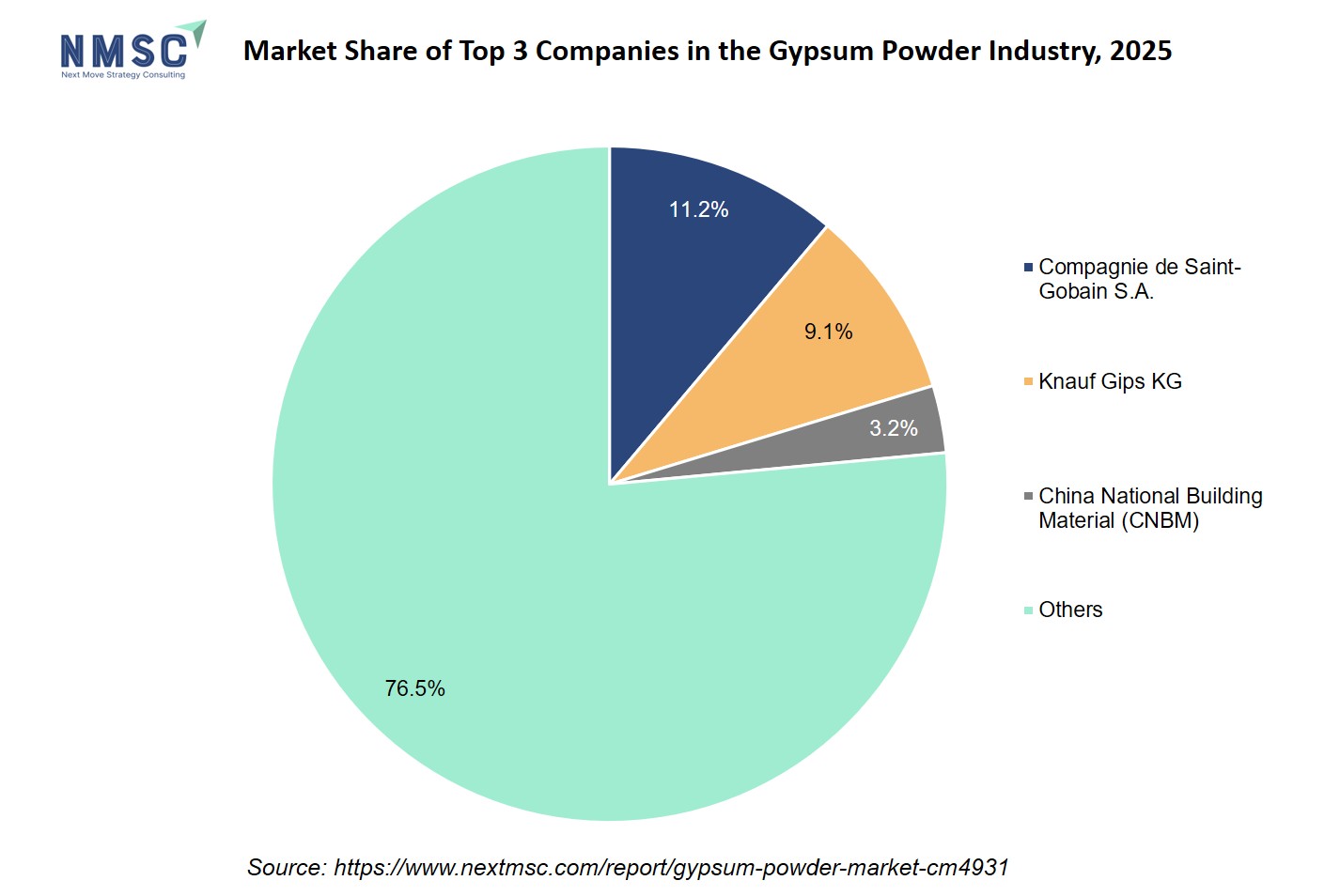
For the latest market share analysis and in-depth report on Gypsum Powder Industry insights, you can buy our latest report: Access the Report
How Do Companies Compete in the Gypsum Powder Market?
The Gypsum Powder Market competitive structure reflects a combination of vertically integrated global producers who own gypsum quarries, calcination plants, and downstream wallboard facilities, alongside specialized gypsum powder manufacturers serving premium industrial, agricultural, and dental market segments. NMSC's analysis indicates that market structure competition is anchored by Compagnie de Saint-Gobain and Knauf Gips, which compete through full product portfolio breadth, pan-European and global manufacturing presence, and brand-backed technical service capabilities that support contractor-level specification. Regional players including Yoshino Gypsum in Japan, CNBM's Taishan Gypsum in China, and Mada Gypsum in Saudi Arabia leverage geographic proximity and domestic regulatory relationships to maintain competitive market share positions.
Innovation investment is concentrated in alpha hemihydrate process efficiency improvement, synthetic gypsum feedstock qualification for board-grade applications, ultra-fine powder milling for dental and industrial premium segments, and digital process control integration in calcination plant operations. Pricing strategies across the Gypsum Powder Market reflect substantial premiums for alpha hemihydrate and ultra-fine grades above commodity beta hemihydrate, with geographic pricing differentiation driven by transportation cost structures. Geographic expansion strategies prioritize India, Southeast Asia, and the Middle East where construction-driven demand growth outpaces mature market rates, with joint ventures and local manufacturing investments enabling market entry under local content frameworks.
Which Kind of Companies Dominate the Gypsum Powder Market?
The Gypsum Powder Market is dominated by integrated construction materials conglomerates with dedicated gypsum divisions operating full value chains from quarrying through finished product manufacture. Compagnie de Saint-Gobain S.A., through its Gyproc, British Gypsum, and Placo brands, commands a leading global revenue share with manufacturing operations across Europe, North America, India, and Asia-Pacific. Knauf Gips KG, as the world's second-largest gypsum producer, operates across over 85 countries with fully integrated production. Georgia-Pacific LLC and New NGC, Inc. dominate the North American wallboard gypsum feedstock supply with FGD gypsum-integrated manufacturing, while China National Building Material's Taishan Gypsum brand commands a dominant position in the world's largest single national Gypsum Powder Market.
Market Players to Opt for Merger and Acquisition Strategies to Expand Their Presence in the Gypsum Powder Market
Strategic M&A activity in the Gypsum Powder Market is being driven by the need to secure raw material supply chains in growing markets, acquire local technical expertise, and capture premium product capabilities in high-growth industrial segments. Knauf Gips has pursued a consistent acquisition strategy of regional plaster and board manufacturers across Eastern Europe, the Middle East, and Asia-Pacific to extend its global production network. Saint-Gobain's Gyproc brand has established new manufacturing facilities in India and Southeast Asia through strategic investment, enabling local production for government housing supply chain participation. Our assessment indicates that future M&A in the Gypsum Powder Market will focus on agricultural gypsum distributors, dental and medical grade specialty producers, and recycled gypsum processing technology companies as the market's fastest-growing value segments attract acquirer attention.
Who Are the Key Market Players in the Gypsum Powder Market?
-
Compagnie de Saint-Gobain S.A.
-
Knauf Gips KG
-
China National Building Material (CNBM) Ltd.
-
New NGC, Inc. (National Gypsum Company)
-
Georgia-Pacific LLC
-
Yoshino Gypsum Co., Ltd.
-
Etex Group NV
-
Mada Gypsum Company
-
Global Gypsum Board Co. LLC
-
Volma
-
Aytas Alci A.S.
-
Matanat A Company
-
Al Ahli International Building Products Trading
-
UltraTech Cement Limited
-
Sakarni Plaster Private Limited
-
Fassa S.r.l.
-
Sika Corporation
-
MAPEI Corporation
-
ARDEX L.P.
-
Diamond K Gypsum Company
What Are the Latest Developments in the Gypsum Powder Market Industry?
|
Date |
Event |
|
June 2025 |
Saint-Gobain Gyproc India launched India's first low-carbon gypsum plaster verified through an Environmental Product Declaration (EPD). The product was unveiled at the Chennai facility and specifically targets sustainable construction projects seeking lower embodied-carbon materials. |
|
May 2025 |
Saint-Gobain's Gyproc business partnered with Formula to establish India's first Group production plant dedicated to industrial and construction plasters in Jhagadia, Gujarat. The facility manufactures gypsum-based industrial plasters and construction plasters for ceramics, foundry, and building applications. |
Expert Insights
 “The launch of our low-carbon plasters is a testament to Saint-Gobain Gyproc India’s unwavering commitment to sustainability and environmental responsibility.”
— Mr. Sudeep Kolte, Managing Director, Saint-Gobain Gyproc India
Statement made during the launch of Saint-Gobain Gyproc India's low-carbon gypsum plaster portfolio.
Market Interpretation
The comment highlights the growing transition within the construction materials industry toward low-carbon and environmentally certified gypsum-based products. As developers, contractors, and building owners increasingly prioritize sustainable construction practices and green building certifications, demand for gypsum plasters with lower embodied carbon is gaining momentum. This trend is encouraging manufacturers to invest in cleaner production technologies, renewable energy integration, lifecycle assessment tools, and environmentally responsible product innovation. Consequently, the shift toward sustainable gypsum solutions is creating new growth opportunities across the Gypsum Powder Market while reinforcing the industry's alignment with global decarbonization and circular economy objectives.
SWOT Analysis of the Gypsum Powder Market
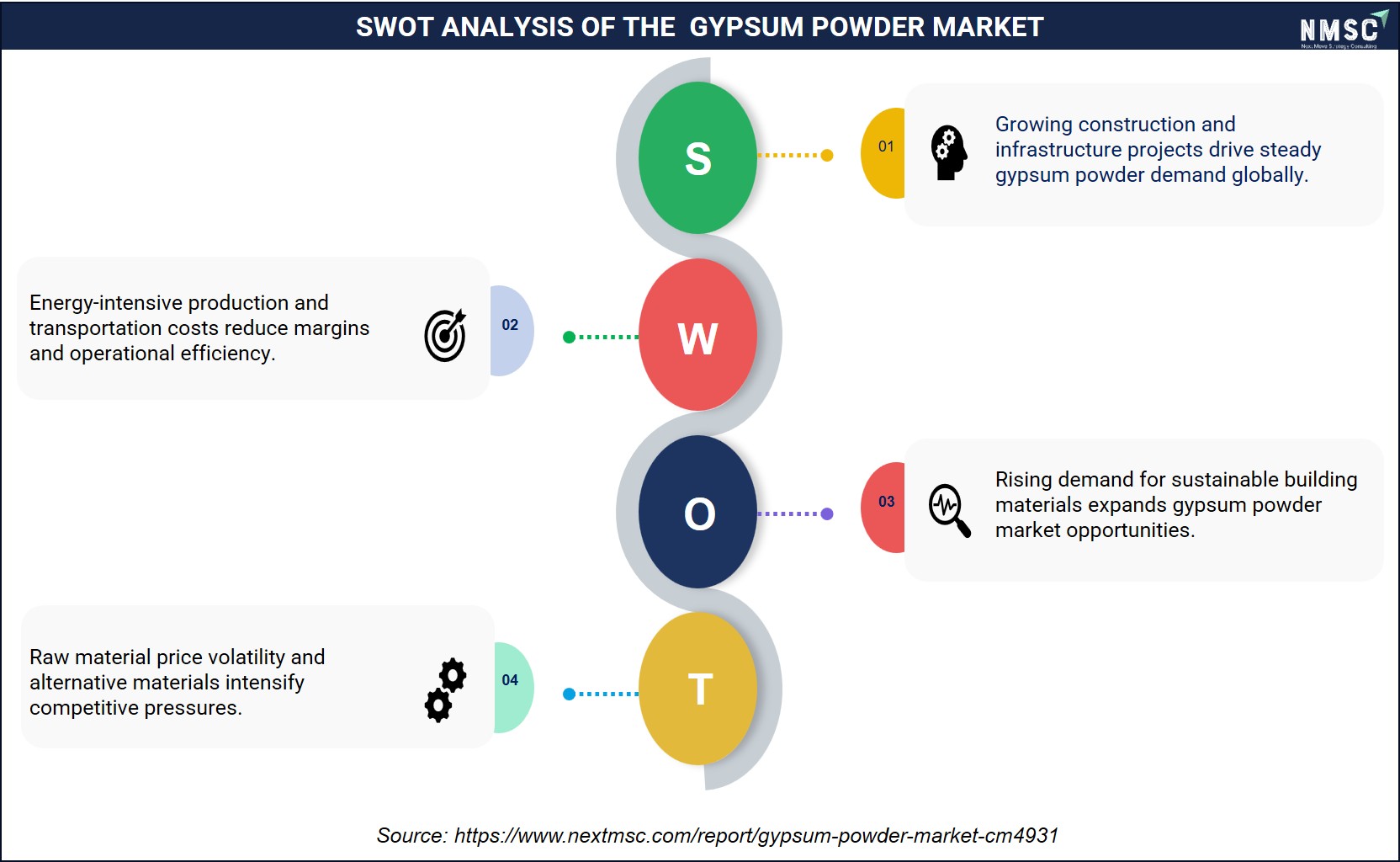
The above infographic presents a SWOT analysis of the Gypsum Powder Market by highlighting its key strengths, weaknesses, opportunities, and threats. It illustrates how rising construction activities support market growth, while energy-intensive production and transportation costs pose operational challenges. The infographic also emphasizes opportunities arising from increasing demand for sustainable building materials, alongside threats from raw material price volatility and competition from alternative construction products. Overall, it provides a concise assessment of the factors influencing the market's long-term prospects.
What Are the Investment Opportunities in the Gypsum Powder Market?
How Are Capital Inflows Supporting Gypsum Powder Market Expansion?
The Gypsum Powder Market is attracting growing institutional capital inflows driven by the convergence of construction sector growth financing, agricultural sustainability investment programs, and industrial specialty chemicals market development. Based on NMSC's research, we found that the European Investment Bank's sustainable construction financing commitments and the International Finance Corporation's green building lending standards in emerging markets are progressively directing infrastructure capital toward construction material supply chains that include gypsum powder producers. India's Production Linked Incentive scheme for building materials creates structured government capital support for wallboard manufacturing capacity expansion that directly benefits gypsum feedstock procurement volumes through the forecast period.
How Do Infrastructure and Housing Investment Programs Create Durable Gypsum Powder Market Opportunities?
Government-mandated housing and infrastructure investment programs across Asia-Pacific, the Middle East, and Latin America represent the most durable long-term demand formation mechanism for the Gypsum Powder Market's Construction application segment. India's PMAY housing mission, Saudi Arabia's Affordable Housing program, Egypt's Social Housing Finance Fund, and Brazil's Minha Casa Minha Vida program collectively define a multi-year procurement pipeline that sustains board feedstock and site-applied plaster volume growth. The Asian Development Bank estimates that Asia needs USD 26 trillion in infrastructure investment through 2030, a substantial portion of which encompasses the building construction activity that generates Construction Gypsum demand throughout the region.
How Are ESG Frameworks Creating New Investment Channels in the Gypsum Powder Market?
Environmental, Social, and Governance investment criteria are creating structurally new capital allocation channels within the Gypsum Powder Market by positioning recycled gypsum recovery, FGD gypsum utilization, and low-carbon calcination technologies as eligible sustainable infrastructure investments. Green bond issuances by major gypsum producers financing recycled content capacity and energy-efficient kiln upgrades are attracting ESG-aligned institutional investment. Our assessment indicates that the LEED material credit framework's preference for recycled-content gypsum products and BREEAM's material efficiency scoring are creating specification-level demand incentives that PE-backed building material distributors are positioning to capture by developing sustainable Gypsum Powder Market supply chain offerings.
How Is Digital Transformation Investment Creating Value in the Gypsum Powder Market?
Digital transformation investment is creating process optimization and product quality value layers within the Gypsum Powder Market through the integration of real-time process analytics, AI-driven calcination temperature control, and advanced particle size measurement systems that enable consistent ultra-fine powder production at commercial scale. Through our market assessment, we observed that leading calcination plant operators are investing in IIoT sensor networks for kiln condition monitoring, reducing energy consumption and improving product consistency in alpha hemihydrate production. Digital quality control investment in dental and pharmaceutical grade gypsum production is enabling manufacturers to justify premium pricing through traceable, certified product specifications that meet stringent regulatory requirements in healthcare procurement contexts globally.
Key Benefits for Stakeholders
For Gypsum Powder Manufacturers and Processors
Gypsum powder manufacturers and processors gain access to a comprehensive, vendor-neutral assessment of the Gypsum Powder Market, including quantitative sizing across product type, source, application, and regional demand segments. The analysis provides intelligence on evolving demand for construction plaster, industrial plaster, agricultural gypsum, and specialty gypsum products, enabling informed capacity expansion, product diversification, and raw-material sourcing strategies. Regional demand forecasting and competitive benchmarking further support long-term investment planning and operational optimization initiatives.
For Construction Companies and Building Material Contractors
Construction companies and building material contractors gain structured insights into gypsum powder consumption trends across residential, commercial, and infrastructure sectors. The report provides detailed analysis of regional supply availability, sustainable construction adoption, and application-specific demand patterns for plastering, prefabricated construction, drywall systems, and decorative finishes. These insights support procurement planning, supplier selection, cost management, and project execution strategies in an increasingly competitive construction environment.
For Investors and Financial Analysts
Investors and financial analysts access a structured, data-driven evaluation of the Gypsum Powder Market’s growth trajectory, competitive landscape, and segment-level revenue opportunities through 2035. Market sizing, CAGR projections, and regional growth assessments enable more accurate valuation models, investment screening, and risk analysis. Additionally, coverage of sustainability initiatives, recycled gypsum adoption, and emerging production technologies provides valuable context for identifying long-term growth opportunities across the gypsum value chain.
For Agricultural Input Suppliers and Distributors
Agricultural input suppliers and distributors gain detailed insights into the expanding use of gypsum powder as a soil amendment and crop productivity enhancer. The report evaluates regional adoption patterns, demand growth drivers, and application trends across key agricultural markets. These findings help fertilizer manufacturers, agri-input distributors, and soil health solution providers optimize product portfolios, strengthen distribution networks, and align business strategies with evolving agricultural requirements.
For Government Bodies and Regulatory Authorities
Government agencies, construction regulators, and sustainability policymakers gain evidence-based analysis of how environmental regulations, green building standards, and circular economy initiatives are influencing the Gypsum Powder Market. The report provides perspectives on gypsum recycling programs, phosphogypsum utilization, resource efficiency measures, and sustainable construction policies. These insights support informed decision-making related to building material regulations, infrastructure planning, and low-carbon construction initiatives.
Key Market Segments
By Product Form
-
Raw Gypsum Powder
-
Beta Hemihydrate
-
Alpha Hemihydrate
-
Anhydrite
By Source
-
Natural Gypsum
-
Synthetic Gypsum
-
FGD Gypsum
-
Phosphogypsum
-
Other Synthetic Gypsum
-
-
Recycled Gypsum
By Particle Size
-
Standard Powder
-
Fine Powder
-
Ultra Fine Powder
-
Granulated Powder
By Sales Channel
-
Direct Sales
-
Distributor Sales
-
Retail Sales
By Application
-
Construction
-
Board Feedstock
-
Joint Compounds
-
Site-Applied Plaster
-
Screeds
-
Cement
-
-
Agriculture
-
Soil Amendment
-
Fertilizer Input
-
Animal Bedding
-
-
Industrial
-
Moulding and Casting
-
Ceramics
-
Fillers
-
Dental and Medical
-
Food and Pharma
-
Other Industrial
-
By Region
-
North America: U.S., Canada, and Mexico
-
Europe: UK, Germany, France, Italy, Spain, Sweden, Denmark, Finland, the Netherlands, and the rest of Europe
-
Asia Pacific: China, India, Japan, South Korea, Taiwan, Indonesia, Vietnam, Australia, Philippines, Malaysia, and the rest of APAC
-
Middle East & Africa (MEA): Saudi Arabia, UAE, Egypt, Israel, Turkey, Nigeria, South Africa, and the rest of MEA
-
Latin America: Brazil, Argentina, Chile, Colombia, and the rest of LATAM
Conclusion and Recommendations
Long-Term Outlook
The Gypsum Powder Market is positioned for steady, structurally supported growth from USD 7.07 billion in 2025 to USD 12.73 billion by 2035, underpinned by construction sector expansion in Asia-Pacific and the Middle East, European renovation mandates, growing agricultural soil amendment adoption, and industrial premium segment development. The market's 5.45% CAGR reflects a mature but expanding demand base across multiple independent structural drivers, reducing single-factor revenue concentration risk. NMSC's analysis indicates that the long-term trajectory is supported by durable policy commitments, from India's PMAY housing mission and the European Renovation Wave to USDA agricultural soil health programs, that sustain procurement pipeline visibility for market participants across the forecast decade.
Strategic Positioning Recommendations
Market participants are advised to prioritize alpha hemihydrate production capability expansion as the foundational competitive requirement given the product form's 6.35% CAGR leadership and growing premium application specification. Ultra-fine powder milling investment is recommended to capture the 8.48% CAGR growth in dental, pharmaceutical, and industrial precision segments. Geographic expansion into India, Vietnam, Indonesia, and MEA markets should be prioritized through local manufacturing or joint ventures aligned with in-country procurement requirements. Agricultural gypsum distribution network development in North America, India, and Brazil represents an underserved, fast-growing revenue diversification pathway. Recycled gypsum processing capability is recommended for European market participants to align with mandatory circular economy policy frameworks through 2030.
Investment Attractiveness Assessment
The Gypsum Powder Market presents a moderate-to-high investment attractiveness profile, characterized by predictable construction sector demand, multiple independent growth verticals including agricultural and industrial applications, and policy-backed procurement visibility across major geographies. Alpha hemihydrate and ultra-fine powder premium segments offer above-market CAGR rates and margin profiles attractive to specialty chemicals investors. ESG alignment through FGD gypsum utilization, recycled gypsum recovery, and energy-efficient calcination creates sustainable investment narratives for green infrastructure capital deployment. The agricultural gypsum segment's 8.88% CAGR and expanding geographic adoption base represent a particularly compelling growth investment theme within the broader Gypsum Powder Market landscape.
Key Market Risks
The Gypsum Powder Market faces several material risk factors that investment and operational strategies must proactively address. Construction cycle downturns in major procurement markets, particularly China's real estate sector volatility, can materially compress volume demand within the dominant Construction application segment. Transportation cost inflation, driven by energy price volatility, elevates delivered product costs across supply chains dependent on long-distance gypsum ore shipment. Regulatory restrictions on phosphogypsum utilization in North America limit a potentially abundant synthetic feedstock option. Currency volatility in MEA and Latin American markets can constrain procurement budgets in dollar-denominated import-dependent gypsum markets, moderating near-term volume realization against structural long-term growth potential.
Growth Pathways
The highest-probability growth pathways in the Gypsum Powder Market over the 2025-2035 forecast period encompass alpha hemihydrate technology leadership for high-performance screed and premium plaster premium segments; agricultural gypsum distribution expansion across North American, Indian, and Brazilian farming regions; ultra-fine powder production investment targeting dental, pharmaceutical, and food-grade industrial applications; Southeast Asian and MEA manufacturing localization to serve government housing procurement programs; and recycled gypsum processing capability development to comply with European circular economy mandates. Companies combining production excellence with diversified application exposure and geographic flexibility across emerging market regulatory frameworks will capture disproportionate Gypsum Powder Market revenue and margin expansion over the forecast decade.
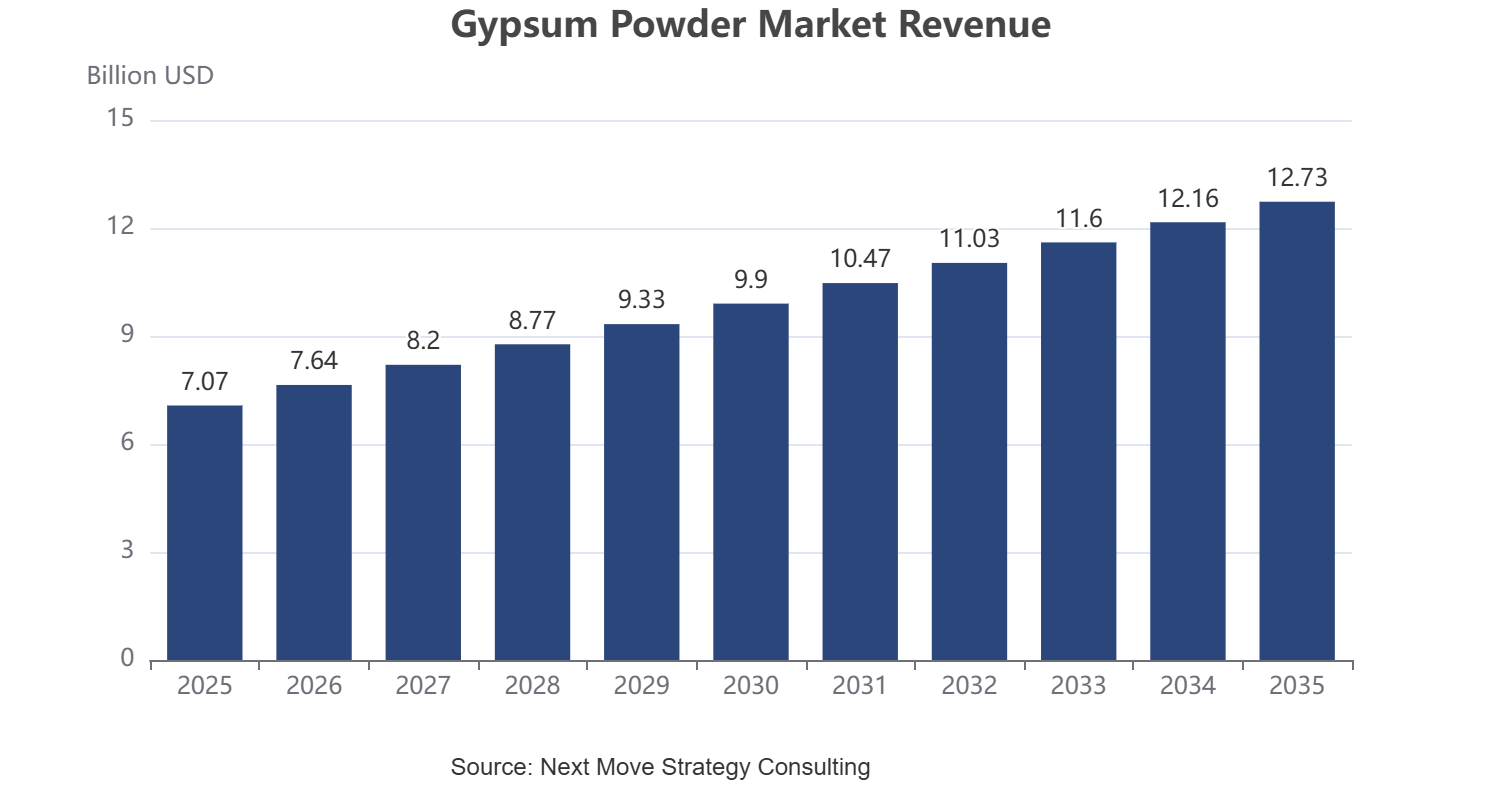
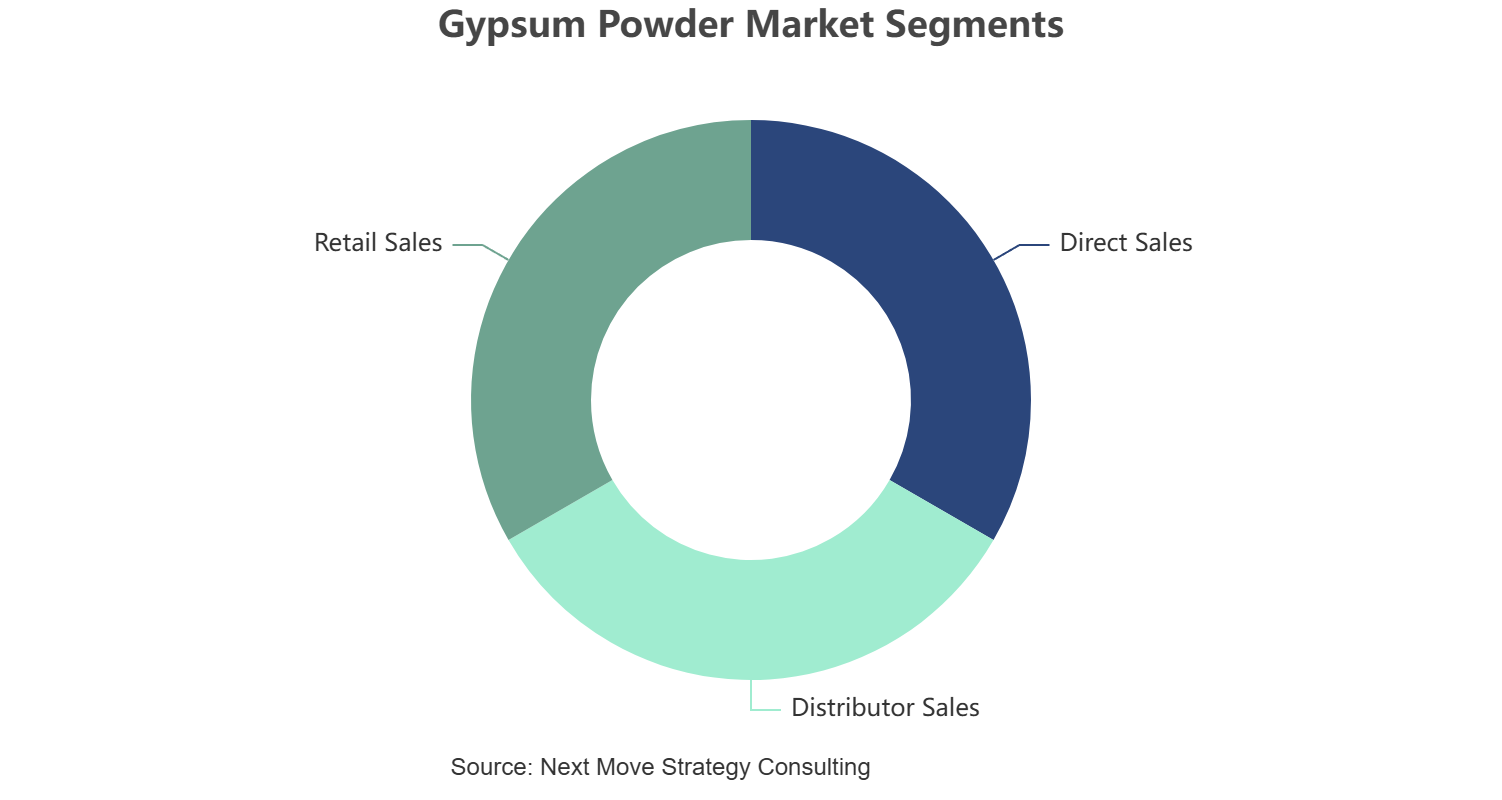
About the Author
 Mayurima Roy
— Mayurima Roy is Research Analyst at Next Move Strategy Consulting, where she has spent 4 years working across the firm's full industry coverage rather than a single fixed vertical. Her work centers on structured research, ongoing trend tracking, competitive assessment, and insight-led content development, translating complex market data into clear, decision-ready narratives that support informed client decision-making across diverse global industries, market sectors, and world regions every day.
Mayurima Roy
— Mayurima Roy is Research Analyst at Next Move Strategy Consulting, where she has spent 4 years working across the firm's full industry coverage rather than a single fixed vertical. Her work centers on structured research, ongoing trend tracking, competitive assessment, and insight-led content development, translating complex market data into clear, decision-ready narratives that support informed client decision-making across diverse global industries, market sectors, and world regions every day.
About the Reviewer
 Supradip Baul
— Supradip Baul is an accomplished business consultant and strategist with over a decade of rich experience in market intelligence, strategy, technology, and business transformation. His work has included rigorous qualitative and quantitative analysis across multiple industries, helping clients shape investment decisions and long-term roadmaps. Earlier in his career, he was associated with Gartner, where he contributed to industry-leading reports and market share analyses. He has worked with leading global companies and holds an MBA with a dual specialization in Marketing and Finance.
Supradip Baul
— Supradip Baul is an accomplished business consultant and strategist with over a decade of rich experience in market intelligence, strategy, technology, and business transformation. His work has included rigorous qualitative and quantitative analysis across multiple industries, helping clients shape investment decisions and long-term roadmaps. Earlier in his career, he was associated with Gartner, where he contributed to industry-leading reports and market share analyses. He has worked with leading global companies and holds an MBA with a dual specialization in Marketing and Finance.
At Next Move Strategy Consulting, we understand that insightful market research is the cornerstone of successful business decisions. That's why we employ a robust and multifaceted approach, combining various methodologies to deliver the most accurate and actionable data for our clients.

Research Landscape
We navigate the world of research with two primary approaches:
Qualitative Approach
Our qualitative research methodologies involve immersive techniques such as in-depth interviews, focus groups, and observational studies. By engaging directly with individuals and stakeholders, we uncover valuable insights that quantitative data alone may overlook.

Quantitative Research
In tandem with qualitative methodologies, NMSC leverages the power of Quantitative Research to provide a robust foundation of numerical insights. Through systematic data collection and analysis, we quantify patterns, preferences, and market trends, offering a comprehensive view of the business landscape.
Our quantitative research approach employs diverse tools, including surveys, experiments, and statistical modelling. These methodologies enable us to gather data from a large and representative sample, ensuring the statistical significance of our findings. By employing structured questionnaires and standardized data collection methods, we guarantee the reliability and validity of the information we present to our clients.
Quantitative research is particularly effective in measuring the prevalence of trends, assessing market size, and gauging the impact of various factors on consumer behavior. The numerical precision attained through this approach equips our clients with actionable insights, facilitating data-driven decision-making and strategy formulation.


Our Specialized Toolbox for Industry-Specific Market Research
We deploy a specialized arsenal of techniques tailored to meet your unique requirements. Here's a glimpse into our comprehensive toolbox:

Information Procurement
The stage entails acquiring market data or relevant information through various sources and methodologies.


Market Research Approach
We utilize both top-down and bottom-up approaches in market research analysis to achieve a comprehensive understanding of the market dynamics, leveraging the broad perspective of industry trends and macroeconomic factors alongside detailed insights from specific segments and individual companies.

Porters Five Forces Analysis
We conduct Porter's Five Forces analysis to evaluate the competitive landscape of an industry, providing us with insights into factors that affect profitability and strategic positioning.

SWOT Analysis

Forecasting
We utilize a forecasting model to predict future consumption by considering parameters like population, economics, regulations, market competition, drivers, constraints, technology, and pricing. We also employ statistical techniques such as multilinear regression, exponential smoothing, moving average, ARIMA, and Monte Carlo simulations for accurate predictions. In econometric forecasting, we analyzed short-term and long-term event impacts, attributing values based on regulatory frameworks, economic factors, and market events.





 Speak to Our Analyst