Healthcare Payer Network Management Market Analysis and Forecast (2026-2035)

Healthcare Payer Network Management Market size is estimated at USD 7.88 billion in 2026, projected to reach USD 21.03 billion by 2035, growing at a CAGR of 11.53% from 2026 to 2035. Key drivers include rising provider directory accuracy requirements, expanding managed care enrolment and growing demand for interoperable provider data management, with North America leading the market and Asia-Pacific registering the fastest growth.

Download Free Sample PDF
Base Year (2025)
$6.42 Billion
Forecast (2035)
$21.03 Billion
CAGR (2026-2035)
11.5%
Top Region
North America

What Is the Healthcare Payer Network Management Market Size?

The global healthcare payer network management market size was valued at USD 6.42 Billion in 2025 and is estimated to grow from USD 7.88 Billion in 2026 to USD 21.03 Billion by 2035, expanding at a CAGR of 11.53% between 2026 and 2035. North America led the healthcare payer network management market with an approximate 58% revenue share in 2025, while Provider Credentialing and Enrolment remained the dominant function segment with an approximate 34% share of global revenue.

We observed that the healthcare payer network management market's momentum is best captured through a concise set of indicators before deeper analysis follows.

Healthcare Payer Network Management Market Analysis and Forecast (2026-2035) Revenue Forecast

Values in USD Billion

2025 $6.42 Billion
2025
2026 $7.16 Billion
2026
2027 $7.99 Billion
2027
2028 $8.91 Billion
2028
2029 $9.93 Billion
2029
2030 $11.08 Billion
2030
2031 $12.36 Billion
2031
2032 $13.78 Billion
2032
2033 $15.37 Billion
2033
2034 $17.14 Billion
2034
2035 $21.03 Billion
2035

Key Takeaways

By Function: Provider Credentialing and Enrolment held the largest share of approximately USD 2.18 billion in 2025 and is projected to reach USD 5.89 billion by 2035; Provider Data Management is the fastest-growing sub-segment at 18.94% CAGR from 2026–2035

By Offering: Software held the largest share of approximately USD 4.11 billion in 2025 and is projected to reach USD 12.20 billion by 2035; Services is the fastest-growing sub-segment at 14.31% CAGR from 2026–2035

By End User: Health Insurance Payers held the largest share of approximately USD 3.53 billion in 2025 and is projected to reach USD 10.09 billion by 2035; Government Health Programs is the fastest-growing sub-segment at 17.32% CAGR from 2026–2035

Dominant Region: North America dominated with approximately USD 3.71 billion in 2025 and is projected to reach USD 10.09 billion by 2035

Fastest-Growing Region: Asia-Pacific is expected to register the highest CAGR of 16.47% during 2026–2035

Dominant Country: U.S. was the largest single national contributor within North America in 2025

Fastest-Growing Country: India is the fastest-growing country, with its CAGR outpacing the regional Asia-Pacific average

By End User: Health Insurance Payers held the largest share of approximately USD 3.53 billion in 2025 and is projected to reach USD 10.09 billion by 2035; Government Health Programs is the fastest-growing sub-segment at 17.32% CAGR from 2026–2035

The healthcare payer network management market is projected to generate an incremental revenue opportunity of approximately USD 13.15 Billion between 2026 and 2035, reflecting the absolute dollar gap between the 2035 forecast and the 2026 base value a signal of accelerating payer investment in automated provider data accuracy compliance.

According to NMSC analysis, No Surprises Act-linked provider directory accuracy requirements are pushing U.S. payers to replace manual roster reconciliation processes faster than broader network management modernization budgets alone would suggest.

What does the Healthcare Payer Network Management Market Encompass?

The healthcare payer network management market encompasses software and services that health insurance payers and managed care organizations use to credential providers, maintain accurate network directories, manage contract and rate terms, and monitor network adequacy compliance. Our assessment indicates that the market's scope spans provider data management, credentialing and enrolment, and contract management functions distinct from broader healthcare payer services outsourcing that covers claims adjudication and member services beyond network-specific functions.

Structurally the market has evolved from manual, spreadsheet-based provider roster tracking toward automated, continuously monitored provider data platforms integrated with claims and directory systems. We found that regulatory environments administered by national health authorities continue to raise provider directory accuracy requirements following recent no surprise billing legislation, while technology adoption trends in AI-assisted credentialing verification are reshaping how payers manage growing provider network complexity.

Market Drivers & Dynamics

Interactive Dataset
Rising regulatory penalty exposure for inaccurate provider directories driver +3.1% North America 2026–2032
Expanding managed care enrolment requiring network scale management driver +2.2% North America, Asia-Pacific 2026–2035
Growing AI-assisted credentialing automation adoption driver +1.7% North America, Europe 2027–2035
Rising government health program network management complexity driver +1.2% Global 2026–2033
Fragmented, non-standardized provider data formats across payers restraint −1.1% Global 2026–2032
High integration cost with legacy payer claims and enrolment systems restraint −0.8% North America, Europe 2026–2030
Limited network management technology budgets among smaller regional payers restraint −0.5% Asia-Pacific, Latin America 2026–2033
Source: Next Move Strategy Consulting

Growth Drivers

What Is the Primary Growth Driver for the Healthcare Payer Network Management Market?

Rising regulatory penalty exposure for inaccurate provider directories is the primary growth driver, as payers invest in automated validation platforms to avoid compliance penalties. The U.S. Centers for Medicare & Medicaid Services continues to enforce provider directory accuracy requirements tied to the No Surprises Act, underscoring the regulatory pressure driving payer investment in automated network management platforms capable of maintaining continuously accurate provider data.

How Is Managed Care Enrolment Growth Driving the Market Growth?

Expanding managed care enrolment is driving growth by increasing the scale and complexity of provider networks that payers must credential, contract, and maintain accurately. Company analysis indicates that platforms capable of scaling credentialing and directory management across rapidly growing member populations are capturing incremental payer technology spend. Based on research conducted by NMSC, we found that this shift is most pronounced among Medicaid managed care and Medicare Advantage plan operators.

Growth Inhibitors

What Is Restraining the Healthcare Payer Network Management Market?

Fragmented, non-standardized provider data formats across payers are restraining platform interoperability, as provider organizations must maintain separate credentialing submissions for each health plan relationship. We observed that this restraint is most pronounced for multi-payer provider groups facing redundant data entry burden, slowing broader industry-wide efficiency gains even as individual payer platforms continue to modernize.

What Are the Growth Opportunities?

Can Standardized Provider Data Exchange Reduce Multi-Payer Redundancy?

Standardized, interoperable provider data exchange protocols can reduce redundant credentialing submissions for provider groups contracted with multiple payers, unlocking efficiency gains across the broader network management ecosystem. This mechanism primarily benefits platforms with established multi-payer data exchange network capability.

Will Delegated Credentialing Services Expand Smaller Payer Adoption?

Delegated credentialing verification services allow smaller regional payers to access enterprise-grade network management capability without building in-house infrastructure. Vendors offering delegated services alongside core software can capture demand from smaller health insurance plans previously priced out of full platform deployment.

Can AI-Driven Network Adequacy Monitoring Expand Compliance Linked Demand?

AI-driven, continuous network adequacy monitoring tied directly to regulatory filing requirements offers a mechanism to expand compliance linked platform demand beyond periodic manual adequacy assessments. Vendors with established regulatory reporting integration capability are best positioned to capture this compliance driven opportunity as adequacy standards continue tightening.

Segmentation Analysis

2025 (USD Billion)
2035 (USD Billion)
Provider Credentialing and Enrolment 2025: $2.18 Billion | 2035: $5.89 Billion
Provider Cre
Network Adequacy and Directory Management 2025: $1.54 Billion | 2035: $4.63 Billion
Network Adeq
Contract and Rate Management 2025: $1.28 Billion | 2035: $4.00 Billion
Contract and
Claims and Payment Integrity Integration 2025: $0.90 Billion | 2035: $3.58 Billion
Claims and P
Provider Data Management 2025: $0.52 Billion | 2035: $2.93 Billion
Provider Dat
Provider Credentialing and Enrolment $2.18 Billion $5.89 Billion 10.44%
Network Adequacy and Directory Management $1.54 Billion $4.63 Billion 11.65%
Contract and Rate Management $1.28 Billion $4.00 Billion 12.06%
Claims and Payment Integrity Integration $0.90 Billion $3.58 Billion 14.65%
Provider Data Management $0.52 Billion $2.93 Billion 18.94%

Which Function Dominates the Healthcare Payer Network Management Market?

Provider Credentialing and Enrolment dominates function segmentation with an estimated USD 2.18 Billion in 2025, rising to USD 5.89 Billion by 2035, reflecting its role as the foundational, regulatorily mandated function every payer network requires. Provider Data Management is the fastest-growing function at an 18.94% CAGR, reflecting rising payer investment in continuously monitored, interoperable provider data infrastructure beyond point-in-time credentialing checks.

2025 (USD Billion)
2035 (USD Billion)
Software
Services
Segment Item 2025 (USD Billion) 2035 (USD Billion) CAGR
Software $10.0 USD Billion $40.0 USD Billion 14.0%
Services $17.1 USD Billion $51.1 USD Billion 8.0%

Segment-wise data is locked

Unlock complete segment-wise numbers for By Offering.

Unlock Full Data

Which Offering Is Gaining the Most Ground?

Software leads offering segmentation with USD 4.11 Billion in 2025 revenue, reflecting platform licensing and subscription fees as the primary revenue category. Services is the fastest-growing offering at a 14.31% CAGR, driven by rising demand for delegated credentialing verification organization services and implementation support as payers modernize legacy network management processes.

2025 (USD Billion)
2035 (USD Billion)
Health insur
Managed care
Third-party
Government h
Segment Item 2025 (USD Billion) 2035 (USD Billion) CAGR
Health insurance payers $10.0 USD Billion $40.0 USD Billion 14.0%
Managed care organizations $17.1 USD Billion $51.1 USD Billion 24.0%
Third-party administrators $24.2 USD Billion $62.2 USD Billion 22.0%
Government health programs $31.3 USD Billion $73.3 USD Billion 12.0%

Segment-wise data is locked

Unlock complete segment-wise numbers for By End User.

Unlock Full Data

Which End User Segment Is Growing Fastest?

Health Insurance Payers lead end-user segmentation with USD 3.53 Billion in 2025 revenue, reflecting their role as the largest direct purchaser of network management platforms. Government Health Programs is the fastest growing end-user category at a 17.32% CAGR, driven by expanding Medicaid managed care and public health insurance exchange network management complexity.

2025 (USD Billion)
2035 (USD Billion)
Cloud
On-premises
Segment Item 2025 (USD Billion) 2035 (USD Billion) CAGR
Cloud $10.0 USD Billion $40.0 USD Billion 25.0%
On-premises $17.1 USD Billion $51.1 USD Billion 11.0%

Segment-wise data is locked

Unlock complete segment-wise numbers for By Deployment.

Unlock Full Data

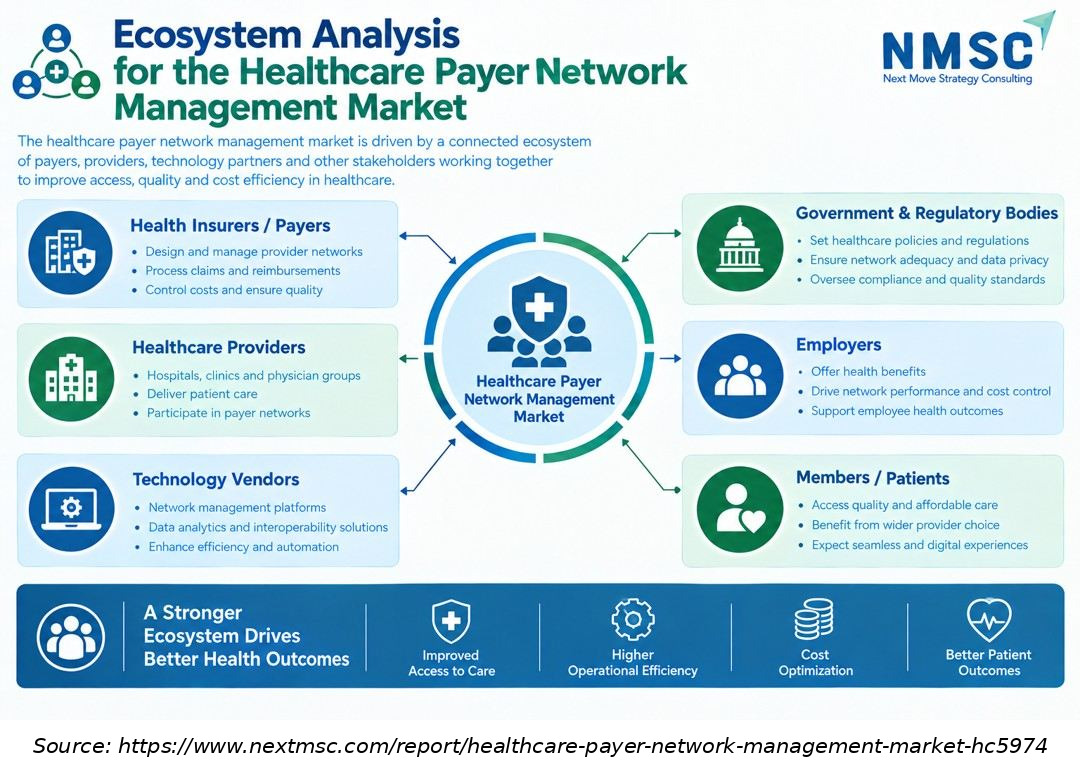
Ecosystem Analysis

Growth Opportunities

Beyond current demand drivers, three whitespace opportunities stand out as forward-looking mechanisms for revenue expansion through 2035.

Can Standardized Provider Data Exchange Reduce Multi-Payer Redundancy?

Standardized, interoperable provider data exchange protocols can reduce redundant credentialing submissions for provider groups contracted with multiple payers, unlocking efficiency gains across the broader network management ecosystem. This mechanism primarily benefits platforms with established multi-payer data exchange network capability.

Will Delegated Credentialing Services Expand Smaller Payer Adoption?

Delegated credentialing verification services allow smaller regional payers to access enterprise-grade network management capability without building in-house infrastructure. Vendors offering delegated services alongside core software can capture demand from smaller health insurance plans previously priced out of full platform deployment.

Can AI-Driven Network Adequacy Monitoring Expand Compliance Linked Demand?

AI-driven, continuous network adequacy monitoring tied directly to regulatory filing requirements offers a mechanism to expand compliance linked platform demand beyond periodic manual adequacy assessments. Vendors with established regulatory reporting integration capability are best positioned to capture this compliance driven opportunity as adequacy standards continue tightening.

Regional Outlook

2025 (USD Billion)
2035 (USD Billion)
North Americ
Europe
Asia-Pacific
Middle East
Latin Americ
Region 2025 (USD Billion) 2035 (USD Billion) CAGR (%)
North America $10.0 USD Billion $40.0 USD Billion 9.0%
Europe $17.1 USD Billion $51.1 USD Billion 27.0%
Asia-Pacific $24.2 USD Billion $62.2 USD Billion 25.0%
Middle East & Africa $31.3 USD Billion $73.3 USD Billion 23.0%
Latin America $38.4 USD Billion $84.4 USD Billion 12.0%

Regional data is locked

Unlock complete regional numbers for this market.

Unlock Full Data

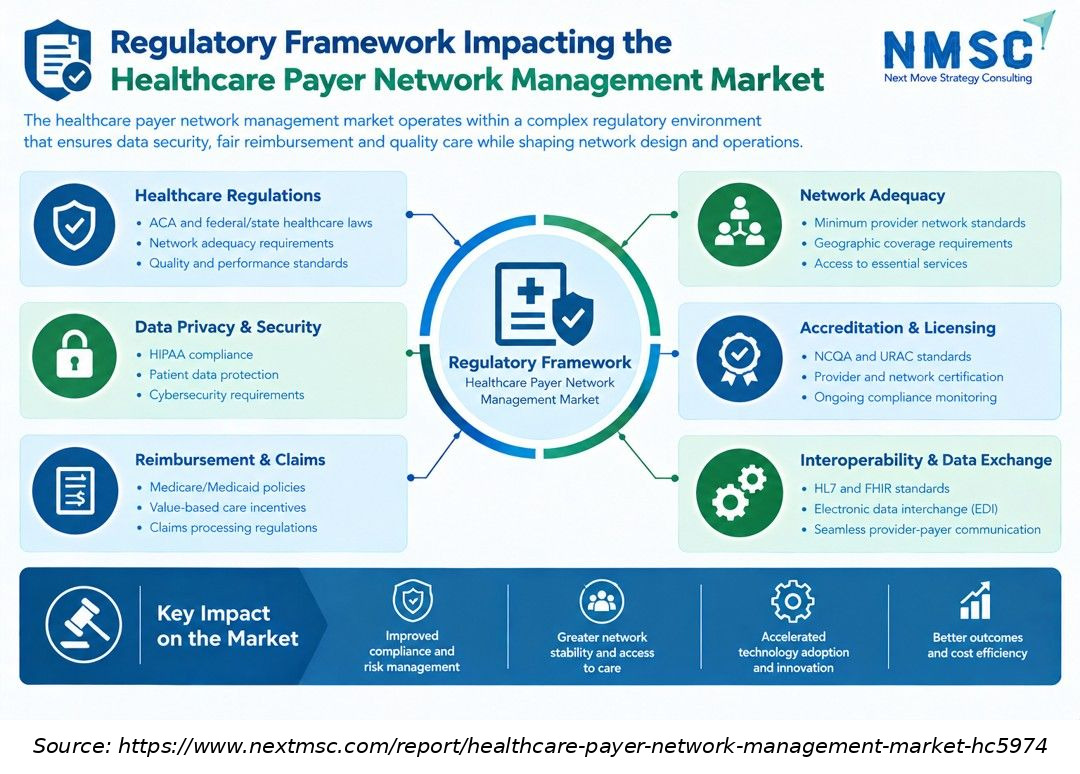
Regulatory Framework of Healthcare Payer Network Management Market

This infographic presents the key regulatory factors shaping the Healthcare Payer Network Management Market, including healthcare regulations, data privacy and security, reimbursement and claims, network adequacy, accreditation and licensing, and interoperability standards. It highlights how regulatory compliance influences network stability, technology adoption, data exchange, risk management, care access, and overall cost efficiency across the healthcare payer ecosystem.

Competitive Landscape

Dimension Description
Market Structure Moderately fragmented; diversified healthcare data platform providers hold significant enterprise payer share while specialized credentialing vendors compete on verification speed and accuracy
Innovation Focus AI-assisted primary source verification, continuous credential monitoring, interoperable provider data exchange
M&A Activity Elevated; diversified platform providers acquire specialized credentialing and verification technology developers to expand functional breadth

How Do Companies Compete in the Healthcare Payer Network Management Market?

Companies compete primarily on credentialing verification speed, breadth of integrated network management functions, and depth of provider data interoperability with claims and directory systems. Our analysis shows that vendors combining fast, automated verification with broader network adequacy and directory management capability sustain larger enterprise payer contracts than single-function credentialing specialists.

Which Competitive Archetypes Dominate the Healthcare Payer Network Management Market?

Two archetypes dominate: diversified healthcare data platform providers offering network management within broader payer technology ecosystems, and specialized credentialing-focused vendors competing on AI-driven verification speed. We observed that the differentiation between these archetypes is narrowing as specialized vendors expand into adjacent network adequacy and directory management functions.

What Innovation and Differentiation Strategies Are Companies Pursuing?

Company analysis indicates that leading firms are differentiating through AI-driven primary source verification speed, continuous credential and sanctions monitoring, and interoperable provider data exchange capability. Investment in regulatory reporting integration continues, alongside expanded delegated credentialing service offerings targeting smaller payers seeking enterprise-grade capability without in-house infrastructure.

How Active Is M&A in the Healthcare Payer Network Management Industry?

M&A activity remains elevated as diversified healthcare data platform providers acquire specialized credentialing and verification technology developers to expand functional breadth. Based on research conducted by NMSC, we found that acquisition targets increasingly include AI-native verification and provider data interoperability developers, reflecting strategic pivots toward the fastest-growing functional categories.

Key Market Players

Our assessment indicates that the following companies represent the validated set of key players shaping competitive dynamics across credentialing, directory management, and provider data functions within the healthcare payer network management market.

symplr, LLC HealthStream, Inc. MultiPlan Corporation Zelis Healthcare, LLC Availity, LLC Cotiviti, Inc. Verisys Corporation Medallion Health, Inc. Kyruus Health, Inc. Andros Technologies, Inc. Edifecs, Inc. RLDatix North America, Inc. Modio Health, Inc. QGenda, LLC Atlas Systems, Inc. H1 Insights, Inc. Vālenz Health, LLC

Latest Developments

We observed that recent developments across the industry reflect continued investment in AI-assisted verification and provider data interoperability capability.

Date Event
April 2026 Availity launched Availity Extend, a network-connected activation layer that enables AI and automation across payer, provider, and partner workflows
October 2025 HealthStream acquired Virsys12, whose provider data management suite supports payer and health-plan onboarding, credentialing, and network management
August 2025  Atlas Systems Prime a provider data management engine and real time data exchange platform, announced its partnership with leading behavioural health provider Sonder Mind

Expert Insights

Meghan Gaffney

Meghan Gaffney

Co-Founder & CEO | Veda

"Accurate provider data is a key component of efficient health plan operations, care delivery, interoperability, and ultimately patient satisfaction."

Analyst Interpretation

The statement identifies provider data as a foundational element of payer network management. Accurate and connected provider information supports network administration, directory maintenance, interoperability, and member navigation. As health plans increasingly digitize network workflows, demand is expanding for technologies that validate, reconcile, and maintain provider data across credentialing, contracting, directory, and care-delivery processes.

Investment Opportunities

Where Is Capital Flowing Within the Healthcare Payer Network Management Market?

Capital inflows are concentrated in AI-driven credentialing verification technology and provider data interoperability platform development among diversified healthcare data providers. We found that strategic and venture capital is also flowing into delegated credentialing service platforms targeting smaller regional payers, signalling growing institutional interest in the underserved smaller-payer segment.

How Significant Is Infrastructure Investment in This Market?

Infrastructure investment is substantial, with vendors expanding cloud hosting capacity and AI model training infrastructure to support real-time credential verification at scale. Our assessment indicates that continued investment in healthcare IT integration infrastructure is becoming a prerequisite for competing in the fastest-growing provider data management category.

What ESG Considerations Are Relevant to This Market?

ESG considerations center on data privacy and security for sensitive provider licensure and sanctions data, equitable network adequacy ensuring access across underserved populations, and responsible AI governance in automated credentialing decisions. We observed that vendors increasingly disclose data security certification and AI governance frameworks in response to payer procurement due diligence requirements.

Key Benefits for Stakeholders

How Does This Report Benefit Industry Leaders?

Industry and enterprise leaders gain a structured view of function, offering, and regional revenue distribution, supporting prioritization decisions across product investment and go to market strategy. Our analysis shows that this structured segmentation clarifies where competitive intensity is rising fastest ahead of resource-allocation decisions.

How Does This Report Benefit Investors and Financial Analysts?

Investors and financial analysts gain reconciled market-size, CAGR, and regional-growth data supporting valuation and portfolio-allocation decisions. Company analysis indicates that segment-level growth differentials, particularly around provider data management and government health program categories, are material inputs for evaluating vendor growth durability.

How Does This Report Benefit Technology Vendors and Product Teams?

Technology vendors and product teams gain visibility into function and end-user trends shaping platform engineering and integration infrastructure demand. We found that this analysis supports prioritization of engineering investment toward the fastest-growing functional categories identified across the forecast period.

Key Market Segments Evaluated

By Function

  • Provider Credentialing and Enrolment
  • Network Adequacy and Directory Management
  • Contract and Rate Management
  • Claims and Payment Integrity Integration
  • Provider Data Management

By Offering

  • Software
  • Services

By End User

  • Health Insurance Payers
  • Managed Care Organizations
  • Third-Party Administrators
  • Government Health Programs

By Deployment

  • Cloud
  • On-premises

Conclusion & Recommendations

The long-term outlook remains firmly expansionary, with revenue projected to more than double from USD 7.88 Billion in 2026 to USD 21.03 Billion by 2035 at an 11.53% CAGR. Our analysis shows that this trajectory is underpinned by structural regulatory compliance demand rather than discretionary IT modernization spending alone.

What Strategic Positioning Should Companies Pursue?

Companies should prioritize AI-driven verification speed and provider data interoperability over standalone credentialing workflow features. We found that vendors combining fast verification with broader network adequacy and directory management capability sustain larger, more durable enterprise payer contracts than single-function competitors.

How Attractive Is the Market for Investment?

Investment attractiveness is high given double-digit growth across nearly every function and end-user category alongside sustained regulatory compliance pressure supporting demand durability. Our assessment indicates that capital allocators should weight exposure toward vendors with proven AI-driven verification and continuous monitoring capability over legacy manual-process competitors.

What Market Shifts and Key Risks Should Stakeholders Monitor?

Key risks include fragmented, non-standardized provider data formats across payers, high integration cost with legacy claims systems, and limited technology budgets among smaller regional payers. We observed that data fragmentation poses the most immediate risk to broader industry-wide interoperability gains even as individual payer platforms continue modernizing.

What Are the Primary Growth Pathways Through 2035?

Primary growth pathways include standardized provider data exchange reducing multi-payer redundancy, delegated credentialing services expanding smaller payer adoption, and AI-driven network adequacy monitoring tied to regulatory compliance. Our findings suggest that companies combining all three pathways will outpace single-lever competitors through the forecast period.

FAQs

About the Author

Liza Phukan

Liza Phukan

Liza Phukan is Research Associate at Next Move Strategy Consulting, where she has covered emerging industries and market research across sectors for 3.5 years. Her work includes analyzing industry developments, validating market data, and developing structured business content from research findings. She uses secondary research and data-validation practices to turn complex market information into clear decision-useful market analysis for business audiences and support report development and B2B.

About the Reviewer

Supradip Baul

Supradip Baul

Supradip Baul is an accomplished business consultant and strategist with over a decade of rich experience in market intelligence, strategy, technology, and business transformation. His work has included rigorous qualitative and quantitative analysis across multiple industries, helping clients shape investment decisions and long-term roadmaps. Earlier in his career, he was associated with Gartner, where he contributed to industry-leading reports and market share analyses. He has worked with leading global companies and holds an MBA with a dual specialization in Marketing and Finance.

Download Free Sample

Kevin Coker

KEVIN COKER

Founder, CEO and Board Diector

Proxima Clinical Research

I have been using Next MSC reports for product positioning in a new geography for a long time. They have by far the best reports I have found and the price is reasonable too!

Robert Sean Trevino

ROBERT SEAN TREVINO

Sr. Director, Head of Strategic Insights & Analytics

Foundation Medicine

I realized that it was a reliable source of information. These days, there are many people who are looking for authentic data, and this is one of the only sources that can offer them with what they need;

Henri Knyphausen

HENRI KNYPHAUSEN

Partner at Singulier [Ex-BCG]

Singulier

I recently engaged NEXTMSC.com for a commercial due diligence project within the intralogistics sector, and I am pleased to provide a reference based on my experience. In utilizing NEXTMSC.com's services, I found their report to offer valuable insights into market dynamics and key industry players. The initial report provided a solid foundation for our analysis. However, as we were investigating a smaller target in the market, and I had specific customization requests requiring additional research. These requests included detailed information on product portfolios of various players and sub-market sizes, both inclusive and exclusive of certain product categories. NEXTMSC.com demonstrated commendable responsiveness and agility in accommodating these customization requests. Within a timeframe of 1-2 weeks, they delivered a revised report that met our specific needs. Furthermore, they were receptive to my follow-up inquiries, ensuring clarity and understanding of the data provided. The final deliverable significantly contributed to our due diligence efforts. One of NEXTMSC.com's notable strengths lies in their qualitative research capabilities. However, for future engagements, I would recommend the inclusion of a quantified market model in Excel format. Such a model would offer the ability to conduct in-depth analyses and explore various market segments, including country-specific data and subcomponent breakdowns. Based on my positive experience, I would not hesitate to work with NEXTMSC.com again. Their responsiveness, willingness to accommodate customization requests, and commitment to delivering actionable insights make them a reliable partner for commercial research projects.

Melanie Samko

MELANIE SAMKO

Director of Marketing

TOSOH BIOSCIENCE, INC.

The information provided by NMSC is incredibly valuable, thank you so much for such a excellent work. I really appreciate it. I will make sure to reference all of it, in my summary document.

Rishabh Jogani

RISHABH JOGANI

Strategy Analyst

Accenture Japan

We are incredibly impressed with the market report on the real estate market in India provided by Next Move Strategy Consulting. The report was thorough, insightful, and well-structured, offering deep analysis and actionable recommendations. It not only captured the current trends and dynamics but also provided a forward-looking perspective that has been invaluable for our strategic planning. Their team demonstrated exceptional professionalism, attention to detail, and a profound understanding of the industry. The data-driven insights and clarity of presentation exceeded our expectations, making complex market trends easy to understand. We highly recommend Next Move Strategy Consulting to anyone looking for reliable and comprehensive market research services. Their expertise has given us the confidence to navigate the complexities of the Indian real estate market with clarity and foresight.

Custom Market Research Services

We will customize the research for you if the listed report does not fully match your requirements.

Get 30% Free Customization

Select License

This website uses cookies to ensure you get the best experience on our website. Learn more

✖