eConsent in Healthcare Market Size, Share, Growth & Forecast by Offering (Software Platforms, Professional Services, Managed Services, Support and Maintenance), Application (Clinical Research, Clinical Care, Data Sharing and Registries, Other Applications), End User, By Deployment Model (Public Cloud, Private Cloud, Hybrid Cloud, and On Premises), Consent Modality, By Patient Interaction Channel (Web Portal, Mobile Application, Tablet Interface, and Kiosk Interface)— Global Analysis 2025–2035
Industry: Healthcare | Publishing Date: July 7, 2026 | Last Updated: September 30, 2026 | No of Pages: N/A | No. of Tables: N/A | No. of Figures: N/A | Format: PDF | Report Code: HC4988
What Is the eConsent in Healthcare Market Size?
The Global eConsent in Healthcare Market was valued at USD 553.5 million in 2025 and is estimated to advance to USD 622.0 million in 2026. Sustained growth in global clinical trial volumes, accelerating adoption of decentralized and hybrid trial models, expanding digitization of surgical and treatment consent workflows across hospitals, and tightening regulatory expectations around documented, auditable informed consent are projected to drive the market to USD 1,782.0 million by 2035, reflecting a CAGR of 12.4% from 2026 to 2035. Through our market assessment, we observed that pharmaceutical sponsors, contract research organizations, hospitals, and biobank networks are steadily replacing paper-based forms with cloud-hosted, multimedia-enabled eConsent platforms that improve participant comprehension, reduce protocol deviations, and support remote and hybrid enrollment across global clinical research and patient care environments.
|
Parameters |
Details |
|
Market Size in 2025 |
USD 553.5 Million |
|
Market Size in 2026 |
USD 622.0 Million |
|
Revenue Forecast in 2035 |
USD 1,782.0 Million |
|
Growth Rate |
CAGR of 12.4% from 2026 to 2035 |
|
Analysis Period |
2025–2035 |
|
Base Year Considered |
2025 |
|
Forecast Period |
2026–2035 |
|
Market Size Estimation |
USD Million |
|
Companies Profiled |
20 |
|
Countries Covered |
33 |
|
Market Share |
Top 10 |
eConsent in Healthcare Market Overview
What Is eConsent in Healthcare?
eConsent in Healthcare refers to the digital process of presenting, explaining, capturing, and securely storing informed consent from clinical trial participants, patients, biobank donors, and registry contributors through electronic platforms rather than paper documents. From our research, we found that the eConsent in Healthcare Market spans software platforms used in clinical research, clinical care settings such as surgical and treatment consent, and data sharing or registry programs, supported by implementation, managed, and ongoing support and maintenance services. The market serves pharmaceutical sponsors, hospitals, contract research organizations, and biobank networks across web, mobile, tablet, and kiosk-based consent channels.
How Has the eConsent in Healthcare Market Evolved?
The eConsent in Healthcare Market has evolved through several distinct phases of technology adoption. Early implementations centered on static, PDF-based electronic forms used primarily within clinical trials to replace wet-ink signatures and accelerate site activation timelines. The second phase introduced interactive, quiz-based comprehension checks and multilingual text modules to support diverse participant populations. Based on NMSC's research, we found that the current phase is defined by multimedia and video-enabled consent, remote and hybrid workflows supporting decentralized clinical trials, and integration with electronic health record and eClinical systems, allowing consent data to move seamlessly across research, care, and registry environments.
How Do Regulations Influence the eConsent in Healthcare Market?
Regulatory developments are a central structural factor shaping the eConsent in Healthcare Market. The FDA's final guidance on informed consent for clinical investigations and its 2024 final guidance on conducting clinical trials with decentralized elements formally recognize electronic and remote consent methods, while the European Medicines Agency's Clinical Trials Regulation (EU) No. 536/2014 and its Clinical Trials Information System establish harmonized digital consent procedures across the EU and EEA. We noticed that these frameworks, together with HIPAA and GDPR data protection requirements, are compelling sponsors, hospitals, and biobanks to adopt auditable, version-controlled eConsent platforms with robust access governance and consent withdrawal management.
How Is Technology Adoption Expanding Across the eConsent in Healthcare Market?
Technology adoption across the eConsent in Healthcare Market is accelerating as cloud-based platforms, AI-assisted plain-language translation, and mobile-first consent experiences become standard practice. In our observation, sponsors and hospitals are increasingly deploying integrated eClinical eConsent modules alongside electronic data capture and clinical trial management systems, while remote and hybrid consent modalities are expanding rapidly among decentralized clinical trial sponsors, telehealth providers, and biobank programs seeking to broaden participant access without compromising regulatory compliance, audit traceability, or data security.
|
Key Takeaways |
|
By offering, Software Platforms held the largest share at USD 378.0 million in 2025, led by Clinical Research eConsent Platforms used across interventional and decentralized trials. Managed Services, particularly Content Configuration Services, represent the fastest-growing offering segment at a CAGR of 13.3% from 2026 to 2035, as sponsors increasingly outsource study-specific consent build, translation, and localization work. |
|
By application, Clinical Research generated USD 305.0 million in 2025, maintaining the largest share as pharmaceutical and biotechnology sponsors digitize informed consent across Phase I to Phase IV interventional studies. Clinical Care is the fastest-growing application segment at a CAGR of 13.8% from 2026 to 2035, driven by rising adoption of eConsent for surgical, treatment, diagnostic, and telehealth encounters. |
|
Data Sharing and Registries is the second-fastest-growing application segment in the eConsent in Healthcare Market at a CAGR of 13.2% from 2026 to 2035, reflecting expanding biobank, health information exchange, and longitudinal registry consent programs worldwide. |
|
By end user, Pharmaceutical Companies accounted for USD 148.0 million in 2025, the largest end-user share. Hospitals and Health Systems represent the fastest-growing end-user segment at a CAGR of 14.0% from 2026 to 2035, as health systems digitize surgical, treatment, and procedure consent workflows. |
|
By deployment model, Public Cloud platforms led with USD 298.0 million in 2025 and remain the fastest-growing deployment mode at a CAGR of 13.7% from 2026 to 2035, as sponsors and hospitals prioritize scalable, multi-study cloud infrastructure over on-premises systems. |
|
By consent modality, On Site Consent held the largest share at USD 210.0 million in 2025. Remote Consent is the fastest-growing modality at a CAGR of 16.0% from 2026 to 2035, supported by decentralized clinical trial adoption and telehealth expansion. |
|
Hybrid Consent is the second-fastest-growing consent modality in the eConsent in Healthcare Market at a CAGR of 15.2% from 2026 to 2035, as sponsors combine in-person enrollment visits with remote re-consent and follow-up activities across multi-site studies. |
|
By patient interaction channel, Web Portal access generated USD 232.0 million in 2025, the largest channel share. Mobile Application is the fastest-growing channel at a CAGR of 15.5% from 2026 to 2035, reflecting rising smartphone-based participation in decentralized trials and patient registries. |
|
North America held the largest regional share in the eConsent in Healthcare Market at USD 232.0 million in 2025, projected to reach USD 680.0 million by 2035 at a CAGR of 11.4%, supported by the highest concentration of clinical trial sponsors, CROs, and FDA regulatory clarity on electronic consent. |
|
Asia Pacific is the fastest-growing region in the eConsent in Healthcare Market at a CAGR of 15.1% from 2026 to 2035, driven by rising clinical trial activity in China and India, expanding digital health infrastructure, and growing CRO capacity across the region. |
|
The United States is the largest country market for eConsent in Healthcare, underpinned by the world's highest concentration of clinical trial sponsors, the presence of leading eConsent platform providers, and FDA guidance explicitly recognizing electronic and remote informed consent methods. |
|
India is the fastest-growing country market for eConsent in Healthcare at a CAGR of approximately 19.8% from 2026 to 2035, propelled by rapid growth in CRO capacity, expanding clinical trial registrations, and government-backed digital health initiatives. |
Key Emerging Trends in eConsent in Healthcare Market
How Is AI-Powered Consent Comprehension Reshaping the eConsent in Healthcare Market?
AI-powered consent comprehension tools are reshaping the eConsent in Healthcare Market by embedding natural language processing directly within consent workflows. We found that platforms increasingly generate plain-language summaries, real-time multilingual translations, and adaptive comprehension quizzes thatflag sections participants struggle to understand. The FDA's August 2023 informed consent guidance explicitly encourages auxiliary aids such as visual diagrams and simplified language for participants with low literacy or disabilities. For sponsors and IRBs, AI-assisted comprehension tools reduce protocol deviations tied to consent misunderstanding, while participants benefit from clearer, more accessible enrollment experiences across multilingual, multi-site clinical research programs.
How Is the Shift Toward Decentralized and Remote Clinical Trials Transforming the eConsent in Healthcare Market?
The shift toward decentralized and remote clinical trials is fundamentally transforming the eConsent in Healthcare Market. Through our analysis, we observed that sponsors are restructuring enrollment workflows so participants can review study information, ask questions through telehealth, and sign consent remotely from home. The FDA's September 2024 final guidance, Conducting Clinical Trials With Decentralized Elements, formally supports remote consent and bring-your-own-device participation. This transformation expands trial access for rural and mobility-limited participants, reduces site burden, and is accelerating vendor investment in remote identity verification, e-signature, and video-witnessed consent capabilities across the eConsent in Healthcare ecosystem.
How Is Interoperability with Electronic Health Record Systems Reshaping the eConsent in Healthcare Market?
Interoperability with electronic health record systems is reshaping the eConsent in Healthcare Market as consent status becomes a structured, shareable data element. We noticed that the Office of the National Coordinator for Health Information Technology's HTI-1 final rule, which adopted USCDI Version 3 as the baseline standard effective January 1, 2026, supports consistent exchange of consent-related data across certified health IT systems covering more than 96% of U.S. hospitals. For hospitals, CROs, and biobanks, this interoperability reduces duplicate consent capture, supports consent withdrawal propagation, and strengthens audit trails across connected eConsent in Healthcare platforms.
How Is Multimedia and Video-Based Consent Redefining Patient Comprehension in the eConsent in Healthcare Market?
Multimedia and video-based consent is redefining patient comprehension within the eConsent in Healthcare Market, particularly for surgical, treatment, and biobank consent. Based on our market evaluation, we noticed that FDA informed consent guidance explicitly recognizes video, audio, and visual aids as appropriate methods for improving comprehension among participants with disabilities, low literacy, or language barriers. Hospitals and clinical care providers are adopting interactive video modules that walk patients through procedure risks and benefits before signature. This trend is improving documented comprehension scores, reducing consent-related compliance risk, and driving adoption of video-enabled and interactive consent modalities across the eConsent in Healthcare Market.
Ecosystem Analysis of the eConsent in Healthcare Market
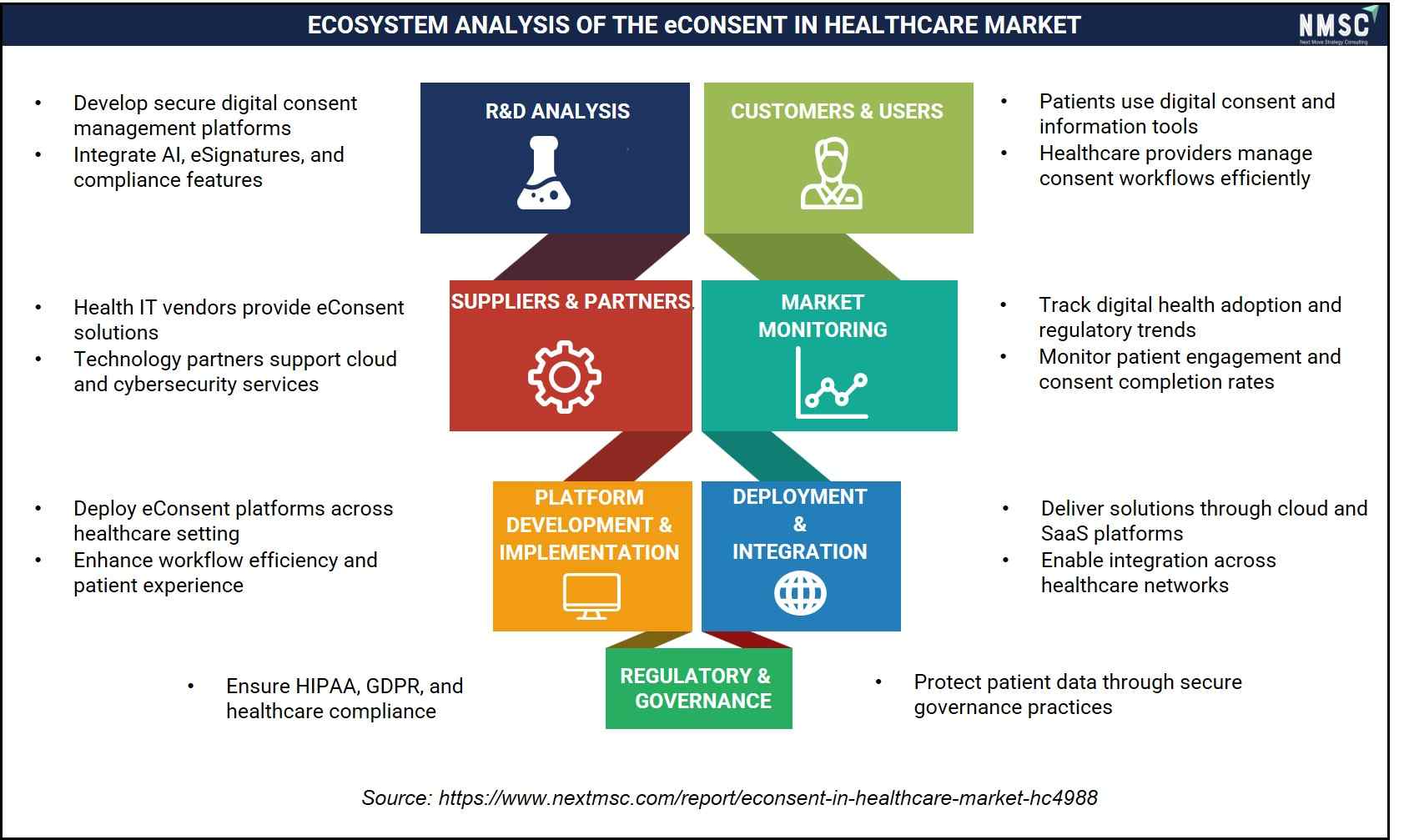
Based on our comprehensive assessment, we found that the eConsent in Healthcare Market ecosystem connects technology developers, healthcare providers, research organizations, and regulatory bodies to streamline patient consent management. Platform vendors develop secure digital consent solutions, while healthcare institutions and clinical trial sponsors drive adoption. Integration partners, cloud providers, and compliance specialists support deployment, enabling efficient, transparent, and patient-centric consent workflows.
What Are the Key Market Drivers, Breakthroughs, and Investment Opportunities that Will Shape the eConsent in Healthcare Industry in the Next Decade?
|
Drivers / Trends / Restraints |
(+/-) % Impact on CAGR Forecast |
Geographic Relevance |
Impact Timeline |
|
FDA Decentralized Clinical Trial Guidance Adoption |
+2.6% |
North America, Europe |
2025–2030 |
|
EU Clinical Trials Regulation Digital Consent Harmonization |
+1.7% |
Europe |
2025–2032 |
|
Rising Global Clinical Trial Registration Volume |
+2.2% |
Global |
2026–2035 |
|
AI-Enabled Multilingual Consent Translation |
+1.5% |
Global (APAC, LATAM emphasis) |
2026–2032 |
|
EHR and USCDI Interoperability Mandates |
+1.2% |
North America, Europe |
2025–2030 |
|
Expansion of Biobank and Registry Consent Programs |
+1.3% |
Global |
2026–2035 |
|
Telehealth and Remote Patient Monitoring Growth |
+1.6% |
Global |
2026–2033 |
|
Data Privacy and Cross-Border Consent Regulation Complexity |
-1.3% |
Europe, Asia-Pacific |
Ongoing |
|
Legacy Paper-Based Consent Infrastructure in Hospitals |
-0.9% |
Latin America, MEA, parts of APAC |
2025–2029 |
|
Cybersecurity and Data Breach Risk in Cloud Consent Platforms |
-0.6% |
Global |
Ongoing |
What Are the Growth Drivers of eConsent in Healthcare?
How Is the Global Rise in Clinical Trial Registration Volume Driving eConsent in Healthcare?
The continual rise in global clinical trial registration volume is a primary driver of demand and growth in the eConsent in Healthcare Market. According to ClinicalTrials.gov, operated by the U.S. National Library of Medicine, the registry surpassed 530,000 total registered studies as of March 2025, with more than 35,000 new study registrations added annually over the preceding five years. From our research, we found that each newly registered interventional or observational study requires a documented informed consent process, and sponsors increasingly select eConsent platforms to standardize consent across multi-country, multi-site protocols, directly expanding demand for the eConsent in Healthcare Market.
How Are FDA and EMA Regulatory Endorsements Accelerating Demand for eConsent in Healthcare?
Regulatory endorsement of electronic informed consent by major health authorities is accelerating growth in the eConsent in Healthcare Market. The FDA's final Informed Consent guidance, issued August 2023, formally acknowledges electronic media and innovative approaches to the consent process, building on its earlier electronic informed consent questions-and-answers guidance from 2016. In Europe, the European Medicines Agency's Clinical Trials Information System, launched January 2022 under Regulation (EU) No. 536/2014, establishes harmonized digital procedures including informed consent documentation across the EU and EEA. We noticed that these endorsements reduce regulatory uncertainty and encourage broader sponsor adoption of eConsent platforms globally.
How Is the Expansion of Decentralized Clinical Trials Driving Growth in eConsent in Healthcare?
The expansion of decentralized clinical trials is a structural driver of growth in the eConsent in Healthcare Market. The FDA's September 2024 final guidance, Conducting Clinical Trials With Decentralized Elements, formally supports remote consent, telehealth-based participant interactions, and bring-your-own-device participation in trials regulated under the Consolidated Appropriations Act, 2023. We found that this guidance reduces ambiguity for sponsors designing remote and hybrid enrollment pathways, directly increasing demand for eConsent platforms capable of supporting identity verification, video-witnessed signature, and remote re-consent across geographically distributed participant populations.
What Are the Growth Inhibitors of eConsent in Healthcare?
How Does Regulatory Fragmentation Across Jurisdictions Constrain eConsent in Healthcare Market Expansion?
Regulatory fragmentation across jurisdictions constrains the pace of eConsent in Healthcare Market expansion for multinational sponsors. The U.S. Department of Health and Human Services enforces the HIPAA Privacy Rule governing protected health information, while the European Union's General Data Protection Regulation imposes distinct consent, data localization, and portability requirements for clinical and health data. We further observed that sponsors operating across both jurisdictions must configure eConsent platforms to satisfy divergent consent retention, withdrawal, and cross-border data transfer rules, extending implementation timelines and increasing compliance overhead for global eConsent in Healthcare deployments.
How Does Limited Digital Connectivity in Emerging Markets Constrain eConsent in Healthcare Adoption?
Limited digital connectivity in emerging markets constrains eConsent in Healthcare adoption among hospitals, biobanks, and trial sites in lower-income regions. According to the International Telecommunication Union's Facts and Figures 2023 report, internet usage in low-income countries reached only 27% of the population in 2023, compared with 93% in high-income countries. We noticed that this digital divide limits the feasibility of fully remote and mobile-based consent modalities in parts of Africa, South Asia, and Latin America, requiring eConsent vendors to maintain offline-capable, tablet-based deployment options alongside cloud-native platforms to serve trial sites and registries in connectivity-constrained settings.
What Are the Growth Opportunities in eConsent in Healthcare?
How Does the Growth of Biobanking and Large-Scale Research Cohort Programs Create Opportunities in eConsent in Healthcare?
The growth of large-scale biobanking and research cohort programs presents a substantial opportunity for the eConsent in Healthcare Market. The U.S. National Institutes of Health's All of Us Research Program, which aims to enroll at least one million participants, had enrolled 705,719 diverse participants through its digital health research platform using a modular electronic informed consent process, according to research published via the National Library of Medicine. Through our analysis, we found that comparable national biobank and registry initiatives across Europe and Asia-Pacific are similarly adopting eConsent frameworks, creating durable, multi-year demand for registry and biobank consent platforms.
How Does Telehealth and Remote Care Expansion Create New Opportunities for eConsent in Healthcare?
Telehealth and remote care expansion is creating new opportunities within the eConsent in Healthcare Market. The FDA's 2024 decentralized clinical trial guidance explicitly addresses telehealth-based participant interactions and requires sponsors to account for state-level telehealth regulations when designing remote visit protocols. From our research, we found that healthcare providers expanding telehealth-based diagnostic and treatment encounters increasingly require digital consent capture integrated directly into virtual care workflows, extending the eConsent in Healthcare Market beyond clinical trials into routine telehealth-based medical treatment and diagnostic consent across hospitals and ambulatory care providers.
How Does AI-Driven Consent Personalization Open New Growth Avenues in eConsent in Healthcare?
AI-driven consent personalization is opening new growth avenues across the eConsent in Healthcare Market. The Office of the National Coordinator for Health Information Technology's HTI-1 final rule establishes first-of-its-kind transparency requirements for predictive decision support algorithms embedded within certified health IT, a framework that NMSC's analysis indicates will extend to AI-driven consent comprehension tools as they become embedded within certified electronic health record systems. We assessed that vendors integrating AI-based readability scoring, adaptive questioning, and personalized consent pathways are positioned to capture premium pricing within the eConsent in Healthcare Market as regulatory transparency expectations mature.
How Is eConsent in Healthcare Segmented, and What Are the Key Insights from the Segmentation Analysis?
What Do the Sub-Segments Under the Offering Dimension Reveal About Value Distribution in the eConsent in Healthcare Market?
|
Segment |
2025 (USD Mn) |
2035 (USD Mn) |
CAGR (%) |
|
Software Platforms |
378.0 |
1,184.0 |
12.1% |
|
Professional Services |
98.0 |
293.0 |
11.6% |
|
Managed Services |
48.5 |
169.0 |
13.3% |
|
Support and Maintenance |
29.0 |
136.0 |
16.7% |
Based on our analysis of offering-level adoption patterns across the eConsent in Healthcare Market, we observed that the market is structured across Software Platforms, Professional Services, Managed Services, and Support and Maintenance offerings. Software Platforms dominate, with Clinical Research eConsent Platforms, including both Standalone and Integrated eClinical modules, capturing the largest share due to sustained sponsor demand across interventional and observational studies. Clinical Care eConsent Platforms covering Surgical, Treatment, and Procedure Consent are growing as hospitals digitize patient-facing consent workflows. Data Sharing and Registry Platforms are expanding across Biobank, Research Registry, and Data Sharing Consent applications. Professional Services led by Implementation, Integration, Validation, and Training remain stable contributors, while Managed Services focused on Content Configuration and Support segments covering Standard, Premium, and Regulatory Compliance support are the fastest-growing offering categories as sponsors outsource operational consent management.
Which Application Segments Are Generating the Most Revenue and Growth in the eConsent in Healthcare Market?
|
Segment |
2025 (USD Mn) |
2035 (USD Mn) |
CAGR (%) |
|
Clinical Research |
305.0 |
876.0 |
11.1% |
|
Clinical Care |
142.0 |
532.0 |
13.8% |
|
Data Sharing and Registries |
88.5 |
310.0 |
13.2% |
|
Other Applications |
18.0 |
64.0 |
13.5% |
Our findings suggest that the eConsent in Healthcare Market is segmented by application into Clinical Research, Clinical Care, Data Sharing and Registries, and Other Applications. Clinical Research commands the largest share, driven by Interventional Studies spanning Phase I through Phase IV, Observational Studies, Decentralized Clinical Trials, Real World Evidence Studies, and Patient Registries. Decentralized Clinical Trials is the fastest-growing sub-segment within Clinical Research, reflecting FDA and EMA guidance endorsing remote consent. Clinical Care applications including Surgical Procedures, Medical Treatments, Diagnostic Procedures, and Telehealth Encounters represent the fastest-growing primary application segment, as hospitals integrate digital consent into routine patient workflows. Data Sharing and Registries applications spanning Biobanks, Health Information Exchange, Longitudinal Registries, and Digital Health Programs are expanding as national genomic and health data programs scale.
How Do End-User Profiles Define the Demand Structure of the eConsent in Healthcare Market?
|
Segment |
2025 (USD Mn) |
2035 (USD Mn) |
CAGR (%) |
|
Pharmaceutical Companies |
148.0 |
418.0 |
11.0% |
|
Biotechnology Companies |
86.0 |
260.0 |
11.7% |
|
Contract Research Organizations |
92.0 |
270.0 |
11.4% |
|
Academic Research Institutions |
52.0 |
152.0 |
11.3% |
|
Hospitals and Health Systems |
96.0 |
360.0 |
14.0% |
|
Ambulatory Care Centers |
28.5 |
112.0 |
14.6% |
|
Specialty Clinics |
21.5 |
82.0 |
14.3% |
|
Biobanks and Registries |
16.0 |
72.0 |
16.2% |
|
Digital Health Organizations |
8.5 |
40.0 |
16.7% |
|
Other End Users |
5.0 |
16.0 |
12.3% |
Through our market assessment, we observed that the eConsent in Healthcare Market is served across ten end-user categories. Pharmaceutical Companies retain the dominant share as the largest sponsors of global clinical trials, maintaining eConsent platform investments across their commercial trial portfolios. Contract Research Organizations represent the second-largest end-user group, deploying eConsent across sponsored studies conducted for pharma and biotech clients. Hospitals and Health Systems are the fastest-growing end-user segment, adopting eConsent platforms for surgical, treatment, and telehealth consent at scale. Biobanks and Registries, and Digital Health Organizations represent the smallest but fastest-growing emerging end-user segments, reflecting expanding population health research and consumer-facing consent applications.
How Does Deployment Model Selection Reflect Risk Tolerance and Regulatory Requirements in the eConsent in Healthcare Market?
|
Segment |
2025 (USD Mn) |
2035 (USD Mn) |
CAGR (%) |
|
Public Cloud |
298.0 |
988.0 |
13.7% |
|
Private Cloud |
128.0 |
378.0 |
11.5% |
|
Hybrid Cloud |
88.5 |
302.0 |
13.0% |
|
On Premises |
39.0 |
114.0 |
11.3% |
Based on our market evaluation, we noticed that deployment model preferences across the eConsent in Healthcare Market reflect a clear shift toward cloud-native infrastructure. Public Cloud platforms dominate due to their scalability, multi-study configurability, and ability to support distributed, multi-site global consent workflows without infrastructure management burden. Hybrid Cloud deployment is the second-fastest-growing mode, particularly among large health systems and academic medical centers that require cloud scalability alongside on-premises data residency for sensitive patient consent records. Private Cloud deployments serve regulated pharmaceutical sponsors and hospitals in jurisdictions with strict data localization requirements. On-Premises installations are declining in relative share but remain essential for certain hospital information security environments in Europe and the Middle East.
How Do Consent Modalities Reflect the Evolving Channel Mix Within the eConsent in Healthcare Market?
|
Segment |
2025 (USD Mn) |
2035 (USD Mn) |
CAGR (%) |
|
On Site Consent |
210.0 |
522.0 |
9.5% |
|
Remote Consent |
128.0 |
620.0 |
16.0% |
|
Hybrid Consent |
104.5 |
450.0 |
15.7% |
|
Text Based Consent |
72.0 |
109.0 |
4.2% |
|
Multimedia Consent (Video, Audio, Interactive) |
39.0 |
81.0 |
7.6% |
Our analysis shows that the eConsent in Healthcare Market supports five primary consent modalities: Text Based Consent, Multimedia Consent (including Video-Enabled, Audio-Enabled, and Interactive sub-modalities), Remote Consent, On Site Consent, and Hybrid Consent. On Site Consent retains the largest absolute share as the majority of clinical trial sites and hospitals continue to conduct in-person enrollment visits. However, Remote Consent and Hybrid Consent are the fastest-growing modalities, directly reflecting FDA's 2024 decentralized clinical trial guidance and the expansion of telehealth-based care delivery. Multimedia Consent modalities are gaining traction in clinical care settings for surgical and treatment consent, where comprehension verification is a compliance priority. Text Based Consent remains foundational but is declining in relative share as richer interaction models replace static form-signing workflows.
How Are Patient Interaction Channels Shaping the User Experience in the eConsent in Healthcare Market?
|
Segment |
2025 (USD Mn) |
2035 (USD Mn) |
CAGR (%) |
|
Web Portal |
232.0 |
660.0 |
11.0% |
|
Mobile Application |
156.5 |
684.0 |
15.8% |
|
Tablet Interface |
120.0 |
338.0 |
10.9% |
|
Kiosk Interface |
45.0 |
100.0 |
8.3% |
From our assessment of eConsent in Healthcare platform deployments, we found that Web Portal access commands the largest patient interaction channel share due to its broad compatibility across operating systems, ease of multi-language configuration, and suitability for both clinical research and clinical care consent workflows. Tablet Interface deployments remain common at clinical trial sites and hospital check-in points where a sponsor or staff member facilitates the consent process. Mobile Application access is the fastest-growing interaction channel, driven by decentralized clinical trial enrollment, remote re-consent, and digital health programs that require participants to complete or update consent from personal smartphones. Kiosk Interface deployments remain relevant in hospital ambulatory settings and emergency departments where unattended consent initiation is required.
Regional Outlook
Geographic Performance Snapshot
|
Region |
2025 (USD Mn) |
2035 (USD Mn) |
CAGR (%) |
Key Driver |
|
North America |
232.0 |
680.0 |
11.4% |
Sponsor concentration, FDA guidance, DCT adoption |
|
Europe |
148.0 |
440.0 |
11.5% |
EU CTR CTIS, GDPR compliance, multi-country trials |
|
Asia Pacific |
108.5 |
450.0 |
15.1% |
CRO growth, clinical trial volume, digital health |
|
Middle East & Africa |
34.0 |
108.0 |
12.3% |
GCC Vision programs, hospital digitization |
|
Latin America |
31.0 |
104.0 |
12.9% |
Brazil pharma investment, CRO expansion |
North America eConsent in Healthcare Market
North America is the largest regional market for eConsent in Healthcare, contributing USD 232.0 million in 2025 and forecast to reach USD 680.0 million by 2035 at a CAGR of 11.4%. The region benefits from the world's highest concentration of pharmaceutical company headquarters, the most active clinical trial sponsor base, and the clearest regulatory framework supporting electronic informed consent through FDA guidance. NMSC's analysis indicates that U.S. health systems are rapidly expanding eConsent adoption beyond clinical research into surgical and routine care settings, while Canadian academic health centers are advancing biobank and registry consent digitization.
U.S. eConsent in Healthcare Market
Based on our engagements with North American clinical trial stakeholders, the United States represents approximately 85% of North American eConsent in Healthcare revenue, making it the world's single largest national market. The FDA's August 2023 Informed Consent guidance and September 2024 Decentralized Clinical Trials guidance have together created the clearest regulatory pathway for electronic and remote consent globally. The NIH's All of Us Research Program, which deployed a modular eConsent framework to enroll over 700,000 diverse participants through its digital health research platform, demonstrates large-scale government endorsement of eConsent in Healthcare. Leading platforms including Medidata Solutions, Veeva Systems, Oracle, and Signant Health are headquartered or operate primary R&D centers in the U.S.
Canada eConsent in Healthcare Market
Through our analysis, Canada represents approximately 10% of North American eConsent in Healthcare market revenue, with the remainder attributed to Mexico. Canadian academic health centers and university-affiliated hospitals are early adopters of eConsent platforms for clinical research, patient care, and biobank consent programs. Health Canada's clinical trial regulatory framework and provincial privacy legislation under PIPEDA are driving demand for auditble, access-controlled eConsent platforms. The government's Pan-Canadian Health Data Strategy is further encouraging digital consent infrastructure investment across provincial health authority networks for research and care data sharing programs.
Mexico eConsent in Healthcare Market
From our assessment, Mexico is a growing eConsent in Healthcare market within North America, driven by its expanding pharmaceutical manufacturing sector and increasing domestic clinical trial participation. COFEPRIS, Mexico's Federal Commission for Protection against Sanitary Risks, regulates clinical investigations and has progressively aligned with ICH E6(R2) Good Clinical Practice guidelines, supporting electronic documentation. Mexico's growing CRO sector and increasing participation in global multi-site pharmaceutical trials are generating early but structurally important demand for cloud-based eConsent in hHealthcare platforms that can serve Spanish-language participants in compliance with international study protocols.
Europe eConsent in Healthcare Market
Europe is the second-largest regional market for eConsent in hHealthcare, contributing USD 148.0 million in 2025 and forecast to reach USD 440.0 million by 2035 at a CAGR of 11.5%. The EU's Clinical Trials Information System, which launched January 2022 under Regulation (EU) No. 536/2014, has established a single digital point of entry for clinical trial applications and informed consent documentation across EU and EEA member states. GDPR requirements around consent data retention, withdrawal rights, and cross-border transfer continue to shape platform architecture choices, with sponsors preferring vendors offering in-region cloud data processing options.
U.K. eConsent in Healthcare Market
According to our evaluation, the United Kingdom is Europe's largest individual country market for eConsent in Healthcare, representing approximately 22% of European regional revenue in 2025. Post-Brexit, the U.K. maintains its own GDPR-equivalent UK GDPR framework administered by the Information Commissioner's Office, while the Medicines and Healthcare products Regulatory Agency governs clinical trial conduct. The U.K.'s extensive National Health Service clinical research network and active pharmaceutical sector create high demand for eConsent platforms supporting both commercial and NHS-sponsored studies, with the NIHR Clinical Research Network facilitating wide eConsent infrastructure adoption.
Germany eConsent in Healthcare Market
Through our analysis, Germany is the second-largest European eConsent in Healthcare market, driven by its world-class pharmaceutical sector anchored by Bayer, Boehringer Ingelheim, and Merck KGaA, alongside strong hospital-based clinical research networks. German enterprises are among the most stringent data governance buyers globally, requiring eConsent platforms to comply with the Bundesdatenschutzgesetz and GDPR. The Paul Ehrlich Institute and the Federal Institute for Drugs and Medical Devices oversee clinical trial authorization, and both favor fully auditable, version-controlled electronic consent documentation as part of compliance requirements.
France eConsent in Healthcare Market
From our assessment, France is the third-largest European eConsent in Healthcare market, distinguished by strong public health research infrastructure and active pharmaceutical industry participation. The Agence nationale de sécurité du médicament et des produits de santé oversees clinical trial authorization. France's national health data platform, the Health Data Hub, is advancing structured consent data integration as part of France 2030 digital health investment. The CNIL, France's primary GDPR enforcement body, actively shapes consent data handling standards, compelling eConsent vendors to build granular consent withdrawal and audit log capabilities into their platforms for French deployments.
Italy eConsent in Healthcare Market
Based on our engagements with European healthcare sector participants, Italy is a mid-tier eConsent in Healthcare market with growing adoption in both hospital care and pharmaceutical research settings. The Agenzia Italiana del Farmaco oversees clinical trial authorization, and Italy's National Recovery and Resilience Plan has directed significant investment toward hospital digitization, creating indirect demand for surgical and treatment eConsent platforms. Italy's Garante data protection authority actively enforces GDPR, compelling hospitals and sponsors operating in Italy to implement compliant, documented electronic consent workflows.
Spain eConsent in Healthcare Market
According to our evaluation, Spain is a growing eConsent in Healthcare market with a dynamic pharmaceutical sector, expanding biomedical research network, and government commitment to digital health under Agenda España Digital 2026. The Spanish Agency of Medicines and Medical Devices governs clinical trial regulatory approval. Spain's healthcare system managed by the Ministry of Health is actively pursuing hospital digitization programs that create demand for patient-facing eConsent platforms in surgical and treatment care settings, complementing growth in sponsor-driven clinical trial eConsent adoption.
Sweden eConsent in Healthcare Market
From our research, Sweden is a high-per-capita eConsent in Healthcare market, supported by its world-class life sciences sector anchored by AstraZeneca and a deeply digitized public health system. Sweden's Medical Products Agency oversees clinical research conduct, and the Swedish national quality register network already collects structured patient-reported data with digital consent frameworks. Sweden's Integritetsskyddsmyndigheten supervises GDPR compliance, while the country's Data Act transposition will further shape eConsent data governance requirements for both clinical research and care settings.
Denmark eConsent in Healthcare Market
Through our market assessment, Denmark is among the most advanced digital health economies in Europe for eConsent in Healthcare adoption. The Danish Health Authority and the Regional Ethics Committees oversee clinical trial and research ethics requirements, with strong preference for documented, version-controlled consent records. Denmark's consistent top ranking in the European Commission's Digital Economy and Society Index reflects deep healthcare digitization penetration, supporting early and broad eConsent adoption across hospital, biobank, and research registry settings. The Danish Data Protection Agency is an active GDPR regulator shaping platform requirements.
Finland eConsent in Healthcare Market
Based on our analysis, Finland's eConsent in Healthcare market is characterized by high digital health infrastructure maturity, progressive public health data governance, and an advanced pharmaceutical sector. Finland's Secondary Use of Health and Social Data Act enables structured health data access with digital consent frameworks administered through the Findata authority. The Finnish National Institute for Health and Welfare manages major national biobanks and health registries where digital consent infrastructure is foundational. Finland's Office of the Data Protection Ombudsman provides active GDPR oversight, reinforcing the demand for robust, compliant eConsent platforms.
Netherlands eConsent in Healthcare Market
From our assessment, the Netherlands occupies a strategically important position in the European eConsent in Healthcare Market as both a significant clinical research hub and a data infrastructure gateway. The Dutch healthcare system operates multiple national patient registries and clinical research programs administered through academic medical centers including Amsterdam UMC and Erasmus MC. The Dutch Data Protection Authority has issued significant GDPR enforcement decisions shaping platform consent data handling standards. The Netherlands Vaccine Institute and other national health programs are advancing structured eConsent frameworks for population health research programs.
Rest of Europe eConsent in Healthcare Market
The Rest of Europe, encompassing Poland, Belgium, Switzerland, Austria, Portugal, Czech Republic, and other European nations, represents a growing segment of the European eConsent in Healthcare Market. Switzerland hosts major pharmaceutical companies including Novartis and Roche, generating significant demand for enterprise eConsent platforms supporting global multi-site trials. Belgium, home to EU institutions and active academic research centers, is a key demand center for compliance-driven eConsent solutions. Poland and Czech Republic are emerging clinical trial destinations where CRO-driven eConsent demand is growing in parallel with their pharmaceutical manufacturing sectors.
Asia Pacific eConsent in Healthcare Market
Asia Pacific is the fastest-growing major region in the eConsent in Healthcare Market, advancing from USD 108.5 million in 2025 to an estimated USD 450.0 million by 2035 at a CAGR of 15.1%. The region's growth is propelled by rapidly expanding clinical trial activity in China and India, growing contract research organization capacity in India, Singapore, South Korea, and Taiwan, and government-backed digital health infrastructure investments across the region. Diverse regulatory frameworks including Japan's APPI, South Korea's PIPA, China's PIPL, and India's DPDPA are shaping data governance requirements for eConsent platforms across Asia Pacific.
China eConsent in Healthcare Market
Based on our engagements with Asia Pacific healthcare sector participants, China is the largest single eConsent in Healthcare market in Asia Pacific, driven by its massive clinical trial volumes and rapid digital health infrastructure expansion. China's National Medical Products Administration oversees clinical trial authorization and has been progressively aligning with ICH E6 Good Clinical Practice standards. China's Personal Information Protection Law and Data Security Law impose data localization and classification requirements compelling sponsors and hospitals to deploy domestic or compliant cloud eConsent solutions. Local CRO capacity growth and increasing pharmaceutical R&D investment are expanding eConsent demand.
India eConsent in Healthcare Market
Through our analysis, India is the fastest-growing country market for eConsent in Healthcare in Asia Pacific, advancing at a CAGR of approximately 19.8% from 2026 to 2035. India's Central Drugs Standard Control Organisation regulates clinical trial conduct, and the country hosts one of the world's largest CRO sectors. India's Digital Personal Data Protection Act 2023, notified under the Ministry of Electronics and Information Technology, establishes consent-based data processing requirements that are driving enterprise investment in compliant eConsent infrastructure. The Ayushman Bharat Digital Mission is advancing health data interoperability frameworks that will support eConsent integration across public and private healthcare settings.
Japan eConsent in Healthcare Market
According to our evaluation, Japan is the second-largest Asia Pacific market for eConsent in Healthcare, supported by a mature pharmaceutical sector and advanced hospital digitization. The Pharmaceuticals and Medical Devices Agency oversees clinical trial authorization, and Japan's ICH harmonization commitments support electronic informed consent adoption. Japan's Act on Protection of Personal Information, enforced by the Personal Information Protection Commission, provides a structured governance framework for consent data management. Major pharmaceutical companies including Takeda, Astellas, and Daiichi Sankyo are significant eConsent in Healthcare platform buyers for global clinical research programs.
South Korea eConsent in Healthcare Market
From our assessment, South Korea demonstrates high eConsent in Healthcare market maturity, supported by one of the world's most advanced digital health ecosystems, a strong pharmaceutical R&D sector, and a proactive regulatory environment. The Ministry of Food and Drug Safety oversees clinical trial authorization, and South Korea's Personal Information Protection Act governs healthcare consent data handling. South Korea's leading pharmaceutical and biotechnology companies, including Samsung Bioepis, Celltrion, and Yuhan Corporation, are significant buyers of eConsent in Healthcare platforms for domestic and global clinical research programs.
Taiwan eConsent in Healthcare Market
Based on our analysis, Taiwan's eConsent in Healthcare market is concentrated in pharmaceutical research and hospital-based clinical trials, supported by a sophisticated medical research infrastructure and the Taiwan Food and Drug Administration's regulatory framework. Taiwan's Personal Data Protection Act governs research data handling, including electronic consent records. National university hospitals and CROs affiliated with Taiwan's expanding biomedical industry are active eConsent in Healthcare platform adopters, particularly for oncology, immunology, and rare disease studies participating in global multi-regional clinical trial programs.
Indonesia eConsent in Healthcare Market
Through our analysis, Indonesia is among the most rapidly growing eConsent in Healthcare markets in Southeast Asia, driven by its 280 million population, expanding pharmaceutical sector, and government digital health transformation programs. The National Agency of Drug and Food Control oversees clinical trial regulation. Indonesia's Personal Data Protection Law, enacted in 2022, establishes electronic consent and data processing requirements that are driving demand for compliant eConsent platforms. Growing CRO capacity and increasing multinational pharma clinical trial investment in Indonesia are accelerating eConsent in Healthcare platform adoption.
Vietnam eConsent in Healthcare Market
From our assessment, Vietnam is an emerging eConsent in Healthcare market in Southeast Asia, supported by its government's National Digital Transformation Program and an expanding pharmaceutical manufacturing sector. The Ministry of Health's Department of Medical Services Administration oversees clinical trial regulation. Vietnam's Cybersecurity Law and Decree 13/2023 on Personal Data Protection establish data governance requirements that international sponsors must comply with when deploying eConsent platforms in Vietnam. Growing Phase I to Phase II trial activity and biosimilar development programs are the primary drivers of eConsent in Healthcare demand.
Australia eConsent in Healthcare Market
Based on our engagements, Australia is the most mature eConsent in Healthcare market in Asia Pacific outside Northeast Asia, with strong adoption across pharmaceutical research, hospital surgical consent, and national registry programs. The Therapeutic Goods Administration and Human Research Ethics Committees oversee clinical trial authorization and ethical review processes. Australia's Privacy Act 1988, amended through the Privacy Legislation Amendment Act 2024, and the Consumer Data Right framework enforced by the ACCC are shaping data governance requirements for clinical and health consent platforms deployed across Australian organizations.
Philippines eConsent in Healthcare Market
According to our evaluation, the Philippines is a developing but rapidly growing eConsent in Healthcare market, supported by its large healthcare system and expanding pharmaceutical research activity. The Food and Drug Administration Philippines oversees clinical trial conduct, while the National Privacy Commission enforces the Data Privacy Act of 2012, which governs electronic consent and health data processing. The Department of Health's eHealth Strategic Framework and government ICT modernization programs are creating early-stage demand for digital consent infrastructure within public hospital networks and national health information exchange programs.
Malaysia eConsent in Healthcare Market
Through our market assessment, Malaysia is a mid-tier and growing eConsent in Healthcare market, characterized by government-led digital health transformation and a maturing pharmaceutical research sector. The National Pharmaceutical Regulatory Agency oversees clinical trial authorization. Malaysia's Personal Data Protection Act 2010 provides the data governance baseline, with reform aligned with GDPR under consideration. Malaysia's MyDigital strategy and expanding hospital network are generating demand for eConsent in Healthcare platforms across both commercial clinical research and routine surgical and treatment consent workflows.
Rest of Asia Pacific eConsent in Healthcare Market
The Rest of Asia Pacific, comprising Thailand, Singapore, Bangladesh, Sri Lanka, New Zealand, and other nations, collectively represents a growing component of the regional eConsent in Healthcare Market. Singapore functions as a strategic hub for Southeast Asian clinical trial management, with the Health Sciences Authority providing a respected regulatory framework. Thailand's FDA is expanding clinical trial oversight, and Singapore's Personal Data Protection Act governs health consent data. New Zealand's clinical research sector benefits from close alignment with Australian regulatory standards, with the Medicines and Medical Devices Act governing electronic informed consent requirements.
Middle East and Africa eConsent in Healthcare Market
The Middle East and Africa region represents a smaller but growing segment of the eConsent in Healthcare Market, advancing from USD 34.0 million in 2025 to USD 108.0 million by 2035 at a CAGR of 12.3%. Vision-driven national health transformation programs in Saudi Arabia and the UAE are the primary growth engines, complemented by Israel's advanced life sciences sector, South Africa's established pharmaceutical research industry, and Nigeria's growing digital health ecosystem. Sovereign cloud infrastructure investment across the Gulf Cooperation Council is creating demand for eConsent platforms with in-country data residency capabilities.
Saudi Arabia eConsent in Healthcare Market
From our assessment, Saudi Arabia is the largest eConsent in Healthcare market in the Middle East and Africa, driven by Vision 2030's health transformation programs, NEOM smart city healthcare initiatives, and the Saudi Food and Drug Authority's alignment with ICH GCP standards. The Saudi Authority for Data and Artificial Intelligence and the National Health Information Center are advancing digital health ai governance frameworks that include structured electronic consent requirements for clinical research and health data sharing programs. Major hospital networks including King Faisal Specialist Hospital are adopting eConsent in Healthcare platforms for research consent programs.
UAE eConsent in Healthcare Market
According to our evaluation, the UAE is the second-largest eConsent in Healthcare market in MEA, powere
UAE eConsent in Healthcare Market
According to our evaluation, the UAE is the second-largest eConsent in Healthcare market in MEA, powered by Dubai and Abu Dhabi's ambitions as regional health innovation hubs. The UAE's National Unified Medical Record program and UAE Health Data Law provide regulatory frameworks for electronic consent in clinical and care settings. The Dubai Health Authority and the Department of Health Abu Dhabi oversee healthcare digital governance, while the UAE National AI Strategy 2031 encourages AI-enabled health technology adoption. Dubai Healthcare City serves as a regional concentration point for clinical research and eConsent platform deployment.
Egypt eConsent in Healthcare Market
Based on our analysis, Egypt is a developing eConsent in Healthcare market, supported by a large population, growing pharmaceutical manufacturing sector, and government health digitization efforts under Egypt Vision 2030. The Egyptian Drug Authority oversees clinical trial authorization and is progressively aligning with international GCP standards. Egypt's Personal Data Protection Law (Law No. 151 of 2020) establishes consent data handling requirements. Egyptian academic medical centers and multinational pharmaceutical sponsors conducting regional Phase II to Phase IV studies are the primary drivers of early eConsent in Healthcare platform demand.
Israel eConsent in Healthcare Market
Through our analysis, Israel occupies a distinctive position in the eConsent in Healthcare Market as both a significant platform technology developer and an enterprise buyer. Israel's Privacy Protection Authority and the Ministry of Health oversee research ethics and data governance for clinical studies. The Israeli healthcare system's advanced digitization level, with national Clalit and Maccabi health maintenance organizations operating large integrated clinical research registries, creates demand for structured eConsent in Healthcare frameworks. Multiple Israeli healthtech startups are developing AI-driven consent management modules for global pharmaceutical research clients.
Turkey eConsent in Healthcare Market
From our assessment, Turkey is a mid-sized and growing eConsent in Healthcare market, supported by a dynamic pharmaceutical sector, large hospital network, and a government health IT modernization agenda. The Turkish Medicines and Medical Devices Agency oversees clinical trial authorization. Turkey's Personal Data Protection Law (KVKK), enforced by the Personal Data Protection Authority, mandates documented consent for health data processing, driving adoption of auditable eConsent platforms. Turkey's growing CRO sector and increasing participation in global multi-regional pharmaceutical trials are expanding demand for eConsent in Healthcare solutions.
Nigeria eConsent in Healthcare Market
Based on our engagements, Nigeria is Sub-Saharan Africa's largest emerging eConsent in Healthcare market, driven by its 220 million population, growing pharmaceutical research activity, and government health IT investment. The National Agency for Food and Drug Administration and Control oversees clinical trial regulation. The Nigeria Data Protection Act 2023, enforced by the Nigeria Data Protection Commission, establishes structured consent requirements for health data processing. Growing CRO activity in Lagos and academic medical center research programs at University of Lagos and University of Ibadan Teaching Hospital are driving early eConsent in Healthcare adoption.
South Africa eConsent in Healthcare Market
From our assessment, South Africa is the most mature eConsent in Healthcare market in Sub-Saharan Africa, driven by its established pharmaceutical research sector, advanced academic hospital network, and regulatory alignment with international GCP standards through the South African Health Products Regulatory Authority. The Protection of Personal Information Act (POPIA), which came into full effect in 2021 under the Information Regulator, establishes structured consent documentation requirements for health research and clinical data processing. Major academic medical centers including Groote Schuur and Charlotte Maxeke hospitals are active eConsent in Healthcare adopters.
Rest of MEA eConsent in Healthcare Market
The Rest of Middle East and Africa, encompassing Kuwait, Qatar, Bahrain, Oman, Jordan, Morocco, Kenya, Ghana, and other nations, collectively represents a growing segment of the eConsent in Healthcare Market. GCC countries outside Saudi Arabia and UAE are investing in national health IT infrastructure aligned with regional Vision strategies. Kenya is Africa's fastest-growing digital health economy, with expanding clinical research activity in infectious disease, HIV, and tuberculosis therapeutic areas where eConsent platforms are increasingly replacing paper-based IRB consent processes at academic and government research centers.
Latin America eConsent in Healthcare Market
Latin America represents a growing segment of the eConsent in Healthcare Market, advancing from USD 31.0 million in 2025 to USD 104.0 million by 2035 at a CAGR of 12.9%. Brazil and Mexico collectively account for approximately 68% of regional revenue. Growing pharmaceutical clinical trial investment, hyperscaler cloud infrastructure expansion across major markets, and evolving data protection legislation are the primary drivers. Contract research organization capacity growth in Brazil and Mexico is creating sustained demand for healthcare Cloud Security
eConsent platforms capable of supporting Portuguese-language and Spanish-language participant consent workflows.
Brazil eConsent in Healthcare Market
Based on our engagements, Brazil is the largest eConsent in Healthcare market in Latin America, accounting for approximately 44% of regional revenue in 2025. Brazil's National Health Surveillance Agency oversees clinical trial authorization, and the National Research Ethics Commission provides IRB oversight for research consent requirements. Brazil's Lei Geral de Proteção de Dados, enforced by the Autoridade Nacional de Proteção de Dados, is a GDPR-aligned data protection law that drives enterprise investment in compliant eConsent infrastructure. Brazilian academic medical centers and multinational pharma sponsors conducting Phase II to Phase IV oncology and cardiometabolic studies are primary eConsent in Healthcare platform buyers.
Argentina eConsent in Healthcare Market
Through our analysis, Argentina is the second-largest eConsent in Healthcare market in Latin America, with a strong technology sector and a significant clinical research tradition across oncology, infectious disease, and rare disease therapeutic areas. The National Administration of Medicines, Food and Medical Technology oversees clinical trial authorization. Argentina's Personal Data Protection Law (Law No. 25.326) governs electronic consent data, with modernization toward GDPR alignment underway. Buenos Aires-based CROs and university hospital research departments are the primary adopters of eConsent in Healthcare platforms for sponsored studies.
Chile eConsent in Healthcare Market
From our assessment, Chile represents a stable eConsent in Healthcare market, benefiting from one of Latin America's strongest economies, high healthcare quality standards, and a proactive regulatory environment. The Chilean Institute of Public Health and FONDECYT oversee pharmaceutical and academic research authorization. Chile's new Data Protection Law, approved in 2024 and aligned with GDPR standards, establishes formal electronic consent data governance mandates. Chilean academic hospitals affiliated with Universidad de Chile and Pontificia Universidad Católica are significant eConsent in HealthcareHealthcare buyers for oncology and cardiovascular research programs.
Colombia eConsent in Healthcare Market
According to our evaluation, Colombia is among the fastest-growing eConsent in Healthcare markets in Latin America, supported by Bogotá's emergence as a regional technology hub and a dynamic clinical research sector. The National Institute for Food and Drug Surveillance oversees clinical trial authorization. Colombia's Statutory Law 1581 of 2012 on Personal Data Protection, enforced by the Superintendencia de Industria y Comercio, establishes formal consent documentation requirements. Colombian academic medical centers and growing mid-market CROs are expanding eConsent in Healthcare adoption for multinational pharmaceutical trials in cardiovascular, oncology, and infectious disease therapeutic areas.
Rest of Latin America eConsent in Healthcare Market
The Rest of Latin America, including Peru, Ecuador, Uruguay, Bolivia, Panama, Costa Rica, and Caribbean nations, represents a smaller but emerging component of the eConsent in Healthcare Market. Uruguay has a notably advanced data protection framework under Law 18.331, making it an early adopter of structured electronic consent practices in its academic research and hospital sectors. Costa Rica serves as a nearshore clinical operations hub for North American CROs, generating demand for English and Spanish bilingual eConsent platforms. Peru and Ecuador are in early stages of clinical trial volume growth, creating nascent demand for cloudcloud-based eConsent in Healthcare solutions.
Strategic Framework of the eConsent in Healthcare Market
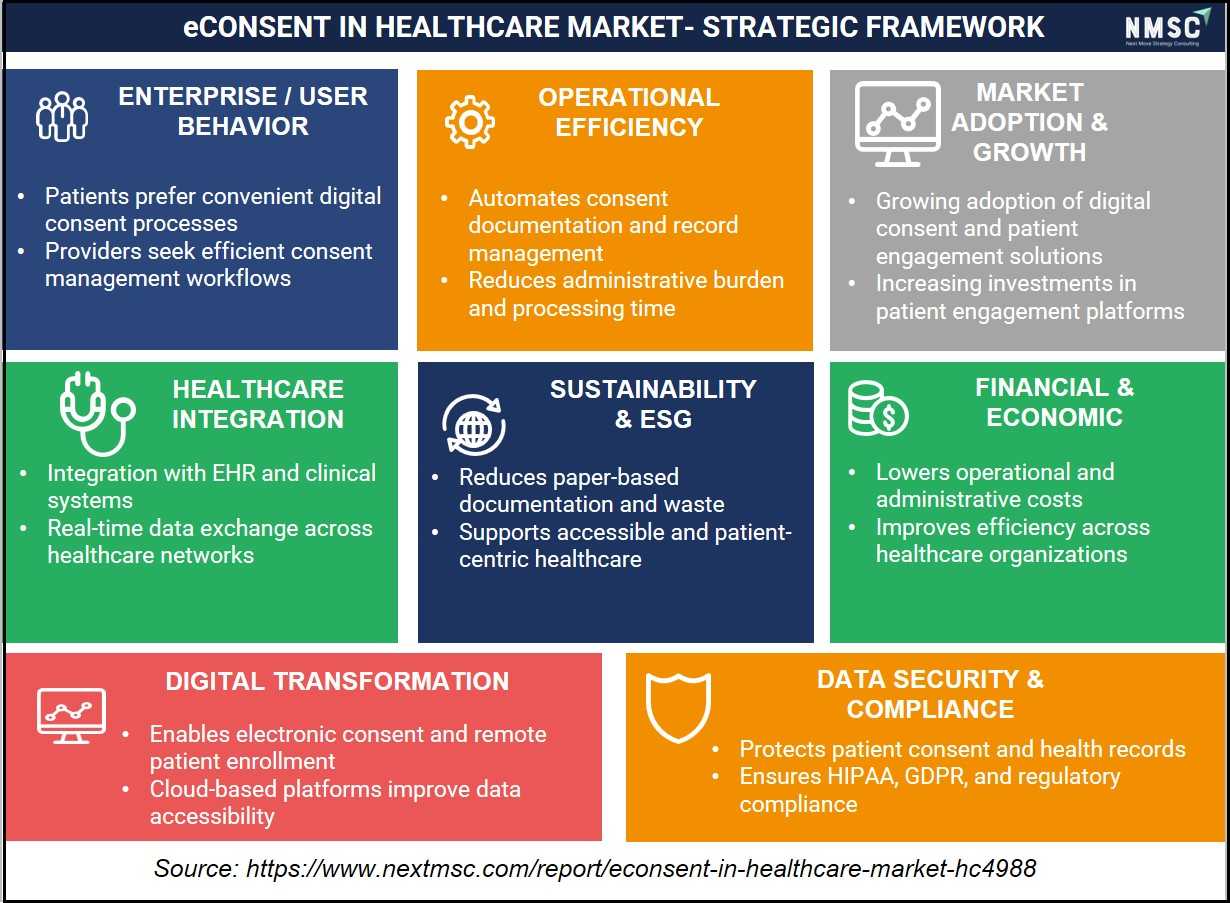
Based on our comprehensive assessment, we found that the eConsent in Healthcare Market is driven by rising demand for digital patient engagement, operational efficiency, and regulatory compliance. Organizations are adopting eConsent platforms to automate documentation, reduce administrative burdens, and improve patient experiences. Integration with healthcare systems, strong data protection measures, and cloud-enabled accessibility collectively strengthen adoption while supporting sustainable and cost-effective healthcare delivery.
Competitive Landscape
Competitive Dynamics and M&A Landscape
|
Key Takeaways |
Details |
|
Market Structure |
The eConsent in Healthcare Market industry features multi-tiered competition among large eClinical suite vendors (Medidata, Oracle, Veeva), specialized eConsent and ePRO platform providers (Signant Health, Florence Healthcare, Suvoda), and emerging digital health CRO-facing platforms (Castor, ObvioHealth, ClinOne), each competing on distinct value propositions around sponsor workflow integration, patient experience, and regulatory validation depth. |
|
Innovation Focus |
Innovation is centered on AI-driven consent comprehension and plain-language translation, remote identity verification for fully decentralized consent, video-enabled and interactive consent modalities, EHR and eClinical system API integration, and blockchain-based immutable audit trails for cross-jurisdictional regulatory compliance. |
|
M&A Activity |
The eConsent in Healthcare Market has experienced consolidation as eClinical suite vendors seek to internalize eConsent capabilities previously supplied by point-solution vendors. Strategic partnerships between eConsent platform providers and decentralized trial technology vendors are accelerating, with technology tuck-in acquisitions and partnerships expected to remain active through 2028 as the market matures. |
How Do Companies Compete in eConsent in Healthcare?
The eConsent in Healthcare Market is characterized by multi-tiered competition among eClinical suite vendors, specialized consent platform providers, and CRO-focused digital healthcare platforms. Large eClinical suite vendors including Medidata Solutions, Oracle, and Veeva Systems compete on deep integration with electronic data capture, clinical trial management, and risk-based monitoring systems, bundling eConsent as a module within broader platform ecosystems. Specialized consent platform providers such as Signant Health, Florence Healthcare, and Suvoda differentiate on depth of IRB-validated consent workflows, multimedia consent modalities, regulatory compliance depth, and sponsor-specific configuration services. Our analysis shows that pricing strategies range from subscription-based per-study licensing to enterprise-wide consumption models.
Which Kind of Companies Dominate the eConsent in Healthcare Market?
Three distinct categories of companies dominate the eConsent in Healthcare Market. First, eClinical suite leaders including Medidata Solutions, Oracle Corporation, IQVIA, and Veeva Systems offer eConsent as a component of comprehensive eClinical platforms, benefiting from existing sponsor relationships and integrated data flows. Second, dedicated eConsent and patient engagement platform specialists including Signant Health, Suvoda, Florence Healthcare, YPrime, and Clinical Ink provide purpose-built consent platforms with deep IRB validation, multimedia modality support, and regulatory submission readiness. Third, emerging digital health and decentralized trial platforms including ObvioHealth, Castor EDC, ClinOne, and THREAD Research are gaining traction among sponsors prioritizing patient-centric, mobile-first consent experiences for decentralized studies.
AI-Native Differentiation and Open Standards Drive Market Success in the eConsent in Healthcare Market
Innovation focus across the eConsent in Healthcare Market is concentrated in AI-native consent comprehension capabilities, remote identity verification for fully decentralized enrollment, video-enabled and interactive consent modalities, and HL7 FHIR-based API integration with electronic health record systems. Vendors that successfully embed AI-driven plain-language generation, adaptive comprehension assessment, and automated translation within validated consent platforms are capturing premium pricing and accelerating adoption among sponsors managing complex, multilingual, multi-regional studies. Open standard API frameworks that enable bidirectional data flow with EHR and eClinical ecosystems represent a key competitive differentiator.
Market Players to Opt for Merger and Acquisition Strategies to Expand Their Presence in the eConsent in Healthcare Market
Mergers, acquisitions, and strategic partnerships are reshaping the competitive landscape of the eConsent in Healthcare Market. eClinical suite vendors are pursuing technology acquisitions to internalize specialized eConsent and ePRO capabilities. Decentralized clinical trial platform providers are building eConsent into broader virtual trial management suites through organic development and partnership agreements with telehealth providers. NMSC's analysis indicates that consolidation around specialized multimedia consent, biobank consent, and telehealth care consent providers is expected to accelerate during the 2025 to 2028 period as large sponsors seek fewer, more integrated vendor relationships across their eClinical ecosystems.
Who Are the Key Market Players in eConsent in Healthcare Market?
-
Medidata Solutions, Inc.
-
IQVIA Inc.
-
Veeva Systems Inc.
-
Oracle Corporation
-
Signant Health Holdings, Inc.
-
Advarra, Inc.
-
Suvoda LLC
-
Florence Healthcare, Inc.
-
YPrime, LLC
-
Medrio, Inc.
-
Castor EDC B.V.
-
Clinical Ink, Inc.
-
OpenClinica, LLC
-
THREAD Research, Inc.
-
Kayentis SAS
-
ObvioHealth Pte. Ltd.
-
ClinOne, Inc.
-
Crucial Data Solutions, Inc.
-
Interlace Health, LLC
-
Concentric Health Ltd.
What Are the Latest Developments in the eConsent in Healthcare Industry?
|
Date |
Event |
|
May 2026 |
Signant Health acquired Ametris, creating a comprehensive end-to-end platform for eCOA and digital outcome measures. By unifying their participant-facing and data collection technologies, Signant aims to provide a more cohesive digital experience for sites and patients, further reducing the administrative burden of eConsent implementation. |
|
February 2026 |
Oracle Life Sciences and ObvioHealth announced a strategic integration, connecting ObvioGo, which includes enterprise-grade eConsent, eCOA, and ePRO modules, directly into the Oracle Clinical One data collection platform. This allows sponsors to deploy participant-facing technologies within a unified system, reducing the need for disparate third-party software and streamlining hybrid trial operations. |
What Are the Investment Opportunities in eConsent in Healthcare?
Capital Inflows and Venture Activity
The eConsent in Healthcare Market continues to attract private and institutional capital, reflecting growing recognition of electronic consent infrastructure as a foundational layer of the clinical research and digital health ecosystem. Dedicated eConsent and patient engagement platform providers including Florence Healthcare and Signant Health have received venture and private equity investment in recent years. The National Venture Capital Association's annual reporting consistently identifies healthcare IT and clinical trial technology as top investment categories within U.S. digital health venture activity, supporting the view that eConsent platforms will continue attracting capital during the 2025 to 2035 forecast period as sponsor budgets for decentralized trial technology expand.
Infrastructure Investment
Infrastructure investment in cloud computing and digital health platforms is a foundational enabler of eConsent in Healthcare Market growth. Hyperscaler cloud infrastructure expansion by Amazon Web Services, Microsoft Azure, and Google Cloud, each investing in region-specific data center capacity globally, directly expands the hosting capacity available for cloud-native eConsent platforms. From our research, we found that these infrastructure investments lower per-transaction data storage and compute costs for eConsent platforms, improving margin economics for vendors and reducing total deployment costs for sponsors, CROs, and hospitals deploying enterprise-scale eConsent programs.
ESG Considerations
Environmental, social, and governance considerations are influencing eConsent in Healthcare investment decisions. The elimination of paper-based consent forms through eConsent platform adoption represents a measurable sustainability benefit for hospital and clinical research operations, reducing paper consumption, printing, and physical storage overhead. Socially, eConsent platforms that improve patient comprehension through multilingual video and plain-language content address health equity goals emphasized by the FDA's 2024 DCT guidance, which explicitly supports expanded access for underrepresented trial populations. We assessed that eConsent vendors demonstrating alignment with patient-centricity and diversity goals attract preferential consideration from institutional investors with ESG mandates.
Digital Transformation Enablement
eConsent in Healthcare platforms serve as a critical data foundation for broader enterprise digital health transformation programs, making them structurally integral to multi-year health IT investment cycles. Hospitals undergoing electronic health record migrations, clinical research organizations implementing integrated eClinical suites, and pharmaceutical sponsors digitizing site-to-sponsor data flows all require eConsent platform integration as a prerequisite for compliant, end-to-end digital trial and care workflows. NMSC's analysis indicates that eConsent in Healthcare investment decisions are frequently bundled with broader eClinical transformation initiatives, creating durable, multi-year demand tied to larger technology refresh cycles.
Private Equity and Strategic M&A Activity
Private equity firms are deploying capital into eConsent in Healthcare platform vendors, targeting mid-market and specialist consent management technology providers. Strategic acquisitions by large eClinical suite vendors seeking to internalize consent capabilities are reshaping the competitive map. Through our market evaluation, we assessed that the highest-conviction M&A themes within the eConsent in Healthcare space include consolidation of biobank and registry consent platform specialists, acquisition of AI-driven patient engagement and comprehension technology vendors, and partnership formation between eConsent providers and remote patient monitoring and telehealth platform companies to create integrated decentralized trial technology stacks.
Key Benefits for Stakeholders
For Pharmaceutical and Biotechnology Sponsors
Pharmaceutical and biotechnology sponsors gain comprehensive, vendor-neutral insights into the eConsent in Healthcare Market trends, including quantitative sizing across all software platform types, application areas, deployment models, consent modalities, and patient interaction channels. This intelligence supports procurement evaluation, vendor benchmarking, and multi-year digital trial technology investment roadmap planning. Our competitive landscape analysis enables clinical operations and technology teams to evaluate build-versus-buy decisions for eConsent capabilities and assess integration pathways with existing eClinical ecosystems.
For Contract Research Organizations and Academic Institutions
Contract research organizations and academic research institutions gain a structured, data-rich assessment of the eConsent in Healthcare Market's growth trajectory, competitive dynamics, and segment-level revenue forecasts through 2035. Our analysis of end-user adoption patterns and patient interaction channel trends enables CROs and academic sites to benchmark their eConsent infrastructure investments against leading sponsor expectations and identify platform selection criteria that improve study start-up efficiency, participant comprehension, and regulatory compliance across sponsored and investigator-initiated research programs.
For Hospitals, Health Systems, and Ambulatory Care Centers
Hospitals, health systems, and ambulatory care centers gain actionable intelligence on the fastest-growing deployment models, consent modalities, and patient interaction channels within the eConsent in Healthcare Market for clinical care applications. Our segmentation analysis of surgical, treatment, diagnostic, and telehealth consent use cases identifies the platform categories and vendor capabilities most relevant to hospital digitization programs. The regional outlook sections provide country-level regulatory context that informs procurement decisions within specific health system and national digital health policy environments.
For eConsent Platform Vendors and Technology Providers
eConsent platform vendors and healthcare technology providers gain actionable intelligence on white-space opportunities, competitive positioning gaps, and fastest-growing sub-segments within the eConsent in Healthcare Market. Our segmentation analysis reveals underserved opportunities in Remote Consent, Biobank and Registry Consent, and Telehealth-based Clinical Care Consent. The regional outlook and country-level insights identify geographic expansion priorities with regulatory maturity context. Investment opportunity analysis enables vendors to identify M&A targets and partnership candidates that would expand their addressable market across the eConsent in Healthcare ecosystem.
For Investors and Financial Analysts
Investors and financial analysts access a structured, data-rich assessment of the eConsent in Healthcare Market's growth trajectory, competitive dynamics, M&A landscape, and segment-level revenue forecasts through 2035. The CAGR analysis by offering segment, application, end user, deployment model, consent modality, and region enables precise portfolio construction and valuation modeling. Detailed market intelligence on all 20 covered companies combined with latest development tracking and investment opportunity analysis provide an early-signal framework for identifying acquisition targets, emerging platform leaders, and at-risk incumbents within the global eConsent in Healthcare landscape.
eConsent in Healthcare Market Key Market Segments
By Offering
-
Software Platforms
-
Clinical Research eConsent Platform
-
Standalone eConsent Platform
-
Integrated eClinical eConsent Module
-
-
Clinical Care eConsent Platform
-
Surgical Consent Platform
-
Treatment Consent Platform
-
Procedure Consent Platform
-
-
Data Sharing and Registry eConsent Platform
-
Research Registry Consent Platform
-
Biobank Consent Platform
-
Data Sharing Consent Platform
-
-
-
Professional Services
-
Implementation Services
-
Integration Services
-
Validation Services
-
Training Services
-
-
Managed Services
-
Content Configuration Services
-
-
Support and Maintenance
-
Standard Support
-
Premium Support
-
Regulatory Compliance Support
-
By Application
-
Clinical Research
-
Interventional Studies
-
Phase I
-
Phase II
-
Phase III
-
Phase IV
-
-
Observational Studies
-
Decentralized Clinical Trials
-
Real World Evidence Studies
-
Patient Registries
-
-
Clinical Care
-
Surgical Procedures
-
Medical Treatments
-
Diagnostic Procedures
-
Telehealth Encounters
-
-
Data Sharing and Registries
-
Biobanks
-
Health Information Exchange
-
Longitudinal Registries
-
Digital Health Programs
-
-
Other Applications
By End User
-
Pharmaceutical Companies
-
Biotechnology Companies
-
Contract Research Organizations
-
Academic Research Institutions
-
Hospitals and Health Systems
-
Ambulatory Care Centers
-
Specialty Clinics
-
Biobanks and Registries
-
Digital Health Organizations
-
Other End Users
By Deployment Model
-
Public Cloud
-
Private Cloud
-
Hybrid Cloud
-
On Premises
By Consent Modality
-
Text Based Consent
-
Multimedia Consent
-
Video Enabled
-
Audio Enabled
-
Interactive Consent
-
-
Remote Consent
-
On Site Consent
-
Hybrid Consent
By Patient Interaction Channel
-
Web Portal
-
Mobile Application
-
Tablet Interface
-
Kiosk Interface
By Region
-
North America: U.S., Canada, and Mexico
-
Europe: UK, Germany, France, Italy, Spain, Sweden, Denmark, Finland, the Netherlands, and the rest of Europe
-
Asia Pacific: China, India, Japan, South Korea, Taiwan, Indonesia, Vietnam, Australia, Philippines, Malaysia and the rest of APAC
-
Middle East & Africa (MEA): Saudi Arabia, UAE, Egypt, Israel, Turkey, Nigeria, South Africa, and the rest of MEA
-
Latin America: Brazil, Argentina, Chile, Colombia, and the rest of LATAM
Conclusion and Recommendations
Long-Term Outlook
The eConsent in Healthcare Market is positioned for sustained and structurally supported growth through 2035, underpinned by irreversible regulatory digitization mandates, expanding global clinical trial activity, and growing hospital adoption of digital patient consent workflows. The market is forecast to grow from USD 622.0 million in 2026 to USD 1,782.0 million by 2035 at a CAGR of 12.4%. We further analysed that this growth reflects both the structural expansion of clinical research activity and the healthcare sector's progressive replacement of paper-based consent with auditable, multimedia-capable, and EHR-integrated eConsent in Healthcare platforms.
Strategic Positioning Recommendations
Platform vendors should prioritize AI-native differentiation through integrated consent comprehension assessment, adaptive multilingual translation, and automated plain-language generation. Organizations that embed AI capabilities within IRB-validated eConsent platforms, rather than treating AI as a separate overlay, will capture premium pricing and superior adoption economics among large pharmaceutical sponsors. Remote consent and decentralized trial enablement are non-negotiable capabilities for vendors targeting top-25 pharmaceutical sponsor procurement in the post-2024 FDA DCT guidance environment. Vendors without robust video-witnessed remote consent and identity verification features will face structural disadvantage in global sponsor procurements.
Investment Attractiveness
The eConsent in Healthcare Market represents an attractive investment environment given durable regulatory tailwinds, recurring subscription-based revenue models, and a structural shift from paper-based processes toward managed digital consent platforms. Our assessment indicates that the highest-conviction investment themes include Clinical Care eConsent (13.8% CAGR), Remote Consent modality (16.0% CAGR), Mobile Application channel (15.8% CAGR), Hospitals and Health Systems end-user segment (14.0% CAGR), and Asia Pacific regional growth (15.1% CAGR). Investors should monitor specialist eConsent vendors, AI-driven patient engagement platforms, and biobank consent technology companies as structurally attractive acquisition targets.
Market Shifts and Key Risks
The most significant market shift underway is the migration from standalone eConsent point solutions toward fully integrated eClinical suite deployments where consent is one module within a broader electronic data capture, patient engagement, and study management ecosystem. This shift benefits large eClinical suite vendors at the expense of standalone specialist platforms. Key risks for the eConsent in Healthcare Market include data privacy regulatory escalation constraining cross-border consent data flows, cybersecurity incidents at cloud eConsent platforms undermining sponsor confidence, and economic pressures causing clinical research budget reductions that slow platform upgrade cycles among smaller sponsor organizations.
Growth Pathways
Organizations seeking to maximize value from the eConsent in Healthcare Market should pursue a three-horizon strategy. In the near term from 2025 to 2027, prioritize deployment of remote and hybrid consent-capable platforms aligned with FDA 2024 DCT guidance and EU CTR CTIS digital documentation standards to capture the accelerating decentralized trial market opportunity. In the mid-term from 2027 to 2031, invest in AI-driven comprehension assessment, multilingual consent generation, and EHR FHIR API integration to build the interoperability and comprehension quality credentials required for clinical care eConsent expansion. In the long term from 2031 to 2035, position for biobank and longitudinal registry consent platform leadership as national genomic and population health programs scale globally across Europe, Asia Pacific, and North America.
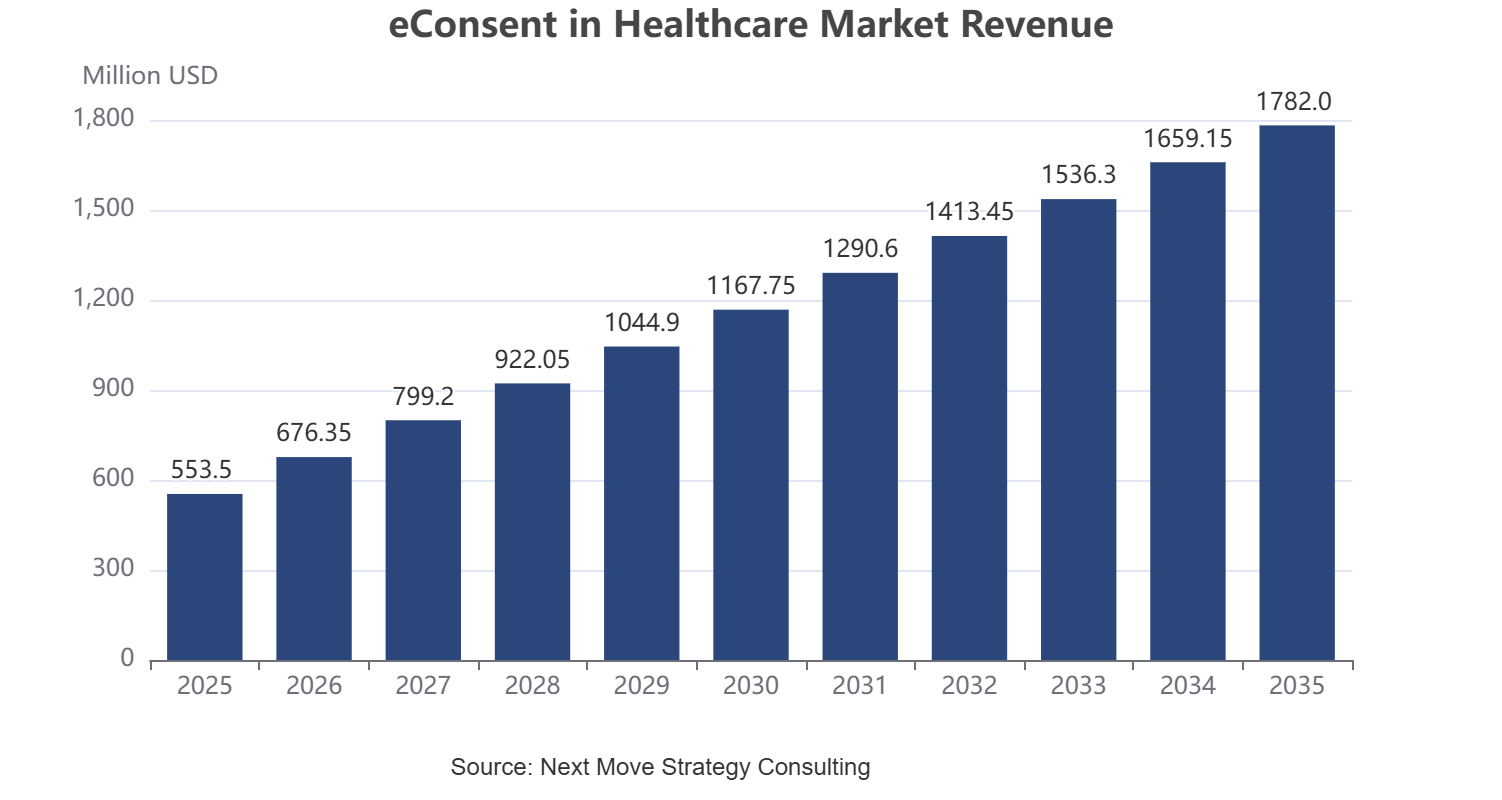
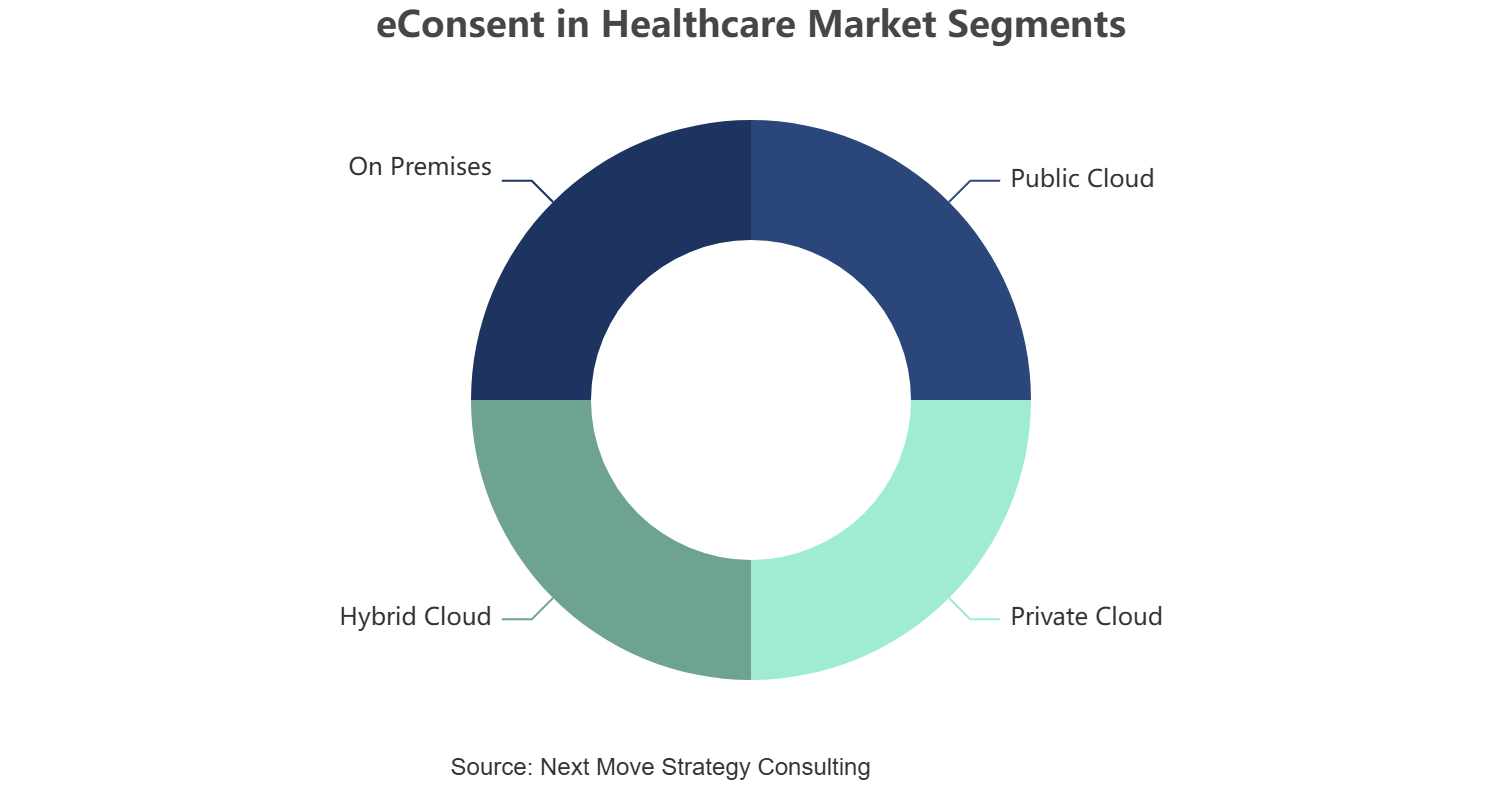
About the Author
 Saista Faiyaz
— Saista Faiyaz is Research Associate at Next Move Strategy Consulting, where she has covered consumer markets and healthcare technologies for 3 years. Her work includes primary interview review, secondary-source validation, market sizing, and structured analysis of company and industry data. She supports research by comparing evidence across sources, organizing findings into market narratives, and documenting assumptions used in analysis. Her scope includes cross-market benchmarking, and reports.
Saista Faiyaz
— Saista Faiyaz is Research Associate at Next Move Strategy Consulting, where she has covered consumer markets and healthcare technologies for 3 years. Her work includes primary interview review, secondary-source validation, market sizing, and structured analysis of company and industry data. She supports research by comparing evidence across sources, organizing findings into market narratives, and documenting assumptions used in analysis. Her scope includes cross-market benchmarking, and reports.
About the Reviewer
 Supradip Baul
— Supradip Baul is an accomplished business consultant and strategist with over a decade of rich experience in market intelligence, strategy, technology, and business transformation. His work has included rigorous qualitative and quantitative analysis across multiple industries, helping clients shape investment decisions and long-term roadmaps. Earlier in his career, he was associated with Gartner, where he contributed to industry-leading reports and market share analyses. He has worked with leading global companies and holds an MBA with a dual specialization in Marketing and Finance.
Supradip Baul
— Supradip Baul is an accomplished business consultant and strategist with over a decade of rich experience in market intelligence, strategy, technology, and business transformation. His work has included rigorous qualitative and quantitative analysis across multiple industries, helping clients shape investment decisions and long-term roadmaps. Earlier in his career, he was associated with Gartner, where he contributed to industry-leading reports and market share analyses. He has worked with leading global companies and holds an MBA with a dual specialization in Marketing and Finance.
At Next Move Strategy Consulting, we understand that insightful market research is the cornerstone of successful business decisions. That's why we employ a robust and multifaceted approach, combining various methodologies to deliver the most accurate and actionable data for our clients.

Research Landscape
We navigate the world of research with two primary approaches:
Qualitative Approach
Our qualitative research methodologies involve immersive techniques such as in-depth interviews, focus groups, and observational studies. By engaging directly with individuals and stakeholders, we uncover valuable insights that quantitative data alone may overlook.

Quantitative Research
In tandem with qualitative methodologies, NMSC leverages the power of Quantitative Research to provide a robust foundation of numerical insights. Through systematic data collection and analysis, we quantify patterns, preferences, and market trends, offering a comprehensive view of the business landscape.
Our quantitative research approach employs diverse tools, including surveys, experiments, and statistical modelling. These methodologies enable us to gather data from a large and representative sample, ensuring the statistical significance of our findings. By employing structured questionnaires and standardized data collection methods, we guarantee the reliability and validity of the information we present to our clients.
Quantitative research is particularly effective in measuring the prevalence of trends, assessing market size, and gauging the impact of various factors on consumer behavior. The numerical precision attained through this approach equips our clients with actionable insights, facilitating data-driven decision-making and strategy formulation.


Our Specialized Toolbox for Industry-Specific Market Research
We deploy a specialized arsenal of techniques tailored to meet your unique requirements. Here's a glimpse into our comprehensive toolbox:

Information Procurement
The stage entails acquiring market data or relevant information through various sources and methodologies.


Market Research Approach
We utilize both top-down and bottom-up approaches in market research analysis to achieve a comprehensive understanding of the market dynamics, leveraging the broad perspective of industry trends and macroeconomic factors alongside detailed insights from specific segments and individual companies.

Porters Five Forces Analysis
We conduct Porter's Five Forces analysis to evaluate the competitive landscape of an industry, providing us with insights into factors that affect profitability and strategic positioning.

SWOT Analysis

Forecasting
We utilize a forecasting model to predict future consumption by considering parameters like population, economics, regulations, market competition, drivers, constraints, technology, and pricing. We also employ statistical techniques such as multilinear regression, exponential smoothing, moving average, ARIMA, and Monte Carlo simulations for accurate predictions. In econometric forecasting, we analyzed short-term and long-term event impacts, attributing values based on regulatory frameworks, economic factors, and market events.





 Speak to Our Analyst