Heavy-Duty Landscape Fabric Market Global Industry Analysis and Forecast (2026-2035)

Heavy-Duty Landscape Fabric Market size was USD 1.05 Billion in 2025, projected to reach USD 2.01 Billion by 2035, growing at a CAGR of 6.70% from 2026 to 2035. Key drivers include rising residential landscaping expenditure, increasing municipal erosion-control infrastructure investment, expansion of commercial hardscaping projects, and growing adoption of UV-stabilized fabrics, with North America leading the market.

Download Free Sample PDF
Base Year (2025)
$1,050.0 Million
Forecast (2035)
$2,010.0 Million
CAGR (2026-2035)
6.7%
Top Region
North America

What Is the Heavy-Duty Landscape Fabric Market Size?

The global heavy-duty landscape fabric market size was valued at USD 1,050.0 Million in 2025 and is estimated at USD 1,120.0 Million in 2026, forecast to reach USD 2,010.0 Million by 2035, expanding at a 6.70% CAGR between 2026 and 2035. North America leads with approximately 43% share, while woven polypropylene fabric dominates all other material types with approximately 40% share.

We observed that demand is broadening across residential, commercial, and municipal infrastructure applications, with agricultural mulching and municipal erosion-control projects driving the fastest incremental gains through 2035.

Heavy-Duty Landscape Fabric Market Global Industry Analysis and Forecast (2026-2035) Revenue Forecast

Values in USD Million

2025 $1,050.0 Million
2025
2026 $1,120.4 Million
2026
2027 $1,195.4 Million
2027
2028 $1,275.5 Million
2028
2029 $1,361.0 Million
2029
2030 $1,452.1 Million
2030
2031 $1,549.4 Million
2031
2032 $1,653.3 Million
2032
2033 $1,764.0 Million
2033
2034 $1,882.2 Million
2034
2035 $2,010.0 Million
2035

Key Takeaways

By Material Type: Woven Polypropylene held the largest share of approximately 40% (USD 420.0 Million) in 2025; Non-Woven Polypropylene is the fastest-growing sub-segment at 8.4% CAGR from 2026–2035.

By Application: Weed Control held the largest share of approximately 50% (USD 525.0 Million) in 2025; Agricultural Mulching is the fastest-growing sub-segment at 9.1% CAGR from 2026–2035.

By End Use: Residential held the largest share of approximately 52% (USD 546.0 Million) in 2025; Municipal & Infrastructure is the fastest-growing sub-segment at 8.2% CAGR from 2026–2035.

By Distribution Channel: Direct-to-Contractor held the largest share of approximately 38% (USD 399.0 Million) in 2025; Online Retail is the fastest-growing sub-segment at 9.5% CAGR from 2026–2035.

Dominant Region: North America dominated with approximately 43% revenue share (USD 451.5 Million) in 2025.

Fastest-Growing Region: Asia-Pacific is expected to register the highest CAGR of 9.1% during 2026–2035.

Dominant Country: U.S. led with approximately USD 380.0 Million in 2025.

Fastest-Growing Country: India is the fastest-growing country at approximately 10.5% CAGR from 2026–2035.

What Does the Heavy-Duty Landscape Fabric Market Encompass?

The heavy-duty landscape fabric market encompasses woven and non-woven synthetic ground-cover materials used for weed suppression, erosion control, and soil-moisture retention across residential, commercial, and infrastructure applications. Our assessment indicates that the scope spans polypropylene, polyethylene, and PVC-coated fabric formats supplied through home-improvement retail, wholesale distribution, and direct-to-contractor channels. The category has evolved from lightweight residential ground cover into UV-stabilized, tear-resistant contractor-grade fabric increasingly specified in municipal drainage and highway erosion-control projects worldwide.
Regulatory frameworks such as the U.S. Environmental Protection Agency's stormwater management guidance and state-level erosion-control codes shape specification standards for municipal and infrastructure procurement. We observed that technology adoption is shifting toward UV-stabilized polymer formulations and higher-denier weave construction that extend field service life. NMSC's analysis indicates that this structural shift, combined with rising demand for geosynthetics in erosion-control applications, is redefining product specification criteria across the heavy-duty landscape fabric market.

Market Drivers & Dynamics

Interactive Dataset
Rising residential landscaping and gardening spend driver +1.6% North America, Europe 2026–2035
Growth in municipal erosion-control infrastructure spending driver +1.3% Global 2026–2033
Expansion of commercial hardscaping projects driver +0.9% North America, Asia-Pacific 2026–2032
Rising adoption of UV-stabilized contractor-grade fabric driver +0.7% Global 2027–2035
Growth of e-commerce distribution for garden products driver +0.6% Global 2026–2031
Volatility in polypropylene resin input costs restraint −0.7% Global 2026–2029
Availability of low-cost unbranded imports restraint −0.5% Asia-Pacific, Latin America 2026–2030
Substitution by organic mulch alternatives restraint −0.4% Europe 2026–2032
Source: Next Move Strategy Consulting

Growth Drivers

What Is the Primary Growth Driver of the Heavy-Duty Landscape Fabric Market?

Rising residential landscaping and gardening expenditure represents the primary growth driver, expanding demand for durable weed-barrier and ground-cover fabric among homeowners undertaking yard-improvement projects. Data from national statistical agencies indicates sustained growth in home-improvement spending across North American and European households through 2025. This expanding residential base is prompting manufacturers to scale retail-ready packaging formats to capture repeat seasonal purchasing.

How Is Municipal Infrastructure Spending Driving the Market Growth?

Growing municipal investment in erosion-control and stormwater-management infrastructure is driving market growth, as transportation and public-works departments increasingly specify contractor-grade fabric for embankment stabilization. Government infrastructure-spending data from several national transportation agencies shows sustained capital allocation toward drainage and erosion-control projects through 2025. Manufacturers are responding by expanding bulk-roll production capacity to meet rising public-sector procurement volumes.

Growth Inhibitors

What Is Restraining the Heavy-Duty Landscape Fabric Market Growth?

Volatility in polypropylene resin input costs restrains market growth by compressing manufacturer margins and complicating retail-price stability. Government commodity-pricing data has documented material fluctuations in polypropylene feedstock costs across recent reporting periods. These conditions are prompting manufacturers to diversify resin-sourcing contracts and explore recycled-content blends to reduce exposure to virgin-resin price swings.

What Are the Growth Opportunities?

How Can Manufacturers Capture Municipal Procurement Contracts?

Manufacturers can capture rising municipal erosion-control procurement by securing state transportation-department qualification and bulk-roll supply agreements. Infrastructure-grade fabric producers stand to benefit most, as public-sector contracts offer multi-year volume commitments that reduce dependency on seasonal residential retail demand cycles.

What Opportunity Exists in Recycled-Content Product Lines?

Expanding recycled-content fabric formulations into commercial and municipal specifications presents a scalable growth mechanism as sustainability requirements tighten. Manufacturers with established recycling infrastructure benefit directly, converting sustainability credentials into premium pricing power across environmentally conscious commercial and institutional buyer segments.

How Can E-Commerce Expansion Unlock Direct-to-Consumer Demand?

Expanding direct e-commerce distribution for pre-cut, retail-ready fabric rolls creates a durable opportunity to capture price-sensitive residential buyers. Online-native and hybrid retailers benefit most, capturing higher margins through reduced physical-retail overhead while reaching homeowners in regions with limited home-improvement store density.

Segmentation Analysis

2025 (USD Million)
2035 (USD Million)
Woven Polypropylene 2025: $420.0 Million | 2035: $780.0 Million
Woven Polypr
Non-Woven Polypropylene 2025: $294.0 Million | 2035: $660.0 Million
Non-Woven Po
Woven Polyethylene 2025: $189.0 Million | 2035: $340.0 Million
Woven Polyet
PVC-Coated Fabric 2025: $105.0 Million | 2035: $170.0 Million
PVC-Coated F
Others 2025: $42.0 Million | 2035: $60.0 Million
Others
Woven Polypropylene $420.0 Million $780.0 Million 6.4%
Non-Woven Polypropylene $294.0 Million $660.0 Million 8.4%
Woven Polyethylene $189.0 Million $340.0 Million 6.0%
PVC-Coated Fabric $105.0 Million $170.0 Million 4.9%
Others $42.0 Million $60.0 Million 3.6%

Which Material Type Dominates the Heavy-Duty Landscape Fabric Market?

Material type segmentation divides the market into woven polypropylene, non-woven polypropylene, woven polyethylene, PVC-coated fabric, and other specialty formats. Woven polypropylene holds the dominant position, supported by established manufacturing capacity and broad retail distribution across residential weed-barrier applications. Non-woven polypropylene is the fastest-growing sub-segment, driven by rising demand for superior water-permeability performance in moisture-sensitive planting-bed and erosion-control installations.

2025 (USD Million)
2035 (USD Million)
Weed Control
Erosion Cont
Hardscaping
Agricultural
Segment Item 2025 (USD Million) 2035 (USD Million) CAGR
Weed Control $10.0 USD Million $40.0 USD Million 15.0%
Erosion Control $17.1 USD Million $51.1 USD Million 21.0%
Hardscaping & Pathways $24.2 USD Million $62.2 USD Million 11.0%
Agricultural Mulching $31.3 USD Million $73.3 USD Million 21.0%

Segment-wise data is locked

Unlock complete segment-wise numbers for By Application.

Unlock Full Data

Which Application Leads Heavy-Duty Landscape Fabric Demand?

Application segmentation spans weed control, erosion control, hardscaping and pathways, and agricultural mulching. Weed control dominates the segment, reflecting sustained residential and commercial demand for ground-cover fabric beneath mulch and planting beds. Agricultural mulching is the fastest-growing application, supported by rising adoption of fabric-based mulching to reduce irrigation frequency and suppress weed competition across commercial farming and horticultural operations.

2025 (USD Million)
2035 (USD Million)
Residential
Commercial
Municipal &
Agricultural
Segment Item 2025 (USD Million) 2035 (USD Million) CAGR
Residential $10.0 USD Million $40.0 USD Million 25.0%
Commercial $17.1 USD Million $51.1 USD Million 27.0%
Municipal & Infrastructure $24.2 USD Million $62.2 USD Million 21.0%
Agricultural $31.3 USD Million $73.3 USD Million 15.0%

Segment-wise data is locked

Unlock complete segment-wise numbers for By End Use.

Unlock Full Data

Which End Use Segment Leads the Heavy-Duty Landscape Fabric Market?

End use segmentation covers residential, commercial, municipal and infrastructure, and agricultural buyers. Residential end use dominates the segment, reflecting sustained homeowner spending on yard maintenance and garden-bed weed control. Municipal and infrastructure is the fastest-growing end use, driven by expanding public-works investment in erosion-control fabric for highway embankments, drainage channels, and stormwater-management infrastructure projects across covered geographies.

2025 (USD Million)
2035 (USD Million)
Direct-to-Co
Home Improve
Online Retai
Wholesale &
Segment Item 2025 (USD Million) 2035 (USD Million) CAGR
Direct-to-Contractor $10.0 USD Million $40.0 USD Million 8.0%
Home Improvement Retail $17.1 USD Million $51.1 USD Million 10.0%
Online Retail $24.2 USD Million $62.2 USD Million 20.0%
Wholesale & Distributors $31.3 USD Million $73.3 USD Million 10.0%

Segment-wise data is locked

Unlock complete segment-wise numbers for By Distribution Channel.

Unlock Full Data

Growth Opportunities

Beyond current demand drivers, three forward-looking whitespace opportunities are positioned to reshape competitive positioning through 2035.

How Can Manufacturers Capture Municipal Procurement Contracts?

Manufacturers can capture rising municipal erosion-control procurement by securing state transportation-department qualification and bulk-roll supply agreements. Infrastructure-grade fabric producers stand to benefit most, as public-sector contracts offer multi-year volume commitments that reduce dependency on seasonal residential retail demand cycles.

What Opportunity Exists in Recycled-Content Product Lines?

Expanding recycled-content fabric formulations into commercial and municipal specifications presents a scalable growth mechanism as sustainability requirements tighten. Manufacturers with established recycling infrastructure benefit directly, converting sustainability credentials into premium pricing power across environmentally conscious commercial and institutional buyer segments.

How Can E-Commerce Expansion Unlock Direct-to-Consumer Demand?

Expanding direct e-commerce distribution for pre-cut, retail-ready fabric rolls creates a durable opportunity to capture price-sensitive residential buyers. Online-native and hybrid retailers benefit most, capturing higher margins through reduced physical-retail overhead while reaching homeowners in regions with limited home-improvement store density.

Regional Outlook

2025 (USD Million)
2035 (USD Million)
North Americ
Europe
Asia-Pacific
Middle East
Latin Americ
Region 2025 (USD Million) 2035 (USD Million) CAGR (%)
North America $10.0 USD Million $40.0 USD Million 9.0%
Europe $17.1 USD Million $51.1 USD Million 27.0%
Asia-Pacific $24.2 USD Million $62.2 USD Million 25.0%
Middle East & Africa $31.3 USD Million $73.3 USD Million 23.0%
Latin America $38.4 USD Million $84.4 USD Million 12.0%

Regional data is locked

Unlock complete regional numbers for this market.

Unlock Full Data

Competitive Landscape

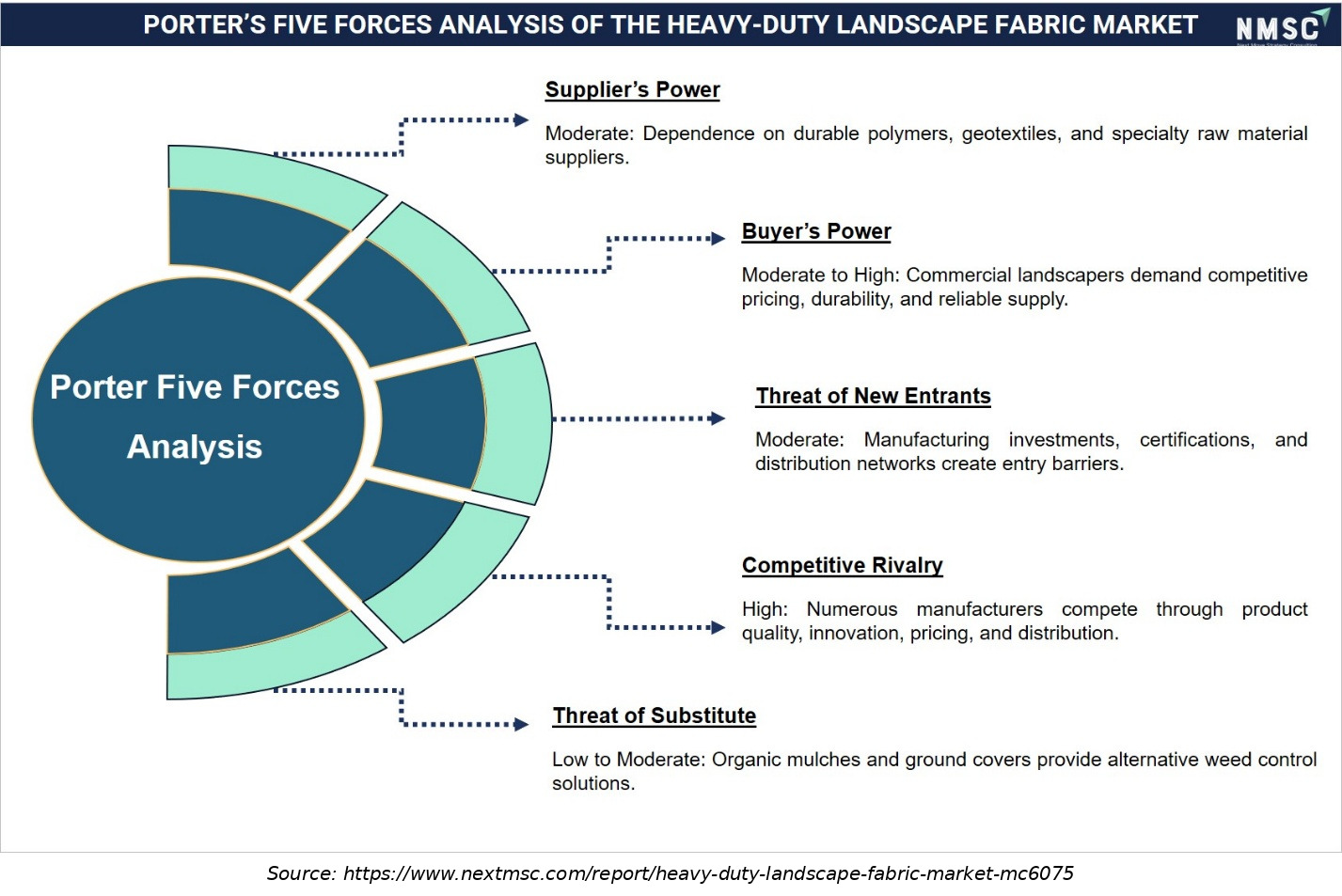
We observed that the competitive landscape is moderately fragmented, with established polymer-fabric manufacturers and regional distributors accounting for a substantial share of branded contractor-grade capacity.

Dimension Description
Dimension Assessment
Market Structure Moderately fragmented, led by established polymer-fabric manufacturers and regional distributors.
Innovation Focus UV-stabilized formulations, recycled-content blends, and non-woven permeability performance.
M&A Activity Selective acquisitions of regional distributors to expand direct-to-contractor reach.

How Do Companies Compete in the Heavy-Duty Landscape Fabric Market?

Companies compete primarily on fabric durability, UV-resistance ratings, and breadth of distribution reach rather than on price alone. Contractor-grade certification and bulk-roll supply capability are key differentiators for infrastructure-focused manufacturers, while retail-focused producers compete on packaging convenience and brand recognition. Industry participants are increasingly investing in recycled-content formulations to strengthen positioning with sustainability-conscious commercial buyers.

Which Competitive Archetypes Dominate the Heavy-Duty Landscape Fabric Market?

Two archetypes dominate the industry: diversified polymer-materials manufacturers with multi-category fabric portfolios, and specialized landscape-fabric producers focused solely on ground-cover and erosion-control products. The diversified archetype benefits from shared extrusion infrastructure and raw-material purchasing scale, while specialists differentiate through deep application expertise. This dual structure explains why market share remains distributed across both large manufacturers and focused independent producers.

What Innovation and Differentiation Strategies Are Companies Pursuing?

Companies are pursuing UV-stabilized formulation upgrades, recycled-content product lines, and non-woven permeability enhancements as core differentiation strategies. Solmax International's expanded non-woven geotextile-grade fabric line, scaled through 2025, illustrates a strategy of embedding infrastructure-grade performance directly into landscape-fabric product tiers. Manufacturers across the industry are prioritizing third-party durability certification to strengthen contractor and municipal buyer confidence.

Key Market Players

We found that the competitive set below reflects the validated group of companies most active in shaping global heavy-duty landscape fabric supply as of 2026.

Berry Global Group, Inc. Propex Operating Company, LLC Solmax International Inc. DeWitt Company Dalen Products, Inc. Mutual Industries, Inc. Easy Gardener Products, Ltd. Fiberweb Geosynthetics Limited Belton Industries, Inc. Leggett & Platt, Incorporated (Hanes Geo Components) GSE Environmental, LLC Global Synthetics Pty Ltd Agfabric Inc. ECOgardener LLC Central Garden & Pet Company Freudenberg Performance Materials SE & Co. KG NDS, Inc. Skaps Industries Inc. Contech Engineered Solutions LLC TWP Inc.

Latest Developments

Our analysis shows that recent company activity reflects continued capacity expansion and product innovation across the manufacturing base.

Date Event
May 2026 Solmax began construction of an eight-hectare flagship European geosynthetics center in Les Mureaux, France. The facility consolidates European nonwoven production while integrating manufacturing, laboratory, and commercial operations, strengthening technical capabilities and operational efficiency for geosynthetic products used across infrastructure and landscaping applications.
November 2025 Freudenberg acquired Toray Industries' remaining 25% stake in Japan Vilene Company, becoming the sole owner. The transaction, valued at approximately USD 108 million (converted from approximately EUR 100 million), strengthens Freudenberg's technical textiles and nonwovens portfolio with expanded production and sales capabilities across Asia.
June 2025 Solmax commercially launched Performance Materials, integrating the long-established TenCate Geosynthetics and Propex industrial fabrics businesses under one global platform. The launch expands Solmax's portfolio of high-performance technical textiles serving agriculture, recreation, specialty industries, and engineered fabric applications worldwide.
April 2025 Berry Global completed its all-stock combination with Amcor, creating a larger global materials and packaging company with broader innovation capabilities, expanded manufacturing scale, and enhanced material science expertise. The completed merger is expected to accelerate product development and operational synergies across multiple end markets.

Expert Insights

Jacob Thomlinson

Landscape Expert

"Landscape fabric is an incredibly versatile material used for gardening and landscaping projects that can last anywhere from five to twenty years, depending on the quality of the fabric, where it is placed, and how it is cared for."

Analyst Interpretation

The statement highlights the increasing importance of durability and long-term performance in the landscape fabric industry. As residential, commercial, and infrastructure landscaping projects increasingly prioritize effective weed suppression with lower maintenance requirements, demand is shifting toward heavy-duty landscape fabrics that offer superior strength, UV resistance, and permeability. The emphasis on product lifespan also reflects growing consumer preference for high-quality materials that reduce replacement frequency and lifecycle costs. Consequently, manufacturers are focusing on developing advanced woven and nonwoven landscape fabrics with enhanced durability and environmental performance, supporting the continued expansion of the heavy-duty landscape fabric market.

Investment Opportunities

What Capital Inflows Are Shaping the Heavy-Duty Landscape Fabric Market?

Capital inflows are concentrating on non-woven production-capacity expansion and recycled-content processing infrastructure. Private equity and strategic manufacturers are directing sustained capital toward polymer-extrusion capacity across North America and Asia-Pacific. This inflow pattern is enabling producers to accelerate capacity pipelines while diversifying revenue between residential retail and infrastructure-grade income streams through 2035.

How Is Infrastructure Investment Supporting Market Expansion?

Infrastructure investment in municipal drainage, highway embankment stabilization, and stormwater-management systems is directly supporting heavy-duty landscape fabric expansion. Government-backed infrastructure programs across North American and Asia-Pacific economies are expanding capacity for erosion-control procurement, complementing broader modular and prefabricated construction investment. This infrastructure buildout is reinforcing demand for bulk-roll, infrastructure-grade fabric across newly funded regional public-works projects.

What ESG Considerations Are Influencing Investment Decisions?

Environmental, Social, and Governance considerations are increasingly shaping investment decisions, with investors favoring manufacturers demonstrating verified recycled-content sourcing and reduced virgin-resin dependency. Third-party sustainability certification and closed-loop recycling partnerships are gaining preference among institutional investors evaluating long-term polymer-materials assets. This ESG-linked capital allocation is reinforcing demand for recycled-content fabric across commercial and municipal procurement channels.

Key Benefits for Stakeholders

How Does This Report Benefit Industry Leaders?

Industry leaders gain a validated view of segment-level revenue distribution, competitive positioning, and regional growth trajectories that inform manufacturing and distribution investment decisions. The report's segmentation and regional analysis clarify where demand is concentrating, enabling manufacturing executives to prioritize capital allocation toward the highest-growth material types and end-use categories through 2035.

How Does This Report Benefit Investors and Financial Analysts?

Investors and financial analysts gain access to consistent market-sizing figures, CAGR forecasts, and competitive-landscape assessment that support valuation and portfolio-allocation decisions across polymer-materials assets. The report's regional and segmental breakdowns provide a defensible basis for evaluating growth-adjusted investment opportunities across the heavy-duty landscape fabric value chain through the 2026–2035 forecast period.

How Does This Report Benefit Technology and Product Vendors?

Technology and product vendors supplying extrusion equipment, UV-stabilizer additives, and recycling infrastructure gain insight into which material types and end-use categories are expanding fastest. This analysis helps vendors prioritize product roadmaps toward the highest-growth integration points, including non-woven production technology and recycled-content processing favored by the dominant end-use segments identified in this report.

Key Market Segments Evaluated

By Material Type

  • Woven Polypropylene
  • Non-Woven Polypropylene
  • Woven Polyethylene
  • PVC-Coated Fabric
  • Others

By Application

  • Weed Control
  • Erosion Control
  • Hardscaping & Pathways
  • Agricultural Mulching

By End Use

  • Residential
  • Commercial
  • Municipal & Infrastructure
  • Agricultural

By Distribution Channel

  • Direct-to-Contractor
  • Home Improvement Retail
  • Online Retail
  • Wholesale & Distributors

By Region

  • North America 
    • U.S.
    • Canada
    • Mexico
    • Rest of North America
  • Europe 
    • UK
    • Germany
    • France
    • Italy
    • Spain
    • Sweden
    • Denmark
    • Finland
    • Netherlands
    • Rest of Europe
  • Asia-Pacific 
    • China
    • India
    • Japan
    • South Korea
    • Taiwan
    • Indonesia
    • Vietnam
    • Australia
    • Philippines
    • Malaysia
    • Rest of APAC
  • Middle East & Africa 
    • Saudi Arabia
    • UAE
    • Egypt
    • Israel
    • Turkey
    • Nigeria
    • South Africa
    • Rest of MEA
  • Latin America 
    • Brazil
    • Argentina
    • Chile
    • Colombia
    • Rest of LATAM

Conclusion & Recommendations

The long-term outlook remains positive, with the market expanding from USD 1,120.0 Million in 2026 to USD 2,010.0 Million by 2035 at a 6.70% CAGR. Sustained residential landscaping spend, expanding municipal erosion-control infrastructure investment, and rising agricultural mulching adoption collectively support continued growth across the fastest-expanding regions and material categories through the full forecast period.

What Strategic Positioning Should Manufacturers Pursue?

Manufacturers should prioritize UV-stabilized formulation upgrades, recycled-content product lines, and direct-to-contractor distribution channels to strengthen competitive positioning. Diversified polymer-materials producers are advised to expand infrastructure-grade capacity, while specialized landscape-fabric producers should scale e-commerce distribution to capture recurring residential retail demand across both established and emerging regional markets.

How Attractive Is the Heavy-Duty Landscape Fabric Market for Investment?

The market presents solid investment attractiveness, supported by an absolute dollar opportunity of USD 890.0 Million between 2026 and 2035. Asia-Pacific offers the highest growth-adjusted returns given its double-digit-adjacent regional CAGR, while established North American and European markets provide stable, lower-volatility exposure to residential and municipal fabric procurement.

What Market Shifts and Key Risks Should Stakeholders Monitor?

Stakeholders should monitor polypropylene resin price volatility, competition from low-cost unbranded imports, and rising substitution pressure from organic mulch alternatives in select European markets. Additionally, tightening municipal sustainability procurement requirements demand continuous recycled-content innovation, as manufacturers unable to adapt formulations risk losing share to more sustainability-forward competitors.

What Are the Key Growth Pathways Through 2035?

Key growth pathways include expanding non-woven production capacity, scaling recycled-content product lines, and deepening direct-to-contractor and municipal procurement relationships across emerging infrastructure markets. Manufacturers pursuing coordinated expansion across these three pathways, supported by e-commerce distribution investment, are best positioned to capture disproportionate share of the USD 890.0 Million incremental opportunity through 2035.

FAQs

About the Author

Saista Faiyaz

Saista Faiyaz

Saista Faiyaz is Research Associate at Next Move Strategy Consulting, where she has covered consumer markets and healthcare technologies for 3 years. Her work includes primary interview review, secondary-source validation, market sizing, and structured analysis of company and industry data. She supports research by comparing evidence across sources, organizing findings into market narratives, and documenting assumptions used in analysis. Her scope includes cross-market benchmarking, and reports.

About the Reviewer

Supradip Baul

Supradip Baul

Supradip Baul is an accomplished business consultant and strategist with over a decade of rich experience in market intelligence, strategy, technology, and business transformation. His work has included rigorous qualitative and quantitative analysis across multiple industries, helping clients shape investment decisions and long-term roadmaps. Earlier in his career, he was associated with Gartner, where he contributed to industry-leading reports and market share analyses. He has worked with leading global companies and holds an MBA with a dual specialization in Marketing and Finance.

Download Free Sample

Rishabh Jogani

RISHABH JOGANI

Strategy Analyst

Accenture Japan

We are incredibly impressed with the market report on the real estate market in India provided by Next Move Strategy Consulting. The report was thorough, insightful, and well-structured, offering deep analysis and actionable recommendations. It not only captured the current trends and dynamics but also provided a forward-looking perspective that has been invaluable for our strategic planning. Their team demonstrated exceptional professionalism, attention to detail, and a profound understanding of the industry. The data-driven insights and clarity of presentation exceeded our expectations, making complex market trends easy to understand. We highly recommend Next Move Strategy Consulting to anyone looking for reliable and comprehensive market research services. Their expertise has given us the confidence to navigate the complexities of the Indian real estate market with clarity and foresight.

Amos Chang

AMOS CHANG

Strategy Consultant

Kardex Group

I have bought the intralogistics market reports from NMSC two times so far. Joseph and his team are always very helpful and flexible in responding to any customization requirements on the report. Their expertise in market reports really helps us steer the day-to-day business. I will definitely recommend and come back myself whenever there is a need.

Ross J Mckenzie

ROSS J MCKENZIE

Business Insight Manager

Staysure Group

“Next MSC have been incredibly helpful in providing detailed & robust information on our market, alongside quantifying growth by different segments. The process to procure was simple and easy, with sample reports and regular contact to ensure we had what we needed. Succinct detail on their sources & methodologies is also greatly received, allowing transparency in this respect helps build trust in the detail you pay for. Joseph in particular was fantastic, and helped ensure efficient provision of the insight pack – thank you NMSC!”.

Henri Knyphausen

HENRI KNYPHAUSEN

Partner at Singulier [Ex-BCG]

Singulier

I recently engaged NEXTMSC.com for a commercial due diligence project within the intralogistics sector, and I am pleased to provide a reference based on my experience. In utilizing NEXTMSC.com's services, I found their report to offer valuable insights into market dynamics and key industry players. The initial report provided a solid foundation for our analysis. However, as we were investigating a smaller target in the market, and I had specific customization requests requiring additional research. These requests included detailed information on product portfolios of various players and sub-market sizes, both inclusive and exclusive of certain product categories. NEXTMSC.com demonstrated commendable responsiveness and agility in accommodating these customization requests. Within a timeframe of 1-2 weeks, they delivered a revised report that met our specific needs. Furthermore, they were receptive to my follow-up inquiries, ensuring clarity and understanding of the data provided. The final deliverable significantly contributed to our due diligence efforts. One of NEXTMSC.com's notable strengths lies in their qualitative research capabilities. However, for future engagements, I would recommend the inclusion of a quantified market model in Excel format. Such a model would offer the ability to conduct in-depth analyses and explore various market segments, including country-specific data and subcomponent breakdowns. Based on my positive experience, I would not hesitate to work with NEXTMSC.com again. Their responsiveness, willingness to accommodate customization requests, and commitment to delivering actionable insights make them a reliable partner for commercial research projects.

Kevin Coker

KEVIN COKER

Founder, CEO and Board Diector

Proxima Clinical Research

I have been using Next MSC reports for product positioning in a new geography for a long time. They have by far the best reports I have found and the price is reasonable too!

Custom Market Research Services

We will customize the research for you if the listed report does not fully match your requirements.

Get 30% Free Customization

Select License

This website uses cookies to ensure you get the best experience on our website. Learn more

✖