Fibreglass Fabric Market By Glass Type (E-Glass, S-Glass, Specialty Glass), By Fabric Type (Woven Fabric, Non-Woven Fabric, Specialty Fabrics), By Resin (Polyester Resin Systems, Epoxy Resin Systems, Vinyl Ester Resin Systems, Other Resin Types), By Application (Construction & Infrastructure, Wind Energy, Electrical & Electronics, Aerospace & Defence, Marine & Marine Structures, Transportation, and Others) – Global Analysis & Forecast, 2025–2035
Industry: Materials and Chemical | Publishing Date: July 2, 2026 | Last Updated: October 16, 2026 | No of Pages: N/A | No. of Tables: N/A | No. of Figures: N/A | Format: PDF | Report Code: MC3852
Industry Outlook
The global Fibreglass Fabric Market size is valued at USD 15.3 billion in 2025 and is expected to reach USD 16.32 billion by 2026. Looking ahead, the industry is projected to expand significantly, reaching USD 27.4 billion by 2035, registering a CAGR of 6.69% from 2026 to 2035.
The industry is growing steadily, driven by rising demand for lightweight, durable, and high-strength materials across industries such as construction, aerospace, automotive, marine, and wind energy. Fibreglass fabrics offer excellent mechanical strength, corrosion resistance, thermal stability, and cost-effectiveness, making them a preferred choice for composites, insulation, reinforcement, and protective applications.
The global shift toward energy-efficient buildings, expanded wind turbine installations, and lightweight transportation components is further accelerating market growth. Advancements in weaving technologies, resin compatibility, and hybrid composite structures such as glass-carbon blends are enhancing performance and application versatility.
Manufacturers are focusing on high-performance fabrics, eco-friendly production processes, and improved surface treatments to meet evolving industry standards. By combining durability, versatility, and innovation, the fibreglass fabric market continues to support the expansion of modern engineering, construction, and renewable energy solutions worldwide.
What Are the Key Trends in the Fibreglass Fabric Industry?
How is Wind Energy Demand Shaping Growth for High-Performance Fibreglass Fabrics?
Wind turbine blade manufacturing is a major and rapidly evolving addressable market for high-performance fibreglass fabrics. IEA and industry reporting point to continued wind capacity growth to 2030 for onshore and offshore expansion, which sustains long-term blade demand and thus demand for large-format, high-tensile woven E-glass and S-glass fabrics and bespoke stitched multiaxial reinforcements.
Blade OEMs require certified fabric properties like tensile strength, fatigue resistance, resin compatibility, and consistent supply. This raises the value of suppliers that provide quality certification, blade-grade woven fabrics, and localised logistics near blade plants. Firms are prioritising scale-qualified production lines for large-width fabrics, co-engineer fabric-resin systems with blade OEMs and securing multi-year offtake contracts. Evidence from wind capacity projections and supplier disclosures shows clear demand continuity for blade-grade fabrics.
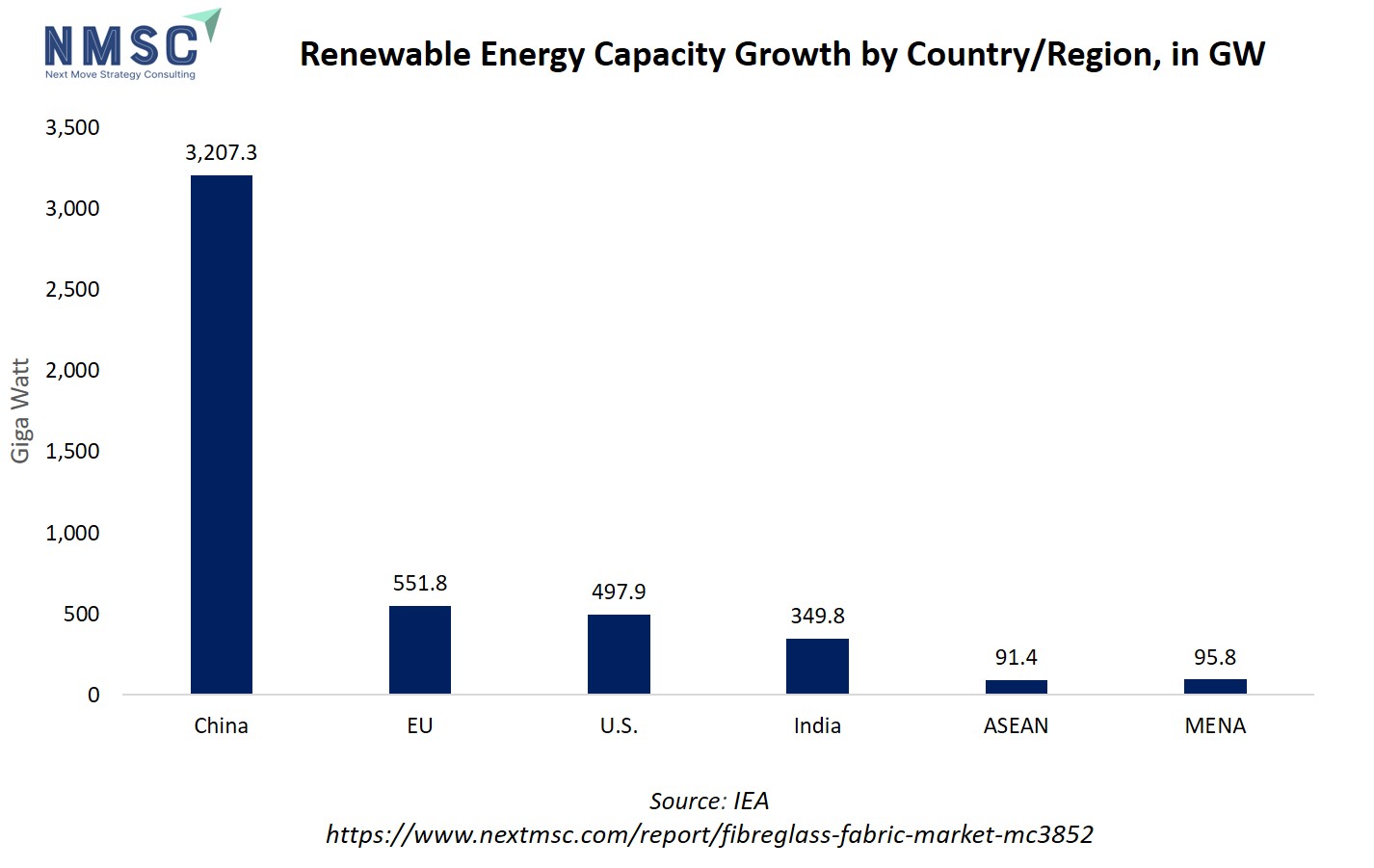
The chart highlights China's overwhelming dominance in renewable energy capacity growth with over 3,207.3 GW, far surpassing other regions such as the EU, U.S., India, ASEAN, and MENA. This large-scale renewable deployment accelerates demand for robust infrastructure, particularly in wind and solar segments, which are major consumers of fibreglass fabric for blades, panel backing, cables, and reinforcement components.
As renewable installations expand, the fibreglass fabric market experiences substantial growth, providing essential material properties like strength, durability, and lightweight performance necessary for supporting next-generation energy systems. The push for renewables, thus, directly stimulates innovation and scaling in the fibreglass fabric sector, making it integral to global energy transition projects.
How is Automotive and Transport Lightweighting Increasing Demand for Tailored Fibreglass Architectures?
Automotive OEMs continue to pursue lightweighting to improve fuel/energy efficiency, and composites using fibreglass fabrics enable a lower cost than carbon on some structural parts. Demand is for engineered woven and non-woven glass architectures that balance stiffness, impact resistance and cost, combined with thermoplastic or thermoset matrices.
Manufacturers report targeted products for thermoplastic composite reinforcement and continuous fibre mats optimised for automated layup and press cycle speeds. Fabric suppliers are developing thermoplastic-compatible glass rovings and tailoring fabric formats for automated processes and secure development partnerships with Tier-1 automotive suppliers to qualify parts for production.
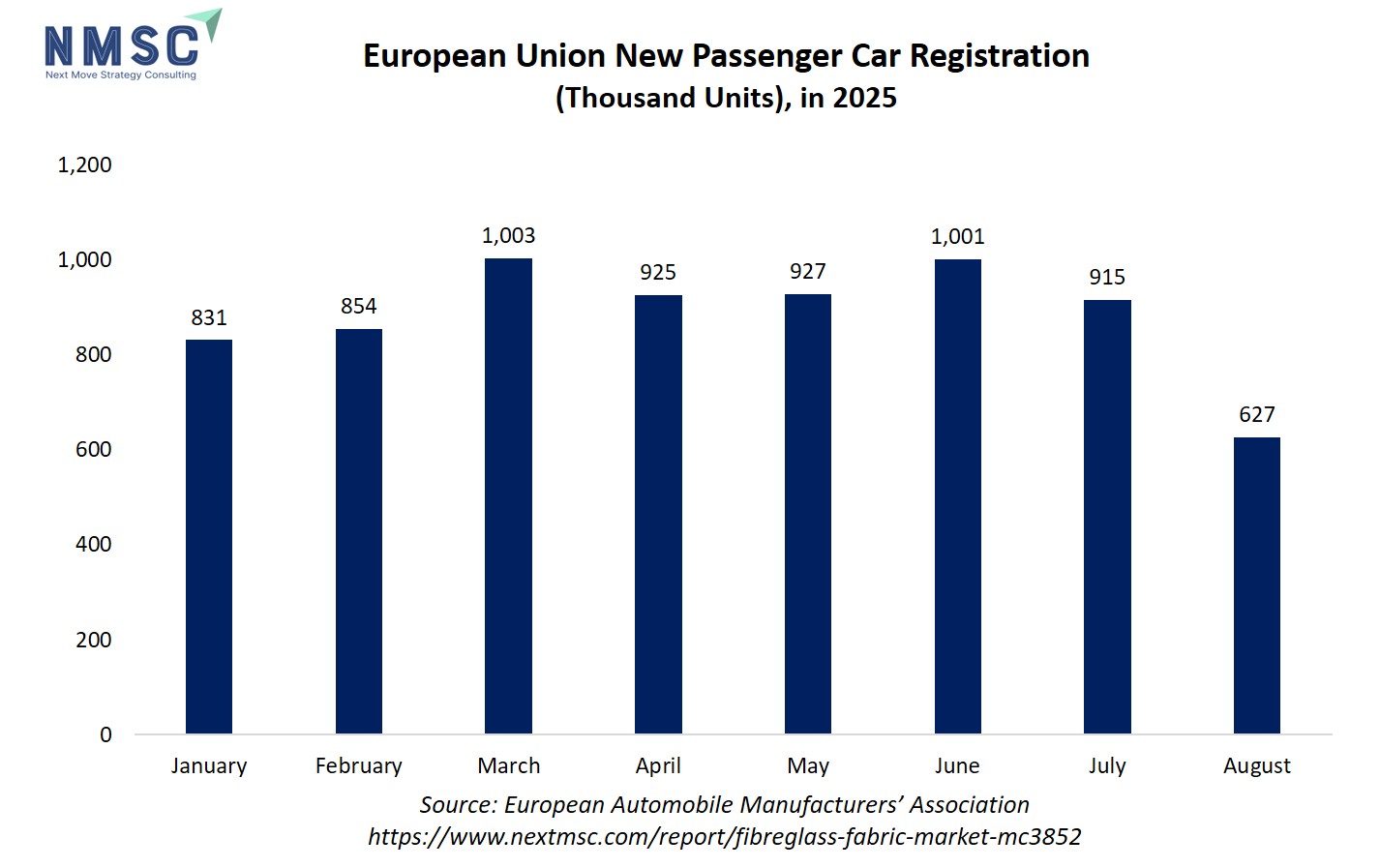
The steady demand for new vehicles in the above chart underscores the automotive sector's ongoing growth and its consistent need for advanced materials. The fibreglass fabric market is directly impacted, as automakers increasingly turn to lightweight composite solutions, such as tailored fibreglass architectures, for body panels, structural reinforcements, and interior elements to boost fuel efficiency and meet emissions targets. The drive for lightweighting in automotive and transport sectors fuels innovation in customised fibreglass fabrics that offer strength, safety, and design flexibility, helping manufacturers reduce overall vehicle mass while improving performance and sustainability.
How is Sustainability and Circularity Influencing Fibreglass Product Design and Buyer Procurement?
Sustainability and circularity are increasingly shaping both fibreglass product design and procurement decisions, as buyers push for lower-embodied-carbon materials and credible end-of-life pathways for composite products. Manufacturers’ 2024 sustainability disclosures highlight growing use of recycled-glass feedstock, energy-efficient melting technologies, and expanded scrap-recovery systems.
In many non-structural applications, recycled E-glass and reprocessed process scrap are becoming widely accepted, whereas OEMs producing high-performance structural parts continue to demand virgin or tightly controlled recycled content to maintain mechanical integrity. Suppliers able to verify recycled content, reduce melting-related emissions, and provide take-back or re-manufacturing programs are increasingly favoured in procurement evaluations. Strategic priorities now include investing in closed-loop recycling pilots, publishing third-party EPDs, and developing tiered recycled-content product ranges linked to certification.
What Are the Key Market Drivers, Breakthroughs, and Investment Opportunities That Will Shape the Fibreglass Fabric Industry in the Next Decade?
The fibreglass fabric market growth is driven by structural demand from wind energy, transportation lightweighting, and construction/infrastructure applications that favour durable, corrosion-resistant composites. Manufacturers’ 2024 reports emphasise product qualification cycles with OEMs and the premium for certified blade-grade and automotive-grade fabrics.
Technological advances in weaving, multiaxial stitching and thermoplastic-compatible architectures support broader substitution of metals and higher composite penetration rates. At the same time, sustainability requirements and supply concentration, notably glass-melting capacity and speciality weaving lines located in China and India, create both value opportunities and supply risk.
Breakthroughs include scaled large-format weaving and hybrid multiaxial fabrics that reduce layup time and improve mechanical performance, process innovations in glass melting reduce energy intensity. Challenges encompass resin compatibility qualification time, logistics for large-width fabrics, and limits on recycled glass use in high-strain structural parts. Opportunities centre on certified low-carbon glass, localised production near blade and automotive hubs, and product-service models that bundle fabric supply with certification and testing support.
Growth Drivers:
How is Infrastructure and Construction Growth Accelerating the Fibreglass Fabric Market Demand?
Global infrastructure expansion continues to accelerate, particularly in rapidly urbanising regions such as the Asia-Pacific, the Middle East, and Latin America, where governments are investing heavily in transportation corridors, industrial hubs, and large-scale residential developments. This momentum is increasing demand for materials that deliver long-term durability, structural stability and resistance to fire, corrosion and moisture.
Woven fibreglass fabrics are well-positioned in this environment because they provide high mechanical strength at a relatively low cost, making them suitable for insulation, roofing, wall reinforcement and composite panels. As construction standards move toward higher safety, energy efficiency and sustainability, fibreglass fabrics increasingly become an indispensable material choice for builders and infrastructure planners.
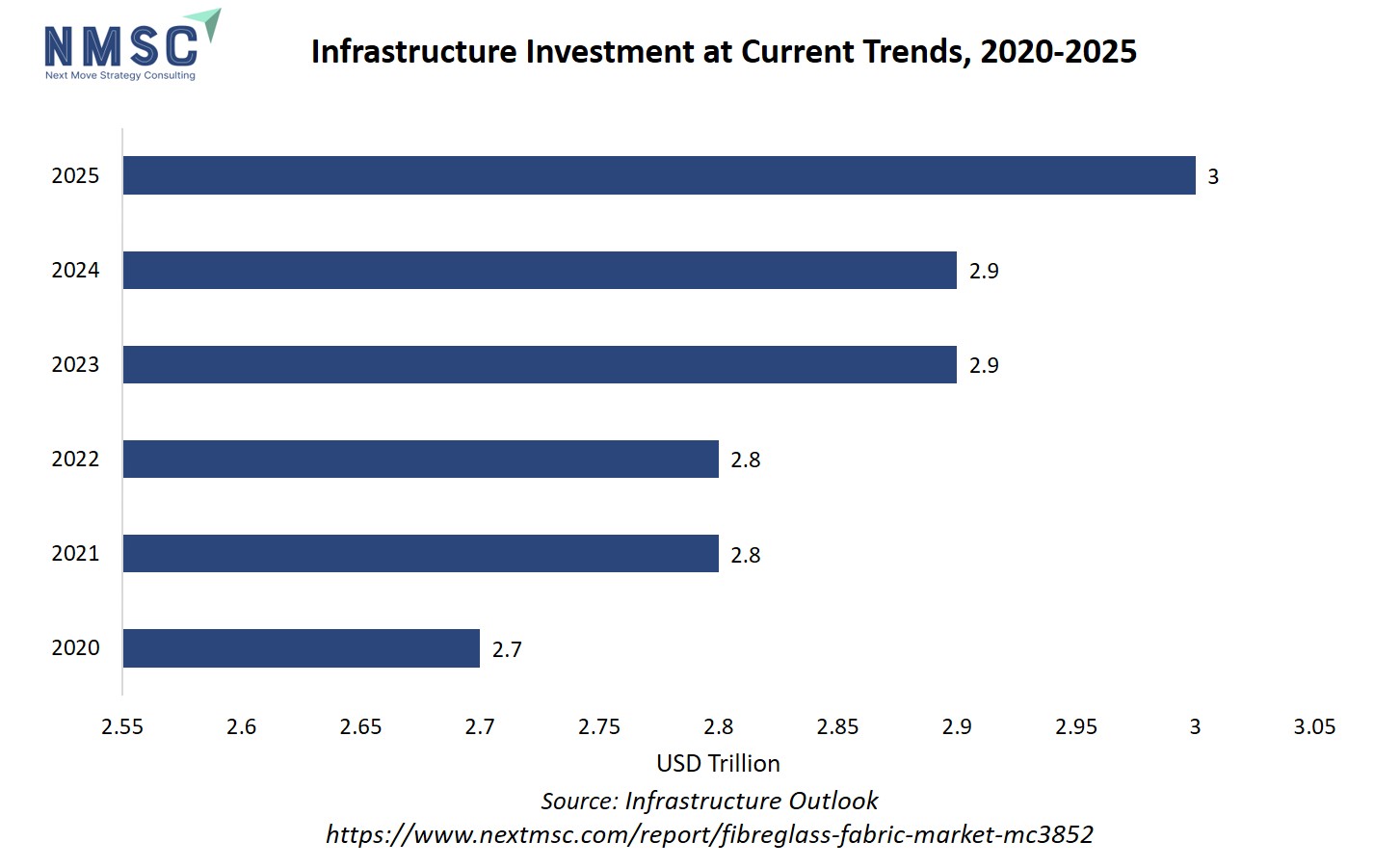
The chart shows a steady increase in global infrastructure investment. The consistent growth supports large-scale construction and modernisation projects, such as bridges, commercial buildings, utilities, transportation, and renewable energy installations, that demand advanced materials with strength, durability, and lightweight properties.
The fibreglass fabric market trends benefits directly from rising infrastructure outlays, as these fabrics are integral for reinforcement in concrete, composites, corrosion-resistant panels, piping, and insulation systems. As project counts and complexity grow, the use of composite materials expands to meet technical, regulatory, and sustainability criteria across diverse infrastructure segments.
How are Technological and Manufacturing Innovations Strengthening Fibreglass Fabric Market Adoption?
Technology-driven advancements are reshaping the Fibreglass fabric market, improving product performance while reducing production inefficiencies. High-precision weaving systems, automated looms and digitally controlled finishing lines are enabling consistent quality and tighter dimensional tolerances.
Parallel innovations in materials science, such as enhanced resin compatibility, hybrid fibre architectures, and thermoplastic-ready fabrics, are expanding the suitability of fibreglass in demanding environments. These developments support tailored solutions for applications in aerospace, automotive lightweighting, marine structures and industrial equipment.
As manufacturers adopt smarter process control, predictive maintenance and low-energy melting technologies, the sector is becoming more cost-efficient and sustainable, strengthening the value proposition of S-glass fabrics for global OEMs and converters.
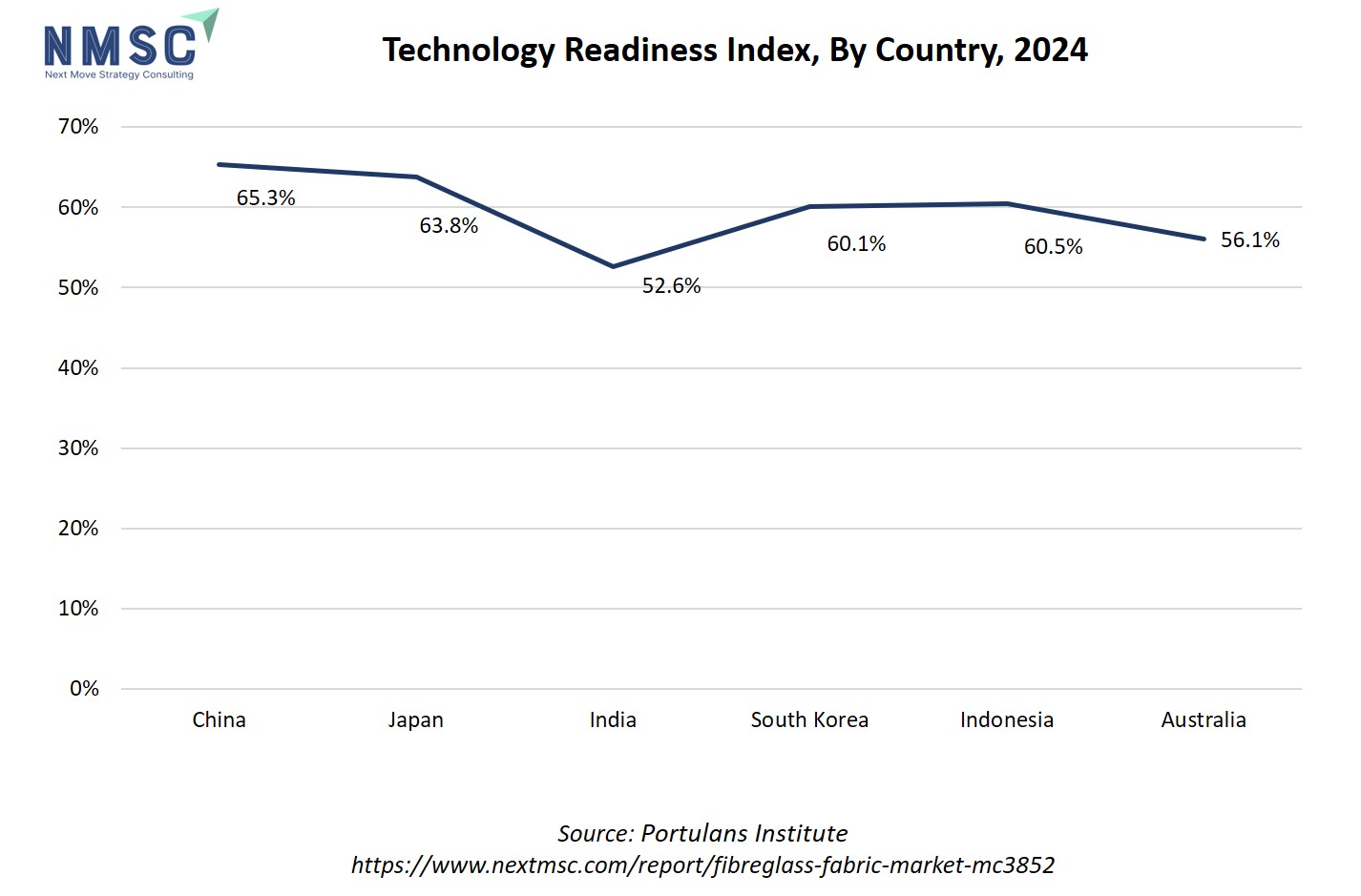
The chart illustrates the Technology Readiness Index for various countries in 2024. High technology readiness signals advanced adoption of smart manufacturing, automation, and digital materials management, essential for industries like construction, transport, and renewables. This readiness accelerates the use of engineered materials such as fibreglass fabric, vital for lightweight, strong, and corrosion-resistant components in infrastructure, automotive, and energy. As top-ranked countries invest in technology-led construction and manufacturing, the fibreglass fabric market grows through rising demand for high-performance, tailored solutions in everything from advanced infrastructure to mobility and clean energy projects.
Growth Inhibitors:
How do Resin Qualification Cycles and OEM Certification Impede Rapid Adoption of New Fibreglass Fabrics?
Resin qualification cycles and OEM certification requirements significantly slow the uptake of new fibreglass fabrics because high-performance structural applications demand extensive verification of resin–fabric compatibility, fatigue behaviour, and environmental durability. OEMs and certification authorities typically require multi-season performance data, controlled process trials, and full factory audits before granting approval, which lengthens time-to-market for innovations such as thermoplastic fabrics or recycled-content variants.
These prolonged validation timelines also increase working-capital pressure on suppliers that must fund development, tooling, and inventory through the qualification phase. To mitigate these bottlenecks, leading suppliers are adopting joint-development agreements that share testing costs, supplying provisional pilot-scale material for field trials, and engaging accredited third-party laboratories to accelerate test cycles and shorten OEM approval processes.
Where are the Highest-Return Investments in the Fibreglass Fabric Value Chain?
The highest-return opportunities in the fibreglass fabric value chain are emerging around wide-loom fabric capacity located close to major blade and composite manufacturing hubs, as well as R&D and pilot lines dedicated to thermoplastic-compatible glass architectures. Significant upside also lies in closed-loop recycling systems and low-carbon melting technologies, which align with tightening sustainability requirements.
Investors gain the strongest advantage by backing assets that pair scale manufacturing with deep R&D collaboration or long-term offtake agreements from key OEMs in sectors such as wind blades and automotive. Early-stage financing of recycling pilots or EPD certification programs provides access to emerging sustainability premiums, while brownfield capacity expansions near major composite OEM clusters, especially when co-funded with strategic customers, help secure demand and materially reduce commercialisation risk.
How Is the Fibreglass Fabric Report Segmented, and What Are the Key Insights from the Segmentation Analysis?
By Glass Type Insights
Is E-Glass Remaining the Dominant Subsegment While S-Glass and Speciality Glass Expand in Structural Niches?
Based on glass type, the market includes E-glass, S-glass, and speciality glass.
E-glass continues to dominate overall Fibreglass fabric volume because it balances cost and mechanical performance for general reinforcement and many construction and marine applications. However, S-glass and speciality high-strength glass see faster percentage growth in structural, aerospace and blade roots where higher tensile strength and fatigue life are required. Manufacturers’ 2024 reports indicate strategic capacity increases for S-glass and hybrid glass blends to serve premium composites. For fabric suppliers, this suggests a two-track strategy, maintaining high-volume E-glass throughput while selectively investing in S-glass wide-loom and certification for structural OEMs to capture higher ASPs.
By Fabric Type Insights
Are Woven and Stitched Multiaxial Fabrics Leading Performance Demand While Non-Wovens Serve Formability and Cost-Sensitive Applications?
Based on fabric type, the segmentation covers woven fabrics, non-woven fabrics, and speciality fabrics.
Woven fabrics and stitched multiaxial reinforcements lead in structural and load-bearing applications because they offer predictable in-plane properties and automated layup compatibility. They are crucial for wind blades and structural transport parts. Non-wovens and chopped-strand mats dominate in SMC/RTM and cost-sensitive marine or construction laminates where formability and resin loading matter. Speciality fabrics like 3D weaves, hybrid architectures are growing in aerospace and advanced automotive for integrated structural roles. Suppliers are segmenting product lines by automated process compatibility and part-level performance to optimise value capture.
By Resin Insights
Is Epoxy and Vinyl Ester Demand Growing for Structural Applications While Polyester Dominates Cost-Sensitive Markets?
Based on resin type, the market includes polyester resin systems, epoxy resin systems, vinyl ester resin systems, and other resin types.
Epoxy resins are preferred for high-performance, fatigue-sensitive applications such as wind blades, aerospace because of their superior mechanical and bonding characteristics. Vinyl ester provides corrosion resistance for marine and chemical applications. Polyester resin systems continue to dominate cost-sensitive markets like general construction and non-structural marine components. Fabric suppliers qualify fabric-resin systems for epoxy infusion and thermoplastic bonding to enter higher-margin segments. Evidence from company R&D disclosures shows deliberate moves to position fabrics for epoxy infusion and thermoplastic processes.
By Application Insights
Are Wind Energy, Transport and Construction the Largest Addressable Markets for Fibreglass Fabric Growth?
Based on application, the market is segmented into construction and infrastructure, wind energy, electrical and electronics components, aerospace and defence, marine and marine structural structures, transportation, and others.
Wind energy and transport, automotive, and rail represent the fastest growing structural segments due to lightweighting and renewable expansion, while construction and infrastructure demand steady volumes for corrosion-resistant composites like gratings, façade panels. Marine and electrical insulation remain important but grow more slowly. Strategic fabric suppliers prioritise blade-grade fabrics and thermoplastic/thermoset certified products for transportation, while offering cost-effective mats and chopped strand for construction. IEA wind outlook and manufacturer disclosures support prioritising blade and transport offtake for near-term volume growth.
Regional Outlook
The fibreglass fabric market trends is geographically studied across North America, Europe, Asia Pacific, Middle East & Africa, and Latin America and each region is further studied across countries.
Fibreglass Fabric Market in North America
The North American market shows sustained momentum driven by wind blade manufacturing, infrastructure upgrades and automotive lightweighting programs. OEMs increasingly request regionally qualified fabrics to reduce logistics risk and shorten blade and composite qualification cycles.
Suppliers are localising wide-loom capacity, expanding multiaxial stitching lines and introducing thermoplastic-compatible fabrics targeting mobility and industrial customers. Sustainability pilots, including low-carbon melting and EPD documentation, are becoming central to procurement evaluations as utilities, blade OEMs and public projects demand verified environmental metrics. Overall, North America is transitioning toward a more integrated supply chain where regional finishing, faster qualification and sustainability disclosures define supplier competitiveness.
Fibreglass Fabric Market in the United States
The U.S. market is driven by accelerating demand for thermoplastic-ready composites in automotive platforms and large-format blade fabrics for growing onshore wind installations. Tier-1 suppliers increasingly involve fabric producers in joint material development to achieve resin compatibility, optimised infusion behaviour and automated layup standards. Corporate disclosures highlight investment in engineered fabric lines, regional finishing capacity, and low-carbon process trials aligned with federal clean-manufacturing incentives.
Procurement teams prioritise supply stability, domestic lead times and proven mechanical consistency, prompting suppliers to expand stocking programs and quality-assurance automation. The U.S. continues shifting toward engineered, application-specific fibreglass fabrics with a strong emphasis on sustainability transparency.
Fibreglass Fabric Market in Canada
Canada’s market is relatively moderate in size but strategically important for infrastructure rehabilitation, marine manufacturing and lightweight transport composites. Local insulation and composite producers emphasise security of supply and environmentally responsible feedstock values, aligning with Canada’s clean-manufacturing policy environment.
Export opportunities arise from proximity to U.S. OEMs demanding qualified structural fabrics, stitched multiaxial and consistent finishing quality. Canadian buyers increasingly seek suppliers who document lower embodied carbon, maintain stable lead times despite cross-border logistics variability and support customised fabric formats for niche marine and industrial applications. The industry favours regional producers and distributors offering technical support and predictable delivery.
Fibreglass Fabric Market in Europe
Europe remains the global benchmark for certified blade manufacturing and advanced transport composites, driving strong demand for high-performance fibreglass fabrics. Suppliers invest heavily in epoxy-infusion qualification, automated multiaxial stitching, defect-reduction systems and EPD publication to meet strict regulatory requirements.
Offshore wind expansion in the North Sea and Baltic regions accelerates the uptake of wide-width fabrics and premium S-glass architectures with low-void content and optimised drapability. Automotive lightweighting and rail composites add further demand for engineered thermoset and thermoplastic fabrics. Europe’s emphasis on traceability, clean energy and regionalised supply influences supplier decisions on localisation, sustainability accounting and cost-efficient logistics.
Fibreglass Fabric Market in the United Kingdom
The UK market is shaped by offshore wind development, infrastructure reinforcement programs and marine composites. Blade OEMs and public procurement rules require certified performance fabrics, robust traceability and documented environmental metrics. Suppliers prioritise local finishing operations and quicker qualification cycles to meet project schedules for offshore arrays and coastal infrastructure.
The market demands wide-width blade fabrics, stitched multiaxial and corrosion-resistant reinforcement fabrics for industrial structures. Sustainability expectations continue rising, prompting suppliers to publish verified EPDs, adopt renewable-energy-backed melting processes and reduce transport emissions. Overall, competitiveness depends on consistent quality, local availability and adherence to stringent UK procurement frameworks.
Fibreglass Fabric Market in Germany
Germany’s insulation materials demand is largely driven by automotive lightweighting, industrial machinery components and precision composite applications. OEMs require very tight weaving tolerances, consistent fibre alignment and validated resin compatibility for automated composite processes. Suppliers focus on advanced stitching technologies, resin-infusion trials and digital quality-tracking to meet Germany’s rigorous engineering standards.
Sustainability pressures are increasing as automotive and industrial buyers demand verified low-carbon supply chains and recyclable composite pathways. German composite clusters also rely on reliable logistics and just-in-time finishing availability. Suppliers with technical R&D centers, automated quality control and strong co-development capabilities enjoy a competitive advantage in this market.
Fibreglass Fabric Market in France
France’s market is anchored by transport composites, infrastructure reinforcement and speciality marine applications. French OEMs demand high-certification structural fabrics with proven mechanical consistency, resin compatibility and strict traceability. Environmental standards require suppliers to provide EPDs, sustainability reporting and verified supply-chain transparency.
Marine and rail segments increasingly adopt advanced woven and multiaxial fabrics to optimise weight and long-term durability. Local finishing capacity, quick qualification support and robust logistics are critical for meeting domestic procurement requirements. Suppliers that combine technical engineering support with sustainability compliance and localised service capability are best positioned as France expands its composite-intensive industrial sectors.
Fibreglass Fabric Market in Italy
Italy’s composites sector demands high-finish fibreglass fabrics for industrial components, marine manufacturing and speciality architectural elements. Local fabricators increasingly rely on tailored woven and stitched architectures optimised for visual quality, resin flow and mechanical integrity. Partnerships between fabric suppliers and downstream composite manufacturers are central to accelerating part qualification, enabling Italy’s fast-moving marine and industrial clusters to shorten time-to-market.
Supply security and reliable finishing quality are key procurement considerations, especially for export-oriented manufacturers. Sustainability expectations are strengthening, with buyers requesting EPDs, documented traceability and reduced-emission production processes. Italy favours suppliers offering customisation, technical support and consistent performance.
Fibreglass Fabric Market in Spain
Spain’s fibreglass fabric demand is heavily influenced by wind blade manufacturing and expanding offshore wind plans. Blade OEMs require wide-width multiaxial fabrics, optimised stitching patterns and certified mechanical consistency to reduce splice defects and improve blade reliability. Spanish suppliers prioritise production of wide-loom fabrics, investment in yarn handling automation and efficient logistics links to coastal blade facilities.
The sector also benefits from construction and marine composite uses, though blade-grade demand dominates strategic investment decisions. Environmental compliance and sustainability disclosures are increasingly important as developers adopt strict procurement guidelines. Suppliers with capability in wide-format fabrics and stable lead times hold strong competitive positioning.
Fibreglass Fabric Market in the Nordics
Nordic’s market demand is driven by offshore wind, marine structures and green industrial projects. Producers and OEMs emphasise low-carbon supply chains enabled by hydro-powered production, strong sustainability certification and verified EPDs. Blade-grade multiaxial and structural fabrics for harsh offshore environments represent core demand segments, alongside specialised marine and infrastructure reinforcement fabrics.
Regional buyers prioritise suppliers with proven durability, ice-resistant performance characteristics and deep technical support capabilities. Logistics reliability in Nordic ports and localised finishing partnerships further influence procurement decisions. The region favours suppliers who combine premium fabric quality, sustainability, transparency and consistent delivery performance.
Fibreglass Fabric Market in the Asia-Pacific
APAC is the largest volume region for fibreglass fabrics, led by massive melting, weaving and multiaxial capacity in China and increasingly supported by India, Taiwan and Southeast Asia. The region supplies global wind blade, automotive and construction composite manufacturers, competing primarily on scale, procurement efficiency and rapid qualification turnaround.
APAC suppliers expand engineered fabric portfolios, invest in automated quality systems and adopt sustainability reporting to meet OEM expectations. Regional growth in blade manufacturing and transport composites continues, particularly in India and Vietnam. The APAC market rewards suppliers capable of high-volume production, consistent mechanical performance and competitive pricing backed by strong logistics.
Fibreglass Fabric Market in China
China remains the dominant global supplier of E-glass, multiaxial fabrics and wide-loom blade fabrics, supported by extensive melting capacity and integrated glass fibre value chains. Chinese producers are scaling engineered fabrics for wind, transportation and industrial composites, while also investing in sustainability upgrades, including low-emission furnaces and published environmental reporting, to retain Western OEM contracts.
Domestic demand for wind and automotive composites keeps capacity utilisation high, enabling cost-efficient production. China’s competitive advantages include scale, vertically integrated operations and fast qualification cycles. Suppliers increasingly focus on premium blade-grade and transport-compatible fabrics to capture higher-margin demand segments.
Fibreglass Fabric Market in Japan
Japan’s market specialises in precision-engineered fabrics for electronics, aerospace and advanced transport applications. Japanese producers emphasise extremely tight weaving tolerances, high-purity glass formulations and advanced fabric architectures with controlled drape and low defect rates.
Traceability, documentation and long-term mechanical reliability are core procurement requirements, particularly for aerospace and electronic insulation fabrics. Domestic manufacturers invest in R&D, highly automated equipment and rigorous QA systems to differentiate in high-value segments. While Japan’s volume is smaller than China’s, its premium positioning and consistent reliability ensure strong demand from regional OEMs and global speciality composite programs.
Fibreglass Fabric Market in India
India’s market is expanding quickly due to growth in wind blade manufacturing, construction composites and emerging automotive lightweighting trends. Suppliers invest in wide-loom capability, thermoplastic-compatible fabrics and upgraded multiaxial stitching to serve both domestic blade OEMs and export markets.
The government’s renewable energy targets drive long-term blade demand, prompting material suppliers to scale capacity and pursue international certification. Indian OEMs value stable supply, resin compatibility trials and competitive pricing. As India becomes a regional composite hub, suppliers with strong quality control, logistics capability, and certification readiness are well-positioned to capture both domestic and global demand.
Fibreglass Fabric Market in South Korea
South Korea demands high-spec fibreglass fabrics for automotive components, industrial composites and electronics insulation. Local converters and suppliers focus on precision weaving, defect-reduction systems and rigorous QA to meet standards for automated composite processes and advanced industrial applications.
Korea’s premium electronics and automotive sectors require consistent resin compatibility, flame-resistance options and advanced stitched architectures. Import reliance for some fibre types creates opportunities for regional distributors and high-quality foreign suppliers.
Sustainability expectations are rising, with OEMs requesting documentation on embodied carbon and supply-chain transparency. Suppliers providing engineered solutions and reliable logistics performance have strong positioning in the Korean market.
Fibreglass Fabric Market in Taiwan
Taiwan supports strong electronics, marine and speciality composite ecosystem that relies on high-quality fibreglass fabrics with consistent mechanical properties and precise finishing. Local producers and converters prioritise controlled tension weaving, high-quality surface treatments and reliable export logistics to serve regional OEMs.
Taiwan’s focus on precision manufacturing drives procurement of speciality woven fabrics, multiaxial and technical mats used in electronic substrates, marine structures and specialised industrial parts. Buyers emphasise supplier reliability, traceability and consistent performance across batches. The market favours suppliers who provide technical support, stable lead times and the capability to tailor fabrics for niche high-value applications.
Fibreglass Fabric Market in Indonesia
Indonesia’s market demand is project-driven, supported by marine repair, coastal infrastructure and emerging local blade assembly. The market uses significant volumes of commodity woven roving and chopped strand mats, though select structural fabric demand is growing with local composite manufacturing expansion.
Infrastructure gaps and logistics constraints create opportunities for regional distributors and finishing houses that shorten delivery lead times. Supplier success depends on competitive pricing, availability of standard grades and the ability to service intermittent but high-volume project requirements. As offshore and marine investments rise, higher-quality structural fabrics and certified materials will gain traction.
Fibreglass Fabric Market in Australia
Australia’s market is influenced by mining-sector composites, marine applications and regional infrastructure projects. Local composite fabricators demand a reliable supply of certified woven and multiaxial fabrics with consistent mechanical behaviour. Australia also provides raw materials for glass manufacturing and maintains a stable base of niche composite producers.
Logistics reliability, coastal distribution and supplier responsiveness are key buyer priorities due to long import lead times. Sustainability considerations are growing as public infrastructure projects increasingly request environmental documentation. Suppliers that offer consistent quality, responsive logistics and flexible order quantities perform strongly in the Australian market.
Fibreglass Fabric Market in Latin America
Latin America’s market is shaped by construction, marine and localised industrial projects, with demand varying significantly by country. The region is highly price-sensitive but increasingly values stable delivery and consistent fabric quality as local composite manufacturing matures.
Opportunities exist for regional capacity expansion or import substitution to reduce long logistics lead times and currency-related cost pressures. Wind blade production in Brazil and construction composites in Mexico and Chile support moderate structural-fabric demand. Suppliers capable of offering competitive pricing, technical support and reliable distribution networks stand to gain share in this increasingly diversified market.
Fibreglass Fabric Market in the Middle East & Africa
The Middle East and Africa market centres on infrastructure reinforcement, marine construction and oil & gas composite applications. Offshore projects and industrial facilities require certified structural fabrics with strong corrosion and temperature resistance. Regional distributors and fabrication centres play a major role, supplying mats, woven fabrics and stitched multiaxial to repair, marine and infrastructure projects.
In Africa, demand is more project-specific but increasingly supported by localised fabrication efforts. Sustainability and traceability requests are emerging through international EPC contractors. Suppliers with strong logistics, certified product portfolios and technical service capabilities are well-positioned across both sectors.
Competitive Landscape
Which Companies Dominate the Fibreglass Fabric Industry and How do they Compete?
The market features global integrated glass fibre producers such as China Jushi, Owens Corning, Johns Manville, Nippon Electric Glass and specialised fabric/weaving houses. Competition blends scale like volume E-glass supply, melting and roving with specialisation such as wide-loom woven, stitched multiaxial and thermoplastic-compatible fabrics.
Large producers leverage integrated melt-to-fabric value chains and global sales channels, specialist players compete on R&D, custom architectures and closer OEM co-development. Success favours firms that combine quality certification, regional proximity to composite OEMs like blade and automotive and proven resin-fabric system performance.
Market Dominated by Fibreglass Fabric Giants and Specialists
Giants manage large-scale glass melting and roving output, enabling price leadership in commodity mats and woven E-glass, while specialists target higher-margin segments such as S-glass, 3D weaves, and stitched reinforcements. Some large firms Saint-Gobain/ADFORS, Owens Corning, also provide system solutions, fabric with coating and reinforcement services, strengthening their position for construction and roofing composites.
Smaller innovators focus on blade-grade fabrics, automated layup compatibility and thermoplastic formats for automotive. For buyers, the mix of suppliers allows sourcing for commodity mats as well as high-precision structural fabrics. For suppliers, partnerships with OEMs and localised supply are decisive.
Innovation and Adaptability Drive Market Success
Innovation centres on wide-loom systems like reducing splices for blades, hybrid multiaxial fabrics improving through-thickness properties, and thermoplastic-friendly architectures for automated processes. Firms investing in recycling, low-emissions melting, and EPDs gain procurement preference for sustainability-sensitive OEMs.
Adaptable suppliers that co-develop resin-fabric systems and provide qualification support shorten OEM time-to-approval. Scaling R&D in weave architecture, investing in pilot lines for thermoplastic fabrics and publishing third-party performance data accelerates OEM acceptance.
Market Players to Opt for Merger & Acquisition Strategies to Expand their Presence
Market participants are increasingly turning to mergers and acquisitions as a strategic pathway to expand their capabilities and geographic footprint. Recent activity has centred on acquiring wide-loom production assets, local weaving and finishing facilities positioned near blade and transportation OEM clusters, and specialist technologies for thermoplastic or S-glass manufacturing.
Companies are also pursuing bolt-on acquisitions of regional fabricators to secure offtake, reduce lead times, and strengthen customer proximity. Alongside M&A, many players are forming joint ventures or strategic partnerships with blade OEMs to lock in long-term supply agreements. Investors are evaluating opportunities to acquire facilities adjacent to fast-growing blade or automotive composite hubs and to co-invest in next-generation product lines. Public filings in 2024 indicate that leading industry participants are actively adjusting capacity and footprint through targeted acquisition-led strategies.
Key Players
-
China Jushi Co., Ltd.
-
ADFORS / Saint-Gobain
-
Johns Manville
-
CTG Group
-
CPIC
-
3B - the fibreglass company
-
Taiwan Glass Ind. Corp.
-
NITTOBO GLOBAL TRADING Co., Ltd
-
China Beihai Fiberglass Co., Ltd.
-
SAERTEX
-
BGF Industries
-
HDI PVT LTD
-
Shree Shyam Corporation
-
Shrinath Adhesive Products Pvt. Ltd.
What Are the Latest Key Industry Developments?
-
February 2025 - Jushi launched the construction for the second phase of its Huai'an Carbon-neutral Intelligent Manufacturing Base, featuring a 100,000-ton electronic glass fibre production line and a 500MW supporting facility for wind power generation.
What Are the Key Factors Influencing Investment Analysis & Opportunities in the Fibreglass Fabric Market?
Investment decisions in fibreglass fabrics hinge on offtake security with blade, automotive and infrastructure OEMs, access to wide-loom capacity and the ability to supply epoxy/thermoplastic-qualified fabrics. Funding flows favour brownfield capacity expansions adjacent to composite OEM clusters and pilot plants for recycled-content and low-emissions melting. Valuation uplift attaches to suppliers with long-term offtake contracts, published performance data and sustainability certification (EPDs).
Hotspots include APAC-wide loom expansions, European blade-grade supply for offshore wind and thermoplastic fabric lines for automotive in North America and Europe. Investors are stress-testing for resin-qualification cyclicality and logistics constraints and prefer assets with co-investment or anchor customer commitments.
Key Benefits for Stakeholders:
Next Move Strategy Consulting (NMSC) presents a comprehensive analysis of the Fibreglass Fabric Market, covering historical trends from 2020 through 2025 and offering detailed forecasts through 2035. Our study examines the industry at regional and country levels, providing quantitative projections and insights into key growth drivers, challenges, and investment opportunities across all major market segments.
Investors gain exposure to structural renewable and transport trends via suppliers that capture blade and automotive offtake, fabric suppliers obtain revenue visibility from OEM contracts and margin uplift from specialised fabrics like S-glass, stitched multiaxial. OEMs secure a qualified fabric supply, reducing part variability and time to production. End customers such as utilities, transport fleets, and builders benefit from longer asset life and lower maintenance via corrosion-resistant composite components.
Policymakers and society gain decarbonisation benefits where wind and lightweighting reduce emissions. Benefits scale most where suppliers integrate quality certification, sustainability credentials and localised logistics to shorten qualification and enable volume growth.
Report Scope
|
Parameters |
Details |
|
Market Size in 2026 |
USD 16.32 Billion |
|
Revenue Forecast in 2035 |
USD 27.4 Billion |
|
Growth Rate |
CAGR of 6.69% from 2026 to 2035 |
|
Analysis Period |
2025–2035 |
|
Base Year Considered |
2025 |
|
Forecast Period |
2026–2035 |
|
Market Size Estimation |
Billion (USD) |
|
Growth Factors |
|
|
Companies Profiled |
15 |
|
Countries Covered |
33 |
|
Market Share |
Available for 10 companies |
|
Customization Scope |
Free customization (equivalent to up to 80 analyst-working hours) after purchase. Addition or alteration to country, regional & segment scope. |
|
Pricing and Purchase Options |
Avail customized purchase options to meet your exact research needs. |
|
Approach |
In-depth primary and secondary research; proprietary databases; rigorous quality control and validation measures. |
|
Analytical Tools |
Porter's Five Forces, SWOT, value chain, and Harvey ball analysis to assess competitive intensity, stakeholder roles, and relative impact of key factors. |
Fibreglass Fabric Market Key Segments
By Glass Type
-
E-Glass
-
S-Glass
-
Speciality Glass
By Fabric Type
-
Woven Fabric
-
Non-Woven Fabric
-
Speciality Fabrics
By Resin
-
Polyester Resin Systems
-
Epoxy Resin Systems
-
Vinyl Ester Resin Systems
-
Other Resin Types
By Application
-
Construction and Infrastructure
-
Wind Energy
-
Electrical and Electronics
-
Aerospace and Defence
-
Marine and Marine Structures
-
Transportation
-
Others
Geographical Breakdown
-
North America: U.S., Canada, and Mexico.
-
Europe: UK, Germany, France, Italy, Spain, Sweden, Denmark, Finland, Netherlands, and rest of Europe.
-
Asia Pacific: China, India, Japan, South Korea, Taiwan, Indonesia, Vietnam, Australia, Philippines, Malaysia and rest of APAC.
-
Middle East & Africa (MEA): Saudi Arabia, UAE, Egypt, Israel, Turkey, Nigeria, South Africa, and rest of MEA.
-
Latin America: Brazil, Argentina, Chile, Colombia, and rest of LATAM.
Conclusion & Recommendations
Our report equips stakeholders, industry participants, investors, and consultants with actionable intelligence to capitalise on the transformative fibreglass fabric market potential. By combining robust data-driven analysis with strategic frameworks, NMSC’s Market Report serves as an indispensable resource for navigating the evolving landscape.
The market is set to expand alongside growth in renewables, transportation lightweighting, and infrastructure development, but competitive advantage will favour players that integrate certified performance, regionally optimised manufacturing, and strong sustainability credentials. Producers are increasingly focusing on wide-loom capabilities, joint resin-fabric development, and the adoption of recycled or low-emission melting technologies.
For industry leaders and investors, capturing this momentum requires prioritising high-value segments, strengthening R&D for next-generation fibreglass fabric architectures, and forming strategic partnerships to deepen market penetration. Investments in recycling platforms and third-party EPD certification help secure procurement premiums and meet tightening sustainability regulations.
Accelerating resin-fabric system qualification and publishing independently verified performance data further shortens OEM approval timelines and improves commercialisation outcomes.


About the Author
 Ridip Gogoi
— Ridip Gogoi is a Research Associate at Next Move Strategy Consulting, where he supports cross-vertical market research and analysis across multiple industry sectors, with four years of experience. His work includes market analysis, data validation, secondary research, and insight development, helping structure evidence into clear findings for business and strategy decisions. He contributes to research quality checks and reporting, with a focus on consistency, source review, and clarity accuracy.
Ridip Gogoi
— Ridip Gogoi is a Research Associate at Next Move Strategy Consulting, where he supports cross-vertical market research and analysis across multiple industry sectors, with four years of experience. His work includes market analysis, data validation, secondary research, and insight development, helping structure evidence into clear findings for business and strategy decisions. He contributes to research quality checks and reporting, with a focus on consistency, source review, and clarity accuracy.
About the Reviewer
 Supradip Baul
— Supradip Baul is an accomplished business consultant and strategist with over a decade of rich experience in market intelligence, strategy, technology, and business transformation. His work has included rigorous qualitative and quantitative analysis across multiple industries, helping clients shape investment decisions and long-term roadmaps. Earlier in his career, he was associated with Gartner, where he contributed to industry-leading reports and market share analyses. He has worked with leading global companies and holds an MBA with a dual specialization in Marketing and Finance.
Supradip Baul
— Supradip Baul is an accomplished business consultant and strategist with over a decade of rich experience in market intelligence, strategy, technology, and business transformation. His work has included rigorous qualitative and quantitative analysis across multiple industries, helping clients shape investment decisions and long-term roadmaps. Earlier in his career, he was associated with Gartner, where he contributed to industry-leading reports and market share analyses. He has worked with leading global companies and holds an MBA with a dual specialization in Marketing and Finance.
At Next Move Strategy Consulting, we understand that insightful market research is the cornerstone of successful business decisions. That's why we employ a robust and multifaceted approach, combining various methodologies to deliver the most accurate and actionable data for our clients.

Research Landscape
We navigate the world of research with two primary approaches:
Qualitative Approach
Our qualitative research methodologies involve immersive techniques such as in-depth interviews, focus groups, and observational studies. By engaging directly with individuals and stakeholders, we uncover valuable insights that quantitative data alone may overlook.

Quantitative Research
In tandem with qualitative methodologies, NMSC leverages the power of Quantitative Research to provide a robust foundation of numerical insights. Through systematic data collection and analysis, we quantify patterns, preferences, and market trends, offering a comprehensive view of the business landscape.
Our quantitative research approach employs diverse tools, including surveys, experiments, and statistical modelling. These methodologies enable us to gather data from a large and representative sample, ensuring the statistical significance of our findings. By employing structured questionnaires and standardized data collection methods, we guarantee the reliability and validity of the information we present to our clients.
Quantitative research is particularly effective in measuring the prevalence of trends, assessing market size, and gauging the impact of various factors on consumer behavior. The numerical precision attained through this approach equips our clients with actionable insights, facilitating data-driven decision-making and strategy formulation.


Our Specialized Toolbox for Industry-Specific Market Research
We deploy a specialized arsenal of techniques tailored to meet your unique requirements. Here's a glimpse into our comprehensive toolbox:

Information Procurement
The stage entails acquiring market data or relevant information through various sources and methodologies.


Market Research Approach
We utilize both top-down and bottom-up approaches in market research analysis to achieve a comprehensive understanding of the market dynamics, leveraging the broad perspective of industry trends and macroeconomic factors alongside detailed insights from specific segments and individual companies.

Porters Five Forces Analysis
We conduct Porter's Five Forces analysis to evaluate the competitive landscape of an industry, providing us with insights into factors that affect profitability and strategic positioning.

SWOT Analysis

Forecasting
We utilize a forecasting model to predict future consumption by considering parameters like population, economics, regulations, market competition, drivers, constraints, technology, and pricing. We also employ statistical techniques such as multilinear regression, exponential smoothing, moving average, ARIMA, and Monte Carlo simulations for accurate predictions. In econometric forecasting, we analyzed short-term and long-term event impacts, attributing values based on regulatory frameworks, economic factors, and market events.





 Speak to Our Analyst