
AI Yield Management Market Size, Share and Growth Analysis, By Solution (Demand Forecasting, Price Optimization, Offer and Personalization, Inventory and Capacity, Ancillary and Upsell, Competitive Intelligence and Rate Shopping, Channel and Distribution, Markdown and Promotion, Consulting and Managed Services, and Other), By Deployment, By Buyer Size, By Revenue Model, By End Market, and Region — Global Industry Report and Forecast, 2026–2035
Industry: ICT & Media | Publishing Date: July 14, 2026 | Last Updated: September 30, 2026 | No of Pages: N/A | No. of Tables: N/A | No. of Figures: N/A | Format: PDF | Report Code: IC5139
What Is the AI Yield Management Market Size?
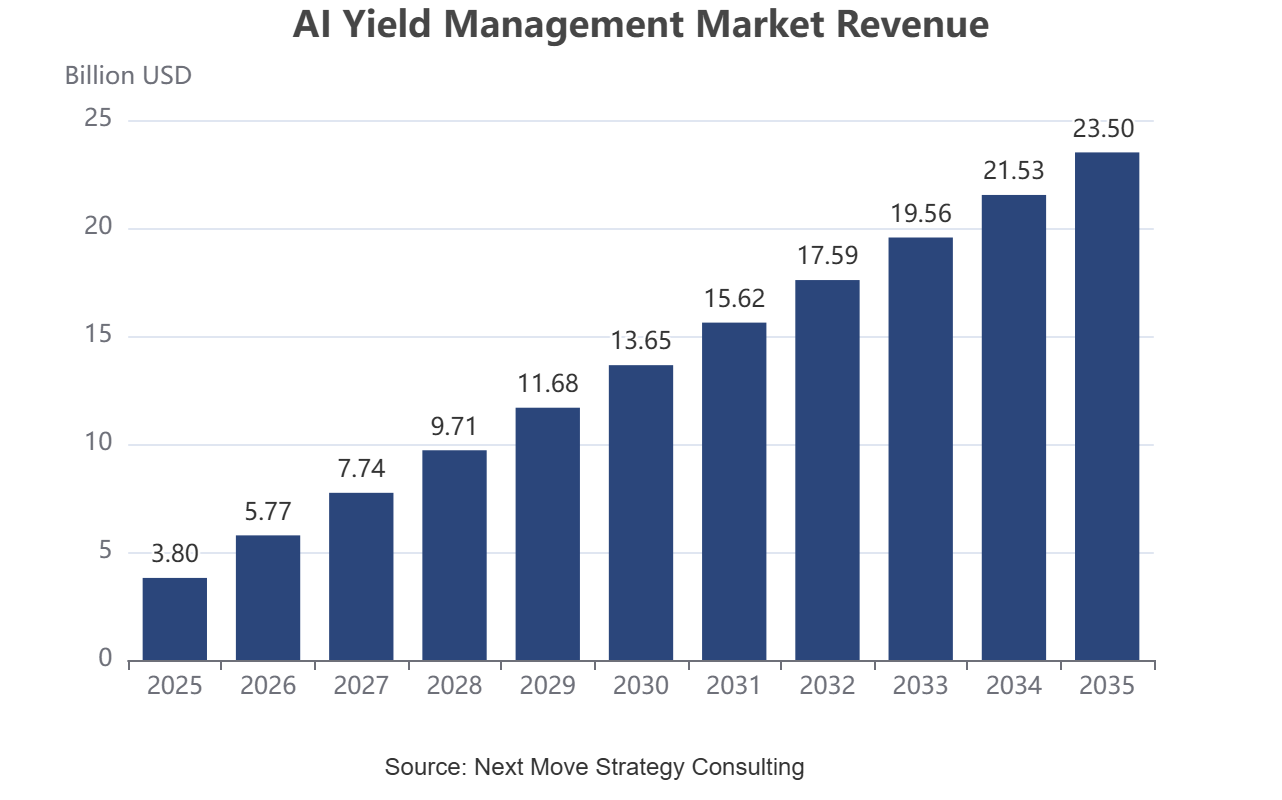
The global AI yield management market size was valued at USD 3.80 billion in 2025 and is estimated at USD 4.55 billion in 2026, forecast to reach USD 23.50 billion by 2035, expanding at a 20.0% CAGR between 2026 and 2035. North America leads with approximately 38% share, while price optimization dominates all other solutions with approximately 24% share.
We observed that the growth is broad-based across every segmentation axis, with agentic AI adoption and cross-industry price optimization driving the dominant structural shifts through 2035.
|
Key Takeaways |
|
By Solution: Price Optimization held the largest share of approximately 24% (USD 0.91 billion) in 2025; Offer and Personalization is the fastest-growing sub-segment at 22.8% CAGR from 2026–2035. |
|
By Deployment: Cloud held the largest share of approximately 70% (USD 2.66 billion) in 2025; Hybrid is the fastest-growing sub-segment at 21.8% CAGR from 2026–2035. |
|
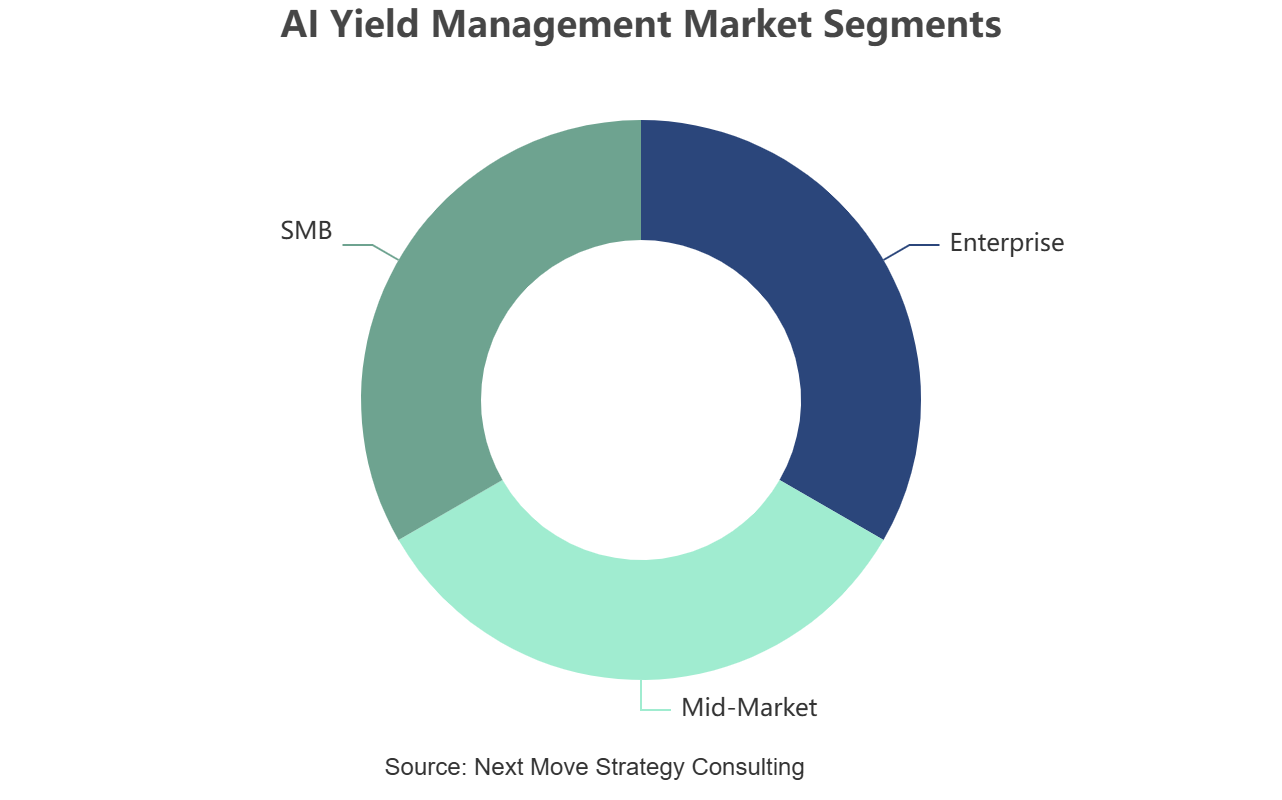
By Buyer Size: Enterprise held the largest share of approximately 58% (USD 2.20 billion) in 2025; SMB is the fastest-growing sub-segment at 25.0% CAGR from 2026–2035. |
|
By Revenue Model: Subscription held the largest share of approximately 62% (USD 2.36 billion) in 2025; Usage Based is the fastest-growing sub-segment at 24.7% CAGR from 2026–2035. |
|
By End Market: Hotels and Lodging held the largest share of approximately 24% (USD 0.92 billion) in 2025; Media, Entertainment and Gaming is the fastest-growing sub-segment at 25.0% CAGR from 2026–2035. |
|
Dominant Region: North America dominated with approximately 38% revenue share (USD 1.44 billion) in 2025. |
|
Fastest-Growing Region: Asia-Pacific is expected to register the highest CAGR of 22.9% during 2026–2035. |
|
Dominant Country: U.S. led with approximately USD 1.13 billion in 2025. |
|
Fastest-Growing Country: India is the fastest-growing country at approximately 25.3% CAGR from 2026–2035. |
Market Opportunity: The AI yield management market is expected to create an absolute dollar opportunity of USD 18.95 billion between 2026 and 2035, presenting significant investment potential across the travel, hospitality, retail, and manufacturing yield-optimization value chain.
According to Next Move Strategy Consulting analysis, enterprises are increasingly consolidating pricing, forecasting, and inventory decisioning onto unified agentic AI platforms rather than point solutions, a shift that favors vendors with broad cross-functional data integration as buyers rationalize technology stacks through 2035.
What Does the AI Yield Management Market Encompass?
The AI yield management market encompasses software platforms and managed services that apply machine learning and, increasingly, agentic AI to forecast demand, optimize price, and allocate constrained inventory across capacity-limited and perishable-asset industries. Our assessment indicates that the scope spans demand forecasting, price optimization, offer personalization, and ancillary upsell engines deployed by airlines, hotels, short-term rental operators, cruise lines, retailers, and B2B manufacturers seeking to convert historical and real-time transaction data into automated pricing and inventory decisions across every customer channel.
The category has evolved from rule-based revenue management spreadsheets into cloud-native, self-learning platforms that continuously retrain on booking, transaction, and competitor-rate data. The U.S. Department of Justice's November 2025 settlement with RealPage over algorithmic rental-pricing coordination and the Federal Trade Commission's scrutiny of surveillance pricing are reshaping data-governance requirements for pricing algorithms. We observed that vendors are responding by shifting toward backward-looking, non-collusive training data and transparent override controls, while agentic AI copilots increasingly automate routine forecasting and rate-shopping tasks that previously required dedicated revenue-management analysts.
|
Parameter |
Details |
|
Market Size in 2025 |
USD 3.80 Billion |
|
Market Size in 2026 |
USD 4.55 Billion |
|
Revenue Forecast in 2035 |
USD 23.50 Billion |
|
Growth Rate |
CAGR of 20.0% from 2026 to 2035 |
|
Analysis Period |
2025–2035 |
|
Base Year Considered |
2025 |
|
Forecast Period |
2026–2035 |
|
Market Size Estimation |
Revenue (USD Billion) |
|
Companies Profiled |
20 |
|
Countries Covered |
33 |
|
Market Share |
Available for Top 10 Companies |
Key Emerging Trends
Based on research conducted by Next Move Strategy Consulting, we found that four structural trends are reshaping product development, data governance, and stakeholder engagement across the industry.
How Is Agentic AI Transforming Yield Decisioning?
Agentic AI is replacing static, rule-based pricing engines with autonomous agents that monitor demand signals and execute pricing actions with minimal analyst intervention. We observed that PROS Holdings unveiled multiple AI agents across its platform at Outperform with PROS 2025, enabling real-time contextual pricing recommendations that revenue teams can act on directly. RateGain's AI-Powered Digest, launched in March 2025, similarly delivers daily route-performance insight to airline customers. Enterprises are adopting these agent-based workflows to reduce manual override cycles and accelerate pricing response across high-velocity inventory categories such as airline seats and hotel rooms.
Why Is Personalized, Real-Time Offer Optimization Gaining Adoption?
Static rate grids are giving way to personalized offer engines that price each guest or shopper based on individual price sensitivity and predicted lifetime value. Our findings suggest that IDeaS' Spotlight tool, updated in March 2026 with an industry-first 'Potential to Influence' score, quantifies which demand segments will respond most to targeted promotion. Hospitality groups and airlines are integrating these personalization layers into loyalty and marketing systems, shifting revenue management from a siloed pricing function into a connected commercial-strategy discipline spanning marketing, sales, and operations.
How Is Algorithmic Pricing Regulation Reshaping Vendor Data Practices?
Heightened antitrust scrutiny of algorithmic pricing is forcing yield management vendors to redesign how their models ingest competitor data. We observed that the U.S. Department of Justice's November 2025 proposed settlement with RealPage restricts the company from sharing granular, current nonpublic rental-pricing data and limits reliance on data younger than twelve months in model training. Vendors serving hospitality, short-term rental, and multifamily housing customers are auditing data pipelines and override workflows to demonstrate independent, backward-looking pricing decisions ahead of similar state-level algorithmic pricing statutes taking effect.
What Role Does Platform Consolidation Play in Yield Management?
Consolidation is converging previously separate pricing, distribution, and marketing-intelligence platforms into unified commercial suites. Next Move Strategy Consulting's analysis indicates that Thoma Bravo's approximately USD 1.4 billion acquisition of PROS Holdings, completed in December 2025, will run PROS Travel as a dedicated platform while merging its B2B pricing business with Conga. RateGain's November 2025 acquisition of Sojern similarly combined marketing, distribution, and revenue-optimization data under one roof, serving more than 13,000 travel brands and signaling that scale and data breadth are becoming decisive competitive differentiators.
Consumer Behavior Analysis of the AI Yield Management Market
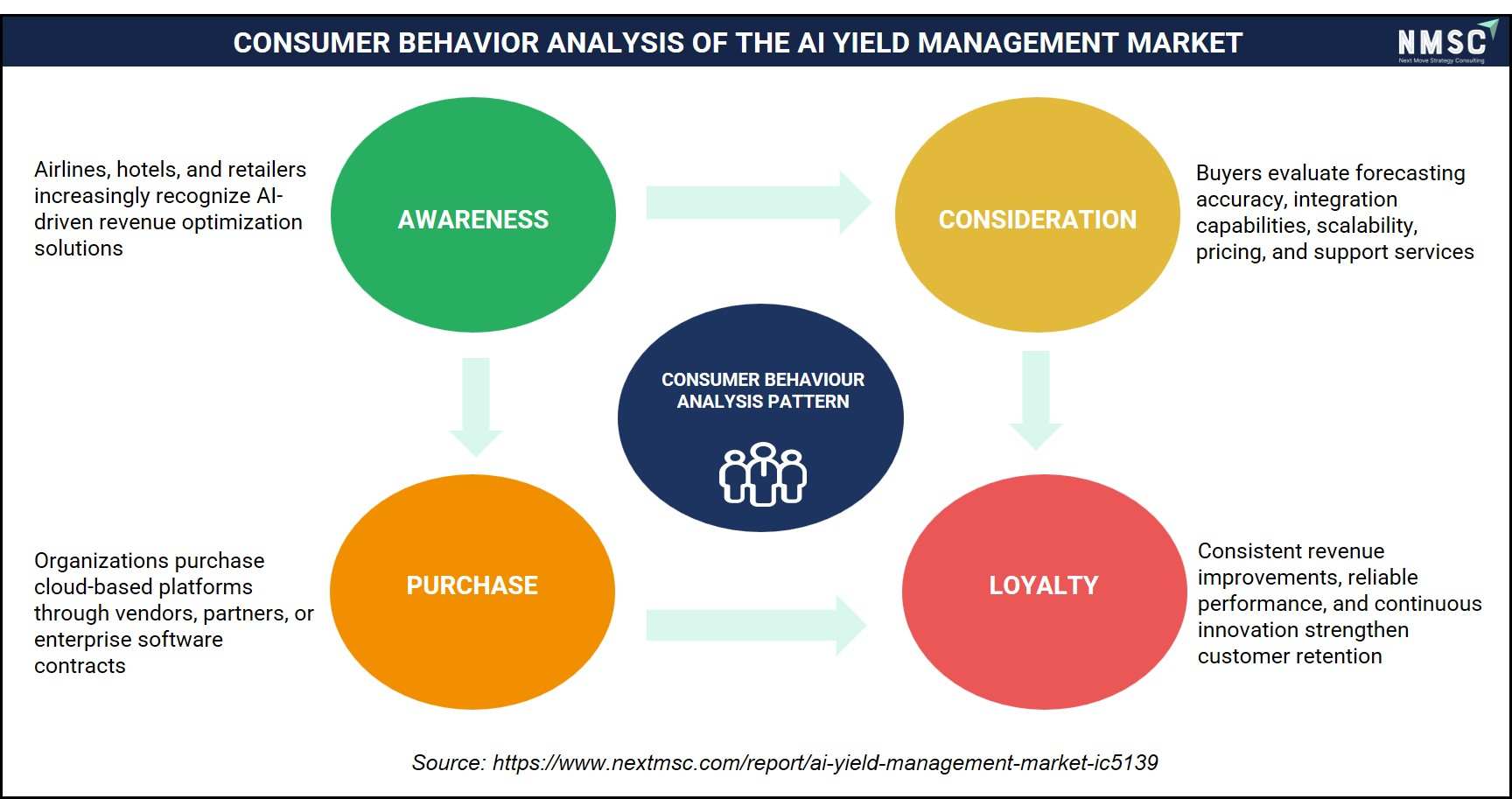
Based on our consumer behavior assessment, we identified that enterprises progress from recognizing AI-driven revenue optimization benefits to evaluating forecasting accuracy, integration capabilities, scalability, pricing, and vendor support before purchasing AI yield management platforms. Furthermore, our industry analysis indicates that consistent revenue improvements, reliable platform performance, and continuous AI innovation strengthen long-term customer loyalty and subscription renewals.
Growth Drivers and Restraints
|
Factors |
Type |
(+/−) % Impact on CAGR |
Geographic Relevance |
Impact Timeline |
|
Rising adoption of agentic AI copilots in pricing decisioning |
Driver |
+3.2% |
Global |
2026–2035 |
|
Airline industry capacity discipline and record load factors |
Driver |
+2.4% |
Global |
2026–2035 |
|
E-commerce and retail dynamic pricing expansion |
Driver |
+2.1% |
North America, Europe, Asia-Pacific |
2026–2033 |
|
Hotel and short-term rental digital distribution growth |
Driver |
+1.9% |
Global |
2026–2035 |
|
Semiconductor and manufacturing yield analytics investment |
Driver |
+1.3% |
Asia-Pacific, North America |
2026–2035 |
|
Cloud and API-based integration lowering deployment barriers |
Driver |
+1.1% |
Global |
2026–2032 |
|
Algorithmic pricing antitrust scrutiny and compliance costs |
Restraint |
−1.4% |
North America, Europe |
2026–2035 |
|
Legacy system integration complexity and data fragmentation |
Restraint |
−0.9% |
Global |
2026–2032 |
|
Shortage of skilled revenue-science and AI implementation talent |
Restraint |
−0.7% |
Global |
2026–2035 |
What Is the Primary Growth Driver of the AI Yield Management Market?
Rapid enterprise adoption of agentic AI copilots is the primary driver of the market. PROS Holdings reported third-quarter 2025 subscription revenue growth of 13% year-over-year to USD 76.0 million, reflecting accelerating demand for AI-powered pricing platforms. We observed that this adoption curve is reinforced by airlines and hotels replacing manual, override-heavy revenue-management workflows with autonomous agents capable of executing pricing actions in real time, a shift that continues to anchor baseline platform spending across both developed and emerging markets.
How Is Airline Industry Capacity Discipline Driving Market Growth?
Airline capacity constraints are accelerating investment in AI-driven revenue optimization. The International Air Transport Association reported a record full-year 2025 passenger load factor of 83.6%, with ancillary and other revenue projected to reach USD 145 billion in 2026, nearly 14% of total industry revenue. Our assessment indicates that airlines facing constrained aircraft delivery schedules are prioritizing yield-maximizing software over fleet expansion, sustaining demand for demand-forecasting and ancillary-upsell solutions as carriers work to extract additional revenue from fixed seat inventory.
What Is Restraining AI Yield Management Market Expansion?
Heightened antitrust scrutiny of algorithmic pricing tools restrains near-term platform expansion, particularly in rental housing and hospitality-adjacent applications. The U.S. Department of Justice's November 2025 settlement with RealPage requires the company to stop sharing granular nonpublic rental-pricing data among competing landlords and imposes compliance-monitoring obligations for seven years. We found that vendors across adjacent hospitality and short-term rental segments are proactively revising data-governance practices in anticipation of similar scrutiny, adding compliance overhead that can lengthen enterprise sales cycles.
Segmentation Analysis
Segment Sizing: By Solution
|
Segment |
2025 (USD) |
2035 (USD) |
CAGR% (2026–2035) |
|
Demand Forecasting |
USD 0.76 Billion |
USD 4.00 Billion |
18.1% |
|
Price Optimization |
USD 0.91 Billion |
USD 5.30 Billion |
19.2% |
|
Offer and Personalization |
USD 0.46 Billion |
USD 3.55 Billion |
22.8% |
|
Inventory and Capacity |
USD 0.38 Billion |
USD 2.35 Billion |
20.0% |
|
Ancillary and Upsell |
USD 0.30 Billion |
USD 2.10 Billion |
21.3% |
|
Competitive Intelligence and Rate Shopping |
USD 0.30 Billion |
USD 1.85 Billion |
19.8% |
|
Channel and Distribution |
USD 0.27 Billion |
USD 1.65 Billion |
20.0% |
|
Markdown and Promotion |
USD 0.19 Billion |
USD 1.20 Billion |
20.2% |
|
Consulting and Managed Services |
USD 0.15 Billion |
USD 1.05 Billion |
21.3% |
|
Other |
USD 0.08 Billion |
USD 0.45 Billion |
19.5% |
|
Total |
USD 3.80 Billion |
USD 23.50 Billion |
20.0% |
Which Solution Segment Dominates the AI Yield Management Market?
Price Optimization, encompassing dynamic fare, rate, and markdown pricing engines, led the market with USD 0.91 billion in 2025, supported by its direct, measurable impact on revenue per available unit across airlines, hotels, and retailers. We observed that Offer and Personalization is the fastest-growing solution, expanding at a 22.8% CAGR from 2026 to 2035, as enterprises increasingly bundle price, product, and promotional messaging into a single AI-driven offer decision rather than optimizing price in isolation.
Segment Sizing: By End Market
|
Segment |
2025 (USD) |
2035 (USD) |
CAGR% (2026–2035) |
|
Airlines |
USD 0.84 Billion |
USD 4.23 Billion |
17.6% |
|
Hotels and Lodging |
USD 0.92 Billion |
USD 4.94 Billion |
18.4% |
|
Short-Term Rentals |
USD 0.30 Billion |
USD 2.35 Billion |
22.7% |
|
Cruises and Parking |
USD 0.19 Billion |
USD 1.41 Billion |
22.2% |
|
Travel Intermediaries |
USD 0.34 Billion |
USD 1.88 Billion |
18.6% |
|
Retail and E-Commerce |
USD 0.68 Billion |
USD 4.70 Billion |
21.3% |
|
B2B Distribution and Manufacturing |
USD 0.30 Billion |
USD 2.12 Billion |
21.4% |
|
Media, Entertainment and Gaming |
USD 0.15 Billion |
USD 1.41 Billion |
25.0% |
|
Other |
USD 0.08 Billion |
USD 0.46 Billion |
20.0%
|
|
Total |
USD 3.80 Billion |
USD 23.50 Billion |
20.0% |
Which End Market Leads AI Yield Management Market Demand?
Hotels and Lodging remained the leading end market, valued at USD 0.92 billion in 2025 on sustained global room-rate optimization and commercial-strategy platform adoption across independent and branded properties. Our findings suggest that Media, Entertainment and Gaming is the fastest-growing end market, registering a 25.0% CAGR from 2026 to 2035, as streaming platforms, live-event ticketing, and gaming operators increasingly apply dynamic, demand-based pricing to digital content and experience inventory.
Segment Sizing: By Buyer Size
|
Segment |
2025 (USD) |
2035 (USD) |
CAGR% (2026–2035) |
|
Enterprise |
USD 2.20 Billion |
USD 11.75 Billion |
18.2% |
|
Mid-Market |
USD 1.14 Billion |
USD 7.52 Billion |
20.8% |
|
SMB |
USD 0.46 Billion |
USD 4.23 Billion |
25.0% |
|
Total |
USD 3.80 Billion |
USD 23.50 Billion |
20.0% |
Which Buyer Size Segment Leads the AI Yield Management Market?
Enterprise buyers led the market with USD 2.20 billion in 2025, reflecting large airlines, hotel chains, and retailers with dedicated revenue-management teams and multi-property deployment needs. Based on research conducted by Next Move Strategy Consulting, we found that SMB is the fastest-growing buyer-size segment, expanding at a 25.0% CAGR from 2026 to 2035, as usage-based pricing and self-service onboarding lower adoption barriers for independent hotels, boutique retailers, and short-term rental hosts.
Growth Opportunities
Our analysis shows that three forward-looking opportunities stand out for stakeholders positioning within the AI yield management market over the 2026–2035 forecast period.
How Can Agentic AI Copilots Unlock Value for Mid-Market Hospitality Brands?
Mid-market and independent hotel groups that lack dedicated revenue-management analysts represent a whitespace opportunity for vendors offering low-touch, agentic AI copilots. IDeaS reported that nearly 40% of its independent hotel, small group, and regional chain clients have implemented its Optix commercial-intelligence tool within months of launch. Vendors that package forecasting, pricing, and marketing-optimization agents into simplified, self-service interfaces stand to capture recurring subscription revenue from mid-market hospitality brands previously priced out of enterprise-grade revenue management.
Where Does Semiconductor Yield Analytics Create New Demand for AI Platforms?
Semiconductor foundries and outsourced assembly and test providers represent an underpenetrated opportunity for AI-driven manufacturing yield analytics beyond traditional travel and retail applications. Synopsys and Advantest's real-time test-data streaming partnership, centered on the SiliconDash solution, illustrates how AI platforms can flag yield-limiting defects during high-volume chip production. Suppliers that extend price- and inventory-optimization expertise into fab-level yield analytics can capture new B2B Distribution and Manufacturing segment revenue as chipmakers scale advanced-node capacity.
How Can Usage-Based Pricing Expand Adoption Among SMB Buyers?
Small and mid-sized retailers and short-term rental hosts that cannot justify large upfront software licenses create an opportunity for usage-based and transaction-metered pricing models. Vendors that offer consumption-priced demand-forecasting and rate-shopping modules can lower adoption barriers for SMB buyers, already the fastest-growing buyer-size segment at a 25.0% CAGR. Early movers that bundle usage-based pricing with self-service onboarding stand to capture disproportionate share of this underserved, price-sensitive customer base through 2035.
Regional Outlook
Geographic Performance Snapshot
|
Region |
2025 (USD) |
2035 (USD) |
CAGR% (2026–2035) |
Key Driver |
|
North America |
USD 1.44 Billion |
USD 7.52 Billion |
17.9% |
Mature airline and hospitality adoption; DOJ algorithmic-pricing oversight |
|
Europe |
USD 0.91 Billion |
USD 4.94 Billion |
18.4% |
EU data-governance rules and rate-parity defense against OTAs |
|
Asia-Pacific |
USD 0.84 Billion |
USD 6.58 Billion |
22.9% |
Expanding airline capacity and e-commerce retail growth |
|
Middle East & Africa |
USD 0.34 Billion |
USD 2.58 Billion |
22.4% |
Vision 2030-linked hospitality and aviation expansion |
|
Latin America |
USD 0.27 Billion |
USD 1.88 Billion |
21.6% |
Growing airline traffic and organized retail infrastructure |
|
Total |
USD 3.80 Billion |
USD 23.50 Billion |
20.0% |
— |
North America AI Yield Management Market Outlook
North America leads the AI yield management market, anchored by mature airline, hotel, and retail revenue-management adoption alongside an established base of enterprise software vendors including Oracle, PROS, and RealPage. We observed that the U.S. Department of Justice's November 2025 RealPage settlement is reshaping data-governance practices across the region's hospitality and multifamily-adjacent pricing platforms. Technology adoption remains advanced, with agentic AI copilots increasingly embedded into airline and hotel commercial-strategy workflows, while competitive intensity stays high among incumbent vendors defending large enterprise accounts.
Europe AI Yield Management Market Outlook
Europe's AI yield management market reflects a mature but increasingly regulation-conscious landscape shaped by evolving European Union algorithmic-pricing and data-protection frameworks. Our findings suggest that hotel groups across Germany, France, and the UK are accelerating adoption of AI-driven commercial-strategy platforms such as IDeaS and RateGain's UNO Direct Stack to defend rate parity and direct-booking share against online travel agencies. Technology adoption favors cloud-native deployment, supported by regional travel-technology vendors investing in compliant data architectures across the bloc.
Asia-Pacific AI Yield Management Market Outlook
Asia-Pacific is the fastest-growing AI yield management market region, propelled by expanding airline capacity, hotel construction, and e-commerce retail activity across China and India. The International Air Transport Association reported that Asia-Pacific load factors are projected to reach a record 84.4% in 2026, intensifying pressure on carriers to optimize yield per available seat kilometer. We found that regulatory frameworks remain less harmonized than in Europe, giving vendors flexibility to scale cloud-based forecasting and pricing platforms rapidly across the region's expanding travel and retail sectors.
Middle East & Africa AI Yield Management Market Outlook
The AI yield management market in Middle East & Africa is expanding as Gulf Cooperation Council economies diversify into hospitality and aviation capacity expansion under national tourism strategies. Our analysis shows that Saudi Arabia and the UAE are attracting significant hotel-development investment, with operators such as Adeera Hospitality adopting AI-driven revenue management from property launch. Regulatory influence remains moderate, while technology adoption is accelerating as regional hotel groups and airlines implement cloud-based forecasting platforms to compete with established international brands.
Latin America AI Yield Management Market Outlook
Latin America's AI yield management market is supported by growing airline traffic and expanding organized retail infrastructure in Brazil and Argentina. We observed that regulatory frameworks are less stringent than in North America or Europe, though multinational hotel and airline brands operating locally are introducing AI-driven pricing specifications. Technology adoption remains concentrated among larger carriers and hotel chains, with competitive intensity increasing as regional distributors partner with global revenue-management vendors to expand platform availability across the region.
U.S. AI Yield Management Market
Based on our estimates, the U.S. market was valued at approximately USD 1.13 billion in 2025 and is projected to reach USD 5.72 billion by 2035, growing at a 17.7% CAGR. Demand is anchored by mature airline, hotel, and retail revenue-management adoption alongside heightened Department of Justice scrutiny of algorithmic rental and hospitality pricing tools. Technology penetration favors agentic AI copilots, and competitive intensity remains high among established vendors including Oracle, PROS, and RealPage serving national enterprise accounts.
Canada AI Yield Management Market
The market in Canada reached roughly USD 0.17 billion in 2025 and is forecast to hit USD 0.90 billion by 2035 at an 18.0% CAGR. Demand structure mirrors U.S. hospitality and airline yield-optimization patterns, while Canadian competition authorities are monitoring algorithmic pricing practices following heightened U.S. antitrust activity. Technology penetration is rising as national hotel chains and regional carriers adopt cloud-based forecasting tools, with competitive intensity moderate given reliance on vendors headquartered in the United States.
UK AI Yield Management Market
As per our estimate, the UK market stood at about USD 0.17 billion in 2025, advancing toward USD 0.89 billion by 2035 at a 17.8% CAGR. Demand is driven by established hotel groups and airlines navigating post-Brexit data-protection and competition rules that increasingly touch algorithmic pricing tools. Regulatory influence is significant, technology penetration favors cloud-native revenue-management platforms, and competitive intensity remains steady among domestic and European vendors serving UK travel and retail brands.
Germany AI Yield Management Market
According to our analysis, Germany's market was valued near USD 0.20 billion in 2025 and is set to reach USD 1.04 billion by 2035, expanding at a 17.8% CAGR. Demand structure benefits from a strong domestic hospitality and manufacturing base, with Synopsys' German engineering customers among adopters of AI-driven yield analytics. Germany's data-protection enforcement under the EU framework shapes regulatory influence, while technology penetration favors cloud-based pricing platforms among leading hotel and retail groups.
France AI Yield Management Market
Based on our estimates, France's market reached approximately USD 0.14 billion in 2025, projected to climb to USD 0.69 billion by 2035 at a 17.6% CAGR. Demand is supported by France's prominent luxury hospitality and travel-intermediary industry, which shapes adoption of personalization and offer-optimization solutions. Regulatory influence from French and EU competition authorities is notable, and competitive intensity remains high given the concentration of global travel-technology vendors serving premium French hospitality brands.
China AI Yield Management Market
The market in China stood at roughly USD 0.25 billion in 2025 and is forecast to reach USD 1.84 billion by 2035, registering a 22.1% CAGR. Demand is fueled by expanding domestic airline capacity and a dense base of e-commerce and retail platforms adopting dynamic-pricing engines. Regulatory influence is increasing gradually, technology penetration is accelerating through cloud-based deployment, and competitive intensity remains elevated among numerous regional software suppliers serving China's travel and retail sectors.
India AI Yield Management Market
As per our estimate, India's market was valued at about USD 0.12 billion in 2025, projected to reach USD 1.12 billion by 2035 at a 25.3% CAGR, the fastest among covered countries. Demand structure reflects rapidly expanding airline capacity and organized retail, with India's domestic air traffic among the fastest-growing globally. Regulatory influence remains developing, while technology penetration is rising quickly as multinational and domestic vendors localize AI yield management platforms to serve India's expanding travel and retail base.
Japan AI Yield Management Market
According to our analysis, Japan's market reached close to USD 0.13 billion in 2025 and is expected to hit USD 0.86 billion by 2035, growing at a 20.4% CAGR. Demand is supported by Japan's precision-oriented airline and hospitality sectors, which prioritize forecasting accuracy amid capacity constraints. Regulatory influence is well established, technology penetration is advanced among domestic carriers and hotel groups, and competitive intensity remains high among long-standing enterprise software vendors serving Japan's travel industry.
South Korea AI Yield Management Market
Based on our estimates, South Korea's market stood at approximately USD 0.08 billion in 2025, forecast to reach USD 0.59 billion by 2035 at a 21.6% CAGR. Demand structure benefits from the country's globally influential retail and travel sectors alongside growing media- and gaming-driven yield-optimization needs. Technology penetration is high, with domestic and international vendors supplying cloud-based pricing platforms, and competitive intensity remains pronounced amid rapid product innovation cycles.
Australia AI Yield Management Market
The AI yield management market in Australia reached about USD 0.08 billion in 2025 and is projected to reach USD 0.53 billion by 2035, expanding at a 21.5% CAGR. Demand is supported by a well-established airline and hospitality retail sector alongside growing consumer preference for dynamic, personalized pricing. Regulatory influence stems from Australian Competition and Consumer Commission oversight of pricing practices, while technology penetration favors cloud-native platforms amid moderate competitive intensity.
UAE AI Yield Management Market
As per our estimate, the UAE market was valued near USD 0.08 billion in 2025, projected to reach USD 0.52 billion by 2035 at a 21.3% CAGR. Demand structure is shaped by the UAE's role as a regional aviation and hospitality hub anchored by major carriers and luxury hotel groups. Regulatory influence remains moderate, technology penetration is improving through cloud-based platform adoption, and competitive intensity is rising as vendors expand product portfolios to serve Gulf travel markets.
Saudi Arabia AI Yield Management Market
According to our analysis, Saudi Arabia's market reached roughly USD 0.09 billion in 2025 and is expected to hit USD 0.65 billion by 2035, growing at a 21.9% CAGR. Demand is driven by Vision 2030-linked hospitality and aviation capacity expansion, exemplified by Adeera Hospitality's planned rollout of more than 60 hotels using AI-driven revenue management from launch. Regulatory influence is developing, and technology penetration is advancing as domestic hotel groups and carriers scale AI-driven platforms.
South Africa AI Yield Management Market
Based on our estimates, South Africa's market stood at about USD 0.04 billion in 2025, forecast to reach USD 0.28 billion by 2035 at a 21.4% CAGR. Demand structure reflects a developing airline and hospitality sector serving regional Southern African travel and retail markets. Regulatory influence remains moderate, technology penetration is gradually improving, and competitive intensity is limited given reliance on international vendors supplying cloud-based yield management platforms to regional carriers and hotel groups.
Brazil AI Yield Management Market
The market in Brazil reached approximately USD 0.12 billion in 2025 and is projected to reach USD 0.79 billion by 2035, registering a 20.7% CAGR. Demand is underpinned by Brazil's large domestic airline industry and expanding organized retail sector adopting dynamic-pricing engines. Regulatory influence stems from Brazilian competition-authority oversight of pricing algorithms, technology penetration favors cloud-based deployment, and competitive intensity remains moderate among regional and international vendors.
Argentina AI Yield Management Market
As per our estimate, Argentina's market was valued near USD 0.04 billion in 2025, projected to reach USD 0.28 billion by 2035 at a 20.7% CAGR. Demand structure is supported by steady airline and hospitality consumption despite macroeconomic volatility affecting capital-investment cycles. Regulatory influence remains limited, technology penetration is modest, and competitive intensity is centered on a small number of vendors serving domestic carriers and hotel operators across the country.
Price Point Analysis of the AI Yield Management Market
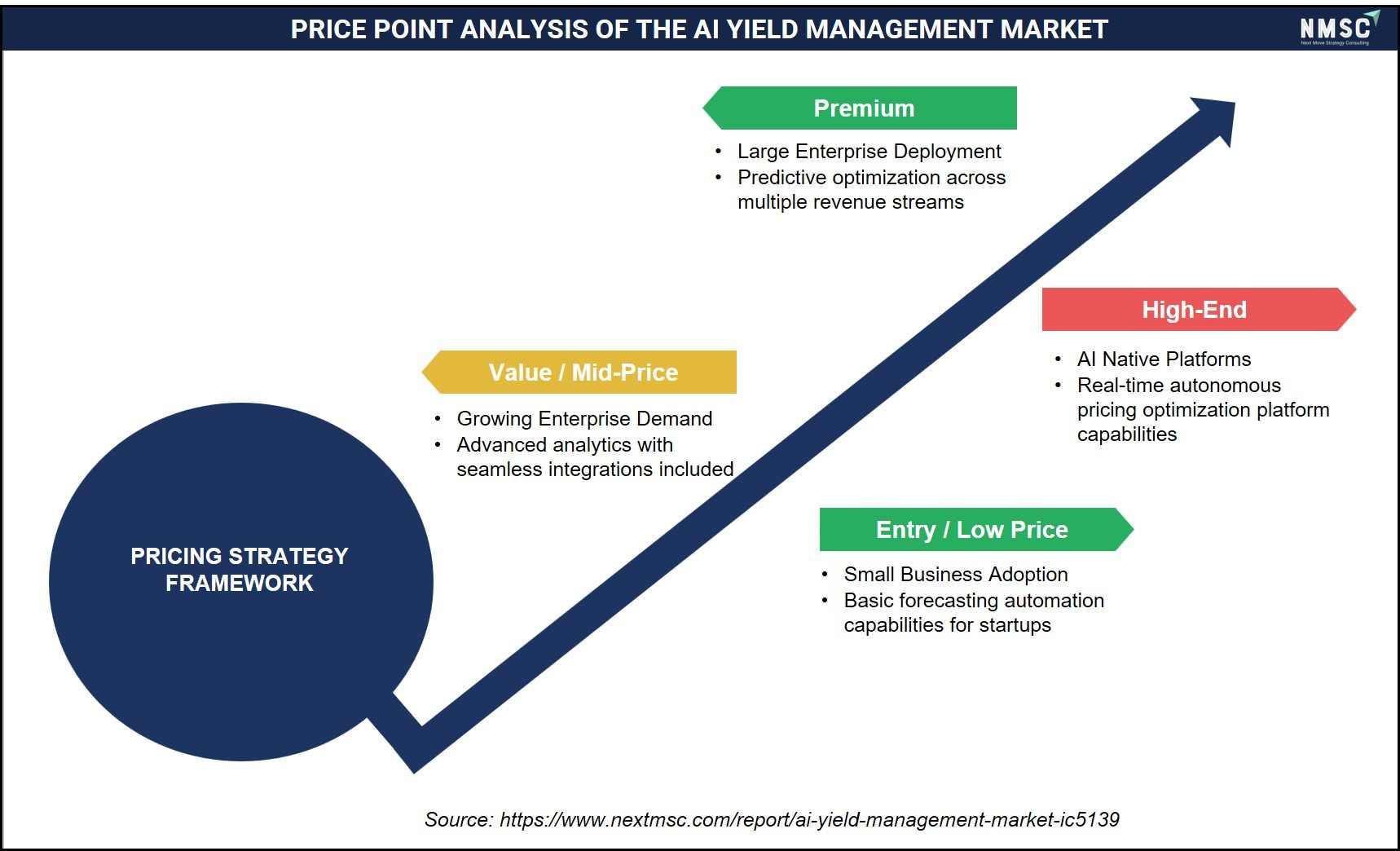
Based on our pricing assessment, we observed that AI yield management solutions are positioned across entry-level, value, premium, and high-end segments to address varying enterprise requirements. Moreover, our industry evaluation indicates that pricing increases alongside advanced forecasting capabilities, real-time optimization, seamless integrations, deployment scale, and autonomous revenue management features, enabling vendors to serve organizations ranging from startups to large multinational enterprises.
Competitive Landscape
We observed that the AI yield management market features a moderately fragmented competitive landscape, with travel- and hospitality-focused specialists competing alongside diversified enterprise software vendors and semiconductor yield-analytics providers.
|
Key Takeaways |
|
Market Structure: Moderately fragmented; the top companies profiled in this report collectively serve a majority of enterprise airline, hotel, and large-format retail accounts, while numerous specialized vendors serve mid-market and independent operators. |
|
Innovation Focus: Agentic AI copilots, real-time offer personalization, and unified commercial-strategy platforms that connect pricing, marketing, and inventory decisioning dominate current innovation pipelines across leading vendors. |
|
M&A Activity: Active consolidation through platform acquisitions, exemplified by Thoma Bravo's approximately USD 1.4 billion acquisition of PROS Holdings and RateGain's acquisition of Sojern to combine marketing, distribution, and revenue-optimization data. |
Source: www.nextmsc.com
How Do Companies Compete in the AI Yield Management Market?
Companies compete primarily on forecasting accuracy, breadth of cross-industry data, and depth of agentic AI automation across the industry. Global players such as Oracle, Amadeus, and Sabre leverage broad travel-distribution footprints to serve multinational airline and hotel accounts, while specialized vendors including IDeaS, Duetto, and BEONx compete on hospitality-specific forecasting precision and rapid implementation for independent and mid-market hotel groups seeking lower-touch deployment.
Which Competitive Archetypes Dominate the AI Yield Management Market?
Two archetypes dominate the market: diversified enterprise software groups offering integrated pricing, distribution, and commerce platforms, and specialized point-solution vendors focused on a single vertical such as hospitality, airline, or retail markdown optimization. Oracle and Amadeus exemplify the diversified archetype through end-to-end hospitality and travel technology stacks, while PROS Holdings and RateGain exemplify focused, AI-native platforms built specifically around pricing and revenue-optimization science.
How Are Companies Differentiating Through Innovation?
Innovation and differentiation strategy increasingly center on agentic AI copilots and unified commercial-strategy suites that connect forecasting, pricing, and marketing decisions. PROS Holdings' AI Agents, unveiled at Outperform with PROS 2025, and IDeaS' Spotlight marketing-optimization tool both extend pricing science into adjacent commercial functions. Our analysis shows that vendors unable to demonstrate agentic, cross-functional capability risk exclusion from enterprise request-for-proposal shortlists as buyers consolidate technology stacks.
What M&A and Expansion Activity Is Shaping the Market?
Mergers, acquisitions, and platform expansion continue to consolidate capabilities within the industry. Thoma Bravo's completed acquisition of PROS Holdings in December 2025 separated the company's travel and B2B pricing businesses into distinct platform investments, while RateGain's November 2025 acquisition of Sojern combined marketing, distribution, and revenue-optimization data serving more than 13,000 travel brands, illustrating how diversified groups pursue geographic expansion and cross-sell leverage across travel, hospitality, and retail end markets.
Key Market Players
Our assessment indicates that the following 20 companies are actively shaping product innovation, agentic AI capability, and geographic expansion within the global AI yield management market.
-
Amadeus IT Group
-
Sabre Corporation
-
Blue Yonder Group, Inc.
-
Infor, Inc.
-
RateGain Travel Technologies Limited
-
IDeaS Revenue Solutions
-
Mews Systems B.V
-
Duetto Research Inc.
-
Mastercard Incorporated
-
Pricefx AG
-
Zilliant, Inc.
-
Revionics LLC
-
Cendyn Group, LLC
-
Revenue Analytics, LLC
-
Volantio, Inc.
-
BEONx S.L.
-
BEONx S.L.
Latest Developments
We found that recent developments within the AI yield management market are concentrated on agentic AI product launches and platform-consolidating M&A, reflecting the industry's broader shift toward unified commercial-strategy suites.
|
Date |
Event |
|
June 2026 |
Blue Yonder announced the expansion of its AI Agents and role-specific mobile applications. By integrating these agents into its "Common Data Cloud," the company is moving toward fully autonomous supply chain planning, where AI doesn't just suggest a price or inventory level but executes end-to-end tactical decisions across retail and manufacturing. |
|
June 2026 |
Oracle announced that its application suites now include over 1,000 AI agents capable of reasoning and executing work. These agents are being applied to core ERP and supply chain functions to automate yield-critical tasks like dynamic inventory allocation and automated procurement, helping enterprises bridge the gap between financial planning and operational execution. |
|
May 2026 |
IDeaS (a SAS company) expanded its integration with Stayntouch PMS to introduce "Value-Based Hurdle" decisions. By leveraging Last Room Value analytics, hotels can now automatically adjust room availability based on the total potential guest lifetime value rather than just the nightly room rate, marking a shift toward profitability-focused revenue management. |
Expert Insights

“Yield and ancillary optimization is where I'd put my chips. Companies like Hopper, TravelX, and Fairlyne are finally capturing revenue that was always there but too complex to unlock manually—personalized upsell at booking, post-booking seat buyback, transferable ticket markets, loyalty monetization. In today's macro environment, a 1% uplift in gross profit isn't a nice-to-have, it's a board conversation. And the defensibility is structural: the model gets smarter with every transaction.”
— Mia Morisset, Partner, Curiosity Ventures
Statement made during an interview with Skift discussing how AI-powered yield optimization is reshaping travel revenue management through intelligent pricing, ancillary revenue generation, and continuously learning AI models.
Market Interpretation
The statement underscores the growing adoption of AI-driven yield management solutions that optimize pricing, inventory allocation, and ancillary revenue opportunities through continuous learning. Rather than relying on static pricing rules, organizations are increasingly leveraging machine learning models to analyze customer behavior and transaction data in real time, enabling personalized offers and dynamic revenue optimization. As businesses prioritize profitability amid economic uncertainty, AI-powered yield management platforms are emerging as strategic tools that enhance revenue performance while improving decision-making with every customer interaction.
Investment Opportunities
What Capital Inflows Are Targeting the AI Yield Management Market?
Capital inflows are increasingly directed toward agentic AI platform consolidation and cross-industry data capability. Thoma Bravo's approximately USD 1.4 billion acquisition of PROS Holdings, completed in December 2025, and RateGain's acquisition of Sojern illustrate private equity and strategic acquirers funding platform convergence across pricing, marketing, and distribution. We observed that investors favor vendors demonstrating agentic AI differentiation and multi-vertical data assets, viewing platform breadth as a proxy for durable enterprise contract retention amid intensifying competition.
How Is Infrastructure Investment Supporting AI Yield Management Platforms?
Infrastructure investment is expanding cloud computing and real-time data-streaming capacity to support increasingly autonomous pricing decisioning. Synopsys and Advantest's expanded real-time test-data streaming infrastructure illustrates how vendors are investing in low-latency data pipelines spanning both semiconductor manufacturing and enterprise pricing applications. Our findings suggest that vendors are prioritizing API-based, cloud-native architecture investment to support the sub-second decisioning latency required by agentic pricing agents operating across high-volume transaction environments.
What ESG Considerations Are Shaping AI Yield Management Investment Decisions?
Environmental, social, and governance considerations increasingly shape investment decisions, with algorithmic-pricing fairness and data-governance transparency emerging as key criteria following the DOJ's RealPage settlement. The U.S. Department of Justice's compliance-monitoring requirements, effective for seven years under the November 2025 settlement, set a governance benchmark that investors are applying to comparable pricing-algorithm vendors. We found that investors increasingly favor vendors with documented model-governance and bias-testing practices, treating regulatory readiness as a governance indicator alongside data-privacy compliance.
Key Benefits for Stakeholders
How Does This Report Benefit Enterprise and Industry Leaders?
Enterprise and industry leaders gain access to validated segmentation, competitive benchmarking, and regional demand forecasts that support technology-sourcing and platform-consolidation decisions across the AI yield management industry. Our analysis shows that detailed solution, deployment, and buyer-size breakdowns help procurement and revenue-management teams align platform selection with organizational scale and regulatory requirements, while identifying underserved end-market segments such as short-term rentals and B2B manufacturing for portfolio expansion.
How Does This Report Benefit Investors and Financial Analysts?
Investors and financial analysts benefit from consistent, single-point market size and CAGR estimates that support valuation and capital-allocation decisions across the AI yield management supply chain. We observed that the report's regional and segment-level growth differentials help identify which vendors are best positioned to capture above-market growth in usage-based pricing and SMB buyer categories through 2035, informing diligence on pending and future platform-consolidation transactions.
How Does This Report Benefit Technology Vendors and Product Teams?
Technology vendors and product teams gain insight into emerging design requirements, including agentic AI automation, algorithmic-pricing compliance, and cross-functional commercial-strategy integration, that are reshaping the industry. Our findings suggest that this analysis helps product teams prioritize development roadmaps around data-governance transparency and personalization capability that are increasingly required by enterprise request-for-proposal processes across airline, hospitality, and retail buyers.
Key Market Segments
By Solution
-
Demand Forecasting
-
Price Optimization
-
Offer and Personalization
-
Inventory and Capacity
-
Ancillary and Upsell
-
Competitive Intelligence and Rate Shopping
-
Channel and Distribution
-
Markdown and Promotion
-
Consulting and Managed Services
-
Other
By Deployment
-
Cloud
-
On-Premise
-
Hybrid
By Buyer Size
-
Enterprise
-
Mid-Market
-
SMB
By Revenue Model
-
Subscription
-
Usage Based
-
Professional Services
-
Data and Content
-
Managed Service
By End Market
-
Airlines
-
Hotels and Lodging
-
Short-Term Rentals
-
Cruises and Parking
-
Travel Intermediaries
-
Retail and E-Commerce
-
B2B Distribution and Manufacturing
-
Media, Entertainment and Gaming
-
Other
By Region
-
North America: U.S., Canada, Mexico
-
Europe: UK, Germany, France, Italy, Spain, Sweden, Denmark, Finland, Netherlands, Rest of Europe
-
Asia-Pacific: China, India, Japan, South Korea, Taiwan, Indonesia, Vietnam, Australia, Philippines, Malaysia, Rest of APAC
-
Middle East & Africa: Saudi Arabia, UAE, Egypt, Israel, Turkey, Nigeria, South Africa, Rest of MEA
-
Latin America: Brazil, Argentina, Chile, Colombia, Rest of LATAM
Conclusion and Recommendations
What Is the Long-Term Outlook for the AI Yield Management Market?
The long-term outlook for the market remains strongly positive, with global revenue projected to expand nearly sixfold from USD 3.80 billion in 2025 to USD 23.50 billion by 2035 at a 20.0% CAGR. We observed that sustained agentic AI adoption, airline capacity discipline, and cross-industry expansion into retail markdown and manufacturing yield analytics will continue underpinning demand across price optimization, demand forecasting, and personalization solutions through the forecast period.
What Strategic Positioning Should AI Yield Management Suppliers Pursue?
Suppliers should prioritize agentic AI and unified commercial-strategy platforms while pursuing data-governance transparency to secure long-term enterprise contracts amid intensifying regulatory scrutiny. Our assessment indicates that vendors investing early in cross-functional integration spanning pricing, marketing, and inventory decisioning, alongside compliance-ready data architecture, will be best positioned to capture premium enterprise and mid-market accounts within the AI yield management market.
How Attractive Is the AI Yield Management Market for New Investment?
The AI yield management industry presents an attractive investment case, supported by a USD 18.95 billion absolute dollar opportunity between 2026 and 2035 and above-average growth in Asia-Pacific and SMB buyer categories. We found that investment attractiveness is highest for vendors combining agentic AI differentiation with scaled multi-vertical data assets, positioning them to serve both cost-sensitive SMB and premium enterprise segments simultaneously.
What Market Shifts and Key Risks Should Stakeholders Monitor?
Stakeholders should monitor algorithmic-pricing regulatory expansion, data-governance compliance costs, and competitive pressure from in-house AI development as key risks to the AI yield management market. Our analysis shows that vendors unable to adapt to backward-looking, non-collusive data-training requirements risk losing enterprise contracts to competitors with certified compliance frameworks, particularly within North America's increasingly scrutinized algorithmic-pricing environment.
What Are the Key Growth Pathways for the AI Yield Management Market?
Key growth pathways include expanding agentic AI copilot portfolios, scaling usage-based pricing models for SMB buyers, and deepening penetration into manufacturing yield analytics and media and gaming end markets. Next Move Strategy Consulting's analysis indicates that suppliers pursuing these pathways while maintaining compliance-ready data governance will be best positioned to capture the AI yield management market's projected growth through 2035.
About the Author
 Saista Faiyaz
— Saista Faiyaz is Research Associate at Next Move Strategy Consulting, where she has covered consumer markets and healthcare technologies for 3 years. Her work includes primary interview review, secondary-source validation, market sizing, and structured analysis of company and industry data. She supports research by comparing evidence across sources, organizing findings into market narratives, and documenting assumptions used in analysis. Her scope includes cross-market benchmarking, and reports.
Saista Faiyaz
— Saista Faiyaz is Research Associate at Next Move Strategy Consulting, where she has covered consumer markets and healthcare technologies for 3 years. Her work includes primary interview review, secondary-source validation, market sizing, and structured analysis of company and industry data. She supports research by comparing evidence across sources, organizing findings into market narratives, and documenting assumptions used in analysis. Her scope includes cross-market benchmarking, and reports.
About the Reviewer
 Supradip Baul
— Supradip Baul is an accomplished business consultant and strategist with over a decade of rich experience in market intelligence, strategy, technology, and business transformation. His work has included rigorous qualitative and quantitative analysis across multiple industries, helping clients shape investment decisions and long-term roadmaps. Earlier in his career, he was associated with Gartner, where he contributed to industry-leading reports and market share analyses. He has worked with leading global companies and holds an MBA with a dual specialization in Marketing and Finance.
Supradip Baul
— Supradip Baul is an accomplished business consultant and strategist with over a decade of rich experience in market intelligence, strategy, technology, and business transformation. His work has included rigorous qualitative and quantitative analysis across multiple industries, helping clients shape investment decisions and long-term roadmaps. Earlier in his career, he was associated with Gartner, where he contributed to industry-leading reports and market share analyses. He has worked with leading global companies and holds an MBA with a dual specialization in Marketing and Finance.
At Next Move Strategy Consulting, we understand that insightful market research is the cornerstone of successful business decisions. That's why we employ a robust and multifaceted approach, combining various methodologies to deliver the most accurate and actionable data for our clients.

Research Landscape
We navigate the world of research with two primary approaches:
Qualitative Approach
Our qualitative research methodologies involve immersive techniques such as in-depth interviews, focus groups, and observational studies. By engaging directly with individuals and stakeholders, we uncover valuable insights that quantitative data alone may overlook.

Quantitative Research
In tandem with qualitative methodologies, NMSC leverages the power of Quantitative Research to provide a robust foundation of numerical insights. Through systematic data collection and analysis, we quantify patterns, preferences, and market trends, offering a comprehensive view of the business landscape.
Our quantitative research approach employs diverse tools, including surveys, experiments, and statistical modelling. These methodologies enable us to gather data from a large and representative sample, ensuring the statistical significance of our findings. By employing structured questionnaires and standardized data collection methods, we guarantee the reliability and validity of the information we present to our clients.
Quantitative research is particularly effective in measuring the prevalence of trends, assessing market size, and gauging the impact of various factors on consumer behavior. The numerical precision attained through this approach equips our clients with actionable insights, facilitating data-driven decision-making and strategy formulation.


Our Specialized Toolbox for Industry-Specific Market Research
We deploy a specialized arsenal of techniques tailored to meet your unique requirements. Here's a glimpse into our comprehensive toolbox:

Information Procurement
The stage entails acquiring market data or relevant information through various sources and methodologies.


Market Research Approach
We utilize both top-down and bottom-up approaches in market research analysis to achieve a comprehensive understanding of the market dynamics, leveraging the broad perspective of industry trends and macroeconomic factors alongside detailed insights from specific segments and individual companies.

Porters Five Forces Analysis
We conduct Porter's Five Forces analysis to evaluate the competitive landscape of an industry, providing us with insights into factors that affect profitability and strategic positioning.

SWOT Analysis

Forecasting
We utilize a forecasting model to predict future consumption by considering parameters like population, economics, regulations, market competition, drivers, constraints, technology, and pricing. We also employ statistical techniques such as multilinear regression, exponential smoothing, moving average, ARIMA, and Monte Carlo simulations for accurate predictions. In econometric forecasting, we analyzed short-term and long-term event impacts, attributing values based on regulatory frameworks, economic factors, and market events.





 Speak to Our Analyst