Ice Melt Products Market Global Industry Analysis and Forecast (2026-2035)

The global Ice Melt Products Market is valued at USD 1,089.62 Million in 2026 and is projected to reach USD 5,145.92 Million by 2035, growing at a CAGR of 18.83% from 2026 to 2035. Key growth factors include rising investment in smart winter road maintenance infrastructure and expanding aviation infrastructure in cold-climate regions, with North America leading the market and Calcium Chloride accounting for approximately 31% share of the active ingredient segment.
Download Free Sample PDF
Base Year (2025)
$1,089.6 Million
Forecast (2035)
$5,145.9 Million
CAGR (2026-2035)
18.8%
Top Region
North America

What Is the Ice Melt Products Market Size?
The global Ice Melt Products Market size reached USD 638.92 Million in 2025 and is estimated at USD 1,089.62 Million in 2026, forecast to reach USD 5,145.92 Million by 2035 at a CAGR of 18.83% between 2026 and 2035. North America holds an approximate 42% revenue share in 2025, while Calcium Chloride dominates the active ingredient segment with approximately 31% share.
We observed that the rapid adoption of smart road sensor networks, mandatory airport pavement protection regulations, and the shift toward lower-corrosion acetate-based ice melt formulations across transit authorities and airport operators are simultaneously compressing the sodium chloride commodity base and expanding the premium specialty deicer revenue pool through 2035.

Ice Melt Products Market Global Industry Analysis and Forecast (2026-2035) Revenue Forecast
Values in USD Million

2025 $1,089.6 Million
2025
2026 $1,294.8 Million
2026
2027 $1,538.6 Million
2027
2028 $1,828.3 Million
2028
2029 $2,172.6 Million
2029
2030 $2,581.7 Million
2030
2031 $3,067.8 Million
2031
2032 $3,645.5 Million
2032
2033 $4,332.0 Million
2033
2034 $5,147.7 Million
2034
2035 $5,145.9 Million
2035

Key Takeaways

By Active Ingredient: Calcium Chloride held the largest share at approximately 31% (USD 198.07 million) in 2025, rising to USD 1,543.78 million by 2035; Blended Formulations are the fastest-growing sub-segment at 23.1% CAGR from 2026–2035, reaching USD 926.26 million by 2035.

By Form: Granular held the largest share at approximately 50% (USD 319.46 million) in 2025, rising to USD 2,316.56 million by 2035; Liquid is the fastest-growing sub-segment at 25.4% CAGR from 2026–2035.

By Application: Roadways and Highways held the largest share at approximately 40% (USD 255.57 million) in 2025, rising to USD 1,955.45 million by 2035; Airport and Aviation is the fastest-growing sub-segment at 25.8% CAGR from 2026–2035.

Dominant Region: North America dominated with approximately 42% revenue share (USD 268.35 million) in 2025.

Fastest-Growing Region: Asia-Pacific is expected to register the highest CAGR of 27.7% during 2026–2035.

Dominant Country: U.S. led the market, supported by its extensive municipally maintained road network and airport de-icing requirements.

Fastest-Growing Country: India is the fastest-growing country at approximately 27.4% CAGR from 2026–2035, driven by expressway expansion and increasing winter road maintenance requirements.

Market Opportunity: The market presents an absolute investment opportunity of approximately USD 4,056.30 Million between 2026 and 2035, calculated as the difference between the 2035 forecast of USD 5,145.92 Million and the 2026 estimate of USD 1,089.62 Million, positioning specialty ice melt chemical producers and liquid anti-icer technology developers as high-conviction beneficiaries of accelerating winter infrastructure investment.

According to NMSC analysis, the convergence of connected road sensor infrastructure, electrification of vehicle fleets sensitive to road salt corrosion, and tightening waterway contamination regulation is structurally shifting municipal procurement from sodium chloride commodity bulk toward premium specialty ice melt formulations a transition that explains the market’s above-category CAGR through 2035.

What does the Ice Melt Products Market Encompass?
The Ice Melt Products Market covers chemical de-icing and anti-icing compounds applied to roadways, runways, pedestrian surfaces, parking facilities, and industrial areas to lower the freezing point of water and improve traction during winter weather events. Active ingredient categories include calcium chloride, sodium chloride, magnesium chloride, potassium chloride, calcium magnesium acetate, potassium acetate, and multi-ingredient blended formulations. Products are sold in granular, flake, and liquid forms across municipal, commercial, industrial, and residential channels spanning North America, Europe, Asia-Pacific, and emerging markets.

Structurally, the Ice Melt Products market has evolved from a bulk commodity sodium chloride business into a diversified specialty chemical discipline driven by infrastructure asset protection, environmental compliance and performance differentiation. Regulatory frameworks including the U.S. Federal Aviation Administration’s airport pavement de-icing certification standards, Canada’s Best Practices for Environmental Management for Salt Use on Roads, and the EU’s Water Framework Directive restricting chloride runoff into freshwater ecosystems are accelerating adoption of acetate and blended high-performance coating compatible formulations that reduce infrastructure corrosion alongside environmental chloride loading.

Market Drivers & Dynamics

Interactive Dataset
Accelerating municipal and government investment in smart winter road maintenance infrastructure driver +4.2% North America, Europe, Asia-Pacific 2026–2035
Rapid aviation infrastructure expansion in Asia-Pacific requiring FAA-compatible specialty de-icers driver +3.8% Asia-Pacific, Middle East 2026–2033
Environmental regulation restricting freshwater chloride loading driving acetate and blended formulation adoption driver +3.1% North America, Europe 2026–2032
EV fleet growth increasing municipal demand for low-corrosion magnesium chloride and blended products driver +2.5% North America, Europe, Asia-Pacific 2026–2035
Expanding residential and commercial snow management contractor market requiring bagged specialty products driver +2.0% North America, Europe 2026–2031
Climate variability increasing frequency of freeze-thaw events expanding ice melt application seasons driver +1.4% North America, Europe 2026–2035
High unit cost of acetate and blended formulations limiting adoption in price-sensitive emerging markets restraint −1.8% Latin America, MEA, Asia-Pacific 2026–2033
Sodium chloride commodity oversupply sustaining price competition against specialty ice melt categories restraint −1.2% Global 2026–2030
Warmer winter seasons in temperate regions intermittently reducing demand volumes restraint −0.7% Europe, North America 2026–2035
Source: Next Move Strategy Consulting

Growth Drivers

What Is the Primary Growth Driver in the Ice Melt Products Market?

The primary growth driver is accelerating municipal and government investment in smart winter road maintenance infrastructure that integrates road weather sensors, automated liquid anti-icer dispensers, and material application tracking systems. State and local highway agencies in the U.S. spend more than USD 2.3 billion annually on winter operations, supporting recurring demand for winter road maintenance equipment, materials, and de-icing products.

How Is Aviation Infrastructure Expansion Driving Ice Melt Products Market Growth?

Our analysis shows that China’s 14th Five-Year Plan targets the development of at least 30 new civil airports while also supporting renovation and capacity expansion at existing airports. Ongoing aviation infrastructure development through the 2026–2030 period is expected to create additional demand for specialty airfield de-icing and anti-icing products, including potassium acetate and potassium formate formulations, particularly across northern and high-altitude locations exposed to winter weather. New airport and runway infrastructure can also generate recurring procurement demand for certified de-icing products over the operating life of the facilities.

Growth Inhibitors

What Is Restraining the Ice Melt Products Market?

We found that the primary restraint is the higher cost of specialty acetate and blended formulations compared with commodity sodium chloride road salt, which can limit adoption among emerging-market municipalities operating under constrained road maintenance budgets. Despite their performance advantages and potential to reduce infrastructure damage, higher upfront material costs can slow the transition toward specialty de-icing products in price-sensitive procurement programs across Latin America, the Middle East & Africa, and developing Asia-Pacific markets.

Segmentation Analysis

2025 (USD Million)
2035 (USD Million)
Calcium Chloride 2025: $198.1 Million | 2035: $1,543.8 Million
Calcium Chlo
Sodium Chloride 2025: $153.3 Million | 2035: $720.4 Million
Sodium Chlor
Magnesium Chloride 2025: $115.0 Million | 2035: $926.3 Million
Magnesium Ch
Potassium Chloride 2025: $51.1 Million | 2035: $360.2 Million
Potassium Ch
Calcium Magnesium Acetate 2025: $44.7 Million | 2035: $360.2 Million
Calcium Magn
Potassium Acetate 2025: $38.3 Million | 2035: $308.8 Million
Potassium Ac
Blended Formulations 2025: $38.3 Million | 2035: $926.3 Million
Blended Form
Calcium Chloride $198.1 Million $1,543.8 Million 21.8%
Sodium Chloride $153.3 Million $720.4 Million 16.7%
Magnesium Chloride $115.0 Million $926.3 Million 21.4%
Potassium Chloride $51.1 Million $360.2 Million 21.6%
Calcium Magnesium Acetate $44.7 Million $360.2 Million 21.4%
Potassium Acetate $38.3 Million $308.8 Million 21.3%
Blended Formulations $38.3 Million $926.3 Million 23.1%

Which Active Ingredient Dominates the Ice Melt Products Market?

Calcium Chloride leads with USD 198.07 Million in 2025, expanding to USD 1,543.78 Million by 2035, driven by its superior performance at temperatures as low as −51°C, faster activation speed relative to sodium chloride, and compatibility with pre-wetting liquid anti-icer spray programs. Blended Formulations is the fastest-growing active ingredient category at a 23.1% CAGR, as municipal and commercial road maintenance operators increasingly prefer multi-ingredient formulations that combine sodium chloride bulk economics with calcium or magnesium chloride performance enhancement and corrosion inhibitor additives.

2025 (USD Million)
2035 (USD Million)
Granular
Liquid
Flake
Segment Item 2025 (USD Million) 2035 (USD Million) CAGR
Granular $10.0 USD Million $40.0 USD Million 17.0%
Liquid $17.1 USD Million $51.1 USD Million 11.0%
Flake $24.2 USD Million $62.2 USD Million 9.0%

Segment-wise data is locked

Unlock complete segment-wise numbers for By Form.

Unlock Full Data

Which Form Leads and Which Is Fastest-Growing?

Granular ice melt leads form demand at USD 319.46 Million in 2025, growing to USD 2,316.56 Million by 2035, reflecting its established role in both bulk municipal spreading programs and retail residential packaging. Liquid is the fastest-growing form at a 25.4% CAGR, driven by its compatibility with automated anti-icing spray systems, superior pre-wet mixing efficiency, and ability to be applied before snow events to prevent bonding—a proactive strategy increasingly used in smart road maintenance protocols in smart road maintenance protocols across North American and Northern European highway authorities.

2025 (USD Million)
2035 (USD Million)
Roadways and
Airport and
Pedestrian W
Commercial a
Residential
Segment Item 2025 (USD Million) 2035 (USD Million) CAGR
Roadways and Highways $10.0 USD Million $40.0 USD Million 18.0%
Airport and Aviation $17.1 USD Million $51.1 USD Million 16.0%
Pedestrian Walkways and Parking Lots $24.2 USD Million $62.2 USD Million 22.0%
Commercial and Industrial $31.3 USD Million $73.3 USD Million 12.0%
Residential $38.4 USD Million $84.4 USD Million 19.0%

Segment-wise data is locked

Unlock complete segment-wise numbers for By Application.

Unlock Full Data

Which Application Segment Leads and Which Grows Fastest?

Roadways and Highways leads application demand at USD 255.57 Million in 2025, growing to USD 1,955.45 Million by 2035, reflecting the segment’s status as the foundational ice melt procurement category for municipal and state transportation authorities. Airport and Aviation is the fastest-growing application at a 25.8% CAGR, driven by new runway commissioning in cold-climate Asia-Pacific locations, mandatory FAA airfield pavement protection standards, and the stricter environmental requirements of aircraft aluminiumconstruction that necessitate chloride free acetate deicer formats over commodity sodium chloride alternatives.

2025 (USD Million)
2035 (USD Million)
Municipal an
Commercial
Industrial
Residential
Segment Item 2025 (USD Million) 2035 (USD Million) CAGR
Municipal and Government $10.0 USD Million $40.0 USD Million 26.0%
Commercial $17.1 USD Million $51.1 USD Million 16.0%
Industrial $24.2 USD Million $62.2 USD Million 18.0%
Residential $31.3 USD Million $73.3 USD Million 8.0%

Segment-wise data is locked

Unlock complete segment-wise numbers for By End User.

Unlock Full Data

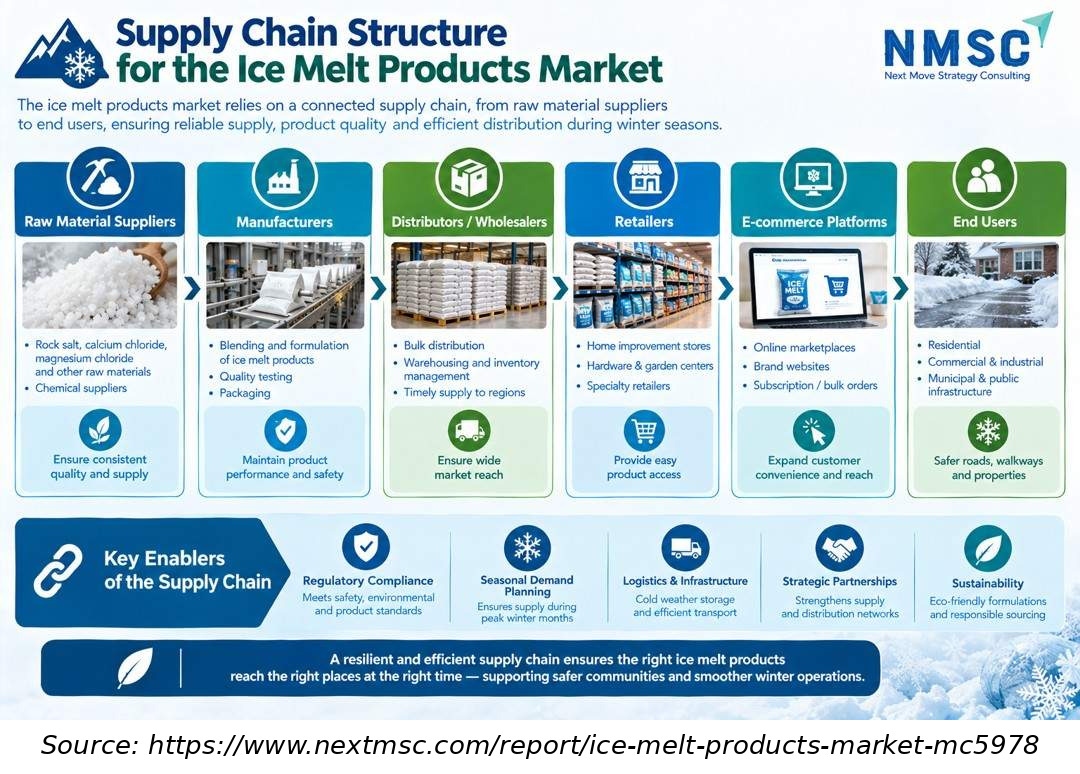
Supply Chain Analysis for the Ice Melt Products Market

The infographic outlines the Supply Chain Structure of the Ice Melt Products Market, tracing the flow from raw-material suppliers and manufacturers to distributors, retailers, e-commerce platforms, and end users. It highlights how seasonal demand planning, logistics, regulatory compliance, strategic partnerships, and sustainability support reliable product availability and efficient winter operations.

Growth Opportunities

Our analysis shows that three whitespace opportunities are positioned to generate disproportionate value for ice melt manufacturers, technology integrators, and investors through 2035.

Can Liquid Anti-Icer Smart Dispensing Systems Create a Recurring Service Revenue Stream?

Manufacturers that bundle liquid calcium chloride or magnesium chloride concentrates with connected dispensing system supply agreements can capture recurring revenue beyond one-time product sales, benefiting the Liquid form segment and Municipal and Government end-user category as smart road maintenance programs transition from spot purchase commodity procurement to outcome based service contracts with embedded material supply agreements across North American and Northern European highway networks.

Does New Cold-Climate Airport Construction in Asia-Pacific Create a Certified De-icer Platform Opportunity?

Manufacturers with AMS 1435 and AMS 1431 certified potassium acetate and potassium formate liquid de-icer products can establish early supply relationships with newly commissioned cold-climate international airports in China, South Korea, and Japan’s northern Hokkaido region, benefiting the Airport and Aviation application segment as each new runway commissioning creates 8 to 15 years of recurring certified product procurement that is technically locked to approved product lists.

Can EV Fleet Corrosion Protection Drive Adoption of Blended Formulations in Urban Municipalities?

Urban municipalities managing growing EV transit and public vehicle fleets can be addressed with performance data demonstrating the total cost of ownership advantage of blended and magnesium chloride formulations over sodium chloride, enabling premium product substitution at scale and benefiting the Blended Formulations active ingredient segment and Commercial and Industrial application category as electric fleet managers quantify the corrosion damage savings of lower chloride ice melt programs against premium input pricing.

Ecosystem Analysis

Regional Outlook

2025 (USD Million)
2035 (USD Million)
North Americ
Europe
Asia-Pacific
Middle East
Latin Americ
Region 2025 (USD Million) 2035 (USD Million) CAGR (%)
North America $10.0 USD Million $40.0 USD Million 9.0%
Europe $17.1 USD Million $51.1 USD Million 27.0%
Asia-Pacific $24.2 USD Million $62.2 USD Million 25.0%
Middle East & Africa $31.3 USD Million $73.3 USD Million 23.0%
Latin America $38.4 USD Million $84.4 USD Million 12.0%

Regional data is locked

Unlock complete regional numbers for this market.

Unlock Full Data

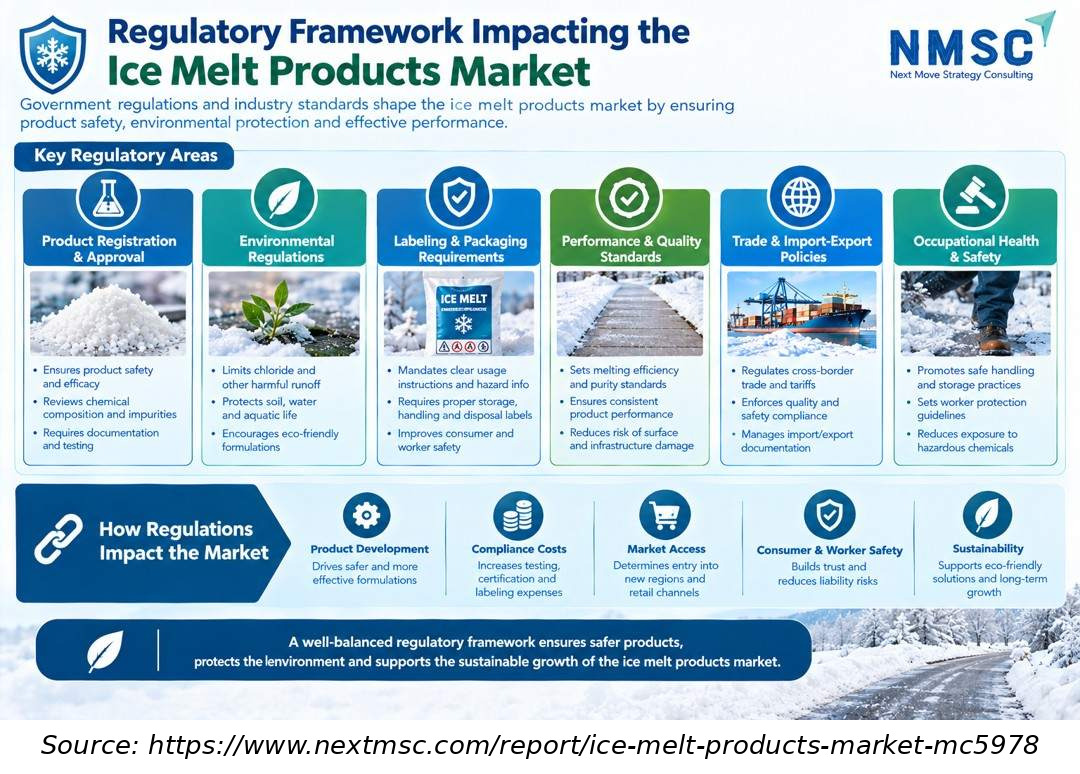
Regulatory Framework Impacting the Ice Melt Products Market

The infographic outlines the Regulatory Framework Impacting the Ice Melt Products Market, highlighting product registration, environmental regulations, labelling requirements, performance standards, trade policies, and occupational safety. It shows how these regulations influence product development, compliance costs, market access, safety, sustainability, and long-term market growth.

Competitive Landscape

Our assessment indicates that the Ice Melt Products Market Industry is moderately fragmented, with a handful of chemical specialty companies and salt producers holding significant share in commodity and near-commodity categories, while a growing tier of specialty formulators and certified aviation de-icer manufacturers compete on performance differentiation, environmental compliance credentials, and technical approvals.

Dimension Description
Market Structure Moderately fragmented; top 10 companies hold an estimated 55–60% of market share, with commodity salt producers competing alongside specialty de-icer formulators and certified aviation chemical manufacturers
Innovation Focus Liquid anti-icer formulation for smart dispensing systems, corrosion inhibitor additive technology for blended products, AMS-certified aviation de-icer development, and eco-friendly acetate and format-based active ingredients
M&A Activity Selective acquisitions of specialty de-icer formulators and certified aviation chemical producers by larger industrial chemical companies seeking premium product portfolio diversification beyond commodity rock salt

How Do Companies Compete in the Ice Melt Products Market Industry?

Companies compete primarily on active ingredient performance at low temperatures, technical approvals under FAA and AMS aviation de-icer certification standards, environmental compliance credentials under freshwater chloride regulations, and distribution network depth reaching municipal bulk procurement, contractor wholesale, and retail consumer channels. Our findings suggest that manufacturers with AMS-certified liquid potassium acetate and sodium format products hold a structural advantage in the high-value aviation segment, which is technically locked to approved product lists that new entrants require multi-year testing timelines to access.

Which Competitive Archetypes Dominate the Ice Melt Products Market Industry?

Diversified chemical and salt companies including Cargill, Incorporated and Compass Minerals International dominate bulk sodium chloride and calcium chloride volume through established mineral extraction and production infrastructure. Specialty de-icer formulators including Envirotech Services, Inc. differentiate on corrosion inhibitor additive systems and blended formulation performance credentials. Certified aviation chemical specialists including Kilfrost Limited and Clariant AG hold technical moats in AMS-certified airfield pavement de-icer categories.

What Innovation and Differentiation Strategies Are Companies Pursuing?

We observed that leading companies are investing in liquid anti-icer formulations compatible with automated road sensor-dispensing networks, corrosion inhibitor additive packages that reduce bridge deck and reinforcing steel damage relative to unmodified chloride salts, and AMS-certified potassium acetate and potassium format development for the growing cold-climate airport commissioning pipeline. Differentiation increasingly rests on environmental performance data chloride loading reduction per lane-kilometre treated as municipal road authorities integrate sustainability reporting into procurement specifications.

What M&A Activity Is Shaping the Ice Melt Products Market?

Recent activity Favors bolt-on acquisitions of specialty de-icer formulators and certified aviation chemical producers by larger industrial chemical companies, rather than large-scale commodity salt company consolidation. Our analysis shows that established specialty chemical companies are prioritizing access to AMS certification holders and corrosion inhibitor additive technology over greenfield development, given the multi-year testing and approval cycle required for aviation and infrastructure protective ice melt product qualification under federal and international standards.

Key Market Players

Based on research conducted by NMSC, the following companies represent the validated set of leading producers, formulators, and certified manufacturers active in the global Ice Melt Products Market.

Cargill, Incorporated Compass Minerals International, Inc. Morton Salt, Inc. Kissner Group Holdings Nordisk Saltimport A/S Kilfrost Limited Clariant AG Envirotech Services, Inc. OxyChem Dow Inc. Natural Blue Resources, Inc. Hawkins, Inc. Mid-American Research Chemical Corporation Scotwood Industries, Inc. Green Earth Deicer Road Solutions, Inc. Ossian, Inc. Wintersun Chemical Rhomar Industries, Inc.

Latest Developments

We found that recent corporate and regulatory activity in the Ice Melt Products Market reflects continued investment in specialty formulation development, smart road maintenance technology partnerships, and sustainability-aligned product launches across leading manufacturers.
Date Event
February 2026 Compass Minerals reaffirmed its commitment to supplying deicing salt across Canada, the U.S., and the U.K., while prioritizing municipal customers amid elevated winter demand. The company highlighted maximized mine output, coordinated transportation, and inventory availability across its North American production and distribution network.
February 2026 The Ohio Turnpike approved an additional purchase of up to $715,000 of EnviroTech’s Meltdown Apex-C, increasing the total purchase order to $1.6 million. The calcium-chloride-based liquid anti-icing and deicing product is being procured through Ohio Department of Transportation’s cooperative purchasing contract.

Investment Opportunities

Where Are Capital Inflows Concentrating in the Ice Melt Products Market?

Capital is concentrating in liquid anti-icer production capacity, specialty blended formulation manufacturing, and AMS-certified aviation de-icer development programs that enable access to the structurally locked in airport procurement channel. We found that private equity interest in specialty winter maintenance chemical companies is growing in parallel with smart road infrastructure investment, as manufacturers supplying integrated sensor-network-compatible liquid products can secure multi-year supply agreements with state DOTs and airport authorities that provide revenue visibility beyond seasonal commodity procurement cycles.

How Is Infrastructure Investment Shaping Long-Term Ice Melt Production Capacity?

Our findings suggest that infrastructure investment is shifting toward liquid brine production and calcium chloride flake manufacturing capacity expansion, as the transition from dry salt application to pre-wet and liquid spray programs requires dedicated liquid storage, blending, and tanker distribution infrastructure at regional distribution centres. Companies investing in liquid handling and delivery logistics infrastructure ahead of municipal smart road maintenance system rollouts are positioning to capture long-term bulk supply contracts as road authorities lock in liquid supplier relationships during winter maintenance equipment procurement.

What ESG Considerations Are Influencing Investment Decisions?

Environmental, Social, and Governance considerations in this market centre on freshwater chloride contamination from road salt runoff, concrete and reinforcing steel corrosion damage from chloride de-icers, and the lifecycle sustainability of acetate-based alternatives that are biodegradable but require specific end of life water treatment management. We observed that municipal procurement sustainability criteria are increasingly requiring environmental product declarations and chloride loading reduction commitments from de-icer suppliers, creating ESG-aligned revenue premium opportunities for manufacturers of certified low-chloride blended and acetate formulations.

Key Benefits for Stakeholders

How Does This Report Benefit Ice Melt Manufacturers and Chemical Distributors?

Ice melt manufacturers and chemical distributors gain segment-level revenue forecasts and CAGR benchmarks across active ingredient, form, application, and end-user axes, enabling product portfolio investment and regional channel priority decisions grounded in the same 2025–2035 figures applied consistently throughout this report. The competitive landscape analysis identifies which differentiation archetypes specialty blended formulations, liquid anti-icer formats, and AMS-certified aviation products are capturing above-market growth and which M&A patterns are consolidating specialty de-icer market share.

How Does This Report Benefit Investors and Financial Analysts?

Investors and financial analysts gain a reconciled market-sizing model anchored by official government publication data and company filings, plus a quantified Growth Catalyst & Risk Assessment Matrix that directly supports valuation and capital allocation decisions across specialty winter maintenance chemical companies. The 18.83% CAGR thesis is grounded in verifiable FHWA investment data and government aviation infrastructure programs, providing a fundamentals-supported basis for sector positioning beyond seasonal commodity chemical investment frameworks.

How Does This Report Benefit Municipal Road Authorities and Airport Operators?

Municipal road authorities and airport operators gain visibility into which ice melt product categories, particularly liquid forms and blended formulations, are delivering the highest cost-of-maintenance efficiency and environmental compliance performance relative to commodity sodium chloride alternatives. The regional analysis and country-level insights enable procurement benchmark comparison across peer agencies in similar climate zones, supporting evidence-based specification updates for winter maintenance chemical procurement contracts and sustainability reporting requirements.

Key Market Segments Evaluated

By Active Ingredient

  • Calcium Chloride
  • Sodium Chloride
  • Magnesium Chloride
  • Potassium Chloride
  • Calcium Magnesium Acetate
  • Potassium Acetate
  • Blended Formulations

By Form

  • Granular
  • Liquid
  • Flake

By Application

  • Roadways and Highways
  • Airport and Aviation
  • Pedestrian Walkways and Parking Lots
  • Commercial and Industrial
  • Residential

By End User

  • Municipal and Government
  • Commercial
  • Industrial
  • Residential

By Region

  • North America 
    • U.S.
    • Canada
    • Mexico.
  • Europe 
    • UK
    • Germany
    • France
    • Italy
    • Spain
    • Sweden
    • Denmark
    • Finland
    • Netherlands
    • Rest of Europe.
  • Asia-Pacific 
    • China
    • India
    • Japan
    • South Korea
    • Taiwan
    • Indonesia
    • Vietnam
    • Australia
    • Philippines
    • Malaysia
    • Rest of APAC.
  • Middle East & Africa 
    • Saudi Arabia
    • UAE
    • Egypt
    • Israel
    • Turkey
    • Nigeria
    • South Africa
    • Rest of MEA.
  • Latin America 
    • Brazil
    • Argentina
    • Chile
    • Colombia
    • Rest of LATAM.

Conclusion & Recommendations

The long-term outlook is structurally positive, with the market expanding from USD 1,089.62 Million in 2026 to USD 5,145.92 Million by 2035 at a CAGR of 18.83%, underpinned by accelerating smart road maintenance investment, cold-climate airport construction in Asia-Pacific, and the progressive regulatory shift from commodity sodium chloride toward specialty acetate and blended formulations. We observed that three independent demand engines highway infrastructure modernization, aviation expansion, and EV fleet corrosion protection provide structural revenue diversification well beyond traditional seasonal de-icer commodity cycles.

What Strategic Positioning Do We Recommend?

Our assessment indicates that manufacturers should prioritize liquid anti-icer formulation capacity development and AMS aviation deicer certification to capture the fastest-growing segment and application categories. Companies without established specialty formulation credentials should pursue targeted acquisitions of certified deicer producers or corrosion inhibitor additive technology developers rather than attempting greenfield certification programs, given the multi-year FAA and AMS approval timeline required for aviation channel access.

How Attractive Is the Ice Melt Products Market for Investment?

Investment attractiveness is highest in liquid formulation manufacturers, AMS-certified aviation de-icer specialists, and Asia-Pacific market entry platforms, with the region’s 27.7% CAGR offering the highest growth exposure. We found that the absolute revenue opportunity of USD 4,056.30 Million between 2026 and 2035 is supported by government infrastructure programs and regulatory mandates rather than discretionary demand cycles, providing above-average investment return predictability relative to seasonal commodity chemical categories.

What Are the Key Market Shifts and Risks?

Key risks include warmer winter seasons intermittently compressing sodium chloride commodity volume demand, commodity salt price pressure limiting specialty product substitution speed in emerging markets, and the risk that acetate de-icer supply chain constraints in potassium acetate precursor chemicals create delivery bottlenecks during peak winter procurement periods. Our analysis shows that companies over-concentrated in sodium chloride commodity volume without specialty segment exposure face above-average revenue volatility risk across climate-sensitive winter cycles.

What Are the Primary Growth Pathways Through 2035?

Primary growth pathways include smart road maintenance liquid anti-icer integration, cold-climate airport AMS-certified de-icer supply, and EV fleet corrosion protection product positioning. We observed that companies combining AMS-certified specialty de-icer portfolios with digital supply chain connectivity to smart road maintenance sensor networks and contracted airport supply agreements are best positioned to capture disproportionate share of the USD 4,056.30 Million absolute investment opportunity created in the market between 2026 and 2035.

FAQs

About the Author

Mihul Sharma

Mihul Sharma

Mihul Sharma is Research Associate at Next Move Strategy Consulting, where he has covered technology, industrial, and healthcare markets for 3 years. His work applies structured business research, market analysis, and secondary-source review to assess market trends, competitive developments, and growth opportunities. He supports report development by fully synthesizing industry data, company information, and market signals into concise findings for strategy and investment-focused research teams.

About the Reviewer

Supradip Baul

Supradip Baul

Supradip Baul is an accomplished business consultant and strategist with over a decade of rich experience in market intelligence, strategy, technology, and business transformation. His work has included rigorous qualitative and quantitative analysis across multiple industries, helping clients shape investment decisions and long-term roadmaps. Earlier in his career, he was associated with Gartner, where he contributed to industry-leading reports and market share analyses. He has worked with leading global companies and holds an MBA with a dual specialization in Marketing and Finance.

Download Free Sample

Pratyush Kumar Das

PRATYUSH KUMAR DAS

Assistant Manager

Polycab India Limited

We would like to express our appreciation for the data and insights provided by nextmsc. We are very pleased with the quality and depth of the information, which has proven to be highly valuable and beneficial for our business decision-making.

Gaurav Jaiswal

GAURAV JAISWAL

Founder & CEO

Yano Charge Private Limited

The EV Charging market research report provided by the NextMSC was exceptionally detailed and insightful. It offered a comprehensive analysis that proved to be a game-changer for our strategic planning. Truly a testament to the NextMSC’s expertise and thoroughness in EV market landscape & analysis.

Mohit Agarwal

MOHIT AGARWAL

Chief Manager

DryChem India Pvt. Ltd.

Next Move Strategy Consulting is an amazing team of consultants. We required a market study report for our investors on top priority and the team went above and beyond our expectations to deliver the same with ample supporting data within a short time span enabling us to secure the investments and keep our project timeline maintained. Their professionalism, attention to detail, and timely delivery of actionable recommendations have left a lasting impression on our organization.

Robert Sean Trevino

ROBERT SEAN TREVINO

Sr. Director, Head of Strategic Insights & Analytics

Foundation Medicine

I realized that it was a reliable source of information. These days, there are many people who are looking for authentic data, and this is one of the only sources that can offer them with what they need;

Henri Knyphausen

HENRI KNYPHAUSEN

Partner at Singulier [Ex-BCG]

Singulier

I recently engaged NEXTMSC.com for a commercial due diligence project within the intralogistics sector, and I am pleased to provide a reference based on my experience. In utilizing NEXTMSC.com's services, I found their report to offer valuable insights into market dynamics and key industry players. The initial report provided a solid foundation for our analysis. However, as we were investigating a smaller target in the market, and I had specific customization requests requiring additional research. These requests included detailed information on product portfolios of various players and sub-market sizes, both inclusive and exclusive of certain product categories. NEXTMSC.com demonstrated commendable responsiveness and agility in accommodating these customization requests. Within a timeframe of 1-2 weeks, they delivered a revised report that met our specific needs. Furthermore, they were receptive to my follow-up inquiries, ensuring clarity and understanding of the data provided. The final deliverable significantly contributed to our due diligence efforts. One of NEXTMSC.com's notable strengths lies in their qualitative research capabilities. However, for future engagements, I would recommend the inclusion of a quantified market model in Excel format. Such a model would offer the ability to conduct in-depth analyses and explore various market segments, including country-specific data and subcomponent breakdowns. Based on my positive experience, I would not hesitate to work with NEXTMSC.com again. Their responsiveness, willingness to accommodate customization requests, and commitment to delivering actionable insights make them a reliable partner for commercial research projects.

Custom Market Research Services

We will customize the research for you if the listed report does not fully match your requirements.

Get 30% Free Customization

Select License

This website uses cookies to ensure you get the best experience on our website. Learn more

✖