India Marketplace Platforms Market Size, Share, Trends and Growth Analysis, By Marketplace Archetype (Goods Marketplaces, Hyperlocal Marketplaces, Mobility and Logistics, Services Marketplaces, Talent and Staffing Marketplaces, Travel and Ticketing, and Classifieds and C2C), By Business Model, By Revenue Model, By Fulfilment Model, By Access Platform, By Buyer Type, and By Region — Industry Report and Forecast, 2026–2035
Industry: Retail and Consumer | Publishing Date: August 10, 2026 | Last Updated: August 10, 2026 | No of Pages: N/A | No. of Tables: N/A | No. of Figures: N/A | Format: PDF | Report Code: RC5656
What Is the India Marketplace Platforms Market Size?
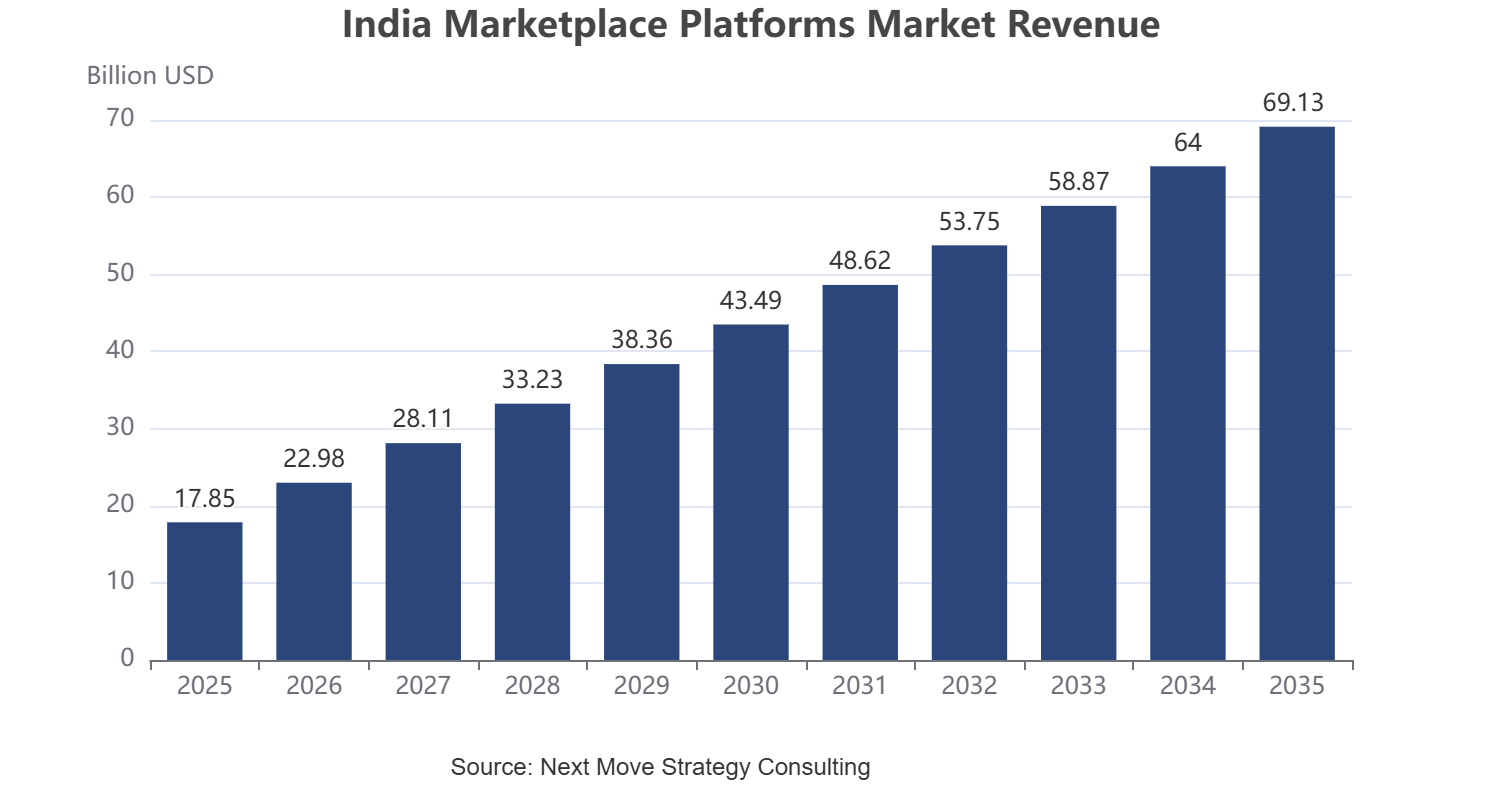
The India Marketplace Platforms Market size was valued at USD 17.85 Billion in 2025 and is estimated at USD 20.44 Billion in 2026, forecast to reach USD 69.13 Billion by 2035, expanding at a 14.5% CAGR between 2026 and 2035. Goods Marketplaces dominate all archetypes with approximately a 44% share.
We observed that growth is concentrated in hyperlocal quick commerce and services marketplaces, with app-first, asset-light platforms gaining disproportionate share against web-only and managed-fulfilment models through 2035.
|
Key Takeaways |
|
By Marketplace Archetype: Goods Marketplaces held the largest share of approximately 44% (USD 7.86 Billion) in 2025; Services Marketplaces is the fastest-growing sub-segment at 19.73% CAGR from 2026–2035. |
|
By Business Model: B2C held the largest share of approximately 62% (USD 11.07 Billion) in 2025; B2B is the fastest-growing sub-segment at 17.08% CAGR from 2026–2035. |
|
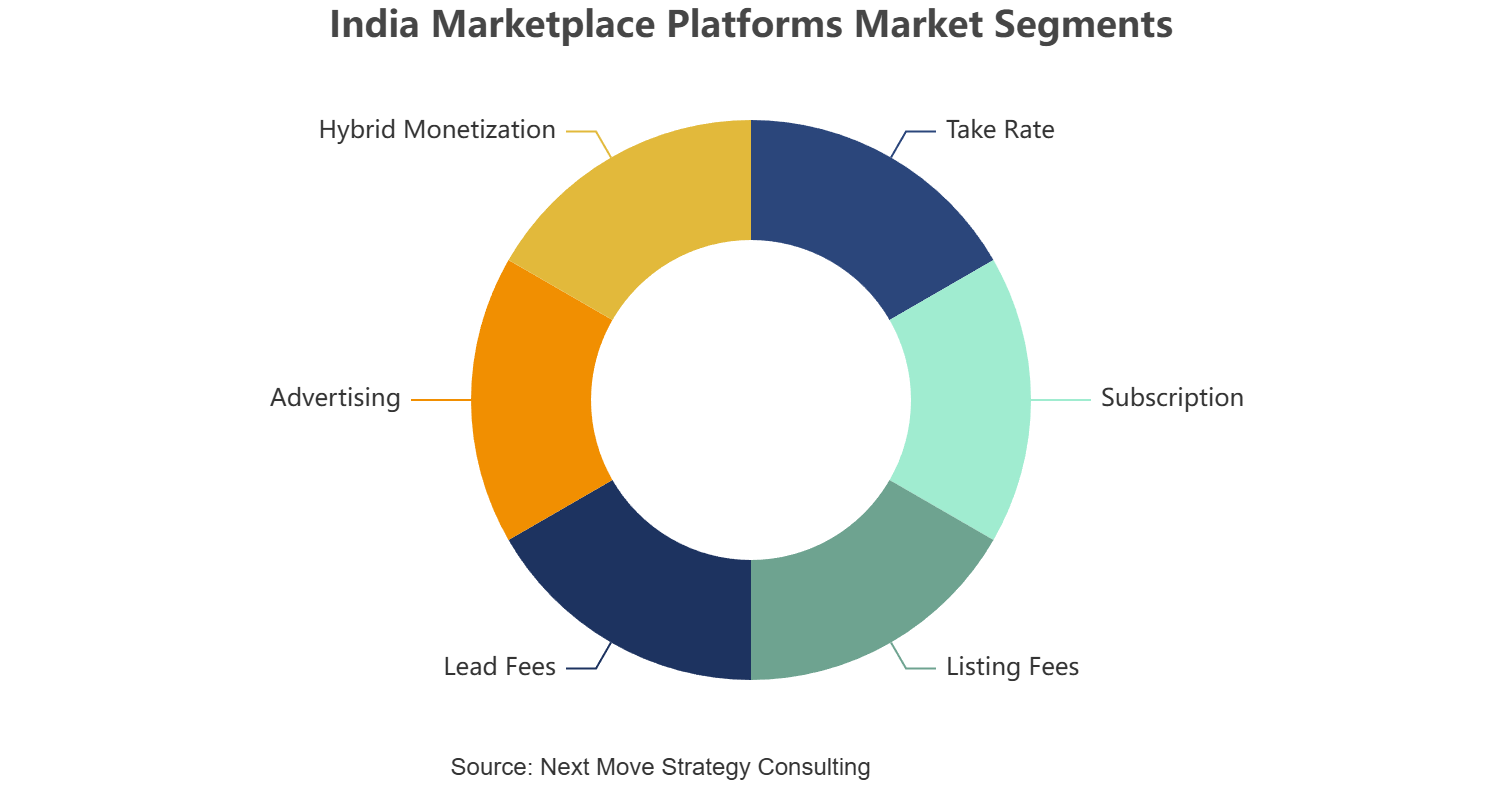
By Revenue Model: Take Rate held the largest share of approximately 48% (USD 8.57 Billion) in 2025; Advertising is the fastest-growing sub-segment at 21.2% CAGR from 2026–2035. |
|
By Fulfilment Model: Asset Light held the largest share of approximately 58% (USD 10.35 Billion) in 2025; Managed is the fastest-growing sub-segment at 18.94% CAGR from 2026–2035. |
|
By Access Platform: App held the largest share of approximately 71% (USD 12.67 Billion) in 2025 and is also the fastest-growing sub-segment at 16.19% CAGR from 2026–2035. |
|
By Buyer Type: Consumers held the largest share of approximately 69% (USD 12.32 Billion) in 2025; Small Businesses is the fastest-growing sub-segment at 19.21% CAGR from 2026–2035. |
Market Opportunity: The India Marketplace Platforms market is expected to create an absolute dollar opportunity of USD 48.69 Billion between 2026 and 2035, presenting significant investment potential across hyperlocal quick commerce and services marketplace expansion.
According to NMSC analysis, platforms are increasingly layering advertising and lead-generation revenue on top of core take-rate monetization rather than relying on transaction commissions alone, a shift that favors marketplaces with large repeat-visit consumer bases over narrowly transactional platforms as monetization intensity deepens through 2035.
India Marketplace Platforms Market Overview
What Does the India Marketplace Platforms Industry Encompass?
The India Marketplace Platforms industry encompasses digital platforms that connect buyers and sellers of goods, services, mobility, talent, travel, and classifieds without directly owning the underlying inventory in most cases. Our assessment indicates that the scope spans horizontal and vertical retail, hyperlocal quick commerce, mobility and logistics, services, talent and staffing, travel and ticketing, and classifieds marketplaces monetized through take rates, subscriptions, listing fees, and advertising across app, web, and hybrid access platforms.
The Ministry of Commerce and Industry's consolidated Foreign Direct Investment policy for e-commerce marketplaces and the Digital Personal Data Protection Act continue to shape marketplace operating structures and data handling practices. We observed that technology adoption is shifting toward app-first, asset-light architectures supported by AI-driven catalog and logistics optimization. NMSC's analysis indicates that this structural shift, combined with rising cross-border e-commerce logistics integration, is redefining monetization strategy across the marketplace platforms value chain.
|
Parameters |
Details |
|
Market Size in 2025 |
USD 17.85 Billion |
|
Market Size in 2026 |
USD 20.44 Billion |
|
Revenue Forecast in 2035 |
USD 69.13 Billion |
|
Growth Rate |
CAGR of 14.5% from 2026 to 2035 |
|
Analysis Period |
2025–2035 |
|
Base Year Considered |
2025 |
|
Forecast Period |
2026–2035 |
|
Market Size Estimation |
USD Billion |
|
Companies Profiled |
20 |
|
Countries Covered |
38 |
|
Market Share |
Available for Top 10 Companies |
Key Emerging Trends in the India Marketplace Platforms Market
Based on research conducted by NMSC, we found that four structural trends are reshaping platform architecture, monetization strategy, and stakeholder engagement across the India Marketplace Platforms market.
How Is Quick Commerce Transforming Hyperlocal Delivery Economics?
Ten- to fifteen-minute delivery formats are reshaping consumer expectations across grocery and daily essentials categories. We observed that Eternal Limited's Blinkit and Zepto Marketplace Private Limited continue to expand dark-store density to compress delivery windows further. This trend is transforming hyperlocal marketplace unit economics as platforms balance delivery speed against fulfilment cost per order.
Why Is Services Marketplace Formalization Accelerating?
Home and professional services marketplaces are formalizing previously unorganized service categories through verified provider networks. We observed that Urban Company Limited's expansion into new service categories and cities reflects sustained demand for standardized, trust-verified home services. This trend is elevating Services Marketplaces as the fastest-growing archetype within the broader platform ecosystem.
How Is B2B Wholesale Digitalization Reshaping Goods Marketplace Structure?
Digital B2B wholesale platforms are formalizing traditional offline distribution across FMCG, industrial supplies, and building materials categories. Our findings suggest that Reliance Retail Limited's continued investment in digital commerce infrastructure reflects large retailers' push to integrate B2B distribution with consumer-facing platforms. This trend is reshaping demand across the B2B Wholesale sub-segment within Goods Marketplaces.
What Role Does Talent and Staffing Marketplace Growth Play in Platform Diversification?
Gig and contract staffing marketplaces are expanding as enterprises increasingly source flexible talent through digital platforms rather than traditional agencies. Our analysis shows that Info Edge (India) Limited's continued investment across its recruitment platform portfolio reflects sustained enterprise demand for digital hiring infrastructure. This trend is reshaping demand across the Talent and Staffing Marketplaces archetype as formal gig employment expands.
Growth Drivers and Restraints
Growth Catalyst and Risk Assessment Matrix
|
Factors |
Type |
(+/-) % Impact on CAGR |
Geographic Relevance |
Impact Timeline |
|
Rising smartphone and low-cost data penetration |
Driver |
+2.8% |
National |
2026-2035 |
|
Expansion of quick commerce dark-store networks |
Driver |
+2.3% |
Metro and Tier-1 cities |
2026-2032 |
|
Growing formalization of home and professional services |
Driver |
+1.7% |
National |
2026-2035 |
|
Rising digital B2B wholesale adoption among small retailers |
Driver |
+1.3% |
National |
2026-2035 |
|
Expanding gig and contract staffing formalization |
Driver |
+0.9% |
National |
2026-2032 |
|
Growing advertising monetization on high-traffic platforms |
Driver |
+0.7% |
National |
2026-2035 |
|
Regulatory scrutiny of e-commerce FDI and marketplace structures |
Restraint |
-1.2% |
National |
2026-2032 |
|
Persistent losses in capital-intensive quick commerce operations |
Restraint |
-0.9% |
Metro cities |
2026-2030 |
|
Data protection compliance costs under new privacy legislation |
Restraint |
-0.5% |
National |
2026-2030 |
What Are the Growth Drivers and Restraints of the India Marketplace Platforms Market?
What Is the Primary Growth Driver of the Market?
Rising smartphone and low-cost data penetration is the primary driver of the market. The Telecom Regulatory Authority of India continues to report sustained growth in broadband subscriber additions across the country. We observed that this connectivity expansion, reinforced by rising digital payment adoption tracked by the National Payments Corporation of India, continues to anchor baseline growth for consumer-facing marketplace platforms across Tier-2 and Tier-3 cities.
How Is Quick Commerce Expansion Driving Market Growth?
Rapid dark-store network expansion is accelerating hyperlocal marketplace growth as platforms compress delivery windows to ten to fifteen minutes. Eternal Limited and Zepto Marketplace Private Limited continue to add dark-store locations across metro and Tier-1 cities to support this format. Our assessment indicates that this capacity expansion is compressing customer acquisition costs as quick commerce platforms achieve higher order density per dark store.
What Is Restraining India Marketplace Platforms Market Expansion?
Regulatory scrutiny of e-commerce foreign direct investment structures and marketplace operating models restrains expansion strategy for platforms with foreign ownership. The Ministry of Commerce and Industry continues to enforce marketplace-model FDI compliance requirements that restrict inventory ownership by foreign-invested entities. We found that this regulatory structure disproportionately affects platforms balancing foreign capital access against operational control over inventory and pricing.
How Is the India Marketplace Platforms Market Segmented in This Report, and What Are the Key Insights from the Segmentation Analysis?
By Marketplace Archetype
Segment Sizing: By Marketplace Archetype
|
Segment |
2025 (USD Billion) |
2035 (USD Billion) |
CAGR% (2026-2035) |
|
Goods Marketplaces |
7.86 |
26.27 |
12.65% |
|
Hyperlocal Marketplaces |
3.21 |
16.59 |
18.21% |
|
Mobility and Logistics |
2.32 |
8.99 |
14.49% |
|
Services Marketplaces |
1.07 |
6.22 |
19.73% |
|
Talent and Staffing Marketplaces |
0.89 |
4.15 |
16.87% |
|
Travel and Ticketing |
1.61 |
4.84 |
11.34% |
|
Classifieds and C2C |
0.89 |
2.07 |
8.18% |
|
Total |
17.85 |
69.13 |
14.50% |
Which Marketplace Archetype Dominates the Market?
Goods Marketplaces led the market with USD 7.86 Billion in 2025, supported by sustained horizontal and vertical retail transaction volume across Amazon Seller Services and Flipkart Internet's platforms. We observed that Services Marketplaces is the fastest-growing archetype, expanding at a 19.73% CAGR from 2026 to 2035, as home and professional services continue to formalize through verified provider networks such as Urban Company.
By Business Model
Segment Sizing: By Business Model
|
Segment |
2025 (USD Billion) |
2035 (USD Billion) |
CAGR% (2026-2035) |
|
B2C |
11.07 |
40.09 |
13.66% |
|
B2B |
3.21 |
15.21 |
17.08% |
|
C2C |
1.61 |
5.53 |
13.01% |
|
B2B2C |
1.96 |
8.30 |
15.61% |
|
Total |
17.85 |
69.13 |
14.50% |
Which Business Model Segment Leads the India Marketplace Platforms Market?
B2C led the market with USD 11.07 Billion in 2025, supported by sustained consumer transaction volume across goods, hyperlocal, and travel marketplaces. B2B is the fastest-growing business model, expanding at a 17.08% CAGR from 2026 to 2035, as digital wholesale platforms increasingly formalize traditional offline distribution across FMCG, industrial supplies, and building materials categories.
Porter's Five Forces Analysis of the Indian Marketplace Platform Industry
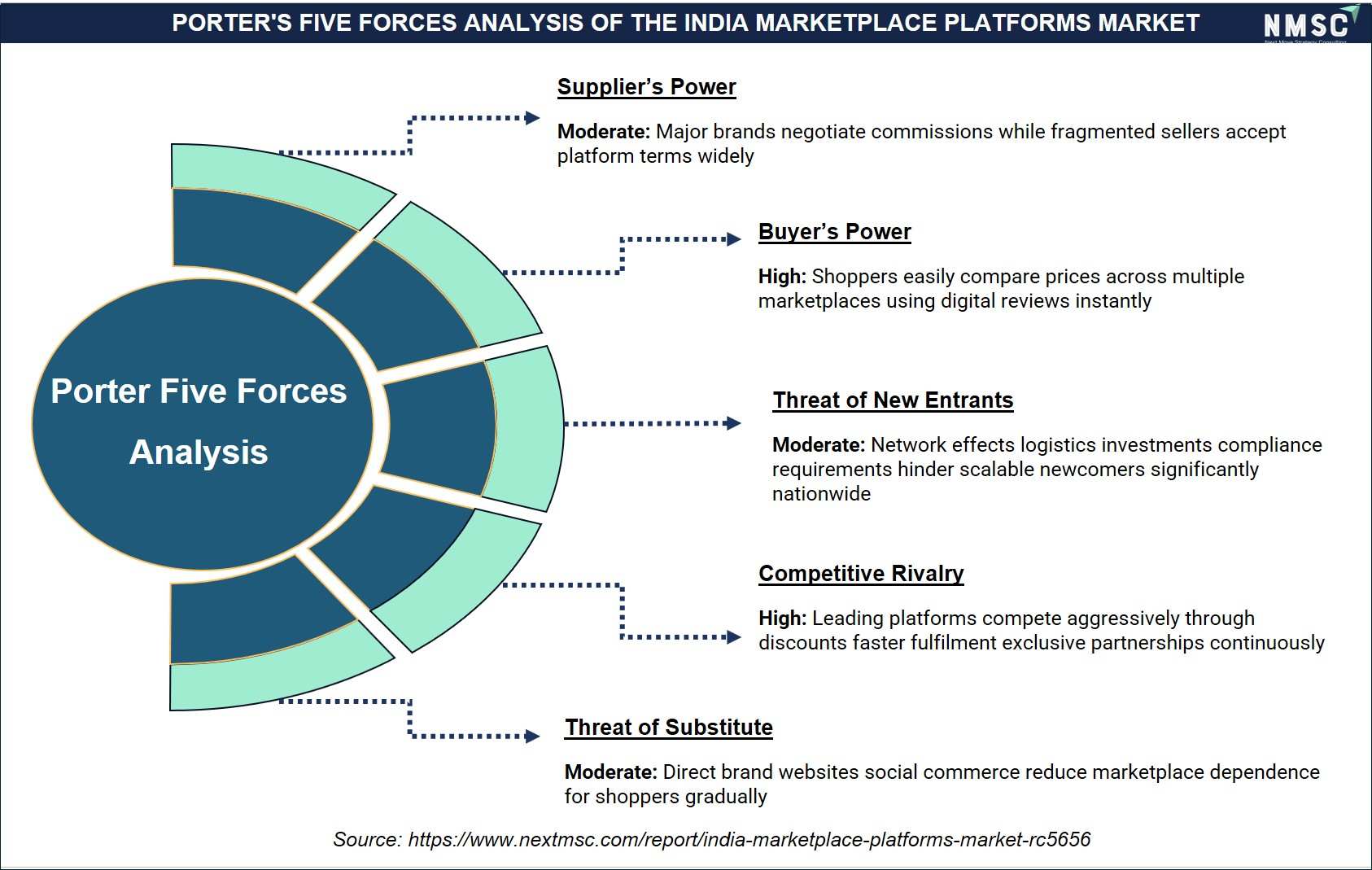
The above infographic presents a Porter's Five Forces analysis of the India marketplace platforms market, wherein supplier power remains moderate as major brands negotiate commercial terms while fragmented sellers largely accept platform conditions. Buyer power is high, driven by the ease of price comparison across multiple digital platforms. Furthermore, the threat of new entrants is moderate, constrained by network effects and logistics investments, while competitive rivalry is intense among leading players competing through discounts and fulfillment efficiency. Looking ahead, we observed that the threat of substitutes remains moderate, as direct brand websites and social commerce are gradually reducing marketplace dependency.
What Are the Growth Opportunities in the India Marketplace Platforms Market?
We found that three forward-looking whitespace opportunities stand out for stakeholders positioning within the India Marketplace Platforms market over the coming decade.
How Can Platforms Capture Demand From B2B Wholesale Digitalization?
Expanding digital adoption among traditional kirana and small retail networks creates a mechanism for B2B wholesale platforms to formalize previously offline FMCG and industrial supply distribution. Platforms offering integrated credit and logistics capability stand to benefit most, as small retailers increasingly prefer consolidated digital procurement over fragmented distributor relationships.
What Opportunity Does Services Marketplace Expansion Present Beyond Metro Cities?
Growing consumer trust in verified service provider networks creates a mechanism for services marketplaces to expand beyond metro cities into Tier-2 and Tier-3 markets. Platforms with scalable provider onboarding and quality assurance systems stand to benefit most, capturing underserved demand for standardized home and professional services outside established metro markets.
How Can Logistics-Enabled Platforms Unlock Cross-Border Commerce Contracts?
Rising export demand among Indian small businesses creates a mechanism for logistics-enabled marketplace platforms to offer integrated fourth party logistics capability for cross-border fulfilment. Platforms combining domestic marketplace scale with international logistics partnerships stand to benefit most, capturing small business sellers seeking simplified overseas market access.
Competitive Landscape
We observed that the India Marketplace Platforms market features a moderately consolidated competitive landscape, with large horizontal platforms competing alongside category-focused specialists on catalog breadth, delivery speed, and monetization depth.
|
Key Takeaways |
Details |
|
Market Structure |
Moderately consolidated; leading horizontal and category-focused platforms profiled in this report collectively account for a significant share of branded transaction value, while regional and niche platforms serve smaller category-specific demand. |
|
Innovation Focus |
Quick commerce dark-store densification, AI-driven catalog and logistics optimization, and services marketplace provider verification dominate current innovation pipelines across leading platforms. |
|
M&A Activity |
Selective category expansion and capacity investment, exemplified by continued dark-store network expansion by quick commerce platforms and category diversification by staffing and classifieds platforms. |
How Do Companies Compete in the India Marketplace Platforms Market?
Companies compete primarily on catalog breadth, delivery speed, and monetization depth across the industry. Large horizontal platforms such as Amazon Seller Services and Flipkart Internet leverage broad category coverage and logistics scale to serve mass-market consumers, while category-focused specialists such as Urban Company and Info Edge (India) compete on deep vertical expertise and provider or candidate quality within their respective services and staffing categories.
Which Competitive Archetypes Dominate the India Marketplace Platforms Industry?
Two archetypes dominate the market: large horizontal platforms offering broad multi-category catalogs with extensive logistics infrastructure, and category-focused vertical specialists building deep domain expertise in a single archetype. Flipkart Internet and Amazon Seller Services exemplify the horizontal archetype through broad goods marketplace coverage, while Urban Company and Bigtree Entertainment exemplify the vertical specialist archetype focused on services and events ticketing respectively.
How Are Companies Differentiating Through Innovation in Marketplace Platforms?
Innovation and differentiation strategy increasingly center on delivery speed and AI-driven personalization. Eternal Limited's and Zepto Marketplace's continued dark-store network expansion reflects efforts to secure differentiated positioning in the quick commerce category. Our analysis shows that platforms unable to demonstrate rapid fulfilment or deep category verification risk losing share to more specialized or faster-delivering competitors.
What M&A and Expansion Activity Is Shaping the Market?
Category expansion and capacity investment continue to reshape competitive positioning within the industry. Continued dark-store network expansion by quick commerce platforms and category diversification efforts by staffing and classifieds platforms illustrate how established players pursue organic capacity growth and category broadening rather than large-scale acquisitions to expand market presence.
Key Market Players in the India Marketplace Platforms Market
Our assessment indicates that the following 20 companies are actively shaping catalog breadth, delivery innovation, and monetization strategy within the India Marketplace Platforms market.
-
Amazon.com, Inc.
-
Flipkart Private Limited
-
Reliance Retail Ventures Limited
-
Fashnear Technologies Private Limited
-
Eternal Limited
-
Swiggy Limited
-
FSN E-Commerce Ventures Limited
-
Uber Technologies, Inc.
-
MakeMyTrip Limited
-
BrainBees Solutions Limited
-
Info Edge (India) Limited
-
Urban Company Limited
-
Kiranakart Technologies Private Limited
-
Bigtree Entertainment Private Limited
-
SmartShift Logistics Solutions Private Limited
-
CARS24 Services Private Limited
-
AgRevolution Private Limited
-
Infocom Network Private Limited
-
NoBroker Technologies Solutions Private Limited
-
Pepperfry Limited
What Are the Latest Developments in the India Marketplace Platforms Industry?
We found that recent capacity and category expansion activity within the India marketplace platforms supply chain are concentrated on quick commerce densification and services category broadening.
|
Date |
Event |
|
June 2026 |
Flipkart Group partnered with Meta to scale creator-led e-commerce across Facebook and Instagram, enabling content creators to tag Flipkart and Myntra products directly within posts and Reels. |
|
Jan 2026 |
Proptech marketplace NoBroker launched its flagship Property Carnival initiative, partnering with over 15 major real estate developers in key urban centers like Mumbai. The initiative bridges online discovery with offline deal closures, offering exclusive payment plans and direct developer pricing to buyers. |
|
May 2025 |
Swiggy expanded its 10-minute food marketplace offering, 'Bolt,' across more than 500 Indian cities in metro and Tier-2/3 regions. Partnering with over 45,000 QSR and local restaurant brands within a 2 km delivery radius, the service caters to growing Indian demand for rapid-prep food delivery. |
Expert Insights
 "Mumbai's residential market is witnessing a phase of sustained, end-user driven demand. Despite price appreciation across key micro-markets, buyer interest remains robust, supported by stable income growth, improved infrastructure visibility, and developers offering more structured and flexible payment options."
- Saurabh Garg, Co-founder and Chief Business Officer of NoBroker
Statement made during the announcement of the NoBroker Property Carnival in Mumbai.
Market Interpretation
The statement reflects the continued evolution of India's marketplace platform ecosystem toward integrated, digital-first property transaction experiences that combine property discovery, transparent pricing, and flexible financing options within a single platform. NMSC's analysis indicates that marketplace platforms are increasingly moving beyond simple listing services by offering value-added capabilities such as verified inventories, digital payment solutions, financing support, and direct developer engagement. Our findings suggest that rising consumer preference for transparent, technology-enabled purchasing journeys is encouraging platform providers to build end-to-end digital ecosystems that enhance customer trust, improve transaction efficiency, and strengthen the long-term growth of the India Marketplace Platforms Market.
Consumer Behavior Analysis of the Indian Marketplace Platform Industry
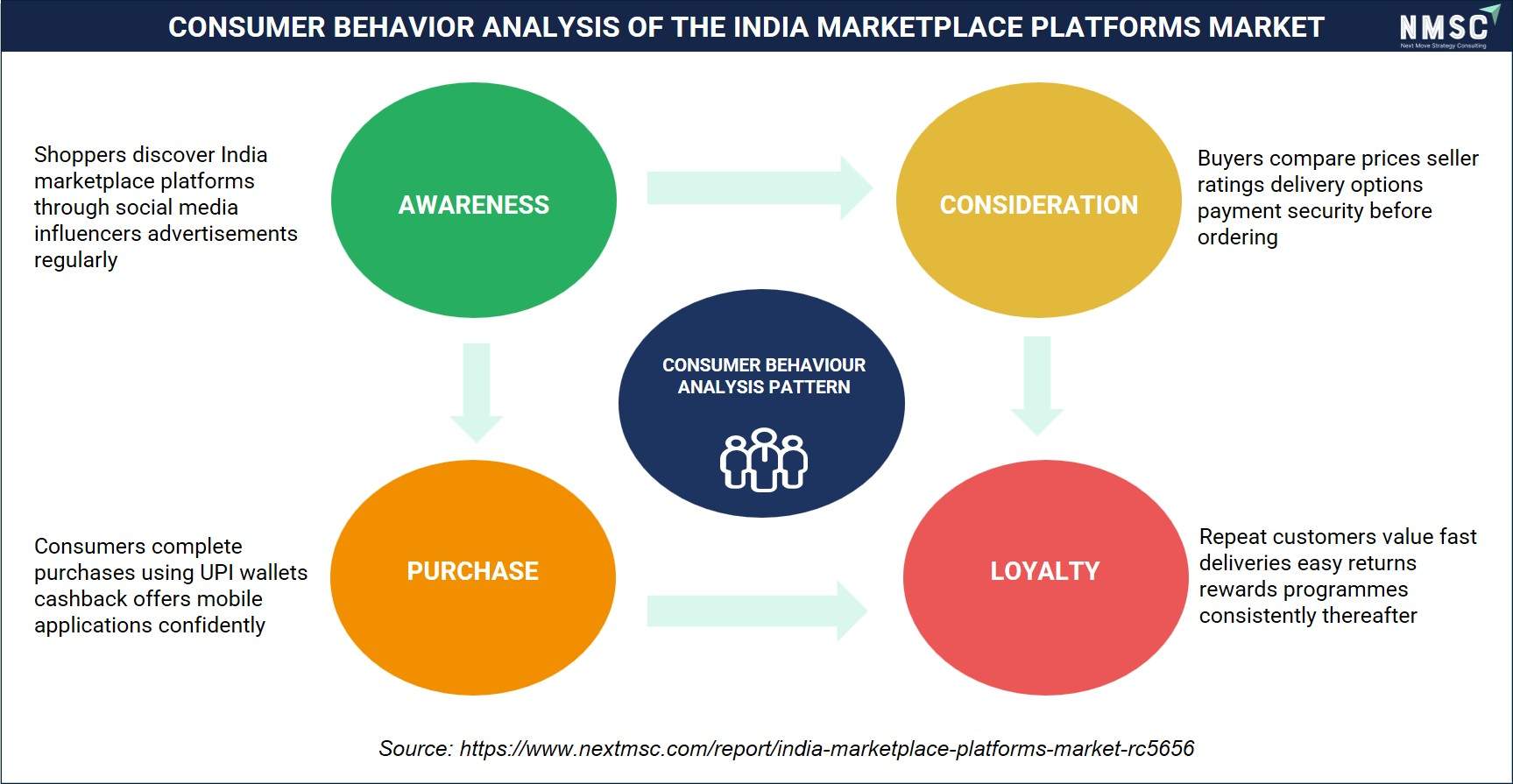
The above infographic presents a consumer behavior analysis of the India marketplace platforms market, mapping the journey from awareness to loyalty. Shoppers discover platforms through social media and influencer campaigns, leading them to evaluate product variety, pricing, and seller ratings before purchasing via UPI, wallets, and mobile apps. Once satisfied, repeat customers continue to engage, driven by fast deliveries, easy returns, and loyalty rewards. Looking ahead, we observed that trust-building and value-added services remain central to sustaining long-term customer retention and platform growth across the competitive Indian e-commerce landscape.
What Are the Investment Opportunities in the India Marketplace Platforms Market?
What Capital Inflows Are Supporting the India Marketplace Platforms Market?
Platforms are directing capital toward dark-store network expansion, services provider onboarding, and logistics capacity. Continued investment by Eternal Limited and Zepto Marketplace in quick commerce infrastructure illustrates sustained capital commitment supporting hyperlocal delivery capacity across metro and Tier-1 cities.
How Is Infrastructure Investment Shaping India Marketplace Platforms Demand?
Government digital infrastructure investment, including the Unified Payments Interface and expanding broadband connectivity programs, continues to expand the addressable consumer base for marketplace platforms. Our assessment indicates that sustained public digital infrastructure investment is creating multi-year demand pipelines for platforms expanding into Tier-2 and Tier-3 cities.
What ESG Considerations Are Influencing India Marketplace Platforms Investment Decisions?
Environmental, social, and governance considerations are increasingly influencing capital allocation toward gig worker welfare and sustainable logistics practices. Platforms are facing growing scrutiny regarding gig worker social security coverage under evolving national labor codes. We observed that investors are favoring platforms with documented gig worker welfare programs as sustainability-linked scrutiny of platform labor practices increases.
Key Benefits for Stakeholders
How Does This Report Benefit Industry Leaders and Platform Operators?
Industry leaders and platform operators gain granular segmentation data across marketplace archetype, business model, and regional axes, enabling informed category expansion decisions for new platform initiatives. Our analysis, data, and forecasts help operators benchmark monetization strategy against verified 2025–2035 market trajectories and evolving fulfilment model trends.
How Does This Report Benefit Investors and Financial Analysts?
Investors and financial analysts gain a validated 2025 base-year market size, a fundamentals-supported 2026–2035 CAGR, and segment-level growth trajectories that support capital allocation and competitive benchmarking decisions. The report's strategic insights into platform expansion and monetization trends help analysts assess relative positioning across the India marketplace platforms value chain.
How Does This Report Benefit Technology Vendors and Product Teams?
Technology vendors and product teams gain visibility into the fastest-growing sub-segments, including Services Marketplaces and Small Businesses buyers, informing product roadmap and go-to-market prioritization aligned with documented buyer and archetype demand shifts through 2035.
Key Market Segments
By Marketplace Archetype
-
Goods Marketplaces
-
Horizontal Retail
-
Vertical Retail
-
Fashion
-
Beauty and Personal Care
-
Baby and Kids
-
Home and Furniture
-
Electronics and Appliances
-
Books and Stationery
-
-
B2B Wholesale
-
FMCG
-
Industrial Supplies
-
Agriculture Inputs
-
Building Materials
-
Office Supplies
-
-
Agritech Commerce
-
Farm Inputs
-
Farm Produce
-
-
Digital Goods
-
Software
-
E Books
-
Music
-
Video
-
Games
-
-
-
Hyperlocal Marketplaces
-
Food Delivery
-
Quick Commerce
-
-
Mobility and Logistics
-
Ride Hailing
-
Freight Brokerage
-
Parcel Delivery
-
-
Services Marketplaces
-
Home Services
-
Professional Services
-
-
Talent and Staffing Marketplaces
-
Jobs
-
Gig Staffing
-
Contract Staffing
-
-
Travel and Ticketing
-
Air Travel
-
Hotel Booking
-
Holiday Packages
-
Bus Booking
-
Rail Booking
-
Events Ticketing
-
-
Classifieds and C2C
-
Real Estate
-
Used Vehicles
-
Matrimony
-
General Listings
-
By Business Model
-
B2B
-
B2C
-
C2C
-
B2B2C
By Revenue Model
-
Take Rate
-
Subscription
-
Listing Fees
-
Lead Fees
-
Advertising
-
Hybrid Monetization
By Fulfilment Model
-
Asset Light
-
Managed
-
Hybrid
By Access Platform
-
App
-
Web
-
App and Web
By Buyer Type
-
Consumers
-
Small Businesses
-
Enterprises
-
Public Sector
Conclusion and Recommendations
What Is the Long-Term Outlook for the Market?
The India Marketplace Platforms market is positioned for sustained growth through 2035, underpinned by rising smartphone penetration and deepening platform monetization. We expect Services Marketplaces and B2B business models to gain structural share as formalization continues, while Goods Marketplaces and B2C retain their position as the largest revenue contributors across the forecast period.
What Strategic Positioning Should Manufacturers Pursue?
Platforms should prioritize delivery speed and category verification depth to align with evolving consumer and small business expectations. Our assessment indicates that platforms investing in dark-store densification and provider verification systems, following the pattern established by Eternal Limited and Urban Company, are best positioned to capture quick commerce and services marketplace opportunities through 2035.
How Attractive Is the India Marketplace Platforms Market for Investment?
The market presents an attractive investment case, supported by a validated USD 48.69 Billion absolute dollar opportunity between 2026 and 2035 and a fundamentals-backed 14.5% CAGR. Sustained platform expansion activity, as demonstrated by continued dark-store and services category investment across leading players, signals sustained investor confidence in the segment's growth trajectory.
What Market Shifts and Key Risks Should Stakeholders Monitor?
Stakeholders should monitor regulatory scrutiny of e-commerce FDI and marketplace operating structures, which restrains expansion strategy for foreign-invested platforms. We found that persistent losses in capital-intensive quick commerce operations also pose a risk to near-term profitability, particularly for platforms dependent on continued external capital to fund dark-store expansion.
What Are the Key Growth Pathways Through 2035?
Key growth pathways include expanding B2B wholesale digitalization among small retailers, scaling services marketplace formalization beyond metro cities, and deepening advertising monetization on high-traffic platforms. Our findings suggest that platforms combining catalog breadth with deep category verification are best positioned to capture a disproportionate share of the market's projected USD 69.13 Billion 2035 revenue base.
About the Author
 Mayurima Roy
— Mayurima Roy is Research Analyst at Next Move Strategy Consulting, where she has spent 4 years working across the firm's full industry coverage rather than a single fixed vertical. Her work centers on structured research, ongoing trend tracking, competitive assessment, and insight-led content development, translating complex market data into clear, decision-ready narratives that support informed client decision-making across diverse global industries, market sectors, and world regions every day.
Mayurima Roy
— Mayurima Roy is Research Analyst at Next Move Strategy Consulting, where she has spent 4 years working across the firm's full industry coverage rather than a single fixed vertical. Her work centers on structured research, ongoing trend tracking, competitive assessment, and insight-led content development, translating complex market data into clear, decision-ready narratives that support informed client decision-making across diverse global industries, market sectors, and world regions every day.
About the Reviewer
 Supradip Baul
— Supradip Baul is an accomplished business consultant and strategist with over a decade of rich experience in market intelligence, strategy, technology, and business transformation. His work has included rigorous qualitative and quantitative analysis across multiple industries, helping clients shape investment decisions and long-term roadmaps. Earlier in his career, he was associated with Gartner, where he contributed to industry-leading reports and market share analyses. He has worked with leading global companies and holds an MBA with a dual specialization in Marketing and Finance.
Supradip Baul
— Supradip Baul is an accomplished business consultant and strategist with over a decade of rich experience in market intelligence, strategy, technology, and business transformation. His work has included rigorous qualitative and quantitative analysis across multiple industries, helping clients shape investment decisions and long-term roadmaps. Earlier in his career, he was associated with Gartner, where he contributed to industry-leading reports and market share analyses. He has worked with leading global companies and holds an MBA with a dual specialization in Marketing and Finance.
At Next Move Strategy Consulting, we understand that insightful market research is the cornerstone of successful business decisions. That's why we employ a robust and multifaceted approach, combining various methodologies to deliver the most accurate and actionable data for our clients.

Research Landscape
We navigate the world of research with two primary approaches:
Qualitative Approach
Our qualitative research methodologies involve immersive techniques such as in-depth interviews, focus groups, and observational studies. By engaging directly with individuals and stakeholders, we uncover valuable insights that quantitative data alone may overlook.

Quantitative Research
In tandem with qualitative methodologies, NMSC leverages the power of Quantitative Research to provide a robust foundation of numerical insights. Through systematic data collection and analysis, we quantify patterns, preferences, and market trends, offering a comprehensive view of the business landscape.
Our quantitative research approach employs diverse tools, including surveys, experiments, and statistical modelling. These methodologies enable us to gather data from a large and representative sample, ensuring the statistical significance of our findings. By employing structured questionnaires and standardized data collection methods, we guarantee the reliability and validity of the information we present to our clients.
Quantitative research is particularly effective in measuring the prevalence of trends, assessing market size, and gauging the impact of various factors on consumer behavior. The numerical precision attained through this approach equips our clients with actionable insights, facilitating data-driven decision-making and strategy formulation.


Our Specialized Toolbox for Industry-Specific Market Research
We deploy a specialized arsenal of techniques tailored to meet your unique requirements. Here's a glimpse into our comprehensive toolbox:

Information Procurement
The stage entails acquiring market data or relevant information through various sources and methodologies.


Market Research Approach
We utilize both top-down and bottom-up approaches in market research analysis to achieve a comprehensive understanding of the market dynamics, leveraging the broad perspective of industry trends and macroeconomic factors alongside detailed insights from specific segments and individual companies.

Porters Five Forces Analysis
We conduct Porter's Five Forces analysis to evaluate the competitive landscape of an industry, providing us with insights into factors that affect profitability and strategic positioning.

SWOT Analysis

Forecasting
We utilize a forecasting model to predict future consumption by considering parameters like population, economics, regulations, market competition, drivers, constraints, technology, and pricing. We also employ statistical techniques such as multilinear regression, exponential smoothing, moving average, ARIMA, and Monte Carlo simulations for accurate predictions. In econometric forecasting, we analyzed short-term and long-term event impacts, attributing values based on regulatory frameworks, economic factors, and market events.





 Speak to Our Analyst