Indoor Positioning and Indoor Navigation Market Global Industry Analysis and Forecast (2026-2035)

Indoor positioning and indoor navigation market size is estimated at USD 127.97 billion in 2026, projected to reach USD 880.27 billion by 2035, growing at a CAGR of 23.90% from 2026 to 2035. Key drivers include rising smart building and warehouse automation investment, expanding UWB precision tracking adoption, and increasing demand for integrated location intelligence, with North America leading the market and Asia-Pacific registering the fastest growth.

Download Free Sample PDF
Base Year (2025)
$44.38 Billion
Forecast (2035)
$880.27 Billion
CAGR (2026-2035)
23.9%
Top Region
North America

What Is the Indoor Positioning and Indoor Navigation Market Size?

The global indoor positioning and indoor navigation market size was valued at USD 44.38 billion in 2025 and is estimated at USD 127.97 billion in 2026, forecast to reach USD 880.27 billion by 2035, expanding at a 23.90% CAGR between 2026 and 2035. North America leads with approximately 36% share, while hardware dominates all other offerings with approximately 44% share.

We observed that growth is broad-based across every segmentation axis, with UWB precision positioning and Asia-Pacific smart building deployment driving the most pronounced structural shifts through 2035.

Indoor Positioning and Indoor Navigation Market Global Industry Analysis and Forecast (2026-2035) Revenue Forecast

Values in USD Billion

2025 $44.38 Billion
2025
2026 $127.97 Billion
2026
2027 $158.55 Billion
2027
2028 $196.45 Billion
2028
2029 $243.40 Billion
2029
2030 $301.57 Billion
2030
2031 $373.65 Billion
2031
2032 $462.95 Billion
2032
2033 $573.60 Billion
2033
2034 $710.69 Billion
2034
2035 $880.27 Billion
2035

Key Takeaways

By Offering: Hardware held the largest share of approximately 44% (USD 19.53 billion) in 2025; Software is the fastest-growing sub-segment at 26.6% CAGR from 2026–2035.

By Technology: BLE held the largest share of approximately 38% (USD 16.86 billion) in 2025; UWB is the fastest-growing sub-segment at 28.5% CAGR from 2026–2035.

By Application: Asset Tracking held the largest share of approximately 34% (USD 15.09 billion) in 2025; Location Analytics is the fastest-growing sub-segment at approximately 27.0% CAGR from 2026–2035.

By Deployment: Cloud held the largest share of approximately 52% (USD 23.08 billion) in 2025; Hybrid is the fastest-growing sub-segment at approximately 27.5% CAGR from 2026–2035.

By End User: Healthcare held the largest share of approximately 24% (USD 10.65 billion) in 2025; Government is the fastest-growing sub-segment at 30.8% CAGR from 2026–2035.

Dominant Region: North America dominated with approximately 36% revenue share (USD 15.98 billion) in 2025.

Fastest-Growing Region: Asia-Pacific is expected to register the highest CAGR of 27.3% during 2026–2035.

Dominant Country: U.S. led with approximately USD 12.78 billion in 2025.

Fastest-Growing Country: India is the fastest-growing country at approximately 29.8% CAGR from 2026–2035.

Market Opportunity: The indoor positioning and indoor navigation market is expected to create an absolute dollar opportunity of USD 752.30 billion between 2026 and 2035, presenting significant investment potential across UWB precision tracking and cloud-native positioning platforms.

According to NMSC analysis, enterprises are increasingly consolidating positioning hardware, mapping software, and analytics into unified platforms, a shift that favors full-stack vendors over single-technology specialists as hybrid BLE-UWB deployments become standard across healthcare and logistics facilities through 2035.

What Does the Indoor Positioning and Indoor Navigation Market Encompass?

The indoor positioning and indoor navigation market encompasses hardware, software, and services that determine and visualize the real-time location of people and assets inside buildings where satellite positioning is unreliable. Our assessment indicates that the scope spans tags, beacons, anchors, readers, and gateways alongside positioning, mapping, navigation, and analytics software deployed across healthcare, manufacturing, logistics, retail, and transportation facilities worldwide. The category has evolved from simple wayfinding kiosks into precision real-time location systems, driven by smart building investment, patient and asset safety mandates, and warehouse automation.
Regulatory frameworks such as building accessibility codes and healthcare asset-tracking compliance guidance shape deployment requirements, while national telecommunications authorities increasingly reference ultra-wideband spectrum allocation in location technology guidance. We observed that technology adoption is shifting toward hybrid BLE-UWB architectures that combine broad coverage with sub-meter precision. NMSC's analysis indicates that this structural shift, combined with growing edge computing integration, is redefining deployment criteria across the market.

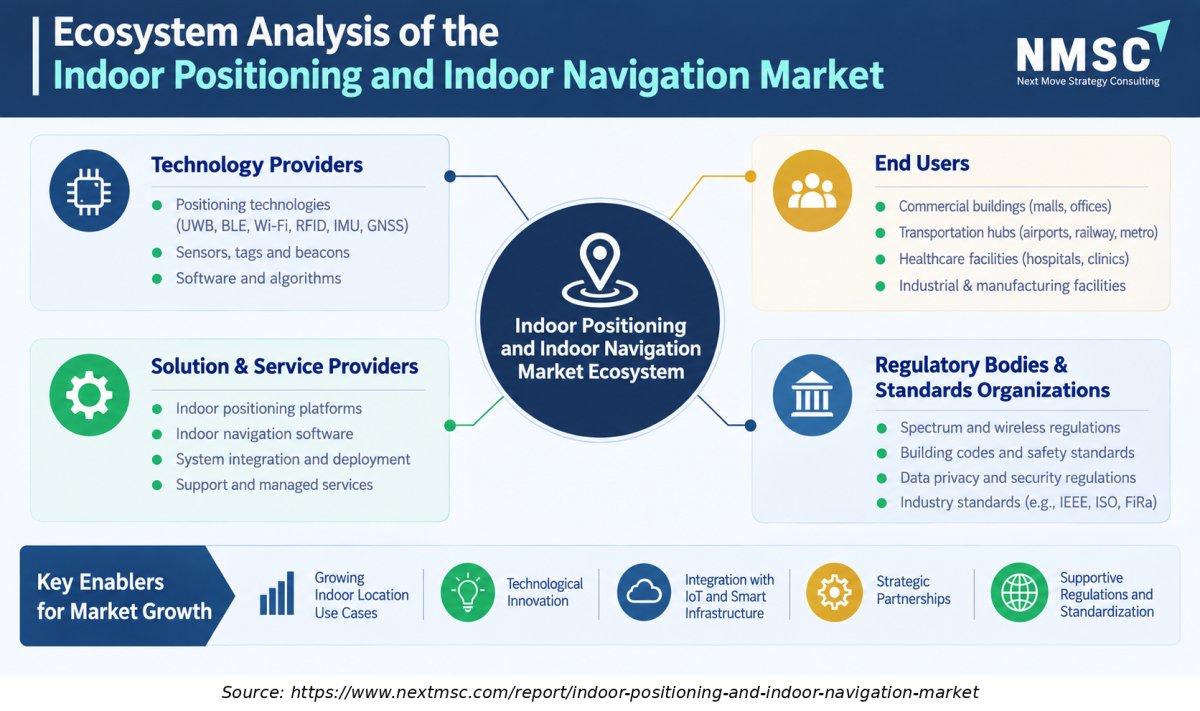
Ecosystem Analysis of the Indoor Positioning and Indoor Navigation Market

This infographic presents the Ecosystem Analysis of the Indoor Positioning and Indoor Navigation Market, highlighting positioning technology providers, hardware and sensor providers, mapping and location software providers, system integrators, service providers, and end users. It also covers supporting stakeholders such as network and connectivity providers, data and analytics providers, cybersecurity providers, and regulatory and standards bodies that enable accurate, secure, and scalable indoor positioning solutions.

Market Drivers & Dynamics

Interactive Dataset
Rising smart building and warehouse automation investment driver +4.8% Global 2026–2035
Expanding UWB precision tracking adoption driver +4.1% North America, Europe 2026–2035
Growing healthcare asset and patient safety mandates driver +3.4% Global 2026–2032
Rapid Asia-Pacific manufacturing and logistics digitization driver +3.9% Asia-Pacific 2026–2035
Platform consolidation through acquisition and integration driver +2.6% Global 2026–2032
Rising digital twin and smart building software integration driver +2.2% Global 2026–2035
High infrastructure cost for dense anchor and beacon deployment restraint −2.1% Global 2026–2032
Signal interference and accuracy limitations in complex facilities restraint −1.3% Global 2026–2032
Data privacy concerns around workforce and visitor tracking restraint −1.0% Europe, North America 2026–2035
Source: Next Move Strategy Consulting

Growth Drivers

What Is the Primary Growth Driver of the Indoor Positioning and Indoor Navigation Market?

Rising smart building and warehouse automation investment is the primary driver of the market. The U.S. Census Bureau's manufacturing and warehousing data continues to track expanding automation capital expenditure, sustaining demand for real-time location systems capable of tracking assets and workflows across increasingly automated facilities. We observed that this automation investment, reinforced by expanding UWB precision tracking adoption, continues to anchor baseline demand across developed and emerging indoor positioning markets alike.

How Is UWB Technology Driving Indoor Positioning and Indoor Navigation Market Growth?

Ultra-wideband technology adoption is accelerating market growth as enterprises demand sub-meter positioning accuracy for safety-critical and high-value asset tracking applications. New UWB infrastructure designed around the 8 GHz band is reducing cabling requirements by up to 80%, lowering total deployment cost for industrial facilities. Our assessment indicates that this infrastructure cost reduction is compressing adoption timelines for precision tracking across manufacturing, healthcare, and logistics operators previously limited to lower-precision BLE deployments.

Growth Inhibitors

What Is Restraining Indoor Positioning and Indoor Navigation Market Expansion?

High infrastructure cost for dense anchor and beacon deployment restrains market expansion, particularly for facilities requiring sub-meter UWB coverage across large footprints. Signal interference from metal structures and dense equipment layouts further complicates accuracy in industrial and healthcare environments. We found that operators lacking phased deployment strategies face particular exposure, as full-facility infrastructure costs compress return on investment compared with organizations prioritizing high-value zones for initial rollout.

Segmentation Analysis

2025 (USD Billion)
2035 (USD Billion)
Hardware 2025: $19.53 Billion | 2035: $303.69 Billion
Hardware
Software 2025: $14.65 Billion | 2035: $352.11 Billion
Software
Services 2025: $10.21 Billion | 2035: $224.47 Billion
Services
Hardware $19.53 Billion $303.69 Billion 20.6%
Software $14.65 Billion $352.11 Billion 26.6%
Services $10.21 Billion $224.47 Billion 25.3%

Which Offering Dominates the Indoor Positioning and Indoor Navigation Market?

Hardware, encompassing tags, beacons, anchors, readers, and gateways, led the market with USD 19.53 billion in 2025, supported by the foundational role of physical infrastructure in every positioning deployment. We observed that Software is the fastest-growing offering, expanding at a 26.6% CAGR from 2026 to 2035, as positioning, mapping, navigation, and analytics platforms increasingly capture recurring revenue beyond one-time hardware installation.

2025 (USD Billion)
2035 (USD Billion)
BLE
UWB
Wi-Fi
RFID
Others
Segment Item 2025 (USD Billion) 2035 (USD Billion) CAGR
BLE $10.0 USD Billion $40.0 USD Billion 25.0%
UWB $17.1 USD Billion $51.1 USD Billion 11.0%
Wi-Fi $24.2 USD Billion $62.2 USD Billion 25.0%
RFID $31.3 USD Billion $73.3 USD Billion 11.0%
Others $38.4 USD Billion $84.4 USD Billion 16.0%

Segment-wise data is locked

Unlock complete segment-wise numbers for By Technology.

Unlock Full Data
2025 (USD Billion)
2035 (USD Billion)
Indoor Navig
Wayfinding
Route Guidan
Accessibilit
Asset Tracki
Segment Item 2025 (USD Billion) 2035 (USD Billion) CAGR
Indoor Navigation $10.0 USD Billion $40.0 USD Billion 27.0%
Wayfinding $17.1 USD Billion $51.1 USD Billion 9.0%
Route Guidance $24.2 USD Billion $62.2 USD Billion 19.0%
Accessibility Navigation $31.3 USD Billion $73.3 USD Billion 17.0%
Asset Tracking $38.4 USD Billion $84.4 USD Billion 18.0%

Segment-wise data is locked

Unlock complete segment-wise numbers for By Application.

Unlock Full Data
2025 (USD Billion)
2035 (USD Billion)
Cloud
Public Cloud
Private Clou
On-Premises
Local Server
Segment Item 2025 (USD Billion) 2035 (USD Billion) CAGR
Cloud $10.0 USD Billion $40.0 USD Billion 14.0%
Public Cloud $17.1 USD Billion $51.1 USD Billion 24.0%
Private Cloud $24.2 USD Billion $62.2 USD Billion 22.0%
On-Premises $31.3 USD Billion $73.3 USD Billion 12.0%
Local Server $38.4 USD Billion $84.4 USD Billion 27.0%

Segment-wise data is locked

Unlock complete segment-wise numbers for By Deployment.

Unlock Full Data
2025 (USD Billion)
2035 (USD Billion)
Healthcare
Manufacturin
Logistics
Retail
Transportati
Segment Item 2025 (USD Billion) 2035 (USD Billion) CAGR
Healthcare $10.0 USD Billion $40.0 USD Billion 24.0%
Manufacturing $17.1 USD Billion $51.1 USD Billion 22.0%
Logistics $24.2 USD Billion $62.2 USD Billion 20.0%
Retail $31.3 USD Billion $73.3 USD Billion 22.0%
Transportation $38.4 USD Billion $84.4 USD Billion 13.0%

Segment-wise data is locked

Unlock complete segment-wise numbers for By End User.

Unlock Full Data

Growth Opportunities

Three forward-looking whitespace opportunities stand out for vendors positioning ahead of 2035 demand across the market.

How Can Hybrid BLE-UWB Platforms Unlock Value for Manufacturing Operators?

Hybrid BLE-UWB platforms present a whitespace opportunity for vendors serving manufacturing operators seeking both broad coverage and sub-meter precision. Providers that commercialize unified hardware supporting both protocols stand to capture recurring contracts as facility operators avoid the cost of maintaining parallel single-technology networks across large industrial footprints.

Where Does Smart Retail Location Analytics Create New Demand?

Location analytics for customer movement and dwell-time measurement represents an underpenetrated opportunity for vendors serving retail chains seeking data-driven store layout optimization. Providers that package space utilization and movement analytics into retailer-friendly dashboards can secure multi-site contracts, benefiting from recurring subscription revenue tied to ongoing in-store behavioral insight.

How Can Digital Twin Data Feeds Benefit Facility Management Software Vendors?

Standardized positioning data feeds for digital twin platforms create an opportunity for vendors serving facility management software providers. Early movers that establish interoperable data partnerships, following the pattern of Microsoft's integration with HERE Technologies, can differentiate with enterprise customers pursuing unified building intelligence platforms through 2035.

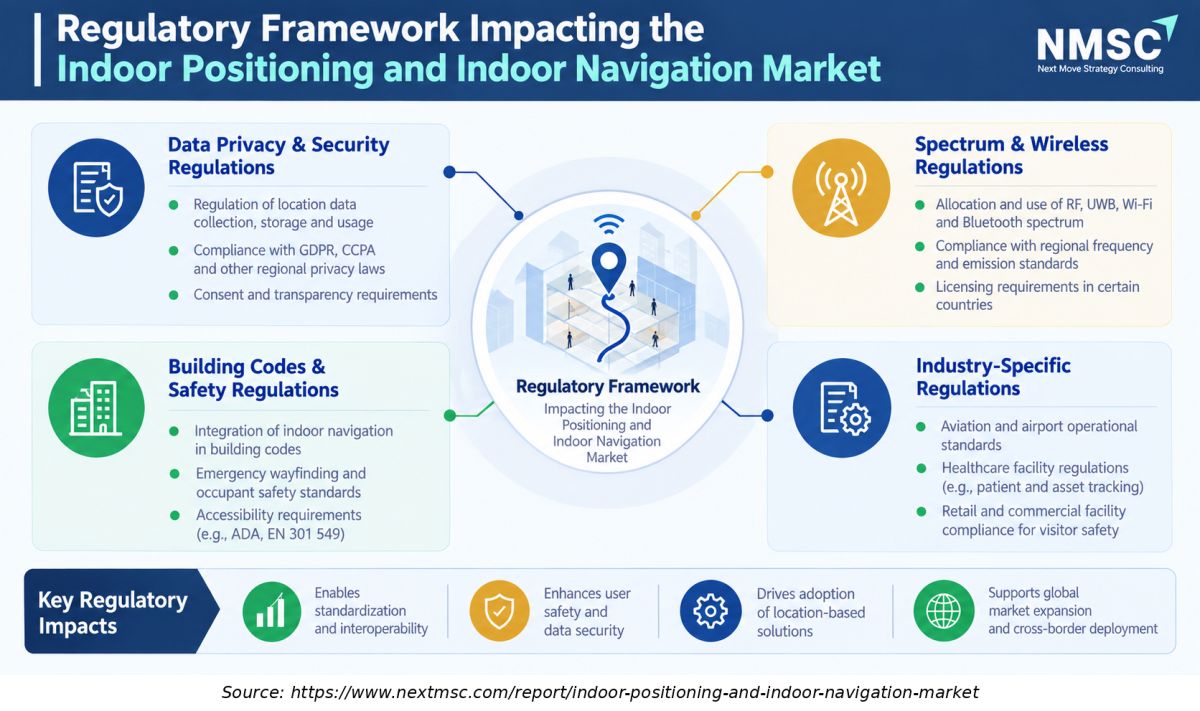
Regulatory Framework Impacting the Indoor Positioning and Indoor Navigation Market

This infographic presents the Regulatory Framework impacting the Indoor Positioning and Indoor Navigation Market, covering data privacy and location data, wireless and spectrum compliance, cybersecurity and system resilience, device safety and technical standards, indoor mapping and data governance, and accessibility, safety, and public-space requirements. It highlights how these requirements influence privacy, compliant wireless deployment, system security, accuracy, interoperability, accessibility, and market expansion.

Regional Outlook

2025 (USD Billion)
2035 (USD Billion)
North Americ
Europe
Asia-Pacific
Middle East
Latin Americ
Region 2025 (USD Billion) 2035 (USD Billion) CAGR (%)
North America $10.0 USD Billion $40.0 USD Billion 9.0%
Europe $17.1 USD Billion $51.1 USD Billion 27.0%
Asia-Pacific $24.2 USD Billion $62.2 USD Billion 25.0%
Middle East & Africa $31.3 USD Billion $73.3 USD Billion 23.0%
Latin America $38.4 USD Billion $84.4 USD Billion 12.0%

Regional data is locked

Unlock complete regional numbers for this market.

Unlock Full Data

North America Indoor Positioning and Indoor Navigation Market

North America leads the market with an established base of warehouse automation and healthcare RTLS deployment. We observed that platform consolidation, exemplified by Zebra Technologies' acquisition of IndoorAtlas, is expanding integrated hardware-software capabilities across the region. Technology adoption remains advanced, with UWB precision tracking driving demand across the region's manufacturing and healthcare facility base.

Europe Indoor Positioning and Indoor Navigation Market

Europe's market reflects a mature but regulation-intensive landscape shaped by building accessibility codes and healthcare compliance requirements. Our findings suggest that operators across Germany, the UK, and France are accelerating adoption of UWB and hybrid positioning architectures to meet precision tracking requirements. Technology adoption favors cloud-based platforms, supported by regional vendors investing in data privacy-compliant tracking solutions.

Asia-Pacific Indoor Positioning and Indoor Navigation Market

Asia-Pacific is the fastest-growing market region, propelled by rapid manufacturing and logistics digitization in China and India. We found that regulatory frameworks remain less harmonized than in Europe, giving regional vendors flexibility to scale deployment rapidly. Technology adoption is accelerating as domestic positioning manufacturers expand BLE and UWB hardware production to serve growing smart factory and smart building demand.

Middle East & Africa Indoor Positioning and Indoor Navigation Market

The market in Middle East & Africa is expanding as Gulf Cooperation Council economies invest in smart city and infrastructure development. Our analysis shows that Saudi Arabia and the UAE are attracting positioning technology investment tied to airport, healthcare, and commercial real estate modernization goals. Regulatory influence remains moderate, while technology adoption is gradually shifting toward imported hybrid positioning platforms as regional developers scale smart building projects.

Latin America Indoor Positioning and Indoor Navigation Market

Latin America's market is supported by expanding retail and logistics modernization in Brazil and Argentina. We observed that regulatory frameworks are less stringent than in North America or Europe, though multinational retailers and logistics operators active locally are introducing positioning specifications aligned with global standards. Technology adoption remains centered on BLE deployments, with competitive intensity increasing as regional integrators partner with global hardware vendors.

U.S. Indoor Positioning and Indoor Navigation Market

Based on our estimates, the U.S. market was valued at approximately USD 12.78 billion in 2025 and is projected to reach USD 206.0 billion by 2035, growing at a 21.1% CAGR. Demand is anchored by a mature warehouse automation and healthcare RTLS base. Technology penetration favors UWB and hybrid positioning platforms, and competitive intensity remains high among established vendors serving national manufacturing, healthcare, and retail portfolios.

Canada Indoor Positioning and Indoor Navigation Market

The market in Canada reached roughly USD 2.24 billion in 2025 and is forecast to hit USD 38.29 billion by 2035 at a 21.9% CAGR. Demand structure mirrors U.S. warehouse and healthcare adoption patterns, while national building code guidance shapes accessibility-driven wayfinding requirements. Technology penetration is rising as national facility operators request hybrid BLE-UWB platforms, with competitive intensity moderate given the market's reliance on U.S.-headquartered vendors.

UK Indoor Positioning and Indoor Navigation Market

As per our estimate, the UK market stood at about USD 1.92 billion in 2025, advancing toward USD 31.58 billion by 2035 at a 21.4% CAGR. Demand is driven by an established healthcare RTLS base and rising accessibility compliance requirements for public buildings. Regulatory influence is significant, technology penetration favors cloud-based positioning platforms, and competitive intensity remains steady among domestic and European vendors.

Germany Indoor Positioning and Indoor Navigation Market

According to our analysis, Germany's market was valued near USD 2.02 billion in 2025 and is set to reach USD 33.38 billion by 2035, expanding at a 21.4% CAGR. Demand structure benefits from a strong domestic manufacturing base and advanced smart factory investment. Germany's federal building and data protection guidance shapes regulatory influence, while technology penetration favors UWB precision tracking among leading manufacturing operators.

France Indoor Positioning and Indoor Navigation Market

Based on our estimates, France's market reached approximately USD 1.38 billion in 2025, projected to climb to USD 23.46 billion by 2035 at a 21.7% CAGR. Demand is supported by France's healthcare and transportation infrastructure modernization, which shapes steady positioning platform adoption. Regulatory influence from French data protection authority requirements is notable, and competitive intensity remains high given the concentration of European positioning vendors serving domestic facilities.

China Indoor Positioning and Indoor Navigation Market

The market in China stood at roughly USD 4.07 billion in 2025 and is forecast to reach USD 97.18 billion by 2035, registering a 26.5% CAGR. Demand is fueled by rapid smart factory and logistics automation investment and a growing domestic positioning hardware manufacturing base. Regulatory influence is increasing gradually, technology penetration is accelerating through domestic BLE and UWB production, and competitive intensity remains elevated among numerous China-based vendors.

India Indoor Positioning and Indoor Navigation Market

As per our estimate, India's market was valued at about USD 1.92 billion in 2025, projected to reach USD 57.70 billion by 2035 at a 29.8% CAGR, the fastest pace among countries profiled in this report. Demand structure benefits from the country's rapidly expanding manufacturing and logistics facility base and growing smart building investment. Technology penetration is rising quickly, and competitive intensity is increasing as domestic and international vendors scale local operations.

Japan Indoor Positioning and Indoor Navigation Market

According to our analysis, Japan's market reached approximately USD 1.56 billion in 2025 and is expected to hit USD 33.41 billion by 2035, growing at a 25.0% CAGR. Demand structure benefits from the country's advanced manufacturing automation base and aging-population-driven healthcare facility investment. Technology penetration is high, with domestic and international vendors supplying precision positioning platforms, and competitive intensity remains pronounced amid rapid technology adoption cycles.

South Korea Indoor Positioning and Indoor Navigation Market

Based on our estimates, South Korea's market was valued near USD 1.32 billion in 2025 and is set to reach USD 30.37 billion by 2035, expanding at a 26.0% CAGR. Demand structure benefits from the country's advanced electronics manufacturing base and smart building initiatives. Regulatory influence is developing under national telecommunications spectrum guidelines, and technology penetration is advancing as domestic vendors scale UWB hardware capacity.

Australia Indoor Positioning and Indoor Navigation Market

The indoor positioning and indoor navigation market in Australia reached about USD 959 million in 2025 and is projected to reach USD 21.26 billion by 2035, expanding at a 25.4% CAGR. Demand is supported by a concentrated commercial real estate and logistics sector and growing adoption of smart building technology. Regulatory influence stems from national building accessibility guidelines, while technology penetration favors cloud-based positioning platforms amid moderate competitive intensity.

UAE Indoor Positioning and Indoor Navigation Market

As per our estimate, the UAE market was valued near USD 839 million in 2025, projected to reach USD 20.20 billion by 2035 at a 26.6% CAGR. Demand structure is shaped by the UAE's smart city and airport infrastructure investment ambitions. Regulatory influence remains moderate, technology penetration is improving through imported hybrid positioning platforms, and competitive intensity is rising as distributors expand service portfolios to serve Gulf commercial developments.

Saudi Arabia Indoor Positioning and Indoor Navigation Market

According to our analysis, Saudi Arabia's market reached roughly USD 777 million in 2025 and is expected to hit USD 19.45 billion by 2035, growing at a 27.2% CAGR. Demand is driven by Vision 2030-linked smart city and giga-project infrastructure investment. Regulatory influence is developing under national telecommunications guidelines, and technology penetration is advancing as domestic and international vendors scale operations.

South Africa Indoor Positioning and Indoor Navigation Market

Based on our estimates, South Africa's market stood at about USD 249 million in 2025, forecast to reach USD 5.99 billion by 2035 at a 26.6% CAGR. Demand structure reflects a developing smart building and healthcare sector serving regional Southern African markets. Regulatory influence remains moderate, technology penetration is gradually improving, and competitive intensity is limited given reliance on imported positioning platforms from Europe and Asia.

Brazil Indoor Positioning and Indoor Navigation Market

The market in Brazil reached approximately USD 1.22 billion in 2025 and is projected to reach USD 25.75 billion by 2035, registering a 24.7% CAGR. Demand is underpinned by Brazil's large retail and logistics sector and expanding warehouse automation investment. Regulatory influence stems from national telecommunications and data protection guidelines, technology penetration favors BLE deployments, and competitive intensity remains moderate among regional integrators.

Argentina Indoor Positioning and Indoor Navigation Market

As per our estimate, Argentina's market was valued near USD 453 million in 2025, projected to reach USD 10.30 billion by 2035 at a 25.8% CAGR. Demand structure is supported by steady retail and logistics digitization despite macroeconomic volatility. Regulatory influence remains limited, technology penetration is modest, and competitive intensity is centered on a small number of regional distributors serving domestic facility operators.

Competitive Landscape

We observed that the indoor positioning and indoor navigation market features a moderately fragmented competitive landscape, with diversified enterprise technology majors competing alongside specialized RTLS vendors on precision technology, platform integration, and vertical-specific depth.

Dimension Description
Dimension Assessment
Market Structure Moderately fragmented; leading companies profiled in this report account for a substantial share of Industry revenue, while numerous regional integrators and niche vendors serve cost-sensitive BLE-only deployments.
Innovation Focus Hybrid BLE-UWB architectures, digital twin data integration, and AI-driven location analytics dominate current innovation pipelines across leading suppliers.
M&A Activity Active consolidation through targeted acquisitions, exemplified by Zebra Technologies' acquisition of IndoorAtlas in May 2024, strengthening its real-time indoor positioning portfolio.

How Do Companies Compete in the Indoor Positioning and Indoor Navigation Market?

Companies compete primarily on positioning precision, platform integration depth, and vertical-specific solution design across the Industry. Global technology majors such as Cisco Systems and Hewlett Packard Enterprise leverage existing enterprise networking infrastructure to embed positioning capabilities, while specialized vendors such as Quuppa and Ubisense compete on precision RTLS depth for healthcare and manufacturing customers with demanding accuracy requirements.

Which Competitive Archetypes Dominate the Indoor Positioning and Indoor Navigation Market?

Two archetypes dominate the market: diversified enterprise technology vendors embedding positioning into broader networking and IoT platforms, and specialized RTLS providers focused on precision tracking for healthcare, manufacturing, and logistics verticals. Cisco Systems and Hewlett Packard Enterprise exemplify the diversified networking archetype, while Quuppa and CenTrak exemplify the specialized RTLS archetype serving technically demanding tracking missions.

How Are Companies Differentiating Through Innovation in Indoor Positioning?

Innovation and differentiation strategy increasingly center on hybrid positioning architecture and data platform integration. Microsoft's Azure Digital Twins partnership with HERE Technologies and Quuppa's expanding ERP and warehouse management integrations both demonstrate how vendors differentiate through interoperability rather than standalone hardware performance. Our analysis shows that vendors unable to demonstrate credible platform integration pathways risk exclusion from enterprise request-for-proposal shortlists in North America and Europe.

What M&A and Expansion Activity Is Shaping the Indoor Positioning and Indoor Navigation Market?

Strategic acquisitions, partnership formation, and portfolio realignment continue to consolidate capabilities within the Industry. Zebra Technologies' acquisition of IndoorAtlas in 2024 and its subsequent divestiture of its Robotics Automation business to Skild AI in April 2026 illustrate how vendors are reallocating capital toward core positioning and tracking technologies, while Microsoft's partnership with HERE Technologies demonstrates sustained investment in digital twin data interoperability.

Key Market Players

Our assessment indicates that the following 20 companies are actively shaping product innovation, precision tracking technology, and platform integration within the global indoor positioning and indoor navigation market.

Zebra Technologies Corporation Cisco Systems, Inc. HERE Global B.V. Hewlett Packard Enterprise Company Honeywell International Inc. Siemens AG Ubisense Group plc Quuppa Oy CenTrak, Inc. Sonitor Technologies AS Securitas Healthcare Esri, Inc. Inpixon HID Global Corporation Impinj, Inc. Pointr Limited Mapsted Corp. infsoft GmbH Situm Technologies, S.L. Oriient New Media Ltd.

Latest Developments

We observed that recent company activity centers on acquisitions, platform partnerships, and portfolio realignment across the indoor positioning and indoor navigation market.

Date Event
May 2026 Pointr’s June 2026 product update introduced Pointr Maps v10, adding direct Epic MyChart integration, richer POI metadata, predefined map personas, and other mapping capabilities. The release strengthens indoor wayfinding and positioning for healthcare while extending deployment and personalization options across enterprise indoor environments.
March 2026 CenTrak unveiled next-generation AI-enhanced location intelligence at HIMSS 2026, including mobile duress, AI-assisted asset analytics, a safety bracelet, and disposable BLE tags. The product expansion broadens healthcare RTLS coverage, lowers the barrier to tracking additional people and assets, and increases the role of AI in location-driven workflows.

Investment Opportunities

What Capital Inflows Are Targeting the Indoor Positioning and Indoor Navigation Market?

Capital inflows into the indoor positioning and indoor navigation market are increasingly directed toward precision tracking technology and platform integration capability. Strategic investment continues to fund platform expansion, as seen in Zebra Technologies' acquisition of IndoorAtlas and Microsoft's partnership with HERE Technologies, both advanced since 2024. We observed that investors favor vendors demonstrating validated UWB precision and interoperability credentials, viewing digital twin integration as a proxy for long-term enterprise contract retention.

How Is Infrastructure Investment Supporting Indoor Positioning and Indoor Navigation Expansion?

Infrastructure investment is expanding Wi-Fi and UWB anchor networks across North America, Europe, and Asia-Pacific to serve rising smart building and warehouse automation demand. Our findings suggest that vendors are investing in reduced-cabling UWB infrastructure and expanded regional manufacturing capacity to improve deployment economics for large-footprint industrial and healthcare facilities.

What ESG Considerations Are Shaping Indoor Positioning and Indoor Navigation Investment Decisions?

Environmental, social, and governance considerations are central to investment decisions across the Industry, with reduced facility energy consumption and improved worker and patient safety as key criteria. Location analytics increasingly inform building energy optimization through space utilization data. We found that investors increasingly favor vendors demonstrating measurable safety and efficiency outcomes, treating data privacy compliance in workforce and visitor tracking as a governance indicator alongside cybersecurity practices.

Key Benefits for Stakeholders

How Does This Report Benefit Enterprise and Industry Leaders?

Enterprise and industry leaders gain access to validated segmentation, competitive benchmarking, and regional demand forecasts that support sourcing and vendor-selection decisions across the indoor positioning and indoor navigation Industry. Our analysis shows that detailed offering, technology, and end user breakdowns help procurement teams align specifications with precision and integration requirements while identifying underserved application and deployment segments for portfolio expansion.

How Does This Report Benefit Investors and Financial Analysts?

Investors and financial analysts benefit from consistent, single-point market size and CAGR estimates that support valuation and capital-allocation decisions across the indoor positioning and indoor navigation supply chain. We observed that the report's regional and segment-level growth differentials help identify which vendors are best positioned to capture above-market growth in UWB and Asia-Pacific categories through 2035.

How Does This Report Benefit Technology Vendors and Product Teams?

Technology vendors and product teams gain insight into emerging design requirements, including hybrid BLE-UWB architecture and IoT platform integration, that are reshaping the Industry. Our findings suggest that this analysis helps R&D teams prioritize development roadmaps around precision tracking certification and digital twin data interoperability increasingly required by enterprise procurement processes.

Key Market Segments Evaluated

By Offering

  • Hardware 
    • Tags
    • Beacons
    • Anchors
    • Readers
    • Gateways
  • Software 
    • Positioning Software
    • Mapping Software
    • Navigation Software
    • Analytics Software
  • Services 
    • Installation Services
    • Integration Services
    • Managed Services
    • Support Services

By Technology

  • BLE
  • UWB
  • Wi-Fi
  • RFID
  • Others

By Application

  • Indoor Navigation 
    • Wayfinding
    • Route Guidance
    • Accessibility Navigation
  • Asset Tracking 
    • Equipment Tracking
    • Inventory Tracking
    • Tool Tracking
  • People Tracking 
    • Workforce Tracking
    • Patient Tracking
    • Visitor Tracking
  • Location Analytics 
    • Space Utilization
    • Movement Analytics
    • Dwell Analytics

By Deployment

  • Cloud 
    • Public Cloud
    • Private Cloud
  • On-Premises 
    • Local Server
    • Edge Processing
  • Hybrid 
    • Cloud-Edge
    • Cloud-On-Premises

By End User

  • Healthcare
  • Manufacturing
  • Logistics
  • Retail
  • Transportation
  • Corporate
  • Government
  • Others

By Region

  • North America 
    • U.S.
    • Canada
    • Mexico.
  • Europe 
    • UK
    • Germany
    • France
    • Italy
    • Spain
    • Sweden
    • Denmark
    • Finland
    • Netherlands
    • Rest of Europe.
  • Asia-Pacific 
    • China
    • India
    • Japan
    • South Korea
    • Taiwan
    • Indonesia
    • Vietnam
    • Australia
    • Philippines
    • Malaysia
    • Rest of APAC.
  • Middle East & Africa 
    • Saudi Arabia
    • UAE
    • Egypt
    • Israel
    • Turkey
    • Nigeria
    • South Africa
    • Rest of MEA.
  • Latin America 
    • Brazil
    • Argentina
    • Chile
    • Colombia
    • Rest of LATAM.

Conclusion & Recommendations

The long-term outlook for the indoor positioning and indoor navigation market remains strongly positive, supported by a USD 752.30 billion absolute dollar opportunity between 2026 and 2035 and sustained Asia-Pacific manufacturing digitization. NMSC's analysis indicates that vendors combining UWB precision tracking with integrated software platforms will be best positioned to capture the market's projected growth from USD 127.97 billion in 2026 to USD 880.27 billion by 2035.

What Strategic Positioning Should Vendors Pursue in the Indoor Positioning and Indoor Navigation Market?

Vendors should prioritize hybrid BLE-UWB architecture to secure long-term enterprise contracts spanning both broad coverage and precision tracking needs. Our assessment indicates that vendors investing early in digital twin data interoperability and location analytics capability, alongside expanded services portfolios, will be best positioned to capture premium pricing within the indoor positioning and indoor navigation market as hybrid deployments become standard.

How Attractive Is the Indoor Positioning and Indoor Navigation Market for New Investment?

The indoor positioning and indoor navigation Industry presents an attractive investment case, supported by a USD 752.30 billion absolute dollar opportunity between 2026 and 2035 and above-average growth in Asia-Pacific and software categories. We found that investment attractiveness is highest for vendors combining validated precision tracking credentials with scaled platform integration capability, positioning them to serve both cost-sensitive and premium enterprise segments simultaneously.

What Market Shifts and Key Risks Should Stakeholders Monitor?

Stakeholders should monitor infrastructure deployment costs, signal interference challenges in complex facilities, and data privacy regulation around workforce and visitor tracking as key risks to the indoor positioning and indoor navigation market. Our analysis shows that vendors unable to adapt to evolving data protection requirements risk losing contracts to competitors with certified privacy-compliant tracking platforms, particularly within increasingly regulated European markets.

What Are the Key Growth Pathways for the Indoor Positioning and Indoor Navigation Market?

Key growth pathways include expanding hybrid BLE-UWB hardware portfolios, scaling location analytics and digital twin integration software, and deepening penetration into Asia-Pacific manufacturing and government channels. NMSC's analysis indicates that vendors pursuing these pathways while maintaining cost competitiveness in standard BLE categories will be best positioned to capture the indoor positioning and indoor navigation market's projected growth through 2035.

Delivered Customizations

We have successfully delivered the following deep-dive customizations:

Client Request Customization Delivered Value Adds
Historical Market Revenue Analysis
  • Historical revenue analysis for 2020-2025 by offering (hardware, software, services), technology, and end user.
  • Identifies the fastest-growing offering and technology segments to prioritize investment and product roadmaps.
Addressable Market Sizing
  • TAM, SAM, and VAM estimates for indoor positioning and navigation, segmented by end-user vertical and deployment model.
  • Shows which verticals and deployment models justify market-entry or expansion investment.
Vendor Offering Share Analysis
  • Company-level revenue share by offering (hardware, software, services) for leading indoor positioning and navigation providers.
  • Benchmarks competitor positioning and reveals whitespace in hardware, software, or service portfolios.
Technology Fit Benchmarking by Venue Environment
  • Comparative assessment of BLE, UWB, Wi-Fi, RFID, and inertial/vision positioning by accuracy, range, infrastructure cost, and venue type.
  • Guides technology selection and R&D priorities for specific venue environments such as hospitals, airports, and warehouses.
Regional Regulatory and Deployment Model Assessment
  • Country-level review of privacy, spectrum, and data-residency rules shaping on-premise versus cloud indoor positioning deployments.
  • Informs regional deployment model choices and compliance-driven go-to-market decisions.
Venue-Level Deployment Opportunity Mapping
  • Mapping of addressable airports, hospitals, large retail sites, and warehouses by region, using public venue and traffic statistics.
  • Pinpoints high-density venue clusters for targeted sales and partnership pipelines.

FAQs

About the Author

Liza Phukan

Liza Phukan

Liza Phukan is Research Associate at Next Move Strategy Consulting, where she has covered emerging industries and market research across sectors for 3.5 years. Her work includes analyzing industry developments, validating market data, and developing structured business content from research findings. She uses secondary research and data-validation practices to turn complex market information into clear decision-useful market analysis for business audiences and support report development and B2B.

About the Reviewer

Supradip Baul

Supradip Baul

Supradip Baul is an accomplished business consultant and strategist with over a decade of rich experience in market intelligence, strategy, technology, and business transformation. His work has included rigorous qualitative and quantitative analysis across multiple industries, helping clients shape investment decisions and long-term roadmaps. Earlier in his career, he was associated with Gartner, where he contributed to industry-leading reports and market share analyses. He has worked with leading global companies and holds an MBA with a dual specialization in Marketing and Finance.

Rishabh Jogani

RISHABH JOGANI

Strategy Analyst

Accenture Japan

We are incredibly impressed with the market report on the real estate market in India provided by Next Move Strategy Consulting. The report was thorough, insightful, and well-structured, offering deep analysis and actionable recommendations. It not only captured the current trends and dynamics but also provided a forward-looking perspective that has been invaluable for our strategic planning. Their team demonstrated exceptional professionalism, attention to detail, and a profound understanding of the industry. The data-driven insights and clarity of presentation exceeded our expectations, making complex market trends easy to understand. We highly recommend Next Move Strategy Consulting to anyone looking for reliable and comprehensive market research services. Their expertise has given us the confidence to navigate the complexities of the Indian real estate market with clarity and foresight.

Kevin Coker

KEVIN COKER

Founder, CEO and Board Diector

Proxima Clinical Research

I have been using Next MSC reports for product positioning in a new geography for a long time. They have by far the best reports I have found and the price is reasonable too!

Diana Trejo

DIANA TREJO

Assistant Manager

Sumitomo Corporation de Mexico, S.A. de C.V.

Recently, we purchased a report on the Mexico Data Center Market from Next Move Strategy Consulting. The service has been excellent, with support that is always timely and thoroughly professional. The information provided is interesting, highly useful, and delivered with clarity. I would highly recommend NextMSC for anyone seeking insightful and dependable analysis.

Mohit Agarwal

MOHIT AGARWAL

Chief Manager

DryChem India Pvt. Ltd.

Next Move Strategy Consulting is an amazing team of consultants. We required a market study report for our investors on top priority and the team went above and beyond our expectations to deliver the same with ample supporting data within a short time span enabling us to secure the investments and keep our project timeline maintained. Their professionalism, attention to detail, and timely delivery of actionable recommendations have left a lasting impression on our organization.

Amos Chang

AMOS CHANG

Strategy Consultant

Kardex Group

I have bought the intralogistics market reports from NMSC two times so far. Joseph and his team are always very helpful and flexible in responding to any customization requirements on the report. Their expertise in market reports really helps us steer the day-to-day business. I will definitely recommend and come back myself whenever there is a need.

Custom Market Research Services

We will customize the research for you if the listed report does not fully match your requirements.

Get 30% Free Customization

Select License

This website uses cookies to ensure you get the best experience on our website. Learn more

✖