Industrial Safety Gas Detection Market By Offering {Hardware (Fixed Gas Detection Systems, Portable Gas Detection Devices, and Others), Software, Services}, By Gas Type (Combustible Gas, Toxic Gas, Refrigerant Gas, and Others), By Sensor Technology (Electrochemical, Catalytic Bead, and Others), By Connectivity Type (Wired Systems, Wireless Systems, and Others), and By Application (Personal Worker Safety, Confined Space Monitoring, and Others) – Global Analysis & Forecast, 2025–2035
Industry: Energy & Power | Publishing Date: October 17, 2026 | Last Updated: October 17, 2026 | No of Pages: N/A | No. of Tables: N/A | No. of Figures: N/A | Format: PDF | Report Code: EP4509
Industry Outlook
The global Industrial Safety Gas Detection Market size was valued at USD 5.32 Billion in 2025, and is expected to be valued at USD 5.68 Billion by the end of 2026. The industry is projected to grow, hitting USD 9.21 Billion by 2035, with a CAGR of 5.95% between 2026 and 2035.
Industrial Safety Gas Detection Market Size & Forecast
|
Parameters |
Details |
|
Market Size in 2026 |
USD 5.68 Billion |
|
Revenue Forecast in 2035 |
USD 9.21 Billion |
|
Growth Rate |
CAGR of 5.95% from 2026 to 2035 |
|
Analysis Period |
2025–2035 |
|
Base Year Considered |
2025 |
|
Forecast Period |
2026–2035 |
|
Market Size Estimation |
Billion (USD) |
|
Companies Profiled |
20 |
|
Countries Covered |
33 |
|
Market Share |
Available for 10 companies |
Based on NMSC’s primary research, we observed that the global industrial safety gas detection market demonstrates steady expansion, driven by stringent workplace safety regulations, increasing industrial automation, and rising awareness of hazardous gas exposure across critical industries. Fixed and portable gas detection systems are increasingly deployed to monitor toxic, combustible, and oxygen-deficient environments across oil & gas facilities, chemical plants, mining operations, and manufacturing sites. Industry analysis indicates that integration of advanced sensing technologies including electrochemical, infrared, and photoionization detectors continues to improve detection accuracy and response times. Our field interactions with plant safety managers and industrial automation integrators shows that connected monitoring platforms, real-time alerts, and predictive safety analytics significantly enhance operational visibility and incident response capabilities. Asia-Pacific emerges as a key growth region, supported by expanding industrial infrastructure and strengthening safety compliance frameworks.
Moreover, through direct evaluation of industrial safety deployments across North America, Europe, and Asia-Pacific, we found that adoption patterns are shaped by regulatory enforcement, operational risk exposure, and digital transformation of industrial facilities. North America benefits from mature compliance standards and advanced safety ecosystems, while Europe emphasizes certified systems and integration with Industry 4.0 frameworks. Emerging markets such as India and Southeast Asia demonstrate accelerating adoption driven by industrial expansion and infrastructure development. Key market participants, including Honeywell, MSA Safety, Dräger, Emerson, and Teledyne, compete through sensor innovation, connected safety platforms, and integration with industrial automation systems. Recent developments in wireless gas monitoring, cloud-based safety platforms, and predictive maintenance capabilities lower operational risks and strengthen long-term reliability, reinforcing the role of gas detection systems as a critical component of modern industrial safety infrastructure.
What Are the Key Trends in the Industrial Safety Gas Detection Industry?
How is AI-Driven Predictive Gas Monitoring Shifting Industrial Safety from Reactive to Proactive Models?
AI-driven monitoring capabilities are redefining how industrial facilities anticipate and manage hazardous gas exposure across complex environments. Within the industrial safety gas detection Market, predictive analytics increasingly enables early risk identification by analyzing historical patterns, environmental variables, and real-time sensor inputs. From our engagements with plant safety managers and control room operators, we observed that facilities adopting AI-enabled systems significantly improve incident preparedness and reduce unplanned disruptions. In addition, machine learning-based insights support faster decision-making during critical events. Data analysis reveals that predictive monitoring enhances operational continuity while strengthening safety performance. As industrial operations become more complex, this shift toward proactive safety models positions AI-driven gas detection as a critical enabler of next-generation risk management.
How Are Connected Worker Safety Ecosystems Enhancing Real-Time Hazard Visibility?
Across large industrial facilities, workforce safety increasingly depends on real-time visibility into hazardous conditions and worker exposure levels. In the industrial safety gas detection Market, connected safety ecosystems integrate gas detection devices with wearables, cloud platforms, and centralized dashboards to enable continuous monitoring. Through our evaluation of deployment environments, we identified that such systems allow instant alerts, location tracking, and coordinated emergency response across distributed operations. Meanwhile, integration with IoT-enabled platforms enhances compliance and strengthens safety reporting accuracy. Market evidence suggests that organizations adopting connected ecosystems achieve faster response times and improved workforce protection. As a result, worker-centric monitoring continues to evolve as a key pillar of modern industrial safety strategies.
How Is Wireless and IIoT-Integrated Gas Detection Accelerating Deployment in the Industrial Safety Gas Detection Market?
The transition from wired infrastructure to flexible, connected systems is accelerating deployment of gas detection technologies across industrial environments. Within the industrial safety gas detection Market, wireless and IIoT-enabled solutions enable scalable monitoring across large and complex facilities. From our analysis of industrial installations, we noticed that wireless sensor networks reduce installation time while allowing easier system expansion and reconfiguration. At the same time, IIoT integration supports centralized monitoring, remote diagnostics, and seamless connectivity with plant automation systems. Procurement trends suggest that operators increasingly prefer modular solutions aligned with digital transformation initiatives. Consequently, wireless gas detection technologies are driving faster adoption and enabling more agile, data-driven industrial safety infrastructure.
Ecosystem Analysis of Industrial Safety Gas Detection Market

Based on our evaluation of the industrial safety gas detection market, we noticed that the ecosystem is highly interconnected, where R&D innovation supports advanced sensing solutions and real-time data collection strengthens safety monitoring. In this structure, suppliers, manufacturers, and distributors enable efficient deployment, while regulatory frameworks guide compliance. As a result, this coordinated ecosystem enhances industrial safety and drives adoption of gas detection technologies.
What Are the Key Market Drivers, Breakthroughs, And Investment Opportunities That Will Shape the Industrial Safety Gas Detection Industry in the Next Decade?
Growth Catalyst & Risk Assessment Matrix
|
DRIVERS / TRENDS / RESTRAINTS |
(+/–) % IMPACT ON CAGR FORECAST |
GEOGRAPHIC RELEVANCE |
IMPACT TIMELINE |
|
Stringent workplace safety regulations and compliance mandates |
+1.2% |
North America; Europe; Middle East; global industrial hubs |
Short to medium term (1–3 years) |
|
Rising industrialization and increasing exposure to hazardous environments |
+1.0% |
Asia-Pacific; Latin America; Middle East & Africa |
Medium term (2–4 years) |
|
AI-driven predictive gas monitoring and risk analytics adoption |
+0.9% |
North America; Europe; Japan; South Korea |
Short to medium term (1–3 years) |
|
Expansion of multi-site industrial operations driving centralized safety management demand |
+0.8% |
Global; strong in multinational industrial enterprises |
Medium to long term (3–5 years) |
|
High implementation costs and system integration complexity limiting adoption |
-0.5% |
Global; prominent in cost-sensitive and legacy infrastructure markets |
Short to medium term (1–3 years) |
Based on our evaluation of industrial safety and monitoring trends, we observed that the industrial safety gas detection market experiences steady growth, driven primarily by stringent workplace safety regulations, increasing industrial automation, and rising awareness of hazardous gas exposure across critical industries. Our interactions with plant safety managers and industrial operators show that gas detection systems are increasingly adopted as a core operational requirement to ensure continuous monitoring and regulatory compliance across oil & gas, chemical processing, mining, and manufacturing facilities. Advancements in sensor technologies, wireless connectivity, and real-time monitoring platforms continue to expand system capabilities, enabling accurate detection and faster incident response in complex industrial environments. Nonetheless, integration complexity and calibration requirements influence deployment strategies, particularly across legacy industrial infrastructure. At the same time, the emergence of connected safety platforms and scalable monitoring solutions creates new opportunities by enabling flexible, data-driven safety management across industrial operations.
Growth Drivers:
How Do Workplace Safety Accountability and Risk Mitigation Priorities Accelerate Market Growth?
ased on our evaluation of industrial safety frameworks and interactions with HSE leaders, we found that increasing emphasis on workplace safety accountability and risk mitigation is significantly accelerating growth in the market. Industrial operators are under mounting pressure to reduce incident rates, comply with stringent safety mandates, and avoid financial and reputational penalties. Consequently, organizations are prioritizing proactive risk management strategies, wherein gas detection systems play a critical role in preventing hazardous exposure and ensuring operational continuity. Moreover, companies are integrating safety performance metrics into core business KPIs, further reinforcing investment in advanced detection solutions. Industry evidence indicates that this shift toward accountability-driven safety culture is consistently driving demand across high-risk sectors, thereby supporting sustained and long-term industrial safety gas detection market expansion.
How Do Real-Time Monitoring and Compliance Needs Accelerate Market Growth?
Real-time monitoring requirements and evolving compliance standards play a central role in driving growth in the industrial safety gas detection market. Facilities increasingly require continuous visibility into gas exposure levels to maintain safe operating conditions and meet audit requirements. Industry evidence suggests that integration of real-time monitoring platforms with plant safety systems improves response time and strengthens operational control. From our evaluation of industrial deployments, we identified that connected gas detection systems enable centralized monitoring and faster incident resolution across large facilities. Consequently, demand continues to rise for solutions that deliver instant alerts, data-driven insights, and seamless compliance reporting across complex industrial operations.
Growth Inhibitor:
How Do High Implementation Costs and System Complexity Limit Adoption in the Industrial Safety Gas Detection Market?
High implementation costs and system complexity continue to act as key restraints in the industrial safety gas detection market, particularly for small and mid-sized industrial operators. Gas detection systems require significant upfront investment in sensors, control units, software platforms, and installation, which increases capital expenditure across industrial facilities. From our discussions with plant engineers and system integrators, we observed that integrating these systems with existing plant automation and safety infrastructure involves complex configuration and site-specific customization. In addition, ongoing calibration requirements, maintenance costs, and reliance on skilled personnel increase the total cost of ownership. As a result, these factors delay investment decisions and limit adoption, especially in facilities operating with older infrastructure and constrained modernization budgets.
Growth Opportunity:
How Do Multi-Site Industrial Operations Create Opportunities for Centralized Safety Management?
Based on our analysis of industrial safety deployments across geographically dispersed facilities, we found that the expansion of multi-site operations is creating significant growth opportunities for centralized safety management in the industrial safety gas detection market. As large enterprises scale across regions, they increasingly require unified frameworks to standardize monitoring, reporting, and compliance processes. Moreover, centralized systems improve cross-site visibility, enabling faster incident response and more consistent safety performance. In addition, organizations benefit from streamlined governance and reduced operational redundancies. Industry evidence indicates that companies adopting centralized safety strategies achieve improved risk control and regulatory alignment. Consequently, as industrial networks continue to expand globally, the demand for integrated and standardized safety infrastructure is expected to strengthen long-term market growth.
Regulatry Framework Impacting the Industrial Safety Gas Detection Industry

Based on our evaluation of the market, we noticed that strong regulatory frameworks and compliance mandates drive consistent adoption, while standardization ensures system reliability. At the same time, enforcement mechanisms strengthen safety practices, and evolving regulations continue to support industrial safety gas detection market growth and technology advancement.
How Is the Industrial Safety Gas Detection Market Segmented in This Report, And What Are the Key Insights From the Segmentation Analysis?
Market Highlights & Strategic Insights – Industrial Safety Gas Detection Market:
|
Segments |
Key Takeaways |
|
Offering |
Hardware dominates the industrial safety gas detection market share, driven by strong deployment of fixed and portable gas detection devices. Software gains traction through monitoring and analytics platforms, while services support calibration, maintenance, and compliance requirements. |
|
Gas Type |
Combustible gas detection leads the market, supported by safety requirements in oil & gas and chemical industries. Toxic gas detection also holds a significant share, while oxygen monitoring and VOC detection support confined space and environmental monitoring. |
|
Sensor Technology |
Electrochemical sensors dominate, widely used for toxic gas detection due to high accuracy. Catalytic bead and infrared sensors support combustible gas monitoring, while PID and semiconductor sensors expand in VOC and specialized applications. |
|
Connectivity Type |
Wired gas detection systems dominate, supported by reliable fixed installations. Wireless systems gain traction in large facilities, while hybrid and IoT-integrated systems expand with connected industrial safety solutions. |
|
Application |
Personal worker safety leads the industrial safety gas detection market, driven by widespread use of portable detectors. Confined space and area monitoring also represent major applications, while process safety and leak detection support industrial risk prevention. |
|
End Use Industry |
Oil and gas dominates adoption, driven by strict safety regulations across upstream, midstream, and downstream operations. Chemicals and petrochemicals also represent a key segment, while mining, power, and manufacturing expand safety monitoring deployments. |
By Offering Insights
How Do Offerings Shape the Industrial Safety Gas Detection Market?
Based on our analysis of industrial safety monitoring deployments, we observed that the industrial safety gas detection market is segmented into hardware, software, and services.
From our deployment review, we identified that hardware accounts for the largest share, driven by widespread installation of fixed gas detection systems and portable gas detectors across hazardous industrial environments. These systems remain essential for continuous gas monitoring and worker protection. Meanwhile, software platforms gain traction as industries adopt device management, cloud monitoring, and analytics tools to improve visibility and compliance reporting. Services, including calibration, maintenance, and operational support, also play an important role in maintaining system reliability. As industrial safety regulations continue strengthening, integrated hardware–software–service offerings increasingly shape market adoption.

By Connectivity Type Insights
How Does Connectivity Influence the Industrial Safety Gas Detection Market?
Based on our assessment of industrial safety infrastructure, we found that the market is segmented into wired gas detection systems, wireless gas detection systems, hybrid wired–wireless systems, and IoT-integrated gas detection systems.
From our evaluation of facility safety deployments, we found that wired gas detection systems hold a significant share, supported by their reliability and long-standing installation across fixed industrial safety infrastructure. At the same time, wireless gas detection systems gain traction in large and complex facilities where flexible deployment and mobility are required. Meanwhile, hybrid wired–wireless systems and IoT-integrated platforms continue expanding as organizations adopt connected safety infrastructure and centralized monitoring capabilities. As industries modernize safety operations, connectivity increasingly plays a key role in enabling real-time monitoring and operational visibility.

By End Use Industry Insights
Which Industries Drive Demand in the Industrial Safety Gas Detection Market?
Based on our analysis of industrial safety installations, we noticed that the industrial safety gas detection market is segmented into oil and gas, chemicals and petrochemicals, mining and metals, power generation, water and wastewater treatment, manufacturing, and other industries.
Through our interviews with industry operators and safety managers, we found that the oil and gas sector represents a leading end-use segment, driven by strict safety regulations and high exposure to combustible and toxic gases across upstream, midstream, and downstream operations. Chemicals and petrochemicals also contribute significant demand due to hazardous process environments requiring continuous gas monitoring. Meanwhile, mining, power generation, and manufacturing industries continue expanding adoption of gas detection systems to strengthen workplace safety. As industrial risk management becomes a strategic priority, gas detection technologies remain critical across high-risk industries.
Regional Outlook:
Geographic Performance Snapshot:
|
Geography |
Key Takeaways |
|
North America |
Industry analysis indicates strong demand for industrial safety gas detection systems driven by strict safety regulations and widespread adoption across oil & gas, chemical, and manufacturing sectors. |
|
Europe |
Market trends indicate steady adoption supported by stringent workplace safety standards and strong industrial presence across energy, chemical, and manufacturing industries. |
|
Asia Pacific |
Industry insights indicate rapid market expansion due to industrialization, growing energy infrastructure, and increasing focus on workplace safety compliance. |
|
Latin America |
Market evidence suggests gradual adoption supported by expanding mining, oil & gas, and petrochemical industries across key regional economies. |
|
Middle East & Africa |
Infrastructure assessment indicates growing deployment of gas detection technologies across oil & gas, petrochemical, and mining operations to enhance industrial safety. |
The industrial safety gas detection market is geographically studied across North America, Europe, Asia Pacific, Latin America and Middle East & Africa, and each region is further studied across countries.
Industrial Safety Gas Detection Market in North America
Across North America’s extensive industrial landscape, advanced safety monitoring technologies play a central role in managing hazardous operating environments. Through our engagements with industrial safety managers, oil & gas operators, and plant automation integrators, we found sustained adoption of fixed and portable gas detection systems across refineries, chemical processing plants, and large manufacturing complexes. In this environment, mature industrial infrastructure and strict occupational safety regulations continue supporting consistent demand for continuous gas monitoring technologies. At the same time, connected safety platforms integrating real-time monitoring, wireless communication, and predictive analytics increasingly influence procurement decisions. Consequently, the presence of global safety technology leaders such as Honeywell, MSA Safety, and Dräger further accelerates innovation in sensing technologies and integrated safety ecosystems across North American industries.
Industrial Safety Gas Detection Market in the United States
The United States remains the primary driver of industrial gas detection systems adoption across North America due to its large concentration of energy infrastructure, chemical processing capacity, and advanced manufacturing facilities. Within this industrial landscape, strict safety compliance frameworks and continuous monitoring requirements across refineries, LNG terminals, and industrial plants strongly shape technology deployment strategies. Through our discussions with plant safety engineers and automation integrators, we identified increasing investment in multi-gas monitoring systems, wireless safety networks, and cloud-connected detection platforms designed to protect workers operating in hazardous environments. In addition, digitalization of industrial operations increasingly encourages integration of gas detection technologies with broader plant automation and safety management systems. As a result, facilities strengthen operational reliability while improving incident response capabilities across complex industrial sites.
Industrial Safety Gas Detection Market in Canada
Canada’s industrial safety gas detection market benefits from the country’s strong resource extraction sector and expanding energy infrastructure. Oil sands production sites, mining operations, and petrochemical facilities increasingly depend on continuous gas monitoring to maintain safe operations in hazardous environments. Through our interactions with industrial safety equipment distributors and facility operators, we noticed growing preference for rugged portable detectors and fixed monitoring systems capable of operating reliably in harsh climatic and industrial conditions. At the same time, strong workplace safety regulations and environmental protection requirements reinforce the role of advanced monitoring technologies. Consequently, gas detection systems continue supporting compliant and resilient operations across Canada’s expanding industrial landscape.
Industrial Safety Gas Detection Market in Europe
Europe’s industrial safety landscape reflects a highly regulation-driven adoption environment for gas detection technologies. Strict workplace safety frameworks and environmental compliance requirements shape monitoring practices across chemical processing plants, refineries, pharmaceutical facilities, and advanced manufacturing sites. Within this regulatory backdrop, operators increasingly prioritize certified detection systems capable of integrating with plant-wide safety and automation networks. From our evaluation of safety deployments across European facilities, we observed growing emphasis on high-precision sensing technologies and connected monitoring platforms. As a result, these developments reinforce long-term demand for reliable gas detection infrastructure across Europe’s industrial ecosystem.
Industrial Safety Gas Detection Market in the United Kingdom
The United Kingdom demonstrates steady and mature adoption of mature gas detection technology adoption across several high-risk industries. Refineries, offshore energy installations, and chemical processing facilities continue expanding deployment of multi-gas monitoring systems to meet strict workplace safety requirements. Through our engagements with industrial safety engineers and automation specialists, we identified increasing interest in wireless monitoring systems and connected worker-safety platforms capable of delivering real-time hazard alerts. Meanwhile, regulatory oversight and occupational health compliance requirements further influence procurement decisions across industrial operators. Consequently, advanced sensing technologies increasingly support continuous gas monitoring across complex UK industrial facilities.
Industrial Safety Gas Detection Market in Germany
Germany’s strong engineering culture and advanced industrial base shape a disciplined approach toward gas detection technology adoption. Chemical plants, automotive manufacturing facilities, and energy installations prioritize highly reliable monitoring systems capable of detecting toxic and combustible gases across hazardous operating environments. Through our technology assessments across German industrial facilities, we identified strong buyer preference for certified equipment, precise sensor calibration, and long-term service reliability. At the same time, close collaboration between automation providers, safety equipment manufacturers, and industrial operators supports deployment of integrated safety monitoring platforms. Consequently, Germany continues strengthening high-performance industrial safety infrastructure across advanced manufacturing environments.
Industrial Safety Gas Detection Market in France
France continues expanding adoption of advanced gas detection systems technologies as chemical processing, energy infrastructure, and pharmaceutical manufacturing facilities reinforce workplace safety practices. Portable detectors and fixed monitoring systems increasingly support worker protection across hazardous industrial environments. Through our market interactions with industrial operators and safety equipment distributors, we found rising investment in connected monitoring platforms capable of improving operational visibility and emergency response readiness. In addition, regulatory emphasis on workplace protection and environmental compliance encourages broader deployment of advanced sensing technologies. As industrial facilities modernize, gas detection platforms continue strengthening safety performance across French industrial operations.
Industrial Safety Gas Detection Market in Italy
Industrial modernization initiatives increasingly shape Italy’s gas detection market. Petrochemical facilities, manufacturing plants, and energy infrastructure operators deploy monitoring systems to maintain safe operations across diverse industrial environments. Through our industry deployment assessments, we identified growing demand for flexible portable gas detectors and scalable monitoring platforms capable of adapting to different operational conditions. Meanwhile, government programs encouraging industrial modernization and operational safety improvements support technology adoption. Consequently, vendors offering adaptable monitoring systems and strong service capabilities achieve stronger penetration across Italy’s industrial landscape.
Industrial Safety Gas Detection Market in Spain
Industrial operators across Spain increasingly strengthen safety monitoring practices as energy facilities, chemical processing plants, and manufacturing sites expand operations. Rising operational complexity and stricter workplace safety expectations encourage deployment of advanced gas monitoring technologies across industrial environments. Through our engagement with plant safety teams and automation specialists, we observed growing interest in portable multi-gas detectors and connected monitoring platforms capable of delivering real-time safety insights. As industrial activity continues to expand, scalable and easy-to-deploy detection systems gain stronger acceptance across Spanish industrial operations.
Industrial Safety Gas Detection Market in the Nordics
Across the Nordic countries, including Sweden, Finland, and Norway,industrial operators maintain a technology-forward approach toward workplace safety monitoring. Offshore energy platforms, advanced manufacturing facilities, and processing plants increasingly deploy gas detection systems to ensure continuous hazard oversight. Through our interactions with plant safety engineers and automation integrators, we observed strong preference for highly reliable sensing technologies and durable equipment design. At the same time, seamless integration with industrial automation platforms remains a key purchasing criterion. Consequently, connected monitoring systems capable of delivering predictive safety insights gain strong traction across Nordic industrial operations.
Industrial Safety Gas Detection Market in Asia-Pacific
Asia-Pacific continues emerging as one of the most dynamic environments for industrial safety gas detection technologies. Rapid industrialization, expanding petrochemical capacity, and large-scale manufacturing operations drive deployment of monitoring systems across complex industrial facilities. Across the region, chemical plants, mining operations, and energy infrastructure increasingly adopt gas detection technologies to strengthen safety compliance. From our regional technology assessments, we identified growing deployment of multi-gas monitoring systems capable of detecting toxic and combustible gases across large industrial environments. As industrial capacity continues expanding, these developments reinforce sustained demand for advanced sensing technologies across Asia-Pacific.
Industrial Safety Gas Detection Market in China
China’s rapidly expanding industrial production and petrochemical infrastructure continue driving adoption of gas detection technologies across manufacturing and processing facilities. Workplace safety oversight and environmental monitoring requirements increasingly encourage deployment of advanced monitoring systems across refineries, chemical plants, and mining operations. Through our evaluation of industrial safety deployments, we noticed growing implementation of scalable monitoring platforms capable of managing safety risks across large industrial complexes. In addition, strong domestic manufacturing capabilities and expanding automation ecosystems improve equipment availability and integration support. Consequently, adoption of advanced gas detection technologies continues accelerating across China’s major industrial hubs.
Industrial Safety Gas Detection Market in Japan
Data analysis reveals that Japan maintains a precision-driven approach toward industrial safety gas detection adoption. Chemical processing facilities, semiconductor manufacturing plants, and energy infrastructure operators consistently prioritize highly reliable monitoring systems capable of detecting hazardous gases with exceptional accuracy. From our technology evaluations across Japanese industrial facilities, we observed strong emphasis on sensor precision, certification standards, and long-term operational reliability. Meanwhile, integration with plant automation and safety management systems continues strengthening real-time monitoring capabilities. As a result, Japan sustains highly controlled and resilient industrial safety environments.
Industrial Safety Gas Detection Market in India
India’s expanding industrial ecosystem increasingly relies on gas detection technologies to support safe operations across energy infrastructure, chemical processing plants, and manufacturing hubs. Oil & gas facilities, fertilizer plants, and petrochemical complexes deploy monitoring systems to maintain compliance with evolving safety regulations. Through our interactions with plant safety managers and automation integrators, we found rising demand for portable multi-gas detectors and scalable monitoring platforms capable of supporting large industrial environments. At the same time, government initiatives encouraging industrial modernization and safety compliance reinforce technology adoption. Consequently, advanced gas detection solutions continue strengthening industrial safety infrastructure across India.
Industrial Safety Gas Detection Market in South Korea
South Korea demonstrates a highly technology-oriented environment for industrial safety gas detection deployment. Semiconductor fabrication facilities, petrochemical complexes, and energy infrastructure increasingly prioritize high-precision monitoring systems capable of detecting hazardous gases across sensitive industrial operations. Through our technology evaluations with automation specialists and plant safety engineers, we identified rising deployment of connected monitoring platforms delivering real-time safety alerts. Meanwhile, collaboration between automation companies, safety equipment providers, and industrial operators accelerates deployment of integrated monitoring systems. Consequently, South Korea strengthens its advanced industrial safety monitoring ecosystem.
Industrial Safety Gas Detection Market in Taiwan
Taiwan’s advanced semiconductor manufacturing ecosystem creates strong demand for precise industrial safety monitoring technologies. Semiconductor fabs, electronics manufacturing plants, and chemical processing facilities deploy gas detection systems to maintain strict environmental and worker safety standards. Through our safety system assessments across Taiwanese industrial installations, we noticed increasing demand for high-precision detection equipment capable of monitoring toxic gases across controlled environments. In addition, seamless integration with plant automation platforms remains a key requirement. As a result, Taiwan continues strengthening sophisticated safety monitoring infrastructure across high-value manufacturing facilities.
Industrial Safety Gas Detection Market in Indonesia
Indonesia’s industrial safety gas detection market expands alongside growing energy infrastructure, mining activity, and petrochemical development. Operators across mining sites, refineries, and industrial plants increasingly deploy monitoring systems to manage hazardous environments. Through our regional safety technology review, we found rising demand for rugged portable detectors and adaptable monitoring platforms capable of operating in challenging industrial conditions. At the same time, expanding industrial infrastructure and stronger workplace safety awareness encourage gradual technology adoption. Consequently, gas detection systems continue gaining importance across Indonesia’s evolving industrial sector.
Industrial Safety Gas Detection Market in Australia
Australia’s extensive mining operations and energy infrastructure create strong demand for reliable industrial safety monitoring systems. Mining sites, LNG facilities, and processing plants require continuous gas detection to maintain safe operations across remote and high-risk environments. Through our engagement with industrial safety specialists and facility operators, we observed strong demand for portable multi-gas detectors and fixed monitoring platforms capable of delivering reliable performance in harsh conditions. Meanwhile, integration with centralized monitoring platforms improves operational safety oversight. As a result, Australia continues strengthening safety management across geographically dispersed industrial facilities.
Industrial Safety Gas Detection Market in Latin America
Through our interactions with industrial safety managers and oil & gas facility engineers, we observed expanding deployment of gas detection technologies across Latin America’s resource-driven industrial landscape. Mining operations, refining activities, and petrochemical facilities increasingly rely on monitoring systems to manage hazardous environments. Across the region, operators prioritize portable multi-gas detectors and scalable fixed monitoring platforms capable of supporting large industrial operations. Meanwhile, expansion of energy infrastructure and stronger occupational safety standards encourage broader adoption of advanced gas detection technologies.
Industrial Safety Gas Detection Market in the Middle East & Africa
The industrial safety gas detection market demand in the Middle East & Africa reflects two distinct adoption environments shaped by energy infrastructure and industrial development. Gulf countries demonstrate strong demand for advanced monitoring technologies due to extensive oil & gas operations, petrochemical complexes, and LNG facilities. From our regional safety technology assessments, we identified increasing deployment of integrated gas detection systems capable of maintaining continuous monitoring across hazardous environments. Meanwhile, expanding mining operations and industrial processing facilities across parts of Africa gradually encourage adoption of scalable monitoring technologies. Consequently, gas detection systems continue strengthening workplace safety across diverse industrial sectors throughout the region.
Competitive Landscape
Competitive Dynamics & M&A Landscape:
|
Key Takeaways |
|
The global industrial safety gas detection market features major safety technology providers such as Honeywell International Inc., MSA Safety Incorporated, Drägerwerk AG & Co. KGaA, Industrial Scientific Corporation, Emerson Electric Co. (Rosemount), and Teledyne Gas & Flame Detection, which leverage advanced sensor technologies and global distribution networks to sustain market leadership. Meanwhile, companies including Riken Keiki Co., Ltd., Crowcon Detection Instruments Ltd., Blackline Safety Corp., New Cosmos Electric Co., Ltd., Hanwei Electronics Group Corporation, Trolex Ltd., Sensidyne LP, International Gas Detectors Ltd., GfG Instrumentation, Inc., RKI Instruments, Inc., WatchGas B.V., Gas Clip Technologies, ESP Safety Inc., and Airtest Technologies Inc. strengthen competition through specialized portable and wireless gas monitoring solutions. |
|
From our assessment of industry developments, we observed that manufacturers prioritize advanced sensor technologies, connected safety platforms, and real-time gas monitoring systems to improve workplace safety across hazardous industrial environments. |
|
Strategic partnerships and portfolio expansion initiatives strengthen the market across energy, mining, chemical processing, and manufacturing sectors, improving system integration, distribution reach, and industrial safety compliance. |
Which Companies Dominate the Industrial Safety Gas Detection Industry and How Do They Compete?
Industry analysis indicates that the industrial safety gas detection market is led by established safety technology providers alongside specialized gas monitoring companies. Honeywell International Inc., MSA Safety Incorporated, Drägerwerk AG & Co. KGaA, Emerson Electric Co. (Rosemount), and Teledyne Gas & Flame Detection maintain strong positions through certified hazardous-area equipment, advanced sensing technologies, and global industrial service networks. From our evaluation of industrial deployments, we noticed that these vendors are widely selected across oil & gas, chemical processing, and power generation facilities where continuous gas monitoring and strict safety compliance remain critical operational requirements. Meanwhile, Industrial Scientific Corporation and Riken Keiki Co., Ltd. strengthen market competition through portable multi-gas detection systems and connected worker safety monitoring platforms used in hazardous industrial environments.
Market Dominated by Industrial Safety Gas Detection Giants and Specialists
Our analysis indicates that the competitive landscape is further shaped by specialized gas detection companies including Crowcon Detection Instruments Ltd., Blackline Safety Corp., New Cosmos Electric Co., Ltd., Hanwei Electronics Group Corporation, and Trolex Ltd. These companies expand competition through application-focused technologies such as wireless gas monitoring systems, rugged portable detectors, and real-time worker safety platforms. Through our industry technology review, we identified that cloud-connected monitoring and fleet-based safety management platforms increasingly influence procurement decisions among industrial operators. Blackline Safety strengthens adoption through connected worker safety ecosystems, while Crowcon and New Cosmos Electric expand capabilities in portable and fixed gas detection technologies designed for confined spaces, industrial plants, and hazardous mining environments.
Innovation and Adaptability Drive Market Success
Technical evaluation shows that sensor innovation remains a key determinant of competitive advantage across the industrial safety gas detection market. Companies including Honeywell, Drägerwerk, MSA Safety, Emerson Electric, and Teledyne advance electrochemical sensing, infrared detection, catalytic bead technologies, and photoionization sensors to detect toxic and combustible gases with greater precision. From our safety system assessments across industrial installations, we noticed that vendors increasingly integrate wireless communication modules, cloud-connected monitoring platforms, and predictive analytics to strengthen operational safety visibility. These advancements allow industrial operators to monitor hazardous environments in real time while improving incident response capabilities across complex facilities such as refineries, chemical plants, and large manufacturing sites.
Market Players to Opt for Merger & Acquisition Strategies to Expand Their Presence
Market evidence suggests that mergers, acquisitions, and strategic partnerships increasingly shape competitive positioning within the industrial safety gas detection market. Companies pursue acquisitions to strengthen product portfolios, expand automation integration, and accelerate development of connected industrial safety ecosystems. In December 2025, Halma plc expanded its safety sector presence by acquiring E2S Group Ltd, adding hazardous-environment notification and detection technologies that complement existing brands such as Crowcon and SENSIT. In March 2025, Emerson completed its acquisition of all outstanding shares of AspenTech, making the industrial software leader a wholly owned subsidiary. From our integration analysis, we found that these strategic moves strengthen integrated safety monitoring and industrial automation capabilities across industrial safety infrastructures.
SWOT Analysis of the Industrial Safety Gas Detection Market:
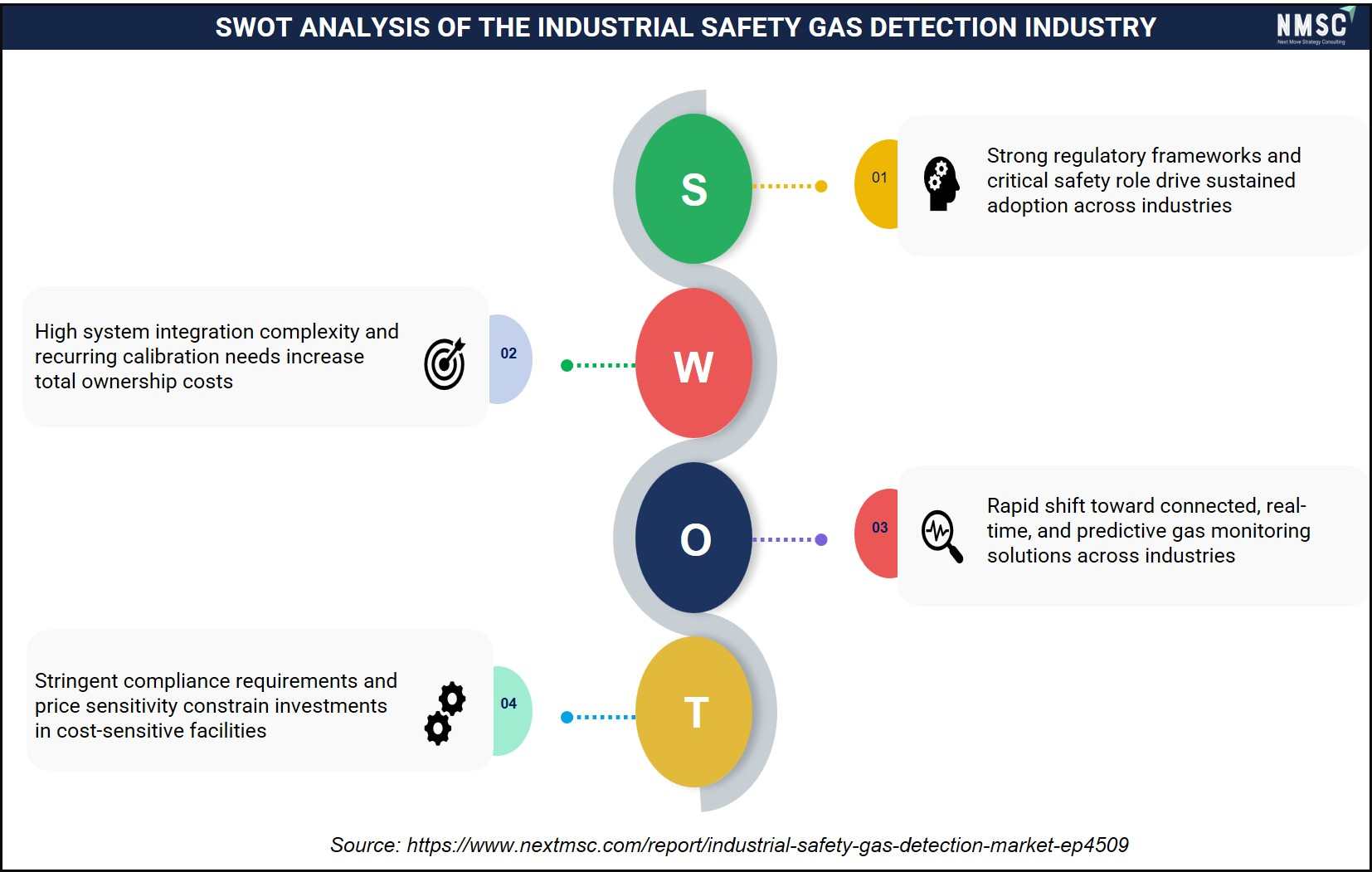
Based on our assessment of the industrial safety gas detection market, we found that strong regulatory frameworks and the critical role of safety systems continue to drive consistent adoption across industries. At the same time, integration complexity and recurring maintenance requirements influence total cost of ownership and deployment decisions. However, the rapid shift toward connected, real-time, and predictive monitoring solutions is creating significant growth momentum. Consequently, despite compliance pressures and cost sensitivity, the market continues to advance toward more intelligent, scalable, and data-driven safety ecosystems.
List of Key Industrial Safety Gas Detection Companies
-
MSA Safety Incorporated
-
Drägerwerk AG & Co. KGaA
-
Industrial Scientific Corporation
-
Emerson Electric Co. (Rosemount)
-
Teledyne Gas & Flame Detection
-
Riken Keiki Co., Ltd.
-
Crowcon Detection Instruments Ltd.
-
Blackline Safety Corp.
-
New Cosmos Electric Co., Ltd.
-
Hanwei Electronics Group Corporation
-
Trolex Ltd.
-
Sensidyne LP
-
International Gas Detectors Ltd.
-
GfG Instrumentation, Inc.
-
RKI Instruments, Inc.
-
WatchGas B.V.
-
Gas Clip Technologies
-
ESP Safety Inc.
-
Airtest Technologies Inc.
What Are The Latest Key Industry Developments?
-
February 2026 – Emerson released its Rosemount QX1000 Continuous Gas Analyzer, the world's first hybrid analyzer to combine quantum cascade laser (QCL) and paramagnetic detection. This achievement sets a new standard for precision in continuous emissions monitoring (CEMS) and industrial process safety.
-
February 2026 – Riken Keiki launched the FPM-80A, a new specialized gas monitor, following the December 2025 release of the GD-81D Series. These launches signify Riken Keiki’s 2026 push to update its high-precision sensor portfolio for semiconductor and industrial hazardous area monitoring.
-
November 2025 – MSA Safety introduced the ALTAIR io 6 Multigas Detector at the A+A 2025 International Trade Fair. As the company’s first cellular-connected six-gas detector with an integrated pump, it is scheduled for official commercial availability in early 2026.
What Are The Key Factors Influencing Investment Analysis & Opportunities In The Industrial Safety Gas Detection Market?
Investment analysis in the industrial safety gas detection market increasingly reflects a shift toward connected safety ecosystems and intelligent monitoring platforms rather than standalone detection devices. Market evidence suggests that investors prioritize companies developing advanced sensing technologies, wireless monitoring platforms, and cloud-connected safety analytics capable of delivering recurring value across industrial operations. In this evolving landscape, vendors integrating gas detection systems with broader industrial automation and worker safety platforms attract stronger strategic interest. From our evaluation of recent partnerships, acquisitions, and technology investments, we observed that companies demonstrating scalable deployment models, proprietary sensor capabilities, and seamless integration with plant safety networks consistently strengthen their investment appeal.
At the same time, data analysis reveals increasing capital concentration around next-generation sensing technologies, predictive safety analytics, and connected monitoring platforms designed to enhance real-time hazard detection across complex industrial environments. As industrial operations become more interconnected, strategic investments increasingly originate from automation providers, energy companies, and safety technology groups seeking tighter ecosystem control. Through our review of investment activity, we identified that companies combining sensor innovation with scalable monitoring platforms and global service capabilities remain best positioned to capture long-term growth opportunities. Consequently, investment strategies increasingly favor platform extensibility, lifecycle value creation, and integrated safety infrastructure development.
Key Benefits for Stakeholders:
Next Move Strategy Consulting (NMSC) presents a comprehensive analysis of the industrial safety gas detection market trends, covering historical developments from 2020 to 2025 and providing forward-looking forecasts through 2035. The study evaluates the market at global, regional, and country levels, delivering quantitative outlooks alongside qualitative insights into key growth drivers, regulatory frameworks, technology advancements, and investment trends across major safety monitoring segments. Industry analysis indicates that increasing focus on workplace safety compliance, hazardous environment monitoring, and industrial automation continues to shape adoption patterns across energy, chemical, mining, and manufacturing sectors.
Within this ecosystem, the industrial safety gas detection market delivers measurable value to a diverse participant base. Market evidence suggests that investors benefit from recurring revenue streams driven by connected monitoring platforms, calibration services, and lifecycle-based safety solutions. Industrial operators and facility managers gain improved hazard detection, regulatory compliance, and operational reliability through deployment of fixed and portable gas monitoring systems. From our interactions with safety engineers, distributors, and automation integrators, we found that service providers and technology partners increasingly benefit from long-term maintenance contracts, system upgrades, and integrated safety platform deployments. Consequently, the market supports sustained value creation by aligning safety innovation with operational resilience and industrial risk management.
Industrial Safety Gas Detection Market Key Segments
By Offering
-
Hardware
-
Fixed Gas Detection Systems
-
Point Gas Detectors
-
Open Path Gas Detectors
-
Area Gas Monitoring Systems
-
Gas Detection Controllers
-
Gas Sampling Systems
-
-
Portable Gas Detection Devices
-
Single Gas Detectors
-
Multi Gas Detectors
-
Wearable Gas Detectors
-
Pumped Portable Monitors
-
Disposable Gas Detectors
-
-
Accessories and Replacement Components
-
Replacement Sensors
-
Batteries and Chargers
-
Pumps and Filters
-
Mounting Hardware
-
Calibration Accessories
-
Carrying Cases
-
-
-
Software
-
Device Management Software
-
Data Analytics Platforms
-
Cloud Monitoring Platforms
-
Mobile Monitoring Applications
-
Compliance & Reporting Software
-
-
Services
-
Calibration Services
-
On Site Calibration
-
Factory Calibration
-
Bump Testing
-
-
Maintenance and Repair Services
-
Preventive Maintenance
-
Corrective Repair
-
Overhaul Services
-
Sensor Replacement Programs
-
-
Operational Services
-
Rental and Leasing
-
Fleet Management
-
Training Services
-
-
By Gas Type
-
Combustible Gas Detection
-
Toxic Gas Detection
-
Oxygen Monitoring
-
Volatile Organic Compound Detection
-
Refrigerant Gas Detection
-
Other Industrial Gas Detection
By Sensor Technology
-
Electrochemical Sensors
-
Catalytic Bead Sensors
-
Infrared Sensors
-
Photoionization Detectors (PID)
-
Semiconductor Sensors
-
Ultrasonic Gas Leak Detectors
-
Laser Based Sensors
-
Thermal Conductivity Sensors
By Connectivity Type
-
Wired Gas Detection Systems
-
Wireless Gas Detection Systems
-
Hybrid Wired–Wireless Systems
-
IoT Integrated Gas Detection Systems
By Application
-
Confined Space Monitoring
-
Area Monitoring
-
Process Safety Monitoring
-
Leak Detection
-
Fugitive Emission Monitoring
-
Environmental Monitoring
-
Others
By End Use Industry
-
Oil and Gas
-
Upstream
-
Midstream
-
Downstream
-
-
Chemicals and Petrochemicals
-
Mining and Metals
-
Power Generation
-
Water and Wastewater Treatment
-
Manufacturing
-
Automotive
-
Aerospace
-
Heavy Industry
-
General Manufacturing
-
-
Food and Beverage Processing
-
Pharmaceuticals and Biotechnology
-
Semiconductor and Electronics
-
Commercial Facilities
-
Laboratories
-
Refrigeration Systems
-
Parking Garages
-
Commercial Kitchens
-
-
Public Safety and Government
-
Emergency Response
-
Fire Services
-
Defense
-
-
Marine and Offshore Operations
-
Building Safety and HVAC Systems
-
Others
Geographical Breakdown
-
North America: U.S., Canada, and Mexico.
-
Europe: UK, Germany, France, Italy, Spain, Sweden, Denmark, Finland, the Netherlands, and the Rest of Europe.
-
Asia Pacific: China, India, Japan, South Korea, Taiwan, Indonesia, Vietnam, Australia, Philippines, Malaysia and the rest of APAC.
-
Middle East & Africa (MEA): Saudi Arabia, UAE, Egypt, Israel, Turkey, Nigeria, South Africa, and the rest of MEA.
-
Latin America: Brazil, Argentina, Chile, Colombia, and the rest of LATAM.
Conclusion & Recommendations
This report equips stakeholders, industry participants, investors, and consultants with actionable intelligence to capitalize on the structural transformation underway in market. By combining rigorous data-driven analysis with proven strategic frameworks, NMSC’s Industrial Safety Gas Detection Market Report serves as a critical decision-support resource for navigating an increasingly safety- and compliance-driven industrial landscape. The market is positioned for sustained expansion, supported by rising regulatory scrutiny, growing industrial automation, and increasing need for real-time hazard monitoring across energy, chemical, and manufacturing sectors. Industry trends indicate that connected safety platforms, advanced sensing technologies, and seamless integration with industrial automation systems strengthen operational visibility and long-term reliability. Vendors prioritizing sensor accuracy, wireless connectivity, and scalable monitoring architectures consistently enhance customer retention and lifecycle value generation.
In this context, executives and investors focus on high-impact applications such as continuous plant monitoring, confined space safety, and large-scale industrial hazard detection while sustaining investments in sensor innovation, predictive analytics, and integrated safety ecosystems. Data analysis reveals that expansion across high-growth regions, particularly Asia-Pacific and resource-intensive markets, unlocks new deployment opportunities. As industrial operations evolve, scalability, system reliability, and compliance-driven performance continue to strengthen vendor credibility, accelerating adoption and supporting long-term value creation across the global industrial safety gas detection ecosystem.
Expert Insights
 “In too many cases, by the time anyone else is aware the worker is in danger, it is too late. With G7c, we can not only alert others instantly when a worker is in trouble but direct the right help to them, potentially saving their life. This is what true connected safety means for the workplace.”.
— Cody Slater, CEO and Chairman of Blackline Safety
Statement made during the launch of Blackline Safety’s G7c connected gas detection device, highlighting real-time monitoring and worker safety.
Market Interpretation
The statement highlights the critical importance of real-time hazard detection in industrial environments, where delays in identifying risks can significantly impact worker safety. As industries operate in increasingly hazardous conditions, there is a growing need for gas detection solutions that provide instant alerts and enable rapid emergency response. The adoption of connected safety technologies is increasing, allowing companies to monitor workers continuously and respond proactively to incidents. Consequently, industrial operators are increasingly investing in advanced gas detection systems integrated with real-time monitoring and communication capabilities, supporting the growth of the industrial safety gas detection market.


About the Author
 Saista Faiyaz
— Saista Faiyaz is Research Associate at Next Move Strategy Consulting, where she has covered consumer markets and healthcare technologies for 3 years. Her work includes primary interview review, secondary-source validation, market sizing, and structured analysis of company and industry data. She supports research by comparing evidence across sources, organizing findings into market narratives, and documenting assumptions used in analysis. Her scope includes cross-market benchmarking, and reports.
Saista Faiyaz
— Saista Faiyaz is Research Associate at Next Move Strategy Consulting, where she has covered consumer markets and healthcare technologies for 3 years. Her work includes primary interview review, secondary-source validation, market sizing, and structured analysis of company and industry data. She supports research by comparing evidence across sources, organizing findings into market narratives, and documenting assumptions used in analysis. Her scope includes cross-market benchmarking, and reports.
About the Reviewer
 Supradip Baul
— Supradip Baul is an accomplished business consultant and strategist with over a decade of rich experience in market intelligence, strategy, technology, and business transformation. His work has included rigorous qualitative and quantitative analysis across multiple industries, helping clients shape investment decisions and long-term roadmaps. Earlier in his career, he was associated with Gartner, where he contributed to industry-leading reports and market share analyses. He has worked with leading global companies and holds an MBA with a dual specialization in Marketing and Finance.
Supradip Baul
— Supradip Baul is an accomplished business consultant and strategist with over a decade of rich experience in market intelligence, strategy, technology, and business transformation. His work has included rigorous qualitative and quantitative analysis across multiple industries, helping clients shape investment decisions and long-term roadmaps. Earlier in his career, he was associated with Gartner, where he contributed to industry-leading reports and market share analyses. He has worked with leading global companies and holds an MBA with a dual specialization in Marketing and Finance.
At Next Move Strategy Consulting, we understand that insightful market research is the cornerstone of successful business decisions. That's why we employ a robust and multifaceted approach, combining various methodologies to deliver the most accurate and actionable data for our clients.

Research Landscape
We navigate the world of research with two primary approaches:
Qualitative Approach
Our qualitative research methodologies involve immersive techniques such as in-depth interviews, focus groups, and observational studies. By engaging directly with individuals and stakeholders, we uncover valuable insights that quantitative data alone may overlook.

Quantitative Research
In tandem with qualitative methodologies, NMSC leverages the power of Quantitative Research to provide a robust foundation of numerical insights. Through systematic data collection and analysis, we quantify patterns, preferences, and market trends, offering a comprehensive view of the business landscape.
Our quantitative research approach employs diverse tools, including surveys, experiments, and statistical modelling. These methodologies enable us to gather data from a large and representative sample, ensuring the statistical significance of our findings. By employing structured questionnaires and standardized data collection methods, we guarantee the reliability and validity of the information we present to our clients.
Quantitative research is particularly effective in measuring the prevalence of trends, assessing market size, and gauging the impact of various factors on consumer behavior. The numerical precision attained through this approach equips our clients with actionable insights, facilitating data-driven decision-making and strategy formulation.


Our Specialized Toolbox for Industry-Specific Market Research
We deploy a specialized arsenal of techniques tailored to meet your unique requirements. Here's a glimpse into our comprehensive toolbox:

Information Procurement
The stage entails acquiring market data or relevant information through various sources and methodologies.


Market Research Approach
We utilize both top-down and bottom-up approaches in market research analysis to achieve a comprehensive understanding of the market dynamics, leveraging the broad perspective of industry trends and macroeconomic factors alongside detailed insights from specific segments and individual companies.

Porters Five Forces Analysis
We conduct Porter's Five Forces analysis to evaluate the competitive landscape of an industry, providing us with insights into factors that affect profitability and strategic positioning.

SWOT Analysis

Forecasting
We utilize a forecasting model to predict future consumption by considering parameters like population, economics, regulations, market competition, drivers, constraints, technology, and pricing. We also employ statistical techniques such as multilinear regression, exponential smoothing, moving average, ARIMA, and Monte Carlo simulations for accurate predictions. In econometric forecasting, we analyzed short-term and long-term event impacts, attributing values based on regulatory frameworks, economic factors, and market events.





 Speak to Our Analyst