Israel Fabric Care Market, By Product Type {Fabric Detergents (General Purpose, Baby Laundry Detergent, and Delicate Laundry Detergent), Fabric Softeners/Conditioners, and Others}, By Form (Liquid, Powder, Unit-Dose, Sheet & Wipe, and Spray), By Nature (Conventional and Eco-friendly / Organic), By Price Tier (Value, Mid-range, and Premium), By Distribution Channel (Online and Offline), and By End-User (Residential, Commercial, and Others) – Analysis & Forecast, 2025–2035
Industry: Retail and Consumer | Latest Edition: September 30, 2026 | No of Pages: 152 | No. of Tables: 49 | No. of Figures: 43 | Format: PDF | Report Code: RC5745
Israel Fabric Care Market Size & Forecast
|
Parameters |
Details |
|
Market Size in 2025 |
USD 2.25 billion |
|
Market Size in 2026 |
USD 2.57 billion |
|
Revenue Forecast in 2035 |
USD 4.24 billion |
|
Growth Rate |
CAGR of 5.72% from 2026 to 2035 |
|
Analysis Period |
2025–2035 |
|
Base Year Considered |
2025 |
|
Forecast Period |
2026–2035 |
|
Companies Profiled |
10 |
|
Market Share |
Available for 10 companies |
Industry Outlook
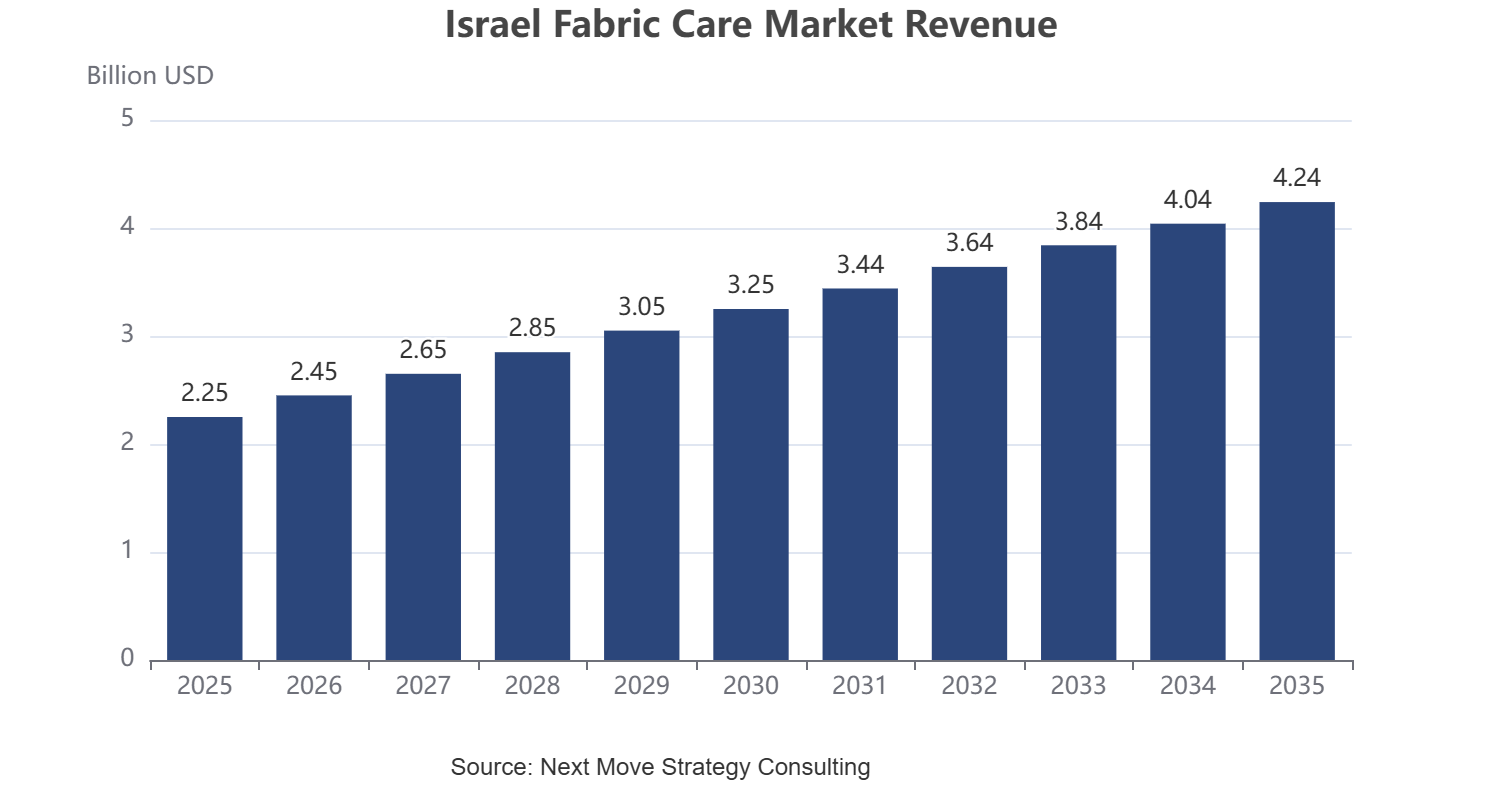
The Israel Fabric Care Market was valued at USD 2.25 billion in 2025 and is estimated to reach USD 2.57 billion in 2026, driven by rising household consumption, growing urbanization, and increasing demand for premium and eco-certified fabric care products. The market is projected to expand to USD 4.24 billion by 2035, registering a CAGR of 5.72% over the forecast period. This robust growth trajectory reflects Israel’s high per-capita income levels, a tech-savvy consumer base driving online retail adoption, and sustained innovation in concentrated and dermatologically tested fabric care formulations.
Ecosystem Analysis of the Israel Fabric Care Market:
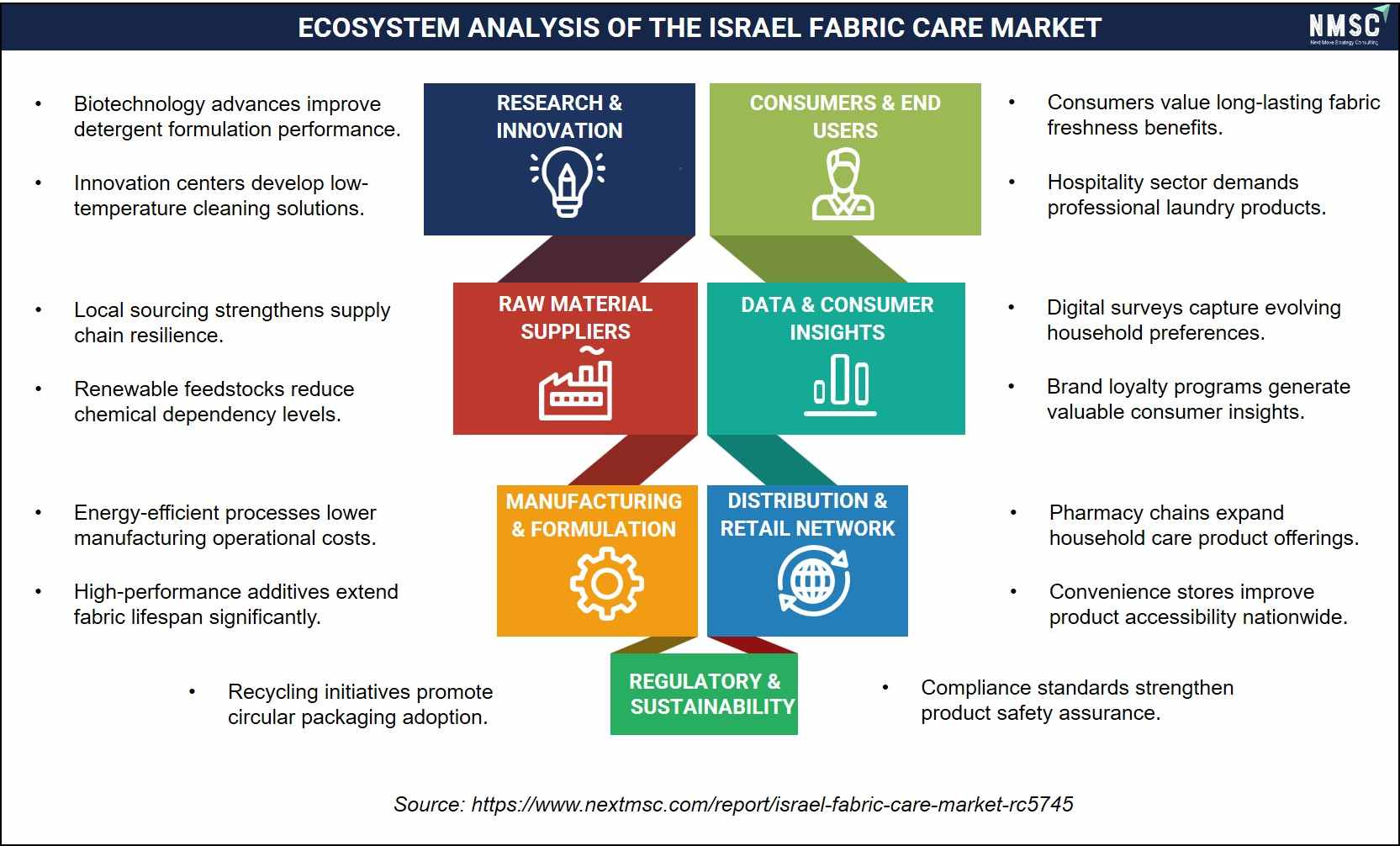
The above ecosystem analysis maps the key operational pillars, such as research and innovation, raw material suppliers, manufacturing and formulation, regulatory and sustainability, distribution and retail network, data and consumer insights, and consumers and end users, shaping the Israel fabric care industry. From our analysis, we observed that research drives biotechnology advances and low-temperature cleaning solutions, while raw material suppliers focus on local sourcing and renewable feedstocks. Manufacturing emphasizes energy-efficient processes and high-performance additives, whereas regulatory frameworks enforce recycling initiatives and compliance standards. Distribution through pharmacy chains and convenience stores expands reach, while insights guide brand loyalty programs. Finally, consumers value fabric freshness, and the hospitality sector demands professional laundry products.
What Are the Key Growth Drivers, Restraints, and Opportunities Shaping the Israel Fabric Care Market Through 2035?
Growth Catalyst & Risk Assessment Matrix
|
DRIVERS / TRENDS / RESTRAINTS |
(+/–) % IMPACT ON CAGR FORECAST |
GEOGRAPHIC RELEVANCE |
IMPACT TIMELINE |
|
High per-capita income driving premiumization toward concentrated, dermatologist-tested, and baby fabric care formats elevating average selling prices across Israeli retail |
+3.8% |
National (Tel Aviv, Jerusalem, Haifa) |
Long term (4–7 years) |
|
Rapid expansion of online grocery and quick-commerce platforms accelerating shift from supermarket fabric care purchasing to digital and subscription-based channels |
+3.1% |
Urban centres and greater Tel Aviv metropolitan area |
Medium to long term (3–6 years) |
|
EU-aligned environmental regulations and eco-conscious consumer segment driving demand for phosphate-free, biodegradable, and EcoLabel-certified fabric care formulations |
+2.6% |
Tel Aviv, Central District, Northern Israel |
Medium term (2–5 years) |
|
Geopolitical risk, import disruption, and small domestic population base constraining volume ceiling and raising raw material sourcing costs for imported formulations |
–2.1% |
National, most acute for import-reliant manufacturers |
Short to medium term (1–4 years) |
The Israel Fabric Care Market operates within a compact yet highly developed consumer economy, where elevated purchasing power, high smartphone penetration, and a sophisticated retail infrastructure combine to support above-average CAGR growth relative to broader Middle Eastern markets. Competitive intensity is driven by both global multinational brands and well-entrenched domestic manufacturers with strong supermarket and hypermarket partnerships. Macro-level factors, including geopolitical risks and a complex import environment, temper volume-side expansion while simultaneously accelerating the shift toward domestic production, eco-certified formulations, and higher-value product formats that sustain category revenue growth through 2035.
Growth Drivers:
How Is High Consumer Purchasing Power Driving Premiumization Across Israel?
Israeli consumers rank among the highest per-capita spenders on household care in the Middle East, and this purchasing power is channeling steadily toward premium fabric detergents, dermatologist-tested baby laundry products, and fragrance-enhanced softeners with long-lasting efficacy claims. Retail shelf analysis shows consistent value-mix improvement as shoppers trade up from economy formats to mid-range and premium tiers, particularly for baby and delicate laundry sub-segments. Manufacturers are reinforcing this trend through pack-size optimization, concentrated formulas that deliver more washes per unit, and ingredient transparency labeling that resonates with Israel’s health-conscious, well-informed consumer segments.
How Is the Rapid Growth of Online Grocery and Quick-Commerce Platforms Reshaping Fabric Care Distribution in Israel?
Israel’s e-commerce penetration rate is among the highest in the Middle East, with grocery delivery and quick-commerce platforms having expanded significantly as urban households prioritize time efficiency. Fabric care benefits disproportionately from this shift, as subscription-based detergent replenishment, bulk-format pod bundles, and direct-brand storefronts allow manufacturers to bypass traditional margin-intensive retail channels and build direct consumer relationships. Major local supermarket chains and third-party marketplaces are investing heavily in same-day and next-day delivery capacity, further accelerating the migration of high-frequency household care purchasing from physical shelves to digital channels.
How Are EU-Aligned Environmental Regulations Accelerating Demand for Eco-Certified Fabric Care Products in Israel?
Israel has adopted stringent environmental standards aligned closely with EU chemical regulations, creating meaningful regulatory pressure on fabric care manufacturers to eliminate phosphates, reduce surfactant concentrations, and certify biodegradability across product lines. This regulatory environment, combined with a culturally influential green consumer segment concentrated in Tel Aviv and central urban districts, is driving double-digit growth in eco-certified detergents, fragrance-free softeners, and unit-dose formats that minimize per-wash packaging waste. Domestic producers are reformulating legacy products to maintain market relevance against incoming European eco-label brands entering Israeli retail through dedicated import channels.
Growth Inhibitor:
What Structural and Geopolitical Factors Are Restraining Faster Growth in Israel?
Israel’s security environment and regional geopolitical tensions introduce recurring supply-chain disruption risks for imported fabric care raw materials and finished goods, particularly surfactants and fragrance compounds sourced from Asia and Europe. Port delays, elevated import insurance costs, and exchange-rate volatility against the US dollar and euro periodically squeeze manufacturer margins, especially for foreign-brand subsidiaries reliant on centralized European or Asian sourcing. Additionally, Israel’s relatively small population of approximately ten million limits the absolute volume ceiling of the domestic market, constraining the scale economics available to manufacturers investing in local production or dedicated Israeli product line extensions.
Growth Opportunity:
What Underserved Segments and Emerging Channels Represent the Strongest Growth Opportunities in Israel?
Israel’s ultra-Orthodox and Arab-Israeli communities, together representing more than thirty percent of the national population, remain comparatively underserved by mainstream fabric care marketing and product design, constituting a substantial and structurally distinct growth opportunity. Product formulations and packaging adapted to these communities’ specific laundry habits, language preferences, and purchasing channels represent a low-competition entry point for both domestic manufacturers and international brands. Simultaneously, the rapid growth of Israel’s commercial hospitality and healthcare sectors is expanding demand for institutional-grade fabric sanitizers and commercial-volume softeners, adding a high-margin B2B revenue layer alongside the dominant residential segment.
Consumer Behavior Analysis of the Israel Fabric Care Market:
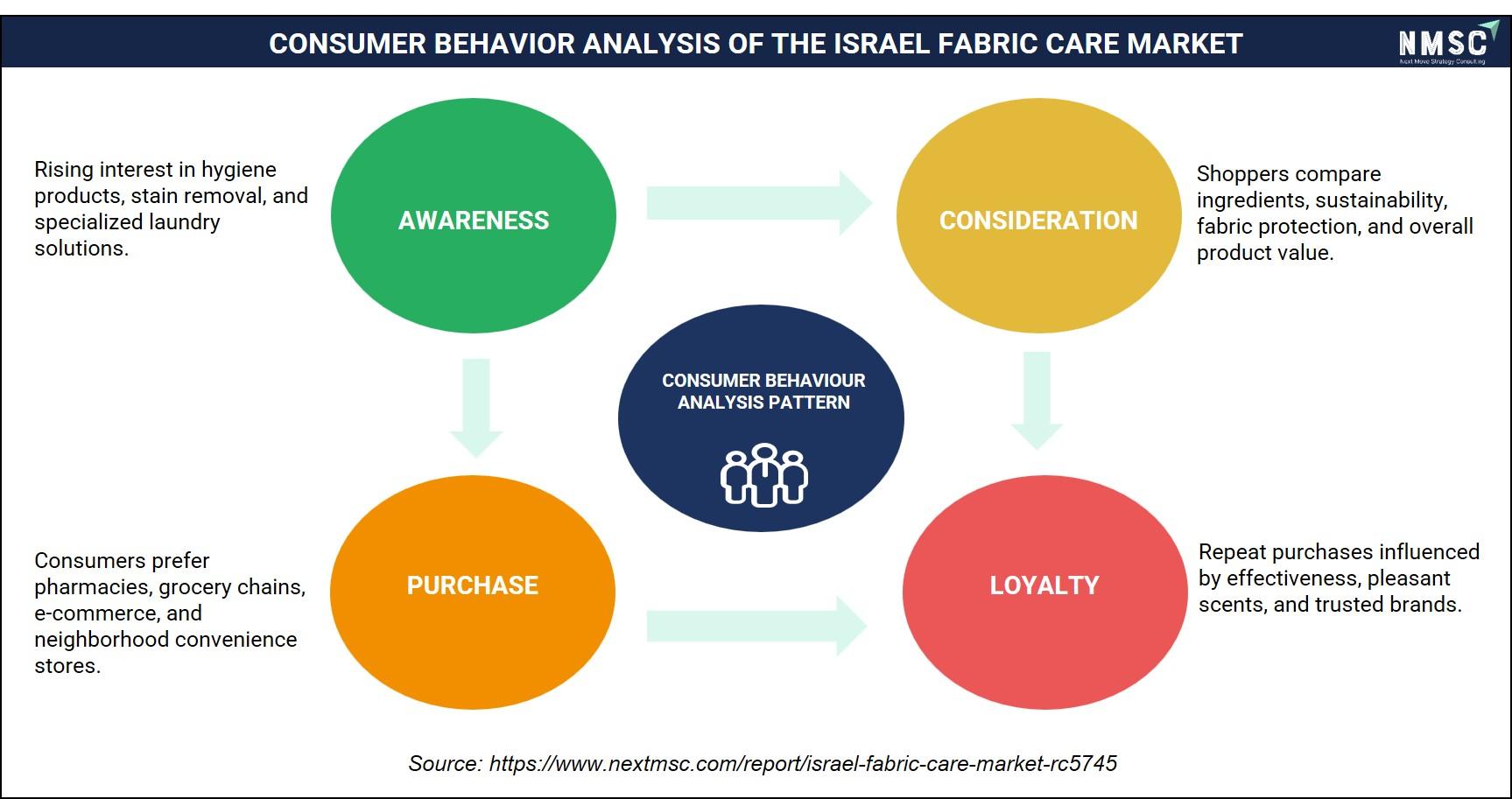
The above consumer behavior analysis maps the key decision-making stages, such as awareness, consideration, purchase, and loyalty, shaping the Israel fabric care industry. From our analysis, we observed that awareness reflects rising interest in hygiene products, stain removal, and specialized laundry solutions, while consideration involves shoppers comparing ingredients, sustainability, fabric protection, and overall product value. During purchase, consumers prefer pharmacies, grocery chains, e-commerce, and neighborhood convenience stores, whereas brand loyalty is ultimately driven by repeat purchases influenced by effectiveness, pleasant scents, and trusted brands.
How Is the Israel Fabric Care Market Segmented in This Report, and What Are the Key Insights from the Segmentation Analysis?
By Nature Insights
How Is Nature Segmentation Reflecting Sustainability Preferences?
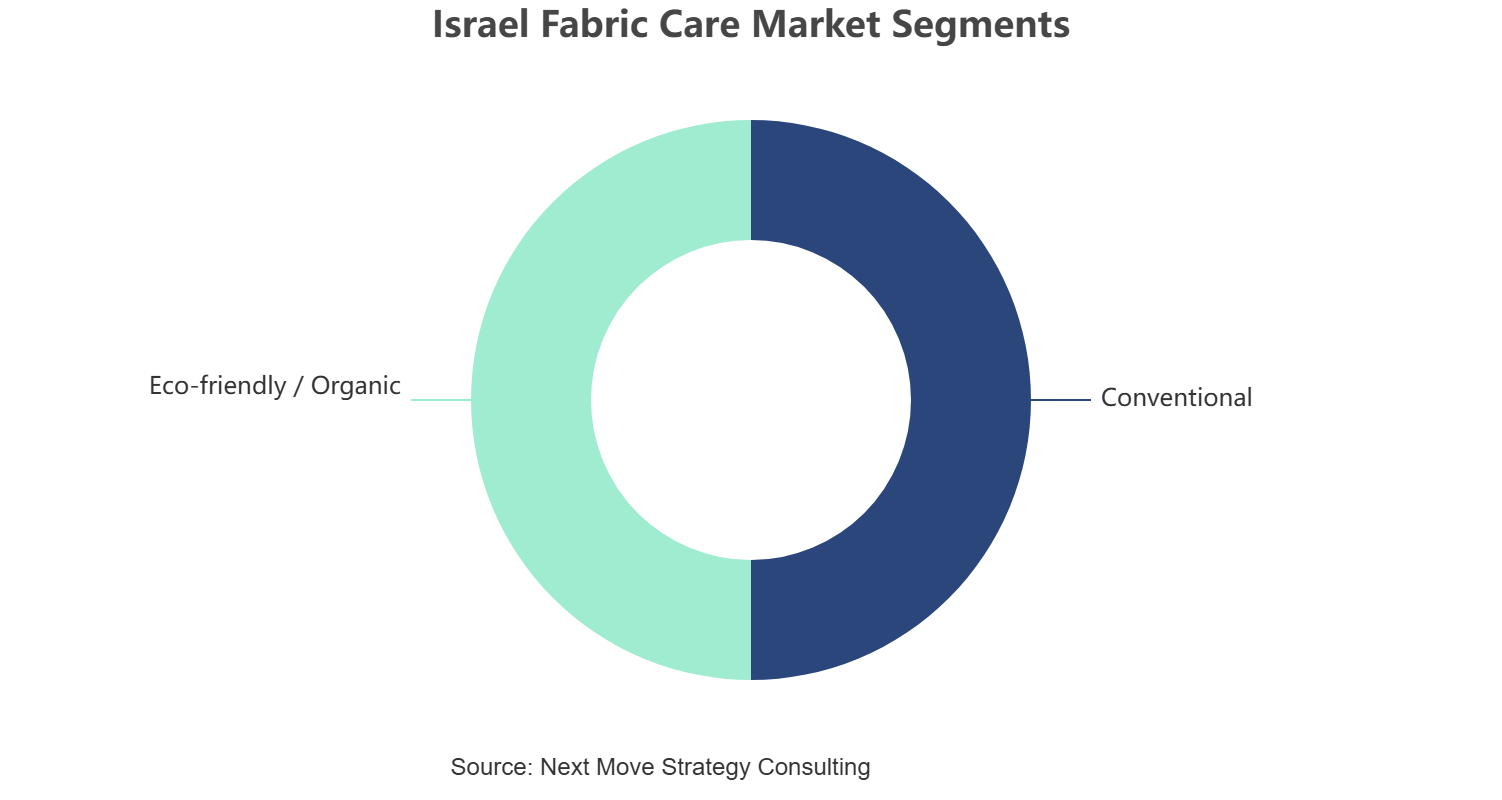
Based on nature, the Israel Fabric Care Market is segmented into conventional and eco-friendly/organic products.
The market reflects changing consumer priorities as sustainability considerations increasingly influence fabric care purchasing decisions alongside cleaning effectiveness and product value. According to our analysis, we found that conventional products continue to support everyday laundry needs through established usage patterns and broad market availability, while eco-friendly and organic formulations are gaining attention among environmentally conscious consumers seeking biodegradable ingredients, reduced chemical content, and sustainable packaging solutions, encouraging manufacturers to expand greener fabric care offerings across the market.
By Form Insights
How Does Form Segmentation Reflect Changing Consumer Preferences?
Based on form, the Israel Fabric Care Market is segmented into liquid, powder, unit-dose, sheet & wipe, and spray formulations.
The market demonstrates a diverse format landscape shaped by consumer preferences for convenience, efficiency, storage flexibility, and sustainable laundry solutions. In our observation, liquid and powder formulations continue to support everyday fabric care needs across households, while unit-dose formats, including pods and sachets, are gaining acceptance due to precise dosing and ease of use. Sheet & wipe and spray formats are emerging through niche applications, particularly among convenience-focused and environmentally aware consumers seeking compact and innovative fabric care alternatives.
Key Segments
By Product Type
-
Fabric Detergents
-
General Purpose
-
Baby Laundry Detergent
-
Delicate Laundry Detergent
-
-
Fabric Softeners/Conditioners
-
Stain Removers/Bleach
-
Sanitizer
-
Other Products
By Form
-
Liquid
-
Powder
-
Unit-Dose
-
Pods
-
Sachets
-
-
Sheet & Wipe
-
Spray
By Nature
-
Conventional
-
Eco-friendly / Organic
By Price Tier
-
Value
-
Mid-range
-
Premium
By Distribution Channel
-
Online
-
Marketplaces
-
Brand E-com
-
Quick Commerce
-
-
Offline
-
Supermarkets
-
Hypermarkets
-
Department Stores
-
By End-User
-
Residential
-
Commercial
-
Others
Competitive Landscape
The Israel Fabric Care Market is characterized by a dual competitive structure in which globally recognized multinational brands compete directly against established domestic manufacturers that hold deep retail relationships and localized consumer trust built over decades. Competitive dynamics center on shelf placement in Israel’s concentrated supermarket and hypermarket retail environment, where a small number of dominant grocery chains exercise significant buyer power over brand assortment and promotional programming. Innovation in eco-certified reformulation, unit-dose convenience, and dermatologically validated baby and sensitive-skin products is the primary axis of differentiation among category leaders contending for premium-tier share.
Key Players
-
Sano-Bruno’s Enterprises Ltd.
-
Henkel Israel Ltd.
-
Reckitt Benckiser Israel Ltd.
-
SC Johnson Israel Ltd.
-
Werner & Mertz Israel Ltd.
-
Miele Israel Ltd.
-
Zohar Dalia Ltd.
-
Kvisakol Ltd.
The competitive roster of the Israel Fabric Care Market includes dominant domestic manufacturers Sano-Bruno’s Enterprises Ltd. and Zohar Dalia Ltd., whose longstanding retail partnerships and locally resonant brand equities anchor category leadership. Global majors operating through Israeli subsidiaries, including Unilever Israel Ltd., Procter & Gamble Israel Ltd., Henkel Israel Ltd., and Reckitt Benckiser Israel Ltd., bring scale innovation and global R&D pipelines to bear against local incumbents. Specialist and niche players, including SC Johnson Israel Ltd., Werner & Mertz Israel Ltd., Miele Israel Ltd., and Kvisakol Ltd., target differentiated segments ranging from premium enzymatic cleaners to appliance-linked fabric care solutions.
Key Benefits for Stakeholders
Next Move Strategy Consulting (NMSC) offers a comprehensive research study of the Israel Fabric Care Market, covering the historical base year of 2025 and providing detailed revenue forecasts through 2035 across all major product, form, nature, price tier, distribution channel, and end-user segments. Designed for market participants operating within Israel’s unique regulatory, demographic, and geopolitical environment, this report delivers actionable intelligence on growth pockets, competitive positioning, and evolving consumer preferences that enable manufacturers, distributors, investors, and retail partners to make high-confidence strategic decisions within one of the Middle East’s most sophisticated household care markets.
Manufacturers gain the segment-level revenue breakdowns needed to prioritize product line investments across premium, eco-certified, and unit-dose categories where Israel’s value-mix is shifting most rapidly. Retail and distribution partners benefit from channel-level analysis that quantifies the accelerating migration from traditional supermarket formats to online, quick-commerce, and direct-brand e-commerce platforms. For investors and market entrants, the competitive profiling and opportunity mapping sections identify the community-specific and commercial-sector growth vectors that represent Israel’s clearest under-penetrated market segments, reducing the risk of generic market entry strategies that fail to account for Israel’s structurally distinct consumer landscape.
|
Parameters |
Details |
|
Customization Scope |
Free customization (equivalent to up to 80 analyst-working hours) after purchase. |
|
Pricing and Purchase Options |
Avail customized purchase options to meet your exact research needs. |
|
Approach |
In-depth primary and secondary research; proprietary databases; rigorous quality control and validation measures. |
|
Analytical Tools |
Porter’s Five Forces, SWOT, value chain, and Harvey ball analysis to assess competitive intensity, stakeholder roles, and relative impact of key factors. |
Conclusion
The Israel Fabric Care Market is projected to grow from USD 2.57 billion in 2026 to USD 4.24 billion by 2035, at a CAGR of 5.72%, outpacing most developed-market peers. Premiumization, eco-regulatory alignment, and rapid expansion of online and quick-commerce channels are the primary revenue catalysts, while geopolitical supply-chain risk and a finite population base act as structural constraints. Domestic leaders and multinational subsidiaries will continue to contest premium shelf real estate, leaving the clearest opportunities in underserved community segments, institutional end-users, and the fast-growing unit-dose and eco-certified product niches.
About the Author
 Mayurima Roy
— Mayurima Roy is Research Analyst at Next Move Strategy Consulting, where she has spent 4 years working across the firm's full industry coverage rather than a single fixed vertical. Her work centers on structured research, ongoing trend tracking, competitive assessment, and insight-led content development, translating complex market data into clear, decision-ready narratives that support informed client decision-making across diverse global industries, market sectors, and world regions every day.
Mayurima Roy
— Mayurima Roy is Research Analyst at Next Move Strategy Consulting, where she has spent 4 years working across the firm's full industry coverage rather than a single fixed vertical. Her work centers on structured research, ongoing trend tracking, competitive assessment, and insight-led content development, translating complex market data into clear, decision-ready narratives that support informed client decision-making across diverse global industries, market sectors, and world regions every day.
About the Reviewer
 Supradip Baul
— Supradip Baul is an accomplished business consultant and strategist with over a decade of rich experience in market intelligence, strategy, technology, and business transformation. His work has included rigorous qualitative and quantitative analysis across multiple industries, helping clients shape investment decisions and long-term roadmaps. Earlier in his career, he was associated with Gartner, where he contributed to industry-leading reports and market share analyses. He has worked with leading global companies and holds an MBA with a dual specialization in Marketing and Finance.
Supradip Baul
— Supradip Baul is an accomplished business consultant and strategist with over a decade of rich experience in market intelligence, strategy, technology, and business transformation. His work has included rigorous qualitative and quantitative analysis across multiple industries, helping clients shape investment decisions and long-term roadmaps. Earlier in his career, he was associated with Gartner, where he contributed to industry-leading reports and market share analyses. He has worked with leading global companies and holds an MBA with a dual specialization in Marketing and Finance.
At Next Move Strategy Consulting, we understand that insightful market research is the cornerstone of successful business decisions. That's why we employ a robust and multifaceted approach, combining various methodologies to deliver the most accurate and actionable data for our clients.

Research Landscape
We navigate the world of research with two primary approaches:
Qualitative Approach
Our qualitative research methodologies involve immersive techniques such as in-depth interviews, focus groups, and observational studies. By engaging directly with individuals and stakeholders, we uncover valuable insights that quantitative data alone may overlook.

Quantitative Research
In tandem with qualitative methodologies, NMSC leverages the power of Quantitative Research to provide a robust foundation of numerical insights. Through systematic data collection and analysis, we quantify patterns, preferences, and market trends, offering a comprehensive view of the business landscape.
Our quantitative research approach employs diverse tools, including surveys, experiments, and statistical modelling. These methodologies enable us to gather data from a large and representative sample, ensuring the statistical significance of our findings. By employing structured questionnaires and standardized data collection methods, we guarantee the reliability and validity of the information we present to our clients.
Quantitative research is particularly effective in measuring the prevalence of trends, assessing market size, and gauging the impact of various factors on consumer behavior. The numerical precision attained through this approach equips our clients with actionable insights, facilitating data-driven decision-making and strategy formulation.


Our Specialized Toolbox for Industry-Specific Market Research
We deploy a specialized arsenal of techniques tailored to meet your unique requirements. Here's a glimpse into our comprehensive toolbox:

Information Procurement
The stage entails acquiring market data or relevant information through various sources and methodologies.


Market Research Approach
We utilize both top-down and bottom-up approaches in market research analysis to achieve a comprehensive understanding of the market dynamics, leveraging the broad perspective of industry trends and macroeconomic factors alongside detailed insights from specific segments and individual companies.

Porters Five Forces Analysis
We conduct Porter's Five Forces analysis to evaluate the competitive landscape of an industry, providing us with insights into factors that affect profitability and strategic positioning.

SWOT Analysis

Forecasting
We utilize a forecasting model to predict future consumption by considering parameters like population, economics, regulations, market competition, drivers, constraints, technology, and pricing. We also employ statistical techniques such as multilinear regression, exponential smoothing, moving average, ARIMA, and Monte Carlo simulations for accurate predictions. In econometric forecasting, we analyzed short-term and long-term event impacts, attributing values based on regulatory frameworks, economic factors, and market events.





 Speak to Our Analyst