Japan Industrial Robotics Market Size, Share, Trends and Growth Analysis, By Robot Type (Articulated Robots, SCARA Robots, Cartesian and Gantry Robots, Delta Robots, Collaborative Robots, Autonomous Mobile Robots (AMRs), Automated Guided Vehicles (AGVs), and Other Robots), By Offering (Hardware, Software, and Services), By Application (Handling, Welding and Soldering), By Mounting Type, By Mobility, By Payload Capacity, By End User – Opportunity Analysis and Industry Forecast, 2025–2035
Industry: Semiconductor & Electronics | Latest Edition: September 1, 2026 | No of Pages: 165 | No. of Tables: 144 | No. of Figures: 130 | Format: PDF | Report Code: SE3726
What Is the Japan Industrial Robotics Market Size?
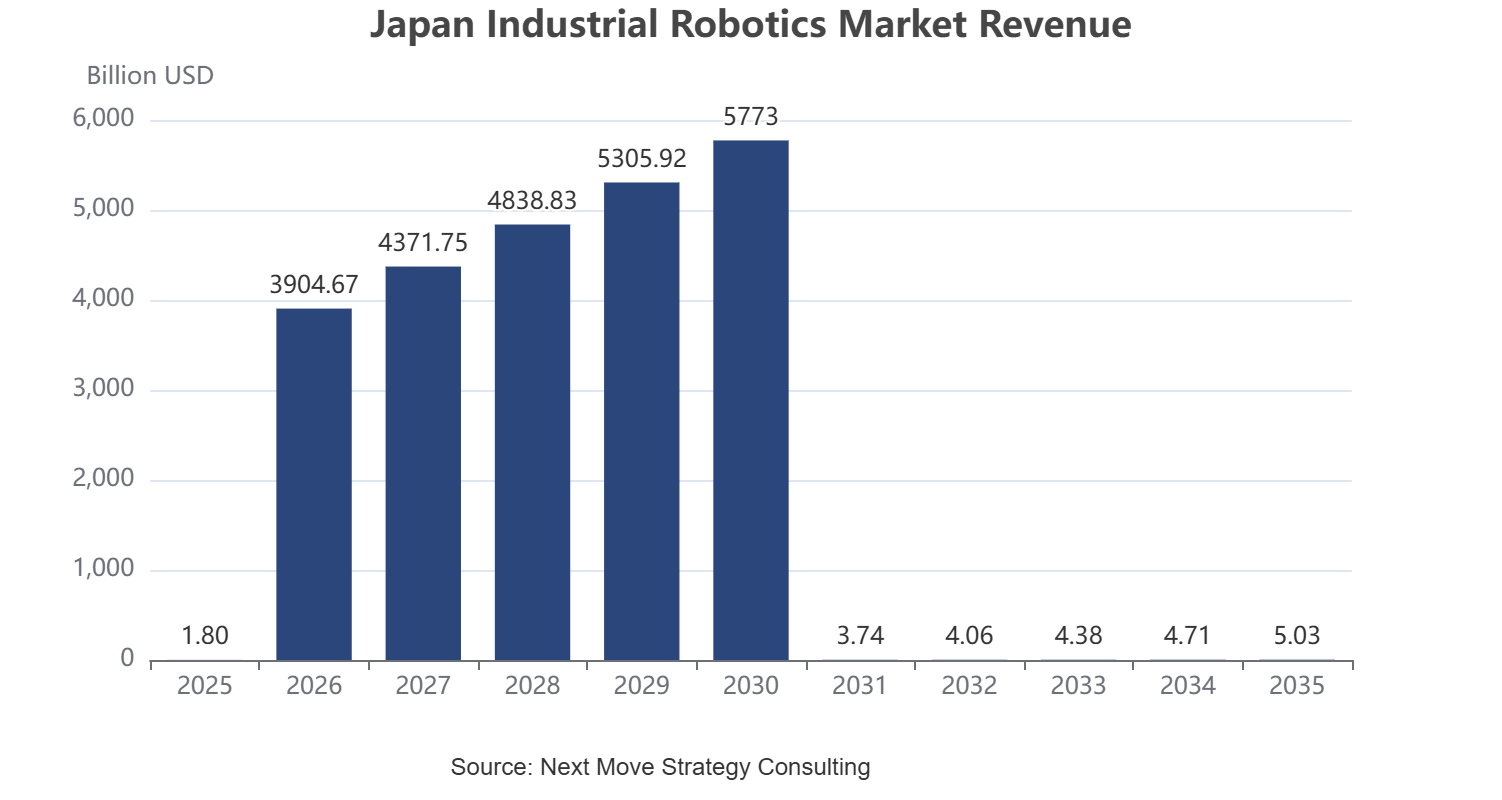
The Japan industrial robotics market size was valued at USD 1.80 billion in 2025 and is estimated at USD 2.00 billion in 2026, forecast to reach USD 5.03 billion by 2035, expanding at a 10.80% CAGR between 2026 and 2035. Articulated robots dominate the market by robot type, reflecting sustained deployment across automotive and electronics assembly lines.
In unit terms, deployed robot volume is estimated at 22 thousand units in 2025 and 24 thousand units in 2026, rising to 69 thousand units by 2035 at a 12.31% CAGR between 2026 and 2035, a faster expansion rate than the value CAGR that reflects falling average unit prices as collaborative and lower-payload robots gain share.
We observed that market growth is supported by Japan's aging workforce, government-backed physical AI initiatives, and continuous adoption of collaborative and mobile robotics across automotive, electronics, and semiconductor manufacturing operations through 2035.
|
Key Takeaways |
|
By Robot Type: Articulated Robots is the dominant segment, while Collaborative Robots is the fastest-growing segment. |
|
By Offering: Hardware is the dominant segment, while Software is the fastest-growing segment. |
|
By Application: Handling is the dominant segment, while Inspection and Quality Control is the fastest-growing segment. |
|
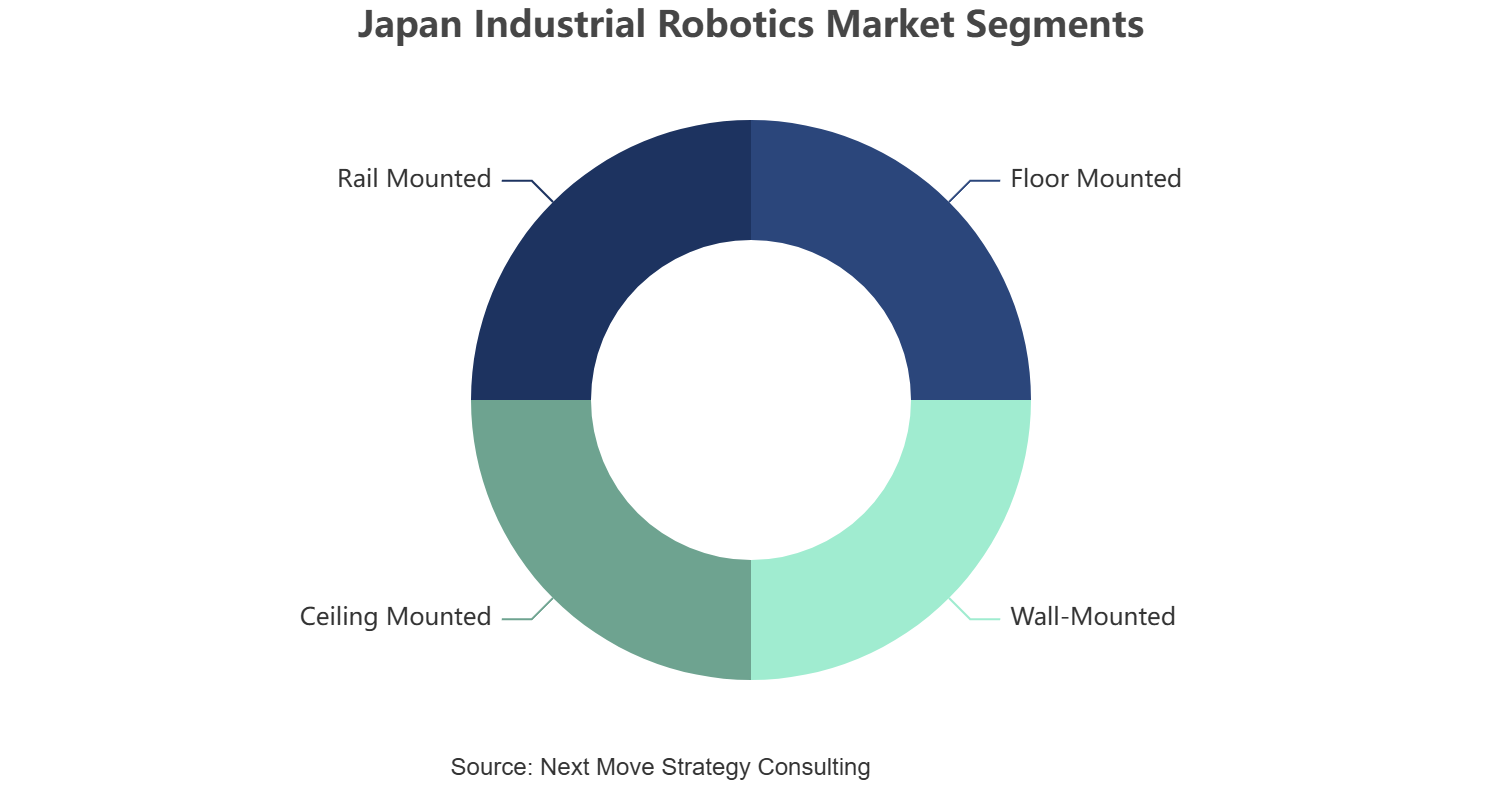
By Mounting Type: Floor Mounted is the dominant segment, while Rail Mounted is the fastest-growing segment. |
|
By Mobility: Stationary Robots is the dominant segment, while Mobile Robots is the fastest-growing segment. |
|
By Payload Capacity: Medium Payload 20 kg to 100 kg is the dominant segment, while Low Payload Up to 20 kg is the fastest-growing segment. |
|
By End User: Automotive Industry is the dominant segment, while Electrical and Electronics Industry is the fastest-growing segment. |
Market Opportunity: The Japan industrial robotics market is expected to create an absolute dollar opportunity of USD 3.03 billion between 2026 and 2035, presenting significant investment potential across physical AI-enabled robotics, collaborative robots, and semiconductor equipment automation segments.
According to NMSC's analysis, leading Japanese manufacturers are increasingly partnering with global AI technology providers to embed physical AI capabilities into industrial robots, strengthening their competitive position in the Japan industrial robotics market through 2035.
|
Parameters |
Details |
|
Market Size in 2025 |
USD 1.80 Billion |
|
Market Size in 2026 |
USD 2.00 Billion |
|
Revenue Forecast in 2035 |
USD 5.03 Billion |
|
Growth Rate |
CAGR of 10.80% from 2026 to 2035 |
|
Market Volume in 2025 |
22 Thousand Units |
|
Market Volume in 2026 |
24 Thousand Units |
|
Volume Forecast in 2035 |
69 Thousand Units |
|
Volume Growth Rate |
CAGR of 12.31% from 2026 to 2035 |
|
Analysis Period |
2025–2035 |
|
Base Year Considered |
2025 |
|
Forecast Period |
2026–2035 |
|
Market Size Estimation |
Revenue (USD Billion) |
|
Companies Profiled |
15 |
|
Market Share |
Available for Top 10 Companies |
What Does the Japan Industrial Robotics Market Encompass?
The Japan industrial robotics market encompasses articulated, SCARA, Cartesian and gantry, delta, collaborative, and mobile robotic systems deployed across handling, welding, assembly, dispensing, and inspection operations. Our assessment indicates that the market includes hardware components such as robot arms, controllers, end effectors, and vision systems, alongside programming software and system integration services delivered by Japan's globally dominant robot manufacturers serving automotive, electronics, and semiconductor production lines.
Japan's Ministry of Economy, Trade and Industry shapes robotics industrial policy through its Society 5.0 framework and dedicated research funding programs. We observed that manufacturers are increasingly investing in physical AI, vision-guided automation, and collaborative robotics to address a shrinking working-age population. NMSC's analysis indicates that rising integration of artificial intelligence computing platforms and open robot operating system frameworks continues to reshape robot programming, deployment speed, and factory-floor flexibility across Japanese manufacturing regions.
Key Emerging Trends
Based on research conducted by NMSC, we found that four structural trends are reshaping automation adoption, integration models, and competitive dynamics across the Japan industrial robotics market.
How Is Physical AI Reshaping Japan's Robot Manufacturing Leadership?
Leading Japanese robot manufacturers are embedding physical AI computing platforms into industrial robots to enable perception, reasoning, and adaptive task execution on the factory floor. We observed that companies such as FANUC Corporation are integrating open robot operating system drivers and simulation frameworks to shorten commissioning time. This shift strengthens Japan's global robotics leadership while supporting manufacturers seeking intelligent, adaptable automation across automotive and electronics production lines.
Why Are Collaborative Robots Gaining Traction Amid Labor Shortages?
Collaborative robots are increasingly deployed by small and mid-sized Japanese manufacturers confronting a shrinking working-age population and rising labor costs. Our findings suggest that cobots are being adopted for machine tending, palletizing, and packaging tasks without extensive safety fencing. This trend is expanding automation beyond large-tier automotive suppliers into food and beverage, logistics, and general manufacturing operations across Japan.
How Is Semiconductor Manufacturing Expansion Driving Robot Demand?
Expanding semiconductor fabrication and equipment manufacturing capacity across Japan is intensifying demand for cleanroom-compatible and precision handling automation. We observed that electronics and machinery manufacturers are commissioning new production lines equipped with SCARA and articulated robots to support chip and component assembly. As a result, integrators are reporting expanded order books tied directly to semiconductor capacity investments across Japanese industrial regions.
What Role Are Robot Manufacturer and AI Technology Partnerships Playing?
Strategic partnerships between Japanese robot manufacturers and global AI technology providers are accelerating the development of intelligent, adaptable automation systems. NMSC's analysis indicates that companies such as Yaskawa Electric Corporation are collaborating with telecommunications and AI infrastructure providers to build physical AI foundations. This collaboration model is reinforcing Japan's position as a central hub for AI-powered industrial robotics development and deployment.
Growth Drivers and Restraints
Growth Catalyst and Risk Assessment Matrix
|
Factors |
Type |
(+/−) % Impact on CAGR |
Geographic Relevance |
Impact Timeline |
|
Shrinking working-age population and persistent labor shortages driving automation demand |
Driver |
+3.68% |
Japan (nationwide; strongest in Kanto and Chubu manufacturing belts) |
Long term (3–8 years) |
|
Government-backed Society 5.0 and physical AI research funding accelerating robotics innovation |
Driver |
+2.74% |
Japan (nationwide; strongest around Tokyo and Osaka research clusters) |
Medium to Long term (2–7 years) |
|
Expanding semiconductor and electronics manufacturing capacity increasing precision robot demand |
Driver |
+2.31% |
Japan (strongest in Kyushu and Kansai semiconductor hubs) |
Medium term (2–5 years) |
|
Rising adoption of collaborative robots among small and mid-sized manufacturers |
Driver |
+1.79% |
Japan (nationwide) |
Medium term (2–5 years) |
|
Growing integration of physical AI and vision systems in industrial robots |
Driver |
+1.36% |
Japan (strongest among leading robot OEMs) |
Short to Medium term (1–4 years) |
|
High upfront capital costs limiting robotics adoption among small manufacturers |
Restraint |
−1.84% |
Japan (nationwide; strongest among small and mid-sized firms) |
Short to Medium term (1–4 years) |
|
Intensifying global competition from Chinese and European robot manufacturers |
Restraint |
−1.42% |
Japan (nationwide; strongest in export-dependent segments) |
Medium term (2–5 years) |
What Is the Primary Growth Driver of the Japan Industrial Robotics Market?
Japan's shrinking working-age population and persistent manufacturing labor shortages are the primary growth driver of the Japan industrial robotics market. According to Japan's Ministry of Economy, Trade and Industry, the country maintains one of the world's highest robot densities per manufacturing worker, reflecting decades of sustained automation investment. We observed that automotive, electronics, and machinery manufacturers continue prioritizing articulated and collaborative robot deployments to maintain output despite persistent recruitment challenges.
How Is Physical AI Investment Driving Japan Industrial Robotics Market Growth?
Government-backed research funding and corporate investment in physical AI are accelerating robotics innovation across the Japan industrial robotics market. Japan's Ministry of Economy, Trade and Industry has allocated dedicated funding for robot research and development programs spanning the current fiscal cycle, supporting foundational research in learning-based robotics and human-robot interaction. We observed that leading manufacturers are translating this research investment into commercial physical AI robot deployments across automotive and electronics production.
What Is Restraining Japan Industrial Robotics Market Expansion?
High upfront capital costs and intensifying competition from Chinese and European robot manufacturers continue to restrain market expansion, particularly among small and mid-sized Japanese manufacturers. We found that limited automation budgets and lengthy return-on-investment timelines increase adoption hesitancy for smaller enterprises. Our analysis shows that these constraints slow automation adoption outside large automotive and electronics manufacturers, limiting near-term robot density growth across smaller production facilities in Japan.
Ecosystem Analysis of the Japan Industrial Robotics Market
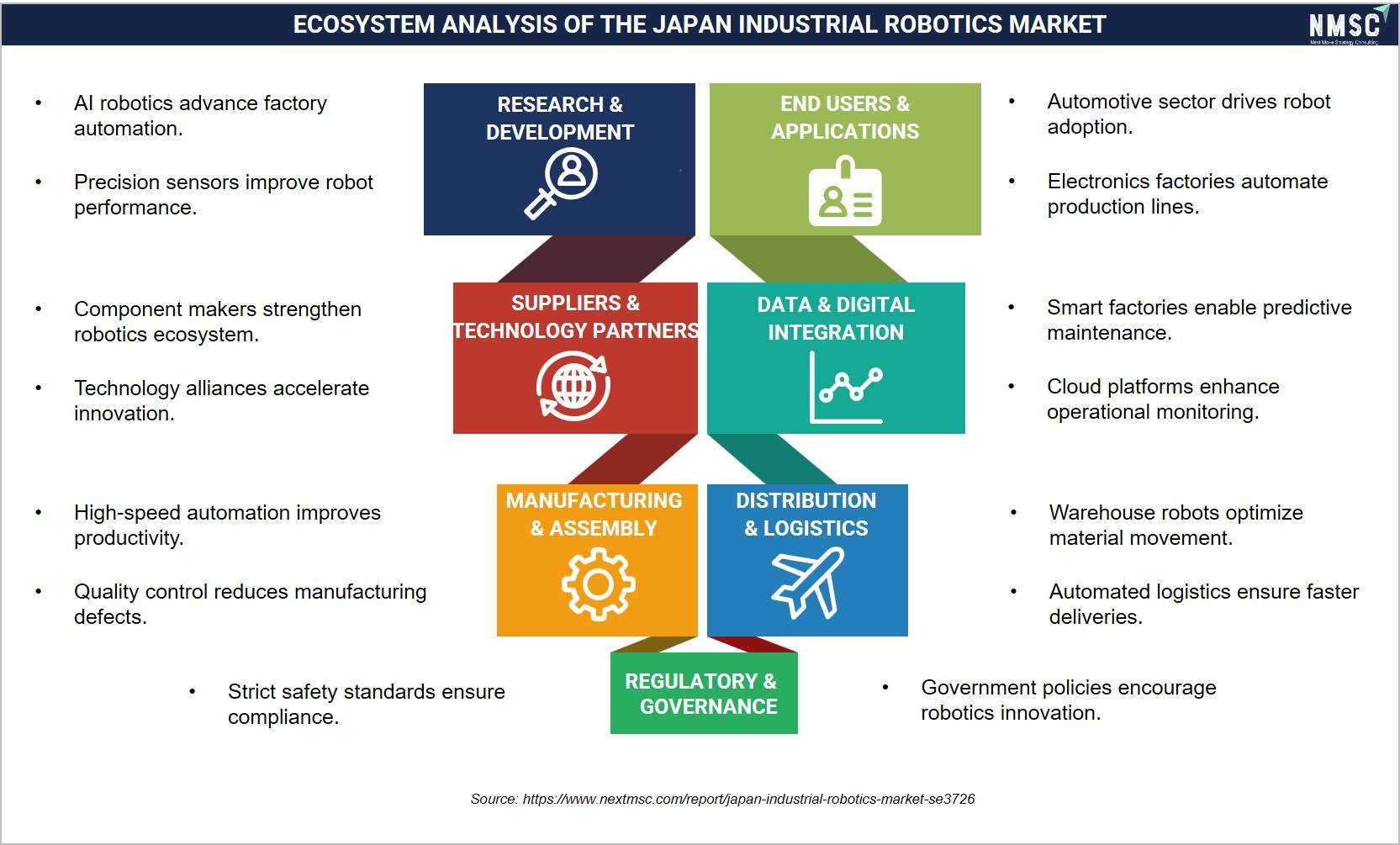
Japan's industrial robotics Sector is supported by a highly integrated ecosystem connecting research institutions, technology providers, manufacturers, logistics partners, end users, and regulatory bodies. Strong collaboration across the value chain accelerates innovation, digital integration, and advanced automation deployment, reinforcing Japan's leadership in precision manufacturing and sustainable industrial robotics development.
Segmentation Analysis
By Robot Type Insights
How Is the Japan Industrial Robotics Market Segmented by Robot Type?
Based on robot type, the Japan industrial robotics ecosystem is segmented into articulated robots, SCARA robots, Cartesian and gantry robots, delta robots, collaborative robots, autonomous mobile robots, automated guided vehicles, and other robots. Each robot type addresses distinct application requirements across Japanese manufacturing environments. Articulated robots provide multi-axis flexibility suited to welding, material handling, and assembly, while SCARA robots support high-speed, repetitive tasks in electronics and semiconductor production. Collaborative and mobile platforms extend automation into flexible, labor-constrained production settings.
Articulated robots dominate the Japan industrial robotics market, supported by extensive deployment across automotive welding, assembly, and material handling lines where multi-axis reach and payload versatility remain essential. We observed that collaborative robots represent the fastest-growing robot type, driven by rising adoption among small and mid-sized manufacturers confronting labor shortages and seeking flexible automation without extensive safety infrastructure. This shift reflects broader industry trends toward mixed human-robot production environments across Japanese industrial facilities.
By End User Insights
How Is the Japan Industrial Robotics Market Segmented by End User?
Based on end user, the Japan industrial robotics industry is segmented into automotive, electrical and electronics, metals and machinery, food and beverages, pharmaceuticals and medical devices, plastics rubber and chemicals, logistics and warehousing, and other industries. Each end-use industry applies robotics differently depending on production complexity and regulatory requirements. Automotive manufacturers rely heavily on welding and assembly robots, while electronics and semiconductor producers prioritize precision handling and inspection automation.
The automotive industry remains the dominant end user within the Japan industrial robotics market, reflecting the sector's long-standing reliance on welding, assembly, and material handling automation across vehicle and component production. Our analysis indicates that the electrical and electronics industry is the fastest-growing end user, supported by rising semiconductor fabrication and consumer electronics manufacturing investment across Japan. This growth reflects increasing demand for precision handling, inspection, and cleanroom-compatible robots supporting sensitive electronics assembly processes.
Growth Opportunities
Our analysis shows that three forward-looking opportunities stand out for stakeholders operating in the Japan industrial robotics market over the 2026–2035 forecast period.
How Can Physical AI Partnerships Unlock Next-Generation Robot Capabilities?
Partnerships between Japanese robot manufacturers and global AI computing providers present a significant opportunity to accelerate physical AI adoption across industrial robotics applications. Companies integrating AI-enabled perception, simulation, and digital twin platforms can help manufacturers deploy adaptive robots faster while reducing commissioning time. This opportunity particularly benefits robot OEMs and system integrators serving automotive, electronics, and logistics customers seeking intelligent automation.
Where Do Collaborative Robots Create New Demand Among Smaller Manufacturers?
Flexible, easy-to-deploy collaborative robots present a significant opportunity to expand automation adoption among small and mid-sized Japanese manufacturers constrained by labor shortages and limited floor space. Providers offering simplified programming, compact form factors, and bundled integration services can accelerate deployment across food processing, logistics, and general manufacturing segments beyond traditional automotive customers.
How Can Semiconductor Equipment Automation Benefit Electronics Manufacturers?
Growing demand for cleanroom-compatible, precision handling automation creates opportunities for robot and vision system providers serving Japan's expanding semiconductor and electronics manufacturing base. Companies integrating high-precision SCARA robots and AI-enabled inspection systems can help manufacturers meet strict quality and throughput requirements while addressing chronic skilled labor shortages in fabrication facilities.
Competitive Landscape
We observed that the Japan industrial robotics market features a highly competitive landscape, with globally dominant Japanese robot manufacturers competing alongside multinational automation suppliers and specialized collaborative robot providers.
|
Key Takeaways |
Details |
|
Market Structure |
Highly competitive with the presence of globally dominant Japanese robot manufacturers accounting for a significant share of the Japan industrial robotics market, alongside multinational automation suppliers and specialized collaborative robot providers expanding local distribution. |
|
Innovation Focus |
Physical AI integration, collaborative robotics, open robot operating system frameworks, and simulation-based digital twin platforms dominate current product development strategies across leading robot manufacturers. |
|
M&A Activity |
Strategic acquisitions, technology partnerships, and AI infrastructure alliances continue to shape the competitive landscape as companies strengthen their presence in high-growth segments such as physical AI and collaborative robotics. |
How Do Companies Compete in the Japan Industrial Robotics Market?
Companies compete primarily through robot precision, reliability, software integration capabilities, and service network breadth. Leading manufacturers such as FANUC Corporation, YASKAWA Electric Corporation, and Kawasaki Heavy Industries Ltd. leverage decades of engineering expertise, extensive product portfolios, and established distribution networks to maintain market leadership. Meanwhile, specialized providers including Universal Robots A/S Japan Branch differentiate themselves through collaborative robot ease of use and simplified programming interfaces across Japanese manufacturing segments.
Which Competitive Archetypes Dominate the Japan Industrial Robotics Market?
Two primary competitive archetypes characterize the market. The first comprises Japan's globally dominant diversified robot manufacturers offering comprehensive portfolios spanning articulated, SCARA, and collaborative platforms, supported by extensive service networks. Companies such as FANUC Corporation, YASKAWA Electric Corporation, OMRON Corporation, and Mitsubishi Electric Corporation represent this category. The second includes multinational and specialized collaborative robot providers such as ABB K.K., KUKA Japan K.K., and Universal Robots A/S Japan Branch, which focus on application-specific and flexible automation solutions.
How Are Companies Differentiating Through Innovation in Japan Industrial Robotics?
Innovation strategies increasingly focus on physical AI integration, open robot operating system compatibility, digital twin simulation, and collaborative robot safety features. Companies are investing in AI computing partnerships, expanded payload ranges, and cloud-connected diagnostics to reduce commissioning time and improve uptime. Our analysis indicates that manufacturers capable of combining decades of hardware reliability with software-driven AI flexibility are strengthening their competitive positioning across the Japan industrial robotics market's automotive and electronics segments.
What M&A and Expansion Activity Is Shaping the Japan Industrial Robotics Market?
Strategic acquisitions, AI technology partnerships, and manufacturing capacity expansions continue to shape competition across the market. Leading companies are strengthening their positions through acquisitions of robotics divisions, expanded overseas manufacturing facilities, and enhanced AI infrastructure alliances. These initiatives enable manufacturers to broaden their automation offerings, enter high-growth segments such as physical AI-enabled robotics, and respond more effectively to evolving customer requirements across Japanese industry.
Consumer Behavior Analysis of the Japan Industrial Robotics Market
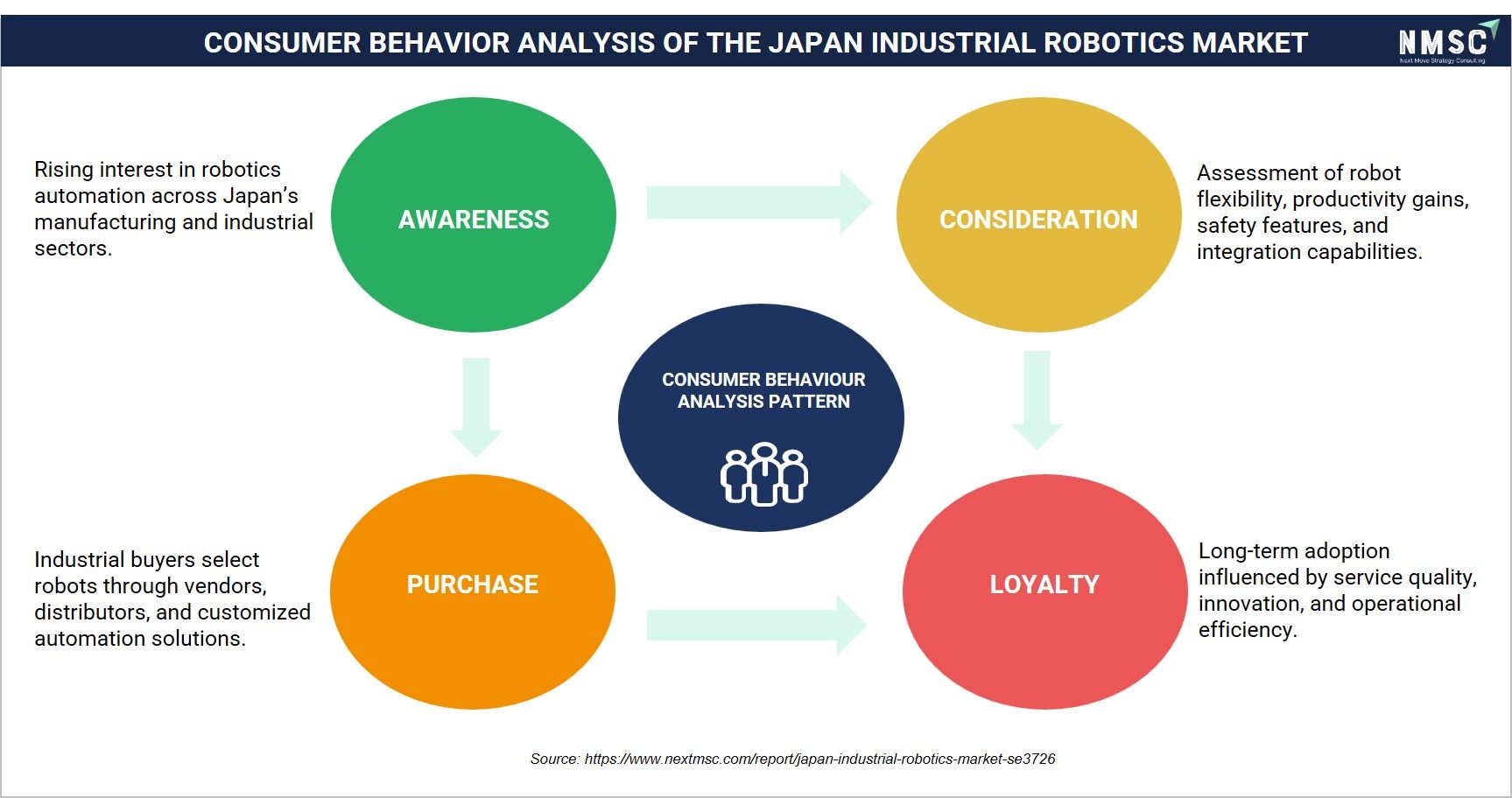
Industrial robotics purchasing in Japan follows a value-driven decision process focused on productivity, precision, and operational reliability. Buyers evaluate automation performance, flexibility, safety, and integration capabilities before selecting trusted vendors and customized solutions. Long-term customer loyalty is sustained through continuous innovation, dependable after-sales support, and consistent improvements in manufacturing efficiency.
Key Market Players
Our assessment indicates that the following 15 companies are actively shaping product innovation, service expansion, and competitive dynamics within the Japan industrial robotics Industry.
-
FANUC Corporation
-
YASKAWA Electric Corporation
-
Kawasaki Heavy Industries Ltd.
-
KUKA Japan K.K.
-
OMRON Corporation
-
DENSO WAVE Incorporated
-
Mitsubishi Electric Corporation
-
NACHI-FUJIKOSHI CORP.
-
Seiko Epson Corporation
-
Stäubli Corporation
-
John Bean Technologies K.K.
-
Comau S.p.A. Japan Branch
-
Shenzhen Yuejiang Technology Co., Ltd. Japan Branch
Investment Opportunities
What Capital Inflows Are Targeting the Japan Industrial Robotics Market?
Capital inflows into the Japan industrial robotics sector are increasingly directed toward physical AI computing integration, collaborative robotics, and semiconductor equipment automation. Leading Japanese robot manufacturers continue to attract strategic capital and technology partnerships to expand AI-enabled product development and global distribution. We observed that investors favor companies demonstrating strong AI infrastructure alliances, established service networks, and diversified end-user exposure across automotive and electronics customers.
How Is Infrastructure Investment Supporting the Japan Industrial Robotics Market?
Infrastructure investment is expanding robot manufacturing capacity, research facilities, and AI computing infrastructure across Japan's leading industrial regions. Our findings suggest that companies are investing in dedicated physical AI research centers, demonstration facilities, and overseas manufacturing expansion to support faster commissioning and global distribution. In addition, manufacturers are strengthening partnerships with semiconductor and automotive operators to enhance market penetration across Japan.
What ESG Considerations Are Shaping Investment Decisions in the Japan Industrial Robotics Market?
Environmental, social, and governance considerations are increasingly integral to investment decisions across the Japan industrial robotics market, with energy-efficient robot design, workplace safety, and workforce reskilling emerging as key priorities amid demographic labor constraints. We found that investors increasingly favor companies demonstrating measurable progress in sustainability ratings, reducing robot energy consumption, and supporting technician retraining programs, strengthening brand reputation while supporting long-term value creation across Japan's evolving industrial automation sector.
Key Benefits for Stakeholders
How Does This Report Benefit Enterprise and Industry Leaders?
Enterprise and industry leaders gain access to validated segmentation, competitive benchmarking, and technology adoption analysis that support strategic planning, capital allocation, and automation roadmap development across the Japan industrial robotics market. Our analysis shows that detailed assessments of robot type, offering, application, and end-user trends help manufacturers and integrators identify high-growth opportunities, strengthen market positioning, and develop effective long-term automation strategies.
How Does This Report Benefit Investors and Financial Analysts?
Investors and financial analysts benefit from consistent market size estimates, growth forecasts, and competitive assessments that support investment evaluation and capital allocation decisions across the Japan industrial robotics market. We observed that the report's detailed analysis of physical AI, collaborative robotics, and semiconductor automation segments enables stakeholders to identify companies and market categories with the strongest long-term growth potential through 2035.
How Does This Report Benefit Technology Vendors and Product Teams?
Technology vendors and product development teams gain valuable insights into emerging innovation trends, including physical AI integration, open robot operating system frameworks, and digital twin simulation that are transforming Japanese industrial automation. Our findings suggest that this analysis helps research and development teams prioritize future product pipelines, accelerate innovation initiatives, and align product offerings with evolving customer expectations across the Japan industrial robotics market.
Key Market Segments
By Robot Type
-
Articulated Robots
-
SCARA Robots
-
Cartesian and Gantry Robots
-
Delta Robots
-
Collaborative Robots
-
Autonomous Mobile Robots (AMRs)
-
Automated Guided Vehicles (AGVs)
-
Other Robots
By Offering
-
Hardware
-
Robot Arms
-
Controllers
-
End Effectors and Grippers
-
Sensors and Vision Systems
-
-
Software
-
Control and Programming Software
-
Simulation and Offline Programming Software
-
Fleet Management Software
-
-
Services
-
System Integration and Installation
-
Maintenance and Support
-
Training and Consulting
-
By Application
-
Handling
-
Pick and Place
-
Machine Tending
-
Palletizing and Depalletizing
-
-
Welding and Soldering
-
Assembly and Disassembly
-
Dispensing
-
Painting
-
Adhesive and Sealant Application
-
-
Processing
-
Cutting and Machining
-
Grinding and Polishing
-
-
Cleanroom Operations
-
Inspection and Quality Control
-
Packaging and Labeling
-
Intralogistics and Transport
By Mounting Type
-
Floor Mounted
-
Wall-Mounted
-
Ceiling Mounted
-
Rail Mounted
By Mobility
-
Stationary Robots
-
Mobile Robots
By Payload Capacity
-
Low Payload Up to 20 kg
-
Medium Payload 20 kg to 100 kg
-
High Payload 100 kg to 500 kg
-
Heavy Duty Payload Over 500 kg
By End User
-
Automotive Industry
-
Electrical and Electronics Industry
-
Metals and Machinery Industry
-
Food and Beverages Industry
-
Pharmaceuticals and Medical Devices Industry
-
Plastics Rubber and Chemicals Industry
-
Logistics and Warehousing
-
Other Industries
Conclusion and Recommendations
What Is the Long-Term Outlook for the Japan Industrial Robotics Market?
The long-term outlook for the Japan industrial robotics market remains positive, supported by sustained demographic labor pressures, expanding semiconductor manufacturing, and continued government-backed physical AI research investment. We observed that growing adoption of collaborative robots, physical AI-enabled automation, and precision handling systems will continue to drive market expansion across automotive, electronics, and machinery segments throughout the forecast period.
What Strategic Positioning Should Robotics Companies Pursue?
Manufacturers should prioritize investments in physical AI integration, collaborative robotics, and open robot operating system compatibility while strengthening AI technology partnerships across Japanese industrial regions. Our assessment indicates that companies expanding simulation-based digital twin platforms and application-specific automation solutions will be well positioned to capture demand from small and mid-sized manufacturers within the Japan industrial robotics market.
How Attractive Is the Japan Industrial Robotics Market for New Investment?
The Japan industrial robotics market presents an attractive investment opportunity, supported by rising automation spending, expanding semiconductor manufacturing, and continued innovation in physical AI and collaborative robotics. We found that investment potential is particularly strong for companies focused on AI computing integration, digital twin simulation, and open platform frameworks, enabling them to capitalize on evolving customer preferences and long-term market growth.
What Market Shifts and Key Risks Should Stakeholders Monitor?
Stakeholders should closely monitor evolving AI integration standards, intensifying competition from Chinese and European robot manufacturers, and fluctuations in semiconductor component supply chains. Our analysis shows that companies unable to continuously innovate, expand AI partnerships, or address cost barriers among smaller manufacturers may face increasing competitive pressure within the Japan industrial robotics market.
What Are the Key Growth Pathways for the Japan Industrial Robotics Market?
Key growth pathways include expanding physical AI-enabled robot portfolios, accelerating innovation in collaborative robotics and digital twin simulation, strengthening AI technology partnerships, and enhancing semiconductor equipment automation capabilities. NMSC's analysis indicates that companies successfully combining decades of hardware reliability with AI-driven software flexibility will be best positioned to capture the Japan industrial robotics market's projected growth through 2035.
About the Author
 Mihul Sharma
— Mihul Sharma is Research Associate at Next Move Strategy Consulting, where he has covered technology, industrial, and healthcare markets for 3 years. His work applies structured business research, market analysis, and secondary-source review to assess market trends, competitive developments, and growth opportunities. He supports report development by fully synthesizing industry data, company information, and market signals into concise findings for strategy and investment-focused research teams.
Mihul Sharma
— Mihul Sharma is Research Associate at Next Move Strategy Consulting, where he has covered technology, industrial, and healthcare markets for 3 years. His work applies structured business research, market analysis, and secondary-source review to assess market trends, competitive developments, and growth opportunities. He supports report development by fully synthesizing industry data, company information, and market signals into concise findings for strategy and investment-focused research teams.
About the Reviewer
 Supradip Baul
— Supradip Baul is an accomplished business consultant and strategist with over a decade of rich experience in market intelligence, strategy, technology, and business transformation. His work has included rigorous qualitative and quantitative analysis across multiple industries, helping clients shape investment decisions and long-term roadmaps. Earlier in his career, he was associated with Gartner, where he contributed to industry-leading reports and market share analyses. He has worked with leading global companies and holds an MBA with a dual specialization in Marketing and Finance.
Supradip Baul
— Supradip Baul is an accomplished business consultant and strategist with over a decade of rich experience in market intelligence, strategy, technology, and business transformation. His work has included rigorous qualitative and quantitative analysis across multiple industries, helping clients shape investment decisions and long-term roadmaps. Earlier in his career, he was associated with Gartner, where he contributed to industry-leading reports and market share analyses. He has worked with leading global companies and holds an MBA with a dual specialization in Marketing and Finance.
At Next Move Strategy Consulting, we understand that insightful market research is the cornerstone of successful business decisions. That's why we employ a robust and multifaceted approach, combining various methodologies to deliver the most accurate and actionable data for our clients.

Research Landscape
We navigate the world of research with two primary approaches:
Qualitative Approach
Our qualitative research methodologies involve immersive techniques such as in-depth interviews, focus groups, and observational studies. By engaging directly with individuals and stakeholders, we uncover valuable insights that quantitative data alone may overlook.

Quantitative Research
In tandem with qualitative methodologies, NMSC leverages the power of Quantitative Research to provide a robust foundation of numerical insights. Through systematic data collection and analysis, we quantify patterns, preferences, and market trends, offering a comprehensive view of the business landscape.
Our quantitative research approach employs diverse tools, including surveys, experiments, and statistical modelling. These methodologies enable us to gather data from a large and representative sample, ensuring the statistical significance of our findings. By employing structured questionnaires and standardized data collection methods, we guarantee the reliability and validity of the information we present to our clients.
Quantitative research is particularly effective in measuring the prevalence of trends, assessing market size, and gauging the impact of various factors on consumer behavior. The numerical precision attained through this approach equips our clients with actionable insights, facilitating data-driven decision-making and strategy formulation.


Our Specialized Toolbox for Industry-Specific Market Research
We deploy a specialized arsenal of techniques tailored to meet your unique requirements. Here's a glimpse into our comprehensive toolbox:

Information Procurement
The stage entails acquiring market data or relevant information through various sources and methodologies.


Market Research Approach
We utilize both top-down and bottom-up approaches in market research analysis to achieve a comprehensive understanding of the market dynamics, leveraging the broad perspective of industry trends and macroeconomic factors alongside detailed insights from specific segments and individual companies.

Porters Five Forces Analysis
We conduct Porter's Five Forces analysis to evaluate the competitive landscape of an industry, providing us with insights into factors that affect profitability and strategic positioning.

SWOT Analysis

Forecasting
We utilize a forecasting model to predict future consumption by considering parameters like population, economics, regulations, market competition, drivers, constraints, technology, and pricing. We also employ statistical techniques such as multilinear regression, exponential smoothing, moving average, ARIMA, and Monte Carlo simulations for accurate predictions. In econometric forecasting, we analyzed short-term and long-term event impacts, attributing values based on regulatory frameworks, economic factors, and market events.





 Speak to Our Analyst