What Is Driving the Next Wave of Articulated Robot Adoption in 2026?
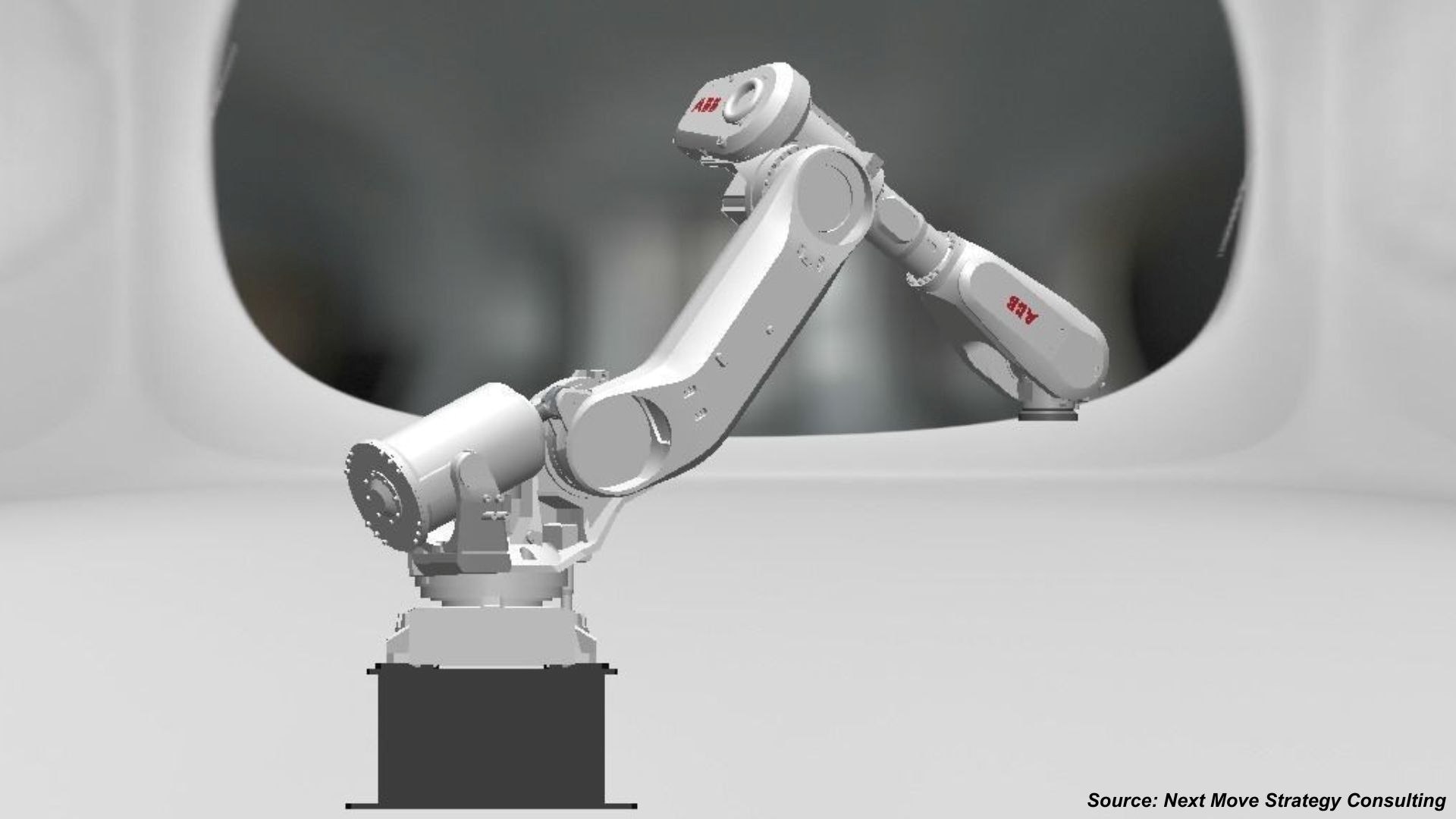
The growth of the Articulated Robot Market is being driven by a fundamental shift across manufacturing, logistics, and research environments. Organizations are increasingly moving beyond traditional automation systems and adopting more flexible robotic solutions capable of handling complex, variable, and precision-driven tasks. This transition reflects a broader industry focus on improving operational efficiency while addressing the growing need for adaptability in modern production and research settings.
Recent developments from LG CNS, along with the collaboration between Techman Robot and Tesollo, highlight how articulated robots are evolving from standalone automation tools into strategic assets that support robot transformation (RX) initiatives. As industries continue to prioritize greater flexibility, productivity, and accuracy, the Articulated Robot Market is witnessing increased demand for advanced robotic systems that can support next-generation automation strategies across diverse industrial applications.
How Are Articulated Robots Expanding Beyond Traditional Manufacturing?
Historically, articulated robots were primarily associated with repetitive industrial production tasks. However, recent deployments indicate a much broader application landscape.
LG CNS has integrated articulated robotic systems across manufacturing facilities, logistics centers, research laboratories, battery material processing operations, and product development environments. This expansion reflects a growing demand for automation solutions that can operate effectively in settings where precision and flexibility are equally important.
One notable example involves a robotic system combining a Doosan Robotics articulated robot with an OnRobot gripper at an LG Unicharm research laboratory. The deployment automated powder measurement processes that were previously performed manually.
The system reportedly improved measurement precision from approximately 0.5 grams to an error margin of around 0.05 grams. According to LG CNS, such laboratory automation can shorten product development timelines by as much as 50%.
How Is Physical AI Increasing the Strategic Importance of Articulated Robots?
One of the most significant themes highlighted by LG CNS is the rise of physical AI.
Physical AI refers to artificial intelligence technologies that enable robots to perceive, understand, and respond to real-world environments. As industrial operations become increasingly dynamic, conventional programmed automation often struggles to adapt to changing conditions.
By incorporating physical AI capabilities, articulated robots can react more effectively to environmental variations, perform complex tasks with greater autonomy, and operate in less predictable settings. This evolution moves robotics beyond repetitive execution and toward intelligent decision-making.
To strengthen its position in this area, LG CNS has invested in robotics AI specialist Skilled AI and humanoid robot developer Dexmate while expanding research activities in South Korea and Silicon Valley.
How Are Power Electronics Enhancing Articulated Robot Performance?
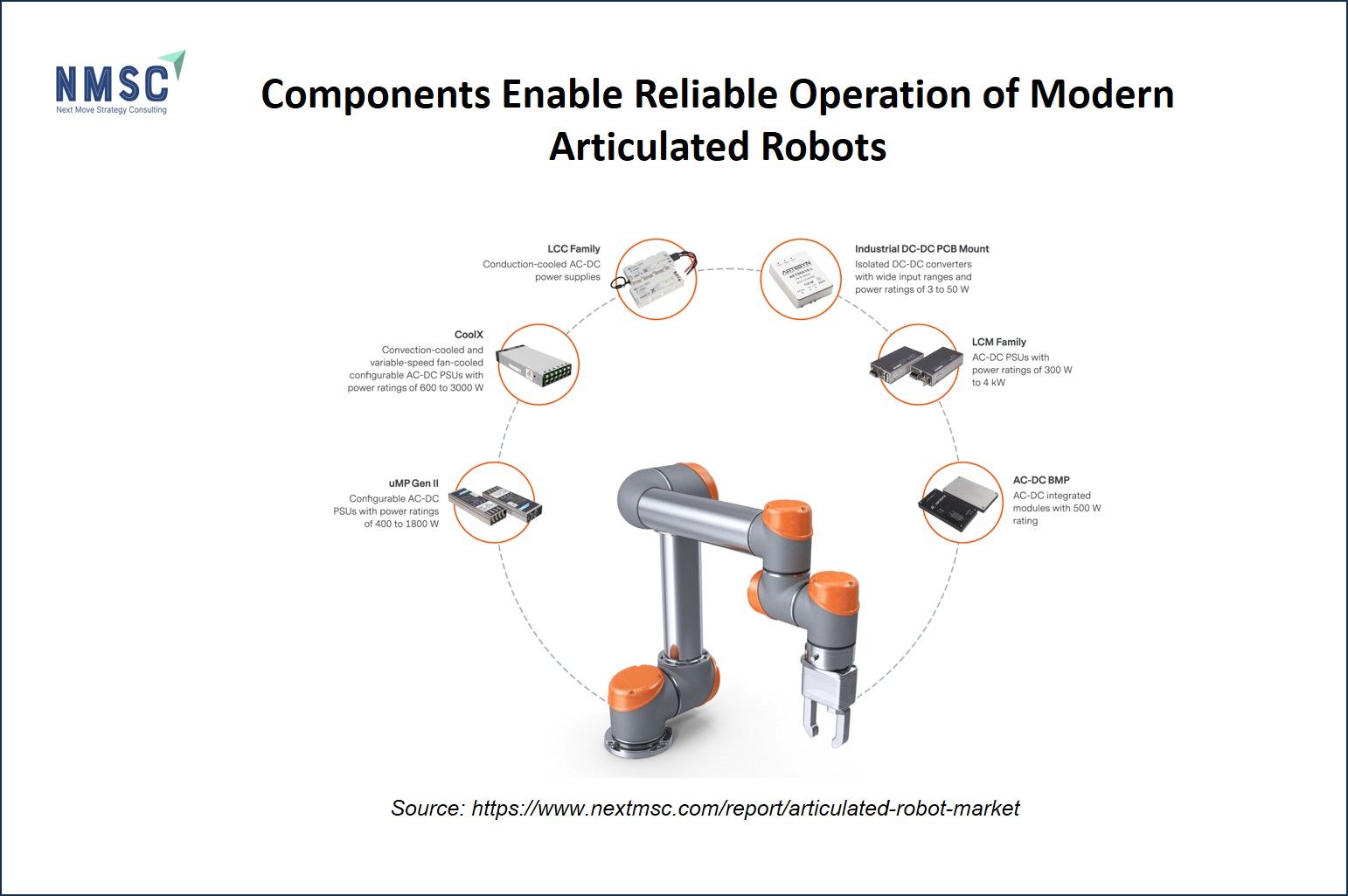
This illustration highlights the ecosystem of power supply and power conversion components that support articulated robot operations in industrial environments. At the center is an articulated robotic arm used for manufacturing and automation tasks, while the surrounding components represent various AC-DC and DC-DC power solutions required to ensure stable, efficient, and reliable robot performance.
The image demonstrates that articulated robots depend not only on advanced mechanical design and control software but also on sophisticated power management systems. Components such as AC-DC power supplies, DC-DC converters, and integrated power modules enable robots to maintain precise motion control, handle varying workloads, and operate continuously in demanding industrial settings. The visualization emphasizes the interconnected relationship between robotics hardware and supporting power electronics infrastructure.
How Are Adaptive Grippers Making Articulated Robots More Flexible?
One of the biggest challenges in industrial automation has been handling diverse product types without extensive reconfiguration.
Techman Robot and Tesollo addressed this challenge through an integrated solution that combines the TM5S collaborative robot with the DG-3F-M articulated gripper. Unlike traditional parallel grippers that rely on simple open-and-close movements, the DG-3F-M uses three articulated fingers that adapt to the shape of the object being handled.
|
Feature |
DG-3F-M Capability |
|
Pinching Payload |
2.5 kg rated (5 kg maximum) |
|
Enveloping Payload |
10 kg rated (15 kg maximum) |
|
Grasping Method |
Shape-adaptive articulated fingers |
|
Application Focus |
High-mix, low-volume production |
This design allows the robotic system to handle randomly oriented components, irregular parts, mixed product batches, and objects with varying geometries. As a result, manufacturers can reduce dependence on specialized fixtures and minimize the need for frequent process redesigns.
Why Does This Matter?
Manufacturers increasingly require automation systems that can adapt to changing production demands. Adaptive gripping technology helps bridge the gap between robotic efficiency and operational flexibility, making articulated robots more practical for modern manufacturing environments.
Why Are High-Mix Production Environments Creating New Opportunities?
Manufacturers today increasingly operate in high-mix, low-volume production environments where product variations change frequently. This trend is driven by growing customer demand for customization and shorter product life cycles.
Traditional automation systems often struggle in such environments because production lines require frequent adjustments, fixtures must be replaced regularly, and setup times can increase significantly. These limitations reduce operational flexibility and can diminish the economic benefits of automation.
The Techman Robot-Tesollo solution demonstrates how articulated robot systems can address these challenges through adaptive grasping and collaborative automation. By accommodating a wider range of product shapes and configurations, these systems can support more agile production strategies.
Potential applications include automotive manufacturing, where robots may handle multiple component types during assembly; electronics production, where parts often vary in size and geometry; bin-picking operations involving irregular objects; and mixed-part assembly environments that require continuous adaptability.
What Could Shape the Future of Articulated Robots?
Current developments suggest that the future of articulated robots will be shaped by a combination of artificial intelligence, advanced automation, and broader deployment opportunities. The growing integration of AI-driven robotics is expected to improve robot autonomy and adaptability, while laboratory automation continues to emerge as a promising application area.
At the same time, investments in humanoid robotics, mobile manipulators, and adaptive gripping technologies indicate that the robotics ecosystem is becoming increasingly interconnected. Collaborative robot platforms are also likely to play a larger role as organizations seek automation solutions that can operate alongside human workers.
LG CNS's continued investment strategy and research initiatives indicate growing industry confidence in intelligent robotic systems capable of supporting long-term robot transformation programs.
Leading Companies Driving Innovation in the Articulated Robot Industry
The articulated robot industry is characterized by the presence of several established automation and robotics companies, including ABB Ltd, FANUC Corporation, KUKA, Yaskawa Electric Corporation, Kawasaki Heavy Industries, Ltd., Adept Technology Pvt. Ltd., American Robot Corporation, Rockwell Automation, Inc., Honeywell International Inc., and Omron Adept Technology, among others. To strengthen their market position and expand their customer base, these companies are increasingly focusing on product launches and technological advancements as key growth strategies across global markets. Such initiatives enable them to enhance their robotics portfolios, address evolving industrial automation requirements, and maintain a competitive edge within the articulated robot industry.

Next Steps
Organizations evaluating articulated robot investments should consider:
-
Assessing high-mix production requirements.
-
Identifying repetitive precision-driven workflows.
-
Evaluating AI-enabled automation capabilities.
-
Exploring collaborative robot and adaptive gripper combinations.
-
Developing long-term robot transformation roadmaps.
Conclusion
Articulated robot technology is entering a new phase of industrial relevance. Recent developments from LG CNS, Techman Robot, and Tesollo demonstrate that modern robotic systems are evolving beyond traditional automation toward intelligent, adaptive, and highly flexible operational platforms.
As physical AI, collaborative robotics, and adaptive gripping technologies mature, articulated robots are becoming strategic tools for organizations seeking greater efficiency, precision, and resilience across manufacturing, logistics, and laboratory environments. For business leaders planning future automation investments, these developments represent important indicators of where industrial robotics is heading.
About the Author
 Sanyukta Deb
— Sanyukta Deb is Digital Marketing Team Lead at Next Move Strategy Consulting, where she has led content strategy and technical SEO for the firm's B2B market research publications for over 2 years. Her editorial process translates NextMSC's primary and secondary research — spanning technology, industrial, and consumer sectors — into commercial narratives, backed by search-intent, keyword, and competitive analysis. She brings 5 years of overall experience in digital marketing and content strategy.
Sanyukta Deb
— Sanyukta Deb is Digital Marketing Team Lead at Next Move Strategy Consulting, where she has led content strategy and technical SEO for the firm's B2B market research publications for over 2 years. Her editorial process translates NextMSC's primary and secondary research — spanning technology, industrial, and consumer sectors — into commercial narratives, backed by search-intent, keyword, and competitive analysis. She brings 5 years of overall experience in digital marketing and content strategy.
About the Reviewer
 Debashree Dey
— Debashree Dey is Assistant Manager at Next Move Strategy Consulting, where she supports cross-vertical market content and communications across diverse industries for 6 years. Her professional background includes senior content writing, communications, and published manuscript authorship, with experience developing audience-focused business narratives and maintaining clear, consistent messaging. Her role supports research-led content development and editorial quality across NextMSC publications.
Debashree Dey
— Debashree Dey is Assistant Manager at Next Move Strategy Consulting, where she supports cross-vertical market content and communications across diverse industries for 6 years. Her professional background includes senior content writing, communications, and published manuscript authorship, with experience developing audience-focused business narratives and maintaining clear, consistent messaging. Her role supports research-led content development and editorial quality across NextMSC publications.
















Add Comment