LGBTQ+ Sexual Wellbeing Market Global Industry Analysis and Forecast (2026–2035)

The global Quantum as a Service (QaaS) Market size was valued at USD 4.48 billion in 2025 and is estimated at USD 6.68 billion in 2026, forecast to reach USD 150.82 billion by 2035, expanding at a 42.1% CAGR between 2025 and 2035. North America leads with approximately 38% share, while Consulting and Integration Services dominate all other components with approximately 38% share.

Download Free Sample PDF
Base Year (2025)
$4.55 Billion
Forecast (2035)
$10.66 Billion
CAGR (2026-2035)
8.9%
Top Region
North America

What Is the LGBTQ+ Sexual Wellbeing Market Size?

The global LGBTQ+ sexual wellbeing market size was valued at USD 4.55 billion in 2025 and is estimated at USD 4.94 billion in 2026, forecast to reach USD 10.66 billion by 2035, expanding at an 8.9% CAGR between 2026 and 2035. North America leads with approximately 42% share, while Pleasure Devices dominate all other product categories with approximately 34% share.

We observed that growth is broad-based across every segmentation axis, with digital services and gender affirming products driving the dominant structural shifts through 2035.

LGBTQ+ Sexual Wellbeing Market Global Industry Analysis and Forecast (2026–2035) Revenue Forecast

Values in USD Billion

2025 $4.55 Billion
2025
2026 $4.94 Billion
2026
2027 $5.38 Billion
2027
2028 $5.86 Billion
2028
2029 $6.38 Billion
2029
2030 $6.95 Billion
2030
2031 $7.57 Billion
2031
2032 $8.24 Billion
2032
2033 $8.97 Billion
2033
2034 $9.77 Billion
2034
2035 $10.66 Billion
2035

Key Takeaways

By Product Category: Pleasure Devices held the largest share of approximately 34% (USD 1.55 billion) in 2025; Digital Services is the fastest-growing sub-segment at 15.6% CAGR from 2026–2035.

By Distribution Channel: Marketplace held the largest share of approximately 27% (USD 1.23 billion) in 2025; Institutional is the fastest-growing sub-segment at 13.4% CAGR from 2026–2035.

By Buyer Type: Consumer held the largest share of approximately 74% (USD 3.37 billion) in 2025; Corporate Buyers is the fastest-growing sub-segment at 16.5% CAGR from 2026–2035.

By Price Tier: Mid held the largest share of approximately 40% (USD 1.82 billion) in 2025; Luxury is the fastest-growing sub-segment at 13.4% CAGR from 2026–2035.

By Material: Silicone held the largest share of approximately 30% (USD 1.37 billion) in 2025; Mixed Electronic is the fastest-growing sub-segment at 15.0% CAGR from 2026–2035.

By Technology: Non-Powered held the largest share of approximately 34% (USD 1.55 billion) in 2025; App Connected is the fastest-growing sub-segment at 17.4% CAGR from 2026–2035.

Dominant Region: North America dominated with approximately 42% revenue share (USD 1.91 billion) in 2025.

Fastest-Growing Region: Asia-Pacific is expected to register the highest CAGR of 11.4% during 2026–2035.

Dominant Country: U.S. led with approximately USD 1.61 billion in 2025.

Fastest-Growing Country: India is the fastest-growing country at approximately 13.3% CAGR from 2026–2035.

Market Opportunity: The LGBTQ+ sexual wellbeing market is expected to create an absolute dollar opportunity of USD 5.72 billion between 2026 and 2035, presenting significant investment potential across the digital services and gender affirming product value chain.

According to Next Move Strategy Consulting analysis, retailers and healthcare providers are increasingly consolidating sourcing with manufacturers capable of supplying inclusive product lines spanning safer sex, gender affirming, and intimate care categories under a single account, a shift that favors diversified suppliers over single-category specialists as mainstream retail visibility expands through 2035.

What Does the LGBTQ+ Sexual Wellbeing Market Encompass?

The LGBTQ+ sexual wellbeing market encompasses safer sex, lubricant, pleasure device, intimate care, gender affirming, apparel and gear, and digital service products designed or marketed to serve LGBTQ+ consumers and the broader inclusive sexual wellness audience. Our assessment indicates that the scope spans direct to consumer, marketplace, specialty retail, mass retail, pharmacy, wholesale, and institutional distribution channels serving consumer, retail trade, healthcare, public health, and corporate buyer segments. The category has evolved from niche specialty retail into mainstream consumer wellness, with gender affirming products and telehealth-delivered digital services expanding alongside traditional safer sex and pleasure device categories.
Public health guidance from bodies including the World Health Organization and UNAIDS continues to shape safer sex product standards, while destigmatization and expanded retail distribution are reshaping category visibility across mainstream pharmacy and marketplace channels. We observed that technology adoption is shifting toward app connected and rechargeable pleasure devices alongside telehealth-delivered education and coaching services. Next Move Strategy Consulting's analysis indicates that this structural shift, combined with growing corporate and healthcare provider procurement, is redefining vendor selection criteria across the LGBTQ+ sexual wellbeing market.

CONSUMER BEHAVIOR ANALYSIS OF THE LGBTQ+ SEXUAL WELLBEING MARKET

CONSUMER BEHAVIOR ANALYSIS OF THE LGBTQ+ SEXUAL WELLBEING MARKET

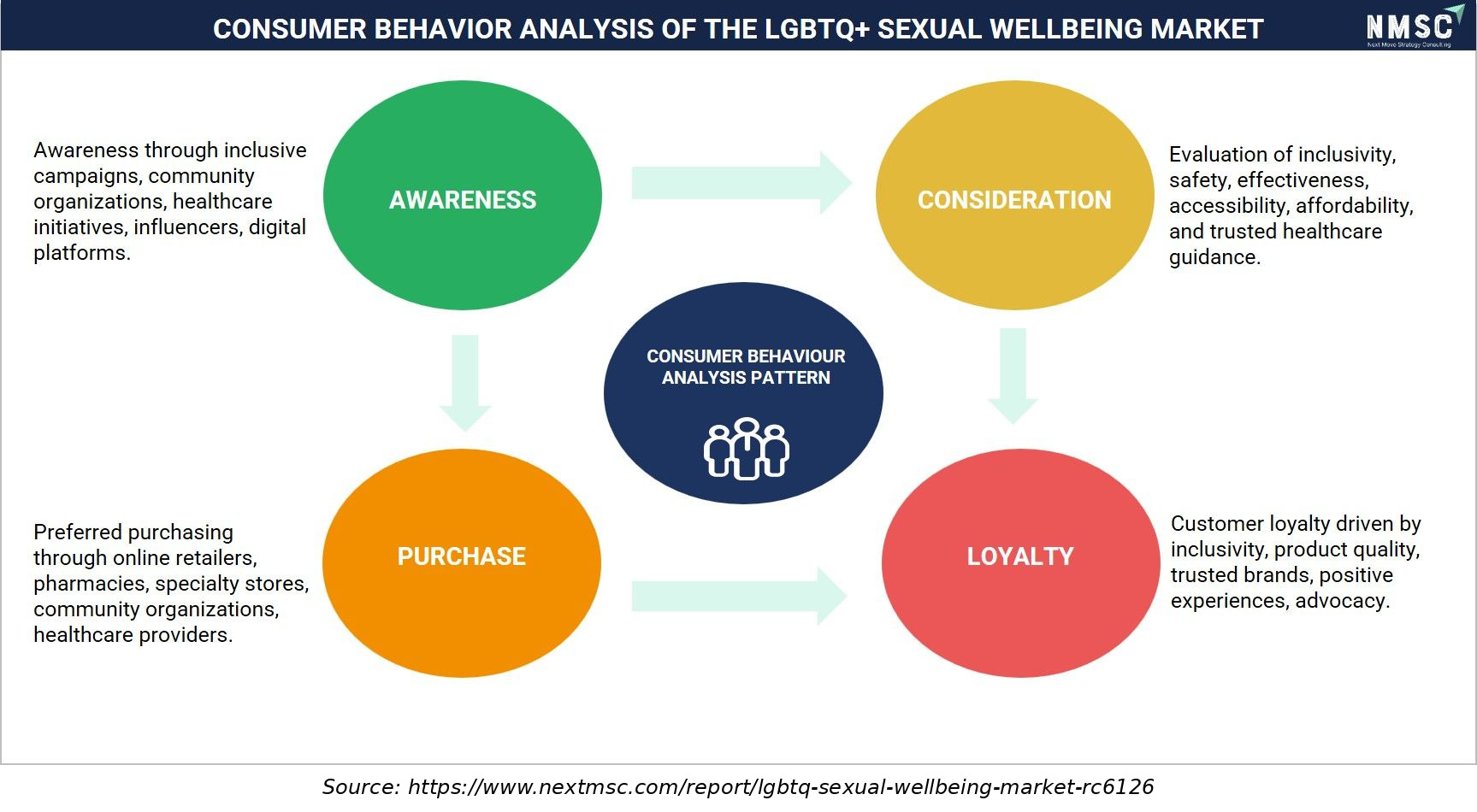
The figure illustrates the consumer behavior journey in the LGBTQ+ sexual wellbeing market. Consumers first gain awareness through inclusive campaigns, community organizations, healthcare initiatives, influencers, and digital platforms. During the consideration stage, they evaluate inclusivity, safety, effectiveness, accessibility, affordability, and trusted healthcare guidance. They then purchase through online retailers, pharmacies, specialty stores, community organizations, or healthcare providers. Positive experiences, trusted brands, and inclusive support foster loyalty, encouraging repeat purchases and long-term advocacy.

Market Drivers & Dynamics

Interactive Dataset
Mainstream retail and pharmacy channel expansion driver +2.1% North America, Europe 2026-2035
Rising telehealth and digital sexual wellness services adoption driver +1.9% Global 2026-2035
Non-latex and body-safe material innovation driver +1.4% Global 2026-2033
Expanding gender affirming product availability and insurance coverage driver +1.6% North America, Europe 2026-2035
App connected and rechargeable device innovation driver +1.5% Global 2026-2035
Growing corporate and healthcare provider bulk procurement driver +1.2% Global 2026-2033
Regulatory restrictions on LGBTQ+-oriented marketing in certain jurisdictions restraint -1.5% Middle East & Africa, Asia-Pacific 2026-2035
Retail stigma and limited brick-and-mortar shelf placement restraint -1.1% Global 2026-2032
Payment processing and advertising platform content restrictions restraint -0.9% Global 2026-2030
Price sensitivity in value-tier safer sex categories restraint -0.6% Latin America, Middle East & Africa 2026-2032
Source: Next Move Strategy Consulting

Growth Drivers

What Is the Primary Growth Driver of the LGBTQ+ Sexual Wellbeing Market?

Mainstream retail and pharmacy channel expansion is the primary driver of the market. Manufacturers continue to broaden distribution beyond specialty retail into pharmacy, mass retail, and department store channels, improving product accessibility and reducing purchase friction. We observed that this retail-driven demand, reinforced by rising telehealth adoption, continues to anchor baseline demand for safer sex and intimate care categories across developed retail markets.

How Is Telehealth Adoption Driving Market Growth?

Rising telehealth and digital sexual wellness service adoption is accelerating market growth as consumers seek discreet, accessible education and clinical guidance. The World Health Organization continues to document expanding digital health service adoption globally. Our assessment indicates that this shift, combined with growing employer and public health organization procurement of wellness benefits, is compressing adoption timelines for digital services and telehealth-delivered coaching across the LGBTQ+ sexual wellbeing market.

Growth Inhibitors

What Is Restraining LGBTQ+ Sexual Wellbeing Market Expansion?

Regulatory restrictions on LGBTQ+-oriented marketing and product advertising in certain jurisdictions restrain broader market expansion. Retail stigma continues to limit brick-and-mortar shelf placement in some regions, while payment processing and advertising platform content restrictions constrain digital marketing reach for direct to consumer brands. We found that manufacturers operating in restrictive regulatory environments face particular exposure, as limited retail and marketing access reduces addressable demand relative to more permissive markets.

What Are the Growth Opportunities?

How Can Digital Health Platforms Capture the Telehealth Opportunity?

Consumers seeking discreet, accessible sexual wellness guidance present a whitespace opportunity for digital health platforms offering telehealth and coaching services. Providers that commercialize validated, clinically supported digital education platforms stand to capture recurring subscription revenue as public health organizations and employers expand covered wellness benefits.

Where Does Gender Affirming Product Innovation Create Whitespace?

Expanding insurance coverage and clinical recognition of gender affirming care create an underpenetrated opportunity for manufacturers offering validated packers, prosthetics, and binder products. Suppliers that achieve clinical-grade material certification can secure long-term healthcare provider and retail contracts, benefiting from sustained demand as gender affirming care access expands across developed markets.

How Can Manufacturers Benefit from Corporate Wellness Procurement?

Employers expanding inclusive workplace wellness benefits represent a fast-growing opportunity for manufacturers offering curated corporate procurement programs. Firms that build employer-facing sales channels and bulk-order capabilities can differentiate from consumer-only brands, capturing recurring benefit-cycle revenue tied to expanding corporate diversity and wellness initiatives.

Segmentation Analysis

2025 (USD Billion)
2035 (USD Billion)
Safer Sex 2025: $0.64 Billion | 2035: $1.17 Billion
Safer Sex
Lubricants 2025: $0.59 Billion | 2035: $1.17 Billion
Lubricants
Pleasure Devices 2025: $1.55 Billion | 2035: $3.41 Billion
Pleasure Dev
Intimate Care 2025: $0.46 Billion | 2035: $0.96 Billion
Intimate Car
Gender Affirming Products 2025: $0.50 Billion | 2035: $1.39 Billion
Gender Affir
Apparel and Gear 2025: $0.41 Billion | 2035: $0.85 Billion
Apparel and
Digital Services 2025: $0.32 Billion | 2035: $1.39 Billion
Digital Serv
Other Qualified Products 2025: $0.09 Billion | 2035: $0.32 Billion
Other Qualif
Safer Sex $0.64 Billion $1.17 Billion 6.2%
Lubricants $0.59 Billion $1.17 Billion 7.1%
Pleasure Devices $1.55 Billion $3.41 Billion 8.3%
Intimate Care $0.46 Billion $0.96 Billion 7.8%
Gender Affirming Products $0.50 Billion $1.39 Billion 10.6%
Apparel and Gear $0.41 Billion $0.85 Billion 7.6%
Digital Services $0.32 Billion $1.39 Billion 15.6%
Other Qualified Products $0.09 Billion $0.32 Billion 14.5%

Which Product Category Segment Dominates the LGBTQ+ Sexual Wellbeing Market?

Pleasure Devices, encompassing vibrators, insertable toys, masturbators, and couples devices, led the market with USD 1.55 billion in 2025, supported by expanding mainstream retail distribution and product innovation. We observed that Digital Services are the fastest-growing product category, expanding at a 15.6% CAGR from 2026 to 2035, as telehealth-delivered education, coaching, and subscription content gain traction among consumers seeking discreet, accessible guidance.

2025 (USD Billion)
2035 (USD Billion)
Direct to Co
Marketplace
Specialty Re
Mass Retail
Pharmacy and
Segment Item 2025 (USD Billion) 2035 (USD Billion) CAGR
Direct to Consumer $10.0 USD Billion $40.0 USD Billion 25.0%
Marketplace $17.1 USD Billion $51.1 USD Billion 11.0%
Specialty Retail $24.2 USD Billion $62.2 USD Billion 25.0%
Mass Retail $31.3 USD Billion $73.3 USD Billion 11.0%
Pharmacy and Drugstore $38.4 USD Billion $84.4 USD Billion 16.0%

Segment-wise data is locked

Unlock complete segment-wise numbers for By Distribution Channel.

Unlock Full Data

Which Distribution Channel Segment Leads LGBTQ+ Sexual Wellbeing Market Demand?
Marketplace remained the leading distribution channel within the market, valued at USD 1.23 billion in 2025 on sustained e-commerce convenience and product discovery advantages. Our findings suggest that Institutional is the fastest-growing distribution channel, registering a 13.4% CAGR from 2026 to 2035, as public health organizations and healthcare providers expand bulk procurement of safer sex and intimate care products for clinical and community distribution programs.

2025 (USD Billion)
2035 (USD Billion)
Consumer
Retail Trade
Healthcare a
Public Healt
Corporate Bu
Segment Item 2025 (USD Billion) 2035 (USD Billion) CAGR
Consumer $10.0 USD Billion $40.0 USD Billion 27.0%
Retail Trade $17.1 USD Billion $51.1 USD Billion 9.0%
Healthcare and Clinical Providers $24.2 USD Billion $62.2 USD Billion 19.0%
Public Health Organizations $31.3 USD Billion $73.3 USD Billion 17.0%
Corporate Buyers $38.4 USD Billion $84.4 USD Billion 18.0%

Segment-wise data is locked

Unlock complete segment-wise numbers for By Buyer Type.

Unlock Full Data

Which Buyer Type Segment Leads the LGBTQ+ Sexual Wellbeing Market?

Consumer remained the leading buyer type within the market, valued at USD 3.37 billion in 2025 on sustained direct purchasing across all product categories. Our analysis shows that Corporate Buyers are the fastest-growing buyer type, registering a 16.5% CAGR from 2026 to 2035, as employers increasingly include sexual wellness and gender affirming benefits within workplace wellness and inclusive healthcare programs.

2025 (USD Billion)
2035 (USD Billion)
Value
Mid
Premium
Luxury
Segment Item 2025 (USD Billion) 2035 (USD Billion) CAGR
Value $10.0 USD Billion $40.0 USD Billion 14.0%
Mid $17.1 USD Billion $51.1 USD Billion 24.0%
Premium $24.2 USD Billion $62.2 USD Billion 22.0%
Luxury $31.3 USD Billion $73.3 USD Billion 12.0%

Segment-wise data is locked

Unlock complete segment-wise numbers for By Price Tier.

Unlock Full Data
2025 (USD Billion)
2035 (USD Billion)
Latex
Nonlatex Pol
Silicone
Hard Plastic
Fabric and L
Segment Item 2025 (USD Billion) 2035 (USD Billion) CAGR
Latex $10.0 USD Billion $40.0 USD Billion 24.0%
Nonlatex Polymer $17.1 USD Billion $51.1 USD Billion 22.0%
Silicone $24.2 USD Billion $62.2 USD Billion 20.0%
Hard Plastic and Glass $31.3 USD Billion $73.3 USD Billion 22.0%
Fabric and Leather $38.4 USD Billion $84.4 USD Billion 13.0%

Segment-wise data is locked

Unlock complete segment-wise numbers for By Material.

Unlock Full Data
2025 (USD Billion)
2035 (USD Billion)
Manual
Rechargeable
App Connecte
Air Pulse
Non-Powered
Segment Item 2025 (USD Billion) 2035 (USD Billion) CAGR
Manual $10.0 USD Billion $40.0 USD Billion 23.0%
Rechargeable $17.1 USD Billion $51.1 USD Billion 9.0%
App Connected $24.2 USD Billion $62.2 USD Billion 19.0%
Air Pulse $31.3 USD Billion $73.3 USD Billion 13.0%
Non-Powered $38.4 USD Billion $84.4 USD Billion 10.0%

Segment-wise data is locked

Unlock complete segment-wise numbers for By Technology.

Unlock Full Data

Growth Opportunities

Our analysis shows that three forward-looking opportunities stand out for stakeholders positioning within the market over the 2026-2035 forecast period.

How Can Digital Health Platforms Capture the Telehealth Opportunity?

Consumers seeking discreet, accessible sexual wellness guidance present a whitespace opportunity for digital health platforms offering telehealth and coaching services. Providers that commercialize validated, clinically supported digital education platforms stand to capture recurring subscription revenue as public health organizations and employers expand covered wellness benefits.

Where Does Gender Affirming Product Innovation Create Whitespace?

Expanding insurance coverage and clinical recognition of gender affirming care create an underpenetrated opportunity for manufacturers offering validated packers, prosthetics, and binder products. Suppliers that achieve clinical-grade material certification can secure long-term healthcare provider and retail contracts, benefiting from sustained demand as gender affirming care access expands across developed markets.

How Can Manufacturers Benefit from Corporate Wellness Procurement?

Employers expanding inclusive workplace wellness benefits represent a fast-growing opportunity for manufacturers offering curated corporate procurement programs. Firms that build employer-facing sales channels and bulk-order capabilities can differentiate from consumer-only brands, capturing recurring benefit-cycle revenue tied to expanding corporate diversity and wellness initiatives.

PESTEL ANALYSIS OF THE LGBTQ+ SEXUAL WELLBEING MARKET

PESTEL ANALYSIS OF THE LGBTQ+ SEXUAL WELLBEING MARKET
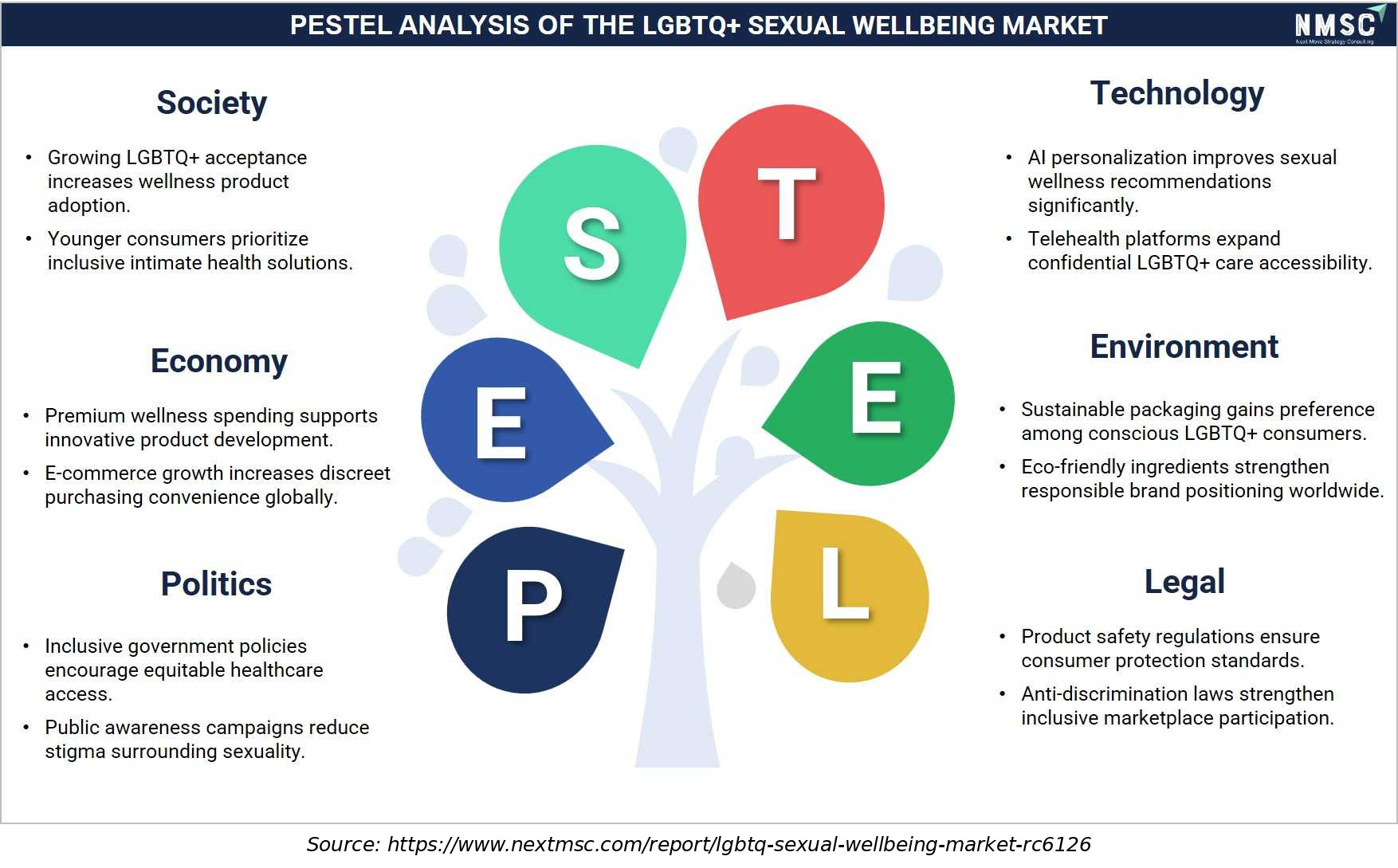
The figure presents a PESTEL analysis of the market, illustrating the external factors shaping industry growth. Political and legal frameworks influence product regulations and equal access, while economic conditions affect consumer spending. Social acceptance and inclusivity drive demand, technological advancements enhance digital healthcare and product innovation, and environmental considerations encourage sustainable manufacturing and packaging, collectively supporting long-term market development.

Regional Outlook

2025 (USD Billion)
2035 (USD Billion)
North Americ
Europe
Asia-Pacific
Middle East
Latin Americ
Region 2025 (USD Billion) 2035 (USD Billion) CAGR (%)
North America $10.0 USD Billion $40.0 USD Billion 9.0%
Europe $17.1 USD Billion $51.1 USD Billion 27.0%
Asia-Pacific $24.2 USD Billion $62.2 USD Billion 25.0%
Middle East & Africa $31.3 USD Billion $73.3 USD Billion 23.0%
Latin America $38.4 USD Billion $84.4 USD Billion 12.0%

Regional data is locked

Unlock complete regional numbers for this market.

Unlock Full Data

Competitive Landscape

We observed that the LGBTQ+ sexual wellbeing market features a moderately fragmented competitive landscape, with diversified consumer health conglomerates competing alongside specialized pleasure product and digital wellness brands.

Dimension Description
Market Structure Moderately fragmented; large diversified consumer health companies compete in safer sex categories alongside numerous specialized direct to consumer pleasure device and digital wellness brands profiled in this report.
Innovation Focus Non-latex material innovation, app connected device technology, and telehealth-delivered digital services dominate current innovation pipelines across leading manufacturers.
M&A Activity Selective acquisitions and brand portfolio expansion continue to broaden specialty manufacturers' category breadth across pleasure devices and intimate care.

How Do Companies Compete in the LGBTQ+ Sexual Wellbeing Market?

Companies compete primarily on material innovation, retail distribution breadth, and brand trust across the industry. Diversified consumer health companies such as Church & Dwight and Reckitt Benckiser leverage established pharmacy and mass retail relationships to serve broad safer sex demand, while specialized direct to consumer brands compete on product design, inclusivity positioning, and digital community engagement.

Which Competitive Archetypes Dominate the LGBTQ+ Sexual Wellbeing Market?

Two archetypes dominate the market: diversified consumer health conglomerates offering scaled safer sex product distribution, and specialized direct to consumer brands focused on inclusive pleasure device and digital wellness innovation. Church & Dwight and Reckitt Benckiser exemplify the diversified archetype, while Dame Products and Lovehoney Group exemplify the specialized, digitally native archetype serving core consumer demand.

How Are Companies Differentiating Through Innovation in Sexual Wellbeing Products?

Innovation and differentiation strategy increasingly center on non-latex materials, app connected technology, and inclusive product design validated through direct consumer engagement. Church & Dwight's non-latex Trojan G.O.A.T. condom launch exemplifies how established manufacturers are pursuing material innovation to differentiate within mature categories. Our analysis shows that brands unable to demonstrate credible inclusivity and quality positioning risk losing share to digitally native specialists.

What M&A and Expansion Activity Is Shaping the LGBTQ+ Sexual Wellbeing Market?

Brand portfolio expansion and selective acquisitions continue to consolidate specialty category capabilities within the industry. Dame Products' expansion into complementary intimate wellness brands illustrates how direct to consumer specialists are broadening category breadth beyond core pleasure devices into adjacent specialty segments, strengthening competitive positioning against larger diversified consumer health companies.

Key Market Players

Our assessment indicates that the following 20 companies are actively shaping product innovation, distribution expansion, and inclusive positioning strategy within the global LGBTQ+ sexual wellbeing market.

Reckitt Benckiser Group plc Church & Dwight Co., Inc. Mankind Pharma Limited Karex Berhad LifeStyles Healthcare Pte. Ltd. Okamoto Industries, Inc. Lovehoney Group Limited LELOiAB TENGA Co., Ltd. California Exotic Novelties, LLC Doc Johnson Enterprises FUN FACTORY GmbH Mayer Laboratories, Inc. Pipedream Products, LLC CC Wellness LLC Sliquid, LLC Dame Products, Inc. Aneros Company Tantus, Inc. Unbound Babes, Inc.

Latest Developments

We found that recent product and portfolio activity within the LGBTQ+ sexual wellbeing market is concentrated on non-latex material innovation and specialty brand consolidation, reflecting the industry's broader mainstreaming and category expansion.

Date Event
January 2026 Church & Dwight reported that its TROJAN G.O.A.T. non-latex condom, launched in Q4 2025, had become the #1-rated TROJAN-branded condom on Amazon, with a 4.7-star rating.

Investment Opportunities

What Capital Inflows Are Targeting the LGBTQ+ Sexual Wellbeing Market?

Capital inflows into the market are increasingly directed toward digital services platforms and specialty brand portfolio expansion. Direct to consumer manufacturers continue to fund product line extensions and complementary brand acquisitions. We observed that investors favor brands demonstrating validated consumer engagement and retail distribution growth, viewing mainstream retail placement as a proxy for long-term revenue retention.

How Is Infrastructure Investment Supporting Market Expansion?

Infrastructure investment is expanding manufacturing and fulfillment capacity across North America and Europe to serve rising direct to consumer and marketplace demand. Our findings suggest that manufacturers are investing in automated fulfillment and discreet packaging logistics to improve consistency across direct to consumer and institutional distribution channels, supporting the scale required for expanding corporate and public health procurement programs.

What ESG Considerations Are Shaping Investment Decisions?

Environmental, social, and governance considerations are increasingly central to investment decisions, with inclusive product access and body-safe material sourcing as key criteria. The World Health Organization's public health guidance continues to inform safer sex product standards. We found that investors increasingly favor manufacturers with validated inclusivity commitments and body-safe material certification, treating these as governance indicators alongside supply-chain transparency.

Key Benefits for Stakeholders

How Does This Report Benefit Enterprise and Industry Leaders?

Enterprise and industry leaders gain access to validated segmentation, competitive benchmarking, and regional demand forecasts that support sourcing and portfolio-planning decisions across the LGBTQ+ sexual wellbeing industry. Our analysis shows that detailed product category, material, and technology breakdowns help procurement teams align specifications with evolving consumer preferences while identifying underserved buyer segments for portfolio expansion.

How Does This Report Benefit Investors and Financial Analysts?

Investors and financial analysts benefit from consistent, single-point market size and CAGR estimates that support valuation and capital-allocation decisions across the LGBTQ+ sexual wellbeing supply chain. We observed that the report's regional and segment-level growth differentials help identify which manufacturers and distributors are best positioned to capture above-market growth in digital services and gender affirming product categories through 2035.

How Does This Report Benefit Technology Vendors and Product Teams?

Technology vendors and product teams gain insight into emerging design requirements, including app connected technology, non-latex materials, and telehealth-delivered digital services, that are reshaping the industry. Our findings suggest that this analysis helps research and development teams prioritize roadmaps around inclusivity, material safety, and connected technology increasingly valued by mainstream retail and healthcare procurement processes.

Key Market Segments Evaluated

By Product Category

  • Safer Sex
  • Lubricants
  • Pleasure Devices
  • Intimate Care
  • Gender Affirming Products
  • Apparel and Gear
  • Digital Services
  • Other Qualified Products

By Distribution Channel

  • Direct to Consumer
  • Marketplace
  • Specialty Retail
  • Mass Retail
  • Pharmacy and Drugstore
  • Wholesale and B2B
  • Institutional

By Buyer Type

  • Consumer
  • Retail Trade
  • Healthcare and Clinical Providers
  • Public Health Organizations
  • Corporate Buyers

By Price Tier

  • Value
  • Mid
  • Premium
  • Luxury

By Material

  • Latex
  • Nonlatex Polymer
  • Silicone
  • Hard Plastic and Glass
  • Fabric and Leather
  • Liquid and Gel
  • Mixed Electronic
  • Not Applicable

By Technology

  • Manual
  • Rechargeable
  • App Connected
  • Air Pulse
  • Non-Powered
  • Not Applicable

Conclusion & Recommendations

The long-term outlook for the market remains positive, with global revenue projected to expand from USD 4.55 billion in 2025 to USD 10.66 billion by 2035 at an 8.9% CAGR. We observed that sustained mainstream retail expansion, telehealth adoption, and gender affirming product innovation will continue underpinning demand across consumer, healthcare, and corporate buyer segments through the forecast period.

What Strategic Positioning Should Suppliers Pursue?

Suppliers should prioritize non-latex material innovation and inclusive product design while expanding mainstream retail and institutional distribution relationships. Our assessment indicates that manufacturers investing early in digital services and app connected technology will be best positioned to capture premium pricing within the LGBTQ+ sexual wellbeing market.

How Attractive Is the LGBTQ+ Sexual Wellbeing Market for New Investment?
The LGBTQ+ sexual wellbeing industry presents an attractive investment case, supported by a USD 5.72 billion absolute dollar opportunity between 2026 and 2035 and above-average growth in Asia-Pacific and digital services categories. We found that investment attractiveness is highest for manufacturers combining validated inclusivity positioning with scaled retail distribution, positioning them to serve both consumer and institutional customer segments simultaneously.

What Market Shifts and Key Risks Should Stakeholders Monitor?

Stakeholders should monitor regulatory restrictions on LGBTQ+-oriented marketing in certain jurisdictions, payment processing and advertising platform content restrictions, and retail stigma as key risks to the LGBTQ+ sexual wellbeing market. Our analysis shows that manufacturers unable to adapt to varying regional regulatory environments risk losing addressable demand relative to competitors with diversified, multi-channel distribution strategies, particularly within Middle East & Africa's more restrictive markets.

What Are the Key Growth Pathways for the LGBTQ+ Sexual Wellbeing Market?

Key growth pathways include expanding digital services and telehealth offerings, scaling gender affirming product distribution, and deepening penetration into corporate and institutional procurement channels. Next Move Strategy Consulting's analysis indicates that suppliers pursuing these pathways while maintaining cost competitiveness in value-tier safer sex categories will be best positioned to capture the LGBTQ+ sexual wellbeing market's projected growth through 2035.

FAQs

About the Author

Liza Phukan

Liza Phukan

Liza Phukan is Research Associate at Next Move Strategy Consulting, where she has covered emerging industries and market research across sectors for 3.5 years. Her work includes analyzing industry developments, validating market data, and developing structured business content from research findings. She uses secondary research and data-validation practices to turn complex market information into clear decision-useful market analysis for business audiences and support report development and B2B.

About the Reviewer

Supradip Baul

Supradip Baul

Supradip Baul is an accomplished business consultant and strategist with over a decade of rich experience in market intelligence, strategy, technology, and business transformation. His work has included rigorous qualitative and quantitative analysis across multiple industries, helping clients shape investment decisions and long-term roadmaps. Earlier in his career, he was associated with Gartner, where he contributed to industry-leading reports and market share analyses. He has worked with leading global companies and holds an MBA with a dual specialization in Marketing and Finance.

Download Free Sample

Mohit Agarwal

MOHIT AGARWAL

Chief Manager

DryChem India Pvt. Ltd.

Next Move Strategy Consulting is an amazing team of consultants. We required a market study report for our investors on top priority and the team went above and beyond our expectations to deliver the same with ample supporting data within a short time span enabling us to secure the investments and keep our project timeline maintained. Their professionalism, attention to detail, and timely delivery of actionable recommendations have left a lasting impression on our organization.

Diana Trejo

DIANA TREJO

Assistant Manager

Sumitomo Corporation de Mexico, S.A. de C.V.

Recently, we purchased a report on the Mexico Data Center Market from Next Move Strategy Consulting. The service has been excellent, with support that is always timely and thoroughly professional. The information provided is interesting, highly useful, and delivered with clarity. I would highly recommend NextMSC for anyone seeking insightful and dependable analysis.

Henri Knyphausen

HENRI KNYPHAUSEN

Partner at Singulier [Ex-BCG]

Singulier

I recently engaged NEXTMSC.com for a commercial due diligence project within the intralogistics sector, and I am pleased to provide a reference based on my experience. In utilizing NEXTMSC.com's services, I found their report to offer valuable insights into market dynamics and key industry players. The initial report provided a solid foundation for our analysis. However, as we were investigating a smaller target in the market, and I had specific customization requests requiring additional research. These requests included detailed information on product portfolios of various players and sub-market sizes, both inclusive and exclusive of certain product categories. NEXTMSC.com demonstrated commendable responsiveness and agility in accommodating these customization requests. Within a timeframe of 1-2 weeks, they delivered a revised report that met our specific needs. Furthermore, they were receptive to my follow-up inquiries, ensuring clarity and understanding of the data provided. The final deliverable significantly contributed to our due diligence efforts. One of NEXTMSC.com's notable strengths lies in their qualitative research capabilities. However, for future engagements, I would recommend the inclusion of a quantified market model in Excel format. Such a model would offer the ability to conduct in-depth analyses and explore various market segments, including country-specific data and subcomponent breakdowns. Based on my positive experience, I would not hesitate to work with NEXTMSC.com again. Their responsiveness, willingness to accommodate customization requests, and commitment to delivering actionable insights make them a reliable partner for commercial research projects.

Gustaf Hummel Burstrom

GUSTAF HUMMEL BURSTROM

Founder

Revline Tools AB

Joseph and the team at Next Move Strategy Consulting have been excellent to work with, in supplying us with relevant market data and forecasts for our specific category. We had some special requirements and they were able to do a custom package to suit our needs. We would definitely recommend them to any other company needing market data and forecasts

Semih Kavaklioglu

SEMIH KAVAKLIOGLU

Co-Founder & Sales Manager

Decortie

I work a lot in the marketing industry and I know that research is an essential part of any campaign. I have used Market research reports for my own products and I found them to be very informative and well-researched. The team here produces insightful reports for a good price

Custom Market Research Services

We will customize the research for you if the listed report does not fully match your requirements.

Get 30% Free Customization

Select License

This website uses cookies to ensure you get the best experience on our website. Learn more

✖