Sexual Health Apps Market Global Industry Analysis and Forecast (2026–2035)

The global Sexual Health Apps Market size was valued at USD 3.85 billion in 2025 and is estimated at USD 4.55 billion in 2026, forecast to reach USD 20.95 billion by 2035, expanding at an 18.49% CAGR from 2026 to 2035. Key drivers include rising telehealth consultation adoption for reproductive care and expanding smartphone and wearable device penetration, with North America leading the global market.
Download Free Sample PDF
Base Year (2025)
$3.85 Billion
Forecast (2035)
$20.95 Billion
CAGR (2026-2035)
18.5%
Top Region
North America

What Is the Sexual Health Apps Market Size?

The global sexual health apps market size was valued at USD 3.85 Billion in 2025 and is estimated at USD 4.55 Billion in 2026, forecast to reach USD 20.95 Billion by 2035, expanding at an 18.49% CAGR between 2026 and 2035. North America leads with approximately 38% share, while the Sexual Health Management Apps segment dominates all other offerings with approximately 28% share.

We observed that adoption is broadening across every segmentation axis, with expanding telehealth consultation access and rising fertility tracking engagement driving structural shifts through 2035.

Sexual Health Apps Market Global Industry Analysis and Forecast (2026–2035) Revenue Forecast

Values in USD Billion

2025 $3.85 Billion
2025
2026 $4.56 Billion
2026
2027 $5.41 Billion
2027
2028 $6.40 Billion
2028
2029 $7.59 Billion
2029
2030 $8.99 Billion
2030
2031 $10.65 Billion
2031
2032 $12.63 Billion
2032
2033 $14.96 Billion
2033
2034 $17.73 Billion
2034
2035 $20.95 Billion
2035

Key Takeaways

By Offering: Sexual Health Management Apps held the largest share of approximately 28% (USD 1.08 Billion) in 2025; the Sexual Health Testing Apps segment is the fastest-growing sub-segment at 20.54% CAGR from 2026–2035.

By Technology Platform: Mobile Platform held the largest share of approximately 70% (USD 2.69 Billion) in 2025; Connected Platform is the fastest-growing sub-segment at 23.95% CAGR from 2026–2035.

By Revenue Model: Subscription Model held the largest share of approximately 58% (USD 2.23 Billion) in 2025; Enterprise Model is the fastest-growing sub-segment at 20.92% CAGR from 2026–2035.

By Application: Consumer Health Applications held the largest share of approximately 52% (USD 2.00 Billion) in 2025; the Clinical Health Applications segment is the fastest-growing sub-segment at 20.15% CAGR from 2026–2035.

By End User: Individual Users held the largest share of approximately 64% (USD 2.46 Billion) in 2025; the Enterprises segment is the fastest-growing sub-segment at 21.47% CAGR from 2026–2035.

Dominant Region: North America dominated with approximately 38% revenue share (USD 1.46 Billion) in 2025.

Fastest-Growing Region: Asia-Pacific is expected to register the highest CAGR of 22.18% during 2026–2035.

Dominant Country: U.S. led with approximately USD 1.14 Billion in 2025.

Fastest-Growing Country: India is the fastest-growing country at approximately 24.69% CAGR from 2026–2035.

Market Opportunity: The sexual health apps market is expected to create an absolute dollar opportunity of USD 16.40 billion between 2026 and 2035, presenting strong investment potential across consumer wellness, clinical telehealth, and diagnostic testing value chains.

According to Next Move Strategy Consulting analysis, platform operators are increasingly integrating telehealth consultation and at-home testing workflows into a single application experience, a shift that favors diversified offering portfolios over single-function trackers as clinical partnership demand intensifies through 2035.

What Does the Sexual Health Apps Market Encompass?
The sexual health apps market encompasses mobile, web, and connected-device applications that support sexual wellness management, fertility tracking, telehealth consultation, sexual education, and at-home testing coordination for individual users, healthcare providers, and enterprises. Our assessment indicates that the scope spans consumer wellness tracking, clinical remote consultation, and diagnostic testing management delivered through subscription, transaction, and enterprise licensing revenue models across individual, provider, and employer-sponsored channels.

Regulatory frameworks such as national telehealth prescribing statutes and data-privacy requirements for reproductive health information shape platform compliance obligations, while rising integration with telemedicine infrastructure is reshaping clinical consultation workflows. We observed that technology adoption is shifting toward AI-assisted symptom triage and wearable-integrated cycle tracking, a structural change that is redefining engagement models across the sexual health apps market.

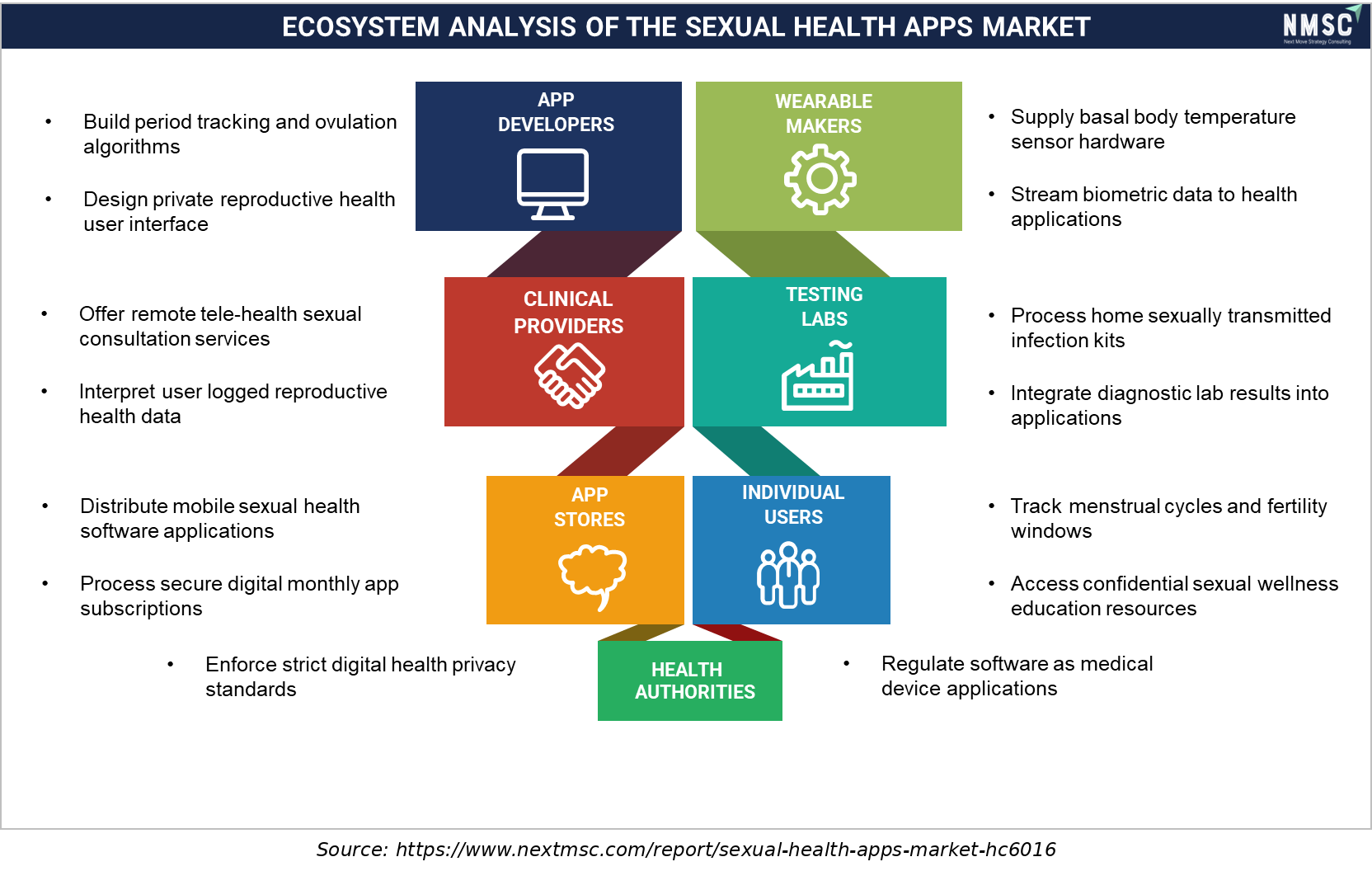
Ecosystem Analysis

Market Drivers & Dynamics

Interactive Dataset
Rising telehealth consultation adoption for reproductive care driver +3.8% North America, Europe 2026–2035
Expanding smartphone and wearable device penetration driver +3.1% Asia-Pacific, Latin America 2026–2035
Growth in employer-sponsored digital health benefits driver +2.4% North America 2026–2032
Rising demand for discreet at-home sexual health testing driver +2.0% Global 2026–2035
Increasing venture and strategic investment in femtech platforms driver +1.6% North America, Europe 2026–2032
Expanding insurance coverage for digital reproductive health services driver +1.1% North America, Europe 2026–2035
Data-privacy and regulatory uncertainty around reproductive health data restraint -2.2% North America 2026–2035
Cultural and social stigma limiting adoption in certain regions restraint -1.5% Middle East and Africa, Asia-Pacific 2026–2035
Fragmented cross-border telehealth prescribing regulations restraint -1.0% Europe, Asia-Pacific 2026–2032
Source: Next Move Strategy Consulting

Growth Drivers

What Is the Primary Growth Driver of the Sexual Health Apps Market?

Rising telehealth consultation adoption for reproductive care is the primary driver of the market. The U.S. Department of Health and Human Services continues to report sustained growth in telehealth utilization for reproductive and sexual health services, reinforcing consumer demand for app-based consultation access. We observed that this behavioral shift, combined with expanding licensed clinician networks, continues to anchor baseline consumption of sexual health apps across developed markets.

How Is Smartphone Penetration Driving Market Growth?

Expanding smartphone and wearable device penetration is accelerating consumer access to sexual health tracking and consultation tools. Government-backed digital health initiatives, documented by national health ministries, are supporting mobile health infrastructure expansion across emerging economies. Our assessment indicates that this infrastructure growth, combined with rising health-conscious consumer behavior, is compressing adoption cycles for platform operators across Asia-Pacific and Latin America.

Growth Inhibitors

What Is Restraining Sexual Health Apps Market Expansion?

Data-privacy and regulatory uncertainty around reproductive health data restrains platform expansion in certain jurisdictions. The U.S. Federal Trade Commission has issued guidance on reproductive health data handling that increases compliance obligations for app operators. We found that smaller platform providers face particular exposure, as limited legal and compliance infrastructure reduces their ability to navigate evolving data-protection requirements compared with larger, well-capitalized operators.

Segmentation Analysis

2025 (USD Billion)
2035 (USD Billion)
Sexual Health Management Apps 2025: $1.08 Billion | 2035: $5.03 Billion
Sexual Healt
Sexual Health Telehealth Apps 2025: $0.92 Billion | 2035: $5.66 Billion
Sexual Healt
Fertility Apps 2025: $0.85 Billion | 2035: $4.40 Billion
Fertility Ap
Sexual Education Apps 2025: $0.54 Billion | 2035: $2.93 Billion
Sexual Educa
Sexual Health Testing Apps 2025: $0.46 Billion | 2035: $2.93 Billion
Sexual Healt
Sexual Health Management Apps $1.08 Billion $5.03 Billion 16.48%
Sexual Health Telehealth Apps $0.92 Billion $5.66 Billion 20.05%
Fertility Apps $0.85 Billion $4.40 Billion 17.88%
Sexual Education Apps $0.54 Billion $2.93 Billion 18.49%
Sexual Health Testing Apps $0.46 Billion $2.93 Billion 20.54%

Which Offering Dominates the Sexual Health Apps Market?

Sexual Health Management Apps led the market with USD 1.08 Billion in 2025, supported by broad consumer adoption of men's, women's, and couple wellness tracking tools. We observed that the Sexual Health Testing Apps segment is the fastest-growing offering, expanding at 20.54% CAGR from 2026 to 2035, as users increasingly seek discreet, app-coordinated at-home STI and fertility testing services.

2025 (USD Billion)
2035 (USD Billion)
Mobile Platf
iOS Apps
Android Apps
Cross Platfo
Web Platform
Segment Item 2025 (USD Billion) 2035 (USD Billion) CAGR
Mobile Platform $10.0 USD Billion $40.0 USD Billion 19.0%
iOS Apps $17.1 USD Billion $51.1 USD Billion 13.0%
Android Apps $24.2 USD Billion $62.2 USD Billion 27.0%
Cross Platform Apps $31.3 USD Billion $73.3 USD Billion 13.0%
Web Platform $38.4 USD Billion $84.4 USD Billion 18.0%

Segment-wise data is locked

Unlock complete segment-wise numbers for By Technology Platform.

Unlock Full Data

Which Technology Platform Leads Sexual Health Apps Market Demand?

Mobile Platform remained the dominant technology platform, valued at USD 2.69 Billion in 2025 due to widespread smartphone penetration and app-store distribution convenience. The analysis indicates that Connected Platform is the fastest-growing technology category, registering 23.95% CAGR from 2026 to 2035, as wearable-integrated tracking gains traction among fertility and cycle-tracking users.

2025 (USD Billion)
2035 (USD Billion)
Subscription
Premium Subs
Membership S
Content Subs
Transaction
Segment Item 2025 (USD Billion) 2035 (USD Billion) CAGR
Subscription Model $10.0 USD Billion $40.0 USD Billion 23.0%
Premium Subscription $17.1 USD Billion $51.1 USD Billion 13.0%
Membership Subscription $24.2 USD Billion $62.2 USD Billion 23.0%
Content Subscription $31.3 USD Billion $73.3 USD Billion 9.0%
Transaction Model $38.4 USD Billion $84.4 USD Billion 26.0%

Segment-wise data is locked

Unlock complete segment-wise numbers for By Revenue Model.

Unlock Full Data

Which Revenue Model Is Growing Fastest in the Sexual Health Apps Market?

Subscription Model remained the leading revenue model, reaching USD 2.23 Billion in 2025 due to predictable recurring revenue for platform operators and continuous access for users. Based on research conducted by Next Move Strategy Consulting, we found that Enterprise Model is the fastest-growing revenue category, expanding at 20.92% CAGR from 2026 to 2035, as employer-sponsored benefits programs expand licensing agreements.

2025 (USD Billion)
2035 (USD Billion)
Consumer Hea
Personal Hea
Wellness Man
Education Ac
Clinical Hea
Segment Item 2025 (USD Billion) 2035 (USD Billion) CAGR
Consumer Health Applications $10.0 USD Billion $40.0 USD Billion 18.0%
Personal Health Tracking $17.1 USD Billion $51.1 USD Billion 16.0%
Wellness Management $24.2 USD Billion $62.2 USD Billion 22.0%
Education Access $31.3 USD Billion $73.3 USD Billion 12.0%
Clinical Health Applications $38.4 USD Billion $84.4 USD Billion 19.0%

Segment-wise data is locked

Unlock complete segment-wise numbers for By Application.

Unlock Full Data

Which Application Segment Anchors Sexual Health Apps Market Revenue?

Consumer Health Applications accounted for the largest application share, valued at USD 2.00 Billion in 2025, reflecting broad personal tracking and wellness management adoption. Our analysis shows that the Clinical Health Applications segment is growing fastest at 20.15% CAGR from 2026 to 2035, as remote consultation and treatment management functionality expands.

2025 (USD Billion)
2035 (USD Billion)
Individual U
Men
Women
Couples
LGBTQ+ Users
Segment Item 2025 (USD Billion) 2035 (USD Billion) CAGR
Individual Users $10.0 USD Billion $40.0 USD Billion 26.0%
Men $17.1 USD Billion $51.1 USD Billion 16.0%
Women $24.2 USD Billion $62.2 USD Billion 18.0%
Couples $31.3 USD Billion $73.3 USD Billion 8.0%
LGBTQ+ Users $38.4 USD Billion $84.4 USD Billion 23.0%

Segment-wise data is locked

Unlock complete segment-wise numbers for By End User.

Unlock Full Data

Which End User Segment Is Expanding Fastest?

Individual Users accounted for the largest end-user share, valued at USD 2.46 Billion in 2025, reflecting the market's consumer-first adoption pattern. The analysis indicates that the Enterprises segment is the fastest-growing end-user segment, expanding at 21.47% CAGR from 2026 to 2035, as employer and insurance-sponsored programs broaden platform access.

Growth Opportunities

We identified three forward-looking whitespace opportunities that stakeholders across the sexual health apps market can pursue through 2035.

How Can Employer Benefits Partnerships Unlock Enterprise Revenue?

Expanding employer-sponsored digital health benefits partnerships offers platforms a mechanism to access enterprise licensing revenue beyond direct consumer subscriptions. This mechanism benefits fertility and telehealth platforms positioned to integrate with existing workplace benefits administration systems.

How Can At-Home Testing Integration Expand Diagnostic Revenue?

Integrating at-home STI and fertility testing kit coordination offers platforms a mechanism to capture diagnostic revenue beyond tracking and consultation services. This mechanism benefits testing-service operators positioned to bundle result management with ongoing consultation relationships.

How Can Underserved Regional Markets Expand User Access?

Expanding localized, culturally adapted platform offerings in underserved Asia-Pacific and Latin American markets offers a mechanism to capture untapped smartphone-enabled user demand. This mechanism benefits platforms with localization capability positioned to navigate regional cultural and regulatory sensitivities.

Regional Outlook

2025 (USD Billion)
2035 (USD Billion)
North Americ
Europe
Asia-Pacific
Middle East
Latin Americ
Region 2025 (USD Billion) 2035 (USD Billion) CAGR (%)
North America $10.0 USD Billion $40.0 USD Billion 9.0%
Europe $17.1 USD Billion $51.1 USD Billion 27.0%
Asia-Pacific $24.2 USD Billion $62.2 USD Billion 25.0%
Middle East & Africa $31.3 USD Billion $73.3 USD Billion 23.0%
Latin America $38.4 USD Billion $84.4 USD Billion 12.0%

Regional data is locked

Unlock complete regional numbers for this market.

Unlock Full Data

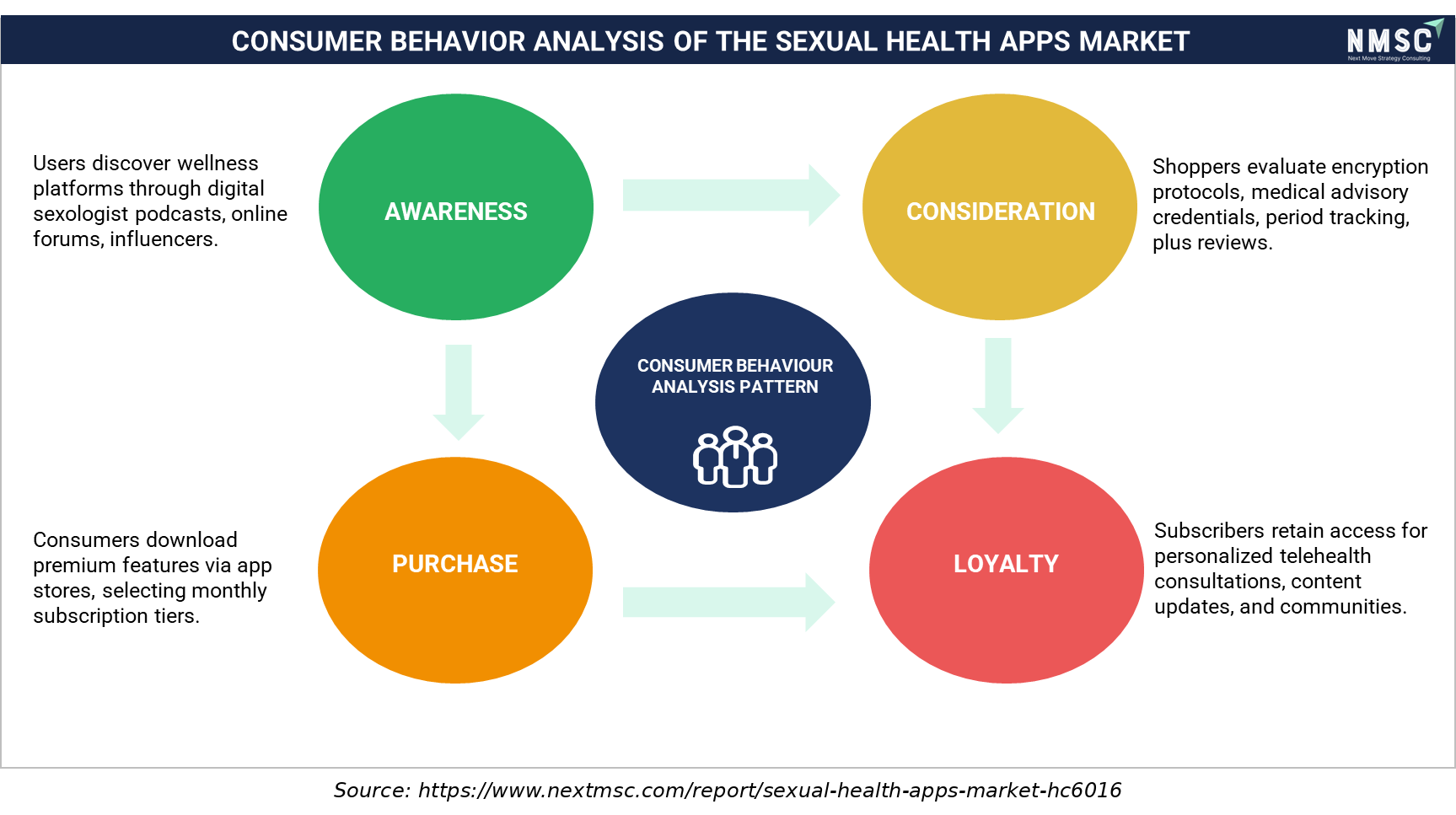
Consumer Behavior Analysis of the Sexual Health Apps Market

Consumer Behavior Analysis of the Sexual Health Apps Market

Based on research conducted by NMSC, we found that consumer journey in the Sexual Health Apps Market begins when users discover platforms via podcasts, forums, and influencers. During evaluation, shoppers carefully assess encryption protocols, medical advisory credentials, and period tracking features before downloading premium subscriptions through app stores. Subsequently, ongoing loyalty is sustained through personalized telehealth access, continuous content updates, and supportive community engagement.

Competitive Landscape

We observed that the sexual health apps market remains moderately fragmented, with diversified telehealth platforms competing alongside specialty fertility, wellness, and education-focused applications.

Dimension Description
Market Structure Moderately fragmented, with the top 10 companies accounting for a meaningful but non-dominant share of global revenue
Innovation Focus AI-assisted triage, wearable integration, and at-home testing coordination
M&A Activity Selective acquisitions of specialty fertility and telehealth platforms by diversified digital health operators

How Do Companies Compete in the Sexual Health Apps Market?

Companies compete primarily on clinician network breadth, platform trust, and user retention across consumer and enterprise channels. We found that diversified telehealth operators leverage broad licensed clinician networks and multi-offering portfolios to sustain premium positioning, while specialty fertility and wellness platforms compete on focused user experience and community engagement within specific sub-segments.

Which Competitive Archetypes Dominate the Sexual Health Apps Market?

Two archetypes dominate the sexual health apps market: diversified telehealth platforms with integrated consultation, prescription, and testing capability, and specialty consumer applications focused on fertility tracking or wellness education niches. The analysis indicates that diversified platforms sustain scale advantages in clinical and enterprise channels, while specialty applications differentiate through curated, community-driven user experiences.

What Innovation and Differentiation Strategies Define the Industry?

Innovation strategy centers on AI-assisted symptom triage, wearable data integration, and streamlined at-home testing coordination. Our analysis shows that leading platforms are investing in clinician network expansion and data-privacy infrastructure to differentiate trust positioning, while pricing strategies increasingly bundle subscription tracking with pay-per-use consultation and testing services.

What M&A and Geographic Expansion Activity Is Shaping the Market?

M&A activity remains selective, concentrated on acquisitions of specialty fertility and telehealth platforms that expand offering breadth and clinician network reach. We observed that geographic expansion is prioritizing Asia-Pacific mobile-first markets, where diversified operators are localizing platform content to accelerate market-specific user acquisition.

Key Market Players

Our assessment indicates that the following companies represent the leading verified participants in the global sexual health apps market based on platform scale, offering breadth, and confirmed operating presence.

Hims and Hers Health Inc. Flo Health Inc. Ro Inc. Natural Cycles Nordic AB BioWink GmbH Thirty Madison Inc. Maven Clinic Co. WELL Health Technologies Corp. Everly Health Inc. Kindbody Inc. Glow Inc. OvulineInc. Twentyeight Health Inc. Femometer Inc. Peanut App Ltd. Dipsea Inc. Lover App Inc. Coral Health Inc. Blueheart Ltd. Emjoy Ltd.

Latest Developments

We observed that recent company activity across the sexual health apps market centers on platform feature expansions, clinician network growth, and partnership announcements disclosed through official company channels.

Date Event
March 2026 Maven Clinic launched a direct-to-consumer platform, making its virtual healthcare services directly accessible to all women and families outside traditional employer-sponsored plans. The expanded offering introduces specialized products focused on hormone health and a subscription-based GLP-1 care model designed specifically for women.
January 2026 BioWink GmbH, creator of the Clue menstrual and cycle-tracking app, secured a significant strategic investment from European growth equity firm Verdane from its €2 billion growth fund. The investment, the largest in Clue's history, will support product innovation, global expansion, clinical research, healthcare partnerships, and privacy-first digital health technology.
October 2025 Hims and Hers Health Inc. launched a new menopause and perimenopause specialty on its Hers platform. The digital expansion allows eligible female subscribers to access personalized, affordable treatment plans, including provider-directed prescription medications such as estradiol and progesterone pills, patches, or creams tailored to their health histories.
July 2025 Flo Health Inc. launched Flo for Perimenopause, an in-app offering providing personalized guidance, symptom tracking, and medically-backed educational content for women entering or experiencing perimenopause. The feature includes a scientifically validated Perimenopause Score and customized cycle irregularity predictions designed to improve digital reproductive literacy.

Expert Insights

Shailja Mittal

Founder | Qurex

"The Indian market is witnessing a significant shift towards digital solutions for sexual wellness, driven by increased internet penetration and a growing comfort with online consultations."

Analyst Interpretation

The statement reflects a significant shift in the Sexual Health Apps Market, where increasing internet accessibility and growing consumer confidence in virtual healthcare are accelerating the adoption of digital sexual health solutions. As individuals seek greater privacy, convenience, and timely access to expert guidance, sexual health apps are emerging as an effective alternative to traditional in-person consultations. The integration of telemedicine, AI-driven personalization, digital assessments, and educational resources is further enhancing user engagement and accessibility. Consequently, rising acceptance of confidential digital healthcare platforms is expected to drive innovation and sustained growth in the global Sexual Health Apps Market by expanding access to personalized, stigma-free sexual health services.

Investment Opportunities

Where Are Capital Inflows Concentrated in the Sexual Health Apps Market?

Capital inflows are concentrating in platforms that integrate digital therapeutics capability with clinical consultation and testing coordination. We observed that private investment is favoring platforms with proven clinician network scale, positioning them to capture expanding enterprise and insurance-sponsored demand across North America and Europe.

How Is Infrastructure Investment Supporting Market Expansion?

Infrastructure investment is expanding secure data-handling systems and licensed clinician network capacity to support rising consultation volumes. Our assessment indicates that platforms investing in privacy-compliant infrastructure and multi-state clinician licensing are better positioned to meet rising demand from telehealth-dependent users.

What ESG Considerations Are Shaping Sexual Health Apps Investment?

Environmental, Social, and Governance considerations are increasingly shaping investment decisions, with platforms prioritizing equitable access programs and transparent data-governance practices for sensitive reproductive health information. We found that ESG-aligned platforms are gaining preferential access to enterprise and insurance partnerships that increasingly specify data-privacy and equity-linked procurement criteria.

Key Benefits for Stakeholders

How Does This Report Benefit Industry Leaders and Platform Operators?

Industry leaders and platform operators gain access to validated segmentation, competitive benchmarking, and regional demand forecasts that support offering and geographic expansion decisions. Our analysis shows that this data enables operators to prioritize investment toward the fastest-growing segments and geographies identified through 2035.

How Does This Report Benefit Investors and Financial Analysts?

Investors and financial analysts benefit from independently derived market sizing, CAGR methodology, and company-level competitive positioning that support capital-allocation and due-diligence decisions. We observed that the report's regional and segment-level forecasts help quantify addressable opportunity across consumer, clinical, and diagnostic demand channels.

How Does This Report Benefit Healthcare Providers and Enterprise Partners?

Healthcare providers and enterprise partners gain insight into platform adoption patterns, enabling more informed partnership and benefits-integration planning. This analysis helps providers and employers align digital health procurement strategy with shifting consumer and workforce demand for sexual and reproductive health services.

Key Market Segments Evaluated

By Offering

  • Sexual Health Management Apps
  • Sexual Health Telehealth Apps
  • Fertility Apps
  • Sexual Education Apps
  • Sexual Health Testing Apps

By Technology Platform

  • Mobile Platform
  • Web Platform
  • Connected Platform

By Revenue Model

  • Subscription Model
  • Transaction Model
  • Enterprise Model

By Application

  • Consumer Health Applications
  • Clinical Health Applications
  • Diagnostic Applications

By End User

  • Individual Users
  • Healthcare Providers
  • Enterprises

Conclusion & Recommendations

The long-term outlook remains favorable, with the market projected to grow from USD 4.55 Billion in 2026 to USD 20.95 Billion by 2035 at an 18.49% CAGR. We observed that sustained telehealth adoption, expanding enterprise benefits integration, and rising at-home testing demand collectively support durable growth across both developed and emerging markets through the forecast period.

What Strategic Positioning Should Companies Pursue?

Companies should prioritize clinical credibility and data-privacy infrastructure while expanding integrated offering portfolios that combine tracking, consultation, and testing. Our assessment indicates that platforms combining strong clinician networks with enterprise partnership capability are best positioned to capture share across both consumer and institutional demand segments.

How Attractive Is the Sexual Health Apps Market for Investment?

The market presents strong investment attractiveness, anchored by an 18.49% CAGR from 2026 to 2035 and expanding enterprise and insurance-sponsored procurement. We found that clinician network infrastructure and data-privacy compliance capability represent the most capital-efficient investment avenues, given their direct link to user trust and platform retention.

What Market Shifts and Key Risks Should Stakeholders Monitor?

Stakeholders should monitor data-privacy regulatory uncertainty, cultural adoption barriers, and fragmented cross-border telehealth prescribing rules. The analysis indicates that platforms with diversified geographic operating footprints are better insulated against regional regulatory and cultural shocks that could otherwise disrupt user growth and retention.

What Are the Key Growth Pathways Through 2035?

Key growth pathways include expanding enterprise benefits partnerships, deepening at-home testing integration, and scaling localized platform offerings in underserved regional markets. We observed that companies pursuing these pathways simultaneously are best positioned to capture the full breadth of demand across consumer, clinical, and diagnostic channels through 2035.

FAQs

About the Author

Saista Faiyaz

Saista Faiyaz

Saista Faiyaz is Research Associate at Next Move Strategy Consulting, where she has covered consumer markets and healthcare technologies for 3 years. Her work includes primary interview review, secondary-source validation, market sizing, and structured analysis of company and industry data. She supports research by comparing evidence across sources, organizing findings into market narratives, and documenting assumptions used in analysis. Her scope includes cross-market benchmarking, and reports.

About the Reviewer

Debashree Dey

Debashree Dey

Debashree Dey is Assistant Manager at Next Move Strategy Consulting, where she supports cross-vertical market content and communications across diverse industries for 6 years. Her professional background includes senior content writing, communications, and published manuscript authorship, with experience developing audience-focused business narratives and maintaining clear, consistent messaging. Her role supports research-led content development and editorial quality across NextMSC publications.

Download Free Sample

Mohit Agarwal

MOHIT AGARWAL

Chief Manager

DryChem India Pvt. Ltd.

Next Move Strategy Consulting is an amazing team of consultants. We required a market study report for our investors on top priority and the team went above and beyond our expectations to deliver the same with ample supporting data within a short time span enabling us to secure the investments and keep our project timeline maintained. Their professionalism, attention to detail, and timely delivery of actionable recommendations have left a lasting impression on our organization.

Robert Sean Trevino

ROBERT SEAN TREVINO

Sr. Director, Head of Strategic Insights & Analytics

Foundation Medicine

I realized that it was a reliable source of information. These days, there are many people who are looking for authentic data, and this is one of the only sources that can offer them with what they need;

Rishabh Jogani

RISHABH JOGANI

Strategy Analyst

Accenture Japan

We are incredibly impressed with the market report on the real estate market in India provided by Next Move Strategy Consulting. The report was thorough, insightful, and well-structured, offering deep analysis and actionable recommendations. It not only captured the current trends and dynamics but also provided a forward-looking perspective that has been invaluable for our strategic planning. Their team demonstrated exceptional professionalism, attention to detail, and a profound understanding of the industry. The data-driven insights and clarity of presentation exceeded our expectations, making complex market trends easy to understand. We highly recommend Next Move Strategy Consulting to anyone looking for reliable and comprehensive market research services. Their expertise has given us the confidence to navigate the complexities of the Indian real estate market with clarity and foresight.

Kevin Coker

KEVIN COKER

Founder, CEO and Board Diector

Proxima Clinical Research

I have been using Next MSC reports for product positioning in a new geography for a long time. They have by far the best reports I have found and the price is reasonable too!

Kishu Kanda

KISHU KANDA

Strategy Analyst

Accenture

We purchased the AI Consumer Market Report from this company. Not only did they customize the report to meet our specific requirements, but they also showed great flexibility in accommodating our budget. The report we received fully met our expectations. Additionally, they provided prompt and thorough responses to both our pre-purchase and follow-up questions. We look forward to working with this company again in the future.

Custom Market Research Services

We will customize the research for you if the listed report does not fully match your requirements.

Get 30% Free Customization

Select License

This website uses cookies to ensure you get the best experience on our website. Learn more

✖