Liquid Metal Robot Market Global Industry Analysis and Forecast (2026–2035)

The global Liquid Metal Robot Market size was valued at USD 155.0 million in 2025 and is estimated at USD 205.0 million in 2026, forecast to reach USD 2.95 billion by 2035, expanding at a 34.5% CAGR between 2026 and 2035. North America leads with approximately 34% share, while Liquid Metal Thermal Interface Materials dominate all other product types with approximately 28% share.
Download Free Sample PDF
Base Year (2025)
$155.00 Billion
Forecast (2035)
$2.95 Billion
CAGR (2026-2035)
34.5%
Top Region
North America

What Is the Liquid Metal Robot Market Size?
The global liquid metal robot market size was valued at USD 155.0 million in 2025 and is estimated at USD 205.0 million in 2026, forecast to reach USD 2.95 billion by 2035, at a 34.5% CAGR from 2026 to 2035. North America leads with approximately 34% share, while liquid metal thermal interface materials dominate all other product types with approximately 28% share.

We observed that growth is accelerating fastest in biomedical and defense-linked applications, reflecting the market's transition from laboratory-stage gallium alloy research toward early commercial deployment through 2035.

Liquid Metal Robot Market Global Industry Analysis and Forecast (2026–2035) Revenue Forecast
Values in USD Billion

2025 $0.16 Billion
2025
2026 $0.21 Billion
2026
2027 $0.28 Billion
2027
2028 $0.37 Billion
2028
2029 $0.50 Billion
2029
2030 $0.67 Billion
2030
2031 $0.90 Billion
2031
2032 $1.21 Billion
2032
2033 $1.63 Billion
2033
2034 $2.20 Billion
2034
2035 $2.95 Billion
2035

Key Takeaways

By Product Type: Liquid Metal Thermal Interface Materials held the largest share of approximately 28% (USD 43.4 Million) in 2025; Liquid Metal Biomedical Devices is the fastest-growing sub-segment at 39.9% CAGR from 2026-2035.

By Actuation Mechanism: Magnetic Actuation held the largest share of approximately 38% (USD 58.9 Million) in 2025; Acoustic Actuation is the fastest-growing sub-segment at 38.9% CAGR from 2026-2035.

By End-User Industry: Consumer Electronics held the largest share of approximately 30% (USD 46.5 Million) in 2025; Aerospace and Defense is the fastest-growing sub-segment at 37.5% CAGR from 2026-2035.

Dominant Region: North America dominated with approximately 34% revenue share (USD 52.6 Million) in 2025.

Fastest-Growing Region: Asia-Pacific is expected to register the highest CAGR of 38.5% during 2026-2035.

Dominant Country: U.S. led with approximately USD 40.0 Million in 2025.

Fastest-Growing Country: India is the fastest-growing country at approximately 47.6% CAGR from 2026-2035.

Market Opportunity: The liquid metal robot market is expected to create an absolute dollar opportunity of USD 2.75 billion between 2026 and 2035, presenting significant investment potential across gallium alloy materials, soft actuation, and biomedical device applications.

According to Next Move Strategy Consulting analysis, manufacturers that solve gallium oxide-skin handling and scalable patterning constraints are transitioning fastest from research demonstrations to shippable products, a shift that favors vertically integrated materials-to-device suppliers over pure academic licensing models as commercialization accelerates through 2035.

What Does the Liquid Metal Robot Market Encompass?
The liquid metal robot market encompasses materials, components, and devices built on gallium-based alloys such as eutectic gallium-indium and Galinstan that remain liquid near room temperature, enabling shape-shifting actuators, stretchable circuits, and soft robotic systems. Our assessment indicates that the scope spans actuators and grippers, circuits and sensors, thermal interface materials, and biomedical devices supplied to consumer electronics, healthcare, aerospace and defense, and industrial robotics manufacturers. The category has evolved from laboratory demonstrations of shape-shifting droplets into early commercial stretchable-circuit and thermal-management products, driven by advances in oxide-skin control and scalable patterning.
Regulatory oversight remains limited and largely governed by general materials-safety and electronics-conductivity standards rather than technology-specific frameworks, while non-toxicity relative to mercury shapes adoption in wearable and biomedical contexts. We observed that technology adoption is shifting from pure research licensing toward direct commercialization by specialized materials companies entering soft robotics and stretchable electronics supply chains. Next Move Strategy Consulting's analysis indicates that this structural shift is redefining sourcing criteria across the liquid metal robot market as component-level suppliers scale manufacturing capability.

ECOSYSTEM ANALYSIS OF THE LIQUID METAL ROBOT MARKET

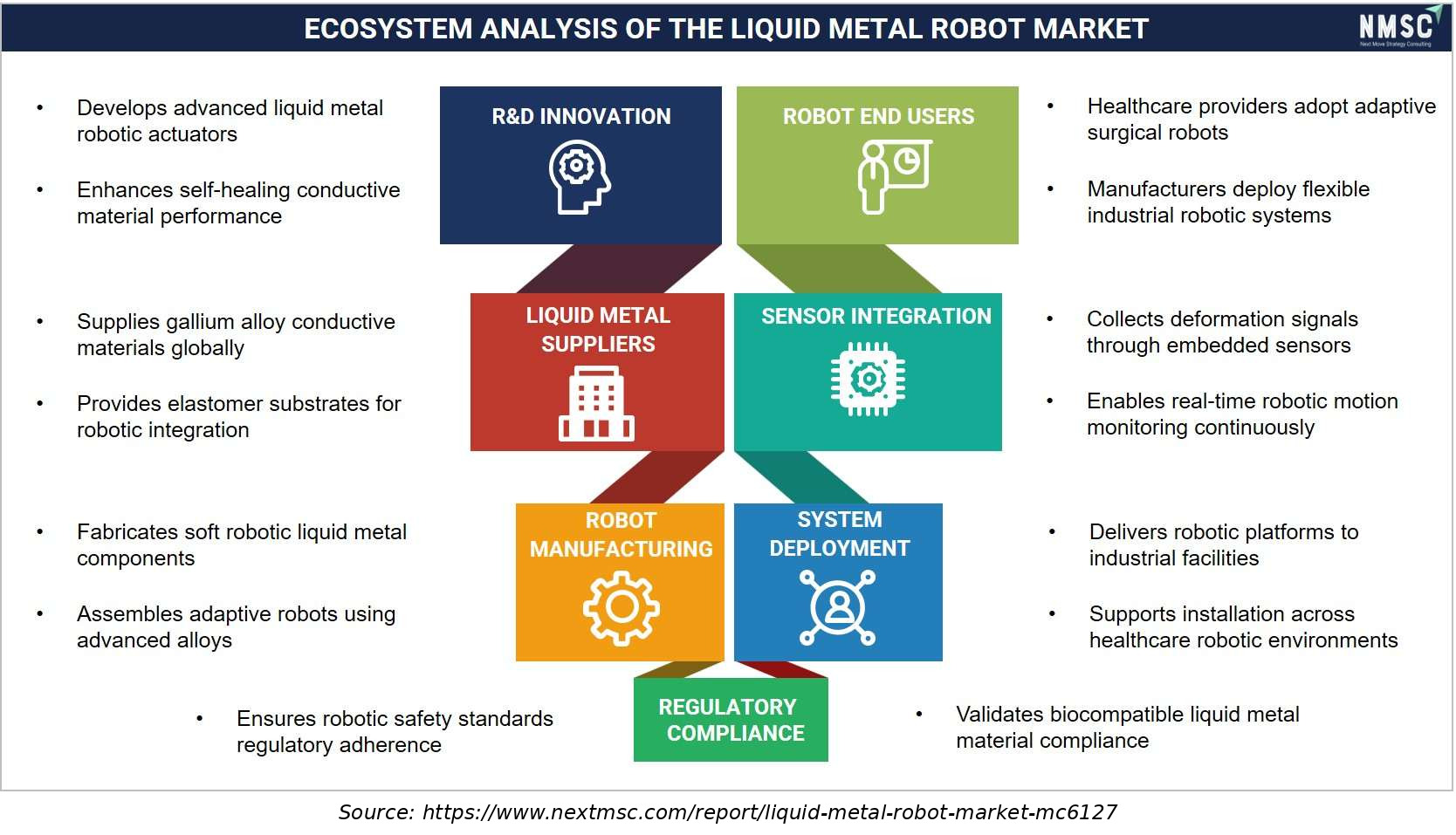
The Liquid Metal Robot Market ecosystem is driven by continuous R&D in smart materials, followed by liquid metal suppliers providing advanced conductive alloys and composites. Sensor integration enables adaptive movement and real-time responsiveness, while robot manufacturers develop flexible robotic systems for industrial, healthcare, and electronics applications. Successful deployment depends on regulatory compliance and end-user adoption, creating a collaborative value chain that accelerates commercialization and technological advancement.
Market Drivers & Dynamics

Interactive Dataset
Advances in gallium oxide-skin control and scalable patterning driver +7.2% North America, Europe 2026-2035
Rising demand for stretchable, wearable electronics driver +6.4% Global 2026-2035
Biomedical adoption of non-toxic mercury alternatives driver +5.5% North America, Asia-Pacific 2026-2035
Venture capital investment in liquid metal materials startups driver +4.1% North America 2026-2032
Growing soft robotics and adaptive gripper research funding driver +3.8% Global 2026-2035
Thermal management demand in high-density electronics driver +3.0% Asia-Pacific, North America 2026-2033
Manufacturing scalability and yield constraints restraint -3.4% Global 2026-2032
Aluminum-incompatibility and material handling limitations restraint -2.1% Global 2026-2033
Source: Next Move Strategy Consulting

Growth Drivers

What Is the Primary Growth Driver of the Liquid Metal Robot Market?

Advances in gallium oxide-skin control and scalable patterning are the primary driver of the market. We observed that Carnegie Mellon University researchers developed a combined lithographic wetting and dip-coating process that achieves microelectronic-compatible precision for liquid metal circuit fabrication, addressing the historic mass-manufacturing barrier. This manufacturability breakthrough continues to anchor early-stage commercial procurement of liquid metal circuits and actuators across research and early industrial adopters.

How Is Wearable Electronics Demand Driving Market Growth?

Rising demand for stretchable, skin-conformal wearable electronics is accelerating market growth as manufacturers seek conductors that match human tissue mechanics. Our assessment indicates that Liquid Wire Inc.'s Metal Gel circuits, backed by a USD 10 million Series A round, are being commercialized specifically for medical wearables and performance apparel applications. This funding and product validation is compressing adoption timelines for gallium-based stretchable conductors among device manufacturers.

Growth Inhibitors

What Is Restraining Liquid Metal Robot Market Expansion?

Manufacturing scalability and yield constraints restrain the pace of commercialization across the industry, as the reactive gallium-oxide skin that forms on air exposure complicates uniform, repeatable device fabrication at scale. Aluminum-incompatibility further limits material handling and integration options, since gallium alloys corrode aluminum surfaces on contact. We found that smaller research-stage developers face particular exposure to these constraints, as limited manufacturing infrastructure reduces their ability to achieve consistent production yields compared with better-capitalized materials companies.

What Are the Growth Opportunities?

How Can Biomedical Carriers Unlock Value for Liquid Metal Material Suppliers?

Biomedical drug-delivery and implantable device applications present a whitespace opportunity for suppliers offering high-purity, biocompatible gallium alloy formulations. Manufacturers that commercialize validated non-toxic liquid metal carriers stand to capture recurring device-supply revenue as healthcare developers seek mercury-free alternatives for diagnostic and therapeutic applications.

Where Does Reconfigurable Antenna Technology Create New Demand?

Reconfigurable antennas and adaptive electromagnetic surfaces represent an underpenetrated opportunity for manufacturers integrating liquid metal circuits into telecommunications and defense hardware. Suppliers that secure qualified-vendor status with defense electronics integrators can access long-term contracts, benefiting from recurring engineering revenue tied to adaptive sensing and communications programs.

How Can Scalable Manufacturing Benefit Stretchable Circuit Producers?

Scalable, lithography-compatible liquid metal patterning creates an opportunity for suppliers serving wearable electronics and soft robotics manufacturers seeking volume production. Early movers that validate microelectronic-grade fabrication processes can differentiate with device makers pursuing both performance and manufacturability, capturing recurring revenue tied to the segment's above-market growth through 2035.

Segmentation Analysis

2025 (USD Billion)
2035 (USD Billion)
Liquid Metal Actuators and Grippers 2025: $40.30 Billion | 2035: $885.00 Billion
Liquid Metal
Liquid Metal Circuits and Sensors 2025: $37.20 Billion | 2035: $767.00 Billion
Liquid Metal
Liquid Metal Thermal Interface Materials 2025: $43.40 Billion | 2035: $472.00 Billion
Liquid Metal
Liquid Metal Biomedical Devices 2025: $21.70 Billion | 2035: $590.00 Billion
Liquid Metal
Other Liquid Metal Robotic Systems 2025: $12.40 Billion | 2035: $236.00 Billion
Other Liquid
Liquid Metal Actuators and Grippers $40.30 Billion $885.00 Billion 36.6%
Liquid Metal Circuits and Sensors $37.20 Billion $767.00 Billion 35.7%
Liquid Metal Thermal Interface Materials $43.40 Billion $472.00 Billion 26.4%
Liquid Metal Biomedical Devices $21.70 Billion $590.00 Billion 39.9%
Other Liquid Metal Robotic Systems $12.40 Billion $236.00 Billion 34.5%

Which Product Type Dominates the Liquid Metal Robot Market?

Liquid Metal Thermal Interface Materials led the market with USD 43.4 million in 2025, supported by established commercial demand for high-performance cooling compounds in consumer electronics. We observed that Liquid Metal Biomedical Devices is the fastest-growing product type, expanding at a 39.9% CAGR from 2026 to 2035, as non-toxic gallium alloy formulations gain traction in implantable and wearable medical applications relative to mercury-based alternatives.

2025 (USD Billion)
2035 (USD Billion)
Magnetic Act
Electrochemi
Thermal Phas
Acoustic Act
Segment Item 2025 (USD Billion) 2035 (USD Billion) CAGR
Magnetic Actuation $10.0 USD Billion $40.0 USD Billion 25.0%
Electrochemical Actuation $17.1 USD Billion $51.1 USD Billion 11.0%
Thermal Phase-Change Actuation $24.2 USD Billion $62.2 USD Billion 25.0%
Acoustic Actuation $31.3 USD Billion $73.3 USD Billion 11.0%

Segment-wise data is locked

Unlock complete segment-wise numbers for By Actuation Mechanism.

Unlock Full Data

Which Actuation Mechanism Leads Liquid Metal Robot Development?

Magnetic Actuation led the market, valued at USD 58.9 million in 2025, reflecting its maturity as the most widely demonstrated method for reprogrammable liquid metal shape control without complex onboard electronics. Our findings suggest that Acoustic Actuation is the fastest-growing mechanism, registering a 38.9% CAGR from 2026 to 2035, as sound-wave-controlled liquid robots demonstrated in recent biological-cell-inspired research gain traction for micro-scale manipulation applications.

2025 (USD Billion)
2035 (USD Billion)
Consumer Ele
Healthcare a
Industrial R
Aerospace an
Research and
Segment Item 2025 (USD Billion) 2035 (USD Billion) CAGR
Consumer Electronics $10.0 USD Billion $40.0 USD Billion 27.0%
Healthcare and Biomedical $17.1 USD Billion $51.1 USD Billion 9.0%
Industrial Robotics and Manufacturing $24.2 USD Billion $62.2 USD Billion 19.0%
Aerospace and Defense $31.3 USD Billion $73.3 USD Billion 17.0%
Research and Academia $38.4 USD Billion $84.4 USD Billion 18.0%

Segment-wise data is locked

Unlock complete segment-wise numbers for By End-User Industry.

Unlock Full Data

Which End-User Industry Leads Liquid Metal Robot Demand?

Consumer Electronics remained the leading end-user industry, valued at USD 46.5 million in 2025 on established thermal interface material demand for high-performance computing devices. Our analysis shows that Aerospace and Defense is the fastest-growing end-user segment, registering a 37.5% CAGR from 2026 to 2035, as defense research programs fund liquid metal actuators and reconfigurable systems for adaptive, damage-tolerant robotic applications.

2025 (USD Billion)
2035 (USD Billion)
North Americ
Canada
Mexico
Europe: UK
Germany
Segment Item 2025 (USD Billion) 2035 (USD Billion) CAGR
North America: U.S. $10.0 USD Billion $40.0 USD Billion 14.0%
Canada $17.1 USD Billion $51.1 USD Billion 24.0%
Mexico $24.2 USD Billion $62.2 USD Billion 22.0%
Europe: UK $31.3 USD Billion $73.3 USD Billion 12.0%
Germany $38.4 USD Billion $84.4 USD Billion 27.0%

Segment-wise data is locked

Unlock complete segment-wise numbers for By Region.

Unlock Full Data

Growth Opportunities

Our analysis shows that three forward-looking opportunities stand out for stakeholders positioning within the liquid metal robot market over the 2026-2035 forecast period.

How Can Biomedical Carriers Unlock Value for Liquid Metal Material Suppliers?

Biomedical drug-delivery and implantable device applications present a whitespace opportunity for suppliers offering high-purity, biocompatible gallium alloy formulations. Manufacturers that commercialize validated non-toxic liquid metal carriers stand to capture recurring device-supply revenue as healthcare developers seek mercury-free alternatives for diagnostic and therapeutic applications.

Where Does Reconfigurable Antenna Technology Create New Demand?

Reconfigurable antennas and adaptive electromagnetic surfaces represent an underpenetrated opportunity for manufacturers integrating liquid metal circuits into telecommunications and defense hardware. Suppliers that secure qualified-vendor status with defense electronics integrators can access long-term contracts, benefiting from recurring engineering revenue tied to adaptive sensing and communications programs.

How Can Scalable Manufacturing Benefit Stretchable Circuit Producers?

Scalable, lithography-compatible liquid metal patterning creates an opportunity for suppliers serving wearable electronics and soft robotics manufacturers seeking volume production. Early movers that validate microelectronic-grade fabrication processes can differentiate with device makers pursuing both performance and manufacturability, capturing recurring revenue tied to the segment's above-market growth through 2035.

SUPPLY CHAIN STRUCTURE OF THE LIQUID METAL ROBOT MARKET

SUPPLY CHAIN STRUCTURE OF THE LIQUID METAL ROBOT MARKET
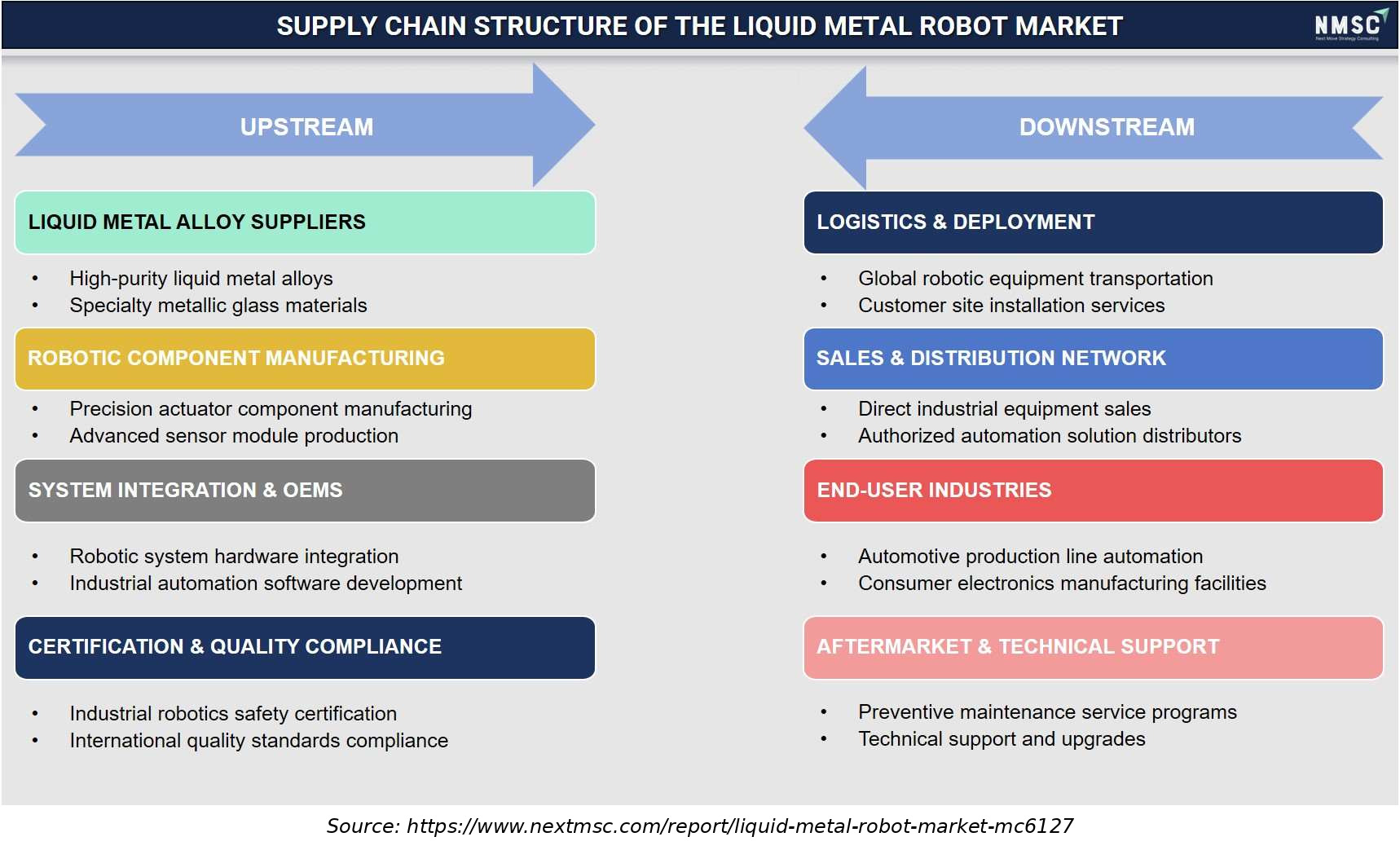
The Liquid Metal Robot Market supply chain begins with upstream suppliers of high-purity liquid metal alloys and metallic glass materials, followed by manufacturers producing actuators, sensors, and robotic components. System integrators and OEMs assemble complete robotic solutions while ensuring regulatory and quality compliance. Downstream activities include logistics, distribution, deployment, and after-sales services, with end-user industries such as automotive and electronics driving commercial adoption and ongoing system upgrades.

Regional Outlook

2025 (USD Billion)
2035 (USD Billion)
North Americ
Europe
Asia-Pacific
Middle East
Latin Americ
Region 2025 (USD Billion) 2035 (USD Billion) CAGR (%)
North America $10.0 USD Billion $40.0 USD Billion 9.0%
Europe $17.1 USD Billion $51.1 USD Billion 27.0%
Asia-Pacific $24.2 USD Billion $62.2 USD Billion 25.0%
Middle East & Africa $31.3 USD Billion $73.3 USD Billion 23.0%
Latin America $38.4 USD Billion $84.4 USD Billion 12.0%

Regional data is locked

Unlock complete regional numbers for this market.

Unlock Full Data

Competitive Landscape

We observed that the liquid metal robot market remains at an early, pre-consolidation stage, with a small number of specialized materials companies competing on manufacturability, product validation, and application-specific engineering rather than broad portfolio breadth.

Dimension Description
Market Structure Highly fragmented and pre-commercial; the verified company set profiled in this report reflects a genuinely nascent market where most liquid metal robotics activity remains within academic and government research institutions rather than standalone commercial vendors.
Innovation Focus Scalable gallium alloy patterning, oxide-skin control, and biocompatible material formulations dominate current innovation pipelines across verified commercial suppliers.
M&A Activity Limited to date; capital activity is concentrated in early-stage venture financing, exemplified by Liquid Wire Inc.'s USD 10 million Series A round led by Deerfield Management Company.

How Do Companies Compete in the Liquid Metal Robot Market?

Companies compete primarily on manufacturing scalability, material purity, and application-specific validation across the nascent industry. Materials suppliers such as Indium Corporation leverage established thermal interface material manufacturing and distribution infrastructure to serve electronics customers, while specialized developers such as Liquid Wire Inc. compete on proprietary formulation and lithography-compatible circuit fabrication for wearable and robotics applications.

Which Competitive Archetypes Dominate the Liquid Metal Robot Market?

Two archetypes currently define the market: established materials manufacturers extending existing gallium alloy product lines into new applications, and venture-funded specialized startups engineering purpose-built liquid metal devices. Indium Corporation exemplifies the established materials archetype through its GalliTHERM product family, while Liquid Wire Inc. exemplifies the specialized startup archetype, concentrating on proprietary Metal Gel stretchable circuit technology for wearables and robotics.

How Are Companies Differentiating Through Innovation in Liquid Metal Robotics?

Innovation and differentiation strategy increasingly center on solving manufacturability constraints that have historically confined liquid metal devices to laboratory settings. Liquid Wire Inc.'s patented Metal Gel formulation, engineered for lamination onto plastic and textile substrates without soldering, illustrates how suppliers are converting fundamental material science into production-ready processes. Our analysis shows that suppliers unable to demonstrate repeatable, scalable fabrication risk remaining confined to research and pilot-scale applications.

What M&A and Investment Activity Is Shaping the Liquid Metal Robot Market?

Investment activity remains concentrated in early-stage venture financing rather than mergers and acquisitions, reflecting the market's pre-consolidation stage. Liquid Wire Inc.'s USD 10 million Series A round, led by Deerfield Management Company with participation from Oregon Nanoscience and Microtechnologies Institute and Portland State University, illustrates how capital is flowing toward manufacturers with validated medical wearable and robotics use cases ahead of broader industry consolidation.

Key Market Players

Our assessment indicates that the liquid metal robot market remains at a genuinely early commercial stage; only two companies met this report's verification criteria for confirmed, market-specific commercial products backed by official company disclosures, with the broader innovation base still concentrated in academic and government research institutions rather than standalone vendors.

Liquid Wire Inc. Indium Corporation

Latest Developments

We found that recent developments within the liquid metal robot market are concentrated on manufacturability breakthroughs and closed-loop robotic control, reflecting the industry's transition from materials science toward integrated device engineering.

Date Event
April 2025 Strategic partnership with Meiban to establish high-volume manufacturing in Malaysia. The partnership will scale production of Liquid Wire's patented Metal Gel stretchable electronics for humanoid robots, industrial robots, and medical robotic devices. Dedicated production lines will support growing robotics demand.

Investment Opportunities

What Capital Inflows Are Targeting the Liquid Metal Robot Market?

Capital inflows into the market remain concentrated in early-stage venture financing directed toward manufacturers with validated commercial use cases. We observed that Liquid Wire Inc.'s USD 10 million Series A round, led by Deerfield Management Company, was earmarked specifically for medical wearables manufacturing expansion rather than continued research. Investors favor developers demonstrating a credible path from laboratory material science to repeatable production.

How Is Infrastructure Investment Supporting Liquid Metal Robot Manufacturing?

Infrastructure investment remains limited but growing, concentrated in pilot-scale manufacturing lines for stretchable circuits and thermal interface materials. Our findings suggest that Liquid Wire Inc.'s Portland-based pilot manufacturing line expansion, funded through its Series A round, supports the precision lamination processes required for gallium-based circuit production, reflecting the broader industry's shift from bench-scale to pilot-scale capability.

What ESG Considerations Are Shaping Liquid Metal Robot Investment Decisions?

Environmental, social, and governance considerations favor gallium-based liquid metals as non-toxic alternatives to mercury in thermometry, wearables, and biomedical applications. Manufacturers continue to disclose material safety data affirming that gallium-based liquid metals do not evaporate and cannot be inhaled under normal handling conditions. We found that investors increasingly favor suppliers with transparent material safety disclosures, treating them as governance indicators alongside manufacturing transparency.

Key Benefits for Stakeholders

How Does This Report Benefit Enterprise and Industry Leaders?

Enterprise and industry leaders gain access to validated segmentation, competitive benchmarking, and regional demand forecasts that support sourcing and product-portfolio decisions across the liquid metal robot industry. Our analysis shows that detailed product type, actuation mechanism, and end-user breakdowns help procurement teams align specifications with manufacturability and material safety requirements while identifying underserved applications for portfolio expansion.

How Does This Report Benefit Investors and Financial Analysts?

Investors and financial analysts benefit from consistent, single-point market size and CAGR estimates that support valuation and capital-allocation decisions across the liquid metal robot supply chain. We observed that the report's regional and segment-level growth differentials help identify which developers are best positioned to capture above-market growth in biomedical devices and Asia-Pacific manufacturing through 2035.

How Does This Report Benefit Technology Vendors and Product Teams?

Technology vendors and product teams gain insight into emerging design requirements, including oxide-skin control, biocompatible formulation, and lithography-compatible patterning, that are reshaping the industry. Our findings suggest that this analysis helps R&D teams prioritize development roadmaps around manufacturability and application-specific validation increasingly required to transition from research prototypes to commercial products.

Key Market Segments Evaluated

By Product Type

  • Liquid Metal Actuators and Grippers
  • Liquid Metal Circuits and Sensors
  • Liquid Metal Thermal Interface Materials
  • Liquid Metal Biomedical Devices
  • Other Liquid Metal Robotic Systems

By Actuation Mechanism

  • Magnetic Actuation
  • Electrochemical Actuation
  • Thermal Phase-Change Actuation
  • Acoustic Actuation

By End-User Industry

  • Consumer Electronics
  • Healthcare and Biomedical
  • Industrial Robotics and Manufacturing
  • Aerospace and Defense
  • Research and Academia

By Region

  • North America 
    • U.S.
    • Canada
    • Mexico
  • Europe 
    • UK
    • Germany
    • France
    • Italy
    • Spain
    • Sweden
    • Denmark
    • Finland
    • Netherlands
    • Rest of Europe
  • Asia-Pacific 
    • China
    • India
    • Japan
    • South Korea
    • Taiwan
    • Indonesia
    • Vietnam
    • Australia
    • Philippines
    • Malaysia
    • Rest of APAC
  • Middle East & Africa 
    • Saudi Arabia
    • UAE
    • Egypt
    • Israel
    • Turkey
    • Nigeria
    • South Africa
    • Rest of MEA
  • Latin America 
    • Brazil
    • Argentina
    • Chile
    • Colombia
    • Rest of LATAM

Conclusion & Recommendations

The long-term outlook for the market remains exceptionally strong, with global revenue projected to expand from USD 155.0 million in 2025 to USD 2.95 billion by 2035 at a 34.5% CAGR. We observed that continued progress in manufacturability, non-toxic biomedical formulations, and venture capital investment will remain the primary determinants of how quickly the market transitions from research-stage demonstrations to broad commercial deployment through the forecast period.

What Strategic Positioning Should Liquid Metal Robot Suppliers Pursue?

Suppliers should prioritize scalable, lithography-compatible manufacturing processes while pursuing validated application partnerships in wearables, biomedical devices, and thermal management to secure early commercial revenue. Our assessment indicates that developers investing early in oxide-skin control and biocompatible formulation capability will be best positioned to capture premium pricing and defensible market position as the liquid metal robot market matures.

How Attractive Is the Liquid Metal Robot Market for New Investment?

The liquid metal robot industry presents a high-risk, high-reward investment case, supported by a USD 2.75 billion absolute dollar opportunity between 2026 and 2035 and above-average growth in Asia-Pacific and biomedical device categories. We found that investment attractiveness is highest for developers combining validated manufacturability breakthroughs with early commercial partnerships, given the market's current concentration in research institutions rather than established vendors.

What Market Shifts and Key Risks Should Stakeholders Monitor?

Stakeholders should monitor manufacturing scalability constraints, aluminum-incompatibility handling limitations, and the market's continued dependency on academic and government research funding as key risks to the liquid metal robot market. Our analysis shows that the transition from laboratory demonstration to commercial product remains the central uncertainty, with suppliers unable to achieve repeatable production yields risking prolonged confinement to pilot-scale applications.

What Are the Key Growth Pathways for the Liquid Metal Robot Market?

Key growth pathways include expanding biomedical device applications, scaling manufacturable magnetic and electrochemical actuation platforms, and deepening penetration into aerospace and defense research programs. Next Move Strategy Consulting's analysis indicates that suppliers pursuing these pathways while solving core manufacturability constraints will be best positioned to capture the liquid metal robot market's projected growth through 2035.

FAQs

About the Author

Liza Phukan

Liza Phukan

Liza Phukan is Research Associate at Next Move Strategy Consulting, where she has covered emerging industries and market research across sectors for 3.5 years. Her work includes analyzing industry developments, validating market data, and developing structured business content from research findings. She uses secondary research and data-validation practices to turn complex market information into clear decision-useful market analysis for business audiences and support report development and B2B.

About the Reviewer

Supradip Baul

Supradip Baul

Supradip Baul is an accomplished business consultant and strategist with over a decade of rich experience in market intelligence, strategy, technology, and business transformation. His work has included rigorous qualitative and quantitative analysis across multiple industries, helping clients shape investment decisions and long-term roadmaps. Earlier in his career, he was associated with Gartner, where he contributed to industry-leading reports and market share analyses. He has worked with leading global companies and holds an MBA with a dual specialization in Marketing and Finance.

Download Free Sample

Ross J Mckenzie

ROSS J MCKENZIE

Business Insight Manager

Staysure Group

“Next MSC have been incredibly helpful in providing detailed & robust information on our market, alongside quantifying growth by different segments. The process to procure was simple and easy, with sample reports and regular contact to ensure we had what we needed. Succinct detail on their sources & methodologies is also greatly received, allowing transparency in this respect helps build trust in the detail you pay for. Joseph in particular was fantastic, and helped ensure efficient provision of the insight pack – thank you NMSC!”.

Amos Chang

AMOS CHANG

Strategy Consultant

Kardex Group

I have bought the intralogistics market reports from NMSC two times so far. Joseph and his team are always very helpful and flexible in responding to any customization requirements on the report. Their expertise in market reports really helps us steer the day-to-day business. I will definitely recommend and come back myself whenever there is a need.

Nishant Awate

NISHANT AWATE

Business Development Global Sales

Zehnder Group Deutschland GmbH

Our experience working with Next Move Strategy Consulting was positive. The team was responsive, professional, and open to incorporating our specific requirements throughout the project. The India AHU market study was comprehensive and well structured, covering market value and volume forecasts, product and application segments, and key industry trends. The inclusion of both AHU and residential MVHR market insights made the study particularly relevant for our strategic market assessment. Overall, the report provides a solid foundation for evaluating market potential, identifying priority segments, and supporting business-development decisions in India.

Melanie Samko

MELANIE SAMKO

Director of Marketing

TOSOH BIOSCIENCE, INC.

The information provided by NMSC is incredibly valuable, thank you so much for such a excellent work. I really appreciate it. I will make sure to reference all of it, in my summary document.

Gustaf Hummel Burstrom

GUSTAF HUMMEL BURSTROM

Founder

Revline Tools AB

Joseph and the team at Next Move Strategy Consulting have been excellent to work with, in supplying us with relevant market data and forecasts for our specific category. We had some special requirements and they were able to do a custom package to suit our needs. We would definitely recommend them to any other company needing market data and forecasts

Custom Market Research Services

We will customize the research for you if the listed report does not fully match your requirements.

Get 30% Free Customization

Select License

This website uses cookies to ensure you get the best experience on our website. Learn more

✖