AI Robot Navigation Market Size, Share, Trends and Growth Analysis, By Offering (Navigation Hardware, Navigation Software, Integrated Navigation Systems, and Navigation Services), By Primary Navigation Method (LiDAR-Based, Vision-Based, Radar-Based, GNSS-Based, UWB-Based, Magnetic, and Multi-Sensor Navigation), By Navigation Architecture, By Robot Type, By Deployment Environment, By Business Model, By Sales Channel, By End User— Global Industry Report and Forecast, 2026–2035
Industry: ICT & Media | Publishing Date: July 15, 2026 | Last Updated: September 30, 2026 | No of Pages: N/A | No. of Tables: N/A | No. of Figures: N/A | Format: PDF | Report Code: IC5147
What Is the AI Robot Navigation Market Size?
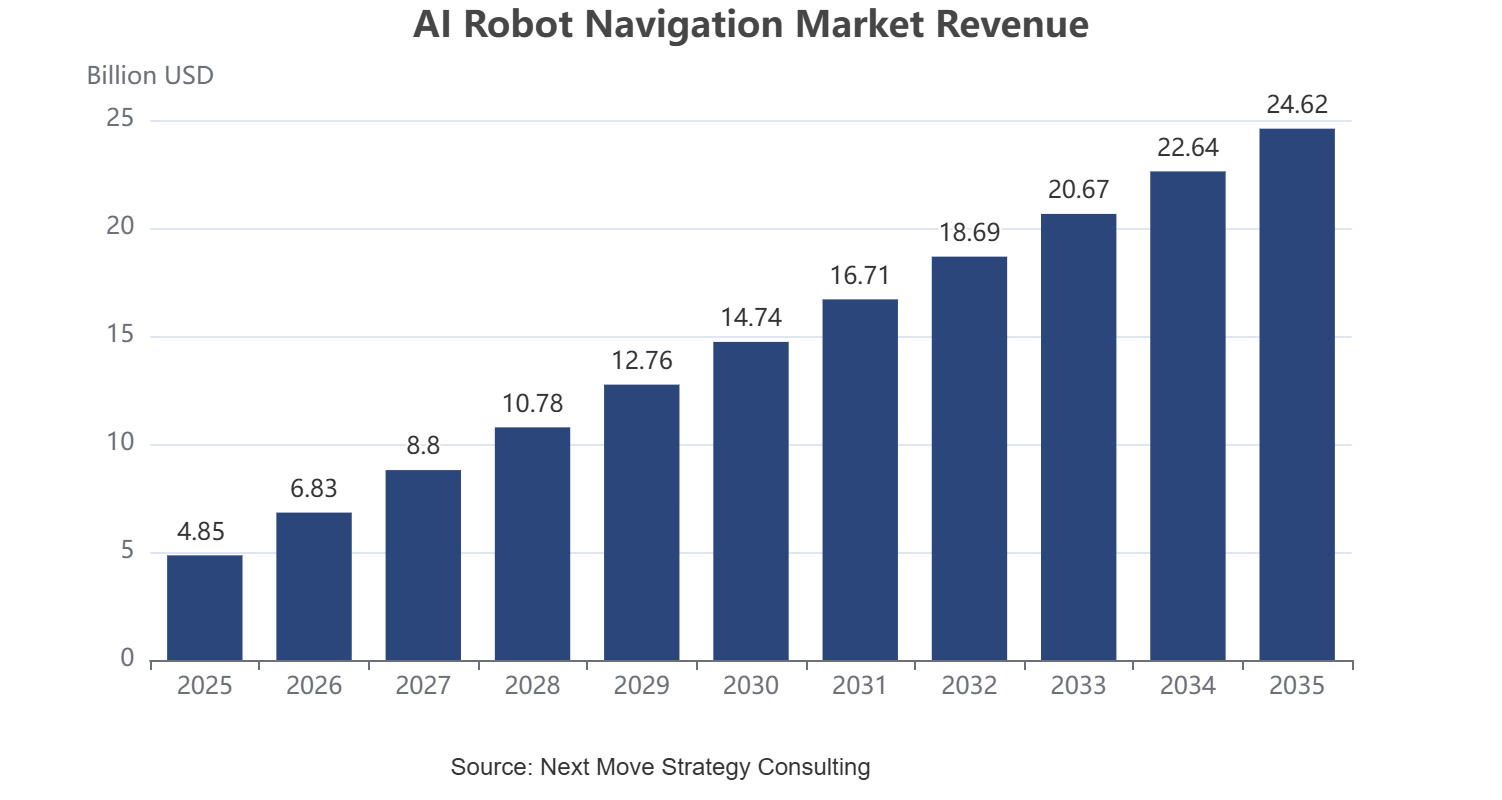
The global AI robot navigation market size was valued at USD 4.85 billion in 2025 and is estimated at USD 5.68 billion in 2026, forecast to reach USD 24.62 billion by 2035, expanding at a CAGR of 17.8% between 2026 and 2035. North America leads with approximately 36% share, while navigation software dominates all other offerings with approximately 44% share.
We observed that growth is broad-based across every segmentation axis, with autonomous mobile robot deployment and multi-sensor perception fusion driving the dominant structural shifts through 2035.
|
Key Takeaways |
|
By Offering: Navigation Software held the largest share of approximately 44% (USD 2.13 billion) in 2025; Navigation Services is the fastest-growing sub-segment at 20.5% CAGR from 2026–2035. |
|
By Primary Navigation Method: Vision-Based Navigation held the largest share of approximately 34% (USD 1.65 billion) in 2025; Multi-Sensor Navigation is the fastest-growing sub-segment at 20.8% CAGR from 2026–2035. |
|
By Navigation Architecture: Infrastructure-Free Navigation held the largest share of approximately 63% (USD 3.06 billion) in 2025; Infrastructure-Assisted Navigation is the fastest-growing sub-segment at 18.9% CAGR from 2026–2035. |
|
By Robot Type: AMRs held the largest share of approximately 29% (USD 1.41 billion) in 2025; Humanoid Robots is the fastest-growing sub-segment at 26.4% CAGR from 2026–2035. |
|
By Deployment Environment: Indoor held the largest share of approximately 58% (USD 2.81 billion) in 2025; Hybrid Indoor and Outdoor is the fastest-growing sub-segment at 19.7% CAGR from 2026–2035. |
|
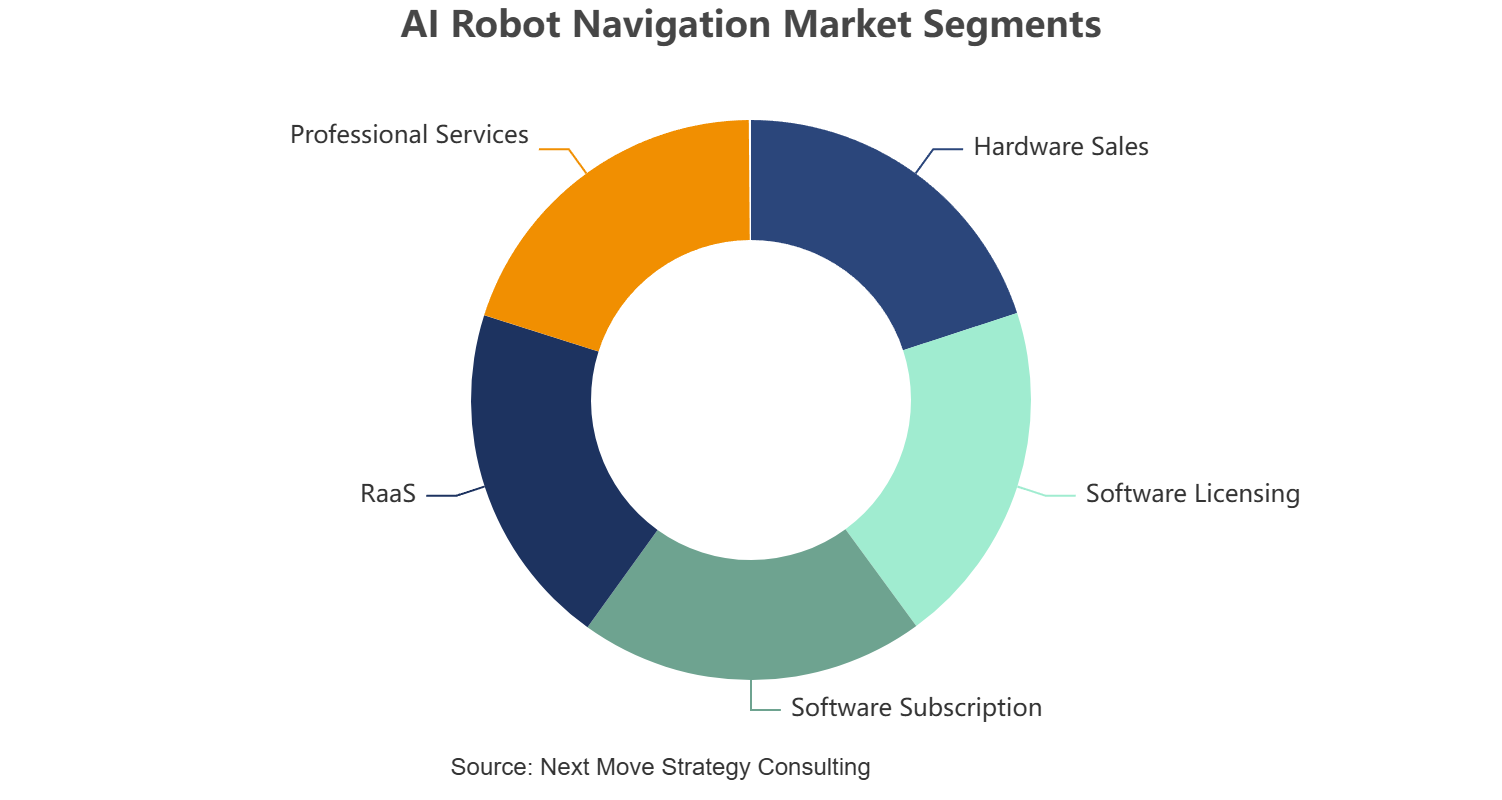
By Business Model: Hardware Sales held the largest share of approximately 41% (USD 1.99 billion) in 2025; RaaS is the fastest-growing sub-segment at 22.3% CAGR from 2026–2035. |
|
By Sales Channel: Direct Sales held the largest share of approximately 37% (USD 1.79 billion) in 2025; System Integrator Channel is the fastest-growing sub-segment at 19.1% CAGR from 2026–2035. |
|
By End User: Logistics and Warehousing held the largest share of approximately 31% (USD 1.50 billion) in 2025; Healthcare is the fastest-growing sub-segment at 20.9% CAGR from 2026–2035. |
|
Dominant Region: North America dominated with approximately 36% revenue share (USD 1.75 billion) in 2025. |
|
Fastest-Growing Region: Asia-Pacific is expected to register the highest CAGR of 19.5% during 2026–2035. |
|
Dominant Country: U.S. led with approximately USD 1.55 billion in 2025. |
|
Fastest-Growing Country: India is the fastest-growing country at approximately 21.5% CAGR from 2026–2035. |
Market Opportunity: The AI robot navigation market is expected to create an absolute dollar opportunity of USD 18.94 billion between 2026 and 2035, presenting significant investment potential across the autonomous mobile robot and navigation software value chain.
According to Next Move Strategy Consulting analysis, robot OEMs are increasingly embedding navigation stacks as software subscriptions rather than one-time licenses, a shift that favors vendors with recurring-revenue models over hardware-only suppliers as fleet scale expands through 2035.
|
Parameters |
Details |
|
Market Size in 2025 |
USD 4.85 Billion |
|
Market Size in 2026 |
USD 5.68 Billion |
|
Revenue Forecast in 2035 |
USD 24.62 Billion |
|
Growth Rate |
CAGR of 17.8% from 2026 to 2035 |
|
Analysis Period |
2025–2035 |
|
Base Year Considered |
2025 |
|
Forecast Period |
2026–2035 |
|
Market Size Estimation |
USD Billion |
|
Companies Profiled |
16 |
|
Countries Covered |
33 |
|
Market Share |
Available for Top 10 Companies |
What Does the AI Robot Navigation Market Encompass?
The AI robot navigation market encompasses the hardware, software, integrated systems, and services that let mobile robots perceive, localize, plan, and move through indoor and outdoor spaces without continuous human control. Our assessment indicates that scope spans perception and positioning sensors, SLAM and path planning software, and fully integrated navigation stacks supplied to AMR, AGV, service robot, UAV, and humanoid robot manufacturers across logistics, manufacturing, healthcare, retail, agriculture, and defense end markets. This market report covers a category that has evolved from single-sensor guidance rails into multi-sensor, AI-driven autonomy embedded across nearly every mobile robot class.
Regulatory frameworks such as the U.S. Federal Aviation Administration's rules for unmanned aircraft systems and the European Union's Machinery Regulation (EU) 2023/1230 shape functional-safety requirements for autonomous navigation, while ISO 3691-4 increasingly governs AGV and AMR safety design. We observed that technology adoption is shifting toward multi-sensor fusion and edge AI compute that reduce reliance on facility infrastructure. Next Move Strategy Consulting's analysis indicates that this structural shift, combined with rising humanoid robot pilots, is redefining sourcing criteria across the AI robot navigation market.
Key Emerging Trends
Based on research conducted by Next Move Strategy Consulting, we found that four structural trends are reshaping product development, sourcing, and stakeholder engagement across the AI robot navigation industry.
How Is Multi-Sensor Fusion Transforming Navigation Accuracy?
Multi-sensor fusion combining LiDAR, cameras, radar, and inertial data is replacing single-sensor navigation to improve reliability in cluttered environments. We observed that NVIDIA's Isaac perception stack, expanded through 2025 releases, lets robot builders fuse sensor streams on a single compute module rather than integrating disparate pipelines. Warehouse and hospital operators are adopting fused perception to cut localization drift, while system integrators retool robot fleets to accommodate combined sensor payloads across AMR and mobile manipulator platforms.
Why Is Humanoid Robot Navigation Gaining Investment?
Humanoid robot navigation is attracting capital as manufacturers pursue bipedal locomotion in unstructured, human-built spaces. Our findings suggest that Boston Dynamics' electric Atlas platform, advanced through 2024 and 2025 demonstrations, increasingly pairs dynamic balance control with real-time scene understanding for warehouse and factory tasks. Automotive and logistics operators are piloting humanoid units, positioning navigation software as a premium, higher-value layer within the broader robot navigation market segmentation.
How Is Edge AI Compute Reshaping Navigation Hardware Requirements?
Edge AI processors are pushing navigation compute away from centralized servers toward on-robot inference to cut latency. We observed that compact AI accelerator modules increasingly ship pre-integrated with perception and SLAM frameworks for delivery and inspection robots. This trend is elevating demand for embedded controllers and compute modules among navigation hardware vendors, while integrators redesign robot electronics to minimize communication delay during obstacle avoidance.
What Role Does Robotics as a Service Play in Navigation Software Adoption?
Robotics as a Service models are emerging as a scalable path for smaller operators to access advanced navigation without large upfront capital outlays. Our analysis shows that logistics and healthcare operators increasingly favor subscription access to fleet management and SLAM software bundled with hardware leasing. Locus Robotics and similar providers exemplify this direction, pairing recurring software revenue with rapid warehouse deployment cycles across e-commerce fulfillment operations.
Ecosystem Analysis of the AI Robot Navigation Industry
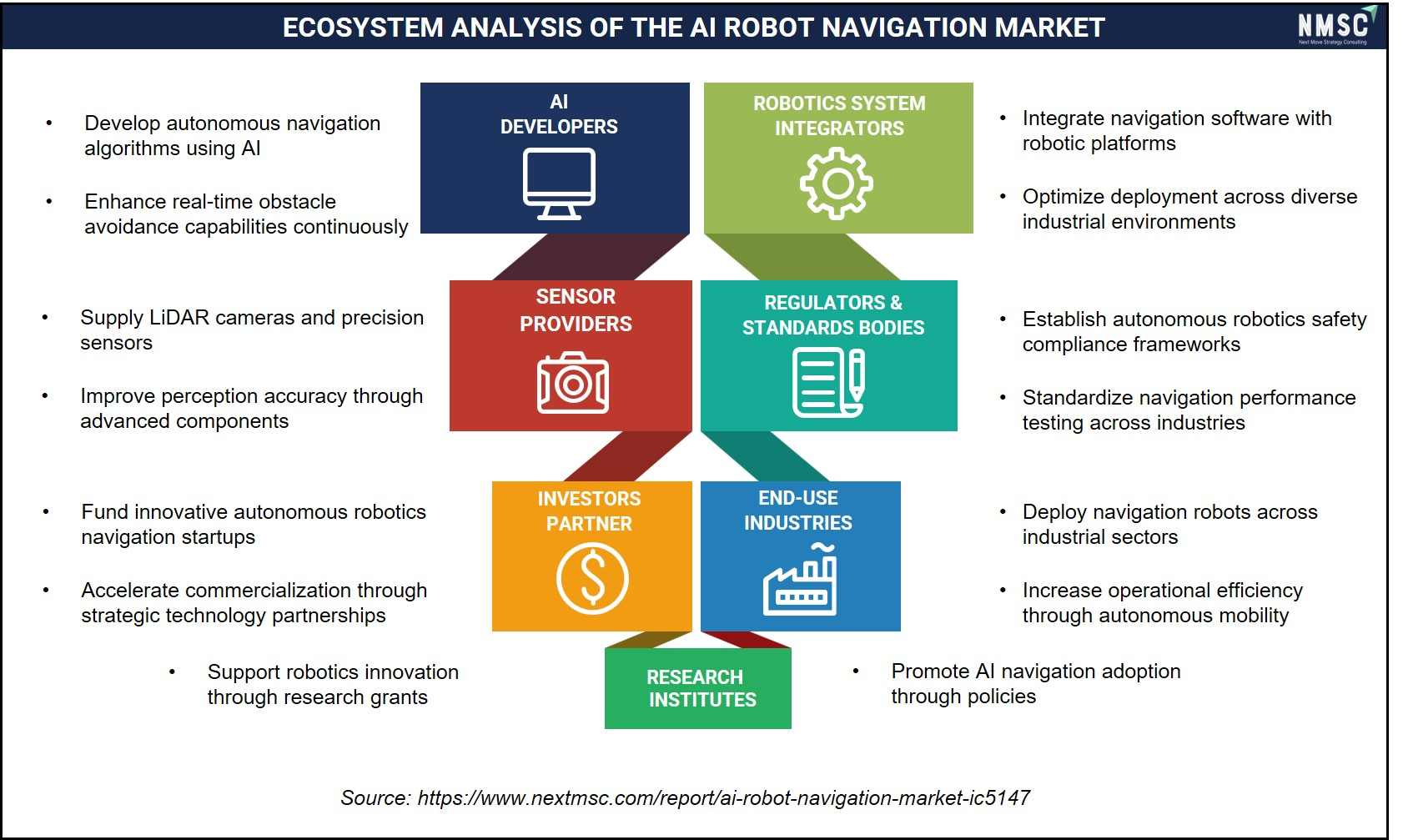
Based on our ecosystem assessment, we identified that AI developers, sensor providers, robotics system integrators, research institutes, investors, regulators, and end-use industries collectively strengthen the AI robot navigation industry. Furthermore, our industry analysis indicates that continuous collaboration across these stakeholders accelerates navigation innovation, enhances system interoperability, and supports scalable deployment of autonomous robotic solutions across industrial and commercial environments.
Growth Drivers and Restraints
Growth Catalyst and Risk Assessment Matrix
|
Factors |
Type |
(+/−) % Impact on CAGR |
Geographic Relevance |
Impact Timeline |
|
Rising e-commerce fulfillment automation |
Driver |
+3.2% |
Global |
2026-2035 |
|
Falling LiDAR and sensor hardware costs |
Driver |
+2.6% |
Global |
2026-2035 |
|
Labor shortages in warehousing and manufacturing |
Driver |
+2.4% |
North America, Europe |
2026-2035 |
|
Expansion of humanoid and service robotics |
Driver |
+2.1% |
Asia-Pacific, North America |
2028-2035 |
|
Government robotics and automation incentives |
Driver |
+1.5% |
Asia-Pacific |
2026-2035 |
|
Growth of RaaS deployment models |
Driver |
+1.3% |
Global |
2026-2032 |
|
High integration and customization costs |
Restraint |
-1.4% |
Global |
2026-2035 |
|
Cybersecurity and data-privacy concerns |
Restraint |
-1.0% |
North America, Europe |
2026-2035 |
|
Interoperability gaps across sensor and software vendors |
Restraint |
-0.7% |
Global |
2026-2032 |
What Is the Primary Growth Driver of the AI Robot Navigation Market?
Rising automation of e-commerce fulfillment and warehousing operations is the primary driver of the market. The U.S. Bureau of Labor Statistics continues to report persistent warehousing labor shortages, sustaining operator demand for autonomous mobile robots that navigate without fixed infrastructure. We observed that this labor gap, reinforced by peak-season volume swings, continues to anchor baseline consumption of navigation hardware and software across developed and emerging logistics markets alike.
How Is Falling Sensor Hardware Cost Driving Market Growth?
Declining LiDAR and camera sensor prices are accelerating adoption of multi-sensor navigation across mid-size manufacturing and healthcare operators. The U.S. Department of Commerce's semiconductor and robotics initiatives track continued cost reduction in perception hardware components. Our assessment indicates that this cost compression, combined with modular navigation computing hardware, is shortening payback periods for AMR and AGV deployments across North America and Asia-Pacific.
What Is Restraining AI Robot Navigation Market Expansion?
High integration and customization costs restrain adoption among small and mid-size operators lacking dedicated robotics engineering teams. The National Institute of Standards and Technology's robotics interoperability research documents recurring integration friction between navigation software and legacy warehouse management systems. We found that smaller manufacturers face particular exposure, as limited technical staff reduces their ability to customize fleet management software compared with large, vertically integrated logistics operators.
Segmentation Analysis
Segment Sizing: By Offering
|
Segment |
2025 (USD) |
2035 (USD) |
CAGR% (2026–2035) |
|
Navigation Hardware |
USD 1.60 Billion |
USD 6.40 Billion |
16.4% |
|
Navigation Software |
USD 2.13 Billion |
USD 10.62 Billion |
19.0% |
|
Integrated Navigation Systems |
USD 0.78 Billion |
USD 3.71 Billion |
18.6% |
|
Navigation Services |
USD 0.34 Billion |
USD 3.89 Billion |
20.5% |
|
Total |
USD 4.85 Billion |
USD 24.62 Billion |
17.8% |
Which Offering Dominates the AI Robot Navigation Market?
Navigation software dominates the market with approximately 44% share in 2025, reflecting operator preference for upgradable SLAM, path planning, and fleet management stacks over fixed hardware. Our analysis shows that navigation services is the fastest-growing sub-segment at 20.5% CAGR through 2035, as deployment, integration, and subscription support revenue scales alongside expanding fleet installations across logistics and manufacturing operators worldwide.
Segment Sizing: By Robot Type
|
Segment |
2025 (USD) |
2035 (USD) |
CAGR% (2026–2035) |
|
AMRs |
USD 1.41 Billion |
USD 6.51 Billion |
18.1% |
|
AGVs |
USD 0.87 Billion |
USD 3.31 Billion |
15.7% |
|
Service Robots |
USD 0.85 Billion |
USD 4.28 Billion |
19.2% |
|
Industrial Mobile Robots |
USD 0.56 Billion |
USD 2.36 Billion |
16.9% |
|
Mobile Manipulators |
USD 0.29 Billion |
USD 1.59 Billion |
20.3% |
|
UAVs |
USD 0.34 Billion |
USD 1.51 Billion |
17.6% |
|
Agricultural Robots |
USD 0.18 Billion |
USD 0.91 Billion |
19.4% |
|
Defense and Security Robots |
USD 0.20 Billion |
USD 0.94 Billion |
18.5% |
|
Humanoid Robots |
USD 0.15 Billion |
USD 3.21 Billion |
26.4% |
|
Total |
USD 4.85 Billion |
USD 24.62 Billion |
17.8% |
Which Robot Type Leads AI Robot Navigation Market Demand?
AMRs lead robot type demand with approximately 29% share in 2025, supported by widespread goods-to-person and material transport deployments across e-commerce fulfillment centers. We observed that humanoid robots represent the fastest-growing sub-segment at 26.4% CAGR through 2035, as automotive, logistics, and manufacturing operators expand pilot programs requiring advanced bipedal navigation, dynamic obstacle avoidance, and human-aware path planning capabilities.
Segment Sizing: By End User
|
Segment |
2025 (USD) |
2035 (USD) |
CAGR% (2026–2035) |
|
Logistics and Warehousing |
USD 1.50 Billion |
USD 6.86 Billion |
18.0% |
|
Manufacturing |
USD 1.31 Billion |
USD 5.71 Billion |
17.1% |
|
Healthcare |
USD 0.53 Billion |
USD 3.05 Billion |
20.9% |
|
Retail |
USD 0.34 Billion |
USD 1.61 Billion |
18.4% |
|
Hospitality |
USD 0.24 Billion |
USD 1.13 Billion |
18.2% |
|
Agriculture |
USD 0.22 Billion |
USD 1.14 Billion |
19.6% |
|
Construction |
USD 0.19 Billion |
USD 0.92 Billion |
18.9% |
|
Mining |
USD 0.14 Billion |
USD 0.63 Billion |
17.8% |
|
Defense and Security |
USD 0.20 Billion |
USD 0.94 Billion |
18.5% |
|
Energy and Utilities |
USD 0.10 Billion |
USD 0.51 Billion |
19.3% |
|
Research and Education |
USD 0.06 Billion |
USD 0.30 Billion |
19.5% |
|
Residential and Consumer |
USD 0.02 Billion |
USD 1.82 Billion |
56.9% |
|
Total |
USD 4.85 Billion |
USD 24.62 Billion |
17.8% |
Which End User Segment Is Fastest-Growing in the Market?
Logistics and warehousing operators account for the largest end-user share at approximately 31% in 2025, driven by sustained e-commerce fulfillment automation. Our findings suggest that healthcare is the fastest-growing conventional end-user segment at 20.9% CAGR through 2035, as hospitals scale delivery and disinfection robot fleets, while residential and consumer adoption, though starting from a small base, expands rapidly as consumer service robots gain navigation autonomy.
Growth Opportunities
Next Move Strategy Consulting's analysis identifies three forward-looking whitespace opportunities across the AI robot navigation value chain through 2035.
How Can Edge AI Chipmakers Capture Navigation Compute Demand?
Semiconductor vendors that ship pre-integrated navigation compute modules stand to capture rising AMR and humanoid robot demand. We observed that navigation computing hardware vendors bundling perception and path planning acceleration on a single chip reduce integration time for robot OEMs, positioning navigation processor suppliers as key beneficiaries of fleet expansion.
What Opportunity Exists in Software Subscription Models for Fleet Operators?
Fleet management software vendors offering subscription-based SLAM and orchestration tools can capture recurring revenue from mid-size logistics and manufacturing operators. Our analysis shows that software subscription services reduce upfront capital barriers, benefiting third-party logistics providers seeking scalable, pay-as-you-grow navigation capability.
How Can System Integrators Benefit From Humanoid Robot Deployment Growth?
System integrators specializing in humanoid robot navigation configuration are positioned to benefit as automotive and logistics operators scale pilot programs into production fleets. We found that integration services covering dynamic balance, scene understanding, and safety certification represent a high-margin opportunity within the broader navigation services segment.
Regional Outlook
Geographic Performance Snapshot
|
Region |
2025 (USD) |
2035 (USD) |
CAGR% (2026–2035) |
Key Driver |
|
North America |
USD 1.75 Billion |
USD 8.09 Billion |
18.1% |
E-commerce and warehouse automation |
|
Europe |
USD 1.16 Billion |
USD 5.20 Billion |
17.4% |
Manufacturing automation mandates |
|
Asia-Pacific |
USD 1.45 Billion |
USD 8.68 Billion |
19.5% |
Electronics manufacturing scale-up |
|
Middle East and Africa |
USD 0.28 Billion |
USD 1.34 Billion |
18.2% |
Logistics infrastructure investment |
|
Latin America |
USD 0.21 Billion |
USD 1.31 Billion |
20.1% |
Retail and agriculture automation |
|
Total |
USD 4.85 Billion |
USD 24.62 Billion |
17.8% |
— |
North America AI Robot Navigation Market
North America leads the global market with mature warehouse automation and strong AMR OEM presence. The region benefits from advanced navigation software vendors and dense logistics infrastructure. We observed that regulatory clarity from federal robotics safety guidance supports steady enterprise adoption, while technology adoption continues shifting toward multi-sensor fusion, sustaining North America's strategic leadership position through 2035.
Europe AI Robot Navigation Market
Europe's market reflects strong manufacturing automation demand shaped by the EU Machinery Regulation and ISO 3691-4 safety standards. Our assessment indicates that automotive and electronics manufacturers drive steady AGV and AMR navigation adoption. Regulatory emphasis on functional safety continues to influence sensor redundancy requirements, supporting a disciplined but consistent regional growth trajectory through the forecast period.
Asia-Pacific AI Robot Navigation Market
Asia-Pacific is the fastest-growing region, propelled by large-scale electronics and automotive manufacturing capacity expansion. We found that government robotics incentives across the region accelerate AMR and humanoid robot pilot programs. Rising technology adoption among contract manufacturers, combined with expanding e-commerce logistics networks, positions Asia-Pacific for sustained competitive intensity through 2035.
Middle East and Africa AI Robot Navigation Market
The Middle East and Africa market is emerging, supported by logistics infrastructure investment tied to regional diversification strategies. Our findings suggest that free-zone logistics hubs increasingly pilot AMR deployments for warehousing efficiency. Regulatory frameworks remain nascent, but strategic government investment programs continue to expand technology adoption across the region's growing distribution networks.
Latin America AI Robot Navigation Market
Latin America's market is expanding as retail and agricultural operators adopt navigation-enabled robotics to offset labor constraints. We observed that Brazil's manufacturing base anchors regional demand, while regulatory environments remain moderately developed. Rising e-commerce penetration and agricultural mechanization programs continue to strengthen the region's strategic outlook through the forecast period.
U.S. AI Robot Navigation Market
Based on our estimates, the U.S. market was valued at approximately USD 1.55 billion in 2025 and is projected to reach USD 7.05 billion by 2035, expanding at a 17.9% CAGR from 2026 to 2035. Demand structure reflects a mix of manufacturing and logistics adoption, with technology penetration accelerating among mid-size operators. Regulatory influence remains moderate, competitive intensity is rising among local integrators, and the strategic outlook favors continued multi-sensor navigation adoption through the forecast period.
Canada AI Robot Navigation Market
The market in Canada, the Canada market was valued at approximately USD 0.20 billion in 2025 and is projected to reach USD 1.04 billion by 2035, expanding at a 19.4% CAGR from 2026 to 2035. Demand structure reflects a mix of manufacturing and logistics adoption, with technology penetration accelerating among mid-size operators. Regulatory influence remains moderate, competitive intensity is rising among local integrators, and the strategic outlook favors continued multi-sensor navigation adoption through the forecast period.
UK AI Robot Navigation Market
As per our estimate, the UK market was valued at approximately USD 0.24 billion in 2025 and is projected to reach USD 1.06 billion by 2035, expanding at a 17.3% CAGR from 2026 to 2035. Demand structure reflects a mix of manufacturing and logistics adoption, with technology penetration accelerating among mid-size operators. Regulatory influence remains moderate, competitive intensity is rising among local integrators, and the strategic outlook favors continued multi-sensor navigation adoption through the forecast period.
Germany AI Robot Navigation Market
According to our analysis, the Germany market was valued at approximately USD 0.34 billion in 2025 and is projected to reach USD 1.52 billion by 2035, expanding at a 17.5% CAGR from 2026 to 2035. Demand structure reflects a mix of manufacturing and logistics adoption, with technology penetration accelerating among mid-size operators. Regulatory influence remains moderate, competitive intensity is rising among local integrators, and the strategic outlook favors continued multi-sensor navigation adoption through the forecast period.
France AI Robot Navigation Market
Based on our estimates, the France market was valued at approximately USD 0.17 billion in 2025 and is projected to reach USD 0.75 billion by 2035, expanding at a 17.2% CAGR from 2026 to 2035. Demand structure reflects a mix of manufacturing and logistics adoption, with technology penetration accelerating among mid-size operators. Regulatory influence remains moderate, competitive intensity is rising among local integrators, and the strategic outlook favors continued multi-sensor navigation adoption through the forecast period.
China AI Robot Navigation Market
The market in China, the China market was valued at approximately USD 0.62 billion in 2025 and is projected to reach USD 4.05 billion by 2035, expanding at a 20.9% CAGR from 2026 to 2035. Demand structure reflects a mix of manufacturing and logistics adoption, with technology penetration accelerating among mid-size operators. Regulatory influence remains moderate, competitive intensity is rising among local integrators, and the strategic outlook favors continued multi-sensor navigation adoption through the forecast period.
India AI Robot Navigation Market
As per our estimate, the India market was valued at approximately USD 0.16 billion in 2025 and is projected to reach USD 1.20 billion by 2035, expanding at a 21.5% CAGR from 2026 to 2035. Demand structure reflects a mix of manufacturing and logistics adoption, with technology penetration accelerating among mid-size operators. Regulatory influence remains moderate, competitive intensity is rising among local integrators, and the strategic outlook favors continued multi-sensor navigation adoption through the forecast period.
Japan AI Robot Navigation Market
According to our analysis, the Japan market was valued at approximately USD 0.24 billion in 2025 and is projected to reach USD 1.24 billion by 2035, expanding at a 19.3% CAGR from 2026 to 2035. Demand structure reflects a mix of manufacturing and logistics adoption, with technology penetration accelerating among mid-size operators. Regulatory influence remains moderate, competitive intensity is rising among local integrators, and the strategic outlook favors continued multi-sensor navigation adoption through the forecast period.
South Korea AI Robot Navigation Market
Based on our estimates, the South Korea market was valued at approximately USD 0.19 billion in 2025 and is projected to reach USD 1.03 billion by 2035, expanding at a 19.7% CAGR from 2026 to 2035. Demand structure reflects a mix of manufacturing and logistics adoption, with technology penetration accelerating among mid-size operators. Regulatory influence remains moderate, competitive intensity is rising among local integrators, and the strategic outlook favors continued multi-sensor navigation adoption through the forecast period.
Australia AI Robot Navigation Market
The market in Australia, the Australia market was valued at approximately USD 0.08 billion in 2025 and is projected to reach USD 0.41 billion by 2035, expanding at a 18.6% CAGR from 2026 to 2035. Demand structure reflects a mix of manufacturing and logistics adoption, with technology penetration accelerating among mid-size operators. Regulatory influence remains moderate, competitive intensity is rising among local integrators, and the strategic outlook favors continued multi-sensor navigation adoption through the forecast period.
UAE AI Robot Navigation Market
As per our estimate, the UAE market was valued at approximately USD 0.06 billion in 2025 and is projected to reach USD 0.30 billion by 2035, expanding at a 18.9% CAGR from 2026 to 2035. Demand structure reflects a mix of manufacturing and logistics adoption, with technology penetration accelerating among mid-size operators. Regulatory influence remains moderate, competitive intensity is rising among local integrators, and the strategic outlook favors continued multi-sensor navigation adoption through the forecast period.
Saudi Arabia AI Robot Navigation Market
According to our analysis, the Saudi Arabia market was valued at approximately USD 0.05 billion in 2025 and is projected to reach USD 0.25 billion by 2035, expanding at a 18.6% CAGR from 2026 to 2035. Demand structure reflects a mix of manufacturing and logistics adoption, with technology penetration accelerating among mid-size operators. Regulatory influence remains moderate, competitive intensity is rising among local integrators, and the strategic outlook favors continued multi-sensor navigation adoption through the forecast period.
South Africa AI Robot Navigation Market
Based on our estimates, the South Africa market was valued at approximately USD 0.03 billion in 2025 and is projected to reach USD 0.14 billion by 2035, expanding at a 17.9% CAGR from 2026 to 2035. Demand structure reflects a mix of manufacturing and logistics adoption, with technology penetration accelerating among mid-size operators. Regulatory influence remains moderate, competitive intensity is rising among local integrators, and the strategic outlook favors continued multi-sensor navigation adoption through the forecast period.
Brazil AI Robot Navigation Market
The market in Brazil, the Brazil market was valued at approximately USD 0.10 billion in 2025 and is projected to reach USD 0.63 billion by 2035, expanding at a 20.3% CAGR from 2026 to 2035. Demand structure reflects a mix of manufacturing and logistics adoption, with technology penetration accelerating among mid-size operators. Regulatory influence remains moderate, competitive intensity is rising among local integrators, and the strategic outlook favors continued multi-sensor navigation adoption through the forecast period.
Argentina AI Robot Navigation Market
As per our estimate, the Argentina market was valued at approximately USD 0.04 billion in 2025 and is projected to reach USD 0.24 billion by 2035, expanding at a 19.8% CAGR from 2026 to 2035. Demand structure reflects a mix of manufacturing and logistics adoption, with technology penetration accelerating among mid-size operators. Regulatory influence remains moderate, competitive intensity is rising among local integrators, and the strategic outlook favors continued multi-sensor navigation adoption through the forecast period.
Porter's Five Forces Analysis of the AI Robot Navigation Industry
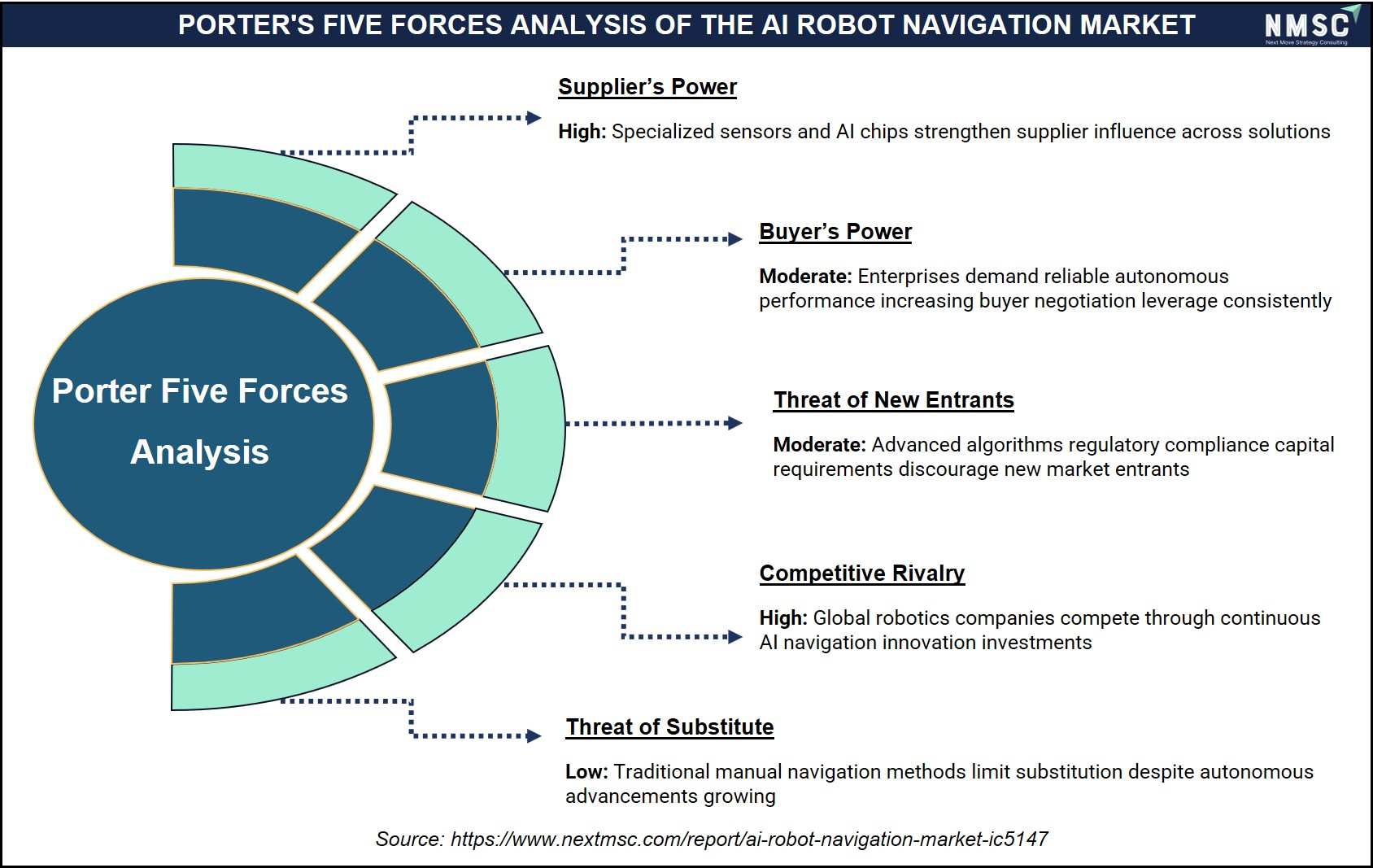
Based on our competitive assessment, we observed that supplier capabilities, buyer expectations, competitive rivalry, substitute technologies, and barriers to market entry collectively influence the AI robot navigation industry. Moreover, our industry evaluation indicates that advancements in AI algorithms, sensor technologies, and autonomous navigation capabilities strengthen competitive positioning, encourage innovation, and support sustainable market growth across diverse robotic applications.
Competitive Landscape
We observed that the AI robot navigation market remains moderately fragmented, with global technology leaders competing alongside specialized robotics manufacturers and emerging navigation software startups across regional logistics and manufacturing hubs.
|
Dimension |
Description |
|
Market Structure |
Moderately fragmented, with leading semiconductor and robotics manufacturers holding disproportionate navigation software influence. |
|
Innovation Focus |
Multi-sensor fusion, edge AI compute, and humanoid-capable navigation stacks. |
|
M&A Activity |
Selective acquisitions of SLAM and perception software specialists by larger automation and semiconductor companies. |
How Do Companies Compete in the AI Robot Navigation Market?
Companies compete primarily on perception accuracy, compute efficiency, and integration speed with existing warehouse and manufacturing execution systems. Our analysis shows that vendors bundling navigation hardware with subscription software increasingly outcompete pure hardware suppliers, as operators prioritize total cost of ownership and upgrade flexibility over one-time equipment purchases across fleet deployments.
Which Competitive Archetypes Dominate the Market?
Two archetypes dominate: diversified automation conglomerates offering integrated navigation systems across robot classes, and specialized AMR or SLAM software vendors focused on single-domain excellence. We found that diversified players leverage cross-selling into existing industrial automation accounts, while specialists differentiate through faster iteration cycles and deeper perception software expertise tailored to specific deployment environments.
What Innovation and Differentiation Strategies Are Companies Pursuing?
Companies are differentiating through proprietary perception software, edge AI processor partnerships, and fleet orchestration platforms that reduce deployment time. Our assessment indicates that navigation software vendors increasingly open developer ecosystems to accelerate third-party integration, while hardware manufacturers pursue tighter sensor and compute co-design to improve localization accuracy in GNSS-denied environments.
How Active Is M&A in the AI Robot Navigation Market?
M&A activity remains selective but strategic, concentrated on acquiring SLAM, perception, and fleet management software specialists. We observed that larger automation and semiconductor companies pursue targeted acquisitions to shorten software development timelines, while geographic expansion through regional distributor partnerships and pricing strategies emphasizing subscription bundles continue to shape competitive positioning across logistics and manufacturing verticals.
Key Market Players
Next Move Strategy Consulting's analysis identifies the following companies as the leading participants profiled in the AI robot navigation market.
-
KUKA AG
-
OMRON Corporation
-
Teradyne, Inc.
-
Locus Robotics Corp.
-
Rockwell Automation, Inc.
-
FANUC Corporation
-
Boston Dynamics, Inc.
-
HAI Robotics Co., Ltd.
-
GreyOrange Pte. Ltd.
-
Seegrid Corporation
-
ForwardX Robotics, Inc.
-
Vecna Robotics, Inc.
-
Addverb Technologies Limited
-
Aethon, Inc.
Latest Developments
We observed several notable developments across the AI robot navigation market during 2025 and 2026.
|
Date |
Event |
|
June 2026 |
At Automate 2026, ABB Robotics introduced its Physical AI Toolchain, a comprehensive software stack that enables robots to learn from simulated, synthetic, and real-world data. Following its strategic partnership with NVIDIA in March 2026, ABB has closed the "sim-to-real" gap, allowing its mobile and collaborative robots to deploy navigation policies with industrial-grade accuracy without extensive manual programming. |
|
April 2026 |
Locus Robotics announced the Locus Array, a "Robots-to-Goods" (R2G) fulfillment system. Unlike traditional warehouse robots that require fixed conveyors or structured environments, Locus Array integrates mobile navigation with robotic picking arms. It operates dynamically in existing aisle layouts, allowing robots to identify and pick items autonomously without facility retrofitting. |
|
March 2026 |
At NVIDIA GTC 2026, RealSense and LimX Dynamics demonstrated the first-ever autonomous humanoid navigation using NVIDIA CuVSLAM and dense 3D depth perception. This breakthrough allows robots to navigate stairs, uneven terrain, and moving crowds, solving the long-standing "3D awareness" constraint that previously required human supervision for legged robots. |
Investment Opportunities
How Are Capital Inflows Shaping the AI Robot Navigation Market?
Venture and strategic capital inflows continue to concentrate on navigation software and perception AI startups. Our assessment indicates that investors favor companies demonstrating recurring software revenue over hardware-only business models. This capital preference is accelerating consolidation among smaller SLAM and fleet management software vendors as larger automation companies seek to acquire proven navigation intellectual property.
What Infrastructure Investment Trends Support Market Growth?
Infrastructure investment in automated warehousing and manufacturing facilities continues to expand navigation-ready deployment environments. We found that logistics operators increasingly design new facilities with robot-compatible layouts from inception, reducing integration friction. This infrastructure-first approach is expanding addressable demand for integrated navigation systems across greenfield warehouse and factory construction projects globally.
How Do ESG Considerations Influence Investment in Navigation Technology?
Environmental, social, and governance considerations increasingly influence robotics investment decisions, particularly around energy-efficient navigation compute and workplace safety outcomes. Our analysis shows that investors favor navigation platforms demonstrating reduced collision incidents and lower power consumption per compute cycle, aligning capital allocation with operator sustainability disclosures and workplace safety compliance requirements across manufacturing and logistics deployments.
Key Benefits for Stakeholders
How Does This Report Benefit Industry Leaders?
Industry leaders gain a structured view of segment-level demand, competitive positioning, and regional growth patterns to prioritize product development and deployment investment. Our analysis, data, and forecasts help enterprise decision-makers benchmark navigation technology adoption against peers, identify underserved deployment environments, and align procurement strategy with the fastest-growing robot types and navigation methods through 2035.
How Does This Report Benefit Investors and Financial Analysts?
Investors and financial analysts gain quantified market size, CAGR, and segment-level revenue data to evaluate capital allocation across navigation hardware, software, and services. We found that the report's competitive landscape and latest developments sections support due diligence on acquisition targets, while regional forecasts inform geographic investment prioritization across high-growth Asia-Pacific and North American markets.
How Does This Report Benefit Technology Vendors and Product Teams?
Technology vendors and product teams gain granular segmentation insight to prioritize roadmap investment across SLAM, path planning, and fleet management software. Our strategic insights help product teams identify which robot types and deployment environments offer the strongest growth trajectories, supporting more informed decisions on sensor partnerships, compute architecture, and go-to-market sequencing across target end-user verticals.
Key Market Segments
By Offering
-
Navigation Hardware
-
Perception Sensors
-
LiDAR
-
Cameras
-
Radar
-
Ultrasonic Sensors
-
-
Positioning Sensors
-
IMUs
-
Encoders
-
GNSS Receivers
-
UWB Modules
-
-
Navigation Computing Hardware
-
AI Processors
-
Embedded Controllers
-
Compute Modules
-
-
-
Navigation Software
-
SLAM Software
-
LiDAR SLAM
-
Visual SLAM
-
Multi-Sensor SLAM
-
Localization Engines
-
-
Path Planning Software
-
Global Path Planning
-
Local Path Planning
-
Trajectory Planning
-
-
Perception Software
-
Object Detection
-
Obstacle Recognition
-
Semantic Mapping
-
Scene Understanding
-
-
Motion Control Software
-
Fleet Management Software
-
Fleet Orchestration
-
Traffic Management
-
Task Allocation
-
-
-
Integrated Navigation Systems
-
AMR Navigation Systems
-
AGV Navigation Systems
-
UAV Navigation Systems
-
Service Robot Navigation Systems
-
Mobile Manipulator Navigation Systems
-
Humanoid Robot Navigation Systems
-
-
Navigation Services
-
Deployment Services
-
Integration Services
-
Training Services
-
Support and Maintenance Services
-
Software Subscription Services
-
By Primary Navigation Method
-
LiDAR-Based Navigation
-
Vision-Based Navigation
-
Radar-Based Navigation
-
GNSS-Based Navigation
-
UWB-Based Navigation
-
Magnetic Navigation
-
Multi-Sensor Navigation
By Navigation Architecture
-
Infrastructure-Free Navigation
-
Infrastructure-Assisted Navigation
By Robot Type
-
AMRs
-
Goods-to-Person Robots
-
Material Transport Robots
-
Inspection Robots
-
Delivery Robots
-
-
AGVs
-
Service Robots
-
Cleaning Robots
-
Hospitality Robots
-
Healthcare Robots
-
Security Robots
-
-
Industrial Mobile Robots
-
Mobile Manipulators
-
UAVs
-
Agricultural Robots
-
Defense and Security Robots
-
Humanoid Robots
By Deployment Environment
-
Indoor
-
Warehouses
-
Factories
-
Hospitals
-
Commercial Buildings
-
-
Outdoor
-
Logistics Yards
-
Agricultural Fields
-
Construction Sites
-
Mining Sites
-
-
Hybrid Indoor and Outdoor
By Business Model
-
Hardware Sales
-
Software Licensing
-
Software Subscription
-
RaaS
-
Professional Services
By Sales Channel
-
Direct Sales
-
OEM Channel
-
System Integrator Channel
-
Distributor and Reseller Channel
By End User
-
Logistics and Warehousing
-
E-Commerce Fulfillment
-
Third-Party Logistics
-
Retail Distribution
-
Parcel and Postal
-
-
Manufacturing
-
Automotive
-
Electronics and Semiconductor
-
Aerospace
-
Food and Beverage
-
Pharmaceuticals
-
General Manufacturing
-
-
Healthcare
-
Retail
-
Hospitality
-
Agriculture
-
Construction
-
Mining
-
Defense and Security
-
Energy and Utilities
-
Research and Education
-
Residential and Consumer
By Region
-
North America: U.S., Canada, Mexico
-
Europe: UK, Germany, France, Italy, Spain, Sweden, Denmark, Finland, Netherlands, Rest of Europe
-
Asia-Pacific: China, India, Japan, South Korea, Taiwan, Indonesia, Vietnam, Australia, Philippines, Malaysia, Rest of APAC
-
Middle East and Africa: Saudi Arabia, UAE, Egypt, Israel, Turkey, Nigeria, South Africa, Rest of MEA
-
Latin America: Brazil, Argentina, Chile, Colombia, Rest of LATAM
Conclusion and Recommendations
What Is the Long-Term Outlook for the AI Robot Navigation Market?
The long-term outlook remains strongly positive, with the market projected to expand from USD 4.85 billion in 2025 to USD 24.62 billion by 2035 at a 17.8% CAGR. We observed that this trajectory reflects sustained demand across logistics, manufacturing, and healthcare, with humanoid and service robot navigation emerging as durable growth engines through the forecast period and beyond.
What Strategic Positioning Do We Recommend for Market Participants?
We recommend vendors prioritize modular navigation software architectures that integrate across multiple robot types and sensor configurations. Our assessment indicates that companies bundling subscription software with hardware sales are best positioned to capture recurring revenue, while system integrators should build vertical-specific expertise in high-growth end users such as healthcare and defense.
How Attractive Is the Market for Investment?
Investment attractiveness remains high given the market's 17.8% CAGR and expanding addressable base across nine robot types and five business models. Our findings suggest that navigation software and services offer the strongest margin profile, while humanoid robot navigation represents a high-risk, high-reward opportunity for investors seeking exposure to emerging robotics categories.
What Market Shifts and Key Risks Should Stakeholders Monitor?
Stakeholders should monitor sensor hardware price volatility, interoperability gaps across navigation software platforms, and cybersecurity exposure as fleets scale. We found that regulatory evolution around functional safety and autonomous operation could reshape certification timelines, requiring vendors to maintain flexible compliance strategies across North America, Europe, and Asia-Pacific.
What Growth Pathways Will Define the Next Decade?
Growth pathways center on multi-sensor fusion adoption, RaaS expansion, and humanoid robot commercialization. Our analysis shows that vendors combining edge AI compute innovation with scalable software subscription models will capture disproportionate share, while geographic expansion into Asia-Pacific and Latin America offers the clearest incremental revenue pathway through 2035.
About the Author
 Saista Faiyaz
— Saista Faiyaz is Research Associate at Next Move Strategy Consulting, where she has covered consumer markets and healthcare technologies for 3 years. Her work includes primary interview review, secondary-source validation, market sizing, and structured analysis of company and industry data. She supports research by comparing evidence across sources, organizing findings into market narratives, and documenting assumptions used in analysis. Her scope includes cross-market benchmarking, and reports.
Saista Faiyaz
— Saista Faiyaz is Research Associate at Next Move Strategy Consulting, where she has covered consumer markets and healthcare technologies for 3 years. Her work includes primary interview review, secondary-source validation, market sizing, and structured analysis of company and industry data. She supports research by comparing evidence across sources, organizing findings into market narratives, and documenting assumptions used in analysis. Her scope includes cross-market benchmarking, and reports.
About the Reviewer
 Supradip Baul
— Supradip Baul is an accomplished business consultant and strategist with over a decade of rich experience in market intelligence, strategy, technology, and business transformation. His work has included rigorous qualitative and quantitative analysis across multiple industries, helping clients shape investment decisions and long-term roadmaps. Earlier in his career, he was associated with Gartner, where he contributed to industry-leading reports and market share analyses. He has worked with leading global companies and holds an MBA with a dual specialization in Marketing and Finance.
Supradip Baul
— Supradip Baul is an accomplished business consultant and strategist with over a decade of rich experience in market intelligence, strategy, technology, and business transformation. His work has included rigorous qualitative and quantitative analysis across multiple industries, helping clients shape investment decisions and long-term roadmaps. Earlier in his career, he was associated with Gartner, where he contributed to industry-leading reports and market share analyses. He has worked with leading global companies and holds an MBA with a dual specialization in Marketing and Finance.
At Next Move Strategy Consulting, we understand that insightful market research is the cornerstone of successful business decisions. That's why we employ a robust and multifaceted approach, combining various methodologies to deliver the most accurate and actionable data for our clients.

Research Landscape
We navigate the world of research with two primary approaches:
Qualitative Approach
Our qualitative research methodologies involve immersive techniques such as in-depth interviews, focus groups, and observational studies. By engaging directly with individuals and stakeholders, we uncover valuable insights that quantitative data alone may overlook.

Quantitative Research
In tandem with qualitative methodologies, NMSC leverages the power of Quantitative Research to provide a robust foundation of numerical insights. Through systematic data collection and analysis, we quantify patterns, preferences, and market trends, offering a comprehensive view of the business landscape.
Our quantitative research approach employs diverse tools, including surveys, experiments, and statistical modelling. These methodologies enable us to gather data from a large and representative sample, ensuring the statistical significance of our findings. By employing structured questionnaires and standardized data collection methods, we guarantee the reliability and validity of the information we present to our clients.
Quantitative research is particularly effective in measuring the prevalence of trends, assessing market size, and gauging the impact of various factors on consumer behavior. The numerical precision attained through this approach equips our clients with actionable insights, facilitating data-driven decision-making and strategy formulation.


Our Specialized Toolbox for Industry-Specific Market Research
We deploy a specialized arsenal of techniques tailored to meet your unique requirements. Here's a glimpse into our comprehensive toolbox:

Information Procurement
The stage entails acquiring market data or relevant information through various sources and methodologies.


Market Research Approach
We utilize both top-down and bottom-up approaches in market research analysis to achieve a comprehensive understanding of the market dynamics, leveraging the broad perspective of industry trends and macroeconomic factors alongside detailed insights from specific segments and individual companies.

Porters Five Forces Analysis
We conduct Porter's Five Forces analysis to evaluate the competitive landscape of an industry, providing us with insights into factors that affect profitability and strategic positioning.

SWOT Analysis

Forecasting
We utilize a forecasting model to predict future consumption by considering parameters like population, economics, regulations, market competition, drivers, constraints, technology, and pricing. We also employ statistical techniques such as multilinear regression, exponential smoothing, moving average, ARIMA, and Monte Carlo simulations for accurate predictions. In econometric forecasting, we analyzed short-term and long-term event impacts, attributing values based on regulatory frameworks, economic factors, and market events.





 Speak to Our Analyst