Military ATV & UTV Market

Military ATV & UTV Market size was USD 1.08 Billion in 2025, projected to reach USD 1.78 Billion by 2035, growing at a CAGR of 4.92% from 2026 to 2035. Key drivers include rising defense budget allocation to light tactical mobility platforms and expanding border security procurement, with North America leading the market and Europe registering the fastest growth .

Download Free Sample PDF
Base Year (2025)
$1,082.41 Billion
Forecast (2035)
$1,777.49 Billion
CAGR (2026-2035)
4.9%
Top Region
North America

What Is the Military ATV & UTV Market Size?

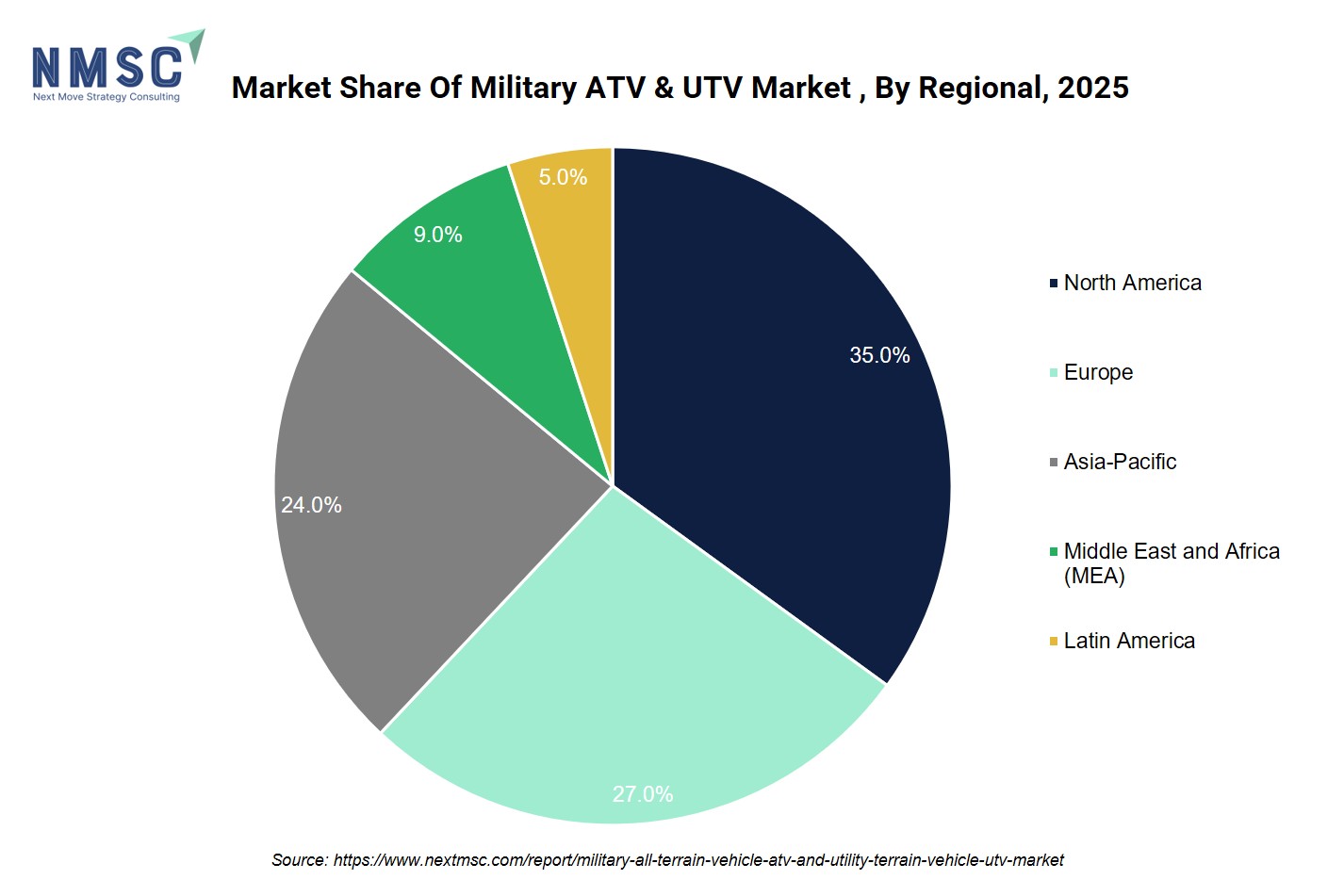
The global military all-terrain vehicle (ATV) & utility terrain vehicle (UTV) market size was valued at USD 1082.41 Million in 2025 and is estimated to grow from USD 1153.81 Million in 2026 to USD 1777.49 Million by 2035, expanding at a CAGR of 4.92% between 2026 and 2035. North America led the market with an approximate 35% revenue share in 2025, while Utility Task Vehicles (UTVs / SxS) remained the dominant vehicle-configuration segment with an approximate 58% share of global revenue.

We observed that the military ATV & UTV market's momentum is best captured through a concise set of indicators before deeper analysis follows.

Military ATV & UTV Market Revenue Forecast

Values in USD Billion

2025 $1,082.41 Billion
2025
2026 $1,135.66 Billion
2026
2027 $1,191.54 Billion
2027
2028 $1,250.16 Billion
2028
2029 $1,311.67 Billion
2029
2030 $1,376.21 Billion
2030
2031 $1,443.91 Billion
2031
2032 $1,514.96 Billion
2032
2033 $1,589.49 Billion
2033
2034 $1,667.69 Billion
2034
2035 $1,777.49 Billion
2035

Key Takeaways

By Vehicle Configuration: Utility Task Vehicles (UTVs / SxS) held the largest share of approximately USD 801.43 million in 2025 and are projected to reach USD 1355.33 million by 2035; UTVs / SxS are also the fastest-growing vehicle configuration, registering a 5.23 % CAGR from 2026–2035.

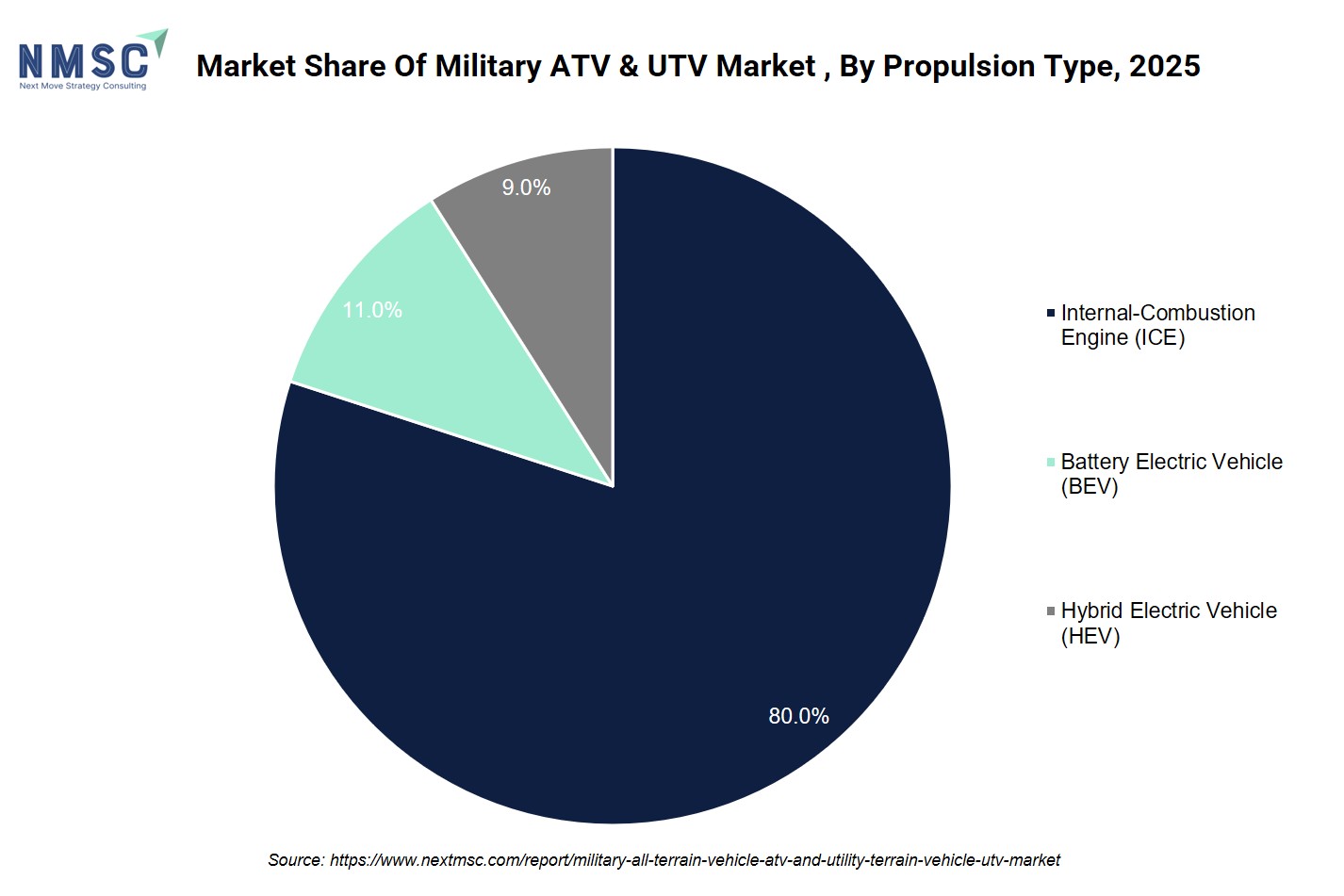
By Propulsion Type: Internal-Combustion Engine (ICE) held the largest share of approximately USD 869.25 million in 2025 and is projected to reach USD 1,414.95 million by 2035; Battery Electric Vehicle (BEV) is the fastest-growing propulsion type, registering a 6.33% CAGR from 2026–2035.

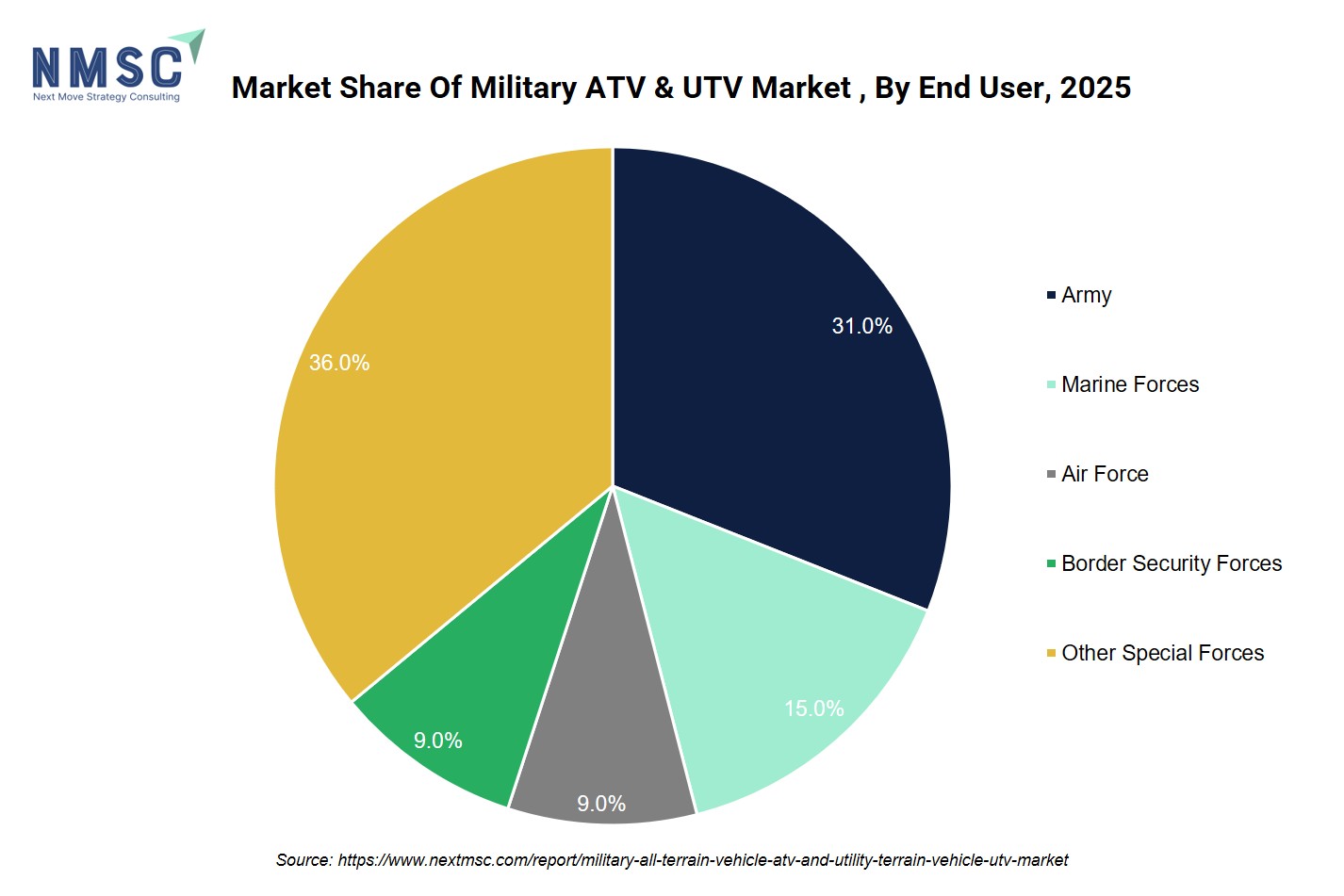
By End User: Army held the largest share of approximately USD 332.00 million in 2025 and is projected to reach USD 569.02 million by 2035; Other Special Forces is the fastest-growing end-user segment, registering a 4.56% CAGR from 2026–2035.

Dominant Region: North America dominated with approximately USD 378.80 million in 2025 and is projected to reach USD 630.92 million by 2035.

Fastest-Growing Region: Europe is expected to register the highest CAGR of 6.19% during 2026–2035.

Dominant Country: The U.S. was the largest single-country market in 2025, with approximately USD 348.70 million , and is projected to reach USD 572.47 million by 2035.

Fastest-Growing Country: Mexico is expected to register the highest country-level CAGR of 9.11% during 2026–2035.

Market Opportunity: The military ATV & UTV market is projected to generate an incremental revenue opportunity of approximately USD 623.68 Million between 2026 and 2035, reflecting the absolute dollar gap between the 2035 forecast and the 2026 base value a signal of sustained defense procurement investment in light tactical mobility platforms.

According to NMSC analysis, battery electric propulsion adoption within military procurement is advancing faster in reconnaissance and special forces applications than in general logistics roles, a dynamic tied to acoustic signature reduction requirements not fully captured in aggregate revenue figures.

What does the Military ATV & UTV Market Encompass?

The military ATV & UTV market encompasses purpose-built and commercial-standard all-terrain and utility task vehicles procured by armed forces, marine forces, air forces, border security agencies, and other special forces units for reconnaissance, logistics, casualty evacuation, and rapid-mobility applications. Our assessment indicates that the market's scope spans internal-combustion, battery electric, and hybrid electric propulsion platforms distinct from broader unmanned ground vehicle categories, which operate without an onboard human driver, and from civilian recreational ATV and UTV products not procured under defense contracts.
Structurally, the market has evolved from adapted commercial ATV platforms toward purpose-built military variants engineered for higher payload capacity, ballistic protection add-ons, and modular mission-specific configurations. We found that regulatory environments administered by national defense procurement agencies continue to shape vehicle qualification and testing standards, while technology adoption trends in electric and hybrid propulsion are reshaping platform selection for reconnaissance and special operations roles requiring reduced acoustic and thermal signatures.

Porter’s Five Forces analysis of the Military ATV & UTV Market

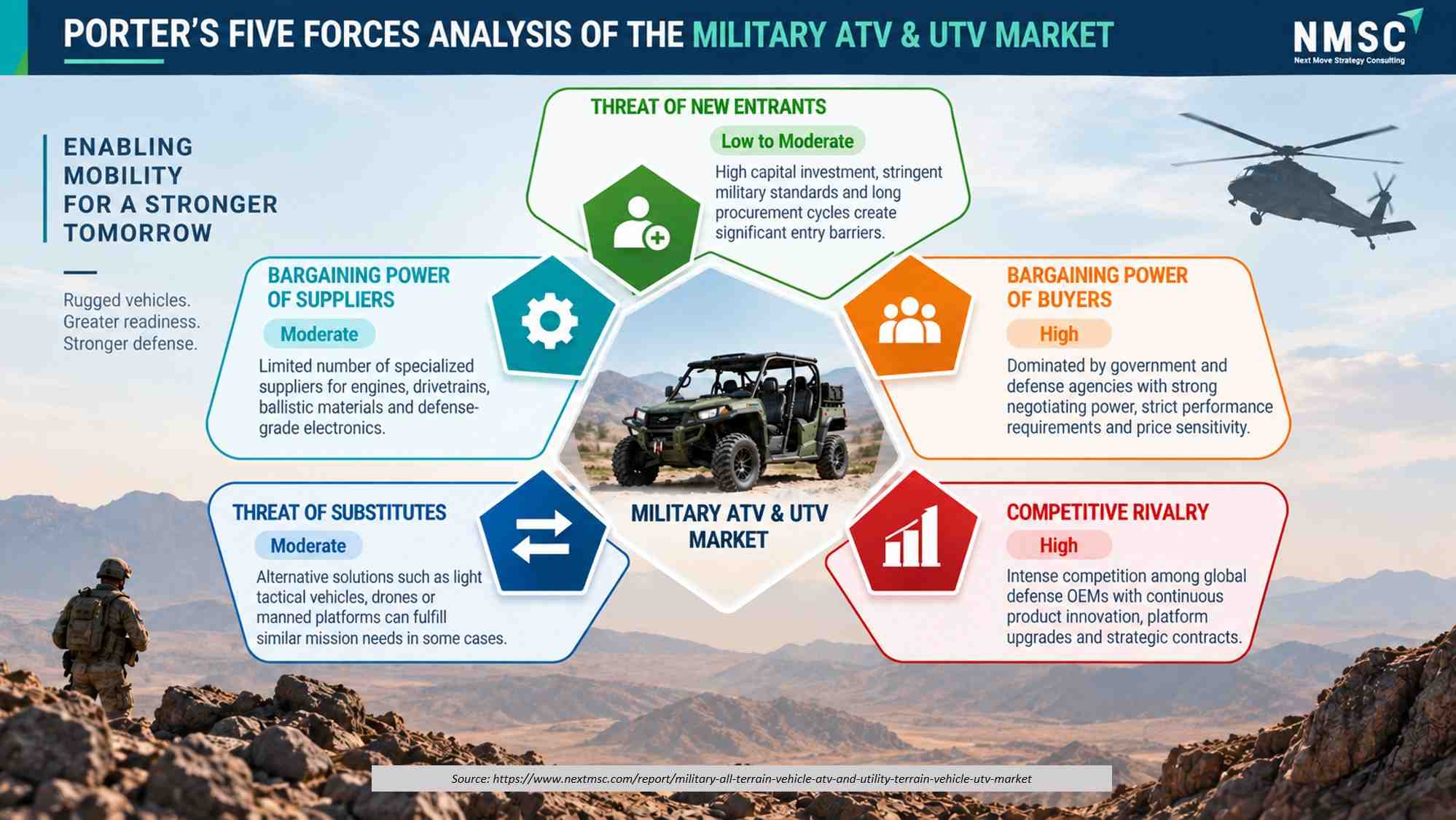
The infographic presents a Porter’s Five Forces analysis of the Military ATV & UTV Market, highlighting the competitive dynamics shaping the industry. It assesses the threat of new entrants as low to moderate due to capital and military standards, supplier power as moderate, and buyer power as high. The threat of substitutes is moderate, while competitive rivalry remains high due to strong competition, continuous innovation, and strategic defense contracts.

Market Drivers & Dynamics

Interactive Dataset
Rising defense budget allocation to light tactical mobility platforms driver +1.4% North America, Europe 2026–2035
Expanding border security agency procurement driver +1.1% Middle East & Africa, Latin America 2026–2033
Growing special forces demand for silent-drive reconnaissance platforms driver +0.8% North America, Europe 2027–2035
Rising modular mission-kit platform standardization driver +0.6% Global 2026–2032
Extended defense procurement and qualification testing cycles restraint −0.7% North America, Europe 2026–2032
Constrained defense budgets in select emerging markets restraint −0.5% Asia-Pacific, Latin America 2026–2030
Limited battlefield charging infrastructure for electric platforms restraint −0.4% Global 2026–2033
Source: Next Move Strategy Consulting

Growth Drivers

What Is the Primary Growth Driver for the Military ATV & UTV Market ?

Rising defense budget allocation to light tactical mobility platforms is the primary growth driver, as armed forces prioritize rapid-mobility assets for reconnaissance and logistics roles. The U.S. Department of Defense continues to allocate procurement funding for light tactical vehicle programs within its annual budget requests, underscoring sustained institutional demand for platforms in the payload and mobility class that military ATVs and UTVs occupy.

How Is Border Security Procurement Driving the Market Growth?

Expanding border security agency procurement is driving growth by diversifying the buyer base beyond traditional army and marine forces customers. Company analysis indicates that manufacturers with dedicated border-patrol-configured platform lines are capturing incremental demand from agencies previously reliant on standard commercial vehicles. Based on research conducted by NMSC, we found that this shift is most pronounced across Middle Eastern and Latin American border security procurement programs.

Growth Inhibitors

What Is Restraining the Military ATV & UTV Market?

Extended defense procurement and qualification testing cycles are restraining revenue realization, as new platform variants must complete lengthy military standard testing before contract award. We observed that this restraint is most pronounced for manufacturers introducing new electric and hybrid propulsion variants, which face additional qualification requirements around battery safety and field durability beyond those applied to established combustion platforms.

What Are the Growth Opportunities?

Can Silent-Drive Electric Platforms Unlock Special Forces Procurement?

Purpose-built silent-drive electric platforms tailored specifically to reconnaissance and forward special operations missions can unlock incremental procurement beyond current combustion-dominated special forces fleets. This mechanism primarily benefits manufacturers with established electric propulsion engineering capability and existing defense qualification track records.

Will Modular Multi-Role Kits Expand Fleet Standardization Contracts?

Modular mission-kit platforms allowing a single vehicle chassis to serve logistics, casualty evacuation, and weapons-carrier roles can expand large fleet standardization contracts as procurement agencies seek to reduce platform diversity. Manufacturers with established modular kit engineering are best positioned to capture multi-year standardization procurement programs.

Can Border Security Fleet Expansion Diversify Manufacturer Revenue?

Expanding border security agency procurement across the Middle East and Latin America offers manufacturers a mechanism to diversify revenue beyond traditional army and marine forces contracts. Manufacturers with dedicated border-patrol-configured platform lines stand to benefit most from this expanding, geographically diversifying buyer base.

Segmentation Analysis

2025 (USD Billion)
2035 (USD Billion)
All-Terrain Vehicles (ATVs) 2025: $280.98 Billion | 2035: $422.16 Billion
All-Terrain
Utility Task Vehicles (UTVs / SxS) 2025: $801.43 Billion | 2035: $1,355.33 Billion
Utility Task
All-Terrain Vehicles (ATVs) $280.98 Billion $422.16 Billion 3.99 %
Utility Task Vehicles (UTVs / SxS) $801.43 Billion $1,355.33 Billion 5.23 %

Which Vehicle Configuration Dominates the Military ATV & UTV Market?

Utility Task Vehicles (UTVs / SxS) dominate configuration segmentation with an estimated USD 801.43 Million in 2025, rising to USD 1355.33 Million by 2035, reflecting higher payload capacity and side-by-side seating better suited to multi-role logistics and casualty evacuation missions. UTVs are also the fastest-growing configuration at a 5.23 % CAGR, driven by procurement agencies favoring their greater mission versatility over single-rider ATV platforms.

2025 (USD Billion)
2035 (USD Billion)
Internal-Combustion Engine (ICE) 2025: $869.25 Billion | 2035: $1,414.95 Billion
Internal-Com
Battery Electric Vehicle (BEV) 2025: $119.82 Billion | 2035: $225.13 Billion
Battery Elec
Hybrid Electric Vehicle (HEV) 2025: $93.34 Billion | 2035: $137.41 Billion
Hybrid Elect
Internal-Combustion Engine (ICE) $869.25 Billion $1,414.95 Billion 4.83%
Battery Electric Vehicle (BEV) $119.82 Billion $225.13 Billion 6.33%
Hybrid Electric Vehicle (HEV) $93.34 Billion $137.41 Billion 3.77%

Which Propulsion Type Is Gaining the Most Ground?

Internal-Combustion Engine platforms lead propulsion segmentation with USD 869.25 Million in 2025 revenue, reflecting continued reliance on proven, field-serviceable combustion drivetrains across established defense fleets. Battery Electric Vehicle propulsion is the fastest-growing type at a 6.33% CAGR, driven by rising special forces demand for silent-drive reconnaissance platforms with reduced acoustic and thermal signatures.

2025 (USD Billion)
2035 (USD Billion)
Army 2025: $332.00 Billion | 2035: $569.02 Billion
Army
Marine Forces 2025: $162.75 Billion | 2035: $260.31 Billion
Marine Force
Air Force 2025: $99.95 Billion | 2035: $155.00 Billion
Air Force
Border Security Forces 2025: $96.06 Billion | 2035: $171.63 Billion
Border Secur
Other Special Forces 2025: $391.65 Billion | 2035: $621.53 Billion
Other Specia
Army $332.00 Billion $569.02 Billion 5.37 %
Marine Forces $162.75 Billion $260.31 Billion 4.64 %
Air Force $99.95 Billion $155.00 Billion 4.32%
Border Security Forces $96.06 Billion $171.63 Billion 5.81 %
Other Special Forces $391.65 Billion $621.53 Billion 4.56%

Which End-User Segment Leads and Which Is Growing Fastest?

Other Special Forces leads end-user segmentation with USD 391.65 Million in 2025 revenue, representing the largest share of demand among the defined end-user categories. This reflects procurement requirements for compact, rapidly deployable mobility platforms supporting specialized reconnaissance, logistics, and unconventional mission profiles. Border Security Forces is the fastest-growing end-user segment at a 5.81% CAGR from 2026 to 2035, supported by increasing demand for mobile patrol, surveillance, reconnaissance, and border-terrain mobility capabilities.

2025 (USD Billion)
2035 (USD Billion)
<500 kg
500-800 kg
>800 kg
Segment Item 2025 (USD Billion) 2035 (USD Billion) CAGR
<500 kg $10.0 USD Billion $40.0 USD Billion 27.0%
500-800 kg $17.1 USD Billion $51.1 USD Billion 9.0%
>800 kg $24.2 USD Billion $62.2 USD Billion 19.0%

Segment-wise data not detailed in this view

Unlock complete segment-wise numbers for By Payload Capacity.

Unlock Full Data
2025 (USD Billion)
2035 (USD Billion)
Low (<500cc
Medium (500-
High (>1000
Segment Item 2025 (USD Billion) 2035 (USD Billion) CAGR
Low (<500cc or <37 kW) $10.0 USD Billion $40.0 USD Billion 14.0%
Medium (500-1000 cc or 37-90 kW) $17.1 USD Billion $51.1 USD Billion 24.0%
High (>1000 cc or >90 kW) $24.2 USD Billion $62.2 USD Billion 22.0%

Segment-wise data not detailed in this view

Unlock complete segment-wise numbers for By Power Output.

Unlock Full Data
2025 (USD Billion)
2035 (USD Billion)
North Americ
Canada
Mexico
Europe: UK
Germany
Segment Item 2025 (USD Billion) 2035 (USD Billion) CAGR
North America: U.S. $10.0 USD Billion $40.0 USD Billion 23.0%
Canada $17.1 USD Billion $51.1 USD Billion 9.0%
Mexico $24.2 USD Billion $62.2 USD Billion 19.0%
Europe: UK $31.3 USD Billion $73.3 USD Billion 13.0%
Germany $38.4 USD Billion $84.4 USD Billion 10.0%

Segment-wise data not detailed in this view

Unlock complete segment-wise numbers for By Region.

Unlock Full Data

Other Special Forces leads end-user segmentation with USD 391.65 Million in 2025 revenue, representing the largest share of demand among the defined end-user categories. This reflects procurement requirements for compact, rapidly deployable mobility platforms supporting specialized reconnaissance, logistics, and unconventional mission profiles. Border Security Forces is the fastest-growing end-user segment at a 5.81% CAGR from 2026 to 2035, supported by increasing demand for mobile patrol, surveillance, reconnaissance, and border-terrain mobility capabilities.

Growth Opportunities

Beyond current demand drivers, three whitespace opportunities stand out as forward-looking mechanisms for revenue expansion through 2035.

Can Silent-Drive Electric Platforms Unlock Special Forces Procurement?

Purpose-built silent-drive electric platforms tailored specifically to reconnaissance and forward special operations missions can unlock incremental procurement beyond current combustion-dominated special forces fleets. This mechanism primarily benefits manufacturers with established electric propulsion engineering capability and existing defense qualification track records.

Will Modular Multi-Role Kits Expand Fleet Standardization Contracts?

Modular mission-kit platforms allowing a single vehicle chassis to serve logistics, casualty evacuation, and weapons-carrier roles can expand large fleet standardization contracts as procurement agencies seek to reduce platform diversity. Manufacturers with established modular kit engineering are best positioned to capture multi-year standardization procurement programs.

Can Border Security Fleet Expansion Diversify Manufacturer Revenue?

Expanding border security agency procurement across the Middle East and Latin America offers manufacturers a mechanism to diversify revenue beyond traditional army and marine forces contracts. Manufacturers with dedicated border-patrol-configured platform lines stand to benefit most from this expanding, geographically diversifying buyer base.

Ecosystem Analysis of the Military ATV & UTV Market

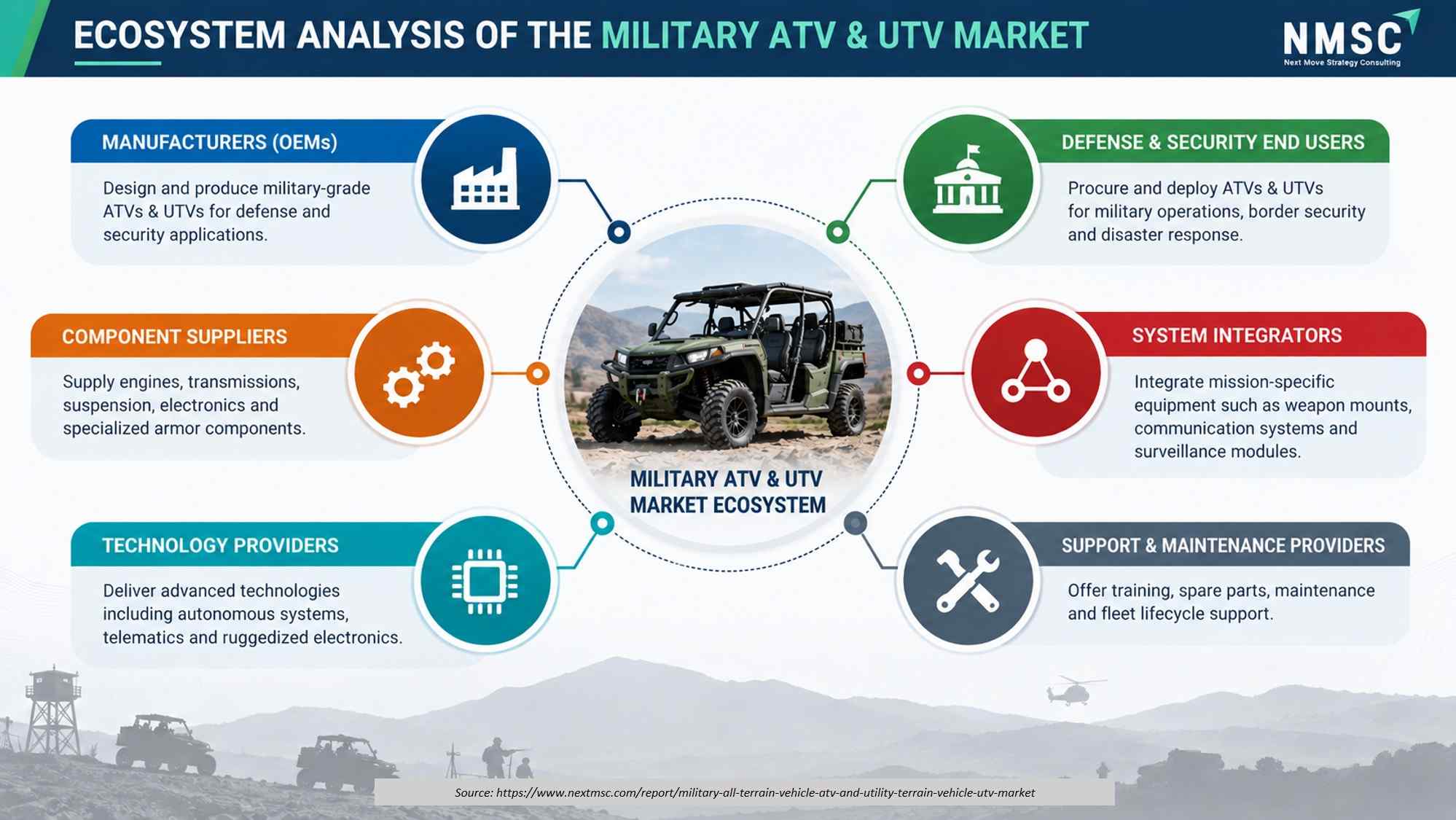
The infographic presents the ecosystem of the Military ATV & UTV Market, highlighting the key stakeholders supporting defense mobility and mission operations. It covers vehicle manufacturers, defense and security end users, component suppliers, system integrators, technology providers, and support and maintenance providers. The interconnected structure illustrates how these participants collaborate to deliver rugged, technologically advanced, and mission-ready ATV and UTV solutions for military and security applications.

Regional Outlook

North America $378.80 Billion $630.92 Billion 5.07%
Europe $293.57 Billion $544.40 Billion 6.19%
Asia-Pacific $262.82 Billion $391.31 Billion 3.89%
Middle East & Africa $96.93 Billion $142.29 Billion 3.74%
Latin America $50.29 Billion $68.57 Billion 2.97%

SWOT Analysis

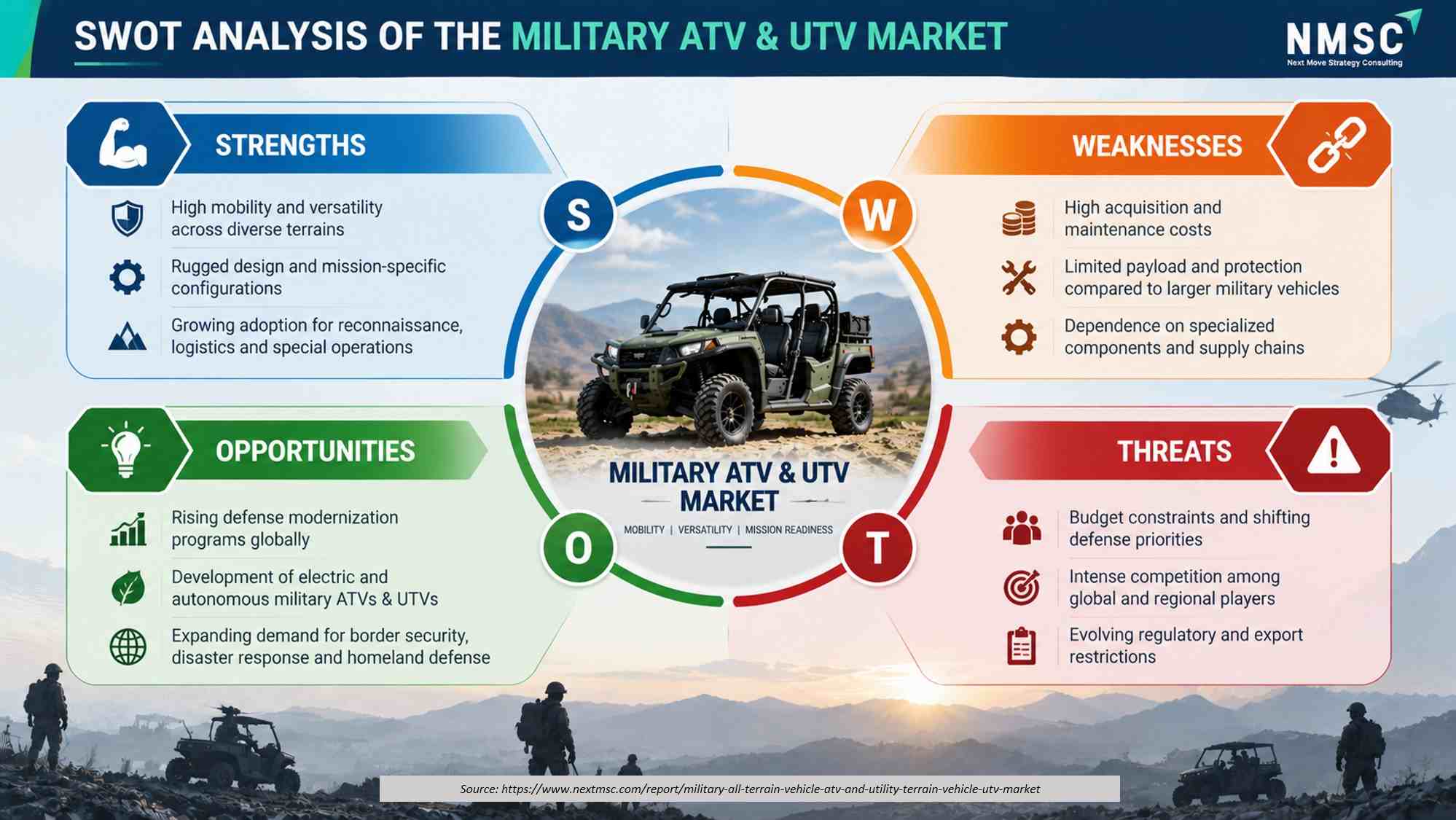
This SWOT view highlights structural strengths, strategic gaps, expansion headroom, and external risks shaping outcomes in the Military ATV & UTV Market.

Strengths

High mobility and versatility across diverse terrains, Rugged design and mission-specific configurations, Growing adoption for reconnaissance, logistics and special operations

Weaknesses

High acquisition and maintenance costs, Limited payload and protection compared to larger military vehicles, Dependence on specialized components and supply chains

Opportunities

Rising defense modernization programs globally, Development of electric and autonomous military ATVs & UTVs, Expanding demand for border security, disaster response and homeland defense

Threats

Budget constraints and shifting defense priorities, Intense competition among global and regional players, Evolving regulatory and export restrictions

Competitive Landscape

Our findings suggest that the competitive landscape spans diversified powersports manufacturers with dedicated defense divisions and specialized military platform developers, each pursuing distinct differentiation strategies. Dimension | Assessment Market Structure | Moderately consolidated; diversified powersports manufacturers hold significant defense-adapted platform share while specialized defense vehicle developers compete on purpose-built engineering depth Innovation Focus | Electric and hybrid propulsion, modular mission-kit architecture, amphibious and all-weather platform capability M&A Activity | Selective; diversified manufacturers acquire specialized defense platform engineering capability to strengthen military qualification depth Source: www.nextmsc.com

How Do Companies Compete in the Military ATV & UTV Market?

Companies compete primarily on defense qualification track record, payload and durability engineering depth, and breadth of modular mission-kit configurations available for a given platform. Our analysis shows that manufacturers with established defense procurement relationships and dedicated military engineering divisions sustain larger contract wins than powersports manufacturers offering only lightly adapted commercial platforms.

Which Competitive Archetypes Dominate the Military ATV & UTV Industry?

Two archetypes dominate: diversified powersports manufacturers with dedicated defense engineering divisions serving both commercial and military customers, and specialized defense vehicle developers focused exclusively on purpose-built military and security platforms. We observed that the differentiation between these archetypes is narrowing as diversified manufacturers expand dedicated defense product lines.

What Innovation and Differentiation Strategies Are Companies Pursuing?

Company analysis indicates that leading firms are differentiating through electric and hybrid propulsion platform development, modular mission-kit architecture, and amphibious or all-weather platform capability. Investment in defense-specific qualification testing infrastructure continues, alongside expanded border-patrol-configured product lines targeting the diversifying security agency buyer base.

How Active Is M&A in the Military ATV & UTV Industry?

M&A activity remains selective as diversified manufacturers pursue targeted acquisitions of specialized defense platform engineering capability to strengthen military qualification depth. Based on research conducted by NMSC, we found that acquisition interest is concentrated on electric propulsion and modular mission-kit engineering specialists, reflecting strategic pivots toward the fastest-growing propulsion and configuration categories.

Key Market Players

Our assessment indicates that the following companies represent the validated set of key players shaping competitive dynamics across ATV, UTV, and defense-adapted platform categories within the military ATV & UTV market.

Polaris Inc. Bombardier Recreational Products Inc. (BRP) Ontario Drive & Gear Limited (ARGO) CORVUS Innova, S.L. Arctic Cat Inc. Kubota Corporation Yamaha Motor Co., Ltd. Kawasaki Motors Co., Ltd. Honda Motor Co., Ltd. Suzuki Motor Corporation International Automated Systems, Inc. Zhejiang CFMOTO Power Co., Ltd. Chongqing Huansong Industries Co., Ltd. (HISUN) Kwang Yang Motor Co., Ltd. Taiwan Golden Bee Co., Ltd. Jiangsu Linhai Power Machinery Group Co., Ltd. Segway Technology Co., Ltd. Doosan Bobcat Inc. ASW, LLC (Landmaster) TOMCAR USA

Latest Developments

We observed that recent developments across the industry reflect continued investment in electric propulsion platforms and defense-specific engineering capability.

Date Event
June 2026 The U.S. Marine Corps placed its first order under the new Ultra-Light Tactical Vehicle contract, purchasing more than 70 MRZR Alpha vehicles and accessories. More than half are equipped with the new 5 kW exportable-power configuration, expanding onboard power capability for expeditionary missions.
September 2025 Polaris received a two-year NATO Support and Procurement Agency framework contract for MRZR D light tactical vehicles, with the potential to extend to five years and a value described as hundreds of millions of dollars. The framework enables NATO members and partners to procure the vehicle without separate competitive trials.
August 2025 The U.S. Army Corps of Engineers solicited a Honda Pioneer 1000-5 side-by-side UTV with accessories for operational utility requirements. The procurement demonstrates the use of commercially available UTV platforms within U.S. Department of Defense operating environments, highlighting demand for readily available, multipurpose off-road vehicles for utility and support applications
August, 2025 JSW Sarbloh Motors and Tomcar USA formed a strategic joint venture to indigenize, manufacture, assemble, and support the Tomcar TX range of all-terrain vehicles (ATVs) in India. The first India-assembled TX units were expected to roll out by early 2026, with field trials and demonstrations planned for multiple defense and paramilitary agencies. The partnership is intended to strengthen local production of tactical mobility platforms for India's armed and security forces.

Expert Insights

Nick Francis

Nick Francis

Vice President | Polaris Government & Defense

"“More than just a troop carrier, a single MRZR Alpha can be transformed into multiple configurations for different environments and unique missions.”"

Analyst Interpretation

Francis's statement highlights the increasing importance of modularity and multi-mission capability in the Military ATV & UTV Market. Military forces operating in austere and expeditionary environments require lightweight platforms that can be adapted to different operational roles and transportation requirements. The MRZR Alpha's configurable architecture supports emerging applications involving command and control, UAS/drone operations, counter-UAS, logistics, and other mission payloads. This trend indicates growing demand for flexible, reconfigurable UTV platforms that can support multiple missions without requiring separate vehicle platforms.

Investment Opportunities

Where Is Capital Flowing Within the Military ATV & UTV Market?

Capital inflows are concentrated in electric propulsion engineering and modular mission-kit platform development by diversified powersports manufacturers with defense divisions. We found that strategic capital is also flowing into military robots and adjacent unmanned mobility platform development, reflecting broader defense investment in ground mobility innovation beyond crewed vehicles alone.

How Significant Is Infrastructure Investment in This Market?

Infrastructure investment is moderate, with manufacturers expanding dedicated defense qualification testing facilities and battery safety validation infrastructure to support electric platform certification. Our assessment indicates that continued investment in field-serviceability engineering remains a prerequisite for winning multi-year fleet procurement contracts across remote operating environments.

What ESG Considerations Are Relevant to This Market?

ESG considerations center on reduced-emission propulsion adoption within defense fleets, responsible sourcing of battery materials for electric platforms, and end-of-life vehicle recycling programs. We observed that manufacturers increasingly disclose propulsion transition and materials sourcing commitments in annual sustainability reporting relevant to defense customer procurement criteria.

Key Benefits for Stakeholders

How Does This Report Benefit Industry Leaders?

Industry and enterprise leaders gain a structured view of configuration, propulsion, and regional revenue distribution, supporting prioritization decisions across platform engineering investment and defense qualification strategy. Our analysis shows that this structured segmentation clarifies where competitive intensity is rising fastest ahead of resource-allocation decisions.

How Does This Report Benefit Investors and Financial Analysts?

Investors and financial analysts gain reconciled market-size, CAGR, and regional-growth data supporting valuation and portfolio-allocation decisions. Company analysis indicates that segment-level growth differentials, particularly around electric propulsion and special forces end-user categories, are material inputs for evaluating manufacturer growth durability.

How Does This Report Benefit Technology Vendors and Product Teams?

Technology vendors and product teams gain visibility into propulsion and configuration trends shaping platform engineering and battery infrastructure demand. We found that this analysis supports prioritization of engineering investment toward the fastest-growing platform categories identified across the forecast period.

Key Market Segments Evaluated

By Vehicle Configuration

  • All-Terrain Vehicles (ATVs)
  • Utility Task Vehicles (UTVs / SxS)

By Propulsion Type

  • Internal-Combustion Engine (ICE)
  • Battery Electric Vehicle (BEV)
  • Hybrid Electric Vehicle (HEV)

By End User

  • Army
  • Marine Forces
  • Air Force
  • Border Security Forces
  • Other Special Forces

By Payload Capacity

  • <500 kg
  • 500-800 kg
  • >800 kg

By Power Output

  • Low (<500cc or <37 kW)
  • Medium (500-1000 cc or 37-90 kW)
  • High (>1000 cc or >90 kW)

By Region

  • North America: U.S.
  • Canada
  • Mexico
  • Europe: UK
  • Germany
  • France
  • Italy
  • Spain
  • Sweden
  • Denmark
  • Finland
  • Netherlands
  • Rest of Europe
  • Asia-Pacific: China
  • India
  • Japan
  • South Korea
  • Taiwan
  • Indonesia
  • Vietnam
  • Australia
  • Philippines
  • Malaysia
  • Rest of APAC
  • Middle East & Africa: Saudi Arabia
  • UAE
  • Egypt
  • Israel
  • Turkey
  • Nigeria
  • South Africa
  • Rest of MEA
  • Latin America: Brazil
  • Argentina
  • Chile
  • Colombia
  • Rest of LATAM

Conclusion & Recommendations

The long-term outlook remains steadily expansionary, with revenue projected to grow from USD 1153.81 Million in 2026 to USD 1777.49 Million by 2035 at a 4.92% CAGR. Our analysis shows that this trajectory is underpinned by structural defense procurement demand for light tactical mobility rather than cyclical replacement demand alone.

What Strategic Positioning Should Companies Pursue?

Companies should prioritize purpose-built defense engineering and modular mission-kit capability over lightly adapted commercial platforms. We found that manufacturers with dedicated defense qualification track records sustain more durable procurement relationships than competitors relying on commercial platform adaptation alone.

How Attractive Is the Market for Investment?

Investment attractiveness is moderate to high given double-digit growth in electric propulsion and special forces end-user categories alongside a stable base of established combustion-platform army procurement. Our assessment indicates that capital allocators should weight exposure toward manufacturers with proven electric propulsion and modular kit engineering over single-platform competitors.

What Market Shifts and Key Risks Should Stakeholders Monitor?

Key risks include extended defense procurement and qualification testing cycles, constrained defense budgets in select emerging markets, and limited battlefield charging infrastructure for electric platforms. We observed that qualification cycle length poses the most immediate risk to revenue timing for manufacturers introducing new propulsion variants.

What Are the Primary Growth Pathways Through 2035?

Primary growth pathways include silent-drive electric platforms for special forces procurement, modular multi-role kits for fleet standardization contracts, and border security fleet expansion across the Middle East and Latin America. Our findings suggest that companies combining all three pathways will outpace single-lever competitors through the forecast period.

FAQs

About the Author

Liza Phukan

Liza Phukan

Liza Phukan is Research Associate at Next Move Strategy Consulting, where she has covered emerging industries and market research across sectors for 3.5 years. Her work includes analyzing industry developments, validating market data, and developing structured business content from research findings. She uses secondary research and data-validation practices to turn complex market information into clear decision-useful market analysis for business audiences and support report development and B2B.

About the Reviewer

Supradip Baul

Supradip Baul

Supradip Baul is an accomplished business consultant and strategist with over a decade of rich experience in market intelligence, strategy, technology, and business transformation. His work has included rigorous qualitative and quantitative analysis across multiple industries, helping clients shape investment decisions and long-term roadmaps. Earlier in his career, he was associated with Gartner, where he contributed to industry-leading reports and market share analyses. He has worked with leading global companies and holds an MBA with a dual specialization in Marketing and Finance.

Download Free Sample

Robert Sean Trevino

ROBERT SEAN TREVINO

Sr. Director, Head of Strategic Insights & Analytics

Foundation Medicine

I realized that it was a reliable source of information. These days, there are many people who are looking for authentic data, and this is one of the only sources that can offer them with what they need;

Ross J Mckenzie

ROSS J MCKENZIE

Business Insight Manager

Staysure Group

“Next MSC have been incredibly helpful in providing detailed & robust information on our market, alongside quantifying growth by different segments. The process to procure was simple and easy, with sample reports and regular contact to ensure we had what we needed. Succinct detail on their sources & methodologies is also greatly received, allowing transparency in this respect helps build trust in the detail you pay for. Joseph in particular was fantastic, and helped ensure efficient provision of the insight pack – thank you NMSC!”.

Melanie Samko

MELANIE SAMKO

Director of Marketing

TOSOH BIOSCIENCE, INC.

The information provided by NMSC is incredibly valuable, thank you so much for such a excellent work. I really appreciate it. I will make sure to reference all of it, in my summary document.

Diana Trejo

DIANA TREJO

Assistant Manager

Sumitomo Corporation de Mexico, S.A. de C.V.

Recently, we purchased a report on the Mexico Data Center Market from Next Move Strategy Consulting. The service has been excellent, with support that is always timely and thoroughly professional. The information provided is interesting, highly useful, and delivered with clarity. I would highly recommend NextMSC for anyone seeking insightful and dependable analysis.

Semih Kavaklioglu

SEMIH KAVAKLIOGLU

Co-Founder &amp; Sales Manager

Decortie

I work a lot in the marketing industry and I know that research is an essential part of any campaign. I have used Market research reports for my own products and I found them to be very informative and well-researched. The team here produces insightful reports for a good price

Custom Market Research Services

We will customize the research for you if the listed report does not fully match your requirements.

Get 30% Free Customization

Select License

This website uses cookies to ensure you get the best experience on our website. Learn more

✖