Military Robots Market Size, Share, Growth & Forecast by Platform Type (Airborne Robots {Fixed-Wing UAV, Rotary-Wing UAV, and others}, Land Robots, Maritime Robots), Mission (ISR, Combat Operations, EOD, Mine Clearance, Maritime MCM, Logistics Support, Electronic Warfare, Training & Simulation), Autonomy Level (Teleoperated, Semi-Autonomous, Fully Autonomous), and End User (Army, Navy, Air Force, Marine Corps, Special Forces) — Global Analysis 2025–2035
Industry: Aerospace & Defense | Latest Edition: July 4, 2026 | No of Pages: 597 | No. of Tables: 784 | No. of Figures: 774 | Format: PDF | Report Code : AD3269
What Is the Military Robots Market Size?
The global Military Robots Market was valued at USD 26.2 billion in 2025 and is expected to reach USD 36.9 billion in 2026. Driven by escalating geopolitical tensions, accelerating defense modernization programs across NATO and Indo-Pacific alliances, and growing integration of artificial intelligence into unmanned platforms, the market is projected to reach USD 83.8 billion by 2035, advancing at a CAGR of 9.53% from 2026 to 2035. In volume terms, the market was estimated at 626 thousand units in 2025 and is projected to increase from 883 thousand units in 2026 to 2024 thousand units by 2035, registering a CAGR of 9.65% during the forecast period. Key growth drivers include expanding loitering munition deployments, increasing autonomous ground vehicle adoption, rising maritime unmanned system investment, and surging demand for ISR platforms across multiple operational theaters worldwide.
|
Parameters |
Details |
|
Market Size in 2025 |
USD 26.2 Billion |
|
Market Size in 2026 |
USD 36.9 Billion |
|
Revenue Forecast in 2035 |
USD 83.8 Billion |
|
Growth Rate |
CAGR of 9.53% from 2026 to 2035 |
|
Analysis Period |
2025–2035 |
|
Base Year Considered |
2025 |
|
Forecast Period |
2026–2035 |
|
Market Volume in 2026 |
883 thousand units |
|
Volume Forecast in 2035 |
2024 thousand units |
|
Growth Rate |
CAGR of 9.65% from 2026 to 2035 |
|
Market Size Estimation |
Billion (USD) |
|
Companies Profiled |
20 |
|
Countries Covered |
33 |
|
Market Share |
Top 10 |
Military Robots Market Overview
What Is the Military Robots Market?
The Military Robots Market encompasses unmanned platforms and autonomous systems designed, developed, and deployed for defense and national security applications. These systems operate across airborne, land-based, and maritime domains, supporting missions including intelligence, surveillance and reconnaissance, combat operations, explosive ordnance disposal, mine clearance, logistics support, and electronic warfare. The market covers teleoperated, semi-autonomous, and fully autonomous robotic systems procured by armed forces, special operations units, coast guards, and defense agencies across all major military powers globally.
How Has the Military Robots Market Evolved?
The Military Robots Market has evolved through distinct technology transformation phases. The initial phase focused on teleoperated EOD ground robots and fixed-wing ISR drones deployed in counterterrorism operations. A subsequent phase introduced rotary-wing platforms, early loitering munitions, and modular UGV systems for base security. NMSC's analysis indicates that the current phase reflects AI-driven autonomy integration, multi-domain unmanned system coordination, swarming capabilities, and the convergence of commercial drone technologies with military-grade autonomous platforms across all service branches globally.
How Do Regulations Influence the Military Robots Market?
Regulatory and policy frameworks exert significant structural influence on the Military Robots Market. The U.S. Department of Defense Directive 3000.09, which governs meaningful human control requirements for autonomous and semi-autonomous weapon systems, directly shapes procurement specifications and development timelines. NATO's policy framework on autonomous systems and the International Committee of the Red Cross guidelines on lethal autonomous weapons inform allied procurement standards. U.S. International Traffic in Arms Regulations (ITAR) and the EU Common Position on arms exports further regulate cross-border technology transfer, affecting competitive dynamics and market access strategies.
How Is Technology Adoption Expanding Across the Military Robots Market?
Technology adoption across the Military Robots Market is accelerating through integration of AI-enabled autonomy, advanced sensor fusion, and resilient communication architectures into unmanned platforms. Edge computing allows real-time battlefield decision-making without continuous data link dependency, particularly valuable in contested electromagnetic environments. Loitering munitions with onboard AI-assisted target recognition, legged robots navigating complex terrain, and AI-powered autonomous underwater vehicles executing extended covert missions represent the current frontier. Through NMSC's assessment, we found that defense forces are increasingly adopting open-architecture modular platforms that reduce integration costs and support rapid capability upgrades.
|
Key Takeaways |
|
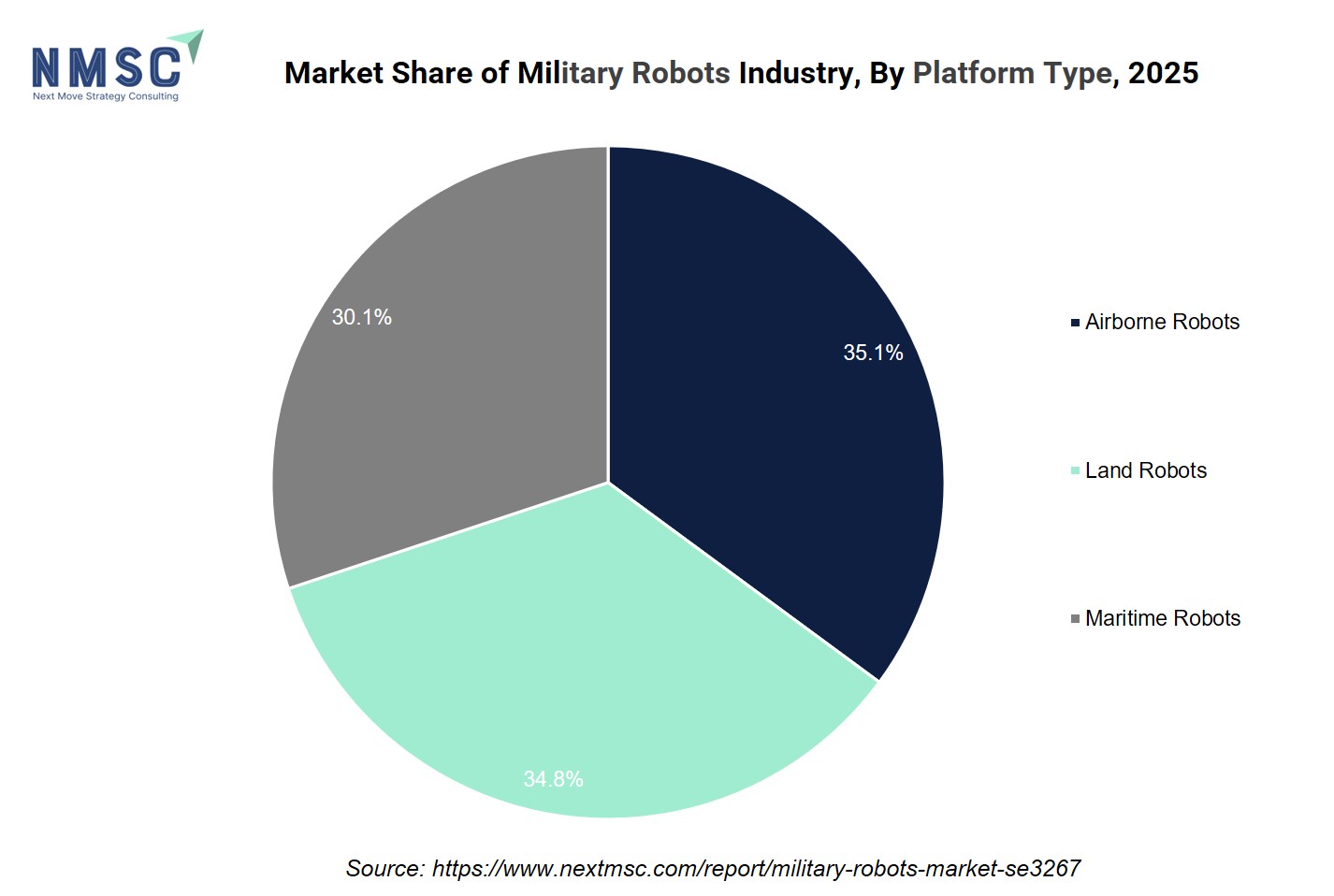
By platform type, Airborne Robots held the largest share of the Military Robots Market at USD 9.19 billion in 2025, representing 35.1% of total market revenue, driven by high procurement volumes of fixed-wing ISR drones, rotary-wing platforms, and rapidly expanding loitering munition programs across defense forces worldwide. |
|
Maritime Robots is the fastest-growing platform type in the Military Robots Market at a CAGR of 10.51% from 2026 to 2035, projected to grow from USD 7.88 billion in 2025 to USD 27.55 billion by 2035, fueled by rising naval investment in uncrewed surface vessels, AUVs, and large-displacement XLUUVs. |
|
By mission, Intelligence, Surveillance, and Reconnaissance (ISR) held the largest share at USD 4.15 billion in 2025 and is simultaneously the fastest-growing mission segment at a CAGR of 11.07%, underpinned by growing demand for persistent battlefield surveillance and multi-domain reconnaissance across NATO and Indo-Pacific theaters. |
|
Electronic Warfare is the second-fastest growing mission segment at a CAGR of 10.85% from 2026 to 2035, expanding from USD 3.68 billion in 2025 to USD 13.28 billion by 2035, as armed forces prioritize spectrum dominance and counter-drone jamming capabilities in modern operational environments. |
|
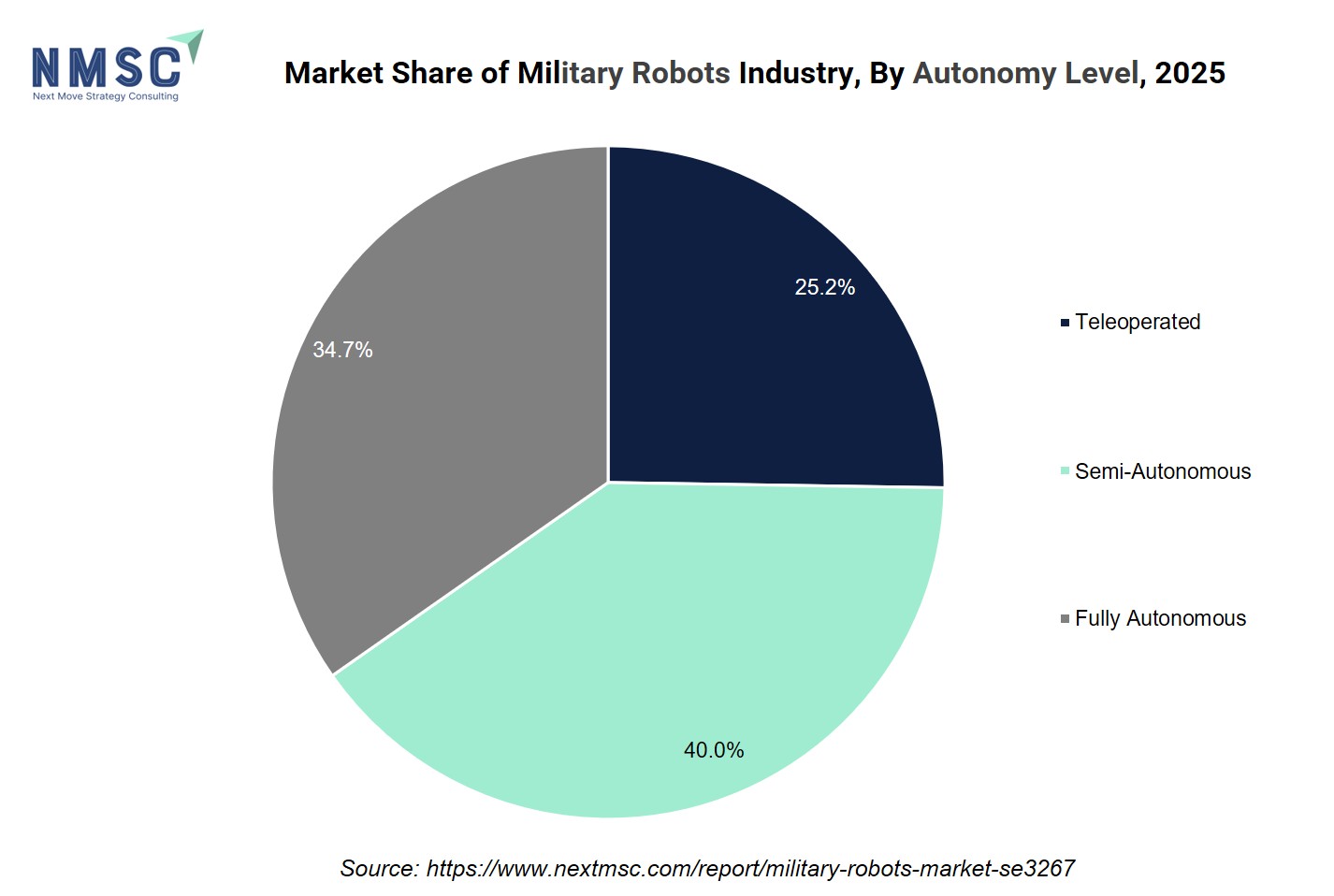
By autonomy level, the Semi-Autonomous segment commanded the largest revenue share of the Military Robots Market at USD 10.48 billion in 2025, reflecting defense forces' preference for human-in-the-loop systems that balance operational effectiveness with compliance requirements under DoD Directive 3000.09 and allied policies. |
|
Fully Autonomous systems represent the fastest-growing autonomy segment at a CAGR of 11.21% from 2026 to 2035, advancing from USD 9.10 billion in 2025 to USD 33.84 billion by 2035, driven by AI maturity, advancing computational capabilities, and growing acceptance of fully autonomous platforms for non-lethal logistics and ISR missions. |
|
By end user, the Air Force segment held the largest revenue share at USD 6.41 billion in 2025, reflecting sustained investment in fixed-wing and rotary-wing UAVs, HALE platforms, and loitering munition programs across major air forces globally, including the U.S. Air Force, Israeli Air Force, and NATO partners. |
|
The Army segment is the fastest-growing end user in the Military Robots Market at a CAGR of 10.74% from 2026 to 2035, advancing from USD 5.34 billion in 2025 to USD 19.07 billion by 2035, driven by large-scale UGV procurement, robotic logistics programs, and AI-enabled autonomous ground combat initiatives. |
|
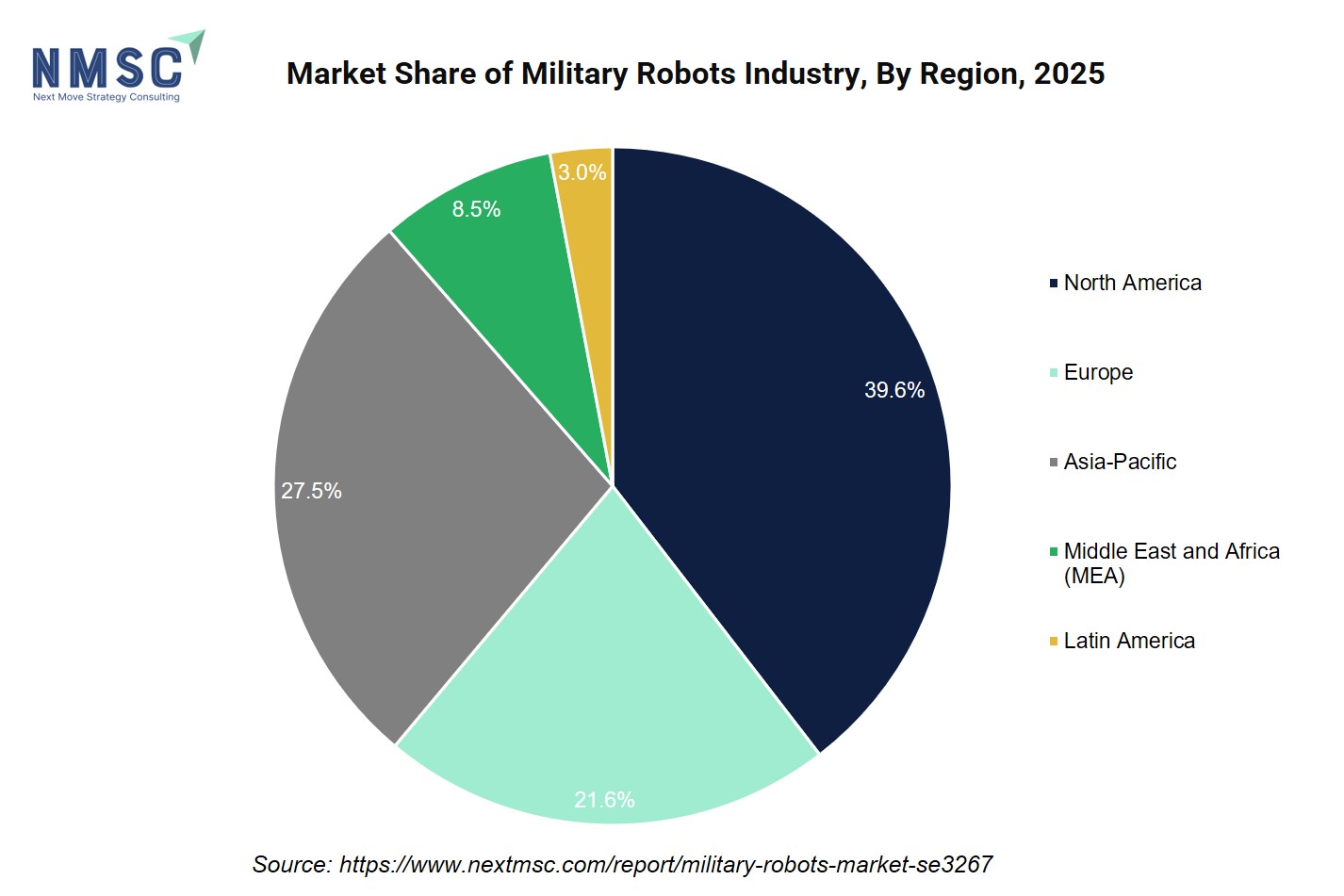
North America dominated the Military Robots Market with USD 10.36 billion in 2025, representing 39.6% of global revenue, anchored by the United States' Replicator drone initiative, ongoing Army Next Generation Combat Vehicle programs, and sustained DoD investment in autonomous maritime platforms. |
|
Asia-Pacific is the fastest-growing major region in the Military Robots Market at a CAGR of 10.83% from 2026 to 2035, propelled by China's large-scale military drone modernization, India's UAV procurement programs under its Defense Acquisition Procedure, South Korea's autonomous DMZ surveillance systems, and Japan's expanding maritime UAS capabilities. |
|
The United States is the single largest country market in the Military Robots Market, representing about 92.4% of North American revenue in 2025, underpinned by the world's highest defense R&D spending and sustained multi-program procurement across all services. |
|
Malaysia is the fastest-growing country in Asia-Pacific within the Military Robots Market, advancing at a CAGR of 14.34% from 2026 to 2035, driven by growing investments in tactical ISR drone programs, maritime surveillance capabilities, and autonomous patrol systems supporting security operations across strategic maritime corridors. |
Key Emerging Trends in the Military Robots Market
How Is Artificial Intelligence Transforming Autonomous Targeting and Mission Planning in the Military Robots Market?
Artificial intelligence is fundamentally reshaping the Military Robots Market by embedding machine learning capabilities directly within unmanned platform architectures. From our research, we found that defense contractors including Lockheed Martin and L3Harris Technologies are integrating AI-powered target recognition algorithms into ISR platforms and loitering munitions, enabling real-time threat classification without continuous operator input. The U.S. DoD's Project Maven, an AI-assisted image analysis program, exemplifies how AI transforms raw sensor data into actionable intelligence. This transformation compels every unmanned platform vendor to demonstrate AI integration to remain competitive in major defense procurement processes globally.
How Are Loitering Munitions Reshaping Tactical Combat Operations in the Military Robots Market?
Loitering munitions have emerged as one of the most tactically disruptive platform categories in the Military Robots Market, fundamentally altering close air support and precision strike doctrines. NMSC's analysis indicates that operational use of systems such as AeroVironment's Switchblade and Israel Aerospace Industries' Harop in multiple active conflicts demonstrated decisive battlefield effectiveness. The Loitering Munition sub-segment is projected to achieve a CAGR of 13.03% from 2026 to 2035, the highest growth rate among airborne platform types. Multiple NATO and Indo-Pacific nations are accelerating loitering munition procurement as cost-effective alternatives to conventional precision-guided munitions in contested environments.
How Is the Military Robots Market Responding to Growing Demand for Multi-Domain Swarming Technologies?
Swarming technology represents a strategic inflection point in the Military Robots Market, enabling coordinated autonomous operations across large numbers of low-cost unmanned platforms. Our findings suggest that the U.S. Defense Advanced Research Projects Agency (DARPA)'s OFFensive Swarm-Enabled Tactics (OFFSET) program and China's verified swarm UAV demonstrations signal a decisive shift toward distributed autonomous systems as force multipliers. Swarming capabilities are influencing procurement strategy across airborne, land, and maritime domains, driving demand for advanced communication mesh networks, collaborative AI algorithms, and open-architecture platforms that support multi-unit coordination at scale.
How Are Large-Displacement Autonomous Underwater Vehicles Redefining Strategic Maritime Security in the Military Robots Market?
Extra-Large Unmanned Undersea Vehicles (XLUUVs) are emerging as strategically significant platforms within the Maritime Robots segment of the Military Robots Market. Based on our market evaluation, we noticed that the U.S. Navy's Orca XLUUV program, awarded to Boeing and Huntington Ingalls, represents investment in platforms capable of operating independently for extended periods across thousands of miles. With a projected CAGR of 10.66% from 2026 to 2035, XLUUVs are enabling persistent undersea surveillance, minelaying, and anti-submarine warfare missions previously requiring crewed submarines, representing a fundamental transformation of undersea operational concepts among major naval powers.
Ecosystem Analysis of the Military Robots Market
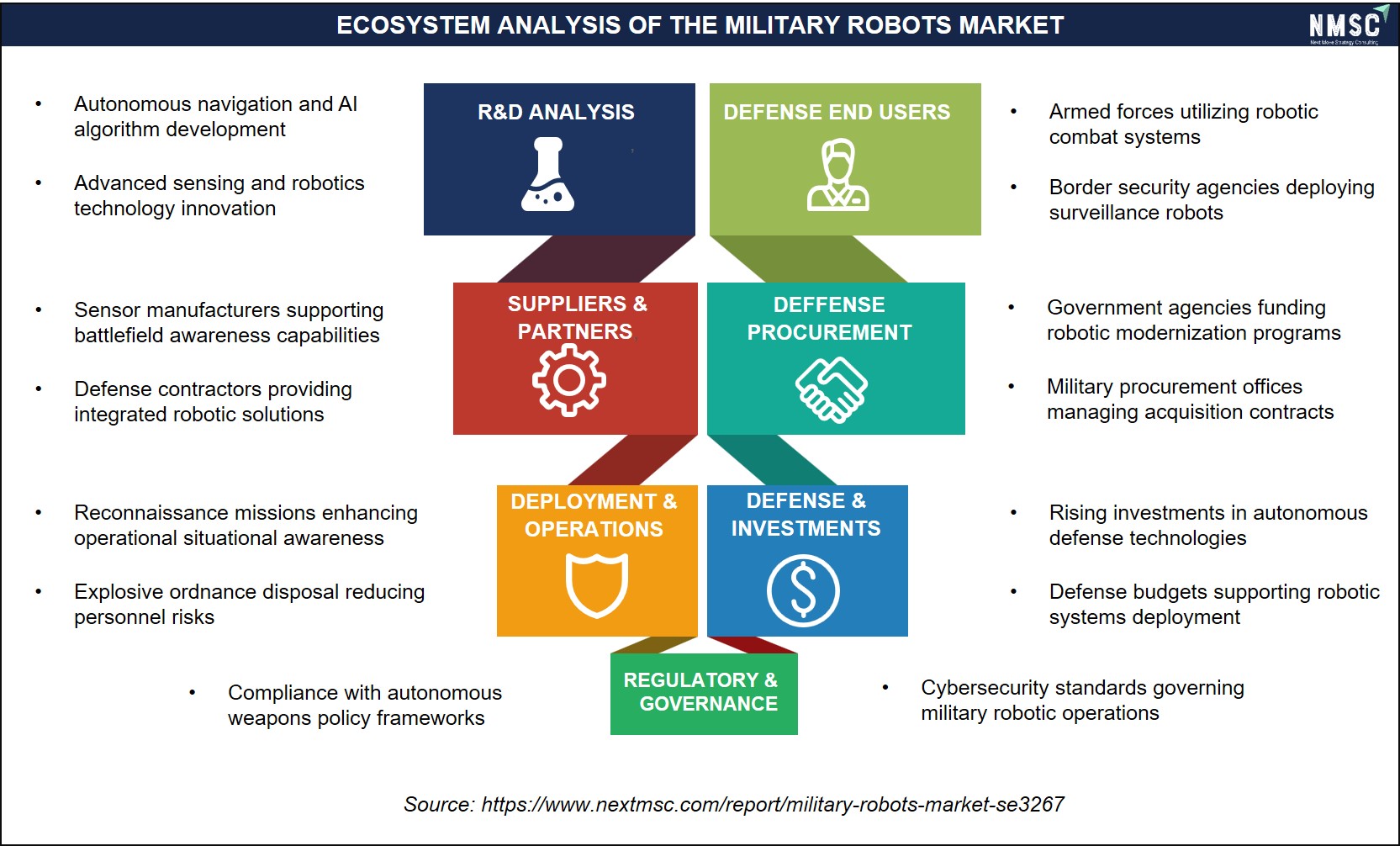
Our analysis indicates that the Military Robots Market is supported by a sophisticated ecosystem comprising defense technology developers, military organizations, component suppliers, procurement agencies, and regulatory authorities. The assessment indicates that advancements in artificial intelligence, autonomous navigation, sensing technologies, and robotic platforms are accelerating innovation across defense applications. Additionally, increasing defense investments, modernization initiatives, and strategic partnerships are strengthening deployment capabilities. Regulatory oversight, cybersecurity requirements, and operational governance frameworks further support technology integration. Consequently, continuous innovation and defense modernization programs are strengthening ecosystem expansion globally.
What Are the Key Market Drivers, Breakthroughs, and Investment Opportunities that Will Shape the Military Robots Market in the Next Decade?
|
Drivers / Trends / Restraints |
(+/-) % Impact on CAGR Forecast |
Geographic Relevance |
Impact Timeline |
|
Escalating Global Defense Budgets and Geopolitical Tensions |
+2.1% |
Global (led by North America, Europe, APAC) |
2025–2035 |
|
AI and Machine Learning Integration into Autonomous Platforms |
+1.8% |
North America, Europe, Asia-Pacific |
2025–2030 |
|
Surging Multi-Domain ISR Demand |
+1.4% |
Global (all regions) |
2025–2032 |
|
Loitering Munition Proliferation in Active Conflict Theaters |
+1.2% |
Europe, MEA, APAC |
2025–2030 |
|
NATO 2% GDP Defense Spending Commitments |
+1.0% |
Europe, North America |
2026–2035 |
|
Counter-Drone and Electronic Warfare System Demand |
+0.9% |
Global |
2025–2032 |
|
Maritime UAS and XLUUV Procurement Growth |
+0.8% |
North America, APAC, Europe |
2026–2035 |
|
High Development, Lifecycle, and Procurement Costs |
-0.9% |
All regions (SMB defense budgets) |
Ongoing |
|
International Regulatory Constraints on Autonomous Lethal Systems |
-0.7% |
Europe, North America |
Ongoing |
|
Emerging Market Defense Modernization (Southeast Asia, MEA) |
+1.1% |
APAC, MEA |
2026–2035 |
|
Commercial Drone Technology Crossover and Cost Reduction |
+1.6% |
Global |
2025–2032 |
What Are the Growth Drivers of the Military Robots Market?
How Is the Escalation of Global Defense Budgets Propelling the Military Robots Market?
Rising defense expenditure across NATO member states, Indo-Pacific allies, and Gulf Cooperation Council nations is the most consequential structural driver of Unmanned Military Systems investment globally. According to NATO's Secretary General's Annual Report 2023, twenty-three of thirty-one NATO allies met or exceeded the 2% GDP defense spending target in 2023, representing a sustained trend toward budget expansion. Our analysis shows that the U.S. fiscal year 2025 National Defense Authorization Act allocated increased funding specifically for autonomous systems and unmanned platform programs, including the Replicator initiative targeting deployment of thousands of autonomous systems across multiple domains within 18 to 24 months.
How Is the Proliferation of Artificial Intelligence Accelerating Adoption in the Military Robots Market?
Artificial intelligence is the most transformative enabling technology within the Military Autonomous Systems landscape, directly accelerating procurement cycles and unlocking new mission capabilities across all platform categories. Through NMSC's assessment, we found that the U.S. Department of Defense AI Strategy and subsequent National Defense Science and Technology Strategy prioritize AI integration across robotic platforms as a core modernization objective. AI-driven autonomy enables platforms to process multi-spectral sensor data in real time, perform onboard threat assessment, execute obstacle avoidance, and maintain formation integrity during GPS-denied operations, dramatically expanding the operational envelope of unmanned systems in contested environments.
How Is Growing Multi-Domain ISR Demand Driving Investment in the Military Robots Market?
The structural shift toward multi-domain operations doctrine across NATO, U.S., and partner defense forces has elevated persistent ISR capability as a non-negotiable operational requirement, directly driving sustained investment in the Robotic Warfare Systems segment. Our assessment indicates that the U.S. Army's Aerial Intelligence, Reconnaissance, and Surveillance Enterprise (AIRS) program exemplifies centralized investment in autonomous airborne ISR assets. The ISR mission segment leads all mission categories in the Military Robots Market at a CAGR of 11.07%, reflecting the growing operational reliance on continuous, real-time battlefield awareness delivered by unmanned platforms operating independently of manned aviation assets across all theaters and environmental conditions.
What Are the Growth Inhibitors of the Military Robots Market?
How Do High Development and Lifecycle Costs Constrain Expansion of the Defense Robotics Market?
Despite falling unit costs for smaller UAVs driven by commercial technology crossover, high development and lifecycle costs remain a significant restraint on Defense Robotics Market expansion, particularly for advanced multi-domain platforms. Full-system lifecycle costs for programs such as the U.S. MQ-9 Reaper include sustained procurement, depot maintenance, sensor upgrades, and ground control station modernization, creating multi-decade financial commitments that constrain available procurement budgets for emerging platform types. The U.S. Government Accountability Office has documented cost growth patterns in major defense acquisition programs, noting that unmanned systems programs are not immune to the schedule delays and cost overruns that affect conventional acquisition pathways.
How Do International Regulatory Frameworks on Autonomous Lethal Systems Limit Combat Robotics Market Growth?
International legal and policy constraints on fully autonomous lethal weapons systems create structural uncertainty that slows Combat Robotics Market adoption in the most advanced autonomy tier. The ongoing deliberations at the UN Convention on Certain Conventional Weapons regarding Lethal Autonomous Weapons Systems (LAWS) have not yet produced binding restrictions, but they create procurement risk for defense forces and contractors investing in fully autonomous lethal platforms. The U.S. DoD Directive 3000.09 mandates that autonomous weapon systems be designed to allow commanders and operators to exercise appropriate levels of human judgment, requiring engineering and testing investments that extend development timelines and increase per-unit program costs for next-generation systems.
What Are the Growth Opportunities in the Military Robots Market?
How Does the Convergence of Commercial and Defense Drone Technology Create Opportunities for Unmanned Defense Platforms?
The rapid maturation of commercial drone technologies is creating a structural cost-reduction opportunity within the Unmanned Defense Platforms segment, enabling defense forces to acquire capable ISR and logistics support systems at substantially lower unit costs than traditional defense-specific development pathways. Our findings suggest that the U.S. Army's Short-Range Reconnaissance program, which leverages commercial small UAS technology adapted for military use, exemplifies the scalable procurement model enabled by commercial crossover. The Federal Aviation Administration's Beyond Visual Line of Sight (BVLOS) regulatory developments for commercial drones are simultaneously advancing the airspace management frameworks and communications architectures relevant to military unmanned systems operations in joint airspace environments.
How Is Defense Modernization Across Emerging Markets Generating New Demand for Autonomous Defense Systems?
Significant defense modernization investment across Southeast Asia, South Asia, and the Gulf region is generating new procurement opportunities for Autonomous Defense Systems vendors beyond the traditional U.S., European, and Israeli core markets. India's defense acquisition modernization under the Defence Acquisition Procedure 2020 allocates substantial funding to domestic and imported UAV systems, including the approved acquisition of MQ-9B SeaGuardian platforms. According to the Stockholm International Peace Research Institute (SIPRI) Arms Transfers Database, arms imports by Southeast Asian nations, including the Philippines, Vietnam, and Indonesia, reflect rising procurement interest in airborne ISR and maritime surveillance unmanned systems as regional maritime security concerns intensify.
How Are Counter-Drone and Electronic Warfare Capabilities Opening New Revenue Streams in Military AI Robotics?
The proliferation of adversarial commercial drones on modern battlefields is creating substantial investment momentum in counter-drone and electronic warfare capabilities within the Military AI Robotics segment. Based on NMSC's research, we found that the U.S. Army's counter-small unmanned aerial systems (c-sUAS) strategy and associated Joint C-sUAS Office procurement programs represent a multi-billion-dollar acquisition pipeline spanning detection systems, kinetic interceptors, and directed-energy effectors. Electronic Warfare robotic platforms capable of autonomous spectrum sensing, jamming, and signal exploitation are among the fastest-growing mission sub-categories, with a projected CAGR of 10.85% from 2026 to 2035, driven by near-peer competitor investments in spectrum denial and cyber-physical disruption capabilities.
How Is the Military Robots Market Segmented in This Report, and What Are the Key Insights from the Segmentation Analysis?
How Do Airborne, Land, and Maritime Platforms Define the Structural Composition of the Military Robots Market?
|
Platform Type |
2025 (USD Mn) |
2035 (USD Mn) |
CAGR (%) |
|
Airborne Robots |
9,194.0 |
28,792.8 |
9.29% |
|
Land Robots |
9,115.3 |
27,458.7 |
8.87% |
|
Maritime Robots |
7,884.6 |
27,547.9 |
10.51% |
Based on our analysis of global defense procurement trends, the Military Robots Market is segmented into Airborne, Land, and Maritime robotic platforms. Airborne Robots currently hold the largest revenue share at USD 9.19 billion in 2025, driven by the extensive Fixed-Wing UAV and Rotary-Wing UAV fleets operated by major air forces and armies globally. Within airborne platforms, Loitering Munitions are the fastest-growing sub-segment at a CAGR of 13.03%, reflecting their expanding role in precision strike missions. Fixed-Wing UAVs remain the dominant sub-segment given established procurement programs. Land Robots are experiencing strong growth across Wheeled and Tracked UGV categories as ground forces worldwide introduce autonomous combat support and logistics vehicles. Maritime Robots lead platform-level CAGR growth at 10.51%, anchored by rising naval investment in Uncrewed Surface Vessels and Autonomous Underwater Vehicles.
Which Mission Categories Are Driving Revenue Concentration in the Military Robots Market?
|
Mission Segment |
2025 (USD Mn) |
2035 (USD Mn) |
CAGR (%) |
|
ISR |
4,146.9 |
15,248.4 |
11.07% |
|
Combat Operations |
3,854.9 |
11,461.5 |
8.72% |
|
Electronic Warfare |
3,679.9 |
13,277.1 |
10.85% |
|
Mine Countermeasures (Maritime MCM) |
3,315.1 |
9,618.9 |
8.46% |
|
EOD |
2,414.1 |
7,272.7 |
8.88% |
|
Mine Clearance |
2,401.1 |
6,642.3 |
7.93% |
|
Logistics Support |
2,274.2 |
7,020.4 |
9.14% |
|
Training and Simulation |
2,014.5 |
6,894.4 |
10.27% |
|
Other Mission |
2,093.2 |
6,363.7 |
8.97% |
Our analysis of military operational requirements and defense acquisition priorities reveals that the Military Robots Market mission segmentation spans ISR, Combat Operations, Electronic Warfare, Mine Countermeasures, EOD, Mine Clearance, Logistics Support, Training and Simulation, and Other missions. The ISR segment dominates at USD 4.15 billion in 2025, reflecting the foundational role of persistent unmanned surveillance in modern warfare doctrines adopted by NATO and Indo-Pacific partners. ISR is simultaneously the fastest-growing mission at an 11.07% CAGR, driven by increasing sensor payload diversity and AI-assisted data processing. Electronic Warfare is the second-fastest growing segment at 10.85%, as armed forces prioritize spectrum dominance. Training and Simulation is expanding at 10.27% CAGR as defense organizations scale realistic unmanned systems training programs without exposing live platforms to wear and operational risk.
How Does Autonomy Level Distribution Reflect Operational Maturity in the Military Robots Market?
|
Autonomy Level |
2025 (USD Mn) |
2035 (USD Mn) |
CAGR (%) |
|
Teleoperated |
6,613.4 |
18,088.7 |
7.80% |
|
Semi-Autonomous |
10,484.9 |
31,871.6 |
8.96% |
|
Fully Autonomous |
9,095.6 |
33,839.1 |
11.21% |
From our market assessment, we observed that the Military Robots Market autonomy level segmentation reflects a transition from predominantly teleoperated systems toward semi-autonomous and fully autonomous platforms. Semi-Autonomous systems command the largest revenue share at USD 10.48 billion in 2025, representing defense forces' preference for human-in-the-loop architectures that satisfy DoD Directive 3000.09 and equivalent allied policies while delivering mission effectiveness benefits. Fully Autonomous systems represent the fastest-growing tier at an 11.21% CAGR, driven by maturation of AI and computer vision capabilities that enable reliable autonomous operation in non-lethal mission categories including logistics, ISR, and mine clearance. Teleoperated systems retain relevance for high-consequence EOD and combat operations where direct human control remains operationally preferred.
Which Military End Users Are Driving the Highest Investment Levels in the Military Robots Market?
|
End User |
2025 (USD Mn) |
2035 (USD Mn) |
CAGR (%) |
|
Air Force |
6,407.6 |
20,189.6 |
9.36% |
|
Army |
5,343.3 |
19,073.7 |
10.74% |
|
Navy |
4,559.8 |
15,239.3 |
10.01% |
|
Special Forces |
4,219.8 |
11,180.0 |
7.46% |
|
Marine Corps |
3,170.3 |
10,040.0 |
9.42% |
|
Other Defense Forces |
2,493.2 |
8,076.9 |
9.65% |
Based on NMSC's research, we found that the Military Robots Market end-user segmentation spans Air Force, Army, Navy, Special Forces, Marine Corps, and Other Defense Forces, reflecting the multi-service adoption of unmanned and autonomous systems across all military domains. The Air Force segment holds the largest revenue share at USD 6.41 billion in 2025, driven by sustained procurement of fixed-wing ISR platforms, strike-capable UAVs, loitering munitions, and target drones across major air forces globally. The Army is the fastest-growing end-user segment at a CAGR of 10.74%, reflecting accelerating ground robot procurement including UGVs, EOD robots, and autonomous logistics vehicles. The Navy is growing at 10.01% CAGR as naval forces expand investment in USVs, AUVs, and XLUUVs for undersea and surface autonomous operations.
Regional Outlook
Geographic Performance Snapshot
|
Region |
2025 (USD Mn) |
2035 (USD Mn) |
CAGR (%) |
Key Driver |
|
North America |
10,359.7 |
32,120.3 |
9.19% |
U.S. Replicator initiative, multi-service UAV procurement, Navy XLUUV programs |
|
Asia-Pacific |
7,195.5 |
25,927.5 |
10.83% |
China UAV expansion, India MALE/HALE procurement, South Korea DMZ robotics |
|
Europe |
5,644.8 |
19,265.5 |
10.24% |
NATO 2% commitment, Ukraine conflict lessons, EU defense industrial expansion |
|
Middle East & Africa |
2,216.0 |
4,952.5 |
5.61% |
Gulf state modernization, Israeli platform exports, ISR demand |
|
Latin America |
778.0 |
1,533.5 |
4.25% |
Border surveillance, counter-narcotics UAS, limited defense budgets |
North America Military Robots Market
North America dominates the Military Robots Market, contributing USD 10.36 billion in 2025 and forecast to reach USD 32.12 billion by 2035 at a CAGR of 9.19%. The region benefits from the world's largest defense R&D budget, concentrated at the U.S. DoD, comprehensive multi-service UAV and autonomous system acquisition programs, and a deeply integrated defense industrial base. The Replicator initiative, NATO interoperability requirements, and the Navy's XLUUV program underpin sustained demand. Canada and Mexico contribute niche but growing procurement budgets focused on maritime patrol, border security, and counter-narcotics unmanned systems operations.
U.S. Military Robots Market
Based on our engagements with defense industry stakeholders, the United States represents over 80% of North American Military Robots Market revenue, making it the world's single largest national market. The U.S. DoD's fiscal year 2025 budget request included sustained funding for the Army's Robotic Combat Vehicle program, the Navy's Orca XLUUV, and the Air Force's Collaborative Combat Aircraft initiative. The Defense Innovation Unit and DARPA continue to accelerate technology development and adoption cycles. Export control frameworks governed by ITAR tightly manage technology transfer, sustaining domestic vendor concentration while limiting foreign competition in core platform categories.
Canada Military Robots Market
Through our analysis, Canada is a strategically aligned but budget-constrained participant in the North American Military Robots Market. The Royal Canadian Air Force operates medium-altitude ISR UAVs, and the Canadian Army has evaluated autonomous ground systems for logistics and route clearance missions. Canada's defense procurement, managed through Public Services and Procurement Canada, benefits from the U.S.–Canada Defense Production Sharing Agreement, enabling joint technology access. Increasing NATO commitments and Arctic surveillance requirements are driving demand for cold-weather-capable ISR drones and autonomous surface vessels.
Mexico Military Robots Market
From our assessment, Mexico represents a developing segment of the Military Robots Market primarily focused on border security, counter-narcotics, and cartel surveillance applications using small and medium UAVs. The Mexican Secretariat of National Defense operates commercially derived fixed-wing and multi-rotor ISR platforms. Budgetary constraints limit high-end autonomous system procurement, though growing security challenges are gradually expanding the use case for unmanned aerial and ground surveillance systems. International cooperation programs with U.S. agencies provide indirect access to advanced unmanned surveillance technologies under security assistance frameworks.
Europe Military Robots Market
Europe is the second-largest region in the Military Robots Market, contributing USD 5.64 billion in 2025 and forecast to reach USD 19.27 billion by 2035 at a CAGR of 10.24%. NATO burden-sharing commitments, the operational lessons derived from the Ukraine conflict, and accelerating EU defense industrial investment are simultaneously driving procurement and domestic capability development. Loitering munitions, tactical ISR drones, and autonomous EOD platforms have become priority procurement items across Central and Eastern European NATO members. Major European defense contractors including BAE Systems, Rheinmetall, Thales, Saab, and Leonardo are scaling unmanned system production and technology integration programs.
Military Expenditure in European Countries
|
Standard Countries |
Military Expenditure in 2024 (USD Billion) |
|
UK |
89.81 |
|
Germany |
86.15 |
|
France |
63.57 |
|
Italy |
37.85 |
|
Spain |
25.2 |
|
Denmark |
9.64 |
|
Netherlands |
23.58 |
|
Finland |
6.5 |
|
Sweden |
12.05 |
|
Rest of EU |
118.45 |
UK Military Robots Market
Based on our engagements with European defense market participants, the United Kingdom holds the largest individual country share in the European Military Robots Market. The UK MoD's Integrated Review and Defence Command Paper identified uncrewed systems as a central pillar of future force structure. The Protector RG Mk1 program introduces advanced remotely piloted air systems, while Malloy Aeronautics supplies heavy-lift drones for logistics. The UK's commitment to developing autonomous combat aircraft through the FCAS Team Tempest program signals long-term structural investment in defense robotics technology and industrial capability.
Germany Military Robots Market
According to evaluation of Germany's defense modernization trajectory, the Bundeswehr is significantly expanding autonomous systems procurement as part of the Zeitenwende defense investment program, which allocated EUR 100 billion in special defense funding following Russia's invasion of Ukraine. Germany operates Heron TP ISR drones and is advancing procurement of medium-altitude UAVs for persistent surveillance. Rheinmetall AG is developing the Mission Master autonomous UGV family for logistics and armed reconnaissance, positioning Germany as both a significant domestic Military Robots Market consumer and an emerging autonomous systems exporter.
France Military Robots Market
Through our analysis, France maintains an advanced and domestically oriented Military Robots Market anchored by sustained investment under the Loi de Programmation Militaire 2024–2030, which allocated increased funding for autonomous drone systems and combat UAS development. The French Army is fielding the Patroller tactical UAV and investing in loitering munition development through the AeroSmart and future SMDR programs. Thales and Safran are the primary domestic platform integrators. France's strategic autonomy doctrine creates strong preference for domestic sourcing, limiting import penetration and supporting indigenous military robotics capability development.
Italy Military Robots Market
From our assessment, Italy's Military Robots Market is centered on the Leonardo-led Falco EVO ISR UAV program and increasing tactical drone adoption within the Italian Army and Navy. Italy participates in European collaborative defense programs and is investing in maritime autonomous surveillance systems for Mediterranean security operations. The Italian defense budget expansion under NATO commitments is gradually accelerating autonomous systems procurement, particularly for persistent maritime ISR and anti-piracy surveillance missions in the Mediterranean and Gulf of Aden operational areas.
Spain Military Robots Market
Based on our engagements, Spain's Military Robots Market reflects a transitional procurement environment characterized by increasing small and medium ISR UAV adoption and early-stage autonomous ground vehicle evaluation programs. The Spanish Armed Forces operate SAGEM Sperwer tactical UAVs and have expressed procurement interest in loitering munition capabilities. Spain's participation in EU defense industry programs through the European Defence Fund supports domestic R&D in autonomous systems. Airbus Defence & Space, headquartered in Getafe, contributes domestically developed UAV technologies to Spanish and allied defense procurement.
Sweden Military Robots Market
Through our analysis, Sweden's Military Robots Market is distinguished by high-value Saab AB contributions to autonomous systems technology and growing Swedish Armed Forces investment in tactical UAVs, autonomous surface vessels, and autonomous underwater mine countermeasure systems. Sweden's NATO accession in 2024 creates new interoperability requirements and procurement access pathways. The Swedish FMV defense procurement agency has prioritized unmanned systems in its capability development roadmap, with particular emphasis on maritime surveillance and undersea mine threat neutralization in the Baltic Sea operational environment.
Denmark Military Robots Market
From our assessment, Denmark's Military Robots Market is growing driven by increased NATO commitments and Arctic surveillance requirements. The Danish Armed Forces are investing in maritime ISR drones and autonomous patrol capabilities for North Sea and Arctic operations. Denmark's 2024 defense agreement significantly raised defense spending, creating new procurement capacity for unmanned systems. Danish company Sky-Watch produces tactical fixed-wing ISR UAVs that serve both domestic and export markets, contributing to the local defense robotics ecosystem.
Finland Military Robots Market
Based on our engagements, Finland's Military Robots Market reflects growing investment following NATO accession and sustained awareness of the Russian border threat. The Finnish Defence Forces have integrated small tactical UAVs into combined-arms operations and evaluated autonomous logistics support robots for Arctic terrain operations. Finland's defense procurement emphasizes robust, cold-weather-capable autonomous systems designed for Finland's specific operational environment. The war in Ukraine has accelerated Finnish procurement urgency and highlighted specific capability gaps in persistent surveillance and counter-drone systems that unmanned platforms can address.
Netherlands Military Robots Market
Through our analysis, the Netherlands Military Robots Market is driven by the Royal Netherlands Army and Navy's sustained investment in tactical ISR UAVs and maritime autonomous patrol vessels. The Netherlands Defence Materiel Organisation prioritizes interoperability with NATO allies, creating demand for standardized unmanned systems platforms. The Dutch Navy is actively evaluating autonomous mine countermeasure vehicles for North Sea and Wadden Sea operations. Netherlands-based companies including C2 Systems contribute to unmanned systems integration, while Dutch defense participation in NATO multinational procurement programs supports collective capability development.
Rest of Europe Military Robots Market
From our assessment, the Rest of Europe Military Robots Market segment encompasses NATO members and partner nations including Poland, Romania, Turkey, Norway, Belgium, the Czech Republic, and others experiencing accelerating autonomous systems procurement. Poland has significantly expanded drone and loitering munition acquisitions following NATO commitments and Ukraine conflict proximity. Turkey, through Baykar and TAI, is both a significant domestic Military Robots Market consumer and a major loitering munition and MALE UAV exporter, complicating its classification as a pure importer in NATO-focused analysis.
Asia-Pacific Military Robots Market
Asia-Pacific is the fastest-growing major region in the Military Robots Market at a CAGR of 10.83% from 2026 to 2035, advancing from USD 7.20 billion in 2025 to USD 25.93 billion by 2035. The region's growth reflects China's large-scale military drone modernization program, India's expanding UAV procurement pipeline, South Korea's investment in autonomous DMZ surveillance systems, Japan's growing maritime UAS capabilities, and Taiwan's accelerating autonomous system development in response to cross-strait security dynamics. The Indo-Pacific strategic theater is increasingly defined by unmanned system competition, driving multi-decade procurement cycles across all platform categories.
China Military Robots Market
Based on our engagements with Asia-Pacific defense analysts, China represents the largest single country market in the Asia-Pacific Military Robots Market and the most significant global competitor to U.S. autonomous systems leadership. China's People's Liberation Army operates the world's second-largest military drone fleet, including Wing Loong MALE UAVs, CH-series drones, and advanced loitering munitions. China's military-civil fusion strategy channels commercial drone R&D from companies such as DJI into PLA system development. State investment in AI-enabled autonomous combat systems positions China as both a dominant consumer and a globally disruptive exporter of affordable military drone platforms.
India Military Robots Market
Through our analysis, India is the fastest-growing significant market within Asia-Pacific's Military Robots Market, driven by the Defence Acquisition Procedure 2020 and the Make in India defence manufacturing initiative. India has approved acquisition of MQ-9B Predator drones for tri-service use and is developing indigenous MALE UAVs through DRDO and HAL. The iDEX innovation ecosystem has accelerated startup-led autonomous system development. India's 2025–2030 defence capital procurement budget allocates increasing funding to unmanned systems across the Indian Army, Navy, and Air Force, reflecting strategic priority placed on autonomous ISR and strike capabilities along contested borders.
Japan Military Robots Market
From our assessment, Japan's Military Robots Market is experiencing a structural shift following the country's 2022 National Security Strategy, which dramatically increased defence spending toward 2% of GDP and identified autonomous systems as a priority capability. The Japan Air Self-Defense Force operates RQ-4 Global Hawk UAVs for maritime domain awareness, while the Japan Maritime Self-Defense Force is investing in autonomous underwater mine countermeasure vehicles. Japan's defence industrial base, led by Mitsubishi Heavy Industries and Kawasaki Heavy Industries, is developing domestically designed unmanned platforms for joint ISR and logistics roles.
South Korea Military Robots Market
Based on our engagements, South Korea's Military Robots Market reflects one of the world's most compelling autonomous system deployment environments, with the Korean Demilitarized Zone providing operational justification for persistent autonomous surveillance and armed robot systems. Samsung Techwin and LIG Nex1 develop autonomous DMZ surveillance systems, while Korean Aerospace Industries advances military UAV programs. South Korea's Defense Acquisition Program Administration has allocated substantial procurement budgets to UAVs, autonomous sentry robots, and maritime unmanned systems, driven by North Korean drone incursion incidents and evolving conventional warfare threat assessments.
Taiwan Military Robots Market
Through our analysis, Taiwan's Military Robots Market is characterized by urgency-driven procurement and asymmetric defense strategy requirements. The Republic of China Armed Forces are investing in suicide drones, ISR UAVs, and coastal surveillance autonomous systems as cost-effective deterrents against potential amphibious operations. Taiwan's National Chung-Shan Institute of Science and Technology is domestically developing tactical UAVs and loitering munitions. U.S. Foreign Military Sale programs provide access to advanced ISR platforms, while Taiwan's growing local defense industry is accelerating autonomous system development timelines to address immediate security imperatives.
Indonesia Military Robots Market
From our assessment, Indonesia's Military Robots Market is growing steadily as the Indonesian National Armed Forces (TNI) prioritize maritime domain awareness across the world's largest archipelago. Indonesia operates domestically developed PUNA Wulung ISR UAVs and is evaluating procurement of larger MALE platforms for extended maritime patrol. Indonesia's broad maritime exclusive economic zone creates structural demand for autonomous surveillance. The government's growing defense budget, supported by Indonesia's economic expansion, is gradually enabling higher-value unmanned systems procurement including naval autonomous surface patrol vessels for monitoring key shipping lanes.
Vietnam Military Robots Market
Based on our engagements, Vietnam's Military Robots Market is developing in response to South China Sea sovereignty tensions and the Vietnam People's Army's maritime security priorities. Vietnam operates small ISR UAVs and is investing in coastal surveillance autonomous systems. Defense modernization is constrained by budget limitations but is accelerating due to strategic imperatives. Vietnam's defense procurement diversification strategy, which includes acquisitions from Israel, Russia, and Western suppliers, creates opportunities for autonomous systems vendors offering cost-effective maritime surveillance and ISR platforms suitable for Vietnam's operational environment and budget parameters.
Australia Military Robots Market
Through our analysis, Australia's Military Robots Market reflects strong capability investment driven by the 2023 National Defence Strategy and AUKUS security partnership commitments. The Australian Defence Force operates Boeing MQ-28 Ghost Bat Loyal Wingman platforms and is investing in autonomous maritime mine countermeasure systems. AUKUS Pillar II, which focuses on advanced capabilities including autonomous underwater vehicles, creates a structured multi-decade investment pathway. Australia's geographic context creates strong demand for long-endurance maritime ISR drones and autonomous undersea surveillance systems across the Indo-Pacific operational environment.
Philippines Military Robots Market
From our assessment, the Philippines Military Robots Market is expanding driven by South China Sea territorial disputes and the Armed Forces of the Philippines' modernization program under the Horizon 2 and 3 acquisition roadmaps. The Philippines has procured Israeli-made UAVs and is evaluating maritime patrol drone systems for West Philippine Sea surveillance operations. U.S. security assistance under the Enhanced Defence Cooperation Agreement provides access to advanced intelligence and surveillance technologies. Funding constraints limit high-end autonomous platform acquisition, but ISR drone procurement is a declared priority within the AFP modernization budget.
Malaysia Military Robots Market
Based on our engagements, Malaysia's Military Robots Market is centered on the Royal Malaysian Air Force's tactical ISR drone programs and the Royal Malaysian Navy's growing interest in autonomous maritime patrol vessels for Strait of Malacca security. Malaysia has operated Aludra SR-10 UAVs and is evaluating foreign procurement of medium-altitude ISR platforms. The National Aerospace Industry Corporation provides some domestic manufacturing capability. Malaysia's strategic maritime position in Southeast Asia's busiest shipping lanes creates persistent demand for autonomous surveillance capabilities across both military and coast guard operational domains.
Rest of Asia-Pacific Military Robots Market
Through our analysis, the Rest of Asia-Pacific Military Robots Market encompasses significant and growing procurement from defense forces in Thailand, Singapore, Bangladesh, Pakistan, New Zealand, Sri Lanka, and other nations. Singapore's Defence Science and Technology Agency leads one of the region's most technologically advanced autonomous systems development programs, including autonomous ground robots and unmanned naval vessels. Pakistan's aeronautical complex is developing MALE UAVs domestically while importing platforms from Turkey and China. Thailand and New Zealand are expanding tactical UAV fleets under bilateral defense partnerships with major Indo-Pacific allies.
Middle East and Africa Military Robots Market
The Middle East and Africa Military Robots Market contributed USD 2.22 billion in 2025 and is forecast to reach USD 4.95 billion by 2035 at a CAGR of 5.61%. While representing the slowest growth among major regions, absolute procurement volumes are substantial, particularly in Gulf Cooperation Council nations investing in advanced MISR and loitering munition capabilities. Israel drives significant domestic military robotics innovation and export activity. African nation procurement is limited by budget constraints but growing in UAV-based border surveillance and counter-insurgency applications. The region's operational experience with drone warfare provides significant real-world performance data driving platform development globally.
Saudi Arabia Military Robots Market
Based on our engagements, Saudi Arabia is the largest Military Robots Market in the MEA region, driven by Vision 2030 defense industrialization goals and the Royal Saudi Air Force's sustained UAV procurement programs. Saudi Arabia has procured U.S.-made ISR drones and is investing in domestic defense manufacturing capability through the Saudi Arabian Military Industries (SAMI) joint venture framework. Counter-drone systems are a priority acquisition following Houthi drone and cruise missile attacks on Saudi infrastructure. Saudi Arabia's defense budget, one of the world's largest, creates substantial procurement capacity for advanced autonomous systems across multiple service branches.
UAE Military Robots Market
Through our analysis, the UAE Military Robots Market reflects the advanced procurement posture of the UAE Armed Forces, which have deployed Predator-class and CH-4 drones operationally and are investing significantly in domestically developed unmanned systems through EDGE Group subsidiaries including HALCON and Calidus. The UAE's operational experience in Yemen and Libya with loitering munitions and armed UAVs provides domestic demand for continued platform development. The UAE's defense industrial diversification strategy, anchored in Abu Dhabi, is creating a growing export-capable military drone manufacturing ecosystem within the MEA region.
Egypt Military Robots Market
From our assessment, Egypt's Military Robots Market is driven by the Egyptian Armed Forces' counter-insurgency operations in Sinai and growing demand for border surveillance UAV systems across Egypt's expansive desert frontier regions. Egypt operates Chinese-supplied Wing Loong drones and has expressed interest in domestically manufactured ISR platforms through the Arab Organisation for Industrialisation. Egypt's strategic positioning as a regional security hub and its large military establishment create structural long-term demand for affordable and operationally proven unmanned systems across army, navy, and air force service branches.
Israel Military Robots Market
Based on our engagements, Israel is the most technologically advanced Military Robots Market in MEA and among the top five globally, characterized by a highly capable domestic defense robotics industrial base anchored in Israel Aerospace Industries, Elbit Systems, and Rafael Advanced Defense Systems. Israel was first to operationally deploy loitering munitions (Harop), autonomous ground patrol robots (Guardium UGV), and AI-enabled border surveillance systems. Extensive export programs position Israeli military robotics firms as globally dominant suppliers, particularly in loitering munitions, tactical UAVs, and autonomous ground vehicle sectors worldwide.
Turkey Military Robots Market
Through our analysis, Turkey's Military Robots Market is uniquely positioned as both a significant consumer and an increasingly dominant global exporter of military drones. Baykar's Bayraktar TB2 MALE drone achieved global recognition through operational success in conflicts in Libya, Nagorno-Karabakh, Ukraine, and Syria, establishing Turkey as a tier-one military drone exporter. Turkish Aerospace Industries' Akıncı UCAV and Baykar's Kizilelma UCAV represent next-generation development programs. Turkey's military robotics industry has rapidly matured from domestic consumer to globally competitive exporter, challenging established Western suppliers across the MALE and UCAV market segments.
Nigeria Military Robots Market
From our assessment, Nigeria's Military Robots Market is primarily driven by counter-insurgency and counter-terrorism requirements associated with Boko Haram and ISWAP operations in the Northeast and maritime security needs in the Gulf of Guinea. The Nigerian Air Force operates Chinese-supplied CH-3 and CH-4 armed drones, demonstrating the growing affordability of capable drone platforms for African defense forces. Budget constraints limit procurement scale, but operational urgency is driving continued investment in airborne ISR and armed drone capabilities as Nigeria addresses persistent internal security challenges across multiple geographic operational theaters.
South Africa Military Robots Market
Based on our engagements, South Africa's Military Robots Market reflects a technically capable but budget-constrained defense industrial base. Denel Dynamics has developed the Seeker ISR UAV platform for domestic use and export. South Africa's defence budget limitations have significantly constrained large-scale unmanned system procurement, though the South African National Defence Force is evaluating autonomous border surveillance systems for land and maritime frontier security. Peacekeeping operations across the African continent create ongoing demand for tactical UAV capabilities, while domestic industrial development programs support local technology manufacturing goals.
Rest of MEA Military Robots Market
Through our analysis, the Rest of MEA Military Robots Market encompasses growing procurement from defense forces in Kuwait, Qatar, Bahrain, Jordan, Morocco, Ethiopia, Kenya, and other nations. Gulf Cooperation Council members including Kuwait and Qatar are expanding autonomous systems acquisition through U.S. and European foreign military sale programs. North African nations including Morocco and Algeria are investing in Chinese and Turkish military drone systems. Sub-Saharan African peacekeeping operations are increasingly incorporating tactical UAVs under UN mission frameworks, driving graduated adoption of unmanned systems across the continent's diverse security environments.
Latin America Military Robots Market
Latin America is the slowest-growing Military Robots Market region at a CAGR of 4.25%, advancing from USD 778.0 million in 2025 to USD 1,533.5 million by 2035. Budget constraints, limited threat perception of peer-state conflict, and reliance on internal security applications such as border surveillance and counter-narcotics operations characterize regional procurement. Brazil dominates the regional market through its domestically developed Hermes 900 drone partnership and Embraer Defence-linked programs. The Inter-American Defense Board's growing focus on regional security cooperation may gradually elevate collective investment in shared autonomous surveillance capabilities across the region.
Brazil Military Robots Market
Based on our engagements, Brazil holds the largest Military Robots Market in Latin America, anchored by the Brazilian Air Force's operation of Hermes 900 ISR drones acquired under a technology transfer agreement with Israel. The Brazilian Army is evaluating autonomous ground vehicles for Amazon surveillance and border security operations across the world's largest tropical frontier. EMBRAER's defence subsidiary and the Brazilian Army Technology Center are developing indigenous autonomous system capabilities. Brazil's Amazon monitoring imperatives and border security requirements create consistent demand for long-endurance ISR drones and autonomous surveillance systems adapted to tropical operational conditions.
Argentina Military Robots Market
Through our analysis, Argentina's Military Robots Market is growing modestly, driven by Falkland/Malvinas maritime surveillance requirements and border security ISR needs. The Argentine Air Force has evaluated tactical UAV acquisition options, while the Argentine Navy is interested in maritime patrol autonomous systems. Budget constraints have historically delayed procurement programs, but Argentina's 2024 defense modernization agenda includes UAV acquisition as a stated priority. Domestic development through the Argentine Army's robotics research programs contributes niche capability development, though large-scale procurement remains constrained by economic conditions and competing budget priorities.
Chile Military Robots Market
From our assessment, Chile's Military Robots Market benefits from a relatively robust defense budget by Latin American standards and a professional military culture that prioritizes technology adoption. The Chilean Air Force operates Hermes 450 ISR UAVs and has evaluated medium-altitude platforms for extended Pacific coast surveillance. Chile's tri-service defence modernization program includes unmanned systems as a capability development priority. Chile's Pacific coast geography and Antarctic territory responsibilities create unique long-endurance maritime ISR requirements that align with emerging naval autonomous systems capabilities including autonomous surface vessels and long-range UAVs.
Colombia Military Robots Market
Based on our engagements, Colombia's Military Robots Market is primarily shaped by decades of internal security operations against FARC dissidents, ELN, and organized crime networks that have created operational demand for tactical ISR drones and autonomous surveillance systems. The Colombian Air Force operates small ISR UAVs and has benefited from U.S. security assistance providing access to unmanned surveillance systems. Post-conflict security transition is gradually shifting priorities toward border surveillance and counter-narcotics operations, maintaining structural demand for affordable and operationally proven unmanned aerial systems within Colombia's constrained defense procurement budget.
Rest of Latin America Military Robots Market
Through our analysis, the Rest of Latin America Military Robots Market includes defense procurement from Peru, Ecuador, Venezuela, Bolivia, Uruguay, Paraguay, Panama, and Central American nations. Peru operates Hermes 450 tactical drones and is evaluating broader unmanned system capabilities. Ecuador's border security with Colombia drives UAV surveillance demand. Most Central American and Caribbean nations operate small commercial-derived UAVs adapted for security and disaster response. The overall sub-regional market remains limited in scale but is gradually expanding as affordable commercial drone platforms provide entry-level autonomous ISR capabilities to defense forces with constrained procurement budgets.
Regulatory Framework Impacting the Military Robots Market
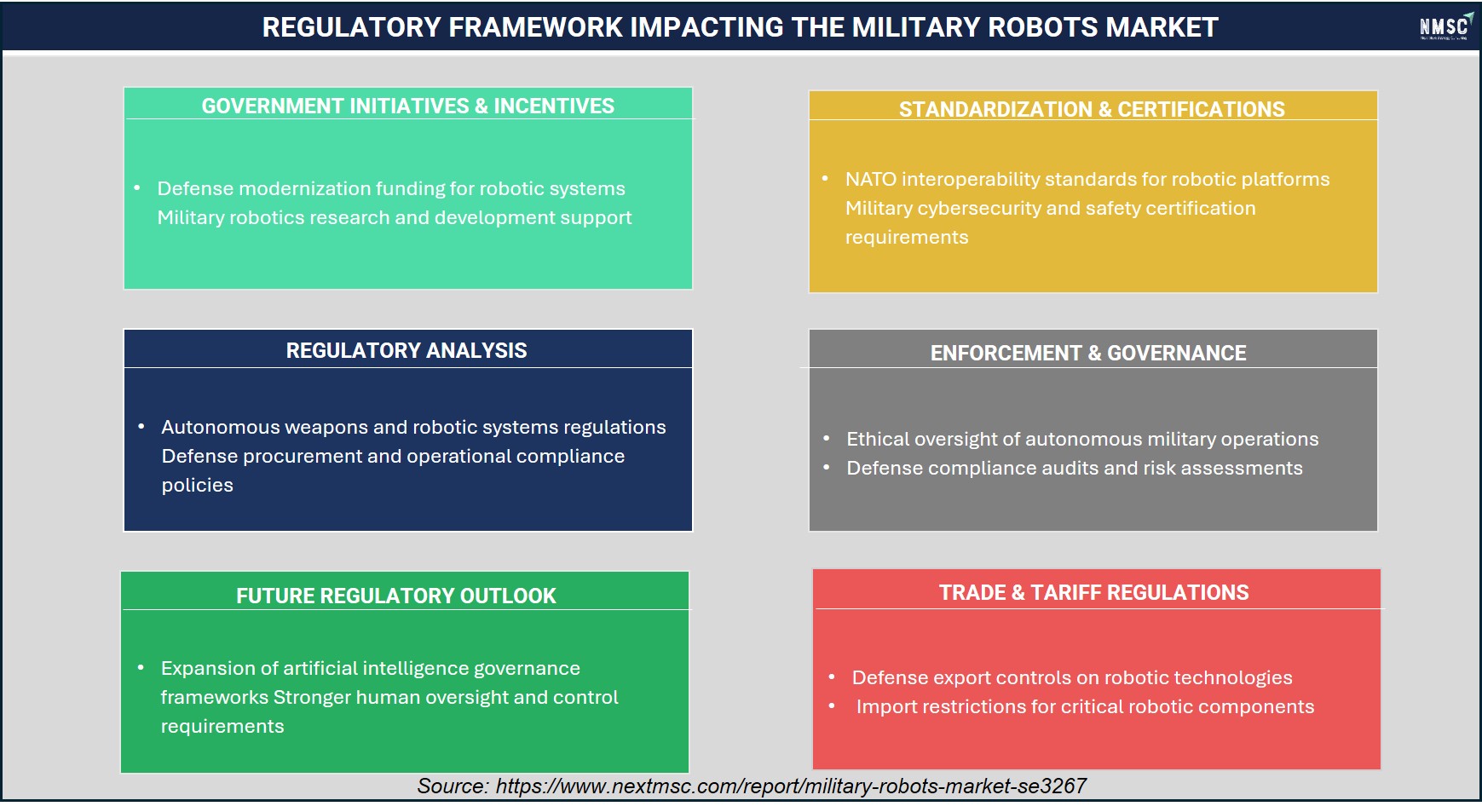
Our evaluation indicates that the Military Robots Market operates within a stringent regulatory framework focused on autonomous systems governance, defense procurement compliance, cybersecurity, and operational safety. Government funding initiatives and military research programs are supporting robotic technology advancement across defense applications. Additionally, interoperability standards, certification requirements, and compliance mechanisms govern product development and deployment activities. Ethical oversight policies, risk management frameworks, and operational audits further influence adoption strategies. Consequently, evolving artificial intelligence regulations, export controls, and security requirements continue to shape market development and competitive dynamics.
Competitive Landscape
Competitive Dynamics and M&A Landscape
|
Key Takeaways |
Details |
|
Market Structure |
Moderately concentrated. The top five vendors — AeroVironment, Boeing, Lockheed Martin, General Dynamics, and Thales — collectively hold an estimated 35–40% of total Military Robots Market revenue. The competitive landscape includes diversified global defense primes, specialist unmanned systems integrators, and agile autonomous technology firms. Israeli firms IAI and Elbit Systems hold disproportionately strong positions in loitering munition and tactical UAV sub-segments globally. |
|
Innovation Focus |
AI-enabled autonomous navigation, onboard target recognition for loitering munitions, swarming coordination algorithms, extended endurance fuel cell and hybrid propulsion, modular open-architecture payload integration, AI-assisted sonar for AUVs, and resilient communications for GPS-denied environments. |
|
M&A Activity |
Notable sector consolidation has targeted AI and autonomous systems capabilities. L3Harris acquired SRC Inc., strengthening electronic warfare autonomous systems. General Dynamics acquired smaller autonomous technology firms to accelerate UGV programs. European defense consolidation through KNDS and MBDA partnerships reflects EU defense industrial sovereignty goals. Rheinmetall AG has pursued strategic partnerships with Milrem Robotics to expand European autonomous ground vehicle market presence. |
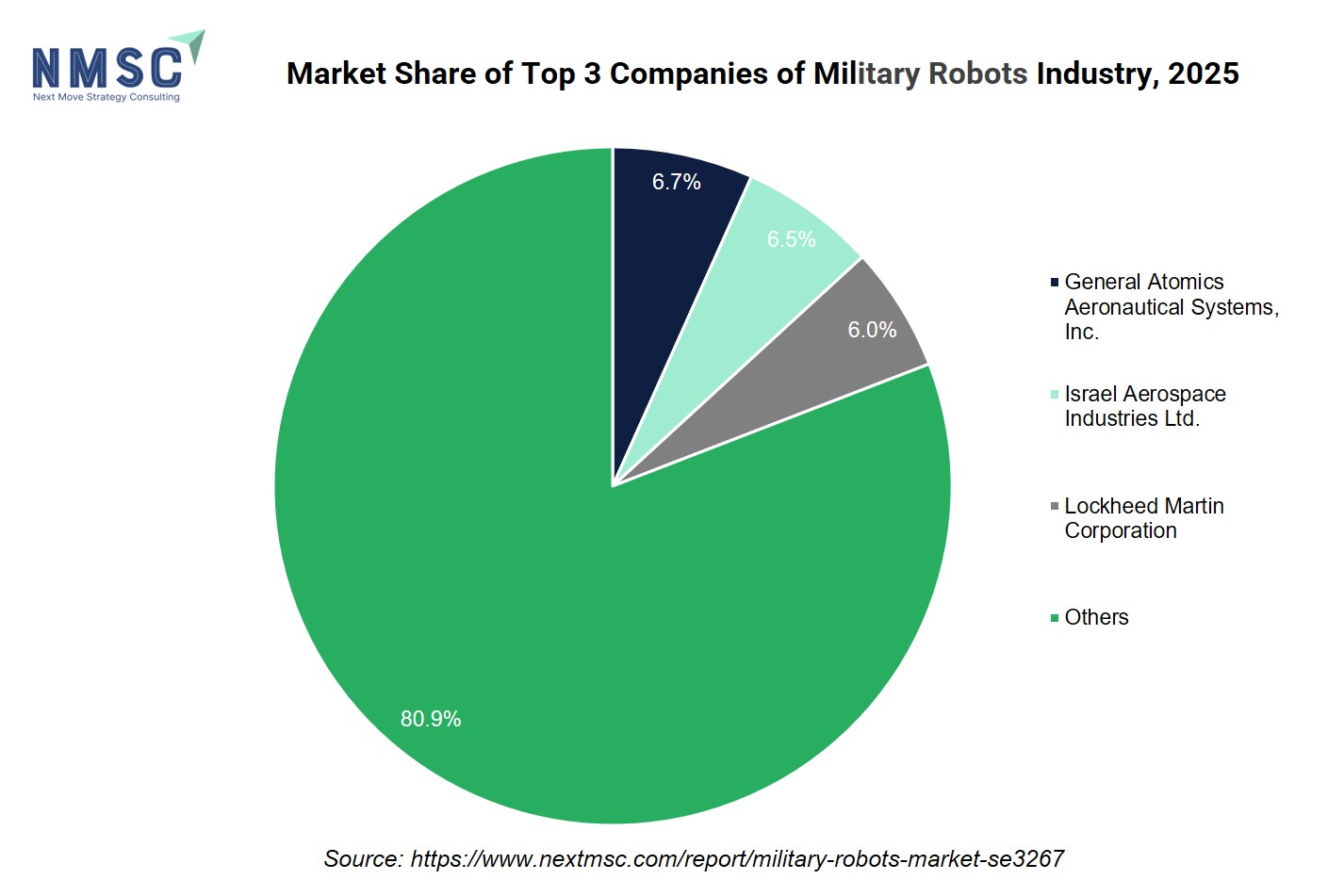
For the latest market share analysis and in-depth report on Military Robots Industry insights, you can buy our latest report: Access the Report
How Do Companies Compete in the Military Robots Market?
Our analysis shows that the Military Robots Market competitive structure is shaped by the dominance of large diversified defense primes that leverage existing platform relationships, government certifications, and deep DoD/MoD procurement network access. Competitive strategies center on multi-year IDIQ contracts, system-of-systems integration capability, and lifecycle support programs that create sustained revenue streams beyond initial platform delivery. Innovation investment in AI-enabled autonomy, sensor miniaturization, and extended endurance propulsion is critical for maintaining technical differentiation in an environment where commercial technology crossover is rapidly commoditizing entry-level unmanned platform capabilities.
Which Kind of Companies Dominate the Military Robots Market?
The Military Robots Market is dominated by three distinct company archetypes. Diversified global defense primes including Lockheed Martin, Boeing, BAE Systems, Thales, and Leonardo hold competitive advantages through multi-program government relationships, certified airworthiness frameworks, and system integration capabilities spanning manned and unmanned platforms. Specialist unmanned systems companies including AeroVironment, General Atomics, Kratos, and Milrem Robotics compete on platform-specific technical leadership and operational track records. Emerging autonomous AI companies are increasingly partnering with primes to embed AI navigation, target recognition, and mission planning capabilities across existing platform architectures.
AI-Native Differentiation and Open Standards Drive Market Success in the Military Robots Market
NMSC's analysis indicates that AI-native differentiation is becoming the primary competitive battleground in the Military Robots Market, as platforms with advanced onboard AI capabilities command premium pricing and preferential selection in competitive procurement programs. Defense forces increasingly specify open-architecture standards, most prominently the U.S. Army's Modular Open System Approach (MOSA), in autonomous system procurement requirements. Vendors that support open interfaces enabling rapid integration of new payloads, AI algorithms, and communication systems gain structural procurement advantages over proprietary closed-architecture competitors in multi-source defense acquisition environments.
Market Players to Opt for Merger and Acquisition Strategies to Expand Their Presence in the Military Robots Market
Our findings suggest that merger and acquisition activity will remain a primary growth strategy for Military Robots Market participants seeking to accelerate AI autonomy capability development and expand geographic market access. Prime contractors face build-vs.-buy decisions regarding AI and autonomy technology stacks, with acquisition of specialized startups emerging as the preferred pathway for capabilities requiring rapid technology insertion. European defense industry consolidation is advancing through national champion mergers and joint venture structures designed to achieve competitive scale against U.S. and Israeli platform vendors in NATO procurement competitions and third-country export markets.
Who Are the Key Market Players in the Military Robots Market?
-
The Boeing Company
-
General Dynamics Mission Systems, Inc.
-
Thales S.A.
-
L3Harris Technologies, Inc.
-
Textron Inc.
-
Rheinmetall AG
-
BAE Systems plc
-
Elbit Systems Ltd.
-
Saab AB
-
Israel Aerospace Industries Ltd.
-
General Atomics Aeronautical Systems, Inc.
-
QinetiQ Group plc
-
Ghost Robotics Corporation
-
Teledyne Technologies Incorporated
-
Kratos Defense & Security Solutions, Inc.
-
Milrem Robotics B.V.
-
ST Engineering Land Systems Ltd.
What Are the Latest Developments in the Military Robots Market?
|
Date |
Development |
|
April 2026 |
AeroVironment launched the MAYHEM 10, an autonomous, multi-role launched effects system designed for integrated ISR, electronic warfare, and precision strike missions. |
|
March 2026 |
General Atomics expanded its Mississippi facility with a USD 25M investment, utilizing advanced robotics to mass-produce the Long-Range Maneuvering Projectile (LRMP). |
|
March 2026 |
AeroVironment acquired ESAero, strengthening aerospace engineering + autonomous UAV development capabilities for next-gen military robotics platforms |
|
Feb 2026 |
Kratos Defense secured a USD 61.1 million U.S. Navy contract for full-rate production of the BQM-177A subsonic aerial target, scaling their manufacturing capacity. |
|
January 2026 |
Germany joined NATO countries acquiring Eight MQ-9B SeaGuardian, strengthening GA-ASI’s presence in Europe and expanding its defense customer base |
|
January 2026 |
Elbit completed full acquisition of UAV Tactical Systems (UTACS), strengthening its tactical drone manufacturing and autonomy capabilities in Europe. |
|
Sept 2025 |
BAE Systems entered a 10-year partnership with Cellula Robotics to bring the Herne autonomous underwater vehicle (AUV) to market for critical subsea infrastructure protection. |
Expert Insights
 "Drones and AI are emerging fields that Germany needs to develop. The changes they're bringing to the battlefield are as revolutionary as the introduction of the machine gun, tank, or airplane."
- Annette Lehnigk-Emden, Head of Germany's Armed Forces Procurement Agency
Statement made during a Reuters interview discussing emerging military technologies and defense modernization.
Market Interpretation
The comment highlights the growing strategic importance of drones, artificial intelligence, and autonomous military systems in modern warfare. Defense agencies are increasingly prioritizing next-generation technologies to enhance battlefield awareness, operational efficiency, and mission effectiveness. As a result, governments and defense organizations are increasing investments in military robots, unmanned ground vehicles (UGVs), autonomous reconnaissance platforms, and AI-enabled combat support systems to strengthen defense capabilities and address evolving security requirements.
What Are the Investment Opportunities in the Military Robots Market?
Capital Inflows and Defense Procurement Budget Expansion
The Military Robots Market is attracting sustained capital inflows through both direct government procurement and defense-focused private investment. The U.S. DoD's fiscal year 2025 budget request included significant increases in autonomous systems and AI-enabled platform funding across all service branches. NATO allies' collective move toward 2% GDP defense spending commitments creates a multi-billion-dollar aggregate procurement pipeline for autonomous systems vendors. Based on our market evaluation, we noticed that defense-focused private equity funds and venture capital firms have substantially increased investment in autonomous systems startups, AI navigation companies, and specialized drone component manufacturers, reflecting growing investor confidence in long-term defense robotics market growth.
Infrastructure Investment in Defense Robotics Manufacturing
Domestic defense manufacturing base investment is a critical dimension of Military Robots Market opportunity, particularly in the context of allied governments' strategic autonomy objectives and supply chain resilience requirements. The U.S. Defense Production Act investments and allied equivalent programs in the UK, Australia, and EU member states are funding capacity expansion in drone manufacturing, autonomous systems assembly, and advanced semiconductor production for defense applications. Through NMSC's assessment, we found that companies establishing domestic production facilities in allied nations gain significant competitive advantages in government procurement processes that prioritize national industrial security and technology sovereignty considerations.
ESG Considerations in Defense Technology Investment
Environmental, Social, and Governance considerations are increasingly relevant to Military Robots Market investment decisions, particularly for dual-use technology companies that attract both defense and commercial institutional investors. The replacement of crewed platforms with autonomous systems reduces personnel casualty risk, which aligns with social-dimension ESG objectives related to workforce safety and human capital preservation. Battery and hydrogen fuel cell propulsion development for silent UAV and UGV applications contributes to defense force emissions reduction goals. Investors are evaluating the dual-use potential of autonomous defense technologies in search and rescue, disaster response, and maritime environmental monitoring applications as components of comprehensive ESG assessments.
Digital Transformation and AI Integration Investment
Digital transformation investment across defense forces globally is creating significant indirect demand within the Military Robots Market through AI platform development, secure cloud-based command and control architecture, and data integration infrastructure required to operate multi-domain autonomous system fleets. According to the U.S. DoD's Chief Digital and Artificial Intelligence Office, Project Convergence and the Combined Joint All-Domain Command and Control architecture development programs represent foundational digital infrastructure investment that enables more effective autonomous system deployment. Our analysis shows that companies delivering AI autonomy software, mission planning algorithms, and human-machine teaming interfaces capture value from this infrastructure investment as recurring software and service revenue components.
Private Equity and Venture Capital Activity
Defense-focused private equity and venture capital investment in Military Robots Market companies has accelerated significantly following the Replicator initiative announcement and observed UAV effectiveness in the Ukraine conflict. Shield Capital, Andreessen Horowitz's American Dynamism fund, and In-Q-Tel have publicly disclosed investments in autonomous defense systems startups. NMSC's analysis indicates that the most active investment themes include loitering munition manufacturing scale-up, AI-enabled autonomous navigation software, counter-drone detection systems, and maritime autonomous vehicle platforms targeting both defense and coast guard procurement markets. IPO activity in defense autonomy companies is expected to increase as program revenues mature through forecast period.
Key Benefits for Stakeholders
For Defense Procurement Agencies and Government Bodies
Defense procurement agencies and government bodies gain a structured, data-rich assessment of the Military Robots Market's growth trajectory, competitive supplier landscape, and segment-level revenue forecasts through 2035. The CAGR analysis by platform type, mission, autonomy level, and end user enables precise capability investment prioritization and long-term force structure planning. Detailed coverage of 20 key vendor profiles combined with latest development tracking provides procurement decision-makers with an evidence-based framework for evaluating program options, identifying emerging technology suppliers, and assessing competitive procurement pathways across all major military unmanned system categories.
For Military Robots Vendors and Platform Integrators
Military Robots vendors and platform integrators gain actionable intelligence on white-space opportunities, competitive positioning gaps, and fastest-growing sub-segments within the Military Robots Market. Platform type analysis reveals specific growth leaders including Loitering Munitions (13.03% CAGR), Wheeled UGVs (11.02% CAGR), and XLUUVs (10.66% CAGR) that represent priority investment areas. Regional outlook sections identify geographic expansion priorities with regulatory and procurement maturity context across 33 countries. The competitive dynamics analysis enables vendors to refine go-to-market strategies, evaluate partnership and acquisition targets, and optimize portfolio positioning across platform, mission, and autonomy level dimensions.
For Defense Investors and Financial Analysts
Investors and financial analysts access a structured assessment of the Military Robots Market's growth trajectory, competitive dynamics, M&A pipeline, and segment-level revenue forecasts through 2035. The CAGR analysis by segment, region, and end user enables precise portfolio construction and defense sector valuation modeling. Detailed company profiles of all 20 covered vendors, combined with latest development tracking, provide an early-signal framework for identifying acquisition targets, emerging technology leaders, and established primes positioned to capture disproportionate share of growing autonomous systems procurement budgets across all major defense-spending nations globally.
For Defense Industry Analysts and Strategic Consultants
Defense industry analysts and strategic consultants gain a comprehensive, publication-ready research foundation covering all key dimensions of the Military Robots Market including technology trends, regulatory dynamics, competitive intelligence, and granular segmentation analysis. Country-level insights across 33 nations provide granular market development context essential for supporting client advisory engagements on defense market entry, export strategy, and technology partnership evaluation. The integration of primary-research-style analytical insights, expert assessments, and verified government and institutional data sources ensures that derived advisory work reflects rigorous evidentiary standards appropriate for defense procurement and investment decision-making contexts.
Key Market Segments
By Platform Type
-
Airborne Robots
-
Fixed-Wing UAV
-
Rotary-Wing UAV
-
Hybrid VTOL UAV
-
Loitering Munition
-
Target Drone
-
Other Airborne Robots
-
-
Land Robots
-
Wheeled UGV
-
Tracked UGV
-
Legged Robots
-
Optionally Manned Combat Vehicle
-
Other Land Robots
-
-
Maritime Robots
-
Uncrewed Surface Vessel (USV)
-
Underwater Vehicle
-
Remotely Operated Vehicle (ROV)
-
Autonomous Underwater Vehicle (AUV)
-
Large Displacement XLUUV
-
-
Other Maritime Robots
-
By Mission
-
Intelligence, Surveillance, Reconnaissance (ISR)
-
Combat Operations
-
Explosive Ordnance Disposal (EOD)
-
Mine Clearance
-
Mine Countermeasures (Maritime MCM)
-
Logistics Support
-
Electronic Warfare
-
Training and Simulation
-
Other Mission
By Autonomy Level
-
Teleoperated
-
Semi-Autonomous
-
Fully Autonomous
By End User
-
Army
-
Navy
-
Air Force
-
Marine Corps
-
Special Forces
-
Other Defense Forces
By Region
-
North America: U.S., Canada, and Mexico
-
Europe: UK, Germany, France, Italy, Spain, Sweden, Denmark, Finland, the Netherlands, and the Rest of Europe
-
Asia-Pacific: China, India, Japan, South Korea, Taiwan, Indonesia, Vietnam, Australia, Philippines, Malaysia, and the Rest of APAC
-
Middle East & Africa (MEA): Saudi Arabia, UAE, Egypt, Israel, Turkey, Nigeria, South Africa, and the Rest of MEA
-
Latin America: Brazil, Argentina, Chile, Colombia, and the Rest of LATAM
Conclusion and Recommendations
Long-Term Outlook
The Military Robots Market is entering its most consequential growth decade, driven by AI platform maturation, multi-domain warfare doctrine adoption, and sustained defense budget expansion across NATO, Indo-Pacific, and Gulf Cooperation Council nations. The market is forecast to grow from USD 36.9 billion in 2026 to USD 83.8 billion by 2035, at a CAGR of 9.53%. Our analysis shows that this growth reflects both the structural expansion of unmanned platform fleets across all service branches and the progressive shift from teleoperated systems toward semi-autonomous and fully autonomous platforms that deliver superior operational persistence, reduced personnel risk, and lower long-run total mission cost.
Strategic Positioning Recommendations
Platform vendors should prioritize AI-native autonomy differentiation, embedding machine learning-based navigation, target recognition, and collaborative swarm coordination capabilities into next-generation platform architectures. Compliance with open-architecture standards including U.S. Army MOSA requirements is non-negotiable for vendors seeking prime DoD contract positions. Investment in modular payload integration frameworks enables rapid adaptation to evolving mission requirements without complete platform redesign. European vendors must simultaneously address NATO interoperability requirements and the EU defence industrial sovereignty agenda, which is creating structural preference for domestically developed autonomous system solutions across EU member state procurement programs.
Investment Attractiveness
The Military Robots Market represents a structurally attractive investment environment underpinned by long-cycle government procurement programs, high switching costs embedded in operator training and logistics infrastructure, and recurring maintenance and upgrade revenue streams. The highest-conviction investment themes include Loitering Munitions (13.03% CAGR), Fully Autonomous systems (11.21% CAGR), ISR mission applications (11.07% CAGR), XLUUV platforms (10.66% CAGR), and Wheeled UGVs (11.02% CAGR). Asia-Pacific's sustained procurement growth at 10.83% CAGR creates geographic diversification opportunities beyond the saturated U.S. and European core markets for vendors with export-compliant technology portfolios.
Market Shifts and Key Risks
The most significant market shift underway is the transition from platform-centric procurement toward mission-system acquisition, where armed forces increasingly specify integrated autonomous system capabilities spanning multiple platforms, AI software, communication networks, and ground control infrastructure. This shift benefits integrators with full-stack autonomous system capabilities at the expense of single-platform specialists. Key risks include regulatory escalation on autonomous lethal weapons constraining Fully Autonomous segment growth, geopolitical export controls limiting market access for U.S. vendors in certain regions, and adversarial electronic warfare capabilities reducing operational effectiveness of GPS-dependent platforms in contested electromagnetic environments.
Growth Pathways
Organizations seeking to maximize value from the Military Robots Market should pursue a three-horizon strategy. In the near term through 2027, prioritize loitering munition production scaling, AI integration into existing ISR platforms, and open-architecture compliance to capture immediate procurement opportunities driven by the Replicator initiative and allied defense budget expansion. In the mid-term from 2027 to 2031, invest in semi-autonomous combat vehicle development, maritime XLUUV capability maturation, and Asia-Pacific market access through government-to-government partnership frameworks. In the long term through 2035, position for Fully Autonomous combat system certification, counter-drone integrated system leadership, and electronic warfare autonomous platform integration as dominant market segments.
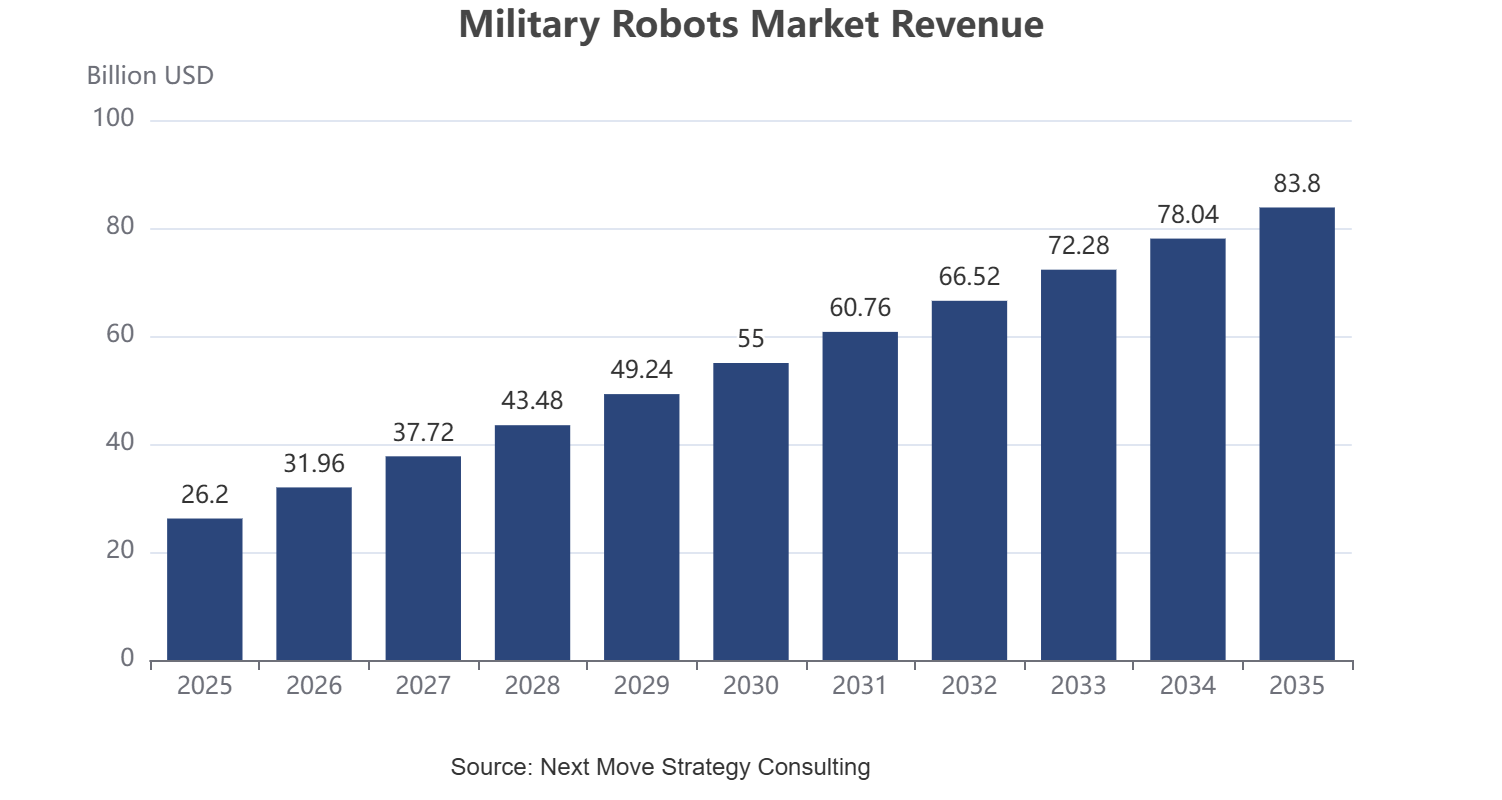
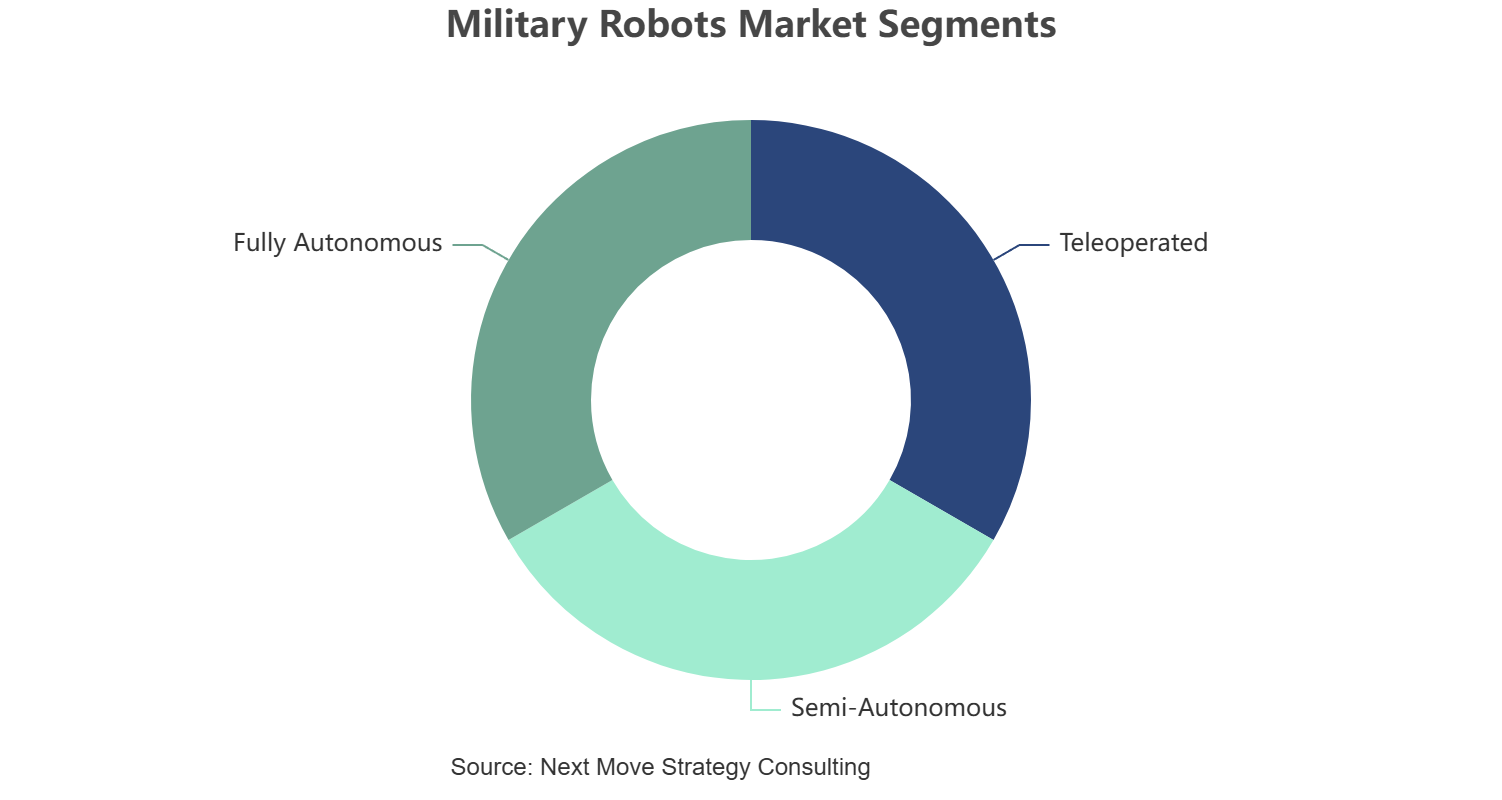
About the Author
 Saista Faiyaz is Research Associate at Next Move Strategy Consulting, where she has covered consumer markets and healthcare technologies for 3 years. Her work includes primary interview review, secondary-source validation, market sizing, and structured analysis of company and industry data. She supports research by comparing evidence across sources, organizing findings into market narratives, and documenting assumptions used in analysis. Her scope includes cross-market benchmarking, and reports.
About the Reviewer
 Supradip Baul is an accomplished business consultant and strategist with over a decade of rich experience in market intelligence, strategy, technology, and business transformation. His work has included rigorous qualitative and quantitative analysis across multiple industries, helping clients shape investment decisions and long-term roadmaps. Earlier in his career, he was associated with Gartner, where he contributed to industry-leading reports and market share analyses. He has worked with leading global companies and holds an MBA with a dual specialization in Marketing and Finance.
At Next Move Strategy Consulting, we understand that insightful market research is the cornerstone of successful business decisions. That's why we employ a robust and multifaceted approach, combining various methodologies to deliver the most accurate and actionable data for our clients.

Research Landscape
We navigate the world of research with two primary approaches:
Qualitative Approach
Our qualitative research methodologies involve immersive techniques such as in-depth interviews, focus groups, and observational studies. By engaging directly with individuals and stakeholders, we uncover valuable insights that quantitative data alone may overlook.

Quantitative Research
In tandem with qualitative methodologies, NMSC leverages the power of Quantitative Research to provide a robust foundation of numerical insights. Through systematic data collection and analysis, we quantify patterns, preferences, and market trends, offering a comprehensive view of the business landscape.
Our quantitative research approach employs diverse tools, including surveys, experiments, and statistical modelling. These methodologies enable us to gather data from a large and representative sample, ensuring the statistical significance of our findings. By employing structured questionnaires and standardized data collection methods, we guarantee the reliability and validity of the information we present to our clients.
Quantitative research is particularly effective in measuring the prevalence of trends, assessing market size, and gauging the impact of various factors on consumer behavior. The numerical precision attained through this approach equips our clients with actionable insights, facilitating data-driven decision-making and strategy formulation.


Our Specialized Toolbox for Industry-Specific Market Research
We deploy a specialized arsenal of techniques tailored to meet your unique requirements. Here's a glimpse into our comprehensive toolbox:

Information Procurement
The stage entails acquiring market data or relevant information through various sources and methodologies.


Market Research Approach
We utilize both top-down and bottom-up approaches in market research analysis to achieve a comprehensive understanding of the market dynamics, leveraging the broad perspective of industry trends and macroeconomic factors alongside detailed insights from specific segments and individual companies.

Porters Five Forces Analysis
We conduct Porter's Five Forces analysis to evaluate the competitive landscape of an industry, providing us with insights into factors that affect profitability and strategic positioning.

SWOT Analysis

Forecasting
We utilize a forecasting model to predict future consumption by considering parameters like population, economics, regulations, market competition, drivers, constraints, technology, and pricing. We also employ statistical techniques such as multilinear regression, exponential smoothing, moving average, ARIMA, and Monte Carlo simulations for accurate predictions. In econometric forecasting, we analyzed short-term and long-term event impacts, attributing values based on regulatory frameworks, economic factors, and market events.





 Speak to Our Analyst