Modified Bitumen Market Size, Share, Trends and Growth Analysis, By Product Type (Modified Bitumen Binders, Modified Bitumen Membranes, and Modified Bitumen Liquids), By Modifier Type (Styrene Butadiene Styrene, Atactic Polypropylene, and Other Modifiers), By Reinforcement, By Distribution Channel, By Application Method (Hot Mix, Hot Applied, Cold Applied, and Others), By End Use (Road Construction, Roofing, and Others), and Region — Global Industry Report and Forecast, 2026–2035
Industry: Materials and Chemical | Publishing Date: July 31, 2026 | Last Updated: September 3, 2026 | No of Pages: N/A | No. of Tables: N/A | No. of Figures: N/A | Format: PDF | Report Code: MC5502
What Is the Modified Bitumen Market Size?
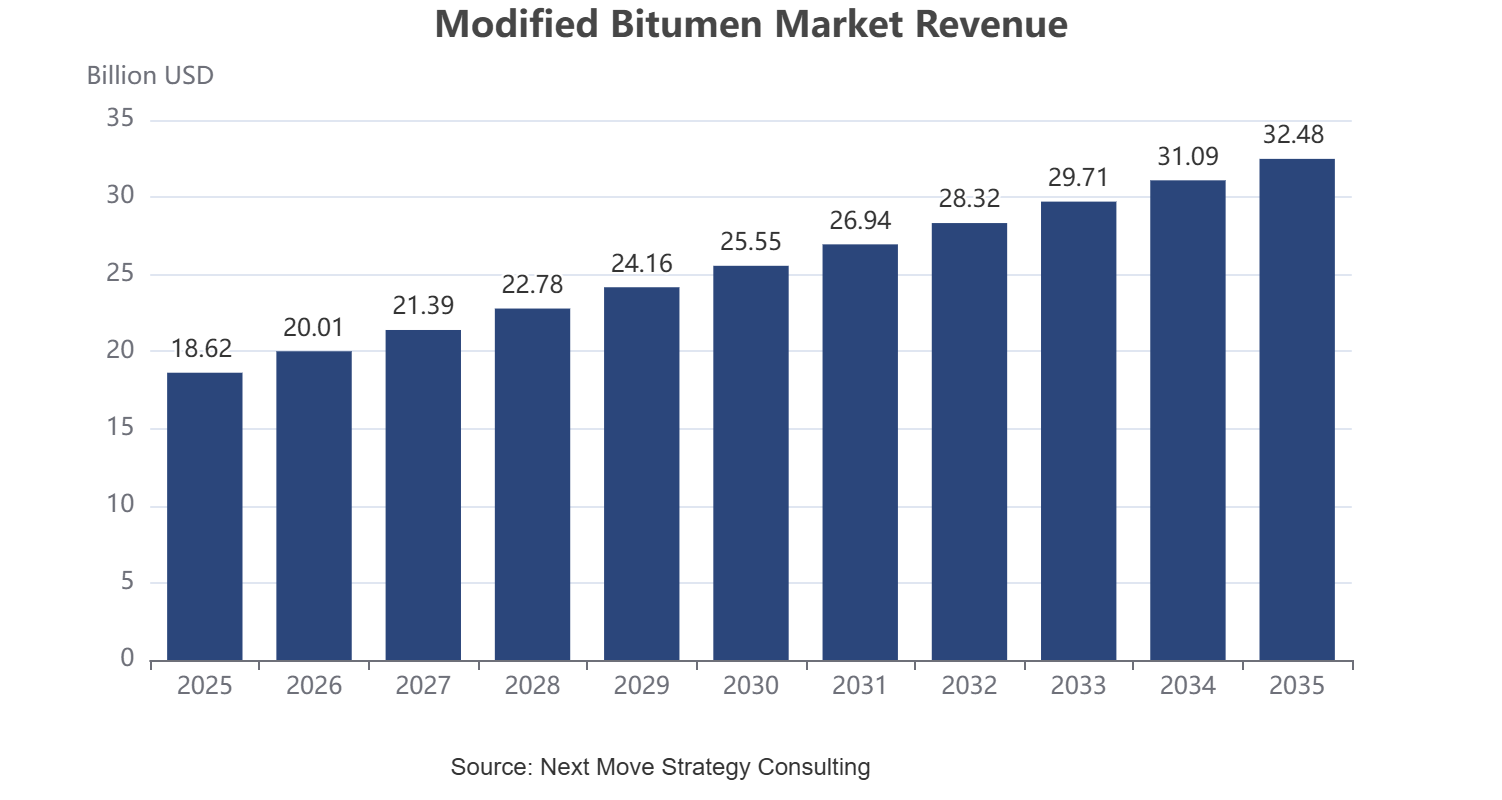
The global Modified Bitumen Market size was valued at USD 18.62 billion in 2025 and is estimated at USD 19.69 billion in 2026, forecast to reach USD 32.48 billion by 2035, expanding at a 5.7% CAGR between 2026 and 2035. Asia-Pacific leads with approximately a 36% share, while Modified Bitumen Binders dominate all other product categories with approximately a 58% share.
We observed that growth is concentrated in road construction and waterproofing applications, with crumb rubber modifiers and self-adhered application methods gaining the most pronounced structural momentum through 2035.
|
Key Takeaways |
|
By Product Type: Modified Bitumen Binders held the largest share of approximately 58% (USD 10.80 Billion) in 2025; Modified Bitumen Liquids is the fastest-growing sub-segment at 7.9% CAGR from 2026–2035. |
|
By Modifier Type: Styrene Butadiene Styrene held the largest share of approximately 42% (USD 7.82 Billion) in 2025; Crumb Rubber is the fastest-growing sub-segment at 10.9% CAGR from 2026–2035. |
|
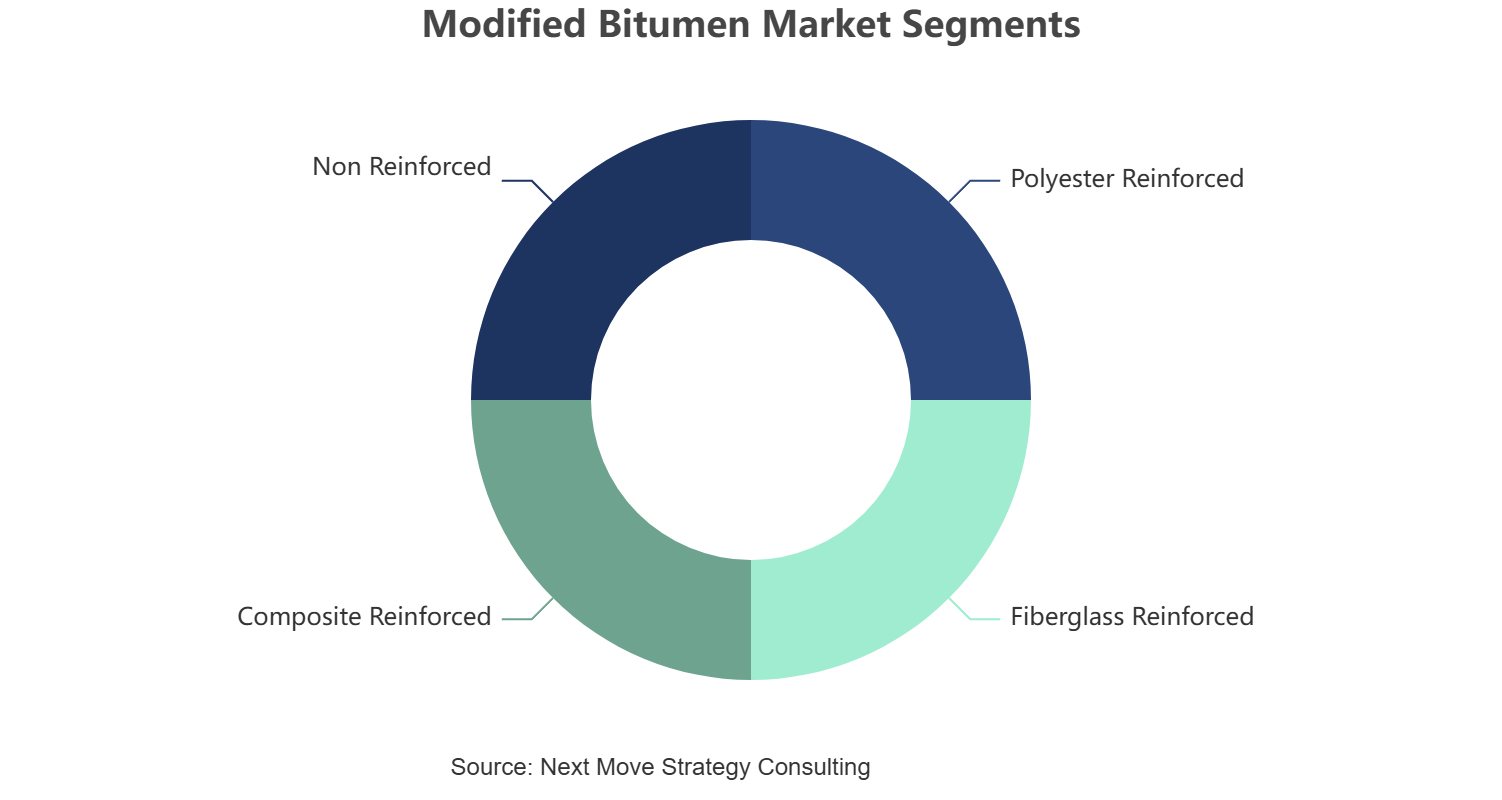
By Reinforcement: Polyester Reinforced held the largest share of approximately 46% (USD 8.57 Billion) in 2025; Composite Reinforced is the fastest-growing sub-segment at 9.2% CAGR from 2026–2035. |
|
By Distribution Channel: Direct Sales held the largest share of approximately 40% (USD 7.45 Billion) in 2025; Private Label Supply is the fastest-growing sub-segment at 10.6% CAGR from 2026–2035. |
|
By Application Method: Hot Mix held the largest share of approximately 30% (USD 5.59 Billion) in 2025; Self-Adhered is the fastest-growing sub-segment at 9.6% CAGR from 2026–2035. |
|
By End Use: Road Construction held the largest share of approximately 44% (USD 8.19 Billion) in 2025; Waterproofing is the fastest-growing sub-segment at 7.9% CAGR from 2026–2035. |
|
Dominant Region: Asia-Pacific dominated with approximately 36% revenue share (USD 6.70 Billion) in 2025. |
|
Fastest-Growing Region: Asia-Pacific is expected to register the highest CAGR of 7.3% during 2026–2035. |
|
Dominant Country: The U.S. led with approximately USD 3.04 Billion in 2025. |
|
Fastest-Growing Country: India is the fastest-growing country at approximately 10.4% CAGR from 2026–2035. |
Market Opportunity: The Modified Bitumen Market is expected to create an absolute dollar opportunity of USD 12.79 billion between 2026 and 2035, presenting significant investment potential across the road construction, roofing, and waterproofing membrane value chain.
According to NMSC analysis, road authorities and roofing contractors are increasingly consolidating procurement with vendors offering validated durability performance and integrated binder-to-membrane product portfolios, a shift that favors diversified petrochemical and building-materials groups over single-product specialists as infrastructure replacement cycles accelerate through 2035.
What Does the Modified Bitumen Market Encompass?
The Modified Bitumen Market encompasses polymer-enhanced binders, prefabricated membranes, and liquid-applied primers, adhesives, sealants, and coatings used to improve the elasticity, durability, and temperature resistance of conventional bitumen. Our assessment indicates that the scope spans road construction binders, roofing and waterproofing membranes, and specialty liquids supplied through direct sales, authorized distributors, and construction chemicals channels to highway authorities, commercial and residential roofing contractors, and industrial flooring applicators across 38 countries covered in this report.
The category has evolved from conventional oxidized bitumen into polymer-modified formulations engineered for rutting resistance, fatigue durability, and low-temperature flexibility, driven by highway modernization programs and stricter pavement lifecycle requirements. Regulatory frameworks such as the U.S. Federal Highway Administration's pavement performance specifications and the European standard EN 14023 for polymer-modified bitumen shape formulation and testing requirements shape formulation and testing requirements across developed markets. We observed that technology adoption is shifting toward crumb rubber and hybrid modifier systems that improve sustainability credentials by incorporating recycled tire rubber, a trend NMSC's analysis indicates is reshaping supplier sourcing strategy across the market.
|
Parameter |
Details |
|
Market Size in 2025 |
USD 18.62 Billion |
|
Market Size in 2026 |
USD 19.69 Billion |
|
Revenue Forecast in 2035 |
USD 32.48 Billion |
|
Growth Rate |
CAGR of 5.7% from 2026 to 2035 |
|
Analysis Period |
2025–2035 |
|
Base Year Considered |
2025 |
|
Forecast Period |
2026–2035 |
|
Market Size Estimation |
USD Billion |
|
Companies Profiled |
20 |
|
Countries Covered |
38 |
|
Market Share |
Available for Top 10 Companies |
Key Emerging Trends
Based on research conducted by NMSC, we found that four structural trends are reshaping formulation, deployment, and stakeholder engagement across the modified bitumen industry.
How Is Crumb Rubber Adoption Transforming Binder Formulation?
Crumb rubber modified bitumen is gaining share as road authorities prioritize recycled-material pavement solutions that reduce waste-tire disposal volumes while improving rutting resistance. We observed that Nynas AB expanded its sustainable polymer-modified bitumen portfolio with bio-based asphalt technologies in 2025, targeting lower-carbon road construction applications. Highway agencies across North America and Europe are adopting crumb rubber specifications to meet sustainability procurement criteria, elevating demand for recycled-content binder formulations.
Why Is Membrane Brand Consolidation Reshaping Roofing Supply Chains?
Roofing and waterproofing membrane manufacturers are consolidating fragmented product lines under unified brand architectures to simplify contractor purchasing. Our findings suggest that SOPREMA's 2025 integration of Tropical Roofing Products into its core brand illustrates this shift, unifying coatings and roof-maintenance offerings under a single national identity. Contractors are adopting consolidated supplier relationships to reduce SKU complexity and strengthen technical support access across large commercial roofing projects.
How Is Domestic Manufacturing Capacity Expansion Securing Supply Resilience?
Manufacturers are investing in vertically integrated domestic production capacity to reduce raw-material supply-chain exposure. We found that IKO Industries Ltd. completed more than USD 500 million in fiberglass and glass mat manufacturing investment in South Carolina in 2025, supporting its shingle and modified bitumen membrane production network. This trend is elevating demand for backward-integrated reinforcement material capacity among North American and European membrane producers.
What Role Does Joint-Venture Localization Play in Emerging Market Growth?
Joint ventures between international bitumen majors and domestic refiners are accelerating localized polymer-modified bitumen production capacity in emerging economies. Indian Oil Corporation Limited and TotalEnergies SE's ITPL joint venture combines research and marketing strengths to manufacture polymer-modified and rubber-modified bitumen formulations across India, reflecting how road-building demand in high-growth economies is reshaping vendor go-to-market structures across the Modified Bitumen Market.
Growth Drivers and Restraints
Growth Catalyst and Risk Assessment Matrix
|
Factors |
Type |
(+/-) % Impact on CAGR |
Geographic Relevance |
Impact Timeline |
|
Rising highway modernization and rehabilitation investment |
Driver |
+1.6% |
Global |
2026–2035 |
|
Expanding commercial roofing replacement demand |
Driver |
+1.3% |
North America, Europe |
2026–2035 |
|
Growth of crumb rubber and recycled-content formulations |
Driver |
+1.1% |
North America, Europe, Asia-Pacific |
2026–2035 |
|
Rising airport pavement and bridge deck construction |
Driver |
+0.9% |
Asia-Pacific, Middle East & Africa |
2026–2035 |
|
Increasing below-grade and tunnel waterproofing demand |
Driver |
+0.8% |
Global |
2026–2035 |
|
Government infrastructure stimulus programs |
Driver |
+0.7% |
Asia-Pacific, North America |
2026–2032 |
|
Crude oil and polymer feedstock price volatility |
Restraint |
-0.9% |
Global |
2026–2035 |
|
High initial cost versus conventional bitumen |
Restraint |
-0.6% |
Middle East & Africa, Latin America |
2026–2032 |
|
Skilled-labor shortage in torch-applied installation |
Restraint |
-0.4% |
North America, Europe |
2026–2030 |
What Is the Primary Growth Driver of the Modified Bitumen Market?
Rising highway modernization and rehabilitation investment is the primary driver of the market. The U.S. Federal Highway Administration continues to fund pavement preservation programs under its National Highway Performance Program, sustaining institutional demand for polymer-modified binders engineered for extended service life. We observed that this funding continuity, combined with rising heavy-traffic loads, continues to anchor baseline consumption of SBS and APP modified bitumen across developed road networks.
How Is Roofing Replacement Demand Driving the Market Growth?
Expanding commercial roofing replacement cycles are accelerating growth toward SBS and APP modified bitumen membrane adoption across North America and Europe. We observed that Owens Corning and Roof Count Inc. introduced Scout, an AI-enabled virtual sales tool for roofing contractors in 2025, reflecting how digital adoption is compressing project specification and replacement timelines. Our assessment indicates that this replacement-cycle acceleration, combined with aging commercial building stock, continues to sustain membrane demand growth.
What Is Restraining Modified Bitumen Market Expansion?
Crude oil and polymer feedstock price volatility restrains margin stability across the supply chain, as bitumen is petroleum-derived and polymer modifiers such as SBS depend on petrochemical feedstock pricing. We found that this volatility squeezes manufacturer profit margins and creates budgeting uncertainty for infrastructure projects, particularly among smaller regional producers with limited feedstock hedging capacity compared with vertically integrated majors such as Shell plc and TotalEnergies SE.
Segmentation Analysis
Segment Sizing: By Product Type
|
Segment |
2025 (USD) |
2035 (USD) |
CAGR% (2026–2035) |
|
Modified Bitumen Binders |
USD 10.80 Billion |
USD 17.54 Billion |
4.9% |
|
Modified Bitumen Membranes |
USD 5.96 Billion |
USD 11.04 Billion |
6.4% |
|
Modified Bitumen Liquids |
USD 1.86 Billion |
USD 3.90 Billion |
7.9% |
|
Total |
USD 18.62 Billion |
USD 32.48 Billion |
5.7% |
Which Product Type Dominates the Modified Bitumen Market?
Modified Bitumen Binders led the market with USD 10.80 billion in 2025, supported by sustained global road construction and rehabilitation spending across highway networks. We observed that Modified Bitumen Liquids is the fastest-growing product category, expanding at a 7.9% CAGR from 2026 to 2035, as primers, adhesives, and protective coatings gain adoption in specialty waterproofing and industrial flooring applications requiring liquid-applied installation flexibility.
Segment Sizing: By Modifier Type
|
Segment |
2025 (USD) |
2035 (USD) |
CAGR% (2026–2035) |
|
Styrene Butadiene Styrene |
USD 7.82 Billion |
USD 12.99 Billion |
5.1% |
|
Atactic Polypropylene |
USD 4.47 Billion |
USD 6.50 Billion |
3.6% |
|
Ethylene Vinyl Acetate |
USD 2.61 Billion |
USD 4.22 Billion |
4.9% |
|
Crumb Rubber |
USD 2.42 Billion |
USD 6.50 Billion |
10.9% |
|
Other Modifiers |
USD 1.30 Billion |
USD 2.27 Billion |
5.7% |
|
Total |
USD 18.62 Billion |
USD 32.48 Billion |
5.7% |
Which Modifier Type Leads Modified Bitumen Market Demand?
Styrene Butadiene Styrene remained the leading modifier type within the market, reaching USD 7.82 billion in 2025 on the strength of its superior elasticity, flexibility, and resistance to thermal cracking across highway and roofing applications. Our findings suggest that Crumb Rubber is the fastest-growing modifier type, registering a 10.9% CAGR from 2026 to 2035, as road authorities increasingly specify recycled-tire-content bitumen binders to meet sustainability procurement mandates without materially compromising pavement performance.
Segment Sizing: By End Use
|
Segment |
2025 (USD) |
2035 (USD) |
CAGR% (2026–2035) |
|
Road Construction |
USD 8.19 Billion |
USD 12.99 Billion |
4.6% |
|
Roofing |
USD 5.21 Billion |
USD 8.77 Billion |
5.3% |
|
Waterproofing |
USD 3.72 Billion |
USD 7.80 Billion |
7.9% |
|
Industrial Applications |
USD 1.49 Billion |
USD 2.92 Billion |
7.1% |
|
Total |
USD 18.62 Billion |
USD 32.48 Billion |
5.7% |
Which End Use Segment Leads Modified Bitumen Market Demand?
Road Construction remained the leading end use segment within the market, valued at USD 8.19 billion in 2025 on sustained highway, urban road, and airport pavement investment worldwide. Based on research conducted by NMSC, we found that Waterproofing is the fastest-growing end use segment, registering a 7.9% CAGR from 2026 to 2035, as below-grade foundation, tunnel, and podium deck waterproofing demand accelerates alongside dense urban construction activity.
Supply Chain Analysis of the Modified Bitumen Industry
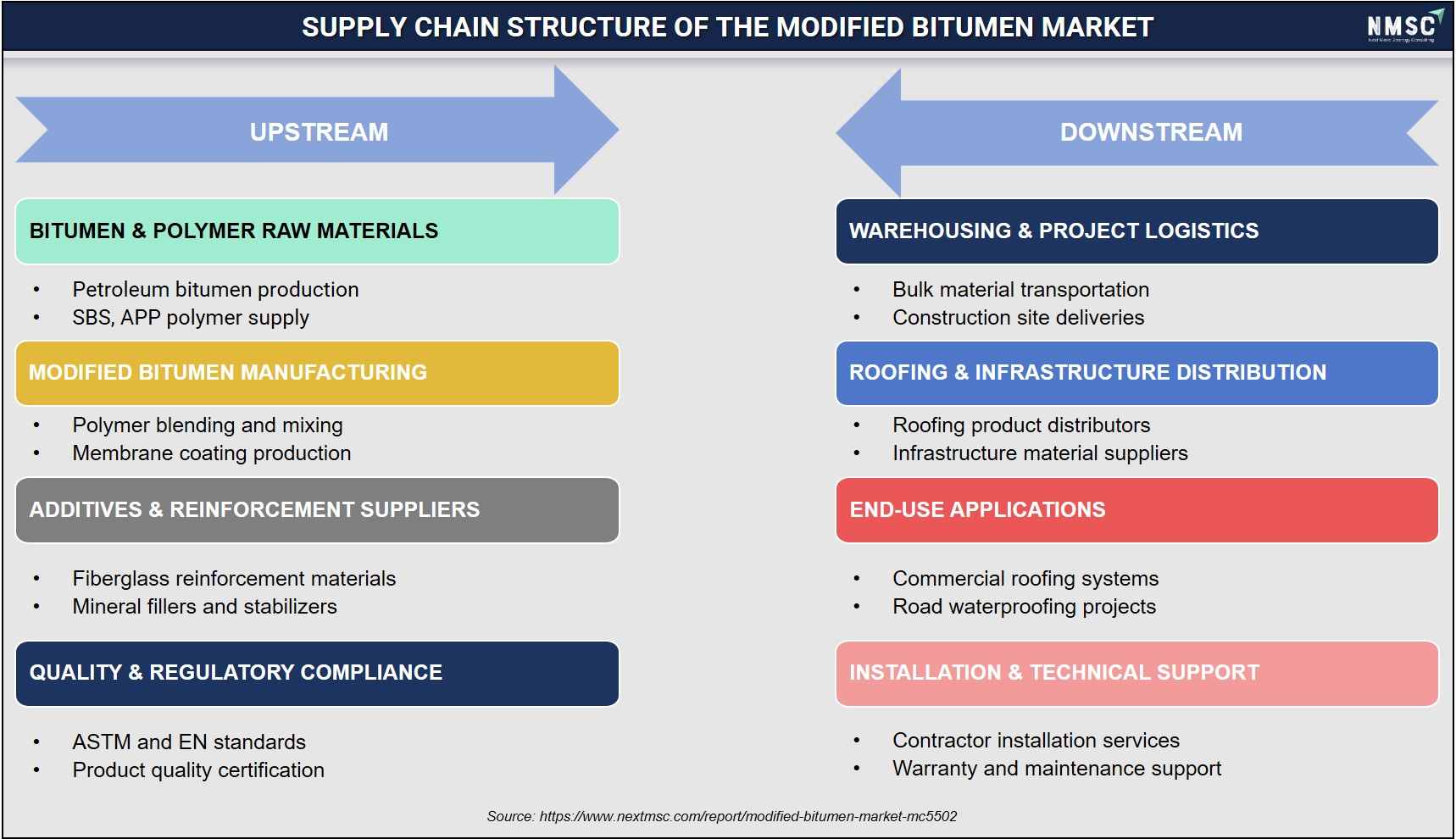
The above infographic presents the supply chain structure of the Modified Bitumen Market, segmented into upstream and downstream activities. Upstream begins with petroleum bitumen and SBS/APP polymers, which move into blending, mixing, and membrane coating production. Suppliers provide fiberglass reinforcements and mineral fillers, while compliance with ASTM and EN standards ensures quality and certification. Moving downstream, bulk transportation and warehousing enable distribution through roofing and infrastructure suppliers to commercial roofing and road waterproofing projects. Looking ahead, we observed that contractor installation services, warranty support, and maintenance ensure long-term performance and customer satisfaction across the market.
Growth Opportunities
Our analysis shows that three forward-looking opportunities stand out for stakeholders positioning within the Modified Bitumen Industry over the 2026-2035 forecast period.
How Can Recycled-Content Binder Formulations Unlock Value in Highway Procurement?
Recycled crumb rubber and bio-based binder formulations present a whitespace opportunity for vendors serving highway authorities under sustainability-linked procurement mandates. Suppliers that secure formulation validation against agency specifications stand to capture long-term supply contracts as departments of transportation prioritize recycled-material pavement solutions across resurfacing and new-construction programs.
Where Do Self-Adhered Membrane Systems Create New Roofing Demand?
Self-adhered membrane systems represent an underpenetrated opportunity for vendors offering torch-free installation that reduces contractor labor risk and jobsite fire hazards. Manufacturers expanding self-adhered roofing portfolios can capture share from traditional torch-applied systems as contractors face mounting skilled-labor shortages and stricter jobsite safety requirements across commercial reroofing projects.
How Can Below-Grade Waterproofing Specialists Benefit from Urban Densification?
Below-grade foundation and tunnel waterproofing present a durable growth opportunity for vendors supplying dense urban construction and transit-infrastructure projects. Early movers that combine modified bitumen membranes with integrated protective coating systems can differentiate with civil-engineering contractors pursuing long-service-life waterproofing solutions for podium decks and underground structures in high-density metropolitan markets.
Regional Outlook
Geographic Performance Snapshot
|
Region |
2025 (USD) |
2035 (USD) |
CAGR% (2026–2035) |
Key Driver |
|
Asia-Pacific |
USD 6.70 Billion |
USD 13.32 Billion |
7.3% |
Large-scale highway expansion and urbanization across China and India |
|
Europe |
USD 5.03 Billion |
USD 7.80 Billion |
4.3% |
EN 14023 standardization and road rehabilitation investment |
|
North America |
USD 4.47 Billion |
USD 6.82 Billion |
4.2% |
Federal Highway Administration funding and commercial reroofing demand |
|
Middle East & Africa |
USD 1.49 Billion |
USD 2.92 Billion |
7.1% |
Vision 2030-linked infrastructure and extreme-climate pavement demand |
|
Latin America |
USD 0.93 Billion |
USD 1.62 Billion |
5.7% |
Growing highway concession investment and urban waterproofing adoption |
|
Total |
USD 18.62 Billion |
USD 32.48 Billion |
5.7% |
-- |
Asia-Pacific
Asia-Pacific leads the Modified Bitumen Market, propelled by large-scale highway expansion and urbanization across China and India. We observed that regional governments continue to fund national highway and expressway programs, sustaining demand for polymer-modified binders. Regulatory frameworks remain less harmonized than in Europe, giving manufacturers flexibility to scale production rapidly. Technology adoption is accelerating as domestic producers integrate SBS and crumb rubber modification into export-oriented product lines.
Europe
Europe's market reflects a mature, standardization-driven landscape shaped by the EN 14023 specification for polymer-modified bitumen. Our findings suggest that road authorities across Germany, the UK, and France prioritize long-life pavement rehabilitation over new-build construction. Technology adoption favors elastomeric SBS formulations, supported by strong regional testing infrastructure and established relationships between refiners and highway agencies.
North America
North America benefits from sustained Federal Highway Administration funding and a mature commercial roofing replacement cycle. We found that U.S. and Canadian roofing contractors increasingly specify SBS modified membranes for their flexibility and cold-weather performance. Technology adoption is advanced, with self-adhered and cold-applied systems gaining share as contractors navigate labor shortages across the region's construction sector.
Middle East & Africa
The Modified Bitumen Market in Middle East & Africa is expanding as Gulf Cooperation Council economies invest in Vision 2030-linked transportation infrastructure. Our analysis shows that Saudi Arabia and the UAE are driving demand for high-performance binders engineered to resist extreme-temperature rutting. Regulatory influence remains moderate, while technology adoption is gradually shifting toward polymer-modified formulations as regional contractors align with global specification standards.
Latin America
Latin America's market is supported by growing highway concession investment in Brazil and expanding urban waterproofing demand in Argentina. We observed that regulatory frameworks are less stringent than in North America or Europe, though multinational binder producers operating locally are introducing polymer-modified product lines. Technology adoption remains centered on SBS formulations, with competitive intensity increasing as regional integrators partner with global bitumen majors.
U.S.
Based on our estimates, the U.S. market was valued at approximately USD 3.04 Billion in 2025, projected to reach USD 4.50 Billion by 2035 at a 3.8% CAGR. Demand is anchored by Federal Highway Administration-funded pavement preservation programs and a mature commercial roofing replacement cycle. Technology penetration favors SBS modified binders and self-adhered membrane systems, and competitive intensity remains high among established refiners and building-materials groups serving state transportation departments.
Canada
The market in Canada reached approximately USD 0.63 Billion in 2025 and is projected to reach USD 1.02 Billion by 2035, registering a 5.0% CAGR. Demand structure mirrors U.S. highway rehabilitation patterns, while cold-climate performance requirements shape binder specification. Technology penetration is rising as provincial transportation agencies specify polymer-modified formulations for freeze-thaw durability, with competitive intensity moderate given reliance on cross-border supply from North American refiners.
Germany
As per our estimate, the Germany market was valued at about USD 1.21 Billion in 2025, projected to reach USD 1.71 Billion by 2035 at a 3.3% CAGR. Demand is driven by EN 14023-compliant road rehabilitation and a strong domestic roofing manufacturing base. Regulatory influence is significant under German and European Union construction product standards, technology penetration favors elastomeric SBS formulations, and competitive intensity remains steady among established European binder and membrane producers.
UK
According to our analysis, the UK market reached close to USD 0.80 Billion in 2025 and is expected to hit USD 1.17 Billion by 2035, growing at a 3.6% CAGR. Demand structure benefits from ongoing motorway resurfacing programs and commercial reroofing activity following post-Brexit construction product regulation changes. Regulatory influence from UK-specific standards is notable, technology penetration favors SBS modified membranes, and competitive intensity remains high among domestic and continental European vendors.
France
Based on our estimates, the France market was valued at approximately USD 0.70 Billion in 2025, projected to reach USD 1.01 Billion by 2035 at a 3.5% CAGR. Demand is supported by France's extensive national highway network and established civil-engineering waterproofing sector. Regulatory influence from French and EU pavement standards is well established, and competitive intensity remains elevated given the concentration of premium bitumen and membrane producers headquartered domestically.
China
The market in China reached approximately USD 2.82 Billion in 2025 and is projected to reach USD 5.33 Billion by 2035, registering a 6.7% CAGR. Demand is fueled by continued national expressway expansion and large-scale urban infrastructure investment. Regulatory influence is increasing gradually through national pavement performance standards, technology penetration is accelerating through domestic SBS production capacity, and competitive intensity remains elevated among numerous China-based binder manufacturers.
India
As per our estimate, the India market was valued at about USD 1.34 Billion in 2025, projected to reach USD 3.46 Billion by 2035 at a 10.4% CAGR. Demand structure reflects aggressive national highway construction targets under government-funded expressway programs. Regulatory influence remains developing, while technology penetration is rising quickly as joint ventures such as ITPL localize polymer-modified bitumen production to serve India's expanding road-building sector, the fastest-growing country in this report.
Japan
According to our analysis, the Japan market reached close to USD 0.80 Billion in 2025 and is expected to hit USD 1.20 Billion by 2035, growing at a 3.9% CAGR. Demand is supported by Japan's mature highway maintenance and seismic-resilient infrastructure requirements. Regulatory influence is well established, technology penetration is advanced with widespread SBS modified bitumen adoption, and competitive intensity remains high among long-standing domestic petrochemical and roofing-materials vendors.
South Korea
Based on our estimates, the South Korea market was valued at approximately USD 0.47 Billion in 2025, projected to reach USD 0.80 Billion by 2035 at a 5.4% CAGR. Demand structure benefits from continued expressway maintenance and a well-developed commercial roofing sector. Technology penetration is high, with domestic producers supplying polymer-modified binders for both road and building applications, and competitive intensity remains pronounced amid steady infrastructure-replacement cycles.
Australia
The market in Australia reached approximately USD 0.34 Billion in 2025 and is projected to reach USD 0.67 Billion by 2035, registering a 7.3% CAGR. Demand is supported by state-level road rehabilitation programs and growing commercial waterproofing adoption. Regulatory influence stems from Australian pavement design standards, while technology penetration favors imported polymer-modified formulations amid moderate competitive intensity among regional distributors.
Saudi Arabia
As per our estimate, the Saudi Arabia market was valued at about USD 0.42 Billion in 2025, projected to reach USD 0.85 Billion by 2035 at a 7.5% CAGR. Demand is driven by Vision 2030-linked transportation infrastructure and extreme-temperature pavement performance requirements. Regulatory influence is developing under national highway specifications, and technology penetration is advancing as domestic integrators scale polymer-modified binder production to serve major infrastructure programs.
UAE
According to our analysis, the UAE market reached close to USD 0.30 Billion in 2025 and is expected to hit USD 0.56 Billion by 2035, growing at a 6.5% CAGR. Demand structure is shaped by the UAE's role as a regional construction-materials distribution hub and extreme-climate road performance needs. Regulatory influence remains moderate, technology penetration is improving through imported high-performance binders, and competitive intensity is rising as integrators expand portfolios to serve Gulf infrastructure markets.
South Africa
Based on our estimates, the South Africa market was valued at approximately USD 0.18 Billion in 2025, projected to reach USD 0.32 Billion by 2035 at a 6.1% CAGR. Demand structure reflects a developing road-construction and waterproofing materials base serving regional Southern African markets. Regulatory influence remains moderate, technology penetration is gradually improving, and competitive intensity is limited given reliance on imported modified bitumen products from Europe and the Middle East.
Brazil
The market in Brazil reached approximately USD 0.41 Billion in 2025 and is projected to reach USD 0.68 Billion by 2035, registering a 5.2% CAGR. Demand is underpinned by Brazil's large highway concession program and expanding urban waterproofing adoption. Regulatory influence stems from national pavement design standards, technology penetration favors SBS modified binders, and competitive intensity remains moderate among regional integrators and multinational bitumen producers.
Argentina
As per our estimate, the Argentina market was valued at about USD 0.13 Billion in 2025, projected to reach USD 0.24 Billion by 2035 at a 6.5% CAGR. Demand structure is supported by steady road-maintenance and building-waterproofing consumption despite macroeconomic volatility. Regulatory influence remains limited, technology penetration is modest, and competitive intensity is centered on a small number of regional distributors serving domestic infrastructure and construction buyers.
PESTEL Analysis of the Modified Bitumen Industry
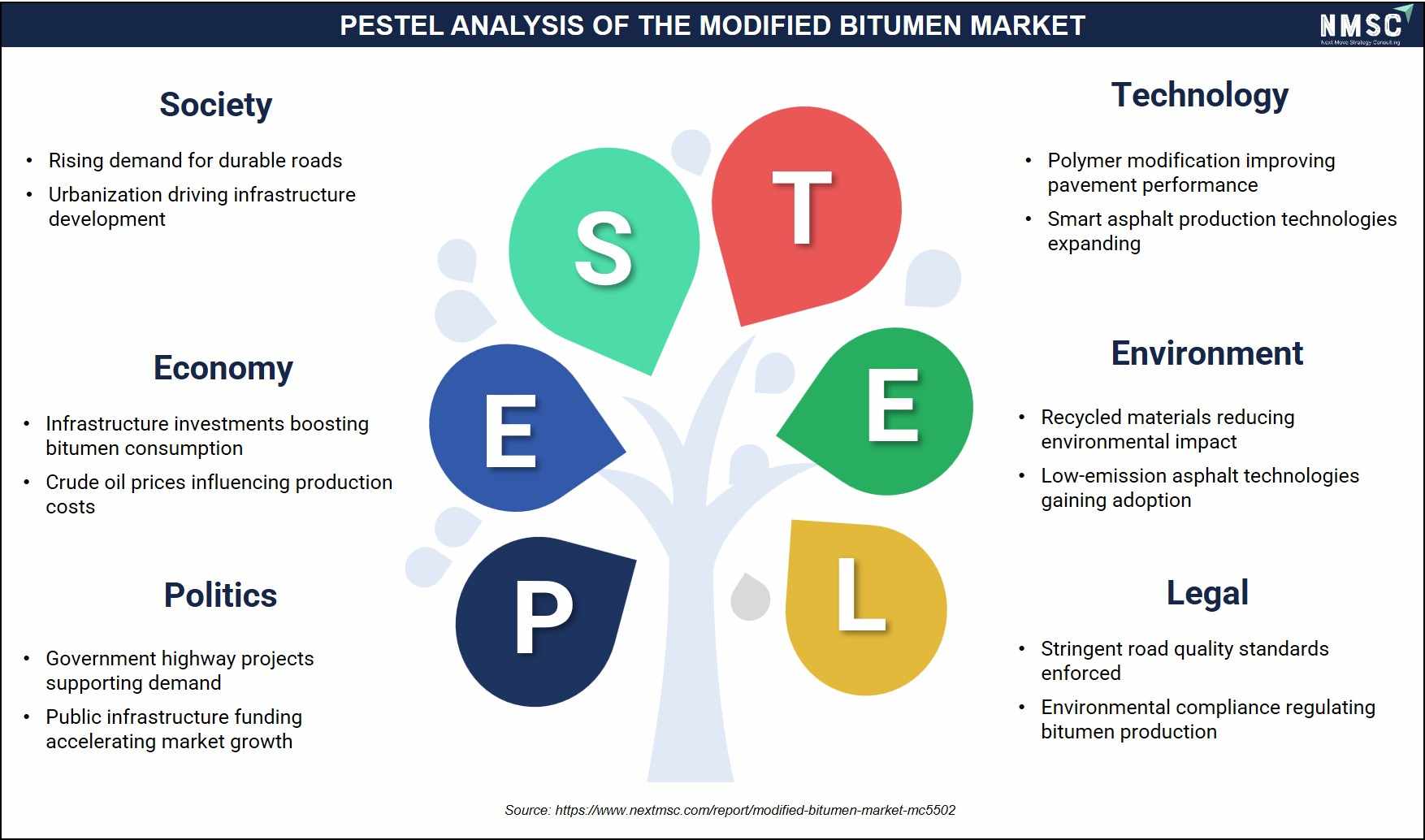
The above infographic presents a PESTEL analysis of the Modified Bitumen Market, where government highway projects and infrastructure funding are accelerating growth and supporting demand. At the same time, crude oil prices are influencing production costs, while rising demand for durable roads and urbanization are shaping social acceptance. Technological advancements such as polymer modification and smart asphalt production are improving performance, while recycled materials and low-emission technologies are reducing environmental impact. All these developments are taking place within a legal framework of road quality and environmental compliance standards. Looking ahead, we observed that these interconnected factors collectively shape the market's evolution across the construction sector.
Competitive Landscape
We observed that the Modified Bitumen Market features a moderately consolidated competitive landscape, with integrated energy majors supplying base bitumen competing alongside specialized building-materials groups on formulation performance, brand strength, and distribution reach across the industry.
|
Dimension |
Description |
|
Market Structure |
Moderately consolidated; the top companies profiled in this report collectively account for a significant share of global Modified Bitumen Market revenue, with integrated energy majors dominating binder supply and specialized manufacturers leading membrane and liquid categories. |
|
Innovation Focus |
Crumb rubber and bio-based binder formulations, self-adhered membrane systems, and vertically integrated reinforcement manufacturing dominate current innovation pipelines across leading vendors. |
|
M&A Activity |
Selective brand consolidation and joint-venture localization, as diversified building-materials groups unify fragmented product lines and energy majors partner with domestic refiners to expand regional production capacity. |
How Do Companies Compete in the Modified Bitumen Market?
Companies compete primarily on formulation durability, distribution network depth, and validated agency-specification compliance across the industry. Integrated energy majors such as Shell plc and TotalEnergies SE leverage upstream feedstock access to serve road-construction binder demand at scale, while diversified building-materials groups such as SOPREMA Group and Sika AG compete on membrane brand strength and technical support depth for roofing and waterproofing contractors.
Which Competitive Archetypes Dominate the Market?
Two archetypes dominate the market: vertically integrated energy majors supplying base and polymer-modified bitumen binders at refinery scale, and specialized building-envelope manufacturers offering branded membrane and liquid-applied systems. Exxon Mobil Corporation and Gazprom Neft PJSC exemplify the integrated-energy archetype, while Johns Manville and Carlisle Companies Incorporated exemplify the specialized building-envelope archetype serving roofing and waterproofing contractors directly.
How Are Companies Differentiating Through Innovation in Modified Bitumen?
Innovation and differentiation strategy increasingly center on recycled-content formulations and installation-efficiency membrane systems. Nynas AB's bio-based asphalt technology and IKO Industries Ltd.'s vertically integrated reinforcement manufacturing both target improved sustainability credentials and supply-chain resilience. Our analysis shows that vendors unable to demonstrate agency-validated performance data risk exclusion from highway and commercial roofing procurement shortlists in North America and Europe.
What M&A and Expansion Activity Is Shaping the Market?
Mergers, acquisitions, and joint-venture expansion continue to consolidate production capabilities within the industry. Indian Oil Corporation Limited's ITPL joint venture with TotalEnergies SE broadened localized polymer-modified bitumen manufacturing across India, while SOPREMA Group's brand integration of Tropical Roofing Products illustrates how diversified groups pursue unified product portfolios and expanded distribution reach across roofing and waterproofing end markets.
Key Market Players
Our assessment indicates that the following 20 companies are actively shaping product innovation, capacity expansion, and distribution strategy within the global Modified Bitumen Market.
-
Shell plc
-
TotalEnergies SE
-
Exxon Mobil Corporation
-
Colas SA
-
Nynas AB
-
Indian Oil Corporation Limited
-
Gazprom Neft PJSC
-
Repsol S.A.
-
SOPREMA Group
-
Sika AG
-
Standard Industries Inc.
-
IKO Industries Ltd.
-
TECHNONICOL Corporation
-
Bauder GmbH & Co. KG
-
Polyglass S.p.A.
-
Johns Manville
-
Tremco CPG Inc.
-
Beijing Oriental Yuhong Waterproof Technology Co., Ltd.
-
Owens Corning
-
Carlisle Companies Incorporated
Latest Developments
We found that recent developments within the Modified Bitumen Market are concentrated on recycled-content formulations, brand consolidation, and vertically integrated manufacturing capacity, reflecting the industry's broader shift toward sustainability and supply-chain resilience.
|
Date |
Event |
|
February 2025 |
Sika AG launched its SikaShield modified bitumen roofing product range in the US, including the SikaShield HB79 hybrid membrane, which combines APAO and SBS asphaltic membrane technologies. |
Investment Opportunities
What Capital Inflows Are Targeting the Modified Bitumen Market?
Capital inflows into the market are increasingly directed toward recycled-content binder capacity and vertically integrated reinforcement manufacturing. IKO Industries Ltd.'s more than USD 500 million investment in South Carolina fiberglass and glass mat production illustrates this trend. We observed that investors favor manufacturers demonstrating supply-chain resilience, viewing domestic reinforcement and modifier production as a proxy for long-term margin protection against feedstock volatility.
How Is Infrastructure Investment Supporting Modified Bitumen Deployment?
Infrastructure investment is expanding highway rehabilitation and commercial roofing replacement capacity across North America, Europe, and Asia-Pacific to serve rising polymer-modified binder demand. Our findings suggest that road authorities and adhesives and sealants suppliers are investing in joint-venture localization, as seen in the ITPL partnership between Indian Oil Corporation Limited and TotalEnergies SE, to reduce import dependency for polymer-modified bitumen production.
What ESG Considerations Are Shaping Modified Bitumen Investment Decisions?
Environmental, social, and governance considerations are central to investment decisions across the industry, with recycled-tire-content formulations and bio-based binder technology as key sustainability criteria. Nynas AB's 2025 bio-based asphalt technology expansion reflects this governance-linked innovation focus. We found that investors increasingly favor manufacturers with transparent recycled-content disclosures and validated lifecycle-emissions data, treating both as governance indicators alongside standard labor and safety compliance.
Key Benefits for Stakeholders
How Does This Report Benefit Enterprise and Industry Leaders?
Enterprise and industry leaders gain access to validated segmentation, competitive benchmarking, and regional demand forecasts that support sourcing and product-portfolio decisions across the modified bitumen industry. Our analysis shows that detailed product-type, modifier-type, and end-use breakdowns help procurement teams align vendor selection with agency specification requirements while identifying underserved application segments for portfolio expansion.
How Does This Report Benefit Investors and Financial Analysts?
Investors and financial analysts benefit from consistent, single-point market size and CAGR estimates that support valuation and capital-allocation decisions across the Modified Bitumen Market supply chain. We observed that the report's regional and segment-level growth differentials help identify which manufacturers and distributors are best positioned to capture above-market growth in Asia-Pacific and waterproofing categories through 2035.
How Does This Report Benefit Technology Vendors and Product Teams?
Technology vendors and product teams gain insight into emerging formulation requirements, including recycled-content modifiers, self-adhered installation systems, and vertically integrated reinforcement sourcing, that are reshaping the industry. Our findings suggest that this analysis helps R&D teams prioritize development roadmaps around durability validation and sustainability credentials increasingly required by highway agency and commercial roofing procurement processes.
Key Market Segments
By Product Type
-
Modified Bitumen Binders
-
Polymer Modified Bitumen
-
SBS Modified Bitumen
-
APP Modified Bitumen
-
EVA Modified Bitumen
-
Other Polymer Modified Bitumen
-
-
Crumb Rubber Modified Bitumen
-
Hybrid Modified Bitumen
-
-
Modified Bitumen Membranes
-
SBS Modified Membranes
-
APP Modified Membranes
-
Hybrid Modified Membranes
-
Other Modified Membranes
-
-
Modified Bitumen Liquids
-
Primers
-
Adhesives
-
Sealants and Mastics
-
Protective Coatings
-
By Modifier Type
-
Styrene Butadiene Styrene
-
Atactic Polypropylene
-
Ethylene Vinyl Acetate
-
Crumb Rubber
-
Other Modifiers
By Reinforcement
-
Polyester Reinforced
-
Fiberglass Reinforced
-
Composite Reinforced
-
Non Reinforced
By Distribution Channel
-
Direct Sales
-
Authorized Distributors
-
Project Tender Sales
-
Retail Sales
-
Private Label Supply
By Application Method
-
Hot Mix
-
Hot Applied
-
Cold Applied
-
Torch Applied
-
Self-Adhered
-
Mechanically Attached
By End Use
-
Road Construction
-
Highways
-
Urban Roads
-
Airport Pavements
-
Bridge Decks
-
-
Roofing
-
Commercial Roofing
-
Residential Roofing
-
-
Waterproofing
-
Foundation Waterproofing
-
Tunnel Waterproofing
-
Bridge Waterproofing
-
Podium and Plaza Deck Waterproofing
-
-
Industrial Applications
-
Industrial Flooring
-
Tanking
-
Other Industrial Applications
-
By Region
-
North America: U.S., Canada, Mexico
-
Europe: UK, Germany, France, Italy, Spain, Sweden, Denmark, Finland, Netherlands, Rest of Europe
-
Asia-Pacific: China, India, Japan, South Korea, Taiwan, Indonesia, Vietnam, Australia, Philippines, Malaysia, Rest of APAC
-
Middle East & Africa: Saudi Arabia, UAE, Egypt, Israel, Turkey, Nigeria, South Africa, Rest of MEA
-
Latin America: Brazil, Argentina, Chile, Colombia, Rest of LATAM
Conclusion and Recommendations
What Is the Long-Term Outlook for the Modified Bitumen Market?
The long-term outlook for the market remains steadily positive, with global revenue projected to expand from USD 18.62 billion in 2025 to USD 32.48 billion by 2035 at a 5.7% CAGR. We observed that sustained highway modernization, commercial roofing replacement, and waterproofing demand will continue underpinning growth across binder, membrane, and liquid categories through the forecast period.
What Strategic Positioning Should Modified Bitumen Vendors Pursue?
Vendors should prioritize recycled-content and bio-based binder formulations while pursuing agency-specification validation to secure long-term highway and commercial roofing contracts. Our assessment indicates that manufacturers investing early in vertically integrated reinforcement capacity and self-adhered installation systems will be best positioned to capture premium pricing within the Modified Bitumen Market.
How Attractive Is the Modified Bitumen Market for New Investment?
The modified bitumen industry presents a steady investment case, supported by a USD 12.79 billion absolute dollar opportunity between 2026 and 2035 and above-average growth in Asia-Pacific and waterproofing categories. We found that investment attractiveness is highest for vendors combining validated durability credentials with vertically integrated feedstock and reinforcement access, positioning them to serve both cost-sensitive road-construction and premium commercial roofing segments simultaneously.
What Market Shifts and Key Risks Should Stakeholders Monitor?
Stakeholders should monitor crude oil and polymer feedstock price volatility, skilled-labor shortages in torch-applied installation, and competitive pressure from alternative waterproofing technologies as key risks to the Modified Bitumen Market. Our analysis shows that vendors unable to hedge feedstock exposure risk losing contract bids to vertically integrated competitors with greater pricing stability, particularly within Europe's increasingly standardized procurement environment.
What Are the Key Growth Pathways for the Modified Bitumen Market?
Key growth pathways include expanding recycled-content binder portfolios, scaling self-adhered and cold-applied membrane systems, and deepening penetration into below-grade and tunnel waterproofing channels. NMSC's analysis indicates that vendors pursuing these pathways while maintaining cost competitiveness in commodity road-construction categories will be best positioned to capture the Modified Bitumen Market's projected growth through 2035.
About the Author
 Mayurima Roy
— Mayurima Roy is Research Analyst at Next Move Strategy Consulting, where she has spent 4 years working across the firm's full industry coverage rather than a single fixed vertical. Her work centers on structured research, ongoing trend tracking, competitive assessment, and insight-led content development, translating complex market data into clear, decision-ready narratives that support informed client decision-making across diverse global industries, market sectors, and world regions every day.
Mayurima Roy
— Mayurima Roy is Research Analyst at Next Move Strategy Consulting, where she has spent 4 years working across the firm's full industry coverage rather than a single fixed vertical. Her work centers on structured research, ongoing trend tracking, competitive assessment, and insight-led content development, translating complex market data into clear, decision-ready narratives that support informed client decision-making across diverse global industries, market sectors, and world regions every day.
About the Reviewer
 Supradip Baul
— Supradip Baul is an accomplished business consultant and strategist with over a decade of rich experience in market intelligence, strategy, technology, and business transformation. His work has included rigorous qualitative and quantitative analysis across multiple industries, helping clients shape investment decisions and long-term roadmaps. Earlier in his career, he was associated with Gartner, where he contributed to industry-leading reports and market share analyses. He has worked with leading global companies and holds an MBA with a dual specialization in Marketing and Finance.
Supradip Baul
— Supradip Baul is an accomplished business consultant and strategist with over a decade of rich experience in market intelligence, strategy, technology, and business transformation. His work has included rigorous qualitative and quantitative analysis across multiple industries, helping clients shape investment decisions and long-term roadmaps. Earlier in his career, he was associated with Gartner, where he contributed to industry-leading reports and market share analyses. He has worked with leading global companies and holds an MBA with a dual specialization in Marketing and Finance.
At Next Move Strategy Consulting, we understand that insightful market research is the cornerstone of successful business decisions. That's why we employ a robust and multifaceted approach, combining various methodologies to deliver the most accurate and actionable data for our clients.

Research Landscape
We navigate the world of research with two primary approaches:
Qualitative Approach
Our qualitative research methodologies involve immersive techniques such as in-depth interviews, focus groups, and observational studies. By engaging directly with individuals and stakeholders, we uncover valuable insights that quantitative data alone may overlook.

Quantitative Research
In tandem with qualitative methodologies, NMSC leverages the power of Quantitative Research to provide a robust foundation of numerical insights. Through systematic data collection and analysis, we quantify patterns, preferences, and market trends, offering a comprehensive view of the business landscape.
Our quantitative research approach employs diverse tools, including surveys, experiments, and statistical modelling. These methodologies enable us to gather data from a large and representative sample, ensuring the statistical significance of our findings. By employing structured questionnaires and standardized data collection methods, we guarantee the reliability and validity of the information we present to our clients.
Quantitative research is particularly effective in measuring the prevalence of trends, assessing market size, and gauging the impact of various factors on consumer behavior. The numerical precision attained through this approach equips our clients with actionable insights, facilitating data-driven decision-making and strategy formulation.


Our Specialized Toolbox for Industry-Specific Market Research
We deploy a specialized arsenal of techniques tailored to meet your unique requirements. Here's a glimpse into our comprehensive toolbox:

Information Procurement
The stage entails acquiring market data or relevant information through various sources and methodologies.


Market Research Approach
We utilize both top-down and bottom-up approaches in market research analysis to achieve a comprehensive understanding of the market dynamics, leveraging the broad perspective of industry trends and macroeconomic factors alongside detailed insights from specific segments and individual companies.

Porters Five Forces Analysis
We conduct Porter's Five Forces analysis to evaluate the competitive landscape of an industry, providing us with insights into factors that affect profitability and strategic positioning.

SWOT Analysis

Forecasting
We utilize a forecasting model to predict future consumption by considering parameters like population, economics, regulations, market competition, drivers, constraints, technology, and pricing. We also employ statistical techniques such as multilinear regression, exponential smoothing, moving average, ARIMA, and Monte Carlo simulations for accurate predictions. In econometric forecasting, we analyzed short-term and long-term event impacts, attributing values based on regulatory frameworks, economic factors, and market events.





 Speak to Our Analyst