Multimodal UI Market

Multimodal UI market size was USD 18.6 billion in 2025, projected to reach USD 96.3 billion by 2035 at a 17.6% CAGR from 2026 to 2035, per this market report.

Download Free Sample PDF
Base Year (2025)
$18.60 Billion
Forecast (2035)
$96.30 Billion
CAGR (2026-2035)
17.6%
Top Region
North America

What Is the Multimodal UI Market Size?

The global multimodal UI market size was valued at USD 18.6 billion in 2025 and is estimated at USD 22.4 billion in 2026, forecast to reach USD 96.3 billion by 2035, expanding at a 17.6% CAGR between 2026 and 2035. North America leads with approximately 38% share, while Voice and Speech Recognition dominates all other modalities with approximately 34% share.

We observed that the growth is broad-based across every segmentation axis, with combined multimodal fusion platform adoption and cloud-based deployment driving the dominant structural shifts through 2035.

Multimodal UI Market Revenue Forecast

Values in USD Billion

2025 $18.60 Billion
2025
2026 $22.40 Billion
2026
2027 $26.34 Billion
2027
2028 $30.98 Billion
2028
2029 $36.43 Billion
2029
2030 $42.84 Billion
2030
2031 $50.38 Billion
2031
2032 $59.25 Billion
2032
2033 $69.68 Billion
2033
2034 $81.94 Billion
2034
2035 $96.30 Billion
2035

Key Takeaways

By Modality: Voice and Speech Recognition held the largest share of approximately 34% (USD 6.32 billion) in 2025; Combined Multimodal Fusion Platforms is the fastest-growing sub-segment at 26.3% CAGR from 2026-2035.

By End Use Industry: Consumer Electronics held the largest share of approximately 30% (USD 5.58 billion) in 2025; Healthcare is the fastest-growing sub-segment at 19.3% CAGR from 2026-2035.

By Deployment: Embedded/On-Device held the largest share of approximately 62% (USD 11.53 billion) in 2025; Cloud-Based is the fastest-growing sub-segment at 20.7% CAGR from 2026-2035.

Dominant Region: North America dominated with approximately 38% revenue share (USD 7.07 billion) in 2025.

Fastest-Growing Region: Asia-Pacific is expected to register the highest CAGR of 20.3% during 2026-2035.

Dominant Country: U.S. led with approximately USD 5.66 billion in 2025.

Fastest-Growing Country: India is the fastest-growing country at approximately 26.2% CAGR from 2026-2035.

Market Opportunity: The multimodal UI market is expected to create an absolute dollar opportunity of USD 73.9 billion between 2026 and 2035, presenting significant investment potential across the combined voice, vision, and gesture fusion platform value chain.

According to Next Move Strategy Consulting analysis, device makers are increasingly fusing voice, vision, and gesture recognition into single AI-native interaction layers rather than shipping separate single-modality features, a shift that favors vendors with integrated fusion middleware over single-modality specialists as consumer and automotive buyers seek seamless, context-aware interfaces through 2035.

What Does the Multimodal UI Market Encompass?

The multimodal UI market encompasses hardware sensors, software recognition engines, and fusion middleware that enable devices to interpret voice, gesture, gaze, touch, and facial input as a combined interaction model. Our assessment indicates that the scope spans embedded and cloud-based deployment across consumer electronics, automotive, healthcare, and industrial buyers of varying scale. The category has evolved from single-modality features, such as standalone voice assistants, into unified interaction layers that blend multiple input types in real time, closely intersecting with the broader human machine interface (HMI) technology ecosystem worldwide.
Regulatory frameworks such as the U.S. Federal Communications Commission's accessibility guidance and the European Union's Accessibility Act shape design requirements, while automotive safety regulations increasingly influence in-vehicle interface certification. We observed that technology adoption is shifting toward AI-native fusion platforms that combine large language models with real-time sensor input for context-aware interaction. Next Move Strategy Consulting's analysis indicates that this structural shift, combined with rising demand for hands-free and accessible interfaces, is redefining sourcing criteria across the multimodal UI market.

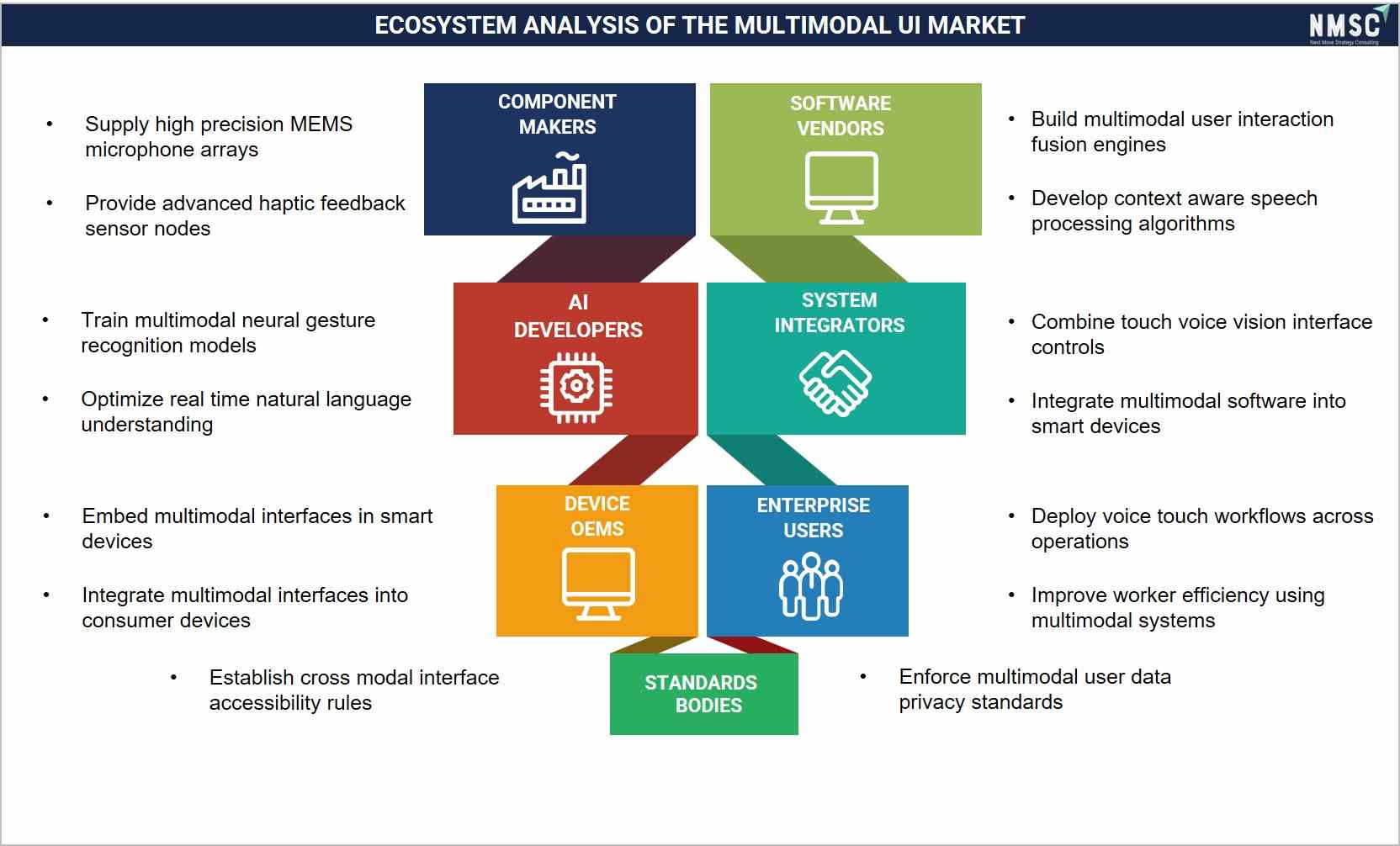
ECOSYSTEM ANALYSIS OF THE MULTIMODAL UI MARKET

The ecosystem analysis illustrates the interconnected stakeholder structure of the market, spanning component makers, software vendors, AI developers, system integrators, device OEMs, enterprise users, and standards bodies. These participants collectively support the development, integration, deployment, and standardization of multimodal UI technologies. The ecosystem highlights how hardware, AI software, enterprise applications, devices, and industry standards interact to enable scalable and interoperable multimodal user experiences across enterprise and consumer environments.

Market Drivers & Dynamics

Interactive Dataset
Rising consumer demand for hands-free device interaction driver +3.4% Global 2026-2035
Expanding in-vehicle voice and gesture interface adoption driver +2.6% North America, Europe 2026-2035
Growing generative AI integration into interaction layers driver +2.1% Global 2026-2032
Rising accessibility technology mandates and adoption driver +1.4% North America, Europe 2026-2032
Expanding IoT and connected device installed base driver +1.2% Asia-Pacific, MEA 2026-2035
High integration complexity across multiple sensor types restraint -1.3% Global 2026-2032
Data-privacy concerns around biometric and facial recognition restraint -1.0% Europe, North America 2026-2032
Elevated hardware and sensor bill-of-materials costs restraint -0.7% Global 2026-2030
Source: Next Move Strategy Consulting

Growth Drivers

What Is the Primary Growth Driver of the Multimodal UI Market?

Rising consumer demand for hands-free device interaction is the primary driver of the market. The U.S. Federal Communications Commission continues to track expanding voice-enabled device adoption across consumer electronics and automotive categories nationwide. We observed that this hands-free demand, reinforced by expanding in-vehicle interface adoption, continues to anchor baseline consumption of voice, gesture, and combined fusion platforms across developed and emerging economies alike.

How Is Generative AI Integration Driving Market Growth?

Growing generative AI integration into interaction layers is accelerating market growth toward combined multimodal fusion platforms. The U.S. National Institute of Standards and Technology continues to publish guidance on multimodal AI system evaluation, reflecting the scale of enterprise investment in combined voice, vision, and text interaction infrastructure. Our assessment indicates that this guidance, combined with rising consumer expectations for natural interaction, is compressing adoption timelines for fusion-based interface platforms among device manufacturers and automakers.

Growth Inhibitors

What Is Restraining Multimodal UI Market Expansion?

High integration complexity across multiple sensor types restrains development timelines across the multimodal UI supply chain. Engineering disclosures continue to show that combining voice, vision, gesture, and haptic sensors into a single coherent interaction model requires substantial cross-disciplinary integration effort. We found that smaller device makers face particular exposure, as limited engineering resources reduce their ability to achieve reliable sensor fusion compared with larger, well-resourced technology companies with dedicated multimodal engineering teams.

Segmentation Analysis

2025 (USD Billion)
2035 (USD Billion)
Voice and Speech Recognition 2025: $6.32 Billion | 2035: $26.96 Billion
Voice and Sp
Touch and Haptic Feedback 2025: $3.72 Billion | 2035: $14.44 Billion
Touch and Ha
Gesture Recognition 2025: $2.98 Billion | 2035: $14.44 Billion
Gesture Reco
Combined Multimodal Fusion Platforms 2025: $1.86 Billion | 2035: $18.30 Billion
Combined Mul
Facial and Emotion Recognition 2025: $1.86 Billion | 2035: $10.59 Billion
Facial and E
Eye and Gaze Tracking 2025: $1.86 Billion | 2035: $11.56 Billion
Eye and Gaze
Voice and Speech Recognition $6.32 Billion $26.96 Billion 15.1%
Touch and Haptic Feedback $3.72 Billion $14.44 Billion 13.9%
Gesture Recognition $2.98 Billion $14.44 Billion 16.8%
Combined Multimodal Fusion Platforms $1.86 Billion $18.30 Billion 26.3%
Facial and Emotion Recognition $1.86 Billion $10.59 Billion 18.8%
Eye and Gaze Tracking $1.86 Billion $11.56 Billion 20.0%

Which Modality Segment Dominates the Multimodal UI Market?

Voice and Speech Recognition led the market with USD 6.32 billion in 2025, supported by near-universal deployment across smartphones, smart speakers, and in-vehicle assistants. We observed that Combined Multimodal Fusion Platforms is the fastest-growing modality, expanding at a 26.3% CAGR from 2026 to 2035, as device makers increasingly integrate voice with eye tracking and gesture recognition into unified interaction systems rather than shipping single-modality features.

2025 (USD Billion)
2035 (USD Billion)
Consumer Ele
Automotive
Healthcare
Retail
Industrial a
Segment Item 2025 (USD Billion) 2035 (USD Billion) CAGR
Consumer Electronics $10.0 USD Billion $40.0 USD Billion 20.0%
Automotive $17.1 USD Billion $51.1 USD Billion 18.0%
Healthcare $24.2 USD Billion $62.2 USD Billion 12.0%
Retail $31.3 USD Billion $73.3 USD Billion 22.0%
Industrial and Enterprise $38.4 USD Billion $84.4 USD Billion 25.0%

Segment-wise data is locked

Unlock complete segment-wise numbers for By End Use Industry.

Unlock Full Data

Which End Use Industry Generates the Most Multimodal UI Revenue?

Consumer Electronics remained the leading end use industry, valued at USD 5.58 billion in 2025 as smartphone and wearable manufacturers integrate voice, touch, and gesture recognition as standard features. Based on research conducted by Next Move Strategy Consulting, we found that Healthcare is the fastest-growing end use industry at a 19.3% CAGR from 2026 to 2035, reflecting expanding adoption of accessible, hands-free interfaces in clinical and assistive-care settings.

2025 (USD Billion)
2035 (USD Billion)
Embedded/On-
Cloud-Based
Segment Item 2025 (USD Billion) 2035 (USD Billion) CAGR
Embedded/On-Device $10.0 USD Billion $40.0 USD Billion 10.0%
Cloud-Based $17.1 USD Billion $51.1 USD Billion 24.0%

Segment-wise data is locked

Unlock complete segment-wise numbers for By Deployment.

Unlock Full Data

Which Deployment Model Leads Multimodal UI Adoption?

Embedded/On-Device deployment remained the leading model, valued at USD 11.53 billion in 2025 on sustained demand for low-latency, privacy-preserving local processing in consumer devices. Our findings suggest that Cloud-Based deployment is the fastest-growing model, registering a 20.7% CAGR from 2026 to 2035, as generative AI-powered fusion platforms increasingly rely on cloud compute for complex multimodal reasoning beyond on-device processing capability.

2025 (USD Billion)
2035 (USD Billion)
North Americ
Canada
Mexico
Europe: UK
Germany
Segment Item 2025 (USD Billion) 2035 (USD Billion) CAGR
North America: U.S. $10.0 USD Billion $40.0 USD Billion 26.0%
Canada $17.1 USD Billion $51.1 USD Billion 16.0%
Mexico $24.2 USD Billion $62.2 USD Billion 22.0%
Europe: UK $31.3 USD Billion $73.3 USD Billion 12.0%
Germany $38.4 USD Billion $84.4 USD Billion 27.0%

Segment-wise data is locked

Unlock complete segment-wise numbers for By Region.

Unlock Full Data

Growth Opportunities

Our analysis shows that three forward-looking opportunities stand out for stakeholders positioning within the market over the 2026-2035 forecast period.

How Can Vision-Grounded Voice AI Unlock Value for Automakers?

Vision-grounded voice AI presents a whitespace opportunity for automakers seeking to reduce driver distraction while enabling richer in-cabin interaction. Vendors that commercialize validated, low-latency vision-and-voice fusion systems stand to capture recurring platform-license revenue as automakers increasingly specify combined multimodal cabin systems for new vehicle platforms.

Where Does Accessible Interface Design Create New Demand?

Accessible interface design represents an underpenetrated opportunity for vendors engineered to serve users with limited mobility through combined eye-tracking and voice systems. Providers that develop validated, certified accessible midair ultrasound haptics and gesture solutions can secure long-term healthcare and public-sector contracts, benefiting from recurring revenue tied to expanding accessibility technology mandates.

How Can Industrial Multimodal Systems Benefit Enterprise Buyers?

Industrial and enterprise buyers seeking hands-free operation in noisy or safety-critical environments create an opportunity for vendors offering ruggedized voice and gesture interfaces. Early movers that secure partnerships with industrial equipment manufacturers can differentiate with warehouse and manufacturing buyers pursuing safer, more efficient worker interaction with connected equipment.

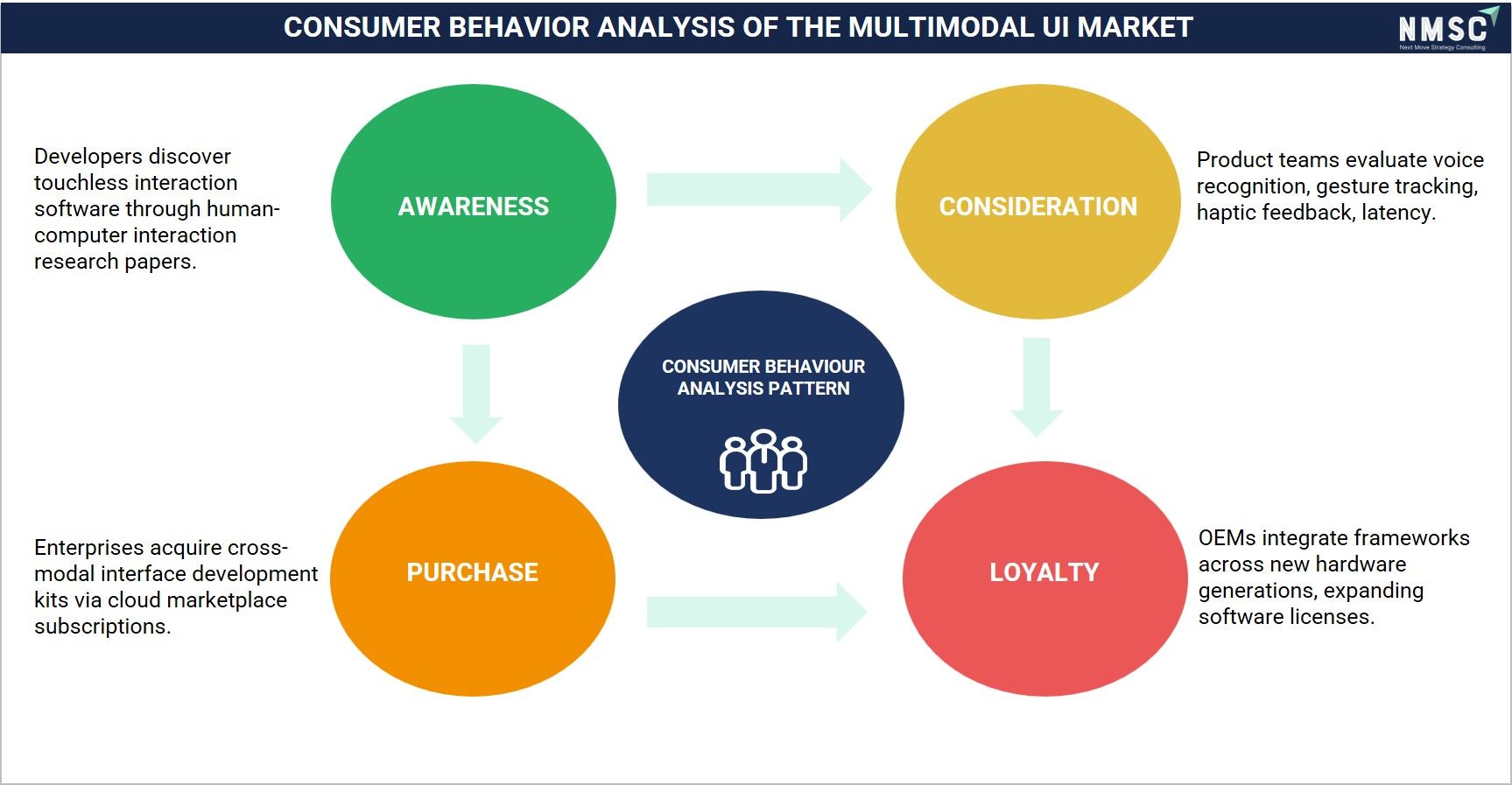
CONSUMER BEHAVIOR ANALYSIS OF THE MULTIMODAL UI MARKET

CONSUMER BEHAVIOR ANALYSIS OF THE MULTIMODAL UI MARKET

The consumer behavior analysis illustrates the adoption journey for multimodal UI technologies across awareness, consideration, purchase, and loyalty stages. Developers initially explore touchless and human-computer interaction technologies, while product teams evaluate capabilities such as voice recognition, gesture tracking, haptic feedback, and latency. Enterprises subsequently acquire cross-modal development solutions through cloud marketplaces, while OEMs integrate multimodal frameworks into successive hardware generations, supporting continued software adoption and customer retention.

Regional Outlook

2025 (USD Billion)
2035 (USD Billion)
North Americ
Europe
Asia-Pacific
Middle East
Latin Americ
Region 2025 (USD Billion) 2035 (USD Billion) CAGR (%)
North America $10.0 USD Billion $40.0 USD Billion 9.0%
Europe $17.1 USD Billion $51.1 USD Billion 27.0%
Asia-Pacific $24.2 USD Billion $62.2 USD Billion 25.0%
Middle East & Africa $31.3 USD Billion $73.3 USD Billion 23.0%
Latin America $38.4 USD Billion $84.4 USD Billion 12.0%

Regional data is locked

Unlock complete regional numbers for this market.

Unlock Full Data

Competitive Landscape

We observed that the market remains moderately concentrated, with large diversified technology companies, automotive-focused interface specialists, and single-modality hardware vendors competing across overlapping segments of the value chain.

Dimension Description
Market Structure Moderately concentrated among top 10 diversified technology and automotive interface vendors, with a long tail of single-modality hardware specialists
Innovation Focus Vision-grounded voice AI, agentic multimodal fusion, and automotive cabin integration
M&A Activity Acquisition of single-modality specialists by diversified platform vendors to build integrated fusion capability

How Do Companies Compete in the Multimodal UI Market?

Companies compete primarily on recognition accuracy, integration breadth, and AI model sophistication within the market. We observed that vertically integrated technology companies combining hardware, software, and AI models can offer more seamless fusion experiences than single-modality specialists. Latency performance and cross-modal context retention increasingly differentiate bids in device manufacturer and automotive procurement, alongside proven large-scale deployment for buyers seeking production-grade reliability.

Which Competitive Archetypes Dominate the Multimodal UI Industry?

Two archetypes dominate the multimodal UI industry: large diversified technology companies with integrated hardware, software, and AI capability, and specialized single-modality vendors concentrated in voice, gesture, or eye-tracking technology. We found that the first group competes primarily on platform breadth and existing device ecosystems, while the second differentiates through deep technical specialization that generalist platforms often license or acquire, securing recurring licensing revenue from device makers seeking best-in-class single-modality performance.

What Innovation and Differentiation Strategies Define Market Leaders?

Market leaders differentiate through vision-grounded voice AI, agentic task completion, and integration with adjacent augmented reality platforms for buyers managing converging spatial computing and interaction needs. Our analysis shows that companies investing in cross-modal context retention are positioning to capture premium automotive and enterprise accounts, while low-latency on-device processing increasingly forms a core part of competitive bids across consumer electronics tenders.

How Active Is M&A in the Multimodal UI Market?

M&A and strategic partnership activity remains active as diversified technology vendors pursue acquisition of single-modality specialists to build integrated fusion capability. We found that SoundHound AI's continued expansion into vision-enabled voice AI reflects this trend toward platform consolidation, while automotive interface specialists pursue partnerships with automakers to secure long-term in-vehicle platform integration across new vehicle programs.

Key Market Players

We observed that the following 18 companies represent the leading participants shaping the competitive structure of the multimodal UI market.

Apple Inc. Alphabet Inc. (Google) Microsoft Corporation Amazon.com, Inc. Samsung Electronics Co., Ltd. Meta Platforms, Inc. NVIDIA Corporation Qualcomm Incorporated Cerence Inc. SoundHound AI, Inc. Synaptics Incorporated Tobii AB Ultraleap Ltd. Smart Eye AB RealWear, Inc. Sensory, Inc. FaceTec, Inc. KIOSK Information Systems, Inc.

Latest Developments

Our assessment indicates that recent corporate activity reflects continued fusion platform innovation and automotive integration expansion across the multimodal UI market.

Date Event
June 2026 Meta introduced Meta Glasses with EssilorLuxottica, offering 26 styles and Meta AI powered by Muse Spark. The glasses combine voice interaction, environmental understanding, navigation, translation and visual AI assistance, strengthening eyewear as a hands-free multimodal interface between users, AI and their surroundings.
May 2026 Google demonstrated intelligent eyewear running Android XR with Gemini, enabling hands-free directions, messaging, photography and other contextual assistance. The platform is being developed with Samsung and Qualcomm and is designed to combine cameras, audio, displays and Gemini for more natural interactions
May 2026 Amazon introduced a full visual shopping experience on Echo Show powered by Alexa+, allowing customers to browse products, compare options, read reviews and purchase through voice, touch or a combination of both. The experience is initially available on Echo Show 15 and 21.

Expert Insights

Bill McDermott

Chairman & CEO | ServiceNow

"“We are turning complexity into simplicity by helping integrate any model, workflow and data source into a single pane of glass.”"

Analyst Interpretation

The statement highlights the growing demand for unified AI-native and multimodal interfaces that reduce dependence on fragmented applications and conventional navigation. By bringing models, workflows, and enterprise data into a common interaction layer, multimodal UI can enable users to access information, initiate workflows, and interact with AI systems more naturally. This trend is expected to support adoption of multimodal interfaces across enterprise software, particularly where organizations seek to simplify complex workflows, improve employee productivity, and provide more intuitive access to distributed data and applications.

Investment Opportunities

Where Are Capital Inflows Concentrated in the Multimodal UI Market?

Capital inflows are concentrated in vision-grounded voice AI and agentic multimodal fusion platform development. We observed that strategic investors and diversified technology companies are increasingly funding single-modality specialists to strengthen integrated fusion capability, reflecting growing investor confidence in multimodal UI as foundational human-computer interaction infrastructure rather than a collection of standalone features.

How Significant Is Infrastructure Investment in Multimodal UI Platforms?

Infrastructure investment in cloud-based AI processing and low-latency edge computing is accelerating as vendors compete on cross-modal reasoning capability. Our findings suggest that augmented reality and virtual reality headset manufacturers are investing in dedicated multimodal sensor arrays to support spatial computing applications, supplementing traditional voice and touch interfaces with combined gesture and gaze input.

What ESG Considerations Shape Multimodal UI Investment?

Environmental, social, and governance considerations increasingly shape investment decisions, with investors favoring vendors that demonstrate responsible biometric data governance and accessible design practice. We observed that facial recognition and gaze-tracking data handling are drawing heightened regulatory and investor scrutiny, reflecting growing attention to privacy-preserving design and inclusive accessibility across the human-computer interaction value chain.

Key Benefits for Stakeholders

How Does This Report Benefit Device Maker and Industry Leaders?

Device maker and industry leaders gain access to segment-level revenue forecasts and modality-adoption trends that inform product roadmap planning. Our analysis shows that the report's regional breakdowns support market-entry and feature-prioritization decisions, helping stakeholders align investment with the fastest-growing modalities and end-use industries through 2035.

How Does This Report Benefit Investors and Financial Analysts?

Investors and financial analysts benefit from consolidated market-sizing data, competitive-landscape mapping, and CAGR-level growth drivers that support valuation and due-diligence work. We found that the report's country-level forecasts help identify markets with the strongest risk-adjusted return profiles, particularly across the fastest-growing Asia-Pacific and Middle East & Africa regions.

How Does This Report Benefit Technology Vendors and Product Teams?

Technology vendors and product teams gain segmentation-level insight into modality, end-use industry, and deployment preferences that inform roadmap prioritization. Our assessment indicates that the report's trend analysis highlights combined multimodal fusion platforms as a high-growth adjacency, helping product teams align development resources with the fastest-growing sub-segments identified in this market report.

Key Market Segments Evaluated

By Modality

  • Voice and Speech Recognition
  • Gesture Recognition
  • Eye and Gaze Tracking
  • Touch and Haptic Feedback
  • Facial and Emotion Recognition
  • Combined Multimodal Fusion Platforms

By End Use Industry

  • Consumer Electronics
  • Automotive
  • Healthcare
  • Retail
  • Industrial and Enterprise
  • Gaming and Entertainment

By Deployment

  • Embedded/On-Device
  • Cloud-Based

By Region

  • North America 
    • U.S.
    • Canada
    • Mexico
  • Europe 
    • UK
    • Germany
    • France
    • Italy
    • Spain
    • Sweden
    • Denmark
    • Finland
    • Netherlands
    • Rest of Europe
  • Asia-Pacific 
    • China
    • India
    • Japan
    • South Korea
    • Taiwan
    • Indonesia
    • Vietnam
    • Australia
    • Philippines
    • Malaysia
    • Rest of APAC
  • Middle East & Africa 
    • Saudi Arabia
    • UAE
    • Egypt
    • Israel
    • Turkey
    • Nigeria
    • South Africa
    • Rest of MEA
  • Latin America 
    • Brazil
    • Argentina
    • Chile
    • Colombia
    • Rest of LATAM

Conclusion & Recommendations

The long-term outlook remains strongly positive, with the market projected to grow more than fourfold from USD 22.4 billion in 2026 to USD 96.3 billion by 2035. We observed that this trajectory is underpinned by structural generative AI integration and rising consumer expectation for natural interaction rather than a niche feature trend alone, positioning multimodal UI as foundational human-computer interaction infrastructure through 2035 and beyond.

What Strategic Positioning Should Stakeholders Pursue?

Stakeholders should pursue platform-consolidated positioning that combines voice, vision, gesture, and haptic capability within a single AI-native fusion layer. Our analysis shows that vendors investing early in cross-modal context retention and cloud-based reasoning capability, spanning consumer electronics, automotive, and healthcare applications, will be best positioned to capture premium device manufacturer and automotive contract awards within the multimodal UI market.

How Attractive Is the Multimodal UI Market for New Investment?

The multimodal UI industry presents a highly attractive investment case, supported by a USD 73.9 billion absolute dollar opportunity between 2026 and 2035 and above-average growth in Asia-Pacific and Middle East & Africa. We found that investment attractiveness is highest for platforms combining recognition accuracy with fusion differentiation, positioning them to serve both cost-sensitive consumer electronics buyers and premium automotive and healthcare segments simultaneously.

What Market Shifts and Key Risks Should Stakeholders Monitor?

Stakeholders should monitor high integration complexity across sensor types, data-privacy concerns around biometric recognition, and elevated hardware bill-of-materials costs as key risks to the multimodal UI market. Our analysis shows that vendors unable to achieve reliable, low-cost sensor fusion risk losing device manufacturer contracts to competitors with proven integration engineering, particularly as consumer expectations for seamless interaction accelerate through 2035.

What Are the Key Growth Pathways for the Multimodal UI Market?

Key growth pathways include expanding combined multimodal fusion platform capability, scaling cloud-based AI reasoning infrastructure, and deepening penetration into healthcare and industrial buyer segments. Next Move Strategy Consulting's analysis indicates that vendors pursuing these pathways while maintaining recognition accuracy in core voice and touch categories will be best positioned to capture the multimodal UI market's projected growth through 2035.

FAQs

About the Author

Liza Phukan

Liza Phukan

Liza Phukan is Research Associate at Next Move Strategy Consulting, where she has covered emerging industries and market research across sectors for 3.5 years. Her work includes analyzing industry developments, validating market data, and developing structured business content from research findings. She uses secondary research and data-validation practices to turn complex market information into clear decision-useful market analysis for business audiences and support report development and B2B.

About the Reviewer

Supradip Baul

Supradip Baul

Supradip Baul is an accomplished business consultant and strategist with over a decade of rich experience in market intelligence, strategy, technology, and business transformation. His work has included rigorous qualitative and quantitative analysis across multiple industries, helping clients shape investment decisions and long-term roadmaps. Earlier in his career, he was associated with Gartner, where he contributed to industry-leading reports and market share analyses. He has worked with leading global companies and holds an MBA with a dual specialization in Marketing and Finance.

Download Free Sample

Pratyush Kumar Das

PRATYUSH KUMAR DAS

Assistant Manager

Polycab India Limited

We would like to express our appreciation for the data and insights provided by nextmsc. We are very pleased with the quality and depth of the information, which has proven to be highly valuable and beneficial for our business decision-making.

Semih Kavaklioglu

SEMIH KAVAKLIOGLU

Co-Founder & Sales Manager

Decortie

I work a lot in the marketing industry and I know that research is an essential part of any campaign. I have used Market research reports for my own products and I found them to be very informative and well-researched. The team here produces insightful reports for a good price

Rishabh Jogani

RISHABH JOGANI

Strategy Analyst

Accenture Japan

We are incredibly impressed with the market report on the real estate market in India provided by Next Move Strategy Consulting. The report was thorough, insightful, and well-structured, offering deep analysis and actionable recommendations. It not only captured the current trends and dynamics but also provided a forward-looking perspective that has been invaluable for our strategic planning. Their team demonstrated exceptional professionalism, attention to detail, and a profound understanding of the industry. The data-driven insights and clarity of presentation exceeded our expectations, making complex market trends easy to understand. We highly recommend Next Move Strategy Consulting to anyone looking for reliable and comprehensive market research services. Their expertise has given us the confidence to navigate the complexities of the Indian real estate market with clarity and foresight.

Kevin Coker

KEVIN COKER

Founder, CEO and Board Diector

Proxima Clinical Research

I have been using Next MSC reports for product positioning in a new geography for a long time. They have by far the best reports I have found and the price is reasonable too!

Henri Knyphausen

HENRI KNYPHAUSEN

Partner at Singulier [Ex-BCG]

Singulier

I recently engaged NEXTMSC.com for a commercial due diligence project within the intralogistics sector, and I am pleased to provide a reference based on my experience. In utilizing NEXTMSC.com's services, I found their report to offer valuable insights into market dynamics and key industry players. The initial report provided a solid foundation for our analysis. However, as we were investigating a smaller target in the market, and I had specific customization requests requiring additional research. These requests included detailed information on product portfolios of various players and sub-market sizes, both inclusive and exclusive of certain product categories. NEXTMSC.com demonstrated commendable responsiveness and agility in accommodating these customization requests. Within a timeframe of 1-2 weeks, they delivered a revised report that met our specific needs. Furthermore, they were receptive to my follow-up inquiries, ensuring clarity and understanding of the data provided. The final deliverable significantly contributed to our due diligence efforts. One of NEXTMSC.com's notable strengths lies in their qualitative research capabilities. However, for future engagements, I would recommend the inclusion of a quantified market model in Excel format. Such a model would offer the ability to conduct in-depth analyses and explore various market segments, including country-specific data and subcomponent breakdowns. Based on my positive experience, I would not hesitate to work with NEXTMSC.com again. Their responsiveness, willingness to accommodate customization requests, and commitment to delivering actionable insights make them a reliable partner for commercial research projects.

Custom Market Research Services

We will customize the research for you if the listed report does not fully match your requirements.

Get 30% Free Customization

Select License

This website uses cookies to ensure you get the best experience on our website. Learn more

✖