
AI Competitive Analysis Market Size, Share, Growth & Forecast by Product Function (Digital Presence Intelligence, Social & Brand Intelligence, Market & Corporate Intelligence, Product Intelligence, Sales Competitive Intelligence, Pricing & Commercial Intelligence, Specialized Competitive Intelligence), Deployment Model (Cloud, Hybrid, On-Premises), Enterprise Size, End User Function, Revenue Model, and Industry Vertical — Global Analysis 2025–2035
Industry: ICT & Media | Publishing Date: July 6, 2026 | Last Updated: September 30, 2026 | No of Pages: N/A | No. of Tables: N/A | No. of Figures: N/A | Format: PDF | Report Code: IC4979
What Is the AI Competitive Analysis Market Size?
The global AI Competitive Analysis Market was valued at USD 4.2 billion in 2025 and is expected to reach USD 5.0 billion in 2026. Accelerating enterprise adoption of AI-driven intelligence platforms, growing demand for real-time competitive signals across digital, social, and commercial dimensions, and expanding integration of large language models into competitive workflows are projected to propel the market to USD 24.6 billion by 2035, advancing at a CAGR of 19.3% from 2026 to 2035. Key growth drivers include the proliferation of AI-native insight platforms, increasing reliance on automated battlecard generation, the rise of continuous market monitoring architectures, and growing C-suite demand for real-time competitor visibility across global markets.
|
Parameters |
Details |
|
Market Size in 2025 |
USD 4.2 Billion |
|
Market Size in 2026 |
USD 5.0 Billion |
|
Revenue Forecast in 2035 |
USD 24.6 Billion |
|
Growth Rate |
CAGR of 19.3% from 2026 to 2035 |
|
Analysis Period |
2025–2035 |
|
Base Year Considered |
2025 |
|
Forecast Period |
2026–2035 |
|
Market Size Estimation |
Billion USD |
|
Companies Profiled |
20 |
|
Countries Covered |
33 |
|
Market Share |
Top 10 |
AI Competitive Analysis Market Overview
What Is the AI Competitive Analysis Market?
The AI Competitive Analysis Market encompasses software platforms, data services, and intelligence tools that leverage artificial intelligence, machine learning, and natural language processing to capture, synthesize, and deliver actionable competitive insights across digital, social, commercial, and corporate intelligence domains. These solutions automate competitive monitoring, benchmark competitor activities, analyze market positioning, and surface strategic signals—transforming vast volumes of public and proprietary data into decision-ready intelligence for enterprise strategy, sales, marketing, and product teams.
How Has the AI Competitive Analysis Market Evolved?
The AI Competitive Analysis Market has progressed through three distinct phases. The first phase centered on manual research aggregation and rudimentary web scraping tools. The second phase introduced cloud-hosted competitive intelligence platforms integrating structured data crawling, SEO analytics, and social monitoring dashboards. NMSC's analysis indicates that the current phase is defined by AI-native architectures that embed generative AI for automated insight synthesis, conversational intelligence interfaces, real-time signal classification, and predictive competitive scenario modeling—fundamentally shifting competitive intelligence from periodic reporting to continuous, AI-mediated situational awareness.
How Do Regulations Influence the AI Competitive Analysis Market?
Regulatory frameworks are increasingly shaping the AI Competitive Analysis Market. The European Union's General Data Protection Regulation (GDPR) constrains the methods by which competitive platforms collect and process personal data embedded in competitive signals. The EU AI Act introduces transparency and explainability obligations for AI-generated competitive recommendations used in high-stakes business decisions. Additionally, regulations governing web scraping, data resale, and intellectual property—including platform terms-of-service enforcement—are compelling vendors to invest in compliant data acquisition architectures and consent-based intelligence workflows.
How Is Technology Adoption Expanding Across the AI Competitive Analysis Market?
Technology adoption across the AI Competitive Analysis Market is accelerating as organizations embed competitive intelligence into their existing CRM, product management, and marketing automation workflows. From our market assessment, we observed that the integration of large language models with real-time data pipelines enables automated competitive narrative generation, dynamic battlecard updates, and conversational competitor queries. API-first architectures and pre-built CRM connectors are lowering the adoption barrier for mid-market buyers, while enterprise teams are increasingly deploying custom-trained competitive intelligence models fine-tuned on proprietary win-loss data and company-specific competitive landscapes.
|
Key Takeaways |
|
By product function, Digital Presence Intelligence held the largest share in the AI Competitive Analysis Market at USD 1.02 billion in 2025, driven by growing enterprise demand for website analytics, search visibility monitoring, traffic intelligence, and digital benchmarking capabilities. Specialized Competitive Intelligence is the fastest-growing product function at a CAGR of 23.2% from 2026 to 2035, supported by increasing adoption of AI-driven strategic monitoring, automated competitor tracking, and industry-specific intelligence platforms. |
|
Pricing and Commercial Intelligence is the second-fastest-growing product function, advancing at a CAGR of 22.7% from 2026 to 2035, reflecting increasing demand for dynamic pricing optimization, competitive pricing surveillance, and AI-powered commercial decision-support solutions. |
|
By deployment model, Public Cloud accounted for the largest market share at USD 2.10 billion in 2025, driven by enterprise preference for scalable, continuously updated, and globally accessible intelligence platforms. Public Cloud is the fastest-growing deployment segment at a CAGR of 19.8% from 2026 to 2035, supported by increasing enterprise adoption of cloud-native analytics architectures and AI-powered intelligence platforms. |
|
By enterprise size, Large Enterprises generated the highest revenue contribution at USD 2.52 billion in 2025, reflecting substantial investments in competitive intelligence, strategic planning, and market monitoring capabilities. Medium Enterprises are the fastest-growing enterprise segment at a CAGR of 19.6% from 2026 to 2035, driven by growing accessibility of AI-powered competitive intelligence tools and increasing digital transformation initiatives. |
|
By end-user function, Marketing represented the largest user segment at USD 1.05 billion in 2025, supported by increasing adoption of AI-powered competitive intelligence for SEO benchmarking, content intelligence, digital presence monitoring, and share-of-voice analysis. Product Management is the fastest-growing end-user function at a CAGR of 20.5% from 2026 to 2035, driven by increasing demand for competitive product benchmarking, product positioning intelligence, technology stack monitoring, and market opportunity assessment. |
|
By revenue model, Subscription Revenue accounted for the largest market share at USD 2.94 billion in 2025, reflecting widespread adoption of recurring SaaS-based intelligence platforms. Managed Intelligence Services is the fastest-growing professional services segment at a CAGR of 18.8% from 2026 to 2035, driven by increasing demand for outsourced competitive monitoring, strategic intelligence support, and analyst-assisted insights. |
|
By industry vertical, Technology generated the largest revenue contribution at USD 1.00 billion in 2025, supported by highly competitive market environments, rapid product innovation cycles, and significant investments in competitive intelligence capabilities. Healthcare and Life Sciences is the fastest-growing industry vertical at a CAGR of 20.7% from 2026 to 2035, driven by increasing competitive pressures, accelerated innovation cycles, and growing adoption of AI-enabled market intelligence solutions. |
|
North America held the largest regional share in the AI Competitive Analysis Market at USD 1.89 billion in 2025 and is projected to reach approximately USD 11.20 billion by 2035 at a CAGR of 19.5%, supported by strong enterprise AI adoption, advanced digital infrastructure, and the presence of leading competitive intelligence platform providers. |
|
Asia-Pacific is the fastest-growing region in the AI Competitive Analysis Market at a CAGR of 20.2% from 2026 to 2035, driven by rapid digital transformation, increasing enterprise technology spending, expanding startup ecosystems, and growing adoption of AI-powered business intelligence solutions. |
|
The United States is the largest country market in the AI Competitive Analysis Market, supported by extensive enterprise software adoption, strong AI investment activity, and widespread use of competitive intelligence platforms across industries. |
|
India is the fastest-growing country market within Asia-Pacific, driven by accelerating digital transformation initiatives, expanding technology and startup ecosystems, increasing enterprise adoption of AI-powered analytics platforms, and rising demand for strategic competitive intelligence solutions. |
Key Emerging Trends in the AI Competitive Analysis Market
How Is Generative AI Transforming Competitive Intelligence Workflows in the AI Competitive Analysis Market?
Generative AI is fundamentally redefining how enterprises consume competitive intelligence within the AI Competitive Analysis Market by enabling natural-language queries against real-time competitor data repositories. Our analysis shows that platforms such as Klue and AlphaSense have integrated LLM-based interfaces allowing sales and strategy teams to ask conversational questions, receiving synthesized competitive summaries rather than raw data dashboards. This transformation reduces the time-to-insight from hours to minutes, democratizes competitive intelligence access beyond specialized analyst roles, and enables scalable battlecard generation, executive briefing automation, and real-time competitive response recommendations across enterprise functions.
How Is the Convergence of Go-to-Market and Product Intelligence Reshaping the AI Competitive Analysis Market?
Through our market assessment, we observed a structural convergence between go-to-market competitive tools and product intelligence platforms within the AI Competitive Analysis Market. Organizations are increasingly demanding unified platforms that simultaneously track competitor pricing, feature launches, sales messaging, and technology stack changes within a single intelligence environment. This convergence is accelerating the product roadmaps of leading vendors including Crayon, Kompyte, and Klue, which are expanding from sales battlecard management into product feature intelligence, user review analytics, and technology stack monitoring—compressing previously distinct market categories into integrated competitive operating systems.
What Role Is Real-Time Signal Intelligence Playing in the Evolution of the AI Competitive Analysis Market?
Real-time signal intelligence is emerging as a defining capability differentiation in the AI Competitive Analysis Market, as organizations move from periodic competitive research cycles to continuous, event-driven intelligence consumption. Based on our research, we found that platforms integrating real-time monitoring across regulatory filings, patent publications, job postings, earnings call transcripts, news events, and social media are providing strategists with early warning signals of competitor strategic pivots. AlphaSense's acquisition of Tegus in 2023 exemplifies this trend, combining expert network insights with AI document analysis to deliver multi-source real-time corporate intelligence for institutional users.
How Is Win-Loss Intelligence Becoming a Core AI Competitive Analysis Market Growth Driver?
Win-loss intelligence, historically a qualitative and inconsistently practiced discipline, is being transformed into a quantitative and AI-automated capability within the AI Competitive Analysis Market. NMSC's analysis indicates that AI-powered win-loss platforms now analyze CRM data, call recordings, buyer survey responses, and deal cycle metadata to identify statistically significant patterns in why competitive deals are won or lost against specific rivals. This intelligence directly informs sales training, battlecard updates, and product prioritization. The structural integration of win-loss analytics with CRM platforms is expanding the total addressable market for AI competitive analysis solutions beyond standalone tools into embedded CRM intelligence modules.
Ecosystem Analysis of the AI Competitive Analysis Market
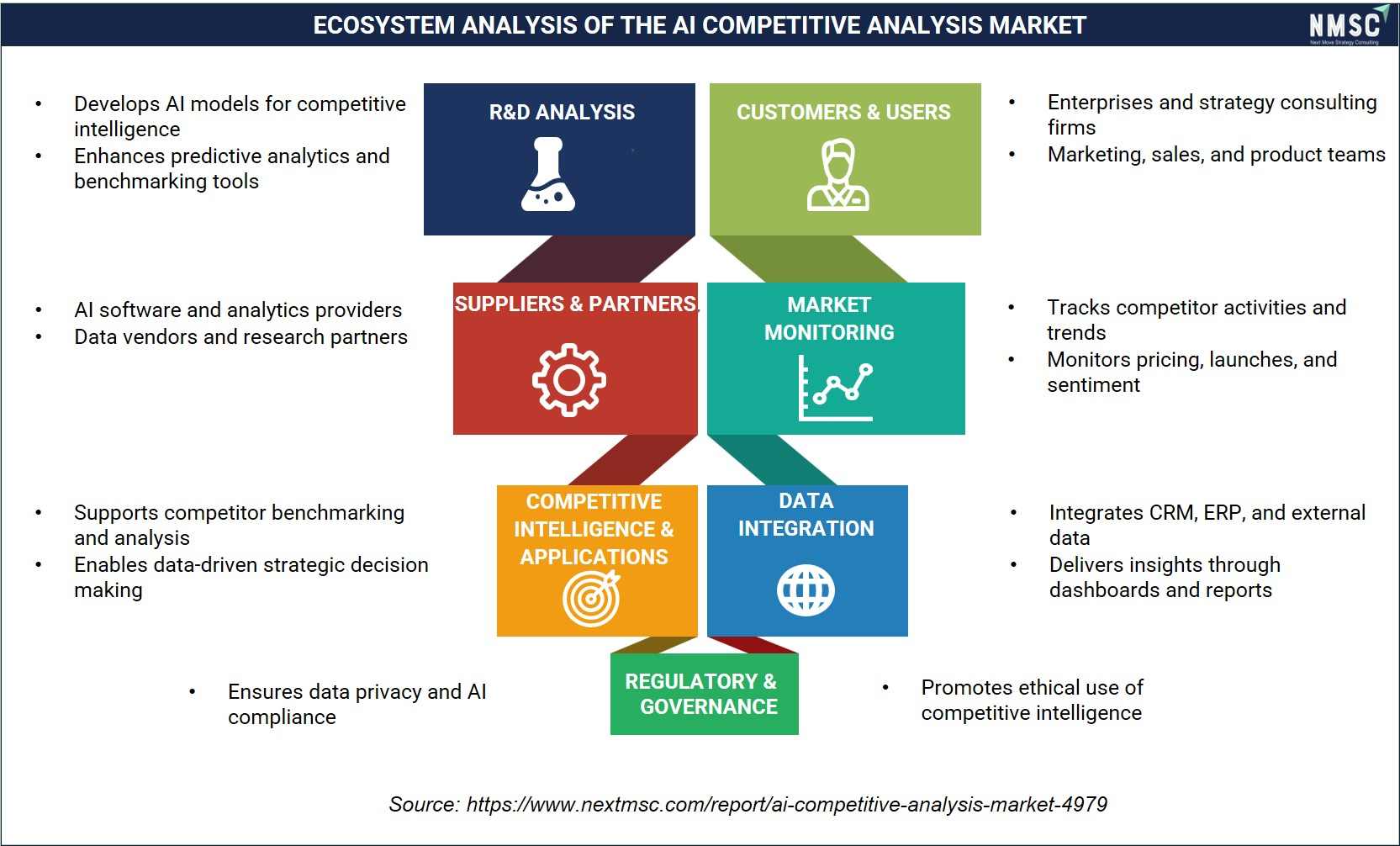
Based on our comprehensive assessment, we found that the AI competitive analysis ecosystem is driven by continuous R&D, data aggregation providers, technology partners, and market intelligence platforms. Organizations utilize AI-powered solutions to monitor competitors, track market trends, and generate strategic insights. Data integration, regulatory compliance, and analytics infrastructure support ecosystem growth, while suppliers, enterprise users, and software vendors enable widespread adoption.
What Are the Key Market Drivers, Breakthroughs, and Investment Opportunities that Will Shape the AI Competitive Analysis Industry in the Next Decade?
|
Drivers / Trends / Restraints |
(+/-) % Impact on CAGR Forecast |
Geographic Relevance |
Impact Timeline |
|
AI and LLM Integration in CI Platforms |
+2.6% |
Global (led by North America, Europe) |
2025–2030 |
|
CRM Integration of Competitive Intelligence |
+1.8% |
North America, Europe, APAC |
2025–2028 |
|
Rise of Win-Loss and Sales Intelligence Platforms |
+1.5% |
North America, Europe |
2025–2030 |
|
Real-Time Signal and Event Intelligence |
+1.4% |
Global (all regions) |
2025–2035 |
|
Healthcare and Life Sciences Vertical Expansion |
+1.2% |
North America, Europe, APAC |
2026–2035 |
|
Generative AI Battlecard Automation |
+1.1% |
North America, Europe |
2025–2030 |
|
GDPR and Web Scraping Regulatory Constraints |
-1.3% |
Europe, APAC, North America |
Ongoing |
|
High Cost and Complexity of Enterprise Platform Integration |
-0.8% |
Mid-market globally |
2025–2028 |
|
Data Quality and Coverage Inconsistency |
-0.6% |
All regions |
Ongoing |
|
Agentic AI Competitive Analysis Automation |
+2.0% |
Global |
2027–2035 |
|
Emerging Market Enterprise Adoption |
+1.0% |
APAC, MEA, LATAM |
2026–2035 |
What Are the Growth Drivers of the AI Competitive Analysis Market?
How Is the Rapid Integration of Artificial Intelligence into Enterprise Strategy Functions Driving the AI Competitive Analysis Market?
The integration of artificial intelligence into core enterprise strategy and go-to-market functions is the primary structural catalyst propelling the AI Competitive Analysis Market. Organizations across technology, financial services, and healthcare sectors are systematically replacing manual competitive research workflows with AI-automated intelligence platforms that continuously monitor competitor activities, analyze market shifts, and surface decision-ready insights. Based on our market evaluation, we noticed that the U.S. National Institute of Standards and Technology's AI Risk Management Framework, released in January 2023, has elevated AI governance awareness among enterprise buyers, accelerating adoption of AI competitive tools that include built-in transparency and audit trail capabilities to satisfy internal compliance requirements during platform procurement and deployment.
How Is the Expansion of CRM Integration Driving Demand for AI Competitive Analysis Platforms?
The growing integration of AI competitive analysis capabilities directly within CRM platforms represents a major structural demand driver for the AI Competitive Analysis Market. Sales organizations are increasingly demanding that competitive intelligence be delivered natively within Salesforce, HubSpot, and Microsoft Dynamics environments, eliminating context-switching and enabling sellers to access real-time battlecards, win-loss analytics, and competitor comparison intelligence at the point of need within active deal cycles. From our research, we found that Salesforce's disclosure in its annual proxy filings of growing third-party application partner revenue validates the commercial scale and enterprise demand for CRM-embedded competitive intelligence integrations within large enterprise sales environments globally.
How Is the Rise of Digital Commerce and Online Competitive Intensity Accelerating AI Competitive Analysis Market Growth?
The global expansion of digital commerce and the intensification of online competitive dynamics across retail, financial services, and technology sectors are compelling organizations to invest in AI-powered digital presence and pricing intelligence platforms. As brands compete for digital shelf space, organic search visibility, and paid media efficiency, the demand for AI Competitive Analysis tools that benchmark SEO performance, monitor competitor advertising strategies, and track marketplace pricing in real time has grown substantially. Through NMSC's assessment, we found that the U.S. Census Bureau's E-Commerce Statistics report consistently documents accelerating digital commerce penetration across retail verticals, creating structural demand for AI competitive monitoring platforms among e-commerce strategy and performance marketing teams.
What Are the Growth Inhibitors of the AI Competitive Analysis Market?
How Do Data Privacy Regulations and Web Scraping Restrictions Constrain the AI Competitive Analysis Market?
Regulatory constraints on competitive data collection represent the most significant structural inhibitor facing the AI Competitive Analysis Market. The European Union's GDPR restricts the collection and processing of personal data embedded within competitive intelligence signals, including social media profile data, contact-level behavioral tracking, and cross-site audience analytics. Platform terms-of-service enforcement by major technology companies against automated web scraping has further constrained data acquisition methods. Our assessment indicates that the EU AI Act, fully applicable from August 2026, introduces additional transparency obligations for AI systems generating competitive recommendations, increasing compliance costs and extending procurement approval processes for enterprise AI competitive analysis deployments across regulated industries in Europe.
How Do Integration Complexity and Competitive Intelligence Adoption Barriers Limit AI Competitive Analysis Market Growth?
Enterprise integration complexity represents a persistent constraint on AI Competitive Analysis Market adoption among mid-market and large enterprise organizations. Embedding competitive intelligence platforms within existing technology stacks—including CRM systems, product management tools, marketing automation platforms, and collaboration environments—requires significant IT resource investment, API configuration, and ongoing data synchronization management. Our findings suggest that organizations frequently underestimate the change management effort required to shift competitive intelligence workflows from ad-hoc manual research to platform-mediated, AI-automated intelligence consumption. The U.S. Government Accountability Office has documented analogous digital transformation adoption challenges within federal agencies, reflecting broader enterprise dynamics where technology capability and organizational readiness gaps extend platform deployment timelines and dampen near-term market growth.
What Are the Growth Opportunities in the AI Competitive Analysis Market?
How Does the Emergence of Agentic AI Create a Transformative Opportunity in the AI Competitive Analysis Market?
Agentic AI, wherein autonomous AI agents continuously monitor competitive environments, self-direct intelligence gathering tasks, and proactively surface strategic recommendations without human prompting, represents the most consequential growth opportunity in the AI Competitive Analysis Market over the 2027–2035 period. Our analysis shows that organizations deploying agentic competitive intelligence systems will achieve continuous, always-on competitive awareness across digital, social, regulatory, and commercial intelligence domains simultaneously—eliminating the latency inherent in analyst-mediated intelligence cycles. The National Institute of Standards and Technology's ongoing AI standards development work, including frameworks for autonomous AI systems, provides the governance architecture within which enterprise agentic competitive intelligence platforms will be procured and deployed across regulated corporate environments.
How Does the Expansion into Healthcare and Life Sciences Represent a Structural Growth Opportunity for the AI Competitive Analysis Market?
The healthcare and life sciences sector represents one of the highest-potential untapped expansion opportunities within the AI Competitive Analysis Market, driven by pharmaceutical companies, medical device manufacturers, and digital health platforms investing in pipeline intelligence, patent landscape monitoring, regulatory submission tracking, and clinical trial competitive benchmarking. Through our analysis, we identified that the U.S. Food and Drug Administration's publicly accessible databases—including Drugs@FDA, the FDA Drug Approval Database, and the Patent and Exclusivity Database—provide the foundational structured data sources that AI competitive intelligence platforms are increasingly monetizing through automated pharmaceutical pipeline tracking, exclusivity monitoring, and competitive positioning intelligence services for life sciences strategy teams.
How Does the Growing Demand for Procurement and Supply Chain Intelligence Open New Revenue Streams in the AI Competitive Analysis Market?
The expansion of AI Competitive Analysis capabilities into procurement and supply chain intelligence domains represents an emerging revenue opportunity as organizations seek competitive visibility across supplier ecosystems, vendor risk landscapes, and commodity market dynamics. Based on NMSC's research, we found that enterprises increasingly require AI-powered competitive intelligence that surfaces supplier concentration risks, monitors competitor sourcing strategies, and benchmarks procurement performance against industry peers. The U.S. Department of Commerce's supply chain monitoring initiatives and the European Commission's Strategic Dependencies and Capacities assessments have elevated supply chain competitive awareness to a board-level strategic priority, creating durable institutional demand for AI competitive analysis platforms that extend beyond traditional go-to-market intelligence into supply-side competitive benchmarking.
How Is the AI Competitive Analysis Market Segmented in This Report, and What Are the Key Insights from the Segmentation Analysis?
How Does Product Function Segmentation Reveal the Structural Composition of the AI Competitive Analysis Market?
|
Product Function Segment |
2025 (USD Bn) |
2035 (USD Bn) |
CAGR (%) |
|
Digital Presence Intelligence |
1.02 |
5.20 |
17.7% |
|
Social and Brand Intelligence |
0.78 |
4.10 |
18.2% |
|
Market and Corporate Intelligence |
0.88 |
4.60 |
18.0% |
|
Product Intelligence |
0.42 |
2.60 |
19.9% |
|
Sales Competitive Intelligence |
0.48 |
3.20 |
20.8% |
|
Pricing and Commercial Intelligence |
0.36 |
2.80 |
22.7% |
|
Specialized Competitive Intelligence |
0.26 |
2.10 |
23.2% |
Based on our analysis of enterprise intelligence consumption patterns, the AI Competitive Analysis Market is segmented by product function into Digital Presence Intelligence, Social and Brand Intelligence, Market and Corporate Intelligence, Product Intelligence, Sales Competitive Intelligence, Pricing and Commercial Intelligence, and Specialized Competitive Intelligence. Digital Presence Intelligence dominates with USD 1.02 billion in 2025, driven by strong enterprise demand for Website Traffic Intelligence, SEO Keyword and Backlink Intelligence, Paid Search benchmarking, and Audience Intelligence tools that quantify competitor digital publishing footprint. Market and Corporate Intelligence follows closely at USD 0.88 billion, underpinned by financial benchmarking, earnings call analysis, M&A intelligence, and executive monitoring capabilities. Specialized Competitive Intelligence at USD 0.26 billion is the fastest-growing segment, while Pricing and Commercial Intelligence at USD 0.36 billion is the second-fastest-growing segment, reflecting escalating enterprise investment in AI price monitoring, MAP compliance enforcement, and promotional benchmarking across digital commerce environments.
How Do Deployment Model Preferences Shape Revenue Distribution in the AI Competitive Analysis Market?
|
Deployment Segment |
2025 (USD Bn) |
2035 (USD Bn) |
CAGR (%) |
|
Cloud (Public Cloud) |
2.10 |
12.80 |
19.8% |
|
Cloud (Private Cloud) |
0.84 |
5.00 |
19.5% |
|
Hybrid |
0.88 |
4.80 |
18.5% |
|
On-Premises |
0.38 |
2.00 |
18.2% |
From our market assessment, we observed that the AI Competitive Analysis Market is deployed across Cloud (Public and Private), Hybrid, and On-Premises environments. Public Cloud deployment dominates at USD 2.10 billion in 2025, reflecting the preference of SaaS-native AI competitive intelligence vendors for cloud-first delivery architectures that provide automatic platform updates, continuous data refresh pipelines, and elastic scalability for high-volume intelligence workloads. Private Cloud adoption at USD 0.84 billion serves large enterprises requiring enhanced data isolation, custom security configurations, and dedicated computing resources for sensitive competitive strategy workloads. Hybrid deployment at USD 0.88 billion is growing steadily as enterprises balance cloudcloud intelligence agility with on-premises data residency requirements. On-Premises deployments, while the smallest segment, remain relevant in government and highly regulated financial services organizations requiring complete data sovereignty.
How Does Enterprise Size Influence Adoption Patterns and Spending in the AI Competitive Analysis Market?
|
Enterprise Size Segment |
2025 (USD Bn) |
2035 (USD Bn) |
CAGR (%) |
|
Large Enterprises |
2.52 |
14.80 |
19.3% |
|
Medium Enterprises |
1.14 |
6.80 |
19.6% |
|
Small Enterprises |
0.54 |
3.00 |
18.8% |
Our analysis of enterprise competitive intelligence program maturity indicates that the AI Competitive Analysis Market is segmented into Large, Medium, and Small Enterprises. Large Enterprises dominate at USD 2.52 billion in 2025, supported by structured competitive intelligence functions, dedicated strategy teams, and substantial technology procurement budgets enabling comprehensive AI competitive analysis platform deployments across multiple business units. Medium Enterprises at USD 1.14 billion represent the fastest-growing size cohort by CAGR at 19.6% from 2026 to 2035, increasingly adopting AI-native competitive analysis platforms as SaaS subscription pricing and self-serve onboarding lower the implementation barrier. Small Enterprises at USD 0.54 billion are expanding their AI competitive analysis adoption rapidly, driven by affordable entry-tier subscriptions from vendors including Semrush, SpyFu, SE Ranking, and Ahrefs that provide accessible competitive intelligence capabilities for growing businesses.
Which End User Functions Are Driving the Highest AI Competitive Analysis Platform Demand Across the Enterprise?
|
End User Function |
2025 (USD Bn) |
2035 (USD Bn) |
CAGR (%) |
|
Marketing |
1.05 |
6.20 |
19.4% |
|
Sales |
0.84 |
5.10 |
19.8% |
|
Product Management |
0.63 |
4.10 |
20.5% |
|
Strategy and Corporate Development |
0.52 |
3.20 |
19.8% |
|
Executive Leadership |
0.42 |
2.60 |
19.9% |
|
Investor Relations and Finance |
0.31 |
1.60 |
17.9% |
|
Procurement and Sourcing |
0.27 |
1.30 |
17.0% |
|
Other Functions |
0.16 |
0.50 |
12.0% |
Based on our evaluation of enterprise AI competitive analysis deployment patterns, the market is segmented by end user function into Marketing, Sales, Product Management, Strategy and Corporate Development, Executive Leadership, Investor Relations and Finance, Procurement and Sourcing, and Other Functions. The Marketing function dominates at USD 1.05 billion in 2025, as marketing teams leverage AI competitive analysis for content gap identification, SEO benchmarking, share of voice measurement, and paid media intelligence. Sales at USD 0.84 billion represents the second-largest function, driven by battlecard management, win-loss intelligence, and CRM-integrated competitive insights at the point of sale. Product Management at USD 0.63 billion is the fastest-growing end user function, reflecting the increasing use of AI competitive platforms for product feature benchmarking, technology stack intelligence, and competitive roadmap monitoring to inform product differentiation and development prioritization.
How Do Revenue Models Reflect the Commercial Architecture of the AI Competitive Analysis Market?
|
Revenue Model |
2025 (USD Bn) |
2035 (USD Bn) |
CAGR (%) |
|
Subscription Revenue |
2.94 |
18.00 |
19.8% |
|
Professional Services Revenue – Implementation |
0.28 |
1.40 |
17.5% |
|
Professional Services Revenue – Integration |
0.24 |
1.20 |
17.4% |
|
Professional Services Revenue – Training |
0.18 |
0.90 |
17.4% |
|
Professional Services Revenue – Managed Intelligence |
0.32 |
1.80 |
18.8% |
|
Professional Services Revenue – Consulting |
0.24 |
1.30 |
18.4% |
Through our analysis of AI competitive intelligence vendor business models, we observed that the market is commercially structured around Subscription Revenue and Professional Services Revenue. Subscription Revenue dominates at USD 2.94 billion in 2025, reflecting the near-universal adoption of recurring SaaS subscription models by AI competitive analysis vendors including Semrush, Similarweb, Meltwater, Klue, and AlphaSense. This model provides platform vendors with predictable annual recurring revenue and supports continuous product improvement cycles. Professional Services, totaling USD 1.26 billion across Implementation, Integration, Training, Managed Intelligence, and Consulting sub-segments, are growing steadily as enterprise buyers require expert deployment support and custom intelligence workflow design. Managed Intelligence Services within the professional services category is the fastest-growing sub-segment, as organizations outsource ongoing competitive monitoring and analysis to vendor-managed intelligence teams.
Which Industry Verticals Generate the Most Value in the AI Competitive Analysis Market?
|
Industry Vertical |
2025 (USD Bn) |
2035 (USD Bn) |
CAGR (%) |
|
Technology |
1.00 |
6.20 |
19.9% |
|
Retail and E-Commerce |
0.58 |
3.60 |
19.9% |
|
Financial Services |
0.55 |
3.50 |
20.3% |
|
Healthcare and Life Sciences |
0.44 |
2.90 |
20.7% |
|
Manufacturing |
0.33 |
1.90 |
19.2% |
|
Telecommunications |
0.28 |
1.70 |
19.6% |
|
Media and Entertainment |
0.24 |
1.30 |
18.5% |
|
Consumer Goods |
0.21 |
1.10 |
18.0% |
|
Energy and Utilities |
0.17 |
0.80 |
16.8% |
|
Government and Public Sector |
0.12 |
0.60 |
17.5% |
|
Professional Services |
0.10 |
0.50 |
17.5% |
|
Other Industries |
0.18 |
0.50 |
10.8% |
Based on our analysis of enterprise competitive intelligence investment priorities across industry sectors, the AI Competitive Analysis Market spans Technology, Retail and E-Commerce, Financial Services, Healthcare and Life Sciences, Manufacturing, Telecommunications, Media and Entertainment, Consumer Goods, Energy and Utilities, Government and Public Sector, Professional Services, and Other Industries. The Technology vertical dominates at USD 1.00 billion in 2025, as software companies, cloud platforms, and hardware vendors operate in the most competitively intensive market segments globally, requiring comprehensive AI competitive analysis across digital presence, product, pricing, and talent intelligence domains. Healthcare and Life Sciences at USD 0.44 billion is the fastest-growing vertical at a CAGR of 20.7%, driven by accelerating pharmaceutical pipeline intelligence, patent tracking, regulatory submission monitoring, and clinical trial competitive benchmarking demands.
Regional Outlook
Geographic Performance Snapshot
|
Region |
2025 (USD Bn) |
2035 (USD Bn) |
CAGR (%) |
Key Driver |
|
North America |
1.89 |
11.20 |
19.5% |
SaaS vendor HQ, enterprise AI spend |
|
Europe |
1.05 |
6.00 |
19.0% |
GDPR compliance, regulated CI adoption |
|
Asia-Pacific |
0.80 |
5.00 |
20.2% |
Technology sector growth, digital transformation |
|
Middle East & Africa |
0.25 |
1.40 |
18.8% |
Vision 2030, digital economy initiatives |
|
Latin America |
0.21 |
1.00 |
16.8% |
SaaS adoption, technology sector expansion |
North America AI Competitive Analysis Market
North America is the dominant region in the AI Competitive Analysis Market, contributing USD 1.89 billion in 2025 and forecast to reach USD 11.2 billion by 2035 at a CAGR of 19.5%. The region benefits from the global headquarters of leading AI competitive intelligence platform vendors including AlphaSense, Klue, Semrush, Similarweb, Hootsuite, and Sensor Tower. Deep enterprise SaaS adoption, mature competitive intelligence program culture, substantial technology investment budgets, and a highly developed venture capital ecosystem sustaining continuous platform innovation underpin North America's sustained market leadership throughout the forecast period. Regulatory developments including CCPA and FTC guidance on data practices are also shaping platform compliance architectures across the region.
U.S. AI Competitive Analysis Market
Based on our engagements with enterprise technology buyers and competitive intelligence practitioners, the United States represents approximately 82% of North American AI Competitive Analysis Market revenue. The U.S. market is underpinned by the world's highest concentration of SaaS competitive intelligence vendors, Fortune 500 enterprise buyers maintaining structured competitive intelligence programs, and the deepest technology sector ecosystems requiring intensive competitor monitoring across software, cloud, semiconductor, and digital media verticals. The U.S. Securities and Exchange Commission's EDGAR database provides a foundational publicly available data source that AI competitive intelligence platforms increasingly mine for financial benchmarking, M&A signal detection, and executive intelligence services benefiting U.S.-based enterprise users.
Canada AI Competitive Analysis Market
Through our analysis, Canada represents approximately 11% of North American AI Competitive Analysis Market revenue, supported by a rapidly expanding technology sector concentrated in Toronto, Vancouver, and Montreal, and by financial services firms with deep competitive intelligence program requirements. Canadian enterprises in financial services, retail, and technology are increasing AI competitive analysis platform adoption to benchmark digital presence, monitor competitor pricing, and track talent movement. Canada's Digital Charter and its proposed Consumer Privacy Protection Act are compelling platform vendors serving Canadian clients to invest in enhanced data governance capabilities, creating demand for compliance-ready AI competitive analysis architectures within the Canadian enterprise market.
Mexico AI Competitive Analysis Market
From our assessment, Mexico is emerging as a strategically important growth market within North America in the AI Competitive Analysis Market, driven by rapid expansion of the technology sector, growing fintech ecosystem, and nearshoring-driven multinational corporate presence requiring competitive intelligence support for market entry and competitive benchmarking. Mexican enterprises are increasingly adopting cloud-based AI competitive analysis platforms for digital presence monitoring, social intelligence, and e-commerce competitive pricing tracking. The government's digital economy agenda and increasing broadband penetration are expanding the enterprise technology adoption base, creating an expanding addressable market for SaaS-delivered competitive intelligence platforms across the country's major commercial centers.
Europe AI Competitive Analysis Market
Europe is the second-largest region in the AI Competitive Analysis Market, contributing USD 1.05 billion in 2025 and forecast to reach USD 6.0 billion by 2035 at a CAGR of 19.0%. Europe's market is shaped by the intersection of strong enterprise demand for competitive intelligence tools and a complex regulatory environment anchored by GDPR, the EU AI Act, the Digital Markets Act, and the EU Data Act. These regulations simultaneously compel enterprises to invest in compliant competitive intelligence platforms and constrain data collection methods available to vendors. The region's diverse and competitive retail, financial services, telecommunications, and manufacturing sectors drive sustained demand for AI competitive analysis across digital presence, pricing, and brand intelligence domains.
UK AI Competitive Analysis Market
Based on our engagements, the United Kingdom is the largest individual country market in Europe for AI Competitive Analysis, representing approximately 24% of European revenue in 2025. London's status as a global financial and technology hub drives intensive competitive intelligence requirements across fintech, asset management, media, and professional services sectors. Post-Brexit regulatory flexibility under the UK GDPR has created a differentiated compliance environment from EU counterparts while maintaining equivalent data protection standards. Vendors including Meltwater, Onclusive, and Adthena maintain significant UK operations, reflecting the market's depth and the concentration of sophisticated enterprise competitive intelligence program buyers across British commercial sectors.
Germany AI Competitive Analysis Market
According to evaluation of Germany's technology and industrial landscape, Germany represents the second-largest European market in the AI Competitive Analysis Market, anchored by the country's industrial manufacturing, automotive, chemicals, and engineering sectors, which require intensive supply chain competitive intelligence, patent monitoring, and technology stack benchmarking. German enterprises demonstrate strong preference for compliance-validated AI competitive analysis platforms that meet the stringent requirements of the Bundesdatenschutzgesetz (BDSG) and GDPR simultaneously. The German federal government's National AI Strategy, which has committed EUR 3 billion in public AI investment, is also expanding public sector and research institution demand for structured market and competitive intelligence tools.
France AI Competitive Analysis Market
Through our analysis, France is a significant European market for AI Competitive Analysis, driven by its large retail, luxury goods, telecommunications, and financial services sectors with structured competitive intelligence program requirements. French enterprises are increasingly adopting AI-powered social listening, brand reputation intelligence, and share-of-voice monitoring platforms to benchmark competitor positioning across digital and traditional media environments. France's national AI strategy, supported by the Agence Nationale de la Recherche and public investment through Bpifrance, is expanding the AI technology ecosystem, indirectly accelerating demand for AI competitive analysis capabilities among French technology companies and startups requiring competitor benchmarking intelligence.
Italy AI Competitive Analysis Market
From our assessment, Italy's AI Competitive Analysis Market is expanding across its retail, fashion, food and beverage, manufacturing, and financial services sectors, where competitive pricing intelligence, brand reputation monitoring, and digital presence benchmarking represent the primary use cases. Italian enterprises are increasingly digitizing their competitive intelligence workflows, replacing manual research with AI-native monitoring platforms. The Italian government's National Recovery and Resilience Plan allocates significant investment toward digital transformation and AI adoption across industry, providing an institutional tailwind supporting enterprise technology adoption including AI competitive analysis platform deployments across Italian commercial and industrial organizations.
Spain AI Competitive Analysis Market
Based on our market evaluation, Spain's AI Competitive Analysis Market is growing driven by its telecommunications, banking, retail, and tourism sectors, each requiring digital presence intelligence, competitor pricing monitoring, and social brand intelligence capabilities. Spanish multinational corporations with significant Latin American operational footprints are increasingly leveraging AI competitive analysis platforms that provide multi-market intelligence coverage across both European and Latin American competitive landscapes. The Spanish government's Digital Spain 2026 strategic plan, committing EUR 20 billion toward digital transformation, is accelerating enterprise AI adoption and expanding the domestic addressable market for AI competitive analysis solutions.
Sweden AI Competitive Analysis Market
In our observation, Sweden is among the most technologically advanced markets in Europe for AI Competitive Analysis adoption, supported by its globally competitive technology sector, fintech ecosystem, and high enterprise digitalization rates. Swedish technology companies, including major multinational telecom, streaming, and e-commerce operators, maintain sophisticated competitive intelligence programs that leverage AI-powered platforms for product feature benchmarking, talent intelligence, and digital share of voice monitoring. Sweden's strong regulatory compliance culture and early GDPR alignment have positioned domestic enterprises to adopt compliant AI competitive analysis platforms more rapidly than peers in lower-digitalization European markets.
Denmark AI Competitive Analysis Market
Through our market assessment, Denmark's AI Competitive Analysis Market reflects the country's highly digitalized economy, strong pharmaceutical sector anchored by Novo Nordisk, and internationally competitive shipping and logistics industry. Danish enterprises demonstrate growing adoption of AI-powered competitive intelligence platforms focused on patent intelligence, pipeline monitoring, digital presence benchmarking, and market trend intelligence. Denmark's National Digital Strategy and strong public-private AI research collaboration through the Danish Data Science Academy provide a supportive institutional environment for expanding enterprise AI capability adoption, including AI competitive analysis platforms, within the Danish corporate ecosystem.
Finland AI Competitive Analysis Market
According to evaluation, Finland's AI Competitive Analysis Market is driven by its globally significant technology sector, including Nokia, KONE, and a vibrant gaming and mobile technology ecosystem, all requiring intensive competitive intelligence across product features, talent acquisition strategies, and digital marketing performance. Finland's government-led AI strategy and the AuroraAI national AI program have elevated AI adoption as a national priority, creating a receptive enterprise environment for AI-powered competitive intelligence platforms. Finnish enterprises are increasingly leveraging AI competitive analysis tools for R&D competitive benchmarking, patent landscape analysis, and talent intelligence as they compete in global technology markets.
Netherlands AI Competitive Analysis Market
Based on our research, the Netherlands is a strategically important European hub for AI Competitive Analysis, reflecting the country's role as a major European logistics, financial services, technology, and media market. Dutch enterprises including major e-commerce operators, financial institutions, and FMCG companies are significant buyers of AI competitive intelligence platforms for pricing monitoring, digital presence benchmarking, and brand intelligence. The Netherlands' Data Protection Authority (Autoriteit Persoonsgegevens) enforcement of GDPR has driven demand for compliance-architected AI competitive analysis platforms. The country's advanced digital infrastructure and open trade orientation support strong commercial adoption of SaaS-delivered AI competitive intelligence solutions.
Asia-Pacific AI Competitive Analysis Market
Asia-Pacific is the fastest-growing major region in the AI Competitive Analysis Market, contributing USD 0.80 billion in 2025 and forecast to reach USD 5.0 billion by 2035 at a CAGR of 20.2%. The region's growth is driven by rapid technology sector expansion in China, India, and Southeast Asia, accelerating digital transformation across retail, financial services, and manufacturing, and increasing enterprise investment in AI-powered market intelligence tools. Diverse regulatory environments across the region create both opportunity and complexity for AI competitive intelligence platform vendors pursuing cross-border expansion within Asia-Pacific's heterogeneous market landscape.
China AI Competitive Analysis Market
Through our analysis, China represents the largest individual market within Asia-Pacific for AI Competitive Analysis, driven by its massive technology sector, intensely competitive e-commerce landscape, and globally competing telecommunications and manufacturing industries. Chinese enterprises leverage AI-powered competitive intelligence platforms for digital presence monitoring, competitor pricing tracking, and social brand intelligence across platforms including WeChat, Weibo, and Douyin. The Chinese government's New Generation AI Development Plan and extensive digital economy investment create a strong institutional foundation for AI platform adoption, while domestic AI vendors compete alongside international platforms in serving China's sophisticated enterprise competitive intelligence requirements.
India AI Competitive Analysis Market
Based on our engagements, India is the fastest-growing national market within Asia-Pacific in the AI Competitive Analysis Market, supported by the country's rapidly expanding technology sector, a growing cohort of globally competing SaaS companies, and increasing enterprise investment in competitive intelligence capabilities. Indian technology companies, fintech platforms, and e-commerce operators are significant and growing buyers of AI competitive analysis tools for SEO intelligence, social brand monitoring, and sales competitive intelligence. The government's India AI Mission, announced in 2024 with a USD 1.2 billion investment commitment, is accelerating AI ecosystem development and expanding enterprise AI adoption, including AI competitive analysis platforms, across Indian commercial sectors.
Japan AI Competitive Analysis Market
According to evaluation of Japan's enterprise technology landscape, Japan's AI Competitive Analysis Market is growing across its automotive, electronics, financial services, and consumer goods sectors, where competitive benchmarking, patent intelligence, and product feature analysis are the dominant use cases. Japanese enterprises are adopting AI-native competitive intelligence platforms as part of broader digital transformation programs, though integration with legacy IT systems and organizational change management remain adoption considerations. Japan's government AI strategy and the Society 5.0 national framework provide supportive policy context for expanding AI competitive analysis platform deployments across Japanese corporate organizations with international competitive pressures.
South Korea AI Competitive Analysis Market
From our assessment, South Korea's AI Competitive Analysis Market is expanding within its globally competitive semiconductor, electronics, shipbuilding, and automotive sectors, where product intelligence, patent monitoring, and technology stack benchmarking represent critical competitive intelligence requirements. Samsung, LG, Hyundai, and SK Group, along with Korea's rapidly growing technology startup ecosystem, are significant buyers of AI competitive analysis solutions. South Korea's AI National Strategy and substantial government R&D investment in AI through the Korea Research Institute of Science and Technology provide a technology foundation supporting broader enterprise AI capability adoption including competitive intelligence platforms.
Taiwan AI Competitive Analysis Market
In our observation, Taiwan's AI Competitive Analysis Market is driven by its globally critical semiconductor and electronics manufacturing ecosystem, where technology stack intelligence, supplier competitive monitoring, and patent landscape analysis are strategic requirements for TSMC, MediaTek, ASE Group, and hundreds of component suppliers. Taiwanese enterprises are investing in AI competitive analysis platforms to monitor competitor technology roadmaps, track patent filings, and benchmark supply chain sourcing strategies in an intensely competitive and geopolitically sensitive technology industry environment. Government initiatives supporting the digital transformation of Taiwan's industrial base are expanding enterprise AI platform adoption across key technology manufacturing sectors.
Indonesia AI Competitive Analysis Market
Based on our market evaluation, Indonesia is emerging as one of the most dynamic growth markets for AI Competitive Analysis within Southeast Asia, supported by the country's rapidly expanding digital economy, large and growing technology sector, and intensely competitive e-commerce and fintech landscapes. Indonesian enterprises in retail, financial services, and consumer goods are adopting AI-powered competitive intelligence tools for social media monitoring, competitor pricing analysis, and digital presence benchmarking. The government's Making Indonesia 4.0 industrial strategy and National AI Strategy, coordinated by the Ministry of Communication and Information Technology, are accelerating digital transformation and enterprise AI adoption across Indonesian commercial sectors.
Vietnam AI Competitive Analysis Market
Through our analysis, Vietnam is exhibiting strong growth in AI Competitive Analysis Market adoption, driven by its rapidly expanding technology sector, growing manufacturing base attracting global brands, and accelerating digital commerce ecosystem. Vietnamese enterprises and the local subsidiaries of global technology and retail companies are adopting social listening, digital presence monitoring, and competitive pricing intelligence tools to navigate an increasingly competitive domestic market. Vietnam's National Digital Transformation Program and its national AI strategy roadmap, with targets for significant AI adoption across government and enterprise sectors by 2030, are creating a supportive policy environment for AI competitive intelligence platform adoption.
Australia AI Competitive Analysis Market
Based on our engagements, Australia represents the most mature AI Competitive Analysis market within Oceania and one of the most developed in the Asia-Pacific region, driven by sophisticated technology, financial services, retail, and mining sectors with established competitive intelligence program requirements. Australian enterprises are significant adopters of AI competitive analysis platforms across digital presence, brand intelligence, and market benchmarking categories. The Australian government's AI Action Plan and the Digital Economy Strategy provide institutional support for enterprise AI adoption, while proximity to U.S. and UK headquartered vendors facilitates strong platform access and market penetration for leading AI competitive intelligence providers operating in Australia.
Philippines AI Competitive Analysis Market
According to evaluation, the Philippines' AI Competitive Analysis Market is driven by its large and growing business process outsourcing sector, expanding digital banking ecosystem, and fast-growing e-commerce landscape. Philippine enterprises and BPO companies are adopting AI competitive intelligence platforms for social media monitoring, competitive benchmarking, and digital presence analysis. The Department of Information and Communications Technology's National AI Roadmap and the government's digital economy growth agenda are creating a supportive environment for enterprise AI technology adoption, including competitive intelligence platforms, among Philippine corporations and the international companies operating within the country's growing digital economy.
Malaysia AI Competitive Analysis Market
From our assessment, Malaysia is experiencing growing AI Competitive Analysis Market adoption driven by its technology, financial services, palm oil, and manufacturing sectors. Malaysian enterprises are leveraging AI competitive intelligence tools for digital presence benchmarking, competitor product and pricing monitoring, and market trend analysis as the country intensifies its digital economy development under the Malaysia Digital Economy Blueprint. The government's National AI Roadmap, overseen by the Ministry of Communications and Digital, emphasizes AI adoption across commercial sectors, providing institutional support for expanding enterprise AI competitive analysis platform deployments within Malaysia's growing technology and services economy.
Middle East and Africa AI Competitive Analysis Market
The Middle East and Africa (MEA) region contributes USD 0.25 billion in 2025 and is forecast to reach USD 1.4 billion by 2035 at a CAGR of 18.8% in the AI Competitive Analysis Market. Growth is driven by digital economy transformation programs across the GCC, expanding technology sector investment, and increasing enterprise adoption of AI platforms across banking, retail, and telecommunications sectors. The UAE and Saudi Arabia lead regional AI competitive analysis adoption, supported by ambitious national AI and digitalization strategies, while emerging market adoption across Nigeria, Egypt, Turkey, and South Africa is beginning to contribute incremental growth to the regional intelligence platform market.
Saudi Arabia AI Competitive Analysis Market
Based on our engagements, Saudi Arabia is the largest market for AI Competitive Analysis in the MEA region, driven by Vision 2030 economic diversification ambitions compelling private sector enterprises and newly formed technology companies to invest in competitive intelligence capabilities. Saudi enterprises in banking, retail, telecommunications, and energy are adopting AI-powered competitive analysis platforms to benchmark digital presence, monitor competitor pricing, and track market dynamics across both domestic and regional competitive landscapes. The Saudi Authority for Data and Artificial Intelligence (SDAIA) has established a National AI Strategy committing USD 20 billion in AI investment by 2030, which indirectly supports enterprise AI platform adoption including competitive intelligence solutions across the Kingdom's commercial sectors.
UAE AI Competitive Analysis Market
Through our analysis, the UAE is the most technologically advanced market for AI Competitive Analysis adoption within the Middle East, driven by Dubai's global technology and financial hub positioning, Abu Dhabi's investment in AI infrastructure through G42 and the Falcon AI program, and the UAE government's national AI strategy targeting leadership in AI by 2031. UAE enterprises across financial services, retail, real estate, and hospitality are active buyers of AI competitive intelligence platforms for digital presence monitoring, competitor pricing tracking, and brand intelligence. The UAE's progressive regulatory environment for technology and fintech companies creates a receptive enterprise adoption landscape for internationally developed AI competitive analysis platforms.
Egypt AI Competitive Analysis Market
According to evaluation, Egypt is emerging as a competitive AI Competitive Analysis platform adoption market within North Africa, supported by its large and growing technology sector, expanding banking and financial services industry, and significant telecommunications market. Egyptian enterprises and the local operations of multinational corporations are increasingly adopting AI competitive intelligence tools for social media monitoring, digital presence benchmarking, and competitive pricing analysis. Egypt's ICT 2030 strategy and government investment in digital transformation are creating institutional tailwinds for enterprise AI platform adoption including competitive intelligence solutions across Egypt's growing commercial and industrial sectors.
Israel AI Competitive Analysis Market
Based on our research, Israel represents a uniquely advanced market within the MEA region for AI Competitive Analysis adoption, driven by the country's exceptionally dense technology startup and cybersecurity ecosystem, globally competing enterprise software companies, and a cultural emphasis on competitive intelligence as a strategic capability. Israeli technology companies, defense-adjacent commercial firms, and enterprise software vendors are significant buyers and creators of AI competitive analysis capabilities. Israel's robust venture capital ecosystem and close technology partnership with U.S. enterprise software markets facilitate strong adoption of cutting-edge AI competitive intelligence platforms among Israeli enterprises competing in global markets.
Turkey AI Competitive Analysis Market
From our assessment, Turkey's AI Competitive Analysis Market is growing across its retail, banking, telecommunications, and manufacturing sectors, where digital presence monitoring, competitive pricing intelligence, and social media listening represent primary platform use cases. Turkish enterprises are adopting AI-powered competitive intelligence tools as digital commerce and mobile adoption rates continue to accelerate. The Turkish government's National Artificial Intelligence Strategy, launched in 2021 with commitments through 2025, provides policy support for AI technology ecosystem development, indirectly expanding enterprise AI adoption including competitive intelligence platforms among Turkish corporate organizations competing across domestic and regional markets.
Nigeria AI Competitive Analysis Market
In our observation, Nigeria is the largest African market for AI Competitive Analysis adoption in Sub-Saharan Africa, driven by its rapidly expanding fintech ecosystem, growing e-commerce sector, and large telecommunications market. Nigerian enterprises and the African operations of multinational corporations are beginning to adopt AI competitive intelligence platforms for social media monitoring, brand reputation intelligence, and competitor product tracking. Nigeria's National Digital Economy Policy and Strategy and the growing Nigerian technology startup ecosystem are creating an expanding enterprise AI adoption base that increasingly includes competitive intelligence platform investments as organizations scale their digital operations across West Africa.
South Africa AI Competitive Analysis Market
Based on our engagements, South Africa leads Sub-Saharan Africa in AI Competitive Analysis Market maturity, reflecting the country's developed financial services sector, sophisticated retail landscape, and established mining and resources industry with complex competitive intelligence requirements. South African enterprises in banking, retail, telecommunications, and consumer goods are active buyers of AI competitive analysis platforms for digital presence benchmarking, social listening, and competitor product and pricing intelligence. The South African government's Presidential Commission on the Fourth Industrial Revolution has identified AI as a strategic national capability priority, providing policy support for expanding enterprise AI technology adoption across South Africa's commercial sectors.
Latin America AI Competitive Analysis Market
Latin America contributes USD 0.21 billion to the AI Competitive Analysis Market in 2025 and is forecast to reach USD 1.0 billion by 2035 at a CAGR of 16.8%. Brazil and Mexico anchor regional market growth, driven by expanding technology sector investment, growing digital commerce penetration, and increasing enterprise adoption of SaaS-delivered competitive intelligence platforms. Regional growth is also supported by the expansion of global technology vendors into Latin American markets and the emergence of locally developed AI competitive analysis solutions serving Spanish and Portuguese-language enterprise buyers across the region.
Brazil AI Competitive Analysis Market
Through our analysis, Brazil is the largest market for AI Competitive Analysis in Latin America, anchored by its large retail, banking, telecommunications, and consumer goods sectors with growing competitive intelligence program investment. Brazilian enterprises are adopting AI-powered competitive analysis platforms for social listening in Portuguese-language markets, digital presence benchmarking, and e-commerce competitive pricing intelligence. Brazil's Lei Geral de Proteção de Dados (LGPD), the national data protection law, is shaping platform compliance architectures for AI competitive intelligence vendors serving the Brazilian market. Government digitalization investments and the rapidly expanding Brazilian fintech ecosystem provide a growing enterprise technology adoption base for competitive intelligence platform vendors.
Argentina AI Competitive Analysis Market
According to evaluation, Argentina's AI Competitive Analysis Market is driven by its growing technology export sector, expanding digital services industry, and a vibrant startup ecosystem centered in Buenos Aires. Argentine enterprises in financial services, e-commerce, and technology are adopting AI competitive intelligence tools for competitive monitoring and digital benchmarking. Argentina's strong technology talent base and growing SaaS company ecosystem create both demand and supply-side dynamics supporting competitive intelligence platform adoption. Government digital transformation initiatives and private sector technology investment are gradually expanding the enterprise AI platform adoption base across Argentina's increasingly digitalized commercial economy.
Chile AI Competitive Analysis Market
Based on our market evaluation, Chile represents one of the most advanced digital economies in Latin America, with strong AI Competitive Analysis platform adoption among its technology, financial services, retail, and mining sectors. Chilean enterprises benefit from a stable regulatory environment, high internet penetration, and a sophisticated financial services industry with competitive intelligence program maturity comparable to developed market peers. Chile's National AI Policy and the government's investment in digital economy infrastructure, coordinated through the Ministry of Science, Technology, Knowledge and Innovation, provide institutional support for expanding enterprise AI competitive analysis platform deployments across Chilean commercial and industrial organizations.
Colombia AI Competitive Analysis Market
From our assessment, Colombia is a growing market for AI Competitive Analysis, driven by its expanding technology sector, growing fintech ecosystem, and increasing digital commerce penetration across retail and consumer goods sectors. Colombian enterprises are adopting AI-powered social listening,
From our assessment, Colombia is a growing market for AI Competitive Analysis, driven by its expanding technology sector, growing fintech ecosystem, and increasing digital commerce penetration across retail and consumer goods sectors. Colombian enterprises are adopting AI-powered social listening, digital presence intelligence, and competitor pricing monitoring tools to navigate increasingly competitive domestic markets. Colombia's National Policy for Digital Transformation and Artificial Intelligence provides government support for enterprise AI adoption. The country's growing technology startup ecosystem and Medellín's emergence as a Latin American technology hub are expanding the institutional base for AI competitive analysis platform adoption across Colombian commercial organizations.
Porter’s Five Forces Analysis of the AI Competitive Analysis Market
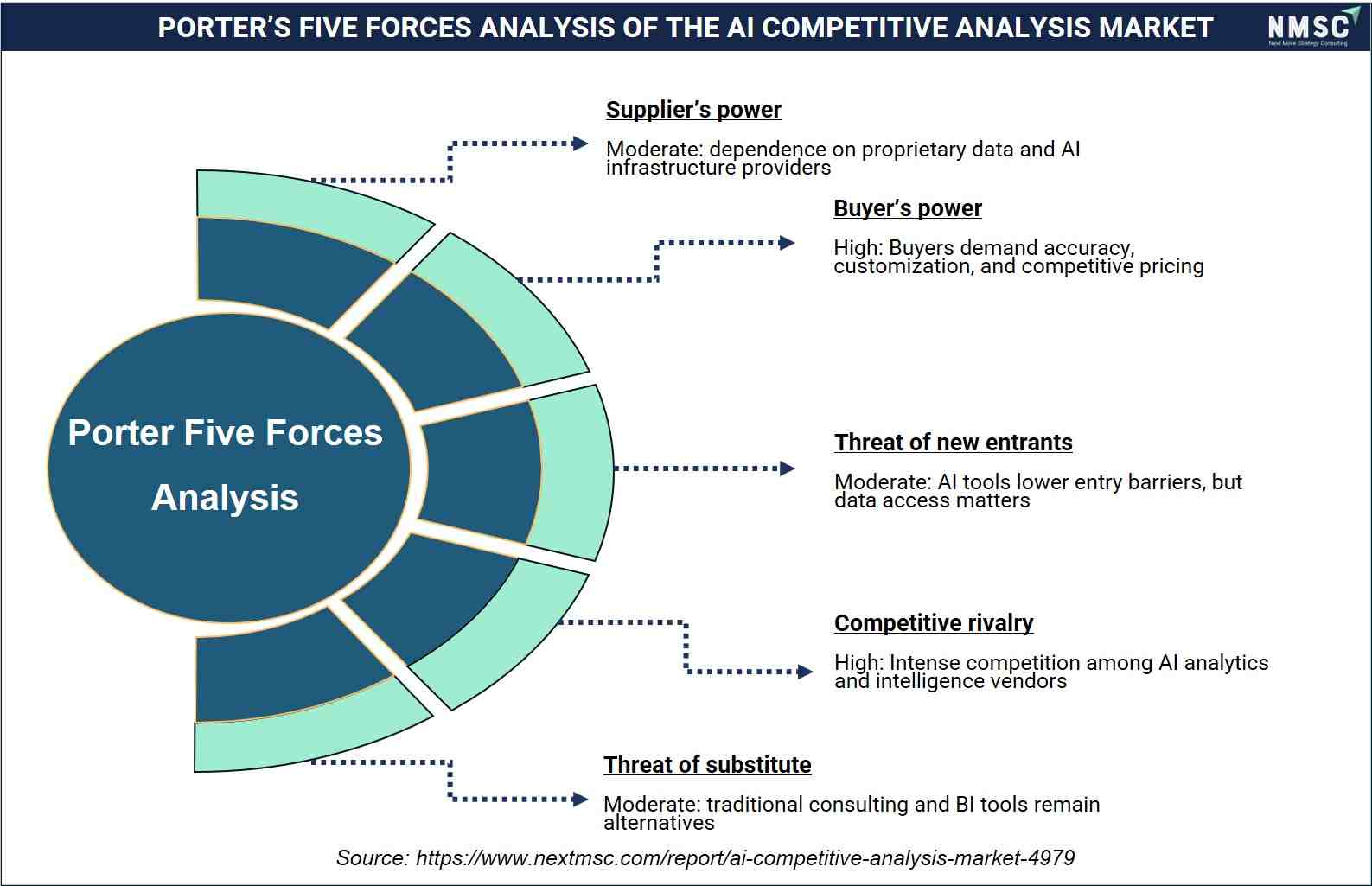
Based on our comprehensive assessment, we found that competitive rivalry is high due to the presence of analytics providers, AI vendors, and market intelligence platforms. Buyer bargaining power remains moderate as enterprises evaluate multiple solutions. Supplier power is moderate because of reliance on data providers and sovereign AI infrastructure. Threats from substitute research methods persist, while technological expertise creates moderate barriers for new entrants.
Competitive Landscape
Competitive Dynamics and M&A Landscape
|
Key Takeaways |
Details |
|
Market Structure |
Fragmented and multi-tier, with specialized point-solution vendors competing alongside broader market intelligence platforms. The market features a mix of AI-native startups and established SaaS companies expanding into competitive intelligence from adjacent digital marketing and media monitoring categories. |
|
Innovation Focus |
Generative AI integration for automated insight synthesis, conversational intelligence interfaces, agentic competitive monitoring, CRM-native battlecard automation, and multi-source real-time signal aggregation across digital, social, regulatory, financial, and talent intelligence domains. |
|
M&A Activity |
M&A is intensifying as platform vendors pursue capability consolidation, with AlphaSense acquiring Tegus in 2023 for expert network intelligence, Semrush expanding its platform through acquisitions of Traffic Think Tank and Kompyte, and ongoing consolidation across social listening, SEO intelligence, and sales competitive intelligence sub-segments. |
How Do Companies Compete in the AI Competitive Analysis Market?
Competition in the AI Competitive Analysis Market is characterized by platform breadth versus depth trade-offs, with leading vendors pursuing distinct positioning strategies. Market structure is fragmented across seven distinct product function categories, with different competitive leaders in each. Vendors such as Semrush and Similarweb compete on digital presence intelligence breadth, while Klue and Crayon differentiate through CRM-native sales battlecard integration. AlphaSense leads in corporate and financial intelligence depth through its AI-powered document analysis architecture. Competitive strategies increasingly revolve around AI model quality, data freshness, platform integration depth with CRM and workflow tools, and the ability to unify multiple intelligence domains within a single interface, reducing the total number of point-solution vendors an enterprise must maintain.
Which Kind of Companies Dominate the AI Competitive Analysis Market?
Our assessment indicates that the AI Competitive Analysis Market is currently dominated by three distinct company archetypes. AI-native competitive intelligence platforms—including AlphaSense, Klue, and Contify—lead through proprietary AI model differentiation, automated intelligence synthesis, and deep CRM integration. Established digital intelligence SaaS platforms—including Semrush, Similarweb, Meltwater, and Ahrefs—command significant market share through broad data coverage, large customer bases, and recognized brand authority. Specialized intelligence vendors—including Sensor Tower for app intelligence, Adthena for paid search intelligence, and Evaluate for pharmaceutical intelligence—maintain competitive positions through depth of coverage in specific intelligence domains. The most successful competitors combine proprietary AI differentiation with comprehensive data coverage and enterprise-grade integration capabilities.
AI-Native Differentiation and Open Standards Drive Market Success in the AI Competitive Analysis Market
Our findings suggest that AI-native differentiation is becoming the primary basis for competitive advantage in the AI Competitive Analysis Market, as vendors that build proprietary AI models for intelligence extraction, classification, and synthesis demonstrate superior insight quality relative to platforms that primarily aggregate third-party data without AI-driven analysis layers. Open API architectures and pre-built integrations with Salesforce, HubSpot, Slack, and Microsoft Teams are increasingly essential product requirements, as enterprise buyers demand intelligence delivery within existing workflow environments rather than standalone competitive intelligence dashboards. Vendors that successfully embed intelligence into the daily workflow of sales, marketing, and strategy teams achieve superior retention economics and platform expansion velocity.
Market Players to Opt for Merger and Acquisition Strategies to Expand Their Presence in the AI Competitive Analysis Market
Mergers and acquisitions represent a defining strategic pathway for AI Competitive Analysis Market participants seeking to accelerate capability expansion, geographic reach, and customer base scale. Based on NMSC's research, we found that the most active M&A themes include acquisitions of expert network platforms for primary research intelligence, content intelligence providers for audience analytics expansion, and CRM-native battlecard tools for sales intelligence integration. Platform vendors are also pursuing acqui-hires of AI research teams to accelerate proprietary model development. The convergence pressure across digital, social, corporate, and sales intelligence categories is compelling platform vendors to pursue inorganic growth to achieve broad intelligence coverage across all seven product function categories within the AI Competitive Analysis Market.
Who Are the Key Market Players in the AI Competitive Analysis Market?
-
AlphaSense, Inc.
-
Similarweb Ltd.
-
Meltwater, Inc.
-
Semrush Holdings, Inc.
-
Cision Ltd.
-
Hootsuite Inc.
-
Sensor Tower Inc.
-
Quid, Inc.
-
Klue Labs Inc.
-
Ahrefs Pte. Ltd.
-
Contify Analytics Private Limited
-
Onclusive, Inc.
-
Valona Intelligence Oy
-
Adthena Limited
-
Owler, Inc.
-
Fuld & Company, Inc.
-
Evaluate Ltd.
-
SE Ranking Limited
-
SpyFu Inc.
-
Rival IQ, Inc.
What Are the Latest Developments in the AI Competitive Analysis Industry?
|
Date |
Event |
|
June 2026 |
AlphaSense closed a USD 350 million funding round at a USD 7.5 billion valuation. The company has surpassed USD 600 million in Annual Recurring Revenue (ARR) and entered a strategic partnership with Accenture to integrate "Agentic Workflows" for market intelligence, enabling enterprise clients to automate complex research and strategy tasks. |
|
March 2026 |
Meltwater launched its Mid-Year 2026 Product Release, featuring "Mira Studio Agents." These AI-powered teammates automate report generation, media briefings, and dashboard creation. The update also includes "Journalist Relevance Matching," using AI to identify the best-fit media contacts based on recent coverage and sentiment |
Expert Insights
 “Industry is on the cusp of a tipping point where AI adoption is accelerating quickly. A year ago the focus was on experimentation, but now we're seeing organisations put AI into production and begin to realise real returns.”
— Maureen Costello, Vice President, Google Cloud (UK, Ireland and Sub-Saharan Africa)
Statement made while discussing the accelerating adoption of artificial intelligence across businesses and the transition from AI experimentation to enterprise-scale implementation.
Market Interpretation
The comment highlights a significant shift in the AI Competitive Analysis Market as organizations increasingly move beyond pilot projects and experimental deployments toward production-scale AI implementations. Businesses are leveraging AI-powered competitive analysis platforms to automate market monitoring, track competitor activities, analyze customer sentiment, identify emerging trends, and generate actionable intelligence from large volumes of structured and unstructured data. As enterprises begin realizing measurable returns from AI investments, demand for advanced competitive intelligence solutions is increasing across industries. This transition from experimentation to operational deployment is driving greater adoption of AI-enabled analytics, strategic decision-support tools, and real-time market intelligence platforms, supporting sustained market growth.
What Are the Investment Opportunities in the AI Competitive Analysis Market?
Capital Inflows and Private Equity Activity in the AI Competitive Analysis Market
The AI Competitive Analysis Market is attracting significant venture capital and private equity investment, driven by the recurring revenue characteristics of SaaS competitive intelligence platforms, large and expanding addressable markets, and the accelerating role of AI in enterprise decision-making workflows. Our analysis shows that leading AI competitive analysis vendors including Klue, AlphaSense, and Contify have raised successive growth rounds from institutional investors, reflecting strong confidence in the market's long-term trajectory. PE firms are increasingly targeting profitable SaaS competitive intelligence platforms for platform-building strategies, executing bolt-on acquisitions to assemble comprehensive competitive intelligence capability suites that command premium enterprise pricing and superior net revenue retention economics.
Infrastructure and Technology Investment Driving AI Competitive Analysis Market Value Creation
Infrastructure investment in AI model development, real-time data pipeline architecture, and enterprise integration platforms is defining the competitive moat for leading players in the AI Competitive Analysis Market. Our findings suggest that vendors investing in proprietary large language model fine-tuning on competitive intelligence corpora, automated multi-source data ingestion architectures, and real-time signal classification engines are establishing durable capability advantages over commodity data aggregation platforms. ESG considerations are also entering AI competitive analysis platform investment decisions, as institutional investors increasingly scrutinize the data ethics, privacy compliance architecture, and responsible AI governance practices of platform vendors prior to committing growth capital within the market.
Digital Transformation Investment Creating New Demand Vectors in the AI Competitive Analysis Market
Broad enterprise digital transformation programs are creating structural demand expansion across the AI Competitive Analysis Market by elevating competitive intelligence from an optional strategic service to an embedded operational necessity. Based on NMSC's research, we found that organizations undergoing digital transformation systematically encounter increased competitive intensity as markets become more transparent, price-sensitive, and rapidly evolving—driving investment in AI competitive monitoring capabilities that provide continuous situational awareness. The U.S. government's digital transformation agenda across federal civilian agencies, documented through the Office of Management and Budget's digital strategy reports, provides an analogous demand signal demonstrating the institutional recognition of competitive intelligence as a necessary component of modern strategic operations.
Key Benefits for Stakeholders
For Enterprise Strategy and Corporate Development Teams
Enterprise strategy and corporate development teams gain access to a comprehensive, data-rich analysis of the AI Competitive Analysis Market trend’s's competitive structure, growth trajectory, and strategic dynamics through 2035. Segmentation by product function, deployment model, enterprise size, end user function, revenue model, and industry vertical enables precise capability gap identification and investment prioritization. Regional and country-level market assessments across 33 countries provide geographic expansion intelligence, while the competitive landscape analysis identifies M&A targets, partnership opportunities, and market consolidation patterns. The forecast period analysis supports strategic planning horizons aligned with enterprise investment and transformation program timelines.
For Technology Vendors and Platform Providers
AI competitive analysis platform vendors and technology providers gain actionable market intelligence on white-space opportunities, underserved segments, and fastest-growing product function categories within the global AI Competitive Analysis Market. Product function segmentation analysis reveals which intelligence domains—including Pricing and Commercial Intelligence at a CAGR of 22.7% and Specialized Competitive Intelligence at 23.2%—represent the highest near-term expansion opportunities. Regional outlook sections identify geographic expansion priorities with market maturity, regulatory, and competitive intensity context. Revenue model analysis enables vendors to refine pricing strategies, optimize channel mix, and identify cross-sell opportunities across enterprise size and end user function segments.
For Investors and Financial Analysts
Investors and financial analysts access a structured assessment of the AI Competitive Analysis Market's growth dynamics, competitive positioning landscape, M&A pipeline, and segment-level revenue forecasts through 2035. The CAGR analysis by segment, region, and industry vertical enables precise portfolio construction and sector allocation modeling. Company profiles covering all 20 key players, combined with recent development tracking, provide an early-signal framework for identifying acquisition targets, market leaders, and at-risk incumbents. The market size progression from USD 5.0 billion in 2026 to USD 24.6 billion by 2035 at a CAGR of 19.3% confirms the AI Competitive Analysis Market as a high-conviction growth investment theme within enterprise AI software.
For Government and Regulatory Bodies
Government agencies and regulatory bodies gain a structured analysis of how AI regulatory frameworks, data privacy mandates, and web scraping governance policies are influencing the AI Competitive Analysis Market's development and competitive dynamics. Country-level insights provide policymakers with evidence-based perspectives on how regulatory design choices affect enterprise AI platform adoption rates, competitive intelligence industry development, and the competitive positioning of domestically headquartered AI intelligence vendors relative to international competitors. The market's compliance architecture analysis offers direct relevance to national AI governance strategy development and digital economy policy formulation.
AI Competitive Analysis Market Key Market Segments
By Product Function
-
Digital Presence Intelligence
-
Website Traffic Intelligence
-
App Performance Intelligence
-
Audience Intelligence
-
SEO Intelligence
-
Keyword Intelligence
-
Backlink Intelligence
-
SERP Intelligence
-
-
Paid Media Intelligence
-
Search Advertising Intelligence
-
Display Advertising Intelligence
-
Shopping Advertising Intelligence
-
-
Content Intelligence
-
Content Gap Analysis
-
Content Performance Benchmarking
-
-
-
Social and Brand Intelligence
-
Social Listening
-
Share of Voice Intelligence
-
Sentiment Intelligence
-
Influencer Intelligence
-
Brand Reputation Intelligence
-
Engagement Benchmarking
-
-
Market and Corporate Intelligence
-
Company Intelligence
-
Company Monitoring
-
Executive Intelligence
-
Partnership Intelligence
-
Merger and Acquisition Intelligence
-
-
Market Intelligence
-
Industry Intelligence
-
Competitive Benchmarking Intelligence
-
Market Trend Intelligence
-
-
Financial Intelligence
-
Financial Benchmarking Intelligence
-
Earnings Call Intelligence
-
-
Regulatory and Intellectual Property Intelligence
-
Regulatory Intelligence
-
Patent Intelligence
-
Intellectual Property Intelligence
-
-
-
Product Intelligence
-
Product Feature Intelligence
-
Product Launch Intelligence
-
Product Roadmap Intelligence
-
Technology Stack Intelligence
-
User Review Intelligence
-
Customer Feedback Intelligence
-
-
Sales Competitive Intelligence
-
Battlecard Management
-
Competitor Comparison Intelligence
-
Win Loss Intelligence
-
Deal Intelligence
-
CRM Integrated Competitive Intelligence
-
Sales Enablement Intelligence
-
-
Pricing and Commercial Intelligence
-
Price Monitoring
-
Promotion Monitoring
-
Discount Monitoring
-
Marketplace Intelligence
-
MAP Compliance Intelligence
-
-
Specialized Competitive Intelligence
-
Talent Intelligence
-
Supply Chain Intelligence
-
Channel Intelligence
-
Litigation Intelligence
-
Other Specialized Intelligence
-
By Deployment Model
-
Cloud
-
Public Cloud
-
Private Cloud
-
-
Hybrid
-
On Premises
By Enterprise Size
-
Large Enterprises
-
Medium Enterprises
-
Small Enterprises
By End User Function
-
Marketing
-
Sales
-
Product Management
-
Strategy and Corporate Development
-
Executive Leadership
-
Investor Relations and Finance
-
Procurement and Sourcing
-
Other Functions
By Revenue Model
-
Subscription Revenue
-
Professional Services Revenue
-
Implementation Services
-
Integration Services
-
Training Services
-
Managed Intelligence Services
-
Consulting Services
-
By Industry Vertical
-
Technology
-
Retail and E Commerce
-
Financial Services
-
Healthcare and Life Sciences
-
Manufacturing
-
Telecommunications
-
Media and Entertainment
-
Consumer Goods
-
Energy and Utilities
-
Government and Public Sector
-
Professional Services
-
Other Industries
By Region
-
North America: U.S., Canada, and Mexico.
-
Europe: UK, Germany, France, Italy, Spain, Sweden, Denmark, Finland, the Netherlands, and the rest of Europe.
-
Asia Pacific: China, India, Japan, South Korea, Taiwan, Indonesia, Vietnam, Australia, Philippines, Malaysia and the rest of APAC.
-
Middle East & Africa (MEA): Saudi Arabia, UAE, Egypt, Israel, Turkey, Nigeria, South Africa, and the rest of MEA.
-
Latin America: Brazil, Argentina, Chile, Colombia, and the rest of LATAM.
Conclusion and Recommendations
Long-Term Outlook
The AI Competitive Analysis Market is positioned for sustained high-growth over the 2025–2035 forecast period, underpinned by irreversible structural trends including AI adoption in enterprise strategy functions, intensifying digital competition across global markets, and the organizational shift toward data-driven competitive decision-making. The market is forecast to advance from USD 5.0 billion in 2026 to USD 24.6 billion by 2035 at a CAGR of 19.3%, reflecting both market expansion across new geographies and end user functions and deepening platform penetration within established enterprise competitive intelligence programs. Our analysis indicates that organizations treating competitive intelligence as a continuous AI-mediated capability will establish decisive strategic advantages over competitors relying on periodic manual research cycles.
Strategic Positioning Recommendations
Platform vendors should prioritize AI-native differentiation through proprietary intelligence models, agentic monitoring architectures, and deep CRM workflow integration. Vendors that consolidate multiple intelligence domains—digital presence, social, corporate, product, sales, pricing, and specialized intelligence—within a unified AI-powered platform will capture premium enterprise pricing and superior retention economics relative to point-solution competitors. Geographic expansion into Asia-Pacific, particularly India and Southeast Asia, represents the highest-priority growth opportunity for AI competitive analysis platform vendors seeking international revenue diversification. Healthcare and life sciences vertical development, leveraging patent intelligence, regulatory monitoring, and clinical pipeline tracking capabilities, represents the highest-value untapped vertical expansion pathway within the forecast period.
Investment Attractiveness
The AI Competitive Analysis Market represents a highly attractive investment environment characterized by recurring SaaS subscription revenue models, expanding addressable markets across all geographies and verticals, strong secular AI adoption tailwinds, and platform economics that reward scale with improving margins. Our assessment identifies the highest-conviction investment themes as Pricing and Commercial Intelligence at 22.7% CAGR, Specialized Competitive Intelligence at 23.2% CAGR, Product Management end user function at 20.5% CAGR, Asia-Pacific regional growth at 20.2% CAGR, and Healthcare and Life Sciences vertical expansion at 20.7% CAGR. PE-led platform-building strategies consolidating fragmented point-solution vendors represent a particularly compelling value creation opportunity given the structural convergence pressure driving enterprise preference for unified AI competitive intelligence platforms.
Market Shifts and Key Risks
The most significant market shift underway is the consolidation from multi-vendor point-solution competitive intelligence portfolios to unified AI competitive intelligence platforms. This shift benefits vendors with the broadest intelligence domain coverage and deepest CRM integration, at the expense of single-category point solutions. Key risks for the AI Competitive Analysis Market include intensifying data privacy regulatory enforcement constraining competitive data collection methods, AI-generated intelligence quality and hallucination concerns undermining user trust in automated competitive summaries, platform vendor concentration risk as market consolidation reduces competitive options for enterprise buyers, and competitive pressure from hyperscaler-embedded intelligence capabilities reducing the total addressable market for standalone AI competitive analysis platforms.
Growth Pathways
Organizations seeking to maximize value from the AI Competitive Analysis Market should implement a three-horizon strategy. In the near term (2025–2027), prioritize deployment of AI-native competitive intelligence platforms with CRM integration and establish continuous monitoring workflows across digital presence, social brand, and competitive pricing intelligence domains. In the mid-term (2027–2031), invest in agentic AI competitive monitoring architectures, expand intelligence coverage into product, talent, and supply chain competitive intelligence, and develop proprietary win-loss intelligence programs that systematically feed competitive analysis insights back into product development and sales training cycles. In the long term (2031–2035), position for unified multi-domain competitive intelligence environments where AI agents continuously synthesize real-time intelligence across all competitive dimensions with minimal human intervention.
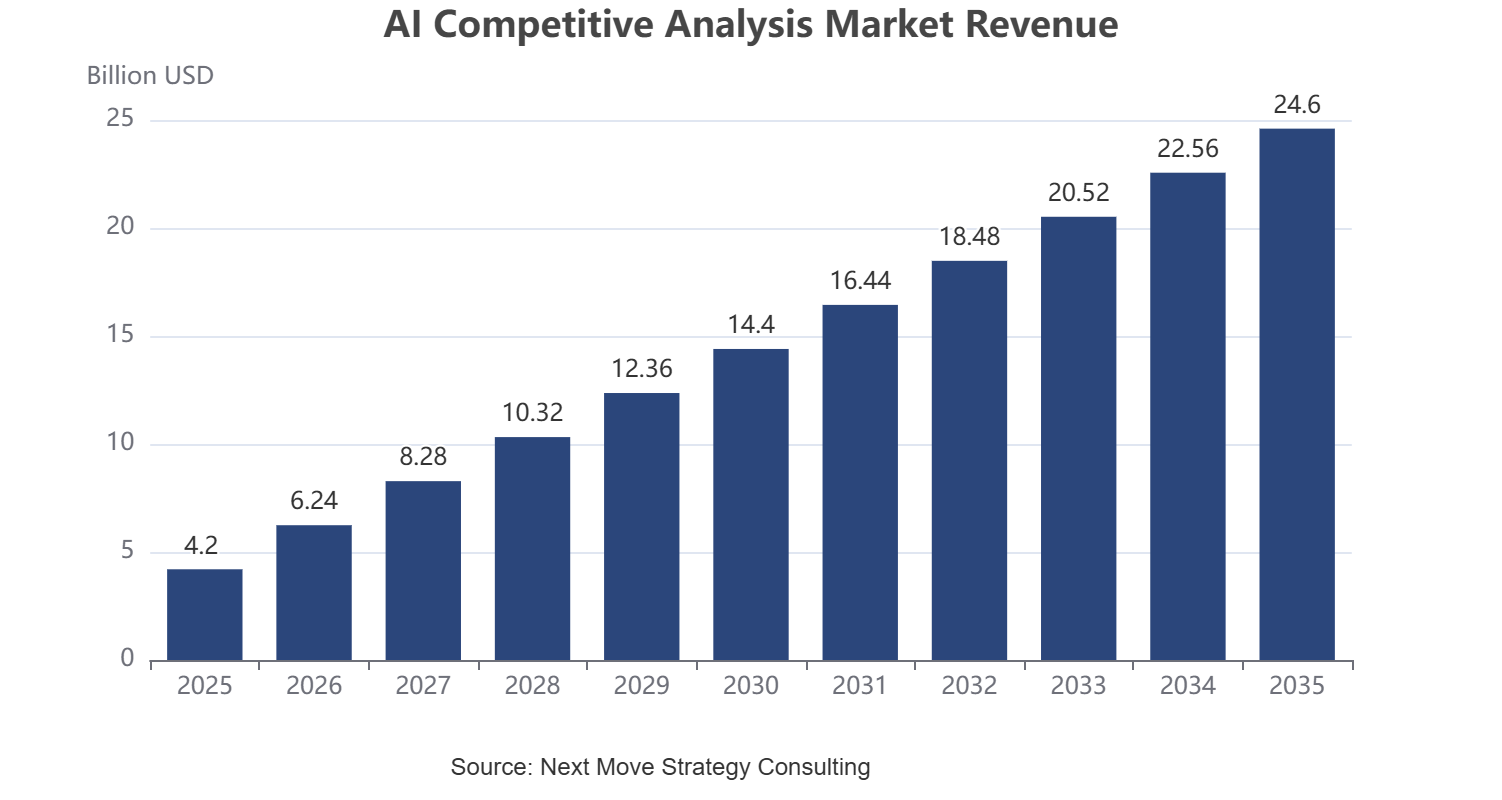
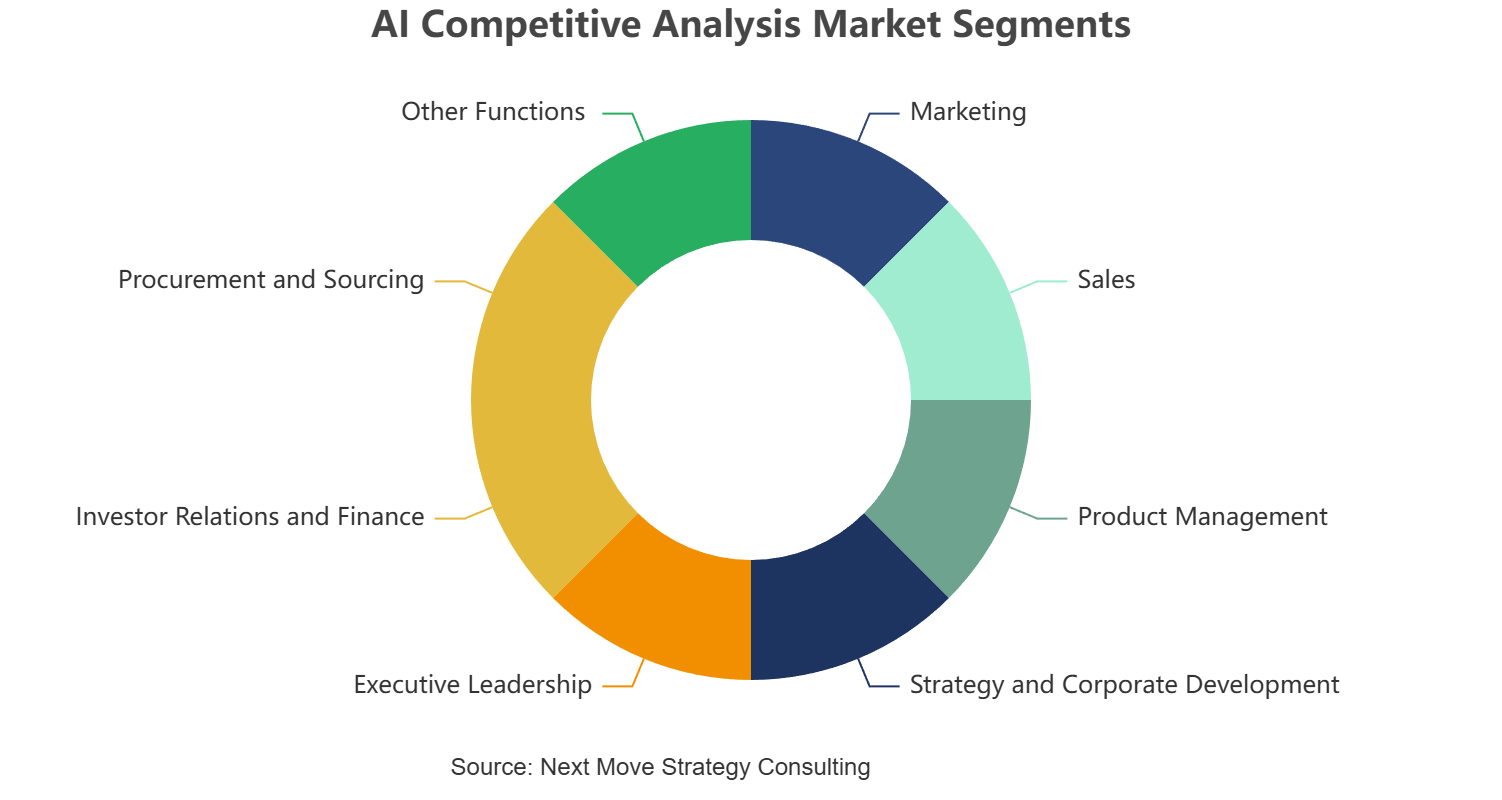
About the Author
 Saista Faiyaz
— Saista Faiyaz is Research Associate at Next Move Strategy Consulting, where she has covered consumer markets and healthcare technologies for 3 years. Her work includes primary interview review, secondary-source validation, market sizing, and structured analysis of company and industry data. She supports research by comparing evidence across sources, organizing findings into market narratives, and documenting assumptions used in analysis. Her scope includes cross-market benchmarking, and reports.
Saista Faiyaz
— Saista Faiyaz is Research Associate at Next Move Strategy Consulting, where she has covered consumer markets and healthcare technologies for 3 years. Her work includes primary interview review, secondary-source validation, market sizing, and structured analysis of company and industry data. She supports research by comparing evidence across sources, organizing findings into market narratives, and documenting assumptions used in analysis. Her scope includes cross-market benchmarking, and reports.
About the Reviewer
 Supradip Baul
— Supradip Baul is an accomplished business consultant and strategist with over a decade of rich experience in market intelligence, strategy, technology, and business transformation. His work has included rigorous qualitative and quantitative analysis across multiple industries, helping clients shape investment decisions and long-term roadmaps. Earlier in his career, he was associated with Gartner, where he contributed to industry-leading reports and market share analyses. He has worked with leading global companies and holds an MBA with a dual specialization in Marketing and Finance.
Supradip Baul
— Supradip Baul is an accomplished business consultant and strategist with over a decade of rich experience in market intelligence, strategy, technology, and business transformation. His work has included rigorous qualitative and quantitative analysis across multiple industries, helping clients shape investment decisions and long-term roadmaps. Earlier in his career, he was associated with Gartner, where he contributed to industry-leading reports and market share analyses. He has worked with leading global companies and holds an MBA with a dual specialization in Marketing and Finance.
At Next Move Strategy Consulting, we understand that insightful market research is the cornerstone of successful business decisions. That's why we employ a robust and multifaceted approach, combining various methodologies to deliver the most accurate and actionable data for our clients.

Research Landscape
We navigate the world of research with two primary approaches:
Qualitative Approach
Our qualitative research methodologies involve immersive techniques such as in-depth interviews, focus groups, and observational studies. By engaging directly with individuals and stakeholders, we uncover valuable insights that quantitative data alone may overlook.

Quantitative Research
In tandem with qualitative methodologies, NMSC leverages the power of Quantitative Research to provide a robust foundation of numerical insights. Through systematic data collection and analysis, we quantify patterns, preferences, and market trends, offering a comprehensive view of the business landscape.
Our quantitative research approach employs diverse tools, including surveys, experiments, and statistical modelling. These methodologies enable us to gather data from a large and representative sample, ensuring the statistical significance of our findings. By employing structured questionnaires and standardized data collection methods, we guarantee the reliability and validity of the information we present to our clients.
Quantitative research is particularly effective in measuring the prevalence of trends, assessing market size, and gauging the impact of various factors on consumer behavior. The numerical precision attained through this approach equips our clients with actionable insights, facilitating data-driven decision-making and strategy formulation.


Our Specialized Toolbox for Industry-Specific Market Research
We deploy a specialized arsenal of techniques tailored to meet your unique requirements. Here's a glimpse into our comprehensive toolbox:

Information Procurement
The stage entails acquiring market data or relevant information through various sources and methodologies.


Market Research Approach
We utilize both top-down and bottom-up approaches in market research analysis to achieve a comprehensive understanding of the market dynamics, leveraging the broad perspective of industry trends and macroeconomic factors alongside detailed insights from specific segments and individual companies.

Porters Five Forces Analysis
We conduct Porter's Five Forces analysis to evaluate the competitive landscape of an industry, providing us with insights into factors that affect profitability and strategic positioning.

SWOT Analysis

Forecasting
We utilize a forecasting model to predict future consumption by considering parameters like population, economics, regulations, market competition, drivers, constraints, technology, and pricing. We also employ statistical techniques such as multilinear regression, exponential smoothing, moving average, ARIMA, and Monte Carlo simulations for accurate predictions. In econometric forecasting, we analyzed short-term and long-term event impacts, attributing values based on regulatory frameworks, economic factors, and market events.





 Speak to Our Analyst